
Business
Which K-pop Boy Group Will Dominate In 2026?


SEOUL, South Korea — BTS launched its long-awaited “ARIRANG” world tour April 9 in Goyang with explosive energy, remixing hits like “FYA” and “Burning Up (Fire)” before a roaring hometown crowd, signaling the septet’s determination to reclaim the global K-pop crown after completing mandatory military service. Just months after their March 20 album release, the group is mounting what promoters call the largest K-pop tour in history, with more than 80 dates planned across Asia, North America, Europe and beyond through 2027.

The timing sets up one of the most anticipated showdowns in K-pop history: BTS, the genre’s undisputed global ambassadors, versus Stray Kids, the self-producing 4th-generation powerhouse that dominated album sales, tours and Billboard charts during BTS’ hiatus. As both groups operate at full throttle in 2026, industry watchers are asking whether Stray Kids’ raw momentum can withstand BTS’ unmatched legacy and fan army.
BTS’ comeback album “Arirang,” released March 20, blended nostalgic hip-hop roots with fresh pop sensibilities, quickly topping charts and sparking celebrations worldwide. Lead single “SWIM” surged to No. 1 on the Billboard Hot 100 and U.K. charts, proving the group’s cultural clout remains intact despite nearly four years of limited group activity while members fulfilled South Korea’s compulsory military duty. All seven — RM, Jin, Suga, J-Hope, Jimin, V and Jungkook — reunited fully by mid-2025, with solo successes during the break only amplifying anticipation.
The “ARIRANG” tour opener featured high-octane performances and emotional moments, with Jungkook, V and Jimin taking prominent roles in the setlist. Tickets for the multi-city run sold out rapidly, underscoring ARMY’s enduring loyalty. Promoters project the tour could eclipse previous K-pop records in both attendance and revenue, capitalizing on pent-up demand from the hiatus era.
Meanwhile, Stray Kids has spent 2025 and early 2026 in overdrive. The JYP Entertainment act shattered records with its “dominATE” world tour, grossing nearly $186 million from 1.3 million tickets sold across reported shows in 2025 alone — setting regional benchmarks in Latin America, North America and Europe. The group became the first K-pop act to debut eight consecutive albums at No. 1 on the Billboard 200 and claimed the No. 2 spot on IFPI’s 2025 Global Artist Chart, behind only Taylor Swift in some metrics.

Stray Kids’ 2025 album “Karma” dominated U.S. album and CD sales among K-pop releases, with the group sweeping multiple top spots on domestic charts. Their self-produced sound — blending aggressive rap, intricate choreography and genre-bending experimentation — resonated deeply with a younger, highly engaged global fanbase known as STAY. In February 2026 brand reputation rankings, Stray Kids held strong at No. 2 behind BTS, reflecting sustained visibility even as the senior group prepared its return.
Metrics Tell a Tale of Two Eras
Legacy versus momentum defines the 2026 narrative. BTS boasts over 140 million career-equivalent units and more than 500 global awards, including a record number of daesangs (grand prizes) in Korea. The group’s Spotify metrics remain superior, with significantly higher monthly listeners and longer chart dominance. Their influence helped transform K-pop from a niche phenomenon into a worldwide industry force, opening doors for acts like Stray Kids.
Stray Kids counters with superior recent sales velocity. The eight-time Billboard 200 toppers outsold many veterans in physical albums during BTS’ absence, with “Karma” ranking high on IFPI global album charts. Their tour earnings and attendance figures for 2025 marked the highest for any K-pop boy group that year, proving stadium-filling power without the same decades-long buildup. Stray Kids also pioneered self-production, with members Bang Chan, Changbin and Han deeply involved in songwriting and composition — a creative edge that appeals to fans seeking authenticity.
In South Korea, however, BTS retains a massive edge in brand reputation and domestic cultural impact. February and March 2026 rankings placed BTS far ahead, with indices nearly triple those of Stray Kids at times. The group’s national pride symbolism, amplified by military service, gives them an unassailable position at home that younger acts struggle to match.
Globally, the picture is more competitive. Stray Kids excelled in Western markets during the hiatus, breaking attendance records in the Americas and Europe. Yet BTS’ return has already shifted streaming and media conversations. Analysts note that while Stray Kids leads in current active metrics like consistent album cycles and tour scale, BTS’ catalog streaming and overall brand equity provide a deeper reservoir of influence.
Fanbase Dynamics and Industry Shifts
ARMY and STAY represent two distinct but overlapping fandoms. ARMY’s size and organizational power remain legendary, driving record-breaking sales and social campaigns. STAY prides itself on a more hands-on connection, fueled by Stray Kids’ frequent content and member-driven creativity.
The 2026 overlap has sparked lively online debates and some tension. When Stray Kids announced new album and tour plans for 2026, a vocal segment of fans accused the timing of overlapping with BTS’ comeback, though others defended the group’s right to maintain momentum. Stray Kids proceeded with its sixth fanmeeting series “STAY in Our Little House” in April, alongside fashion commitments and preparations for further releases, including potential Japanese projects.
K-pop as a whole has evolved since BTS’ last full-group era. The industry now features deeper competition from 4th- and 5th-generation acts, with diversified revenue streams including solo ventures, acting and global brand endorsements. BTS members themselves thrived individually — Jungkook and Jimin scoring major solo hits — which some observers say strengthened rather than diluted the group’s brand.
Stray Kids’ self-sufficiency positions it well for long-term sustainability. Unlike many idol groups reliant on external producers, the eight members (Bang Chan, Lee Know, Changbin, Hyunjin, Han, Felix, Seungmin and I.N.) control much of their artistic direction, potentially insulating them from industry volatility.
What 2026 Will Reveal
The coming months offer a natural laboratory. BTS’ massive tour will test whether post-hiatus demand matches or exceeds past peaks, while Stray Kids’ continued activity — including rumored new material and festival appearances — will measure its ability to hold or grow market share against the returning giants.
Industry executives suggest coexistence is more likely than outright replacement. BTS’ global platform elevates the entire genre, creating spillover benefits for acts like Stray Kids. At the same time, Stray Kids’ youth and output frequency allow it to capture younger demographics and maintain weekly visibility that a touring-heavy BTS schedule might not match between dates.
Pollstar and Billboard projections already rank both groups among the top global touring acts for 2026. Combined, their activities could push K-pop concert revenues to new heights, benefiting venues, promoters and the broader ecosystem.
Cultural observers note BTS’ role in Korean soft power remains peerless, while Stray Kids exemplifies the genre’s creative maturation. Neither is likely to “dominate” in every metric; instead, 2026 may mark a new chapter of parallel supremacy — BTS as the timeless icon, Stray Kids as the tireless innovator.
For fans, the real winner is abundance. With both groups delivering high-caliber music, visuals and performances, K-pop enthusiasts face a embarrassment of riches. Whether streaming “Arirang” tracks or cheering dominATE-era anthems, global audiences can expect an unforgettable year of boy group excellence.
As BTS takes the stage in city after city and Stray Kids pushes creative boundaries from the studio to the fanmeet hall, the competition elevates everyone. In 2026, the K-pop throne isn’t a zero-sum game — it’s big enough for legends to return and rising stars to shine.



My name is Andres Veurink and I have been in the financial markets for over a decade at this point, spending the majority of that in a hedge fund here in Rotterdam, working my way up as an analyst. My work relfect rigourious standards as I myself have a very high standard as to what I invest my money in. My preferred sectors to follow are tech, specifically SaaS and cloud business but recently I’ve also taken up an interest in writing about the energy and minerals sectors, two areas I’m quite familiar with having followed them for over a decade at this point. I find these offer incredible growth opportunities and are also very fun to research and follow. It’s a very active space with plenty of news coming out each week. Work is my own thoughs and research is done only by myself.
Analyst’s Disclosure: I/we have a beneficial long position in the shares of CSTM either through stock ownership, options, or other derivatives. I wrote this article myself, and it expresses my own opinions. I am not receiving compensation for it (other than from Seeking Alpha). I have no business relationship with any company whose stock is mentioned in this article.
Seeking Alpha’s Disclosure: Past performance is no guarantee of future results. No recommendation or advice is being given as to whether any investment is suitable for a particular investor. Any views or opinions expressed above may not reflect those of Seeking Alpha as a whole. Seeking Alpha is not a licensed securities dealer, broker or US investment adviser or investment bank. Our analysts are third party authors that include both professional investors and individual investors who may not be licensed or certified by any institute or regulatory body.

Rep. Pat Fallon, R-Texas, praises War Secretary Hegseth and Chairman of the Joint Chiefs of Staff General Dan Caine for their performances in Congress on ‘The Evening Edit.’
Americans shopping for smartphones, laptops or even home appliances may soon start feeling the effects of the Iran conflict – not just at the gas pump, but at the checkout screen.
A disruption to an essential component in electronics – printed circuit boards (PCBs) – is driving up costs across the tech industry, increasing the likelihood that consumers will face higher prices and fewer deals in the months ahead.
Prices for circuit boards have already surged, jumping as much as 40% in April alone, according to Goldman Sachs. At the same time, other key inputs like copper foil – one of the largest cost components in PCBs – have climbed as much as 30% this year.
The ongoing war with Iran has disrupted supplies of key raw materials used to produce PCBs, which function as the “nervous system” inside nearly every electronic device, from smartphones and computers to cars and AI servers.
GAS PRICES SOAR TO HIGHEST POINT SO FAR DURING UNSETTLED CONFLICT WITH IRAN

An engineer tests the quality of chips for the electronic control unit (ECU) steering controller at a workshop on March 5, 2026. (Lyu Bin/VCG via Getty Images)
At the center of the disruption is an Iranian strike on Saudi Arabia’s Jubail petrochemical complex in early April, which halted production of a critical resin used in circuit boards and tightened global supply, according to analysts. Shipping routes in and out of the Gulf have also been disrupted, compounding delays and shortages.
CHEVRON CEO WARNS AVIATION STRAIN COULD WORSEN AS JET FUEL CRUNCH DEEPENS
Manufacturers are now scrambling to secure materials, with lead times for some chemicals stretching from just three weeks to as long as 15 weeks, according to industry sources. The pressure is cascading through the broader tech supply chain.
“It is not just PCBs,” said Ben Bajarin, CEO of Creative Strategies. “Memory, storage and wafer costs are all increasing the bill of materials for devices.”

Buildings left in ruins from Israeli/U.S. airstrikes on April 4, 2026, in southern Tehran, Iran. (Majid Saeedi/Getty Images)
Companies are trying to offset those increases by negotiating supply contracts and absorbing some of the costs – but only to a point.
Experts say shoppers won’t see price hikes immediately, but they are coming.
“For the average consumer shopping at Best Buy or Amazon, the pass-through won’t happen overnight,” said Galen Zeng, a semiconductor supply chain analyst at IDC. “But expect it to materialize within the next few months.”

Prices for circuit boards have already surged, jumping as much as 40% in April alone, according to Goldman Sachs. (iStock)
Dan Ives, an analyst at Wedbush Securities, said the impact will likely become more visible later this year.
“There will be a lag and much of these costs will be absorbed in the supply chain,” Ives said. “Summer and Fall timeframe could see prices rise.”
That timing could coincide with key retail periods, including back-to-school shopping and the early holiday buying season, when demand for electronics typically accelerates.
TREASURY FREEZES $344M IN IRAN CRYPTO, WARNS OIL HUB NEARING CAPACITY
Data from the Institute for Supply Management suggests companies typically pass through at least part of cost increases to customers, even if they absorb some of the impact through margins, according to ISM Manufacturing PMI Chair Susan Spence.
While some analysts believe companies will absorb costs in the short term, others warn the price increases could stick.
“This is a structural, multi-year upcycle driven by AI demand – not a temporary spike,” Zeng said. “The cost floor for advanced electronics is shifting upward.”

AMD AI chip showcased at an exhibition in Hangzhou, Zhejiang Province, China. (CFOTO/Future Publishing via Getty Images)
Demand for AI infrastructure is already competing with consumer electronics for limited supply of key components, squeezing availability and driving up prices across the board. Even before the Middle East conflict, PCB demand had been rising rapidly due to AI server growth, further tightening supply.
Beyond higher prices, consumers may also face limited availability of certain devices.
“As supplies are redirected toward AI and high-performance computing, consumer electronics manufacturers are left competing for a shrinking pool,” Zeng said.
The result could be delays or “out of stock” issues for some products, especially if supply disruptions persist.
Ives said shortages are not guaranteed but remain a risk.
“If it stays at the current rate, we can see shortages into the Fall on certain products,” he said.
Historically, supply chain shocks don’t translate one-to-one into retail price increases, but they rarely disappear entirely.
CLICK HERE TO GET FOX BUSINESS ON THE GO
That suggests consumers are unlikely to escape the impact altogether.
The disruption may start deep in the global supply chain, but its effects are likely to show up in familiar places: higher price tags, fewer discounts and tighter inventory for everyday tech products.
And with demand for electronics continuing to surge, relief may not come quickly.
Reuters contributed to this report.


Swimming-American Walsh improves own 100m butterfly world record for third time in a year

CINCINNATI — Runners “flew” through the streets of Greater Cincinnati over the weekend as the 28th Flying Pig Marathon Weekend wrapped up on May 3, 2026, blending competitive racing, quirky pig-themed festivities and community spirit in one of the nation’s most beloved running events. Thousands of participants from all 50 states and dozens of countries tackled distances from the full 26.2-mile marathon to shorter races and kids’ events, celebrating the region’s vibrant running culture.
The flagship Flying Pig Marathon, presented by P&G and others, started at 6:30 a.m. Sunday from Rosa Parks Street at Freedom Way. The course wound through Cincinnati, Covington, Newport, Mariemont, Fairfax and Columbia Township, offering scenic views of the Ohio River, historic neighborhoods and urban energy. Despite some construction-related adjustments, including changes around the Fourth Street Bridge and Brent Spence Corridor, runners enjoyed a well-balanced route with rolling hills and enthusiastic crowd support.
Here are 10 fun facts about the 28th Flying Pig Marathon that capture the event’s unique spirit:
- Pig-tastic theming everywhere. From “pig pen” start corrals to the “Finish Swine,” the event embraces porcine puns with medals, shirts and even spectator cheers featuring oinks and pig calls. The mascot and branding make it one of the most memorable themed races in America.
- Massive participation. Approximately 45,000 runners and walkers took part across all weekend events, including the marathon, half marathon, 10K, 5K, Flying Piglet kids’ race and more. The weekend is billed as the largest party in town.
- Streakers keep the streak alive. Sixty-four dedicated runners completed their 28th consecutive Flying Pig Marathon, earning special recognition for their loyalty to the event since its inception.
- Scenic and challenging course. The route offers beautiful views but includes notable hills, testing runners’ endurance. Adjustments this year due to infrastructure projects still preserved the event’s signature charm and spectator-friendly layout.
- Strong elite performances. Top finishers posted competitive times, with the course rewarding well-prepared athletes. The event attracts both local talent and out-of-town speedsters drawn to the Pig’s reputation.
- Community and charity focus. The Flying Pig supports local causes through fundraising and partnerships. This year’s edition highlighted efforts toward a new headquarters and community hub promoting movement across the region.
- Family-friendly weekend. Beyond the main races, events like the 26th Mile for incremental marathon completers, Flying Fur pet-friendly run and kids’ activities ensure the whole family can participate. The Victory Party at Smale Park offered post-race festivities for all.
- Economic boost for Cincinnati. The weekend draws tens of thousands of visitors, filling hotels, restaurants and attractions. It’s a major tourism driver, showcasing the city’s hospitality and vibrant downtown.
- Awards and recognition. The event earned high marks in USA Today’s 10Best poll, ranking among the nation’s top marathons. Finishers receive high-quality medals and swag, with age-group awards adding competitive fun.
- Weather-perfect conditions. Mild spring temperatures in the mid-50s to low 60s created ideal racing conditions, contributing to strong performances and happy participants across distances.
The Flying Pig Marathon began in 1999 and has grown into a premier destination race known for its inclusivity, scenic beauty and lighthearted atmosphere. Organizers pride themselves on creating an event that feels like a giant block party for runners. This year’s edition maintained that tradition while incorporating course tweaks to accommodate ongoing city infrastructure work.
Race director and staff worked tirelessly to ensure safety and enjoyment. Road closures were clearly communicated, with spectator viewing parties at spots like the Moerlein Lager House adding to the festive vibe. Medical support, aid stations and volunteer crews received praise for their professionalism.
For elite and recreational runners alike, the Pig offers a bucket-list experience. The course’s mix of urban and suburban sections, river views and enthusiastic crowds creates lasting memories. Many participants return year after year, drawn by the camaraderie and celebration of running.
Post-race, finishers enjoyed refreshments and the Victory Party, sharing stories of personal triumphs and challenges. Whether first-timers or veterans, runners left with finisher medals, certificates and a sense of accomplishment. The event’s “When Pigs Fly, Anything’s Possible” motto perfectly encapsulates its inspirational spirit.
Looking ahead, organizers are already planning improvements and fundraising for a new headquarters that will serve as a community hub for running and fitness in the region. The 29th Flying Pig Marathon Weekend is expected to build on this year’s success, continuing to put Cincinnati on the map as a running destination.
The 28th edition reinforced why the Flying Pig remains a favorite. Its blend of competition, fun and community creates an unforgettable weekend for thousands. As participants recover and share photos, the memories — and perhaps a few pig puns — will linger until next year’s race.

Real estate moguls Dolly and Jenny Lenz discuss the broadening-out of the market and New York City’s proposed pied-à-terre tax on ‘The Claman Countdown.’
A major blue city saw its population shrink last year after two years of strong growth.
New York City’s population declined in 2025, resulting in a net loss of about 12,000 people. The drop follows post-pandemic gains of 70,000 in 2023 and 163,000 in 2024, driven largely by increased immigration, including asylum seekers, according to an April 20 report from the Citizens Budget Commission.
“Population growth in 2023 and 2024 was driven by the upswing in international in-migration, primarily a surge of migrants and asylum seekers,” the report noted. “In 2025, the trend once again reversed as tighter immigration policy reduced international in-migration by 70 percent and domestic out-migration ticked up.”
HOUSING CRISIS HITS ALL AGES AS HOMEOWNERSHIP DECLINES NATIONWIDE
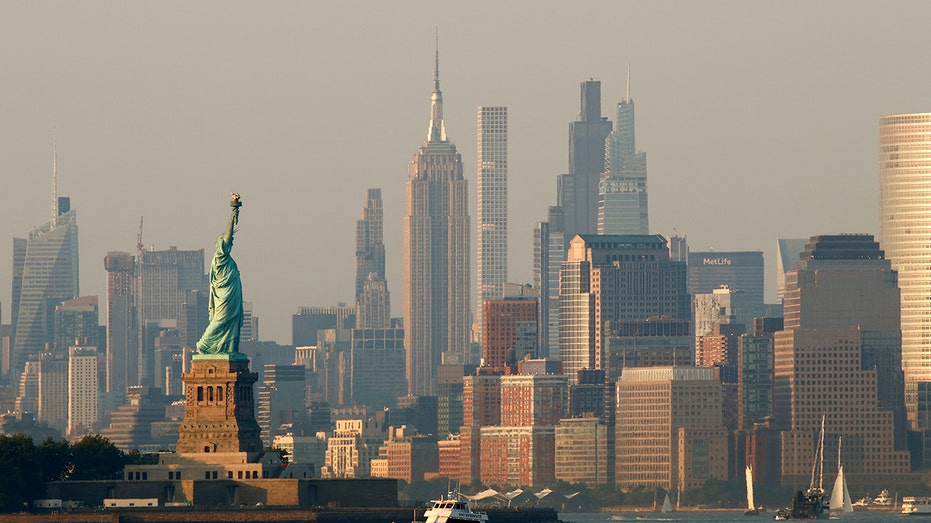
The sun sets on the Statue of Liberty and the Empire State Building in New York City on July 28, 2025, as seen from Bayonne, New Jersey. (Gary Hershorn/Getty Images)
In total, the Big Apple lost a net 114,000 residents to other parts of the U.S., up from 94,000 the year before but still well below the pandemic-era peak net outflow of 330,000 in 2021.
Most departing New Yorkers stayed close to home, relocating to Long Island, Westchester, and nearby states such as New Jersey, Connecticut, and Pennsylvania, the report noted.
“The city has long been a magnet for talent and opportunity, but recent out- and in-migration changes – driven by the pandemic, immigration policy, affordability and taxes, and quality of life issues – reveal a future that may not replicate past growth,” as noted in the report.
Housing remains a major factor in whether residents choose to move to, stay in, or leave New York City. Public services also play a role, the report noted.
TAX FIGHT HEATS UP AS NEW YORK TARGETS WEALTHY HOMEOWNERS

Apartments for rent in the West Village neighborhood of New York. (Alex Kent/Bloomberg via Getty Images)
Median asking rent climbed nearly 7% in 2025 to $3,585, Realtor.com reported.
“It comes as no surprise that rent-burdened households are leaving New York City,” Realtor.com economist Jiayi Xu told FOX Business. “With rents stubbornly high and homeownership remaining out of reach for most, the city leaves rent-burdened residents with little options.”
Xu noted that in the first quarter of 2026, the median asking rent reached $3,616 – requiring about $145,000 in annual income to meet standard affordability benchmarks. By comparison, the city’s median household income is roughly $85,549.
$150K OVER ASKING ISN’T ENOUGH: NJ REAL ESTATE AGENT WARNS ‘AVERAGE PERSON’ IS BEING PRICED OUT

New York City Mayor Zohran Mamdani held a press conference in Coney Island on Feb. 15, 2026. (Theodore Parisienne/New York Daily News/Tribune News Service via Getty Images)
“With so little left over to save, the path to homeownership is effectively closed off for most – and for many, leaving is the only rational response,” Xu said.
The shift also coincides with the election of Mayor Zohran Mamdani, following a campaign that included a proposed rent freeze – a policy some economists warn could further reduce housing turnover, Realtor.com reported.
GET FOX BUSINESS ON THE GO BY CLICKING HERE
The report also noted that it is not just the wealthy that are leaving the city.
“More New York City residents of all incomes, races, ethnicities, and ages have moved to other parts of the U.S. than moved in,” it said. “Such broad-based domestic outmigration demonstrates that many differently-situated New Yorkers no longer find New York City’s value proposition compelling.”
From July 2024 to July 2025, blue states such as New York, California, Illinois, New Jersey and Massachusetts continued to see net population losses, according to the Heritage Foundation, citing data from the Census Bureau.

NEW YORK — Sony Interactive Entertainment has reached a $7.85 million settlement to resolve a class-action lawsuit alleging the company illegally suppressed competition for digital PlayStation games, resulting in higher prices for millions of gamers across the United States. A federal judge granted preliminary approval to the deal in April 2026, paving the way for PlayStation Network account credits to be distributed to approximately 4.4 million eligible class members.
The lawsuit centered on Sony’s decision in 2019 to restrict third-party retailers from selling game-specific vouchers for digital downloads. Plaintiffs claimed this policy eliminated competition, allowing Sony to charge inflated prices through its own PlayStation Store. The settlement, reached after previous proposals were rejected by the court, provides non-cash credits rather than direct payments, a structure that faced initial judicial scrutiny but ultimately gained approval.
Eligible consumers include those in the United States who purchased specific digital games via the PlayStation Store between April 1, 2019, and December 31, 2023, for titles where game-specific vouchers were previously available at retail. Covered games are those with at least 200 voucher redemptions before April 1, 2019, and where prices increased by at least 50 cents in the relevant periods. A full list of qualifying titles is available on the settlement website.
Under the terms, Sony will issue $7.85 million in PlayStation Network credits directly to class members’ accounts. Users with active accounts do not need to file a claim; credits will be distributed automatically following final approval. Those with deactivated accounts can contact the settlement administrator for equivalent cash payments, provided requests are submitted by the deadline. The court has scheduled a final approval hearing for October 2026.
The case, filed in the U.S. District Court for the Northern District of California, accused Sony of violating antitrust laws by maintaining a monopoly over digital game sales. By banning third-party voucher sales, Sony allegedly forced consumers to buy directly from its platform at higher prices, taking a standard 30 percent commission. The settlement resolves these claims without admitting wrongdoing.
Legal experts note the credits-only structure is common in consumer class actions involving digital platforms, allowing efficient distribution while addressing concerns about administrative costs. Previous versions of the settlement were rejected over issues including service awards for plaintiffs and coupon-like valuation concerns. The current proposal addressed those points, leading to preliminary approval by Judge Araceli Martínez-Olguín.
For PlayStation users, the settlement represents potential value in the form of credits redeemable for games, add-ons and other content. Average payouts per account will vary based on qualifying purchases, though individual amounts are expected to be modest given the class size. The settlement website provides tools for checking eligibility and tracking the claims process.
Sony has faced similar scrutiny in other markets. A separate UK class action alleges overcharging for digital downloads, potentially affecting millions more users. The U.S. case highlights ongoing debates about platform monopolies in the gaming industry, where digital sales now dominate over physical copies.
The gaming community has reacted with a mix of appreciation and skepticism. Many players welcome any form of compensation, while others criticize the credits-only format as limiting flexibility. Online forums buzz with discussions about how to maximize value from potential credits, with some suggesting stacking them for major releases.
Industry analysts view the settlement as part of broader regulatory pressure on tech and gaming giants. As digital storefronts control distribution, questions about fair competition and consumer pricing continue to surface. Sony maintains its policies protect quality and security, but the lawsuit underscored tensions between platform control and retailer competition.
The resolution comes at a time when Sony is pushing forward with PlayStation 5 sales and preparing for future hardware. The company continues investing in first-party titles and services like PlayStation Plus, aiming to grow its digital ecosystem despite the legal challenges. The settlement is unlikely to materially impact finances given Sony’s scale.
Class members have until July 2026 to opt out if they wish to pursue individual claims. Those remaining in the class will be bound by the settlement terms upon final approval. Legal fees and administrative costs will be paid from the settlement fund, a standard practice.
For gamers who made qualifying purchases, checking eligibility is straightforward via the settlement site. The process requires no extensive documentation for most, as purchase data is tied to PSN accounts. This automated approach aims to minimize hassle while ensuring fair distribution.
The case underscores the evolving nature of consumer protection in digital markets. As more entertainment shifts online, antitrust oversight plays a growing role in ensuring competitive pricing. Sony’s settlement, while resolving this specific dispute, may influence how other platforms handle third-party distribution.
PlayStation fans can look forward to using any credits on upcoming titles or existing libraries. With major releases on the horizon, the timing provides a small windfall for many. As the final approval process unfolds, affected users are encouraged to monitor official communications for updates.
The $7.85 million PlayStation antitrust settlement marks another chapter in the complex relationship between console makers, retailers and consumers in the digital age. While the amount is modest relative to Sony’s overall revenue, it delivers tangible benefits to millions of gamers and reinforces accountability in digital marketplaces.

Asian Development Bank unveils $70 billion plan for Asia-Pacific energy, digital networks
IHS Holding delivers 78% return, validates Fair Value analysis

Banco Bilbao Vizcaya Argentaria: Strong Q1 FY2026, Valuation Catches Up

The move has brought severe political consequences, too. In Beirut, opposition has hardened to its status as an armed group, which domestic rivals see as exposing Lebanon to repeated wars with Israel.
In April, Lebanon’s government held face-to-face talks with Israel for the first time in decades, a decision Hezbollah firmly opposed.
However, more than a dozen Hezbollah officials told Reuters they see a chance to reverse deteriorating fortunes by aligning with Tehran in its war with Israel and the United States. The group, founded by Iran’s Islamic Revolutionary Guard Corps in 1982, opened fire two days into the conflict, which began with U.S. and Israeli strikes on Iran on February 28.
The group’s calculations are based on the assessment that its participation would force Lebanon onto the agenda of U.S.-Iranian negotiations, and that Iranian pressure can secure a more robust ceasefire than one that took effect in November 2024 following a conflict sparked by the war in Gaza, the officials said.

Hezbollah was mauled in the last war, which killed its leader, Hassan Nasrallah, along with some 5,000 fighters, and weakened its long-dominant hold over the Lebanese state.
Rearmed with Iranian help, it has used new tactics and drones, surprising many with its capabilities after a fragile 15-month truce during which Hezbollah held fire, even as Israel continued to kill its members. Hezbollah lawmaker Ibrahim al-Moussawi denied the group was acting on Iran’s behalf when it resumed hostilities, as alleged by opponents. He told Reuters Hezbollah saw a window to “break this vicious cycle … where the Israelis can target, assassinate, bombard, kill, without any revenge.”
He acknowledged losses and damage in southern Lebanon but said “you don’t go into making calculations of how many are going to be killed” when “pride and sovereignty and independence” are at stake.
While a U.S.-mediated ceasefire that took effect on April 16 has led to a significant reduction in hostilities, Israel and Hezbollah have continued to trade blows in the south, where Israel maintains troops in a self-declared “buffer zone”.
Yezid Sayigh, a senior fellow at the Carnegie Middle East Center in Beirut, said Hezbollah had “shown more resilience than many thought possible, but that was not a strategic gain in itself”.
“The only thing that will contain Israel is a comprehensive U.S.-Iran deal,” he said. “Without a deal, there’s going to be a lot of pain for everyone. At best, a hurting stalemate.”
GRAVES FRESHLY DUG, AND QUICKLY FILLED
More than 2,600 people have been killed since March 2, around a fifth of them women, children and medics, Lebanon’s health ministry has reported. Its toll does not distinguish between civilians and combatants.
Three sources, two of them Hezbollah officials, said the ministry’s figures do not include many of the group’s casualties. They said several thousand Hezbollah fighters have been killed, though the group does not have the full picture yet.
Hezbollah’s media office said the figure of several thousand was inaccurate, but the group does not have the full toll. It referred Reuters to the health ministry’s figures.
One source, a Hezbollah commander, said scores of fighters had gone to the frontline towns of Bint Jbeil and Khiyam intending to fight to the death. Their bodies have yet to be recovered.
In the Hezbollah-controlled southern suburbs of Beirut, more than two dozen freshly dug graves were quickly filled with fighters’ bodies in the days after the ceasefire took hold. Simple marble tombstones identify some as commanders, others as fighters.
In one southern village alone, Yater, the council recorded the deaths of 34 Hezbollah fighters.
Lebanon’s Shi’ite Muslim community has borne the brunt of Israel’s attacks, forced to flee into Christian, Druze and other areas, where many blame Hezbollah for starting the war.
Israel has been entrenching its hold over a security zone stretching as far as 10 km (6 miles) into Lebanon and demolishing villages, saying it aims to shield northern Israel from attacks by Hezbollah militants embedded in civilian areas.
An Israeli government official said Hezbollah had abrogated the November 2024 ceasefire by firing on Israeli citizens on March 2. The threat to northern Israel would be eradicated, the official said, adding thousands of Hezbollah militants had been killed, and Israel was steadily destroying the group’s infrastructure.
The Israeli military says Hezbollah has fired hundreds of rockets and drones at Israel since March 2. Israel has announced 17 soldiers killed in southern Lebanon, along with two civilians in northern Israel.
Citing ongoing Israeli strikes, Hezbollah has called the April ceasefire meaningless and continued to attack.
IRAN ‘WILL NOT SELL’ THEIR FRIENDS
A diplomat who has contact with Hezbollah described its decision to enter the war as a big gamble and a survival strategy, saying it felt it needed to be part of the problem so it could be part of an eventual regional solution.
It has yet to be seen if the gamble will pay off.
Tehran has demanded that Israel’s campaign against Hezbollah be included in any deal on the wider war. But Trump said last month that any deal Washington reaches with Tehran “is in no way subject to Lebanon”.
A spokesperson for Pakistan’s Foreign Ministry, Tahir Andrabi, referred Reuters to an April 16 statement in which he said peace in Lebanon was essential to the talks it is mediating between the U.S. and Iran.
A Western official said they saw a possibility the U.S. and Iran might eventually reach a settlement that does not address the war in Lebanon.
Asked about this, the U.S. State Department, Iran’s mission to the United Nations in Geneva and Lebanon’s government did not immediately comment.
Hezbollah’s Moussawi said a ceasefire in Lebanon continues to be a top priority for Iran, adding Tehran shares Lebanon’s objectives, including that Israel halt attacks and withdraw from Lebanon. Hezbollah has “full trust in Iran – that the Iranians will not sell their own friends”, he said.
The State Department referred Reuters to an April 27 interview Secretary of State Marco Rubio did with Fox News, in which he said Israel had a right to defend itself against Hezbollah’s attacks, and that he didn’t think Israel wanted to maintain its buffer zone in Lebanon indefinitely.
The United States has urged Israel “to make sure their responses are proportional and targeted,” he said.
When the April 16 ceasefire was announced, Israeli Prime Minister Benjamin Netanyahu said Hezbollah’s disarmament would be a fundamental demand in peace talks with Lebanon.
Hezbollah has ruled out disarmament, saying the matter of its weapons is a topic for a national dialogue. Any move by Lebanon to disarm the group by force would risk igniting conflict in a country shattered by civil war from 1975 to 1990.
Lebanon’s President Joseph Aoun and Prime Minister Nawaf Salam have sought Hezbollah’s peaceful disarmament since last year. On March 2, the government banned the group’s military activities.
Hezbollah has demanded the government cancel that decision and end its direct talks with Israel.
Lebanese officials have told Reuters they believe direct talks with Israel under the auspices of the U.S. are the best way to secure a lasting ceasefire and the withdrawal of Israeli troops, as only Washington has enough leverage with Israel to achieve those aims.

Bruno Fernandes confirms penalty plan for Liverpool match – ‘I wouldn’t do that’

Constellium SE: My Conviction Just Got A Boost As Earnings Come In Strong (NYSE:CSTM)

‘The Hangover’ Meets ‘Back to the Future’ in This Sci-Fi Classic Now Streaming for Free

Manchester United reach agreement with Casemiro over contract clause amid transfer speculation

US brings back mandatory military draft registration

Steven Gerrard disagrees with Gary Neville over ‘shock’ Chelsea and Arsenal claim | Football


![Dim4ou x Shunaka - Need Da Money [OFFICIAL 4K VIDEO] 2024](https://wordupnews.com/wp-content/uploads/2026/05/1777808654_maxresdefault-80x80.jpg)
-

 Tech6 days ago
Register Renaming | Hackaday
-

 Politics6 days ago
Drax board avoid their own AGM, accused of greenwashing & environmental racism
-

 Tech6 days ago
Why Blue Badges Disappeared From Toyota Hybrids
-

 Tech6 days ago
Images of Samsung’s rumored smart glasses have leaked
-
 Sports7 days ago
IPL 2026: Ruturaj Gaikwad registers slowest fifty of the season, enters all-time unwanted list | Cricket News
-
 Tech2 days ago
Trump’s 25% EU auto tariff breaches Turnberry Agreement that also covers semiconductors and digital trade
-

 Fashion5 days ago
Kylie Jenner’s KHY Enters a New Era with ‘Born in LA’
-

 Business5 days ago
Most Commercial Energy Audits Miss the Real Losses
-

 Crypto World5 days ago
CFTC’s AI will review U.S. crypto registration applications, chairman tells CoinDesk
-

 Business6 days ago
(VIDEO) Charlize Theron Climbs Times Square Billboard to Promote New Netflix Thriller ‘Apex’
-

 Business4 days ago
Barclay Brothers Avoid Bankruptcy: HSBC Drops High Court Petitions After IVA Deal
-
 Sports2 days ago
Paul Scholes issues Marcus Rashford reality check as agreement emerges over Man United star
-
 Entertainment6 days ago
Alicia Keys Calls Out Music Industry ‘Boys Club’
-
 Business4 days ago
Tesla Officially Registers Elon Musk’s Stock: What Investors Need to Know
-

 Tech5 days ago
Get Ready for More Brain-Scanning Consumer Gadgets
-

 Tech7 days ago
Dyson Vacuums And The Curse Of Cooked Capacitors
-
 Crypto World5 days ago
Robinhood Phishing Scam Exploits Gmail Dot Feature to Bypass Security
-

 Crypto World7 days ago
Only 3% of traders drive Polymarket’s accuracy, not the crowd, study finds
-

 Entertainment6 days ago
Sister Wives: Janelle Posts New Scary Warning
-

 Crypto World5 days ago
Gmail Dot Trick Underpins Robinhood Phishing, Sending Real-Looking Emails
You must be logged in to post a comment Login