The Olympic Games are undoubtedly the only event that manages to attain the interest of the vast majority of the world’s population. Every four years, billions of viewers around the world watch and get glued to their favorite celebrities and national pride. While the excitement of the World Olympics does wonders for ratings, it also has a significant effect on the online world.
Major sporting events have been known to influence online behavior substantially. This is because, during such events, users look for different information online, look for ways to watch the events, and participate in online discussions about sports. It is, however, essential to note that many users look for ways to make their user experience a lot more interactive. This is where online gambling is involved. Due to the increase in popularity of events at the Olympics, the popularity of gambling taking place concurrently is promoted, thereby influencing the online gambling growth globally.
The Global Impact of the Olympic Games on Digital Entertainment
The viewer count for the Olympic Games is massive, reaching over three billion people around the world. This increases the usage of the internet during this period significantly, as people use sports apps and online viewing to watch the games rather than traditional means of viewing, such as TV. Social media also plays an important part in increasing online usage during the Olympic games, as conversations about the games and highlight reels keep people engaged on the internet for longer periods of time. As shown in Chart 1, global online traffic increases noticeably during Olympic years compared to non-Olympic periods. This also means increasing usage in various segments of the online entertainment business, including gaming and betting sites.
Chart #1: Global Online Traffic Growth During Olympic Seasons (2016–2024)
Chart 1: Illustrating noticeable traffic spikes during Olympic years compared to non-Olympic years.
Why Sports Fans Are Turning to Online Gambling
The Olympics have had some dramatic finishes and some underdog stories that enhance that connection. Many sports fans feel a desire to be more engaged with the outcome of sports events and the Olympics. Thus the bet enhances and complements the current betting on the Olympics. As shown in Chart 2, in the sharp rise in new registrations on sports betting platforms during major sporting events, with the Olympics leading.
Advertisement
This can serve to increase the excitement level of even lesser-known games, as people may show greater interest in games they would normally not care much about. This helps to increase the viewership of many different Olympic sports as wagering on these sports is introduced.
Mobile usage also has an important role to play. Today’s sports betting sites allow you to place your bets within seconds using your mobile phones. Even live betting, in which the odds are constantly changing during games, offers an added fast and interactive experience in line with the unpredictable nature of Olympic sports.
Chart #2: Increase in Sports Betting Registrations During Major Sporting Events
Chart 2: Shows higher user sign-ups during global tournaments, with Olympic periods leading.
The Psychology Behind Olympic Betting Trends
Psychologically, many factors explain this rise in betting activity. One major psychological factor is herd mentality, which is thought to occur because with millions being spectators to the same events, people consider joining in some common activities, including wagering.
Advertisement
Another factor is the excitement that comes along with competition. Although the Olympic Games intensify excitement and competition by emphasizing countries and personal success, resulting in an emotional response, the excitement is natural while watching the Olympics and placing bets, thus contributing to the existing Olympic betting trends.
Fear of Missing Out (FOMO) is another driver. When media coverage and social feeds are full of dramatic finishes and betting stories, some users feel they are missing a unique opportunity if they do not participate. Constant media exposure reinforces the idea that betting is a common and accepted part of the sports-viewing experience during the Olympics.
Technology and Accessibility: Making Gambling Easier Than Ever
Online gambling has become more accessible than ever due to technology. For instance, users can use mobile applications to register, make deposits, and start betting at any given moment. This is particularly significant during the live Olympic events, for they determine the chances of winning.
Additionally, fast and safe payment systems make the experience more seamless. Digital wallets, for instance, make it easier for people to make transactions, although such activities may not be as frequent as they are in traditional systems. However, with live stats, performance data, and live odds, sports betting sites provide easier decision-making for users.
Advertisement
Platforms like Fair Go casino, have improved its services for users, optimizing its systems for increased usage during significant sporting events, mimicking the speed of the Olympics with user-friendly interfaces and mobile capabilities in the growing digital betting arena.
Win Big
Comparison of User Activity Before and During the Olympics
User behavior on gambling platforms changes noticeably during the Olympic period. Compared to regular months, platforms report higher registration rates, longer session times, and increased betting volumes, clearly reflecting broader Olympic sports wagering patterns.
The diversity of Olympic sports also brings in new user segments. Some people who rarely bet on traditional leagues become active during the Games because of the wide range of events available. This leads to a broader user base and higher overall engagement across the digital betting industry.
Deposit volumes typically rise with varied bets. Although activity often declines after the Games end, it usually remains above pre-Olympic levels for some time, showing a lasting impact on user behavior. Below Table compares user activity before, during, and after the Olympics, highlighting longer session times and higher betting volumes during the Games.
Table: User Activity Trends Around the Olympic Period
Advertisement
Period
New Users
Avg. Session Time
Betting Volume
Deposits Growth
Pre-Olympics
100,000
18 min
$2.1M
+5%
During Olympics
245,000
32 min
$6.7M
+28%
Post-Olympics
160,000
22 min
$3.4M
+12%
Risks, Regulations, and Responsible Gambling
Despite its growth, online gambling carries risks that should not be ignored. Increased exposure during major events like the Olympics can lead some users to spend more time and money than they planned. This makes responsible gambling practices essential.
Many countries have introduced regulations to protect users. These include age verification, deposit limits, and self-exclusion options. Reputable platforms also provide tools that help users track their spending and set personal limits.
Education plays an important role as well. Understanding the odds, recognizing warning signs of problem gambling, and knowing when to take a break can reduce potential harm. Responsible use helps ensure that betting remains a form of entertainment rather than a source of financial or emotional stress.
Conclusion
The Olympic Games bring a potent combination of international attention, emotional appeal, and online interaction. Such a setting increases the popularity of online gambling sites, as people attempt to interact with the events to which they attach themselves. The development of mobile technology has made it easier for people to get involved, thus ensuring the continued growth of online gambling.
Advertisement
At the same time, the rise of betting on Olympic sports wagering emphasizes the necessity for a balance. Indeed, while the platforms develop and expand the audience, good practices in gambling and regulation remain necessary to ensure the development of a digital betting market responsibly.
LONDON — The FTSE 100 index closed at 10,589.99 on Thursday, rising 30.41 points or 0.29% in a modest but steady rebound that lifted London’s blue-chip benchmark after a softer session the day before.
FTSE 100 Climbs to 10,589.99 on 0.29% Gain as UK Markets Rebound Strongly
Trading volume reached approximately 648 million shares as the index swung between a low of 10,555.53 and a high of 10,645.90 during the session. The gain came amid mixed signals from global markets, with investors weighing fresh U.K. economic data, corporate earnings and ongoing geopolitical developments in the Middle East.
The FTSE 100 now sits comfortably above the psychologically important 10,500 level but remains below its all-time high of 10,934.94 hit in February 2026. Year to date, the index has posted solid gains of around 3.9%, while it has surged nearly 28% over the past 12 months, reflecting resilience despite periodic volatility.
Analysts pointed to a combination of factors supporting Thursday’s advance. A surprise uptick in U.K. GDP figures provided a welcome boost, easing some concerns about economic slowdown. Retail heavyweight Tesco and testing services firm Intertek were among the notable risers, helping to propel the index higher. Entain also advanced on positive momentum in the gaming sector.
Banking stocks offered mixed performance, with some lenders limiting broader gains while others benefited from expectations of stable interest rates. Healthcare names weighed on the index earlier in the week but showed signs of stabilization as traders digested recent results.
Advertisement
The broader FTSE 250, which includes more domestically focused mid-cap companies, outperformed with a 0.5% rise to 22,779.50, adding 113.91 points. The AIM All-Share index edged up 0.2% to 797.86.
Market participants remain cautious about developments between the U.S. and Iran, with peace talks providing some relief from earlier tensions that had weighed on energy and defense stocks. Oil prices hovered near recent levels, supporting shares in BP and Shell, two of the FTSE 100’s heaviest constituents.
Commodity-related stocks saw varied movement. Miners and energy firms, which often drive FTSE performance due to their significant weighting, contributed positively as metals and crude stabilized. Glencore and BAE Systems have been standout performers earlier in 2026, though some of that momentum moderated in recent sessions.
Economists noted that the U.K. economy has shown surprising strength in early 2026, with GDP figures helping to counter worries about inflation and consumer spending. However, challenges persist, including elevated energy costs affecting farmers and households, as well as uncertainty around global trade dynamics.
Advertisement
The FTSE 100’s dividend yield stands around 3.1%, making it attractive for income-seeking investors compared with many international peers. With a market capitalization exceeding £2.4 trillion, the index continues to represent a broad cross-section of the British economy, from multinational giants to household names.
Looking ahead, traders will watch for upcoming corporate updates and inflation data that could influence Bank of England policy expectations. Some forecasts suggest the index could test the 10,700-10,900 range if positive momentum builds, while support lies near 10,400 and the 200-day moving average.
Over the longer term, the FTSE 100 has delivered average annual returns of roughly 8% over the past decade when including dividends, though performance has lagged some technology-heavy indices like the U.S. S&P 500. Its heavy tilt toward value sectors such as financials, energy and materials has provided a buffer during periods of tech volatility.
Recent quarterly performance highlighted both winners and laggards within the index. Insurance and financial names like Beazley and Schroders posted strong gains exceeding 40% in the first three months of 2026, while homebuilders such as Barratt Redrow and travel stocks like easyJet faced steeper declines amid higher borrowing costs and shifting consumer behavior.
Advertisement
International investors have shown renewed interest in U.K. equities, drawn by relatively attractive valuations and a weaker pound in prior periods. Sterling’s movements against the dollar and euro will continue to play a role in multinational earnings translations.
Technical analysts observe that the index has been trading within a broader uptrend since breaking above 10,000 earlier in 2026. Short-term resistance appears near recent highs around 10,645, with further upside potentially capped until clearer catalysts emerge.
The rebound on Thursday contrasted with Wednesday’s 0.47% decline, when healthcare and consumer stocks faced pressure. That session saw the index close at 10,559.58 before recovering ground.
Broader European markets ended the day with modest moves, reflecting a wait-and-see approach among investors. The DAX in Germany and CAC 40 in France showed limited net changes as regional economic indicators came into focus.
Advertisement
U.S. markets, trading later in the global cycle, provided additional context with the Dow Jones Industrial Average and S&P 500 posting fractional gains amid their own corporate earnings season.
For U.K. retirees and pension funds, the FTSE 100 remains a core holding, offering exposure to stable dividend payers. However, critics have long argued that the index’s composition could benefit from greater technology and growth sector representation to match the dynamism seen elsewhere.
Capcom’s video game adaptations and other entertainment crossovers occasionally capture headlines, but Thursday’s focus stayed firmly on traditional market drivers. No major mergers or regulatory announcements moved the needle significantly during the session.
Volume and volatility remained in line with recent averages, suggesting no panic or euphoria in the market. The VIX equivalent for U.K. stocks stayed subdued, indicating calm investor sentiment.
Advertisement
As trading resumes Friday, attention will turn to any overnight developments in geopolitics or fresh U.K. data releases. Many strategists maintain a constructive outlook for the index through the remainder of 2026, citing undervaluation relative to earnings potential and supportive monetary policy.
The FTSE 100’s journey above 10,000 earlier this year marked a milestone, building on strong 2025 performance. While it has pulled back from February peaks, the current level around 10,590 reflects underlying confidence in British business resilience.
Investors seeking exposure can access the index through trackers, ETFs or individual blue-chip shares. With a price-to-earnings ratio that remains competitive globally, the FTSE continues to appeal to those hunting value in a high-valuation world.
In summary, Thursday’s 0.29% advance to 10,589.99 underscored the FTSE 100’s ability to find support and push higher amid a complex backdrop. Whether this marks the start of renewed momentum or a temporary pause will depend on incoming economic signals and corporate health.
Advertisement
The index is expected to open Friday near current levels, with analysts monitoring for any breakout above recent intraday highs.
Plans led by Bankfoot APAM on behalf of the Greater Manchester Pension Fund
George Lythgoe and Local Democracy Reporter
05:00, 17 Apr 2026
How the new 102-home residential complex next to Stalybridge train station could look(Image: TODD Architects/Bankfoot APAM)
Stalybridge train station will soon be surrounded by 102 new homes following planning approval.
Advertisement
The transport hub can expect to see a mixture of three-storey town houses and apartment blocks built on unused land on its doorstep. Approval means the area will see Harrop Street car park, industrial buildings off Water Street and the land historically occupied by Rassbottom Mill will be flattened in order to facilitate 44 townhouses and 58 apartments.
The plans tabled by Bankfoot APAM, on behalf of the Greater Manchester Pension Fund, would all be available for affordable rates (up to 80 per cent of market value).
Potential new residents in the complex would also benefit from ‘quality’ private spaces, including front and rear gardens; roof terraces; and access to the new riverside public realm. Some 56 car parking spaces, 120 cycle storage spots and tree plantings are also included in the plans.
This scheme would form part of the first residential phase of an overhaul of Stalybridge’s western edge. This section of the town has been targeted under a £11.1m scheme for new housing, improved roads, public realm upgrades, a new multi-storey car park and a pedestrian footbridge.
Advertisement
The idea behind this is to deliver regeneration of the town centre, attract further investment, and deliver vital new housing. The proposed new multi-level car park would replace existing surface level car parking lost when the council sold off land to facilitate the development. The footbridge across the River Tame would then help improve access to the new residential quarter of the town.
Aerial view of the how the new 102-home residential complex next to Stalybridge train station could look(Image: TODD Architects/Bankfoot APAM)
Planning papers read: “Stalybridge was once a leader in the cotton manufacturing industry of Victorian Britain, the town has been shaped around its industrial heritage, utilising its natural assets for industrial growth.
“Our proposals look to support Stalybridge’s connection to the river that once shaped the town’s growth. An ambition to create a new vibrant residential-led neighbourhood for the town; incorporating good quality public realm, high quality design and delivering uses that encourage engagement and inclusion with the local community.”
The planning panel, chaired by Coun David Mills, unanimously approved the scheme at their latest meeting in Guardsman Tony Downes House in Droylsden.
Advertisement
To find all the planning applications, traffic diversions, road layout changes, alcohol licence applications and more in your community, visit the Public Notices Portal.
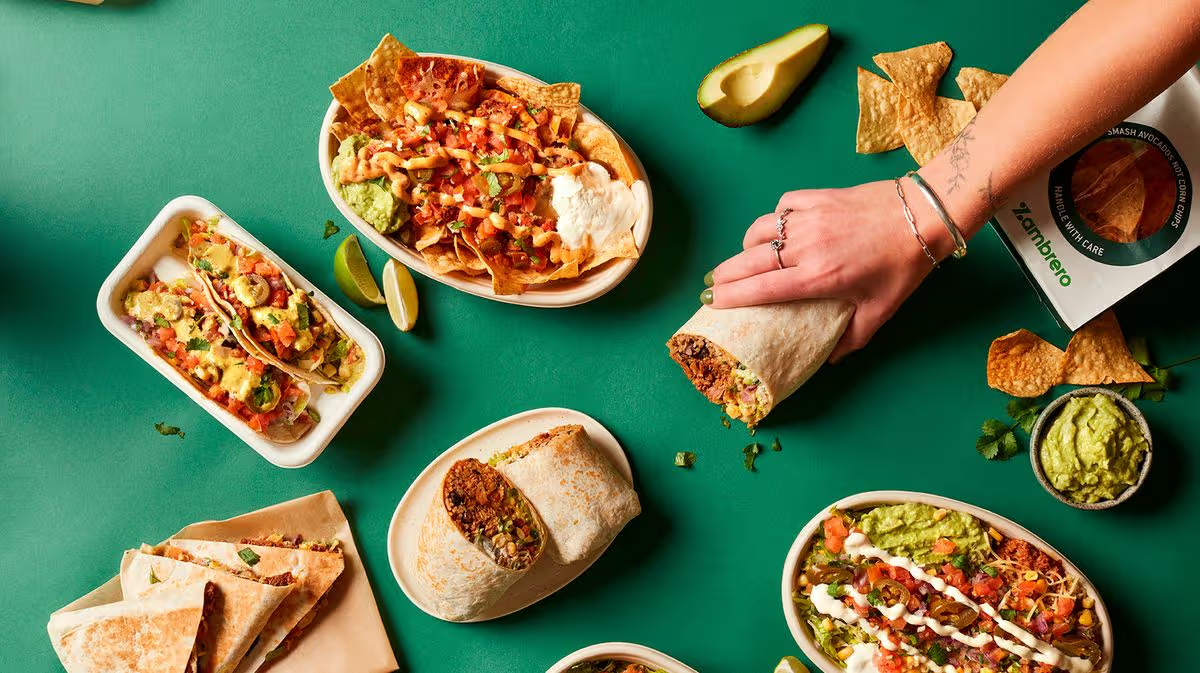
Zambrero is looking to open outlets in larger towns and cities such as Bristol, Bath, Exeter and Plymouth
Zambrero, Australia’s largest Mexican quick-service franchise, is looking to expand in the South West(Image: Zambrero)
An Australian-owned food chain that sells Mexican-inspired cuisine is looking to open a host of outlets across the West of England in the next three years.
Zambrero has appointed three development agents – James Fleck, Michelle Jelfs and Sarah Preston – to spearhead the expansion across Bristol, Dorset, Somerset, Devon and Cornwall.
The trio will be responsible for franchise partner recruitment in the region, with plans to open at least nine restaurants, creating around 135 jobs, including full and part-time roles.
Development will initially focus on larger towns and cities within the region, including Bath, Bournemouth, Bristol, Exeter, Plymouth, Poole, Taunton and Weston-super-Mare.
Advertisement
Initial efforts will be made to secure locations in high footfall areas on high streets, large shopping centres – such as Cabot Circus and Cribbs Causeway in Bristol – retail parks and roadside destinations, according to the company.
The development agents will also be responsible for expansion in the West Midlands, with plans to open at least 12 restaurants via franchise partners in Birmingham, Coventry, Dudley, Solihull, Walsall, Leamington Spa and Worcester over the next three years.
The team will also assist with location acquisition, operational support, brand integrity, regional marketing activation and business strategy, Zambrero said.
“We’re incredibly excited to join the Zam Fam at such a pivotal stage in the brand’s growth,” said Mr Fleck. “Having worked within the hospitality industry for many years, it is clear to me that Zambrero truly stands out – from its fresh, high-quality Mexican food and modern restaurant design, to its positive culture and clear sense of purpose.”
Advertisement
The news comes as the Mexican restaurant group’s looks to open 100 restaurants in the UK by 2030 through strategic franchise partnerships.
Since its 2021 launch, Zambrero now has 14 restaurants across the UK, located in London, Manchester, Birmingham, Reading, Essex and Glasgow.
“We’re actively seeking passionate, committed and like-minded franchise partners to join us in expanding Zambrero across the South West,” added Mr Fleck.
“For ambitious entrepreneurs ready to lead the way in the South West, now is the time to join us on this exciting journey.”
Advertisement
Zambrero has grown into a global brand through its successful franchise programmes, and now has more than 350 restaurants in Australia, Ireland, New Zealand, the UK and the US. It is also the largest Mexican restaurant franchise in Australia and Ireland.
Perth-based predictive diagnostics developer Proteomics has culled a quarter of its staff in a restructure the executive said was neccesary as the firm reaches a critical juncture.
Ken Murphy – Group CEO & Executive Director Imran Nawaz – CFO & Director
Conference Call Participants
Advertisement
Robert Joyce – BNP Paribas, Research Division Manjari Dhar – RBC Capital Markets, Research Division Monique Pollard – Citigroup Inc., Research Division Xavier Le Mené – BofA Securities, Research Division Frederick Wild – Jefferies LLC, Research Division Sreedhar Mahamkali – UBS Investment Bank, Research Division Clive Black – Shore Capital Group Ltd., Research Division William Woods – Bernstein Institutional Services LLC, Research Division Benjamin Yokyong-Zoega – Deutsche Bank AG, Research Division Matthew Clements – Barclays Bank PLC, Research Division François Digard – Kepler Cheuvreux, Research Division Karine Elias – Barclays Bank PLC, Research Division
Presentation
Ken Murphy Group CEO & Executive Director
Advertisement
Good morning, everybody, and thank you for joining Imran and me as we talk through our results for the year. We will also provide an update on our strategic ambitions as we set ourselves up for longer-term delivery in an ever-changing retail landscape. I’m really pleased with our performance across the last year. Against a backdrop of increased competitive intensity, we took decisive action to further strengthen our investments in price, quality, and service. These actions resonated strongly with customers, driving further gains in customer satisfaction and continued growth in market share. Our commitment to delivering the best value for customers remains firm. In a period of continued pressure on household incomes and global uncertainty, this matters more than ever. In a year of strong momentum, customer satisfaction stepped on further, and we reached our highest market share for a decade.
This translated into a strong financial performance with both profit and cash flow ahead of our guidance ranges. Alongside strong operational execution, we have been working across the business to unlock long-term growth opportunities, leveraging our unrivaled customer reach, data
Mark Pownall, Nadia Budihardjo, Claire Tyrrell and Tom Zaunmayr discuss the Hancock-Wright judgment, major property deals, the fuel crisis and agribusiness woes.
Netflix is focusing on delivering a new user experience on its mobile app as it has now confirmed that its vertical video feed, which it has been testing since last year, is debuting this month.
Netflix to Debut Vertical Video Feed to Mobile App
In the latest letter to shareholders from Netflix, the company has revealed that it is planning to launch its take on a vertical video feed right on the streaming platform towards the end of April.
This move centers on a redesign of its mobile app experience, where users will get the chance to enjoy the familiar vertical video format on the Netflix app as enjoyed on social media and other platforms.
According to Netflix, its development of this new user experience will focus on delivering a new vertical video discovery feed on the mobile platforms that will help “better reflect our expanding entertainment offering.”
What this means is that this new feed will have vertical cards that serve as placeholders for the said vertical video clips that, when opened, will stream a specific clip from a show and try to hook audiences.
Advertisement
After watching the clip, users may then add it to their list via the “+” sign or go directly to its page to stream.
That said, its full functionality remains unconfirmed as of press time.
YouTube Shorts-Style Feed on Netflix
The closest comparison and rival to Netflix’s vertical video feed is none other than YouTube, which debuted Shorts around five years ago to deliver its take on the popular format.
YouTube’s Shorts was introduced to challenge TikTok’s dominance during this time as the vertical video format was on the rise.
Advertisement
Netflix’s version of the vertical video format will focus solely on the discovery of its original shows, and it will be unlike YouTube Shorts’ creator-made content.
Apple is improving its AI ecosystem with iOS 27, expected to debut at WWDC this June before rolling out alongside the iPhone 18 Pro series in September.
Early leaks suggest a refined approach to artificial intelligence. This time, the focus is less on flashy features and more on practical, everyday usability.
Visual Intelligence Gets Smarter and More Useful
As MacRumors reports, one of the biggest upgrades centers on Visual Intelligence. Apple is reportedly enhancing its ability to interpret real-world objects through the camera, starting with food packaging.
Users may soon be able to scan nutrition labels and instantly view detailed health insights, potentially integrating with Apple’s Health ecosystem for easier dietary tracking.
The feature is also expanding its recognition capabilities beyond text extraction. Printed phone numbers and addresses could soon be detected and saved directly into Contacts, streamlining a process that currently requires manual input. This builds on Apple’s existing ability to pull event details from images and add them to calendars.
Advertisement
Apple Wallet Moves Closer to an All-in-One Hub
Apple Wallet is set to receive a significant upgrade, enabling the creation of digital passes from physical items. By scanning tickets, membership cards, or other credentials, users can store them instantly within the app.
This feature brings Apple closer to a fully digitized wallet experience, reducing reliance on physical cards while improving convenience for everyday access.
Safari Introduces AI-Powered Organization
According to GSMArena, Safari is also gaining subtle but impactful improvements.
With Apple Intelligence, the browser will automatically generate names for tab groups based on their content. This automation helps users manage multiple tabs more efficiently, especially during research-heavy or multitasking sessions.
Advertisement
While not as attention-grabbing as other AI tools, this kind of background intelligence reflects Apple’s focus on improving user experience without adding complexity.
Apple Doubles Down on Practical AI Integration
Rather than chasing headline-grabbing AI features, the Cupertino giant appears committed to embedding intelligence into everyday interactions. The updates in iOS 27 emphasize convenience, automation, and seamless integration across core apps.
Ahead of WWDC, Apple knows what’s more important. For the tech titan, AI should not feel like a separate tool, but a natural extension of how users already interact with their devices.

























































You must be logged in to post a comment Login