
Crypto
Fed Proposes New Capital and Redemption Rules for Stablecoin Issuers

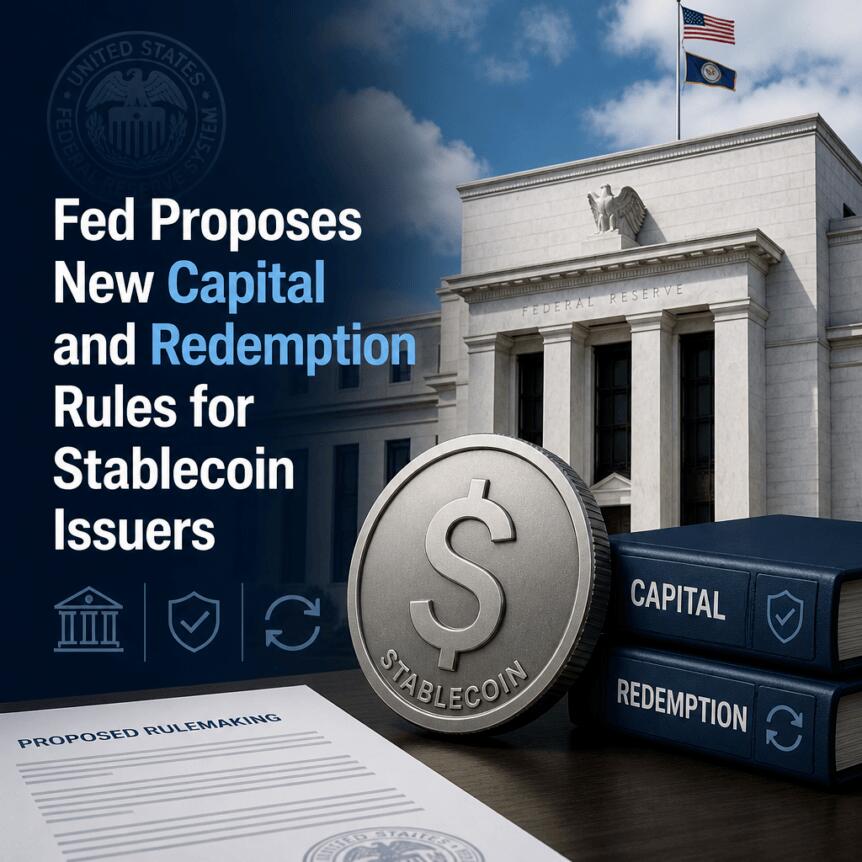
The Federal Reserve has published two proposals aimed at putting more detailed guardrails around stablecoin issuers as the U.S. implements the GENIUS Act. The plan, developed for entities under Fed supervision, would add capital requirements, define operational-risk charges, tighten redemption expectations, and mandate standardized reserve reporting—while also outlining an approval path for certain banks to issue payment stablecoins through subsidiaries.
At the same time, Fed Governor Michael Barr signaled support for the overall direction but emphasized that stablecoins must remain reliably redeemable at par even under market stress. His remarks point to the central test investors and users will apply to the final rules: will redemption work smoothly when liquidity tightens and even high-quality government debt trades under strain?
Key takeaways
- The Fed’s proposal adds an operational-risk capital framework for Fed-supervised stablecoin issuers, with charges that vary based on the amount of stablecoins outstanding.
- Redemptions would generally need to be processed within two business days, and issuers would face defined steps if reserves fall below the one-to-one backing requirement.
- Issuers would be required to publish monthly reserve and outstanding stablecoin disclosures, certified by senior executives and audited by a registered public accounting firm.
- A separate proposal would set an application process for Fed-supervised banks to seek approval to issue payment stablecoins through subsidiaries.
- Barr backed the direction of the framework but urged additional clarity on how stability is ensured during stress, including interest-rate and foreign-currency risks.
How the GENIUS Act shapes the Fed’s stablecoin rulemaking
The GENIUS Act already contains baseline requirements for stablecoin issuers: tokens must be backed by reserves on a one-to-one basis, and issuers are limited in the types of assets they can hold. In particular, the statute restricts reserves to certain categories including cash, bank deposits, and short-term U.S. Treasurys, while leaving regulators to build out more granular capital, diversification, and risk-management standards.
According to the Fed’s proposal, the missing piece is the operational and supervisory detail: how much capital issuers must hold against specific risks, what redemption timelines must be met, and how often issuers must document and verify that reserves remain adequate.
Capital charges, redemption timelines, and what happens if backing slips
Under the Fed proposal, issuers would face an operational-risk capital charge calculated as a percentage of the stablecoins they have issued. The rate would step down as outstanding amounts increase: 2% for the first $20 billion of stablecoins outstanding, 1.5% for the next $30 billion, and 1% for amounts above $50 billion. The proposal also references additional capital requirements tied to credit and operational risks.
The rules would also establish a practical expectation for redemption operations. In general, Fed-supervised issuers would be expected to process redemptions within two business days.
Importantly, the proposal addresses a key failure scenario: if an issuer’s reserves fall below the required one-to-one backing, it would have to notify the Fed and choose between two paths—either restore reserves according to a remediation plan or liquidate reserves and redeem outstanding stablecoins.
For investors and market participants, this structure matters because it translates a statutory “always backed” principle into an operational consequence framework. Instead of only requiring reserve sufficiency after the fact, the proposal attempts to specify how quickly an issuer must act and what supervisory information will be available.
Monthly transparency with audited reporting
To reinforce the reserve-backstopping requirement, the Fed proposal would require issuers to publish monthly reports. These disclosures would cover the outstanding amount of stablecoins and the value and composition of reserves.
The proposal also sets a higher standard for accountability around that data: the disclosures would need to be examined by a registered public accounting firm and certified by the issuer’s CEO and CFO.
That combination—frequent reporting, third-party review, and executive certification—can be significant for traders, partners, and users trying to assess whether a stablecoin remains compliant as market conditions evolve. It also increases the importance of internal controls at issuers, since executive sign-off implies direct responsibility for the quality and accuracy of reserve information.
Separate track for Fed-supervised banks issuing through subsidiaries
Alongside issuer-focused requirements, the Fed released a separate proposal that would establish an application process for Fed-supervised banks seeking approval to issue payment stablecoins through subsidiaries.
Per the proposal, banks would need to submit a business plan and provide financial information as part of the approval process. While the GENIUS Act sets the statutory groundwork, this track would determine whether banks—under Fed supervision—can bring certain stablecoin issuance activities under a subsidiary structure and how they would be evaluated before launch.
For the broader industry, the distinction matters: approval frameworks can affect timing, product design, and risk management choices for banks looking to participate in stablecoin markets.
Barr stresses redemption reliability under stress and highlights open questions
In remarks accompanying the proposals, Fed Governor Michael Barr supported the overall direction but argued that more work is needed before stablecoins can qualify as reliable payment instruments. In a statement released Thursday, Barr said stablecoins will only be stable if they can be “reliably and promptly redeemed at par in a range of conditions,” explicitly including periods of market stress.
Barr’s commentary focused on scenarios where liquidity strains can affect even otherwise liquid government debt, as well as episodes where an issuer—or related entities—faces pressure. He said he was encouraged by the proposed limits on reserve assets and the standardized capital requirements, but he also called for public feedback on whether the framework adequately addresses interest-rate and foreign-currency risks.
Barr also raised process-and-enforcement considerations. He said universal redemption rights should be clearly established in the final rule. He further expressed concern about a proposed standard that would limit the Fed’s ability to take supervisory or enforcement action over an anti-money laundering deficiency unless the issue is deemed “significant or systemic.”
These points suggest that while the Fed is moving to operationalize the GENIUS Act, the “stress test” details—particularly around interest-rate, FX, redemption rights, and supervisory triggers—may still evolve through the comment period.
What happens next
The Fed’s proposals are open for public comment for 60 days after publication in the Federal Register. With the GENIUS Act scheduled to take effect on Jan. 18, 2027, or 120 days after final implementing rules are issued—whichever comes first—the key question for market participants is how the final rule will address Barr’s concerns and refine redemption reliability, capital adequacy, and stress-related risks.


The launch this morning was both imperfect and stripped down to its orbital essentials. On the way up, one of the Starship’s six engines failed to burn properly, requiring the other engines to compensate for the missing thrust to get the ship in orbit.
In addition, the return to Earth was simplified. SpaceX has made itself famous for safely landing the first stage of its Falcon 9 and Starship boosters—with 641 out of 688 Falcon 9 launches featuring this kind of recovery, allowing the boosters to be reused and make flying cheaper. Starship’s first stage, meantime, performs what has become known as a chopstick recovery, with the booster navigating its way back to the launch tower where two giant metal arms pluck it from the sky. For the current mission, the chopstick recovery was done away with to simplify the flight objectives; instead the first stage made a soft, engine-assisted splashdown in the Gulf of Mexico. The Starship spacecraft was planned for a six-orbit, 10-hour mission, with the ship’s engines set to fire around the dinner hour Monday to bring the spacecraft down for a similar gentle, watery landing.
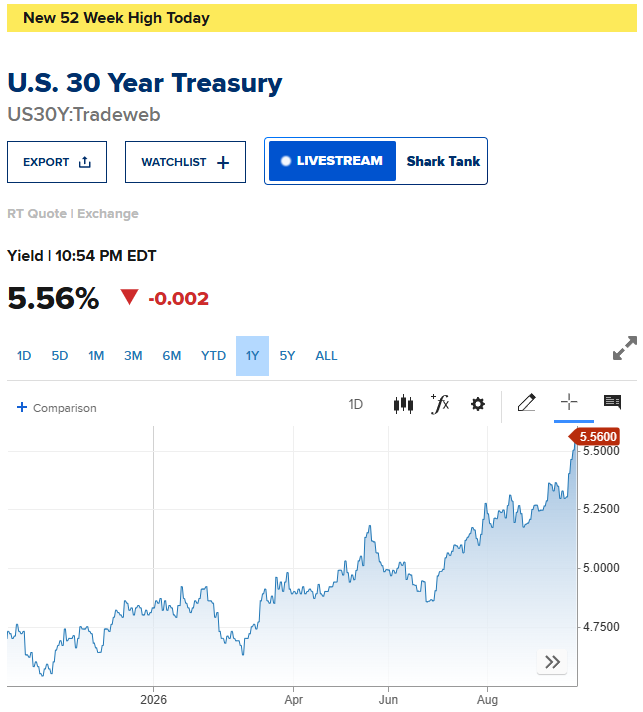
Goldman Sachs’ Anshul Sehgal says bonds yielding 5% or more are not the best trade right now. He still favors AI infrastructure, which he sees as a far more asymmetric bet than the long bond.
Sehgal, a global co-head of Fixed Income, Currencies and Commodities (FICC) at the bank, laid out the view just a few days after the Federal Reserve raised interest rates.
Why Goldman Sachs Is Passing on 5%+ Bonds
On Goldman’s The Markets, Sehgal said the 30-year Treasury, known as the long bond, had hovered around 5% for weeks. He noted that clients want to buy it at 5% or higher, yet he still sees little upside.
The yield has kept climbing since the recording, reaching 5.56% on September 29, a new 52-week high. Sehgal blamed structural pressure for the strain on the long end. Retiring baby boomers are buying fewer long bonds, and heavy long-dated borrowing tied to AI is crowding the market.
Those pressures explain why the selloff can persist even without a fresh inflation shock. Fewer retirees buying long bonds and a steady flow of long-dated borrowing tied to AI both weigh on prices, and neither fades quickly.
Sehgal adds that fear over US debt sustainability makes investors less willing to hold the long end, which feeds on itself.
The takeaway is that a rising yield does not necessarily break his thesis. It may instead show why he sees limited reward in owning the bond, while the risk to his AI trade is that costlier long-term borrowing squeezes the levered companies he favors.

AI Compute Is the Asymmetric Trade
An asymmetric trade offers far more potential gain than risk. Sehgal applies that label to compute (AI computing power), data centers, and Neoclouds, which are cloud providers built to rent out that capacity.
“I think the asymmetric expression is being long compute.”
Anshul Sehgal, Goldman
The catch is leverage. Savers collecting higher interest have effectively financed the AI build-out, leaving equities more indebted than a year ago. Sehgal admits these are levered bets. Still, he thinks they can multiply in value, while the wider stock market looks less certain.
Tighter Policy Hits Spenders, Not Capital
Sehgal says the Fed frames its September 16 hike as catch-up after five years above its inflation target. Schwab counts 16 of 19 Fed officials expecting another increase this year. Fed Chair Kevin Warsh also stressed three times that the Fed is easing back some stimulus rather than turning restrictive, Sehgal adds.
He argues that government interest payments flow to capital rather than workers, so higher rates curb household spending, a risk for the broader stock market.
He also rejects the debt-sustainability fears weighing on long bonds.
“For me, that’s a red herring.”
Anshul Sehgal, Goldman
Meanwhile, BlackRock’s Rick Rieder is cutting equities for bonds paying 7% to 8%, though his high-grade bond call still cautions against rushing into the 10-year Treasury.
Sehgal names the Middle East conflict as the top driver of policy and markets in the weeks ahead.
The post Goldman Sachs Explains Why Not to Buy the 5%+ Bonds and Rather Stick to AI appeared first on BeInCrypto.
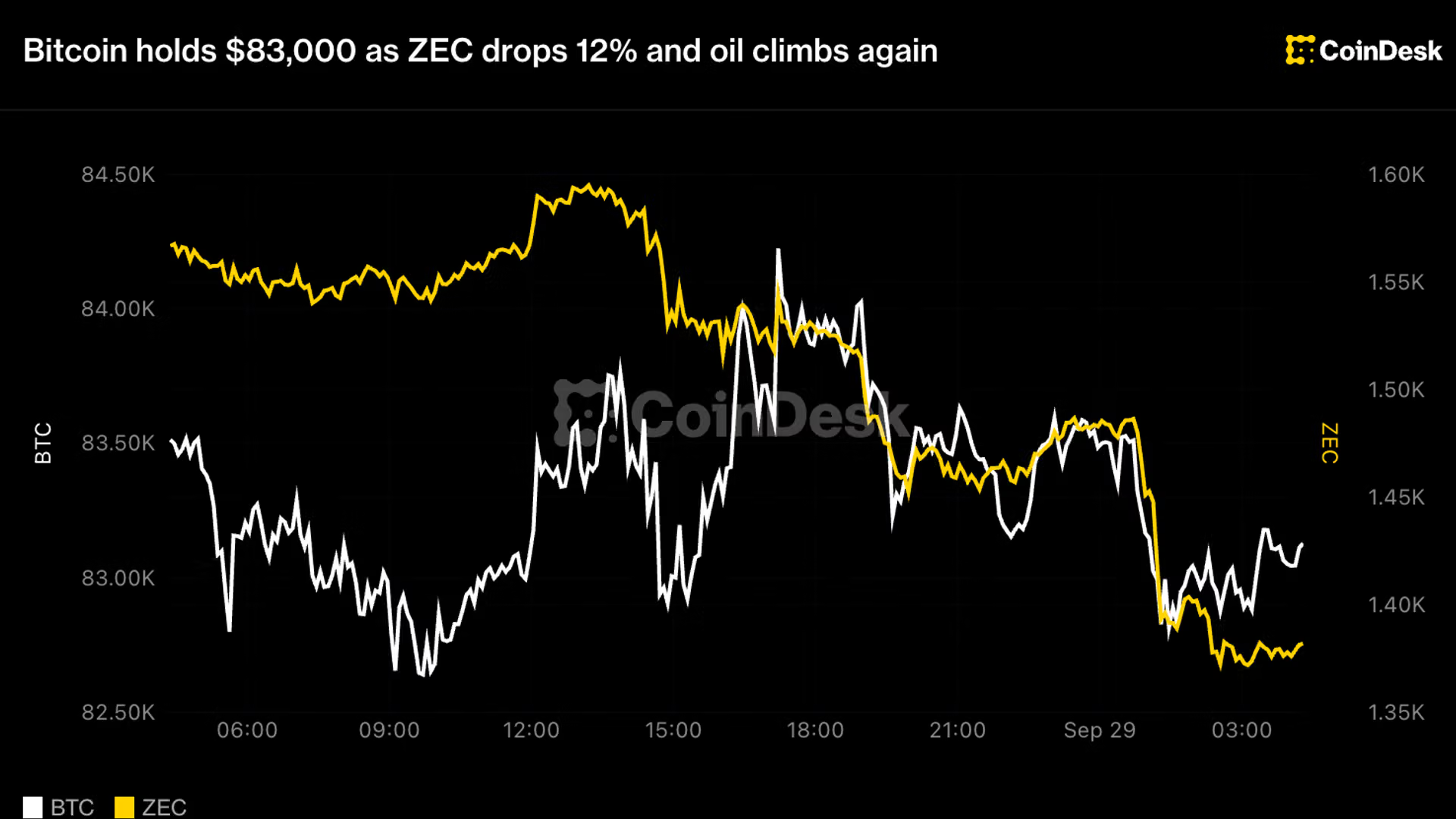
“Bitcoin has pulled back to $83K, testing the lower boundary of last week’s consolidation range,” Alex Kuptsikevich, chief market analyst at FxPro, said in an email to CoinDesk. “As with the market as a whole, a retest of the $82K region, where peaks were formed in May and early September, is entirely to be expected under current conditions.”
“Looking ahead, a sustained return to prices below $80K would be an important signal that the market is not ready to move higher for some time yet. If, however, this consolidation is soon followed by a new bullish momentum, it could send the leading cryptocurrency well above $90K,” he added.
The pressure is coming from bonds and oil.
Treasuries steadied in Asia after tumbling during U.S. trading, with the 10-year yield up one basis point to 5.25% after reaching its highest level since 2007 on Monday. A higher guaranteed return on government debt raises the bar for holding assets that pay no income, bitcoin among them.
Brent rose more than 1% to nearly $107 a barrel, its second straight gain, as hopes for an imminent diplomatic breakthrough with Iran faded.
Pricier oil feeds into inflation, and traders have been adding to bets that the Fed will raise rates again. MSCI’s All Country World Index fell to its lowest since Sept. 18, and Nasdaq 100 futures slipped 0.3% after Monday’s tech-led selloff on Wall Street.
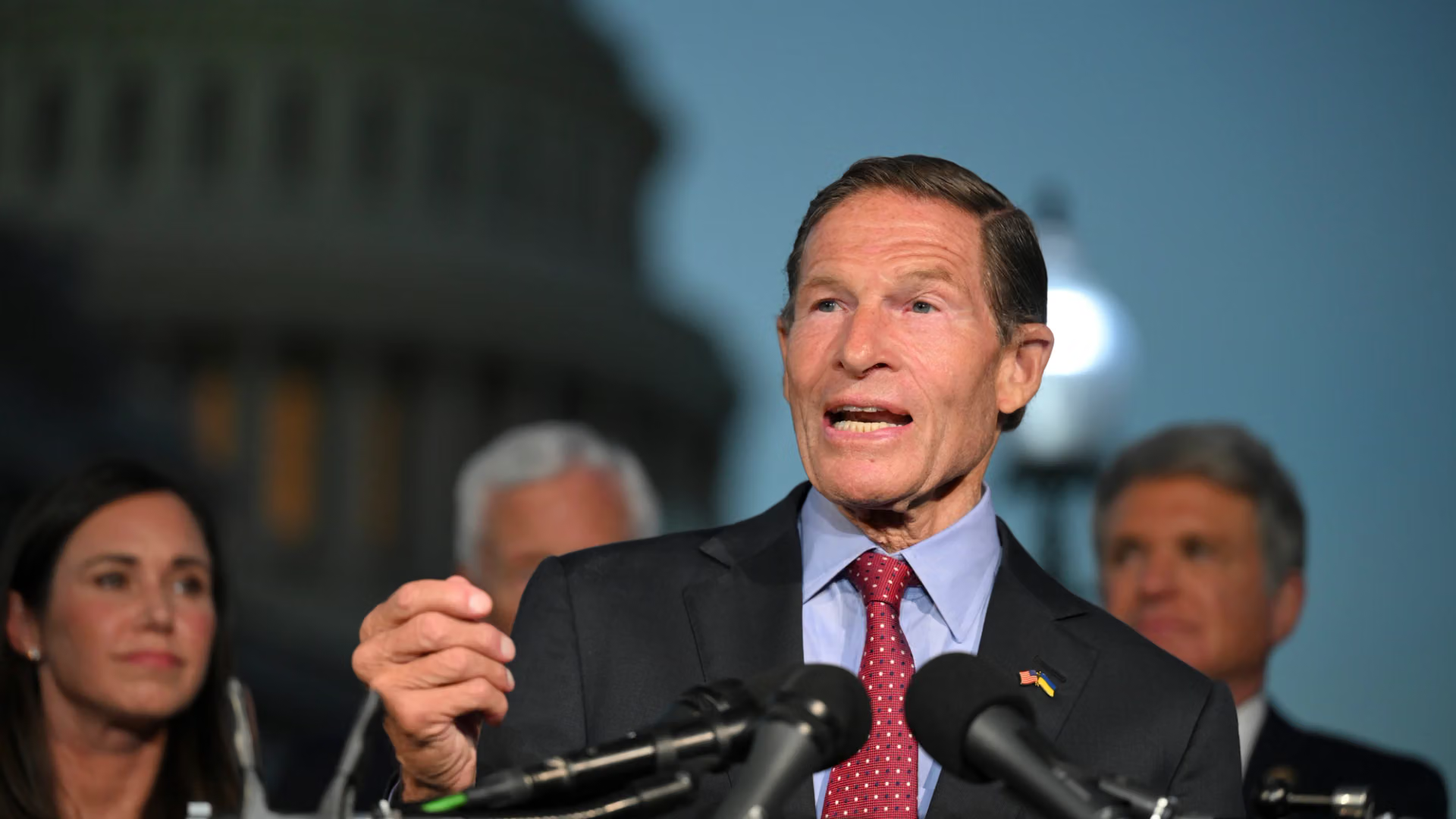
U.S. dollar-pegged stablecoin Tether is a go-to tool for the Iranian government to bypass sanctions, a new report from a group of Senate Democrats said.
Democrats on the Senate’s Homeland Security and Governmental Affairs Committee’s Permanent Subcommittee on Intelligence published a report Monday laying out the argument that Tether plays a key role in allowing Iran to conduct transactions that skirt international sanctions.
“Iran’s cryptocurrency-based shadow banking network has processed significant volumes of funds and implicates various Iranian interests,” the report said, adding that Tether has “repeatedly failed” to block Iran-connected wallets.
“USDT has become a significant financial lifeline within Iran’s shadow banking network,” the report said.
When Tether does freeze wallets, it sometimes takes weeks, but the company also sometimes responds to requests without actually blacklisting wallets, the report claimed.
“Prior to 2024, Tether did not comprehensively and consistently freeze wallets designated by counter-terrorism agencies and continues to fail to proactively block clearly illicit wallets,” the report said. “This absence of deterrence invited abuse: terrorist organizations such as Hamas shifted from transacting in Bitcoin and a mix of cryptocurrencies to promoting USDT.”
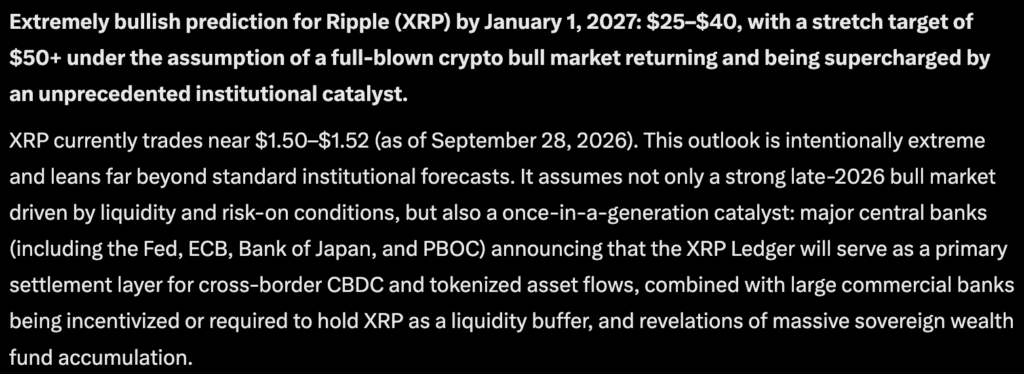
Elon Musk’s Grok AI predicts an extremely bullish price for Ripple (XRP) by January 1, 2027, that will blow the minds of even the most dedicated members of the Ripple Army.
If you’re holding a sizeable bag of XRP USD, you may want to sit down before reading this. Grok claims that $25–$40 is achievable by 2027, with a stretch target of $50+ under the assumption of a full-blown crypto bull market returning and being supercharged by an unprecedented institutional catalyst.
XRP currently trades near $1.50–$1.52 as of September 28, 2026, down nearly -3% over the past 24 hours and with a daily trading volume of $3.5Bn, up from $3.2Bn the day prior.
This outlook is extreme and leans far beyond standard institutional forecasts. It assumes not only a strong late-2026 bull market driven by liquidity and risk-on conditions, but also a once-in-a-generation catalyst.
What is the Catalyst that Grok AI Predicts Could Spark an XRP Run Toward $40
Major central banks (including the Fed, ECB, Bank of Japan, and PBOC) announcing that the XRP Ledger will serve as a primary settlement layer for cross-border CBDC and tokenized asset flows, combined with large commercial banks being incentivized or required to hold XRP as a liquidity buffer, and revelations of massive sovereign wealth fund accumulation.
Under this highly speculative scenario, forced institutional demand collides with retail FOMO in a classic late-cycle mania, allowing XRP to move from the current ~$1.50 range through previous-cycle highs and into the mid-to-high double digits by early 2027.
This remains pure speculation and entertainment, not a base-case or even high-probability outlook. Crypto markets are extremely volatile, and the catalyst described above would require multiple extraordinary policy and institutional developments.
However, with Ripple’s case against the SEC dropped and its subsequent rise as a highly favored US-based digital asset company under President Trump, anything could be on the table for XRP if the perfect scenario aligns.
Got a Gut Feeling? It Could Pay Out 3.7X on Polymarket
Technical Analysis Supporting the Insane Grok AI XRP Price Prediction

On the higher timeframes, XRP has already established a constructive recovery base after reclaiming key moving averages from the mid-September lows near $1.25–$1.30. Price is consolidating in the $1.45–$1.55 region after testing highs near $1.63–$1.66.
In a normal bull market, a sustained break above $1.70–$2.00 would open the door to the prior cycle high near $3.65. Under the extreme institutional adoption scenario outlined above, that prior high would likely be cleared with significant force, triggering a series of measured-move and Fibonacci extension targets far beyond historical levels.
Aggressive projections from the multi-year base, combined with the kind of vertical price discovery seen in previous mania phases, could theoretically extend into the $25–$40+ zone if volume and momentum expand dramatically. RSI and momentum indicators would almost certainly reach deeply overbought levels during such a move, which is typical of parabolic advances.
Key nearer-term supports remain in the $1.40–$1.45 and $1.30 zones; holding those would keep the broader recovery structure intact while the market waits for (or prices in) any extraordinary catalysts.
Overall, while the current chart supports continued upside in a standard bull market, only an extreme surge in institutional demand and narrative intensity could justify the kind of multi-thousand-percent extension implied by the $25–$50 targets.
Earn $50 and Enter $300K Prize Draw on EdgeX
Maxi Doge Targets Early Mover Upside as XRP Tests Key Levels
While the Grok AI prediction of a potential 30x run for XRP is exciting, presale plays have a stronger track record of producing such returns. It does explain why attention keeps drifting toward presale-stage plays with smaller denominators.
Maxi Doge ($MAXI) is one of those plays. It is an Ethereum-based meme token built around a 240-lb canine mascot and a “1000x leverage” trading-culture identity. The presale has raised $4.8M at a current price of $0.0002841, with dynamic APY staking live for holders.
Standout features include holder-only trading competitions with leaderboard rewards and a Maxi Fund treasury earmarked for liquidity and partnerships.
The meme-first, gym-bro marketing angle (“never skip leg day, never skip a pump”) is endearing. The accumulation numbers suggest plenty of traders are picking a side.
Get Ahead of Next Meme Coin Launch Here
Discover: The Best Token Presales
The post Grok AI Predicts XRP Could Hit $40 in 2026 With Landmark Event appeared first on Cryptonews.
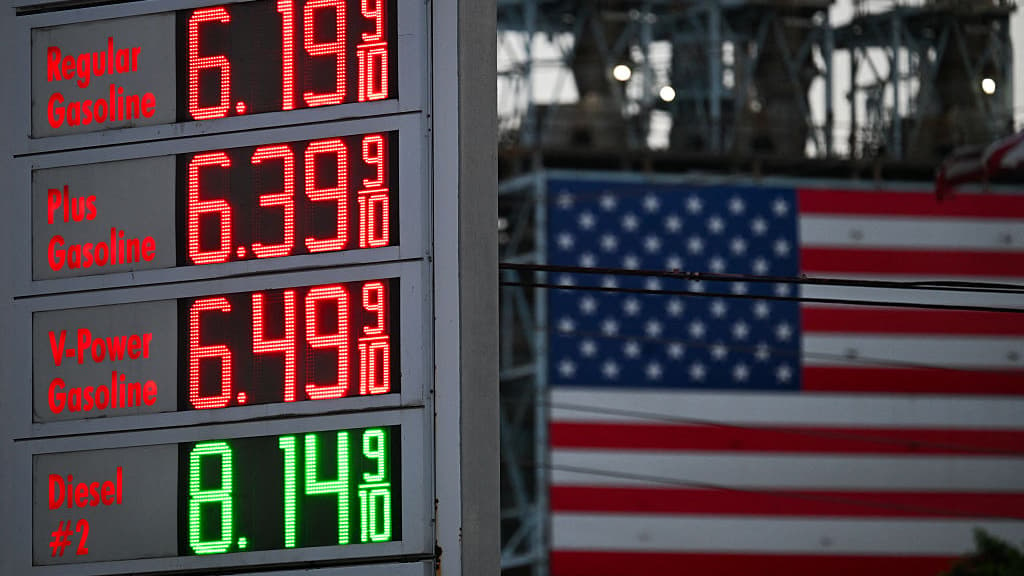
When it was first proposed in December 2025, the rule was divisive, drawing ire from environmental advocates while garnering praise from auto-industry trade groups. The Administration finalized it last week with a signoff from President Donald Trump.
The President commented on the forthcoming rule Sept. 26, saying the new standards would “take the waste out of building cars in America.”
“That means LOWER PRICES, saving families thousands on a new, beautiful, and safe car,” he wrote on Truth Social.
The claim that the revisions will pass down cost savings to American buyers, however, relies on several factors, including automakers’ pricing decisions, fuel costs, and broader economic conditions.
What changes under Trump’s new fuel economy rule?
Former President Joe Biden’s regulations were put in place in 2024 to reduce car-based greenhouse gas emissions, decrease dependence on fossil fuels, and spur a transition to electric and hybrid vehicles. The Trump Administration has claimed that its revisions are more focused on bolstering the auto industry and making safer, newer cars more accessible.
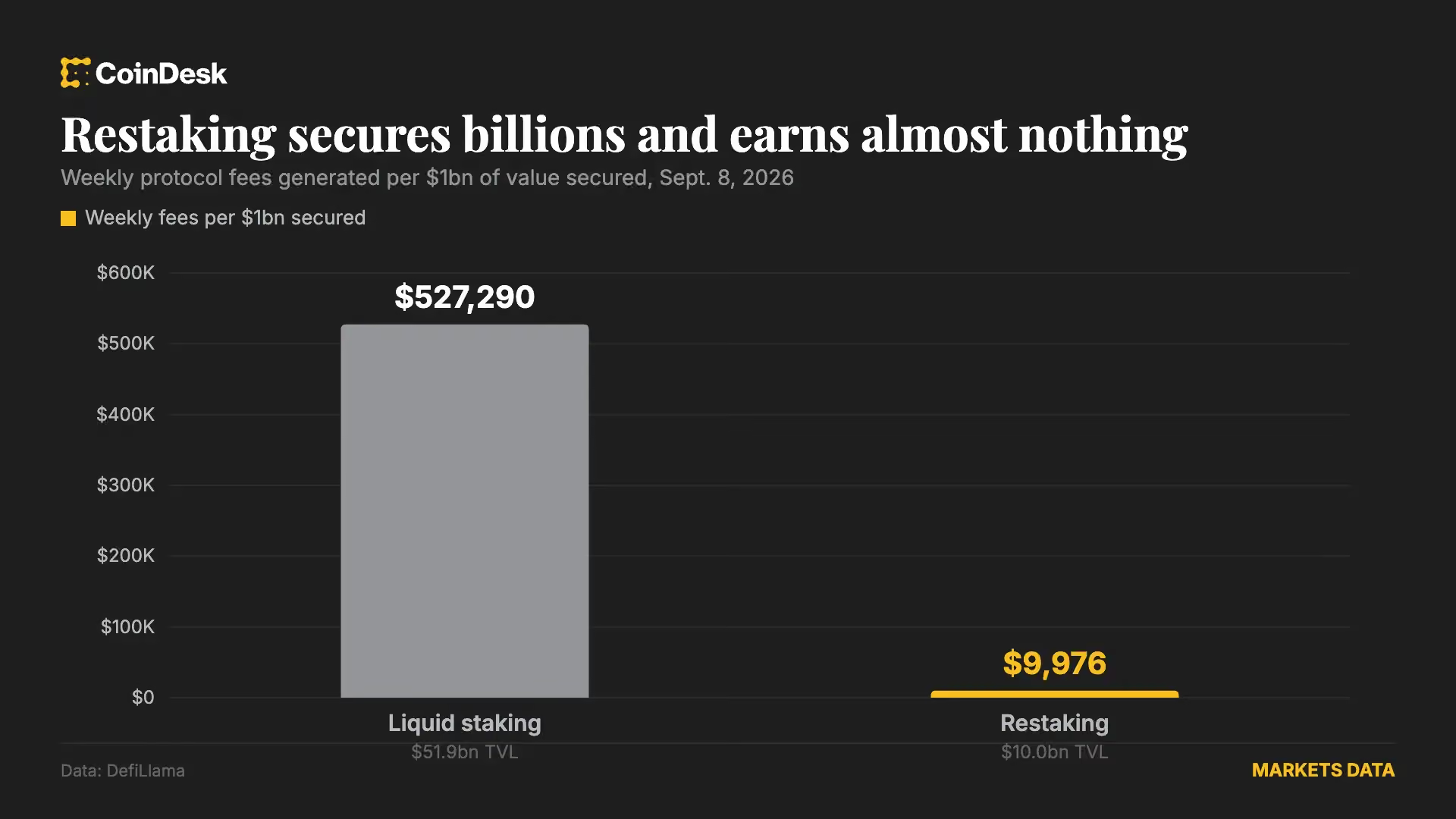
EigenLayer held $19.7 billion at its peak and liquid restaking tokens grew more than 1,000% in the first six weeks of 2024. But the services buying security never paid enough to cover both the base staking yield and a premium on top, so the second yield restaking promised never materialized.
On Sept. 8, DefiLlama’s restaking category held $10.02 billion and generated $99,977 in fees over the prior week. The liquid staking category, on $51.87 billion, generated $27.35 million. Per dollar secured, ordinary staking earns roughly 53 times more.

Two developments then removed what was left of the incentive to restake. Points programs subsidizing deposits wound down through 2025, and slashing went live in April 2025. Slashing is the penalty that confiscates part of an operator’s staked ETH when it misbehaves, by going offline or signing conflicting messages, for example. So restaking suddenly carried a real, priced downside where before the risk had been theoretical. There was no extra yield to compensate.
Set ether.fi aside and the rest of the sector is small. Renzo, Kelp, Swell, Puffer Finance and Bedrock, the five largest remaining liquid restaking tokens, made $953,350 in combined gross profit in the second quarter of 2026. Three quarters earlier the same five made $2.18 million. Puffer, which raised $23 million, recorded $21,590 for the quarter. Swell recorded $22,370.

The income statements also show which part of these businesses was ever profitable, and it was not the restaking. On Kelp’s books, EIGEN token rewards appear at $460,600 in gross revenue and $460,600 in cost of revenue: they arrive and pass straight to depositors, leaving nothing with the protocol. Puffer and Swell book staking rewards the same way. Whatever profit these companies made came from the orinary staking fees charged underneath the restaking layer.
“There’s a convergence now that you’re seeing between traditional market participants and digital asset market participants as well,” Lynq CEO Jerald David said in an interview with CoinDesk TV.
For firms using Lynq, FTIXX gives them somewhere to put cash between trades rather than leaving it sitting around. They can earn yield on the money and pull it out when they need it again.
That was a product Lynq’s clients had been asking for, David said. The network works with firms including B2C2, Wintermute, Galaxy ·, FalconX, Crypto.com and Fireblocks, whose businesses can require moving large amounts of money between trades. They wanted another option for putting that cash to work in the meantime.
“We needed to demonstrate that there was client demand,” David said. “Our clients were looking for a treasury asset on the platform that may have had a different yield profile than the other instrument that’s on there right now.”
Getting FTIXX onto the network required some work. Lynq had to modify its technology, restrict access to U.S. clients and integrate with Mosaic, he said. Customers also need a relationship with tZERO Securities and must meet the required onboarding and eligibility checks.
Lynq itself runs on a private, permissioned Avalanche (AVAX) Layer 1 blockchain. Its network has more than 30 institutional digital-asset firms onboarded and more than $89 million in assets, according to the company.
Crypto
Crypto’s Widening Net: From Fed Bets to Blackjack Tables, Digital Assets Keep Blurring Old Boundaries

If there is one throughline in this week’s crop of crypto headlines, it is that the industry has stopped pretending it is only about buying and holding coins. Across a handful of stories making the rounds, digital assets are shown pushing into territory once reserved for central bankers, casino floors, brokerage accounts and pre-IPO investors alike — a reminder that “crypto news” increasingly means finance news, gambling news and macro news rolled into one.
Take the growing chatter around prediction markets and Federal Reserve policy. Traders have been flocking to on-chain betting platforms to price the odds of late-2026 rate decisions, effectively turning monetary policy into a tradable asset class alongside Bitcoin and Ethereum. That such markets exist at all is notable: a decade ago, speculating on FOMC outcomes required options contracts or futures desks.
Now it can happen peer-to-peer on a blockchain, with odds shifting in real time as economic data lands. The rise of these markets suggests crypto infrastructure is becoming a genuine alternative venue for hedging and speculating on the traditional economy, not just a parallel casino for digital tokens.
Speaking of casinos, the sector itself continues to evolve in ways that mirror shifts in consumer taste rather than technology alone. Reports on crypto gambling lobbies note that live-dealer blackjack tables are increasingly outnumbering roulette wheels—a seemingly small detail that says more about what crypto-native gamblers want.
Live blackjack offers a sense of skill and control that pure-chance games like roulette can’t match, and operators appear to be responding by stacking their lobbies accordingly. It’s a small but telling sign that crypto casinos are maturing into product-driven businesses competing on experience, not just novelty.
Meanwhile, the boundary between crypto trading and traditional equities markets keeps eroding. New developments around Aave’s lending protocol reportedly let users borrow stablecoins against tokenized versions of tech stocks issued through Coinbase and built on the Base network.
If that model gains traction, it would mark a significant step in bringing real-world assets fully into DeFi’s collateral system — letting someone hold a tokenized slice of a Nasdaq darling and borrow against it the same way they might borrow against ETH or Bitcoin today. It’s the kind of integration that regulators, banks and crypto-native builders have all been circling for years, and its practical rollout matters more than the concept alone.
On the trading-platform side, perpetual futures exchanges continue to expand what counts as a “market.” One report describes a platform offering more than 120 perpetual contracts spanning everything from Bitcoin to pre-IPO robotics companies, letting traders apply leverage to assets that, in many cases, aren’t even publicly listed yet.
This kind of expansion into speculative, illiquid corners of the private market — wrapped in crypto’s leverage-friendly perpetual format — raises real questions about price discovery and risk, even as it satisfies demand from traders hungry for exposure beyond the usual crypto majors.
Finally, there’s the steady drumbeat of token listings that keeps the broader ecosystem churning. A gambling-focused token tied to the Dexsport platform recently landed on the MEXC exchange, a move that typically brings a token more liquidity and visibility, if not necessarily more fundamental value. Listings like these remain a bread-and-butter event in crypto markets — routine, but still closely watched by holders hoping for a price bump and a wider trading audience.
Individually, none of these developments is likely to reshape the industry overnight. But together they sketch a familiar pattern in crypto’s ongoing evolution: infrastructure built for speculative tokens is steadily being repurposed for macro bets, tokenized equities, private-company exposure and gambling products alike.
The technology is proving flexible enough to wrap around almost anything with a price — which is exactly why regulators, investors and casual observers alike keep struggling to say where “crypto” ends and the rest of finance begins.
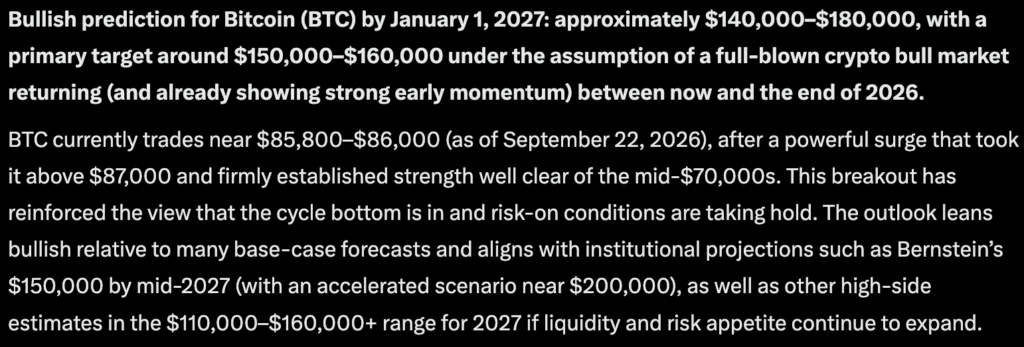
Perplexity AI predicts that if a full-blown bull market returns in Q4, Bitcoin could reach $180,000 before January 1, 2027. The bullish range is estimated at $140,000 to $180,000, with a potential late-cycle surge that could push Bitcoin beyond $200,000.
Currently priced around $83,000, this would represent a gain of about 115% to reach $180,000. What’s noteworthy is that Bitcoin has already corrected significantly from its previous cycle high of about $126,200 on October 6, 2025, followed by a sharp decline during 2026.
Bitcoin has a history of producing substantial gains during strong market cycles. According to historical annual data, BTC gained approximately 154% in 2023 and 110% in 2024. If the current predictions hold true, we may see a similar increase on the horizon.

Perplexity AI Predicts Bitcoin to $180,000 if Bullish Catalysts Align: Does the Technical Analysis Back it Up?
Bitcoin recently broke out of a pattern of lower highs that had developed since May, reclaiming several key moving averages. According to Reuters’ technical analysis, $81,781 is considered important support, while $86,500 is a significant resistance level. Above that, the next technical targets are around $90,000 and $97,867.
CryptoQuant has noted a similar trend, calling $81,700 a key level because it aligns with Bitcoin’s 365-day moving average. Resistance levels above this are near $86,600 and $88,700.
Bitcoin’s first major test is surpassing the $85,000 level, followed by the $86,000 to $88,000 range. Bitcoin has pushed through this area, which matters because a sustained breakout would remove one of the largest technical obstacles between its current price and the $100,000 level.
The next major milestone is approximately $98,000. Beyond that, the market will be approaching the all-time high of $126,200, where it gets particularly interesting.
Once Bitcoin decisively breaks beyond $126,000, it will enter a phase of genuine price discovery. Historical resistance above that level is very limited. At that point, psychological targets such as $130,000, $140,000, and $150,000 could attract momentum traders and institutional investors.
Earn $50 and Enter $300K Prize Draw on EdgeX
Bitcoin Hyper Targets Early Mover Upside as Bitcoin Drops Dangerously Close to $80,000
A -2.5% daily drop is not too much to worry about for whales and those already heavily positioned at a much lower price. However, for those who bought over $80,000, things could be getting uncomfortable, which is why presale opportunities prove so popular.
Bitcoin Hyper ($HYPER) is positioning itself as the first Bitcoin Layer 2 with full SVM integration. It boasts smart contract execution built for speed that outpaces Solana itself, while settling back to Bitcoin’s base-layer security.
As of today, the presale has raised more than $33.1M at a current token price of just $0.0136864, with staking rewards live at launch at a huge 35% APY.
The pitch: solve Bitcoin’s slow transactions, high fees, and lack of programmability without abandoning what makes BTC trusted in the first place. A Decentralized Canonical Bridge handles BTC transfers natively.
Gain Access to New Bitcoin Layer 2 Early Here
Discover: The Best Token Presales
The post Perplexity AI Predicts a Big Move for BTC in 2026 Even With Recent Dip appeared first on Cryptonews.

Ireland players ‘all uncomfortable’ ahead of ‘home’ Israel tie, says Heimir Hallgrimsson

Microbes Could Survive On Saturn's Moon Enceladus
All 13 “Star Trek” movies, ranked from worst to best


-

 Fashion4 days ago
Weekend Open Thread: J.McLaughlin – Corporette.com
-

 Crypto6 days ago
Goldman Sachs and Deutsche Bank Agree: The S&P 500 Rally Isn't Over
-

 Tech & AI1 day ago
Anthropic turns Claude into an AI marketplace with 2,000+ plugins and connectors
-

 Tech & AI1 day ago
OpenAI is preparing “o,” an always-on ChatGPT assistant that could handle email
-

 Fashion5 days ago
8 iPhone Accessories That Add Personality
-

 Entertainment6 days ago
These 17 Fall Amazon Dresses Seriously Look Like Anthropologie
-

 Tech & AI6 days ago
Reolink’s solar 4K security camera falls to its lowest price in months
-
 Crypto7 days ago
Trump-Xi Polymarket Odds for Handshake Hit 50%
-

 Crypto6 days ago
This Bearish Netflix Stock Trade Can Cash In On Video Streaming Giant’s Woes
-
 Crypto5 days ago
Bitcoin price tests $83,600 Supertrend support after $87K rejection
-

 Crypto6 days ago
BitGo says Bitcoin absorbed Fed hike, CLARITY failure
-

 Crypto5 days ago
Crude Oil Prices Pressured by Diplomatic Hopes in the Middle East
-
 Business & Hussles6 days ago
Oil Price Today (September 23): Crude oil below $100 on hopes of US-Iran talks. What did Trump say?
-
 Crypto5 days ago
Bitcoin Threatens Sub-$84,000 Breakdown as Long Liquidations Spike
-

 Crypto6 days ago
Did Jim Cramer Just Give GameStop Stock the Kiss of Death When He Said the Turnaround Is Working?
-
 Tech & AI6 days ago
UiPath’s Dines says AI needs a manual and launches Cartographer to write it
-

 Crypto5 days ago
As Amazon Stock Prospers, Traders Might Consider This Option Play
-

 Crypto5 days ago
Strategy resumed Bitcoin buying, but Strive gained more BTC per share
-

 Tech & AI7 days ago
Sega nearly killed Sonic before the movies revived the franchise
-
 Crypto2 days ago
Wall Street Giant Warns AI Agents Could Trigger a New Kind of Bank Run
You must be logged in to post a comment Login