
Crypto
Plattsburgh weighs 12-month crypto mining ban



Plattsburgh officials are considering a 12-month moratorium on new and expanded cryptocurrency mining, artificial intelligence and other high-energy computing facilities while the New York city updates its zoning rules.
Summary
- Plattsburgh proposes a twelve-month moratorium covering new and expanded high-energy computing facilities within city limits.
- Facilities primarily using 300 kilowatts or more for crypto, AI, or cloud computing qualify automatically.
- Existing lawful operations may continue, but expansions requiring municipal approval would remain prohibited during moratorium.
- City officials say the pause would support zoning updates addressing electricity, noise, cooling, and safety.
- The Common Council’s next regular meeting is scheduled for September 17, according to city records.
Mayor Wendell Hughes introduced Local Law P-2 on Aug. 20. The Common Council held a public hearing on Sept. 3 but has not adopted the proposed crypto mining and AI data center ban.
The measure would cover commercial facilities primarily devoted to cryptocurrency mining, blockchain validation, AI computing, machine learning, cloud computing, digital asset processing, server farms and colocation services.
A covered facility must require High Density Load Service under the city code or have a connected electrical demand of at least 300 kilowatts.
Plattsburgh targets facilities using at least 300 kilowatts
The proposed law would temporarily prevent city departments from issuing land-use approvals for covered high-energy facilities.
Restricted approvals would include building permits, zoning permits, special-use permits, site-plan approvals and certificates of occupancy. The restriction would apply to new facilities, expansions, building conversions and the reopening of facilities after operations ceased.
Electrical consumption alone would not bring an ordinary commercial or industrial business under the proposed law. Computing must represent the facility’s primary purpose or a substantially similar use.
Existing lawful facilities could continue operating during the moratorium. They could also perform routine maintenance, ordinary repairs and equipment replacements that do not materially increase electricity demand or computing capacity.
However, an existing operator could not expand, enlarge or materially intensify its facility when that change requires municipal approval.
Companies facing an “extraordinary hardship” could apply for relief. The Common Council would need to hold a public hearing and issue written findings explaining its decision.
The moratorium would pause approvals during zoning work
Plattsburgh is conducting a wider review of its zoning regulations. City officials said existing rules do not adequately address newer categories of high-energy computing.
The city’s review may examine appropriate zoning districts, electrical thresholds, utility infrastructure, noise, cooling systems, fire protection and emergency response. It may also consider battery storage, decommissioning and financial assurance requirements.
Local Law P-2 describes the measure as a temporary planning action. It says the moratorium is not intended to decide rights involved in existing litigation, contracts, permits or utility arrangements.
The city owns and operates the Plattsburgh Municipal Lighting Department. Officials said unusually large power users can affect utility planning, reserve capacity, capital spending, reliability and municipal finances.
Hughes told local media that some data center proposals can demand about 50 megawatts. Plattsburgh’s total power allocation is approximately 105 MW, meaning one project could potentially consume close to half that amount.
His statement describes a possible project size rather than the documented electricity use of an approved development. The mayor also said existing high-energy facilities were not raising residential electricity rates.
Plattsburgh previously halted Bitcoin mining in 2018
The proposal revives a land-use debate that made Plattsburgh one of the first U.S. cities to halt new commercial cryptocurrency mining.
The Common Council adopted an 18-month moratorium in March 2018 after mining facilities increased demand for the city’s allocation of low-cost hydroelectric power.
When demand exceeded that allocation, Plattsburgh needed to purchase more expensive electricity on the open market. Those costs affected residents’ bills.
Officials later adopted rules requiring special-use permits for new commercial mining operations and expansions. Those regulations also addressed noise, fire safety and heat generated by mining equipment.
The 2026 proposal is broader. It covers AI, cloud computing and large data centers alongside cryptocurrency mining and blockchain validation.
That expansion reflects the growing overlap between mining and AI infrastructure. Both industries seek sites with available grid connections, cooling systems and large amounts of power.
As crypto.news reported, Bitcoin mining companies are converting existing facilities into AI data centers as mining economics weaken and demand for computing capacity rises.
One recent example involved Hyperscale Data, which stopped Bitcoin mining at its Michigan facility while preparing the property for an AI computing customer.
The proposal still requires further review and a vote
Local reporting said the proposed measure must undergo county review before returning to the Common Council. Plattsburgh has not published a final adoption date.
The council’s next regular meeting is scheduled for Sept. 17 at 4:30 p.m., according to the city’s public calendar. However, the currently available information does not confirm that Local Law P-2 will receive a final vote during that meeting.
The council must also comply with New York’s State Environmental Quality Review Act before adopting the law.
If approved, the moratorium would begin when the city files it with the New York secretary of state. It would expire 12 months later unless the council repeals it early or extends it through another local law.
During that period, officials would attempt to develop permanent rules for high-energy computing facilities. The proposal does not require the city to complete every listed study before the moratorium ends.
No publicly traded miner or data center operator has disclosed a material project affected by the proposal. There is therefore no verified market reaction directly connected to the hearing.
The measure’s next confirmed milestone is the council’s Sept. 17 meeting. County review, environmental compliance and a council vote remain necessary before the moratorium can take effect.

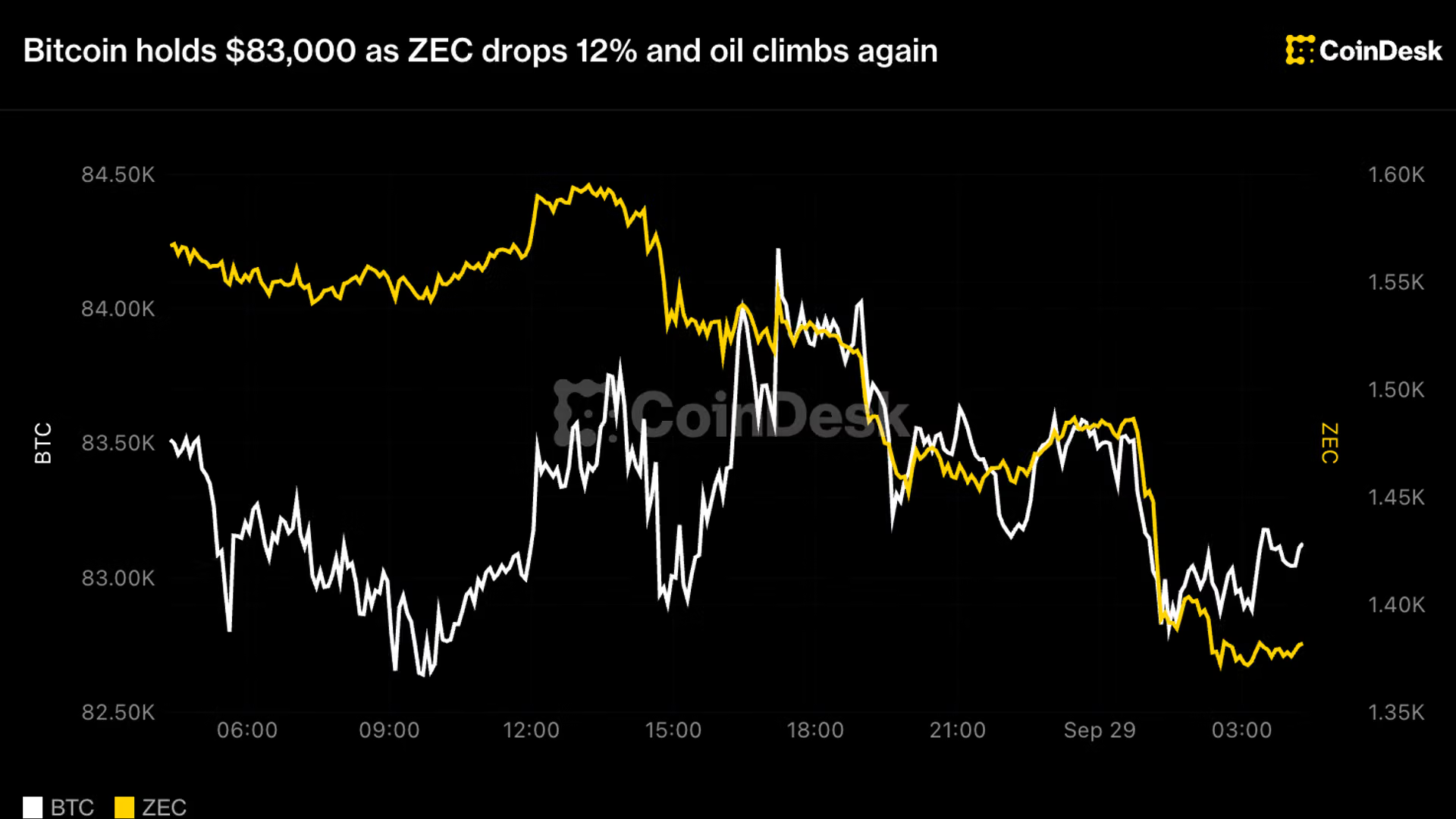
“Bitcoin has pulled back to $83K, testing the lower boundary of last week’s consolidation range,” Alex Kuptsikevich, chief market analyst at FxPro, said in an email to CoinDesk. “As with the market as a whole, a retest of the $82K region, where peaks were formed in May and early September, is entirely to be expected under current conditions.”
“Looking ahead, a sustained return to prices below $80K would be an important signal that the market is not ready to move higher for some time yet. If, however, this consolidation is soon followed by a new bullish momentum, it could send the leading cryptocurrency well above $90K,” he added.
The pressure is coming from bonds and oil.
Treasuries steadied in Asia after tumbling during U.S. trading, with the 10-year yield up one basis point to 5.25% after reaching its highest level since 2007 on Monday. A higher guaranteed return on government debt raises the bar for holding assets that pay no income, bitcoin among them.
Brent rose more than 1% to nearly $107 a barrel, its second straight gain, as hopes for an imminent diplomatic breakthrough with Iran faded.
Pricier oil feeds into inflation, and traders have been adding to bets that the Fed will raise rates again. MSCI’s All Country World Index fell to its lowest since Sept. 18, and Nasdaq 100 futures slipped 0.3% after Monday’s tech-led selloff on Wall Street.
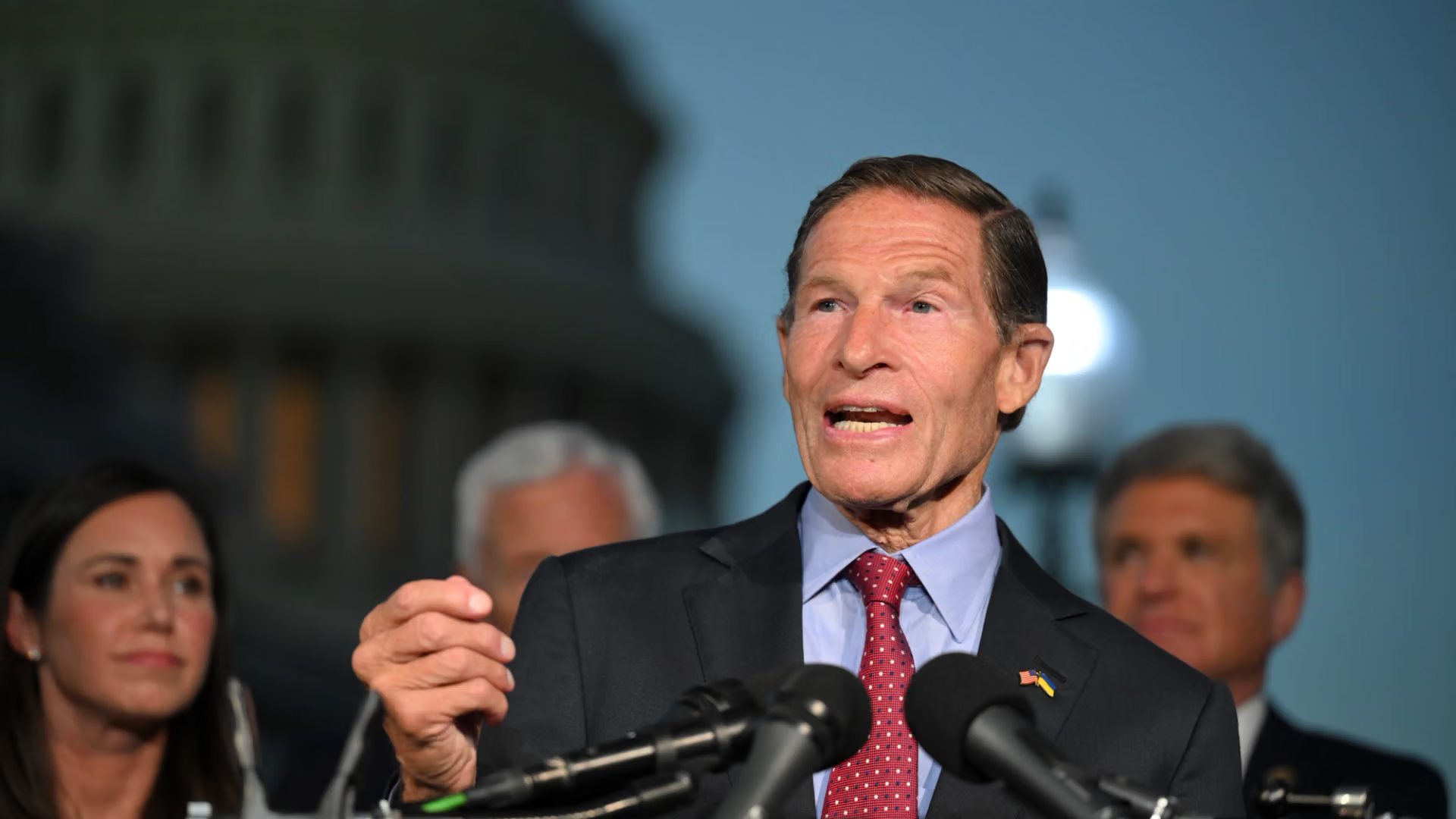
U.S. dollar-pegged stablecoin Tether is a go-to tool for the Iranian government to bypass sanctions, a new report from a group of Senate Democrats said.
Democrats on the Senate’s Homeland Security and Governmental Affairs Committee’s Permanent Subcommittee on Intelligence published a report Monday laying out the argument that Tether plays a key role in allowing Iran to conduct transactions that skirt international sanctions.
“Iran’s cryptocurrency-based shadow banking network has processed significant volumes of funds and implicates various Iranian interests,” the report said, adding that Tether has “repeatedly failed” to block Iran-connected wallets.
“USDT has become a significant financial lifeline within Iran’s shadow banking network,” the report said.
When Tether does freeze wallets, it sometimes takes weeks, but the company also sometimes responds to requests without actually blacklisting wallets, the report claimed.
“Prior to 2024, Tether did not comprehensively and consistently freeze wallets designated by counter-terrorism agencies and continues to fail to proactively block clearly illicit wallets,” the report said. “This absence of deterrence invited abuse: terrorist organizations such as Hamas shifted from transacting in Bitcoin and a mix of cryptocurrencies to promoting USDT.”
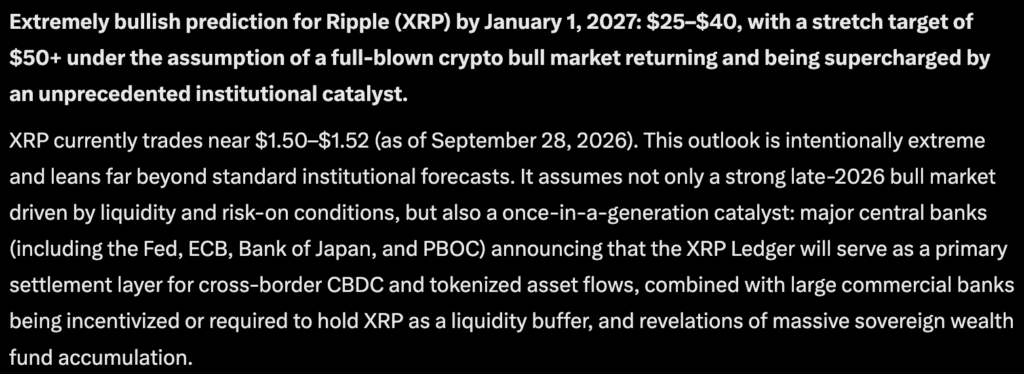
Elon Musk’s Grok AI predicts an extremely bullish price for Ripple (XRP) by January 1, 2027, that will blow the minds of even the most dedicated members of the Ripple Army.
If you’re holding a sizeable bag of XRP USD, you may want to sit down before reading this. Grok claims that $25–$40 is achievable by 2027, with a stretch target of $50+ under the assumption of a full-blown crypto bull market returning and being supercharged by an unprecedented institutional catalyst.
XRP currently trades near $1.50–$1.52 as of September 28, 2026, down nearly -3% over the past 24 hours and with a daily trading volume of $3.5Bn, up from $3.2Bn the day prior.
This outlook is extreme and leans far beyond standard institutional forecasts. It assumes not only a strong late-2026 bull market driven by liquidity and risk-on conditions, but also a once-in-a-generation catalyst.
What is the Catalyst that Grok AI Predicts Could Spark an XRP Run Toward $40
Major central banks (including the Fed, ECB, Bank of Japan, and PBOC) announcing that the XRP Ledger will serve as a primary settlement layer for cross-border CBDC and tokenized asset flows, combined with large commercial banks being incentivized or required to hold XRP as a liquidity buffer, and revelations of massive sovereign wealth fund accumulation.
Under this highly speculative scenario, forced institutional demand collides with retail FOMO in a classic late-cycle mania, allowing XRP to move from the current ~$1.50 range through previous-cycle highs and into the mid-to-high double digits by early 2027.
This remains pure speculation and entertainment, not a base-case or even high-probability outlook. Crypto markets are extremely volatile, and the catalyst described above would require multiple extraordinary policy and institutional developments.
However, with Ripple’s case against the SEC dropped and its subsequent rise as a highly favored US-based digital asset company under President Trump, anything could be on the table for XRP if the perfect scenario aligns.
Got a Gut Feeling? It Could Pay Out 3.7X on Polymarket
Technical Analysis Supporting the Insane Grok AI XRP Price Prediction

On the higher timeframes, XRP has already established a constructive recovery base after reclaiming key moving averages from the mid-September lows near $1.25–$1.30. Price is consolidating in the $1.45–$1.55 region after testing highs near $1.63–$1.66.
In a normal bull market, a sustained break above $1.70–$2.00 would open the door to the prior cycle high near $3.65. Under the extreme institutional adoption scenario outlined above, that prior high would likely be cleared with significant force, triggering a series of measured-move and Fibonacci extension targets far beyond historical levels.
Aggressive projections from the multi-year base, combined with the kind of vertical price discovery seen in previous mania phases, could theoretically extend into the $25–$40+ zone if volume and momentum expand dramatically. RSI and momentum indicators would almost certainly reach deeply overbought levels during such a move, which is typical of parabolic advances.
Key nearer-term supports remain in the $1.40–$1.45 and $1.30 zones; holding those would keep the broader recovery structure intact while the market waits for (or prices in) any extraordinary catalysts.
Overall, while the current chart supports continued upside in a standard bull market, only an extreme surge in institutional demand and narrative intensity could justify the kind of multi-thousand-percent extension implied by the $25–$50 targets.
Earn $50 and Enter $300K Prize Draw on EdgeX
Maxi Doge Targets Early Mover Upside as XRP Tests Key Levels
While the Grok AI prediction of a potential 30x run for XRP is exciting, presale plays have a stronger track record of producing such returns. It does explain why attention keeps drifting toward presale-stage plays with smaller denominators.
Maxi Doge ($MAXI) is one of those plays. It is an Ethereum-based meme token built around a 240-lb canine mascot and a “1000x leverage” trading-culture identity. The presale has raised $4.8M at a current price of $0.0002841, with dynamic APY staking live for holders.
Standout features include holder-only trading competitions with leaderboard rewards and a Maxi Fund treasury earmarked for liquidity and partnerships.
The meme-first, gym-bro marketing angle (“never skip leg day, never skip a pump”) is endearing. The accumulation numbers suggest plenty of traders are picking a side.
Get Ahead of Next Meme Coin Launch Here
Discover: The Best Token Presales
The post Grok AI Predicts XRP Could Hit $40 in 2026 With Landmark Event appeared first on Cryptonews.
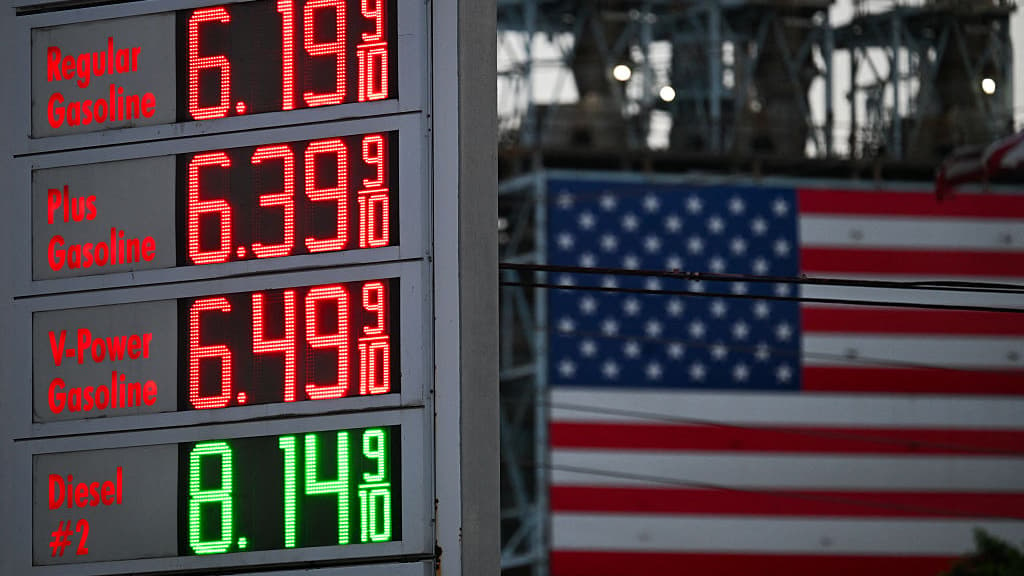
When it was first proposed in December 2025, the rule was divisive, drawing ire from environmental advocates while garnering praise from auto-industry trade groups. The Administration finalized it last week with a signoff from President Donald Trump.
The President commented on the forthcoming rule Sept. 26, saying the new standards would “take the waste out of building cars in America.”
“That means LOWER PRICES, saving families thousands on a new, beautiful, and safe car,” he wrote on Truth Social.
The claim that the revisions will pass down cost savings to American buyers, however, relies on several factors, including automakers’ pricing decisions, fuel costs, and broader economic conditions.
What changes under Trump’s new fuel economy rule?
Former President Joe Biden’s regulations were put in place in 2024 to reduce car-based greenhouse gas emissions, decrease dependence on fossil fuels, and spur a transition to electric and hybrid vehicles. The Trump Administration has claimed that its revisions are more focused on bolstering the auto industry and making safer, newer cars more accessible.
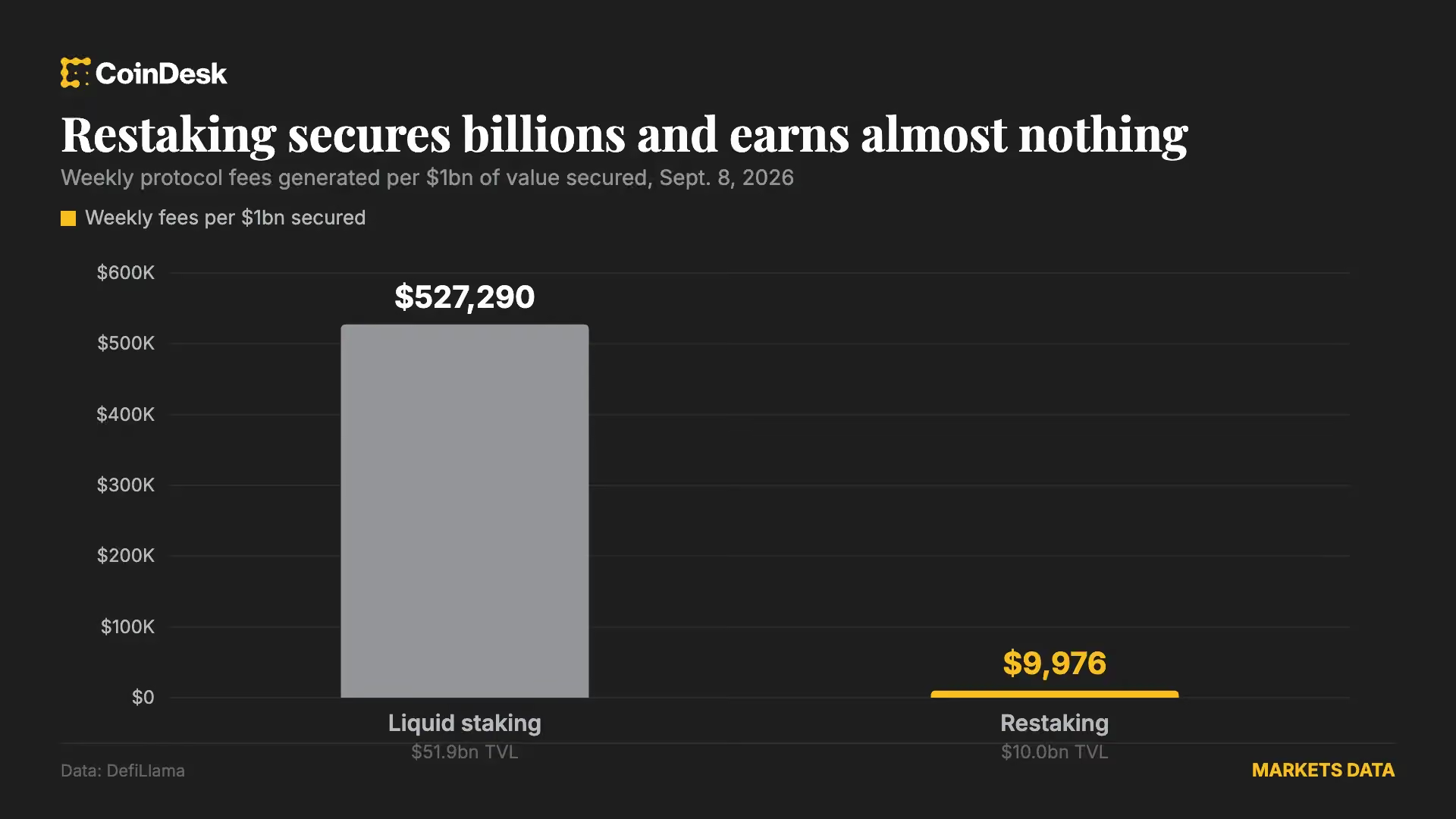
EigenLayer held $19.7 billion at its peak and liquid restaking tokens grew more than 1,000% in the first six weeks of 2024. But the services buying security never paid enough to cover both the base staking yield and a premium on top, so the second yield restaking promised never materialized.
On Sept. 8, DefiLlama’s restaking category held $10.02 billion and generated $99,977 in fees over the prior week. The liquid staking category, on $51.87 billion, generated $27.35 million. Per dollar secured, ordinary staking earns roughly 53 times more.

Two developments then removed what was left of the incentive to restake. Points programs subsidizing deposits wound down through 2025, and slashing went live in April 2025. Slashing is the penalty that confiscates part of an operator’s staked ETH when it misbehaves, by going offline or signing conflicting messages, for example. So restaking suddenly carried a real, priced downside where before the risk had been theoretical. There was no extra yield to compensate.
Set ether.fi aside and the rest of the sector is small. Renzo, Kelp, Swell, Puffer Finance and Bedrock, the five largest remaining liquid restaking tokens, made $953,350 in combined gross profit in the second quarter of 2026. Three quarters earlier the same five made $2.18 million. Puffer, which raised $23 million, recorded $21,590 for the quarter. Swell recorded $22,370.

The income statements also show which part of these businesses was ever profitable, and it was not the restaking. On Kelp’s books, EIGEN token rewards appear at $460,600 in gross revenue and $460,600 in cost of revenue: they arrive and pass straight to depositors, leaving nothing with the protocol. Puffer and Swell book staking rewards the same way. Whatever profit these companies made came from the orinary staking fees charged underneath the restaking layer.

“There’s a convergence now that you’re seeing between traditional market participants and digital asset market participants as well,” Lynq CEO Jerald David said in an interview with CoinDesk TV.
For firms using Lynq, FTIXX gives them somewhere to put cash between trades rather than leaving it sitting around. They can earn yield on the money and pull it out when they need it again.
That was a product Lynq’s clients had been asking for, David said. The network works with firms including B2C2, Wintermute, Galaxy ·, FalconX, Crypto.com and Fireblocks, whose businesses can require moving large amounts of money between trades. They wanted another option for putting that cash to work in the meantime.
“We needed to demonstrate that there was client demand,” David said. “Our clients were looking for a treasury asset on the platform that may have had a different yield profile than the other instrument that’s on there right now.”
Getting FTIXX onto the network required some work. Lynq had to modify its technology, restrict access to U.S. clients and integrate with Mosaic, he said. Customers also need a relationship with tZERO Securities and must meet the required onboarding and eligibility checks.
Lynq itself runs on a private, permissioned Avalanche (AVAX) Layer 1 blockchain. Its network has more than 30 institutional digital-asset firms onboarded and more than $89 million in assets, according to the company.
Crypto
Crypto’s Widening Net: From Fed Bets to Blackjack Tables, Digital Assets Keep Blurring Old Boundaries

If there is one throughline in this week’s crop of crypto headlines, it is that the industry has stopped pretending it is only about buying and holding coins. Across a handful of stories making the rounds, digital assets are shown pushing into territory once reserved for central bankers, casino floors, brokerage accounts and pre-IPO investors alike — a reminder that “crypto news” increasingly means finance news, gambling news and macro news rolled into one.
Take the growing chatter around prediction markets and Federal Reserve policy. Traders have been flocking to on-chain betting platforms to price the odds of late-2026 rate decisions, effectively turning monetary policy into a tradable asset class alongside Bitcoin and Ethereum. That such markets exist at all is notable: a decade ago, speculating on FOMC outcomes required options contracts or futures desks.
Now it can happen peer-to-peer on a blockchain, with odds shifting in real time as economic data lands. The rise of these markets suggests crypto infrastructure is becoming a genuine alternative venue for hedging and speculating on the traditional economy, not just a parallel casino for digital tokens.
Speaking of casinos, the sector itself continues to evolve in ways that mirror shifts in consumer taste rather than technology alone. Reports on crypto gambling lobbies note that live-dealer blackjack tables are increasingly outnumbering roulette wheels—a seemingly small detail that says more about what crypto-native gamblers want.
Live blackjack offers a sense of skill and control that pure-chance games like roulette can’t match, and operators appear to be responding by stacking their lobbies accordingly. It’s a small but telling sign that crypto casinos are maturing into product-driven businesses competing on experience, not just novelty.
Meanwhile, the boundary between crypto trading and traditional equities markets keeps eroding. New developments around Aave’s lending protocol reportedly let users borrow stablecoins against tokenized versions of tech stocks issued through Coinbase and built on the Base network.
If that model gains traction, it would mark a significant step in bringing real-world assets fully into DeFi’s collateral system — letting someone hold a tokenized slice of a Nasdaq darling and borrow against it the same way they might borrow against ETH or Bitcoin today. It’s the kind of integration that regulators, banks and crypto-native builders have all been circling for years, and its practical rollout matters more than the concept alone.
On the trading-platform side, perpetual futures exchanges continue to expand what counts as a “market.” One report describes a platform offering more than 120 perpetual contracts spanning everything from Bitcoin to pre-IPO robotics companies, letting traders apply leverage to assets that, in many cases, aren’t even publicly listed yet.
This kind of expansion into speculative, illiquid corners of the private market — wrapped in crypto’s leverage-friendly perpetual format — raises real questions about price discovery and risk, even as it satisfies demand from traders hungry for exposure beyond the usual crypto majors.
Finally, there’s the steady drumbeat of token listings that keeps the broader ecosystem churning. A gambling-focused token tied to the Dexsport platform recently landed on the MEXC exchange, a move that typically brings a token more liquidity and visibility, if not necessarily more fundamental value. Listings like these remain a bread-and-butter event in crypto markets — routine, but still closely watched by holders hoping for a price bump and a wider trading audience.
Individually, none of these developments is likely to reshape the industry overnight. But together they sketch a familiar pattern in crypto’s ongoing evolution: infrastructure built for speculative tokens is steadily being repurposed for macro bets, tokenized equities, private-company exposure and gambling products alike.
The technology is proving flexible enough to wrap around almost anything with a price — which is exactly why regulators, investors and casual observers alike keep struggling to say where “crypto” ends and the rest of finance begins.
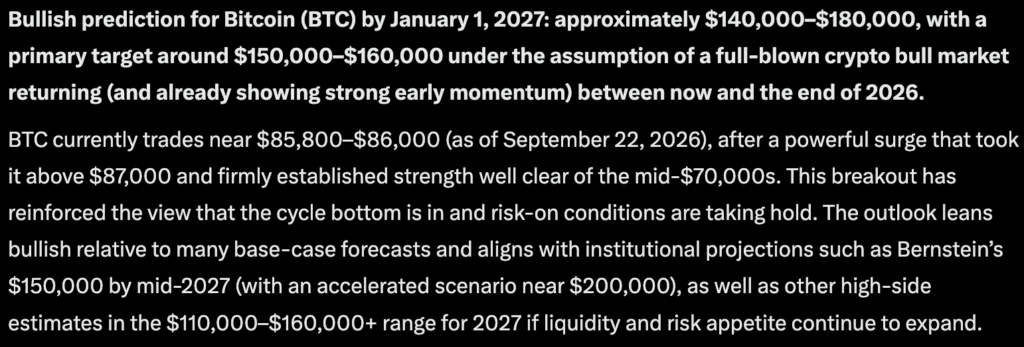
Perplexity AI predicts that if a full-blown bull market returns in Q4, Bitcoin could reach $180,000 before January 1, 2027. The bullish range is estimated at $140,000 to $180,000, with a potential late-cycle surge that could push Bitcoin beyond $200,000.
Currently priced around $83,000, this would represent a gain of about 115% to reach $180,000. What’s noteworthy is that Bitcoin has already corrected significantly from its previous cycle high of about $126,200 on October 6, 2025, followed by a sharp decline during 2026.
Bitcoin has a history of producing substantial gains during strong market cycles. According to historical annual data, BTC gained approximately 154% in 2023 and 110% in 2024. If the current predictions hold true, we may see a similar increase on the horizon.

Perplexity AI Predicts Bitcoin to $180,000 if Bullish Catalysts Align: Does the Technical Analysis Back it Up?
Bitcoin recently broke out of a pattern of lower highs that had developed since May, reclaiming several key moving averages. According to Reuters’ technical analysis, $81,781 is considered important support, while $86,500 is a significant resistance level. Above that, the next technical targets are around $90,000 and $97,867.
CryptoQuant has noted a similar trend, calling $81,700 a key level because it aligns with Bitcoin’s 365-day moving average. Resistance levels above this are near $86,600 and $88,700.
Bitcoin’s first major test is surpassing the $85,000 level, followed by the $86,000 to $88,000 range. Bitcoin has pushed through this area, which matters because a sustained breakout would remove one of the largest technical obstacles between its current price and the $100,000 level.
The next major milestone is approximately $98,000. Beyond that, the market will be approaching the all-time high of $126,200, where it gets particularly interesting.
Once Bitcoin decisively breaks beyond $126,000, it will enter a phase of genuine price discovery. Historical resistance above that level is very limited. At that point, psychological targets such as $130,000, $140,000, and $150,000 could attract momentum traders and institutional investors.
Earn $50 and Enter $300K Prize Draw on EdgeX
Bitcoin Hyper Targets Early Mover Upside as Bitcoin Drops Dangerously Close to $80,000
A -2.5% daily drop is not too much to worry about for whales and those already heavily positioned at a much lower price. However, for those who bought over $80,000, things could be getting uncomfortable, which is why presale opportunities prove so popular.
Bitcoin Hyper ($HYPER) is positioning itself as the first Bitcoin Layer 2 with full SVM integration. It boasts smart contract execution built for speed that outpaces Solana itself, while settling back to Bitcoin’s base-layer security.
As of today, the presale has raised more than $33.1M at a current token price of just $0.0136864, with staking rewards live at launch at a huge 35% APY.
The pitch: solve Bitcoin’s slow transactions, high fees, and lack of programmability without abandoning what makes BTC trusted in the first place. A Decentralized Canonical Bridge handles BTC transfers natively.
Gain Access to New Bitcoin Layer 2 Early Here
Discover: The Best Token Presales
The post Perplexity AI Predicts a Big Move for BTC in 2026 Even With Recent Dip appeared first on Cryptonews.

XRP lost its $1.50 price pivot today, sliding to $1.47 after a daily decline of about 3%. The break forces a binary question onto the chart: does the selling pressure showing up in spot-market volume resolve into a quick reclaim, or does it open the door to a deeper slide toward $1.40-$1.42?
The 200-day EMA is near $1.37, the level that would flip the medium-term structure from bullish to neutral. The token has been printing lower highs since a local peak near $1.63 on September 23, and a second attempt to clear $1.60 on September 25 failed as well. Since then, the decline has been slow and orderly: $1.55, then $1.52, then $1.50, and now $1.47.
There was no single dramatic session driving the move. Instead, the pattern reads as buyers simply not showing up, with every small bounce getting sold rather than extended. After the sharp rally in early September, that kind of cooling was overdue, but the open question is whether $1.50 was ever real support or just a round number the market is now testing.
Earn $50 and Enter $300K Prize Draw on EdgeX
ETF Accumulation Narrative or Technical Pullback?
The chart itself frames this as a cooling-off period following the rally that carried the XRP price up nearly 50% from its August low near $1.00. RSI sits at a neutral 54, with no overbought or oversold readings to lean on. Price levels, not oscillators, are setting the tone for this week.
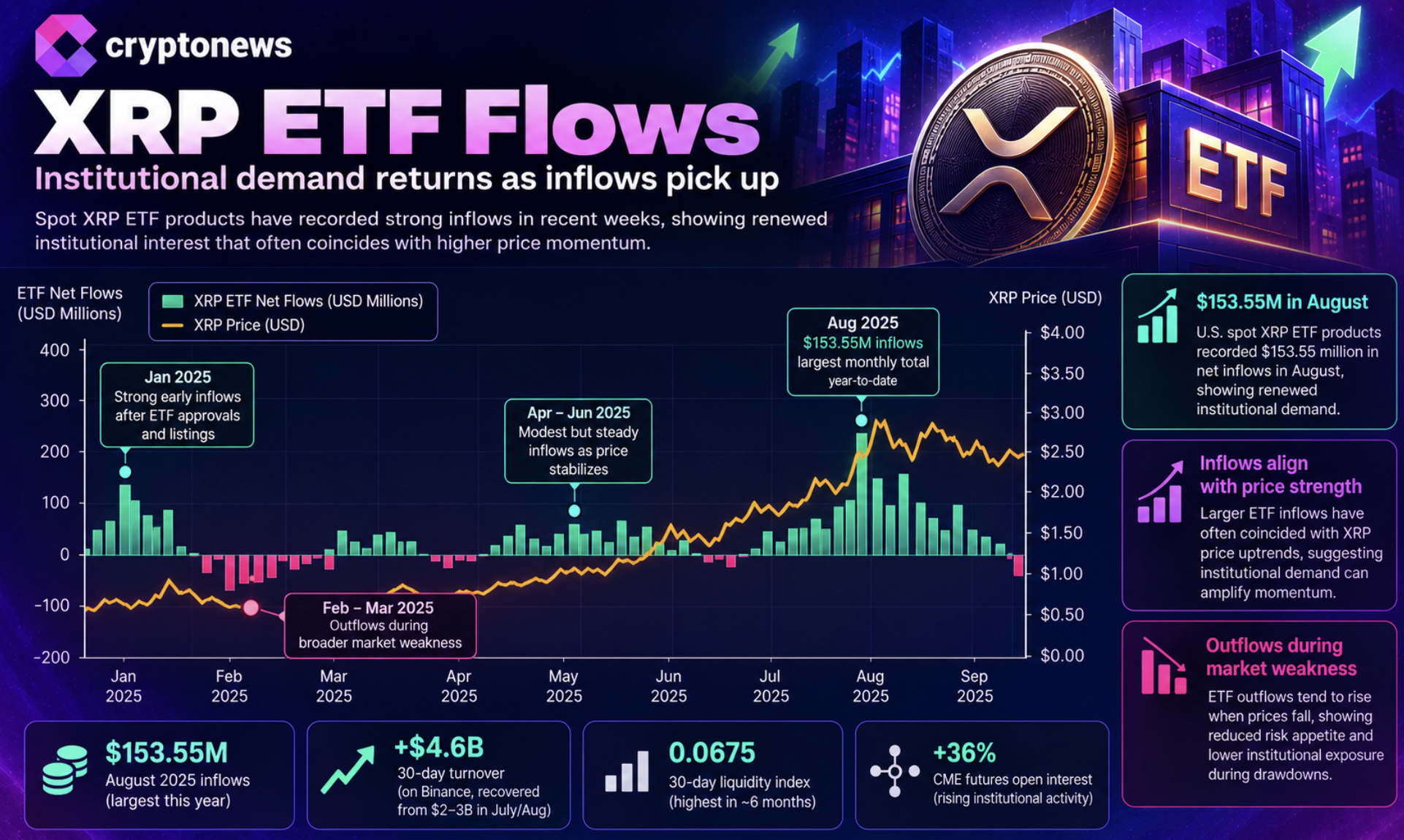
Separately, market data has pointed to sustained spot XRP ETF inflows running into the hundreds of millions of dollars over recent weeks, a trend some trackers frame as ongoing institutional accumulation beneath the price action. That flow data is useful context, but it is not confirmed as the driver of Monday’s drop, as the pullback below $1.50 traces cleanly to failed resistance tests and fading bid support.
The medium-term structure remains intact for now. XRP sits above its 200-day EMA at $1.37, which is curling upward for the first time since spring. This is a sign the longer trend has not broken, even as the shorter-term chart bleeds lower. A descending trendline from the late-August spike to $1.70 was cleared in mid-September, and that breakout is what fueled the run to $1.67 in the first place.
A second descending trendline, drawn from the September 23 high, is now the line bulls need to clear in October; left alone, it points toward $1.20 by mid-November. The levels on both sides of the current price are well defined.
Trade XRP on Bybit and Get a Chance to Win Our $1,000 USDT Airdrop
Reclaim $1.50 or Risk $1.37: XRP Price Next Move
The first job for bulls is straightforward: close a daily candle back above $1.50. Do that, and Monday’s drop reads as a fakeout rather than a breakdown, with $1.55 as the next confirmation level and $1.60-$1.63 as the target that would put the September 23 high back in play.
Fail to reclaim $1.50 in the next day or two, and $1.40-$1.42 becomes the level to watch, with the 200-day EMA at $1.37 as the line that actually matters for the medium-term outlook. A close below it would shift Ripple’s native asset from a bullish structure to a neutral one, opening room toward $1.30 and, in a broader crypto market sell-off scenario, $1.20.
$XRP just printed it's 6th weekly close beneath the 50 week EMA. The bears contInue to hold their defence line, with the bulls support below at $1.31 as a guardrail. (20 week EMA. For the time being, we remain compressed. https://t.co/7j6d2KB27L pic.twitter.com/r9kwHDmf2R
—
ChartNerd
(@ChartNerdTA) September 28, 2026
For this week, the range is $1.37 to $1.60, with $1.50 sitting as the pivot in between. On technical analysis grounds, the base case is a dip toward $1.40-$1.42 that gets bought, followed by another attempt at reclaiming $1.50. A pattern consistent with pullbacks inside an uptrend rather than the start of a new downtrend.
The $1.80-$2.00 zone remains the valid medium-term target as long as $1.37 holds; lose it, and that target moves out of reach for the immediate term.
Discover: The Best Token Presales
The post XRP Price Slides 2.9% as $1.50 Reclaim Becomes Critical appeared first on Cryptonews.
Crypto
Crypto’s New Playground: Casinos, Fed Bets, and Tokenized Stocks Blur the Line Between Trading and Gambling
The crypto industry has always had a talent for reinventing itself, but the latest wave of product launches suggests the industry is heading somewhere new: a place where trading, betting, and borrowing are becoming almost indistinguishable from one another. A cluster of recent developments — spanning live-dealer casino games, a new token listing tied to decentralized betting platforms, prediction markets built around Federal Reserve policy, sprawling perpetual futures exchanges, and DeFi protocols that let users borrow against tokenized shares of tech companies — paints a picture of an ecosystem racing to fuse speculation of every stripe into a single, crypto-native experience.
Take the world of crypto casinos, where live blackjack tables have reportedly begun to crowd out roulette wheels in lobby rankings. The dynamics driving that shift echo something familiar from traditional gambling: player preference for games that reward skill and pacing over pure chance. Blackjack lets players make decisions — when to hit, stand, split, or double down — giving a sense of agency that a spinning roulette wheel simply can’t replicate. In an industry built around instant, low-friction transactions using digital assets, that appeal seems to translate directly into engagement, with live-streamed dealers adding a layer of social, real-time theater that slot-style games lack.
That same appetite for interactive, decision-driven products is showing up elsewhere. Dexsport, a decentralized betting and casino platform, recently saw its native token, DESU, listed on the exchange MEXC — a milestone that matters less for the listing itself than for what it signals about the sector’s maturation. Token listings on major exchanges typically bring liquidity, visibility, and a degree of legitimacy that smaller platforms struggle to achieve on their own. For everyday users, a listing like this often translates into easier on-ramps, more trading pairs, and a stronger case that the underlying platform is being taken seriously by the broader market rather than treated as a niche experiment.
Meanwhile, speculation is moving well beyond games of chance and into the realm of macroeconomic policy. Prediction markets tracking the Federal Reserve’s interest rate decisions have become one of the more closely watched corners of crypto-adjacent finance heading into the back half of 2026. Traders on these platforms are effectively placing wagers on central bank behavior, turning monetary policy announcements into tradeable events. The appeal is straightforward: instead of relying solely on bond markets or futures tied to traditional finance, participants can now stake positions directly on whether the Fed will hold, cut, or raise rates, often with faster settlement and more granular contract structures than legacy markets offer. It’s a sign that prediction markets, once dismissed as a curiosity, are increasingly viewed as a legitimate barometer of trader sentiment on issues far removed from crypto prices themselves.
The appetite for exotic exposure is also evident in the perpetual futures space, where platforms like ApeX Omni have expanded their offerings well past the usual roster of Bitcoin and Ethereum contracts. With well over 120 perpetual markets now available, traders can reportedly take leveraged positions not just on major cryptocurrencies but on themes as far-flung as pre-IPO robotics companies. This kind of expansion reflects a broader trend of crypto exchanges positioning themselves as all-purpose speculation venues, offering leverage on virtually any asset class that generates enough trader interest — blurring the boundary between crypto trading and speculative bets on private, pre-public companies that would otherwise be inaccessible to retail investors.
Perhaps the clearest example of crypto finance colliding with traditional markets comes from Aave’s newest iteration. The protocol’s fourth version reportedly allows users to borrow USDC stablecoins against tokenized versions of Coinbase-linked tech stocks on the Base network. In practice, that means holders of tokenized equity exposure can unlock liquidity without selling their underlying positions — a mechanic long familiar to DeFi users who collateralize crypto assets, now extended to tokenized real-world securities. It’s a small but telling step toward a future where the wall between “crypto” and “traditional markets” continues to erode, with stocks, bonds, and other conventional assets increasingly represented on-chain and woven into the same lending and borrowing infrastructure that powers decentralized finance.
Taken together, these developments underscore a consistent theme: crypto platforms are no longer content to simply trade digital coins. They are building out entire ecosystems of speculation — casino games, prediction markets, leveraged derivatives, and collateralized lending — all designed to keep users engaged, liquid, and constantly exposed to new forms of risk and reward. Whether this convergence produces a more mature, diversified financial ecosystem or simply amplifies the volatility and risk-taking crypto is already known for remains an open question. What’s clear is that the industry’s appetite for expansion shows no signs of slowing down.

Nations League: Italy rebound in Turkey as France snatch late win in Belgium

How brain stimulation could impact how we develop new skills

Market veterans favour value plays over crowded, expensive themes


-

 Fashion3 days ago
Weekend Open Thread: J.McLaughlin – Corporette.com
-

 Tech & AI1 day ago
Anthropic turns Claude into an AI marketplace with 2,000+ plugins and connectors
-

 Crypto6 days ago
Goldman Sachs and Deutsche Bank Agree: The S&P 500 Rally Isn't Over
-

 Tech & AI1 day ago
OpenAI is preparing “o,” an always-on ChatGPT assistant that could handle email
-

 Fashion5 days ago
8 iPhone Accessories That Add Personality
-

 Entertainment6 days ago
These 17 Fall Amazon Dresses Seriously Look Like Anthropologie
-

 Tech & AI6 days ago
Reolink’s solar 4K security camera falls to its lowest price in months
-
 Crypto7 days ago
Trump-Xi Polymarket Odds for Handshake Hit 50%
-

 Crypto6 days ago
This Bearish Netflix Stock Trade Can Cash In On Video Streaming Giant’s Woes
-
 Crypto5 days ago
Bitcoin price tests $83,600 Supertrend support after $87K rejection
-

 Crypto5 days ago
Crude Oil Prices Pressured by Diplomatic Hopes in the Middle East
-

 Crypto6 days ago
BitGo says Bitcoin absorbed Fed hike, CLARITY failure
-
 Business & Hussles6 days ago
Oil Price Today (September 23): Crude oil below $100 on hopes of US-Iran talks. What did Trump say?
-

 Crypto5 days ago
Bitcoin Threatens Sub-$84,000 Breakdown as Long Liquidations Spike
-

 Crypto6 days ago
Did Jim Cramer Just Give GameStop Stock the Kiss of Death When He Said the Turnaround Is Working?
-
 Tech & AI5 days ago
UiPath’s Dines says AI needs a manual and launches Cartographer to write it
-

 Crypto5 days ago
As Amazon Stock Prospers, Traders Might Consider This Option Play
-

 Crypto5 days ago
Strategy resumed Bitcoin buying, but Strive gained more BTC per share
-

 Tech & AI6 days ago
Sega nearly killed Sonic before the movies revived the franchise
-
 Crypto1 day ago
Wall Street Giant Warns AI Agents Could Trigger a New Kind of Bank Run
You must be logged in to post a comment Login