
Crypto World
2014 Email Reveals Blockstream CEO Pressured Epstein to Divest from Ripple and Stellar


TLDR:
- Austin Hill told Epstein that Ripple and Stellar were “bad for the ecosystem” Blockstream was building.
- Blockstream co-founders demanded Epstein reduce his allocation due to competing protocol investments.
- Joi Ito and Reid Hoffman were copied on the 2014 email discussing strategic investor alignment issues.
- Gary Gensler taught crypto at MIT while Ito facilitated Epstein donations to the same institution.
Newly surfaced correspondence from 2014 shows Jeffrey Epstein held an investment allocation in Blockstream, a Bitcoin infrastructure company.
The email from CEO Austin Hill to Epstein reveals strategic pressure to divest from competing protocols Ripple and Stellar.
The communication, which included MIT Media Lab Director Joi Ito and investor Reid Hoffman, demonstrates active enforcement of ecosystem loyalty among early cryptocurrency investors.
Strategic Investor Conflicts in Early Blockchain Development
Austin Hill’s July 31, 2014 email to Epstein outlined a direct request from Blockstream’s co-founders. According to the original message, Hill stated he had “been asked by the other cofounders to reduce or take your allocation away.”
The CEO explained that Ripple and Jed McCaleb’s new Stellar “are bad for the ecosystem we are building.” Hill further noted that having investors “backing two horses in the same race” would damage the company’s strategic positioning.
The correspondence treated Epstein as a strategic investor whose portfolio choices affected Blockstream’s governance and capital strategy.
These were not incidental social exchanges but direct operational communications about investment policy. The email exchange occurred during a critical period for blockchain technology development when competing visions for distributed ledger architecture were taking shape.
Blockstream positioned itself around Bitcoin and the Lightning Network infrastructure. Meanwhile, Ripple’s XRP Ledger and Stellar represented alternative approaches to distributed ledger technology.
These competing protocols created tensions among investors and developers about which system would become the dominant base layer for cryptocurrency transactions.
The involvement of Joi Ito added another dimension to these networks. As MIT Media Lab Director from 2011 to 2019, Ito served on multiple technology boards and advised governments on digital policy.
His presence in the email chain demonstrated connections between cryptocurrency investment decisions and academic institutions researching blockchain technology.
MIT Connections and Regulatory Developments
Ito’s role at MIT Media Lab positioned him as a bridge between cryptocurrency investors and academic research. The lab expanded corporate funding under his leadership while focusing on AI, digital identity, and cryptocurrency projects.
Epstein’s ties to MIT later became controversial when 2019 reporting revealed the Media Lab had accepted donations linked to him. Ito resigned after admitting errors in judgment regarding these financial relationships.
Gary Gensler taught cryptocurrency courses at MIT before his 2021 appointment as SEC Chairman under President Biden.
His academic work occurred within the same institutional environment where Ito facilitated donor relationships. The regulatory approach toward Ripple and other cryptocurrency projects would later become a defining feature of Gensler’s SEC tenure.
Rob Cunningham’s analysis on KUWL.show examined these overlapping relationships. His post noted that “Epstein functioned as a capital node in overlapping elite tech networks.”
The connections between Blockstream, MIT, and later regulatory actions suggest coordinated efforts to shape cryptocurrency market development according to specific ecosystem preferences.
The 2014 correspondence reveals that ecosystem competition extended beyond technical differences. Investor alignment and narrative control played substantial roles in early blockchain development.
Bitcoin infrastructure companies viewed alternative protocols as existential threats to their position as the primary decentralized rail for digital assets.




The mines Iran scattered across the Strait of Hormuz are now preventing the country from widening access to the waterway, as Tehran cannot account for where all of them ended up, US officials say.
The revelation comes as senior delegations from both countries are set to meet in Islamabad for negotiations that will test whether any truce can survive.
Iran Can’t Find the Mines It Planted in the Strait of Hormuz
According to The New York Times, Iran used small boats to scatter mines across the strait after the US and Israel launched their strikes on February 28. US officials noted many mines may have been placed without recorded coordinates or in ways that allowed them to drift.
The haphazard placement created a problem Tehran did not anticipate. Foreign Minister Abbas Araghchi signaled that Tehran would allow vessels through the waterway, but “with due consideration of technical limitations.” American officials said that phrase referred directly to Iran’s inability to find or clear its own ordnance.
Follow us on X to get the latest news as it happens
Meanwhile, this directly undermines the toll system Iran announced. Under that framework, laden tankers must email cargo details to Iranian authorities and then pay $1 per barrel of oil in Bitcoin within seconds. The system was designed to bypass sanctions.
The Hormuz Letter highlighted that, at pre-war traffic of roughly 20 million barrels per day. This fee structure could generate approximately $7.3 billion annually. However, with uncharted mines still drifting through the strait, the toll’s revenue potential is largely theoretical for now.
US-Iran Ceasefire Talks Open Under Immense Pressure
Senior delegations from both countries have arrived in Islamabad for ceasefire talks. Vice President JD Vance leads the US team alongside Steve Witkoff and Jared Kushner. Meanwhile, Parliament Speaker Mohammad Bagher Ghalibaf and Araghchi head Iran’s delegation.
President Trump has demanded the “complete, immediate, and safe opening” of the strait as a condition for the ceasefire to hold. Yet neither side possesses mine-clearing capabilities.
“The US military lacks robust mine removal capabilities, relying on littoral combat ships equipped with mine sweeping capabilities. Iran also does not have the capability of quickly removing mines, even the ones it planted,” the report read.
The mine problem feeds into a broader economic fallout. BeInCrypto recently highlighted that the Strait’s closure has also disrupted global fertilizer and aluminum supply chains, amplifying the damage well beyond oil prices.
Whether Islamabad produces a framework for sustained mine clearance and verified strait reopening will determine whether the ceasefire survives beyond its April 22 expiration.
Subscribe to our YouTube channel to watch leaders and journalists provide expert insights
The post Iran’s Best War Tactic is Now a Liability at the Negotiating Table appeared first on BeInCrypto.

TLDR:
- Arizona must pause criminal charges against CFTC-regulated prediction markets after the federal TRO order.
- The CFTC says federal law grants exclusive authority over event contracts and market enforcement.
- Connecticut and Illinois now face similar federal lawsuits over state prediction market restrictions.
- The ruling strengthens legal momentum for federally supervised crypto-linked trading platforms.
A federal judge in Arizona temporarily halted the state’s criminal case against federally regulated prediction markets on Friday. The order came after the Commodity Futures Trading Commission asked the court to stop Arizona’s enforcement push.
The ruling preserves the status quo while a broader federal preemption fight moves forward. It also sharpens the legal divide between state gambling rules and federal event contract oversight.
CFTC Arizona TRO Freezes State Prediction Markets Charges
The U.S. District Court for the District of Arizona granted the temporary restraining order on April 10. The court barred Arizona from continuing criminal proceedings against CFTC-regulated designated contract markets.
According to the CFTC filing, the agency moved earlier this week for emergency relief. That motion followed its original complaint seeking to block Arizona from enforcing state law.
The dispute centers on whether federal law preempts state gambling and criminal statutes. The CFTC argues the Commodity Exchange Act gives it exclusive authority over event contracts.
Chairman Michael S. Selig said the order keeps the legal status quo intact while the court reviews jurisdictional questions. The agency also tied the case to broader concerns around state interference in federally supervised markets.
Arizona became the first state to pursue criminal counts tied to prediction market listings, including contracts offered by Kalshi. The restraining order now pauses that path, at least temporarily.
Federal Prediction Markets Fight Expands Beyond Arizona
The Arizona action forms part of a wider CFTC legal campaign. Last week, the agency filed related complaints against Connecticut and Illinois.
Those cases seek declaratory judgments confirming exclusive federal control over event contracts. The CFTC also wants permanent injunctions blocking states from enforcing overlapping laws.
The timing matters for crypto-linked prediction markets as well. Platforms like Polymarket and Kalshi increasingly overlap with digital asset users, stablecoin settlement, and onchain market infrastructure.
Recent court decisions have already strengthened the federal side. Earlier this week, an appeals court blocked New Jersey from shutting down Kalshi’s sports markets.
Friday’s Arizona TRO adds another legal marker in the same direction. For traders and exchanges, the immediate effect is procedural, but the broader question remains federal control over fast-growing prediction markets.

TLDR:
- Artemis stablecoin factor posted 83.6% annualized returns with minimal dependence on Bitcoin direction.
- The strategy gained 6.8% monthly across BTC down months, showing resilience during crypto market weakness.
- Mid-cap chains including Polygon and Sei generated 84% of total stablecoin factor returns over five years.
- Stablecoin flows remained Artemis’ least-correlated alpha factor with only 6.1% variance overlap.
Stablecoin flows are emerging as one of crypto’s clearest signals for layer-1 market rotation.
New research from Artemis shows capital moving through stablecoins consistently preceded stronger relative returns across major chains. The firm’s five-year backtest found the strategy remained largely detached from broad crypto market direction.
Results also showed the factor produced gains during months when Bitcoin posted losses.
Stablecoin Flows Predict L1 Returns Across Market Cycles
Artemis said its weekly rebalanced long-short factor generated a 1.67 Sharpe ratio over five years. The model delivered an annualized return of 83.6% during the test period.
The same backtest recorded a maximum drawdown of 43.9%. A volatility-targeted overlay lowered drawdown to 31.9% while reducing Sharpe to 1.17.
The data pointed to minimal dependence on Bitcoin’s broader trend. Artemis reported a market beta of -0.03 and an R² of 0.1%.
That structure became more visible during weaker crypto conditions. Across 30 BTC-negative months, the factor returned 6.8% monthly while Bitcoin fell 10.9%.
Artemis also measured annualized alpha at 73.8% after controlling for market exposure. The reported t-statistic reached 3.31 with significance at the 1% level.
The firm noted the strategy’s out-of-sample Sharpe estimate still held at 0.96 after applying a degrees-of-freedom haircut. That kept stablecoin flows among its strongest market-neutral crypto signals.
Mid-Cap Chains Drive Stablecoin Factor Alpha
Most of the gains came from the long side of the book. Artemis said 84% of returns originated from long exposure to chains attracting positive stablecoin inflows.
Mid-cap networks dominated the return profile. Polygon, Mantle, Optimism, BSC, and Sei contributed 84% of total factor returns.
The research also showed limited overlap with Artemis’ broader factor suite. Maximum pairwise correlation across the stack measured only 0.16.
Even after spanning regression against all other factors, the stablecoin signal retained a 2.54 t-statistic. Artemis said just 6.1% of variance overlapped with other models.
Performance also stayed resilient through distinct market phases. The factor returned 262% in 2021, 47% in 2022, and 315% in 2025.
Its only negative year came in 2024 with a 13% decline. Artemis linked that period to stagnant aggregate stablecoin supply growth before recovery resumed.
TLDR:
- Microsoft found the EngageLab SDK bug could expose private wallet data across 30M Android installs globally.
- The flaw abused Android intents to grant hostile apps persistent read and write provider permissions.
- EngageLab fixed the issue in v5.2.1 by changing MTCommonActivity to non-exported status.
- Google Play removed affected wallet apps, while Android added safeguards for already installed versions.
Microsoft has disclosed a severe Android SDK vulnerability that placed more than 30 million crypto wallet installs at risk. The flaw affected EngageLab’s widely used EngageSDK, which many wallet apps used for push messaging features.
According to Microsoft’s security research, the issue enabled malicious apps on the same device to bypass sandbox protections. Google Play has since removed all identified apps using the vulnerable SDK versions.
EngageLab Android SDK Flaw Exposed Crypto Wallet Attack Surface
Microsoft said the issue centered on an exported Android activity called MTCommonActivity.
The component was automatically added during manifest merging after developers imported the SDK. Because it appeared post-build, many teams likely missed it during review. That left production APKs open to hidden risk.
The vulnerable flow began when the activity received an external intent. Its onCreate() and onNewIntent() callbacks both routed data into processIntent().
That method extracted a URI string and forwarded it deeper into the SDK logic. The chain eventually rebuilt and launched a new intent.
Microsoft’s write-up noted the critical failure happened in a helper method. Instead of returning a safe implicit intent, it returned an explicitly targeted one. That changed Android’s normal resolution path and let hostile apps redirect execution.
In practice, the vulnerable wallet app launched the malicious payload with its own privileges.
The risk worsened because the SDK used Android’s URI_ALLOW_UNSAFE flag. That allowed persistent read and write URI permissions inside the redirected intent.
A malicious app could then gain access to non-exported content providers. From there, sensitive wallet files, credentials, and user data became reachable.
Microsoft Patch Timeline and Android Wallet Mitigation Guidance
Microsoft Security Vulnerability Research first identified the flaw in EngageSDK version 4.5.4 in April 2025. It then notified EngageLab under coordinated disclosure rules.
The Android Security Team also received the report because affected apps were live on Google Play. The fix arrived months later in version 5.2.1 on November 3, 2025.
In the patched release, EngageLab changed the vulnerable activity to non-exported. That single change blocks outside apps from invoking the component directly. Microsoft said it currently has no evidence of in-the-wild exploitation. Still, it urged developers to update immediately.
The report stressed that third-party SDKs can silently expand wallet attack surfaces.
Crypto apps face elevated stakes because they often store keys, credentials, and financial identifiers. Even minor upstream library flaws can ripple across millions of devices. This case pushed total exposure above 50 million installs when non-wallet apps were included.
Microsoft also said Android added automatic protections for previously installed vulnerable apps. Those mitigations reduce risk while developers migrate to the fixed SDK.
The company urged teams to inspect merged manifests after every dependency update. That review can catch exported components before release.
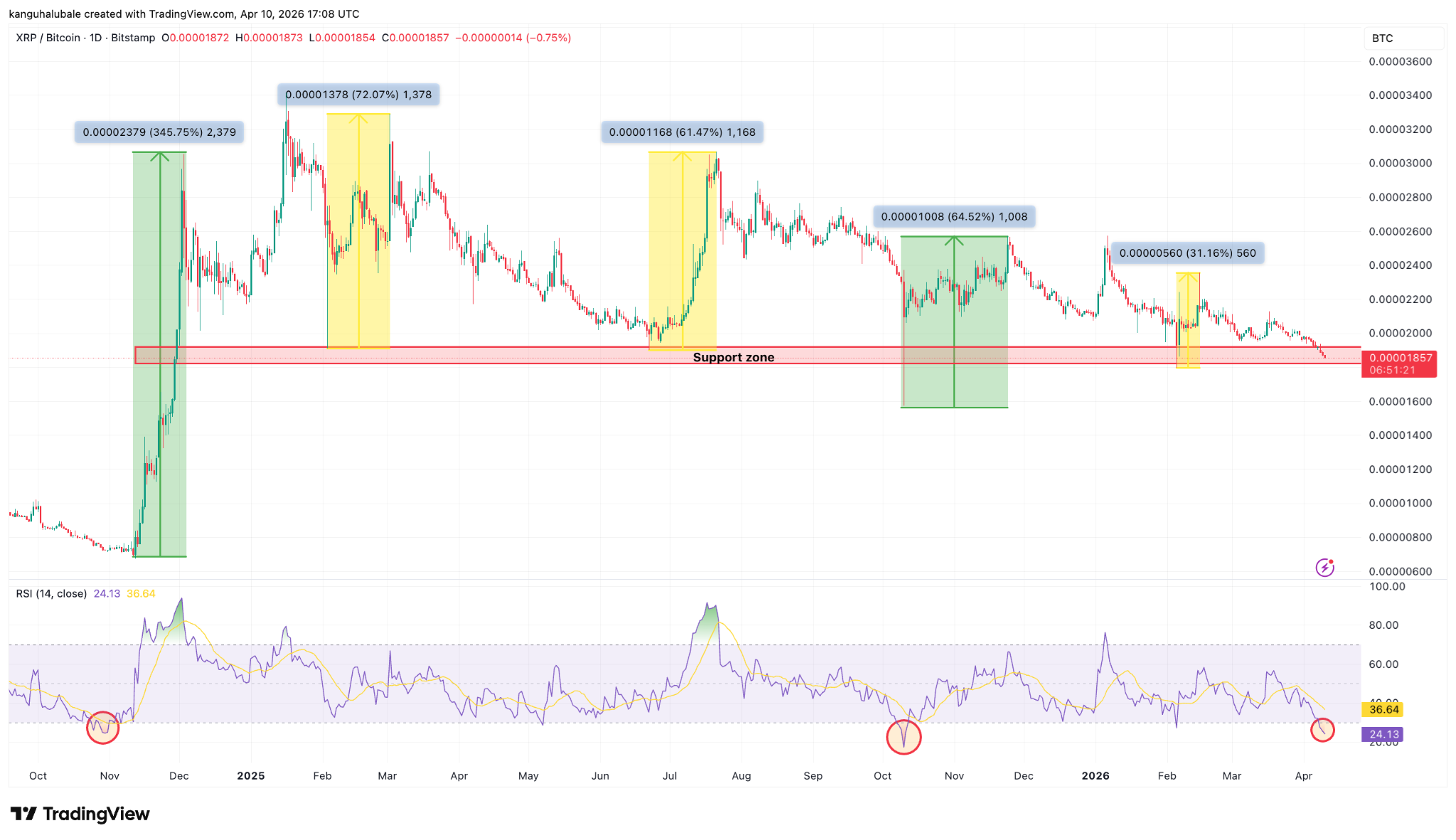
XRP (XRP) has been in an eight-month downtrend, with momentum and onchain indicators at levels that previously coincided with macro bottoms.
Data from TradingView reveals that the relative strength index (RSI) of the XRP/BTC ratio is at 24, the most oversold level since October 2025.
Such low levels in the daily RSI have marked market bottoms for the ratio, ultimately leading to 65% to 345% XRP price breakouts against Bitcoin as seen late 2024 and 2025.

The chart above also shows that the XRP/BTC pair is trading within a long consolidation range, which has previously acted as a strong launching pad for the ratio.
The last time XRP bottomed against Bitcoin around this zone was in June 2025. It marked the beginning of a 61% increase in the XRP/BTC ratio, accompanying a 92% XRP price rally to a multi-year high of $3.66.
Other instances shown by the yellow bars in the chart reinforce the reliability of this level in marking macro bottoms for XRP/BTC.
MVRV Z-Score suggests XRP price is bottoming
XRP’s MVRV Z-score is hovering near zero, a level that historically aligns with accumulation zones and market bottoms.
This indicates that most holders are close to breakeven, reducing sell pressure and signalling potential downside exhaustion. Similar patterns appeared in 2021, 2022 and 2024 before major rallies.

Note that the last time XRP’s MVRV Z-score fell to similar levels in late 2024 coincided with a macro market bottom at $0.30 and preceded a multi-month rally, with the XRP/USD pair rising 500% to a multi-year high above $3.
Meanwhile, the 0.80 MVRV pricing band, which has historically marked cycle bottoms, is currently at $1.14, coinciding with a 15-month low reached on Feb. 6.

These onchain metrics suggest that XRP is undervalued and may continue the ongoing recovery, potentially rising toward $1.70 or higher.
XRP price must hold above $1.30
Meanwhile, XRP/USD remains cautiously bullish as long as it holds the $1.25-$1.30 support zone.
“$XRP is sustaining the major support zone between $1.30-$1.25 levels since early Feb’26,” trader ChiefraT said in an X post on Friday, adding:
“If this zone continues to hold, then a short-term bounce towards $1.45 can’t be ruled out.”

The importance of this support level is reinforced by cost basis distribution. The heatmap below shows that nearly 1.73 billion XRP were acquired around this price.

Below that, the next line of defence is the $1.15 demand zone, where the 200-week simple moving average is.
If XRP/USD drops below this level, it would be in a free-fall toward the measured target of the bear flag at $0.80, or 41% below the current price.
As Cointelegraph reported, holding $1.27-$1.30 would be a sign of strength among the bulls who must push the XRP/USD pair toward the $1.61 range high to regain control.
This article is produced in accordance with Cointelegraph’s Editorial Policy and is intended for informational purposes only. It does not constitute investment advice or recommendations. All investments and trades carry risk; readers are encouraged to conduct independent research before making any decisions. Cointelegraph makes no guarantees regarding the accuracy or completeness of the information presented, including forward-looking statements, and will not be liable for any loss or damage arising from reliance on this content.
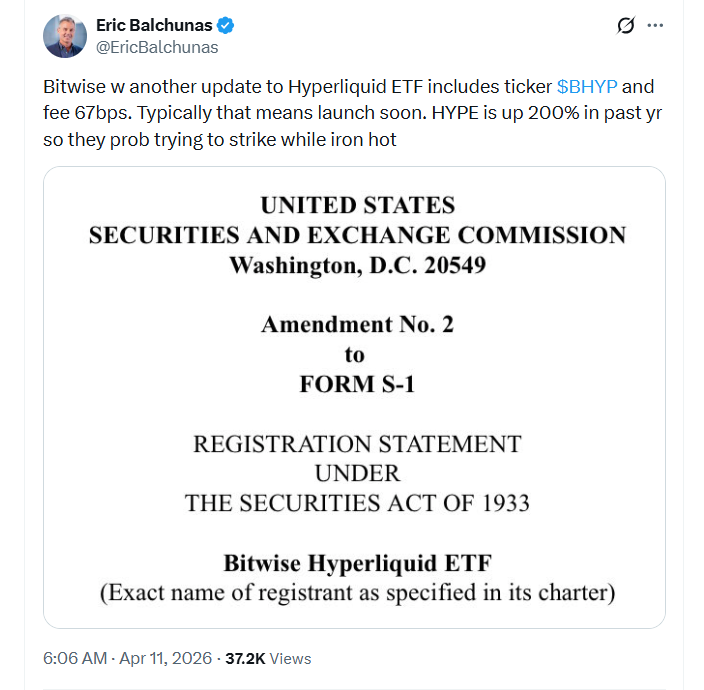
Bitwise Asset Management has reportedly taken a key step toward launching its proposed spot Hyperliquid exchange-traded fund, filing a second amendment with the US Securities and Exchange Commission.
In an X post on Friday, Bloomberg senior ETF analyst Eric Balchunas highlighted that Bitwise had updated its Hyperliquid ETF to include the ticker $BHYP and had also set a management fee of 0.67% (67 basis points).
According to Balchunas, the filing of these details generally indicates that the product will “launch soon.”
“HYPE is up 200% in the past year,” he said, adding that the firm was likely “trying to strike” while the iron was “hot.”
The filing comes amid competition from other asset managers vying to launch the first spot ETF tied to the crypto perpetual futures protocol and blockchain, with Grayscale and 21Shares also pushing for similar products of their own.
Bitwise was the first of the three to submit a Hyperliquid ETF filing with the SEC in September. 21Shares followed a month later with its own, while Grayscale submitted its filing in late March.

If approved, Bitwise’s ETF will trade on the NYSE Arca stock exchange and offer investors exposure to the spot price of Hyperliquid.
In the firm’s first filing amendment from December, Bitwise also indicated that the fund would seek to generate additional returns from HYPE staking — something Grayscale and 21Shares haven’t explicitly indicated their funds would do.
Hyperliquid continues to gain traction
According to data from CoinGecko, the price of HYPE is up 65% since the start of 2026 to around $41.96 at the time of writing, despite a tough start to the year for the broader crypto market. Over 12 months, the price of HYPE is also up about 182%.
Related: BlackRock Bitcoin ETF sees $269M inflows, best day since early March
Alongside a strong token performance, blockchain analytics platform CoinGlass reported in early April that Hyperliquid had broken into the top 10 crypto derivatives platforms by volume, joining the likes of Binance, OKX and Bybit.
During Q1, Hyperliquid generated $492.7 billion in trading volume, putting it shy of ninth-placed Coinbase by about $90 billion.
Magazine: Should users be allowed to bet on war and death in prediction markets?
TLDR:
- Aave Labs secured SOC 2 Type II for security, availability, and confidentiality controls across software operations.
- The audit tested whether Aave’s controls worked consistently over time, not only at one review date.
- The milestone supports Aave’s institutional DeFi push through stronger governance and risk frameworks.
- Aave said the same compliance standards now extend across Pro, Kit, App, and future software products.
Aave Labs has secured SOC 2 Type II attestation, marking a notable compliance milestone for one of DeFi’s largest software contributors. The certification covers security, availability, and confidentiality controls across the company’s software development and operations.
The update arrives as Aave expands deeper into institutional and enterprise-focused DeFi infrastructure. Besides, the move places operational discipline at the center of the protocol’s next growth phase.
Aave SOC 2 Type II Sengthens DeFi Security Standards
The attestation covers the Trust Services Criteria defined by the AICPA. It focuses on whether internal controls worked effectively over time.
Unlike a point-in-time review, Type II testing measures performance across a defined audit window. That gives partners clearer visibility into process consistency.
According to Aave’s official announcement, the audit reviewed development workflows, software safeguards, and information handling practices. The scope also included operational methodologies tied to software releases.
The result confirms that Aave Labs applies standardized controls across the software it contributes to the Aave Protocol. That includes products such as Aave Pro, Aave Kit, and Aave App.
For institutional DeFi users, this matters because compliance standards increasingly shape counterparty decisions. Security controls now carry similar weight to protocol design.
Aave Institutional Strategy Expands Through Compliance and Risk Controls
The timing aligns with Aave’s broader enterprise roadmap. The company has increasingly linked product growth to governance, risk, and market architecture.
Its announcement directly connected the attestation to initiatives like Aave Horizon. That product direction targets institutional and regulated market use cases.
Aave also framed the milestone around operational resilience and confidentiality. Those areas remain central for institutions evaluating DeFi integrations.
The company noted that maintaining SOC 2 Type II requires continuous control testing. That means the process extends beyond a one-time audit achievement.
By embedding those controls into software shipping cycles, Aave positions its infrastructure for larger counterparties. The emphasis stays on repeatable internal standards.
The update also reflects a wider shift in crypto infrastructure. More DeFi platforms now prioritize enterprise-grade software assurance alongside transparent governance.
For Aave, the certification formalizes internal practices already tied to product delivery. It also strengthens the protocol’s credibility with risk-aware finance participants.

The U.S. Commodity Futures Trading Commission has unveiled the first roster of members for its Innovation Task Force, part of a broader effort to bring clearer rules to the crypto market. Spearheaded by Michael Passalacqua, the CFTC’s senior advisor to Chairman Mike Selig, the initiative aims to provide greater clarity for American developers and investors navigating digital assets.
In an announcement on Friday, the agency named five initial members who will join Passalacqua: Hank Balaban, formerly a crypto-focused attorney at Latham & Watkins; Sam Canavos, an ex-Patomak advisor with crypto and prediction markets experience; Mark Fajfar, a longtime CFTC legal veteran; Eugene Gonzalez IV, who previously practiced cryptocurrency law at Sidley Austin; and Dina Moussa, a Market Participants Division special counsel at the CFTC. Chairman Selig praised the lineup, saying the group combines deep legal expertise with a shared commitment to delivering clear “rules of the road” for U.S. innovators.
The expansion of the Innovation Task Force fits a broader push by U.S. regulators to provide regulatory clarity for the digital asset sector, a project outlined under the direction of the Trump administration. The CFTC’s move comes alongside parallel efforts at the Securities and Exchange Commission to define regulatory boundaries for crypto assets.
Key takeaways
- The CFTC has formalized its Innovation Task Force with a first five-member roster led by Michael Passalacqua, signaling a structured approach to crypto governance.
- The new task force is part of the agency’s effort to deliver clear rules of the road for American innovators and to reduce ambiguity around crypto markets.
- The CFTC has also launched an “innovation tracker” to map ongoing work across crypto, artificial intelligence and autonomous systems, and contracts and prediction markets.
- Regulatory clarity remains entangled with the broader political debate, including questions about the CLARITY Act and how the CFTC and SEC divide jurisdiction over digital assets.
A new lineup for regulatory clarity
The initial members bring a blend of legal and regulatory experience tailored to crypto markets. Balaban’s background at a major law firm and Gonzalez IV’s Sidley Austin credentials anchor a practice familiar with crypto law. Canavos’s policy-oriented experience at Patomak and Fajfar’s long tenure within the CFTC provide institutional continuity, while Moussa’s role in the Market Participants Division emphasizes practical, participant-focused considerations. Together with Passalacqua, the group is positioned to translate evolving technology and market developments into more predictable oversight parameters.
“The Innovation Task Force brings together a leading team that exhibits deep expertise and an enthusiastic commitment to deliver clear rules of the road for American innovators,” Selig said in the announcement. The wording underscores the regulator’s intent to move beyond static guidance toward actionable policy that market participants can rely on as the crypto ecosystem evolves.
Innovation tracker and three focus areas
Alongside naming the task force, the CFTC introduced an innovation tracker intended to document the agency’s ongoing efforts to modernize regulation in three priority areas: crypto and blockchain, artificial intelligence and autonomous systems, and contracts and prediction markets. The tracker signals where policymakers believe clarity is most urgently needed and where technological progress intersects with market integrity.
The move occurs amid a broader regulatory dialogue about how U.S. authorities will handle crypto assets, particularly in relation to securities laws and futures framework. The CFTC’s emphasis on “clarity” aligns with a broader push by federal agencies to set clearer boundaries for who regulates what in the digital-asset space, a shift that could influence market structure, product design, and compliance costs for firms building in this space.
Regulatory landscape and the CLARITY Act
Another layer shaping the next steps is the debate over the CLARITY Act, a legislative proposal that some policymakers advocate as a way to codify regulatory jurisdiction for crypto. SEC Chair Paul Atkins has publicly urged Congress to pass the act to establish a durable framework that can accommodate rapid innovation while protecting investors. In parallel, the SEC has signaled that it does not see most crypto assets as securities, a position that would naturally concentrate regulatory authority with the CFTC for many tokenized products if the law changes or is clarified in law.
While both agencies have indicated readiness to implement a clearer framework, the ultimate outcome remains tied to Congressional action and how the CLARITY Act is translated into enforceable policy. For market participants, the tension between the CFTC’s emphasis on spot markets, risk controls, and market infrastructure, and the SEC’s security-centric view, could shape product design, listing decisions, and compliance programs in the near term.
Investors and builders should watch how the Innovation Task Force’s work translates into concrete guidance, potential safe harbors, or pilot programs that could lower uncertainty and speed legitimate innovation. The cross-agency dialogue and the push for legislative clarity may, if successful, unlock a more predictable regulatory environment that balances innovation with market integrity.
Source for the task force announcement: Michael Passalacqua, via a post on X, and the CFTC press release detailing the initial membership and the broader policy objective.
What happens next remains linked to congressional action and how the CLARITY Act is refined and enacted. In the meantime, market participants should monitor how the tracker’s focus areas evolve into practical rules, and which areas—if any—move from guidance toward formal rulemaking or enforcement priorities.


CAEX has secured major backing from OKX Ventures and HashKey Capital as it prepares to enter Vietnam’s strictly regulated digital asset market.
Summary
- CAEX secured fresh backing from OKX Ventures and HashKey Capital to help meet a 10 trillion dong capital requirement for Vietnam’s upcoming crypto exchange pilot.
- The Vietnamese government plans to limit the five-year pilot program to only five licensed entities while maintaining strict caps on foreign ownership and institutional capital.
According to an April 10 press release, the two firms are joining VPBank Securities and LynkiD as shareholders in the platform, which operates within the ecosystem of VPBank, one of the country’s largest private lenders.
This capital injection is designed to help CAEX meet a steep 10 trillion dong (approximately $380 million) charter capital requirement. Reaching this financial threshold is a prerequisite for any firm hoping to secure one of the few licenses available under the government’s new pilot program.
CAEX will use the new investment from OKX Ventures and HashKey Capital to comply with the minimum charter capital requirement of 10 trillion dong that mandates all firms participating in the pilot program must maintain substantial financial reserves to operate legally in Vietnam.
The exchange has confirmed that it is now in the final stages of finalizing its 10 trillion dong capital base to meet the January pilot criteria.
“We believe the future of crypto will be built on regulated, local platforms that users can trust and CAEX represents that future in Vietnam,” OKX Founder and CEO Star Xu noted in a recent blog post regarding the partnership.
Vietnam’s Ministry of Finance and the State Securities Commission are currently rolling out a five-year testing phase for the industry. However, the window for entry is narrow. Only five companies will be permitted to operate exchanges during this period, with the licensing process having officially started on January 20.
The regulatory framework imposes significant restrictions on how these businesses are structured. Foreign investors cannot own more than 49% of an exchange, and at least 65% of the total capital must come from institutional shareholders. These high barriers are intended to ensure only well-capitalized, professional entities enter the space.
Beyond setting high entry costs, the government is signaling a crackdown on the informal market. Once the official onshore exchanges begin operations, authorities may block access to unlicensed international platforms. This policy shift makes a local partnership essential for foreign firms like OKX and HashKey to maintain a compliant presence in the country.
Growing adoption meets increased oversight
Chainalysis ranked Vietnam fourth globally for crypto adoption in 2025. However, the market has struggled with significant fraud.
In March 2026, police detained several individuals linked to the ONUS platform. Investigators allege the group used deceptive promotions and price manipulation to steal billions of dollars from investors.
By integrating with VPBank’s network, CAEX looks to position itself as a stable alternative to the offshore platforms that currently dominate the local landscape. The company confirmed it is now in the final stages of finalizing its 10 trillion dong capital base to meet the January pilot criteria.


The Japanese government passed an amendment to the Financial Instruments and Exchange Act on Friday, officially reclassifying crypto assets as financial instruments.
Summary
- The Japanese government officially reclassified cryptocurrency as a financial instrument on Friday through an amendment to the Financial Instruments and Exchange Act.
- New regulations reported by Nikkei now prohibit insider trading and require asset issuers to provide transparent financial disclosures once a year.
According to a report by Nikkei, the new legislation introduces a ban on insider trading and prohibits any buying or selling of digital assets based on non-public information.
Previously, the Financial Services Agency handled crypto under the Payment and Settlement Act, viewing it primarily as a tool for transactions. The pivot to the new legal framework comes as a direct response to a surge in institutional interest.
Under these updated rules, crypto “issuers” must adhere to higher transparency standards, including mandatory annual disclosures.
To support this transition, the Financial Services Agency has updated its oversight from the previous Payment and Settlement Act.
Cryptocurrency “issuers” are now required to maintain higher levels of transparency, including the mandate to disclose financial information at least once a year. The amendment also stiffens penalties, increasing both fines and potential prison sentences for exchanges that operate without a license.
“We will expand the supply of growth capital in response to changes in financial and capital markets, and ensure market fairness, transparency, and investor protection,” Finance Minister Satsuki Katayama said in an accompanying statement.
Beyond immediate regulations, the government is also overhauling the tax structure to encourage market participation. In December, officials backed a plan to drop the maximum tax rate on crypto profits in favor of a 20% flat rate.
This follows comments from Katayama earlier this year, suggesting that robust exchange infrastructure is essential for citizens to benefit from blockchain technology.
The long-term roadmap includes the legalization of crypto exchange-traded funds (ETFs) by 2028, as noted in a January report. Major financial players, such as Nomura Holdings and SBI Holdings, are already expected to lead the development of these crypto-linked products as the country prepares for broader mainstream adoption.

Tyson Fury fight time tonight – what time is the ring walk?

Iran’s new supreme leader has severe and disfiguring wounds, sources say

Iran’s Best War Tactic is Now a Liability at the Negotiating Table

Why Israel is blocking foreign journalists from entering

Bitcoin: We’re Entering The Most Dangerous Phase

Alan Cumming Brands Baftas Ceremony A ‘Triggering S**tshow’

XRP- Ripple Treasury Ceritified To Tap 11,000+ SWIFT Banks? Yes – Bitcoin Hits $200K What Is XRP???

ULTIMATE Cryptocurrency Trading Course (From Beginner To PRO)

Gs Finance – New Loan App for Low Cibil ( Review ) | New Loan App review 2026 | Only On KYC
-

 Business5 days ago
Three Gulf funds agree to back Paramount’s $81 billion takeover of Warner, WSJ reports
-

 Sports6 days ago
India men’s 4x400m and mixed 4x100m relay teams register big progress | Other Sports News
-

 Politics12 hours ago
US brings back mandatory military draft registration
-

 Fashion12 hours ago
Weekend Open Thread: Veronica Beard
-

 Business7 days ago
Expert Picks for Every Need
-

 Tech3 days ago
How Long Can You Drive With Expired Registration? What Florida Law Says
-

 Business6 days ago
No Jackpot Winner, Prize to Climb to $231 Million
-

 Fashion5 days ago
Massimo Dutti Offers Inspiration for Your Summer Mood Board
-
 Sports13 hours ago
Man United discover Nico Schlotterbeck transfer fee as defender reaches Dortmund agreement
-

 Fashion4 days ago
Let’s Discuss: DEI in 2026
-

 Crypto World3 days ago
Bitcoin recovers as US and Iran Agree a Ceasefire Deal
-

 Business9 hours ago
Tesla Model Y Tops China Auto Sales in March 2026 With 39,827 Registrations, Beating Cheaper EVs and Gas Cars
-

 Crypto World2 days ago
Canary Capital Files SEC Registration for PEPE ETF
-

 Business6 days ago
Akebia Therapeutics, Inc. (AKBA) Discusses Pipeline Progress and Strategic Focus on Kidney Disease Treatments at R&D Day – Slideshow
-

 Business18 hours ago
OpenAI Halts Stargate UK Data Centre Project Over Energy Costs and Copyright Row
-

 Tech5 days ago
Haier is betting big that your next TV purchase will be one of these
-

 Tech5 days ago
The Xiaomi 17 Ultra has some impressive add-ons that make snapping photos really fun
-

 Tech5 days ago
Samsung just gave up on its own Messages app
-

 Tech5 days ago
Gamer Restores the Original PlayStation Portal From Two Decades Ago
-

 Tech5 days ago
Save $130 on the Samsung Galaxy Watch 8 Classic: rotating bezel, sleep coaching, and running coach for $369
You must be logged in to post a comment Login