
Crypto World
4 Memory Stocks Cramer Says Could Avoid an AI Bust and Keep Climbing

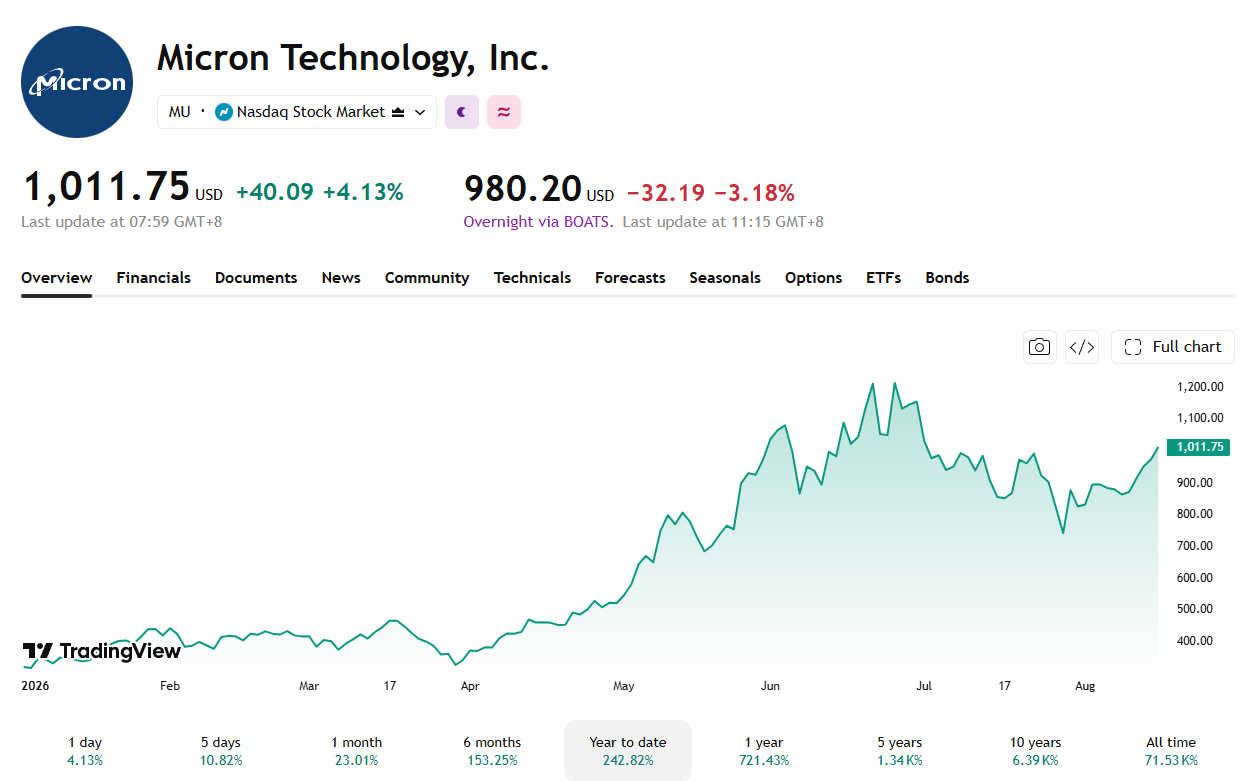
Jim Cramer says four memory chip stocks still have room to climb, even after posting some of 2026’s biggest gains. The Mad Money host argues Micron, SanDisk, Seagate, and Western Digital have broken their old boom-and-bust pattern.
AI data centers have created a persistent memory chip shortage. Elon Musk has called memory the key bottleneck to data center growth, and Cramer says that shortage, not hype, separates this rally from prior cycles.
Micron (MU)
Cramer’s Charitable Trust bought Micron last week during a pullback tied to South Korean peers’ selloff. He calls the stock more of a growth name than its rivals.
Micron has gained 242% this year, and gross margin jumped from 39% to 85% year over year. Shares trade near seven times fiscal 2027 earnings estimates.

Cramer said Micron could double again if data center demand holds, and he plans to visit the company’s Idaho research facility this week to interview CEO Sanjay Mehrotra.
SanDisk (SNDK)
SanDisk has climbed 631% in 2026, and is one of the best preforming stocks thus far. The company authorized a $15.5 billion buyback and posted an 85% gross margin, up from 26% a year earlier. Shares trade near eight times fiscal 2027 earnings estimates.

Seagate (STX)
Seagate is up 252% this year. It authorized a $5 billion buyback last year and posted a record 52% gross margin, up from 37%. The stock trades around 17 times fiscal 2028 earnings estimates.

Western Digital (WDC)
Western Digital has gained 202% in 2026. The company approved a $4 billion buyback and lifted gross margin to 54% from 41%. Shares trade near 16 times fiscal 2028 earnings estimates. Only Micron has skipped a buyback so far, a gap Cramer called curious given the other three companies’ payouts.
Multiyear supply agreements underpin those margins. BeInCrypto previously reported multiyear customer agreements worth $93.9 billion across eight clients, including three US hyperscale data center operators, cited by Evercore ISI as the basis for a bullish SanDisk rating.
The case is not one-sided. BeInCrypto has covered supply glut fears hitting these same names, and Cramer warned three weeks ago that the AI trade echoed the dot-com bust.
Cramer said the biggest risk is Samsung ramping new capacity to flood the market, but he does not expect that to happen soon since new fabs take years to build.
The post 4 Memory Stocks Cramer Says Could Avoid an AI Bust and Keep Climbing appeared first on BeInCrypto.



Jane Street reported more than $1 billion in U.S. spot Bitcoin ETF shares as of June 30, 2026, according to a quarterly regulatory filing released in August.
Summary
- Jane Street reported more than $1 billion in spot Bitcoin ETF shares at quarter end.
- BlackRock’s IBIT represented approximately $828 million, making it the firm’s largest disclosed Bitcoin ETF position.
- The filing covers holdings on June 30 and does not reveal Jane Street’s current positions.
- Jane Street owned ETF shares rather than Bitcoin held directly in wallets or institutional custody.
- Form 13F omits short positions and many derivatives, preventing conclusions about the firm’s net exposure.
The quantitative trading firm’s largest disclosed position was BlackRock’s iShares Bitcoin Trust, or IBIT. Jane Street reported roughly $828 million of IBIT shares in its second quarter filing.
The remaining exposure was distributed among other U.S. listed products. Those holdings included Fidelity’s Wise Origin Bitcoin Fund and Grayscale’s Bitcoin Trust. The combined value of Jane Street’s reported spot Bitcoin ETF shares exceeded $1 billion at the quarter’s close.
The disclosure concerns shares issued by investment funds. It does not establish that Jane Street directly owned the Bitcoin held by those funds.
Jane Street’s IBIT position rebounded during the quarter
Jane Street’s approximately $828 million IBIT position represented a sharp recovery from the previous quarter. At March 31, the firm reported about 5.9 million IBIT shares valued near $225 million.
The earlier reduction attracted attention because Jane Street had held more than 20 million IBIT shares at the end of 2025. As crypto.news reported, the firm reduced several fund positions while expanding its Ether exposure during the first quarter.
The second quarter filing indicates that Jane Street rebuilt its reportable IBIT position by June 30. However, changes in reported value can reflect both share transactions and movements in the fund’s market price. A Form 13F does not disclose when the shares were acquired or the prices paid.
The filing also cannot establish Jane Street’s motive. The firm is a major quantitative trader and liquidity provider in exchange traded products. Its holdings may support market making, arbitrage, hedging or other trading activities rather than a long term directional position.
The $1 billion disclosure does not equal direct Bitcoin ownership
Spot Bitcoin ETFs hold Bitcoin through fund custody arrangements while investors trade shares on regulated securities exchanges. Jane Street’s filing therefore reports ownership of securities rather than coins controlled through the firm’s blockchain addresses.
This distinction also means the filing cannot be converted directly into a specific amount of Bitcoin owned by Jane Street. Each fund has its own share count, net asset value and Bitcoin holdings. Jane Street’s position represents an economic interest in the funds at the reporting date.
Form 13F provides only a partial view of an institutional manager’s activity. SEC guidance requires covered managers to report the number and quarter end value of eligible securities, including ETF shares.
The reports do not provide a complete trading book. Short sales and many derivatives are absent. Separate put and call positions may appear when reportable, but they still do not reveal how each position interacts with the manager’s other trades.
Consequently, the filing does not prove Jane Street held more than $1 billion of unhedged exposure to Bitcoin. It only confirms that its reportable long ETF shares crossed that level on June 30.
U.S. institutions continue using regulated Bitcoin funds
Jane Street’s disclosure adds to evidence that major financial firms use U.S. spot Bitcoin ETFs for trading, portfolio exposure and liquidity management. BlackRock’s IBIT has repeatedly appeared as the largest crypto fund position in institutional reports.
Other institutions have also disclosed material IBIT holdings. In related coverage, Abu Dhabi’s Mubadala raised its reported position to approximately $566 million during the first quarter of 2026.
Banks have reported smaller positions through the same regulatory process. Barclays, for example, disclosed approximately $131 million of exposure in an earlier filing.
Those disclosures do not necessarily represent comparable strategies. A sovereign investor, bank, hedge fund and market maker can hold the same ETF shares for different reasons. Form 13F provides position data but does not require managers to explain their investment purpose.
No verified market reaction could be attributed specifically to Jane Street’s filing. Bitcoin and ETF prices also respond to fund flows, macroeconomic news and wider market positioning.
The next filing will show Jane Street’s September holdings
Jane Street’s next Form 13F will provide a snapshot of reportable positions held on Sept. 30. The SEC lists Nov. 16, 2026, as the filing deadline for third quarter reports.
That disclosure will show whether the firm maintained, expanded or reduced its Bitcoin ETF shares by quarter end. It will not reveal any changes made after Sept. 30 or positions closed before the reporting date.
Investors should therefore treat the current report as historical information. The June 30 holdings may have changed before the filing became public, and Jane Street’s undisclosed hedges could materially alter its net exposure.


Bitcoin rose above $64,000 on Tuesday, up over 1% on the day and marginally higher on the week, the only major with a meaningful gain as the rest of the market drifted lower.
Ether eased half a percent to just under $1,900, though it holds an almost 1% weekly gain. XRP fell over 1% to just under $1 and is down over 2% on the week, the weakest of the group. Dogecoin dropped almost half a percent to 7 cents, BNB and tron both slipped marginally to just over $600 and 33 cents, and solana was flat at just under $76.
Hyperliquid’s HYPE was the exception among the smaller majors, up almost 1% to just over $59 and 7.5% over seven days, by far the strongest weekly performance.
Alex Kuptsikevich, chief market analyst at FxPro, said bitcoin has now spent four days below its 50-day moving average after an earlier attempt to break above it, and remains below its 200-week average on the longer view. That puts sellers in control on both the medium and very long-term trends, he said, and nothing changes until the price leaves the $62,000 to $65,000 range it has been stuck in.
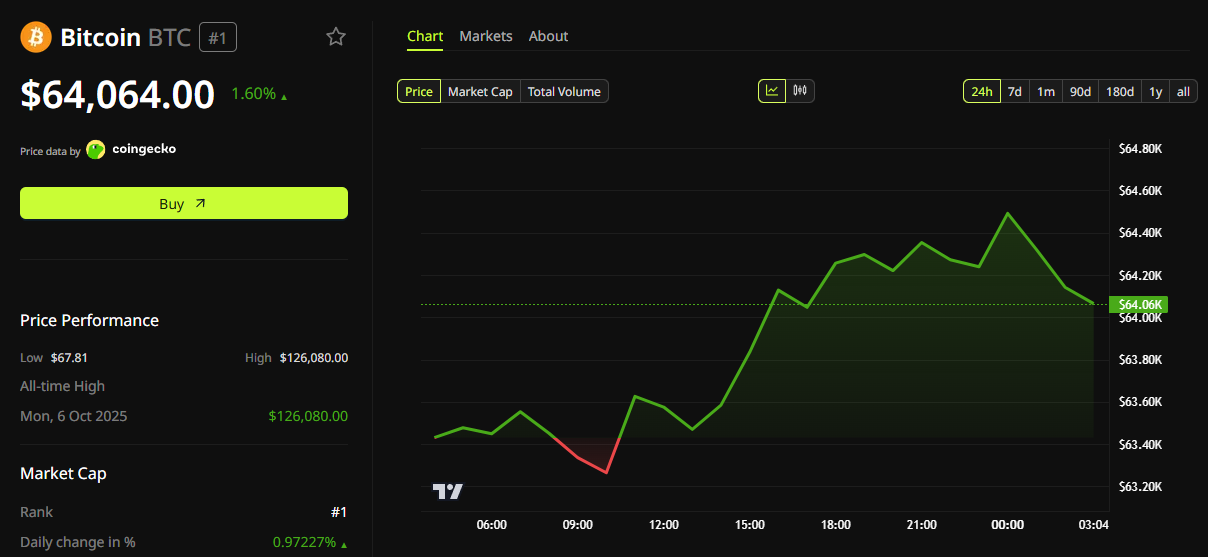
Bitcoin (BTC) climbed back above $64,000 on Monday, and Peter Schiff, the Euro Pacific Capital economist and longtime Bitcoin skeptic, wasted no time calling the move a selling opportunity rather than a turning point.
In the same breath was quick to praise his preferred asset, precious metals, noting Gold is now above $4,430 and silver is above $66.25.
Another Attack on Bitcoin by Schiff
Schiff posted on X that he was unsure why Bitcoin failed to sell off, adding that the rally gave holders another chance to exit before resistance caps further gains.
I’m not sure why Bitcoin didn’t sell off today, but the rally gives HODLers another opportunity to sell. Any ideas what’s propping it up? Remember, $65K is resistance. There isn’t much upside above that level, but plenty of downside below.
Fed Rate Bets Fade, Lifting Risk Appetite
Bitcoin’s recent price rise towards $65,000, likely answer sits in Washington rather than on-chain. Goldman Sachs chief economist Jan Hatzius called a September Federal Reserve rate hike “very unlikely” in a Sunday note, citing soft retail sales, weak jobs data, and cooling inflation.

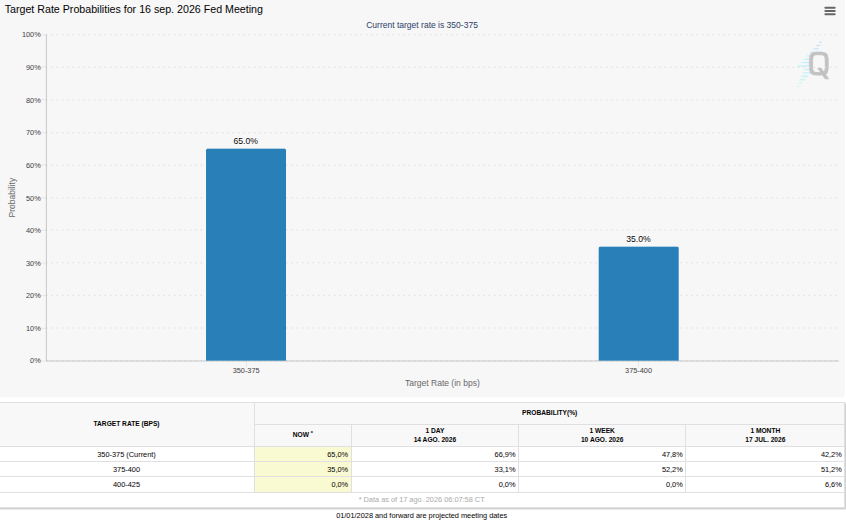
Traders now price just a 30.6% chance of a hike next month, down sharply from a week earlier, according to CME FedWatch data.
Lower rate expectations typically ease borrowing costs and boost demand for Bitcoin and other risk assets, a dynamic that has already helped BTC break out of its recent range. The move also lines up with a broader crypto market rally that started earlier this week.
Schiff’s Decade of Bearish Calls
Schiff’s skepticism is not new. He has publicly declared Bitcoin dead or doomed more than 20 times since 2011, when the cryptocurrency traded near $17. Earlier this month, he pointed to a bond market selloff as another reason to favor gold over Bitcoin.
He has also argued Bitcoin could crash below $20,000 once it lost the $50,000 level, a call that has not yet materialized.
Whether $65,000 holds as resistance this time may depend more on incoming inflation data and the Fed’s September meeting than on any single skeptic’s timeline.
The post Peter Schiff Calls Latest Bitcoin Rally A Sell Opportunity as BTC Approaches $65,000 appeared first on BeInCrypto.


Ripple is bringing its cross-border payments platform to Jeonbuk Bank, but key details including its launch status and settlement asset remain undisclosed.


Jane Street disclosed a $990 million bitcoin (BTC) exchange-traded fund (ETF) position in a Securities and Exchange Commission (SEC) filing. The filing, dated June 30, shows its largest stake in BlackRock’s iShares Bitcoin Trust (IBIT).
The filing landed the same week Jane Street confirmed a $15 billion trading loss in July. The quantitative trading firm and major market maker called it its worst month in about a decade.
The Jane Street Bitcoin ETF Filing Is Just a Snapshot
The $990 million figure comes from a Form 13F. That filing only captures long ETF positions as of a single date, in this case six weeks ago. It says nothing about what Jane Street holds today.
However, Jane Street is not a directional Bitcoin investor. The firm operates primarily as a market maker and authorized participant across several spot Bitcoin ETFs.
Meanwhile, that pattern has precedent. Jane Street cut its IBIT stake by 71% in the first quarter of 2026. It built up an ether ETF position over the same stretch. That swing looks more like rotating inventory than conviction investing.
Historically, large swings in a market maker’s 13F holdings often reflect hedging flow, not sentiment. A big position can mean client demand for ETF shares just as easily as a bullish view on bitcoin.
BTC traded near $64,000 on Tuesday, up 1.6% over 24 hours, according to BeInCrypto data.
A Rough Month, A Record Year
Reuters traced the loss mainly to Jane Street’s stake in Situational Awareness, an artificial intelligence hedge fund. Margin calls forced Situational Awareness into a fire sale of its stock portfolio in late July. Weak bets in Asian equity markets added to the damage.
In contrast, Jane Street has still posted more than $40 billion in trading revenue this year. That already tops the $39.6 billion record it set in all of 2025.
Whether Jane Street’s position has grown, shrunk, or disappeared since June 30 won’t be clear until its next 13F filing. That filing is due in November. Therefore, the $990 million figure is only a data point right now. It isn’t proof that Wall Street’s biggest market maker is turning bullish on bitcoin.
The post Jane Street Discloses Nearly $1 Billion Bitcoin ETF Position After $15 Billion Loss appeared first on BeInCrypto.
The S&P 500 closed down 0.52% on Monday while Bitcoin surged past $64,000, a sharp divergence just two days before the Federal Reserve releases its July meeting minutes.
Markets are now in a holding pattern, with every asset class waiting for a single document to set the direction.
Why S&P 500 Fell While Bitcoin Rallied
Bitcoin moved in the opposite direction entirely. The token gained roughly 2%, climbing from the weekend’s close near $62,800 to $63,000, with a move toward levels above $64,000.
Capital rotation into alternative risk assets helps explain that strength. Traders also priced in the possibility that the minutes would lean dovish, or at least avoid an overtly hawkish tone.
Bitcoin’s correlation with equities has stayed inconsistent throughout 2026. This session, it functioned more like a relative haven while stocks absorbed profit-taking.
Follow us on X to get the latest news as it happens.
FOMC minutes are the detailed record of a Federal Reserve policy meeting, published three weeks after the decision itself. Wednesday’s release covers the July 28-29 gathering. That meeting kept rates unchanged at 3.50% to 3.75%, but the vote split 9-3. Three members dissented in favor of a 25-basis-point hike.
The S&P 500 pulled back from last week’s record highs near 7,800, closing at 7,745 points. Several pressures converged on the same session.
Oil prices climbed on renewed US-Iran tensions, reviving inflation concerns across markets. The 30-year Treasury yields simultaneously reached levels unseen since 2007.
Retail data added further weight. July retail sales fell 0.6%, and investors now await earnings from Home Depot and Walmart to confirm consumer weakness.
What the Fed Minutes Could Change Next
Wednesday’s document carries genuine weight for both markets. A more hawkish internal debate, emphasizing persistent inflation and the risk of a September tightening, would likely pressure the S&P 500 further.
Rate-sensitive sectors like technology would likely decline. Bitcoin has historically reacted with volatility to shifting monetary policy expectations, too.
Markets currently price September hike odds near 35%. A minutes-driven repricing higher would likely weigh on both stocks and crypto simultaneously. A balanced tone would shift that calculus considerably. Focusing on slowing labor market growth or softening consumption could instead support a rebound in both assets.

Context matters for perspective. The S&P 500 has still gained more than 13% year-to-date, driven by solid corporate earnings throughout the period. Bitcoin, by contrast, remains well below its 2025 highs despite Monday’s rally. The gap between the two trajectories underscores how differently investors are positioning right now.
Attention over the coming hours centers on how the minutes interact with corporate earnings and unfolding geopolitical developments. The divergence itself reflects a market stuck in waiting mode.
Selective, nervous, and ready to react sharply to any clear signal from the Federal Reserve, caution remains the dominant strategy across both equities and digital assets right now.
Subscribe to our YouTube channel to watch leaders and journalists provide expert insights.
The post S&P 500 Falls, Bitcoin Surges as Traders Await the Fed Minutes: What Next? appeared first on BeInCrypto.

BitMart’s Chinese-language account has demanded answers from founders Sheldon Lee and Yi Li over frozen user funds and unpaid employee salaries, giving them until August 19 to respond publicly.
The statement also calls for verifiable asset disclosures and a detailed repayment plan as questions grow over what happened to funds held on the exchange.
BitMart Faces Questions Over User Funds and Withdrawals
In a post published on August 17, the account said many users still cannot withdraw their funds, while some employees have yet to receive their final salaries or compensation.
“This isn’t some business dispute that can be brushed off with a single ‘ceasing operations’ statement,” it wrote.
The statement demanded evidence showing BitMart’s current wallets, assets, liabilities, and usable reserves. It also asked management to explain who restricted withdrawals, when the decision was made, and when executives first knew users could no longer withdraw normally.
The account further questioned whether BitMart continued encouraging deposits or trading after management became aware of withdrawal problems. It called for an investigation into affiliated accounts, related companies, trusts, and other arrangements involving BitMart-related funds. The statement also raised questions about accounts allegedly linked to Yi Li that may have held tens of millions of dollars and recorded batch withdrawals.
However, the account stressed that the allegations had not been proven and said that potentially criminal conduct should not be alleged before the evidence is complete. It nevertheless demanded explanations about the source and destination of funds if the accounts existed.
Employee compensation was another focus, with the post contending that rank-and-file workers did not decide how company funds were managed or when operations would end; thus, salaries and outstanding compensation should be paid in full.
The August 19 deadline also covers a repayment plan detailing remaining assets, total liabilities, expected user recoveries, repayment order, start and completion dates, oversight arrangements, and potential independent audits.
Sheldon Lee responded, saying the material cited by the Chinese account consisted of “fabricated rumors.” According to him, BitMart had collected evidence and would file a police report during US daytime hours, alongside a lawyer’s letter to X seeking technical and data forensics.
Blockchain investigator ZachXBT questioned why BitMart would not simply return the funds if it had sufficient liquidity. He also criticized the lack of transparency around users’ access to their money.
But in a later update, Lee claimed that the account had been hacked and the issues raised had not been posted by current employees.
Shutdown Timeline Adds Pressure
The dispute comes shortly before BitMart’s planned shutdown, with a July 26 notice informing users that the exchange would discontinue trading services on August 26, and its official shutdown is scheduled for January 31, 2027.
That announcement placed BitMart alongside other crypto platforms preparing to close during a difficult market period, including BitMEX, which told its customers on July 23 that it would stop operations by September 23. According to analysts like Ran Neuner, the exchange shutdowns are part of a broader market clean-up.
The post BitMart Account Demands Answers Over Frozen User Funds and Unpaid Salaries appeared first on CryptoPotato.


Payward, the parent company of cryptocurrency exchange Kraken, joined Anthropic’s Project Glasswing on Aug. 17 and gained restricted access to Claude Mythos 5 for defensive cybersecurity work.
Summary
- Payward joined Anthropic’s Project Glasswing and gained restricted access to the Claude Mythos 5 model.
- The company plans to scan all Payward environments for software vulnerabilities within the coming weeks.
- Payward says validated third party findings will be shared with relevant open source project maintainers.
- Anthropic limits Mythos 5 access to vetted organizations because its cybersecurity capabilities carry misuse risks.
- Mythos 5 usage requires customers to accept thirty day data retention for Anthropic safety monitoring.
The company plans to use the artificial intelligence model to scan its software environments for vulnerabilities over the coming weeks. Findings will enter Payward’s existing security review process rather than automatically producing software changes.
Payward also said it intends to disclose validated vulnerabilities affecting third party open source projects to their maintainers. The company did not identify its first scanning targets, publish a deployment schedule or disclose the cost of its Mythos 5 access.
Payward will scan its software environments
Payward said Claude Mythos 5 will examine all company environments for software weaknesses. Its infrastructure supports digital asset trading, custody and settlement services that remain available continuously.
The announcement does not specify whether Mythos 5 will receive access to production systems, isolated copies of source code or controlled testing environments. Payward also did not describe how its security team will validate findings before approving fixes.
False positives remain a practical concern when artificial intelligence systems review complex software. A model may identify unreachable code, duplicate an existing report or misunderstand how a component operates in production. Human review is therefore required before teams classify an issue as a vulnerability.
The Ethereum Foundation reached a similar conclusion while testing AI security agents. As crypto.news reported, its researchers found that AI generated vulnerability reports still required independent human validation, particularly when agents examined complex protocol code.
Payward cochief executive Arjun Sethi said AI could change the imbalance between attackers and defenders by reading code at greater scale.
“A model can read every line of code the way an attacker would, at machine scale, so we find the flaw before anyone can build the exploit,” Sethi said.
The statement describes Payward’s intended defensive advantage. The company has not yet published results showing how many valid flaws Mythos 5 found within its systems.
Project Glasswing restricts access to vetted partners
Anthropic launched Project Glasswing in April 2026 to give selected infrastructure providers and software maintainers early access to its strongest cybersecurity models.
Initial participants included Amazon Web Services, Apple, Cisco, CrowdStrike, Google, JPMorganChase, Microsoft, Nvidia, Palo Alto Networks and the Linux Foundation. Anthropic later expanded the initiative to approximately 150 organizations across more than 15 countries.
The company says participating organizations must meet security requirements before receiving access. Mythos 5 is not generally available because the same capabilities used to identify vulnerabilities can also help produce working exploits.
As previously reported, Anthropic restored Mythos access only to vetted U.S. organizations after the U.S. government lifted temporary export restrictions. The safeguarded Claude Fable 5 model returned to wider availability.
Payward said its access followed the U.S. decision allowing Mythos 5 to reach organizations that operate and defend critical infrastructure. Anthropic’s official model page confirms that access was restored for a set of U.S. organizations following government approval.
Neither Anthropic nor the U.S. government has publicly designated every digital asset platform as critical infrastructure. Payward’s statement that such platforms “belong on that list” represents the company’s position rather than a formal government classification.
Claude Mythos 5 carries defensive and offensive risks
Anthropic describes Claude Mythos 5 as its most capable model for cybersecurity and biology research. The model can inspect code, identify weaknesses, suggest patches and assist approved researchers with testing exploit paths.
Project Glasswing’s earlier Mythos Preview reportedly found more than 10,000 flaws classified as high or critical severity across widely used software. Anthropic’s coordinated disclosure dashboard showed 1,596 vulnerabilities reported across 281 open source projects as of May 22.
Those figures are Anthropic’s measurements and do not mean every initial model finding was valid. Its dashboard recorded a 90.8% true positive rate among 1,900 candidates reviewed by external security firms.
Anthropic said independent human triage remains the limiting stage. Only 97 listed findings had been patched upstream at the time of the dashboard update, while 88 had received a public advisory identifier.
The model can also create exploit components and combine them into attack chains. Anthropic cited this dual use capability when explaining why Mythos 5 remains limited to approved partners.
In related coverage, researchers found that Mythos class models could turn software flaws into working exploit chains. Wider access would therefore give attackers some of the same capabilities available to defenders.
Open source findings will go to maintainers
Payward said vulnerabilities discovered in shared third party code will be sent to the relevant project maintainers. It presented that process as a way to protect other organizations using the same software.
The company did not publish a coordinated disclosure policy for the initiative. Important unanswered details include how long maintainers will have to patch flaws, which findings Payward may disclose publicly and how it will handle projects that do not respond.
Responsible disclosure normally requires researchers to verify a vulnerability, contact the maintainer privately and allow time for remediation before releasing technical information. Premature publication can expose users before a patch becomes available.
Payward has previously faced disputes over security research. As crypto.news reported, Kraken patched a deposit flaw that researchers used to withdraw nearly $3 million. The exchange later recovered the funds following a public disagreement with CertiK.
That episode was unrelated to Project Glasswing, but it shows why clear testing and disclosure rules matter. AI scanning can increase the number of reported findings, creating additional work for security teams and maintainers.
What happens next for Payward’s AI security rollout
Payward plans to begin scanning its environments within weeks. The next verifiable updates would include confirmed vulnerabilities, completed patches or public disclosures coordinated with affected open source projects.
No performance targets were announced. Payward did not say how frequently Mythos 5 will scan its systems or whether the model will review new code before deployment.
Anthropic requires Mythos 5 customers to accept thirty day data retention for safety monitoring. Payward has not explained what code or system information will be submitted, how sensitive data will be separated or whether customer information falls outside the scanning process.
For now, the confirmed development is Payward’s admission to Project Glasswing and planned use of Claude Mythos 5. Whether the model improves the company’s security will depend on the quality of its findings, human verification and the speed of subsequent patches.


Anthropic’s annualized revenue run rate reached $65 billion at the end of July, roughly $25 billion above OpenAI’s, according to people familiar with the figures.
The company shared the number in a routine investor update as it prepares for a public listing. Bloomberg reported that the debut could come as soon as this fall.
Anthropic Revenue Run Rate Expands 622% Since Late 2025
Annualized revenue run rate is an estimate of how much revenue a company would generate over a full year if its current revenue pace continued unchanged. Anthropic crossed roughly $9 billion at the end of 2025 and $47 billion in May, Bloomberg reported.
That path works out to a 622% expansion across seven months. The May-to-July stretch alone added $18 billion, a gain of about 38%.
Meanwhile, the AI firm’s preliminary second-quarter revenue topped $11.5 billion, against $787 million in the same quarter a year earlier. Quarterly revenue also more than doubled from $4.73 billion in the first quarter.
Anthropic posted positive adjusted operating income for the period. The company reportedly generated about $10 billion in total revenue throughout 2025, according to financial figures cited by CNBC.
Follow us on X to get the latest news as it happens
OpenAI Trails at $40 Billion While Listing Date Stays Open
Bloomberg reported last week that rival OpenAI is on track for a run rate above $40 billion. That figure roughly doubles its level at the end of 2025.
Neither number came from the companies themselves. Both trace to people familiar with the matter, and the two firms may not calculate the metric the same way.
Anthropic filed a confidential prospectus with the Securities and Exchange Commission (SEC) in June and has since held preliminary investor meetings.
According to Bloomberg, Anthropic is expected to make its Wall Street debut as soon as this fall. Financial Times reported that investors are expecting it to “float at a valuation of $2 trillion.”
Subscribe to our YouTube channel to watch leaders and journalists provide expert insights
The post Anthropic Run Rate Hits $65 Billion and Leaves OpenAI $25 Billion Behind appeared first on BeInCrypto.


Cointelegraph is committed to providing independent, high-quality journalism across the crypto, blockchain, AI, and fintech industries.
All news, reviews, and analyses are produced with full journalistic independence and integrity. For more details on our standards and processes, please read our Editorial Policy.

Jane Street reports over $1B in Bitcoin ETF shares

General Hospital 2-Week Spoilers Aug 17-28: Sonny’s Ruthless Dig & Ric Completely Crumbles!

Marriage Isn’t a One-Person Financial Burden


-

 Fashion3 days ago
Weekend Open Thread: Ann Taylor
-
 NewsBeat6 days ago
Communication cards help banking customers access services or report scams
-
 Sports4 days ago
This U.S. Amateur is a glimpse into golf’s future in more ways than you think
-
 NewsBeat3 days ago
Myanmar says over 300,000 Rohingya refugees verified for repatriation as exodus enters ninth year
-

 Sports3 days ago
Birmingham 2026: Day 6 Timetable for Irish Athletes
-

 Politics3 days ago
SEQ Code: The Three Letter Boarding Pass Code That Could Give You The Worst Seat
-
 Entertainment6 days ago
Keke Palmer Subtly Hints At Sean Evans Drama With Cryptic Post
-

 Fashion6 days ago
Coffee Break: The Fonteyn Jane Flat
-

 Tech6 days ago
Zoom Screen-Sharing Bug Let People Fully Take Over Other Devices On A Call
-

 Fashion6 days ago
Should you refinance your debt? Pros, cons, and real numbers
-

 Fashion7 days ago
Claire Life: Kicking Off MVAAFF With the C Suite Luncheon Featuring Phylicia Rashad, Letoya Luckett, and More!
-
 Crypto World6 days ago
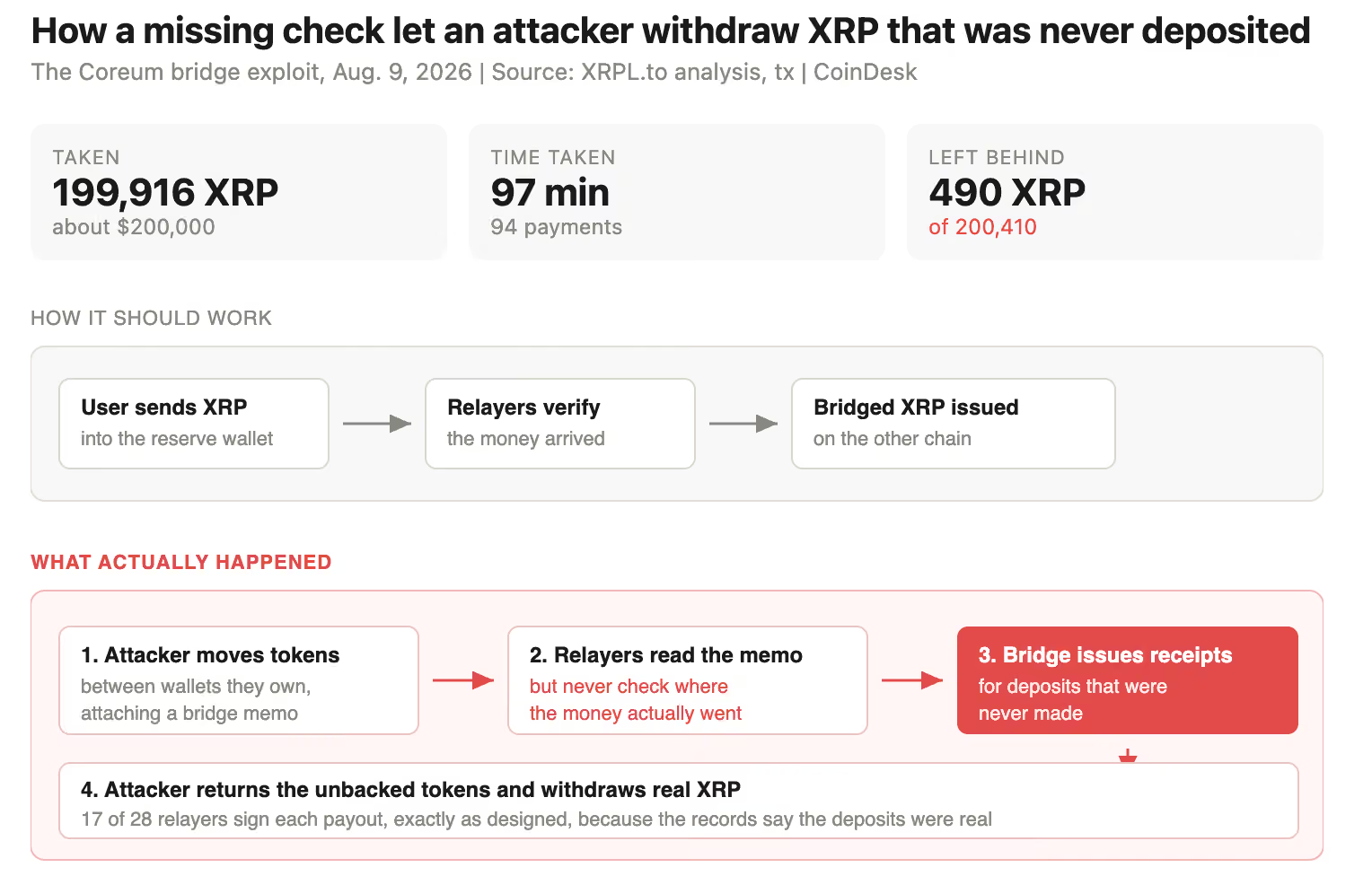
XRP bridge drained after software mistook fake deposits for real ones
-

 Sports5 days ago
DeQuan Jones in ‘high spirits’ after successful leg surgery
-

 Fashion7 days ago
French Rose Gown with Cape Sleeves
-

 Tech4 days ago
DeepSeek Harness launches as open source rival to Claude Code, alongside V4-Pro on API with higher prices
-
 Tech4 days ago
11 Ways to Rank Your Videos
-
 Entertainment7 days ago
Star Wars Officially Continues ‘The Last Jedi’ With a New Spin-Off
-

 Politics7 days ago
In the Chris Kaba case, the police watchdog capitulated to the mob
-
 Crypto World6 days ago
Perplexity AI Predicts an XRP Scenario Few Analysts Are Discussing
-

 Tech6 days ago
SpaceXAI’s Grok Bot turns agents into persistent digital coworkers that can operate your apps for $120-per-month
You must be logged in to post a comment Login