
Crypto World
A16z Crypto Raises $2 Billion Fund Amid Market Downturn

Crypto venture capital giant Andreessen Horowitz is doubling down on crypto despite a major market downturn, seeking $2 billion for a new crypto fund.
A16z Crypto, the blockchain arm of venture capital firm Andreessen Horowitz, is raising a fifth fund focused on crypto with plans to close by mid-2026, according to Fortune, citing anonymous sources on Wednesday.
The latest round is significantly smaller than its previous $4.5 billion fund from 2022, but the company has shifted to a shorter fundraising cycle to remain flexible to ever-changing crypto narratives.
The move comes amid a crypto bear market that has seen more than $2 trillion wiped from total market capitalization since its peak of around $4.4 trillion in early October.
A16z crypto chief Chris Dixon’s Web3 philosophy envisioned a decentralized internet with applications built on blockchains, according to his 2024 book, “Read Write Own.”
But many of those investments have not panned out, notably decentralized X (Twitter) competitor Farcaster, which returned $180 million to investors after selling off its infrastructure in January.
Crypto VCs exploring non-crypto tech
Wall Street crypto buffs have narrowed their focus lately toward stablecoins, real-world asset tokenization, and financial products, with many venture capitalists following that shift. Others have started to look towards other areas of technology.
Co-founder of venture firm Multicoin Capital, Kyle Samani, stepped down in February to “explore new areas of technology,” such as AI, longevity, and robotics.
Meanwhile, crypto venture firm Paradigm is expanding into artificial intelligence and robotics with its latest fund seeking to raise $1.5 billion, as reported in late February.
Related: Crypto slides, but tokenized RWAs and VC push ahead
A16z raised over $15 billion in January to invest in companies and technologies it deemed critical to secure America’s future, mentioning AI and crypto and including technologies in “key areas that generate human flourishing,” such as biology, health, defense, public safety, education, and entertainment.
A16z sees opportunity in AI, crypto in 2026
A16z recently highlighted crypto and AI as major themes for 2026, stating that it expected AI to automate cybersecurity work, AI models to become app stores, privacy to become the “most important moat in crypto,” prediction markets to get “bigger, broader, and smarter,” and stablecoins to become more intertwined with traditional banking and finance.
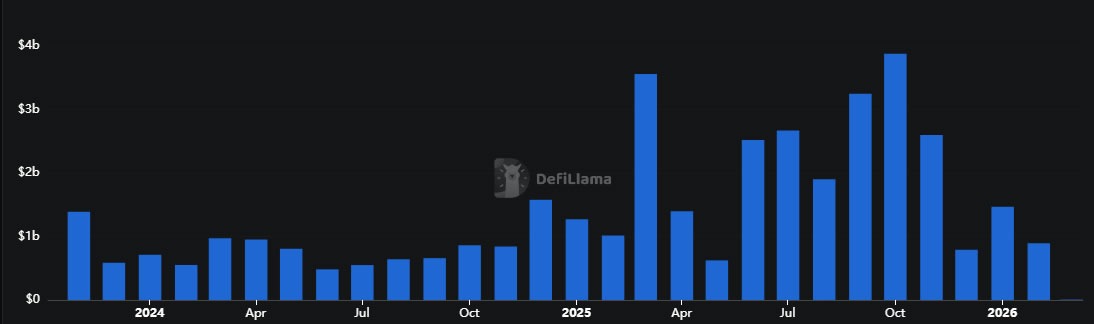
According to DeFiLlama’s fundraising aggregator, crypto startups raised $895 million in February, down almost 40% from the $1.47 billion raised the previous month and marginally less than the $1 billion raised in February 2025.

Magazine: 6 massive challenges Bitcoin faces on the road to quantum security

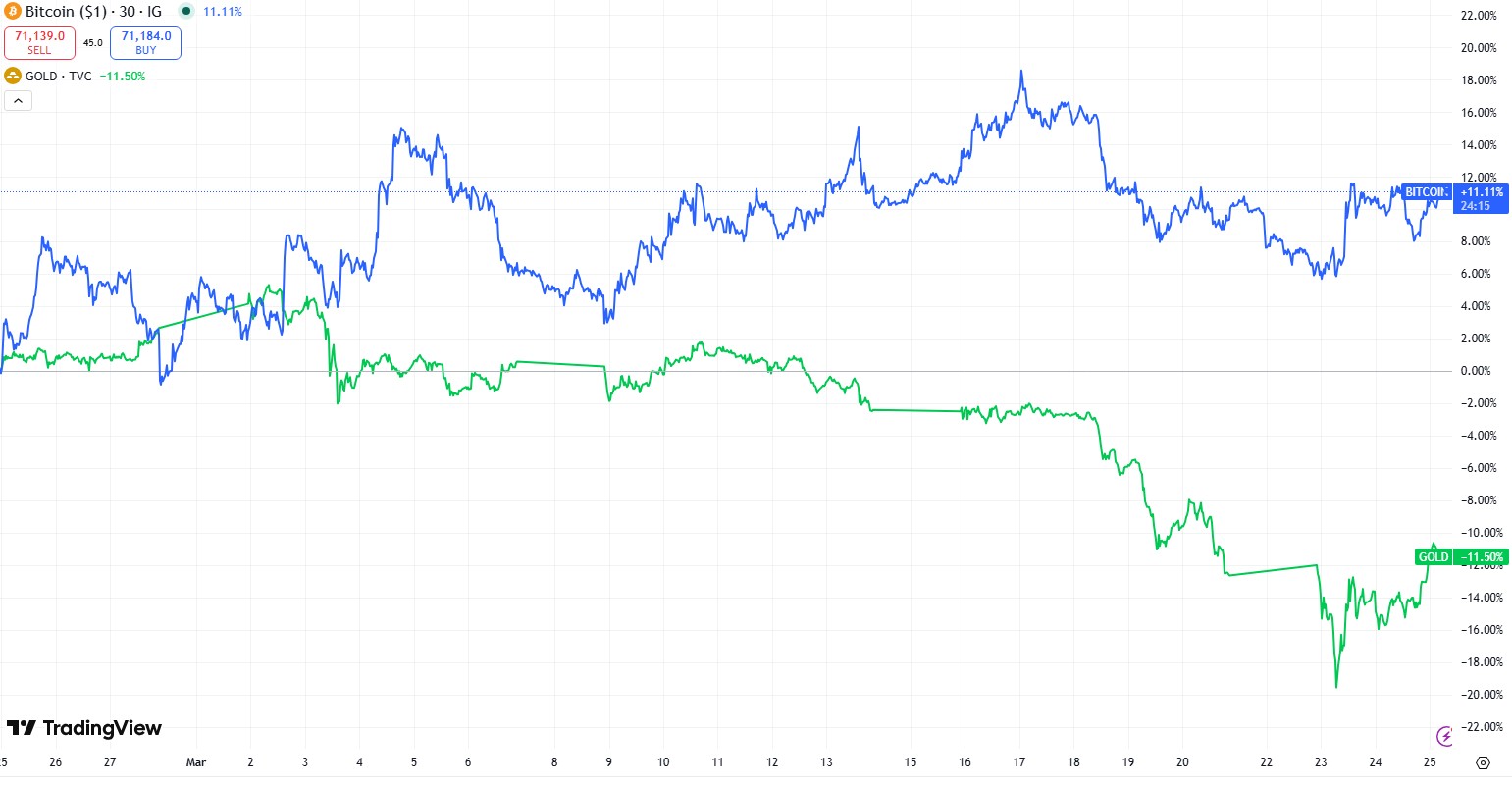
Before the Iran war broke out, Bitcoin spent months trading sideways while gold rallied to record levels.
At the time, gold was seen as the go-to safe haven; inflation concerns remained persistent and geopolitical tensions continued to build, while Bitcoin (BTC) failed to live up to that role.
Nearly a month after the US and Israel launched the first strikes on Iran on Feb. 28, that view is being challenged. Bitcoin initially fell to $63,176 on the news of the attacks but has since risen about 12% to $71,012, as of Wednesday.
Meanwhile, rising oil prices and inflation fears have weighed on gold, which fell 11% last week, marking its largest weekly loss since 1983.

However, Jonatan Randin, a senior market analyst at PrimeXBT, said Bitcoin continues to trade like a risk asset rather than a safe haven. It sells off alongside equities during geopolitical shocks.
“It’s range-bound and showing weakness within a broader downtrend. That’s not safe haven behavior,” he said.
Liquidity is the “dominant” Bitcoin price driver
In recent years, Bitcoin has reacted to global news events, including geopolitical shocks and social media posts from influential figures such as US President Donald Trump. Those moves tend to be short-lived.
Matthew Pinnock, co-founder of decentralized finance project Altura, told Cointelegraph that global liquidity remains the dominant driver of Bitcoin’s price, with macro conditions outweighing headline-driven volatility.
“BTC is trading as a high-beta liquidity asset, which means tighter financial conditions, such as higher real yields, a strong dollar and weaker [exchange-traded fund] inflows, reduce marginal capital and pressure price,” he said.
A September 2024 analysis compiled and written by Sam Callahan of treasury company OranjeBTC found that Bitcoin’s price had a 0.94 correlation with global liquidity between May 2013 and July 2024.
Callahan’s analysis also showed Bitcoin moved in the same direction as global M2 in 83% of 12-month periods, higher than gold, which logged 68.1%. The closest directional alignment after Bitcoin was the S&P 500 index, which represents US large-cap equities and is an often-cited benchmark for risk assets.

Randin said more recent data reflected a similar pattern, pointing to global liquidity rising in the third quarter of 2025, around the time when Bitcoin reached a new all-time high.
The divergence highlights a broader issue with Bitcoin’s safe haven narrative. While it has outperformed gold over certain periods since the war began, its sensitivity to liquidity conditions means it reacts more to financial tightening than to geopolitical stress itself. That complicates the idea of Bitcoin as “digital gold,” particularly in environments where inflation and rates move in tandem.
Related: Bitcoin is a real-time sentiment gauge for weekend warmongering
Oil shock complicates Bitcoin’s inflation narrative
Near-term inflation concerns have been shaping market expectations since the conflict began, driven by rising oil prices and supply disruptions following the closure of the Strait of Hormuz, one of the most important shipping routes in the world.
Randin said rising inflation concerns tied to geopolitical shocks tend to work against Bitcoin in the short term, as higher oil prices feed into inflation expectations, reduce the likelihood of rate cuts and keep real yields elevated. That chain of events tightens financial conditions and suppresses risk appetite, limiting demand for assets like Bitcoin.
In that sense, Bitcoin is not reacting to inflation itself, but to the policy response that follows, said Randin.
The Iran conflict pushed oil prices above $110 while the Federal Reserve raised its 2026 personal consumption expenditures inflation forecast to 2.7% and signaled a more cautious easing path.

“Bitcoin could be better understood as a long-term monetary debasement hedge rather than a short-term inflation hedge, and that’s a critical distinction,” Randin said.
“It responds to the expansion of money supply over multi-year cycles, not to CPI prints. On the timescale of a war-driven oil shock, it still behaves like the risk asset it is.”
Related: ‘Bitcoin Standard’ author explores reality where decentralized gold stopped WWI
Bitcoin rebounds during Iran conflict but risk profile remains
Bitcoin’s behavior during the Iran conflict still aligns with a risk asset. Each escalation has triggered selloffs, liquidation cascades and tighter correlation with equities, even as Bitcoin has held up better than traditional assets over certain periods.
“But it’s important to remember the context. Bitcoin entered this conflict already in a technical bear market, down over 40% from its October highs and well ahead of equities in pricing in deteriorating conditions,” Randin said.
“So while it has held up relatively well since the strikes began, outperforming the S&P 500, gold and silver over certain windows, it hasn’t given us any meaningful directional move.”
A structural shift would require a clear break from that pattern, and those signals have yet to appear.
Onchain data points to a different undercurrent. Continued accumulation, declining exchange reserves and growing holdings among large wallets suggest positioning is building, even if price action has not reflected it.
However, that positioning is still constrained by macro conditions.
“Right now, inflation driven by a hike in oil prices due to geopolitical factors is pushing yields higher and keeping central banks hawkish, which tightens liquidity. That creates a ‘bad inflation’ regime where BTC falls alongside other risk assets,” Pinnock said.
“The inflation hedge thesis breaks because Bitcoin responds more to monetary expansion than to inflation itself, and currently, conditions are restrictive, not stimulative,” he added.
Until liquidity conditions ease and Bitcoin decouples from equities during stress events, its role as a safe haven remains unproven.
Magazine: Banks want to run Vietnam’s crypto exchanges, Boyaa’s $70M BTC plan: Asia Express
Crypto World
Bitcoin tests $72,000 again as rising leverage hints at volatility ahead: Crypto Markets Today
Bitcoin rose 1.2% after midnight UTC, mirroring gains in U.S. equities, with Nasdaq 100 futures up by 1% over the same period.
The advances follow oil’s retreat below $100 per barrel on Tuesday after U.S. President Donald Trump proposed a “15 point plan” to end the war in Iran, although Iranian officials dismissed Trump’s statement as fake news.
The crypto market remains resilient to the conflict with consistent outperformance of traditional haven assets gold and silver since early February.
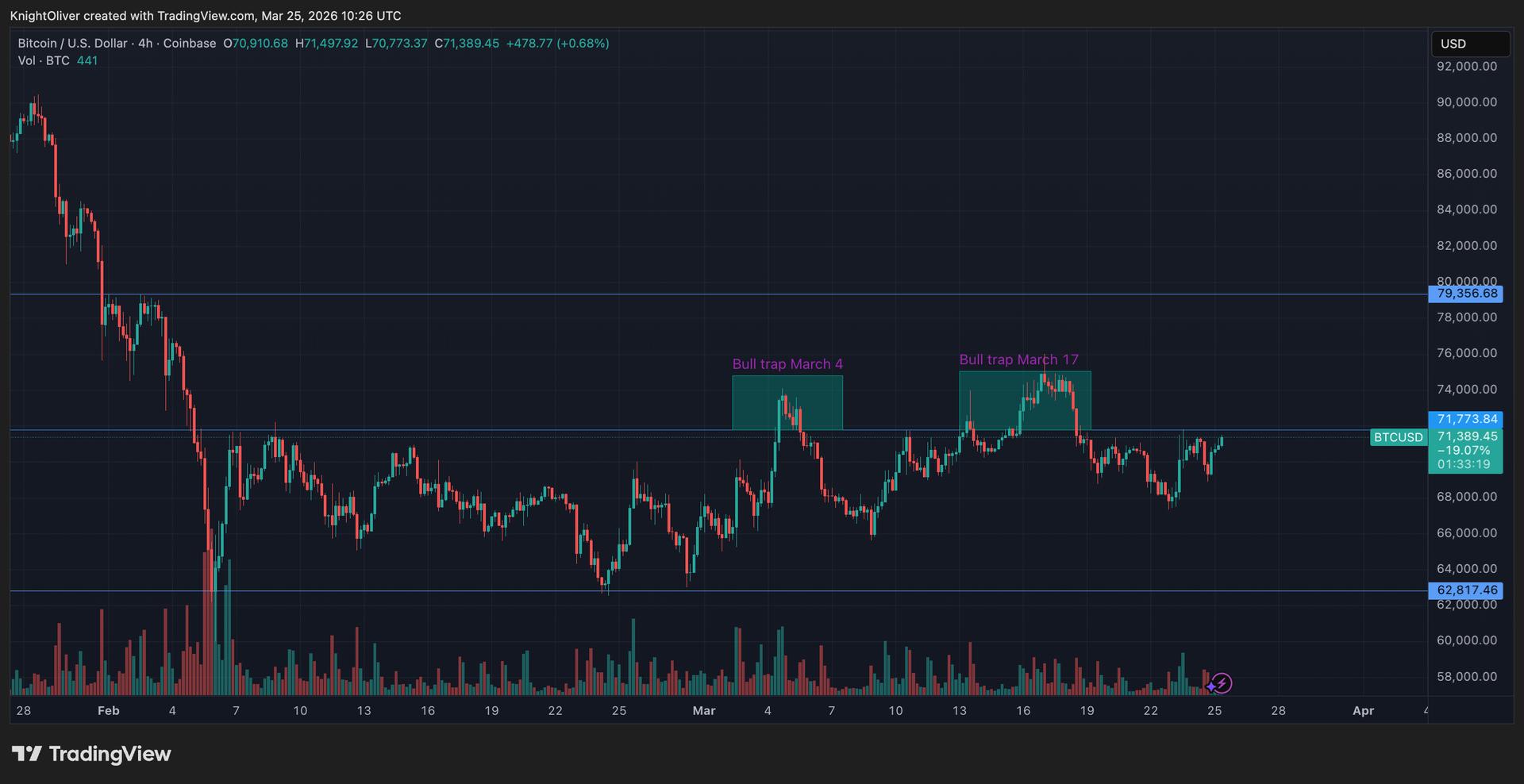
Bitcoin has forayed above $72,000 twice this month, each time followed by a selloff that sent prices to between $67,000 and $65,000.
Traders are opening short positions in this region, resulting in a disproportionate increase in open interest.
Portions of the altcoin market are outperforming bitcoin, with decentralized finance (DeFi) tokens LDO and ETHFI rising by between 2.5% and 3.5% since midnight.
Derivatives positioning
- Industry-wide crypto futures open interest (OI) rose to a one-week high of $112 billion.
- The top 10 tokens, including BTC and ETH, all registered increases of 4% or more in futures open interest in the past 24 hours.
- Ether OI jumped to 14.55 million ETH, the most since Aug. 24. This, coupled with positive funding rates and cumulative volume delta, point to growing demand for bullish bets or longs.
- DOGE and ZEC are other standout tokens with OI increases of over 10% in 24 hours.
- Bitcoin’s 30-day implied volatility index, BVIV, dropped for a third straight day, nearing the weekly low of 53% to indicate a fading geopolitical risk premium. Ether’s volatility is declining, too.
- On Deribit, BTC and ETH put skews continue to weaken, although overall pricing still shows downside concerns across all tenors.
- Friday’s multibillion dollar expiry points to $75,000 as the potential magnet. The max pain theory suggests a potential bounce toward that level.
Token talk
- The CoinDesk Computing Select Index (CPUS) is the best-performing benchmark on Wednesday, rising by 1.9%. The bitcoin-heavy CoinDesk 20 (CD20) gained 0.9% over the same period.
- The CPUS Index is made up of AI tokens TAO and FET as well as chainlink , which makes up 62% of the index weighting.
- LINK is up by 1.5% while TAO and FET have increased by 4.9% and 2.9%, respectively.
- CoinMarketCap’s “Altcoin Season” indicator remains at 48/100, in bullish territory after spending much of February languishing at around 22/100.
- On the flip side, privacy coins XMR and ZEC fell, losing around 1% each as traders rotated between altcoin sectors to position themselves ahead of a potential breakout.
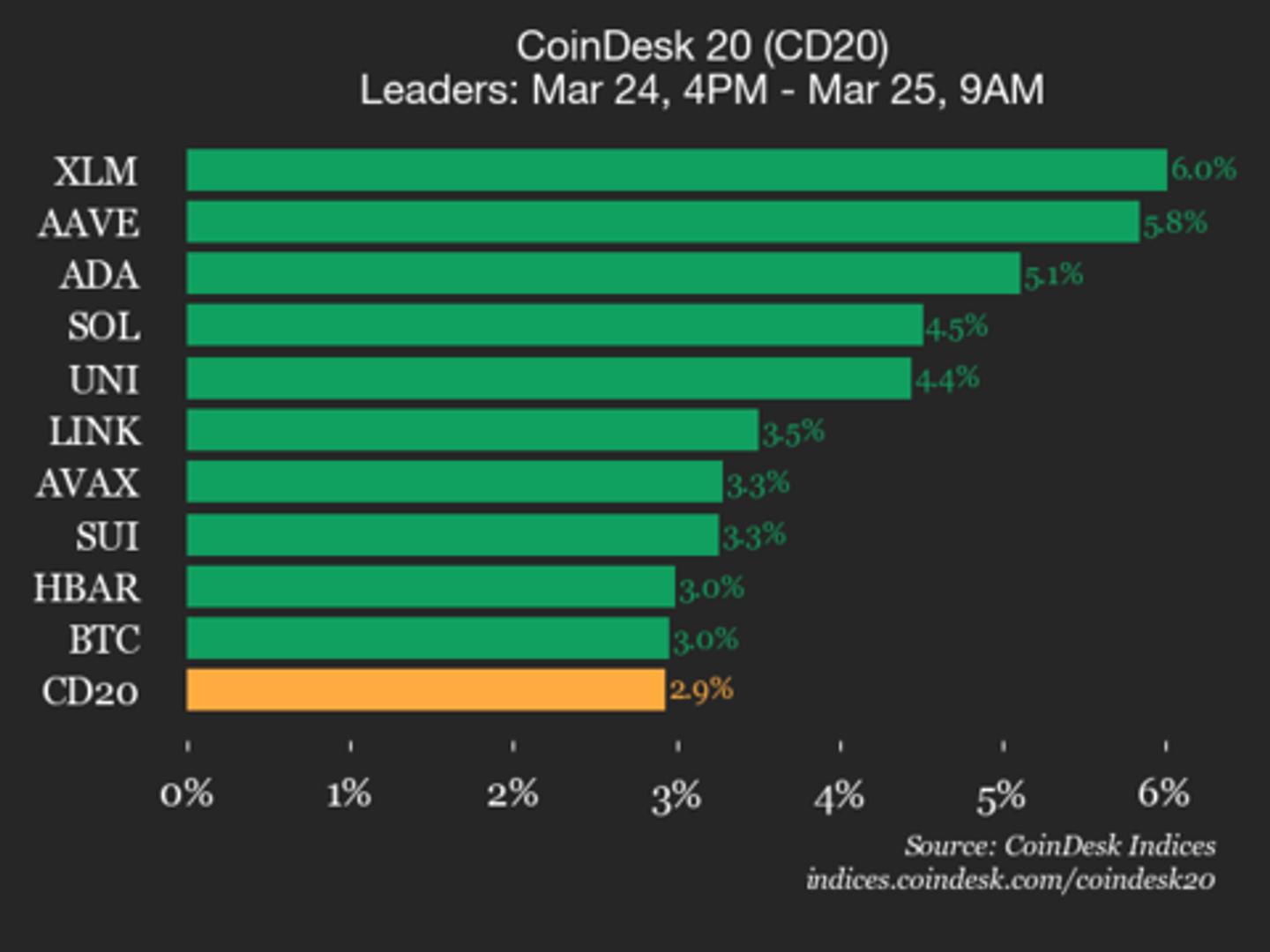
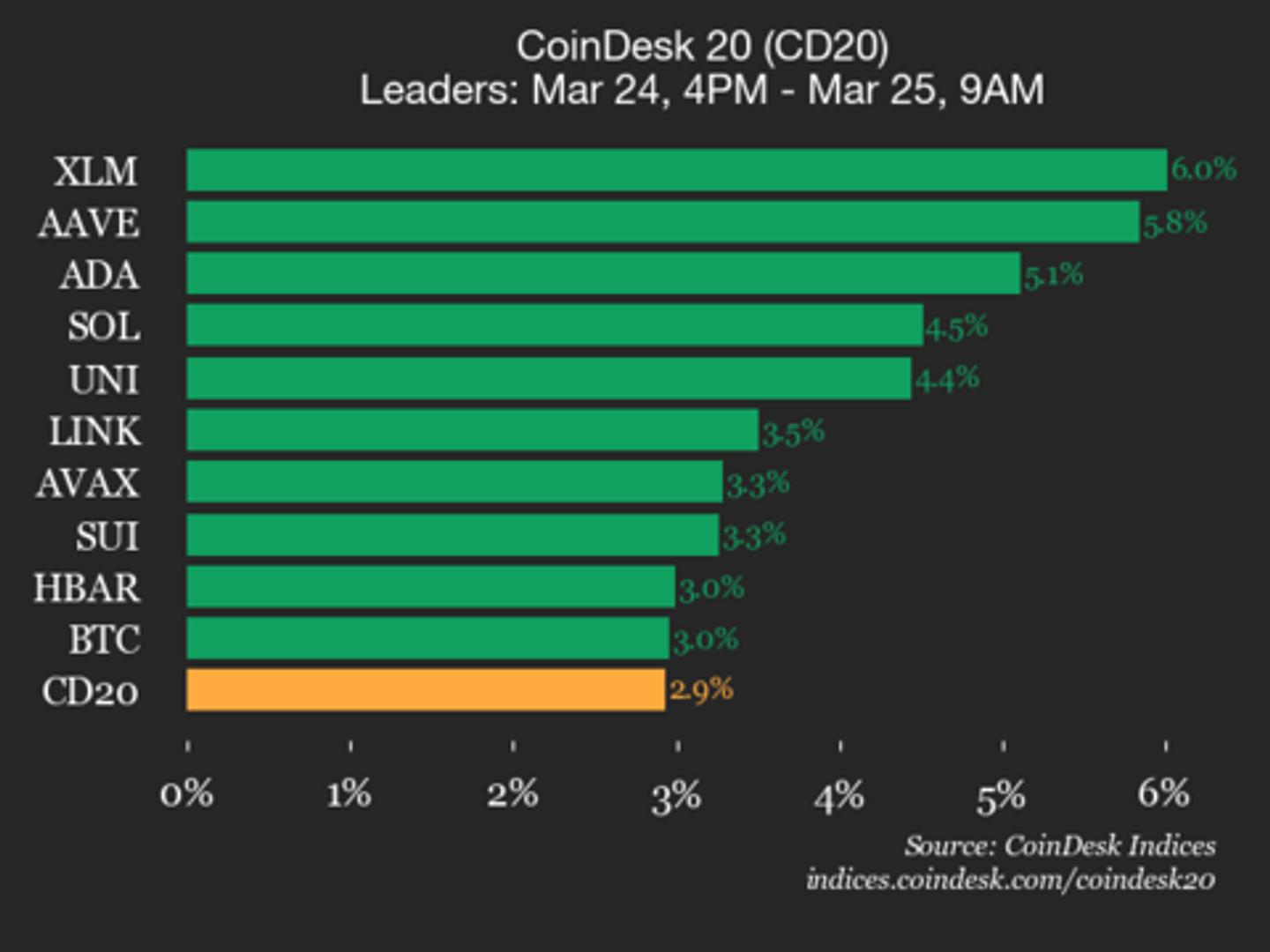
Aave (AAVE), up 5.8% from Tuesday, joined Stellar (XLM) as a top performer.

Bitmine just bought the Ethereum dip. Good enough. 65,341 ETH acquired since March 16. Around $140 million at current prices. Total crypto and cash holdings now sit at $11 billion, making Bitmine the largest Ethereum treasury holder on the planet.
ETH is trading near $2,150, down more than 30% from its 2025 highs. Sentiment is broadly bearish. Bitmine is buying anyway, and doing it faster each week for the past 3 weeks straight.
Tom Lee is not calling this a blind conviction. He is calling it deliberate timing. His base case is simple: Ethereum is in the final stages of a mini crypto winter. The bottom is close and Bitmine is not waiting for confirmation.
- Treasury Signal: Bitmine now holds 4.661 million ETH — 3.86% of Ethereum’s circulating supply of 120.7 million tokens — with 3.14 million already staked, generating an estimated $272 million annually at a 2.83% yield.
- Tom Lee’s Outlook: Lee says ETH has risen 18% since the Iran war commenced, outperforming equities by 2,450 basis points, and identifies crypto as a proven wartime store of value.
- ETH Context: Standard Chartered’s Geoff Kendrick targets $7,500 for ETH in 2026, with Fundstrat’s year-end forecast sitting at $4,500 — both contingent on regulatory clarity and stablecoin supply expansion.
Can Ethereum Price Reclaim $2,500 Before the Next Leg Higher?
ETH is consolidating between $2,100 and $2,250 after recovering from the $1,800 region tested in late Q1 2026.
The 200-day EMA sits at $2,400, and it is the only level that matters right now. ETH has failed to reclaim it 3 times over the past 6 weeks. Every rally has stalled at the same ceiling.
Daily RSI is hovering around 48. Neutral territory that historically precedes a directional break rather than an extended sideways chop. Funding rates across major perpetual markets are slightly negative, meaning bears are still paying.

That is a structural setup that turns into a short squeeze the moment a catalyst arrives. The Iran conflict already showed how fast that can happen, with ETH surging off local lows as markets priced in geopolitical risk premium.
ETH breaks above $2,400, flips the 200-day EMA to support, and opens a path toward $3,000 to $3,200 where Bitmine’s earlier cost basis sits. Or consolidation fails at $2,250, price retests $1,900 to $2,000, and Fundstrat analyst Sean Farrell’s H1 drawdown scenario plays out before any year-end recovery.
Is Bitmine Staking Scale a Supply Shock in Slow Motion?
The headline number understates what is actually happening.
Bitmine has staked 3,142,643 ETH, more than any single entity on the planet, according to Lee. That supply is locked. It is not hitting the market. Through staking partners, including MAVAN, the position generates $272 million annually. This is not a treasury bet sitting in cold storage. It is yield-generating infrastructure.

Lee is making the macro case directly. ETH is up 18% since geopolitical tensions escalated, outperforming equities by 2,450 basis points. That framing positions Ethereum not as a tech asset but as an emerging macro hedge.
Traditional finance infrastructure integrating deeper into on-chain settlement layers is giving that thesis institutional legs.
The broader Bitmine balance sheet reflects the same conviction across multiple bets. 196 BTC. A $200 million stake in Beast Industries. $95 million in WLD treasury firm Eightco. $1.1 billion cash on hand.
Institutional backing includes Ark Invest, Founders Fund, Pantera, Kraken, and Galaxy Digital. The target is 5% of the circulating ETH supply, roughly 6.04 million ETH.
2 levels define the thesis from here. ETH reclaims $2,500 to $3,000, and institutional validation accelerates inflows from funds still sitting on the sidelines. Fail to hold $2,100 on any retest, and the mini-winter narrative breaks down before it gains traction.
The accumulation is not happening in isolation either. Other major capital allocators are repositioning aggressively. Bitmine is the loudest signal in a broader institutional rotation that is just getting started.
Discover: The best new crypto in the world
The post Ethereum ‘Mini Crypto Winter’ Nears End as Bitmine Adds 65,341 ETH, Tom Lee Says appeared first on Cryptonews.

The European Central Bank is laying out a concrete path toward a potential digital euro, signaling that standards for a future euro-wide digital currency could be announced as soon as this summer. ECB Executive Board member Piero Cipollone told EU lawmakers that once those standards are in place, the bank will collaborate with market participants to integrate them into payment terminals and other infrastructure ahead of any issuance decision. The move aims to give European providers a head start by embedding the necessary rails into devices and apps, so European companies can adapt quickly if parliament approves a digital euro in the years ahead.
According to Cipollone, finalizing the rulebook would also enable new payment terminals and apps to ship with the required rails already embedded, positioning Europe to move faster once EU legislation is enacted. The ECB anticipates that legislation could be in place in 2026, aligning with the broader timeline for a potential launch in the subsequent years.
Key takeaways
- Standards for a potential digital euro are expected to be announced by the ECB by summer, with industry participants invited to build the rails into their devices and services.
- A 12-month digital euro pilot is planned to run from the second half of 2027, testing person-to-person and point-of-sale payments in a controlled environment ahead of any possible issuance.
- The ECB envisions the digital euro as public infrastructure used by banks and payment providers to offer wallets and services, not as a consumer-facing product from the central bank.
- Banking-sector costs for implementing the digital euro could reach 4–6 billion euros over four years, roughly 3% of banks’ annual IT maintenance budgets, according to Reuters’ analysis cited by the ECB.
- Even as it aims to broaden pan-European payment rails, the ECB stresses that the digital euro would complement cash and bank deposits, not replace them, with accessibility features designed from the outset.
Standards, timing, and industry readiness
In addressing lawmakers, Cipollone emphasized that releasing clear technical standards would allow market participants to embed the necessary rails into payment terminals and apps well before any formal issuance decision. By finalizing the rulebook, the ECB aims to give European merchants and providers a smoother transition, reducing the risk of fragmentation as the euro area moves toward a unified digital payments backbone. The authorities expect the EU legislative process around the digital euro to play out in 2026, creating a window in which private players can align their products with the coming framework.
Beyond the technical standards, the ECB has been exploring a broader architecture for central bank digital money that could underpin a tokenized and interoperable European financial ecosystem. The agency’s broader agenda includes efforts to ensure that digital euro rails can be used across national schemes and by co-badged cards and bank wallets, enabling seamless switching between domestic schemes and the digital euro within the euro area.
Pilot, cost, and strategic rationale
The 12-month pilot, set to begin in the second half of 2027, will test both person-to-person and point-of-sale payments within a controlled environment. The aim is to assess technical readiness and interoperability across platforms, laying the groundwork for a possible 2029 issuance if lawmakers approve the legal framework. This timeline underscores the ECB’s cautious but forward-leaning approach: build the rails first, test them extensively, then scale to a full launch if political backing coalesces.
On the economic side, the cost of a digital euro to EU banks has been a major talking point. Reuters reported that the ECB’s analysis estimated a four- to six-billion-euro price tag over four years for banks to implement and operate the necessary systems. The bank framed these costs as roughly 3% of the sector’s annual information technology maintenance budget, arguing that the long-term benefits—such as reduced merchant fees and more scalable European payment schemes—could offset the upfront spend.
The ECB stresses that the digital euro is designed as public infrastructure—the rails that private intermediaries will use to offer wallets and services—rather than a product marketed directly to consumers. This distinction is central to the ECB’s design philosophy: a trusted, state-backed settlement layer that can underpin a variety of private offerings while ensuring broad accessibility and resilience.
Public rails, private wallets, and the road ahead
One of the core ambitions of the digital euro program is to reduce Europe’s dependence on international card schemes by establishing pan-European rails for payments. Co-badged cards and bank wallets could potentially switch between domestic schemes and the digital euro, creating a more cohesive payments landscape across the euro area. This approach aligns with the ECB’s broader strategy of anchoring future wholesale markets in central-bank money, a principle that persists across initiatives such as the Pontes project for tokenized securities and the Appia roadmap for a tokenized European financial ecosystem.
In parallel, Cipollone highlighted ongoing work on tokenized central bank money that could serve as the settlement asset for stablecoins and tokenized deposits. While still exploratory, these concepts reflect the ECB’s broader vision of a multi-layered, interoperable financial system where central-bank digital money sits at the core of settlement and reconciliation, while private innovations build on top of this trusted infrastructure.
Accessibility remains a clear priority. The ECB intends to embed inclusivity features—such as voice commands and large-font displays—into the digital euro’s reference app from the outset, ensuring that a wide range of users can access and utilize digital payments as part of the currency’s broader public utility.
For now, the key questions center on the legislative path to a digital euro and the practicalities of cross-border interop. The ECB’s current trajectory suggests a deliberate, staged approach: publish the standards this summer, run a rigorous pilot starting in 2027, and evaluate legislative alignment toward a potential 2029 issuance. Whether policymakers and financial institutions will synchronize their efforts in time remains a live question that readers should monitor closely as EU lawmaking advances and pilots unfold.
Readers should watch for updates on the public standards release and the evolution of the pilot program, as these signals will indicate how quickly Europe might transition toward a digital euro and how the model could influence global central-bank digital currency debates.
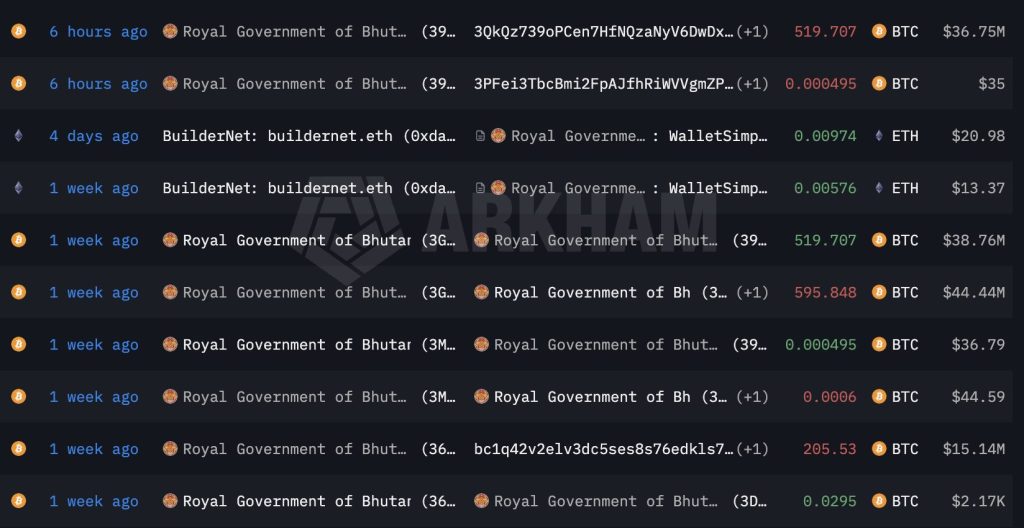
Bhutan is selling Bitcoin again. The Royal Government transferred 519.7 BTC worth roughly $36.75 million to a Binance deposit address Wednesday. The move comes from Druk Holding and Investments, the nation’s sovereign wealth fund, and follows a consistent pattern of outflows that has been running for months.
The remaining stack now sits at 4,453 BTC. That is a sharp drop from a peak of over 13,000 BTC. More than two thirds of the position is gone.
- The Transaction: Druk Holding moved 519.7 BTC to exchange-linked wallets, including Binance and QCP Capital.
- The Trend: Sovereign holdings have dropped over 60% from the October 2024 peak to roughly 4,450 BTC.
- The Signal: Sovereign inventory is converting to liquid supply in steady $30M-$70M tranches.
The Transfer: On-Chain Confirmation
Data from Arkham Intelligence identifies the movement as a split transaction.
The funds were routed to two distinct wallets: one associated with the trading firm QCP Capital and another directly feeding Binance Inflows.

Direct transfers to exchange deposit addresses typically signal immediate intent to sell or collateralize assets rather than mere custody rotation.
This is a liquidity event. The market has seen this repeatedly in recent weeks, including a $72 million exit last week and a $12 million tranche earlier in the month. Druk Holding is averaging down its exposure while prices hover near $71,100. While some analysts debate the exact motive, the destination of these funds suggests active profit-taking rather than long-term repositioning.
The Strategy: From Mining to Monetization
Bhutan Bitcoin holdings were not purchased on the open market like typical institutional assets. They were generated through industrial-scale Bitcoin Mining operations utilizing the country’s renewable hydropower resources.
This gives Druk Holding a cost basis of effectively zero (excluding infrastructure CAPEX), making these Sovereign BTC Sales pure profit realization for the state treasury.

The strategy has shifted. From 2022 through late 2024, Bhutan was a net accumulator. Now, the state acts as a disciplined seller.
Unlike El Salvador, which continues to buy, Bhutan is monetizing its digital surplus to fund domestic initiatives. Analysts view this as a capital rotation likely funding the Gelephu Mindfulness City infrastructure project.
While Bitcoin and gold reverse roles in the broader macro conversation, Bhutan treats its BTC stack strictly as a working capital account.
Markets are absorbing the supply. Despite persistent sell pressure from Bhutan, Bitcoin remains resilient, trading with volatility signals that suggest strong demand absorption. The Druk Holding wallet is now a known sell-side vector. This is an organized unwind. The treasury is liquidating into strength.
Discover: The best new crypto in the world
The post Bhutan Continues Bitcoin Sell-Off with $37M Transfer to Binance appeared first on Cryptonews.


South Korean crypto exchanges recorded large capital outflows in the second half of 2025, even as user activity and deposits continued to grow.
Summary
- South Korean exchanges recorded $60 billion in crypto outflows as funds moved offshore in 2025.
- Exchange accounts rose to 11.1 million and customer deposits climbed despite weaker market conditions nationwide.
- Profits, trading volumes, and market capitalization fell as crypto prices softened late in 2025 overall.
New data from the Financial Services Commission showed that more funds moved to overseas platforms and private wallets during the period. The report also showed weaker profits and lower trading activity across the local market.
The Financial Services Commission said crypto outflows from South Korean exchanges reached 90 trillion won, or about $60 billion, in the second half of 2025. That marked a 14% rise from 78.9 trillion won, or $52.5 billion, in the first half of the year.
The regulator linked part of that movement to cross-border trading activity. In its report, the FSC said,
”It is presumed that virtual assets are being transferred abroad for arbitrage and other similar activities.”
The statement pointed to overseas platforms and private wallets as major destinations for those transfers.
The report showed that more people continued to use local crypto exchanges despite the rise in outflows. By the end of 2025, the number of exchange accounts reached 11.1 million, up 3% from June 2025.
Customer deposits rose at a faster pace. The FSC said deposits climbed 31% to 8.1 trillion won, or about $5.4 billion, during the second half of the year. The figures showed that users kept adding funds to exchanges even as market conditions turned weaker.
In addition, the growth in accounts and deposits did not lift earnings for exchange operators. The country’s 18 active exchanges posted 380.7 billion won, or $253.4 million, in operating profit in the second half. That figure was down 38% from 617.8 billion won, or $411.2 million, in the first half.
Trading activity also moved lower during the period. The FSC estimated average daily trading volume at 5.4 trillion won, or $3.6 billion, which was 15% lower than in the first half. The regulator said lower crypto prices near the end of 2025 likely weighed on exchange revenue and market activity.
Market value also moved lower
The report estimated South Korea’s total crypto market capitalization at 87.2 trillion won, or about $58 billion, at the end of 2025. That was down 8% from the first half of the year and reflected softer market conditions across major digital assets.
The broader market remained below its October 2025 peak, when bitcoin reached an all-time high of about $126,080. The FSC data showed that while local participation stayed firm, weaker prices and lower volumes put pressure on exchange performance in the second half.

Cardano price is grinding through a critical consolidation phase, trading in a tight band between $0.25 and $0.27 as on-chain prediction flashes a potential reversal.
Analysis from market intelligence platform Santiment suggests the asset has entered a historic “opportunity zone,” with average wallet returns signaling capitulation typically seen before market resets.
— Santiment (@santimentfeed) March 24, 2026
 Average wallets that have been active on the Cardano network over the past year are netting a return of -43% on their investments. Memes aside about the altcoin's major -71% price decline since September, this extreme negative MVRV value is generally an indicator of $ADA being… pic.twitter.com/LzQRKhobQe
The 13th-largest cryptocurrency by market cap has printed six consecutive red candles on the daily chart, leaving active wallets from the past 12 months sitting on unrealized losses of approximately -43%. The price action reflects a 63.5% correction from year-ago levels.
Imminent catalysts, including the Midnight privacy sidechain launch and the Plutus V11 hard fork, are keeping smart money attentive. As broader markets hesitate, volume data suggests whales are positioning for volatility.
Discover: The best pre-launch token sales
Cardano Price Prediction: Can ADA Defend Support Amid Record Shorting?
Technical indicators for Cardano reveal a battleground at the $0.25 support level, a zone that has historically triggered significant liquidity inflows. Recent price action shows $ADA hovering near $0.268, down over 71% from its September high of $0.954.
This steep discount has pushed the MVRV (Market Value to Realized Value) metric significantly below zero. Historically, when MVRV drops this low, selling pressure begins to fade as holders refuse to sell at deep losses.
Despite the bearish sentiment, significant accumulation is occurring behind the scenes. Previous analysis highlighted that periods of low social dominance combined with high negative returns often precede short squeezes.

Data indicates that derivatives markets are seeing record shorting interest. If $ADA can reclaim the $0.2717 pivot, a rapid move toward the first resistance level at $0.3230 becomes the primary scenario.
Conversely, a failure to hold $0.25 could expose the asset to price discovery to the downside. However, with the SEC and CFTC recently classifying ADA as a digital commodity, institutional regulatory fears have subsided.
Discover: The best crypto to diversify your portfolio with
Maxi Doge Flows Surge as Traders Rotate into High-Beta Assets
While Cardano works through its slow-moving accumulation phase, aggressive traders are increasingly rotating capital into high-leverage meme protocols to capture immediate upside. The market’s appetite for volatility has found a new outlet in Maxi Doge ($MAXI), a project that blends “gym-bro” meme culture with actual trading utility.
Maxi Doge is positioning itself as the “Review Mirror” for traders who missed the original DOGE runs, but with a distinct cultural twist focused on the “1000x leverage mentality.” The presale has already secured more than $4.7 million in early funding, signaling robust demand for assets that offer higher beta than legacy L1s.
Currently priced at $0.000281, the token incentivizes holding through huge 66% APY staking and holder-only trading competitions.
Unlike standard meme coins that rely solely on hype, Maxi Doge utilizes a “Maxi Fund” treasury to support liquidity and partnerships, aiming to create a sustainable ecosystem for its community. (
Disclaimer: Crypto is a high-risk asset class. This article is provided for informational purposes and does not constitute investment advice.
The post Cardano Price Prediction: Record Shorting and Line to Defend appeared first on Cryptonews.
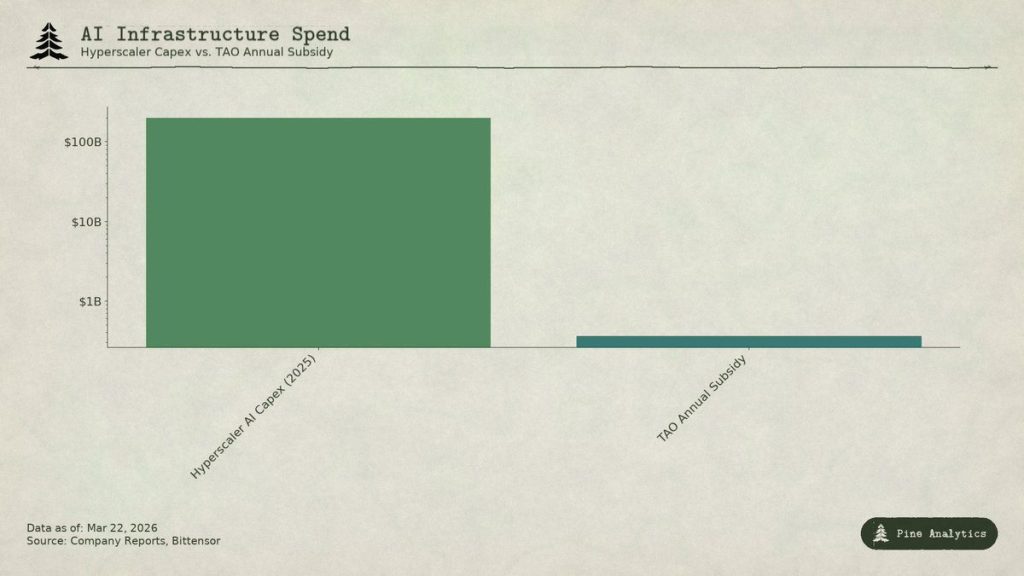
Bittensor (TAO crypto) is currently priced on an annual subsidy of $52 million, not organic revenue.
The decentralized AI protocol incentivizes its subnet to emit 518 TAO daily to top performers like Chutes, masking a near-term liquidity crisis.
With a $1.37 billion subnet market cap and near-zero organic validator yield, the network faces a structural “Income Desert.”
The TAO halving effectively starts a timer on this valuation model. While the TAO price has recovered from its Q1 2026 lows to trade above $330, the disconnect between token incentives and actual utility is widening. If external revenue does not replace inflationary rewards before the miners bleed out, the math stops working.
- Emission Dependency: Top subnets like Chutes receive $52 million in annualized subsidies while generating negligible external revenue.
- Cost Inversion: Unsubsidized decentralized compute costs are roughly 1.6-3.5x higher than centralized competitors like Deepseek.
- Valuation Gap: The network supports a $1.37 billion subnet market cap despite the bulk of validator yield coming from inflation rather than customers.
Tao Crypto Data Deep Dive: The Emission Problem
Subnets are currently paid to exist, not to serve. Chutes (SN64), a top-performing subnet, captures approximately 14.4% of total network emissions. That equals roughly 518 TAO per day. At current market prices, this serves as a $52 million annual operational subsidy shared among miners and validators.
Without this subsidy, the economics invert immediately. Pine Analytics data indicates that unsubsidized inference on Chutes would cost 1.6x to 3.5x as much as centralized competitors like Deepseek or TogetherAI.
The protocol acts as a heavy subsidizer of compute, creating a cost advantage that is artificial rather than structural. When the emissions stop covering the spread, the user value proposition evaporates. This mirrors the structural inefficiencies seen in legacy market infrastructure, where capital gets trapped in systems that do not generate velocity.
The Halving Catalyst: Why the Clock is Ticking
The TAO halving in December 2025 slashed daily emissions from 7,200 to 3,600 TAO. The buffer is gone. Miners previously relying on fat block rewards now fight for a shrinking pie, making the “Income Desert” a solvency issue rather than just a theoretical concern.

This scarcity mechanism is designed to support the price, but it stress-tests the business model. If organic revenue does not scale to replace the lost 3,600 TAO per day, miners operate at a loss. Much like the sustainability challenges that forced Balancer Labs to restructure, Bittensor’s subnets cannot run indefinitely on a deficit. The halving exposes which subnets are businesses and which are zombie chains feeding on inflation.
The Valuation Gap: What the $1.37B Subnet Market Cap Actually Reflects
The market currently values Bittensor’s subnets at roughly $1.37 billion. This figure implies a massive growth multiple based on future Crypto AI adoption, as current organic cash flows are near zero. The discrepancy is stark.
Investors are paying a premium for infrastructure that is currently less efficient than centralized alternatives. In a Proof-of-Work style system like Bittensor, the valuation must eventually be backed by miner revenue.
If the price of TAO drops or the cost-to-serve remains high, the security budget collapses. The current price of $332 assumes a seamless transition from subsidized growth to organic profitability. The data does not yet support that assumption.
The post Bittensor Income Desert: Why $52M in Subsidies Mask a TAO Crypto Valuation Risk appeared first on Cryptonews.


Cipher Digital (CIFR) shares jumped 9% in pre-market trading after the company, formerly a bitcoin miner, announced a new long-term data center lease and said it secured a $200 million revolving credit facility.
The company revealed a 15-year lease agreement with an investment-grade hyperscale tenant for its third data center campus. Cipher will develop and deliver a high-performance computing facility at an existing site, strengthening its position as a partner to large technology firms building AI infrastructure.
Cipher also announced a revolving credit facility of up to $200 million, with an additional $50 million accordion option. Backed by a syndicate of leading global banks, the facility provides non-dilutive capital to support expansion, boost liquidity, and fund future growth initiatives.
Cipher Digital, formerly known as Cipher Mining, has rebranded to reflect a strategic pivot away from bitcoin production toward the development of industrial-scale data centers for AI and cloud workloads. The move aligns the company with the rapidly growing demand for high-performance computing capacity.

Former Google executive Matt Brittin announced as BBC director-general

Greenroom inks global ocean mapping deal

Bitcoin Rallies After Iran Strikes but Safe Haven Role Unproven


-
 Crypto World5 days ago
NIO (NIO) Stock Plunges 6.5% as Shelf Registration Sparks Dilution Worries
-

 Fashion5 days ago
Weekend Open Thread: Adidas – Corporette.com
-

 Politics5 days ago
Jenni Murray, Long-Serving Woman’s Hour Presenter, Dies Aged 75
-

 Crypto World4 days ago
Best Crypto to Buy Now: Strategy Just Spent $1.57 Billion on Bitcoin During Fear While Early Investors Quietly Enter Pepeto for 150x Potential
-

 News Videos7 days ago
RBA board divided on rate cut, unusually buoyant share market | Finance Report | ABC NEWS
-

 Crypto World4 days ago
Bitcoin Price News: Bhutan Sells $72 Million in BTC Under Fiscal Pressure, but the Smart Money Entering Pepeto Sees What the Market Does Not
-
 NewsBeat4 hours ago
Manchester United reach agreement with Casemiro over contract clause amid transfer speculation
-

 Tech5 days ago
inKONBINI Lets You Spend Summer Days Behind the Register
-

 Crypto World7 days ago
Canada’s FINTRAC revokes registrations of 23 crypto MSBs in AML crackdown
-

 Sports2 days ago
Remo Stars and Kano Pillars Strengthen Survival Hopes in NPFL
-
 NewsBeat7 days ago
Residents in North Lanarkshire reminded to register to vote in Scottish Parliament Election
-

 News Videos7 days ago
PARLIAMENT OF MALAWI – PAC MEETING WITH REGISTRAR OF FINANCIAL ON AMARYLLIS HOTEL – INQUIRY LIVE
-

 Politics6 days ago
Gender equality discussions at UN face pushbacks and US resistance
-

 Business3 days ago
No Winner in March 21 Drawing as Prize Rolls to $133 Million for Next
-

 Business7 days ago
Who Was Alex Pretti? 5 Key Facts About the ICU Nurse Killed by Federal Agents in Minneapolis
-

 Sports2 days ago
Gary Kirsten Accuses Pakistan Cricket Board Of ‘Interference’, Mohsin Naqvi Responds
-

 Tech3 days ago
Give Your Phone a Huge (and Free) Upgrade by Switching to Another Keyboard
-

 Tech7 days ago
Inventec’s bizarre VeilBook laptop hides its touchpad under a sliding keyboard just to give cooling fans a little breathing room
-

 Sports5 days ago
2026 Kentucky Derby horses, odds, futures, preview, date: Expert who nailed 12 Derby-Oaks Doubles enters picks
-
Sports6 days ago
Vikings Free Agency Enters Phase 2 with Key Questions
You must be logged in to post a comment Login