
Crypto World
Aave Drops Chaos Labs as Risk Provider, Citing Deliberate Decision


Chaos Labs has parted ways with Aave after three years of serving as the crypto lending protocol’s primary risk service provider, citing a budget dispute and fundamental disagreements over how risk should be managed. The rupture signals a notable inflection point in DeFi risk governance as Aave advances its V4 migration and navigates ongoing governance tensions within its ecosystem.
Chaos founder Omer Goldberg announced the decision on X, stressing that the move was deliberate and not made in haste. He said Aave Labs was willing to raise its budget to $5 million, but that the engagement “no longer reflected how we believe risk should be managed.” Aave Labs CEO Stani Kulechov offered a different framing, describing Chaos’s departure as the result of a push by Chaos to become the sole risk provider and to replace other partner models. Aave’s stance, the two sides said, remains professional; Chaos did not depart on acrimony, but the parties simply could not reconcile their risk-management philosophies.
Key takeaways
- Chaos Labs exits after a three-year engagement as Aave’s main risk service provider, citing a budget dispute and diverging views on risk management.
- The split underscores tensions between a single-provider model and a two-layer risk framework that Aave maintains, with Chaos allegedly seeking to replace Chainlink’s oracles and other partners.
- Aave assures that the departure has not disrupted its protocol, smart contracts, or listings, while signaling it will continue working with LlamaRisk during the transition.
- The move comes amid broader governance frictions within Aave Labs over funding and revenue control, and just weeks after a notable risk incident fueled calls for stronger safeguards.
What triggered Chaos Labs’ departure from Aave
Chaos Labs has been a cornerstone of Aave’s risk infrastructure since November 2022, handling pricing, risk assessment, and related guardrails across Aave’s V2 and V3 markets. In that period, Aave’s total value locked expanded markedly, underscoring the centrality of robust risk tooling to the protocol’s growth. By late February, Aave had crossed a historic milestone in lending activity, with cumulative lending volume advancing past the trillion-dollar mark, a milestone the project highlighted as a first for the DeFi sector.
Goldberg framed the decision as one driven by a misalignment over risk management and the scope of Chaos’s duties. “This decision was not made in haste,” he stated in a post to X. “We worked in good faith with DAO contributors. Aave Labs was professional and supported increasing our budget to $5m to retain us. However, we are leaving because the engagement no longer reflects how we believe risk should be managed.”
Aave’s account of the dispute diverges on what Chaos was seeking. Stani Kulechov contended that Chaos sought to become the sole risk manager and to substitute Chaos’s price oracles for Chainlink—an approach that would have effectively sidelined other risk partners and compromised Aave’s established two-layer risk model. Chaos’s proposal, Kulechov suggested, would have forced Aave to abandon its multi-provider framework, a move the protocol did not accept. Chaos later indicated it was examining winding down its risk consultancy, even as Aave reportedly offered to double the compensation to keep Chaos onboard.
Beyond the personnel dynamics, the departure arrives at a moment of heightened sensitivity around risk in Aave’s community. The ecosystem has recently grappled with high-profile events that tested the resilience of its risk tools, including a $50 million loss traced to a user interacting with Aave’s interface on March 12. In response, Aave rolled out a shielded risk feature designed to deter high-risk trading behavior, signaling a public push to bolster user safeguards even as internal governance wrestles with funding and control questions.
Risk architecture at stake: Chaos’s demands vs. Aave’s model
At the heart of the disagreement is Aave’s two-layer economic risk model, which blends on-chain risk pricing with external risk data. Chaos has been integrated into the back end of that risk framework, providing pricing and risk management services that supported V2 and V3 liquidity and lending operations. The move toward a broader, multi-provider risk architecture—anchored by partners like Chainlink—was a core feature of Aave’s design philosophy as it expanded and upgraded to V4.
Goldberg argued that Chaos’s push to become the sole risk provider, coupled with a desire to substitute its price oracles for Chainlink’s, would have undermined the protocol’s diversification of risk inputs. Kulechov, conversely, stressed that Chaos’s demand would displace established partners and thrust Chaos into a governance role that Aave does not appear prepared to concede. The exchange underscores a broader tension in DeFi: how to balance centralized expertise with multi-source resilience in a rapidly evolving risk landscape.
In practical terms, the split leaves Aave poised to continue with LlamaRisk and other risk partners as it advances V4 and maintains its two-layer model. Chaos had suggested it could take on a more centralized risk-management posture, but Aave’s leadership signaled a preference for a governance-driven, multi-vendor approach, particularly as the platform expands its risk surface with new features and markets. The dispute also highlights a broader industry question: what responsibilities do risk managers owe when a protocol experiences a failure, and who bears the blame when risk controls falter?
Operational realities of the migration and broader implications
The timing of Chaos’s exit aligns with Aave’s ongoing transition from V3 toward V4, a process that executives warned could stretch over months or even years as liquidity and markets migrate and the new feature set is absorbed into existing ecosystems. Goldberg noted that ongoing operations would require maintaining both V3 and V4 during the migration window, a workload that can be substantial for any risk provider. He warned that without clear safety harbors or settled legal precedents, risk governance remains an area of ambiguity with real consequences when things go wrong.
Kulechov framed the disruption as manageable and non-disruptive to Aave’s immediate operations. He emphasized that Chaos’s departure did not affect Aave’s smart contracts, token listings, or network integrations, and that the protocol would continue collaboration with LlamaRisk to ensure a smooth transition. The episode sits against a backdrop of ongoing governance debates about funding and revenue allocation within Aave Labs, a debate that has punctuated discussions about how the DAO should remunerate development and risk oversight in a high-growth, capital-intensive ecosystem.
For users and investors watching the DeFi risk space, the episode underscores two distinct strands: the push for diversified risk inputs that mitigate single points of failure, and the practical realities of a multi-year migration that tests the stamina of risk tooling and governance structures. The fact that Aave achieved a meaningful lending-volume milestone while navigating this internal shift demonstrates the resilience of its ecosystem, but it also raises questions about the pace of migration and the potential for further shuffles among risk partners as V4 scales.
Cointelegraph’s coverage of related risk and governance developments provides broader context for these tensions. For instance, Aave’s response to the March incident and the subsequent shield feature was part of a wider market emphasis on user protection and risk-aware design. The departure also sits within the wider narrative of DeFi risk management evolving from boutique, single-provider arrangements toward resilient, multi-provider ecosystems that can weather shocks and governance disputes alike.
As Aave moves forward, the roadmap will hinge on how smoothly LlamaRisk can integrate and how quickly the V4 platform absorbs legacy markets and liquidity from V3. Chaos’s exit, while financially notable—the firm had been engaged at a $5 million level—illustrates the bargaining power that risk providers can wield in a high-stakes DeFi environment and the lengthier arc of governance negotiations that can accompany critical infrastructure changes.
For readers tracking the real-world implications, the key questions are clear: will Aave maintain a diversified, resilient risk framework as V4 expands? How quickly will the migration reduce the operational overlap between V3 and V4? And what lessons will the DeFi community draw about risk governance, budgeting, and partnerships from this high-profile split?
Investors and developers should watch for updates on Aave’s transition timeline, any new risk-partner arrangements, and how the community approaches risk coverage as V4 matures. The coming months will reveal whether the industry’s move toward multi-provider risk management proves more robust in practice, or if further shifts among top risk suppliers test the protocol’s continuity and user protection standards.
In the meantime, Aave’s leadership reiterated its commitment to maintaining its two-layer risk model and to working with partners—including LlamaRisk—to ensure a seamless transition. The episode also reinforces the broader industry takeaway that risk management in DeFi remains a live, evolving discipline—one where governance choices, partner ecosystems, and architectural design all shape the safety and reliability that users rely on every day.
Readers can follow ongoing developments as Aave navigates V4 integration and the evolving risk landscape, including how new safeguards and partner arrangements influence user experience, security, and the protocol’s long-term resilience.
Related coverage: Aave’s shield initiative after a high-profile loss, and discussions around risk provision and governance within DeFi ecosystems, offer useful context for evaluating how this split may influence future risk partnerships and platform upgrades. Aave Shield rollout and ongoing governance debates illuminate the environment in which Chaos and Aave operated.

Crypto World
Microsoft says legacy banks are hitting a breaking point as AI takes over the heavy lifting


Artificial intelligence is pushing financial systems toward a model where machines execute transactions at scale, raising new challenges around control, oversight and infrastructure, said Microsoft and Chainalysis executives.
Bill Borden, corporate vice president of worldwide financial services at Microsoft, said Tuesday that legacy systems will face increasing pressure as transaction demands grow more complex. The tipping point comes when “latency, scale, complexity are starting to impact your ability to compete,” forcing firms to rethink how their systems are built, he said at an event hosted by Alchemy in New York City.
While automation has long been part of finance, Borden said the focus is now shifting from capability to trust. “It’s not about, can technology automate … executing a hedging strategy — that can be done. The question is: can you trust it? Can you audit and control?” he said.
Microsoft, which offers its own AI assistant in many of its products, is developing tools to manage that transition, including systems that assign identities and permissions to AI agents and track their actions. In regulated environments, Borden said firms must be able to show “what controlled it” and whether a system “followed the policy” when decisions are made without direct human input.
Jonathan Levin, co-founder and CEO of Chainalysis, said the crypto sector already offers a working model of automated finance. Blockchain networks process large volumes of transactions through smart contracts and software-driven wallets, creating what he described as an environment similar to agent-based systems. “We’ve been preparing for these moments way before other parts of the financial services industry,” Levin said.
That experience extends to risk management. Levin pointed to efforts to track illicit funds across “thousands of different wallets” as an example of the kind of monitoring needed in a system where transactions happen at scale without direct human input.
Looking ahead, both executives expect a mix of systems to coexist. Levin said “the majority of commerce in 10 years time will be settled on public infrastructure,” while Borden pointed to a more integrated approach linking public blockchains, private networks and existing rails.
“I do think traditional rails will continue to exist,” Borden said, with software acting as the layer that connects them.
Crypto World
Buy DOGEBALL before 2nd May as one of the leading crypto presales to buy in 2026 nears close

Disclosure: This article does not represent investment advice. The content and materials featured on this page are for educational purposes only.
DOGEBALL nears final presale phase after raising over $230k from more than 830 participating investors.
Summary
- DOGEBALL raises $230K+ from 830 users as its 2026 presale nears final phase ahead of the May closing deadline.
- The project is gaining traction with DOGECHAIN, combining GameFi, PayFi, and instant fiat payouts across 30+ currencies.
- DOGEBALL’s presale grows fast as investors target its payment utility, staking rewards, and $1M gaming prize ecosystem.
A rare window is closing fast for investors searching for the best crypto presale to buy in 2026, and DOGEBALL (DOGEBALL) is already proving why it stands out. With over $230K raised and 830+ participants onboard, this project has moved beyond early speculation into validated demand.
The DOGEBALL presale went live on 2nd January 2026 and is now nearing its final phase on 2nd May 2026. This focused 4-month presale opportunity allows investors to maximize returns in a short timeframe. With the deadline approaching, the opportunity to secure tokens at $0.0004 is quickly disappearing.

Buy DOGEBALL now at $0.0004 before price changes. Only 4 days left use PAY35 today
DOGEBALL project overview: The Best crypto presale to buy in 2026 with real payment utility
DOGEBALL is built on DOGECHAIN, a custom Ethereum Layer 2 blockchain designed for high-speed, low-cost transactions. It combines GameFi and PayFi into one ecosystem, enabling users to send crypto while receivers get fiat directly into their bank accounts globally.
Through its DOGEPAY system, users benefit from zero FX fees, no intermediaries, and near-instant transfers across 30+ currencies. This removes traditional remittance barriers and creates a seamless financial experience that is already gaining traction among global users.
Key USPs driving demand: Instant crypto to fiat and high-utility ecosystem
DOGEBALL introduces a clear value proposition by solving real-world problems in payments and gaming. Users can transfer crypto globally while recipients receive fiat instantly, eliminating delays, hidden fees, and reliance on banks or third-party processors.
The ecosystem also includes a play-to-earn gaming model with up to $1M prize pool and rewards reaching $500K. Players can cash out instantly into fiat, making it highly attractive for gamers and streamers. With DOGEBALL used for transaction fees and staking, the token benefits from continuous demand as ecosystem activity grows.
Presale ROI potential: Early entry at $0.0004 could reach $0.015 launch price
The current presale price is $0.0004, while the expected launch price is $0.015. This represents a potential ROI of over 3,650% within the 4-month presale window, positioning DOGEBALL as a high-upside opportunity for early participants.
Investing today in the best crypto presale to buy in 2026 also unlocks additional advantages through bonus code PAY35, giving 35% extra $DOGEBALL tokens. This increases total holdings instantly and enhances potential returns once the token reaches its launch valuation.
Buyer of the week competition and 100% bonus driving investor FOMO
DOGEBALL is actively rewarding top participants through its Buyer of the Week program, creating strong competition among investors. The top buyer each week receives VIP recognition along with a massive 100% additional token bonus on their entire weekly purchase.
The intensity of this competition is clear. In the past 7 days, a $2131 purchase at 23:58 UTC briefly secured the top spot, only to be overtaken by a $2320 buy at 23:59 UTC. This last-minute surge highlights how investors are pushing hard to maximize rewards before the weekly cutoff.
How to buy DOGEBALL before the 2nd May deadline
Joining the best crypto presale to buy in 2026 is simple and designed for ease of use. Investors can access the presale platform, connect their wallet, and complete their purchase within minutes without complex steps.
To maximize value, apply the bonus code PAY35 during purchase to receive 35% extra tokens. With 2nd May near and the presale set to close on that day, acting quickly is essential to secure the lowest price and highest bonuses.

Conclusion: DOGEBALL presale opportunity closing fast with high roi potential
DOGEBALL has positioned itself as the best crypto presale to buy in 2026 by combining real utility, strong presale traction, and measurable growth potential. Its ability to deliver instant crypto-to-fiat payments and integrate gaming rewards creates a sustainable demand model.
With the DOGEBALL presale ending on 2nd May, this is a time-sensitive opportunity for investors looking to enter early. Strong fundraising, active competition, and clear ROI projections make this presale a compelling option before it transitions to its launch price.
For more information, visit the official website, Telegram, and X.
FAQs for best crypto presale to buy in 2026
1. What is the best crypto presale to buy in 2026?
DOGEBALL is the best crypto presale to buy in 2026 due to its real-world payment utility, strong presale growth, and high ROI potential between $0.0004 entry and $0.015 expected launch price.
2. What crypto to buy early 2026?
DOGEBALL is a strong early 2026 choice because it enables instant crypto-to-fiat payments and gaming rewards, creating consistent demand while offering early investors significant upside through its presale pricing.
3. What is the new coin presale in 2026?
DOGEBALL is one of the most active crypto presales in 2026, raising over $230K with growing participation and offering investors a short, high-potential entry window before its expected launch price increase.
Disclosure: This content is provided by a third party. Neither crypto.news nor the author of this article endorses any product mentioned on this page. Users should conduct their own research before taking any action related to the company.


Summary
- Sharplink received 459 ETH in rewards this week and has earned 18,309 ETH in cumulative staking payouts by locking nearly 900,000 ETH as an institutional treasury position.
- Ethereum’s staking rate has crossed 30% of supply with more than 36 million ETH securing roughly $115–$120 billion, while players like BitMine control about 11% of all staked ETH.
- 21Shares is distributing on-chain staking rewards to TETH ETF holders and JPMorgan’s MONY fund now runs directly on Ethereum, cementing ETH as a yield-bearing base layer for TradFi capital.
Ethereum treasury firm Sharplink (NASDAQ: SBET) announced it received 459 ETH in staking rewards this week, bringing cumulative staking earnings to 18,309 ETH since launching its institutional-grade Ethereum (ETH) treasury platform. The Minneapolis-based company continues to stake 100% of its nearly 900,000 ETH holdings, generating steady yield through Ethereum’s proof-of-stake consensus mechanism.
Staking is the process by which participants lock up ETH to activate validator software that secures the Ethereum network by processing transactions and adding new blocks to the blockchain. In return for storing data and validating transactions, stakers earn newly issued ETH plus transaction fees, currently yielding between 3.5% and 4.2% APY depending on network activity and total ETH staked. Unlike Bitcoin’s proof-of-work model, Ethereum’s proof-of-stake assigns block proposal duties proportionally to staked collateral, requiring a minimum of 32 ETH to run a solo validator.
Institutional Staking Momentum
Sharplink’s aggressive accumulation strategy has positioned it as the second-largest institutional ETH treasury after BitMine Immersion, with holdings valued at over $3 billion at current prices. Joseph Chalom, Sharplink’s Chief Executive Officer, stated during a recent earnings call, “We have successfully transformed into an institutional-grade Ethereum treasury platform. Our goal is straightforward: to responsibly enhance ETH per share and optimize our treasury’s productivity over time”.
The broader institutional staking landscape has matured significantly in 2026. Ethereum’s staking rate officially crossed the 30% threshold in February 2026, with over 36 million ETH now staked across the network, securing approximately $120 billion in value. BitMine controls roughly 11% of all staked ETH with approximately 4 million ETH staked, demonstrating enterprise confidence despite raising questions about decentralization.
In a groundbreaking development, 21Shares announced quarterly staking reward distributions for its spot Ethereum ETF (TETH) in 2026, marking the first time traditional ETF investors can capture validator rewards without directly operating infrastructure. JPMorgan further validated Ethereum’s security model by launching its MONY tokenized money market fund directly on Ethereum mainnet in February 2026, choosing Layer 1 for its security guarantees rather than a private blockchain or Layer 2 solution.
Ethereum is currently trading around $2,305, down approximately 2.8% over the past 24 hours. Bitcoin (BTC) sits near $76,800, while liquid staking protocols like Lido and Rocket Pool continue dominating the retail staking market with combined market share exceeding 35%.


Bitcoin’s drop from the $80k zone shows classic Fed‑week caution, with strong support near $75.5k, mixed on‑chain signals, and traders waiting on the FOMC decision.
Summary
- Bitcoin’s 30% rebound from sub‑$60k stalled in the $78k–$80k supply zone, where options open interest, the 20‑week EMA, and heavy realized supply have formed a hard ceiling.
- Support clusters around $75,500, aligning with key moving averages and a dense UTXO band where roughly 298,560 BTC were accumulated, creating a critical short‑term floor.
- Glassnode data shows rising spot CVD and aggressive accumulation but falling volume and active addresses, underscoring a market that is bullish under the surface yet cautious into the FOMC meeting.
Bitcoin (BTC) dropped below $76,000 after encountering strong resistance around the $80,000 level, a key psychological threshold that has consistently limited upward momentum since late April. Uncertainty surrounding the Strait of Hormuz reopening and tightening macroeconomic conditions continue to weigh on sentiment, keeping traders locked in a narrow range as the FOMC meeting approaches.
Michael van de Poppe, founder of MN Capital, emphasized that the current retracement is “typical behavior” ahead of major monetary policy announcements. He added, “I believe we are still in a phase of strong market conditions,” suggesting the consolidation phase may give way to renewed strength once macro clarity emerges.
Resistance and support zones
Bitcoin’s 30% recovery from its February 6 low below $60,000 stalled sharply when it reached the $78,000–$80,000 supply zone, which coincides with the 20-week exponential moving average (EMA). This concentration of selling pressure has proven formidable, reinforced by options market data showing 7,200 BTC in open interest at the $80,000 strike, coupled with positive gamma and low implied volatility.
On the downside, support is anchored at $75,500, a level that aligns with the 20-day EMA, 100-day EMA, and the lower boundary of an ascending channel. Glassnode’s UTXO Realized Price Distribution (URPD) data reveals direct resistance around $78,000, where investors hold 335,650 BTC, while approximately 298,560 BTC cluster at an average purchase price of $75,500, forming a critical support floor.
On-Chain signals show mixed picture
On-chain indicators paint a nuanced portrait of market dynamics. Glassnode data shows Bitcoin exhibiting “a coexistence of bullish momentum and cautious sentiment”. The spot Cumulative Volume Delta (CVD) surged nearly 200% over the past week, climbing from $18.3 million to $54.8 million, reflecting aggressive accumulation and strong conviction among market participants. However, spot trading volume declined 13.8%, dropping from $6.95 billion to $5.99 billion, signaling reduced overall activity despite the bullish CVD reading. Daily active addresses also fell by 1.6% during the same period, “indicating a reduction in market activity” and more subdued network participation.
Bitcoin is currently trading around $76,800, down approximately 1.9% over the past 24 hours. Ethereum (ETH) sits near $2,315, while the broader crypto market cap stands at $2.62 trillion, down roughly 2% from the prior day.

Key Takeaways
- Q1 2026 earnings release scheduled for May 7; Wall Street projects revenue between $42.5M and $42.8M, marking approximately 46% annual growth
- Shares have fallen roughly 18% in 2026 so far and plunged 66% since hitting December 2024 highs
- Wall Street maintains Strong Buy rating with consensus price target of $14.00, indicating potential gains near 75%
- Company announced acquisition of LivePerson, marking its most significant deal to date
- 2026 revenue outlook set at $225M to $260M; pathway to profitability continues to dominate investor discussions
As SoundHound AI approaches its first-quarter 2026 financial results on May 7, investors and analysts are paying close attention. The company’s shares have struggled this year, declining approximately 18%, prompting questions about whether its expansion narrative can withstand current headwinds.
Wall Street forecasters anticipate first-quarter revenue ranging from $42.5 million to $42.8 million, representing year-over-year expansion of about 46%. This projection follows an impressive fourth quarter performance that saw the company generate $55.1 million in revenue, climbing 59% compared to the prior year.
Looking at the complete fiscal year, management has established revenue guidance between $225 million and $260 million. This represents significant growth from the record $168.9 million achieved in 2025, which had already nearly doubled the $84.7 million reported during 2024.
Yet the stock price tells a different story. SOUN shares have tumbled approximately 66% from the December 2024 high of $22.17, currently changing hands near $8.02.
Wall Street Maintains Optimistic Outlook
Despite recent weakness, analyst sentiment remains firmly positive. TipRanks data shows SOUN holds a Strong Buy consensus, derived from five Buy recommendations and a single Hold rating issued over the last three months. The mean price target stands at $14.00, implying potential appreciation of approximately 74.5% from present trading levels.
Following last week’s LivePerson acquisition announcement, D.A. Davidson’s Gil Luria maintained his Buy rating alongside a $14 price objective. He characterized the transaction as the company’s most substantial acquisition yet and suggested it holds promise for creating long-term shareholder value, while noting that execution and integration represent risks worth tracking.
Wedbush likewise preserved its Buy rating with a $12 target after reviewing the deal terms. The firm emphasized the data advantage—the merged entity would handle tens of billions of customer interactions each year, which Wedbush believes constitutes a significant competitive differentiator.
Valuation Metrics Under Scrutiny
The LivePerson transaction expands SoundHound’s existing technology suite, which encompasses solutions like Dynamic Drive-Thru, automotive Voice AI applications, and the Amelia 7 platform designed for creating customized AI agents.
Valuation metrics present a challenge for some market participants. SoundHound currently commands a price-to-sales multiple near 20, positioning it above most Magnificent Seven companies—with Nvidia being the notable exception. Using the midpoint of 2026 projections on a forward-looking basis, that multiple contracts to approximately 14.4.
Path to Profitability Remains Unclear
Continued losses represent a persistent concern among stakeholders. The company recorded an adjusted net loss of $53.8 million during 2025, showing improvement from the $69.1 million deficit in 2024. While progress is evident, profitability remains elusive.
Analysts are modeling a loss per share of $0.10 for Q1 2026, representing substantial improvement versus the $0.31 loss recorded in the year-ago quarter.
SoundHound concluded 2025 with $248 million in cash reserves and zero debt obligations, providing financial flexibility as it executes growth initiatives.
When earnings arrive on May 7, market participants will scrutinize revenue performance, potential revisions to annual guidance, and management’s timeline for integrating LivePerson into operations.


Key Takeaways
- Annual revenue for 2025 declined to $4.37B from $5.15B in the previous year
- Full-year net loss reached $1.3B for 2025
- Quarter-over-quarter home acquisitions surged 46%, signaling operational momentum
- Analysts maintain a Reduce rating with a consensus price target of $4.48
- Company aims for breakeven adjusted net income by late 2026
Opendoor has emerged as a focal point for investors tracking the residential real estate sector. The attention stems not from exceptional performance, but from its ongoing turnaround efforts amid challenging market conditions.
Opendoor Technologies Inc., OPEN
The company’s business model is straightforward. Opendoor acquires properties directly from homeowners, performs minor renovations, and resells them rapidly. Success requires access to cheap capital, predictable home valuations, and healthy transaction volumes. Currently, all three conditions remain elusive.
The 2025 fiscal year delivered $4.37 billion in revenue, representing a decline from the prior year’s $5.15 billion. Total homes sold reached 11,791, while acquisitions totaled just 8,241 properties. Year-end inventory stood at 2,867 homes valued at $925 million, a sharp contraction from 6,417 homes worth $2.16 billion twelve months earlier.
This represents a substantial downsizing. Leadership, however, positions this as strategic repositioning rather than distress.
CEO Kaz Nejatian has branded this transformation “Opendoor 2.0,” emphasizing improved profitability per transaction, accelerated inventory turnover, and enhanced consumer acquisition channels. The stated objective is achieving breakeven adjusted net income on a trailing twelve-month basis by year-end 2026.
Operational Momentum Building
Some encouraging indicators have surfaced. Home acquisitions climbed 46% versus the previous quarter. Weekly purchase agreements increased more than fourfold between late Q3 2025 and the most recent reporting period.
Contribution margins have shown consecutive monthly improvement since September. Management projects exiting Q1 2026 with the strongest contribution margin performance since Q2 2024.
Nonetheless, Opendoor recorded a $1.3 billion net loss for 2025 and a $195 million adjusted net loss. Fourth-quarter adjusted EBITDA registered at -$43 million. Q1 2026 guidance calls for adjusted EBITDA losses in the low-to-mid $30 million range — directionally positive but still unprofitable.
Market Conditions Remain Challenging
Broader economic factors continue presenting obstacles. Mortgage rates hover around 6%, and March pending home sales declined 1.1% year-over-year according to Reuters data. While not completely stagnant, market activity remains insufficient to support transaction-dependent platforms like Opendoor.
Reputational concerns also linger. In 2025, Opendoor settled a securities class action for $39 million related to allegations about its algorithmic pricing system. Though the company admitted no liability, the settlement underscores execution vulnerabilities inherent in automated valuation models.
Analyst sentiment remains cautious. Opendoor holds a Reduce consensus on MarketBeat, derived from 3 sell ratings, 3 hold ratings, and 1 buy rating across 7 tracked analysts. The mean 12-month price target of $4.48 trades below recent market levels.
Bottom Line
Opendoor has demonstrated tangible progress in inventory management and operational discipline. However, the company continues burning cash, remains vulnerable to interest rate fluctuations, and hasn’t validated its model during prolonged housing weakness. OPEN represents less of a traditional real estate investment and more of a leveraged bet on market normalization. The critical metric ahead is whether management delivers on its Q1 2026 EBITDA loss guidance — a test of execution that will determine credibility for the broader turnaround narrative.


The partnership lets holders of tokenized equity and ETFs participate in proxy voting and access other governance features.
Ondo Finance has teamed up with financial infrastructure giant Broadridge Financial Solutions to give holders of tokenized stocks and ETFs the ability to participate in on-chain proxy voting, according to a press release today, April 28.
The partnership enables holders of more than 250 Ondo tokenized stocks and ETFs to vote in shareholder events via a new platform built by Broadridge. Token holders will also gain access to prospectuses, regulatory filings, and other governance materials for the securities underlying their positions, according to the release.
Broadridge has integrated wallet authentication into its ProxyVote platform to allow investors to sign in and submit votes with a verifiable on-chain record, the release explains.
Ondo president Ian De Bode said on X today hat token holders will be able to “connect their wallet and vote on any relevant shareholder event, just like you would when holding stocks in a brokerage account,” adding that “the lines between offchain and onchain investing continue to blur, with Ondo leading the way.”
The integration marks another step in Ondo’s push to make on-chain equities functionally equivalent to their traditional counterparts.
The protocol launched tokenized U.S. stocks on Ethereum last September, and has since added integrations with MetaMask, Trust Wallet, Felix Protocol on Hyperliquid, and others, as The Defiant has previously reported.
Broadridge is itself a dominant force in tokenized real-world assets. Its Distributed Ledger Repo (DLR) platform accounts for 100% of tokenized RWA value on the Canton Network, per RWAxyz data.
Meanwhile, in December, tokenization platform Superstate launched direct on-chain stock issuance for Securities and Exchange Commission-registered public companies. As the The Defiant reported at the time, investors receive the newly issued on-chain shares in their own name, with the same voting rights as traditional stocks.
This article was written with the assistance of AI workflows. All our stories are curated, edited and fact-checked by a human.
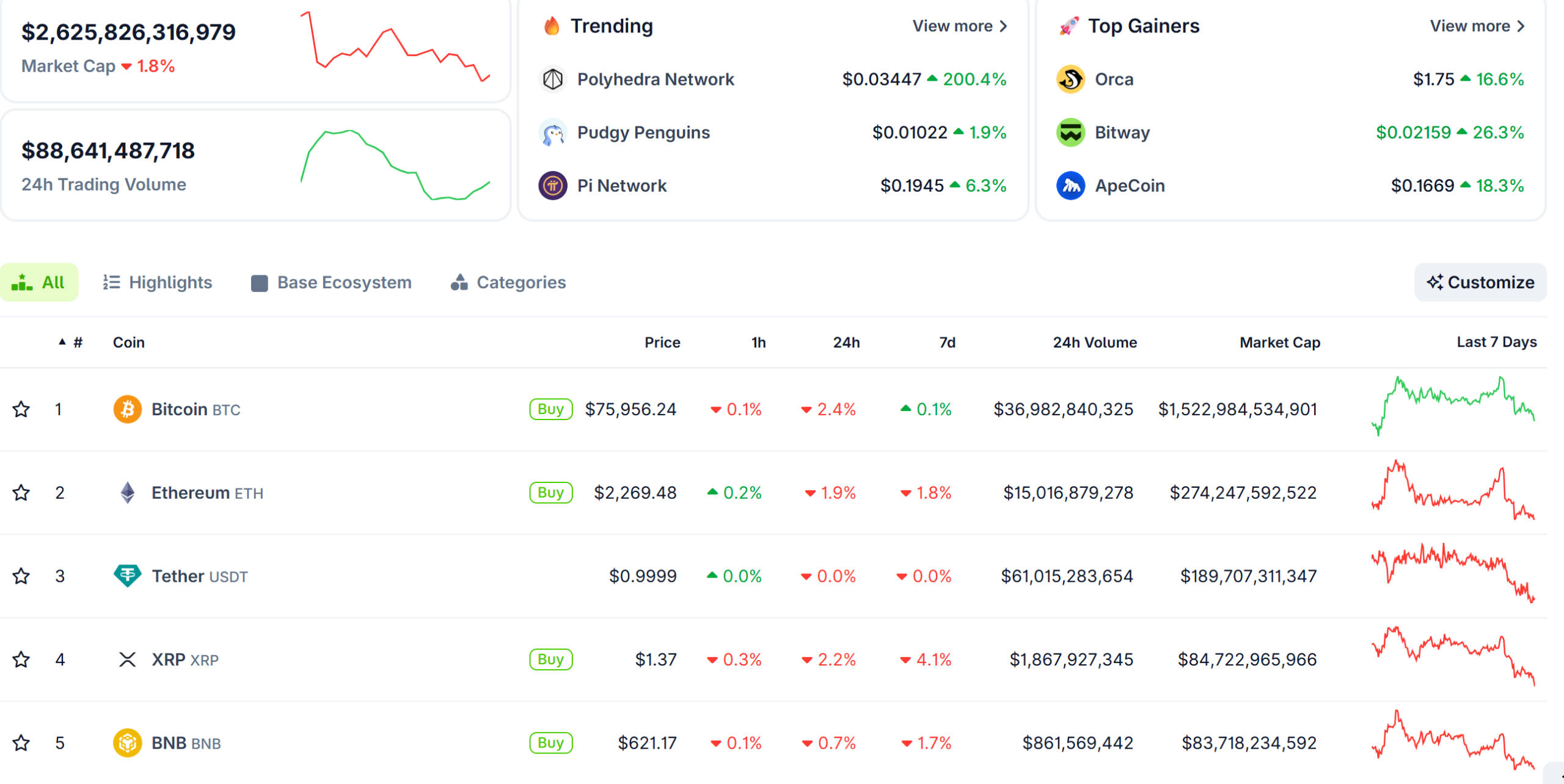
Crypto prices declined Tuesday as traders cut exposure ahead of Federal Reserve Chair Jerome Powell’s final Federal Open Market Committee (FOMC) meeting.
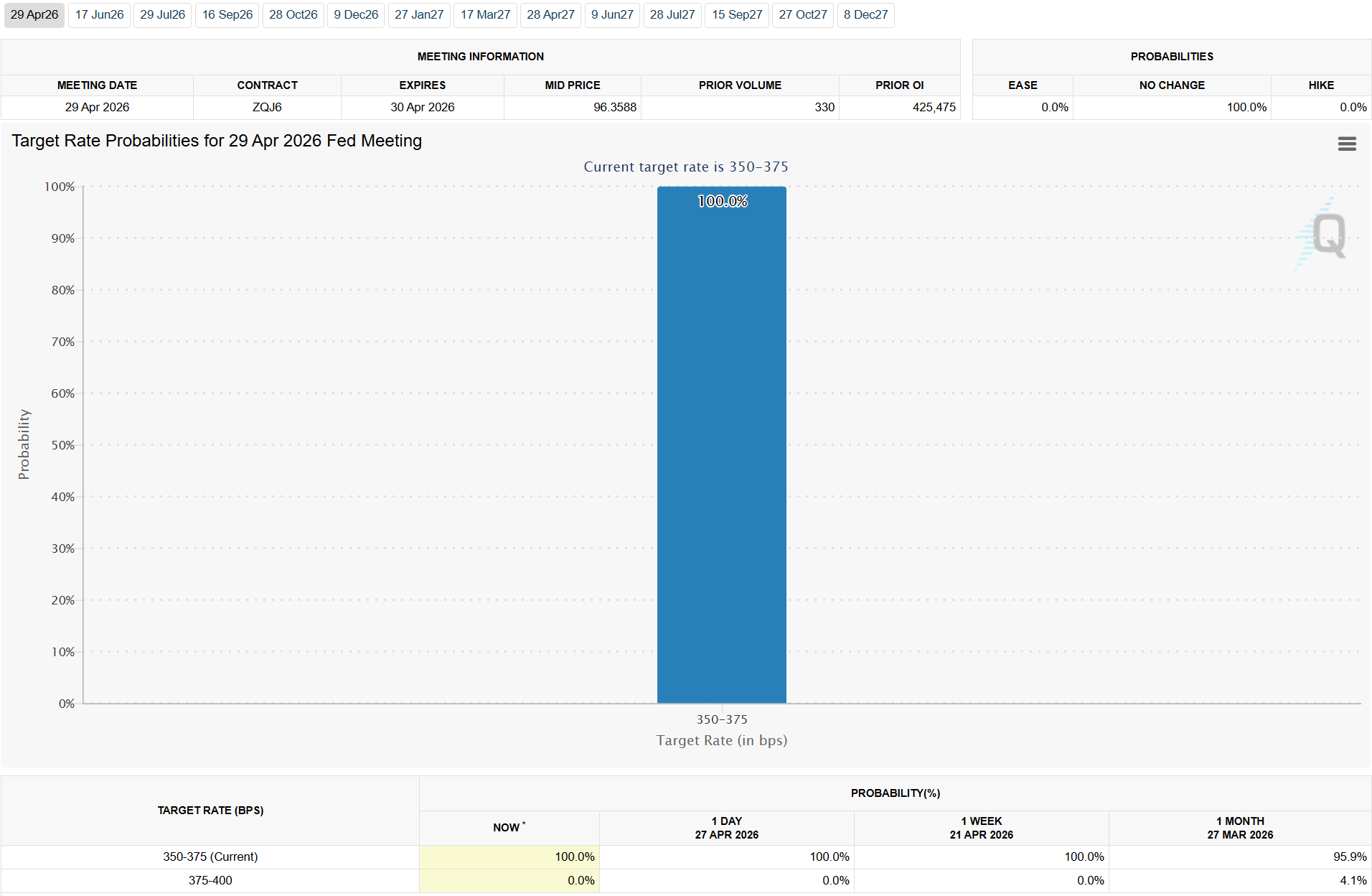
CME Group’s FedWatch tool shows a 100% probability of a hold at 3.50% to 3.75% on April 29, leaving Powell’s press conference as the primary focus for risk assets.
Crypto markets pull back as derisking takes hold
Bitcoin (BTC) fell to levels below $76,000, while the broader market capitalization slid 1.8% to $2.62 trillion, representing losses nearing $40 billion in the last 24 hours.
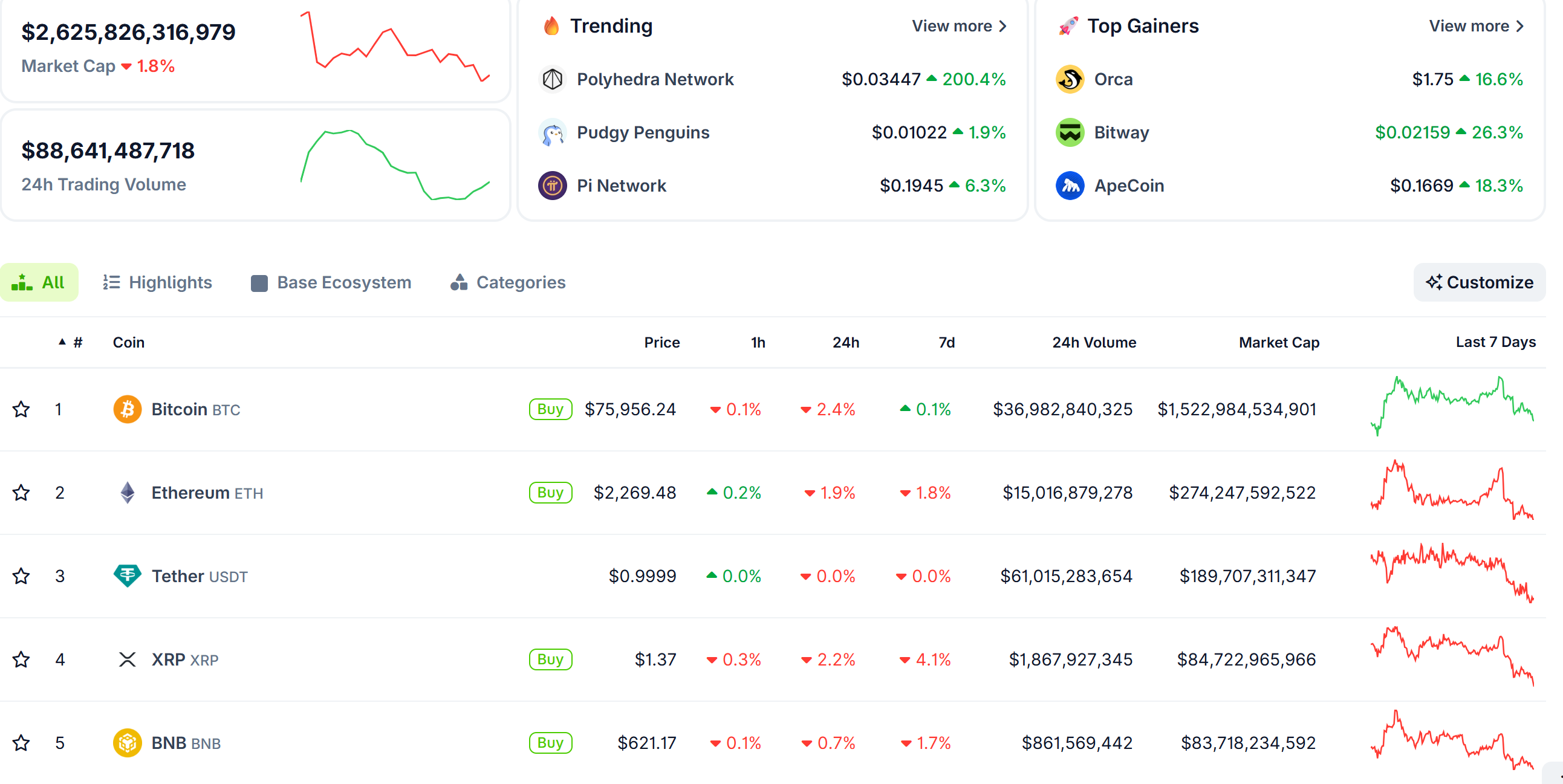
The pullback fits a pattern where Bitcoin and altcoins drift lower in the 24 hours before each Fed decision. Ether (ETH) lost almost 2%, XRP fell 2.2%, and BNB slipped 0.7%, per CoinGecko data.
The retreat tracks reduced positioning in leveraged perpetuals and an uptick in exchange inflows, both common signs of risk reduction before macro events.
“Nearly 10K BTC hit exchanges in a single day while whale inflows made up over 70% of deposits. Tbh thats not random activity thats size moving with intent,” one analyst observed.
Headline inflation near 3.3% to 3.5%, driven by oil pressure from the Iran and Middle East conflict, has weakened the case for near-term cuts and reinforced the hawkish-hold expectation in CME Group’s data.
“Feels like we are doing some derisking ahead of tomorrow. The real move BTC wants to make will happen later this week,” noted one user.
Final Powell Meeting Shifts Focus to Tone
This is widely viewed as Powell’s last appearance as Fed Chair before Kevin Warsh takes over in mid-May. CME data extends the hold forward, with a 100% probability of no change in tomorrow’s FOMC interest rate decision.
“Focus shifts to the FOMC meeting tomorrow. Rates likely unchanged, so eyes will shifts to Powell’s messaging. With inflation pressures tied to energy and global tensions still unresolved, there is a more complex trade-off between price stability and growth,” commented Federico, an executive at Phemex.
Treasury yields ticked higher, with the 10-year near 4.33% to 4.36%, while the dollar held firm on safe-haven flows. Volatility is expected to spike during Powell’s afternoon press conference.
What the next 24 hours could reveal is whether Powell signals openness to later cuts or doubles down on inflation vigilance, a tone that has historically shaped the following month of crypto positioning.
The post Crypto Markets Shed $40 Billion in De-Risking Ahead of Powell’s Final FOMC Decision appeared first on BeInCrypto.

Japan crypto exchange Bitbank has launched a crypto-linked credit card that allows users to pay their bills directly in Bitcoin, the first such product from a licensed Japanese exchange to combine traditional credit functionality with BTC settlement.
The move signals a meaningful shift in how Japan’s regulated crypto sector is approaching retail payment infrastructure.
The card offers 0.5% cashback in cryptocurrency on all spending, layering a rewards incentive on top of the settlement mechanic.
Bitcoin payments integration has never had a cleaner regulatory window in Japan than it does right now, and Bitbank is moving into that window ahead of competitors.
- Settlement currency: Bitcoin, paid directly from user’s Bitbank exchange account
- Cashback rate: 0.5% in cryptocurrency on all card spending
- Card type: Credit card, not prepaid or debit
- Geographic scope: Japan, regulated under FSA licensing framework
- Exchange background: Bitbank FSA-licensed since 2017, operating since 2014
Discover: The best crypto to diversify your portfolio with
How Bitbank’s Bitcoin Crypto Settlement Card Actually Works in Japan
The mechanics are straightforward, but the product structure deserves precision. Users hold a Bitbank credit card, make purchases via standard card rails, and settle the resulting bill in Bitcoin held in their Bitbank exchange account rather than Japanese yen.
The 0.5% cashback reward is paid in cryptocurrency, compounding the user’s crypto exposure with everyday spending.
Bitbank, which received its Financial Services Agency license in 2017 and has operated as one of Japan’s foundational crypto exchanges since 2014, is rolling the product out domestically.

The card targets Japanese retail users who already maintain BTC positions on the exchange and want to bring those holdings into day-to-day financial life without liquidating to fiat first.
This is not a prepaid card or a crypto debit product; it is a credit card with Bitcoin as the settlement currency, a distinction that matters for the payments architecture.
Japan’s 106th credit card company had already launched a crypto Visa prepaid card in September 2024, but Bitbank’s credit-first structure represents a separate and more integrated product category.
Discover: The best pre-launch token sales
The post Japan Bitbank Launches Crypto-Linked Card That Settles Bills in Bitcoin appeared first on Cryptonews.

The recovery effort for rsETH, stalled by the April Kelp bridge incident that released 116,500 rsETH (roughly $293 million at the time) without a corresponding burn on Unichain, is moving into a formal technical phase. The DeFi United coalition, linked to Aave, published a plan to restore rsETH backing by converting committed ETH into rsETH in staged tranches and depositing the tokens into the bridge’s lockbox. This approach aims to resume normal bridge operations once the backing is fully restored. LayerZero and Kelp have also implemented additional security measures ahead of a full return to service, according to Aave.
Parallel to the backing restoration, DeFi United outlined steps to unwind attacker-linked positions across Aave and Compound to reclaim collateral and repair market distortions caused by the exploit. The coalition notes that seven addresses associated with the attacker still hold active rsETH-backed positions on Aave and Compound, representing about 107,000 rsETH of the original 116,500 rsETH released.
The broader context for rsETH recovery continues to unfold as the ecosystem coordinates funding, governance, and technical execution. Earlier coverage highlighted a broader pledge of ETH to restore rsETH backing, and the current plan builds on that momentum with a concrete, vote-dependent process.
The proposed sequence would temporarily adjust the rsETH oracle price to enable controlled liquidations, transfer recovered collateral to a DeFi United multisig, restore the oracle, redeem the rsETH for ETH, and use the resulting funds to clear deficits across affected markets. The recovery plan thus transitions from pledges and public commitments to a coordinated technical process that relies on governance approvals, temporary oracle changes, and execution across several DeFi protocols. While designed to restore rsETH backing, the plan remains contingent on DAO votes, finalized agreements, and the attacker not disrupting the liquidation steps.
Source: Aave
Ethereum backers join the recovery effort
The technical plan follows earlier moves to secure funding and governance support for rsETH restoration. On Monday, Consensys and Ethereum co-founder Joe Lubin joined DeFi United with a commitment of up to 30,000 ETH to back the recovery, while Sharplink, a publicly traded Ethereum treasury company, joined in an advisory role to help structure the plan.
As part of the broader push, Aave Labs had asked the Arbitrum DAO to release 30,765 ETH that had been frozen by the Arbitrum Security Council following the exploit and redirect those funds to DeFi United. The goal is to accelerate the restoration of rsETH backing and stabilize affected markets.
Earlier coverage noted that crypto protocols pledged about 43,000 ETH to the rsETH relief effort, underscoring the ecosystem-wide appetite to address the aftermath of the breach.
As of the latest update, DeFi United’s website shows roughly $302.26 million in total raised or committed toward the rsETH recovery, equivalent to about 132,706.903 ETH. Some commitments remain subject to DAO votes and final execution, reflecting the governance-intensive nature of the plan.
DeFi United secured over $300 million in commitments. Source: DeFi United
The initiative sits at the intersection of cross-chain security, governance, and rapid liquidity management. By moving toward a structured, multi-step restoration rather than relying solely on pledges, the effort aims to reduce the risk of a prolonged imbalance between rsETH and its backing assets while preserving user trust in the affected protocols.
What this means for users and markets
For rsETH holders and the broader DeFi ecosystem, the plan represents a carefully staged attempt to restore collateral behind a pegged asset that saw a rapid distribution of backings during the breach. If successful, the process could set a precedent for how multi-chain bridges and restaking ecosystems manage post-incident recoveries without triggering abrupt slippage or cascading liquidations. The reliance on governance votes underscores the ongoing tension between rapid response and community consent in DeFi crisis management.
Investors and traders will want to watch the timeline for governance approvals, the pace of ETH-to-rsETH conversions, and the execution across Aave, Compound, and the implicated bridge components. The involvement of high-profile supporters—Consensys, Joe Lubin, and Sharplink—adds credibility to the plan, but the execution still hinges on attacker behavior and the stability of oracle adjustments during liquidations.
Next milestones to monitor
Key milestones include finalization of the governance process to authorize the tranche-based ETH-to-rsETH conversions, the operational deployment of the restored backing into the lockbox, and the restoration of oracle feeds to normal levels after backing is re-established. The plan also requires the attacker’s positions to be reliably unwound without triggering further market impairment, an outcome that hinges on coordinated liquidations and cross-protocol cooperation.
Additionally, continued updates on the Arbitrum DAO’s actions and any further commitments from ecosystem participants will shape the speed and reliability of the restoration. The evolving liquidity landscape as new funds are deployed and balances are reset will inform how quickly rsETH markets can regain normal functioning and reduce systemic risk across the DeFi stack involved in the recovery.
Readers should stay attentive to governance votes and official statements from DeFi United, Aave, and partner protocols as the plan progresses. The rsETH restoration is a multi-faceted effort that requires precise coordination across several entities, and the outcome will influence how similar crisis-response playbooks are interpreted in future cross-chain incidents.

Rams had ‘secret meeting’ with Ty Simpson: Intel behind shocking pick

Amazon slashes $200 off M5 Max 16-inch MacBook Pro with month-end deal

Laura Dern Replaces Helena Bonham Carter In The White Lotus Season 4

Manchester United reach agreement with Casemiro over contract clause amid transfer speculation

US brings back mandatory military draft registration

Steven Gerrard disagrees with Gary Neville over ‘shock’ Chelsea and Arsenal claim | Football


-

 Tech23 hours ago
Register Renaming | Hackaday
-

 Fashion4 days ago
Weekend Open Thread – Corporette.com
-
 Crypto World3 days ago
Hyperliquid $HYPE Rally Builds Momentum as AI Sector Enters Prove-It Phase
-

 Politics6 days ago
Making troops accountable for war crimes threatens US alliance, ex-SAS colonel warns
-

 Politics6 days ago
Disabled people challenge government SEND proposals over segregation concerns
-

 Business5 days ago
Patterson-UTI Energy, Inc. (PTEN) Q1 2026 Earnings Call Transcript
-

 Business6 days ago
Rolls-Royce Voted UK’s Most Iconic Trade Mark as IPO Register Hits 150
-
 Sports2 days ago
IPL 2026: Ruturaj Gaikwad registers slowest fifty of the season, enters all-time unwanted list | Cricket News
-

 Crypto World7 days ago
New York sues Coinbase, Gemini over prediction market offerings
-

 Politics18 hours ago
Drax board avoid their own AGM, accused of greenwashing & environmental racism
-

 Politics6 days ago
Starmer handler McSweeney to be dragged from shadows by Foreign Affairs Committee
-

 Politics6 days ago
Zack Polanski responds to home secretary’s taser threat
-
Politics6 days ago
Wings Over Scotland | How To Get Away With Crimes
-
 Business6 days ago
HCL Tech share price tank over 9% after weak Q4. JPMorgan, HSBC & 3 others cut target price
-
 Crypto World7 days ago
Crypto’s great hope in Senate’s Clarity Act still has a path to survive tight calendar
-

 Politics6 days ago
‘Iran is still a nuclear threat’
-
 Sports6 days ago
Tim Bradley names the current best in the world: “Better than Inoue and Usyk”
-

 NewsBeat2 days ago
LK Bennett closes all stores after entering administration
-

 Crypto World4 days ago
Michael Saylor says BTC winter is over. Market analyst disagrees, says bitcoin was in a pullback
-
 Crypto World7 days ago
Ethereum Price News: ETH Flashes a Bullish Setup No Holder Should Miss While Pepeto Nears Its Binance Listing
You must be logged in to post a comment Login