

Crypto World
Aave Founder Maps Hub-And-Spoke Plan To Bring Securities Finance On-Chain


TLDR:
- Repo averages $12.6 trillion in daily U.S. exposures, the largest market V4 targets
- Aave V4 uses hubs and spokes to isolate risk across asset categories and venues
- Lending agents currently keep 20-30% of revenue that could instead reach owners
- Tokenized real-world assets are projected to reach $16 trillion in value by 2030
Aave founder Stani Kulechov outlined a plan to bring securities finance on-chain using Aave V4. The proposal targets repo, securities-based lending, and securities lending markets.
These markets move tens of trillions of dollars through layers of intermediaries. Kulechov says Aave V4 can replace that stack with shared liquidity and transparent settlement.
Market Size And Current Structure
Securities finance covers some of the largest credit markets in traditional finance. Repo alone averages roughly $12.6 trillion in daily exposures across the United States.
Margin lending has reached a record $1.3 trillion, while wealth-management securities-based loans add more than $400 billion. Securities lending keeps about $4.6 trillion of assets on loan and generated $15 billion in revenue during 2025.
Almost none of this activity currently touches a blockchain. Kulechov described the layers sitting between borrowers and lenders, noting that “each layer of the stack takes a fee, adds a settlement delay, and obscures information.” Collateral often gets locked inside bilateral relationships with little visibility into how it moves.
Kulechov argues that onchain rails are already large enough to absorb this volume. The stablecoin market has crossed $322 billion in total supply.
Aave secures close to $23 billion in liquidity, and its native stablecoin GHO is live across the protocol. Aave Horizon, which supports real-world-asset-backed loans, has surpassed half a billion dollars in deposits.
How Aave V4 Organizes The Market
Aave V4 separates its system into liquidity hubs and spokes. A hub holds deep, shared capital, while spokes are modular venues with their own risk parameters and asset scope. This structure mirrors how securities financing already separates collateral pools from specific trading venues.
Three flows are proposed to run through this structure. Securities-backed lending lets owners post tokenized securities as collateral and borrow stablecoins or GHO without selling assets.
Repo becomes short-dated, collateralized cash borrowing against tokenized Treasuries, settled atomically rather than over one or two days.
Securities lending turns tokenized securities into borrowable assets, with fees routed directly to suppliers instead of intermediaries.
Kulechov called repo the largest opportunity in the proposal, writing that “the market that most needs clean settlement and live collateral visibility is the one V4 serves best.”
He proposed two structural options for organizing liquidity. One design uses a single shared hub for maximum depth and simplified accounting.
The other splits liquidity into multiple hubs by asset category and risk level, such as separate pools for Treasuries, credit instruments, and equities.
Roles And Settlement Changes
Under this model, traditional finance roles shift into protocol functions. Lending agents become risk managers tuning hub parameters.
Tri-party collateral managers become the protocol’s accounting and liquidation engine. Prime brokers and clearing houses become operators running permissioned venues, while custodial ledgers move onto the blockchain itself.
Settlement speed changes substantially under this structure. Securities in the United States currently settle one day after a trade, while European markets often take two days.
The recent industry shift to one-day settlement cost market participants close to $30 billion to implement, according to the proposal.
Kulechov summarized the broader shift in roles, stating that under this structure “the work survives while the rent does not.”
Lending agents currently keep roughly 20 to 30 percent of securities-lending revenue before asset owners receive any return, a share Aave V4 aims to route back to owners instead.
The proposal frames real-world asset tokenization as a growth driver for this system. Tokenized assets are projected to reach $16 trillion by 2030, expanding the pool of collateral available for onchain securities finance.
Aave Horizon’s existing deposit growth is cited as early evidence of institutional demand for this type of infrastructure.


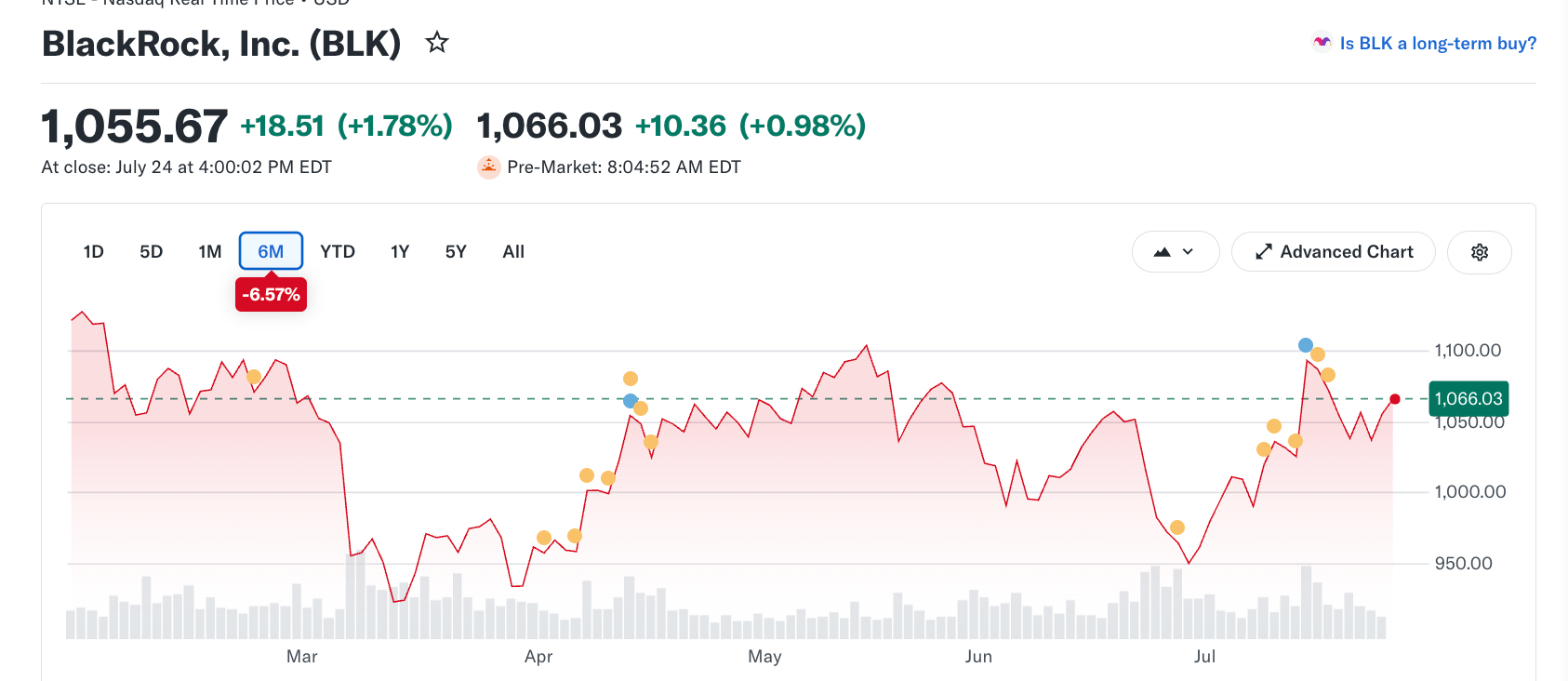
Traders have started betting on a rebound in the world’s largest asset manager, BlackRock since its July earnings beat. They are doing it while the BlackRock stock price falls, and weeks after two of the firm’s biggest rivals told clients to buy.

JPMorgan and Morgan Stanley both lifted their targets on July 16, and the market ignored them for eleven days.
The Bets Nobody Has Closed Now Favour a Rise
The put-call ratio weighs bets on a falling share price against bets on a rising one. A reading under 1.00 means the upside bets are winning.
On BlackRock stock, that measure sat at 1.00 on the day of the July 15 results, an even split. By July 24 it had slipped to 0.98, tipping the balance toward a rise.
Want more insights like this? Sign up for Editor Harsh Notariya’s Daily Newsletter here.
This particular reading only counts positions traders still hold after the market closes. That makes it the money people are willing to leave on the table overnight.

Short-term traders are less convinced. Counting only the trades placed each day, the same ratio climbed from roughly 0.70 to 0.83, so more downside bets are changing hands than before the results.
The split makes sense. Traders are keeping their bets on a recovery while paying for protection to survive the wait, because the share price has kept sliding.
The BLK Stock Price Has Not Agreed Yet, Despite Big Money Interest
Money flow tells the cautious half of the story. Chaikin Money Flow (CMF) shows whether institutional buyers or sellers control a stock, and anything under zero means the sellers do.
BlackRock stock sat near -0.28 on July 15 and recovered to -0.13 by July 24. That is still below zero, so sellers remain in charge. However, the institutional folks seem to be slowly responding to the JPMorgan and Morgan Stanley calls.

Their grip has weakened as the BlackRock price fell between July 15 and July 24 and the CMF trended higher. This could mean that the big traders are early and the share price has not caught up. That is the gap two rival banks spotted proactively.
The Call Two Competitors Made First
JPMorgan and Morgan Stanley chase the same client money as BlackRock through J.P. Morgan Asset Management and Morgan Stanley Investment Management. Both still told clients to buy the competitor.
Morgan Stanley arrived there awkwardly. It cut its target to $1,383 on July 14, a day before earnings, then raised it by $105 to $1,488 on July 16, the highest on Wall Street.
JPMorgan moved harder the same day, upgrading the stock from Neutral to Overweight and lifting its target 17% to $1,364.
Two smaller houses agreed. BMO Capital Markets, the investment banking arm of Bank of Montreal, reiterated Buy at $1,300 on July 17, while Keefe, Bruyette and Woods (KBW), a broker specialising in financial firms, opened coverage at the same target a day earlier.

None of those targets has been cut since. Because the stock has fallen in the meantime, the gap to those targets has widened rather than closed.
What the Bullish BlackRock Bets Are Riding On
BlackRock reported $15.34 trillion in assets under management on July 15, with revenue up 31% to $7.08 billion and net inflows of $191.7 billion.
One number undercuts the rest. Big institutions supplied only about $2.34 billion of those inflows, so nearly all the growth came from ETFs and everyday investors. This aligns with the fact that institutional money or rather big money mostly stayed silent. That metric now improving, courtesy of CMF, could be a good sign.
Two newer businesses may matter more. BlackRock has joined a DTCC pilot on tokenised collateral alongside JPMorgan and Goldman Sachs, covering Russell 1000 shares and Treasuries, with a formal launch due in October.
It is also leading a debt sale of more than $12 billion for a Meta-backed data centre campus in El Paso, pulling it into the financing of the AI build-out.
Markets seem to have priced in none of it. BlackRock stock is only up 7.44% over the past month, that too on results, but remains lower for the year, while Morgan Stanley, Goldman Sachs and Citigroup each gained more than 20%.

One risk sits against those bullish bank bets. BlackRock runs the largest spot Bitcoin ETF at roughly 735,000 BTC, but spot Bitcoin ETFs shed $225 million in one session in late July, with IBIT accounting for $202 million of it.
Analysts call that demand wave-like rather than steady.
For any of the bullish bets to pay off, money flow has to cross back above zero. Until it does, the traders and the banks are right on paper and wrong on the tape.
The post Why Two BlackRock Competitors Told Clients to Buy It appeared first on BeInCrypto.
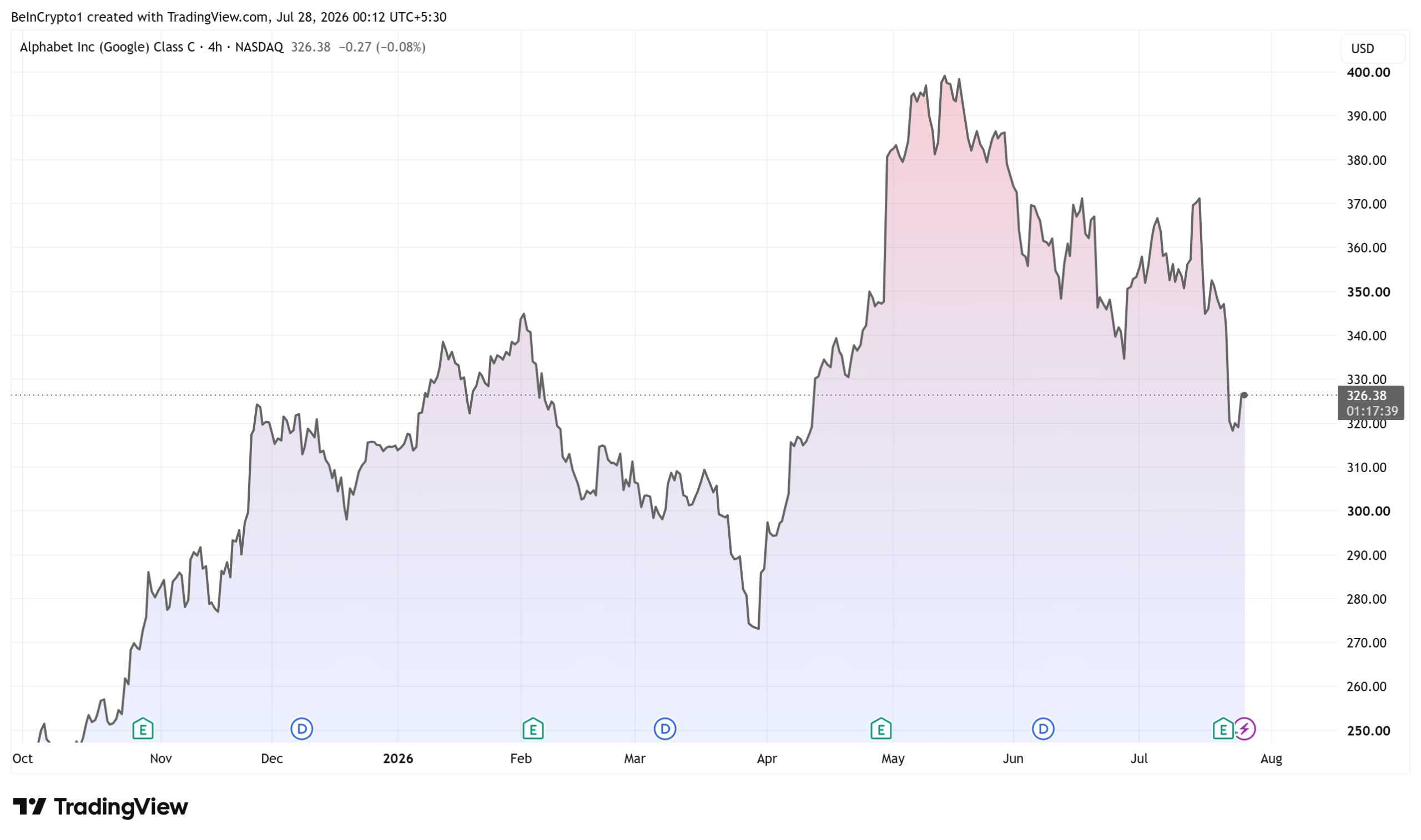
Steve Eisman has sold his long-held Google position to cut his artificial intelligence (AI) exposure. The investor who shorted the 2008 housing market now holds cash, warning the whole market has become one AI bet.
He has not bought a replacement. Eisman says defensive stocks will not work, because investors either want AI or they want nothing.
Eisman Sold Google Near Its Record High
Speaking on CNBC’s Squawk Box, the former Neuberger Berman portfolio manager called the exit deliberate. He built his reputation shorting subprime mortgages at FrontPoint Partners.
“I sold my Google a couple of months ago. I’ve owned Google. I can’t even tell you how long I’ve owned Google, but I felt I wanted to reduce my exposure to AI,” Eisman said.
The timing looks good so far. Alphabet peaked at $408.61 on May 18, its record high. The stock closed at $319.74 on July 24. That is a drop of roughly 20% in about two months.

One session did much of the damage. Alphabet fell 7.1% on July 23, the day after Q2 earnings. The company had just raised 2026 capital spending guidance to a range of $195 billion to $205 billion.
Eisman did not rotate into safety. He explained why in one line.
“People either want to buy AI or they don’t want to buy AI, but they don’t want to shift out of it to buy Clorox,” he said.
The cash is still uncommitted. “I’m just sitting… I’ve got cash,” he said. He does not expect the AI debate to settle “within the next two weeks.”
Why Eisman Says the Market Is ‘One Trade’
His worry is concentration, not valuation.
“It’s all one trade. It’s literally one,” Eisman said.
He then showed his math on a standard portfolio.
“Even people who think they’re diversified because they own 60% stocks and 40% bonds are missing the fact that they’re actually not diversified… more than 50%… is tech and AI related. And of the 40% of bonds, most of the new issuance of bonds is AI related,” he said.
Do Eisman’s Numbers Hold Up?
The stock half broadly does. Information Technology was 37.19% of the S&P 500 on July 24, and Communication Services added 9.34%. That is 46.5% combined.
Add Amazon and Tesla, which sit in Consumer Discretionary, and the figure reaches 51.5%. So his “more than 50%” works, but only on a generous definition.
The concentration itself is not in doubt. The 10 largest constituents make up 36.85% of the index.
The bond half is weaker. High Technology made up 14.2% of US corporate bond issuance in the second quarter, according to SIFMA. Financials led with 46.4%. AI is not “most” of new issuance.
His underlying point still stands, and official data makes it better. The Bank of England reported this month that five AI hyperscalers held just 3% of outstanding US investment-grade debt at the end of 2025, yet accounted for over 15% of this year’s issuance by early May.
The high-yield shift is sharper. Those issuers took 41% of non-refinancing US high-yield issuance this year, from a 1% index weight.

The deal sizes explain the speed. Amazon priced $37 billion of notes on March 10, the largest of these deals, per its SEC filing. Meta raised $30 billion last October and another $25 billion in April.
One caveat sits in the paperwork. The filings state proceeds go to general corporate purposes, so none of this debt is formally earmarked for AI.
Is a Correction Coming if AI Fails?
Asked what happens if AI fails commercially, Eisman was blunt. “I think we have a big correction,” he said. He would not size it.
“What… scares me is that it’s all one trade. So it better succeed,” he added.
Central banks have flagged the same pipe. The Bank for International Settlements warned in June that fixed income is “one obvious vulnerability” if hyperscalers slow capital spending.
What It Means for Crypto
Crypto sits in the same risk bucket. Bitcoin (BTC) trades near $64,980 and is down about 45% over the past year.
The link showed up in June, when a Big Tech selloff dragged Bitcoin lower. Retail flows have favored semiconductor ETFs over crypto funds this year.
Others see the same overlap. Chinese hedge funds have started trimming AI winners in a visible rotation, and one 2008 bubble forecaster has warned of a 70% drawdown.
Where the Thesis Breaks Down
Eisman is not calling a crash. He said he would not short this market, and he expects the technology to work.
“It’s going to be… something really good. That doesn’t mean that everybody succeeds,” he said.
That gap defines the risk. AI can succeed as a technology while the trade built around it still unwinds.
The near term will test him fast. Microsoft and Meta report earnings on July 29, and Amazon follows on July 30. Three more capex updates land inside 72 hours.
The post Entire Market Is Now One Trade, Big Short Investor Steve Eisman Says appeared first on BeInCrypto.
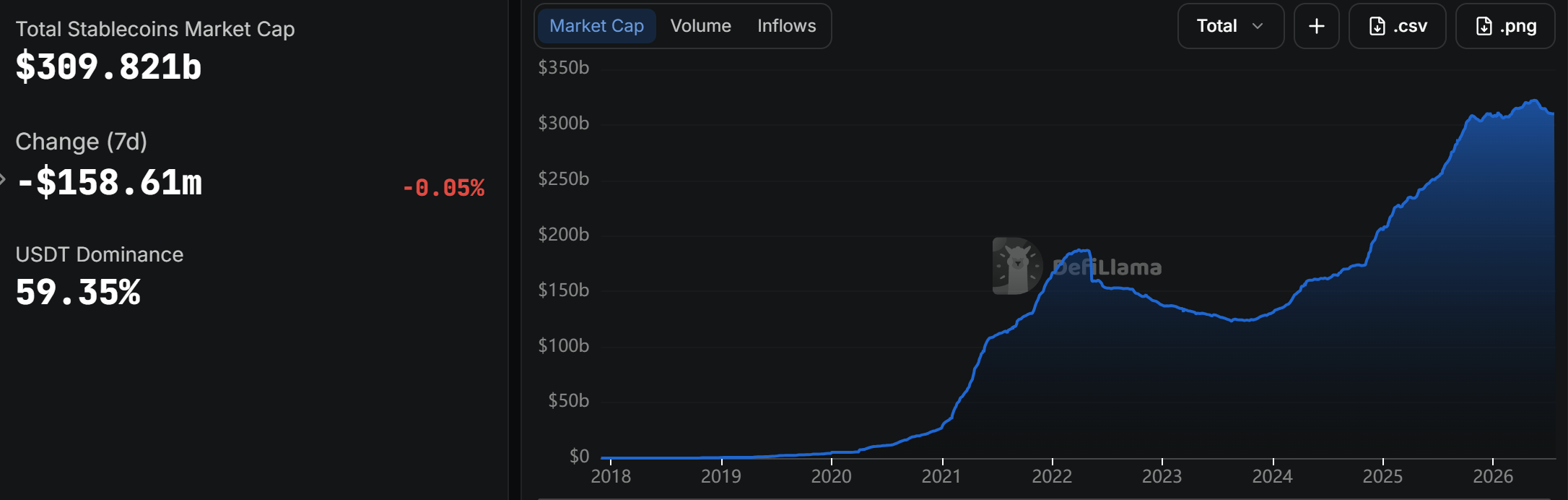
China’s crypto rails have already moved $2.37 trillion. The US Senate has not even voted on its crypto rules. Faryar Shirzad, Chief Policy Officer at Coinbase, says the next financial system is being built right now.
Rails are the plumbing that moves money between banks and countries. Shirzad says China is investing more in this technology than anyone else.
What Did Coinbase Say?
Shirzad spoke in an interview on Fox Business. He called crypto plumbing, not an investment.
“Crypto fundamentally is a technology that allows people to transfer value, whether money or [a] financial instrument, as easily as they transfer a text… or e-mail.”
The host asked about Chinese AI models too. Shirzad then named the leader.
“The country that [in]vests most in this technology is China.”
He gave no numbers. Public data does.
How Big Are China’s Crypto Rails?
China runs a digital version of its currency. It is called the e-CNY.
The central bank says it has handled 3.48 billion payments. Those are worth about $2.37 trillion. Volume is up more than 800% since 2023.
China changed the rules on January 1. Digital yuan now sits in bank accounts like normal savings. Banks pay interest on it. Deposit insurance protects it.
No other major economy has done that yet.
A second system handles payments between countries. It is called mBridge. Five central banks run it, including China’s.
mBridge has settled about $55.49 billion. Back in 2022 it moved just $22 million. China’s digital yuan is 95% of the traffic.
So Is China Really Winning?
Not everywhere. It depends which number you pick.
The $2.37 trillion counts money that moved. It is a running total built up over five years.
Dollar stablecoins work differently. These are crypto tokens worth $1 each. About $310 billion of them exist today. Tether holds $184 billion. USDC holds $73 billion.

Almost all of them track the dollar. Chinese versions barely register.
So the dollar still rules private crypto. China leads on state-run rails.
What About Spending?
The same pattern shows up in AI. Stanford counted $285.9 billion of private US AI investment in 2025. China reported $12.4 billion. That is a 23 to 1 American lead.
Stanford flagged a catch. Chinese state funds pushed an estimated $184 billion into AI firms between 2000 and 2023. Official totals miss that money.
So China spends more than it reports. It also ships faster. America still spends more overall.
Coinbase Buys Chinese Tech Too
Coinbase proves the point on its own books. CEO Brian Armstrong said in June that the firm runs two Chinese AI models. The switch cut its AI bill roughly in half.
Chinese models cost far less. DeepSeek charges $0.87 per million output tokens. Western rivals charge much more.
Cheap and capable beats expensive and patriotic. That logic reaches payments too.
What Happens Next?
Senate action has stalled, and several roadblocks remain. Majority Leader John Thune expects the bill to miss the August break. Banks are still fighting over stablecoin interest. That standoff stalled talks in March over bank deposits.
China is not waiting. PBOC Governor Pan Gongsheng warned last year that a dominant currency “tends to be instrumentalized or weaponized.” Beijing wrote the digital yuan into its latest five-year plan.
Watch three things. A Senate floor vote before recess. A deal on stablecoin interest. And whether mBridge moves into oil and commodity payments.
America is spending more. China is shipping faster.
The post China Is Outspending the US on Crypto Rails, Coinbase Tells Senate appeared first on BeInCrypto.

New York Attorney General Letitia James says a crypto bill in the Senate would leave scam victims with nowhere to turn. Coinbase wants that same bill passed within days.
James sent her case to a Senate investigations panel on Monday. She wants tougher crypto oversight, not less of it.
Why Is New York Fighting the Crypto Oversight Bill?
The bill is called the Digital Asset Market Clarity Act. It would hand most crypto rulemaking to one federal agency, the Commodity Futures Trading Commission (CFTC).
It would also override state investor protection laws. That is the part James cannot accept.
Her office polices securities and commodities for 20 million New Yorkers. Take away that power, she argues, and scam victims lose their closest cop.
The House already passed the bill in July 2025. The vote was 294 to 134. It cleared a key Senate committee in May.
How Bad Are Crypto Scam Losses?
Bad, and getting worse. Her testimony stacks up four separate datasets.
Source
2025 losses
Change from 2024
FBI Internet Crime Complaint Center
$11.4 billion
Up 22%
FTC Consumer Sentinel Network
$1.78 billion
Up 25.6%
TRM Labs illicit volume estimate
$158 billion
Up about 145%
New York complaints
Nearly $500 million over 5 years
Almost tripled in 3 years
The average victim reported losing $62,604, according to the FBI. Crypto complaints to the bureau rose 21% in a year.
James names real cases. One scam worked through Haitian church prayer groups. Another used Facebook ads to hook Russian speakers, then ran the money to Vietnam.
Who Actually Catches Crypto Criminals?
This is the heart of her argument, and the numbers are lopsided.
State and local agencies are 99% of all US law enforcement bodies. They handle about 99.5% of criminal cases and 98.8% of arrests.
Federal authorities handle roughly 1.2%.
At the same time, Washington has pulled back. The Justice Department told prosecutors in April 2025 to stop charging platforms for what their users do. It shut down its crypto enforcement team.
The SEC closed more than 1,000 investigations in 2025. It also dropped seven crypto cases. Judges had already found violations in five of them.
Does the Bill’s Ethics Ban Actually Work?
Here is the finding buried deepest in her filing.
The bill would stop presidents and federal officials from launching their own crypto. Supporters call this the ethics fix.
James read the fine print. The ban would let the sitting president park existing crypto businesses in a blind trust. It would also not start until a full year after the bill becomes law.
She wants something stricter. Officials should not regulate any industry they earn money from. Break that rule and you hand back the profits plus a $50,000 fine each time.
Her case points to Binance, which holds 87% of USD1. That is a stablecoin issued by World Liberty Financial, a firm founded by the president’s family. Forbes and the New York Times reported those holdings.
Who Else Opposes the Bill?
Not just Democrats. The nation’s sheriffs are against a big piece of it too.
The National Sheriffs’ Association wrote to the Senate on May 13. Their letter targets Section 604.
That section would excuse mixers and similar tools from money transmitter rules. Mixers scramble crypto transactions so nobody can follow the money.
The sheriffs still want crypto rules. They just want a narrower version, written by Senator Catherine Cortez Masto.
State securities regulators piled on in May. Their national body urged senators to vote no.
Why Does Coinbase Want a Vote Now?
Coinbase makes a completely different argument. It is about China, not fraud.
Faryar Shirzad is the company’s chief policy officer. He told Fox Business that the next financial system is being built right now.
China is spending the most on it, he said. So the real question is who writes the rules, Washington or Beijing.
Shirzad also likes what the bill does for banks. One whole section protects them from legal surprises when they touch crypto.
He says he has talked to Senate leaders. He expects a vote as early as August 3.
Wall Street is split. Goldman Sachs boss David Solomon backs the bill even though he calls it flawed. JPMorgan’s Jamie Dimon is against it.
What Happens Next?
The math does not work yet. Senate Majority Leader John Thune said on July 23 that the votes are missing. The bill now looks unlikely to pass before the August break.
Three fights are still open. Ethics rules, the Section 604 exemption, and how stablecoins pay interest.
History offers hope to both camps. The GENIUS Act stalled the same way in 2025, then became law. But that bill never asked states to give up their fraud cases.
So watch for three things. A vote on the Cortez Masto amendment. Any move to scrap the one-year delay. And the first Democrat to break ranks.
James has spent five years clawing money back from crypto firms. Her office went after major platforms including Genesis, which paid $2 billion. Gemini returned $50 million to customers.
Now she is asking Congress to leave that power alone.
The post New York AG Letitia James Opposes the Crypto Bill Coinbase Wants Passed August 3 appeared first on BeInCrypto.
Tether’s gold-backed token XAUt has received Shariah certification from Amanah Advisors, a move that could expand access to the token among Islamic financial institutions and investors seeking Shariah-compliant exposure to physical gold.
The certification found XAUt’s structure complies with key Islamic finance principles, including full backing by physical gold, the absence of interest and leverage, and transparent reserves. Each XAUt token represents one troy ounce of physical gold stored in Swiss vaults, according to Tether.
The designation gives Tether a clearer pathway to market XAUt to Islamic financial institutions and investors that require Shariah-compliant investment products. Tether said it expects the certification to support adoption across markets where Islamic finance is widely used, including the Gulf Cooperation Council, South Asia and parts of Africa.
XAUt is one of the largest tokenized gold products in the crypto market. Tether’s latest reserves report showed the token was backed by more than 707,000 troy ounces of physical gold worth over $3.3 billion as of March 31.
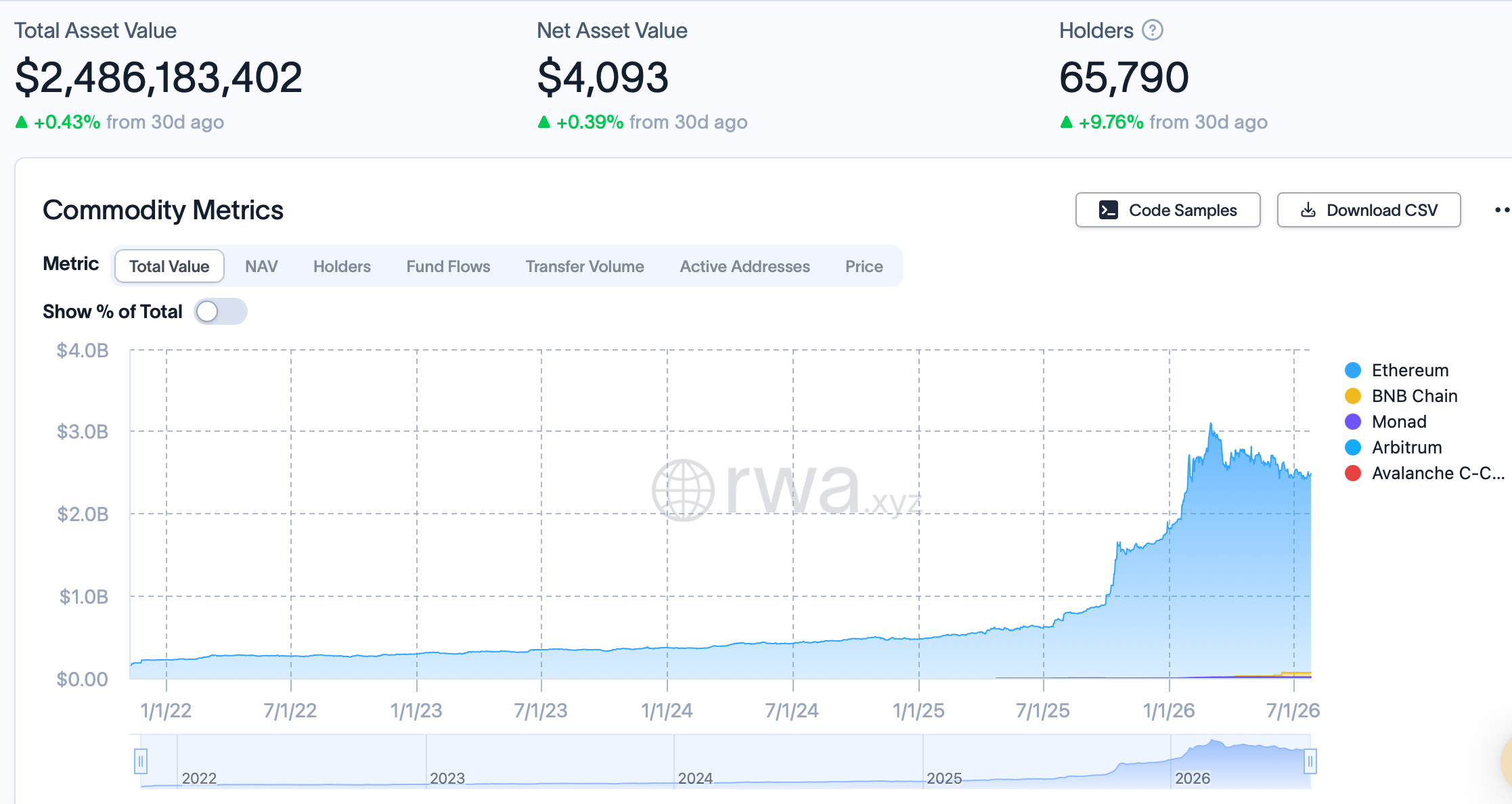
According to RWA.xyz data, the token’s onchain asset value has climbed from about $700 million in July 2025 to roughly $2.5 billion.
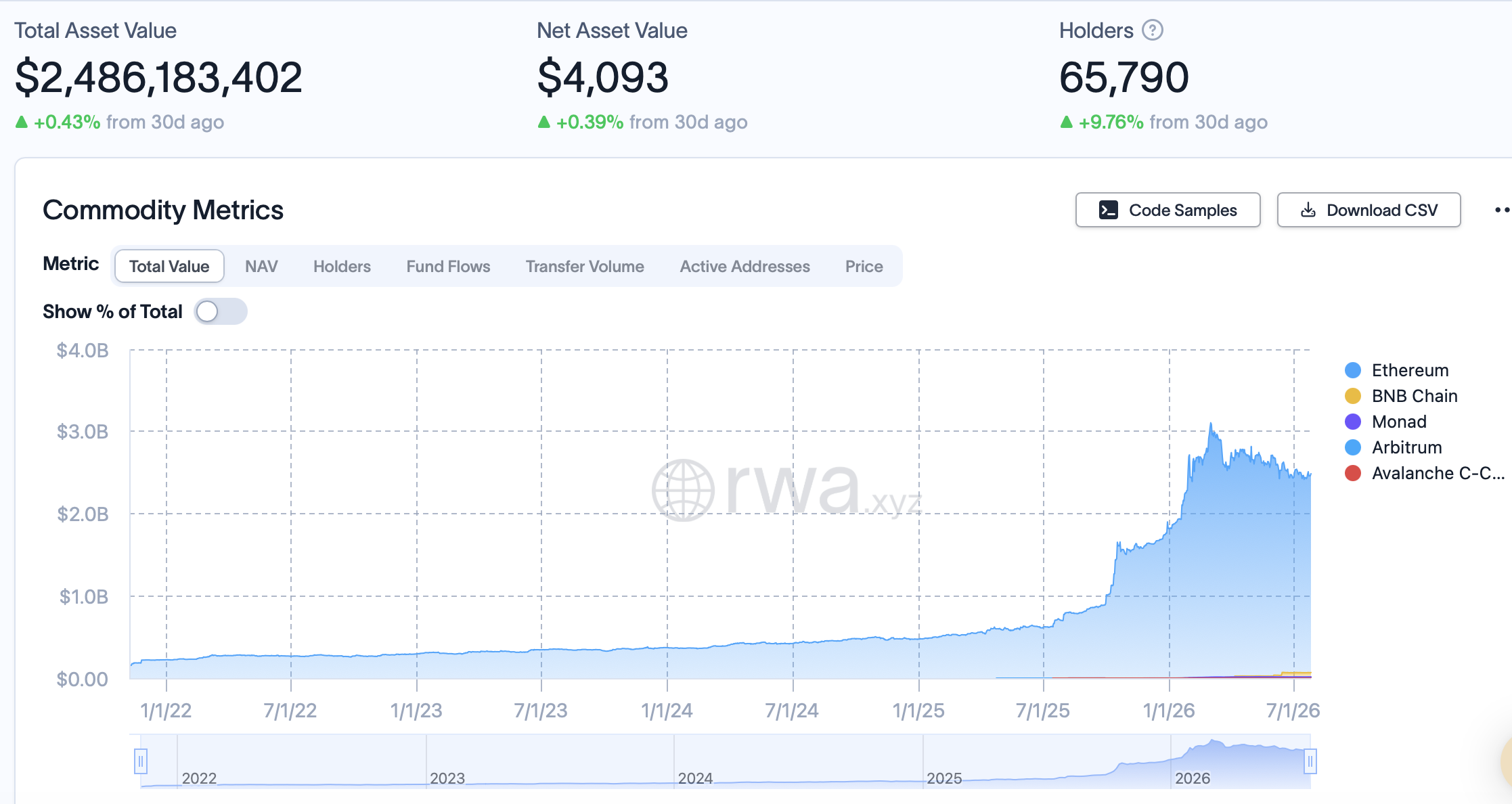
Tether tokenized gold. Source: RWA.xyz
Related: Kraken moves closer to UAE launch after Dubai regulatory approval
Shariah-compliant crypto products gain traction
Cryptocurrencies have long divided Islamic scholars, with debates centering on whether digital assets comply with Shariah principles that prohibit excessive uncertainty, speculation and interest. As companies seek to address those concerns, Shariah-compliant digital assets have begun to emerge.
One early example came in 2025, when Bahrain-based AlAbraaj Restaurants Group adopted a Bitcoin (BTC) treasury strategy and said it planned to develop Shariah-compliant financial instruments to broaden access to Bitcoin across the Islamic world.
More recently, in April, Palm Azgar Finance expanded its Shariah-compliant PUSD stablecoin to ADI Chain, targeting the more than $3 trillion Islamic finance market. PUSD became the second stablecoin available on the network, allowing institutions to settle transactions using either a dollar-linked asset or a dirham-denominated token on the same infrastructure.
Meanwhile, Dubai has emerged as a leading crypto hub in the Middle East, continuing to expand its regulated digital asset market. Earlier this month, the emirate’s Virtual Assets Regulatory Authority (VARA) issued its 50th virtual asset service provider license, surpassing the number of licensed crypto firms in Hong Kong and Singapore.
Magazine: CLARITY hopes fade, BitMEX shuts as lawsuit looms: Hodler’s Digest, July 26

Tether Gold has received Shariah certification, giving Islamic banks, institutions, and investors a compliant way to access physical gold through blockchain technology. Amanah Advisors, led by Mufti Faraz Adam, reviewed the product and approved its structure under Islamic finance rules.
The certification covers real asset ownership, clear gold backing, reserve transparency, and the absence of interest-based features. Each XAU₮ token represents ownership of physical gold stored in secure Swiss vaults and issued by TG Commodities, S.A. de C.V.
Tether Gold Shariah Certification Supports Wider Access
Tether Gold does not rely on riba, leverage, or speculative derivatives, according to the company. This structure allows users to hold tokenized gold while keeping direct exposure to allocated bullion.
The approval may support adoption among Islamic banks, takaful providers, halal savings platforms, and trade finance firms. These institutions often prefer assets backed by real value and clear ownership terms.
Islamic Finance Markets Gain Digital Gold Option
Tether Gold may help Islamic finance firms offer digital gold products without changing the asset’s physical backing. Banks could use the token for savings products, treasury holdings, wealth preservation, or approved collateral services.
The certification may also expand access in GCC countries, South Asia, Africa, and other Islamic finance hubs. These regions have strong demand for gold and growing interest in regulated digital assets.
Gold-Backed Loans Expand XAU₮ Use
Tether Gold holders can also use XAU₮ as collateral through Tether’s partnership with Ledn. The service allows eligible users to access loans while retaining exposure to physical gold.
The lending product keeps bullion backing at the center of the structure. However, users must still review loan terms, fees, and local rules before using the service.
Tether Links Gold With Blockchain Strategy
Tether Gold forms part of Tether’s wider plan to connect traditional assets with blockchain networks. The company also supports Bitcoin-based transfer systems through the RGB protocol and Lightning Network tools.
For XAU₮, Tether Gold remains focused on direct gold ownership, verifiable reserves, and digital transfer access. Each token links to allocated gold bars held in Swiss storage facilities. Investors can also transfer fractional ownership without arranging direct transport or private vault storage.
Tether CEO Paolo Ardoino said gold has long represented trust and stability across many cultures. He said Shariah approval allows Tether Gold to serve more users while respecting Islamic finance standards.
Securitize Capital, a subsidiary of tokenized asset platform Securitize, has registered with the US Securities and Exchange Commission (SEC) as an investment adviser, allowing the company to expand its regulated investment advisory business for institutional clients, Securitize said Monday.
The registration adds investment advisory capabilities to Securitize’s existing regulated businesses, which include an SEC-registered broker-dealer, alternative trading system, transfer agent and fund administration services.
CEO Carlos Domingo said the registration strengthens Securitize’s ability to help institutions develop and manage investment strategies for onchain capital markets. Securitize Capital previously operated as an exempt reporting adviser and is now subject to additional disclosure, compliance, recordkeeping and examination requirements under the Investment Advisers Act.
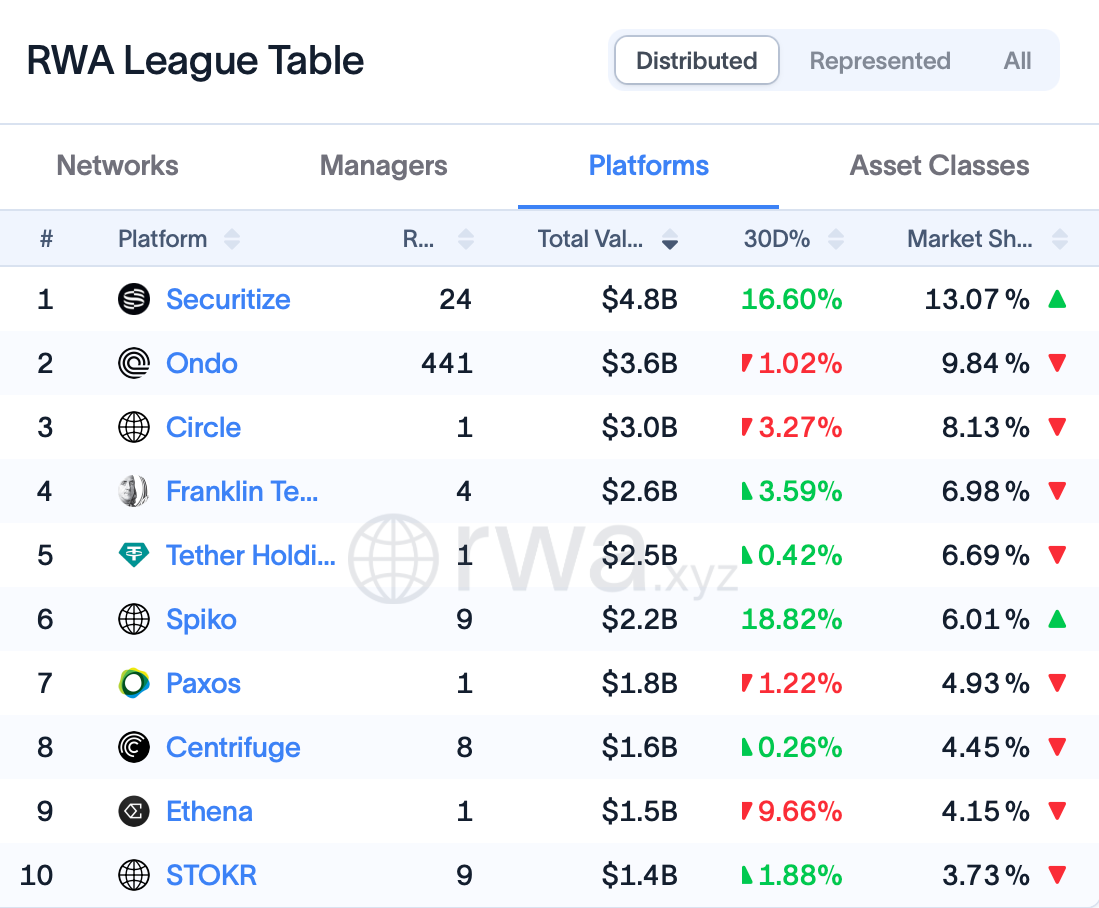
Securitize is the largest tokenization platform by onchain asset value, with around $4.8 billion in tokenized assets across funds from BlackRock, Apollo, KKR, VanEck, Hamilton Lane and other asset managers.
The company began trading on the New York Stock Exchange under the ticker SECZ on July 2 after completing a merger with Cantor Equity Partners II. Shares have since fallen about 46% from their first-day closing price.
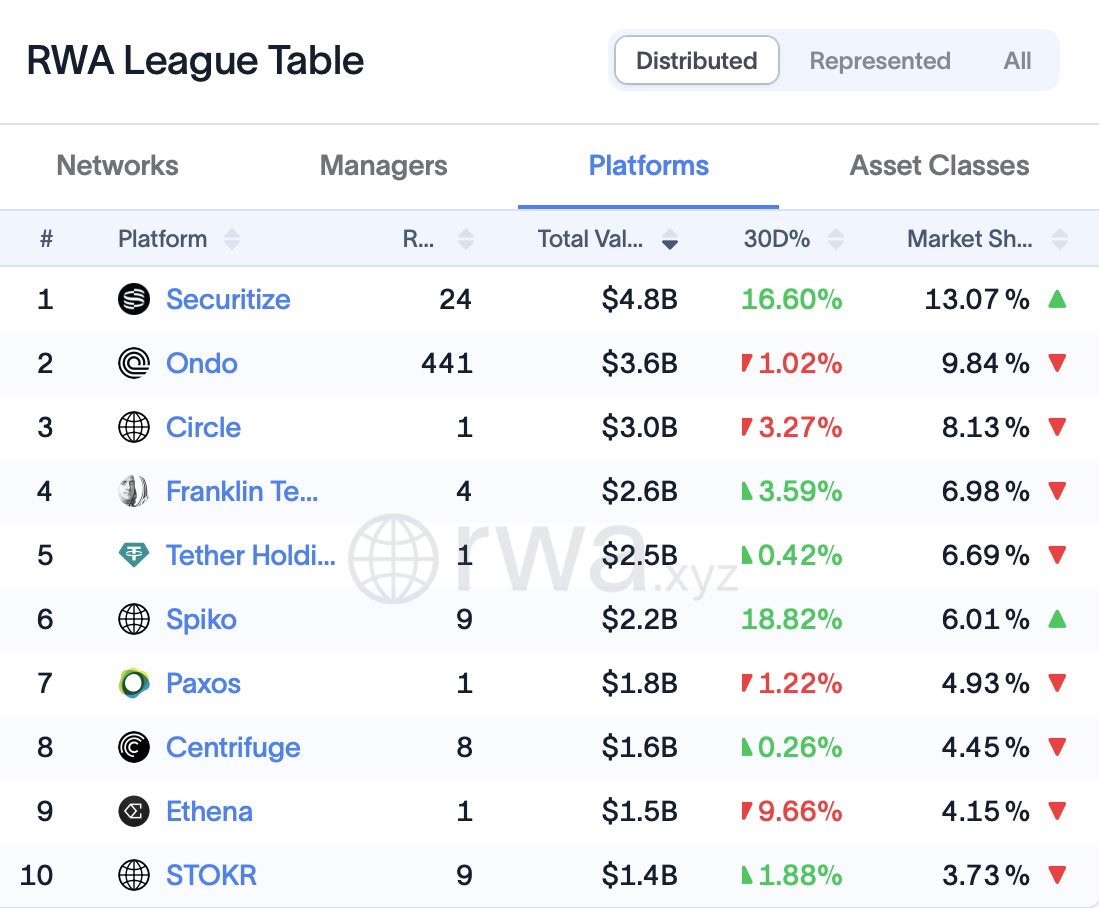
Top RWA tokenization platforms. Source: RWA.xyz
Magazine: CLARITY hopes fade, BitMEX shuts as lawsuit looms: Hodler’s Digest, July 26


Senate Republicans are seeking Democratic support for the Clarity Act as lawmakers consider starting a floor process before the August recess.
Summary
- The Clarity Act needs 60 Senate votes to advance through the chamber’s cloture process.
- Senate Majority Leader John Thune could file cloture on a motion to proceed this week.
- Seven Democratic senators said the revised bill still falls short on several policy issues.
- A major US police union has endorsed the bill after lawmakers revised its DeFi provisions.
Clarity Act faces a 60-vote Senate test
Crypto industry groups hope Thune will begin the floor process by filing cloture on a motion to proceed, according to a Crypto in America report.
A cloture filing would typically set up a vote two Senate session days later. At least 60 senators would need to support the motion before the chamber could begin debating whether to take up the bill.
If the Senate invokes cloture, lawmakers could spend as many as 30 hours debating the motion before voting on whether to proceed to the legislation itself. That process would not guarantee the Clarity Act’s passage but would move the bill closer to a full floor debate.
Republicans hold 53 Senate seats, leaving them dependent on Democratic votes even if nearly every GOP senator supports the measure. Senator Mitch McConnell is also expected to remain absent, while Republican Senators Josh Hawley and Rand Paul have not confirmed their positions.
Both senators voted against the GENIUS Act in 2025, adding uncertainty to the Republican vote count.
Democratic concerns threaten the floor push
Seven Democratic senators said the updated Clarity Act text released last week “fell short” of their expectations. Their concerns include political ethics, consumer protection, illicit finance, market integrity and the regulation of decentralized finance.
Senator Thom Tillis has been leading bipartisan negotiations over stronger ethics rules. The North Carolina Republican has called for provisions that go beyond the proposal agreed to by the White House and other GOP lawmakers.
The White House-backed language would restrict senior elected officials from issuing or sponsoring certain digital assets. However, some Democrats have questioned whether relying on the Department of Justice to enforce the restrictions would provide sufficient oversight.
Senators Catherine Cortez Masto and Mark Warner have also tied their potential support to stronger safeguards against crypto-related financial crime.
Without an agreement, Republicans are unlikely to secure the 60 votes required to move forward. The narrow GOP margin also means that any Republican defections would increase the number of Democratic votes needed.
Police endorsement removes one DeFi obstacle
The National Fraternal Order of Police endorsed the revised Clarity Act on Friday after lawmakers addressed its concerns about the Blockchain Regulatory Certainty Act.
The BRCA provisions would protect certain non-custodial software developers from having to register as money transmitters. Law enforcement groups had previously warned that broad protections could make it harder to prosecute crimes involving digital assets.
The police union now believes the revised language preserves investigators’ authority while providing legal protection for developers who do not control customer assets. Its endorsement could help ease concerns among Democrats focused on illicit finance and enforcement.
However, the support does not resolve broader disagreements over when a DeFi service should qualify as decentralized and when people controlling a protocol should face financial regulations.
SEC Commissioner Hester Peirce separately warned that moving a financial product onchain does not automatically place it outside federal securities law. She said actively managed crypto vaults could resemble investment funds when third parties decide how users’ assets are allocated.
“When you have a third party involved in deciding how different assets are being allocated and invested, that’s really a situation where you have to start asking: Do the securities laws apply?”
August recess leaves little time for a deal
Senators are scheduled to leave Washington on August 7, giving negotiators a limited window to settle the remaining disputes and start the floor process.
Thune said last week that he did not expect the Clarity Act to pass before the break. However, Senate leaders have reportedly discussed keeping lawmakers in Washington during the first few days of the recess if enough votes can be secured.
The bill would establish a federal market structure for digital assets and clarify the roles of the Securities and Exchange Commission and Commodity Futures Trading Commission. Failure to reach a bipartisan agreement before the recess could push further action into a more difficult election-year calendar.

The company added nearly 10,000 ETH over the past week, bringing its holdings to 5.79 million Ether, about 85% of which is staked through its validator operations.
Bitmine Immersion Technologies said Monday it holds 5.79 million Ether, or about 4.8% of the cryptocurrency’s total supply, after purchasing nearly 10,000 ETH over the past week.
Bitmine disclosed that about 4.9 million ETH (ETH), or roughly 85% of its holdings, are staked through its validator operations. The company projected annualized staking rewards of about $299 million once all of its Ether is deployed across its staking infrastructure and partner validators. The company’s crypto holdings, cash and marketable securities total $11.8 billion as of July 26.
The latest purchases come as Ether has outperformed Bitcoin (BTC) over the past week. ETH has gained about 2.4% over the past seven days while Bitcoin has fallen roughly 0.7%, according to CoinGecko data. In Monday’s announcement, Bitmine Chairman Tom Lee said the rising ETH/BTC ratio, which he described as being at a three-month high, signaled strengthening momentum for Ether.

Bitcoin and ETH performance over the past seven days. Source: CoinGecko
Bitmine has built the world’s largest corporate Ether treasury, trailing only Strategy among public companies by the value of its digital asset holdings. However, Bitmine’s accumulation strategy has recently diverged from Strategy’s, which has paused Bitcoin purchases in recent weeks.
On Monday, Strategy announced it had raised $544.5 million through stock sales, repurchased $25 million of its STRC preferred shares and increased its US dollar reserve to $3.75 billion, while maintaining holdings of 843,775 BTC.
Magazine: A quantum roadmap would push Bitcoin much higher: Charles Edwards
Crypto World
EMCD Launches Miner Support Program with up to $30M for Miners Amid Industry’s Steepest Profitability Squeeze
[PRESS RELEASE – Panama City, Panama, July 27th, 2026]
EMCD, a global crypto-fintech platform and one of the world’s largest Bitcoin mining pools, announced the launch of its Miner Support Program, providing eligible miners with access to up to $30 million* in financing, fee relief and partner benefits.
The program launches against a challenging backdrop. Bitcoin’s hashprice — the key measure of mining revenue per unit of compute — has declined to approximately $28/PH/day, a 50% drop from its October 2025 peak and an all-time post-halving low, per CoinShares Q1 2026 data. An estimated 252 EH/s has been taken offline (According to Hashrate Index data, cited in CoinCentral, April 2026) as operators running older-generation hardware found margins no longer viable. Three consecutive negative difficulty adjustments, the first such streak since July 2022, signal broad capitulation across the sector. EMCD, which has operated its mining pool since 2017 and processed over 4,550 BTC mined by its users in 2025, sees the current period as both a stress test and a structural opportunity for operators who remain active.
Program Structure
As margins compress across the industry, EMCD has put together a concrete response: restructured fees, negotiated hardware and infrastructure deals, and opened access to its liquidity and yield products — a toolkit built around how mining businesses actually work, available to operators in any region.
Miners facing cash flow pressure can access EMCD’s secured liquidity facilities at 3.9% APR — to cover operational costs without selling assets into a down market. Unlike generic crypto-backed credit lines, EMCD products are built around mining-specific cash flow cycles and are bundled with the rest of the program, so the effective cost of capital comes down further when combined with fee relief and hardware savings rather than being judged on rate alone.
Those looking to protect margins on every block can apply for zero pool commission for 60 days, reducing overhead while hashprice remains depressed. Miners running older or underperforming hardware can unlock preferential pricing on Vnish firmware — the market’s leading third-party ASIC optimization software. Those looking to expand or relocate capacity get access to special terms on equipment and data center services through EMCD’s partner network.
Partner Participation
EMCD is inviting hardware manufacturers, data centers, and hosting providers to join the program by offering exclusive terms to eligible miners. Partner applications can be submitted at the website: https://support-miners.emcd.io/.
“We’ve been through every cycle in this industry since 2017 — the rallies, the winters, the halvings. What we’ve learned is that the operators who survive aren’t the ones who wait out the downturns. They’re the ones who use them. This program is our commitment to making sure our miners have the tools to do exactly that.” — Michael Jerlis, Founder & CEO, EMCD.
*The stated amount reflects the maximum aggregate value of support (including financing, fee reductions and partner offers) that may be made available under the program and does not constitute a reserved fund.
About EMCD
EMCD is the global cryptocurrency mining pool and infrastructure provider. Founded in 2017 as an early industrial BTC mining operation in Europe, EMCD now serves users and businesses across 120+ markets. With over 30 EH/s of hashrate and a place in the global top ten, EMCD committed to security, reliability and transparency. EMCD’s mission is to make it simpler for individuals and businesses to build, earn and transact with digital assets. EMCD was recognised as Best Mining Pool by Coingape in 2026 and Finance Feeds in 2025.
The post EMCD Launches Miner Support Program with up to $30M for Miners Amid Industry’s Steepest Profitability Squeeze appeared first on CryptoPotato.
Ecuadorian lawyer investigating US drone strikes assassinated

AMD says the MI430X is the fastest FP64 GPU ever built, but you can’t buy one until 2027

Financial freedom plan


-

 Fashion3 days ago
Weekend Open Thread: Brooks Brothers
-

 Crypto World7 days ago
Grayscale Files For Worldcoin ETF, WLD Registers Sharp Rise
-

 NewsBeat6 days ago
How a former Blue Peter presenter stunned America’s Got Talent judges
-

 Tech21 hours ago
Intel is reversing course and bringing hyper-threading back to its server chips
-

 Tech7 days ago
Sail Virtually Aboard The “Itanic” With IA-64 Emulator
-
 Tech7 days ago
Turtle Beach Command Series KB7 review: a nifty screen-equipped gaming keyboard
-
 Business6 days ago
New Jersey voter registration controversy explained: How 6,600 noncitizens got on the rolls, and what happens next
-
 Entertainment6 days ago
Johnny Depp’s R-Rated Gothic Cult Classic Gets New Release Ahead of Sydney Sweeney Remake
-

 Crypto World5 days ago
Ethics, other provisions in crypto Clarity Act to be further discussed
-

 Politics10 hours ago
Luke Littler dismantles Gerwyn Price to retain title in Blackpool
-
 NewsBeat7 days ago
Shanghai science forum photos show China’s AI and robotics advances in rivalry with US
-

 Sports4 days ago
2026 3M Open leaderboard: Scottie Scheffler finds putter in Round 1, sits three back
-
 Sports1 day ago
Commonwealth Games boxing: Jadumani Singh seals dominant 5-0 win over Pakistan’s Sumama Rehman to enter quarter-finals | Commonwealth Games News
-

 News Videos4 days ago
The Peugeot Family: How 200 Years of an “Old Money” Dynasty Died in A Boardroom
-

 Fashion4 days ago
16 Dresses for the High Summer Event
-

 Politics1 day ago
Spain sweeps the board at 2026 World Cup with individual awards
-

 Crypto World7 days ago
Andrew Cuomo joins OKX board as crypto exchange expands in U.S.
-
 Entertainment3 days ago
A New Post-Apocalyptic Gundam Anime Series Blasts Into SDCC
-

 News Videos1 day ago
BITCOIN JUST ENTERED THIS CRITICAL ZONE…
-

 Crypto World2 days ago
XRP Ledger adds $2.6B as RWA inflows rank second
You must be logged in to post a comment Login