
Crypto World
Aave Founder Stani Kulechov buys $30 million mansion in London’s Notting Hill: Bloomberg

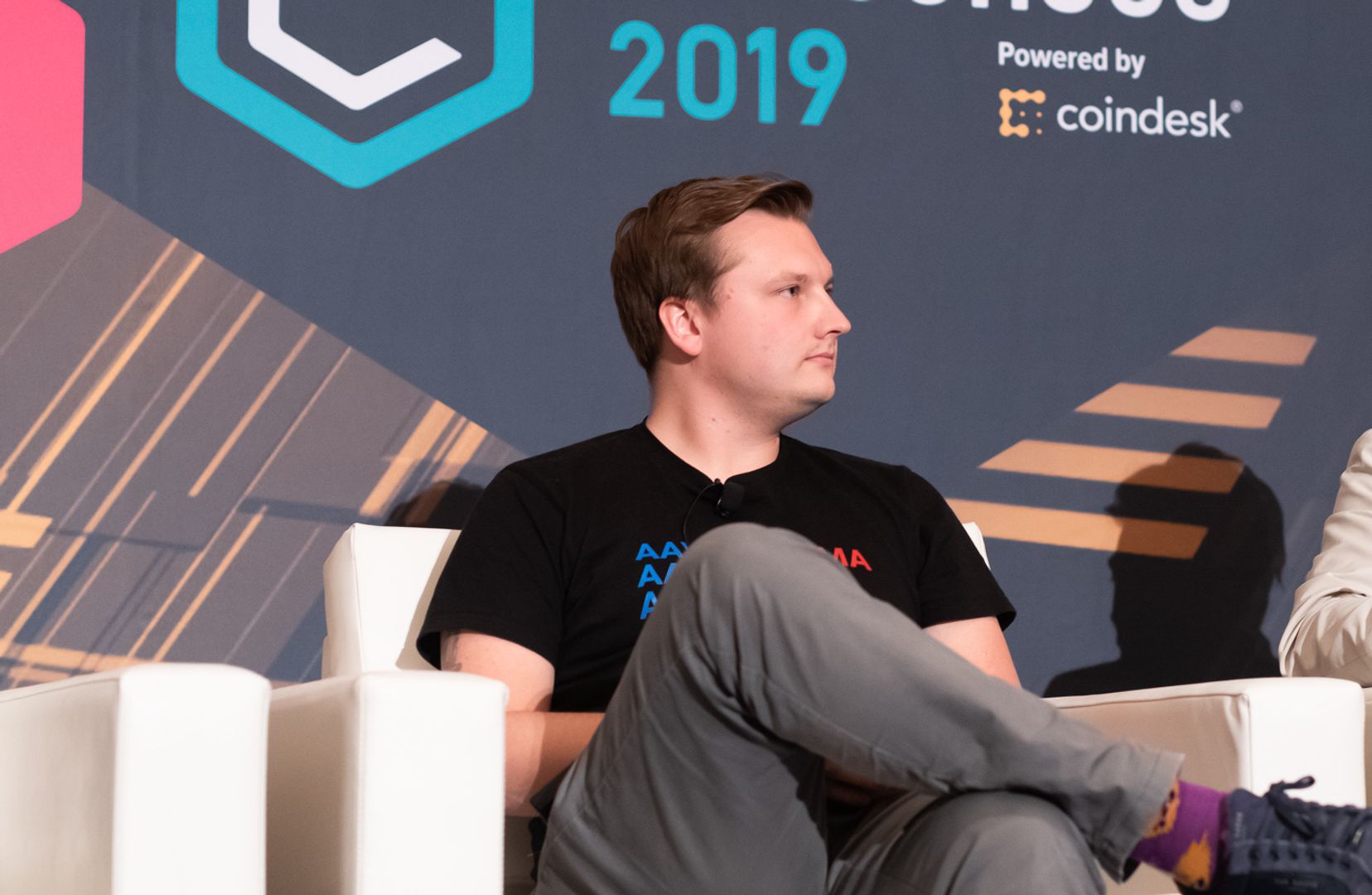
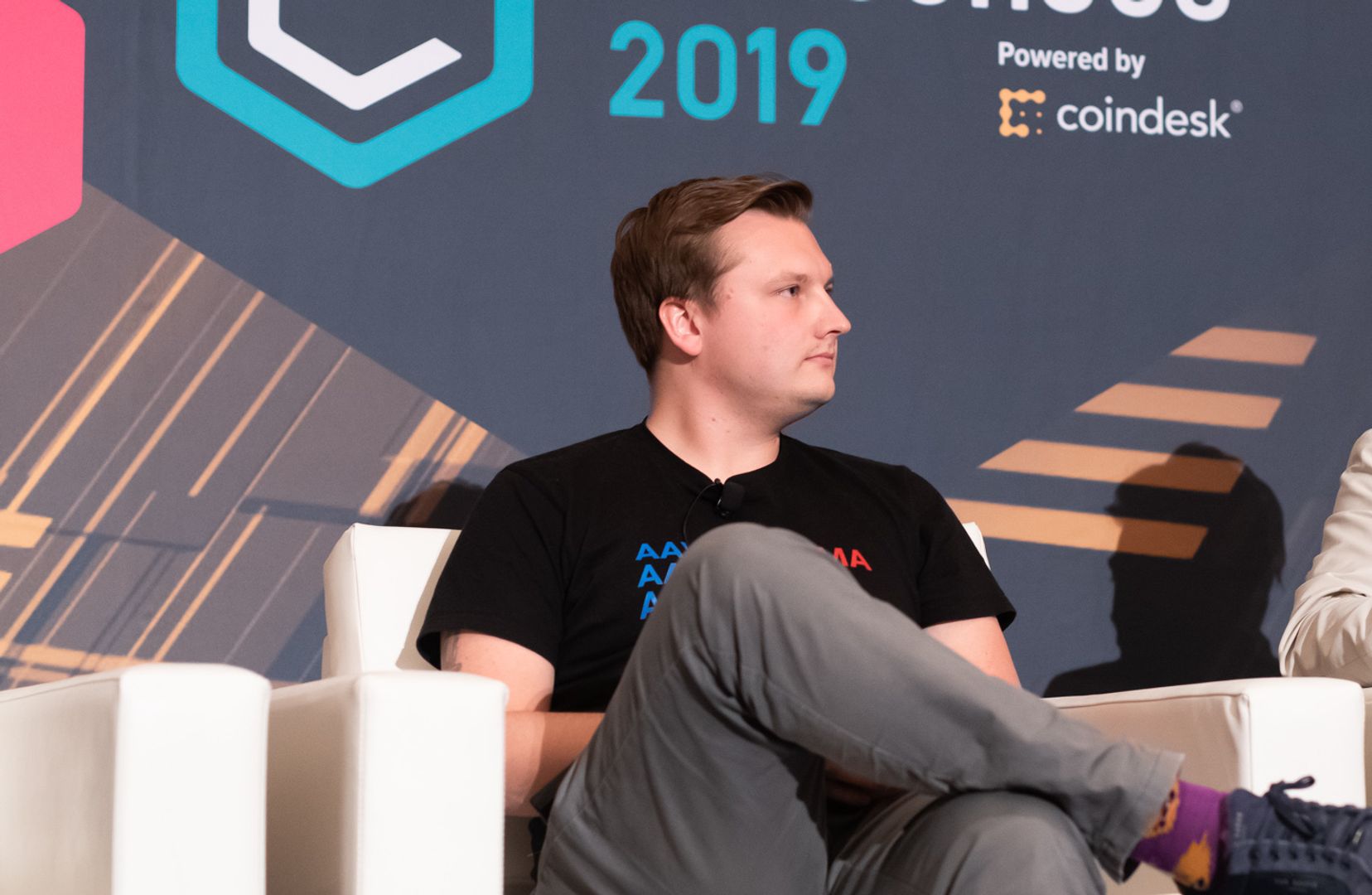
Stani Kulechov, the founder of decentralized lending platform Aave, bought a 22 million-pound ($30 million), five-floor mansion in London’s upscale Notting Hill area, according to a report from Bloomberg.
The entrepreneur bought the luxury property in November for about 2 million pounds less than the guide price, Bloomberg reported citing brokers involved in the sale.
Kulechov, a Russian-born Finnish lawyer, founded Aave in 2017 under the name ETHLend. The platform, which aspires to become the backbone of the next generation of credit services, not just leverage for crypto, has over $50 billion in assets deposited across its markets.
Kulechov has been something of a champion of the U.K. and Ireland as possible crypto hubs. He recently welcomed U.K. tax authority HMRC’s approach to DeFi lending protocols, that locking crypto up as collateral would not generate a taxable event .
A spokesperson for Aave did not immediately respond to a request for comment.

Nigel Farage has become the first sitting UK MP to publicly buy Bitcoin, fronting a £2 million ($2.5 million) purchase through Stack BTC Plc.
The move marks a historic crossover between politics and crypto, and signals growing institutional confidence in Bitcoin as a treasury asset.
Inside the £2.5 Million Bitcoin Treasury Strategy
The transaction, executed on April 13, 2026, positions Farage as both the first sitting Member of Parliament and the first UK political party leader to publicly participate in a Bitcoin purchase.
The deal was carried out at Blockchain.com’s London headquarters, where Farage was filmed taking part in the process.
According to Stack BTC, the move is a “landmark moment,” amid the firm’s strategy to build a corporate Bitcoin reserve.
Farage, a key shareholder, emphasized the rationale that a Bitcoin treasury company must actively accumulate the asset to remain credible.
The $2.5 million buy was funded through recent capital raises totaling over £4.2 million ($5.25 million). Stack BTC’s model combines acquiring profitable UK businesses with converting surplus capital into Bitcoin, effectively treating BTC as a long-term balance sheet asset.
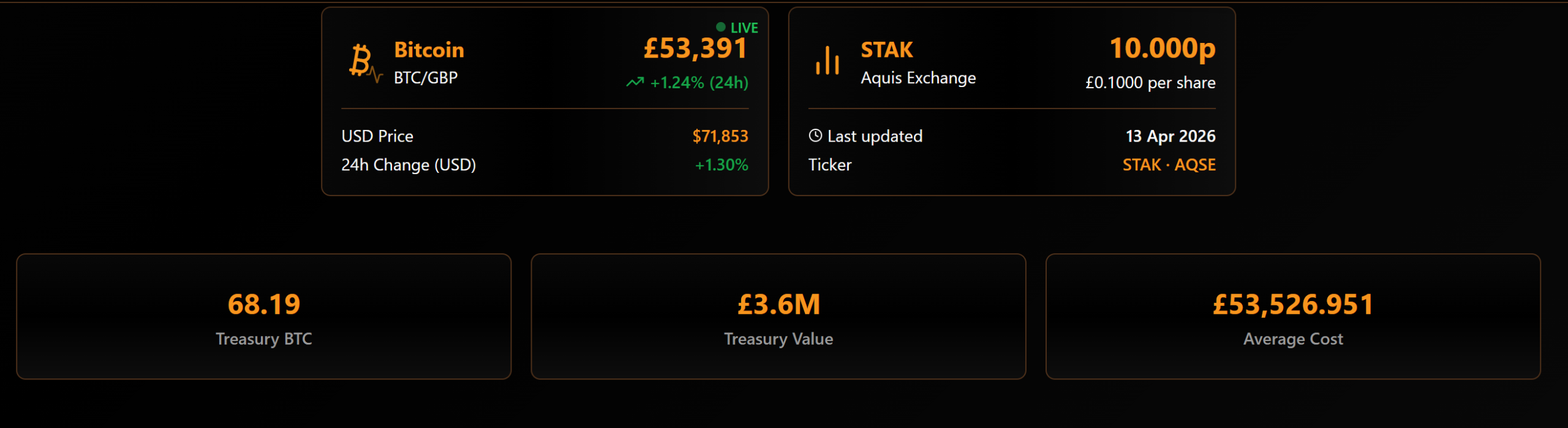
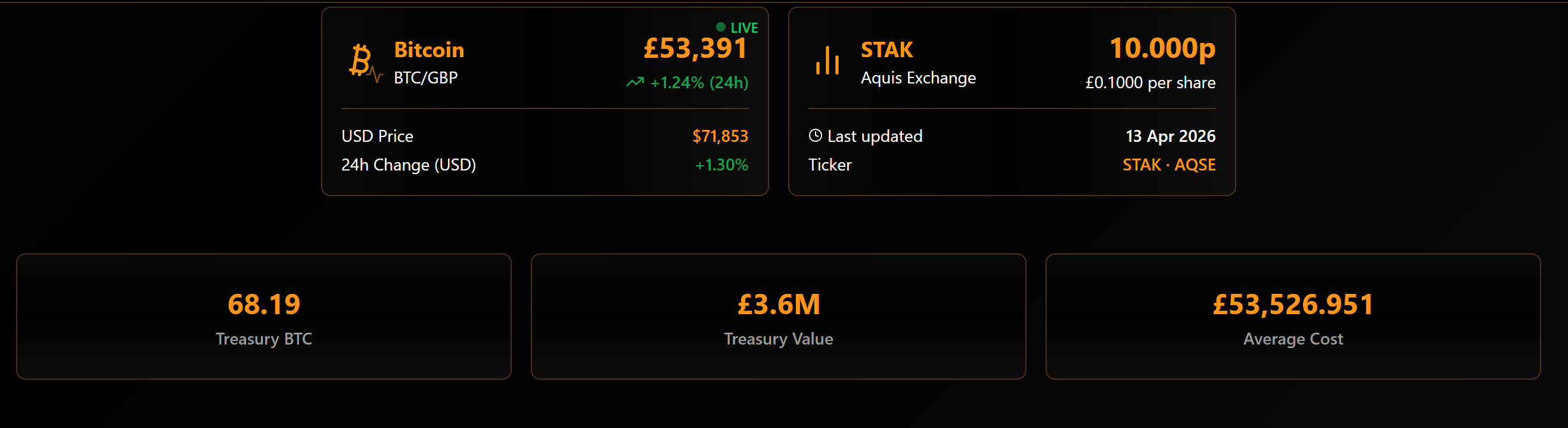
The company previously held a small position of 21 BTC but is now scaling aggressively with 68.19 Bitcoins in its treasury as of this writing.
This mirrors a broader trend among firms globally adopting Bitcoin as “digital gold” amid inflation concerns and fiat currency volatility.
Backing the initiative is Kwasi Kwarteng, former UK Chancellor and Executive Chairman of Stack BTC, adding political and financial credibility to the strategy.
“…our mission to build the UK’s premier Bitcoin treasury company and put London at the centre of this new monetary era,” wrote Kwarteng in a post.
Market Impact and Investor Signals
Farage’s move lands at a sensitive moment for crypto markets, with Bitcoin experiencing recent price weakness. The timing reflects conviction, buying during dips rather than chasing highs, much like what MicroStrategy and Michael Saylor does.
The main question, however, is whether this signals a broader wave of UK corporate Bitcoin adoption. Public, politically-linked participation could normalize BTC exposure among institutional and retail investors alike.
However, the move raises questions around optics and potential conflicts of interest, given Farage’s equity stake in the company executing the purchase.
Policy Pressure and Crypto Adoption
Farage has long advocated for the UK to become a global crypto hub. Reform UK previously accepted cryptocurrency donations and has pushed for more favorable digital asset policies.
This high-profile purchase intensifies pressure on UK regulators and rival political parties to clarify their stance on crypto.
It also highlights the growing intersection between political influence and financial innovation.
The immediate financial impact of the £2 million purchase is modest, but its symbolic weight is significant. As Stack BTC continues to deploy capital into Bitcoin, markets will watch for follow-on buys and balance sheet growth.
More importantly, Farage’s move could accelerate political debate around crypto regulation, taxation, and institutional adoption in the UK.
If additional public figures or companies follow suit, Bitcoin’s role in mainstream finance—and politics—may expand rapidly in the months ahead.
The post UK Far-Right Leader Nigel Farage Buys Over $2 Million in Bitcoin appeared first on BeInCrypto.

As quantum computing edges closer to practical reality, a nuanced risk picture is taking shape for Bitcoin. Rather than a sudden, network-wide catastrophe, researchers and industry observers are highlighting a tiered vulnerability focused on dormant addresses with exposed public keys. Many of these are among the oldest coins from Bitcoin’s early era, and their combination of long-standing exposure, high value, and inertia in defense makes them salient targets for a first generation of quantum-enabled attackers, should such capabilities mature.
Key takeaways
- Dormant Bitcoin addresses with exposed public keys represent a concentrated risk, especially among early-era holdings that haven’t moved in years.
- Quantum threats affect public-key cryptography (ECDSA/Schnorr) more directly than hash functions, meaning on-chain exposure of a public key is a critical vulnerability.
- The risk separates into on-spend attacks (tight time windows tied to block confirmations) and at-rest attacks (longer horizons when keys are exposed but no immediate transaction is triggered).
- Large, long-dormant holdings — including many 50 BTC block rewards from the early mining era — create a high-value target pool that could attract quantum-driven attacks first.
- Beyond technology, the dormant-wallet challenge raises governance questions about asset salvage, protection, and how the protocol might accommodate or address historically inaccessible coins.
Where the risk converges on Bitcoin’s cryptography
Bitcoin relies on two cryptographic pillars: the hash function SHA-256 for mining and block security, and public-key cryptography (ECDSA/Schnorr) for transaction signatures. Quantum computers would affect these components in distinct ways. Hash functions are relatively resilient; even with Grover’s algorithm, they would be weakened but not rendered obsolete. Public-key cryptography, however, presents a sharper exposure path. With Shor’s algorithm, a sufficiently powerful quantum computer could derive a private key from a known public key. In practical terms for Bitcoin, that means any coins whose public key has been revealed could theoretically be spent by an attacker if a quantum-capable adversary can perform the computation in time to act on a vulnerability.
The on-spend vs at-rest distinction and why it matters
Understanding the timing of attacks is crucial to assessing risk. There are two broad categories of quantum attacks:
On-spend attacks
- Trigger a transaction to reveal the user’s public key.
- Attackers must derive the private key within a short window — roughly the span of a single block, or about 10 minutes — to successfully move funds.
At-rest attacks
- Target coins whose public keys are already exposed on-chain.
- Aim for a longer horizon: days, weeks, or longer — with time as the primary constraint, not a rapid transaction window.
- No immediate transaction trigger is required; attackers can plan and execute when they have sufficient quantum capability.
The contrast is telling. On-spend attacks face a tight clock, while at-rest attacks operate on a long-term timescale, hinging on technical breakthroughs rather than a race against a block window. If a large tranche of the supply has already disclosed its public keys, the window for opportunistic action expands dramatically.
Dormant wallets: three vulnerability factors
Dormant wallets—those that have not actively moved funds or upgraded security—combine three attributes that amplify risk:
- No defensive action: Active holders can migrate funds, refresh security models, or move assets into newer, quantum-resistant formats. Dormant holders lack such pathways, leaving coins exposed without recourse.
- Long exposure windows: Since public keys may already be on-chain, attackers can operate offline with less urgency, reducing the urgency imposed by short confirmation times.
- High-value concentration: Many early Bitcoin holdings have appreciated substantially in value. High-value, dormant coins create a prime target profile for any future quantum-era exploit.
Notes from industry observers emphasize that coins in inactive wallets cannot upgrade their security after the fact. Thus, the burden of adoption and migration would fall to active participants and future protocol changes, not the dormant accounts themselves.
Which wallets are most exposed
The risk is not uniform across the blockchain. Several categories stand out as more exposed than others:
Old P2PK outputs
- These early formats reveal public keys directly on-chain when spent, offering little additional protection against quantum-enabled adversaries.
Address reuse
- When an address is spent from and then reused, the public key becomes visible after the first spend. Any remaining funds in that address become more vulnerable as well.
Certain modern script formats, such as those associated with Taproot, also expose public-key material in ways that could fall into an at-rest exposure category under quantum assumptions. While Taproot was designed to improve efficiency and privacy, it does not entirely escape the theoretical risk if keys remain exposed long-term due to address reuse or legacy holdings.
The scale of the problem: dormant coins dominate the risk
Quantifying quantum risk goes beyond theoretical math; it hinges on measurable exposure. Reports indicate that billions of dollars’ worth of Bitcoin remains in addresses whose public keys are exposed, with a significant portion tracing back to early-era mining rewards. A notable share of these coins has not moved for more than a decade, creating a silent pool of assets that could become vulnerable as quantum capabilities advance. Among the most cited examples are the large blocks rewarded to miners in Bitcoin’s infancy — many of these blocks yielded 50 BTC rewards that subsequently remained idle for years. This concentration implies that the largest quantum-targets are often the largest Bitcoin holdings.
A deeper challenge: Dormant wallets and network governance
The emergence of a quantum threat for dormant wallets also raises governance and policy questions that extend beyond pure cryptography. If a future quantum attack were to surface, the Bitcoin community might face difficult choices about asset salvage, fund protection, or even temporary protocol adjustments to address long-dormant coins. Questions include whether such coins should remain spendable, whether there should be mechanisms to protect or freeze longitudinal holdings, and how public policy interacts with the immutable nature of the protocol when a subset of assets appears irrecoverable by design.
Why this doesn’t mean Bitcoin is broken
Crucially, observers stress that there is no current, widely accepted evidence that quantum computers capable of breaking Bitcoin’s cryptography exist today. The development path toward practical, scalable quantum systems is expected to span years, if not decades, of sustained engineering progress. The risk is not imminent, but incremental and evolving. In the near term, the impact is likely to be selective rather than universal as early-stage quantum capabilities emerge and defenses are refined. Active users can adapt more quickly than dormant wallets, which means mitigation may initially favor those who actively manage their keys and upgrade security models.
What can be done in the meantime
Holders and the broader ecosystem can take concrete steps to reduce exposure and accelerate readiness:
- Minimize public-key exposure: Avoid address reuse and curb unnecessary early revelation of public keys, maintaining better separation between on-chain activity and key exposure.
- Migration pathways: Develop and promote clear routes for moving funds into quantum-resistant formats as these technologies mature, ensuring a smooth transition for users who want to upgrade their security posture.
- Continued protocol research: Ongoing work explores integrating quantum-resistant cryptography with Bitcoin’s core properties, aiming to preserve security and decentralization without introducing new central points of failure.
Practically, these measures primarily benefit active participants today, highlighting the gap between movable funds and long-dormant assets. The broader lesson is that a staged approach to upgrading cryptography may be essential to maintain resilience as technology evolves.
In summary, the dormant-wallet vulnerability reframes the quantum risk narrative for Bitcoin. It underscores a layered challenge: the network isn’t threatened as a monolith, but certain pockets of the supply could be more fragile than others if and when quantum capabilities advance. The future resilience of Bitcoin will depend not only on breakthroughs in quantum hardware but on decisive action by the ecosystem to strengthen, migrate, and adapt the way keys are managed across the lifecycle of the blockchain.
Readers should watch for ongoing research into quantum-resistant cryptography, milestones in post-quantum upgrades, and policy discussions about how to handle historical holdings that may be irretrievably exposed to future computational breakthroughs. The next phase will likely hinge on practical migration pathways and protocol-level safeguards that can extend protection to both active and dormant users without compromising Bitcoin’s core principles.
Crypto World
Crypto wallet firm Exodus sues W3C and its CEO Garth Howat, seeking to compel $175M acquisition


Listed cryptocurrency firm Exodus Movement (EXOD) is suing W3C, the parent company of crypto card and payments specialists Baanx and Monovate, and its chief executive, Garth Howat, to complete its $175 million acquisition of W3C, agreed in November of last year.
A lawsuit in the Delaware Court of Chancery seeks to compel Howat to comply with obligations under the November 24, 2025 Stock Purchase Agreement.
Howat and W3C accepted $80 million worth of loans from Exodus upon signing the deal, with $10 million given to Howat personally, who then declared that they did not need to repay these loans, according to the lawsuit.
“Defendants Garth Howat and W3C are engaged in a blatant, reckless, and improper campaign to escape closing a transaction for the sale of W3C to Exodus that they had promised to complete in a binding agreement,” the lawsuit states.
“They have attempted to pilfer millions of dollars from one of their own subsidiaries. They have falsely backdated documents filed with government authorities. They have purported to summarily dismiss entire boards of directors, as well as the CEO and CFO of their key operating entity, and replace them with lackeys of their choosing, despite being precluded from doing so by the binding agreement,” it said.
Howat did not immediately respond to a request for comment.
W3C companies Baanx and Monovate were behind the Crypto Life digital asset cards business that worked with the likes of Mastercard and MetaMask.
JP Richardson, CEO and Co-founder of Exodus commented, “We have a binding agreement with W3C and expect it to be fully honored. We’re confident in the path forward and anticipate a swift resolution.”

TLDR
- The American Bankers Association disputed the White House analysis on stablecoin risks.
- Bankers said policymakers must study a market where stablecoin yield remains allowed.
- Lawmakers drafted a compromise to restrict yield-like rewards on stablecoins.
- The Senate Banking Committee has not scheduled a hearing on the bill.
- Senator Cynthia Lummis called for urgent action to advance the legislation.
U.S. banking leaders have challenged a White House report that downplayed risks from stablecoins. They argue that stablecoin yield could draw deposits away from traditional banks. The dispute has stalled the Digital Asset Market Clarity Act in the Senate.
Bankers Dispute White House Findings on Stablecoin Yield
The American Bankers Association rejected a recent Council of Economic Advisers report. The group said the report examined the wrong policy scenario. It argued that economists should have studied a market where stablecoin yield remains permitted.
ABA economists wrote, “The CEA paper minimizes the core risk by starting from the wrong question.” They said a ban on yield for payment stablecoins would protect insured deposits. They also said such a rule would support stablecoins as payment tools rather than deposit substitutes.
Bankers warned that allowing yield could speed deposit migration. They said returns from stablecoins may exceed bank interest rates. They argued that customers would move funds to chase higher rewards.
The ABA estimated that stablecoin markets could grow from $300 billion to $2 trillion. It said yield would act as the main driver of that expansion. It added that growth at that scale would reshape deposit flows.
Senate Negotiations Stall Over Crypto Bill
Lawmakers have struggled to advance the Digital Asset Market Clarity Act. The bill seeks to set rules for U.S. crypto markets. However, disagreements over stablecoin yield have delayed committee action.
Senators from both parties considered bankers’ concerns about deposit flight. They discussed how depositors fund lending activities. They then drafted a compromise to limit certain reward structures.
The compromise would ban yield on holdings that resemble deposit accounts. It would allow activity-based rewards similar to credit card programs. Still, banks have not publicly endorsed the proposal.
Senator Cynthia Lummis urged action on the social media platform X. She wrote, “America needs Clarity.” She also said the time to move the bill forward is “now or never.”
The Senate Banking Committee has not scheduled a hearing. Lawmaker advocates had expected a session before the month’s end. As of this week, no official date appears on the calendar.
Bank representatives have kept a lower public profile. However, they continue to circulate policy papers and letters. They argue that early safeguards would limit systemic shifts.
The White House economists had said banks face limited risk. They examined a scenario where Congress bans yield. Bankers countered that lawmakers must assess a no-ban environment.

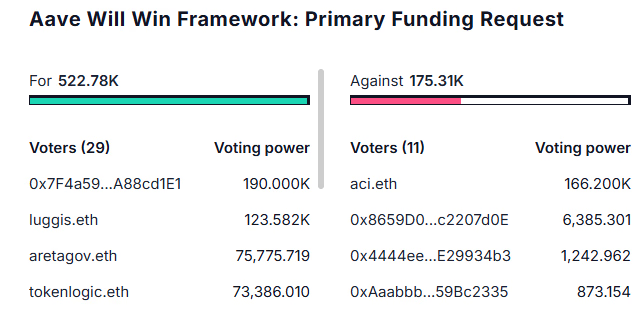
‘Aave Will Win’ passed with 75% support, awarding Aave Labs a $25 million stablecoin grant and 75,000 AAVE in exchange for directing 100% of product revenue to the DAO treasury.
The Aave DAO on Sunday approved the first binding component of the “Aave Will Win” framework, which founder Stani Kulechov calls “the most important proposal in Aave’s history,” directing 100% of revenue from all Aave-branded products to the DAO treasury and consolidating economic rights under the AAVE token.
The vote closed with roughly 75% support, a significantly stronger result than the initial Temp Check in early March, which narrowly cleared amid concerns that Aave Labs-linked addresses had tipped the balance.

The approved package includes a $25 million stablecoin grant from the DAO’s Collector Contract, split between an immediate $5 million allowance and streamed payments over six and 12 months, plus 75,000 AAVE tokens vesting linearly over 48 months from the Ecosystem Reserve, double the timeline outlined in the original temp check.
In exchange, Aave Labs commits to routing all revenue from Aave Pro, the Aave App, Horizon, Aave Kit, and swaps on aave.com to the DAO treasury, a stream that Kulechov said is already generating $10 to $20 million on top of protocol revenue, which hit $140 million in 2025.
“If you own AAVE, you own not just the economic rights of the protocol, but the brand, the users, and the integrations,” Kulechov wrote on X, laying out an ambitious multi-year roadmap spanning consumer products, fintech integrations, and regulatory licensing.
The proposal resolves a governance crisis that erupted in December when a delegate discovered that Aave Labs had been redirecting roughly $200,000 per week in interface fees, previously flowing to the DAO, to itself via a CowSwap integration. That controversy spiraled into a broader confrontation over tokenholder rights, brand ownership, and the power balance between Labs and the DAO.
The fallout was severe. BGD Labs, one of the core teams working on Aave V3, announced its departure in February. The Aave Chan Initiative followed in early March. And last week, risk management firm Chaos Labs became the third major contributor to exit.
The AAVE token has lost roughly 75% of its value since its August 2025 high near $356, though it rallied approximately 5% following the vote to trade near $95.
The vote comes just two weeks after Aave V4 launched on Ethereum mainnet, introducing a hub-and-spoke architecture that allows independent lending markets to share liquidity through a unified system. The framework formally ratifies V4 as the protocol’s long-term technical foundation.
Under the new framework, Kulechov outlined a zero-tolerance policy on “value leakage,” requiring that all service providers build exclusively for Aave with measurable performance goals.
Aave is DeFi’s largest lending protocol with roughly $25 billion in total value locked across multiple chains.
This article was written with the assistance of AI workflows. All our stories are curated, edited and fact-checked by a human.
XRP price is down by 2% in a week, with the Fear & Greed Index pinned at 16, but an analyst comes up with a prediction that creates an unusual tension right now. Technical signals suggest XRP may be approaching a structural bottom, but the longer-term debate on just how high this asset can realistically go has reignited in force.
Financial commentator Jake Claver told the Paul Barron podcast that XRP could reach $1,000 by the end of 2026 if institutions, including BNY Mellon, Fidelity, Citi, Franklin Templeton, and JPMorgan, fully adopt Ripple’s settlement infrastructure.
Ex-Goldman Sachs analyst Dom Kwok echoed the target on a longer timeline, projecting $1,000 by 2030 on the back of regulatory clarity and institutional inflows.
Meanwhile, Vandell of Black Swan Capitalist offered a more grounded framework: in a world of perpetual fiat debasement, asset price ceilings are effectively theoretical.
“No one knows exactly how these things will play out,” he said, “but based on probabilities and the dynamics that actually drive price… over time it becomes natural for the price to rise.”
The macro backdrop, such as dollar weakness, institutional crypto infrastructure buildout, and Ripple’s ongoing acquisition activity, keeps the structural bull case alive even as short-term charts look exhausted.
Discover: The best pre-launch token sales
XRP Price Prediction: Hit $1,000? What the Charts Say First
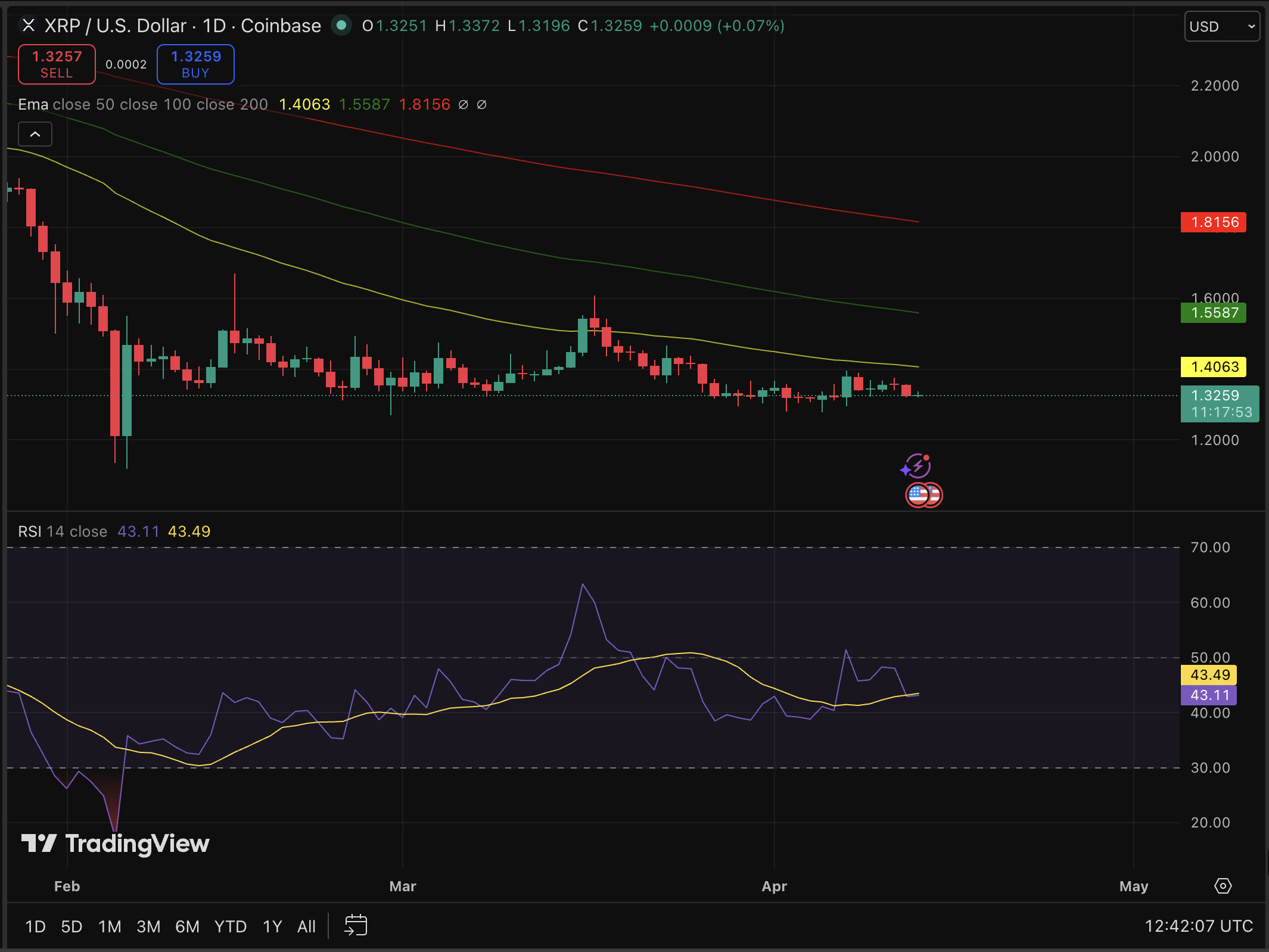
XRP’s current print of $1.32 sits below its 50-day SMA of $1.40, a meaningful technical warning. RSI at 43 reads neutral, with only 40% of the last 30 days closed green for the price.
Support clusters around $1.30, which aligns with algorithm-derived base-case floor estimates for 2026. Resistance sits at the $1.60, a level that would represent a +20% move, which has been putting a ceiling on the current range twice.
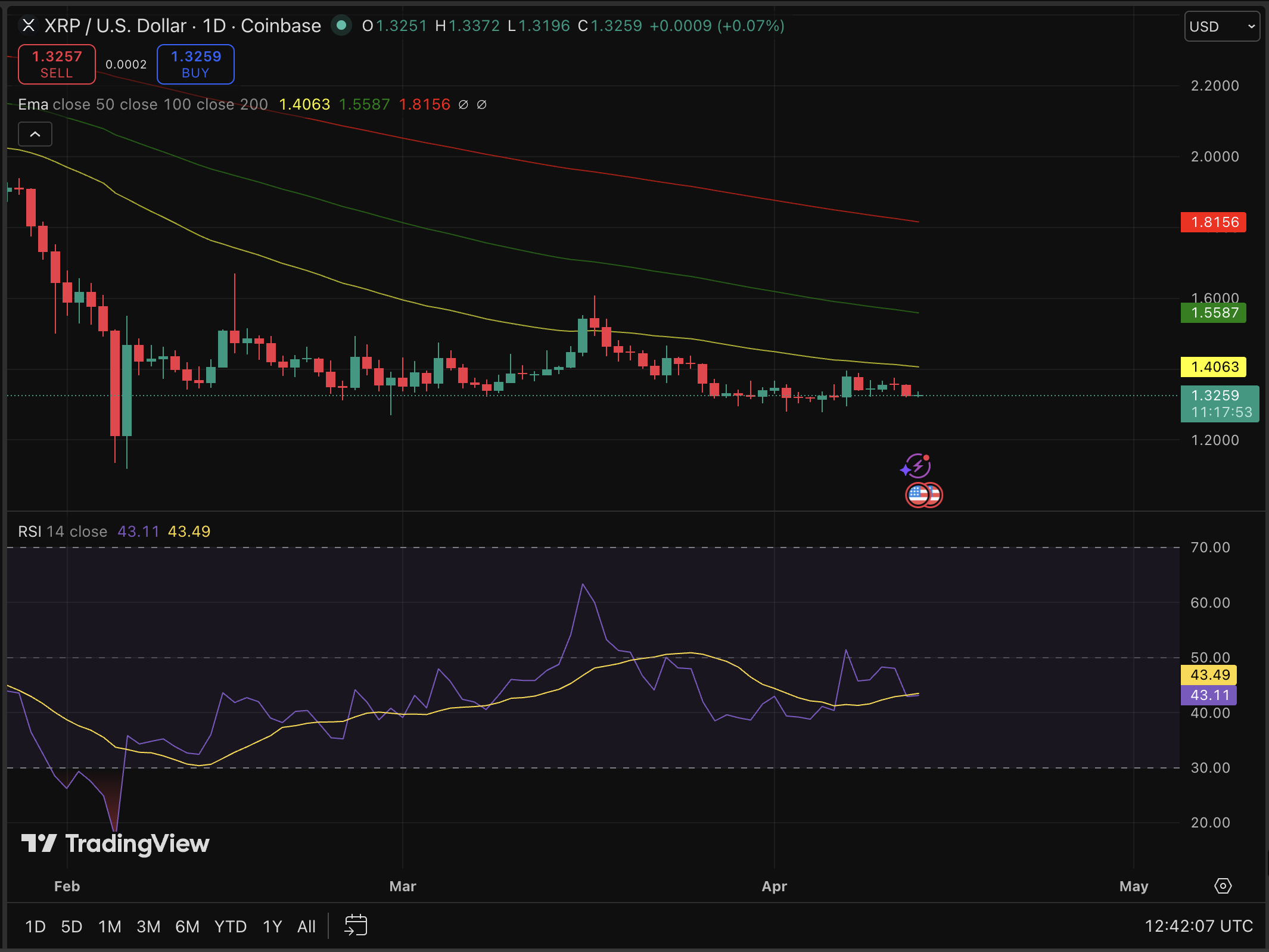
If institutional bank adoption accelerates, Ripple partnerships close, and XRP reclaims $1.40, it could open the path toward analyst Fibonacci targets of $4.50 over 6–12 months.
The $1,000 target requires a market cap north of $57 trillion at current supply, which is the math skeptics cite. What Vandell’s framework suggests is that the denominator (fiat value) shifts, too. Dismissing it entirely misses the point. Treating it as a 2026 certainty misses it even harder.
Discover: The best crypto to diversify your portfolio with
Bitcoin Hyper Eyes Early-Stage Upside While XRP Grinds Through Resistance
XRP’s $81 billion market cap means even a doubling to $2.6 is a $80 billion capital injection requirement. That’s not impossible, but it’s not the risk/reward profile of an early-stage position.
Traders rotating out of large-cap consolidation plays are increasingly scanning presales for asymmetric exposure. That’s where Bitcoin Hyper enters the frame.
Bitcoin Hyper ($HYPER) is building the first-ever Bitcoin Layer 2 with Solana Virtual Machine (SVM) integration, combining Bitcoin’s security with smart contract execution that outpaces Solana on latency.
The presale has now raised a huge $32 million milestone at a current token price of just $0.0136, with 35% APY staking live for early participants.
The core thesis: Bitcoin’s $1 trillion+ ecosystem currently lacks programmability and speed. HYPER targets that gap directly, offering a decentralized canonical bridge for BTC transfers alongside high-speed, low-cost execution.
Research Bitcoin Hyper and review the presale details here.
The post XRP Price Prediction: $1,000 Is Not Impossible appeared first on Cryptonews.


Kraken’s Chief Security Officer Nick Percoco has revealed that the crypto exchange is being extorted by criminals who are threatening to leak videos of client data.
Percoco shared the news on X today, detailing how it identified two instances of its staff accessing its client systems and leaking them online.
He claims that in 2025, the exchange discovered one of its support staff had leaked client data after somebody tipped the firm off about footage circulating on criminal forums.
Read more: Hyperbridge exploited less than two weeks after April Fools’ day hack prank
In this instance, Percoco says the firm was able to revoke the staff member’s access and enact additional security controls.
Percoco says the firm has since learned of another more “recent” breach, and as before, it terminated the individual’s access to company systems.
He claims that Kraken then received extortion demands.
“The criminals threatened to distribute materials from both the February 2025 incident and the recent incident to media outlets and on social media if we did not comply. We will not pay these criminals,” he said.
Clients included in the leaks were informed, and Percoco said it only affected “approximately 2,000 in total (0.02% of clients).”
Read more: Kraken customer data allegedly for sale on dark web
He added that the firm believes “there is sufficient evidence to support the identification and arrest of those responsible.”
“We are actively working with federal law enforcement across multiple jurisdictions to pursue all individuals involved and bring them to justice,” he said.
Protos contacted Kraken for further details about the extortion and why it disclosed the February 2025 breach over a year later, and was told by a spokesperson, “A criminal group is threatening to release information about a security incident if we do not meet their extortion demands.
“We will not negotiate with bad actors and have therefore transparently shared what happened in a post on X.”
Stolen data from Kraken appears to have been listed for sale earlier this year on Russian-speaking criminal forums. The vendor claimed to sell “panel access” login credentials that would give buyers read-only access to Kraken’s know your customer documentation, transaction histories, and support tickets.
Billion-dollar crypto exchange Coinbase was also extorted in 2025 after its customer support staff leaked customer data.
In this case, cybercriminals bribed staff and then used the leaked data to try to blackmail Coinbase out of $20 million.
Protos has reached out to Kraken for comment and will update this piece should we hear anything back.
Got a tip? Send us an email securely via Protos Leaks. For more informed news and investigations, follow us on X, Bluesky, and Google News, or subscribe to our YouTube channel.


Kraken is facing an extortion attempt after uncovering two insider incidents involving support staff access to limited client data.
The exchange’s Chief Security Officer, Nick Percoco, insists its systems and funds were never compromised.
Kraken Insider Extortion Case Exposes Growing Support Staff Security Risks
Crypto exchange Kraken disclosed two separate incidents of insider access involving support staff who viewed limited client data, which later prompted an extortion attempt by a criminal group.
The firm’s CSO says no systems were breached and funds remained secure after acting immediately on each alert. Support access was revoked quickly in both cases, according to the Kraken security update statement.
“We are currently being extorted by a criminal group threatening to release videos of our internal systems with client data shown if we do not comply with their demands,” Percoco wrote in a post.
According to the company, only about 2,000 client accounts, roughly 0.02% of its user base, may have been viewed during the incidents.
Notifications were sent to affected users. Kraken says the exposure was limited to support systems, not trading infrastructure, and no funds were affected.
Kraken Rejects Extortion Demand
The incidents escalated when a criminal group began demanding payment, threatening to release internal videos and data unless Kraken complied.
Reportedly, Kraken refused, stating it would not negotiate with bad actors. The exchange confirmed it is working with law enforcement across jurisdictions and has gathered sufficient evidence for identification efforts.
“We are actively working with federal law enforcement across multiple jurisdictions to pursue all individuals involved and bring them to justice,” he added.
The case reflects a wider industry issue involving attempts to recruit or bribe customer support employees at crypto and tech firms.
It mirrors Coinbase’s 2025 case, where bribed overseas agents leaked customer information. In both, no systems were breached, client funds remained safe, and the exchanges refused extortion demands while cooperating with law enforcement.
Security teams across the sector have increased monitoring and access controls in response. Similar tactics have been observed in the gaming and telecom sectors, according to industry reports.
Notwithstanding, some users question offshore support hiring practices, arguing that geography influences security risk perception.
“Why don’t you hire people from developed countries? I won’t put my money on a platform that I have to hope for their third world support staff to not get bribed by criminals to expose my data. Banks don’t hire support staff in third world countries either,” one user expressed.
Kraken has not commented on those claims but emphasized access controls over location as the primary safeguard.
The post Criminals Blackmail Kraken With Alleged Client Data Leak appeared first on BeInCrypto.


Tom Duff Gordon, the vice president of international policy at U.S.-listed cryptocurrency platform Coinbase (COIN), has left the firm for pastures green.
Duff Gordon, who had been with Coinbase for close to 4 years, left the exchange to join OpenAI as head of EMEA Policy, a Coinbase spokesperson said via email.
Duff Gordon had previously spent 8.5 years working as a banker at Credit Suisse. He did not immediately respond to a request for comment.
An expert on crypto regulations, Duff Gordon recently pointed out that U.K. banks are blocking millions of customers from accessing legal and compliant services, by failing to distinguish between Financial Conduct Authority-registered firms with low fraud rates and higher-risk operators.
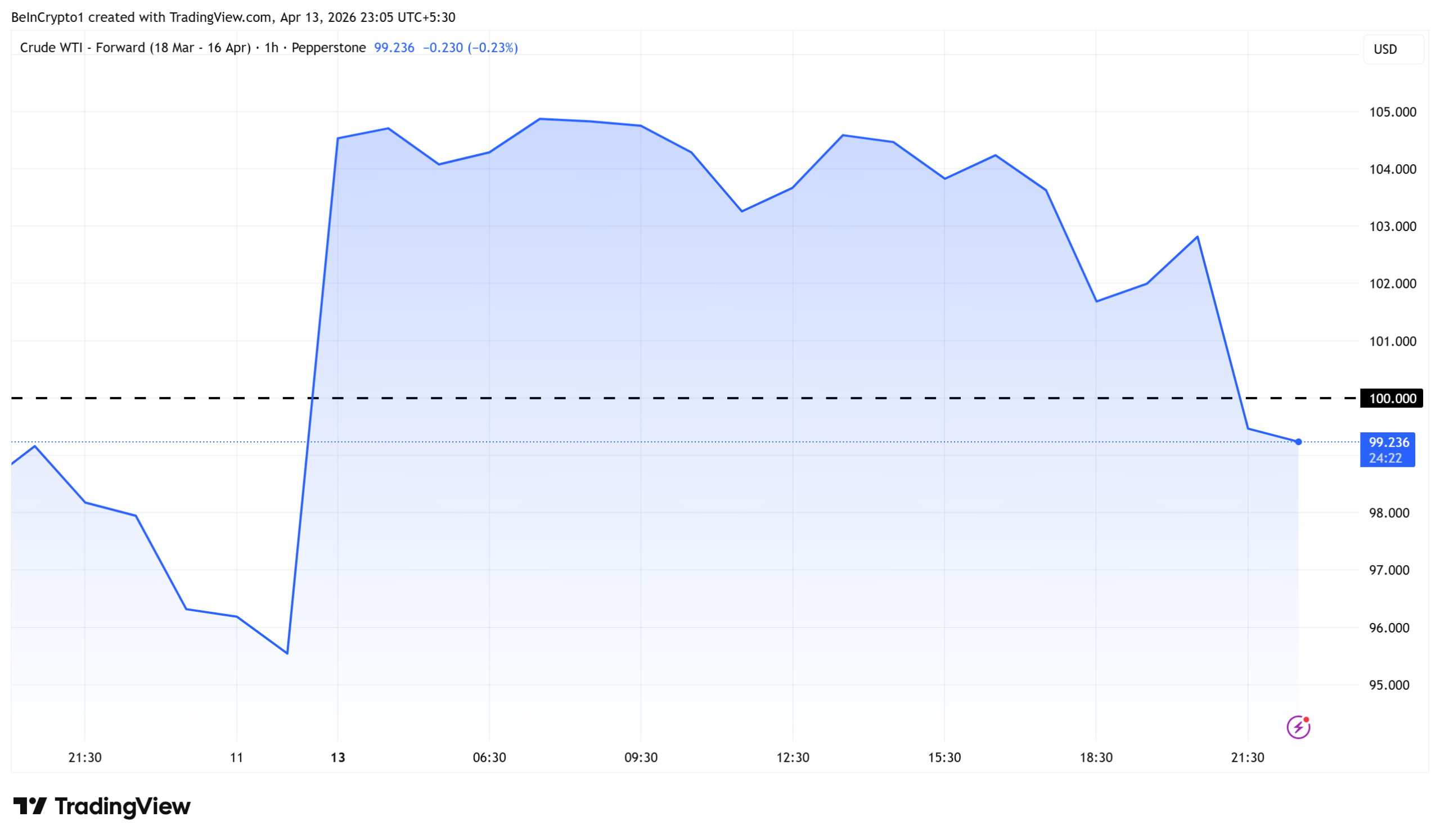
US oil prices fell back below $100 per barrel on Monday after a volatile session, reversing gains that pushed crude above $104 earlier in the day.
The sharp pullback came as China’s Defense Minister Admiral Dong Jun signaled that Chinese vessels would continue transiting the Strait of Hormuz under existing agreements with Iran.
China Challenges US Naval Blockade
Admiral Dong Jun delivered a pointed message to the Trump administration and the US Navy. He confirmed that Chinese ships are actively moving through the Strait of Hormuz and that Beijing will honor its trade and energy agreements with Tehran.
“Iran controls the Strait of Hormuz and it is open for us,” the Hormuz Letter reported, citing Admiral Dong Jun.
The statement reframes the standoff. What began as a bilateral US-Iran confrontation now involves a direct challenge from the world’s second-largest economy.
Analysts noted the repricing in oil markets reflects traders reassessing the blockade’s effectiveness now that China has entered the frame.
Notably, the US blockade of Iran affects China’s interests, as China is Iran’s largest oil export destination.
Trump Sets New April 27 Deadline
Speaking from the Oval Office, President Trump issued a fresh two-week ultimatum to Iran. He warned the situation “won’t be pleasant” if Tehran fails to reach a deal by April 27.
The deadline follows the collapse of US-Iran talks in Islamabad on April 12, which prompted Washington to declare a full naval blockade of the strait.
Brent crude had jumped more than 8% to above $103 following that announcement before reversing.
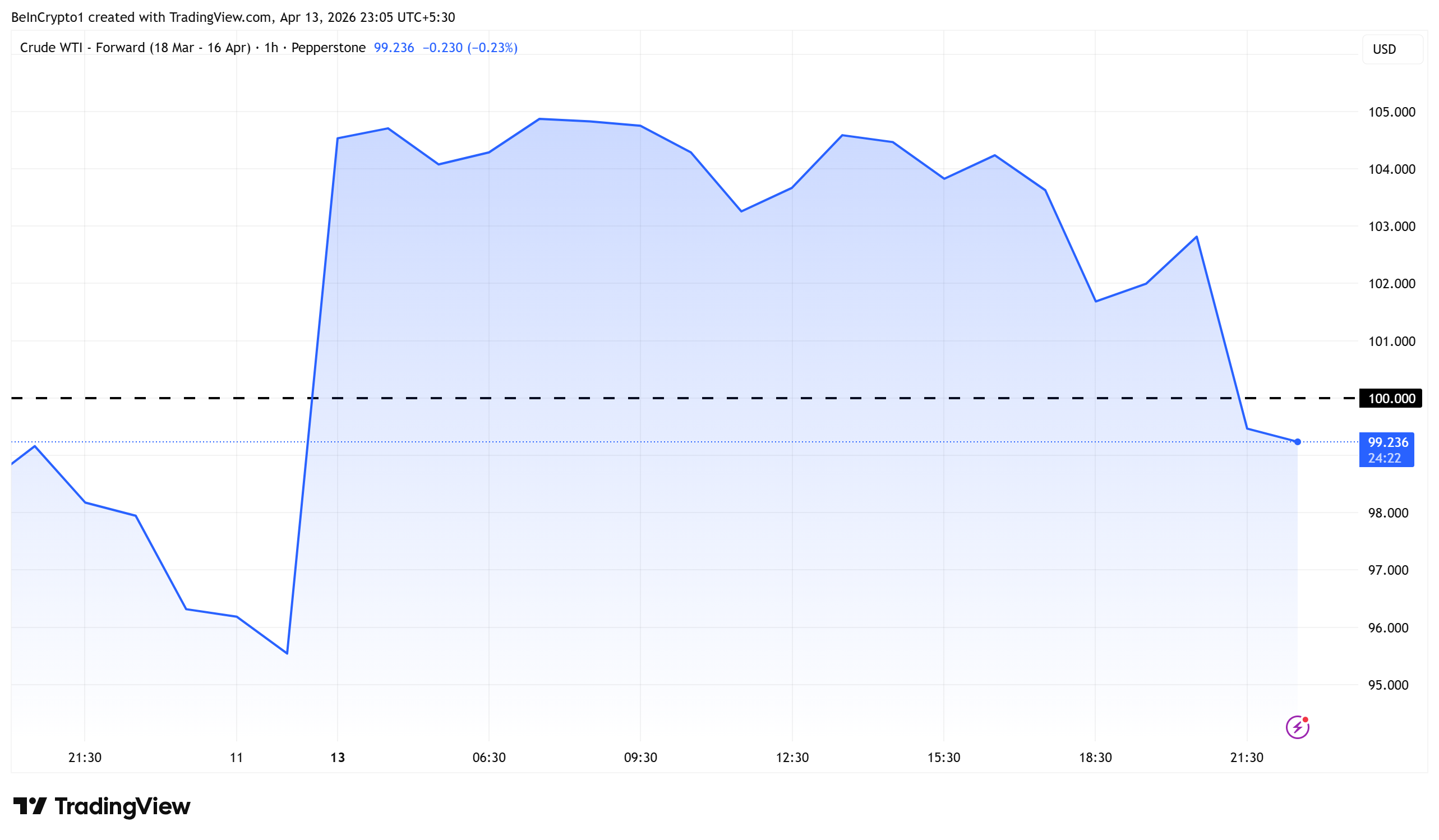
Markets now face a new variable. China’s willingness to test the blockade could determine whether oil stabilizes or enters another leg higher as the April 27 deadline approaches.
However, reports suggest that a tanker bound for China forced to turn back under the U.S. blockade.
“I believe the US intends to use this opportunity to pressure China to help urge Iran to reach an agreement, although this action is not specifically targeted at China,” one user commented.
The post Oil Price Slides Below $100 as China Defies US Hormuz Blockade appeared first on BeInCrypto.

Five arrested for fuel thefts, robbery and weapons after police chase drink driver in Co Tyrone

A New Age of Governance

UK Far-Right Leader Nigel Farage Buys Over $2 Million in Bitcoin


-

 Politics3 days ago
US brings back mandatory military draft registration
-

 Fashion3 days ago
Weekend Open Thread: Veronica Beard
-
 Sports3 days ago
Man United discover Nico Schlotterbeck transfer fee as defender reaches Dortmund agreement
-

 Tech6 days ago
How Long Can You Drive With Expired Registration? What Florida Law Says
-

 Politics1 day ago
World Cup exit makes Italy enter crisis mode
-

 Crypto World4 days ago
Canary Capital Files SEC Registration for PEPE ETF
-

 Business3 days ago
Tesla Model Y Tops China Auto Sales in March 2026 With 39,827 Registrations, Beating Cheaper EVs and Gas Cars
-

 Politics4 days ago
Malcolm In The Middle OG Turned Down ‘Buckets Of Money’ To Appear In Reboot
-

 Crypto World5 days ago
Bitcoin recovers as US and Iran Agree a Ceasefire Deal
-

 Fashion6 days ago
Let’s Discuss: DEI in 2026
-
 NewsBeat21 hours ago
Pep Guardiola and Gary Neville agree over Arsenal title problem that benefits Man City
-

 Business3 days ago
OpenAI Halts Stargate UK Data Centre Project Over Energy Costs and Copyright Row
-

 Business2 days ago
Ireland Fuel Protests Enter Day 5 as Blockades Spark Shortages and Government Prepares Support Package
-

 Crypto World1 hour ago
The SEC Conditionalises DeFi Platforms to Be Avoided for Broker Registration
-

 Politics4 days ago
LBC Presenter Mocks Trump Over Iran War Failures
-

 Crypto World3 days ago
Federal judge blocks Arizona from bringing criminal charges against Kalshi
-

 Tech4 days ago
A version of Windows 10 released a decade ago is now eligible for additional security patches
-
 NewsBeat2 days ago
JD Vance announces ‘no agreement’ with Iran over nuclear weapons fear
-

 Business3 days ago
IMF retains floor for precautionary balances at SDR 20 billion
-
Business3 days ago
Coreweave CSO Venturo sells $5.5m in class a common stock
You must be logged in to post a comment Login