

Crypto World
Aave Unveils Aave Shield After $50M Token Swap Mishap


Decentralized finance protocol Aave is moving to tighten protections after a dramatic interaction on the CoW Swap interface led to a roughly $50 million loss in a single trade. The proposed safeguard, still described as a forthcoming feature, aims to cap price impact on swaps executed through Aave’s own interface, reflecting ongoing concerns about liquidity fragmentation and the risks that automated market-making can pose in stressed markets. The incident centered on a trader who attempted to swap about $50.4 million worth of USDt for Aave’s native token through CoW Swap but received only around $36,500 of the token, underscoring the fragility of routing in an illiquid environment. A substantial portion of the loss was magnified by a Maximal Extractable Value bot that executed a sandwich sequence, capturing nearly $10 million in the process.
Key takeaways
- Aave plans to deploy a feature called Aave Shield that blocks swaps with a price impact above 25% when using the Aave interface, addressing a recent large-value trade failure.
- The high-stakes trade involved converting USDt for AAVE via CoW Swap, where liquidity gaps produced a final payout of only a fraction of the intended amount, illustrating liquidity fragmentation concerns.
- A MEV bot executed a sandwich attack in the same event, contributing roughly $10 million to the total loss and highlighting incentive structures that attackers leverage in DeFi trades.
- A user reportedly saw multiple warnings on the platform, including notes that a route might return less due to low liquidity or small order size, and explicitly confirmed a potential 100% value loss before finalizing the swap.
- CoW DAO attributed the extreme price impact to liquidity deficiencies and several infrastructure failures, including an outdated gas limit that hindered better-priced quotes.
Tickers mentioned: $AAVE, $USDT
Price impact: Negative — the trade exceeded a 25% price-improvement threshold, contributing to a loss of about $50 million and underscoring liquidity-driven risk in cross-exchange routing.
Market context: The episode underscores ongoing fragility in DeFi trading infrastructure amid liquidity fragmentation, MEV-driven risks, and the need for clearer risk disclosures and guardrails as users navigate multiple on-chain venues.
Why it matters
In decentralized finance, liquidity is the lifeblood that enables large swaps to execute without slippage. When liquidity pockets are thin or misaligned, even sophisticated routing engines can deliver outcomes far from the expected fair value, especially on trades of tens of millions of dollars. The Aave Shield proposal signals a shift toward user protections that don’t necessarily rely on post-trade refunds or off-chain interventions. By setting a 25% price-impact guardrail, the protocol aims to prevent users from unintentionally triggering extreme slippage, a feature that could reduce the likelihood of catastrophic outcomes in high-volume trades conducted on Aave’s interface.
The incident also spotlights the persistent incentives for attackers within DeFi ecosystems. A MEV bot earned an estimated $10 million through a sandwich attack tied to the same trade, illustrating how opportunistic front-running and optimization strategies can exploit routing inefficiencies. This reality reinforces the argument that security and risk controls in DeFi must address both the mechanics of on-chain order execution and the broader economic incentives that shape mempool activity and liquidity provisioning. For builders and investors, the event emphasizes the value of robust monitoring, greater transparency around routing logic, and the potential benefits of standardized safeguards that reduce the chance of outsized losses in complex transactions.
CoW DAO’s assessment adds nuance to the discussion by pointing to infrastructure gaps, not just liquidity depth. It noted that an outdated gas limit in a solver used by CoW Swap hindered better-priced quotes from being submitted, leaving users with inferior options. A possible mempool leak was also discussed as a contributing factor to the outsized quote that informed the loss. The joint acknowledgment from Aave and CoW DAO that “not all issues are fully resolved” underscores the collaborative path ahead—fixes, audits, and perhaps new safeguards—needed to improve resilience in cross-ecosystem swaps that lean on multiple on-chain participants.
As the ecosystem matures, projects that overlap between lending protocols and decentralized exchanges increasingly rely on layered protections. Aave Shield, if implemented as described, would add a proactive defense rather than a reactive one, potentially reducing users’ exposure to price impact during volatile periods. The broader takeaway is that users must remain vigilant about routing expectations, price impact disclosures, and the liquidity conditions of the venues they choose for substantial trades. The episode serves as a litmus test for how DeFi platforms balance safety features with user autonomy, especially when dealing with high-value, cross-chain liquidity movements.
What to watch next
- Deployment timeline for Aave Shield and its configurable toggle, with a focus on whether it will be opt-in by default and how users can adjust risk settings.
- Formal updates from Aave and CoW DAO detailing findings from the incident and any roadmap shifts for liquidity provisioning, solver updates, or mempool protections.
- Any governance actions or community discussions about routing heuristics, price impact thresholds, and UX warnings on swap interfaces.
- Further investigations into MEV defense mechanisms and whether new protections integrate with CoW Swap’s routing logic or other DEX aggregators.
- Monitoring of liquidity depth changes across major stablecoins and DeFi venues during periods of market stress to gauge resilience improvements.
Sources & verification
Aave Shield aims to curb high-impact swaps after a $50 million loss
Aave Shield is designed to block swaps with a price impact above a defined threshold for trades conducted via the Aave interface. The feature, described in a post-mortem by the team, represents an attempt to introduce a guardrail before trades are signed, reducing the likelihood that users are exposed to extreme slippage in low-liquidity scenarios. The proposed guardrail is anchored to a 25% price impact limit and would be activated automatically for standard route options, with the option for users to disable Shield if they accept higher risk channels. The incident that prompted the plan involved a trader who moved USDt to AAVE on CoW Swap and encountered a dramatic discrepancy between expected and actual takedown values, highlighting how quickly liquidity conditions can shift in high-value trades.
The interaction underscores a broader challenge for DeFi—balancing user freedom with protective barriers that do not stifle legitimate, sophisticated trading strategies. While shield features cannot eliminate all forms of risk, they can help prevent traders from signing away too much value in a moment of liquidity stress, potentially safeguarding both retail and institutional participants. The ongoing collaboration between Aave and CoW DAO signals an intent to address root causes—ranging from liquidity provisioning to on-chain quote accuracy and gas-limit governance—that contribute to extreme price disclosures in real-world trades.
As the ecosystem continues to adapt, the industry will watch closely how these protections perform in live markets, especially during periods of volatility. If Aave Shield proves effective, it could set a precedent for more proactive risk controls across DeFi interfaces, encouraging exchanges and aggregators to refine their pricing models and warning systems. For users, the episode reinforces the importance of reading on-screen risk disclosures, understanding the consequences of high-impact routes, and considering the broader liquidity landscape when executing multi-million-dollar swaps.

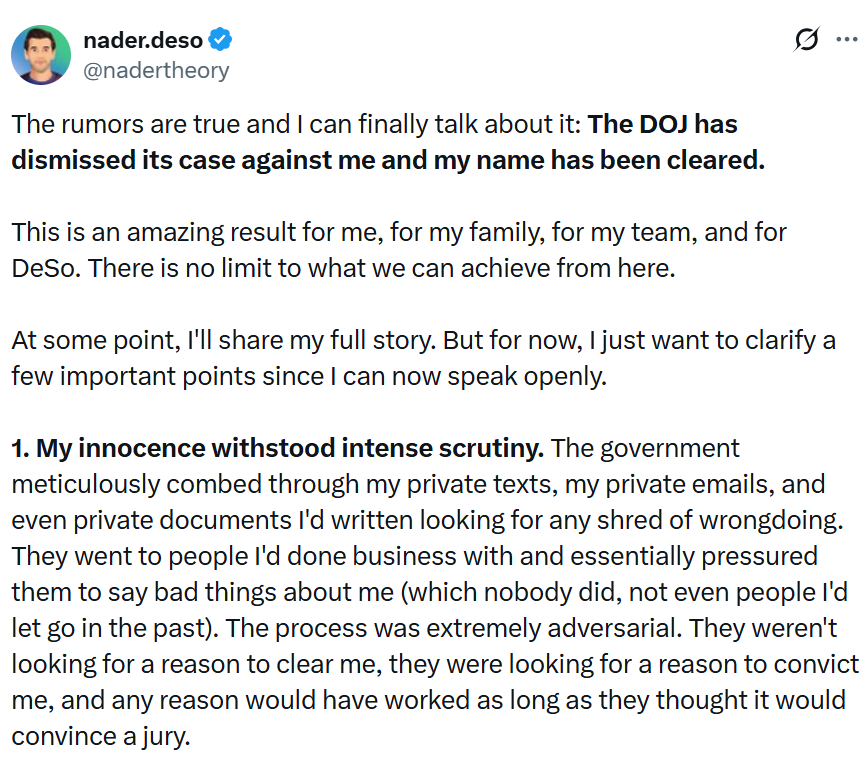
The US Securities and Exchange Commission (SEC) has dropped its two-year-long case against the founder of the blockchain-based social media platform BitClout, Nader Al-Naji.
In the joint dismissal stipulation filed in the US District Court for the Southern District of New York last Thursday, the SEC cited the crypto task force, which was tasked with developing a regulatory framework for crypto in January 2025, and a “reassessment of the evidentiary record” as the basis for dismissal.
However, the regulator cautioned in a statement that this case outcome doesn’t necessarily mean other similar enforcement actions will receive the same treatment.
“The Commission’s decision to exercise its discretion and seek dismissal of this litigation is based on the particular facts and circumstances of this case and does not necessarily reflect the Commission’s position on any other case,” it said.
Cointelegraph has contacted the SEC and the DeSo blockchain, where Al-Naji leads the foundation, for comment.
Accusations included spending money on a mansion
Al-Naji is a former Google engineer, the founder of the Basis protocol and creator of the DeSo blockchain. He founded BitClout and launched it publicly in March 2021.
The SEC’s July 2024 complaint accused Al-Naji of raising more than $257 million by selling the native token of the BitClout platform, BTCLT, while telling investors the funds wouldn’t be used to pay any BitClout team members.
Al-Naji was also accused of spending more than $7 million on personal items, including rent for a Beverly Hills mansion and cash gifts to family members, and also mischaracterizing the inner workings of the platform as decentralized, with no governing company controlling it, despite allegedly running the project behind the scenes himself.
As part of the settlement, Al-Naji has waived any claims for reimbursement of legal fees or expenses against the SEC. The regulator has dismissed the case with prejudice, meaning it can’t bring another case against Al-Naji or the relief defendants mentioned, including his mother, wife, and several companies under his control, again using the same charges.
The Department of Justice also ended a separate case accusing Al-Naji of wire fraud in February 2025 without prejudice. Al-Naji said in an X post at the time the case was dismissed because the government’s case didn’t hold up under scrutiny.

Under the Trump administration, the SEC has slowly been walking back its hardline stance toward crypto firms, dismissing a growing number of enforcement actions against crypto firms.
Magazine: Spot Bitcoin ETFs first green week, crypto ATM losses surge 33%: Hodler’s Digest, Mar. 8 – 14

Decentralized finance has already transformed how people trade, lend, and earn yield. But the next evolution isn’t just new protocols or better liquidity — it’s autonomous intelligence.
AI agents are emerging as a powerful layer on top of DeFi, capable of monitoring markets, executing trades, managing risk, and optimizing strategies in real time. Instead of manually chasing opportunities across dozens of protocols, traders are increasingly relying on intelligent systems that operate 24/7.
And this shift could fundamentally change how DeFi markets work.
From Manual Trading to Autonomous Strategies
Today, most DeFi trading is still highly manual.
Traders:
-
Track prices across multiple chains
-
Watch liquidity pools and funding rates
-
Execute trades manually or with basic bots
-
Constantly adjust strategies
Even experienced traders struggle to keep up with the speed of on-chain markets.
AI agents remove that bottleneck.
Instead of reacting to market changes, AI systems can continuously monitor data, detect patterns, and act instantly.
This turns trading from a manual process into an automated intelligence layer.
What Exactly Is an AI Agent in DeFi?
An AI agent is a self-operating program that analyzes information, makes decisions, and executes transactions on-chain.
In the context of DeFi trading, an AI agent can:
-
Scan multiple blockchains for opportunities
-
Monitor liquidity changes in real time
-
Execute arbitrage trades
-
Rebalance portfolios
-
Manage risk exposure
-
Adapt strategies based on market conditions
Think of it as a personal trading desk that never sleeps.
Instead of clicking buttons on dashboards, traders deploy agents that execute strategies autonomously.
Why AI Is a Perfect Fit for DeFi
DeFi markets produce enormous amounts of real-time data.
Every block includes:
-
trades
-
liquidity updates
-
lending positions
-
liquidations
-
Oracle price changes
This data-rich environment is ideal for machine learning models.
AI agents can analyze thousands of on-chain signals simultaneously, something human traders simply cannot do.
The result is faster decision-making and more efficient capital deployment.
The Rise of AI-Powered Trading Infrastructure
A new generation of platforms is emerging that allows users to deploy AI trading strategies directly on-chain.
These systems typically combine:
-
on-chain execution
-
off-chain machine learning models
-
automated risk management
-
cross-chain liquidity access
Instead of building complex bots from scratch, traders can plug into infrastructure that handles execution, monitoring, and optimization automatically.
This dramatically lowers the barrier to advanced trading strategies.
Autonomous Yield Optimization
One of the biggest advantages of AI agents is dynamic yield optimization.
In DeFi, yield opportunities constantly change:
AI agents can continuously move capital between opportunities to maximize returns.
Rather than manually repositioning funds every few hours or days, an AI system can rebalance in seconds.
Over time, this can significantly improve capital efficiency.
AI Agents and Risk Management
Risk management is one of the hardest parts of DeFi trading.
Smart contracts can fail. Liquidity can vanish. Prices can move violently.
AI agents can help mitigate these risks by:
-
monitoring volatility conditions
-
adjusting leverage dynamically
-
Closing positions when risk thresholds are reached
-
diversifying capital across protocols
Instead of relying on static rules, AI-driven systems can adapt as market conditions evolve.
Cross-Chain Trading Will Become Seamless
Another major advantage of AI agents is their ability to operate across multiple ecosystems simultaneously.
DeFi liquidity is fragmented across chains like:
-
Ethereum
-
Solana
-
Arbitrum
-
Base
-
Cosmos ecosystems
For humans, managing positions across these networks is complicated and time-consuming.
AI agents can treat the entire multi-chain landscape as one unified market.
This opens the door for sophisticated strategies such as:
The Future: Autonomous DeFi Markets
As AI agents become more widespread, DeFi markets themselves may evolve.
We could see:
-
fully autonomous trading vaults
-
AI-managed liquidity pools
-
algorithmic hedge funds running entirely on-chain
-
collaborative networks of AI agents optimizing liquidity across ecosystems
In this future, human traders set high-level strategies while AI handles the execution.
DeFi becomes less about dashboards and manual clicks, and more about deploying intelligent capital.
Final Thoughts
AI agents represent one of the most powerful upgrades DeFi has seen since automated market makers.
By combining real-time blockchain data with autonomous decision-making, these systems can dramatically improve trading efficiency, risk management, and yield generation.
The traders who thrive in the next phase of DeFi won’t necessarily be the fastest clickers or the most active on dashboards.
They’ll be the ones who know how to deploy intelligent agents to trade for them.
And that shift is only just beginning.
REQUEST AN ARTICLE
An Australian Senate committee has backed proposed legislation to integrate cryptocurrency platforms and custody providers into the country’s financial services framework.
The Senate Economics Legislation Committee said in a report published Monday that the proposed Corporations Amendment (Digital Assets Framework) Bill 2025 would modernize digital-asset oversight with traditional market safeguards to protect consumers.
The framework seeks to establish a licensing and compliance system for digital token managers by amending the Corporations Act 2001 and the Australian Securities and Investments Commission Act 2001.
The proposal targets firms that hold digital assets on behalf of customers, bringing them under existing financial services rules instead of attempting to regulate the underlying blockchain infrastructure. Should the measure become law, firms without an AFSL would be given six months to obtain the required authorization and comply with the new framework.
Crypto exchanges operating in Australia are already required to register with the country’s financial intelligence agency, the Australian Transaction Reports and Analysis Centre, as digital currency providers before offering exchange services.
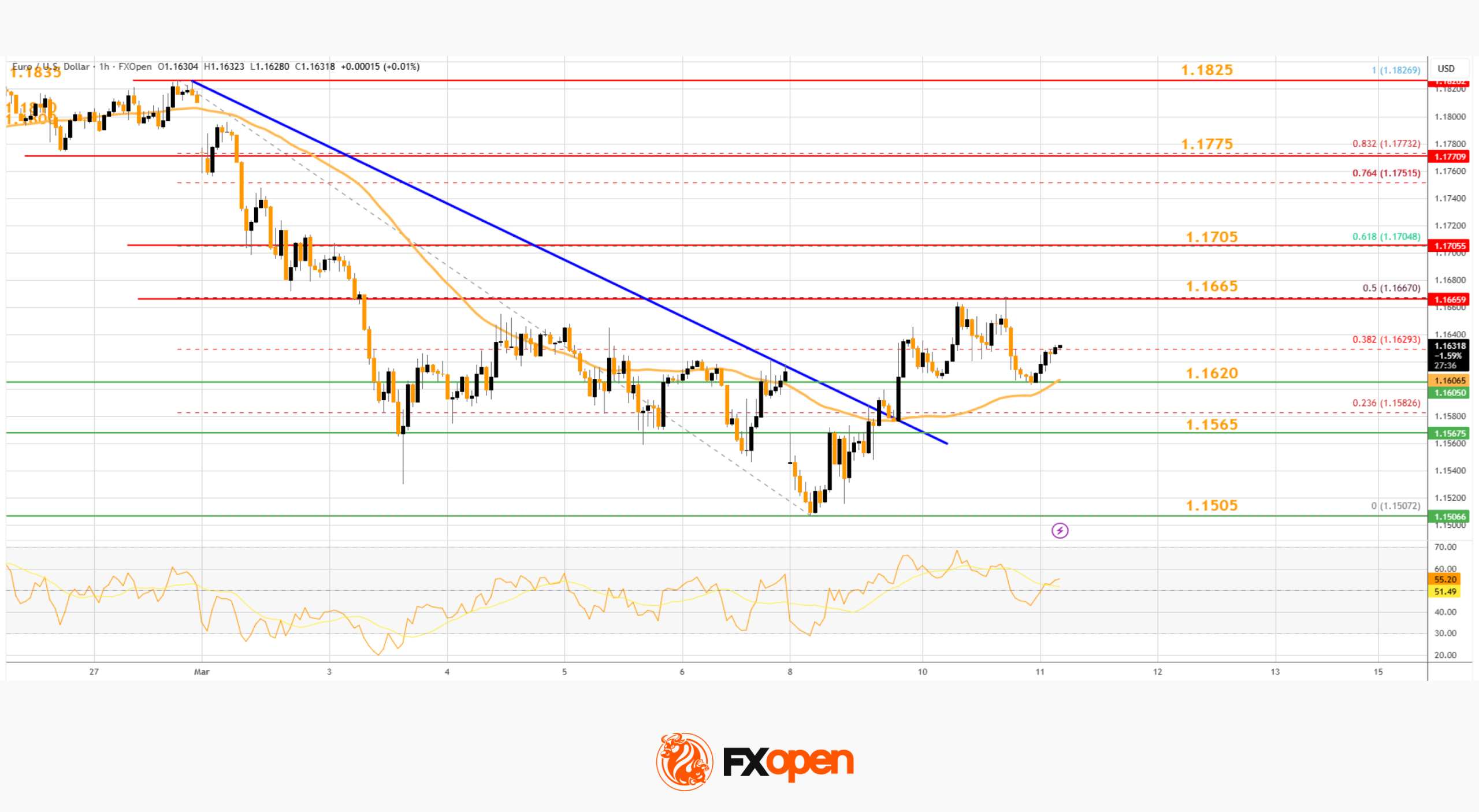
EUR/USD is recovering losses from 1.1500. USD/JPY is correcting gains from 159.00 and might decline further if it stays below 158.30.
Important Takeaways for EUR/USD and USD/JPY Analysis Today
· The Euro struggled to stay in a positive zone and declined below 1.1700 before finding support.
· There was a break above a connecting bearish trend line with resistance at 1.1580 on the hourly chart of EUR/USD at FXOpen.
· USD/JPY started a decent increase above 157.00 before the bears appeared near 158.90.
· There is a key contracting triangle forming with resistance near 158.30 on the hourly chart at FXOpen.
EUR/USD Technical Analysis
On the hourly chart of EUR/USD at FXOpen, the pair started a fresh decline from 1.1825. The Euro declined below 1.1750 and 1.1700 against the US Dollar.
The pair even declined below 1.1665 and the 50-hour simple moving average. Finally, it tested the 1.1500 zone. A low was formed at 1.1507, and the pair is now recovering losses. There was a move above 1.1550 and a connecting bearish trend line at 1.1580.
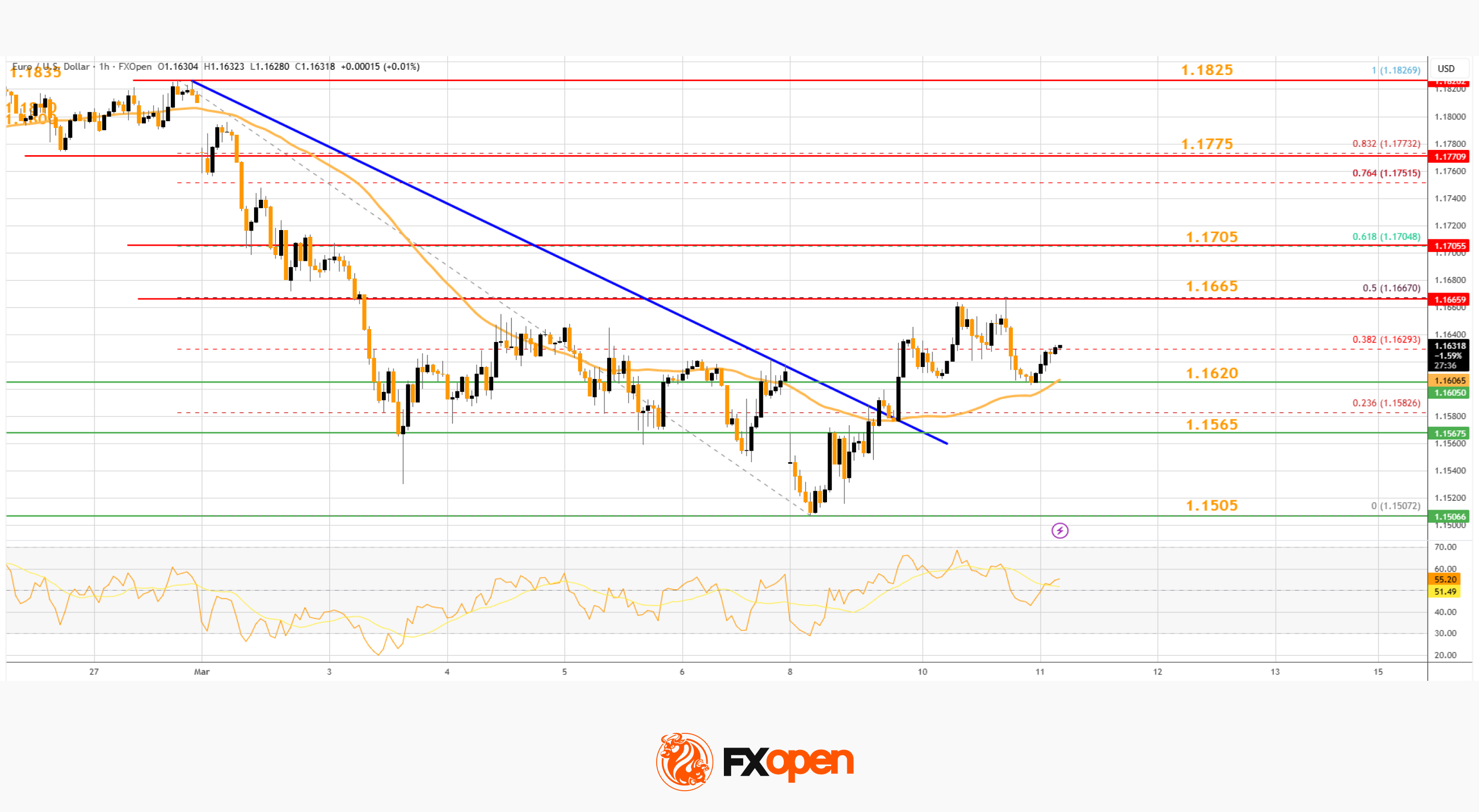
The pair surpassed the 38.2% Fib retracement level of the downward move from the 1.1826 swing high to the 1.1507 low. On the upside, the pair is now facing resistance near the 50% Fib retracement at 1.1665.
The first major hurdle for the bulls could be 1.1705. An upside break above 1.1705 could set the pace for another increase. In the stated case, the pair might rise toward 1.1775.
If not, the pair might drop again. Immediate support is near the 50-hour simple moving average and 1.1620. The next key area of interest might be 1.1565. If there is a downside break below 1.1565, the pair could drop toward 1.1505. The main target for the bears on the EUR/USD chart could be 1.1440, below which the pair could start a major decline.
USD/JPY Technical Analysis
On the hourly chart of USD/JPY at FXOpen, the pair gained pace for a move above 157.00 and 158.00. The US Dollar even traded close to 159.00 against the Japanese Yen before the bears emerged.
A high was formed at 158.90 before there was a downside correction. The pair dipped below 158.00 and the 50% Fib retracement level of the upward move from the 156.45 swing low to the 158.90 high. However, the bulls were active above 157.00 and they protected the 61.8% Fib retracement.
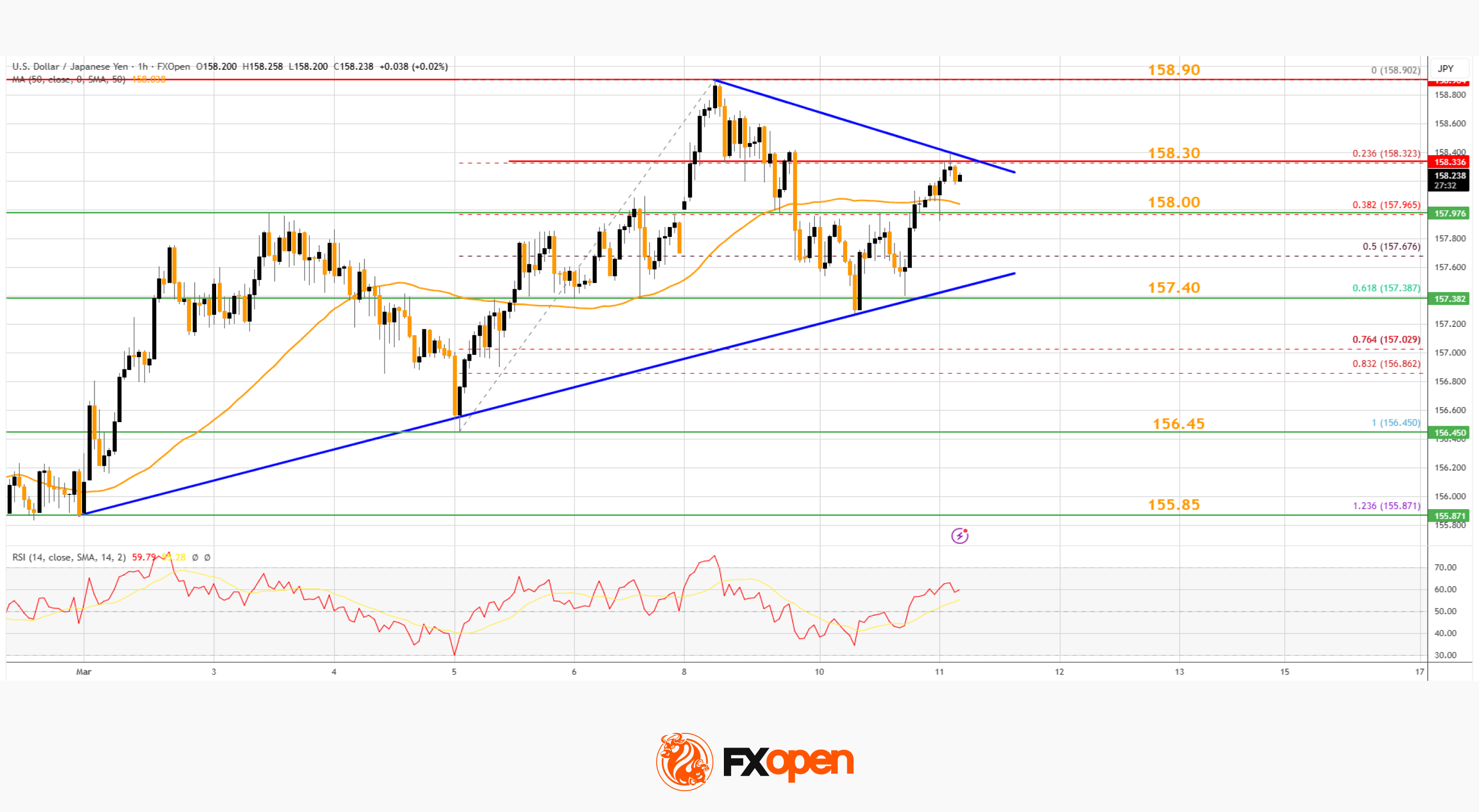
The pair is back above the 50-hour simple moving average and 158.00. Immediate resistance on the USD/JPY chart is near 158.30. There is also a key contracting triangle at 158.30.
If there is a close above the triangle and the hourly RSI moves above 65, the pair could rise toward 158.90. The next major barrier for the bulls could be 159.25, above which the pair could test 160.00 in the near term.
On the downside, the first major support is near 158.00. The next key region for the bulls might be 157.40. If there is a close below 157.40, the pair could decline steadily. In the stated case, the pair might drop toward 156.45. Any more losses might send the pair toward 155.85.
Trade over 50 forex markets 24 hours a day with FXOpen. Take advantage of low commissions, deep liquidity, and spreads from 0.0 pips (additional fees may apply). Open your FXOpen account now or learn more about trading forex with FXOpen.
This article represents the opinion of the Companies operating under the FXOpen brand only. It is not to be construed as an offer, solicitation, or recommendation with respect to products and services provided by the Companies operating under the FXOpen brand, nor is it to be considered financial advice.
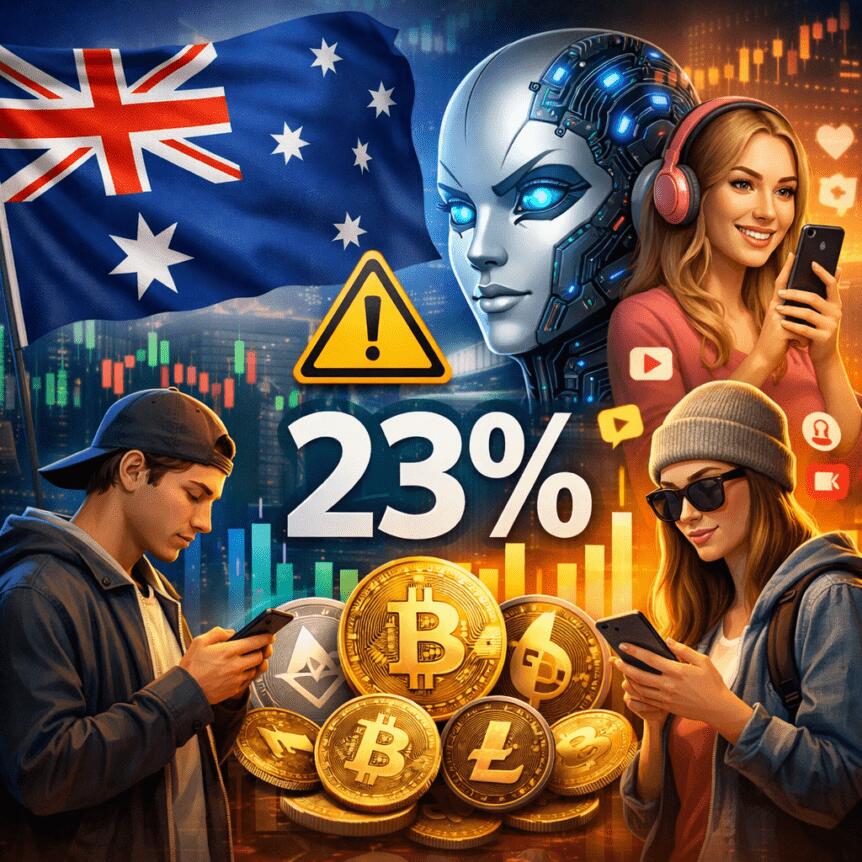
Australia’s financial regulator has published findings from a Gen Z money mindset study, highlighting how social media and artificial intelligence are shaping young investors’ approaches to money. The Australian Securities and Investments Commission (ASIC) released the results of a survey conducted between Nov. 28 and Dec. 10 last year, involving 1,127 respondents aged 18–28. The study shows that roughly one in four Gen Z individuals in Australia now invest in cryptocurrency, and while there is a strong appetite for credible, trustworthy financial content, many struggle to locate it amid engagement-first material. Regulators warn that marketing on social platforms can push people toward riskier investments and, in some cases, toward scams. posted.
The regulator’s findings come as ASIC outlined a cautious stance toward crypto marketing and the broader financial-advice ecosystem. The survey reveals a generation that craves reliable content but often lands on sources built for engagement rather than accuracy. ASIC Commissioner Alan Kirkland highlighted that some marketing activity on social media is specifically designed to drive investments, and a portion of it promotes activity that could expose young Australians to scams. He warned that the volatility of crypto investments is not always understood by those advertising or encouraging participation, particularly when the audience is spread across a developed but complex financial landscape. issuing warning notices to 18 influencers for unlawfully promoting high-risk financial products and providing unlicensed financial advice is a sign of the regulator’s willingness to take action against misleading campaigns.
The survey, which included respondents aged 18–28, found that 63% rely on social media for financial information and guidance, 18% use artificial intelligence (AI) platforms, and 30% turn to YouTube as a source for financial content. On trust, the results show a nuanced picture: 56% of Gen Z say they somewhat or fully trust financial information found on social media, and 52% say the same about “finfluencers”—those online personalities who cover finance and investments. AI, however, stands out as the most trusted source among Zoomers, with 64% expressing trust in AI-enabled financial information.
ASIC calls for caution on crypto influencers
The study also shows a notable crypto footprint among Gen Z in Australia, with 23% reporting ownership of cryptocurrency. Among those who own crypto, 29% trade based on content from social media or influencer posts, a dynamic that prompted regulatory caution. The regulator has warned that influencers may set unrealistic expectations about investment returns, market volatility, and the realities of long-term investing. The findings reinforce concerns about how promotional content can shape risk perceptions and trading behavior in a sector that remains volatile and is subject to evolving regulatory scrutiny.
Speaking with the Australian Financial Review (AFR) on Sunday, ASIC Commissioner Alan Kirkland underscored the risk that marketing activity on social platforms can steer consumers toward risky crypto investments and even scams. “We’re conscious that there’s a lot of marketing activity on social media to encourage crypto investment, and our work has shown some of it is actually encouraging people to invest in scams,” he said. “It’s really important for people to be aware of those risks, because you don’t see that same volatility in other types of investments and often that volatility is driven by forces that it’s impossible for an individual sitting in Australia to understand.”
Kirkland also flagged Australian superannuation funds—the country’s $4.5 trillion retirement pool—as an area where unqualified influencers may be offering inappropriate investment guidance. “We see it most where people are lured in through social media ads and then encouraged to switch their super, because super is often people’s most valuable asset, and that’s why disreputable people often target it and why it can be so tragic if people are encouraged to put it into a risky investment,” he said.
ASIC has AI financial advice in its crosshairs
The regulator also said it is watching closely how AI tools generate financial information. Licensing requirements apply where a source is giving financial advice or making product-specific recommendations based on an individual’s circumstances. “Under Australian law, if any entity is giving financial advice, they need to be licensed. So if an AI tool, whoever’s providing it, is actually making recommendations about individual financial products, taking into account individual circumstances, that would be personal advice, so it needs to be licensed,” Kirkland noted.
Industry observers have noted that some crypto exchanges have begun integrating AI-based guidance features for customers. Platforms such as MEXC, KuCoin and Bitget have introduced AI-assisted options to accompany trading services, signaling regulators’ interest in how digital-asset markets are combining advisory capabilities with automated decision-making.
“One of the most surprising findings from this research was the degree of trust young people are placing in AI platforms,” Kirkland said, adding that the usefulness of AI depends on the specificity of questions and the quality of sources AI can draw on to provide results. The regulator’s concerns extend beyond AI itself, as evidenced by the ongoing focus on licensing requirements for those delivering financial guidance, including AI-driven advice.
ASIC’s stance on AI financial advice is set against a broader regulatory backdrop. In January, the agency signaled that crypto and AI firms exploiting licensing gaps around payments in Australia would be a top priority in 2026. The regulator’s crosshairs are not limited to platforms or influencers but extend to the legal framework that governs how digital financial products are marketed and advised upon.
The Gen Z study illuminates how a generation that grows up with social media and AI navigates risk and opportunity in a rapidly evolving financial landscape. As ASIC continues to monitor marketing practices and the deployment of AI tools in financial services, stakeholders—from investors to platform operators—will be watching closely to see how policy adapts to new behavioral realities in the digital economy.
Why it matters
First, the findings underscore a critical consumer-protection challenge: young investors actively turn to social media and AI for guidance, often without access to robust, independent sources. The potential for misinformation, exaggerated returns, or misaligned risk underscores the need for credible educational resources and transparent disclosures in fintech marketing. Regulators’ emphasis on licensing for AI-driven advice signals a move toward more formal accountability, reducing the likelihood that automated recommendations operate outside established compliance frameworks.
Second, the study highlights the evolving risk landscape around crypto participation among younger demographics. With 23% of Gen Z reporting crypto ownership and 29% of them trading as a result of influencer content, the regulatory focus on finfluencers and marketing practices gains renewed urgency. This is particularly salient as the Australian market approaches broader financial-technology innovations and digital asset service providers push deeper into mainstream finance.
Finally, the integration of AI bots by crypto and fintech platforms is prompting regulators to rethink the boundaries between information and advice. The balance between innovation and consumer protection will likely shape future licensing, disclosure, and advertising standards. In Australia, that balance currently hinges on whether AI-driven guidance crosses into personalized financial advice, a threshold that triggers licensing requirements and stricter oversight.
What to watch next
- ASIC’s ongoing monitoring of social-media marketing for financial products and potential enforcement actions against misleading campaigns.
- Any new guidance or licensing requirements addressing AI-based financial advice and tools that tailor recommendations to individuals.
- Regulatory scrutiny of crypto and fintech platforms deploying AI-based trading guidance or “trading partners.”
- Regulatory priorities in 2026 around payments licensing and licensing expectations for AI-enabled financial services.
Sources & verification
- Australian Securities and Investments Commission, Gen Z and money advice study — 26-049mr: https://www.asic.gov.au/about-asic/news-centre/find-a-media-release/2026-releases/26-049mr-asic-urges-gen-z-to-sense-check-money-advice-as-social-media-fuels-riskier-financial-decisions/
- Australian Financial Review interview with ASIC Commissioner Alan Kirkland on Gen Z and AI trust: https://www.afr.com/wealth/personal-finance/gen-z-puts-trust-in-ai-for-financial-advice-asic-says-don-t-20260311-p5o9iy
- ASIC cracks down on unlawful finfluencers in global push against misconduct: https://www.asic.gov.au/about-asic/news-centre/news-items/asic-cracks-down-on-unlawful-finfluencers-in-global-push-against-misconduct/
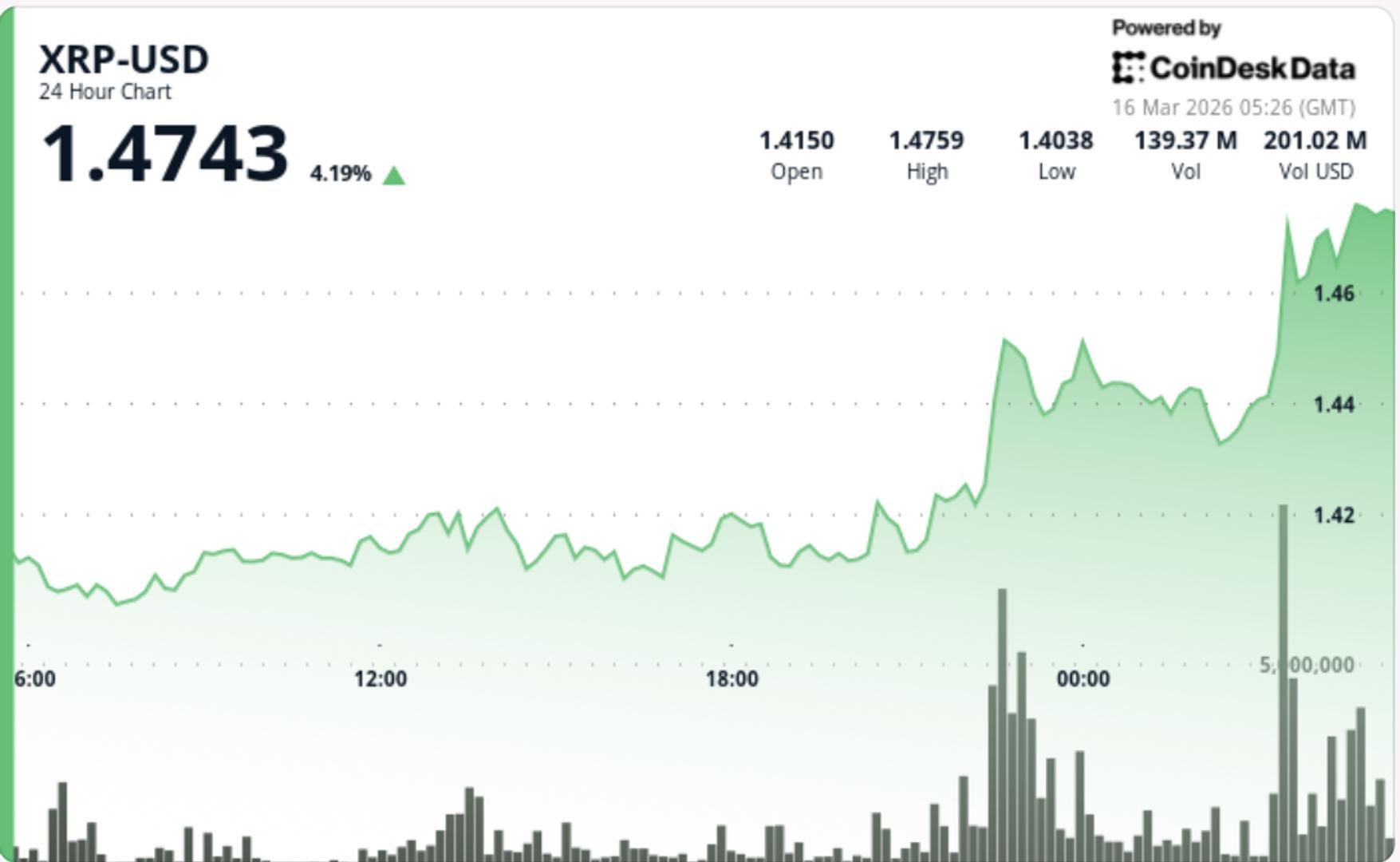
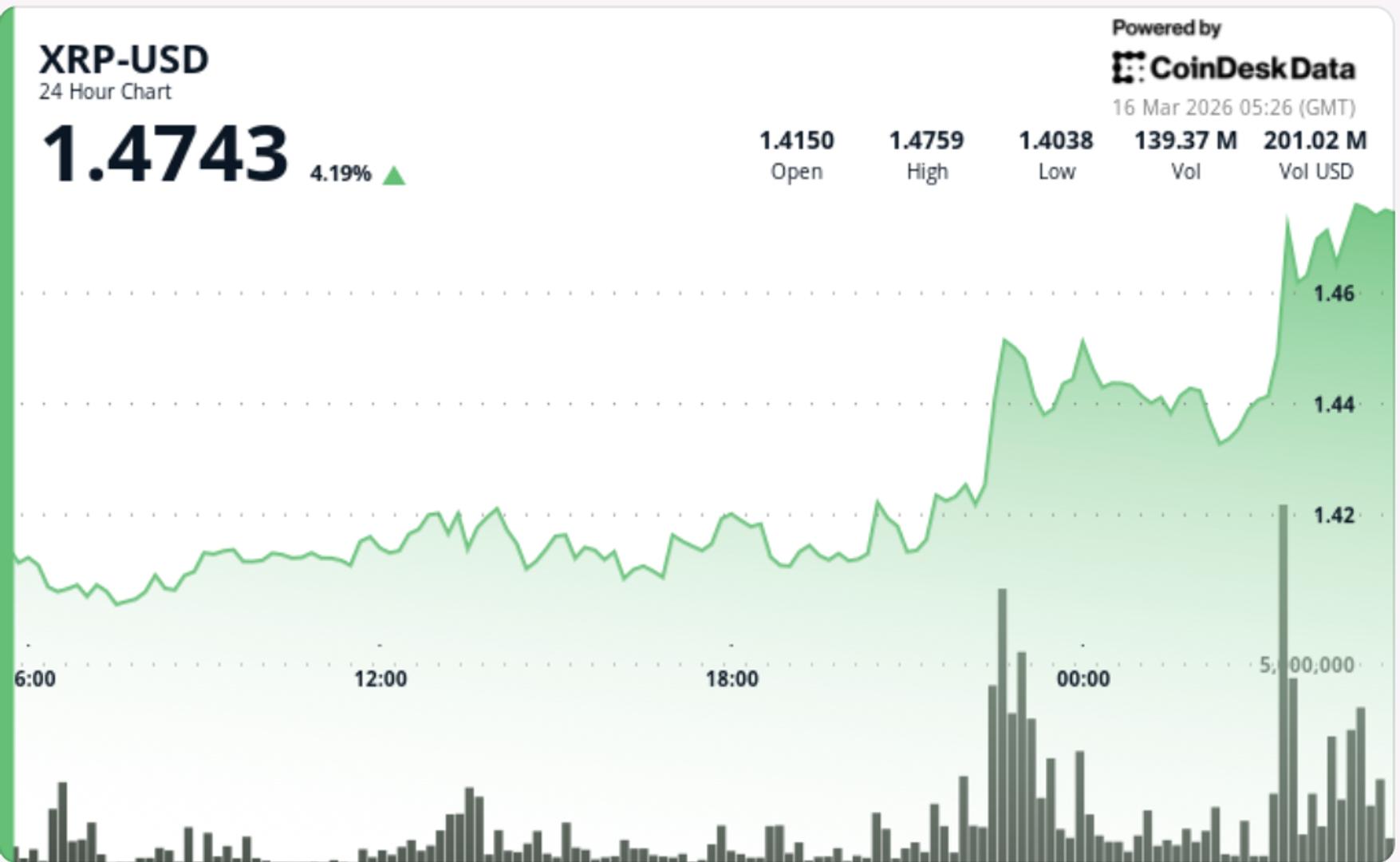
XRP pushed higher after clearing a key resistance level, extending a breakout from a multi-month consolidation range.
News Background
- XRP’s latest move comes after several months of sideways trading, where the token repeatedly failed to sustain rallies above the mid-$1.40 area.
- The breakout marks the first clear move above that ceiling since early 2026, shifting short-term momentum toward buyers.
- While the price advance lacked a clear XRP-specific catalyst, activity on the XRP Ledger has continued to rise.
- Tokenized real-world assets on the network recently climbed sharply, with the value of tokenized commodities approaching $1.14 billion during the first quarter.
Price Action Summary
- XRP rose from about $1.41 to $1.47 during the latest 24-hour session
- The token broke through the $1.426 resistance zone that capped previous rallies
- Trading volume spiked to roughly 170 million tokens during the breakout
- XRP traded within a roughly 5% intraday range
Technical Analysis
The key development was the breakout above $1.426, which had acted as a ceiling throughout recent consolidation. Once the level cleared on strong volume, price accelerated quickly toward the $1.47 area.
Short-term charts show a sequence of higher lows forming after the breakout, suggesting buyers are attempting to turn the former resistance zone into support.
Momentum remains constructive while XRP holds above roughly $1.43. The next technical barrier sits near the $1.48–$1.50 area, where previous rallies have stalled.
What traders say is next?
Traders are now focused on whether XRP can maintain support above the $1.43–$1.44 breakout level.
If that zone holds, the token could extend the move toward $1.50 and potentially the $1.55 region as momentum builds.
However, a drop back below $1.43 would weaken the breakout and could pull XRP back toward the previous consolidation range near $1.39–$1.40.
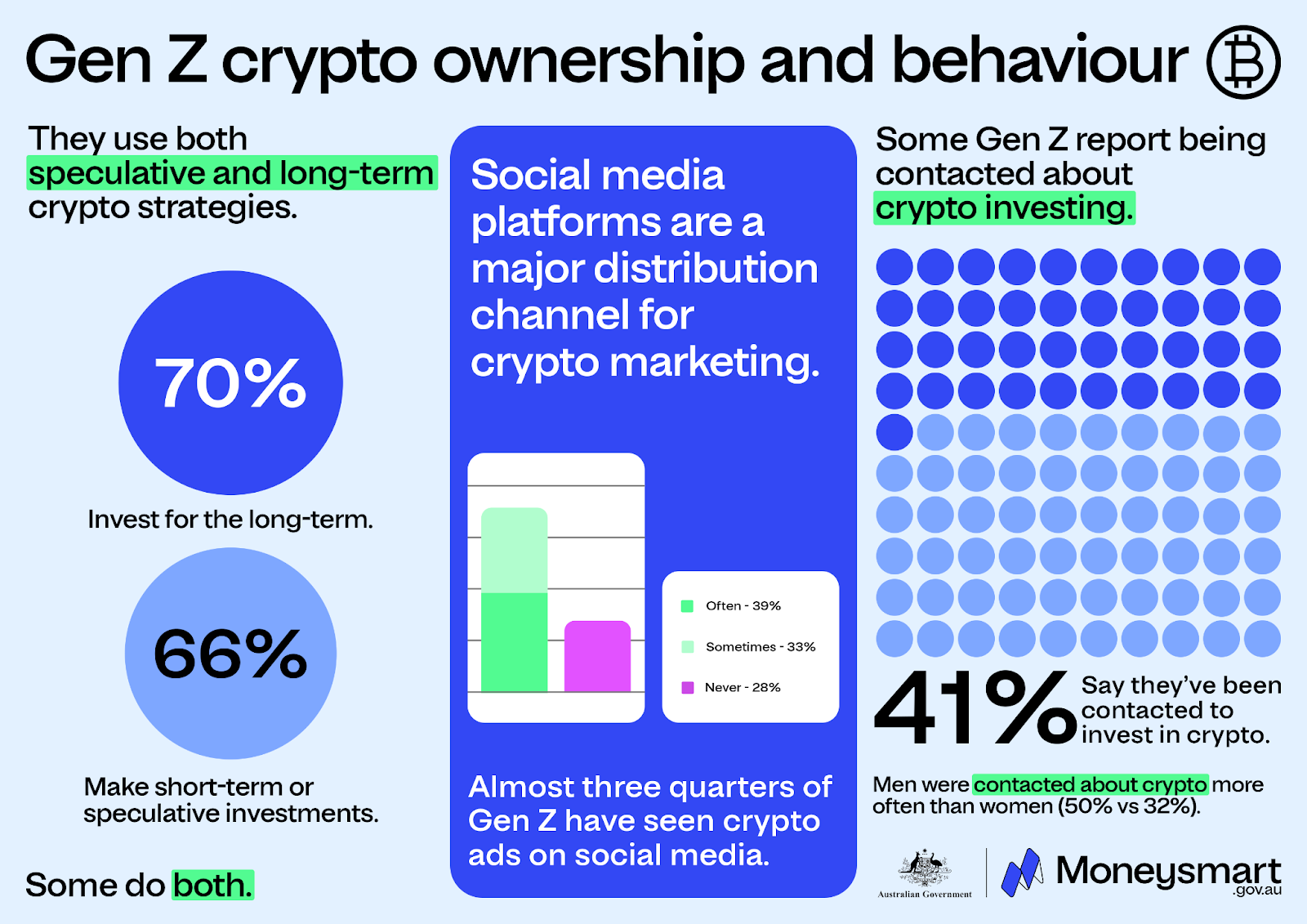
Australia’s financial regulator has urged young investors not to rely on social media influencers and artificial intelligence chatbots to make financial decisions, according to a study that also found that one in four “Gen Zs” invest in crypto.
The Australian Securities and Investments Commission (ASIC) posted the results of a survey on Sunday, finding that Gen Z has high levels of trust in “often unreliable sources,” which has contributed to riskier financial decisions.
“Moneysmart’s Gen Z study found that while Gen Z has a strong appetite for reputable and trustworthy financial content, many struggle to find it – and their search often leads them to sources designed for engagement rather than accuracy,” said ASIC.
ASIC took action against influencers over their financial social media content last year in June, issuing warning notices to 18 influencers “suspected of unlawfully promoting high-risk financial products and providing unlicensed financial advice.”
The latest survey, conducted between Nov. 28 and Dec. 10 last year with 1,127 respondents between 18 and 28, found that 63% of the group uses social media for financial information and guidance, while 18% use artificial intelligence (AI) platforms and 30% said they use YouTube specifically.
It also found that 56% of Gen Z say they “somewhat or completely trust” financial information on social media, with 52% saying the same of “finfluencers” — social media influencers primarily covering financial or investment niches who appear well-versed in finance.
AI, however, was the most trustworthy among Zoomers, at 64%.
ASIC calls for caution on crypto influencers
The survey also showed that 23% of Gen Z now own crypto in Australia, with 29% of these trading based on social media and influencer content, prompting a warning that influencers may “set unrealistic expectations” about investment returns, market volatility, and the intricacies of long-term investing.

Speaking with the Australian Financial Review (AFR) on Sunday, ASIC commissioner Alan Kirkland said the regulator has been keeping an eye on marketing activity designed to drive people to make investments, noting some of them are scams.
“We’re conscious that there’s a lot of marketing activity on social media to encourage crypto investment, and our work has shown some that is actually encouraging people to invest in scams,” Kirkland said.
“It’s really important for people to be aware of those risks, because you don’t see that same volatility in other types of investments and often that volatility is driven by forces that it’s impossible for an individual sitting in Australia to understand,” he added.
Kirkland also flagged Australian superannuation funds — a $4.5 trillion market made of retirement funds — as an area in which unqualified influencers are offering advice.
“We see it most where people are lured in through social media ads and then encouraged to switch their super, because super is often people’s most valuable asset, and that’s why disreputable people often target it and why it can be so tragic if people are encouraged to put it into a risky investment,” he said.
ASIC has AI financial advice in its crosshairs
Kirkland also told the AFR that ASIC is “watching very closely” what types of financial information are being derived from AI tools. The commissioner warned that licenses are required for anything that gives out information representing concrete financial recommendations.
“It is clear under Australian law that if any entity is giving financial advice, they need to be licensed. So if an AI tool, whoever’s providing it, is actually making recommendations about individual financial products, taking into account individual circumstances, that would be personal advice, so it needs to be licensed,” he said.
ASIC’s concerns come amid a number of crypto exchanges that have already integrated AI bots into their services to offer personalized trading guidance or “trading partners”, including the likes of MEXC, KuCoin and Bitget.
Related: Ripple targets April for Australian financial license via acquisition
“One of the most surprising findings from this research was the degree of trust young people are placing in AI platforms,” he said, adding:
“Depends very much on the nature of the questions you’re asking, how specific those questions are and the quality of the sources that AI is able to draw upon in order to serve us the results.”
AI financial information is not the only area ASIC is eyeing this year. In late January, the regulator warned that any crypto or AI firms exploiting licensing gray areas around payments in Australia will be one of its top priorities in 2026.
Magazine: Spot Bitcoin ETFs first green week, crypto ATM losses surge 33%: Hodler’s Digest, Mar. 8 – 14


Bitcoin broke through the $74,000 resistance zone that it had rejected four times in two weeks, and this time the move has more behind it than a short squeeze.
The largest cryptocurrency was trading just above $74,000 on Monday morning, up 2.9% over the past 24 hours and 9.7% on the week. Ether surged 7.7% in 24 hours and 14.3% on the week to $2,261, its strongest weekly performance in months. Solana jumped 5.6% on the day and 12% on the week to $93.
Dogecoin hit $0.10 for the first time since early March, up 4.6% daily and 10.6% weekly. BNB gained 3.8% to $683 with a 9.5% weekly gain. XRP rose 4.2% to $1.47, up 8.9% over seven days.
The catalyst was a shift in tone from multiple directions at once. Trump said the U.S. was talking to Iran, though Tehran denied requesting talks or a ceasefire. Iranian Foreign Minister Abbas Araghchi said the Strait of Hormuz was only closed to ships from “enemies,” a notable softening from the blanket closure that had been in effect.
Two tankers carrying liquefied petroleum gas to India sailed through the strait on Sunday, the first commercial transit since the war began.
Oil reflected the change in mood. Brent traded around $104 after earlier climbing as high as $106.50 following the Kharg Island strikes, but pulled back as the Hormuz headlines hit. WTI dropped below $100. The dollar weakened 0.3%. S&P 500 futures advanced 0.5%, set for their first gain in five days. MSCI’s global equity gauge stabilized after three days of declines.
For crypto, the combination of easing oil, a weaker dollar, and even a hint of de-escalation is the exact macro cocktail that loosens the liquidity chain that has been choking risk assets since the war began.
The weekly numbers are the most impressive since before the war. Bitcoin’s 9.7% gain is strong but the altcoin outperformance is the signal that risk appetite is genuinely returning. When ether outperforms bitcoin by 4.6 percentage points and solana outperforms by 2.3 points on a weekly basis, capital is rotating down the risk curve rather than hiding in bitcoin.
The Fed meeting on March 17-18 arrives with different context than it had a week ago.
Oil is still elevated but the Strait of Hormuz showing signs of reopening changes the inflation calculus. The dot plot and Powell’s press conference on Wednesday will determine whether the market’s rate cut hopes survive or get crushed.


World Liberty Financial (WLFI) holders who want a chance to steer the protocol’s future will now need to lock up their tokens for nearly six months under a newly passed proposal.
The proposal from the Trump family-backed crypto venture closed on Friday with 99.12% of 1,800 votes cast in favor, according to the snapshot governance vote. Over 76% of the tokens came from ten users.
WLFI said the proposal was to ensure only those with “long-term alignment to the protocol” can make decisions on the protocol.
It also entices stakers with a 2% annual percentage yield on their staked tokens if they participate in at least two governance votes during the lock-up period. Users with already-locked tokens are unaffected and can continue voting as usual.
Low voter turnout has been a recurring issue across decentralized autonomous organizations (DAOs), with some estimates suggesting average participation rates between 15% and 25%.
Ethereum co-founder Vitalik Buterin suggested in February that AI personal assistants could help DAO members vote and increase participation, while Stani Kulechov, the founder of decentralized lending platform Aave has suggested scaling back token holders’ votes in favor of more input from leadership. The latest WLFI proposal offers a different approach to the issue.
Super nodes gain “direct access” to WLFI team
One part of the proposal also suggests that those staking 50 WLFI million tokens, worth about $5 million, could get “guaranteed direct access” to the WLFI team for collaboration opportunities.
The WLFI “Gold Paper” lists US President Donald Trump’s sons, Eric and Baron, as co-founders and part of the team “supporting the WLF commitment.” Steven Witkoff’s sons, Zach and Alex, are also named as co-founders.
However, WLFI spokesman David Wachsman reportedly told Reuters on Sunday that the preferential access is to the business development team and executives, not to specific founders, and in a separate statement, said that it also does not guarantee partnership.
WLFI seeks bank charter and to support US dollar
WLFI investors could see an eventful few years ahead.
WLFI is seeking to build a crypto-enabled financial ecosystem centered around its stablecoin, USD1, while also supporting other Defi applications and stablecoins that “seek to preserve the US Dollar’s status”, according to its “Gold Paper.”
Related: WLFI proposes governance staking system and USD1 usage incentives
In January, the project applied to the Office of the Comptroller of the Currency for a national trust bank charter to expand the use of USD1, but is still waiting for a decision. It has also launched rewards programs and partnerships with institutional platforms and other protocols to increase USD1 adoption.
CEO Zach Witkoff has teased tokenization efforts around assets such as real estate and oil and gas, while the project is also exploring the creation of a publicly traded company to hold its WLFI tokens.
The WLFI Gold Paper promises holders the “right to vote on certain WLF Protocol matters.”
So far, WLFI has completed six snapshot votes. Past proposals included using unlocked WLFI tokens to help grow the project’s stablecoin, USD1, and to make the governance token tradable.
Magazine: Bitcoin may take 7 years to upgrade to post-quantum — BIP-360 co-author


Bitcoin’s price has risen past its key average for the first time in two months, signaling strengthening bullish momentum.
The cryptocurrency’s price has gained over 3% to $73,700 in 24 hours, topping the 50-day moving average, which stood at $71,125 at the time of writing. The positive price action follows days of resilient performance amid the Iran war and global equity turmoil, especially in Asian markets.
The so-called 50-day moving average is one of the most widely tracked momentum indicators in the market, which analysts recently cited as one of the formidable resistance levels holding back gains.
“This indicator often signals the medium-term trend, and a confident break above it would be an important turning point in the coming days,” Alex Kuptsikevich, senior market analyst at FxPro, said in an email.
Note, however, that the bullish breakout doesn’t necessarily promise a sustained uptrend. For instance, the previous one in early January was followed by an 8% price rise, but the momentum lasted just two weeks before selling resumed. Previous instances have delivered mixed results as well.
For now, the breakout, points to a continued move higher and perhaps increased volatility as prices move closer to the $75,000 mark. This is the level where market makers – those ensuring a smooth trading experience by providing liquidity on an exchange – hold net short gamma positions worth billions, as CoinDesk noted Friday.
So, as prices rise toward $75,000, they are likely to buy high to rebalance their net exposure to neutral. This could add to market volatility.
Oscars host Conan O'Brien calls out show for cutting off winner's speech, retracting microphone

iGarden M1 Pro Max 100 Review: A Sports Car for Your Pool

Being XRP “RICH” Will Be VERY RARE! Mass Accumulation Will Be IMPOSSIBLE When XRP Hits $10! WAKE UP!

Smart energy pays enters the US market, targeting scalable financial infrastructure

Why Israel is blocking foreign journalists from entering

Bitcoin: We’re Entering The Most Dangerous Phase
Being XRP “RICH” Will Be VERY RARE! Mass Accumulation Will Be IMPOSSIBLE When XRP Hits $10! WAKE UP!

Not Just Another Personal Finance Video.

HUBUNGI WA 0857-7492-0549 #foryou #smartphone #giveawayyy #money #viral #automobile #funny #fyp
-
 Tech5 days ago
A 1,300-Pound NASA Spacecraft To Re-Enter Earth’s Atmosphere
-
 Crypto World2 days ago
HYPE Token Enters Net Deflation as HyperCore Buybacks Outpace Staking Rewards
-

 News Videos7 days ago
10th Algebra | Financial Planning | Question Bank Solution | Board Exam 2026
-

 Business6 days ago
ExxonMobil seeks to move corporate registration from New Jersey to Texas
-

 Crypto World7 days ago
Paradigm, a16z, Winklevoss Capital, Balaji Srinivasan among investors in ZODL
-

 Fashion3 days ago
Weekend Open Thread: Addict Lip Glow
-

 Tech6 days ago
ChatGPT will now generate interactive visuals to help you with math and science concepts
-
Sports2 days ago
Why Duke and Michigan Are Dead Even Entering Selection Sunday
-

 NewsBeat5 days ago
Residents reaction as Shildon murder probe enters second day
-

 Business5 days ago
Search Enters Sixth Week With New Leads in Tucson Abduction Case
-
 NewsBeat6 days ago
Pagazzi Lighting enters administration as 70 jobs lost and 11 stores close across Scotland
-

 Business12 hours ago
Search for Savannah Guthrie’s Mother Enters Seventh Week with No Arrests
-

 Tech7 days ago
Despite challenges, Ireland sixth in EU for board gender diversity
-

 Business2 days ago
US Airports Launch Donation Drives for Unpaid TSA Workers as Partial Government Shutdown Enters Fifth Week
-

 NewsBeat5 days ago
I Entered The Manosphere. Nothing Could Prepare Me For What I Found.
-
Crypto World2 days ago
Coinbase and Bybit in Investment Talks: Could Bybit Finally Enter the US Crypto Market?
-

 Business6 days ago
Search Enters 39th Day with FBI Tip Line Developments and No Major Breakthroughs
-

 Sports7 days ago
Skateboarding World Championships: Britain’s Sky Brown wins park gold
-

 Business2 days ago
Country star Brantley Gilbert enters growing non-alcoholic beer market
-

 Crypto World6 days ago
Will Chainlink price reclaim $10 amid volatility squeeze?

