

Crypto World
Adam Back’s SPAC merger with Cantor Equity Partners could come as soon as April



Undaunted by the plunge in bitcoin and the even worse price action for bitcoin treasury companies, Adam Back, the CEO of Bitcoin Standard Treasury Company (BSTR), says shareholder approval for a public listing could come as soon as April.
The public listing would come via a SPAC merger with Brandon Lutnick’s Cantor Equity Partners I (CEPO).
BSTR intends to debut with 30,000 bitcoin on its balance sheet. Of that total, 25,000 coins will be contributed by Back and other founding shareholders. A further 5,000 BTC will be contributed in-kind by early investors.
The merger plans were announced in the summer of 2025 amid a frenzy of hastily formed crypto treasury companies that hoped to mimic the success of Michael Saylor’s Strategy.
Since, though, the price of bitcoin has crashed to $63,000, and the performance of crypto treasury companies has been far worse, with many prominent ones vaporizing 90% or more of investor capital.
Speaking with CNBC on Monday, Back said a weaker bitcoin price could benefit BSTR ahead of its listing. Launching at a lower reference price would enable the company to accumulate more bitcoin at discounted levels, potentially strengthening its balance sheet and increasing long-term upside if market conditions improve.
Addressing bitcoin’s recent decline, Back noted that it occurred despite what he characterized as a favorable regulatory backdrop in the United States. He attributed the pullback to broader macroeconomic factors, including geopolitical tensions and tariff-related uncertainty, which have weighed on risk assets more broadly.
Back added that bitcoin treasury companies play a supportive role in the market. Their core strategy centers on acquiring and holding bitcoin, though he acknowledged that the pace of accumulation typically slows during bear markets. Ultimately, he said, bitcoin treasury companies are taking bitcoin off the market, which is a long-term bullish catalyst.



Bitwise Investments has acquired institutional staking provider Chorus One, offering clients access to more than 30 proof-of-stake networks.
Bitwise Investments has announced the acquisition of Chorus One, a leading provider of institutional staking services, marking an expansion in Bitwise’s staking capabilities and onchain offerings.
With more $15 billion in assets under management (AUM), Bitwise is known for its crypto index funds and has been broadening its offerings through its Bitwise Onchain Solutions (BOS) division. The acquisition of Chorus One, renowned for its cross-chain staking infrastructure, significantly boosts BOS’ capabilities in the staking domain. The move enhances Bitwise’s reach across over 30 proof-of-stake networks, according to a press release from Bitwise.
Chorus One’s expertise in providing staking services to institutions complements Bitwise’s existing offerings, allowing for a seamless integration that is set to enhance the overall service quality.
The institutional staking market has been experiencing rapid growth, with more institutions looking to participate in proof-of-stake networks. This trend is driven by the dual benefits of yield generation and contribution to network security, which are increasingly attractive to institutional investors seeking diversified returns.
“For our thousands of clients who hold spot crypto assets, staking is one of the most compelling growth opportunities. I’m thrilled about this acquisition and grateful to the Chorus One team for the trust placed in us. Chorus One is best-in-class across technology and research, with an eight-year track record of doing things the right way.” said Bitwise CEO Hunter Horsely.
This article was generated with the assistance of AI workflows.


Shares dropped after Citrini Research published a thought experiment, but the Kobeissi Letter argues the outlook may be too pessimistic.
Shares of major credit card companies fell on Monday, Feb. 23, after a thought experiment report from Citrini Research raised concerns about how artificial intelligence (AI) could change the payments industry – however, a separate note from The Kobeissi Letter pushed back, saying the disruption risks are overstated.
According to market data shared by Bearly AI in a post on X, Visa dropped about 4.4%, Mastercard fell 6.3%, American Express slid 7.9%, and Capital One declined roughly 8% on Feb. 23 after Citrini’s note was published on Feb. 22.
Notably, by Tuesday afternoon, shares were mostly steady or slightly higher. Visa was around $306, flat on the day, while Mastercard traded near $497, up about 0.5%. American Express was also little changed at $321, and Capital One rose about 4% to around $197.
The situation underscores how quickly viral narratives can move markets and how sensitive both stocks and crypto are to FUD (fear, uncertainty, and doubt). It also shows investors are still unsure how much AI will disrupt the industry.
AI Agent Payments
Citrini Research described a scenario in which AI programs make purchases on their own and seek the cheapest way to send money. In that case, stablecoins could replace credit cards for some transactions.
“What follows is a scenario, not a prediction,” the note emphasized. “This isn’t bear porn or AI doomer fan-fiction. The sole intent of this piece is modeling a scenario that’s been relatively underexplored.”
Meanwhile, in a separate note published last night, The Kobeissi Letter said the negative view assumes demand will not change. It argued that when technology makes things cheaper, people usually spend more. Lower-cost AI services could give consumers more buying power and help new businesses start.
“The doomsday scenario went viral because it captured something visceral,” The Kobeissi Letter note reads. “It framed AI not as a productivity tool, but as a macroeconomic destabilizer capable of triggering a negative feedback loop: layoffs lead to weaker consumption, weaker consumption leads to more automation, and automation accelerates layoffs.”
The memo said AI could also have a positive impact. While some companies may face pressure, lower costs could improve productivity and support economic growth over time. “AI amplifies outcomes. It can amplify fragility if institutions fail to adapt, and it can also amplify prosperity if productivity outpaces disruption,” the note reads.
The back-and-forth comes amid declines in some software and tech stocks following major AI announcements. For instance, shares of IBM plummeted about 13% on Monday, the stock’s steepest drop in more than 25 years.

TLDR
- Smarter Web secured a $30 million Bitcoin-backed credit facility from Coinbase Credit.
- The company stated that the facility will help it execute Bitcoin purchases faster after equity raises.
- Smarter Web confirmed that it will not use the credit line as long-term debt for Bitcoin accumulation.
- The firm reported holding 2,689 BTC, which is valued at about $170 million at current market prices.
- Tracker data shows that Smarter Web continued to increase its Bitcoin holdings after its 2025 disclosure.
Smarter Web opened a new phase in its treasury plan as it secured a $30 million Bitcoin-backed credit line, and the firm said the move will speed purchase timing after fundraises, and the structure will support rapid deployment during volatile sessions.
Credit Facility Details and Early 2026 Treasury Activity
The Smarter Web Company confirmed the new facility with Coinbase Credit and stated that the credit line is secured against Bitcoin held in custody with Coinbase. The firm said the facility helps it act quickly after equity raises and cuts timing risk during fast markets. The company stressed that it does not plan to use the structure as ongoing debt and intends to repay it once the funds clear.
Smarter Web trades on the London Stock Exchange Main Market and also trades on the OTCQB Venture Market in the United States. The firm describes Bitcoin as core to its treasury plan and continues to expand digital asset holdings. Data shows digital asset treasuries recorded billions in inflows from late 2025 through early 2026 before slowing in February.
DefiLlama data shows treasuries reached $4 billion in inflows during December and $3.7 billion in January. The figure reached $363 million through February 24 and stayed positive but below earlier peaks. The company cited these flows when noting its need for faster execution during market shifts.
Smarter Web Treasury Position and Sector Activity
Smarter Web reported holdings of 2,689 BTC with an average cost of $112,865 per coin. At current prices near $64,472, the position is valued at about $170 million. The firm said the book reflects an unrealized loss based on its reported cost basis and continues to track long-term plans.
The company reported 2,470 BTC on September 12, 2025, and called itself the largest corporate holder in the United Kingdom. It also mentioned interest in acquiring competitors and referenced future index ambitions. Tracker data indicates the company continued steady accumulation after that point.
The new credit line allows the firm to borrow against existing Bitcoin and act quickly after equity raises. The structure then allows repayment once fundraising proceeds settle.
The company said this approach helps reduce timing gaps during active sessions.
Strategy added 592 BTC on Monday and raised its total to 717,722 BTC. The company marked its 100th purchase since 2020 and maintained its accumulation pattern. Meanwhile, Bitdeer reported selling its entire treasury and shifted to a convertible debt raise while removing all corporate Bitcoin.
Jamie Dimon, chairman and CEO of JPMorgan Chase, attends the ribbon-cutting ceremony opening the firm’s new headquarters at 270 Park Ave., in New York, Oct. 21, 2025.
Eduardo Munoz | Reuters
JPMorgan Chase CEO Jamie Dimon said the bank is taking steps to address the impact of artificial intelligence on its workers, part of what he said should be a broader societal response to the potentially disruptive nature of AI.
Dimon described at an investor meeting late Monday his bank’s internal plans to shift employees into new roles as automation accelerates.
“We already have huge redeployment plans for [our] own people,” Dimon said. “In fact, we spoke about it today, and we have to up that a little bit so we can take people who are displaced — and we have displaced people from AI — and we offer them other jobs.”
JPMorgan, the world’s biggest bank by market cap, has the industry’s largest annual tech budget at nearly $20 billion. Its executives have outlined an ambitious agenda to become “fundamentally rewired” for the AI era.
Even at this early stage, the bank’s workforce provides a snapshot of what happens when corporations employ AI technology, including models from OpenAI and Anthropic, which are both used by JPMorgan’s AI portal.
The bank’s headcount was roughly unchanged at 318,512 over the past year, but there were changes below the surface: Operations and support staff fell by 4% and 2%, respectively, as the firm added 4% to roles that involve catering to clients and generating revenue.
It did that by using technology to boost the number of accounts that each operations employee can handle (up 6%), reducing the per-unit cost to deal with fraud (down 11%) and making their software engineers 10% more efficient, according to the bank’s presentation.
JPMorgan has doubled the use cases for generative AI this year, focusing on customer service and the firm’s technology workers, Chief Financial Officer Jeremy Barnum said at the investor meeting.
A JPMorgan spokeswoman declined to elaborate on Dimon’s comments about plans for redeployment.
Disruption risk
When an analyst on Monday asked if Dimon was concerned about the risk of widespread unemployment because of AI — one of several fears circulating as every AI model update seems to wallop the shares of public companies in recent weeks — Dimon had this response: “We are going to deploy AI as best we can to do a better job for our customers,” he said.
The CEO has previously likened the potential impact of AI to that of electricity or the printing press.
Beyond the “huge redeployment plans” for his bank, Dimon expressed concern that the rapid adoption of AI could put entire professions out of work.
As a thought experiment, what if autonomous trucks were introduced overnight, he asked.
“Would you do it if you put 2 million people on the street?” Dimon asked. “That next job is $25,000 a year, stocking shelves.”
Businesses and governments need to begin planning for this risk now, with ideas including assistance and training for displaced workers, he said.
“Society’s got to think through what it wants to do if this becomes that kind of problem,” Dimon said. “Now is the time to start thinking about it.”


Bitcoin’s on-chain signals have cooled after a run of elevated profitability and aggressive selling, suggesting a potential valuation reset rather than a definitive bottom. In the latest data reads, investor profitability has drifted back toward the long-run mean, while spot order flow shows signs of calmer unloading even as trading activity remains subdued. The interplay between valuation metrics and liquidity conditions is shaping expectations for when genuine spot demand could re-emerge and whether that would accompany a sustained trend reversal. Across the metrics, there is a defensively postured market rather than a clear pivot higher, at least for now.
Key takeaways
- Bitcoin’s market value to realized value (MVRV) has normalized after previously trading at extremes, signaling a shift back toward historical baselines rather than an overt undervaluation.
- Realized capitalization declined to about $1.09 trillion from a peak near $1.12 trillion in November 2025, reflecting roughly $33 billion in on-chain value leaving the network.
- Coins aged three to six months now represent 25.9% of the supply, the largest cohort in the dataset, indicating a substantial portion of holders purchased higher and are underwater on many positions.
- Spot cumulative volume delta (CVD) improved to -$161.5 million from -$177.1 million, while spot trading volume slipped to $6 billion from $7.6 billion, pointing to thinner participation and a more cautious posture among traders.
- Bitcoin has remained range-bound around $62,000–$64,000, suggesting supply absorption could pick up pace only if spot participation and risk appetite recover from current levels.
Tickers mentioned: $BTC
Sentiment: Neutral
Price impact: Neutral. On-chain signals suggest a balanced view rather than a clear, imminent move higher or lower.
Trading idea (Not Financial Advice): Hold. The combination of a mean-reverting valuation backdrop and thinner spot activity argues for patience until clearer demand signals emerge.
Market context: The data aligns with a broader phase of cautious liquidity in crypto markets, where on-chain metrics and macro- and risk-off sentiment influence how quickly fresh spot demand can materialize. While some coins’ outflows have stabilized, the absence of a decisive upshift in participation keeps near-term catalysts subdued.
Why it matters
The evolving on-chain picture matters because it reframes the risk-reward calculus for Bitcoin holders and potential entrants. A move back toward the long-run mean in MVRV implies that the market is not yet deeply undervalued, even as some segments of investors have capitulated in the sense of exiting positions near peak prices. The retrace in realized capitalization reinforces the notion that capital has been reallocated away from high-cost entrants, a behavior consistent with risk-off dynamics rather than aggressive accumulation.
From a supply-demand perspective, the aging cohort — coins held for three to six months — being the largest on record signals that much of the newly minted supply may be sitting underwater. That concentration creates a potential for a more pronounced impact if macro conditions or on-chain signals improve, but it also poses a risk: a wave of unprofitable sellers could re-emerge if price pressure intensifies. The literature around realized cap and MVRV suggests caution, as movements toward positive momentum have historically required renewed, broad-based demand rather than a few strong rallies.
On the liquidity side, the improvement in spot CVD alongside a drop in trading volume paints a portrait of restrained selling pressure rather than a sudden flood of buy orders. In prior cycles, periods where CVD tightened and price action stabilized often foreshadow a bottom, but only when participation recovers meaningfully. In this cycle, BTC has held within a relatively narrow corridor, which implies the market is digesting recent action rather than signaling an imminent breakout.
Analysts have pointed to a neutral-to-defensive posture in the current regime. The data does not indicate a forced capitulation, but it also stops short of confirming the onset of a sustainable upturn. The resulting stance mirrors a broader crypto market landscape where liquidity remains episodic, and traders await clearer macro cues and on-chain signals before reestablishing aggressive exposure.
In related analyses, researchers have flagged similar themes in other data points. For instance, discussions around excessive loss realization have highlighted potential pressure points that could push BTC below certain thresholds, while other research has underscored the possibility of a fair-value gap guiding price targets in different market environments. Taken together, these threads reinforce a cautious approach to near-term positioning until volatility and participation trends tilt decisively in favor of bulls.
What to watch next
- BTC price stability within the $62k–$64k range and any sustained breakout above or below these levels.
- Momentum in realized capitalization — whether the roughly $33 billion drawdown since November 2025 begins to reverse as new capital re-enters the market.
- The share of the supply held by the 3–6 month cohort and any shifts toward older or younger age bands, which could signal changing holder behavior.
- On-chain liquidity signals, particularly if spot volume begins to rebound from current lows and CVD moves toward positive territory.
- Any regulatory or institutional developments that could influence risk sentiment and bid/offer dynamics in spot markets.
Sources & verification
- On-chain profitability and MVRV normalization observations attributed to expert commentary on X, including excerpts from Chris Beamish.
- Realized capitalization levels and monthly change data tracked by on-chain analytics datasets (noting the $1.09 trillion level and the $33 billion decline from the November 2025 peak).
- Spot CVD and trading volume figures, including the move from -$177.1 million to -$161.5 million and the drop in spot volume from $7.6 billion to $6.0 billion.
- Analyses describing the distribution of coins by age, with the 3–6 month cohort comprising 25.9% of supply.
- Related studies and articles cited in the original material for context on potential price implications and fair-value considerations.
Bitcoin valuation indicators in focus
Bitcoin (CRYPTO: BTC) has been navigating a delicate balance between on-chain fundamentals and the psychology of risk markets. The normalization of MVRV away from extreme deviations suggests that investors are no longer chasing outsized upside with the same intensity as earlier in the cycle, while realized cap has cooled after peaking in late 2025. The 30-day realized cap is down about 2.26%, signaling that capital outflows have persisted, even as some long-term holders remain reluctant to surrender positions wholesale.
The market’s price behavior in the $62,000 to $64,000 zone has become a focal point. In many periods when CVD trends toward stability and the bid-ask dynamics thin out, price action tends to consolidate before the next leg — if there is one — depends on the injection of fresh demand. The current mix of data implies a neutral stance on near-term direction, with the potential for a more decisive move only if spot participation and new inflows pick up meaningfully.
These dynamics illuminate how market participants are weighing risk, returns, and capital preservation in an environment where on-chain signals can diverge from short-term price action. While the trajectory remains uncertain, the analytical framework suggests that bulls will need a sustained improvement in on-chain demand and liquidity to push BTC beyond a fresh milestone, beyond the immediate range that has defined recent trading sessions.
Terraform Labs is suing quantitative trading firm Jane Street for its role in the collapse of the Terra ecosystem.
Terraform Labs’ estate has filed a lawsuit against quantitative trading firm Jane Street, alleging that the firm abused insider knowledge to profit from Terra and that it inadvertently contributed to the downfall of the ecosystem.
“In this case, however, Jane Street Capital and its traders exploited the public’s participation in crypto markets and contributed to the collapse of Terraform’s cryptocurrency ecosystem. They did so by misappropriating confidential information and manipulating market prices,” the suit reads.
The filing is heavily redacted, but focuses on a move related to the UST Curve 3pool. Per Snyder, Terraform withdrew $150 million of UST from the pool, a move that “was not publicly announced,” to deploy it to 4pool in the coming week.
Nine minutes later, Jane Street allegedly made its “first and only sale of UST in that pool,” selling $85 million of UST in a single transaction.
Snyder says that the swap directly led to a steep selloff in UST that resulted in Terra’s subsequent death spiral, and accuses Jane Street of using its connections with Terraform Labs to “maximize its own profits and avoid losses suffered by other investors who did not have this confidential information.”
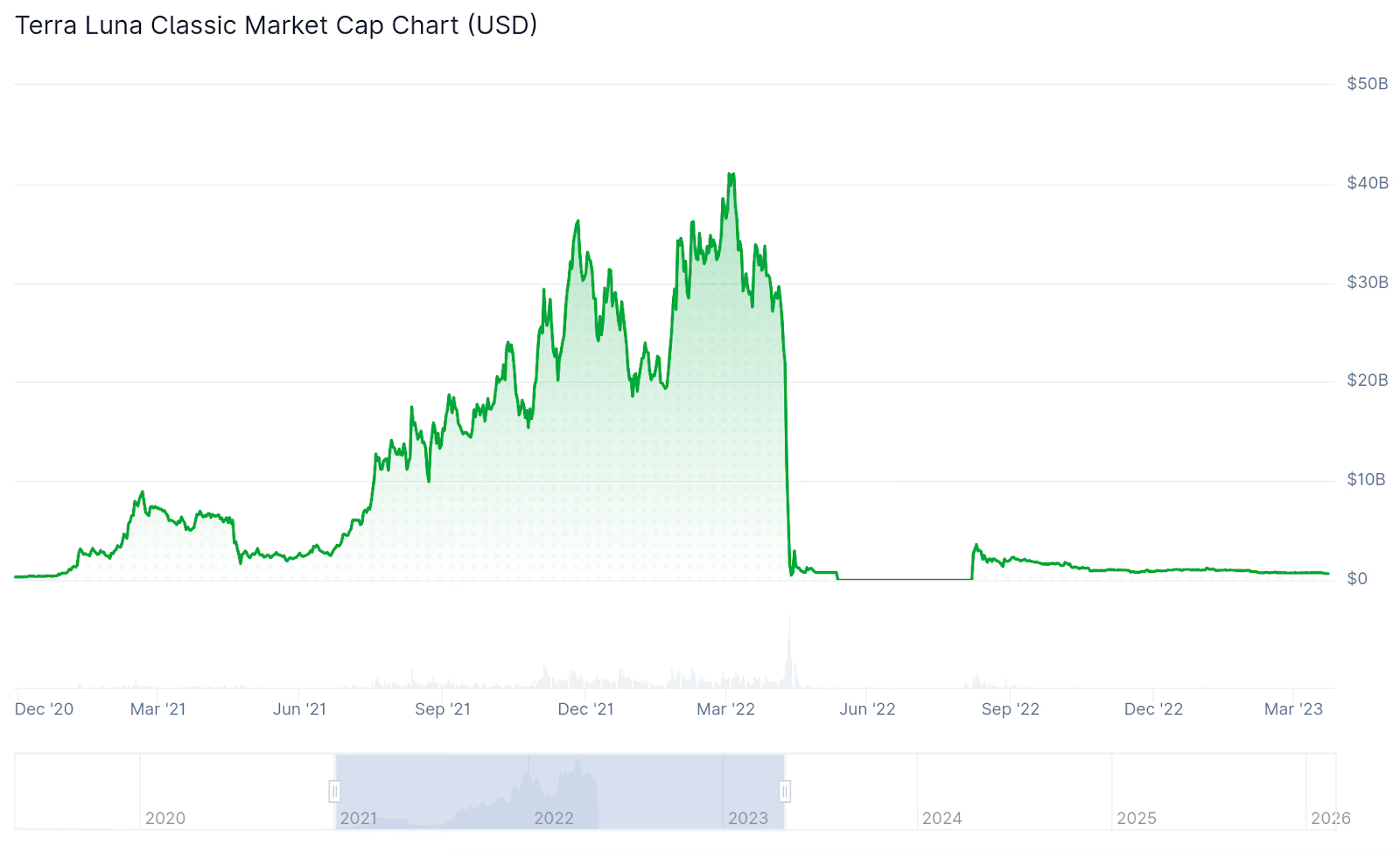
Following the UST depeg, LUNA, now LUNC, plummeted from a $29 billion market capitalization to nearly zero in a matter of days, after reaching as high as $41 billion in April 2022.

In December, Terra founder Do Kwon was sentenced to 15 years in prison, a sentence that exceeded the Department of Justice’s 12-year target, after Kwon pleaded guilty to fraud charges in August 2025.
Jane Street is one of the largest quantitative firms in traditional finance and crypto, with more than $650 billion in assets under management (AUM).


- SEC hires ex-Chainlink lawyer Taylor Lindman to head Crypto Task Force counsel.
- LINK rebounds near $8 but is still down about 51% over the past year.
- Chainlink (LINK) price analysis shows support at $6.80 and resistance near $8.19.
Chainlink (LINK) has rebounded slightly, though it is still in the red as the US SEC taps Chainlink’s veteran Taylor Lindman to head the Crypto Task Force counsel.
At press time, LINK was currently trading at around $8.18, recovering slightly from a low of $8.13. This rebound comes amid broader market volatility that has seen LINK fall roughly 51% over the past year.
SEC taps Chainlink veteran for crypto regulation
The US Securities and Exchange Commission (SEC) has appointed Taylor Lindman, formerly a senior legal officer at Chainlink Labs, as chief counsel for its Crypto Task Force.
Lindman brings over five years of experience in blockchain and regulatory compliance.
He played a key role in advising Chainlink on legal matters and navigating complex digital asset regulations before his departure in February 2023.
Lindman’s move to the SEC signals that regulators are increasingly interested in professionals with hands-on experience in decentralised finance (DeFi) and smart contract ecosystems.
SEC Commissioner Hester Peirce, who leads the Crypto Task Force, welcomed Lindman’s appointment.
Analysts suggest that Lindman’s expertise could influence future guidance and enforcement actions around digital assets.
LINK price performance
The market appeared to respond positively with institutional investors, including firms like Grayscale, steadily accumulating LINK tokens.
The continued institutional interest, combined with Lindman’s transition to the SEC, has reignited confidence in Chainlink’s long-term positioning.
Short-term technical indicators show that LINK recently found support at around $6.80, while the resistance at $8.19 has limited upward movement in the past.
The rebound above $8 could open the door for higher price action, while a fall below $6.80 might signal further downside risk.
Short-term LINK price prediction
With regulatory developments and institutional interest converging, LINK is drawing attention from both traders and long-term investors.
Its price movement over the next few weeks will likely reflect a mix of market sentiment, technical pressure, and evolving regulatory signals.
For short-term traders, analysts have highligted $6.80 as the immediate key short-term support level to watch. Holding above this level would suggest that the market is stabilising after recent volatility.
If LINK can break through the $8.19 resistance, the next target would be $9.51.
A sustained move above $10.80 could indicate stronger bullish momentum, attracting further buying interest.
On the downside, if the $6.80 support fails, traders should monitor the $5.38 zone as a potential safety net.
Price action around these levels will be critical in defining LINK’s short-term trend.
Bitcoin price is holding above $62,000 support, but weak volume participation raises concerns that the current bounce lacks strength and downside risk remains.
Summary
- Bitcoin defending $62K support within broader range structure
- Low volume signals weak bullish conviction
- $60,000 range low remains key downside target if weakness continues
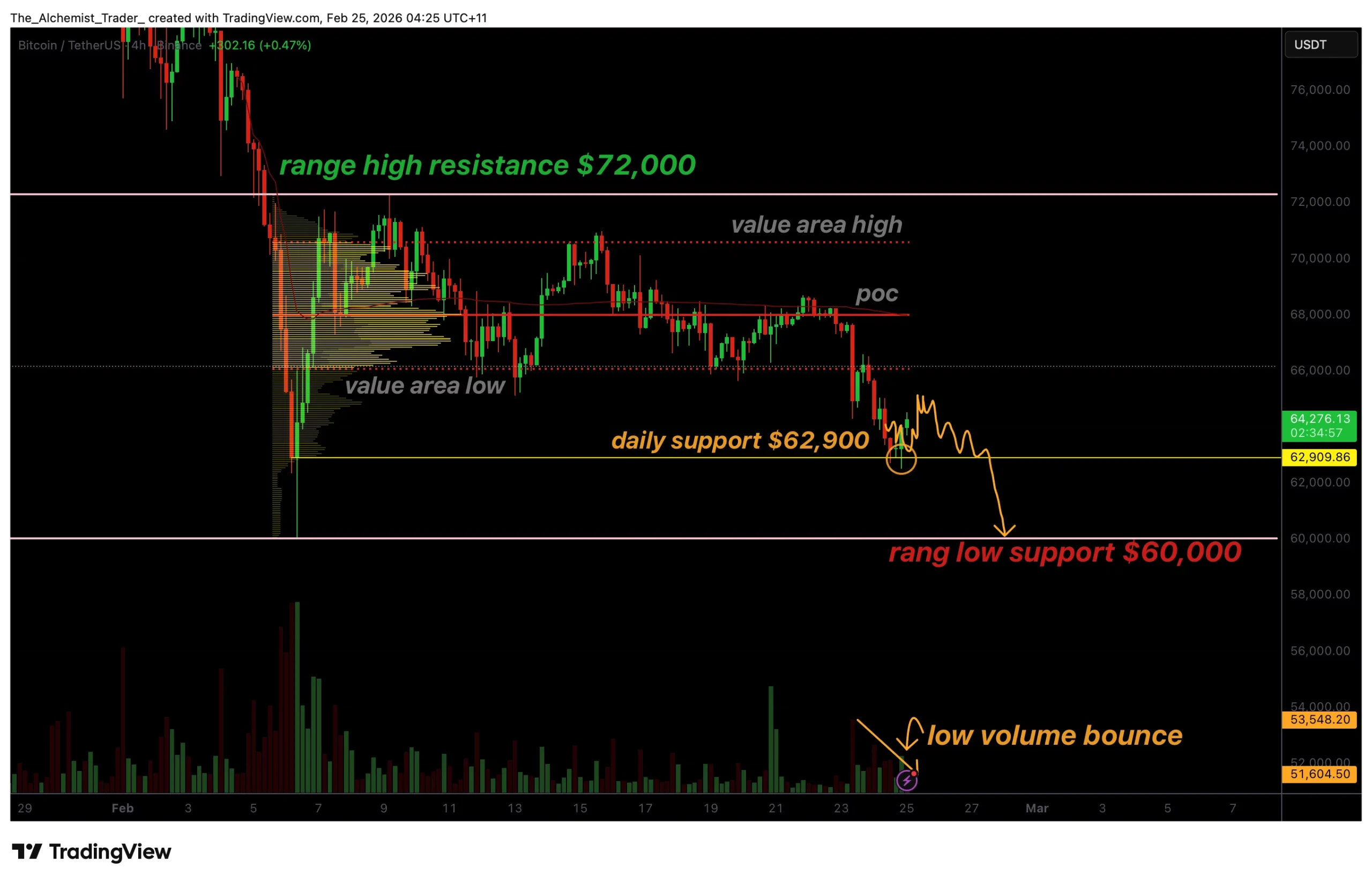
Bitcoin (BTC) price action has entered a consolidative phase after weeks of corrective movement, with the market recently testing daily support near the $62,900 region. This level has so far held firm, preventing an immediate breakdown and allowing price to stabilize within the broader trading range. While the defense of support may appear constructive on the surface, underlying market signals suggest caution remains warranted.
The recent bounce from support lacks convincing momentum, particularly when analyzing volume behavior. In healthy reversals or sustained rallies, price expansion is typically accompanied by strong bullish participation. However, current market conditions reveal subdued trading activity, raising questions about whether the move represents genuine accumulation or merely a temporary oversold reaction.
As long as volume remains weak, Bitcoin may struggle to transition into a sustained bullish trend, leaving the market vulnerable to further downside rotation.
Bitcoin price key technical points
- $62,900 daily support defended: Buyers preventing immediate breakdown
- Low volume weakens recovery: Lack of strong bullish participation
- $60,000 range low remains magnet: Continued rotation within broader range likely
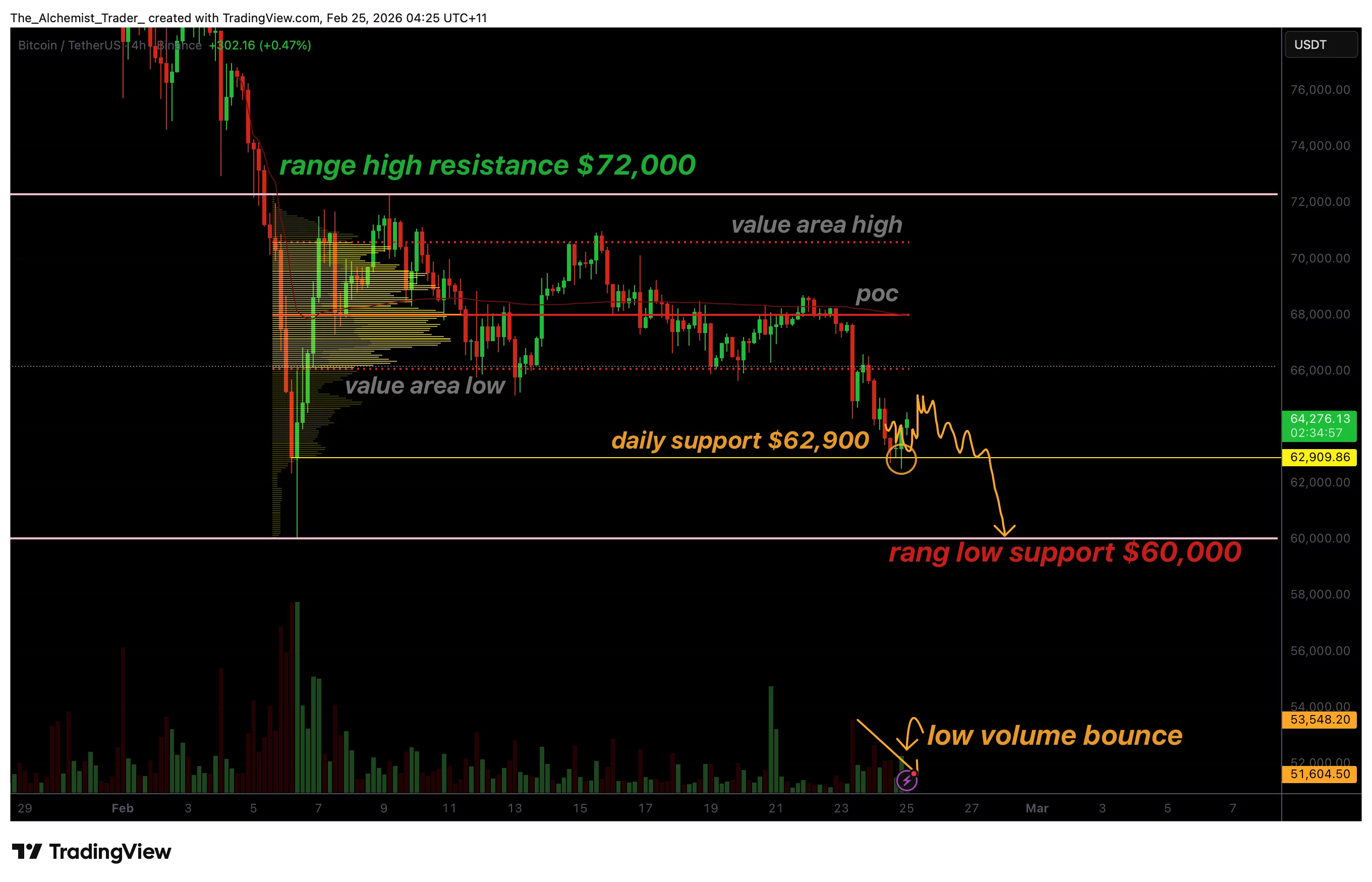
Bitcoin’s recent reaction at the $62,900 support level demonstrates that buyers are still active within this region. The market has shown resilience by holding above support, preventing a rapid continuation lower. From a structural standpoint, this defense keeps Bitcoin trading within its established high-timeframe range rather than confirming a trend collapse.
However, price stability alone does not confirm strength. The bounce from support has occurred with noticeably low volume participation across the volume profile. Strong reversals typically require an influx of directional buying pressure capable of shifting market sentiment.
Without this participation, rebounds often fail to sustain momentum, even as broader institutional and regulatory developments, such as Arizona lawmakers advancing a digital assets reserve fund bill, continue to highlight growing adoption narratives.
This dynamic suggests that the current move may represent an oversold reaction rather than the beginning of a broader bullish recovery.
Volume profile reveals lack of conviction
Volume remains one of the most critical indicators in assessing market intent. In Bitcoin’s current structure, volume profile nodes reveal limited bullish conviction during the recovery phase. Despite holding support, buyers have not entered the market aggressively enough to drive expansion toward higher resistance levels.
When price rises on declining or weak volume, it often indicates short covering or temporary relief rather than genuine demand. These conditions frequently lead to renewed selling pressure once the initial bounce loses momentum.
The absence of strong bullish influx increases the probability that Bitcoin continues rotating within its broader range rather than initiating a breakout. Until volume expands meaningfully, the market remains susceptible to further corrective movement.
Range structure keeps $60,000 in focus
Bitcoin continues to trade within a clearly defined high-timeframe range between resistance near $72,000 and range-low support around $60,000. Markets operating within ranges often rotate between extremes when neither buyers nor sellers establish dominance.
Given the weak nature of the current bounce, the $60,000 range low becomes an increasingly likely destination. This level represents a significant liquidity zone and has historically attracted strong market reactions.
A move toward $60,000 would not necessarily invalidate the broader market structure but instead reinforce the ongoing consolidation phase. Range environments commonly feature multiple tests of support and resistance before a decisive directional move emerges.
This type of price behavior has recently been amplified by macro-driven volatility, with Bitcoin swinging sharply as tariff-related headlines triggered heightened discussion across crypto social media.
What to expect in the coming price action
From a technical, price action, and market structure perspective, Bitcoin’s defense of $62,000 support remains constructive but fragile. Without a clear expansion in bullish volume, the current bounce risks fading into continued downside rotation.
If low participation persists, price is likely to revisit the $60,000 range-low support while continuing to trade within the broader $72,000 to $60,000 high-timeframe range.
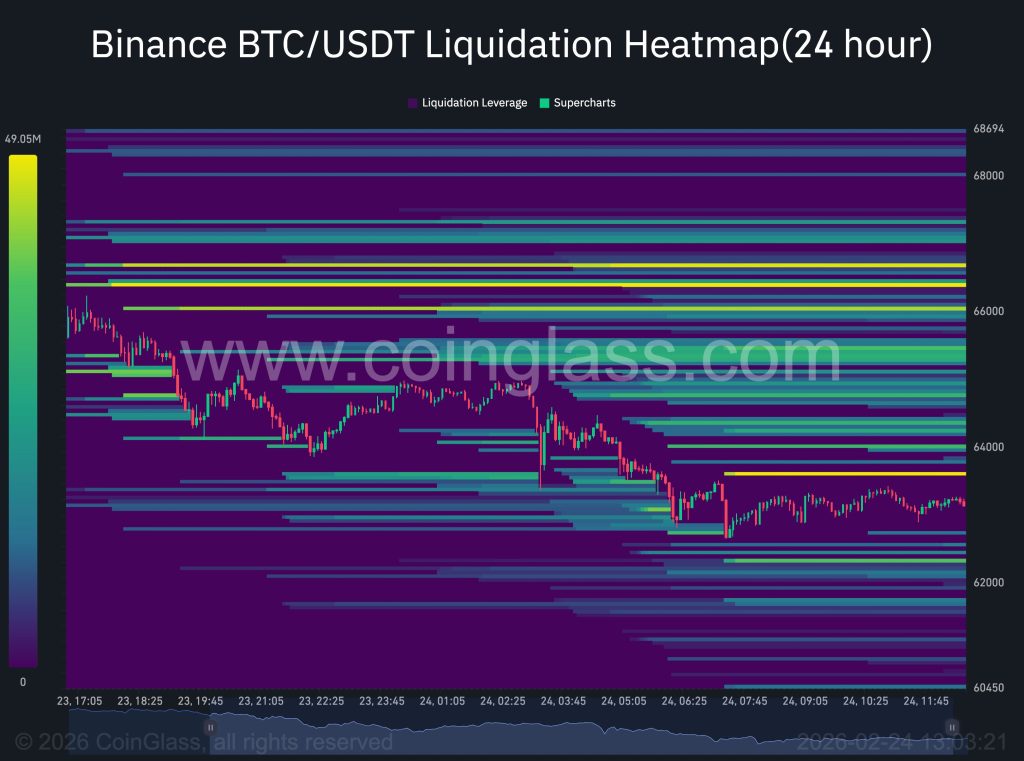
Bitcoin markets suffered a severe deleveraging event overnight, with over $370 million in forced liquidations flushing out leveraged longs as prices tumbled toward the $60,000 threshold.
While retail traders capitulated under the pressure of the sudden crypto market crash, corporate treasuries, led by aggressive accumulators like Metaplanet, stepped in to absorb the selling pressure.
The immediate direction of the market now hinges on whether bulls can defend the critical $60,000 level, a psychological and technical floor that separates a healthy correction from a deep bear market structure.
Key Takeaways
- Over $370 million in total crypto liquidations occurred in the last session, with Bitcoin futures open interest plunging 20% from its peak.
- Institutional accumulation persists despite the drop, with firms like Metaplanet executing strategic spot purchases to defend their average cost basis.
- Technical indicators mark $60,000 as the decisive line in the sand; a confirmed breakdown targets $55,000 as the next major liquidity zone.
Discover: The best meme coins in the world right now.
Why Is the Crypto Market Crashing?
The sell-off was driven by a cascading liquidation loop rather than a fundamental breakdown. According to data from CoinGlass and major exchanges, the market wiped out over $370 million in positions, with long traders accounting for $275 million, or 74% of the losses.
This flush was exacerbated by a sharp decline in Bitcoin futures open interest, which dropped from $61 billion to $49 billion in a few days, a sign that speculative froth is being aggressively removed from the system.
Traders were caught off guard by the speed of the move. Earlier this month, in another drawdown, Bitcoin registered a -6.05σ rate-of-change drop, statistically comparable to the volatility seen during the FTX collapse.
The trigger for this volatility appears to be macro-driven, as fears regarding imminent tariff policies sent risk assets spiraling. When the price of Bitcoin dipped below the 200-day moving average, it triggered a chain reaction of stop losses, accelerating the Bitcoin liquidations.
Metaplanet and Treasuries Buy the Dip
While retail panic dominated the headlines, on-chain data reveals a different story among institutional accumulation desks.
Metaplanet, the Japanese investment firm modeling its treasury strategy after U.S. counterparts, is reportedly adding to its Bitcoin holdings during the downturn, according to X posts by CEO Simon Gerovich.
This behavior aligns with a broader trend of strategic accumulation, where corporates utilize sharp drawdowns to lower their cost basis rather than fleeing to cash.
This follows the precedent set by MicroStrategy. Michael Saylor hints at Strategy’s 100th Bitcoin buy often coincides with market fear, reinforcing the divergence between short-term speculators and long-term treasury hold strategies.
While the paper losses for these entities mount during a correction, their continued buying provides a localized floor, preventing the price from entering a complete freefall.
Bitcoin Price Analysis: Critical BTC Support Levels
The technical picture has reached a decisive juncture. Bitcoin is currently testing the BTC support levels at $60,000, a zone that aligns with high-volume nodes from late 2025.
The Relative Strength Index (RSI) on the daily chart has plunged into oversold territory, currently reading just under 30. Historically, such low RSI readings often precede a sharp mean reversion bounce, but the structural damage on the weekly timeframe remains a concern.
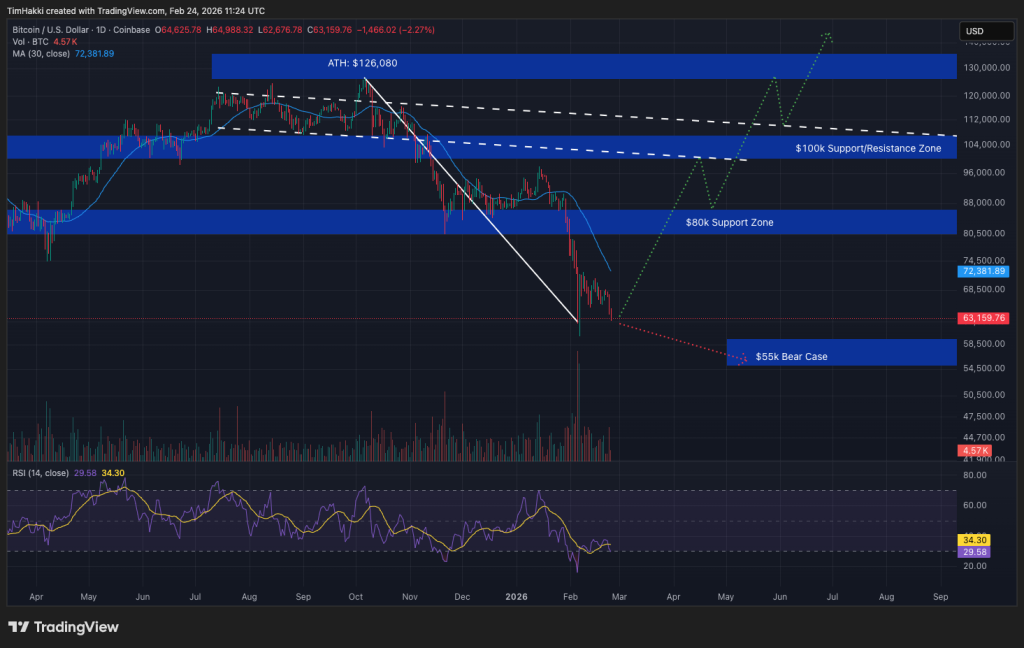
If bulls fail to defend $60,000, the path of least resistance flips to the downside. One CryptoQuant analyst recommends watching the $54,700 price level as the ultimate invalidation point for the bull case.
Sentiment markets are already pricing in this risk; Polymarket odds on a Bitcoin price drop to $55K have surged, reflecting growing skepticism about an immediate V-shaped recovery.
To reclaim bullish momentum, price action must first stabilize above $62,500 and then challenge the $67,500 resistance block. Until a daily close above that level occurs, the trend remains firmly in bear territory.
Discover: The next crypto to explode
Tariff Fears Fuel Record Outflows
The current drawdown extends a rough start to the year, with digital assets logging their longest streak of negative weekly returns since 2022.
Much of this selling is precautionary, driven by the ongoing debate over U.S. tariff implementation under the 1974 Trade Act. The uncertainty has spiked the dollar, effectively siphoning liquidity out of high-beta assets like crypto.
Institutional flows reflect this risk-off rotation. Spot Bitcoin ETFs lodged their fifth straight week of outflows, signaling that traditional finance allocators are de-risking until the regulatory fog clears.
Until these flows reverse, spot markets lack the relentless bid needed to counter derivative sell pressure.
The post Bitcoin Bloodbath: $370M Liquidations as Corporates Defend $60K appeared first on Cryptonews.

You can buy Pepeto in five simple steps: visit the official presale website at pepeto.io, set up a crypto wallet, deposit or buy crypto for payment, select the amount of PEPETO you want, and confirm the purchase. That is all it takes to get in before exchanges list this token and the presale price disappears.
This guide explains in full detail how to buy Pepeto before its presale ends, how the meme coin infrastructure platform works, and why analysts project 100x or more from the current price of $0.000000185.
Pepeto is only available through the official presale at pepeto.io. It is not listed on any exchange, DEX, or trading platform. Any token you see on Uniswap, PancakeSwap, or DEXTools using the Pepeto name is fake. The real PEPETO token does not exist on chain yet. It will only become tradable after the presale closes and the Token Generation Event takes place.
This is important because the presale has raised over $7.3 million and is more than 70% filled. Once it closes, the current price of $0.000000185 is gone permanently. The only safe place to buy Pepeto is pepeto.io.
How to buy Pepeto: step by step guide
Step 1: Set up a crypto wallet
Download MetaMask or Trust Wallet on your phone or browser. Create a new wallet and write down your recovery phrase on paper. Store it somewhere safe and never share it with anyone.
Step 2: Fund your wallet with ETH, USDT, or BNB
The Pepeto presale accepts ETH, USDT, and BNB. You can also pay with a credit card directly on the website. Send crypto from Coinbase or Binance to your wallet address. Keep a small amount for gas fees.
Step 3: Go to pepeto.io and connect your wallet
Visit pepeto.io and click “Connect Wallet.” Select your wallet provider and approve the connection. Always double check the URL before connecting.
Step 4: Choose your investment amount
Enter the amount you want to spend. The dashboard shows exactly how many PEPETO tokens you will receive. There is no minimum investment.
Step 5: Confirm and stake your tokens
Click “Buy” or “Buy and Stake” to start earning 212% APY immediately. Approve the transaction in your wallet. Tokens are claimable after the Token Generation Event.

What is Pepeto and why is it projected for 100x?
Pepeto is not just another meme coin. It is the first dedicated trading infrastructure platform built for the $45 billion meme coin economy. Three working demo products are live right now at pepeto.io. A cross chain swap lets traders move meme coins between networks. A blockchain bridge connects different chains. And a zero fee decentralized exchange saves money on every trade.
SolidProof and Coinsult both completed independent security audits. Zero percent tax on every buy and sell. The project traces back to an original Pepe Coin cofounder who watched $PEPE hit $7 billion with zero products and decided to build what the market was missing. A confirmed Binance listing is approaching.
At $0.000000185, a 100x needs just $50 million market cap. SHIB reached $40 billion with zero infrastructure. DOGE hit $90 billion on tweets alone. The math is simple. The window is now.
Is Pepeto safe to buy?
SolidProof and Coinsult both audited the smart contract with no critical issues found. Zero tax on every transaction. Standard Web3 wallet connections with no KYC required.
The bottom line on buying Pepeto
The Pepeto presale is simple to join. Connect a supported wallet and buy PEPETO with ETH, USDT, BNB, or credit card at $0.000000185. There is no minimum purchase. Staking currently offers 212% APY, which adds serious value on top of the projected 100x from presale to exchange listing. Over $7.3 million raised and 70% filled. Once the presale closes, this price is gone forever.
Click To Visit Official Website To Buy Pepeto
FAQs
How to buy Pepeto in 2026?
Visit pepeto.io, connect MetaMask or Trust Wallet, fund with ETH, USDT, BNB, or credit card, select the amount, and confirm. Pepeto is only available through the official presale website.
Where can I buy Pepeto tokens?
Pepeto can only be purchased at pepeto.io during the presale. It is not on any exchange. Any PEPETO token appearing on exchanges or DEXs is fake and not connected to the real project.
Is Pepeto a good investment in 2026?
At $0.000000185 with three working demos, dual audits, 212% APY staking, and a confirmed Binance listing ahead, Pepeto offers 100x math to just $50 million market cap. The presale is 70% filled.
Disclaimer: This is a Press Release provided by a third party who is responsible for the content. Please conduct your own research before taking any action based on the content.
![Chris Hemsworth arriving to the Thor: Love and Thunder World Premiere at TCL Chinese Theatre on June 23, 2022 in Hollywood, CA. © OConnor/AFF-USA.com. 23 Jun 2022 Pictured: Chris Hemsworth. Photo credit: OConnor/AFF-USA.com / MEGA TheMegaAgency.com +1 888 505 6342 (Mega Agency TagID: MEGA871506_003.jpg) [Photo via Mega Agency]](https://wordupnews.com/wp-content/uploads/2026/02/MEGA871506_003-scaled-80x80.jpg)
Chris Hemsworth Reveals Why He Made The ‘Greatest Decision’ To Leave LA

Popular footballer drowned in river while under influence of drugs

Google apologises for Baftas alert to 'see more' on racial slur


-

 Video5 days ago
XRP News: XRP Just Entered a New Phase (Almost Nobody Noticed)
-

 Fashion4 days ago
Weekend Open Thread: Boden – Corporette.com
-

 Politics3 days ago
Baftas 2026: Awards Nominations, Presenters And Performers
-

 Business7 days ago
Infosys Limited (INFY) Discusses Tech Transitions and the Unique Aspects of the AI Era Transcript
-

 Sports1 day ago
Women’s college basketball rankings: Iowa reenters top 10, Auriemma makes history
-

 Entertainment6 days ago
Kunal Nayyar’s Secret Acts Of Kindness Sparks Online Discussion
-

 Politics1 day ago
Nick Reiner Enters Plea In Deaths Of Parents Rob And Michele
-

 Tech7 days ago
Retro Rover: LT6502 Laptop Packs 8-Bit Power On The Go
-
 Sports6 days ago
Clearing the boundary, crossing into history: J&K end 67-year wait, enter maiden Ranji Trophy final | Cricket News
-

 Business2 days ago
Mattel’s American Girl brand turns 40, dolls enter a new era
-

 Crypto World14 hours ago
XRP price enters “dead zone” as Binance leverage hits lows
-

 Business2 days ago
Law enforcement kills armed man seeking to enter Trump’s Mar-a-Lago resort, officials say
-

 Entertainment6 days ago
Dolores Catania Blasts Rob Rausch For Turning On ‘Housewives’ On ‘Traitors’
-

 Business7 days ago
Tesla avoids California suspension after ending ‘autopilot’ marketing
-

 Tech2 days ago
Anthropic-Backed Group Enters NY-12 AI PAC Fight
-
 NewsBeat1 day ago
‘Hourly’ method from gastroenterologist ‘helps reduce air travel bloating’
-

 NewsBeat2 days ago
Armed man killed after entering secure perimeter of Mar-a-Lago, Secret Service says
-

 Politics2 days ago
Maine has a long track record of electing moderates. Enter Graham Platner.
-

 Crypto World6 days ago
WLFI Crypto Surges Toward $0.12 as Whale Buys $2.75M Before Trump-Linked Forum
-

 Tech4 hours ago
Unsurprisingly, Apple's board gets what it wants in 2026 shareholder meeting