

Crypto World
AI Agents Can Now Transact Via MetaMask Without Accessing Private Keys, Says CoinFello



A new OpenClaw skill from CoinFello addresses a key security issue with AI agents using crypto.
The team behind AI agent CoinFello today announced the release of an open-source skill that lets AI agents securely connect to MetaMask and execute on-chain transactions, without ever handling a user’s private keys.
The skill lets OpenClaw-based personal AI agents, known as MoltBots, transact with designated amounts of crypto from an existing MetaMask wallet, without the wallet’s owner giving up custody of their private keys, per a press release shared with The Defiant.
The agent skill is built via the MetaMask Smart Accounts Kit, using ERC-4337 smart accounts and ERC-7710 delegations. CoinFello’s founder and CEO, known as Jacob C, was previously lead of operations at MetaMask.
The release addresses a core vulnerability in how most AI agent wallets currently operate: agents are typically given direct access to private keys or API credentials, which are then vulnerable to prompt injection attacks, per the release.
CoinFello says its approach allows users to grant agents only the narrowly scoped permissions needed for a specific task.
“If we want agents to participate meaningfully in the onchain economy, we need a security model that is better than handing an autonomous system a private key,” said Brett Cleary, CTO at CoinFello.
MetaMask didn’t publicly comment on CoinFello’s skill release today, but ahead of the skill’s debut at ETHDenver in February, MetaMask’s product team signaled support for the approach.
“We’re pleased to collaborate with the CoinFello team as they bring agent-driven experiences to users through the MetaMask Smart Accounts Kit,” Ryan McPeck, product lead at Consensys for the MetaMask Smart Accounts Kit, was quoted as saying at the time, adding:
“We see a future where AI agents can safely act on behalf of users using granular, transitive permissions that allow individuals to define how activity is executed on-chain.”
Supported capabilities include ERC-20 token swaps, bridging across Ethereum Virtual Machine (EVM) chains, NFT interactions, staking, lending, and multi-step trading strategies — all triggered via natural-language prompts. The skill is released under the MIT license, per the release.
The launch lands as the OpenClaw and MoltBot ecosystem has surged in recent months. As The Defiant reported, the viral growth of AI-only social platform Moltbook — mostly populated by OpenClaw agents — drove record token activity on Base-based launchpad Clanker earlier this year.
Yesterday, Axios reported that Meta, the parent company of Facebook, Instagram and WhatsApp, has acquired Moltbook, bringing its two founders into Meta’s AI division.
This article was written with the assistance of AI workflows. All our stories are curated, edited and fact-checked by a human.

Crypto World
The DEATH BETS Act: Why Lawmakers Are Moving to Shut Down America’s Fastest-Growing Gray Market

TLDR:
- THE DEATH BETS Act seeks to ban prediction contracts tied to war, terrorism, assassination, or individual death.
- Lawmakers cited $500M in wagers on U.S.–Iran strike timing as evidence of rising conflict speculation markets.
- Bill removes discretion from regulators and sets a clear ban on violent event contracts on U.S. exchanges.
- Platforms like Kalshi and Polymarket face scrutiny as war prediction markets attract political attention.
DEATH BETS Act legislation introduced in Washington aims to prohibit prediction markets from listing contracts tied to war, terrorism, assassinations, or individual deaths.
Lawmakers say speculative trading around military conflicts and geopolitical crises has exposed regulatory gaps within U.S. derivatives oversight frameworks and created ethical concerns.
Lawmakers Move to Ban Death and War Event Contracts
The DEATH BETS Act was introduced by Mike Levin and Adam Schiff. The proposal seeks to block regulated prediction markets from offering contracts tied to violent geopolitical events.
The bill would prevent exchanges registered with the Commodity Futures Trading Commission from listing contracts related to war, terrorism, assassination, or an individual’s death.
Lawmakers say the current regulatory framework leaves gaps that allow controversial markets to appear.
Under the Commodity Exchange Act, the CFTC already holds authority to restrict contracts tied to war or terrorism. However, regulators must determine whether such contracts violate public interest standards before taking action.
Supporters of the bill argue that the discretionary nature of the rule allows prediction markets to operate in gray areas. The DEATH BETS Act aims to remove that uncertainty by clearly banning contracts tied to violent events or fatal outcomes.
Rep. Levin pointed to recent speculation involving military conflict. According to the lawmaker, more than $500 million was wagered on the timing of U.S. military strikes on Iran.
Sen. Schiff warned that these markets may encourage traders to profit from classified information or geopolitical instability. Lawmakers argue that markets linked to violent events raise national security concerns.
Prediction Market Activity Fuels Regulatory Debate
Prediction platforms such as Kalshi and Polymarket allow traders to speculate on real-world outcomes. Contracts function similarly to binary options, where traders buy shares representing event probabilities.
Recent geopolitical events have driven heavy activity on these platforms. During tensions involving Iran, traders placed large wagers predicting when military strikes might occur.
A multi-outcome contract on Polymarket reportedly attracted more than $500 million in wagers. Traders could purchase shares tied to specific strike dates and profit if the event occurred during that timeframe.
Reports later suggested several suspected insider accounts generated more than $1.2 million in combined profits from related positions. These findings intensified scrutiny from policymakers.
Another contract on Kalshi asked whether Iranian Supreme Leader Ali Khamenei would remain in power by a certain date. The market reached roughly $54 million in trading volume before trading was halted.
Other markets have speculated on the removal of Nicolás Maduro from power and the capture of Ukrainian territories during the Russia-Ukraine conflict.
Some contracts also explored scenarios involving nuclear escalation or leadership changes during active geopolitical crises. Several were later removed following public criticism.
Lawmakers say these examples illustrate how prediction markets can transform live conflicts into tradable financial events. The DEATH BETS Act aims to establish clear boundaries as the industry expands globally.

Digital asset infrastructure company Foundry Digital plans to launch a mining pool for Zcash in April 2026, expanding beyond Bitcoin mining infrastructure. The company said the pool will be designed for institutional and publicly traded miners seeking compliance-focused mining services.
The new pool will be based in the United States and built on the same infrastructure used by Foundry USA Pool, which is operated by the company. Foundry said the service will include reporting tools and payout systems intended to meet the operational requirements of institutional miners.
Zcash is a privacy-focused cryptocurrency which features an encrypted ledger using zero-knowledge proofs. A mining pool is a service that allows multiple miners to combine computing power and share block rewards, increasing the chances of earning consistent payouts.
A spokesperson for Foundry told Cointelegraph that the company decided to build a the new mining pool because “Zcash addresses something we believe is genuinely important: the idea that financial privacy is foundational to economic freedom, and that privacy and compliance can coexist.” They added:
When institutional and public miners can mine Zcash through infrastructure built to their standards, it brings new hashrate to the network and strengthens its security.
Foundry Digital was founded in 2019 and provides mining infrastructure and related services for digital asset companies. Its Foundry USA Pool is one of the largest Bitcoin mining pools by hashrate share. Foundry said it expects the Zcash pool to begin operations in April 2026.
The announcement comes days after developers who previously worked at Electric Coin Company raised more than $25 million to continue developing a privacy-focused wallet for Zcash.
Related: Dash Evolution chain integrates Zcash Orchard privacy pool
Zcash garners attention amid price volatility
Zcash, launched in 2016, allows users to send transactions without publicly revealing details such as wallet addresses or transaction amounts. The network is based on Bitcoin’s codebase but uses zero-knowledge proofs, known as zk-SNARKs, to enable optional “shielded” transactions alongside standard transparent ones.
In 2025, Zcash became one of the most widely discussed privacy-focused assets in crypto, with comments from industry figures, including Arthur Hayes, Naval Ravikant and Mert Mumtaz, helping drive interest in the network and its native token, ZEC (ZEC).
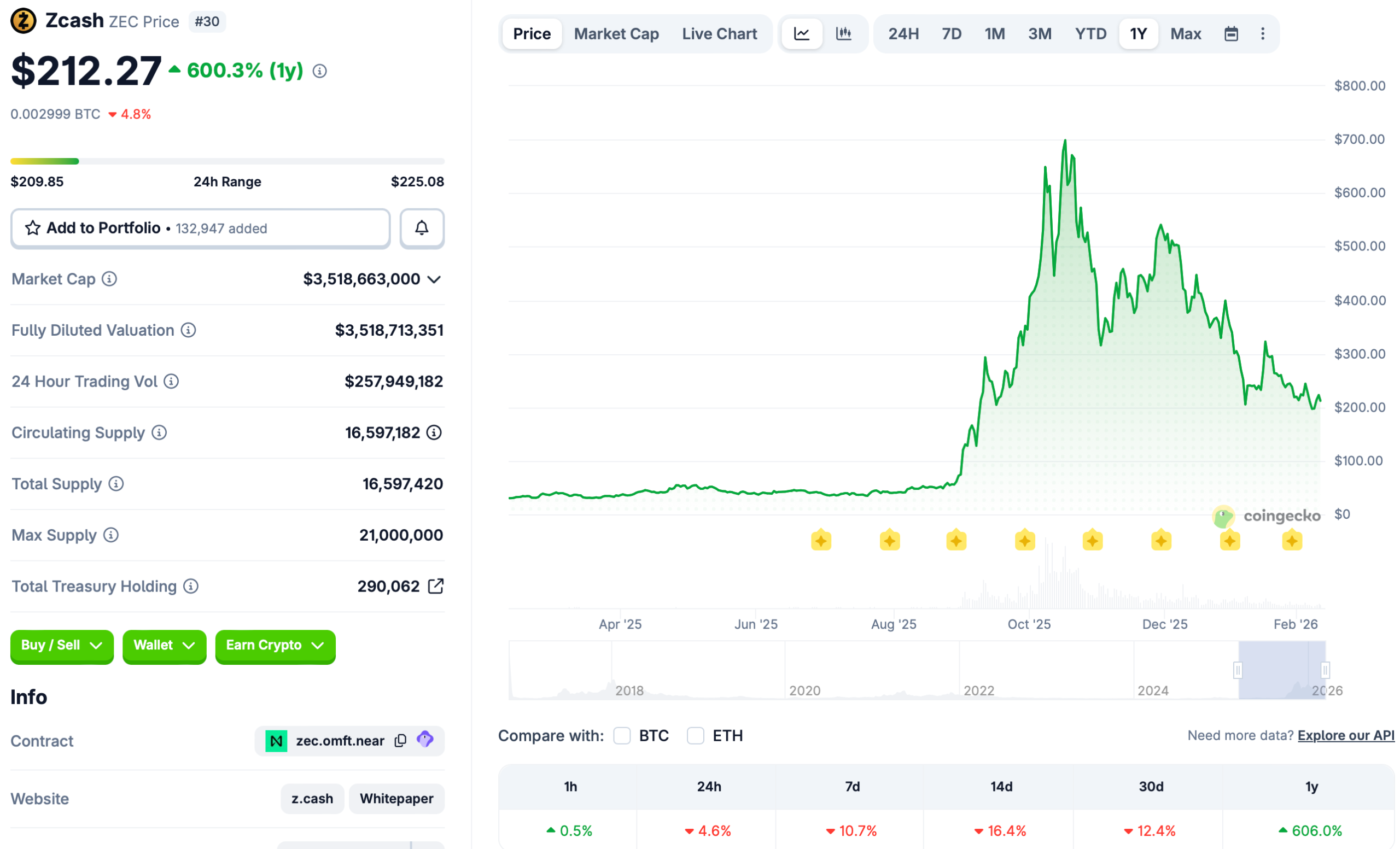
The rally pushed Zcash up nearly 600% over the past year, climbing from below $35 in March 2025 to as high as $698.87 on Nov. 16, 2025, according to CoinGecko data. The token has since pulled back, falling 58.7% year-to-date from about $512 on Jan. 1 to roughly $212 at the time of writing.

Even with the renewed attention, the network’s mining activity remains concentrated among a small number of pools.
Data from Poolbay shows ViaBTC controlling about 31.7% of total hashrate, followed by F2Pool at roughly 15.8%, with smaller shares distributed across pools such as 2Miners and Antpool.
Magazine: All 21 million Bitcoin is at risk from quantum computers

Two of the US’s most influential financial regulators have agreed to better coordinate oversight of the financial markets, seeking to put an end to decades of “regulatory turf wars” between them.
According to the memorandum of understanding written on Wednesday, the US Securities and Exchange Commission and US Commodity Futures Trading Commission said it has become a “pivotal time” to regulate in harmony as new technologies, such as crypto, make it more challenging to monitor the markets:
“New trading models, digital infrastructure, and onchain, automated systems increasingly blur traditional jurisdictional lines,” they said, particularly as market participants operate across platforms and asset classes.
To address that problem, the SEC and CFTC said they will aim to provide regulatory clarity and certainty built on technology-neutral regulations and share information and data concerning issues of “common regulatory interest” to fulfill their respective regulatory mandates.
In a separate statement, SEC chair Paul Atkins said the memo is the latest step toward repairing the relationship between the agencies:
“For decades, regulatory turf wars, duplicative agency registrations, and different sets of regulations between the SEC and CFTC have stifled innovation and pushed market participants to other jurisdictions.”

Both the SEC and CFTC have made strides to deliver on US President Donald Trump’s mission of making the US the “crypto capital of the world,” having set up a crypto-specific task force and established an advisory committee to ensure crypto, AI and other emerging tech innovations continue to push forward in the US.
The agencies also noted in the memo that they strive to provide a “fit-for-purpose regulatory framework for crypto assets.”
Related: SEC chair calls for ‘coordinated oversight‘ between US regulators
The regulatory clarity will be provided to market participants operating everything from trading platforms, clearinghouses and data repositories to pooled investment vehicles, dealers and intermediaries, in addition to products that span securities and derivatives frameworks.
SEC, CFTC to adopt “minimum effective dose” strategy
The two agencies said they also plan to adopt a “minimum effective dose” regulatory strategy to foster innovation while maintaining market integrity and remaining competitive in the global market.
The term “minimum effective dose” is a pharmacological term, defined as the smallest dose of medication that produces the desired therapeutic benefit.
Magazine: Clarity Act risks repeat of Europe’s mistakes, crypto lawyer warns
Traders’ optimism surges as energy shocks and geopolitical uncertainty dominate macro narratives.
Bitcoin (BTC) traders appear to be leaning optimistic in anticipation of a quick end to the war in the Middle East.
In fact, sentiment surrounding the world’s largest crypto asset surged back into FOMO territory after its market value briefly surpassed $70,000 on Tuesday, according to Santiment.
BTC FOMO Returns
Across social platforms, including X, Reddit, and Telegram, discussions reflect optimism, driven in part by comments from US President Donald Trump, who hinted that the war may soon end, as well as by the recent reversal in oil prices.
🤑 Bitcoin sentiment has jumped back into FOMO territory after its market value exceeded $70K Tuesday. Across X, Reddit, Telegram, and other crypto-related discussions, the crowd is encouraged by Trump’s comments that the war may soon end, and oil prices reversing course. pic.twitter.com/S21cXOUM0F
— Santiment (@santimentfeed) March 10, 2026
Despite the heightened market sentiment, on-chain activity shows signs of cooling. Crypto analyst Axel Adler Jr. found that the 30-day average of Bitcoin transfer volume has declined compared with both one month and one quarter ago. This evidences a temporary slowdown in short-term momentum.
However, transfer volume remains above its 365-day average and significantly higher than levels seen six months ago, which potentially means that while network activity has slowed from previous highs, there is no structural breakdown, and the broader trend in Bitcoin usage and movement remains high.
Geopolitical Tensions
This week’s rebound in risk assets such as Bitcoin has coincided with volatility in oil markets and changing expectations about the duration and impact of the Iran conflict.
You may also like:
Amid these macro developments, experts believe that BTC remains within a clearly liquidity-driven structure. In a statement to CryptoPotato, analysts at Bitunix said that derivatives liquidation distributions show a dense concentration of short liquidation zones between approximately $70,000 and $74,000 above current price levels, while leveraged long liquidity remains clustered near the $65,000-$66,000 range below.
After the latest recovery, the analysts said that BTC has entered sideways consolidation, suggesting that short-term price action remains dominated by liquidity sweeps both above and below.
“Overall, with energy shocks and geopolitical uncertainty continuing to dominate the macro narrative, the crypto market has yet to form a unilateral trend structure. Capital currently appears more inclined to engage in short-term liquidity positioning between dense liquidation zones.”
Binance Free $600 (CryptoPotato Exclusive): Use this link to register a new account and receive $600 exclusive welcome offer on Binance (full details).
LIMITED OFFER for CryptoPotato readers at Bybit: Use this link to register and open a $500 FREE position on any coin!
Pi Coin price rose for three consecutive days and is slowly nearing its highest point this year as demand from investors continues rising ahead of the Pi Day event.
Summary
- Pi Network price has formed a bullish pennant pattern on the daily chart.
- The coin’s volume has jumped to over $40 million.
- The rally may continue this week, potentially to the key resistance level at $0.2935.
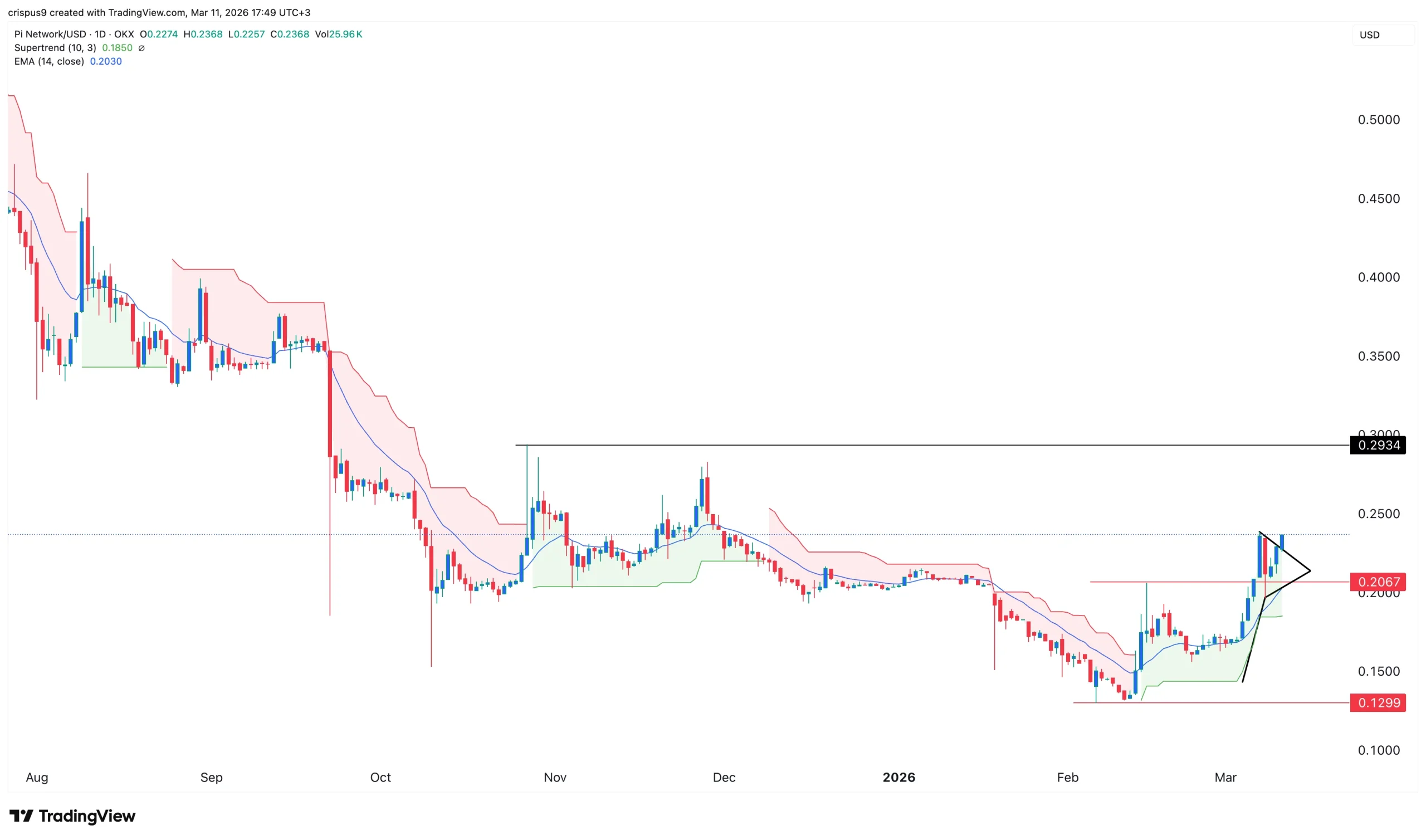
Pi Network (PI) token rose to $0.2325 today, March 11, a few points below the year-to-date high of $0.2363. It has jumped by double digits from its lowest level this year.
Data compiled by CoinMarketCap and CoinGecko shows the coin’s volume continues rising, a sign that investors expect the price to continue rising in the near term.
CMC data shows that the 24-hour volume jumped to $42 million, while another one by CoinGecko puts the figure at $46 million. Its daily volume was less than $10 million a few weeks ago.
In most cases, a surge in daily volume is a sign that investors are buying. It is also a sign that investors are starting to embrace the Fear of Missing Out (FOMO) now that the coin is beating popular coins like Bitcoin and Ethereum.
The ongoing rally is being driven by the hype surrounding the upcoming Pi Day event on Saturday this week. Investors are buying as they wait for what the team will announce on this day.
Additionally, the buying is happening as the ongoing core upgrade advances. The ongoing upgrade phase will have a deadline tomorrow, March 12). If the trend continues, the final upgrade will likely conclude in either April or May this year.
Additionally, the volume is rising as investors continue to wait for the potential Kraken listing, which is expected to happen any day this year. This listing will be a major milestone for the coin as no major exchange has listed it since its mainnet launch.
Pi Coin price prediction and analysis
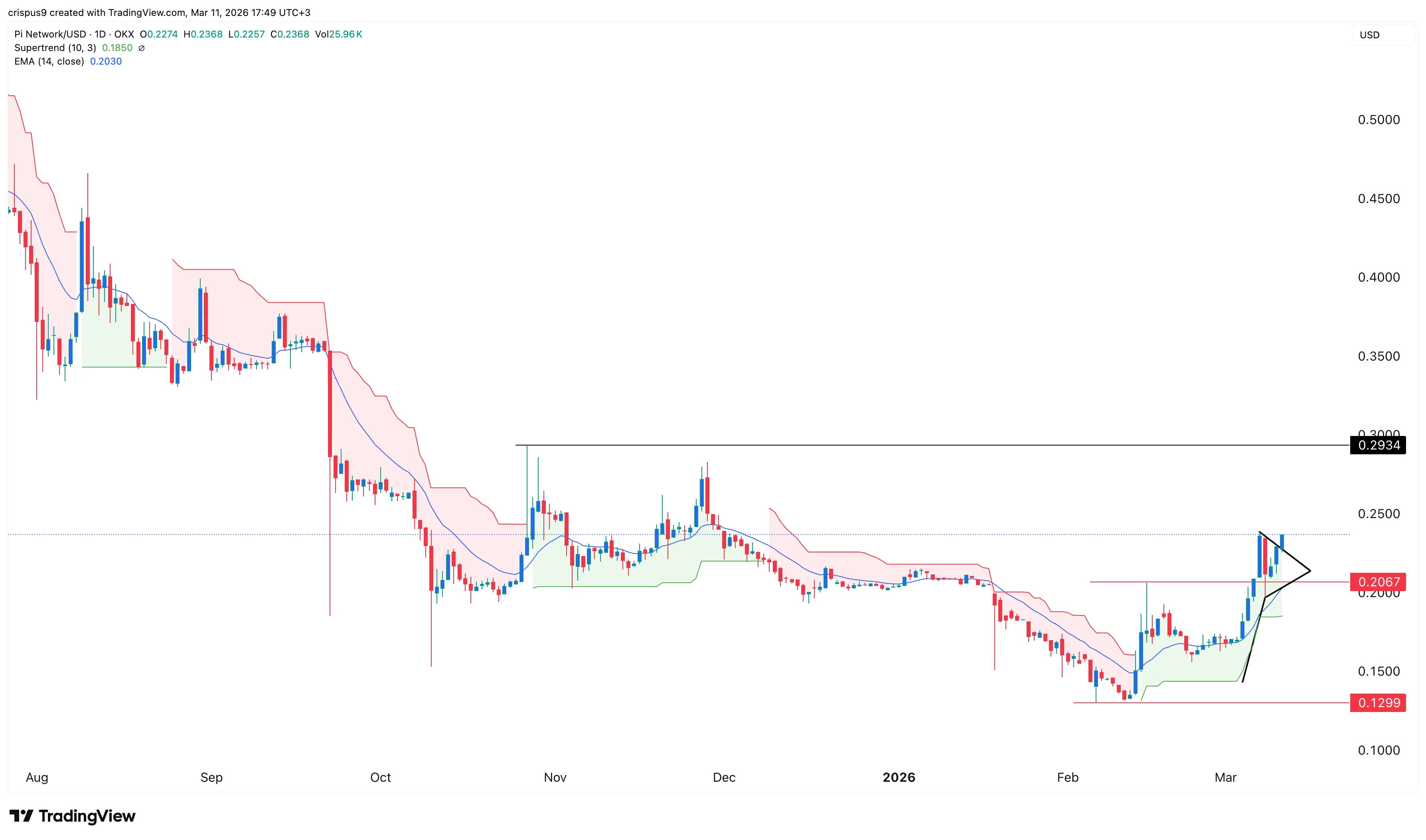
The daily chart shows that the Pi Network price has surged in the past few weeks. A closer look shows that it has formed a bullish pennant pattern, which is made up of a vertical line and a symmetrical triangle. It has already moved above the upper side of the triangle, meaning that the bull run may continue rising.
The coin has also formed an inverted head-and-shoulders-like pattern, which often leads to a bullish reversal. It has moved above the 50-day Exponential Moving Average and the Supertrend indicator.
Therefore, the coin will continue rising as bulls target the next important target at $0.30. This outlook will be confirmed if it moves above the year-to-date high of $0.2380.

Your Android phone might be handing over your crypto wallet in under 60 seconds.
Ledger’s own security team just exposed a hardware flaw in MediaTek chips that lets anyone with physical access to your phone pull your PIN and seed phrase before your phone even boots. USB cable, done. No software patch can fix it either. It is baked into the chip.
The Dimensity 7300 is the chip in question. It affects roughly 25% of all Android devices. Even the Solana Seeker phone is on the list.
INTEL: Ledger exposes a MediaTek Dimensity 7300 flaw that lets attackers with physical access steal Android hot-wallet seed phrases in minutes pic.twitter.com/gBTb2QBXMO
— Solid Intel
 (@solidintel_x) March 11, 2026
MediaTek was told about this back in May 2025. The fix? There is not one. If you have the chip, you have the vulnerability.
For anyone storing real money on a mobile wallet, this one hurts.
How the Boot ROM Exploit Bypasses Android Security
The flaw lives in the boot ROM. That is the code burned into the chip at the factory. It cannot be updated. Ever.
Ledger’s team used electromagnetic pulses to mess with the chip mid-startup. Perfectly timed voltage glitches that force the processor to skip its own security checks. Once that happens, the attacker hits EL3 privilege.
That is the highest level of control possible on ARM architecture. Full access. Game over.
In testing, they pulled it off in about 1 second per attempt.
— SolanaFloor (@SolanaFloor) March 11, 2026
 BREAKING: @Ledger researchers have identified a vulnerability in Android phones using MediaTek processors that could allow an attacker with physical access to extract a device’s PIN and crypto wallet seed phrases in under a minute.
In a proof of concept test, Ledger’s Donjon… pic.twitter.com/ooetcAhZXx
From there, the entire data partition gets decrypted offline. Private keys, PINs, everything your trusted execution environment was supposed to protect. Gone.
No app-level security saves you here. The foundation itself is broken.
Millions of Devices Exposed, Including Solana Seeker
Millions of mid-range Android phones are affected. And there is no patch coming for devices already in the field.
MediaTek’s response was basically “physical attacks are not really our problem.” But when people are storing serious money on these phones, that answer no longer cuts it.
The numbers back that up. Crypto theft hit $3.41 billion in 2024. Personal wallets now account for 44% of all stolen value. In 2022, that number was 7.3%.

Ledger’s own CTO said it. Phones were never designed to be vaults. If you have real money in a mobile wallet, move it to a hardware wallet now.
A software workaround will be included in the March 2026 Android Security Bulletin.
The real question now is whether mobile-first crypto projects can survive a hardware trust problem. If the foundation keeps cracking, the whole pitch of storing crypto on your phone starts falling apart.
Discover: The best new crypto in the world
The post Ledger Researchers Expose Android Flaw Enabling Wallet Seed Theft appeared first on Cryptonews.
Circle stock price is in a strong bull run this month, reaching its highest level since November last year, and this trend may continue as the market capitalization of the USDC stablecoin nears an $80 billion milestone.
Summary
- Circle stock price continued its strong bull run this week.
- The USDC market capitalization is nearing the important $80 billion milestone.
- Technical analysis points to a surge to $174.8, up by 45% from the current level.
CRCL stock jumped to $122.55, up by 147% from its lowest point this year, with its market capitalization jumping to over $30 billion.
There are signs that Circle’s business is thriving as demand for its stablecoin jumps. The supply of all USD Coin (USDC) tokens has jumped to over $79.8 billion, a $10 billion increase from the lowest point last month.
More data shows that USDC has become the most used stablecoin in the industry. Its volume jumped to nearly $6 trillion in the last 30 days, much higher than USDT’s $1.1 trillion.
Soaring USDC supply is important for Circle because of its business model. It makes most of its revenue by investing its USDC holdings into short-term government bonds, which are now yielding about 3.5%.
Government bond yields will likely remain elevated for a while as the Federal Reserve is unlikely to cut interest rates several times this year because of the ongoing Iran war. This war will push inflation much higher than where they are today as energy and transport prices soar.
The most recent numbers showed that Circle’s business continued thriving in the last quarter of last year, with its revenue rising by 77% to $770 million and its EBITDA moving to $167 million.
In addition to this, Circle Payment Network is seeing more user adoption as it has gained 55 partners, and more are coming up. This solution has the ability to disrupt the Swift Network, which moves trillions of dollars annually. It leverages the USDC stablecoin to save money and ensure instant payouts.
Circle stock price prediction: Technical analysis
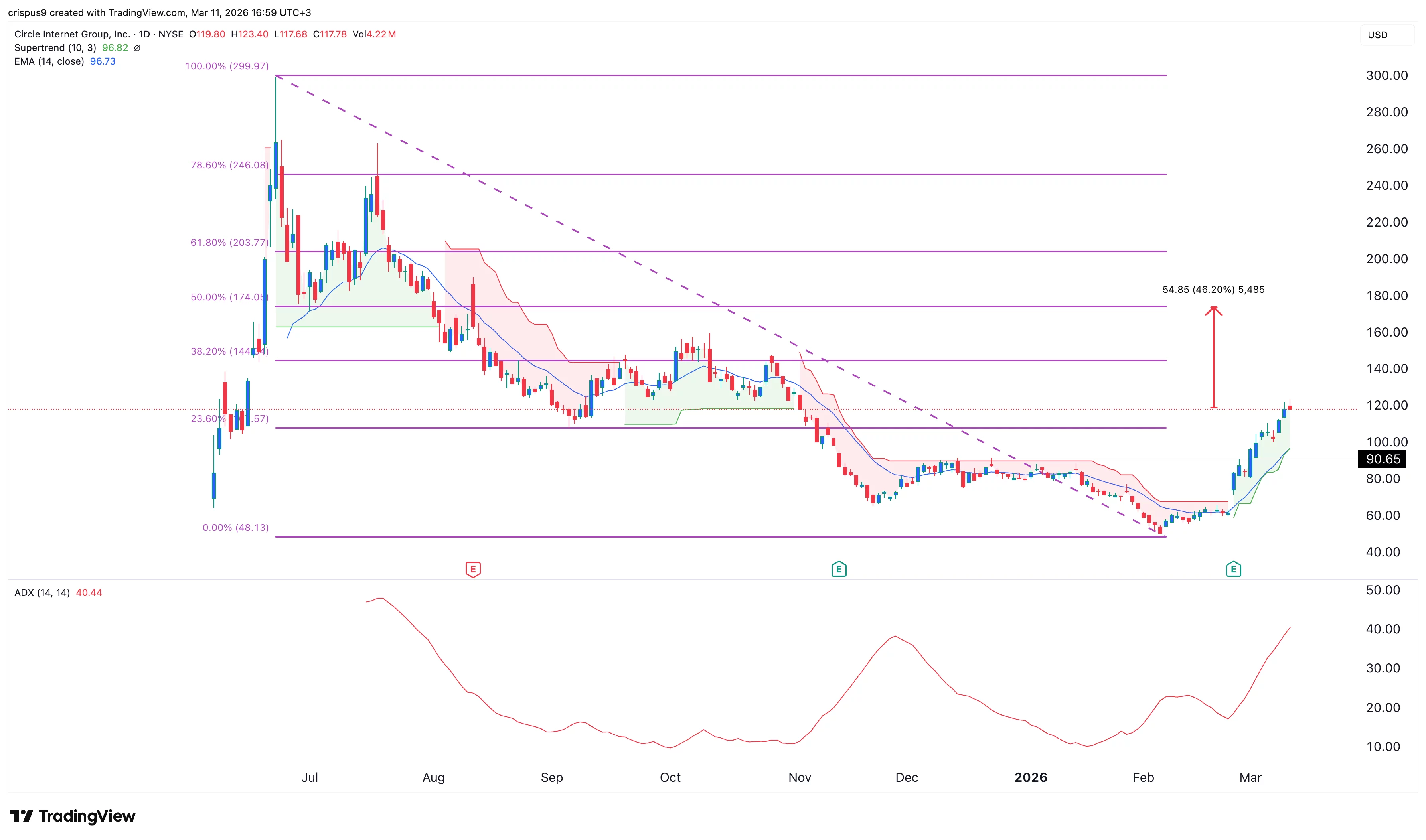
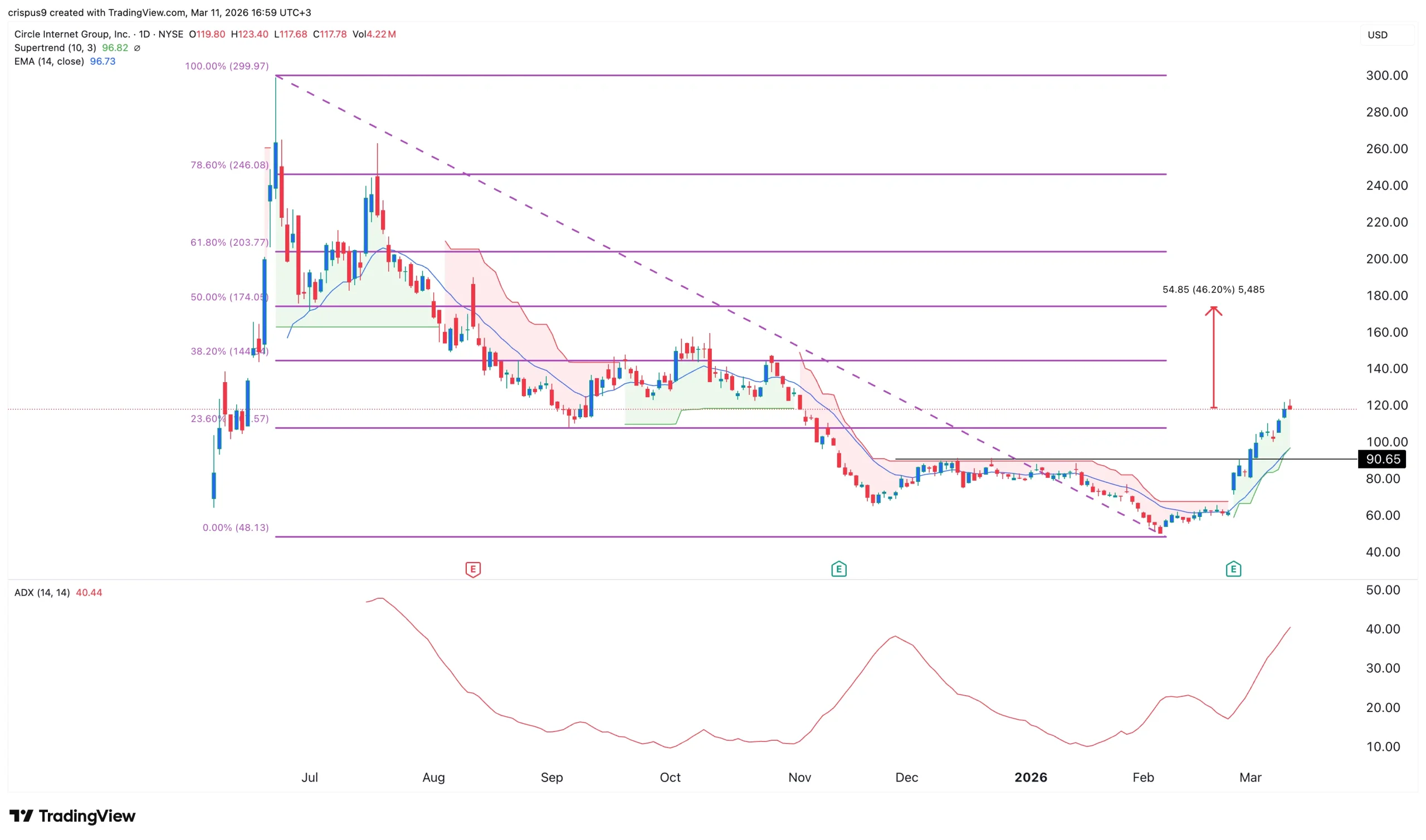
The daily chart shows that the CRCL stock price has rebounded this month. It has already jumped above the 23.6%Fibonacci Retracement level, which is drawn by connecting its highest and lowest levels on record.
The stock has jumped above the 50-day Exponential Moving Average, while the Supertrend indicator has turned green. The Average Directional Index has moved to 40, a sign that the upward momentum is accelerating.
Therefore, the stock will likely continue rising as bulls target the 50% Fibonacci Retracement level at $174, which is about 45% above the current level.
Crypto World
Cardano’s Charles Hoskinson Outlines Strategic Funding Roadmap for 2026: Here’s What’s New


Charles Hoskinson speaks about the 2026 funding agenda and how the Cardano ecosystem should evolve going forward.
In a recently released hour-long video, Charles Hoskinson provided considerable insights into how funding for Cardano’s ecosystem will function in 2026. He also pointed out a few pressure points and how the team plans to tackle them.
There’s nothing here that, with the money that we have, Cardano can’t fix. – Said Hoskinson, while outlining critical flaws in existing models.
The Existing Pillars in Cardano’s Funding Focus
Starting off, Hoskinson said that the ecosystem funding model is generally broken down into three layers: infrastructure, utility, and experience. He outlined that historically, Cardano’s funding has been overrepresented within the infrastructure module and underrepresented within the utility and experience modules.
Infrastructure includes nodes like Ouroboros Leios, Plutus, and Aiken, while utility is what users can do with that infrastructure. This includes building decentralized applications within the broader DeFi ecosystem. Experience, on the other hand, is how users interact with the entire system – through wallets, account abstraction, and on/off ramps.
Hoskinson pointed out that the cost to run and build a node team is about $1 to $5 million per year, requiring between 10 and 40 full-time engineers. He said that the recommended infrastructure to fund includes three already mature node projects – Haskell, Rust, and Go, unified by Project Bluepring plus Hydra, and languages such as Aiken and Plutus.
Funding Utility and Strategic Goals in 2026
Acknowledging that the current state of the Cardano ecosystem is unfavorable (low MAU, TVL, and transaction volume), Hoskinson proposes funding the Utility layer. But this comes with certain conditions, including oversight, OPEX reduction, salary cuts, and alignment with strategic goals.
The idea is to create a weighted index of project tokens, and for the treasury to purchase 10-30% of each project’s total supply in the index.
Strategic goals for the dApps included in the investment rounds should include Bitcoin DeFi, specifically by using the Pogan protocol, as well as upgrading to be hybrid dApps with Midnight for increased privacy.
You may also like:
Moreover, a portion of the protocol revenue (example given with 10%) must be used to buy ADA and donate it back to the treasury. With that, these investments are expected to pay for themselves in one to three years as the treasury divests from the appreciating index.
The Experience Layer
Speaking about funding the Experience layer, Hoskinson said it needs funding to rebuild the ambassador and KOL layer, improve user onboarding, and support wallet providers.
He said that the ecosystem needs somewhere between 20 and 30 high-value hackathons each year to improve the developer experience.
Hoskinson pointed out that in order for the ecosystem to attract external capital, it must be willing to invest in itself. Moreover, he outlined that fragmented and competitive treasury proposals create a “race to the bottom,” while staying firm on the fact that the strategy should be unified.
Binance Free $600 (CryptoPotato Exclusive): Use this link to register a new account and receive $600 exclusive welcome offer on Binance (full details).
LIMITED OFFER for CryptoPotato readers at Bybit: Use this link to register and open a $500 FREE position on any coin!
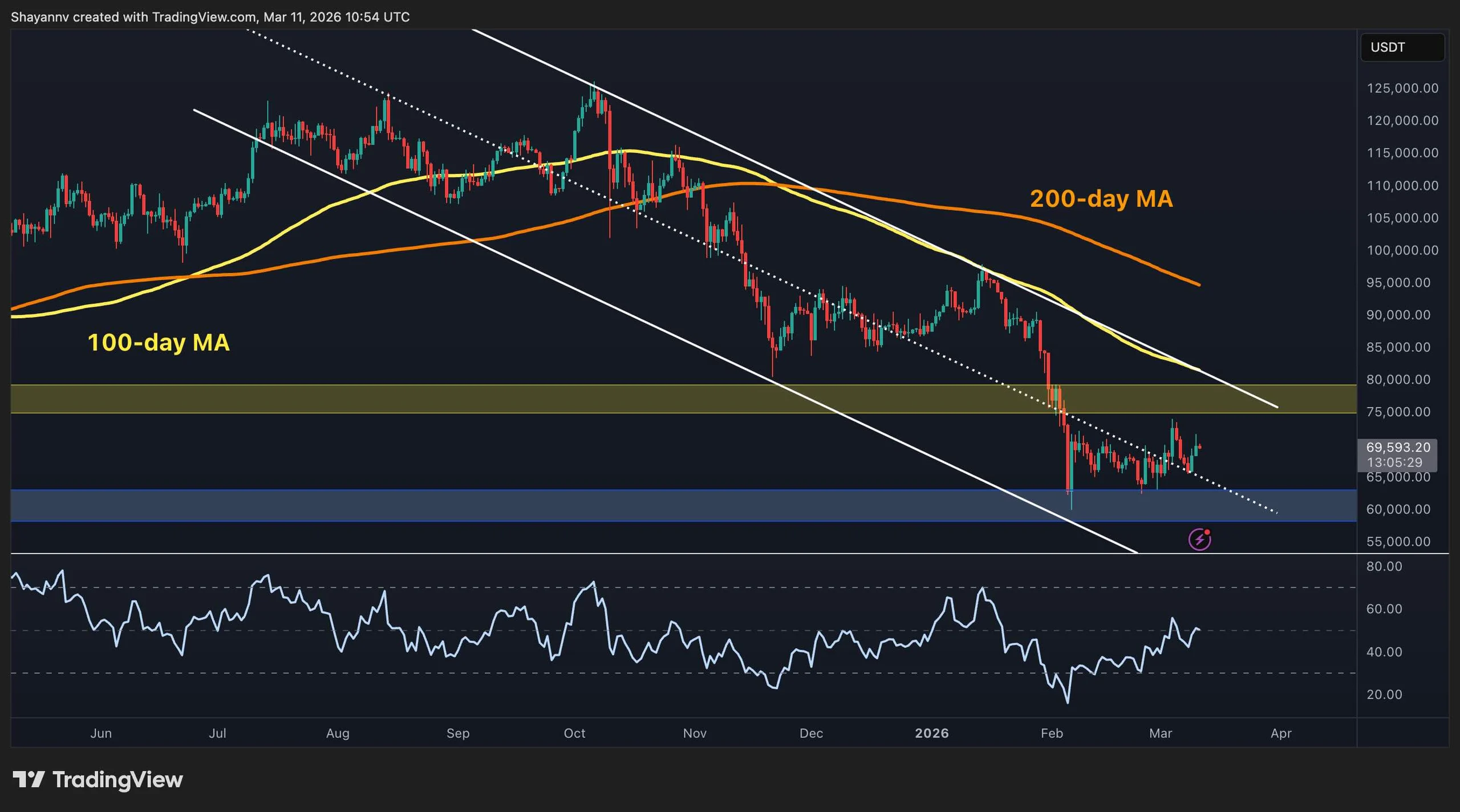
Bitcoin is still trading within a broader bearish market structure, but the recent halt at the $60,000 area shows that buyers are still defending an important support base. Although the recovery has improved short-term conditions, BTC remains below major higher timeframe resistance, which keeps the broader outlook cautious for now.
Bitcoin Price Analysis: The Daily Chart
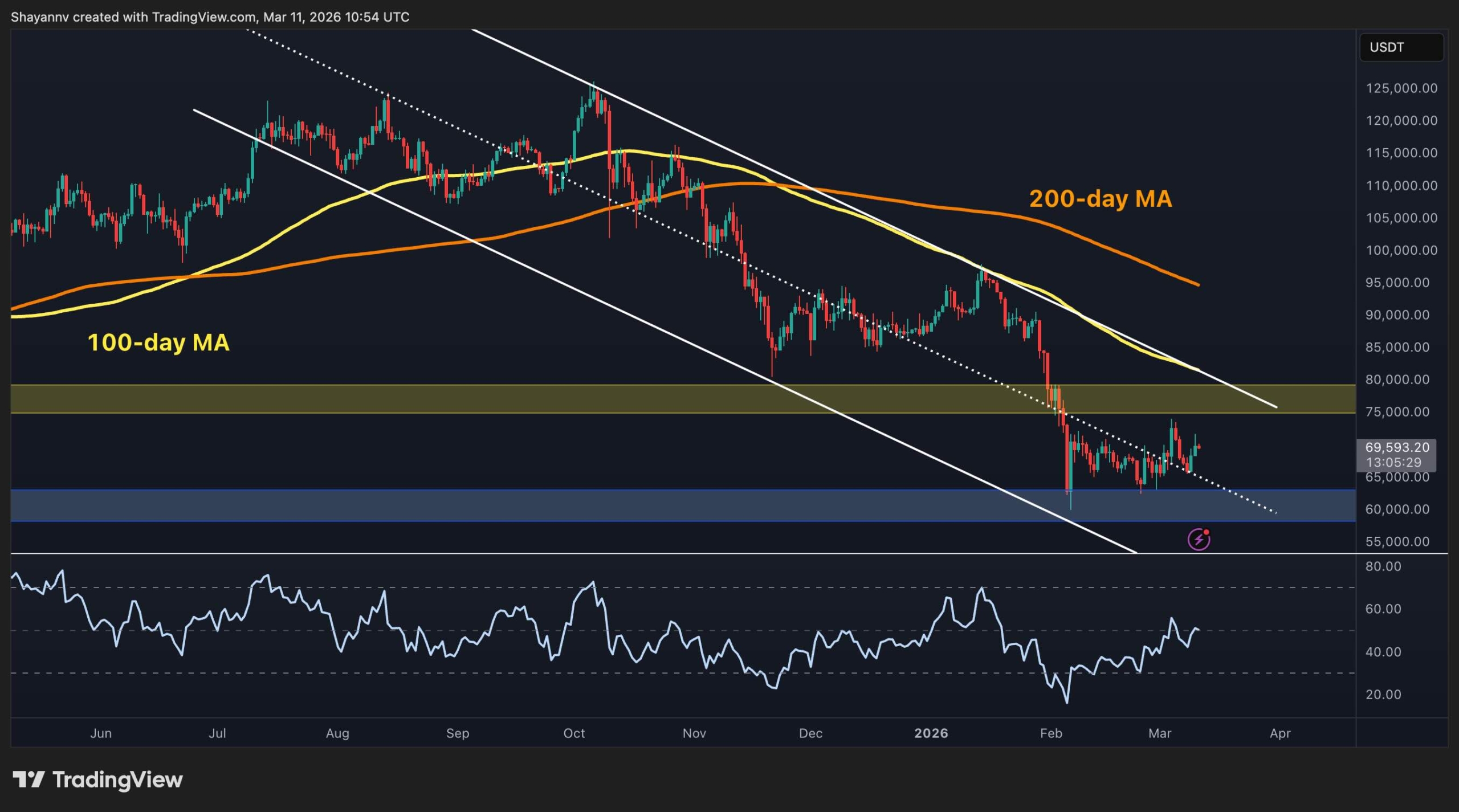
On the daily chart, BTC continues to trade below both the 100-day and 200-day moving averages, keeping the primary trend tilted to the downside. The price also remains beneath the descending channel’s higher trendline that has capped the market for months, which means the latest bounce has not yet changed the broader structure.
The key support zone remains around $60,000, where BTC already reacted well after the sharp sell-off. On the upside, the first major resistance still sits around $75,000 to $80,000, which is now acting as a supply zone. As long as the price stays below that region, rallies are likely to be treated as corrective rebounds inside a larger downtrend.
BTC/USDT 4-Hour Chart
On the 4-hour timeframe, Bitcoin is still moving inside a rising channel, showing that the recovery from the local bottom remains intact in the short term. The asset is now hovering around $69,000 after another push higher, while the lower boundary of the channel continues to provide structure for higher lows.
At the same time, bulls have not yet been able to break through the upper boundary of the formation, which comes in near the $73,000 to $75,000 area and overlaps with a broader resistance zone. The RSI has also recovered toward the upper half of its range, showing improving momentum, but not yet a breakout condition. That leaves the short-term picture constructive, but still dependent on a confirmed move above channel resistance.

Sentiment Analysis
From a sentiment perspective, funding rates have turned negative again after spending most of last year in positive territory. This suggests that derivatives traders have become more cautious and negative and that short positioning has started to increase, even while the price attempts to stabilize above the recent lows.
In practical terms, that kind of reset is not necessarily bearish by itself. In fact, cooling or slightly negative funding often reflects a healthier market backdrop than overcrowded long positioning, especially after a heavy correction. So sentiment currently points to a more balanced setup, where excessive bullish leverage has been washed out, but BTC still needs a clear breakout on the chart to turn that improving sentiment into a stronger bullish continuation.

Binance Free $600 (CryptoPotato Exclusive): Use this link to register a new account and receive $600 exclusive welcome offer on Binance (full details).
LIMITED OFFER for CryptoPotato readers at Bybit: Use this link to register and open a $500 FREE position on any coin!
Disclaimer: Information found on CryptoPotato is those of writers quoted. It does not represent the opinions of CryptoPotato on whether to buy, sell, or hold any investments. You are advised to conduct your own research before making any investment decisions. Use provided information at your own risk. See Disclaimer for more information.
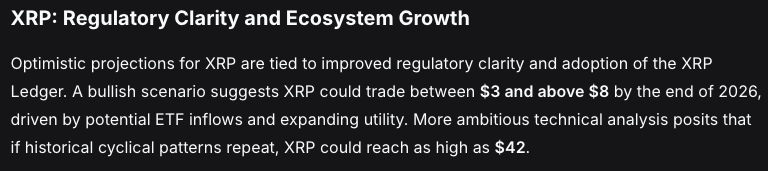
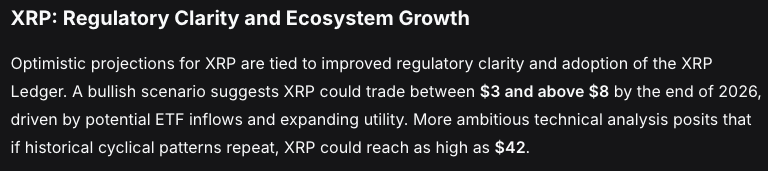
Global geopolitical tensions may be rattling markets, but after some carefully calibrated prompting, DeepSeek AI suggests the three biggest cryptocurrencies could still be heading for a very bullish year.
Its data-driven outlook draws on improving technical indicators, positive industry developments, and a regulatory environment that is slowly becoming clearer.
Here’s why DeepSeek’s predictions are gaining attention.
XRP (XRP): DeepSeek AI Predicts an Explosive Move Soon
In a recent update, Ripple reiterated that XRP ($XRP) remains central to its long-term strategy to transform the XRP Ledger (XRPL) into a global payments infrastructure designed for enterprise adoption.
Ripple designed XRPLedger (XRPL) for extremely fast and low-cost transactions, while giving the network an early advantage in two rapidly expanding sectors: stablecoins and tokenized real-world assets.
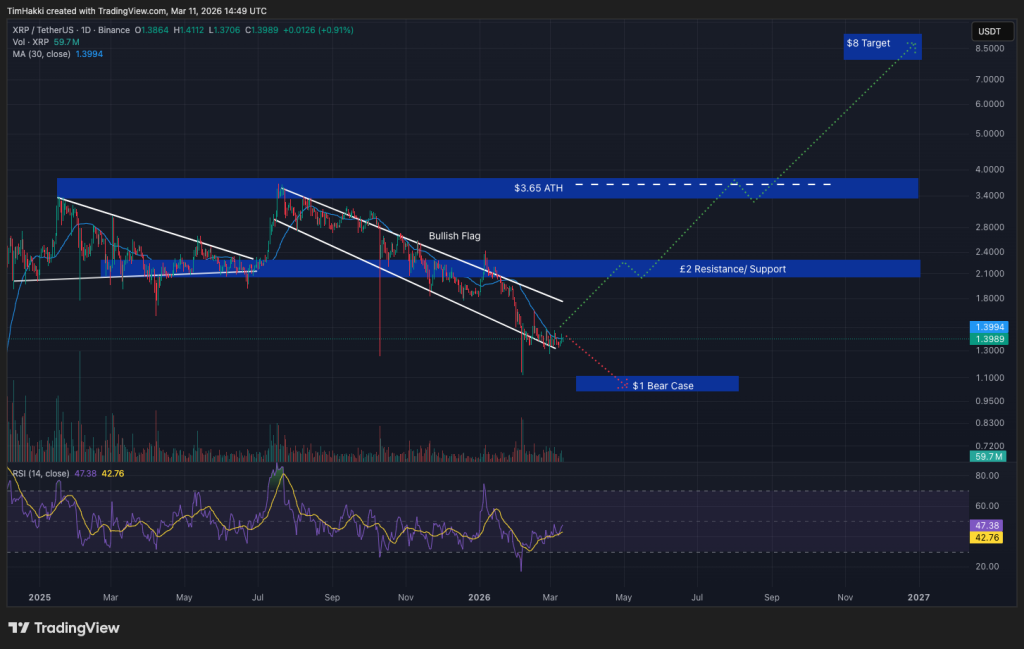
XRP is currently trading around $1.40, and DeepSeek suggests the asset could potentially rise toward $8 before year-end, producing gains of nearly 6x.
Chart patterns also support the possibility of a breakout. XRP forms a bullish flag pattern between recent support and resistance levels, often foreshadowing bullish price action.
It’s mid-to-long-term narrative hinges on continued institutional inflows through recently launched U.S. XRP exchange-traded funds (ETFs), Ripple’s expanding global partnerships, and the possibility that the CLARITY Act could be approved by Congress this year.
Bitcoin (BTC): DeepSeek AI Says Bitcoin Will Be $260k By Christmas
Bitcoin ($BTC) reached an all-time high (ATH) of $126,080 on October 6 before losing nearly half its value in the following months.
Regardless, DeepSeek’s analysis indicates Bitcoin could still be on track for substantial growth, potentially peaking at $266,000 by 2027.
Often referred to as digital gold, Bitcoin continues attracting investors who view it as both a diversification tool and a hedge against inflation and global economic instability.
Bitcoin capitalizes $1.4 trillion of the $2.4 trillion cryptocurrency market. Its recent decline coincided with heightened geopolitical tensions involving the United States, Iran, and Greenland, although the subsequent armed conflict did little to spook investors.
Additionally, if Donald Trump delivers his promise to create a U.S. Strategic Bitcoin Reserve, the “Bitcoin to $1 million” scenario becomes plausible.
Ethereum (ETH): Will Ether Hit Five Digits This Year?
Ethereum ($ETH) is the dominant smart contract platform serving as the backbone of decentralized financ (DeFi).
With a market capitalization approaching $248 billion and around $55 billion TVL, Ethereum is the primary settlement layer blockchain commerce.
The network’s strong security, its leadership in stablecoins, and its growing involvement in real-world asset tokenization all support the case for broader institutional adoption.
However, regulatory clarity plays a critical role in future growth. The passage of the CLARITY Act in the United States could provide the legal framework institutions require before deploying lots of capital on chain.
ETH is currently trading slightly above $2,000. Significant resistance lies at $5,000 range, close to its previous ATH of $4,946.05 recorded last August.
If Ethereum decisively breaks through $5,000, DeepSeek sits it rising to a new high watermark of $7,500.
Maxi Doge: Enter Dogecoin’s Risk-Loving, Hard Pumping Cousin
If a new bull run emerges, meme coins could absorb the most hype, as they historically amplify market price trends.
One new meme coin attracting attention is Maxi Doge ($MAXI). It already raised $4.7 million through its ongoing presale as investors speculate it could eventually challenge BONK, Floki and even Dogecoin.
Maxi Doge introduces himself as Dogecoin’s louder, risk-on gym bro cousin, leaning into the viral “degen” internet culture that helped fuel the meme coin explosion during the 2021 bull market.
MAXI is an ERC-20 asset on Ethereum’s proof-of-stake blockchain, giving it a smaller environmental footprint compared with Dogecoin’s proof-of-work design.
Early presale investors can currently stake MAXI tokens for 67% APY, although those yields gradually decline as the staking pool grows.
MAXI currently sells for $0.0002808, with nominal increases planned through each funding round.
To participate, you can visit the official website and connect a supported wallet such as Best Wallet.
Purchases can also be made using a bank card.
Visit the Official Website Here
The post China’s DeepSeek AI Predicts the Price of XRP, Bitcoin and Ethereum by The End of 2026 appeared first on Cryptonews.
The DEATH BETS Act: Why Lawmakers Are Moving to Shut Down America’s Fastest-Growing Gray Market

Pep Guardiola gives Man City verdict in Real Madrid drubbing – ‘Useless’

A microscope reveals the ghost of analog video hidden inside a LaserDisc


-
Business5 days ago
Form 8K Entergy Mississippi LLC For: 6 March
-

 Tech7 days ago
Bitwarden adds support for passkey login on Windows 11
-

 News Videos3 days ago
10th Algebra | Financial Planning | Question Bank Solution | Board Exam 2026
-

 Fashion5 days ago
Weekend Open Thread: Ann Taylor
-

 Crypto World2 days ago
Paradigm, a16z, Winklevoss Capital, Balaji Srinivasan among investors in ZODL
-
 Tech19 hours ago
A 1,300-Pound NASA Spacecraft To Re-Enter Earth’s Atmosphere
-
 Sports6 days ago
499 runs and 34 sixes later, India beat England to enter T20 World Cup final | Cricket News
-

 Politics6 days ago
Top Mamdani aide takes progressive project to the UK
-

 Business1 day ago
ExxonMobil seeks to move corporate registration from New Jersey to Texas
-

 Sports4 days ago
Three share 2-shot lead entering final round in Hong Kong
-

 Sports4 days ago
Braveheart Lakshya downs Lai in epic battle to enter All England Open final | Other Sports News
-

 NewsBeat8 hours ago
Residents reaction as Shildon murder probe enters second day
-

 NewsBeat6 days ago
Piccadilly Circus just unveiled ‘London’s newest tourist attraction’ and it only costs 80p to enter
-

 Entertainment5 days ago
Hailey Bieber Poses For Sexy Selfies In New Luscious Lip Thirst Traps
-

 Business3 days ago
Search for Nancy Guthrie Enters 37th Day as FBI Probes Wi-Fi Jammer Theory
-

 Business19 hours ago
Search Enters Sixth Week With New Leads in Tucson Abduction Case
-
 NewsBeat2 days ago
Pagazzi Lighting enters administration as 70 jobs lost and 11 stores close across Scotland
-

 Tech2 days ago
Despite challenges, Ireland sixth in EU for board gender diversity
-

 Tech7 days ago
ACIP To Discuss COVID ‘Vaccine Injuries’ Next Month, Despite That Not Being In Its Purview
-

 Business2 days ago
Search Enters 39th Day with FBI Tip Line Developments and No Major Breakthroughs