

Crypto World
Airdrops Fueled Extraction, Ending Real Crypto Communities


Opinion by: Nanak Nihal Khalsa, co-founder of Holonym Foundation
During the last crypto market cycle, airdrops were touted as a way to build community. In practice, they evolved into large-scale value-extraction schemes that rewarded automation and short-term surges over lasting commitment. The result was a structural misalignment: incentives that discouraged genuine belief and rewarded opportunistic behavior, leaving many participants feeling they were part of a competition rather than a community.
Between 2021 and 2024, token launches tended to favor low float and high fully diluted valuations, with point-based programs that rewarded activity more than intention or eligibility. The predictable outcome? Wallets multiplied, engagement was simulated, and shares of future supply were earmarked for rapid exit. Trust eroded as participation became transactional, loyalty proved transient, and governance started to feel like theater. When rewards hinge on volume rather than conviction, rare is the project that yields lasting, substantive communities.
Key takeaways
- Airdrops often functioned as extraction playbooks: low float, high fully diluted valuations, and point programs that rewarded surface-level activity over meaningful commitment.
- Points programs accelerated a race to automate and farm; real users with limited bandwidth were crowded out, undermining the integrity of early distribution.
- Token sales are re-emerging as an alternative distribution model, but with selective access, identity considerations, and allocation caps to curb dominance by automated actors.
- Privacy-preserving identity is being treated as infrastructure—needed to verify unique participation without revealing personal data, balancing openness with protection.
- Wallet design and identity are converging into a single system aimed at resisting manipulation and building longer-term relationships between users and protocols.
From open launches to curated access
The industry is increasingly approaching token launches with a fundamental shift in distribution logic. ICO-style events, once open to anyone with a wallet, exposed the ecosystem to whale dominance, regulatory blind spots, and accountability gaps. Today’s experiments introduce filters and signals designed to identify participants who are likely to stay engaged beyond a single speculative cycle. Identity signals, on-chain behavior analysis, and jurisdiction-aware participation are becoming more common, along with allocation limits intended to prevent runaway concentration.
These changes are not simply about nostalgia for the old days of broad access; they reflect a practical recognition that permissionless distribution without guardrails invites capital leaks to automation and rapid dumping. The aim is to ensure that new tokens reach users who will contribute to long-term health, governance, and stability, rather than a transient crowd animated by hype alone.
In this context, some token launches are edging toward a model where eligibility criteria and access controls are part of the fabric of the protocol, not constraints imposed after the fact. As a result, questions about what constitutes fair access, how to enforce limits, and which signals are trustworthy are moving from footnotes to central design considerations.
Identity, privacy, and the evolution of distribution
One of the most pressing tensions in crypto governance today is how to balance openness with accountability. The industry has spent years promoting permissionless participation, yet the most valuable moments increasingly depend on some form of admission control. Without it, automation can overwhelm the system; with it, there is a risk of recreating surveillance-heavy paradigms many projects sought to escape.
Privacy-preserving identity is emerging as essential infrastructure rather than a philosophical stance. If teams want to limit one person to one allocation, prevent bot-driven governance, and show basic compliance without collecting exhaustive personal dossiers, they need systems that prove properties about participants without revealing who they are. The alternative—full openness or heavy-handed KYC—either invites distortion or erodes trust. The goal is to build a framework where users can prove uniqueness across a suite of applications, maintain consistent accounts, and avoid managing fragile secrets with every new launch.
Related discussions have highlighted real-world frictions, such as Sybil attacks during presales. For example, Cointelegraph noted incidents where presales were hijacked by coordinated wallet clusters, underscoring the need for more robust identity and anti-abuse measures (reference coverage).
Beyond identity, the wallet layer itself remains a critical choke point. Fragmented accounts, recovery fragilities, and browser-based signing vulnerabilities amplify the risk of hacks, loss of access, and post-launch attrition. When distribution hinges on tools that are brittle or spoofable, the resulting ecosystem inherits those weaknesses. A more holistic design—where identity, wallets, and distribution are treated as an interconnected system—appears increasingly necessary for durable participation rather than one-off events.
Several projects are pursuing this integrated approach: a user could demonstrate uniqueness without doxing, transact across apps with a single, coherent account, and control sensitive data without exposing themselves to unnecessary risks. If these pieces lock into a coherent architecture, distribution may evolve from a single launch moment into an ongoing relationship, with participants who care enough to stay, contribute, and govern.
Ultimately, the shift is less about who gets in and more about shaping sustainable alignment. Projects that emphasize human-centric design—fewer, more engaged participants who remain for the long run—tend to show stronger retention, healthier governance participation, and more resilient markets. This is not a matter of ideology; it is observable in how users engage once incentives are aligned with genuine belief rather than short-term gain.
Looking ahead, the winners will be those that treat distribution as infrastructure rather than marketing. They will bake in defense against automation, design for provable integrity, and view identity as a tool to protect both users and ecosystems. Some friction, thoughtfully applied, can be a feature that sustains engagement rather than a barrier to entry.
Airdrops did not fail because users are inherently greedy. They failed because the system rewarded greed while penalizing commitment. If crypto wants broader, healthier adoption, it must shift incentives toward belonging and long-term value creation, not ephemeral wins. Token launches, as a visible facet of this evolution, will reveal who can translate that philosophy into durable practice.
Related context: For a contemporary look at how these dynamics play out in live launches, recent coverage highlights ongoing debates around identity, access, and control in new token distributions.
Author note: Nanak Nihal Khalsa is the co-founder of Holonym Foundation, focused on privacy-respecting, user-centric infrastructure for decentralized ecosystems.

Crypto World
Payward Files OCC Trust Charter Application to Advance Kraken’s Federal Crypto Custody Push

TLDR:
-
- Payward filed for an OCC national trust charter to establish a federally regulated crypto custody entity called PNTC.
- The proposed PNTC would serve institutional clients requiring bank-level custody protections under direct OCC oversight.
- Kraken Financial remains the first digital-asset bank to secure a Federal Reserve master account since 2020.
- Payward’s multi-charter strategy pairs its Wyoming SPDI with the proposed OCC trust charter for broader regulatory coverage.
- Payward filed for an OCC national trust charter to establish a federally regulated crypto custody entity called PNTC.
Payward, the parent company of Kraken, has applied for a national trust company charter with the OCC. The move aims to build a federally regulated digital asset custody entity for institutional clients.
Kraken Pursues Federal Oversight Through OCC Application
If approved, the charter would establish Payward National Trust Company (PNTC). This new entity would focus on fiduciary custody and related digital asset services.
The trust would primarily serve institutions seeking bank-level custody protections. It would operate under direct OCC oversight, adding federal legitimacy to Kraken’s regulated framework.
The application marks a deliberate step in Payward’s U.S. regulatory expansion strategy. Crypto firms have increasingly pursued traditional financial charters to attract institutional clients.
PNTC would rely on Payward’s existing compliance, risk management, and custody infrastructure. This structure is designed to extend access to clients requiring a federally regulated qualified custodian.
Co-CEO Arjun Sethi addressed the rationale behind the application directly. “A national trust company provides the certainty institutions require,” Sethi stated.
He further noted that it “establishes the infrastructure to build the next generation of custody.” His comments point to a deliberate push to serve institutional clients at the federal level.
National trust charters overseen by the OCC have been pursued by crypto-native firms before. These charters offer broader legitimacy and nationwide operations.
They also reduce reliance on state-by-state licensing, which can be fragmented and inconsistent. Payward’s application reflects this broader industry trend toward federal regulatory frameworks.
Kraken Builds Multi-Charter Strategy Alongside Major Acquisitions
The OCC application builds on the foundation of Kraken Financial’s Wyoming SPDI charter, granted in 2020. Kraken Financial was the first digital-asset bank to secure a Federal Reserve master account.
That access gave it a direct link to the U.S. payments system. Sethi described the Wyoming SPDI and prospective OCC trust charter as “complementary pillars” of Payward’s banking strategy.
Payward has also pursued growth through a series of major acquisitions. In 2025, it acquired retail futures platform NinjaTrader for $1.5 billion.
In April, Payward agreed to acquire crypto derivatives exchange Bitnomial for up to $550 million. That deal adds a full suite of CFTC licenses covering brokerage, clearing, and exchange operations.
This week, Payward also announced a $600 million deal to acquire Hong Kong-based payments firm Reap Technologies.
The deal expands Kraken’s presence in stablecoin-powered cross-border payments. It also strengthens Kraken’s card infrastructure across Asia. Together, these moves reflect Kraken’s preparation for a potential IPO.
The U.S. regulatory climate under the current administration has become more industry-friendly toward digital assets. This shift has encouraged crypto firms to seek federal charters, licenses, and banking approvals.
Payward’s approach aligns with this environment, positioning Kraken as a fully regulated financial institution. The OCC application is the latest step in that direction.

The White House says voluntary partnerships, not strict mandates, are the right approach to AI regulation.
Summary
- The White House released its National AI Policy Framework in March 2026, favoring voluntary tech agreements over prescriptive federal rules.
- The framework directs Congress to preempt state AI laws deemed to impose undue burdens on innovation and industry.
- Democratic lawmakers introduced the GUARDRAILS Act to block federal preemption and preserve state authority over AI oversight.
The Trump administration released its National Policy Framework for AI regulation in March 2026, built around voluntary industry agreements rather than top-down mandates.
The framework signals a move away from prescriptive regulation toward an innovation-friendly approach, positioning itself as a clear alternative to the European Union’s AI Act.
The framework cites a March 2026 Ratepayer Protection Pledge, a voluntary agreement signed by major technology companies not to raise electricity bills for households, as a model for the partnership-first approach it prefers over binding rules. The administration’s central premise is that US leadership in AI depends on uniform national standards, not a growing patchwork of state laws.
Federal preemption versus state authority
The framework outlines six objectives: protecting children online, safeguarding against AI harms, respecting intellectual property, preventing AI censorship, promoting innovation, and developing an AI-ready workforce.
It calls on Congress to adopt legislation broadly preempting state AI laws deemed to impose undue burdens, while preserving state authority over consumer protection, child safety, and fraud. Critics argue the approach could hollow out oversight of high-risk AI systems in healthcare, employment, and housing.
Democrats pushed back directly. Representative Beyer and colleagues introduced the GUARDRAILS Act on March 20, 2026, which would repeal the Trump administration’s AI executive order and block any federal moratorium on state AI regulation. Senator Schatz is expected to introduce companion legislation in the Senate.
What changes and what does not
The framework does not itself create new legal obligations or direct agencies to take specific regulatory action. State AI laws remain in effect unless and until Congress passes new legislation or courts strike them down.
Colorado’s comprehensive AI law is scheduled to take effect on June 30, 2026. California’s AI Transparency Act and Texas’s Responsible AI Governance Act are already in force, each imposing disclosure and governance requirements on companies deploying AI in consequential decisions.
The CFTC has separately deployed AI tools to fill regulatory surveillance gaps as Washington’s broader framework battle plays out. The administration has not said whether it will challenge active state laws directly, leaving companies navigating two parallel and potentially conflicting regulatory tracks.

A campaign pushing the Swiss National Bank to add Bitcoin to its reserves is set to end after supporters failed to collect enough signatures for a referendum under Switzerland’s constitutional rules despite months of outreach and public campaigning efforts.
Campaigners were given 18 months to collect 100,000 valid signatures to propose a constitutional amendment that would have obligated the central bank to hold Bitcoin alongside gold and foreign currency reserves. However, with the deadline approaching, the Bitcoin Initiative said it had secured only around half the required number.
Major Setback in Reserve Campaign
In a statement to Reuters, campaign founder Yves Bennaim acknowledged the effort faced difficult odds from the beginning and said the initiative would now be allowed to expire.
Despite the setback, he noted that the campaign had helped advance discussion around the cryptocurrency’s role in the financial system. The SNB has consistently opposed the idea of holding cryptocurrencies in its reserves, with its main point of contention being that digital assets remain too volatile and lack the market liquidity needed for reserve management.
The central bank has also maintained that reserve assets must allow it to quickly expand or reduce its balance sheet when necessary while preserving long-term value. Although some central banks have explored exposure to digital assets, approaches vary widely.
The Czech National Bank, for instance, purchased about $1 million worth of cryptocurrency and blockchain-related assets last year as part of efforts to better understand digital markets. The European Central Bank (ECB), on the other hand, has remained cautious and stressed that reserve assets must remain secure, safe, and liquid.
Last month, Taiwanese lawmaker Dr. Ko Ju-Chun proposed adding Bitcoin to the country’s national reserves during a Legislative Yuan session attended by senior officials. The proposal cited concerns over Taiwan’s heavy reliance on US dollar reserves and suggested Bitcoin could serve as a strategic hedge despite the central bank’s earlier concerns about volatility and custody risks.
Zooming Out
The debate around Bitcoin reserves comes as the market continues to face volatility. BTC recently dropped below $80,000 after briefly reaching fresh multi-month highs earlier this week. The asset is now down more than 36% from its all-time high recorded last year.
Meanwhile, geopolitical tensions added to market caution following conflicting reports claiming Iran had attacked a US Navy vessel in the Strait of Hormuz.
The post Swiss Bitcoin Reserve Dream Collapses After Signature Campaign Falls Short: Report appeared first on CryptoPotato.


Since the start of the 2026 Iran war, Bitcoin has outperformed gold by roughly 35–36% on a relative basis, as BTC rose mid‑single digits while gold slipped and the BTC/gold ratio surged.
Summary
- Since the start of the 2026 Iran war, Bitcoin has outpaced gold by about 35–36% on a relative basis, as the BTC/gold ratio surged.
- BTC is up roughly 7–10% over the conflict period, while gold has been flat to down, a sharp reversal of the traditional “gold as safe haven” pattern.
- Analysts say ETF inflows, the “digital gold” narrative, and macro positioning helped Bitcoin behave more like a risk‑sensitive alternative store of value than a classic crisis hedge.
Data from multiple market trackers show that since the escalation of the U.S.–Israel–Iran conflict on 28 February 2026, Bitcoin (BTC) has materially outperformed gold. Binance’s research feed put it bluntly in early May: “Bitcoin is outperforming gold by 36% since the start of the Iran conflict,” referring to the change in the BTC/XAU ratio rather than just absolute price moves.
BTC/gold ratio jumps as war escalates
A mid‑March analysis from Fortune noted that “since the start of the war, the original cryptocurrency is up about 7%, and on Wednesday was trading at around $71,000,” while gold was “nearly unchanged at about $5,240 an ounce.” Later work from Korea Economic Daily, summarized by Bloomingbit, found that Bitcoin rose about 7% in March while gold fell more than 3%, widening the performance gap as the conflict dragged on.
CryptoNews.net’s recap of the period shows a similar pattern with slightly sharper numbers: at the onset of war, when Donald Trump ordered U.S. forces to join Israeli strikes, BTC was around $65,492 and gold near $5,279 an ounce; by March 23, Bitcoin had rallied to $70,700 while gold had slumped to roughly $4,300. That implies BTC up about 8% versus gold down around 18%, and a rapid rise in the BTC/gold ratio.
First real “war test” for Bitcoin as macro asset
What is different this time is not just that Bitcoin outperformed, but that it did so during a live shooting war where traditional safe havens usually dominate. A detailed explainer from Phemex argued that the Iran conflict was “the first real‑world stress test for Bitcoin as a portfolio‑level safe haven,” noting that over the first 16 days BTC outperformed gold by 9 percentage points and even outpaced the S&P 500 and Nasdaq.
JPMorgan analysts, quoted by RootData and The Block, observed that during the war “Bitcoin outperformed gold and silver, showing signs of inflows and increased activity, while precious metals faced significant outflows and position liquidations.” They pointed to nearly $11 billion in gold ETF outflows and a full reversal of prior silver ETF inflows, versus net inflows into Bitcoin products. That aligns with earlier crypto.news coverage in a story on how bitcoin and ethereum outpaced metals and equities in March, as spot BTC ETFs in the U.S. kept absorbing institutional demand even amid geopolitical tension.
Capital.com’s breakdown, summarized in the Economic Times, stressed that BTC still traded like a high‑beta macro asset in the initial hours after the first strikes — plunging from about $66,000 to $63,000 as over $128 billion in crypto market cap was erased, while gold jumped. But over the full conflict window, Bitcoin recovered and moved higher, supported by ETF dip‑buying, short‑covering, and renewed interest in the “digital gold” narrative, while gold’s early spike faded under the weight of a stronger dollar and rising real yields.
For now, the scoreboard is clear: during the Iran war’s first months, a portfolio long BTC and short gold would have outperformed a classic “own gold in a crisis” stance by roughly a third. Whether that holds in the next geopolitical shock is an open question — but this episode has given Bitcoin one of the strongest empirical arguments yet for its role as a competing macro hedge.


From his prison cell at FCI Lompoc, Sam Bankman-Fried (SBF) is running the same Donald Trump-cheerleading play that Pam Bondi ran right before Trump fired her. He’s joined Bondi on team “Dow 50K.”
The convicted FTX fraudster’s proxy-run X account posted on Wednesday that the S&P 500 had hit a record level of 7,365. The index, the ex-FTX CEO claimed, had rallied an impressive 22.8% since Trump’s second inauguration.
At the corresponding time during Joe Biden’s presidency, it was up just 7%.
The post pulled more than 1.5 million views and tagged @realDonaldTrump, as nearly all of SBF’s recent posts do.
It is a near-perfect echo of the rhetorical move that turned Bondi’s glaze into a meme.
At her February 2026 House Judiciary hearing on the Department of Justice’s handling of the Jeffrey Epstein files, the then-US attorney general abruptly pivoted away from questions about the files.
Instead of responding, she started reciting stock index prices instead, reminding lawmakers that the Dow Jones Industrial Average index was over 50,000, the S&P near 7,000, and that Americans’ 401(k) retirement accounts were “booming.”
The clip of her desperate attempt to defend Trump went viral.
Dow 50K became a meme
Despite her attempts to defend Trump amid a Congressional inquiry into her own mismanagement, Trump fired her on April 2.
SBF is serving 25 years for stealing roughly $8 billion from FTX customers. Despite Trump’s repeated denials to pardon him, he’s apparently undeterred, including by Bondi’s cautionary tale.
The former FTX head’s post yesterday isn’t a one-off occurrence.
For weeks, he’s been posting similar Trump-Biden comparisons. On April 27, his account wrote that the S&P had hit 7,174. The breakdown was 19.6% under Trump versus 8.6% at the same point under Biden.
The format was identical to yesterday’s post. So was the implicit pitch.
Read more: Sam Bankman-Fried had a plan to get out of prison, and he’s following it
Like Pam Bondi, SBF glazes to an audience of one
That pitch is, of course, for a presidential pardon.
SBF’s parents, both former Stanford Law professors, have reportedly lobbied figures in Trump’s orbit for a pardon or clemency since last year. The president declined that proposition in a January New York Times interview, and a White House spokesperson restated his denial to Fortune a month later.
Lawmakers from both parties have described the plea as dead on arrival.
None of these headwinds have slowed SBF’s proxy-posts to his 1 million followers, however. The output of his comments from prison, since February, has converged on a single editorial line. Namely, that everything is better under Trump.
SBF still has 18 years left to serve of his sentence.
Got a tip? Send us an email securely via Protos Leaks. For more informed news and investigations, follow us on X, Bluesky, and Google News, or subscribe to our YouTube channel.
A $1.75 trillion IPO is about to redefine which space stocks to watch this summer. SpaceX is closing in on the largest IPO ever. The public S-1 is due late May, with the listing slated for late June or early July.
When SpaceX publishes real launch costs and Starlink economics, the entire sector gets repriced against the same yardstick. Three names stand out as the cleanest read-through points.
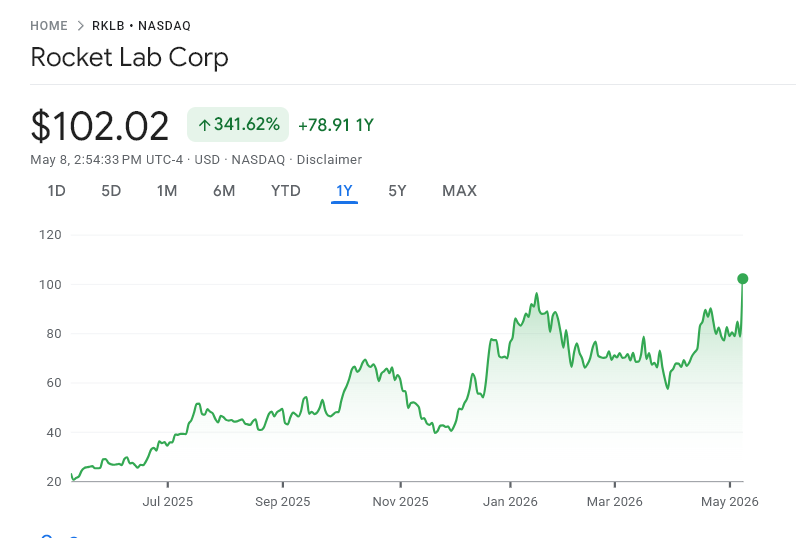
Rocket Lab (NASDAQ: RKLB)
Rocket Lab Corporation (RKLB) is the closest public comparison to SpaceX, building launch vehicles, spacecraft, and components in-house. The SpaceX IPO matters here.
The S-1 is the SEC document required before going public. SpaceX filed confidentially on April 1, with the public version due late May.
When it lands, SpaceX’s launch revenue, costs, and Starlink margins go on display for the first time. RKLB is the only publicly traded company doing similar work. When investors see SpaceX’s real numbers, RKLB gets repriced against them.
Want more insights like this? Sign up for Editor Harsh Notariya’s Daily Newsletter here.
Fundamentals look strong. Q1 revenue hit $200.3 million (+63.5% YoY), backlog reached $2.2 billion, and liquidity exceeded $2 billion.
The stock fell 7.17% to $78.58 anyway, as profit-taking on a 240% YoY run outweighed a Q2 guidance beat.
RKLB sits inside a rising channel that has held since late November. The recent top was rejected at $94.40 (0.618 Fibonacci). Price hugs the 20-day exponential moving average (EMA) at $78.96.
EMAs weight recent prices most heavily, while the 50-day EMA sits at $75.52.
The last clean break of the 20-day EMA on March 26 produced a 19.31% slide. A repeat opens $70.71, then $62.45 (200-day EMA), then $56.08 (channel floor).

Options lean the other way. The volume put-call ratio sits at 0.53 versus 0.73 at the last -$0.07 print. Open interest holds at 0.77. Traders buy calls into the IPO window despite the miss.

A reclaim of $87.08 opens $94.40 and the breakout zone above $104.81.

Among space stocks to watch, RKLB sets up the cleanest move into the SpaceX listing.
AST SpaceMobile (NASDAQ: ASTS)
AST SpaceMobile, Inc. (ASTS) builds the only US satellite network that connects directly to standard smartphones. AT&T, Verizon, and FirstNet are anchor partners.
That positioning maps to the part of SpaceX nobody can price yet: Starlink direct-to-cell. When SpaceX’s S-1 publishes Starlink’s subscriber count and revenue per customer, the market gets its first benchmark for ASTS.
BlueBird 7, one of ASTS’s direct-to-cell satellites, failed to reach orbit on April 20. The miss puts the 45-satellite year-end target at risk. ASTS announced a mid-June Falcon 9 launch for BlueBird 8-10, set to overlap with the SpaceX roadshow week.
ASTS closed at $65.35 on May 7, down 7.54%, with earnings due Monday after close.
ASTS has fallen 51.27% from its February 2 high of $129.78. Current support is $63.25. Above price, the 200-day EMA sits at $73.53, the 20-day at $76.20, and the 50/100-day cluster sits at $82.40-$82.50.
Two bearish crossovers loom. The 50-day EMA is closing in on the 100-day, and the 20-day EMA is closing in on the 200-day. A break of $63.25 opens $58.40, then $45.95.

Options lean the other way. The volume put-call ratio dropped from 0.62 to 0.45 since early April, while open interest fell from 0.49 to 0.42. With earnings on Monday and implied volatility at 112.55%, traders bet on a positive surprise.

For ASTS to reset the trend, it needs to reclaim $68.17, $81.90, and $82.40. A move above $104.12 invalidates the bearishness. Among space stocks to watch, ASTS is the higher-risk pick into the SpaceX listing.
Intuitive Machines (NASDAQ: LUNR)
Intuitive Machines, Inc. (LUNR) builds lunar landers and runs NASA’s Near Space Network, sharing the Artemis program with SpaceX.
The SpaceX IPO angle here is profitability. LUNR is the only listed pure-play stock guiding to positive adjusted EBITDA in 2026. When SpaceX’s S-1 reveals Starlink’s profit economics, the market hunts for the next stock with that profile.
LUNR closed at $24.11 on May 7, down 8.43%. The company guides 2026 revenue of $900 million to $1 billion, almost 5x FY25, with positive adjusted EBITDA. Q1 results land on May 14.
LUNR has held a rising channel since mid-November. A breakout attempt failed on April 22, and the price has weakened since. The recent pullback pushed LUNR below the 20-day EMA at $24.92 on May 7.
The critical floor is $22.71, and the 50-day EMA is at $22.61, just below. Breaking those levels opens deeper losses. The first upside hurdle is $32.21 (0.618 Fibonacci). A clean break sets up a channel breakout.
The Chaikin Money Flow (CMF) measures institutional inflows and outflows. CMF sits at -0.01, just below the zero line. April 1 set the precedent. CMF crossed zero alongside a 20-day EMA reclaim, and LUNR rallied 71.15% in days.

Earnings on May 14 are the trigger. A CMF cross with a 20-day EMA reclaim can replay April 1 into the SpaceX listing. Among space stocks to watch, LUNR offers the cleanest profitability story.
The post 3 Space Stocks To Watch Amid Elon Musk’s SpaceX IPO Hype appeared first on BeInCrypto.
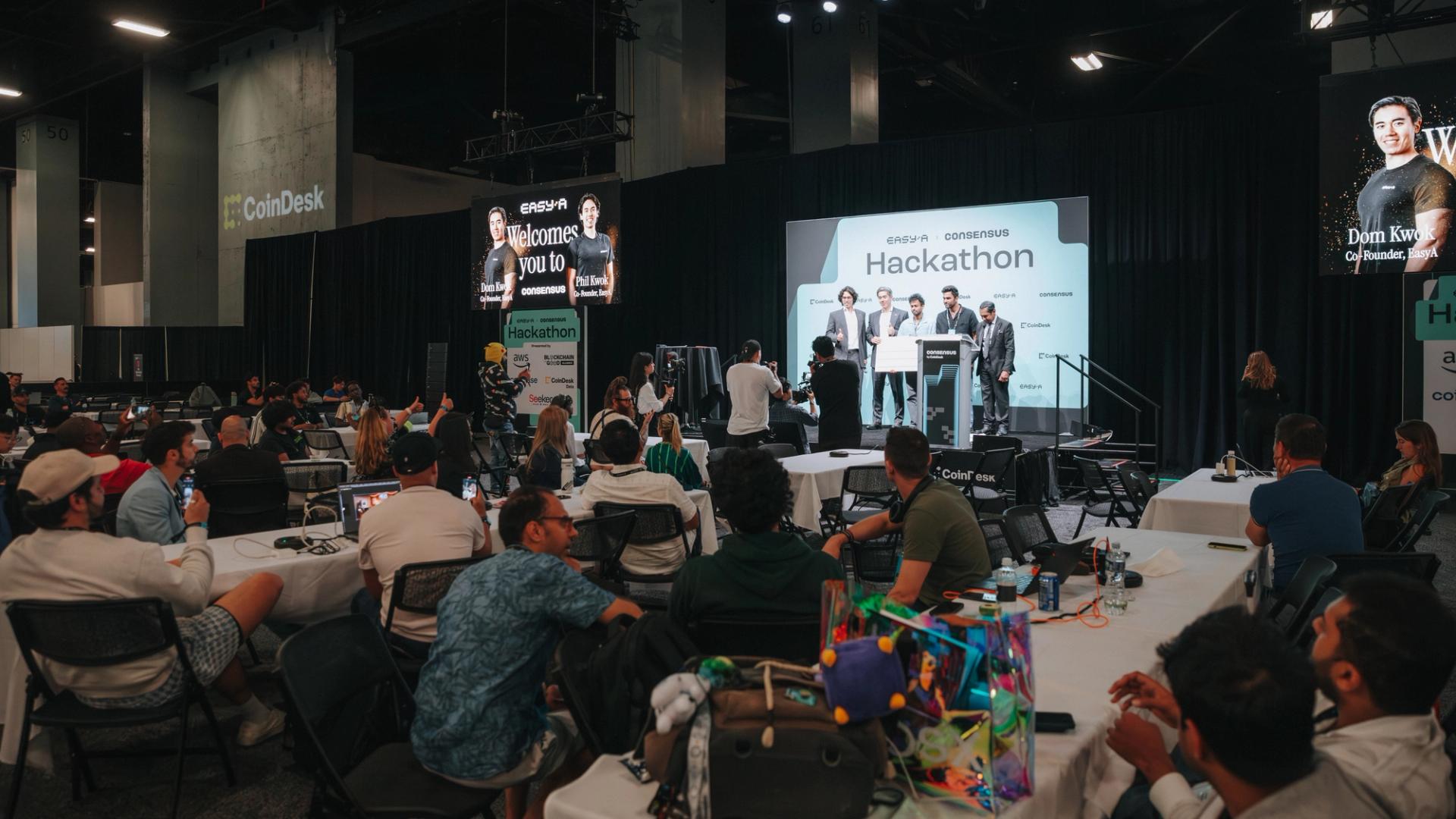
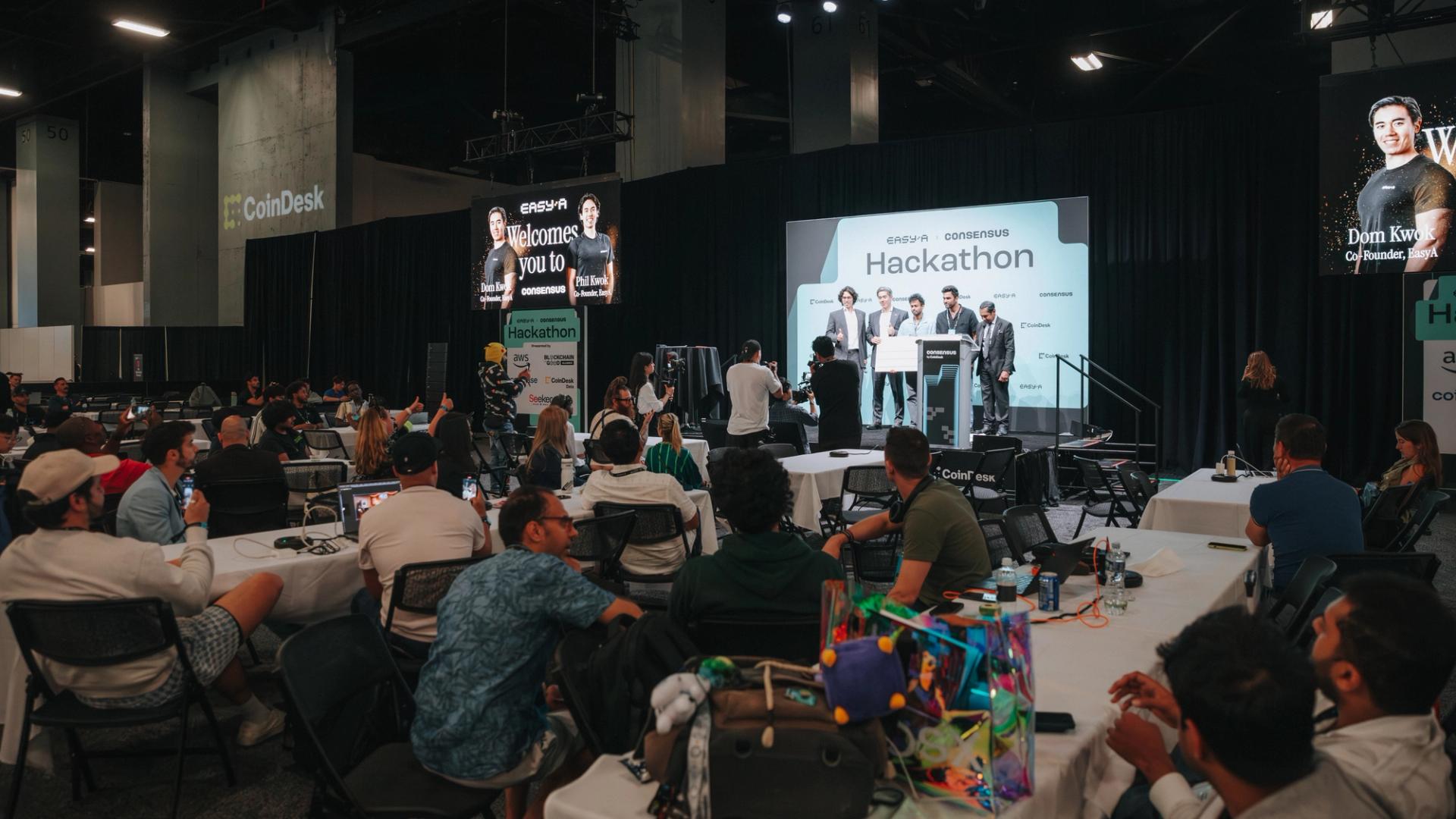
MIAMI BEACH, Fla. — At the EasyA Hackathon tucked inside Consensus Miami 2026, the energy felt less like a traditional crypto developer event and more like a live audition for the next generation of the intersection of blockchain and AI-native startups.
Nearly 1,000 developers competed at the venue, some from established crypto ecosystems like Base and Solana, and others arriving from companies like Microsoft and Google, all racing to build products around one theme that kept surfacing in conversation after conversation: AI agents.
The focus on AI agents had already emerged earlier this year at the EasyA x Consensus Hong Kong hackathon, where organizers described 2026 as the “Year of the Application Layer” as developers increasingly shifted from infrastructure tools toward AI-powered consumer applications and autonomous agents.
For brothers Dom and Philip Kwok, co-founders of EasyA, that evolution is exactly the point. What began as a small hackathon series in Austin, Texas, during Consensus 2023 has quickly transformed into one of crypto’s most closely watched builder gatherings, attracting young passionate developers with increasingly teams with serious technical pedigrees.
Their ambition for the event is bluntly simple. “We want billion-dollar companies coming out of EasyA,” Dom Kwok said during an interview with CoinDesk at the hackathon floor. “We’ve already had, out of our other hackathons, a $10 billion company.”
That success story has become part of EasyA lore. One Harvard team that pitched at a previous EasyA event went on to found “Permission AI,” which the Kwoks say is now valued at roughly $10 billion. Another former participant, Axel, is building stablecoin yield products backed by bitcoin.
Other alumni have reportedly gone through Y Combinator, raised from top venture firms and processed hundreds of millions in transactions. The message to developers walking through the Miami event was clear: this is no longer just a couple-days coding competition, it’s increasingly being framed as a launchpad for venture-scale companies.
This year, however, the center of gravity has unmistakably shifted toward agentic AI. Coinbase sponsored challenges around x402, an emerging framework developers are experimenting with for AI-agent payments and interactions, while Solana and Solana Mobile pushed teams toward mobile-first applications and consumer experiences.
“Lots of developers [are] really excited about AI agentic workloads,” Dom said, pointing to the recent wave of massive venture funding flowing into AI-agent infrastructure startups.
Some of the projects already circulating around the venue reflected how far builders are stretching the category. One team called Praxis was working on blockchain-connected drones controllable through smartphones, what the brothers described as “the next Palantir on the blockchain.” Another startup was building what they called “hyper-intelligent AI,” software designed to turn text prompts into physical 3D objects. “You could put in a prompt and say, ‘Build me a microscope,’ and it will actually build it for you,” Phil said. “It’s like the next phase of taking ChatGPT from something informational into something embodied.”
The winners:
The judges rewarded projects that pushed AI agents beyond chatbots and into real-world coordination, automation and commerce, whether through hardware, payments infrastructure or consumer-facing apps. Across the different sponsor tracks, the winning teams reflected the broader shift underway at this year’s hackathon: developers were no longer just building crypto tools, they were building products meant for everyday use. Prizes differed per track, and are still pending on how they will be divied up in each category.
Kickstart Track ($50,000):
First place: FlyPraxis
Taking the top spot in the Kickstart track was FlyPraxis, a real-time drone intelligence platform designed for military operators. The team pitched the project as “Palantir, but in real time,” using AI-powered coordination and live battlefield intelligence to manage autonomous drone systems.
Second place: HIIE
HIIE placed second with a platform that turns text prompts into fully buildable hardware products. Using AI agents to manage everything from physics calculations and component sourcing to 3D CAD generation and assembly documentation, the startup aimed to compress months of hardware prototyping into a single workflow.
Third place: Clan World
Clan World rounded out the top three in the Kickstart track, joining a broader wave of teams experimenting with AI-native coordination and community-driven applications.
Solana Mobile Track ($30,000 + $75,000 worth of Solana phones)
First place: Parabola
In the Solana Mobile track, first place went to Parabola, a decentralized prediction and estimation market built on Solana. The platform allows users to speculate on real-world events through a distribution-based AMM model designed for mobile-native trading experiences.
Second place: Snakr
Snakr took second place with an AI-powered food intelligence app that lets shoppers scan products to identify potential health risks, FDA recalls and ingredient concerns. Users can also contribute missing product information and earn Solana-based rewards in return.
Third place: Rhythym
Third place winner Rhythym focused on productivity and accessibility, building a mobile routine-support app aimed at helping users with executive dysfunction complete daily tasks. The app integrates with Solana’s Seeker phone, Nova 2 Lite and x402 infrastructure to create AI-assisted workflows.
Coinbase / AWS Track ($45,000)
First place: Dairy Price API x402
The Coinbase and AWS track centered heavily on AI-agent payments and autonomous commerce. The winning project, Dairy Price API x402, built a pay-per-call commodity pricing and forecasting service that allows AI agents to access dairy market data without traditional API keys. Payments are settled directly in USDC through x402 on Base.
Second place: AgentPay
AgentPay placed second with a payment coordination system that gives users one-tap approval over AI-agent transactions while using AWS-powered risk validation to ensure agents spend funds responsibly.
Third place: Giggy
Giggy took third place for building a marketplace where users can hire AI agents to perform research tasks. Payments are locked in crypto escrow on Base, while the agents themselves can pay for premium APIs through x402-powered transactions.
Runner up: Chainlens
Chainlens focused on trust and verification for autonomous systems, building an x402-compatible layer that connects AI agents to verified APIs and only releases payment once responses are authenticated.
Read more: AI-powered agents dominate the EasyA x Consensus Hong Kong hackathon
Key points:
- Bitcoin needs to hold above $78,000 to avoid a trend reversal and return to $80,000 as resistance.
- Altcoin buyers have left the scene, keeping in step with Bitcoin’s slight correction.
Bitcoin (BTC) pulled back near $79,000 on Friday, but buying at lower levels pushed the price toward $80,000. The next big question on traders’ minds is whether BTC will resume its uptrend or higher levels will again attract aggressive selling from bears.
CryptoQuant analyst IT Tech said in a Thursday QuickTake note that BTC needs to rally and maintain above $88,880 for a bottom to be confirmed. Until then, the $85,000 to $88,000 range is likely to see selling by buyers who want to “get out flat.”
However, Bollinger Bands creator John Bollinger has a different view. In an X post on Thursday, Bollinger said that their trend model had turned positive for BTC a day earlier and they had taken a position accordingly.

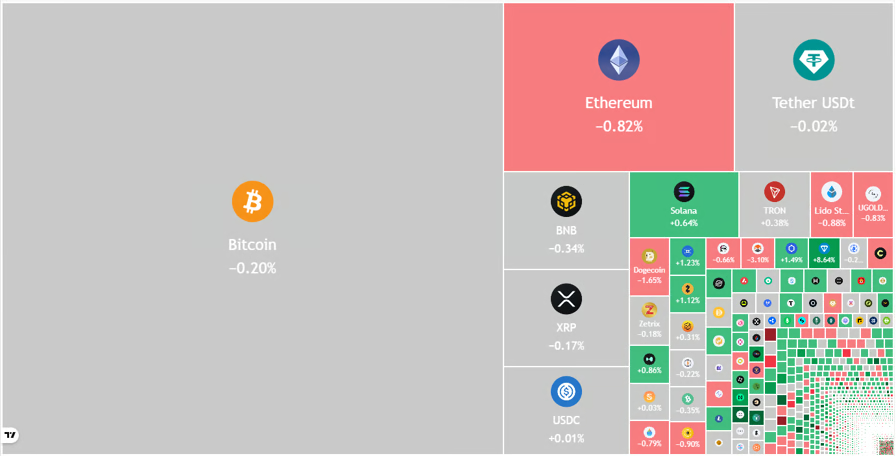
Crypto market data daily view. Source: TradingView
Among all the positives, a minor negative for the bulls is that BTC exchange-traded funds recorded $277.5 million in outflows on Thursday. That was the first net outflow in May, according to SoSoValue data. That suggests select investors have turned cautious and are booking profits near overhead resistance levels.
Could BTC and the major altcoins bounce off their support levels? Let’s analyze the charts of the top 10 cryptocurrencies to find out.
Bitcoin price prediction
BTC pulled back from $82,850 on Wednesday, signaling that the bears are fiercely defending the $84,000 overhead resistance.

BTC/USDT daily chart. Source: Cointelegraph/TradingView
The 20-day exponential moving average ($77,929) is the critical support to watch out for on the downside. If the BTC price rebounds off the 20-day EMA with strength, it signals that the bulls are buying on every minor dip. That improves the prospects of a break above the $84,000 level. If that happens, the BTC/USDT pair may skyrocket to $92,000, then to $97,924.
Sellers are likely to have other plans. They will strive to defend the $84,000 level and yank the price below $74,937. If they manage to do that, the pair may tumble to the 50-day simple moving average ($73,448) and then to the support line.
Ether price prediction
Ether (ETH) closed below the 20-day EMA ($2,304) on Wednesday, indicating that the bulls are booking profits.

ETH/USDT daily chart. Source: Cointelegraph/TradingView
The next stop on the downside is the 50-day SMA ($2,225), followed by the support line. A solid rebound off the support line suggests the ETH/USDT pair may remain within the channel for a few more days.
The first sign of strength will be a break and close above $2,465. The pair may then rise to the resistance line, where the bears are expected to step in. However, if the bulls prevail, the ETH price may soar to $3,050.
BNB price prediction
BNB (BNB) has pulled back toward the moving averages, suggesting bears are selling on minor rallies.

BNB/USDT daily chart. Source: Cointelegraph/TradingView
If the BNB price bounces off the moving averages with force, it increases the likelihood of a rally to the $687 level. Sellers will attempt to keep the price within the $ 570 to $ 687 range by defending the overhead resistance.
On the other hand, a break and close above the $687 signals that the bulls are back in the driver’s seat. The BNB/USDT pair may rise to $730 and then to $790. Sellers are expected to pose a strong challenge at the $790 level.
XRP price prediction
XRP (XRP) continues to trade near the moving averages, indicating a state of equilibrium between the buyers and sellers.

XRP/USDT daily chart. Source: Cointelegraph/TradingView
The flattish moving averages and the RSI just below the midpoint do not give either bulls or bears a clear advantage. If the price turns down and breaks below the $1.27 level, the XRP/USDT pair may remain inside the descending channel pattern for a few more days.
On the upside, the bulls are expected to encounter stiff resistance at the downtrend line and then at the $1.61 level. Buyers will have to overcome the $1.61 barrier to signal a potential trend change. The XRP price may then rally to $2.
Solana price prediction
Solana (SOL) is facing selling pressure at the $90.73 level, but a positive for the bulls is that they have not ceded much ground to the bears.

SOL/USDT daily chart. Source: Cointelegraph/TradingView
The bulls will again attempt to push the SOL price above $90.73. If they succeed, the SOL/USDT pair may surge to $98. Sellers are expected to vigorously defend the $98 level, as a close above it may catapult the pair to $117.
Contrary to this assumption, if the price turns down and breaks below the moving averages, it suggests that the pair may remain inside the tight range for a while longer. A break below the $82.65 level opens the doors for a fall to $76.
Dogecoin price prediction
Dogecoin (DOGE) declined sharply from the $0.12 resistance level on Wednesday, indicating profit-taking by short-term traders.

DOGE/USDT daily chart. Source: Cointelegraph/TradingView
The 20-day EMA ($0.10) is the critical support level to watch in the near term. If the DOGE price turns up sharply from the 20-day EMA, the bulls will again attempt to pierce the $0.12 resistance. If they manage to do that, the DOGE/USDT pair may rally to $0.14, then to $0.16.
Conversely, a break and close below the 20-day EMA suggest that the pair may remain within the $0.09 to $0.12 range for a few more days.
Hyperliquid price prediction
Hyperliquid (HYPE) turned down from the $43.76 to $45.77 zone on Wednesday, indicating aggressive selling by the bears.

HYPE/USDT daily chart. Source: Cointelegraph/TradingView
The HYPE price pulled back to the 20-day EMA ($41.69), an important level to watch. If the price turns up sharply from the 20-day EMA, the bulls will again endeavor to clear the overhead hurdle. If they manage to do that, the HYPE/USDT pair may surge to $50.
This bullish view will be invalidated in the near term if the price continues lower and breaks below the 50-day SMA ($40.29). The pair may then descend to $34.45.
Related: Four signs that show Ethereum’s rally is exhausted at $2.4K
Cardano price prediction
Cardano (ADA) continues to oscillate within the broad range of $0.22 to $0.31, indicating a balance between supply and demand.

ADA/USDT daily chart. Source: Cointelegraph/TradingView
The 20-day EMA ($0.25) has begun to turn up gradually, and the RSI is in positive territory, indicating a slight edge for the bulls. If the price turns up above the moving averages, the bulls will attempt to drive the ADA/USDT pair to $0.30 and, later, to the stiff overhead resistance at $0.31.
Contrarily, a break below the moving averages suggests that the bulls are losing their grip. The bears will then strive to pull the ADA price to the $0.22 support.
Zcash price prediction
Zcash (ZEC) broke above the $560 resistance on Wednesday, but the bears stalled the rally at $607.

ZEC/USDT daily chart. Source: Cointelegraph/TradingView
The shallow pullback is a positive sign, as it indicates the bulls are not rushing to close their positions. That improves the prospects of the continuation of the uptrend. If the ZEC/USDT pair breaks above $607, the next target is likely $750.
On the downside, support lies at the 38.2% Fibonacci retracement level at $496, then at the 50% retracement level at $462. Sellers will be back in the driver’s seat on a close below the 61.8% retracement level of $428.
Bitcoin Cash price prediction
Bitcoin Cash (BCH) turned down sharply from $486 on Wednesday, suggesting bears are aggressively defending the level.

BCH/USDT daily chart. Source: Cointelegraph/TradingView
The flattish 20-day EMA ($450) and the RSI near the midpoint suggest that the BCH/USDT pair may remain inside the $419 to $486 range for some more time.
The next trending move is expected to begin on a close above $486 or below $419. If buyers secure a close above $486, the BCH price may start an up move to $520. Alternatively, a close below the $419 support signals the resumption of the next leg of the downtrend toward $375.
A four-firm pilot settling the first cross-border, cross-bank redemption of tokenized U.S. Treasuries on the XRP Ledger extended a rally sparked by Ondo’s seat at the DTCC’s tokenization table.

Activity on the Ripple (XRP) network has dropped sharply since late 2024, according to the latest findings by blockchain analytics firm Glassnode.
In fact, new XRP addresses fell from around 18,000 per day in December 2024 to 2,700 per day currently, which represents an 85% decline.
Network Growth
Over the same period, monthly active supply also dropped from 7.45 billion XRP/day to nearly 2 billion XRP. Glassnode explained that the speculative momentum that drove the asset’s late-2024 rally has largely faded at the network level.
While on-chain activity has weakened, recent market data also reveals a notable change in terms of whale behavior around XRP. CryptoQuant found that XRP inflows from whales to Binance have dropped to their lowest level since November 2021. The analytics firm said the 30-day cumulative inflow metric previously climbed to nearly 2.6 billion XRP in early March, which evidenced heavy transfers from large holders to the exchange. Since then, the figure has steadily declined to around 736 million XRP.
Large transfers to exchanges are commonly associated with potential selling activity or portfolio adjustments by major investors. The continued decline in inflows during broader market volatility indicates that whale-related selling pressure has eased significantly in recent months.
Rebound Setup
Amid the decline in whale inflows, Ali Martinez observed a potential short-term recovery signal for XRP. The TD Sequential indicator reportedly flashed a buy signal on XRP’s 4-hour chart, a setup that has accurately identified several recent trend reversals, as per the analyst. He referenced a sell signal that appeared near the $1.46 level on May 6, which was followed by a 5% correction over the next two days.
According to Martinez, the latest buy signal means that the recent local exhaustion phase may be ending, which opens the possibility for a rebound toward the $1.45 resistance level. He further identified $1.80 as a secondary upside target if the crypto asset manages to break above overhead supply zones.
The post Ripple (XRP) Activity Crashes 85%: Here’s What the Latest On-Chain Data Reveals appeared first on CryptoPotato.

Forgotten Man City sensation faces pivotal summer

Piaggio & C. SpA 2026 Q1 – Results – Earnings Call Presentation (OTCMKTS:PGGCY) 2026-05-08
Payward Files OCC Trust Charter Application to Advance Kraken’s Federal Crypto Custody Push

Manchester United reach agreement with Casemiro over contract clause amid transfer speculation

US brings back mandatory military draft registration

Steven Gerrard disagrees with Gary Neville over ‘shock’ Chelsea and Arsenal claim | Football


-

 NewsBeat5 days ago
Channel 5 – All Creatures Great and Small series 7 new post
-
 Crypto World11 hours ago
HarrisX Poll Found 52% of Registered Voters Support the CLARITY Act
-

 Crypto World1 day ago
Upbit adds B3 Korean won pair as Base token gains Korea access
-
 NewsBeat2 days ago
NCP car park operator enters administration putting 340 UK sites at risk of closure
-

 Tech4 days ago
Image AI models now drive app growth, beating chatbot upgrades
-

 Entertainment7 days ago
Met Gala 2026 Rumored Guest List Is Turning Heads
-

 Entertainment7 days ago
Kylie Jenner Hit With Second Lawsuit From Ex-Housekeeper
-

 Sports7 days ago
Cavaliers vs. Raptors Game 6 live score, updates, highlights from 2026 NBA playoffs first-round series
-

 Entertainment7 days ago
Young and the Restless Next Week: Cane Arrested & Matt’s Deadly New Scheme!
-
Entertainment6 days ago
New Netflix Movies in May 2026 — My Top 3 Picks to Stream
-

 Entertainment6 days ago
Melissa Joan Hart and More Stars Attend 2026 Kentucky Derby
-
 Sports7 days ago
David Benavidez responds to team Canelo saying the fight will never happen
-
 Sports7 days ago
IPL 2026: ‘Love you darling’- Hardik Pandya’s reaction to MS Dhoni steals the show |Watch | Cricket News
-
Entertainment6 days ago
Anna Nicole Smith’s Daughter Attends 2026 Kentucky Derby
-
Crypto World6 days ago
Pi Network Mandates Protocol 23 Upgrade for All Mainnet Nodes Before May 15 Deadline
-

 Business6 days ago
Luka Doncic Injury Update: Doncic’s Hamstring Recovery Slows Lakers’ Hopes Against Thunder: Can He Run Yet?
-

 Business7 days ago
Can Victor Wembanyama Bring the NBA Ring to Spurs in 2026? Historic Playoff Run Fuels Title Dreams
-

 Sports7 days ago
Plane crash in Wimberley, Texas kills 5 pickleball players at tournament
-
Entertainment6 days ago
Venus Williams’ Best Met Gala Looks Over the Years
-

 Crypto World6 days ago
Bitcoin mining equities rise in 2026 as BTC lags behind
You must be logged in to post a comment Login