

Crypto World
Alsobrooks says Clarity Act needs ethics deal before Senate vote



Latest developments: Sen. Angela Alsobrooks said she will not support the Clarity Act on the Senate floor unless negotiators reach agreement on ethics provisions and other outstanding issues.
- Alsobrooks said ethics concerns remain a major sticking point, alongside illicit finance provisions and work still needed in the Agriculture Committee.
- She characterized her committee vote advancing the bill as support for continued bipartisan negotiations, not unconditional support for final passage.
- “We’re almost there, but not quite there yet,” Alsobrooks said of the negotiations.
- Alsobrooks joined Rebecca Rettig and Renato Mariotti on CoinDesk’s The Policy Protocol.
The compromise: Alsobrooks defended the stablecoin yield language that drew criticism from JPMorgan Chase CEO Jamie Dimon and parts of the banking industry.
- She said she was among the first senators to raise concerns that allowing interest-bearing stablecoins could trigger deposit flight from community banks.
- According to Alsobrooks, negotiators spent roughly nine months crafting language that bars crypto firms from paying yield solely on stablecoin balances and prevents firms from offering products that mimic bank accounts without bank-like protections.
- She argued the final compromise balances industry innovation with consumer and banking-sector protections, even if neither side is fully satisfied.
Why it matters: Alsobrooks framed crypto regulation as a response to growing consumer adoption rather than a speculative future policy debate.
- She noted that tens of millions of Americans already own cryptocurrency and said lawmakers have a responsibility to establish consumer protections.
- The senator argued that digital assets represent an economic opportunity many younger Americans believe they need as traditional paths to wealth become less attainable.
- She said the goal is to ensure the U.S. remains a leader in digital asset innovation while protecting consumers from harm.
Reading between the lines: Alsobrooks suggested Democratic skepticism toward crypto legislation is driven less by the technology itself than by concerns about corruption, ethics and fraud.
- She pointed to concerns involving President Trump’s business interests and broader questions about ethics in the digital asset space.
- She said many lawmakers remain focused on preventing scams and strengthening protections for consumers who have already suffered losses.
- Alsobrooks argued that remaining engaged in negotiations is the best way to ensure constituents have a voice in shaping the final rules.
What comes next: The senator outlined a short list of priorities needed to move the legislation across the finish line.
- Negotiators must finalize ethics provisions acceptable to both parties.
- Lawmakers are still working through illicit finance language championed by Sen. Catherine Cortez Masto.
- The Agriculture Committee must also reach a bipartisan agreement before final Senate consideration can proceed.


HashKey Holdings says it has consolidated its exchange operations into a single user-facing platform, bringing together what were previously separate apps for different regions. In an announcement released Monday, the Hong Kong digital asset services firm said customers across Hong Kong, “Global,” Singapore, and the Middle East (Dubai) will use the same application—while compliance controls are handled according to each jurisdiction’s legal requirements.
The update reflects a broader shift away from early “regional silo” exchange models, where licensing and front-end products were often kept separate to reduce compliance complexity. HashKey’s approach is built around a principle it describes as “unified entry, localized compliance.”
Key takeaways
- HashKey has merged its HashKey Exchange and HashKey Global into one platform and one application for users across multiple regions.
- The front-end experience is centralized, while regulatory compliance is managed based on each customer’s legislative domain.
- HashKey frames the change as a move from earlier jurisdiction-by-jurisdiction exchange silos toward a unified model.
- Other major exchanges have implemented similar structures, though with different ways of routing users to local legal entities.
One app across regions, with compliance tailored locally
HashKey said it has consolidated core jurisdictional hubs—including Hong Kong, Singapore, the Middle East (Dubai), and Bermuda—under a single platform and application. While the firm’s statement emphasizes that the “front-end” is unified, it also stresses that the system is designed to remain compliant with local frameworks by managing compliance requirements in line with each user’s jurisdiction.
Under HashKey’s model, users download the same application, but the platform applies localized compliance handling across the Hong Kong, Global, Singapore, and Middle East regions. In practical terms, that means the product experience is simpler to access, even though the legal and regulatory obligations still differ by geography.
Why unified platforms are becoming more common
HashKey’s announcement positions the merger as an evolution from the early days of virtual asset trading. In those early stages, many licensed exchanges operated through regional silos—separate platforms, separate apps, and often separate operational setups—to make it easier to compartmentalize compliance.
According to HashKey, its updated structure is intended to preserve compliance benefits while reducing friction for users who operate across or move between markets. The promise is a single front-end that can simplify access to systems expected to remain aligned with local regulatory requirements, as compliance is managed within the platform rather than through separate customer-facing products.
For traders and liquidity providers, a unified application can also reduce the risk of confusion around which interface, account type, or supported features apply in different jurisdictions. For the operator, it can streamline development and user onboarding workflows by consolidating the customer entry point while maintaining jurisdiction-specific controls in the background.
How this compares with other exchanges’ structures
HashKey is not alone in moving toward centralized user experiences paired with jurisdiction-specific legal coverage.
As one comparison, the article notes that OKX presents its website and mobile apps as one platform. However, OKX’s terms reportedly assign customers to different providers based on residence. In other words, the customer-facing “one app” concept is paired with a legal routing layer that maps users to the appropriate entity depending on where they are.
Kraken provides another example. The announcement referenced that Kraken consolidated a Dutch broker entity—BCM—into its platform after acquiring it in September 2024. Kraken has also expanded its European offering through a MiCA structure: the firm reportedly began serving the EEA through its Irish MiCA entity in August, suggesting that compliance alignment is achieved within a unified operational framework.
These comparisons underscore that while the “single platform” idea is spreading, implementations can differ. The key variable is how an exchange ties a unified front-end to jurisdiction-appropriate regulatory responsibility—whether by assigning users to distinct providers behind the scenes or by applying compliance processes localized to each customer’s jurisdiction.
What users should watch after the consolidation
HashKey’s transition to a single application across multiple regions raises questions that matter most to customers: how onboarding flows will change, how jurisdiction-specific feature access will be reflected in the user experience, and whether account management will remain seamless when users interact with region-specific compliance requirements.
For regulators and industry observers, the merger is also a useful test case for whether exchanges can maintain strong compliance controls while consolidating products and codebases—an approach that could become more attractive as regulatory regimes mature and operational efficiency becomes a competitive differentiator.
Readers should watch for further details on the rollout mechanics, such as how HashKey handles user migration from previously separate platforms and how the unified app communicates jurisdiction-dependent limitations, if any. As the exchange environment continues to tighten, the ability to centralize the user interface without diluting regulatory obligations will likely be a key measure of operational readiness.


More than a dozen digital asset treasury companies have moved into artificial intelligence and data centres as falling crypto prices weaken demand for the DAT model.
Summary
- More than a dozen crypto treasury companies have pivoted toward AI as investor enthusiasm fades.
- K Wave shares fell 71% after its data-centre shift failed to restore market confidence quickly.
- Falling crypto prices and compressed treasury premiums are pushing listed firms toward new operating businesses.
Bloomberg reported that the shifts have not stopped steep share declines.
K Wave Media has fallen about 71% since its May pivot. Lixte Biotechnology and Alpha Compute have each dropped roughly 33% since announcing their own changes. The figures measure performance after the pivots and do not prove causation.
Digital asset treasury premiums shrink
Digital asset treasury companies use public equity, debt or private placements to buy crypto. The model works best when investors value the company above its token holdings. That premium lets management issue shares and buy more assets.
The structure becomes harder to maintain when crypto prices fall or the stock trades near or below net asset value. New share sales become less attractive, while debt costs remain. VanEck said in January that several DATs faced net asset value discounts, increasing pressure for consolidation and new strategies.
A Bloomberg-syndicated report quoted Renno & Co managing partner Toufic Adlouni as saying the “vast majority are trying to switch gears or are dead or dying.” That is one adviser’s assessment, not a formal count. Still, the pivots show that several boards no longer view crypto accumulation alone as enough.
K Wave abandons its Bitcoin plan
K Wave announced on May 4 that it could redirect up to $485 million from a Bitcoin treasury agreement into data centres, GPU rental operations and AI acquisitions. The plan also included selling its legacy unit and removing about $48 million in debt and related liabilities.
The stock fell almost 25% on the first trading day after the announcement, as crypto.news previously reported. Bloomberg later placed the decline at about 71% from the May reboot. K Wave then sold its remaining 88 BTC to repay $6 million of debt, ending a campaign that once targeted 10,000 BTC.
K Wave said the transformation would build a scalable platform across data centres and computing. That claim remains forward-looking. The company has not yet shown that the new business can replace the investor interest once attached to its Bitcoin plan.
Lixte and Alpha Compute choose new businesses
Lixte entered the DAT market in 2025 by buying 10.5 BTC and 300 ETH for about $2.6 million. The company said crypto represented roughly 43.6% of its treasury and authorised an allocation of up to 50%.
In June 2026, Lixte agreed to acquire NOMAD Transportable Power Systems and said it planned to become NOMAD Power Solutions. The proposed business would provide mobile battery storage for data centres facing grid delays. Bloomberg reported that Lixte shares fell about 33% after the announcement.
AlphaTON Capital launched a Toncoin treasury strategy in September 2025, targeting about $100 million in TON and Telegram infrastructure. It rebranded as Alpha Compute in April 2026 and shifted toward GPU services, confidential computing and AI infrastructure.
Bloomberg said Alpha Compute shares have fallen about 33% since the rebrand. The company has reported AI contracts and acquisitions, but a new sector label has not restored its treasury premium.
AI offers revenue but demands more capital
AI data centres can produce revenue through computing contracts, hosting and power supply. That differs from a treasury model that relies mainly on asset appreciation and capital-market access. Crypto miners have also moved toward AI because they already control power connections, buildings and cooling equipment.
However, AI infrastructure requires heavy upfront spending, electricity, specialised chips and long customer contracts. Companies that struggled to fund crypto purchases may face similar limits. Battery systems, space projects and small modular reactors also involve long development periods and regulatory risk.
Related crypto.news coverage found that the treasury-company group has shifted from accumulation toward selective asset sales. K Wave exited Bitcoin, while Empery Digital sold part of its holdings to fund an AI data-centre strategy. Some treasury stocks traded at or below their crypto asset value as investors stopped paying large premiums for the corporate structure.
The pivots do not mean every DAT will leave crypto. Larger companies may continue raising capital and holding tokens. For smaller firms, AI offers an operating-revenue story. Early share-price results show that markets still want evidence of funding, customers and execution before rewarding the change.
Crypto World
TRX Futures Listing Launches on Bitnomial, Broadening Regulated U.S. Derivatives Access to TRON

TRON DAO, the community-governed DAO dedicated to accelerating the decentralization of the internet through blockchain technology and decentralized applications (dApps), today announced the futures listing of TRX, the native utility token of the TRON network, on Bitnomial, a CFTC-regulated U.S. exchange and clearinghouse.
The new futures listing introduces a regulated derivatives market for TRX, the native utility token of the TRON network, giving eligible U.S. traders and institutions an additional way to manage exposure through exchange-traded futures. The listing represents continued progress in the development of regulated financial products tied to the TRON ecosystem.
TRX powers activity across the TRON blockchain, including transaction fees, smart contract execution, decentralized applications, and on-chain governance. The network has become a leading platform for stablecoin settlement, supporting more than $90 billion in circulating USDT and over $26 billion in total value locked (TVL), while processing billions of transactions across its global user base.
“The launch of the TRX futures contract on Bitnomial expands the ways market participants can access and manage exposure to the TRON ecosystem through a regulated U.S. venue,” said Justin Sun, Founder of TRON. “As digital assets become more integrated into traditional financial markets, regulated products like TRX futures help provide market participants with additional tools to access and manage exposure to blockchain-based assets.”
“TRX is one of the largest digital assets by market capitalization, backed by one of the most established networks in crypto, and now has a regulated US futures market to match, live today on Bitnomial Exchange,” said Michael Dunn, President of Bitnomial Exchange. “Institutions and traders can hedge and express views on TRX with portfolio margining across positions and settlement through Bitnomial Clearinghouse. Additionally, six months of trading history on a CFTC-regulated futures market meets a key milestone for enabling spot ETFs under the SEC’s generic listing standards.”
Bitnomial, LLC, headquartered in Chicago, is a derivatives exchange company that owns and operates U.S. CFTC-regulated exchange (DCM), clearinghouse (DCO), and clearing brokerage (FCM) subsidiaries. Bitnomial offers leveraged spot, perpetuals, futures, options, and prediction markets on a single unified exchange and clearinghouse with digital asset margin and settlement capabilities.
The launch of TRX futures follows Bitnomial’s earlier introduction of spot trading for TRX, expanding the range of regulated products available for the asset within the U.S. market. It also builds on broader institutional momentum for the TRON ecosystem, including the availability of TRX custody and staking through Anchorage Digital, the first federally chartered crypto bank in the United States.
As demand for regulated digital asset products continues to increase, the availability of TRX futures on Bitnomial offers market participants additional tools for trading and portfolio management while further connecting the TRON ecosystem with traditional financial markets.
All Bitnomial futures contracts are offered by, and subject to the rules of, Bitnomial Exchange, LLC.
About TRON DAO
TRON DAO is a community-governed DAO dedicated to accelerating the decentralization of the internet via blockchain technology and dApps.
Founded in September 2017, the TRON blockchain has experienced significant growth since its MainNet launch in May 2018. Until recently, TRON hosted the largest circulating supply of USD Tether (USDT) stablecoin, which currently exceeds $90 billion. As of July 2026, the TRON blockchain has recorded over 395 million in total user accounts, more than 14 billion in total transactions, and over $27 billion in total value locked (TVL), based on TRONSCAN. Recognized as the global settlement layer for stablecoin transactions and everyday purchases with proven success, TRON is “Moving Trillions, Empowering Billions.”
TRONNetwork | TRONDAO | X | YouTube | Telegram | Discord | Reddit | GitHub | Medium | Forum
About Bitnomial, LLC
Bitnomial, LLC, headquartered in Chicago, is a derivatives exchange company that owns and operates U.S. CFTC-regulated exchange (DCM), clearinghouse (DCO), and clearing brokerage (FCM) subsidiaries. Bitnomial offers leveraged spot, perpetuals, futures, options, and prediction markets on a single unified exchange and clearinghouse with digital asset margin and settlement capabilities.
The post TRX Futures Listing Launches on Bitnomial, Broadening Regulated U.S. Derivatives Access to TRON appeared first on BeInCrypto.
Crypto researchers claim crypto exchange BitMart is processing withdrawals at a dramatically slow rate after it announced plans to shut down its operations next year.
BitMart claimed that after assessing its “operating conditions, market environment, and future strategic direction,” its operations would cease to exist on January 31, 2027 — a decision at odds with its seemingly bullish outlook.
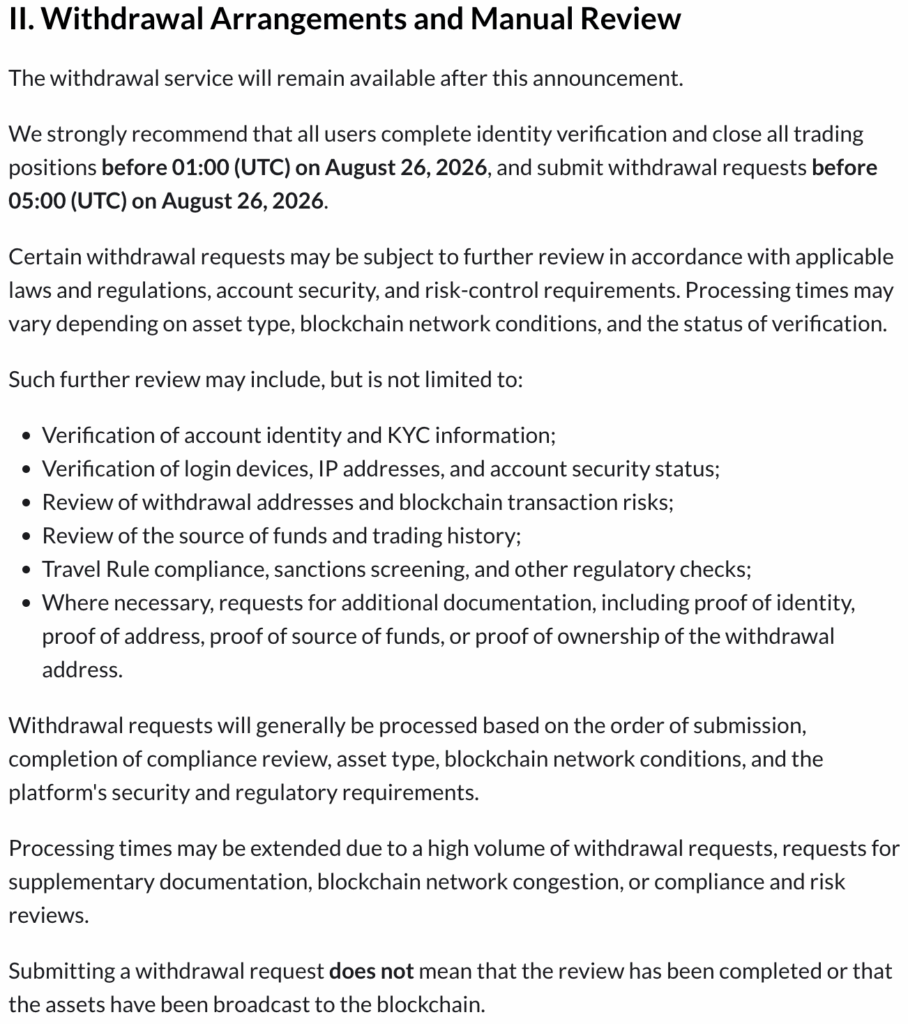
Deposits, new account registrations, and new trades have already been disabled, and by August 21, all services will cease except for withdrawals.
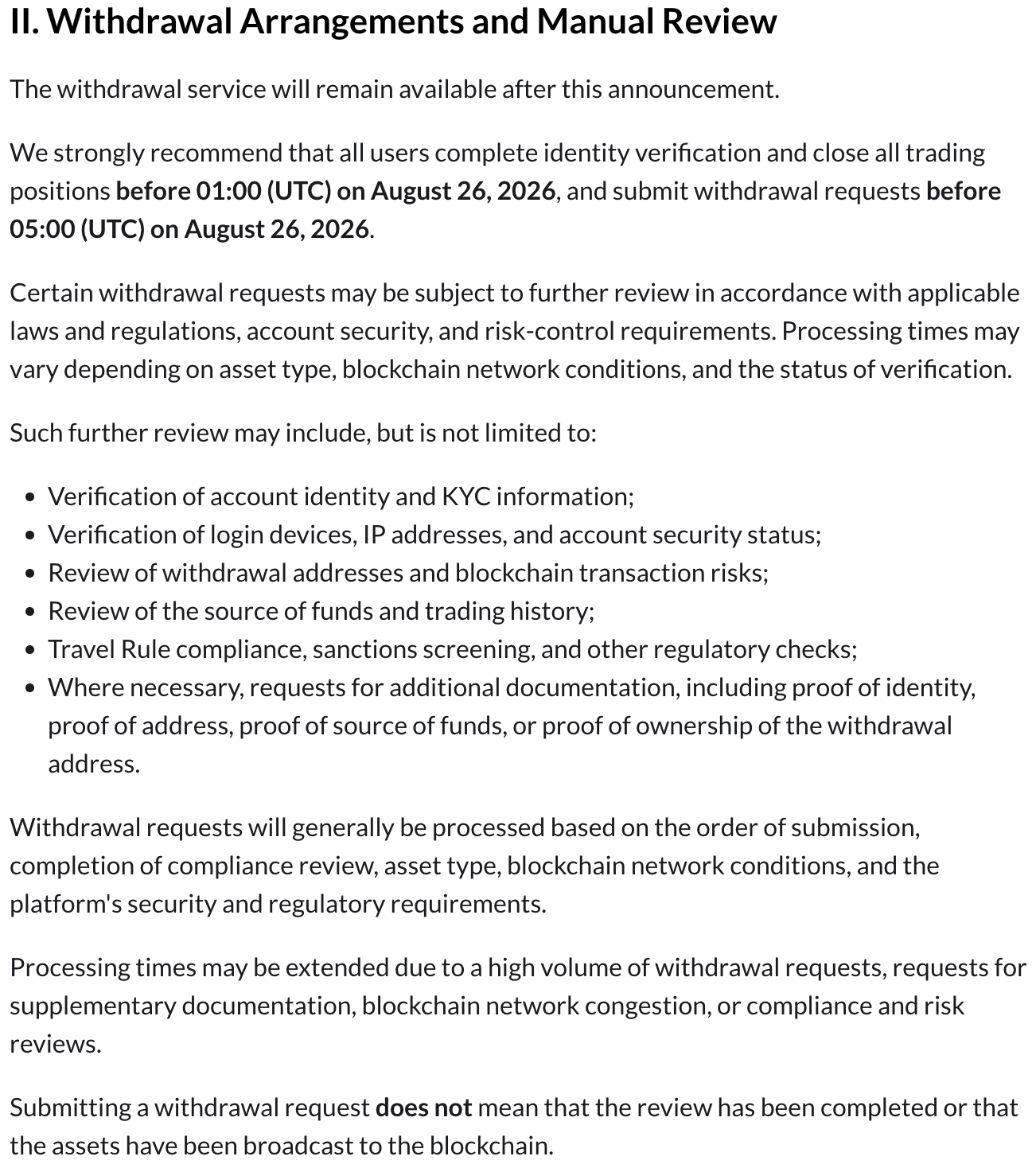
It “strongly” recommends that users submit withdrawal requests before August 26.
Additionally, the exchange warned that because it “generally” processes withdrawals based on the order of submission, “processing times may be extended due to a high volume of withdrawal requests.”
Crypto researcher Quang noted that in the 24 hours after BitMart’s announcement, the exchange only processed 63 withdrawal requests, together worth around $800,000.
They assessed that users with large balances will likely be waiting a long time, and that if you have anything less than $10, “you might as well say goodbye to it.”
Read more: European Union sanctions Justin Sun’s HTX
Crypto analyst Lookonchain also noted that by 7:40 pm EST, the exchange had stopped processing withdrawals for the past eight hours.
The exchange’s API appears to paint a slightly different picture, however. Despite shutting down, it still appeared to have processed $1.8 billion in 24-hour volume.
At time of writing, BitMart is ranked third on CoinGecko for 24-hour volume, behind Binance with $6 billion and Poloniex with over $2 billion.
BitMart was supposed to last another eight years
BitMart had presented a bullish outlook for its operations in this year’s H1 report published earlier this month.
A license to operate in Australia was secured, and the company was expanding in Europe via a partnership with Zero Hash.
Transaction volume was up 300%, BitMart’s assets under management grew roughly “256% period-over-period,” and it had just launched its own prediction market.
BitMart CEO Nathan Chow also said that, “BitMart is eight years old this year. We intend to be here for the next eight, and we are building accordingly.”
He said, “H1 2026 was a market that punished platforms optimizing for the last cycle and rewarded platforms building for the next one. Our numbers reflect that choice.”
Nobody told Chow BitMart was closing
Despite Chow’s statements, he appears not to have gotten the memo about BitMart’s closure.
After its announcement, Chow posted on X claiming “I was not involved in the decision announced today, not consulted on it, and not informed of it. I learned of it when it became public.”
Read more: BitMEX to close, but what about its $270M insurance fund?
He says BitMart told him on July 24 that his role was being terminated and would start winding down immediately. For the next two days, he had no involvement with the company.
Chow thanked his colleagues whom he worked with, and said that he is concerned for BitMart’s users and its employees.
Month of failing crypto firms
Several crypto firms have made major negative announcements this month.
Today, the crypto-based data storage firm Storj announced that it was filing for Chapter 11 bankruptcy.
Crypto firm Movement Labs also filed for Chapter 11 bankruptcy, crypto exchange BitMex announced it was shutting down, and Justin Sun’s HTX was sanctioned by the EU.
In Storj’s case, the firm would continue to operate after the restructuring and give token holders a stake in the newly restructured firm.
Protos has reached out to BitMart for comment and will update this piece should we hear anything back.
Got a tip? Send us an email securely via Protos Leaks. For more informed news and investigations, follow us on X, Bluesky, and Google News, or subscribe to our YouTube channel.


Founded in 2018 as SEBA Bank and rebranded as AMINA in 2023, the lender is overseen by the Swiss Financial Market Supervisory Authority, FINMA. It is one of a small number of regulated banks focused on digital assets. The company offers crypto trading, custody, staking and lending services to institutional and professional investors, and has expanded into Abu Dhabi, Hong Kong and India.
The crypto industry has embraced public markets over the past year, with listings from companies including Circle Internet (CRCL), CoinDesk’s owner Bullish (BLSH), Gemini Space Station (GEMI), BitGo (BTGO) and Figure (FIGR) marking the sector’s strongest IPO wave since 2021.
While the deals initially drew strong investor demand, post-listing performance has been uneven as weaker crypto prices, slowing trading activity and a broader risk-off environment weighed on valuations.
This has prompted some private companies to delay or reconsider their own public market plans. Several major crypto firms, including Kraken parent Payward, Ethereum app builder Consensys, wallet provider Ledger and asset manager Grayscale, have delayed IPO plans while waiting for markets to improve.
As of year-end 2025, AMINA reported 74.6 million francs ($91 million) in Tier 1 capital. It has raised roughly $245 million from investors including Julius Baer, DeFi Technologies and BlackRiver Asset Management.


Technology, artificial intelligence, and prediction market companies spent record sums lobbying Washington in the first half of 2026. New federal disclosures filed this month show the scale of the push.
Anthropic nearly tripled its federal lobbying, outpacing rival OpenAI by more than $1 million.
Anthropic Outspends OpenAI on Federal Lobbying
The Financial Times reported that Anthropic nearly tripled its lobbying expenditure to $3.53 million. The firm added the Treasury Department to its list of lobbied agencies for the first time this quarter.
OpenAI nearly doubled its own spend to a record $2.22 million. Federal rules on new model releases now sit at the top of the industry agenda. Companies also want influence over data center construction, power supply, and more.
“The lobbying offensive has been as much about deterring regulation as making the case for an affirmative government industrial policy that supports the industry,” Amba Kak, co-executive director of AI Now Institute, said.
Follow us on X to get the latest news as it happens
Issue One Counts 324 Lobbyists Across Six Companies
Overall, Issue One counted $41 million in combined spending from January to June. That covers 11 major technology, social media, and AI companies and their trade associations.
The total works out to more than $226,000 per day. The figure rose 8% from $38 million in the same period of 2025.
Six of those companies retained 324 lobbyists during the second quarter alone. The group covers Alphabet, Anthropic, Meta, Microsoft, Nvidia, and OpenAI. That equals roughly one lobbyist for every 1.5 members of Congress.
Meta led second-quarter spending at nearly $6 million. Alphabet followed with $5.3 million, Microsoft with about $3 million, and Nvidia with $1.25 million.
Anthropic reported $1.97 million in lobbying spending for the quarter, its highest since it began lobbying in March 2024. OpenAI spent $1.2 million over the same three months. Notably, four years ago, Anthropic, Nvidia, and OpenAI had no federal lobbyists.
The spending is not limited to tech and AI companies. Prediction market operators have also stepped up their efforts in Washington.
BeInCrypto reported that Kalshi spent $990,000 on lobbying in the first half of 2026. Including outside firms, its total reached nearly $1.8 million. Polymarket keeps a smaller footprint.
Subscribe to our YouTube channel to watch leaders and journalists provide expert insights
The post Anthropic Nearly Tripled Its Lobbying Bill to $3.53 Million in Six Months appeared first on BeInCrypto.
Crypto World
BlackRock tokenization partner Securitize (SECZ) adds SEC investment adviser license amid institutional push


Tokenization specialist Securitize (SECZ) is expanding its regulatory footprint, adding an investment adviser registration as the company positions itself to serve a growing number of institutional investors bringing traditional assets onto blockchain rails.
Securitize said Monday that its subsidiary, Securitize Capital, has registered with the U.S. Securities and Exchange Commission (SEC) as an investment adviser. The new license adds to the firm’s existing regulated businesses, which include a broker-dealer, alternative trading system (ATS), transfer agent and fund administration services.
The move comes as regulators have begun examining how existing securities rules apply to a new generation of investment products on blockchain rails. Last week, SEC Commissioner Hester Peirce said that certain crypto vaults and lending strategies could fall under investment adviser regulations depending on how they’re structured and managed.
Vaults have become one of decentralized finance’s fastest-growing products, allowing users to deposit crypto into smart contracts that automatically allocate capital across lending markets and other yield-generating strategies. Increasingly, those products are being adopted beyond DeFi by platforms reaching a broader investor base such as Coinbase and Robinhood to offer yield on customer balances. Curated vaults now hold about $8.6 billion in assets, according to Vaults.fyi data.
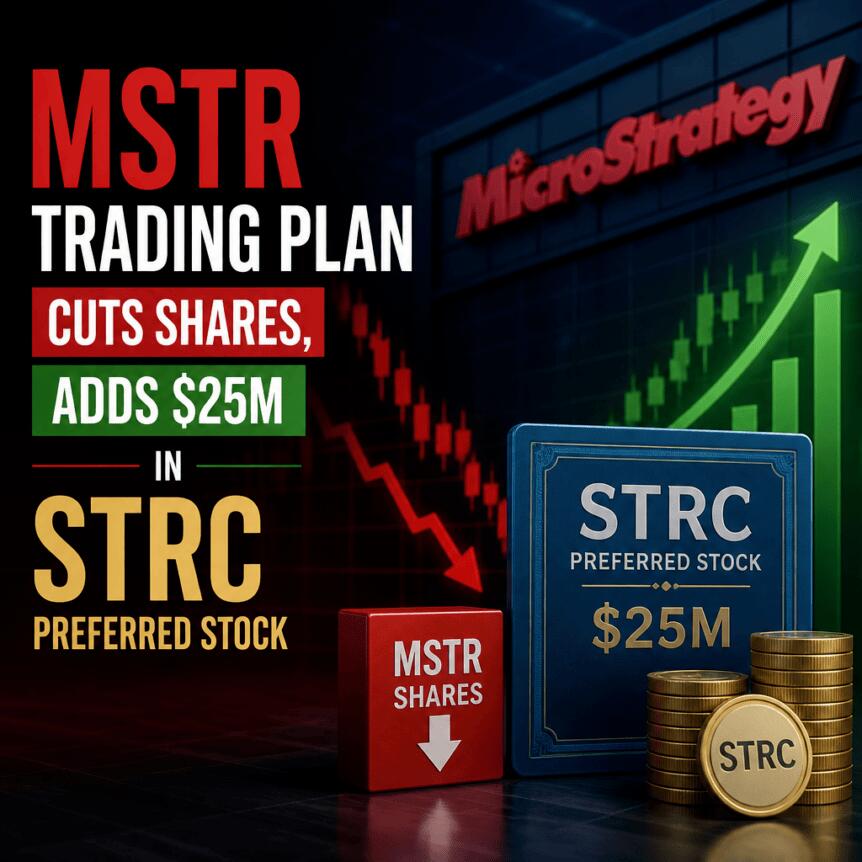
Strategy, the corporate software firm best known for its large Bitcoin treasury, continued to reshape its capital structure last week by selling common stock under its at-the-market program and repurchasing preferred shares.
According to company disclosures, Strategy sold 5,429,160 shares of its Class A common stock through an at-the-market (ATM) offering between July 20 and July 26, generating $544.5 million in net proceeds. In parallel, the company repurchased 288,930 shares of its STRC preferred stock for $25 million, as detailed in a Form 8-K filed with the U.S. Securities and Exchange Commission on Monday.
Key takeaways
- Strategy raised $544.5 million in net proceeds from an at-the-market sale of 5.43 million Class A shares between July 20 and July 26.
- In the same period, the company spent $25 million to repurchase 288,930 shares of STRC preferred stock.
- Strategy’s U.S. dollar reserve increased to $3.75 billion as of July 26, up from $3.225 billion the prior week.
- Strategy reported no Bitcoin purchases or sales during July 20-26, leaving its holdings unchanged at 843,775 BTC.
- The move follows Michael Saylor’s latest social media post, which some observers interpreted as a potential signal about future preferred-stock strategy.
ATM stock sales and STRC preferred buyback
Strategy’s latest financing activity combined two parts: common stock issuance and preferred share repurchases. The Class A share sales were executed via Strategy’s at-the-market offering, allowing the company to issue shares in smaller increments rather than a single large raise.
The preferred buyback is notable because it suggests the company is not only expanding its liquidity through equity markets, but also actively managing its preferred instrument in the capital stack. The $25 million repurchase covered 288,930 shares of STRC preferred stock, per the SEC Form 8-K filed Monday.
While market pricing can shift quickly around corporate actions, Yahoo Finance data cited in the original reporting indicated Strategy’s Class A shares were up more than 2% in Monday’s premarket trading, and STRC preferred shares were higher ahead of the Nasdaq open.
Bitcoin holdings unchanged as cash reserves grow
Despite the increased equity activity, Strategy reported no Bitcoin trades during the July 20-26 window. The company stated its BTC holdings remained at 843,775 BTC, acquired at an average purchase price of $75,476 per Bitcoin, representing an aggregate cost basis of $63.69 billion.
At the time of publication, Bitcoin was reported as trading around $64,971. Strategy’s lack of BTC buying or selling during this specific period means the new liquidity primarily supports corporate objectives rather than immediate additions to its treasury.
Strategy also highlighted how the company intends to use its expanded cash: maintaining liquidity as it increases capital markets activity through common stock offerings and preferred stock instruments. The growing dollar reserve is designed to support dividend payments on preferred stock and interest payments on its outstanding debt.
From “another color” to expectations on preferred strategy
The financing update arrived after executive chairman Michael Saylor sparked speculation on Sunday with an X post referencing “another color.” Some market observers interpreted the phrase as a hint that Strategy could implement additional actions related to its preferred stock approach.
Separately, the preferred stock repurchase and the continued buildup of cash reserves underscore that Strategy’s capital structure management remains tightly linked to its broader treasury and funding strategy. For investors, the key issue is how these moves affect future returns and risk: common stock issuance can dilute shareholders if priced below intrinsic value, while preferred repurchases may reduce fixed obligations, depending on the terms and market conditions.
Saylor reignites debate over banks and Bitcoin’s path
Strategy’s latest corporate filings also surfaced in the context of renewed discussion prompted by Saylor about Bitcoin’s relationship with traditional finance. On X, Saylor argued that rejecting Bitcoin’s connection to financial infrastructure would restrict access to most potential users, suggesting that integration with banks is necessary for broader adoption.
That position drew pushback from some Bitcoin supporters who contend the network’s original intent—outlined in Bitcoin’s white paper as a peer-to-peer electronic cash system—was to reduce the need for financial intermediaries. The exchange highlighted an enduring divide inside the ecosystem: one camp views banks and legacy rails as essential gateways to mainstream usage, while the other sees such involvement as a risk to Bitcoin’s decentralized foundation.
In practice, Strategy sits in the middle of that tension. As a publicly traded company with a large BTC treasury, its operations depend on conventional capital markets. Its use of common stock offerings and preferred instruments illustrates how corporate Bitcoin exposure often relies on the same financial infrastructure that some Bitcoin purists view with skepticism.
Going forward, investors will likely watch whether Strategy’s expanded cash reserve is followed by additional BTC purchases in subsequent reporting windows, and whether Saylor’s “another color” comment evolves into specific preferred-stock actions. The immediate uncertainty remains the timing and purpose of the next treasury decisions—whether liquidity is mainly for near-term corporate obligations or for accelerating Bitcoin accumulation later.


“This is the biggest change to how Lido Core staking works since Lido V2,” said Isidoros Passadis, chief of staking at Lido Labs Foundation. “The node operators securing the majority of ETH staked via Lido are consolidating onto far fewer validators, and for the first time, they’re backing that stake with their own capital, leaving the validator set underpinning Lido Core much leaner and better secured.”
Ecosystem builders had questioned whether enforcing capital bonds would drive away established node operators. Lido confirmed that all 34 of its existing curated operators are expected to transition to CMv2, with none planning to leave because of the bond requirement.
“Rather than replacing the existing reputation-based model, the bonds complement it with real economic accountability,” Will Shannon, head of node operator mechanisms at Lido Labs Foundation, said in an interview with CoinDesk.
He also said the migration will use a separate consensus-layer consolidation queue rather than Ethereum’s deposit and activation queue. Lido estimates that the transition will reduce annual staking rewards across the protocol by about 0.28%. Validators will continue earning rewards until they exit, with any missed rewards limited to the period before their balances reach the new validators.


A venue clearing more than $200 billion a month, holding roughly 70% of on-chain perpetuals volume, is secured by 27 validators. Its foundation ran every one of them at launch. Both the critics and the defenders are working from stale numbers, so here is the audit: what the set looks like now, which powers actually exist, and where the honest gap remains.
Summary
- Hyperliquid’s validator set has grown from 4 at launch to 16, then 21, 24, and 27 as of June, with registration permissionless and the largest stakes forming the active set.
- The decisive number moved this year: foundation-run validators now hold about 49.3% of staked HYPE, with the remaining 50.7% spread across 22 other operators, down from a reported 81% concentration in early 2025.
- The loudest criticism, that the foundation can jail validators at will, does not match the documentation, which describes jailing as peer-triggered for latency and reliability failures, with no automatic slashing anywhere in the system.
- The genuine gap is scale, not malice: 27 validators against roughly 1,800 on Solana and hundreds of thousands on Ethereum, securing a venue whose monthly volume exceeds $200 billion, with node software still closed and a delegation program that applies identity checks to participants.
- Singapore’s regulator added Hyperliquid to its Investor Alert List in June, which converts the decentralization argument from a philosophical debate into a question with legal consequences.
The most valuable thing about a decentralization argument is usually the data it forces into the open, and the Hyperliquid version has been running on stale data for eighteen months. In January 2025 a node operator published a letter noting that five foundation validators controlled more than 81% of staked HYPE across a set of sixteen, and that number entered the discourse and never left it. In June 2026, a prominent investor declared the network not permissionless at all, citing validators concentrated in a single building, node software that remains closed, and a foundation that can jail operators and force upgrades on them. Both interventions were treated as verdicts. Neither reflected the current state of the network, which had by then expanded to 27 validators with foundation-run nodes holding slightly less than half the stake, and neither engaged with what the protocol’s own documentation says about the powers in dispute. Meanwhile the thing being argued over kept growing: a venue processing more than $200 billion a month, holding roughly 70% of decentralized perpetuals volume, generating on the order of a billion dollars a year in fees, with an order book, a matching engine, and a liquidation system all running on those 27 machines. This piece is the audit both sides have been arguing without: the set as it stands, the powers as documented, the precedent where those powers actually fired, and the gap that survives every correction.
The set, counted
Start with the trajectory, because the direction is the part the standing critique omits.
Hyperliquid launched with a handful of validators, all run by the foundation, in what amounted to a permissioned network wearing a public ticker. The set expanded to 16 in January 2025, the moment that produced the original decentralization letter and the 81% concentration figure. In April 2025 the foundation restructured registration itself: the set moved to 21 nodes, with registration open to anyone and the 21 largest by stake forming the active set, which converted validator status from an appointment into an auction. Growth continued through 24 to 27 as of June 2026, with a stake threshold to enter that has run above a million HYPE, a number that itself functions as the network’s real admission price.
The concentration figure moved with it. Following a round of redelegations from foundation validators in June, foundation-run nodes hold approximately 49.3% of staked HYPE, with about 50.7% distributed across 22 independent operators. The foundation runs five validators of the 27. That is a materially different network from the one described by the 81% figure still circulating in criticism, and any honest audit has to lead with the improvement before cataloguing what remains.
The mechanics underneath are worth stating precisely, because they define who can participate. Consensus is delegated proof of stake: validators require a minimum self-delegation of 10,000 HYPE locked for a year, delegators face a one-day lock and a seven-day unstaking queue, and rewards accrue continuously with automatic recompounding. There is no automatic slashing anywhere in the system, which is unusual and cuts both ways: no operator loses stake for a mistake, and no operator loses stake for misbehavior either, leaving the unstaking queue and social consequences as the enforcement layer. Governance runs on delegated stake weight, with validators declaring positions and outcomes determined by the tokens behind them, not by validator headcount, which means the concentration number is the governance number, not a trivium.
The three powers, examined
Now the specific allegations, taken one at a time against the documentation, because two of the three survive and one does not.
Jailing. The claim that has traveled furthest is that the foundation can jail a validator for any reason and remove it from the active set. The protocol documentation describes something different: validators can be jailed through peer voting for latency and reliability failures, and a jailed validator stops producing rewards for its delegators until unjailed, with no slashing attached. Peer-triggered removal for performance is standard practice across proof-of-stake networks and is not foundation discretion. The residual concern is real but narrower than the accusation: when foundation-affiliated nodes hold close to half the stake, peer voting weighted by that stake is not fully independent of the foundation, so the mechanism is only as neutral as the distribution underneath it. That is an argument about concentration, which is the argument this piece keeps returning to, and not an argument about arbitrary power.
Forced upgrades. The claim that validators must adopt protocol upgrades is essentially accurate and largely unremarkable. Every chain running a single client implementation faces the same reality: nodes that decline an upgrade fall out of consensus, which is a coordination fact, not a governance power. What makes it sharper here is the single-binary architecture. Hyperliquid runs one implementation, which the foundation has defended by pointing out that Solana operated the same way for years. The defense is honest and incomplete: single-client networks concentrate the risk that a bug or a decision in one codebase becomes the whole network’s bug or decision, which is precisely why Ethereum’s client diversity is treated as a security property instead of an inefficiency.
Closed source. This one stands, and it is the most consequential of the three. The node software has remained closed, with the foundation’s position since early 2025 being that the code will open when it is stable, citing development speed and security. Eighteen months and considerable growth later, the promise is still outstanding, and it is the crux of the June criticism: a validator running a binary it cannot read is trusting the author in a way that no amount of stake distribution fixes. Users can verify state on-chain, but nobody outside the team can independently verify what the software does before it produces that state. For a venue clearing $200 billion a month, that is the single widest gap between what the network claims and what an outsider can check.
The precedent: when the powers fired
Governance arguments stay abstract until an incident makes them concrete, and Hyperliquid’s arrived in March 2025 with a memecoin called JELLY.
A trader opened a large position and manipulated the thin spot market underneath it, engineering losses that landed on the protocol’s liquidity vault, the pool that absorbs liquidated positions on behalf of depositors. With the vault facing an eight-figure hit, validators voted to delist the market and settle it at a price favorable to the protocol, and the loss was contained. The intervention worked, users were protected, and the affair was over within hours.
It also answered the governance question empirically. A market that traded on a network can be closed by a stake-weighted vote when the network’s own capital is at risk, and the vote at that time ran through a validator set in which the foundation held a decisive share, which is why the episode was described in the trade press as a validator put: an implicit guarantee that the house will intervene when the house is losing. Two readings follow, and both are defensible. The generous one is that any exchange, decentralized or otherwise, must be able to halt manipulation, and a venue that let a vault be drained by an obvious attack would deserve the criticism it received instead. The unforgiving one is that decentralization is only tested at the moment intervention becomes attractive, and Hyperliquid intervened. What the incident settles is not whether the network is good or bad but what it is: a venue with a functioning emergency brake and a small number of hands on it. Traders should price that accordingly, in both directions, since the same brake that protected vault depositors in March 2025 is the brake that could close a market a trader is winning in.
The comparison that survives every correction
Strip out the stale numbers and the overstated claims, and one gap remains that no redelegation fixes: the set is very small relative to what it secures.
Twenty-seven validators sits against roughly 1,800 on Solana, several hundred on Cosmos Hub, and hundreds of thousands on Ethereum. The technical counterargument is legitimate and worth stating properly: Byzantine fault tolerant consensus does not require thousands of participants for safety, it requires an honest supermajority within whatever set exists, and a small high-performance set is exactly how the network achieves the sub-second finality that makes an on-chain order book viable at all. Hyperliquid’s entire product advantage, matching and finality fast enough to compete with centralized venues, is purchased with validator-set size. That is a deliberate trade, not an oversight.
The question is whether the price is right at this scale, and the arithmetic is uncomfortable. A set of 27 secures a venue processing over $200 billion monthly, with open interest, vault deposits, and now equity-linked and other builder-deployed markets on top. The attack surface that matters is not cryptographic but social and regulatory: 27 operators are 27 phone calls, 27 jurisdictions to subpoena, 27 relationships to pressure, and the foundation’s near-half stake means a much smaller number of conversations would decide most outcomes. The delegation program that expands the set applies identity checks to participants, which improves accountability and simultaneously means the expansion is curated, not open, in practice. Each of those facts is defensible on its own terms. Together they describe a network whose decentralization is best characterized as a managed trajectory: real, measurable, improving, and still a long way from the property its marketing language implies.
The regulator arrives
Which is where the argument stopped being philosophical. On June 26, Singapore’s Monetary Authority added Hyperliquid to its Investor Alert List, the register of entities that consumers might wrongly believe are licensed. The listing is not a ban, not an enforcement action, and not a finding of wrongdoing, and Hyperliquid’s response was accurate on every point: it has never claimed authorization from the regulator, nothing about the network changed, users retain self-custody, and settlement remains on-chain. Bybit had joined the same list nine days earlier, KuCoin in February, Binance since 2021, which places Hyperliquid in familiar company and suggests a regulator working through a list instead of singling out a protocol.
The significance is what the listing does to the vocabulary. Permissionless has been a technical description inside crypto and is becoming a legal position outside it, because a protocol claiming to be infrastructure rather than an operator is making an argument about who, if anyone, is responsible for the venue. The critique that landed the same day, that a network with closed-source software, a curated validator set, and foundation-weighted governance does not meet the description, is therefore not merely a purity argument. It is a claim that the legal position rests on facts the network has not fully proven, and regulators reading the same debate will reach their own conclusions about which entity, if any, is running the exchange. That is the real stake of the governance question in 2026, and it is why the numbers in this piece matter beyond ideology: the distance between 49.3% and something much smaller, and between closed source and open, is also the distance between a plausible infrastructure claim and a contestable one.
The listing power, and the money behind it
One dimension of the governance question sits outside the validator debate entirely, and for traders it may be the more consequential one: who decides what trades here.
The network’s newer listing machinery, the builder-deployed markets that opened perpetuals creation beyond the core team and produced the equity-linked contracts this publication audited separately, is gated by stake rather than by approval. Deploying a perpetual market requires staking a large HYPE position for a minimum period, and builder deployments on the EVM side run through a periodic auction for slots. Read one way, that is the most genuinely permissionless part of the system: no committee decides which markets exist, only capital does, which is why the venue could list synthetic equity exposure faster than any regulated exchange could convene a meeting about it. Read another way, it replaces gatekeeping with a wealth qualification, and it means the venue’s expanding product surface, including markets that touch regulated asset classes, is determined by whoever can post the stake.
The economics tie the two halves of the governance question together. Trading fees flow into the token’s buyback machinery, which this publication has covered as crypto’s clearest example of a network routing real revenue to its asset, and staked HYPE is simultaneously the security bond, the governance weight, and the listing key. That triple duty is elegant design and a concentration mechanism at once: the same token that secures the chain decides its rules and controls what it lists, so any accumulation of HYPE is an accumulation of all three powers together. On a chain where roughly half the stake already sits with one affiliated group, and where an entry ticket to the validator set runs above a million tokens, the practical question is not whether the system is permissionless in principle but how much capital it takes to matter, and the answer has been rising with the token.
That is the frame worth carrying out of this audit. Hyperliquid’s governance is not a story about a foundation refusing to let go; the trajectory shows the opposite, steadily and measurably. It is a story about a design in which influence tracks capital with unusual directness, on a venue whose scale now exceeds most regulated exchanges, with the software still unreadable from outside. Whether that is acceptable is a judgment each user makes. What it is, precisely, is now on the record.
What to watch
The stake distribution, not the validator count. Headcount is the easy number to grow and the least informative. Whether foundation-run stake continues falling below 49.3%, and whether any single independent operator accumulates a blocking position, is the measure that determines who actually decides outcomes.
The open-source commitment. The promise to publish node software has been outstanding since early 2025 and is the single change that would most alter the audit. Its continued absence is itself information, and the longer it runs, the weaker the stability rationale becomes.
The next intervention. JELLY showed that the network will act to protect its vault. The next comparable event, and whether the decision runs through a stake distribution that no longer has a foundation majority behind it, is the test of whether governance changed or only its arithmetic did.
Regulatory follow-through. The Singapore listing has no operational effect today. Whether other jurisdictions follow, and whether any of them treats the foundation as the operator of an unlicensed exchange, is the scenario in which every fact in this audit stops being a debating point and becomes evidence.
Disclaimer: This article is for information and educational purposes only and does not constitute financial or investment advice. Validator counts, stake distributions, and protocol parameters change continuously, and figures reflect data reported at the time of writing. Nothing here is a recommendation to buy, sell, hold, or trade any asset or on any venue. Always do your own research. Information is accurate as of July 26, 2026.
Frequently Asked Questions
How many validators does Hyperliquid have?
Twenty-seven as of June 2026, up from four or five at launch, then 16 at the start of 2025, 21 in April 2025, and 24 later that year. Registration is open to anyone, with the largest stakes forming the active set, and entry has required a stake above roughly one million HYPE. Validators must self-delegate a minimum of 10,000 HYPE locked for one year.
Who controls the stake?
Foundation-run validators hold approximately 49.3% of staked HYPE following redelegations in June, with about 50.7% spread across 22 independent operators. The foundation operates five of the 27 validators. This is a substantial change from early 2025, when a widely cited analysis put foundation-controlled stake above 81% across a set of 16.
Can the foundation remove validators at will?
Not according to the documentation. Jailing is described as peer-triggered for latency and reliability failures, with a jailed validator ceasing to earn rewards until unjailed, and there is no automatic slashing in the system. The legitimate concern is indirect: because peer voting is weighted by stake and foundation-affiliated nodes hold close to half of it, the mechanism’s independence is limited by the same concentration issue that affects governance generally.
Is Hyperliquid’s code open source?
The node software has remained closed, with the foundation stating since early 2025 that it will open the code once development is stable, citing security and shipping speed. That commitment is still outstanding, and it is the most substantive of the standing criticisms: validators run a binary they cannot audit, and no distribution of stake compensates for that.
What was the JELLY incident?
In March 2025 a trader manipulated a thinly traded memecoin market to push losses onto the protocol’s liquidity vault. Validators voted to delist the market and settle it at a price that protected the vault, containing an eight-figure loss. The intervention worked and was also read as evidence of a validator put, meaning the network will act when its own capital is at risk, through a stake distribution the foundation then dominated.
How does the validator count compare to other chains?
It is far smaller: roughly 1,800 validators on Solana, several hundred on Cosmos Hub, and hundreds of thousands on Ethereum, against 27 on Hyperliquid. Byzantine fault tolerant consensus does not require large sets for safety, and the small set is what delivers the sub-second finality an on-chain order book needs, but it concentrates social, regulatory, and coordination risk for a venue processing over $200 billion a month.
What did the Singapore listing mean?
The Monetary Authority of Singapore added Hyperliquid to its Investor Alert List on June 26, a register of entities consumers may wrongly believe are licensed. It is not a ban or an enforcement action, and Bybit, KuCoin, and Binance appear on the same list. Its importance is that it moves the permissionless question from a technical debate into a legal one, since the claim to be infrastructure rather than an operator depends on the governance facts being what the protocol says they are.
What should traders take from this?
That the network has a functioning emergency brake with a small number of hands on it, and that this is a property to price, not a scandal to condemn. Decentralization here is a managed trajectory: measurably improving on stake distribution, unresolved on source code, and small relative to the value at risk. Position sizing on any venue should reflect the governance reality, not the marketing vocabulary. This is educational analysis, not investment advice.

Champion Jumper Stern Idol Set for Final Race in 2026

Shadow AI agents are multiplying. Here’s how to find and secure them.

US tourist vanishes on trip to Caribbean as husband issues heartfelt plea | News World


-

 Fashion3 days ago
Weekend Open Thread: Brooks Brothers
-

 Crypto World6 days ago
Grayscale Files For Worldcoin ETF, WLD Registers Sharp Rise
-

 NewsBeat6 days ago
How a former Blue Peter presenter stunned America’s Got Talent judges
-

 Tech15 hours ago
Intel is reversing course and bringing hyper-threading back to its server chips
-

 Tech7 days ago
Sail Virtually Aboard The “Itanic” With IA-64 Emulator
-
 Tech6 days ago
Turtle Beach Command Series KB7 review: a nifty screen-equipped gaming keyboard
-
 Business5 days ago
New Jersey voter registration controversy explained: How 6,600 noncitizens got on the rolls, and what happens next
-
 Entertainment6 days ago
Johnny Depp’s R-Rated Gothic Cult Classic Gets New Release Ahead of Sydney Sweeney Remake
-

 Crypto World5 days ago
Ethics, other provisions in crypto Clarity Act to be further discussed
-

 Politics4 hours ago
Luke Littler dismantles Gerwyn Price to retain title in Blackpool
-
 NewsBeat7 days ago
Shanghai science forum photos show China’s AI and robotics advances in rivalry with US
-
 Sports18 hours ago
Commonwealth Games boxing: Jadumani Singh seals dominant 5-0 win over Pakistan’s Sumama Rehman to enter quarter-finals | Commonwealth Games News
-

 Sports4 days ago
2026 3M Open leaderboard: Scottie Scheffler finds putter in Round 1, sits three back
-

 News Videos4 days ago
The Peugeot Family: How 200 Years of an “Old Money” Dynasty Died in A Boardroom
-

 Politics1 day ago
Spain sweeps the board at 2026 World Cup with individual awards
-

 Fashion3 days ago
16 Dresses for the High Summer Event
-

 Crypto World7 days ago
Andrew Cuomo joins OKX board as crypto exchange expands in U.S.
-
 Entertainment3 days ago
A New Post-Apocalyptic Gundam Anime Series Blasts Into SDCC
-

 News Videos18 hours ago
BITCOIN JUST ENTERED THIS CRITICAL ZONE…
-

 Crypto World1 day ago
XRP Ledger adds $2.6B as RWA inflows rank second
You must be logged in to post a comment Login