
Crypto World
Anchorage Becomes First Federally Chartered US Bank to Custody Tron Crypto


Anchorage Digital has added TRX custody and Tron crypto network staking to its platform, making it the first federally chartered crypto bank in the United States to bring the Tron network inside the regulatory perimeter.
Tron hosts $84 billion in USDT, more than Ethereum, yet has operated almost entirely outside U.S. institutional frameworks until now.
That gap closes here. A federally chartered custodian supporting Tron is not the same as a state-licensed exchange listing TRX. It is a different category of legitimacy, with different compliance obligations, different counterparty implications, and a different signal to the rest of the institutional market.
- Milestone: Anchorage Digital is the first federally chartered U.S. crypto bank to support Tron custody, bringing TRX and future TRC-20 assets—including $84 billion in USDT—into a compliant institutional framework.
- Regulatory Context: Tron and founder Justin Sun faced longstanding U.S. regulatory friction, including a 2023 Coinbase delisting of TRX; the SEC dismissed securities claims against Sun and the Tron Foundation earlier this month, clearing a key obstacle.
- Phased Rollout: Initial support covers TRX custody on Anchorage’s main platform and Porto institutional wallet; TRC-20 token support and native TRX staking infrastructure follow in subsequent phases.
Discover: The best crypto presales gaining institutional momentum right now
What Anchorage Bank Is Actually Building
The initial launch supports TRX custody on Anchorage’s core regulated platform and its Porto self-custody institutional wallet. TRC-20 token support and native TRX staking roll out in phases, a staged structure that allows regulatory validation at each step rather than a single broad deployment.
Anchorage Digital is your new access point to the @trondao ecosystem.$TRX custody is now live with support for TRC-20 assets and native TRX staking on the way. pic.twitter.com/f4xlKwmcir
— Anchorage Digital
 (@Anchorage) March 26, 2026
TRC-20 support is the operationally significant layer. It means institutions will be able to hold and manage Tron-based stablecoins—including the $84 billion USDT supply sitting on Tron—directly within a federally regulated custody account. That is the use case that matters to institutional treasury desks.
Anchorage co-founder Nathan McCauley framed the move as infrastructure-driven: “As TRON expands its presence in the U.S., institutions need trusted infrastructure to securely custody assets and participate in the network. By supporting TRON on Anchorage Digital’s regulated platform, we’re helping bring one of crypto’s largest ecosystems into an institutional framework.”
The federal charter distinction matters here. Anchorage holds a national trust bank charter from the Office of the Comptroller of the Currency—the same regulatory body that oversees JPMorgan and Citibank. State-chartered custodians operate under a patchwork of state regimes. A federally chartered institution conducting AML/BSA due diligence on Tron and clearing it for custody sets a compliance benchmark that state-level operators and foreign custodians cannot replicate by definition.
Tron’s network scale justifies the scrutiny. The chain has recorded over 371 million total user accounts and more than 13 billion total transactions. It is not a niche protocol. It is core stablecoin infrastructure that U.S. institutions have been structurally locked out of engaging with compliantly—until now.
Discover: The best crypto to diversify your portfolio with
Tron Crypto Regulatory Clearance as a Market Structure Event
The background context is critical. Coinbase delisted TRX in 2023 under regulatory pressure. The SEC pursued securities violations against Sun and the Tron Foundation, claims dismissed only earlier this month, with Rainberry, the corporate parent of Sun’s BitTorrent network, paying a $10 million fine over undisclosed BTT token promotions.
That legal overhang suppressed U.S. institutional engagement with Tron for years. Its removal, combined with Anchorage’s federal-level due diligence clearance, reopens the market.
Anchorage’s federal imprimatur gives other U.S.-regulated entities—prime brokers, custodians, asset managers, a compliance reference point.
When America’s only federally chartered crypto bank conducts AML/BSA diligence on a network and approves it for custody, that functions as a de facto institutional clearinghouse signal.
Expect other regulated venues to accelerate their own Tron evaluations.
Discover: The best crypto presales gaining institutional momentum right now
The post Anchorage Becomes First Federally Chartered US Bank to Custody Tron Crypto appeared first on Cryptonews.



Michael Saylor quoted a CNBC TV anchor who repeated his marketing spiel about STRC on live television.
On Thursday’s edition of CNBC’s Power Lunch, Saylor was asked by host Brian Sullivan, “Am I offending you if I call it a money market fund?”
Sullivan was referencing Strategy’s publicly-traded STRC, a 11.5% dividend-paying preferred share that is definitely not a money market fund.
Saylor, who’s spent months likening his uninsured STRC to insured savings products like FDIC-insured bank accounts and SIPC-insured money markets happily agreed.
“It’s meant to be like a money market,” Saylor replied, continuing months of misleading statements about the shares that are supposed to trade near $100 yet have traded beneath $93.50 on 10 separate days.
He later tweeted the clip, declaring that his company’s digital credit products are somehow “redefining” yield.
Unfortunately, STRC is paying 11.5% for a reason, mostly because Strategy hasn’t been able to lower that rate and sustain demand for STRC’s share price near its intended $100 stated amount.
STRC is also nothing like a money market fund, and according to Bloomberg, 80% of STRC buyers have been retail investors, rather than sophisticated institutions.
Read more: Strategy is paying credit card rates to keep STRC at $100
STRC versus an actual money market fund
Unlike a money market fund, Strategy isn’t required to hold full assets to back STRC’s par value, has no bid in the Nasdaq market to support its share price, isn’t required to maintain any particular pricing value of investors’ principal, and has no liquidity requirement to support redemptions.
SEC-registered money market funds must comply with Rule 2a-7 and its liquidity minimums and asset diversification rules.
Money markets maintain stable net asset values by investing in short-term, high-quality debt.
STRC, in contrast, doesn’t comply with money market regulations and invests in one of the most volatile assets in history, bitcoin (BTC).
Unlike a money market fund, STRC pays a dividend from a company with a junk “B-” credit rating from S&P analysts. That same company reported a $12.4 billion net loss in a single quarter.
US money market funds carry SIPC protections when purchased through a registered US brokerage. Bank money market accounts carry FDIC insurance. STRC carries no insurance.
Strategy itself admitted on page 90 of its earnings presentation that STRC isn’t a money market fund.
The company conceded that it’s “not required to hold any assets to back the STRC Stock.” That disclosure didn’t stop Saylor and Sullivan from floating the comparison on national television.
Nor did it stop Saylor from enthusiastically agreeing.
$100 or $90.52 per share, depending on the day
Money market funds shouldn’t lose more than 7% of their value in a few hours. STRC has, repeatedly.
The stock fell to $90.52 in November 2025 and to $93.10 in February 2026. Strategy hiked its dividend rate seven times since launch to encourage secondary trading closer to $100.
Its dividend rate, which started at 9% in July 2025, now sits at 11.5%, a 250 basis point increase.
Meanwhile, BTC trades near $66,000, well below Strategy’s average purchase cost of $75,694 per coin. The company’s entire BTC operation has lost money since inception, while MSTR common stock has declined 74% from its November 2024 high.
Saylor told Sullivan that BTC needs to appreciate just 2% a year to cover STRC’s dividends forever.
However, he conveniently omitted that his model only works for MSTR shareholders if BTC rallies 30% annually, a forecast he has repeated for years but that BTC’s five-year annualized return hasn’t delivered.
Indeed, Saylor has compared STRC to insured products for months.
He described it on CNBC as “a bank that pays you 20% interest.” On an earnings call, he recommended STRC “for your family treasury.”
Incredibly, STRC raised over $1.18 billion in a single week this month, suggesting that comparisons like Sullivan’s are working exactly as intended.
Sullivan’s framing of STRC as a money market fund may have been casual. For the retail investors buying STRC on the basis of these comparisons, the difference between a money market fund and a junk-rated perpetual preferred stock is anything but.
Got a tip? Send us an email securely via Protos Leaks. For more informed news and investigations, follow us on X, Bluesky, and Google News, or subscribe to our YouTube channel.

In this video, we’ll explore the key economic events and market trends, shaping the financial landscape. Get ready for insights into financial markets to help you navigate the week ahead. Let’s dive in!
In this episode of Market Insights, Gary Thomson breaks down what moved the markets over the past few days and unpacks the strategic implications of the most critical events driving global markets.
👉 Key topics covered in this episode:
✔️ What Happened in the Markets Over the Past Few Days
US-Iran tensions are fueling market uncertainty, with shifting headlines, mixed negotiation signals, and no clear resolution. Oil remains volatile, and equities reflect fragile sentiment rather than a trend. Will markets find direction, or will uncertainty keep prices unstable?
✔️ US Retail Sales
US Retail Sales data on 1 April could signal shifts in consumer demand, following weak growth in recent months and a decline in January. The US dollar may react sharply if the new figures diverge from expectations. Will retail sales show a rebound, or continue the trend of weakening consumer demand?
✔️ US Nonfarm Payrolls and Unemployment Rate
US Nonfarm Payrolls and the Unemployment Rate on 3 April could reveal whether the labour market is weakening or stabilising, after February’s 92,000-job loss and a rise in unemployment to 4.4%. Will the data show further deterioration, or a surprising rebound in US employment?
In summary, next week markets face a balance between elevated volatility from geopolitical risks and potential direction from upcoming macroeconomic data.
Gain insights to strengthen your trading knowledge.
💬 Don’t forget to like, comment, and subscribe for more market insights every week.
Watch it now and stay updated with FXOpen.
This article represents the opinion of the Companies operating under the FXOpen brand only. It is not to be construed as an offer, solicitation, or recommendation with respect to products and services provided by the Companies operating under the FXOpen brand, nor is it to be considered financial advice.
Crypto World
Swiss DeFi Infrastructure Provider THORWallet Expands into Asia, Targeting South Korea’s Crypto Market

Swiss-based DeFi infrastructure provider THORWallet is expanding into Asia, with South Korea emerging as a key focus market for its mobile-first crypto platform.
The company, known for its non-custodial wallet that integrates decentralized finance services with traditional banking features, says the move reflects growing demand in Asia for tools that connect centralized crypto markets with global DeFi liquidity.
South Korea is widely considered one of the most active retail crypto markets globally, with millions of traders and some of the highest digital asset participation rates in the world.
Swiss Banking Meets Decentralized Finance
One of THORWallet’s distinguishing features is the integration of Swiss banking functionality directly within a non-custodial crypto wallet.
Eligible users can access a Swiss IBAN, a multi-currency account, and a global payment card, allowing them to move between crypto assets, decentralized finance, and traditional financial infrastructure within a single interface.
The company believes this hybrid approach may appeal to users in Asia seeking more seamless ways to connect digital assets with everyday financial services.
“Many crypto users want access to both DeFi and traditional financial rails without giving up custody of their assets,” said Marcel Harmann, founder of THORWallet. “Combining a non-custodial wallet with banking functionality helps close that gap.”
Positioning as DeFi Infrastructure
THORWallet positions its platform as DeFi infrastructure rather than a traditional crypto wallet, aiming to serve as a gateway through which users and applications can access decentralized liquidity networks.
The mobile wallet has processed more than $1.5 billion in cross-chain swap volume, highlighting its role as an active interface connecting users to decentralized liquidity protocols.
THORWallet integrates cross-chain liquidity networks such as THORChain, Maya Protocol, and NEAR Intents, enabling users to swap native assets across different blockchains without relying on wrapped tokens or centralized bridges.
As liquidity continues to fragment across multiple chains, cross-chain swaps—such as exchanging Bitcoin for Ether across networks—are becoming an increasingly important component of the broader DeFi ecosystem.
By connecting directly to decentralized liquidity networks, THORWallet allows users to access cross-chain trading functionality via a mobile interface while retaining full custody of their assets.
Mobile Access to Global Liquidity
The company has focused heavily on mobile design, reflecting the view that the next wave of DeFi adoption will depend on simplifying complex blockchain interactions for everyday users.
This approach aligns with usage patterns in South Korea, where a significant share of cryptocurrency trading already takes place via mobile applications.
“Our goal is to provide a simple gateway that allows users to move from centralized exchanges into global DeFi liquidity,” Harmann added.
South Korea as a Strategic Entry Point
South Korea has long been one of the most influential cryptocurrency markets globally. Local exchanges such as Upbit and Bithumb consistently rank among the largest platforms by trading volume, and the country is home to millions of active retail traders.
Despite high participation, much of the activity remains concentrated on centralized exchanges, while access to decentralized finance tools is still relatively limited for many users.
THORWallet sees an opportunity to position its platform as a mobile gateway between centralized exchange liquidity and global DeFi infrastructure.
The company identifies South Korea as a strategic entry point for its broader expansion across Asia, where crypto adoption continues to grow and retail participation remains strong.
Asia is widely viewed as one of the most dynamic regions for cryptocurrency innovation, with major user bases across markets such as South Korea, Japan, Singapore, and Taiwan.
“We see Korea as an important starting point,” Harmann said. “From there, we plan to expand further across Asia as demand grows for mobile access to decentralized financial infrastructure.”
Growing Demand for Cross-Chain Infrastructure
As the digital asset ecosystem expands across multiple blockchains, demand for solutions enabling native cross-chain liquidity and interoperability continues to increase.
THORWallet positions itself as a mobile interface connecting users to decentralized cross-chain liquidity networks, with a long-term strategy focused on building infrastructure that allows interaction with multiple blockchains, financial services, and liquidity sources through a single platform.
The post Swiss DeFi Infrastructure Provider THORWallet Expands into Asia, Targeting South Korea’s Crypto Market appeared first on BeInCrypto.
Crypto World
Major volatility in Pi Network price as bulls eye $0.28 with technicals turning cautious into key March upgrades
Pi Network price is stalling near $0.18 as bearish models flag a possible drop toward $0.14, even as mainnet upgrades, a DEX launch and a Consensus 2026 push aim to anchor real‑world Web3 use.
Summary
- Pi Network’s PI token is trading around $0.18 today, down roughly 4.68% over the last 24 hours and underperforming a broader crypto market drop of about 3.56%.
- With PI changing hands near $0.1795 and facing a projected 23.23% downside toward $0.1384 in the next five days, technical models classify the current setup as bearish despite neutral RSI readings.
- The move comes as Pi Network rolls out major node and mainnet upgrades, prepares a DEX launch and secures a Consensus 2026 sponsorship, shifting the project narrative toward real‑world utility and Web3 integration.
Pi Network’s PI (PI) token, the native asset of the mobile‑first smart contract and payments ecosystem, is trading at about $0.1795 today after losing 4.68% in the last 24 hours, extending a pullback from this month’s high near $0.2850.
CoinCodex data shows PI underperformed the broader crypto market, which declined 3.56% over the same period, while PI also dropped 2.65% against BTC and 2.01% versus ETH, reflecting relative weakness across pairs. According to CoinLore, the first recorded exchange rate for PI on its platform was $0.7821, with a cycle low at $0.1317 in February 2026 and a historic high above $3.00, placing the current price roughly 77% below that initial print but still 36% above the February low. Functionally, PI is positioned as a layer‑1 smart contract and payments token aimed at bringing everyday users into Web3 via mobile mining, app‑layer utility and, increasingly, real‑world financial integration.
Pi Network price tests $0.18 support as March upgrades meet bearish models
From a technical perspective, short‑term signals are leaning defensive. CoinCodex’s March 26 update expects PI to fall to $0.138387 by April 1, 2026, implying a 23.23% decline from today’s levels and summarizing the current outlook as bearish. The same dashboard shows PI trading at $0.179471 with a 14‑day RSI of 51.09, a neutral reading that suggests neither deep oversold conditions nor overbought exhaustion, while most short‑term moving averages—from the 3‑day MA at $0.1973 to the 50‑day MA at $0.1826—are flashing sell signals. Structurally, PI remains above the 200‑day simple moving average at $0.269050, which CoinCodex interprets as a longer‑term bullish trendline despite the near‑term bearish bias in the next‑five‑days forecast.
The project’s fundamentals are evolving in parallel with the price chop. AInvest’s March 1 analysis notes that Pi Network is entering a critical phase in 2026, moving from experimental development to real‑world utility with infrastructure upgrades and ecosystem expansion explicitly designed to support financial integration and practical applications. CoinMarketCap’s latest Pi update details several key milestones: completion of the mainnet Protocol 20.2 upgrade on March 18, 2026, which lays the foundation for smart contract functionality; a major node upgrade roadmap targeting version 23.0 by May; and a sponsorship at Consensus 2026 in Miami, including a 20‑minute main‑stage session that will spotlight Pi and artificial intelligence alongside sponsors such as Grayscale and Google Cloud. Separately, MEXC’s February 17 report frames March 12, 2026—the activation date for Pi DEX and related liquidity infrastructure—as a “decisive” turning point for the ecosystem, emphasizing that successful execution will be treated as a confidence event by users and developers monitoring throughput, stability and engagement.
These network‑level developments highlight a familiar tension between narrative and tape. On one hand, Pi Network is signaling a shift toward concrete utility—through protocol upgrades, DEX activation and high‑profile conference exposure—just as the broader market increasingly rewards projects with real‑world use cases over pure speculative hype. On the other hand, CoinCodex’s bearish near‑term projection and the dense cluster of “sell” signals across key moving averages underline the risk that, absent clear evidence of adoption and on‑chain liquidity growth, PI’s price could retest lower support closer to the $0.14 area before any durable repricing can take hold.

Quick Overview
- Umbra introduces encrypted wallet for confidential Solana transactions
- Platform supports private swaps and shielded blockchain operations
- Privacy solution targets mainstream users seeking encrypted onchain finance
- Wallet incorporates compliance features alongside privacy protections
- Solution powered by Arcium’s secure execution infrastructure
Umbra has introduced a privacy-oriented wallet for Solana, broadening availability of encrypted blockchain transactions. The launch brings confidential transfers, private swaps, and built-in compliance mechanisms to users. In doing so, Umbra establishes itself as a functional privacy solution for regular blockchain operations.
Umbra Delivers Confidential Transaction Features on Solana Network
Umbra allows users to transfer digital assets while concealing sender identity, recipient information, and transaction amounts. Additionally, the platform facilitates encrypted token swaps that mask trade volume and execution strategy. Thus, Umbra eliminates public exposure from standard onchain financial operations.
The solution is built upon Arcium’s infrastructure, which enables encrypted execution across blockchain transactions. This architecture permits computation on encrypted information without revealing sensitive transaction details. Consequently, Umbra preserves confidentiality across the complete transaction process.
Previous access was restricted during Arcium’s mainnet alpha phase launched in February. Now, Umbra extends its privacy capabilities to traders, institutional participants, and commercial entities worldwide. This expanded availability addresses rising interest in confidential blockchain technologies.
Secure Execution Technology Sets New Privacy Benchmarks
Umbra utilizes encrypted execution rather than conventional obfuscation techniques or intermediary-dependent privacy approaches. Transaction data remains inaccessible to all participants throughout processing. This framework enhances privacy while preserving trustless onchain verification.
The wallet incorporates compliance mechanisms including viewing keys, risk assessment tools, and geographic restrictions. These capabilities enable controlled transparency while meeting regulatory obligations. Umbra achieves equilibrium between privacy protection and compliance adherence.
Umbra emphasizes accessibility through an intuitive interface designed for everyday transactions. The system prioritizes straightforward usability without sacrificing encryption strength. Umbra accommodates both sophisticated users and mainstream ecosystem adoption.
Development Tools and Growing Market Traction
Umbra has additionally unveiled a software development kit to facilitate encrypted application development on Solana. This resource empowers developers to create privacy-centric services utilizing zero-knowledge technologies. Consequently, Umbra reinforces its standing within the expanding privacy infrastructure sector.
Multiple integrations are anticipated in upcoming weeks as developers implement the framework. These implementations may broaden encrypted finance applications across decentralized platforms. Umbra advances overall ecosystem maturation on Solana.
The initiative previously raised over $150 million via MetaDAO, drawing participation from more than 10,000 contributors. This capital injection demonstrates substantial early enthusiasm for privacy-enabled financial instruments. Umbra therefore enters the marketplace with significant financial support and increasing appetite for encrypted blockchain capabilities.

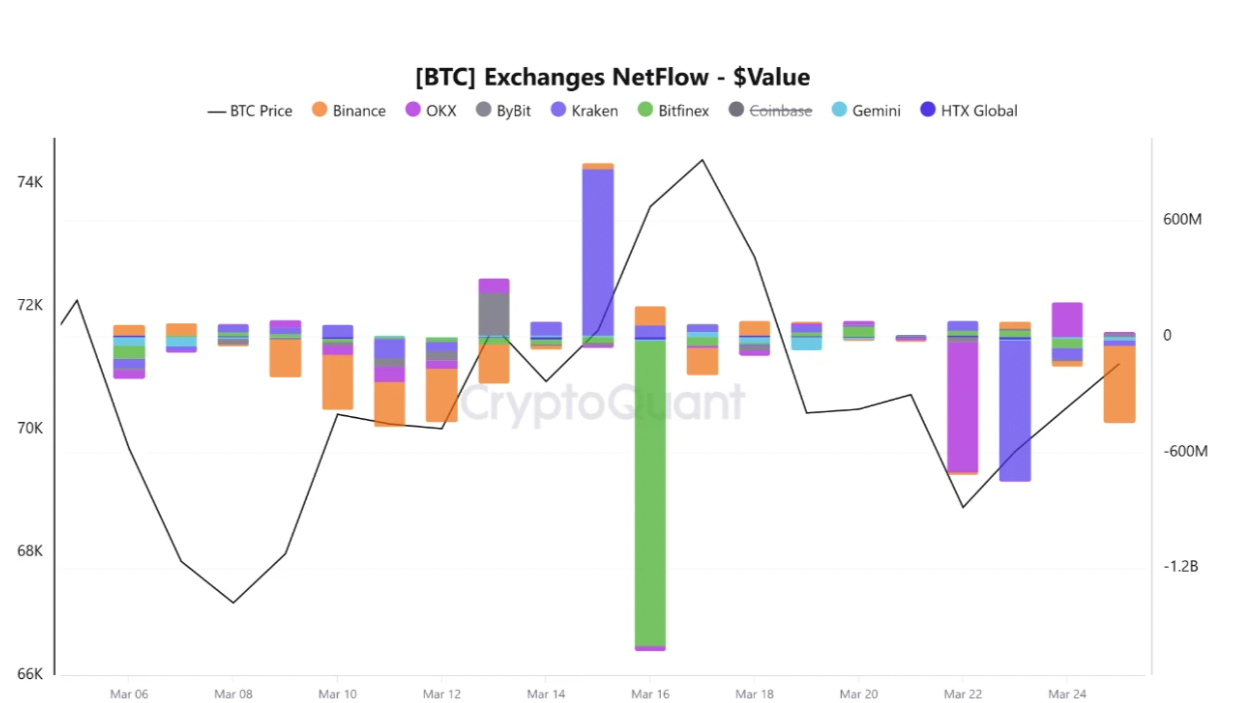
Bitcoin (BTC) dropped toward $67,000 during the European trading session on Friday despite an increase in long-term buying. Exchange withdrawals also increased to 16-month highs, suggesting reduced “immediate selling pressure,” a new analysis said.
Key takeaways:
-
Bitcoin withdrawals from exchanges increases, reducing BTC available for sale.
-
Long-term holders accelerate accumulation, adding 155,450 BTC over the past 30 days.
-
Bitcoin analysts view $65,000–$66,000 as a potential support zone for a bounce.
Bitcoin supply tightens as long-term buying accelerates
CryptoQuant’s exchange flow data highlighted “renewed signs of supply tightening,” as large Bitcoin withdrawals continue across major exchanges.
The chart below shows that investors withdrew nearly $1.6 billion of BTC from Bitfinex on March 16, as shown by the orange bar in the chart below.
Related: Bitcoin floor ‘near $70K’ as TradFi returns: Will war, inflation break their belief?
Since then, the trend has expanded across other major exchanges, with a $678 million withdrawal from OKX on Sunday, a $728 million withdrawal from Kraken on Monday, and another $400 million in BTC leaving Binance on Wednesday.
“This pattern suggests that the latest wave of withdrawals is no longer isolated to one platform,” CryptoQuant analyst Amr Taha said in his latest QuickTake analysis.

The figures support the latest data showing Bitcoin whales and sharks have been accumulating over the last two months, a pattern that could trigger an eventual breakout from the range.
Other data also reflects an accumulation phase, as long-term holders (LTHs), investors who have held Bitcoin for more than 155 days, ramped up buying.
The LTH net position change has been positive since March 5, as about 155,450 BTC has been bought over the past 30 days.
In other words, holders are buying more on the dips, including the latest one below $68,000.

When Bitcoin leaves exchanges while LTHs expand their positions, it “usually signals lower immediate sell pressure and stronger conviction from investors with a longer time horizon,” Amr Taha said.
If this trend continues, the market could be entering another phase where tightening sell-side liquidity and stronger LTH demand “create a more supportive backdrop for price,” the analyst added.
Bitcoin price to revisit $65,000 before bounce
As Cointelegraph reported, $70,000 remains the key for the Bitcoin bulls and that losing it could trigger the next leg down.
The BTC/USD pair was trading below $67,000 at the time of writing, below the 50-day simple moving average (SMA) and the 200-week exponential moving average (EMA).
Bears will attempt to push the price toward the $65,000-$63,300 demand zone, with a deeper focus on the range low below $60,000, reached on Feb. 6.

“It’s quite clear that there’s not enough strength for the markets to move higher after that rejection at $75K,” MN Capital founder Michael van de Poppe said in a recent X post.
An accompanying chart suggested that the price was seeking to print a higher low within the $65,000 to $66,000 range, failing which “we’ll start to see an acceleration downwards,” van de Poppe said, adding:
“I would be looking at longs in the lower-$60K range.”

The Glassnode liquidity heatmap highlighted “stronger” whale bid orders near $65,000, suggesting that the BTC price could retest this area before a bounce.

As Cointelegraph reported, a break and close below the ascending trend line at $68,000 could result in Bitcoin price dropping toward $60,000, where it could consolidate next.
This article does not contain investment advice or recommendations. Every investment and trading move involves risk, and readers should conduct their own research when making a decision. While we strive to provide accurate and timely information, Cointelegraph does not guarantee the accuracy, completeness, or reliability of any information in this article. This article may contain forward-looking statements that are subject to risks and uncertainties. Cointelegraph will not be liable for any loss or damage arising from your reliance on this information.

Key Takeaways
- On Friday, Hedgeye initiated a short position on AppLovin (APP), projecting a 30% downward move.
- Andrew Freedman from Hedgeye contends that MAX, the mediation platform, represents APP’s true advantage—not its AXON AI technology.
- MAX dominates more than 60% of worldwide mobile gaming ad impressions, providing critical data that powers AXON’s capabilities.
- In markets beyond gaming where MAX lacks mediation control, AXON’s performance shows significant variability.
- The firm characterizes APP as an “infrastructure monopoly” that faces mounting competitive threats while generating unsustainable margins.
AppLovin (APP) shares declined 1% Friday following Hedgeye’s announcement of a new short position on the stock, with the research firm projecting as much as 30% downside from present price levels.
Andrew Freedman, an analyst at Hedgeye, released the bearish thesis, challenging the prevailing market narrative surrounding the company’s valuation.
Freedman’s central contention is that market participants have fundamentally misunderstood AppLovin’s business model. Rather than being an artificial intelligence powerhouse as many believe, Hedgeye argues the company’s real strength originates from a different source.
“The primary competitive advantage for AppLovin isn’t AXON, its machine learning technology,” Freedman stated. “Rather, it’s MAX, the mediation infrastructure commanding more than 60% of global mobile gaming ad impressions.”
MAX functions as AppLovin’s advertising mediation infrastructure. Positioned between game developers and advertising buyers, it orchestrates the bidding mechanism for ad inventory within mobile gaming applications.
Given MAX’s commanding position in mobile gaming ad auctions, it accumulates an extensive repository of exclusive bidding intelligence. This proprietary data stream, according to Freedman, is the critical ingredient enabling AXON’s predictive accuracy.
“AXON’s effectiveness diminishes substantially without access to MAX’s data,” the analyst noted.
Performance Challenges Beyond Gaming Territory
The analysis spotlights a significant vulnerability in AppLovin’s diversification strategy. Beyond mobile gaming boundaries, MAX doesn’t maintain mediation dominance—creating a substantially different competitive landscape.
In these alternative sectors, AXON must function without the comprehensive data infrastructure it leverages within gaming environments. Freedman’s research indicates performance outcomes vary considerably under these conditions.
This observation carries weight because AppLovin has aggressively pursued expansion into e-commerce and additional non-gaming categories. Should AXON prove unable to duplicate its gaming success in other verticals, the company’s expansion narrative faces serious challenges.
Current short interest in AppLovin stands at merely 4.5%, indicating the broader market maintains a predominantly optimistic outlook.
Valuation Concerns From Hedgeye
Freedman characterized AppLovin as representing “an infrastructure monopoly narrative”—though his tone was decidedly cautionary.
According to Hedgeye’s assessment, this monopolistic position faces increasing competitive pressure, while the company currently benefits from profit margins that exceed sustainable levels. This suggests the differential between AppLovin’s present earnings and long-term capability may be larger than market participants recognize.
While Hedgeye hasn’t published a precise price objective corresponding to its 30% downside forecast, the analysis implies substantial repricing risk should investors reconsider the AI-related valuation premium.
APP shares have surged 48% during the trailing twelve months, adding substantial market capitalization throughout this period.
Friday’s modest 1% pullback appears relatively insignificant against the backdrop of that extended rally, though Hedgeye’s detailed critique introduces a noteworthy contrarian perspective to what has predominantly been an analyst community expressing bullish sentiment.
With short interest remaining at 4.5%, there isn’t yet substantial positioning against AppLovin—however, Hedgeye has now established one of the most thoroughly articulated bearish arguments on the stock to emerge publicly.
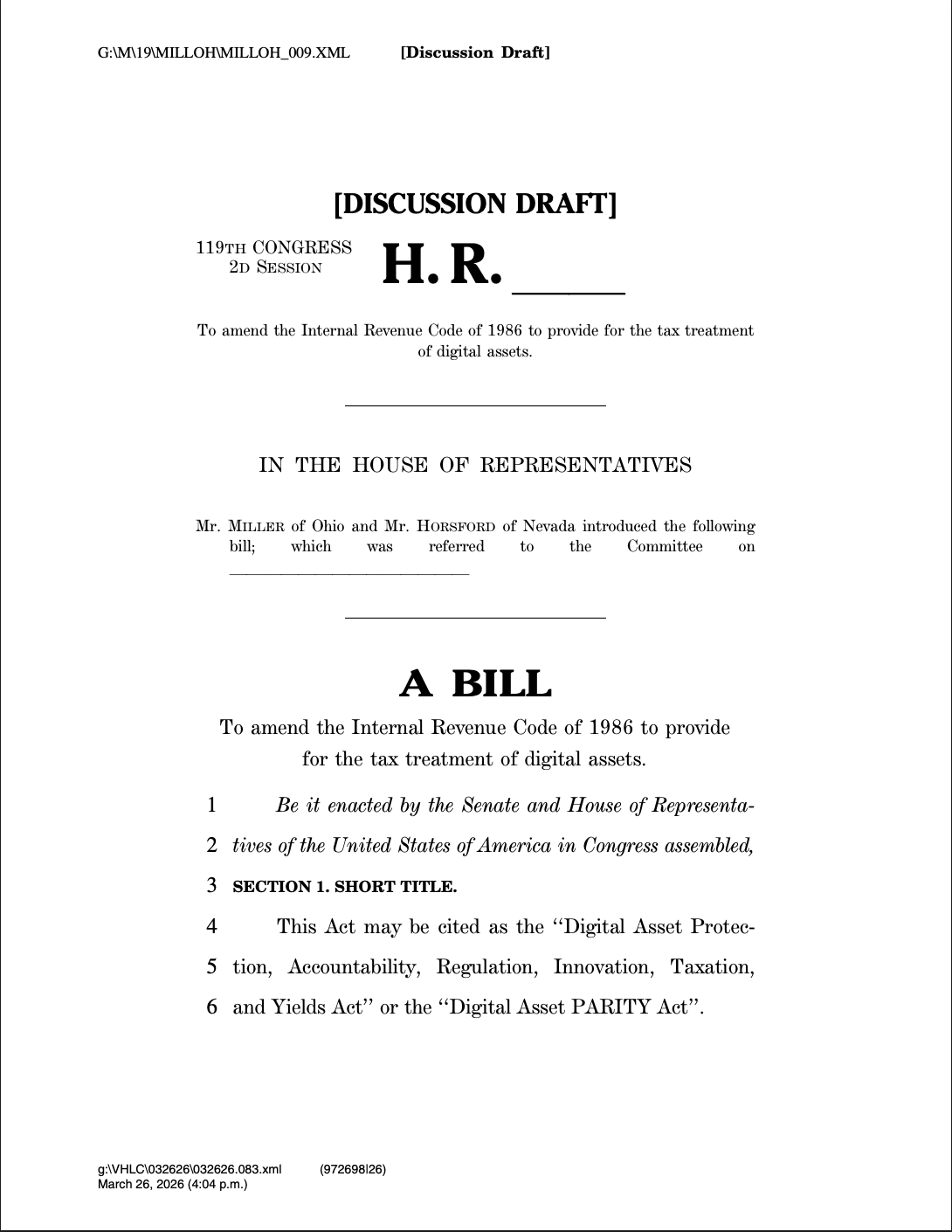
US Representatives Max Miller and Steven Horsford published a discussion draft bill on Thursday titled the ‘‘Digital Asset Protection, Accountability, Regulation, Innovation, Taxation, and Yields Act’’ or the ‘‘Digital Asset PARITY Act,” to overhaul the tax code for digital assets.
The Digital Asset PARITY Act seeks to overhaul the Internal Revenue Code of 1986 by adding provisions that would clarify the tax treatment of digital assets.
The legislation said that stablecoins are not subject to gains if the cost basis, or the amount paid by the investor, does not fluctuate by more than 1% of $1 or $0.01, according to the discussion draft.
Transaction costs incurred to acquire or move regulated dollar-pegged stablecoins cannot be counted toward an investor’s cost basis, according to the bill.

The bill also introduces a de minimis tax exemption for stablecoin transactions below $200, meaning that stablecoin transactions below the $200 threshold do not trigger tax or reporting requirements. A total annual exemption cap is yet to be determined.
Income from lending, staking or income earned through “passive” validator services is treated as part of the recipient’s gross income every year, and calculated using “fair market” value, the draft said.
The Digital Asset PARITY Act has not yet been introduced to Congress; it was published as a discussion draft to open up debate between lawmakers, stakeholders and the crypto industry about how to overhaul crypto tax policy in the US.

Related: Coinbase execs deny lobbying against Bitcoin de minimis tax exemption
Crypto tax proposal highlights schism in the crypto industry
“We need digital asset tax clarity or activity will never fully onshore,” Cody Carbone, the CEO of crypto advocacy organization Digital Chamber, said in response to the discussion draft.
However, Bitcoiners noted that the bill includes only a de minimis tax exemption for stablecoins, not Bitcoin (BTC), similar to pending legislation, including the CLARITY crypto market structure bill, which also lacks a BTC de minimis tax exemption.
“This is the wrong direction to go in,” Pierre Rochard, CEO of The Bitcoin Bond Company, a BTC financial product issuer, said about the draft.
“It’s Bitcoin that should have a de minimis tax exemption. Stablecoins are not decentralized, and they are not permissionless. They’re not real money; they’re just fiat,” he added.
Magazine: How crypto laws changed in 2025 — and how they’ll change in 2026

Key Highlights
- Google is providing construction financing for a massive Texas data center currently under lease to Anthropic
- Nexus Data Centers’ project exceeds $5 billion, with construction loans nearing completion within weeks
- The sprawling 2,800-acre complex will initially provide approximately 500 megawatts by Q4 2026, with plans to scale up to roughly 7.7 gigawatts
- Independent gas turbines connected to local pipelines will power operations, minimizing reliance on public utilities
- Google’s robust financial standing is anticipated to attract bank financing at more favorable terms
According to recent reports, Google is preparing to extend construction loans to Nexus Data Centers for their ambitious $5 billion-plus data center development in Texas, a facility that Anthropic has already secured through a lease agreement.
The Financial Times initially broke the story, referencing sources familiar with the arrangement.
Finalization of these loans is anticipated within the next several weeks. While Alphabet, Google’s parent entity, won’t directly construct the infrastructure, the company is serving as the financial underwriter. Its excellent creditworthiness is expected to facilitate additional banking partnerships with more competitive interest rates.
Multiple banking institutions are currently vying to finance the initial construction phase, with funding targeted for mid-2025.
The computing facility spans an impressive 2,800 acres and aims to provide roughly 500 megawatts of processing capacity by the conclusion of 2026. In the longer term, expansion plans envision the site reaching approximately 7.7 gigawatts — representing significant infrastructure for artificial intelligence computational requirements.
Earlier this month, Anthropic formalized its lease arrangement with Nexus Data Centers.
Energy Independence Through Direct Power Generation
The facility’s strategic positioning between multiple major natural gas pipelines represents deliberate planning. Nexus intends to operate independent gas turbines for power generation instead of drawing from regional electrical grids.
This configuration allows the operation to avoid expensive peak-hour electricity rates — an escalating challenge for facilities operating energy-intensive AI processing continuously.
Additionally, this approach provides enhanced energy supply autonomy, which has become increasingly critical for large-scale data infrastructure developments.
Expanding the Google-Anthropic Alliance
Google currently provides Anthropic with specially engineered TPU infrastructure through Google Cloud for training sophisticated language models.
This collaboration creates mutual advantages. Anthropic receives essential large-scale computing resources, while Google leverages the partnership to enhance its Vertex AI offerings.
By financing the Texas computing complex, Google elevates its role beyond cloud services provider to become a direct infrastructure financier.
Specific financial terms of the construction loan arrangement — including total amount and repayment conditions — remain undisclosed to the public.
Nexus Data Centers has declined to provide official commentary. Anthropic finalized its lease with Nexus in recent weeks, preceding the anticipated loan completion in the near future.
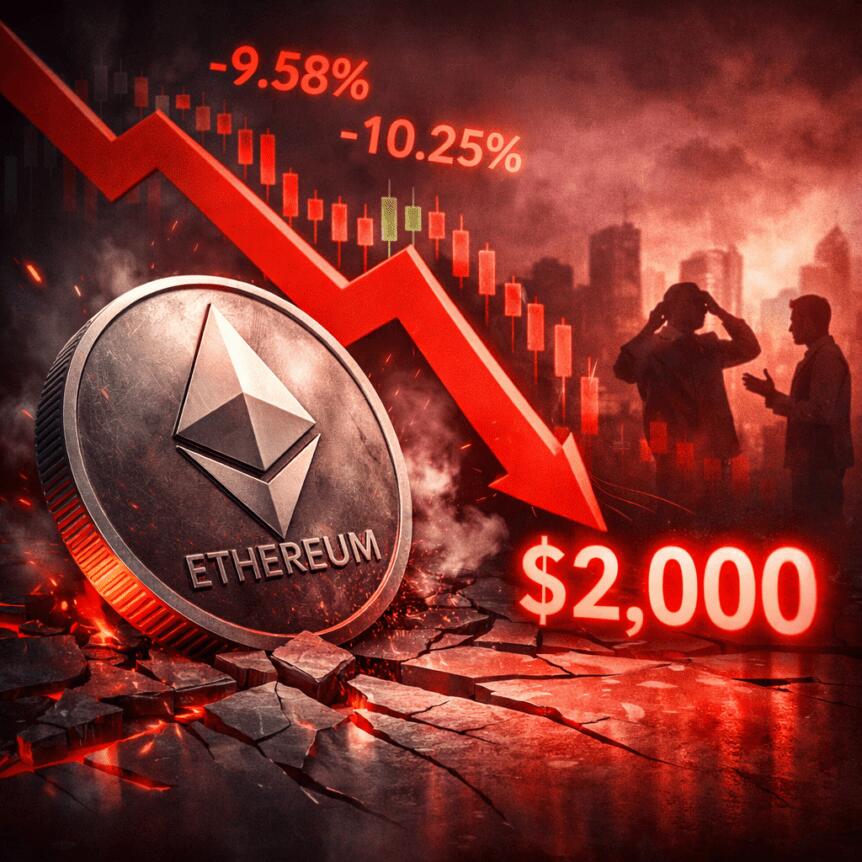
Ether edged below the $2,000 mark on Friday, signaling another potential leg lower for the leading smart contract token. Trading around $1,975, ETH slipped roughly 5% over the past 24 hours, according to TradingView data. The move came as traders weighed weak near-term demand against a backdrop of outflows from spot ETH funds and retreating exchange activity, raising the prospect of a deeper correction in the weeks ahead.
Market participants monitored liquidations and price structure for clues about how much further downside might be in store. Data from Coinglass showed more than $111 million in long Ethereum liquidations as the price pressed lower, underscoring how quickly leverage could unwind in a volatile move. The price action also followed a failure to clear resistance around $2,200 earlier in the week, a bottleneck that had capped any sustained recovery despite long-term bulls arguing for a fundamental case beyond price action.
Key takeaways
- ETH price has shown structural weakness, failing to sustain a move above the $2,000 psychological level and threatening a broader correction.
- Analysts see a risk of further downside toward the $1,750–$1,850 zone if buying interest remains tepid and key technical supports give way.
- Demand trends for ETH remain negative, reinforcing downside pressure even as macro uncertainty persists.
- Spot ETH ETFs and broader Ether-based ETPs have faced persistent outflows, signaling reduced institutional appetite in the near term.
Price action and near-term risk for ETH
After failing to beat back sellers near the $2,200 zone earlier in the week, Ether continued to drift lower, with the daily picture painting a softer short-term trajectory. The break below the critical $2,000 level is noted not only as a round-number psychological barrier but also as a test of longer-term momentum indicators. Analysts have pointed to the 50-day simple moving average near $2,000 as a potential fulcrum; a sustained breach could open the path toward the mid-$1,900s and then into the $1,850–$1,750 corridor that previously acted as a support band in more challenging cycles.
Onur, a trader who commented on social media this week, framed the situation as a tale of waning immediate demand despite constructive, long-horizon narratives. “ETH keeps pressing into the same resistance, but the story sits beneath price action. Even with strong long-term narratives, short-term demand still looks thin,” the analyst wrote, underscoring how a market capable of sustaining a rally requires more than macro optimism.
Another practitioner, CryptoWZRD, offered a bearish read, suggesting ETH could slide further toward the $1,800 area after a close below $2,200. Ted Pillows echoed the sentiment on social channels, calling the Friday move a sign of ongoing weakness and predicting continued downside pressure in the near term. A chart‑driven assessment associated with that view pointed to a potential pullback to the $1,800 level before any meaningful rebound materializes.
Taken together, the setup aligns with a view that a test of fresh demand could be required before ETH could mount a convincing bounce. A referenced analysis from Cointelegraph highlighted that a clean close below the 50-day moving average around $2,000 may pull ETH to the $1,900 zone, with a subsequent drift toward $1,850–$1,750 if selling accelerates. While such targets are not certainties, they reflect a structurally fragile near-term backdrop that traders will be watching in the weeks ahead.
Demand signals and the broader momentum picture
Beyond price, a gauge of demand known as Apparent Demand has shifted negative, reflecting a risk-off posture among market participants. Capriole Investments tracks this metric for Ethereum and reported that the indicator has been in negative territory since March 3, dipping to as low as −58,000 ETH on March 16. The current reading sits at roughly −23,475 ETH, illustrating a partial but not complete improvement from the precipitous declines seen earlier in the month. Negative Apparent Demand suggests that buyers have been less aggressive relative to sellers, a condition that can extend price weakness in the absence of a fundamental catalyst or liquidity-driven relief.
The demand backdrop is reinforced by spot ETH fund flows. Data tracked by SoSoValue shows seven consecutive days of net outflows from spot Ethereum exchange-traded products (ETPs), totaling about $391.8 million. In parallel, global Ether ETPs posted about $27.2 million in outflows last week. Taken together, these figures indicate sustained institutional and fund-level withdrawal of exposure to Ethereum, which can amplify selling pressure when markets navigate a risk-off environment or await clearer catalysts.
The combination of weak near-term demand signals and ongoing fund outflows fits a narrative where ETH could test lower support levels before any substantive rebalancing or accumulation resumes. While the long-term promise of Ethereum’s network and DeFi ecosystem remains, the immediate price psychology remains fragile as traders adjust their risk appetites in response to macro uncertainties.
Institutional flows, ETF dynamics, and what to watch next
From an investor flows perspective, the current pattern suggests an ongoing reassessment of ETH exposure among institutions and professional traders. The outflows from spot ETFs and broader ETPs imply that even as Ether’s network activity and development progress, the market is prioritizing capital preservation over new risk-taking in the current climate. In such environments, reported liquidity dynamics—such as the sizable long liquidations observed during Friday’s session—can dominate short-term price action, even when longer-term fundamentals remain intact.
Market participants should also weigh the interplay between ETH’s on-chain usage, derivatives dynamics, and macro developments. While ETF and ETP outflows can weigh on price, they can also precede periods of renewed interest if catalysts emerge—such as institutional staking activity, improved on-chain metrics, or regulatory clarity that fosters broader participation. Bitmine’s recent move to expand Ethereum staking infrastructure, noted in industry coverage this week, underscores a broader trend toward more institutional-grade exposure to ETH, even if the market’s near-term trajectory remains contested.
In the meantime, traders will likely focus on two anchor points: the psychological $2,000 level and the 50-day moving average around that same vicinity. A sustained dip below these levels could open a fresh wave of risk-off pressure, with the next visible supports in the $1,900 zone and the mid-to-lower $1,800s if selling accelerates. Conversely, any reversal would need to be accompanied by a pickup in demand signals, a cooling in liquidation pressure, and a renewed flow of funds into ETH-based vehicles.
For investors and builders, the unfolding dynamics spotlight a central tension: Ethereum’s technology roadmap and ecosystem benefits remain substantial, but market participation is sensitive to macro cues and fund-level risk tolerances. The current data suggest that near-term ETH price action will be driven more by liquidity and sentiment shifts than by a clear fundamental narrative. That could change quickly if liquidity returns, if staking and institutional products gather traction, or if macro conditions shift in ways that restore risk appetite for non-yielding crypto assets.
Looking ahead, observers should monitor whether demand indicators begin to recover alongside a stabilization in ETF and ETP flows. A sustained uptick in Apparent Demand or a halt to outflows could precede a more constructive price path, especially if price action begins to reflect a more convincing break above existing resistance and a rebuilding of spot and futures premium.
In the near term, however, caution remains warranted as the market tests key support levels and volatility remains elevated. The balance of risk continues to tilt toward further downside unless buyers step in decisively and the flow of institutional capital returns to ETH-focused vehicles.
Readers should keep an eye on evolving liquidity conditions, the pace of outflows or inflows into ETH ETPs, and any new developments in staking infrastructure or regulatory clarity that might tilt sentiment back toward accumulation.

Saylor continues to liken STRC to a money market as risks mount

Prayers up for WWE legend Jamie Noble

OPPO Rolls Out Service Center 3.0 Pro Across 150+ Cities in India


-
 Crypto World7 days ago
NIO (NIO) Stock Plunges 6.5% as Shelf Registration Sparks Dilution Worries
-
 NewsBeat2 days ago
Manchester United reach agreement with Casemiro over contract clause amid transfer speculation
-

 Crypto World6 days ago
Best Crypto to Buy Now: Strategy Just Spent $1.57 Billion on Bitcoin During Fear While Early Investors Quietly Enter Pepeto for 150x Potential
-

 Crypto World6 days ago
Bitcoin Price News: Bhutan Sells $72 Million in BTC Under Fiscal Pressure, but the Smart Money Entering Pepeto Sees What the Market Does Not
-

 News Videos2 days ago
Parliament publishes latest register of MPs’ financial interests
-

 Sports4 days ago
Remo Stars and Kano Pillars Strengthen Survival Hopes in NPFL
-

 Sports4 days ago
Gary Kirsten Accuses Pakistan Cricket Board Of ‘Interference’, Mohsin Naqvi Responds
-

 Business5 days ago
No Winner in March 21 Drawing as Prize Rolls to $133 Million for Next
-

 Tech5 days ago
Give Your Phone a Huge (and Free) Upgrade by Switching to Another Keyboard
-

 Tech5 days ago
AI enters the chat: New Seattle dating app relies on tech to facilitate meaningful human connections
-

 News Videos4 days ago
Ch 9 Financial Management Part 1 | Detailed One Shot | Class 12 Business Studies Boards 2026
-
Business7 days ago
Columbia Sportswear enters $500 million credit agreement with JPMorgan Chase
-

 Tech6 days ago
Today’s NYT Connections Hints, Answers for March 22 #1015
-

 Business23 hours ago
Instagram, YouTube Found Responsible for Teen’s Mental Health Struggle in Historic Ruling
-

 Business5 days ago
Will Duke Basketball Win It All? Duke Basketball Enters Second Round as Third Favorite to Claim NCAA Title
-

 Sports5 days ago
2026 Kentucky Derby horses, odds, futures, preview, date: Expert who hit 12 Derby-Oaks Doubles enters picks
-
 NewsBeat5 days ago
Update on Wisbech river crash as search for teenage boy enters fifth day
-
 Entertainment4 days ago
Cynthia Bailey Dishes on ‘RHOA’ Season 17, Discusses Kandi
-
 NewsBeat2 days ago
Tesco is selling new Cadbury Dairy Milk bar and people can’t wait to try it
-

 Tech4 days ago
Samsung will soon let you control smart home devices from your car’s dashboard
You must be logged in to post a comment Login