

Crypto World
Anchorage Digital offers non-U.S. banks a stablecoin stand-in for correspondent banking

Anchorage Digital, the first crypto firm to get a U.S. banking charter, wants international banks to swap out correspondent banking relationships with a new service that offers U.S.-regulated stablecoin rails for non-U.S. institutions.
The bank is launching what it calls “Stablecoin Solutions” to permit easy, cross-border movement of dollar-tied assets, combining “minting and redemption, custody, fiat treasury management, and settlement” into one service, it said in a Thursday statement.
“Stablecoins are becoming core financial infrastructure,” said Nathan McCauley, co-founder and CEO of Anchorage Digital, in a statement. “Stablecoin Solutions gives banks a federally regulated way to move dollars globally using blockchain rails, without compromising custody, compliance, or operational control.”
Now that the U.S. has a new law governing stablecoin issuers under last year’s Guiding and Establishing National Innovation for U.S. Stablecoins (GENIUS) Act, Anchorage Digital — already regulated under a federal charter by the Office of the Comptroller of the Currency — is moving to offer the stablecoin services. While it’s ready to handle any brand of stablecoin, a field currently dominated by Tether’s $USDT and Circle $USDC, the company said institutions can natively mint and redeem tokens “issued by Anchorage Digital Bank, including Tether’s USA₮, Ethena Labs’ USDtb, OSL’s USDGO and upcoming issuances such as Western Union’s USDPT.”
Correspondent banking allows foreign banks to tap another institution to handle their cross-border activities, such as wire transfers, currency exchange, taking foreign deposits and otherwise acting as a third-party proxy. But it can be expensive and time-consuming. Anchorage Digital is suggesting it can use stablecoin rails to cut settlement delays and simplify the complexity of the existing system.
The GENIUS Act that will govern this business isn’t yet implemented by the federal agencies involved in regulation and oversight, such as the OCC and other banking watchdogs. Those agencies have begun proposing some of the future regulations.
Some provisions on stablecoin yield are now being reopened in the ongoing Senate negotiation over the Digital Asset Market Clarity Act.
Read More: Tether invests $100 million in U.S. crypto bank Anchorage, valued at $4.2 billion

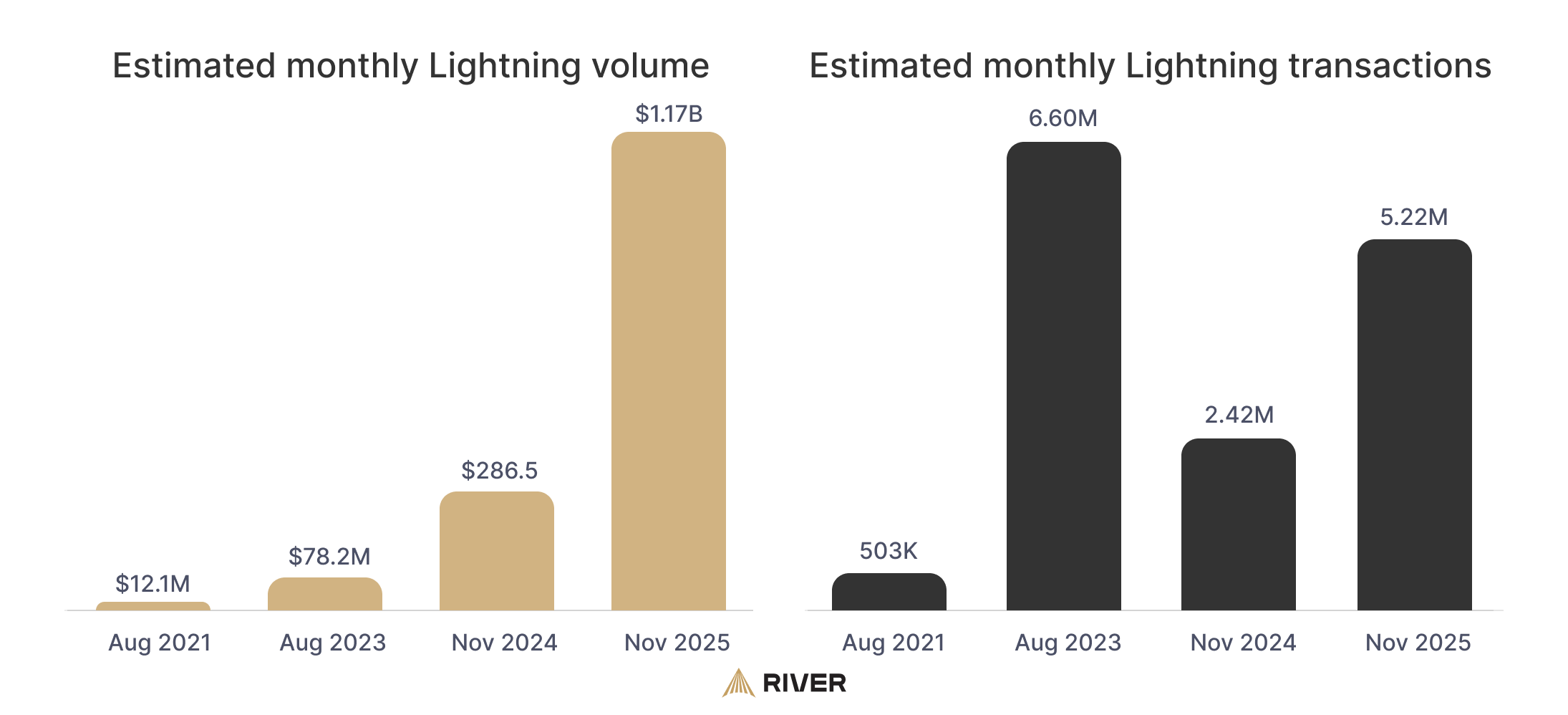
Monthly transaction volume on the Bitcoin (BTC) Lightning Network, a secondary layer for BTC that enables payment use cases, surpassed the $1 billion milestone in November 2025, according to a report from Bitcoin financial services company River.
Transaction volume on the Lightning Network hit an estimated $1.1 billion in November, across 5.2 million transactions, according to a report shared by Sam Wouters, River’s director of marketing. The report said:
“Lightning adoption happened despite the price declining all of November and generally not doing much in 2025. The adoption was largely driven by exchanges, as well as a growing number of businesses accepting bitcoin payments.”

However, the total transaction count in 2025 is lower compared with 2023, when monthly Lightning transactions peaked at 6.6 million in August of that year, which River attributed to experiments with micropayments in gaming and messaging apps.
The report forecast a similar surge in Lightning transactions as individuals and businesses experiment with AI payments.
The Bitcoin Lightning Network helps scale the Bitcoin network, enabling Bitcoin payments between parties that settle in seconds instead of minutes, encouraging Bitcoin’s use as a medium of exchange, instead of just a risk asset or store of value.
Related: Voltage rolls out USD-settled Bitcoin Lightning credit line for businesses
Exchanges and institutional clients adopt Lightning Network
The Lightning Network reduces transaction costs and settlement times by opening up a payment channel between two or more parties to handle transactions offchain, posting only the net balance of the channel to the Bitcoin ledger once it is closed.
Typically, Bitcoin blocks take 10 minutes on average to be added to the ledger, severely limiting BTC payments, particularly for smaller purchases at physical businesses.
In December 2025, the Lightning Network’s capacity, the total number of coins locked on the network for liquidity, reached 5,606 BTC, as more companies and institutions began using it.

Secure Digital Markets, an Institutional trading and lending company, sent crypto exchange Kraken $1 million in a Lightning transaction in February.
The transaction showed that large, seven-figure amounts can be transferred between institutional parties using Bitcoin’s layer-2 scaling network.
Magazine: Bitcoin may take 7 years to upgrade to post-quantum: BIP-360 co-author


The EF announced its 2026 Protocol priorities, emphasizing scalability, user experience, and security, as the network prepares for the Glamsterdam upgrade.
The Ethereum Foundation (EF) has outlined its Protocol priorities for 2026, focusing on scalability, improved user experience, and enhanced network security.
Over the coming year the EF looks to push its gas limit “toward and beyond” 100 million, lean into account abstraction and interoperability, and continue to “harden the L1” focusing on security, censorship resistance, and network resilience.
Today’s initiative release comes shortly after co-executive director Tomasz Stańczak announced his intent to step down at the end of the month. Stańczak indicated he will continue to spend his professional time in the Ethereum ecosystem, working closely with developers and founders. Bastian Aue is assuming interim co-executive director duties for the time being.
The Foundation established Protocol in June 2025 as an improved and more responsive path towards network development. This initiative potentially laid the groundwork towards Ethereum co-founder Vitalik Buterin’s new outlook on the Layer 2 ecosystem, and lays the foundation for future network upgrades like Glamsterdam and Hegota.
Glamsterdam, which is expected to ship in the first half of 2026, is comprised of up to 22 different Ethereum Improvement Proposals (EIPs) and focuses on Layer 1 scalability.
This article was generated with the assistance of AI workflows.


Russia plans liability for gray-market crypto after fraud-linked bank freezes.
Summary
- Central bank wants liability for crypto deals outside regulated segment, citing rising fraud complaints.
- Over 1,800 Russians sought help after bank account freezes tied to suspicious crypto inflows.
- Officials push legalization for cross-border crypto payments while preparing broader licensing regime.
Russia’s central bank has proposed new penalties for cryptocurrency operations conducted outside the country’s regulatory framework, according to statements reported by Russian state media on Wednesday.
Central Bank of Russia
Central Bank of Russia Governor Elvira Nabiullina said during a financial cybersecurity forum that prosecution of unregulated cryptocurrency transactions is necessary to address fraud concerns.
“Fraudsters are taking advantage of the gray market,” Nabiullina stated, according to the official TASS news agency. “A systemic solution is, of course, regulating cryptocurrency with the introduction of liability for transactions outside the regulated segment.”
The central bank chief added that the institution has submitted proposals to the government and is currently in discussions regarding the changes.
Nabiullina noted that Russians who sell cryptocurrency frequently face banking restrictions, with their accounts suspended when received funds are linked to fraudulent activities. More than 1,800 individuals contacted Russian law enforcement agencies in the past three months seeking restoration of banking services after being added to a state database for suspicious transactions, according to government newspaper Rossiyskaya Gazeta on Thursday.
During the same conference in Yekaterinburg, VTB Bank CEO Andrey Kostin called for accelerated legalization of cryptocurrency transactions, particularly for payment purposes. The executive of Russia’s second-largest bank said a significant number of clients, including major exporters, are requesting cryptocurrency payment options, according to news portal Gazeta.ru.
VTB, which is majority state-owned and subject to Western sanctions, announced plans last year to launch cryptocurrency trading through brokerage accounts once regulations are established.
Russia’s push toward cryptocurrency legalization has been driven primarily by the need for international settlement options. In October, the Ministry of Finance and the Central Bank agreed to legalize cryptocurrency payments in foreign trade, enabling Russian firms to circumvent financial restrictions imposed by Western nations over the conflict in Ukraine.
Moscow authorities aim to replace an experimental legal regime for such transactions with comprehensive legislation covering cryptocurrency activities, including investment and trading. The framework will be based on a regulatory concept proposed by the central bank in late December that would recognize cryptocurrencies and stablecoins as “monetary assets.”
Parliamentary Financial Markets Committee Chairman Anatoly Aksakov urged swift action on crypto market regulation at the Yekaterinburg forum, stating that the unregulated sector has resulted in significant financial losses.
Russian authorities have indicated plans to approve the legislation by summer, according to reports.
Industry analysts interviewed by business news outlet RBC this week suggested that Russian regulators may restrict access to foreign cryptocurrency exchanges such as Bybit and OKX once domestic regulations are implemented. Nikita Zuborev, senior analyst at crypto exchange aggregator Bestchange.ru, predicted such restrictions could occur after Russia begins licensing domestic cryptocurrency service providers, potentially by year-end.
Painful decline or a bull run to $1: what is next for PI?
Pi Network’s PI has been the best-performing top 100 cryptocurrency over the past week, with its valuation rising by almost 40%.
Although some market observers foresee additional short-term gains, one factor could dampen their enthusiasm by hinting at a renewed decline.
The Bears Are Coming Back?
PI has finally managed to reverse its massive downtrend over the last several months, posting an upswing to as high as $0.20 just days ago. Currently, it trades at around $0.18 (per CoinGecko’s data), placing it well in green territory on a seven-day and two-week timeframe.
With its market capitalization soaring to roughly $1.7 billion, the asset now ranks as the 47th-largest cryptocurrency. The evident recovery has put PI back in focus, making it one of the most-trending tokens on CoinGecko lately.
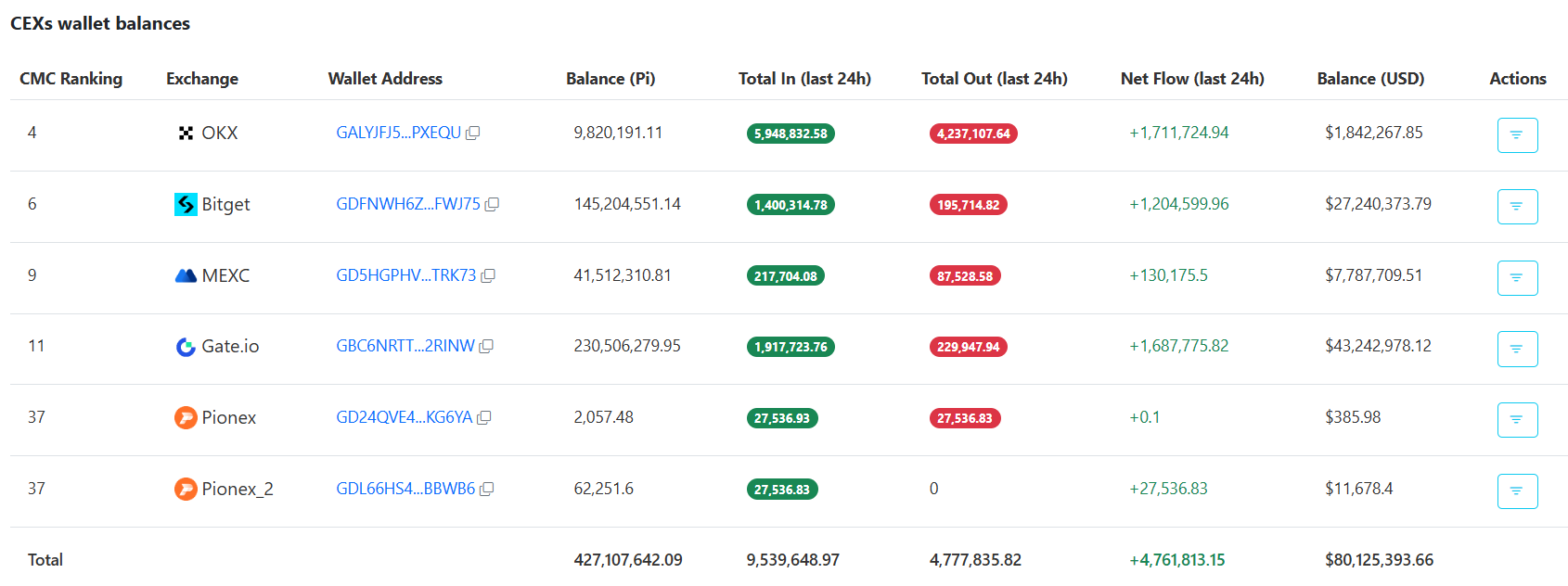
The good days, though, may be coming to an end because the amount of coins stored on crypto exchanges has risen sharply. Almost 5 million PI have been transferred to such platforms in the last 24 hours alone, bringing the total to approximately 427.1 million. More than half of that is held on Gate.io, while Bitget ranks second with approximately 145.2 million tokens.
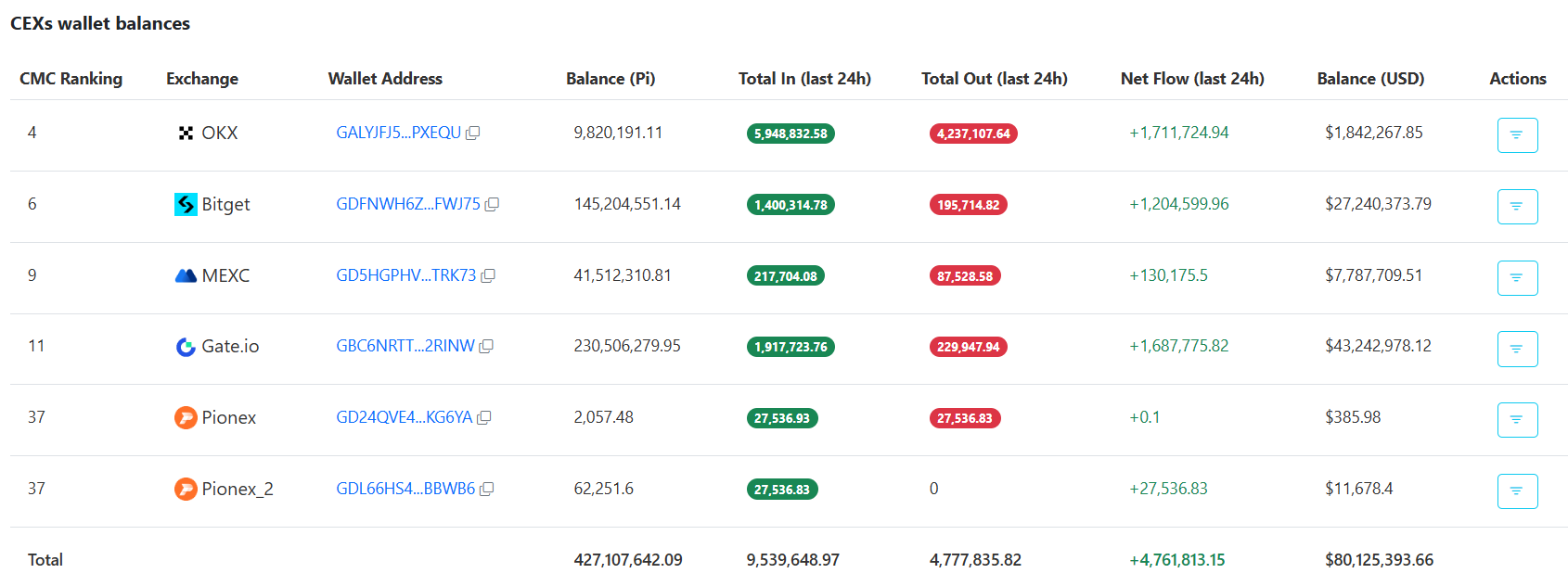
While the shift from self-custody to centralized exchanges doesn’t guarantee a price correction, it is often viewed as a bearish signal, as it could be interpreted as a pre-sale step.
The aggressive token unlocks scheduled for the coming days should also serve as a warning to investors. Data indicates that daily figures will approach 15 million on several occasions before the end of February. After that, though, the process is set to slow down.
You may also like:

New Push From the Bulls?
Contrary to the aforementioned factors, some community members believe PI is on the verge of a more serious surge in the short term. X user Pi Network Academy argued that the asset “is warming up for another big pump,” predicting an explosion to $1.
For their part, Pi Global claimed that “momentum is building, utility is expanding, and community is stronger than ever.” That said, they wondered if the coin’s valuation could hit $0.50 before Pi Day. The date (March 14) is symbolic to Pi Network because it resembles the mathematical constant π (3.14).
Earlier this month, X user Captain Faibik also chipped in. The renowned crypto analyst revealed they had added some PI for the midterm, expecting a 500% rally.
SECRET PARTNERSHIP BONUS for CryptoPotato readers: Use this link to register and unlock $1,500 in exclusive BingX Exchange rewards (limited time offer).
Disclaimer: Information found on CryptoPotato is those of writers quoted. It does not represent the opinions of CryptoPotato on whether to buy, sell, or hold any investments. You are advised to conduct your own research before making any investment decisions. Use provided information at your own risk. See Disclaimer for more information.

Few cryptocurrencies are as polarizing as XRP. Critics across the crypto and DeFi ecosystem often claim XRP has no real utility. They argue it exists mainly as a speculative asset with limited real-world use.
At the same time, XRP maintains one of the largest and most vocal communities in crypto – The XRP Army. They believe the altcoin will eventually power global financial infrastructure.
The truth sits somewhere between those two extremes. XRP does have real utility, but its usage is more specific and narrower than many assume.
XRP is More Unique Than Any Other Cryptocurrency
XRP is the native token of the XRP Ledger, launched in 2012 with a clear purpose: enabling fast and efficient cross-border payments.
Unlike Bitcoin, which focuses on decentralized value storage, or Ethereum, which focuses on programmable smart contracts, XRP was designed primarily to move money between financial systems quickly and cheaply.
Transactions on the XRP Ledger settle in about three to five seconds and cost a fraction of a cent. This makes XRP particularly efficient as a bridge currency, allowing instant conversion between two different fiat currencies without requiring banks or payment providers to hold large reserves in foreign accounts.
Millions Hold XRP — But Most Usage Comes From Traders and Infrastructure
Retail investors make up the largest group of XRP users today. As of early 2025, the XRP Ledger had roughly 6 to 7 million funded accounts, which represent wallets holding XRP.
After adjusting for exchange custody and users holding multiple wallets, analysts estimate around 2 to 3 million individuals globally actually hold XRP.

Crypto exchanges are another major user. Platforms such as Binance, Bitstamp, Kraken, and Uphold use XRP for liquidity management and transfers.
XRP’s speed and low cost make it an efficient tool for moving funds between exchanges and managing trading liquidity.
Payment providers also represent a key real-world use case. Companies like SBI Remit in Japan and Tranglo in Southeast Asia use XRP through Ripple’s On-Demand Liquidity system to facilitate international remittances.
In these cases, XRP acts as a temporary bridge asset, allowing money to move across borders instantly without pre-funded foreign accounts.
Banks Use Ripple Technology, But Only Select Partners Actually Use XRP
Banks, however, present a more nuanced picture. Major financial institutions including Santander, Standard Chartered, and Bank of America have used Ripple’s payment infrastructure.
But most of them use Ripple’s messaging and settlement software without directly using XRP itself. Only select payment providers, rather than global banks broadly, use XRP directly for liquidity.
Beyond financial transfers, XRP also plays an essential technical role within its own network. Every XRP Ledger account must hold XRP, and all transactions require XRP to pay network fees.
XRP supports decentralized trading, token issuance, and asset transfers on the ledger.
So, XRP is neither useless nor universally adopted. Its utility exists in specific financial infrastructure roles, particularly in liquidity provisioning and payment settlement.
Understanding who actually uses XRP reveals a clearer picture—one grounded in real-world function rather than speculation.
The acquisition closed on Friday and should enable Kraken to work closely with token teams early in development.
U.S.-based centralized exchange (CEX) Kraken announced its acquisition of token management platform Magna yesterday.
The deal closed on Friday and marks the CEX’s latest strategic move as it prepares for an initial public offering (IPO).
The move was reported by Fortune, which said Kraken declined to disclose the deal terms, but Kraken’s co-CEO Arjun Sethi told the news outlet that the acquisition will allow Kraken to support token issuer teams “early on in their life cycle,” indicating that it may provide Kraken a strategic leg up in terms of token listings.
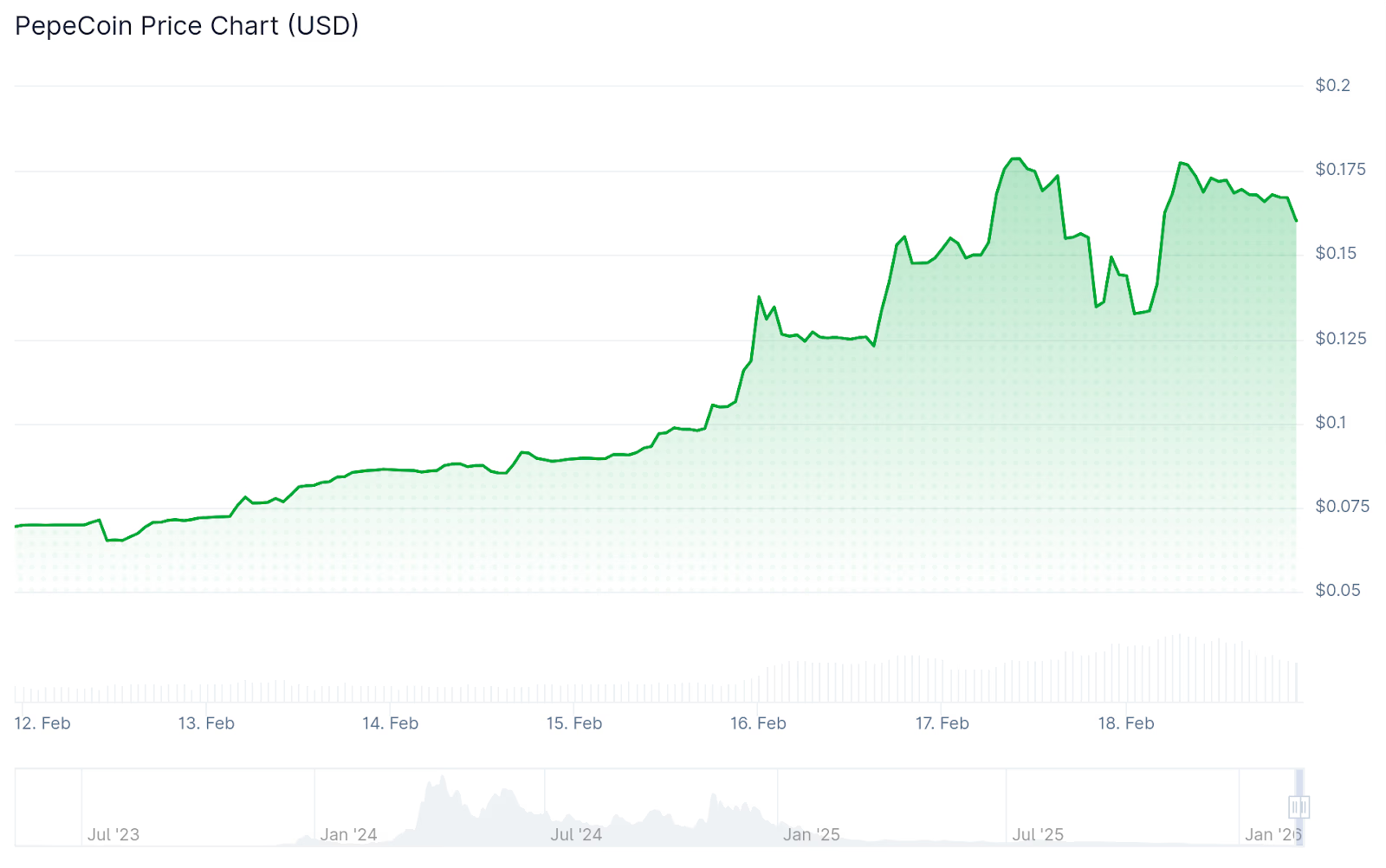
While it is unlikely there is any connection, Kraken also moved to list and promote a memecoin from 2016, PEPECOIN, yesterday, which trades at just a $15 million market capitalization, and should not be confused with PEPE, which launched in 2023 and trades at a $1.7 billion market capitalization.
PEPECOIN is only up 7.6% since the announcement, indicative of the market’s risk-off environment.

Despite the market’s lack of enthusiasm for the listing, the Magna acquisition and the listing of a micro-cap token on the same day may indicate continued aggression from Kraken in expanding asset diversity on the exchange.
Crypto World
Crypto markets feel the chill, Base, ether.fi reorganize layer-2 landscape: Crypto Daybook Americas
By Jacob Joseph (All times ET unless indicated otherwise)
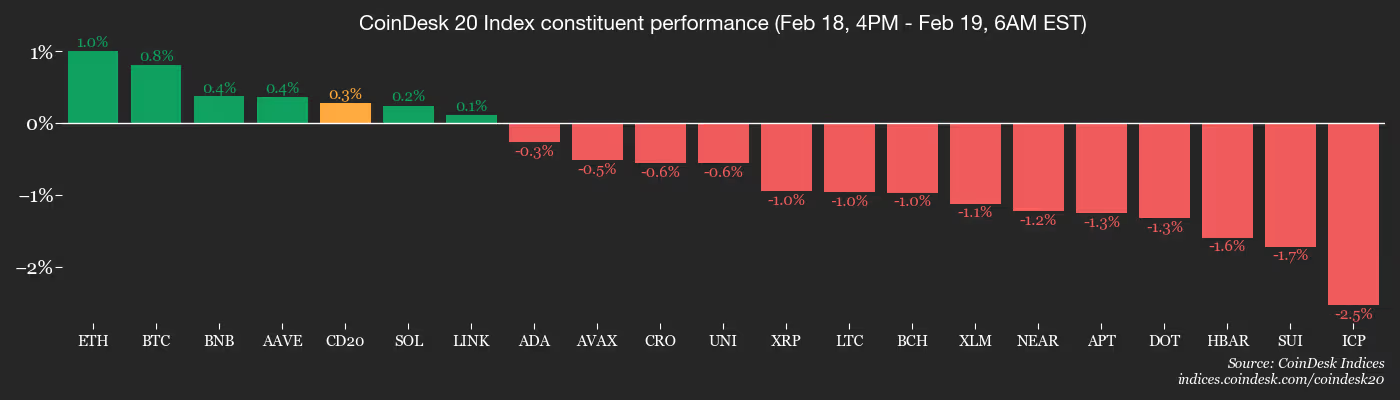
Even with the CoinDesk 20 index (CD20) little changed since midnight UTC, crypto markets remain under pressure. All but one member has dropped, and the outlier, bitcoin , is less than 0.1% in the green.
The index has lost 2% in 24 hours, and spot bitcoin exchange-traded fund flows were negative for a second consecutive session, with $133 million in net outflows on Wednesday. Spot ether (ETH) ETFs also posted net outflows. The second-largest cryptocurrency has lost another 0.2% since midnight.
The key development overnight was Coinbase’s (COIN) announcement that its layer-2 network, Base, will move away from the OP Stack, the open-source, modular rollup framework developed by Optimism that currently powers it. The OP Stack enables chains such as Base and Unichain to operate as low-cost, Ethereum-secured layer 2s, fully compatible with the Ethereum Virtual Machine (EVM) and aligned with Optimism’s broader Superchain vision.
Rather than relying on multiple external contributors for core upgrades and protocol changes, Base intends to consolidate development into a self-managed codebase, giving the team greater control over infrastructure, roadmap, and technical evolution.
The move carries meaningful implications for Optimism. Base has historically accounted for the vast majority of Superchain-generated revenue — often exceeding 90% — which accrues to the Optimism Collective. The announcement represents a significant potential headwind to Optimism’s revenue outlook, with the OP token declining 24% since Wednesday following the news.
In a more positive development, ether.fi said it will migrate its Cash product to Optimism’s OP Mainnet. The move will bring some 70,000 active cards, 300,000 accounts and millions of dollars in total value locked. The non-custodial payment card allows users to spend ETH, BTC and stablecoins at over 100 million Visa merchants, offers 3% crypto cashback and processes about $2 million in daily transaction volume.
In another notable layer-2 development, Robinhood’s testnet recorded 4 million transactions in its first week, according to CEO Vlad Tenev. The Arbitrum-based Robinhood Chain is designed to support tokenized real-world assets and a broader suite of onchain financial services, signaling the firm’s continued push into blockchain-based infrastructure.
While these ecosystem developments remain constructive, broader markets continue to trade within a wider downtrend. The latest Federal Reserve meeting minutes, released yesterday, highlight a growing divergence among policymakers on the path of interest rates.
Several officials indicated that further rate cuts should be paused for now, with the possibility of resuming easing later in the year only if inflation continues to fall. Stay alert!
Read more: For analysis of today’s activity in altcoins and derivatives, see Crypto Markets Today
What to Watch
For a more comprehensive list of events this week, see CoinDesk’s “Crypto Week Ahead“.
- Crypto
- Feb. 19, 8 a.m.: Zama to host a live presentation of its 2026 roadmap.
- Macro
- Feb. 19: U.S. Fed’s Raphael Bostic, Michelle Bowman and Neel Kashkari make speeches throughout the day.
- Feb. 19, 8:30 a.m.: U.S. initial jobless claims for Feb. 14 est. 225K (Prev. 227K)
- Earnings (Estimates based on FactSet data)
- Feb. 19: Riot Platforms (RIOT), post-market, -$0.32
Token Events
For a more comprehensive list of events this week, see CoinDesk’s “Crypto Week Ahead“.
- Governance votes & calls
- ENS DAO is voting to register the on.eth name and establish it as an onchain registry for blockchain metadata. Voting ends Feb. 19.
- Unlocks
- Token Launches
- Feb. 19: Resolv to complete rollout of updated USR/RLP yield distribution parameters
- Feb. 19: Injective to start INJ Community Buyback Round #226
Conferences
For a more comprehensive list of events this week, see CoinDesk’s “Crypto Week Ahead“.
Market Movements
- BTC is up 0.87% from 4 p.m. ET Wednesday at $66,896.68 (24hrs: -1.31%)
- ETH is up 1.29% at $1,966.13 (24hrs: -1.49%)
- CoinDesk 20 is up 0.39% at 1,932.97 (24hrs: -2.57%)
- Ether CESR Composite Staking Rate is unchanged at 2.81%
- BTC funding rate is at 0.0056% (6.1747% annualized) on Binance

- DXY is unchanged at 97.67
- Gold futures are unchanged at $5,009.90
- Silver futures are up 1.13% at $78.47
- Nikkei 225 closed up 0.57% at 57,467.83
- Hang Seng closed up 0.52% at 26,705.94
- FTSE is down 0.63% at 10,618.95
- Euro Stoxx 50 is down 0.81% at 6,054.02
- DJIA closed on Wednesday up 0.26% at 49,662.66
- S&P 500 closed up 0.56% at 6,881.31
- Nasdaq Composite closed up 0.78% at 22,753.63
- S&P/TSX Composite closed up 1.5% at 33,389.73
- S&P 40 Latin America closed up 0.37% at 3,707.85
- U.S. 10-Year Treasury rate is up 1.3 bps at 4.094%
- E-mini S&P 500 futures are down 0.3% at 6,873.25
- E-mini Nasdaq-100 futures are down 0.39% at 24,857.50
- E-mini Dow Jones Industrial Average Index futures are down 0.35% at 49,549.00
Bitcoin Stats
- BTC Dominance: 58.74% (0.26%)
- Ether-bitcoin ratio: 0.0294 (-0.09%)
- Hashrate (seven-day moving average): 1,057 EH/s
- Hashprice (spot): $33.63
- Total fees: 2.31 BTC / $155,155
- CME Futures Open Interest: 118,610 BTC
- BTC priced in gold: 13.4 oz.
- BTC vs gold market cap: 4.47%
Technical Analysis

- The ratio of altcoins (excluding the top 10) to the bitcoin price continues to rise from key weekly support and is now testing the 50-week exponential moving average.
- A break above that level would imply continued resilience of altcoins relative to bitcoin, which is most likely a result of their being extremely oversold.
Crypto Equities
- Coinbase Global (COIN): closed on Monday at $164.05 (-1.19%), +0.24% at $164.45 in pre-market
- Circle Internet (CRCL): closed at $63.15 (+2.48%), +0.19% at $63.27
- Galaxy Digital (GLXY): closed at $21.73 (+2.02%), +0.74% at $21.89
- Bullish (BLSH): closed at $31.85 (-0.47%), unchanged in pre-market
- MARA Holdings (MARA): closed at $7.50 (-0.13%), +0.40% at $7.53
- Riot Platforms (RIOT): closed at $15.49 (+5.73%), +0.19% at $15.52
- Core Scientific (CORZ): closed at $17.27 (+0.23%)
- CleanSpark (CLSK): closed at $9.27 (-0.11%), unchanged in pre-market
- CoinShares Valkyrie Bitcoin Miners ETF (WGMI): closed at $40.04 (+0.10%)
- Exodus Movement (EXOD): closed at $9.88 (-2.08%)
Crypto Treasury Companies
- Strategy (MSTR): closed at $125.20 (-2.70%), unchanged in pre-market
- Strive (ASST): closed at $8.05 (-1.59%)
- SharpLink Gaming (SBET): closed at $6.60 (-0.90%)
- Upexi (UPXI): closed at $0.69 (-4.17%)
- Lite Strategy (LITS): closed at $1.10 (+0.00%)
ETF Flows
Spot BTC ETFs
- Daily net flows: -$133.3 million
- Cumulative net flows: $54.07 billion
- Total BTC holdings ~1.26 million
Spot ETH ETFs
- Daily net flows: -$41.8 million
- Cumulative net flows: $11.68 billion
- Total ETH holdings ~5.74 million
Source: Farside Investors
While You Were Sleeping
- Bitcoin shakes off U.S. session losses as Trump says trade deficit cut by 78% (CoinDesk): Bitcoin trading remained volatile on Thursday, rising to around $67,000 after briefly dipping near $65,900, as traders digested President Trump’s claims the U.S. trade deficit was cut by 78%.
- Bitcoin, ether, xrp ETFs bleed while Solana bucks outflow trend (CoinDesk): U.S.-listed spot crypto ETFs are flashing red across the board, with one exception. SOL ETFs recorded $2.4 million in net inflows, pushing cumulative inflows to nearly $880 million.
- Gold recaptures $5,000 with focus on the Fed’s rate path (Bloomberg): Gold advanced back to around $5,000 an ounce after jumping 2% on Wednesday, with traders focused on the Fed’s next move on interest rates. Bullion climbed as much as 0.9% on Thursday, silver 3%.
- European shares dip as Airbus, Rio Tinto plunge; Nestle gains (Reuters): European shares slipped on Thursday, as investors sifted through a mixed bag of earnings from the likes of Airbus, Rio Tinto and Nestle.
Bitcoin (CRYPTO: BTC) faced renewed selling pressure after failing to clear the $71,000 threshold, slipping toward the $66,000 zone that had provided support in the prior days. The move comes as options markets reveal growing caution among professional traders who are paying a premium for downside protection while hedging risk in a mixed macro backdrop. Despite strength in equities and gold, institutional risk appetite appears to have cooled, with market participants scrutinizing potential catalysts for a deeper pullback. Data during the week showed traders defending the $66k line, but buyers did not mount a decisive comeback, leaving the door open to a retest of lower levels. The dynamic underscores a broader tension between bullish sentiment that sparked a recent rally and a risk-off mood that has crept into crypto trading.
Key takeaways
- Professional traders are paying a 13% premium for downside protection as Bitcoin struggles to maintain support above $66,000.
- While stocks and gold remain resilient, $910 million in Bitcoin ETF outflows since Feb. 11 signal rising institutional caution amid macro uncertainty.
- Put options dominated Deribit activity, with bear diagonal spreads, short straddles and short risk reversals among the most traded strategies in the last 48 hours.
- The delta skew between put and call options remained unconventionally bearish, suggesting traders are hedging against downside moves rather than betting on immediate upside.
- Stablecoin dynamics point to modest outflows, with a 0.2% discount to parity relative to USD/CNY, improving from a prior 1.4% discount.
Tickers mentioned: $BTC
Sentiment: Bearish
Price impact: Negative. A break below key support and persistent hedging pressure hint at further near-term softness for Bitcoin.
Trading idea (Not Financial Advice): Hold. The market backdrop remains tethered to macro cues and evolving ETF flows, so a cautious stance is warranted until clearer catalysts emerge.
Market context: The narrative surrounding Bitcoin is increasingly entwined with broader liquidity concerns, risk sentiment shifts, and ETF flow dynamics that continue to influence institutional exposure amid a volatile macro environment.
Why it matters
For market participants, the current configuration—soft price ceilings around $71,000 giving way to a test of the lower band near $66,000, alongside a persistent premium on downside hedges—highlights a fragile balance between optimism and risk management. The 13% delta skew in put versus call options signals that professional traders are prioritizing protection over speculative bets, which can compress upside opportunities if selling accelerates. This is not merely a Bitcoin story; it reflects how institutions are sizing risk in a backdrop of mixed signals from equities, precious metals, and cross-asset liquidity conditions.
The ETF backdrop compounds the narrative. With US-listed Bitcoin ETFs recording about $910 million in net outflows since Feb. 11, traders are re-evaluating the appetite of large funds to hold or add exposure through traditional wrappers. While broad U.S. equities and gold have shown resilience, crypto-specific demand appears tempered, underscoring the pace at which macro concerns can seep into digital-asset markets. The dislocation between crypto price action and broader risk assets underscores a broader market mood: crypto remains highly sensitive to capital allocation shifts, even as some macro indicators remain supportive for risk-taking in other sectors.
In this environment, traders are not simply playing for a bounce; they are positioning for a potential downside scenario without incurring significant upfront costs. The behavior of the Deribit order book—where bear diagonals, short straddles, and short risk reversals dominated activity in the last 48 hours—illustrates a risk-off posture that seeks to profit from limited price movement in Bitcoin while capping potential losses if liquidation accelerates. The strategy mix effectively lowers the upfront cost of a bearish bet while exposing traders to the risk of a sharp decline, a combination that speaks to growing caution rather than outright pessimism about a rapid collapse.
Beyond price action, the stablecoin channel offers another lens into market sentiment. A 0.2% discount relative to USD/CNY—versus a neutral 0.5% to 1% premium expected under normal conditions—points to moderate outflows or a cautious stance on offshore capital flows. This dynamic can reflect tighter risk appetite in the near term, even as on-chain activity and other on-ramp/off-ramp metrics present a more nuanced picture. The comparison to a prior 1.4% discount earlier in the week signals a partial stabilization, yet it remains a reminder that stablecoin markets often act as a liquid proxy for risk tolerance amid turbulent conditions.
The ETF dynamic remains central to the narrative. While the broader macro environment has not collapsed, crypto-specific inflows have cooled, suggesting that institutional demand for Bitcoin via exchange-traded vehicles is not currently robust enough to sustain a bullish tilt. In parallel, reference to industry coverage suggests that Bitcoin ETFs still sit on substantial net inflows overall—though not enough to offset the near-term outflows and price softness—highlighting a tension between longer-term demand signals and short-term sentiment shifts.
As the market digests these signals, a key question remains: will Bitcoin defend the $66,000 floor, or will sellers reassert control and push the price toward the next set of targets? The answer may hinge on a confluence of factors, including upcoming options activity, regulatory developments, and macro catalysts that can alter the risk calculus for institutions. In the near term, the balance of evidence points to a cautious posture among traders, with hedges and selective exposure dominating the narrative rather than broad-based buying appetite.
Overall, the current environment underscores the complexity of pricing risk in a market where crypto-specific headlines can swing quickly, while cross-asset indicators offer a more tempered read. The juxtaposition of a resilient stock market and a fragile crypto setup creates a dynamic in which investors may rotate away from high-beta crypto exposure until a clearer catalyst emerges. In this sense, Bitcoin’s fate in the weeks ahead will likely depend as much on external liquidity and macro cues as on internal crypto-specific developments, with options markets acting as a barometer for the evolving risk appetite among sophisticated participants.
What to watch next
- Watch Deribit option flows and delta skew in the coming days for signs of renewed hedging or a shift toward riskier bets.
- Monitor Bitcoin ETF net flows over the next two weeks to gauge institutional appetite and potential catalysts for price moves.
- Track stablecoin market dynamics (premium/discount to USD) as a proxy for offshore risk sentiment and liquidity conditions.
- Assess macro catalysts (regulatory developments, inflation data, or Fed commentary) that could reframe risk appetite for crypto assets.
SOURCES & verification
- Deribit option activity and delta skew data cited in Laevitas data (bear diagonal spreads, short straddle, short risk reversal as top strategies over the past 48 hours).
- Stablecoin premium/discount relative to USD/CNY data (OKX) as an indicator of on-chain/FX-related risk flows.
- $910 million in total outflows from US-listed Bitcoin ETFs since Feb. 11; reference to recent ETF flow coverage.
- Bitcoin ETF inflow/outflow context and comparisons to gold and the S&P 500 performance as macro backdrop.
- Bloomberg report noting that Bitcoin ETFs still sit on $53B in net inflows despite recent outflows (as a broader ETF context).
Bitcoin options reflect risk-off mood as ETF outflows weigh on price
Bitcoin (CRYPTO: BTC) is moving in a cautious mode as buyers struggle to push through the $71,000 barrier, with the asset testing the lower support near $66,000. The latest data indicates that professional traders are prioritizing downside hedges, evident in the premium paid for put options and the selective use of bearish strategies on Deribit. In a market where equities and bullion have shown resilience, crypto traders appear to be prioritizing risk management over speculative bets, a stance reinforced by notable ETF outflows and a cautious stance toward new positions.
The premium structure in the option market—specifically a 13% put premium relative to calls on a recent trading day—suggests a market not confident in a rapid revival of momentum. This condition aligns with the broader narrative of risk-off sentiment, where hedges are favored as a way to mitigate the potential for a sharper drawdown should volatility spike or macro catalysts disappoint. The existence of bearish formations such as bear diagonals, short straddles, and short risk reversals among the most active trades over the last two days further underscores a cautious posture among institutional participants who are navigating a delicate balance between preserving capital and seeking incremental exposure.
The ETF story adds another layer of nuance. With $910 million in net outflows since Feb. 11, the flow data reflects a degree of institutional hesitation that cannot be fully explained by price alone. While gold and the broader stock market have been robust, crypto-specific demand appears to be cooling, at least in the near term. The divergence between crypto price action and the appetite of large funds to deploy capital in standard wrappers is a telling indicator of how investors are reassessing risk in a landscape where cross-asset liquidity can tighten quickly, especially in times of macro uncertainty.
On stablecoins, a modest 0.2% discount to parity relative to USD/CNY signals a transitional phase in which cross-border liquidity and currency controls influence how capital moves in and out of crypto markets. That said, the improvement from a prior 1.4% discount suggests some stabilization, but it remains to be seen whether this will translate into stronger on-chain demand or simply reflect a temporary reprieve in selling pressure.
For the broader market, the “risk-off but not outright bearish” stance in Bitcoin contrasts with the relative strength seen elsewhere. A comparison of market conditions suggests that the crypto sector remains more reactive to liquidity flows and sentiment shifts than to standalone fundamental catalysts. This dynamic can produce outsized volatility within short windows, even as longer-term macro considerations remain in flux. Investors and traders alike should stay vigilant for any shifts in ETF flows, option activity, or regulatory signals that could reconfigure the risk premium embedded in BTC and related instruments.
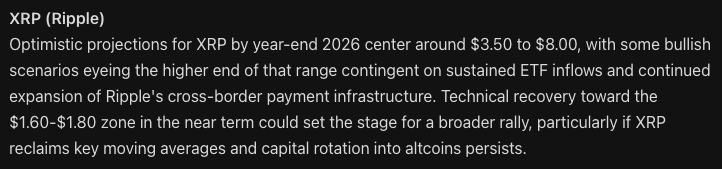
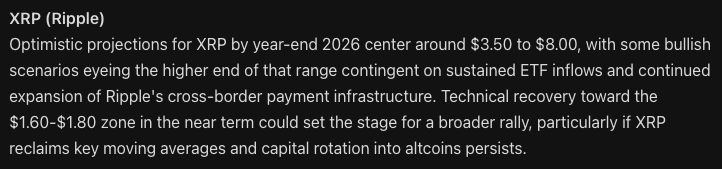
Running a well-crafted prompt through Alibaba AI model KIMI can surface some eye-opening 2026 price scenarios for XRP, Shiba Inu, and Pepe.
According to Alibaba’s outlook, all three digital assets could generate substantial returns by New Year, perhaps much sooner than investors expect.
Below is a closer look at the projections and the logic behind them.
XRP ($XRP): Will Ripple’s Payments Solution Hit $8?
In a recent statement, Ripple once again emphasized that XRP ($XRP) sits at the heart of its strategy to position the XRP Ledger as a globally scalable, enterprise-grade payments infrastructure.
Thanks to near-instant transaction settlement and ultra-low fees, XRPL has also gained traction as a preferred blockchain for two of crypto’s fastest-expanding sectors: stablecoins and tokenized real-world assets.
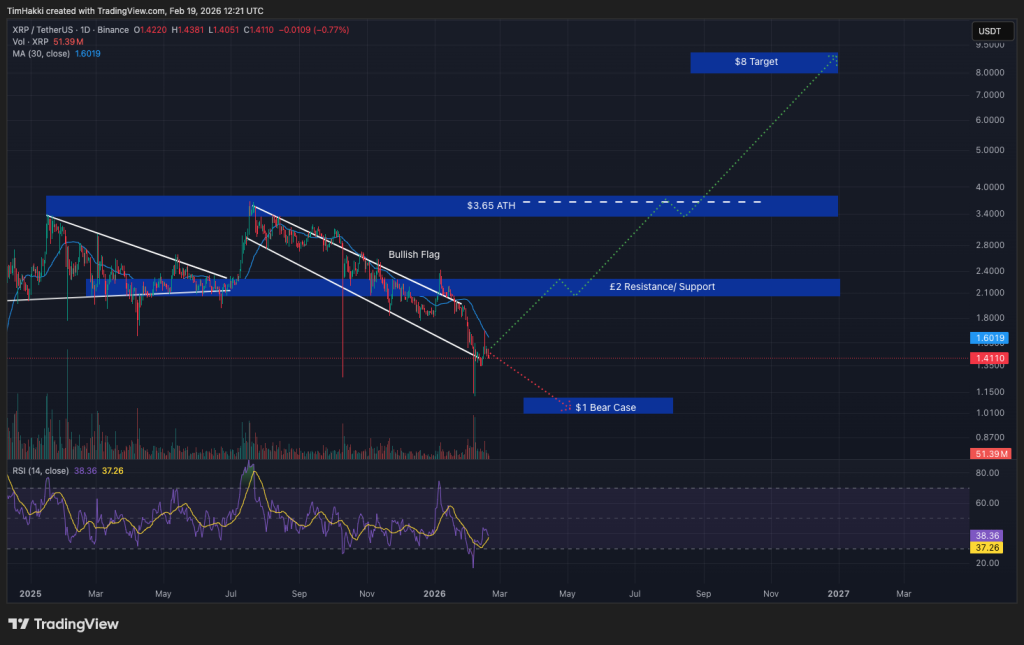
With XRP currently changing hands around $1.41, Alibaba forecasts that the token could reach as high as $8 by the end of 2026, a sixfold increase from today’s levels.
Technical indicators appear to support this scenario. XRP’s recent support and resistance lines for a bullish flag, which could be a precursor to a major rally.
Potential tailwinds include accelerating institutional demand following the approval of U.S.-listed XRP exchange-traded funds, Ripple’s growing roster of enterprise partners, and the possible advancement of the U.S. CLARITY bill later this year.
Shiba Inu (SHIB): Alibaba Think SHIB Will Grow 850% by Christmas
Shiba Inu ($SHIB), launched in 2020 as a lighthearted alternative to Dogecoin, has since matured into a sizable crypto ecosystem with a market cap of $3.6 billion.
Currently trading around $0.000006187, Alibaba’s analysis suggests that a decisive breakout above resistance in the $0.000025 to $0.00003 range could trigger a strong upside move, potentially lifting SHIB to $0.000059 by year-end.
Such a rally would equate to approximately 850% gains from current prices and place SHIB just below its October 2021 ATH of $0.00008616.
Additionally, Shiba Inu has expanded well beyond meme status. Its Layer-2 network, Shibarium, delivers faster transactions, lower fees, added privacy features, and improved developer tools.
Pepe ($PEPE): Alibaba Examines a 2,200% Bull Case
Pepe ($PEPE), which debuted in April 2023, has grown into the largest meme coin outside the doge category, boasting a market capitalization of roughly $1.8 billion.
Drawing inspiration from Matt Furie’s “Boy’s Club” comics, PEPE’s instantly recognizable branding and cultural relevance have kept it highly visible across social media platforms.
Despite fierce competition in the meme coin arena, PEPE’s dedicated community, and the countless imitators it has spawned, have helped it remain a consistent leader within the sector.
Occasional cryptic posts from Elon Musk on X have further fueled speculation that PEPE could sit alongside DOGE and BTC among his personal holdings.
At present, PEPE trades near $0.0000042, roughly 85% below its December 2024 ATH of $0.00002803.
Under Alibaba’s most bullish assumptions, PEPE could surge by as much as 2,233%, climbing to approximately $0.000098 and decisively breaking its previous record.
Maxi Doge: A New Meme Coin Contender Steps Into the Spotlight
Limited by their size, PEPE and SHIB’s potential gains might be substantial, but they’re just short of explosive.
However, Maxi Doge ($MAXI) hasn’t even launched yet and it’s already one of the most talked-about meme coins of 2026, raising $4.6 million in its ongoing presale.
The project revolves around Maxi Doge, a brash, gym-obsessed, unapologetically degen character portrayed as a distant cousin and would-be rival to Dogecoin’s crown, capturing the raw, DGAF energy that defined the 2021 meme coin boom.
MAXI is an ERC-20 token on Ethereum’s proof-of-stake network, giving it a significantly smaller environmental footprint than Dogecoin’s proof-of-work design.
Early presale participants can currently stake MAXI tokens for yields of up to 68% APY, with rewards tapering as more users join the staking pool.
The token is $0.0002804 in the current presale stage, with automatic price increases programmed at each funding milestone. Purchases are supported via MetaMask and Best Wallet.
Stay updated through Maxi Doge’s official X and Telegram pages.
Visit the Official Maxi Doge Website Here
The post China’s Alibaba AI Predicts the Price of XRP, Shiba Inu and PEPE By the End of 2026 appeared first on Cryptonews.
Analysts told The Defiant that the move tests whether Optimism’s shared revenue model is sustainable in the long term.
Base’s decision to move away from the OP Stack to a unified software stack is raising questions about the long-term economics behind Optimism’s Superchain model.
The OP Mainnet, which is powered by the OP Stack, is currently the third-largest Ethereum Layer-2 by total value locked (TVL) at $1.84 billion, per L2beat.
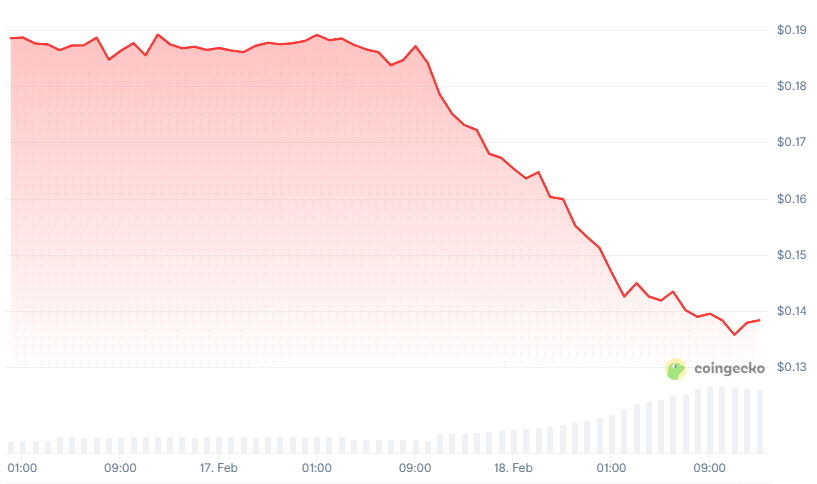
OP, Optimism’s native token, is currently trading at around $0.14, down 26% over the past 24 hours, according to CoinGecko data. The sell-off followed a Wednesday, Feb. 18, blog post from Base – the Ethereum Layer-2 blockchain launched by Coinbase with a TVL of $3.8 billion – outlining plans to move away from Optimism’s software over the coming months.

Experts told The Defiant this move matters because Base is the biggest network using Optimism’s technology. If Base steps away, it raises doubts about whether the Superchain can keep growing its shared revenue over time.
Optimism’s Superchain Model
Under Optimism’s Superchain model, chains that join agree to share a small portion of their fees with the Optimism Collective, according to an official Optimism blog post from 2024. Specifically, each chain sends back either 2.5% of its chain revenue or 15% of its on-chain profits (after costs and gas fees), whichever is higher.
Because Base has been one of the busiest rollups, it was widely seen as one of the biggest contributors to this shared pool.
“Base moving away from the OP Superchain isn’t that surprising when you look at the incentives,” said Shresth Agrawal, CEO of Pod Network. “Base was reportedly contributing around 97% of the revenue, so at some point the ‘Superchain tax’ becomes hard to justify.”
Nicolai Sondergaard, a research analyst at Nansen, told The Defiant that Base was processing roughly four times more transactions than Optimism, generating about 144 times more decentralized exchange (DEX) volume, and producing 80 times more gas fees.
“The ~26% crash in OP (now around $0.14) is the market repricing the whole Superchain thesis,” Sondergaard added. “If Coinbase’s Base, the flagship OP Stack chain, is leaving to build their own stack, why would anyone else stay and share revenue?”
However, Agrawal said that the broader issue, in his opinion, is licensing. “The OP Stack became the default L2 framework partly because it embraced open-source norms,” Agrawal explained. “But fully permissive licenses make monetization difficult—large, well-distributed players can fork or internalize the stack without long-term revenue sharing.”
He pointed to alternatives such as business-style licenses (similar to Arbitrum’s early approach), which he said may be harder to adopt at first but could prove more commercially sustainable.
“Main Revenue Driver”
Meanwhile, Oxytocin, head of ecosystem at Umia and a former Optimism governance delegate, explained to the Defiant that rollup partnerships like Base are integral to Optimism’s long-term revenue narrative.
“While this revenue would go directly to the Foundation as opposed to a token-controlled treasury, the value accrued through these kinds of deals with rollups was one of the main proposed revenue drivers,” Oxytocin said. “The timing of this announcement will also impact the effectiveness of the recently proposed OP buyback scheme.”
In January, the Optimism Foundation proposed a buyback program that would use 50% of incoming Superchain revenue to purchase OP tokens starting sometime in February. The plan is meant to better align the token’s value with the growth of the Superchain ecosystem.
Moving Forward
The Defiant reached out to Optimism for comment and was redirected to an X post by Jing Wang, the CEO of OP Labs and Co-founder of Optimism. “This is a hit to near-term on-chain revenues,” Wang wrote on Feb.18. “But as cryptotwitter has been saying for ages, we needed to evolve our biz model.”
Wang added that the OP Stack remains the “most performant” and has “endured the most traffic in production,” regardless of Base’s fork. Data from DeFiLlama shows that the TVL in Optimism Bridge is $498 million, down sharply from its peak of around $5 billion in 2024.
In an official statement, Optimism said it was “grateful” for its three-year partnership with Base and that it will continue working with Base as an OP Enterprise customer “while they build out their independent infrastructure.”
The development also comes as Optimism is attracting new partners. On Wednesday, decentralized finance (DeFi) firm EtherFi said it plans to move its Cash accounts and card program from Scroll to Optimism’s OP Mainnet.
The move is expected to bring $160 million in TVL and more than 70,000 active cards to the network, The Defiant previously reported. Both companies described the move as a long-term partnership.
“While the recent news is a significant shakeup for many, I remain confident that OP Labs will be able to iterate on their value mission and continue attracting new members to the OP Stack, like the recent announcement from EtherFi,” Oxytocin concluded. “Optimism’s ethos has always been one of strong reflection and iteration, and they have proven many times in the past that they are able to re-align their roadmap as needed.”

The REASON EXPLAINED Why Crypto Has Been Horrible! And, WHEN It Is Going to Explode – EXPLAINED!

All Creatures Great and Small Nicholas Ralph & Rachel Shenton spotted
US Market | Big fund managers bet against Fed cut hopes


-

 Video3 days ago
Bitcoin: We’re Entering The Most Dangerous Phase
-

 Tech5 days ago
Luxman Enters Its Second Century with the D-100 SACD Player and L-100 Integrated Amplifier
-

 Crypto World3 days ago
Can XRP Price Successfully Register a 33% Breakout Past $2?
-

 Sports3 days ago
GB's semi-final hopes hang by thread after loss to Switzerland
-

 Video7 days ago
The Final Warning: XRP Is Entering The Chaos Zone
-
 Tech3 days ago
The Music Industry Enters Its Less-Is-More Era
-

 Business2 days ago
Infosys Limited (INFY) Discusses Tech Transitions and the Unique Aspects of the AI Era Transcript
-

 Entertainment1 day ago
Kunal Nayyar’s Secret Acts Of Kindness Sparks Online Discussion
-

 Video3 days ago
Financial Statement Analysis | Complete Chapter Revision in 10 Minutes | Class 12 Board exam 2026
-

 Tech2 days ago
Retro Rover: LT6502 Laptop Packs 8-Bit Power On The Go
-

 Crypto World6 days ago
Bhutan’s Bitcoin sales enter third straight week with $6.7M BTC offload
-
 Sports20 hours ago
Clearing the boundary, crossing into history: J&K end 67-year wait, enter maiden Ranji Trophy final | Cricket News
-

 Entertainment1 day ago
Dolores Catania Blasts Rob Rausch For Turning On ‘Housewives’ On ‘Traitors’
-

 Crypto World6 days ago
Kalshi enters $9B sports insurance market with new brokerage deal
-

 Business2 days ago
Tesla avoids California suspension after ending ‘autopilot’ marketing
-
 NewsBeat4 days ago
The strange Cambridgeshire cemetery that forbade church rectors from entering
-

 Crypto World1 day ago
WLFI Crypto Surges Toward $0.12 as Whale Buys $2.75M Before Trump-Linked Forum
-
 NewsBeat4 days ago
Man dies after entering floodwater during police pursuit
-

 NewsBeat5 days ago
UK construction company enters administration, records show
-

 Crypto World3 hours ago
83% of Altcoins Enter Bear Trend as Liquidity Crunch Tightens Grip on Crypto Market