

Crypto World
Anchorage Expands TRON Support with Institutional TRX Staking

Digital asset custodian Anchorage Digital has added native TRX staking for institutional clients, expanding its support for the Tron blockchain as demand for regulated access to staking services grows.
The launch expands Anchorage’s support for Tron after introducing institutional custody for TRX, the network’s native token, earlier this year. Clients can now stake TRX directly from the company’s custody platform or Porto self-custody wallet, allowing them to earn protocol rewards for helping secure the blockchain without moving assets outside their existing custody environment.
Anchorage said the expansion reflects growing institutional interest in the Tron ecosystem, one of the largest networks for USDt (USDT) settlement. According to the company, Tron processed roughly $2 trillion in USDT transfers during the first quarter of 2026 while averaging 10.9 million daily transactions and 3.2 million active addresses. Tether’s transparency data shows nearly $90 billion of USDT currently circulates on the network.
The Tron rollout follows Anchorage’s broader expansion of institutional staking services. In November, the company partnered with Figment to add HYPE staking, extending custody-integrated staking support to the Hyperliquid ecosystem.
Related: Ethereum’s much-hated staking ‘tax’ may already be obsolete
Institutional platforms expand beyond custody
Institutional crypto infrastructure providers have increasingly expanded beyond custody, adding staking capabilities as investors seek regulated ways to earn returns on digital assets.
In October 2025, Coinbase and Figment expanded their institutional staking partnership, allowing Coinbase Prime clients to stake proof-of-stake assets including Solana (SOL), Avalanche (AVAX), Sui (SUI) and Aptos (APT) directly from custody. Four months later, Ripple integrated Figment and Securosys into its institutional custody platform, enabling banks and custodians to offer staking without having to operate their own validator infrastructure.
Asset managers have also sought integrated custody and staking services. In February, BitGo expanded its partnership with 21shares to provide regulated custody and staking for the firm’s US exchange-traded funds and global exchange-traded products through its regulated US and European entities.
Corporate crypto treasuries have joined the trend as well. Bitmine launched its MAVAN staking platform in March, having initially built the validator infrastructure for its own Ether treasury and later opening it to external institutions and custodians.
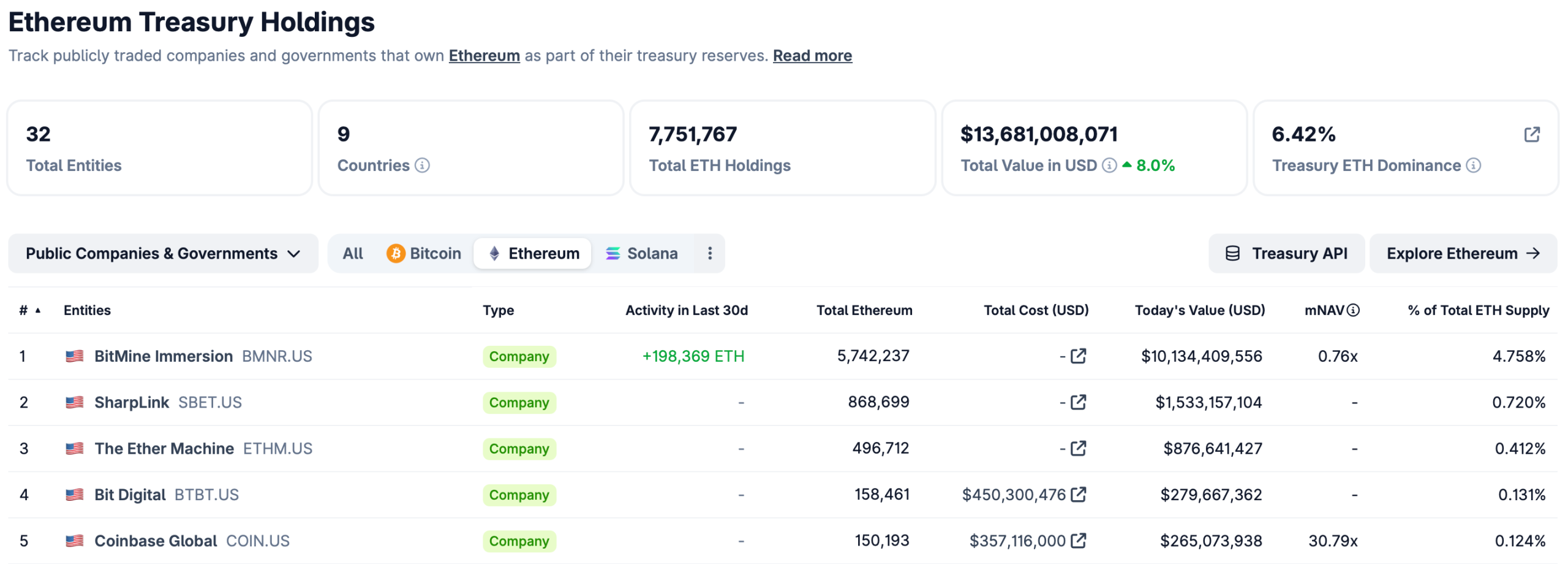
On Monday, Bitmine said it holds 5.77 million ETH, representing about 4.8% of Ether’s total supply, and has staked 4.92 million ETH through MAVAN.
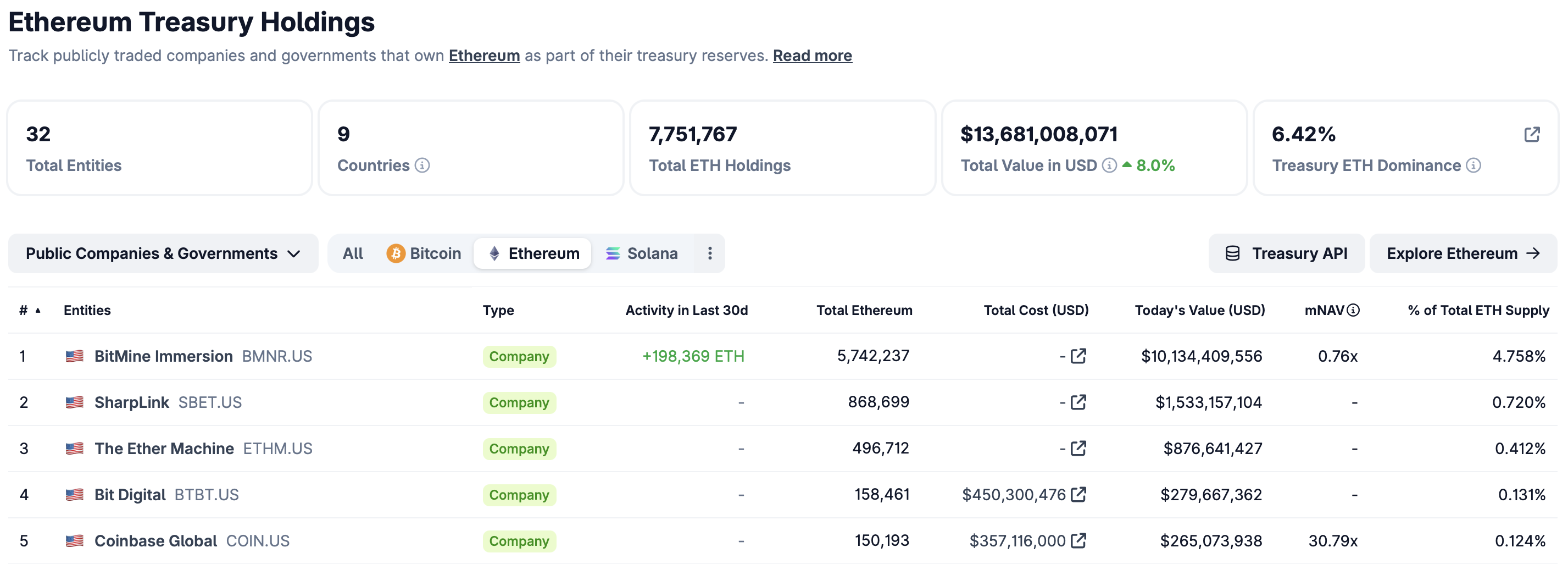
Top Ethereum treasury companies. Source: CoinGecko
Magazine: Robinhood L2 sparks ETH optimism, Saylor ‘muddies waters.’ Hodler’s Digest, July 5-12, 2026

In June 2025, a week before the XRP Ledger’s EVM sidechain went live, the team building it published the arithmetic of what was coming. Polygon had contributed somewhere between $2 billion and $6 billion in total value locked to Ethereum, up to a tenth of the whole.
Summary
- The XRPL EVM sidechain promised a $600 million to $12 billion TVL uplift but holds only $25,741 after one year.
- The chain is technically live, audited, and maintained, but almost no users or capital have arrived.
- Moai Finance has recorded just $95,008 in cumulative spot volume across the sidechain’s entire existence.
- XRPL’s institutional mainnet activity grew while permissionless EVM DeFi failed to gain traction.
- The result suggests EVM compatibility alone does not create demand without users already waiting for cheaper or better execution.
If the XRPL EVM sidechain matched that trajectory, the post argued, the uplift to the XRP Ledger would run from $600 million to $12 billion, and it would fundamentally change the demand curve for XRP. Ninety entities were already building. Sixty days of testnet had pulled in developers who had never touched the XRP ecosystem. The technology was ready. The builders were here.The sidechain launched on June 30, 2025. The anniversary passed two weeks ago.
As of July 14, 2026, total value locked on the XRPL EVM sidechain is $25,741, according to DefiLlama. Chain fees over the past 24 hours: zero. Chain revenue: zero. Decentralized exchange volume over 24 hours: zero. Over seven days: also zero. The largest protocol on the chain, a decentralized exchange called XRiSE33 Network, holds $11,909. The second largest, a launchpad named Riddle, holds $8,831. Moai Finance, the only protocol on the chain that has ever recorded meaningful trading, has done $95,008 in cumulative spot volume across its entire existence and currently holds $1,117.
The low end of the projection was $600 million. The delivery is $25,741. That is not a shortfall. It is a rounding error against a rounding error, and it is the most instructive number in the XRP ecosystem right now, because of what else the same ledger accomplished during the same twelve months.
What was actually built
The technical work was not the problem, and it is worth stating that clearly before the autopsy.The XRPL EVM sidechain is a Cosmos SDK chain running Ethereum Virtual Machine compatibility, connected to the XRP Ledger mainnet through the Axelar bridge, which links more than eighty networks. XRP is the native gas token. Bridged XRP locks on mainnet and mints a synthetic version on the sidechain, so the design preserves mainnet supply integrity while freeing the asset for smart contract use. Consensus is proof of authority, targeting up to 1,000 transactions per second at fees far below Ethereum’s. Squid handles cross-chain transfers as the official interface. Band Protocol supplies oracles, Grove supplies public RPC endpoints. Wormhole integration was slated to follow, extending reach to more than 200 applications across 35 ecosystems.
Ripple built it with Peersyst and contributors from the Cosmos community. crypto.news covered the mainnet launch on June 30, 2025, where Ripple’s David Schwartz framed the sidechain as extending the ecosystem without altering what makes the XRP Ledger reliable. The launch roster included Strobe, a money market for lending and overcollateralized borrowing; Securd, a lending protocol for financing collateralized leverage; Vertex, a derivatives venue; plus Moai, Elys, XRise, and Hammy. The infrastructure was audited end to end. Subsequent releases hardened it further, with a v11 upgrade focused on economic security, IBC transfer hardening, and proof of authority validator management, and an upgrade to Cosmos EVM v0.4.1 adding ERC-20 mint and burn plus current Ethereum improvement proposals.
None of that is vaporware. Every component works. Someone can bridge XRP to the sidechain right now, deploy a Solidity contract, and trade on a decentralized exchange. The chain is live, secure, and functionally complete.It is also empty.That is the part worth sitting with, because it inverts the usual crypto post-mortem. The standard failure story is a project that promised more than it could build: the whitepaper outran the engineers, the deadlines slipped, the product never shipped or shipped broken. XRPL EVM shipped, on schedule, working, audited, and maintained through multiple upgrades over the following year. Every promise about the technology was kept. The only promise that failed was the one about people.
The decline, measured
The most damning fact is not the small number. It is the direction.In August 2025, roughly six weeks after launch, DefiLlama showed the sidechain hosting three decentralized exchanges and a single launchpad, with combined total value locked of $100,818. Twenty four hour volume across the entire chain was $3,238, every dollar of it from Moai Finance. Riddle, XRiSE33 Network, and SurgeDefi recorded no trading activity whatsoever. Developer data at the time counted 168 developers on XRPL EVM against 8,448 on Ethereum, a gap of roughly 98%.
That was the bad news at six weeks. Today, eleven months later, total value locked is $25,741. The chain lost roughly three quarters of the little it had. The protocol count is nominally higher, with Midas RWA, Hyperithm, Portal, Axelar, and an NFT marketplace called Mintiq now listed, but every one of those additions reports zero total value locked on this chain. They are multi-chain protocols that support XRPL EVM the way a restaurant supports a dietary restriction: the option exists on the menu and nobody orders it.
The volume figures are what turn an underperformance into something stranger. Zero over 24 hours. Zero over seven days. Moai Finance, the chain’s only functioning exchange by any historical measure, shows $95,008 in cumulative volume since inception. Not per day. Total, across a year of operation, on the flagship DeFi venue of a chain built for a token with a market capitalization near $68 billion.
A chain with $25,741 of capital and no trading is not a slow start. It is a chain nobody is using, and the trend line says that fewer people are using it every month.For scale, the entire TVL of the sidechain is currently less than the value of roughly 24,000 XRP. Ripple releases a billion tokens from escrow on the first of every month. The whole DeFi economy built on top of the XRP Ledger, through the official sidechain, could be funded out of forty thousandths of a single monthly escrow tranche.
Who was supposed to show up
Reading the launch roster a year later is the clearest way to see what went wrong, because the roster was not thin. It was specific.Strobe was announced as a money market for lending and overcollateralized borrowing on XRPL. Securd was to provide passive income by financing collateralized leverage across DeFi positions. Vertex was a derivatives platform optimizing capital efficiency. Between them, those three cover the load-bearing categories of any DeFi economy: lending, leverage, and derivatives. Add a decentralized exchange for spot, an oracle from Band, RPC infrastructure from Grove, and a cross-chain interface from Squid, and the stack on paper was complete. Nothing essential was missing.
Today none of those three names appears among the protocols holding capital on the chain. The entire TVL sits in two decentralized exchanges and a launchpad. The lending market that would have made bridged XRP productive, the derivatives venue that would have given traders a reason to keep collateral there, the leverage layer that generates the recursive deposits which inflate every chain’s TVL figure: none of it materialized in a form anyone funded.
That absence explains the volume better than any macro argument. A chain with only spot DEXs and no credit has no reason to hold capital between trades. Money arrives, swaps, and leaves. On chains where TVL compounds, it compounds because deposits are collateral, collateral is borrowed against, and the borrowings are redeposited. Without a lending market, TVL is just the float sitting in a few pools, and $25,741 is what that float looks like when almost nobody is swapping.
The irony is precise. The lending layer the sidechain needed and never got is now being built on the mainnet instead, in a permissioned, institutionally underwritten form that has nothing to do with the EVM. The sidechain was the place DeFi was supposed to happen. Credit went somewhere else, and the sidechain was left holding the part of DeFi that cannot sustain itself alone.
Why the projection was never plausible
The Polygon comparison that produced the $600 million to $12 billion range deserves scrutiny, because in retrospect it was comparing two things that share almost no structural features.
Polygon captured Ethereum overflow. It existed because Ethereum’s fees became unbearable during periods of intense demand, and there was a vast population of users and developers already transacting on Ethereum who wanted the same applications for less money. The demand preceded the chain. Polygon did not create appetite for DeFi; it captured appetite that already existed and had nowhere cheaper to go. Add hundreds of millions of dollars in liquidity incentives and a mature Ethereum tooling ecosystem that ported over with a config change, and the TVL followed the demand.
XRPL EVM inverted every one of those conditions. There was no congestion to relieve, because the XRP Ledger has never been congested. There was no population of XRPL DeFi users seeking cheaper execution, because XRPL DeFi barely existed: the ledger’s total value locked has run under 0.05% of its market capitalization, against roughly 20% for Ethereum and 10% for Solana. That statistic was cited in the launch material as the size of the opportunity. It is more accurately read as the size of the demand problem.
Six million XRPL wallet holders were presented as a distribution advantage, but they were six million holders of a payments asset who had spent a decade not asking for smart contracts. The sidechain did not remove a barrier between XRP holders and DeFi. It tested whether the barrier was the reason, and the answer came back no.The Peersyst material was explicit that testnet momentum arrived organically, without incentives or paid marketing, and treated that as evidence of underlying pull. Ninety logos on a testnet is a real signal of developer curiosity. It is not a signal of user demand, and the distinction is the whole story: developers show up to explore new chains constantly, at near zero cost, and the tourism ends when nobody trades.
The comparison that hurts
Here is why this matters beyond a dead sidechain: the XRP Ledger had an extraordinary year, on the mainnet, at exactly the same time.
Tokenized real-world assets on the XRP Ledger grew from under a billion dollars at the start of 2026 to roughly $3.5 billion, and the ledger has led the market on 90-day RWA inflows, adding $1.9 billion. In May 2026, Ondo Finance executed the first cross-border, cross-bank redemption of tokenized United States Treasuries on the XRPL, clearing in seconds, with JPMorgan and Mastercard involved in the surrounding work. RLUSD grew past a $1.5 billion market capitalization. The native automated market maker and multi-purpose token amendments both passed validator votes. The XLS-65 and XLS-66 lending amendments are in validator voting now, an effort crypto.news examined in its analysis of what on-chain credit would mean for XRP.
The mainnet, in other words, went and built exactly the thing the sidechain was supposed to enable, using its own native primitives, aimed at institutions instead of Solidity developers, and it worked. Institutional tokenization found the XRP Ledger without an EVM. Permissionless DeFi did not find it with one.
That contrast reframes the sidechain from a failed product into a resolved question. The bet was that XRPL’s problem was programmability, and that giving Ethereum developers a familiar environment on top of XRP liquidity would unlock a DeFi economy. Twelve months of data says the problem was never programmability. It was that the XRP ecosystem’s actual demand is institutional settlement, and institutional settlement does not want an EVM sidechain with proof of authority consensus and a bridge. It wants permissioned pools, credentialed counterparties, and off-chain underwriting, which is precisely what the mainnet amendments deliver.
Notice also where XRP-adjacent DeFi capital actually went. VivoPower allocated $100 million through Flare, a separate network built specifically to give XRP holders DeFi access, rather than through Ripple’s own sidechain. When money did move toward XRP DeFi, it routed around the official product.
The case that this is unfair
The bearish read above deserves an honest counterweight, and there is a real one.Timing first. The sidechain launched on June 30, 2025, roughly three weeks before XRP’s cycle high near $3.65, and spent its entire first year inside the worst crypto drawdown since 2022. Bitcoin fell more than 40% from its October peak. Digital asset funds ran multi-billion dollar outflow streaks. Three consecutive losing quarters, the longest streak since the last bear market, with institutional capital rotating into artificial intelligence equities. TVL across the market compressed. Judging a new chain’s ecosystem formation against a projection written in a bull market, and measured entirely inside a bear market, stacks the comparison. Polygon’s $2 billion to $6 billion was built during a mania.
Second, no incentives. Polygon’s TVL was purchased. Hundreds of millions in liquidity mining subsidies pulled capital that largely left when the subsidies stopped. XRPL EVM launched with none, which is defensible as a matter of discipline and fatal as a matter of cold-start economics. Liquidity begets liquidity, and a chain with $25,741 cannot attract a trader who needs to move $50,000 without moving the price against themselves. Every DeFi ecosystem that reached scale bought its first users. Refusing to do so is a choice with predictable consequences, not evidence that the underlying idea is wrong.
Third, sequencing. The credit layer was always the point. RippleX’s own framing describes a deliberate progression: represent value, move value, trade value, finance value. The lending amendments now in voting are the fourth step, and they are being built on the mainnet with institutional design constraints, not on the sidechain. If the strategy is institutional DeFi rather than retail DeFi, then the sidechain was never the main line. It was an option that Ripple bought cheaply, and options that expire worthless are still rational to have purchased.
Fourth, the infrastructure persists. A chain is not a startup that folds. It runs, it gets upgraded, and it costs almost nothing to leave running. If the market turns, if incentives arrive, if a single application finds product-market fit, the environment is there, audited and connected to eighty networks. Twelve months is a short window for infrastructure that took years to build.
Fifth, and least comfortable for the bears: the metric itself is contested. Total value locked measures deposited capital, not usefulness, and it is trivially gamed by recursive lending and mercenary liquidity on chains that do buy their numbers. A chain with honest, unincentivized TVL of $25,741 and a chain with subsidized TVL of $500 million are not obviously ranked the way the figures suggest. That argument does not rescue XRPL EVM, because zero volume is not a metrics artifact, but it is a fair caution against treating one number as a verdict on an entire architecture.
The case that it is worse than it looks
Now the harder reading, which the numbers support more directly.The bear market explains compression. It does not explain zero. Solana’s memecoin economy generated tens of billions of dollars of volume through the same drawdown. Robinhood Chain launched on July 1, 2026 into the identical macro and did more than $3 billion in decentralized exchange volume in two weeks, with 19,586 tokens created on a single day. Hyperliquid, Base, and BNB Chain all sustained real activity. Capital did not stop moving in 2026. It moved somewhere else. The absence of incentives explains a smaller number; it does not explain a chain where the flagship exchange has done $95,000 in trading across its entire existence while a two-week-old competitor chain did $3 billion.The declining trend is the tell. $100,818 in August 2025 to $25,741 in July 2026 is not a chain waiting for conditions to improve. It is a chain being abandoned by the little capital that tried it. Bear markets thin the field; they do not usually take three quarters of the liquidity from a chain that started with almost none.
And the developer number from August was the leading indicator everyone skipped: 168 developers against Ethereum’s 8,448. Chains are not built by logos on a testnet. They are built by people shipping applications that someone wants to use, and the ratio said, six weeks in, that the ninety entities had not converted into an ecosystem. The launch roster is the proof. Strobe, Securd, Vertex: named as launch partners, and today the chain’s entire TVL sits in two DEXs and a launchpad nobody trades on. The applications that were supposed to give the chain a reason to exist either never shipped at scale or shipped and found nobody.
The strategic cost is subtler than the wasted engineering. For a year, “XRPfi” and the EVM sidechain functioned as an answer to the hardest question about XRP, which is how any of Ripple’s progress reaches the token. The sidechain made XRP the gas asset of a DeFi economy, which would have generated real, recurring token demand. That answer is now empirically closed, and it closes at the same moment as the structural finding that most of Ripple’s bank partners never touch XRP at all. Two of the three main value-accrual arguments for the token have now been tested against data in the same quarter. Both came back thin.
What the $25,741 is actually evidence of
Step back from XRP entirely, because the finding generalizes.The industry has spent five years treating EVM compatibility as a growth strategy. The reasoning is seductive: Ethereum has the developers, the tooling, the mental models, and the applications, so any chain that speaks Solidity inherits access to all of it at the cost of an engineering project. Dozens of chains have run this play. A few worked. Most produced exactly what XRPL EVM produced, which is a technically excellent environment with nobody in it.
The reason is that EVM compatibility removes a supply-side constraint and does nothing to the demand side. It makes building easier. It does not make anyone want the thing built. When a chain has organic demand and a technical barrier, removing the barrier unlocks enormous value, which is the Polygon story and the Arbitrum story. When a chain has a technical option and no demand, removing the barrier produces an empty room with excellent acoustics.
The diagnostic question is therefore simple and almost never asked before a chain commits to the work: is there a queue? Not a waiting list of developers, who are cheap to attract and cost nothing to lose, but users currently doing the thing somewhere worse and paying for the privilege. Polygon had a queue. Arbitrum had a queue. XRPL EVM had a hypothesis that six million payment-asset holders would become DeFi users once the tooling arrived, and hypotheses are not queues.
XRPL had the cleanest possible version of the test. Six million wallets. A top-ten asset. Twelve years of uptime. Deep liquidity. Real regulatory standing. A functioning native DEX. Every input the thesis requires, and a year later the DeFi economy built on top of it holds less capital than a used car. If EVM compatibility were the unlock, it would have worked here. The mechanics of liquidity pools and automated market makers are identical on XRPL EVM to what they are on Ethereum. The pools are simply empty, because pools are filled by people who want something, and nobody wanted this.
The lesson costs Ripple very little and should cost the next chain a great deal. The company retained an option, learned that its DeFi demand is institutional rather than permissionless, and redirected to native amendments aimed at exactly that. That is a reasonable outcome from a cheap experiment. The problem belongs to everyone still pitching an EVM layer as a demand strategy, because the most rigorous public test of that thesis just returned $25,741 and no volume, and the DeFi industry has not noticed.
The number to remember
The projection was $600 million to $12 billion. The delivery is $25,741 and zero trading volume, twelve months later, on a chain that works perfectly.That gap is not a failure of engineering, marketing, timing, or macro, though each contributed at the margin. It is a measurement. Somebody asked, with real money and real code and a well-built product, whether the XRP ecosystem wanted permissionless DeFi. The ecosystem answered. The answer was no, and it took a year and a nine-figure projection to hear a number that fits on a single line of a spreadsheet.
XRPL’s institutional story is doing better than it has ever done. Its DeFi story is a chain with $25,741 on it and nobody trading. Both of those things are true at once, and anyone building a thesis on XRP needs to hold both, because the second one used to be an argument and is now just a data point.
Disclaimer: This article is for informational purposes only and does not constitute investment advice. Total value locked, volume, and protocol figures are drawn from DefiLlama as of July 14, 2026, and change continuously; TVL is a contested metric and methodologies differ between trackers. Historical figures are attributed to the sources that reported them at the time. Projections cited were published by the sidechain’s development team and are not forecasts by crypto.news. Details reflect information current as of July 14, 2026. Always do your own research.
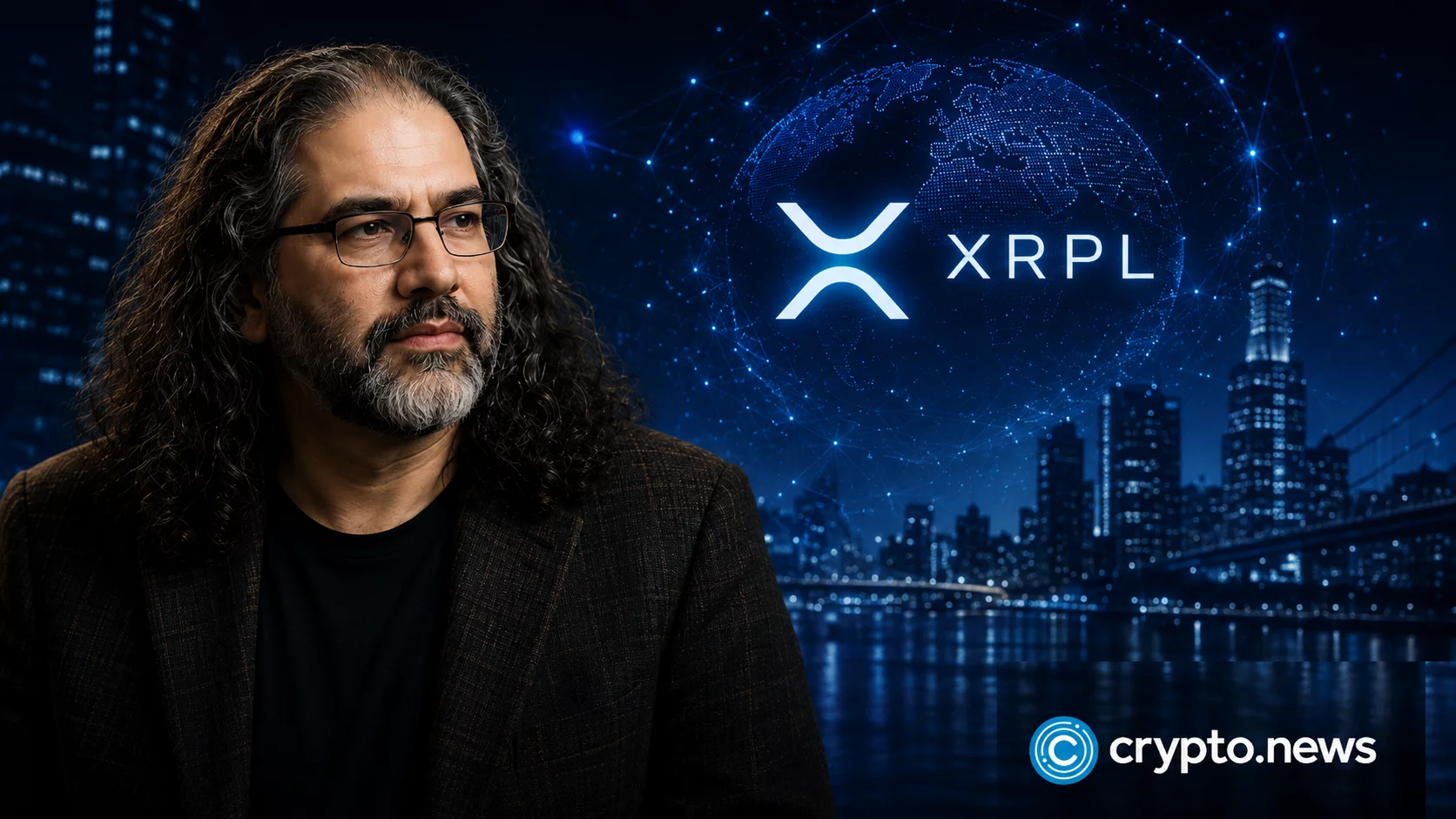
Ripple CTO Emeritus David Schwartz has defended XRP advertising in college sports after critics called for tighter restrictions on crypto promotion.
Summary
- David Schwartz argues truthful XRP advertising receives First Amendment protection against broad government restrictions nationwide.
- His argument cites Supreme Court rulings that struck restrictions on lawful alcohol and gambling advertising.
- Commercial speech remains regulable, meaning the Constitution does not automatically block every potential advertising restriction.
The debate followed the University of Kansas athletics program’s decision to place XRP branding on team uniforms under a multi-year partnership with Ripple.
In a July 15 post on X, Schwartz argued that governments cannot broadly suppress truthful advertising for lawful products simply because officials believe consumers may make poor decisions. His position centers on First Amendment protections for commercial speech.
Schwartz turns XRP advertising debate into constitutional question
The discussion began after critics compared crypto promotion in college sports with advertising for gambling, tobacco and alcohol. They argued that universities should not expose students and younger sports fans to digital asset marketing.
Schwartz responded with a legal argument rather than a defense of XRP as an investment. He wrote that the government cannot suppress truthful commercial speech merely to prevent people from making “bad, but lawful, decisions.” His argument draws a distinction between regulating an activity and banning truthful speech about that activity.
Supreme Court cases support protection for lawful advertising
Schwartz cited 44 Liquormart v. Rhode Island, a 1996 Supreme Court case that struck down restrictions on advertising liquor prices. The Court found that Rhode Island could not broadly block truthful price information simply because the state wanted to reduce alcohol consumption.
He also pointed to Greater New Orleans Broadcasting Association v. United States. In that case, the Supreme Court ruled that a federal restriction could not block advertisements for lawful private casino gambling under the circumstances before the Court.
However, those rulings do not make every restriction on XRP advertising automatically unconstitutional. Under the Supreme Court’s Central Hudson framework, commercial speech receives protection when it concerns lawful activity and is not misleading. Governments may still impose properly tailored restrictions that directly serve a substantial public interest.
Kansas deal puts XRP logo across college sports
Kansas Athletics announced the Ripple partnership on July 8. The XRP logo will appear on uniforms across the university’s athletic programs, making it the first cryptocurrency jersey patch used across a major college athletics program, according to Kansas.
The agreement also covers branding at athletic venues, digital properties and events. Ripple will fund financial and technology education programs for student-athletes and the wider campus community. The partnership also expands an existing recruitment link between Ripple and Kansas graduates.
As previously reported, the agreement runs for five years and has personal ties to Ripple CEO Brad Garlinghouse, a University of Kansas alumnus. The sponsorship has since drawn wider attention to how universities should handle digital asset advertising.
XRP legal history adds context to advertising dispute
The debate comes three years after a federal court issued its split ruling in the SEC’s case against Ripple. The court found that Ripple’s programmatic XRP sales did not qualify as securities transactions under the circumstances examined, while certain institutional sales violated securities laws. The case formally ended in 2025 with a $125 million penalty and an injunction remaining in place.
That history makes broad claims about XRP’s legal status more complex than simply calling the asset universally exempt from financial regulation. Schwartz’s First Amendment argument instead rests on a narrower point: truthful commercial speech concerning lawful activity receives constitutional protection.
A government attempt to impose a blanket ban on XRP advertising could therefore face a serious First Amendment challenge. But existing Supreme Court doctrine still allows some commercial advertising rules when regulators can satisfy the required constitutional test.
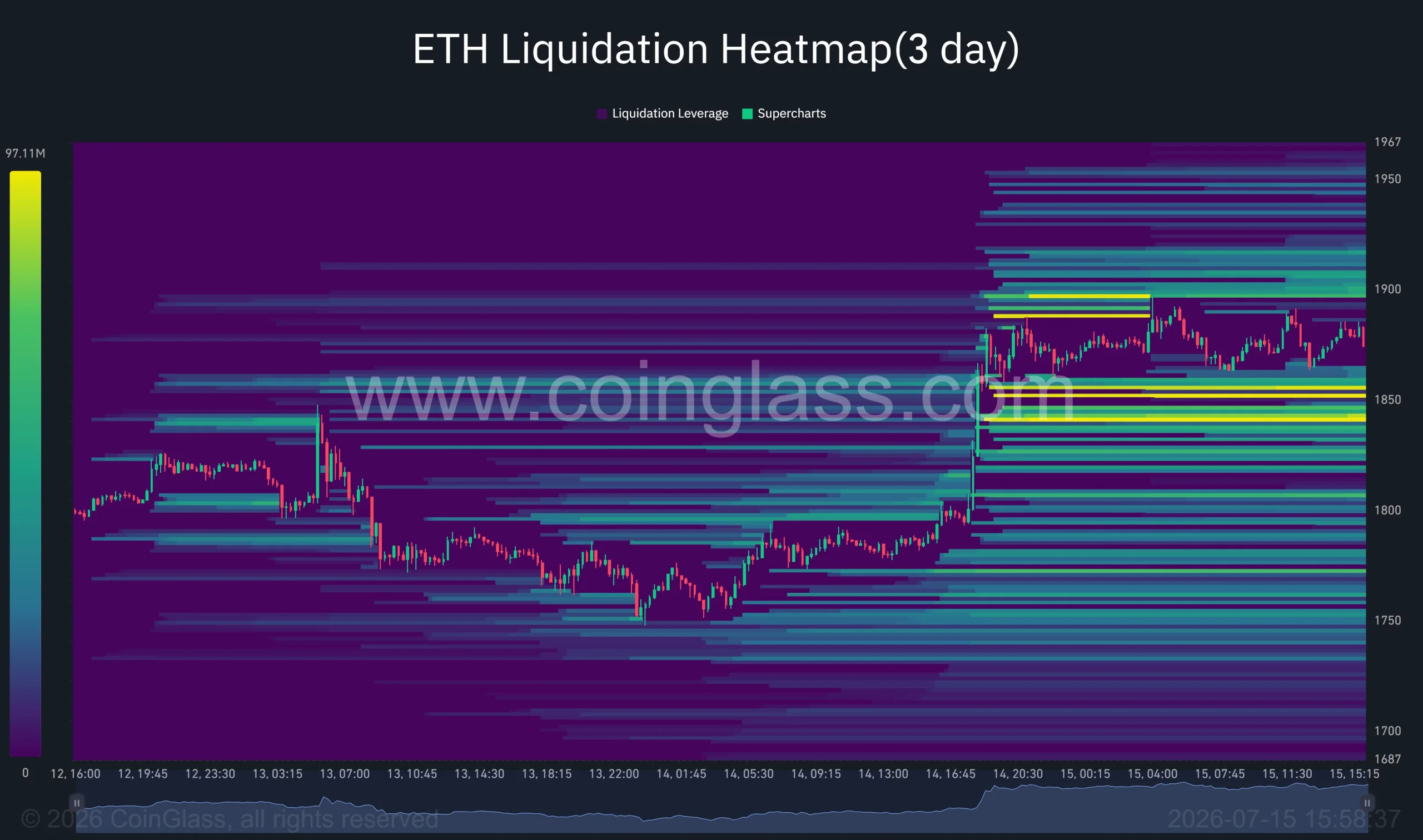
Ethereum price has reclaimed the $1,850 resistance after softer-than-expected U.S. inflation data triggered a sharp short squeeze, putting the $2,000 level back into focus for traders.
Summary
- Ethereum price broke above $1,850 after softer U.S. CPI data sparked a broad crypto rally.
- Technical charts and liquidation clusters suggest $2,000 is the next major price target.
- Analysts say holding $1,850 as support is key to sustaining the current bullish trend.
The second-largest cryptocurrency climbed nearly 5% on July 15 after June’s Consumer Price Index came in below expectations, easing concerns that Federal Reserve Chair Kevin Warsh would resume aggressive rate hikes. Risk assets rallied across global markets, with tech stocks advancing alongside cryptocurrencies as investors priced in a more accommodative policy outlook.
Derivatives markets amplified the move. CoinGlass liquidation data shows a dense cluster of leveraged short positions between $1,800 and $1,850 was wiped out as Ethereum broke through resistance. Forced buybacks accelerated the rally toward $1,900, while the latest liquidation heatmap now shows fresh liquidity pockets concentrated around $1,900-$1,950.
A successful push through that zone could expose another wave of liquidations and open a path toward the psychological $2,000 level.
Technical breakout puts $2,000 back in play
Ethereum’s daily chart shows the recovery has developed from a series of rounded-bottom formations that formed after June’s selloff to nearly $1,500. Price has now completed a breakout above the neckline near $1,850, a level that capped several recovery attempts over recent weeks. The measured move from the pattern projects a target close to $2,190, matching a major resistance zone from earlier this year.
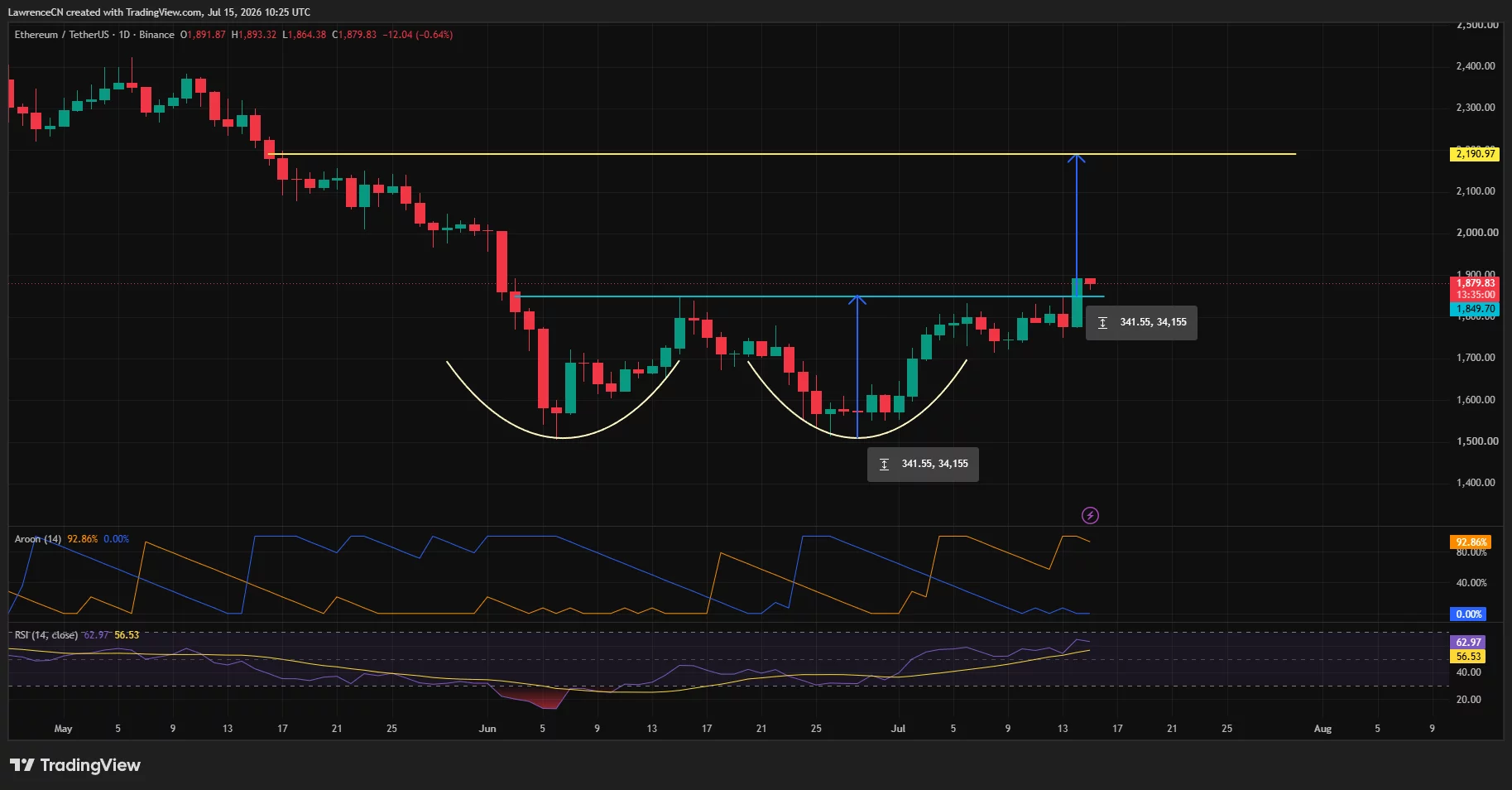
Momentum indicators continue to favor buyers. The Aroon Up indicator stands above 92 while Aroon Down has dropped to zero, suggesting bulls retain control of the prevailing trend. Relative Strength Index has climbed to around 63, leaving room for additional gains before reaching overbought territory.
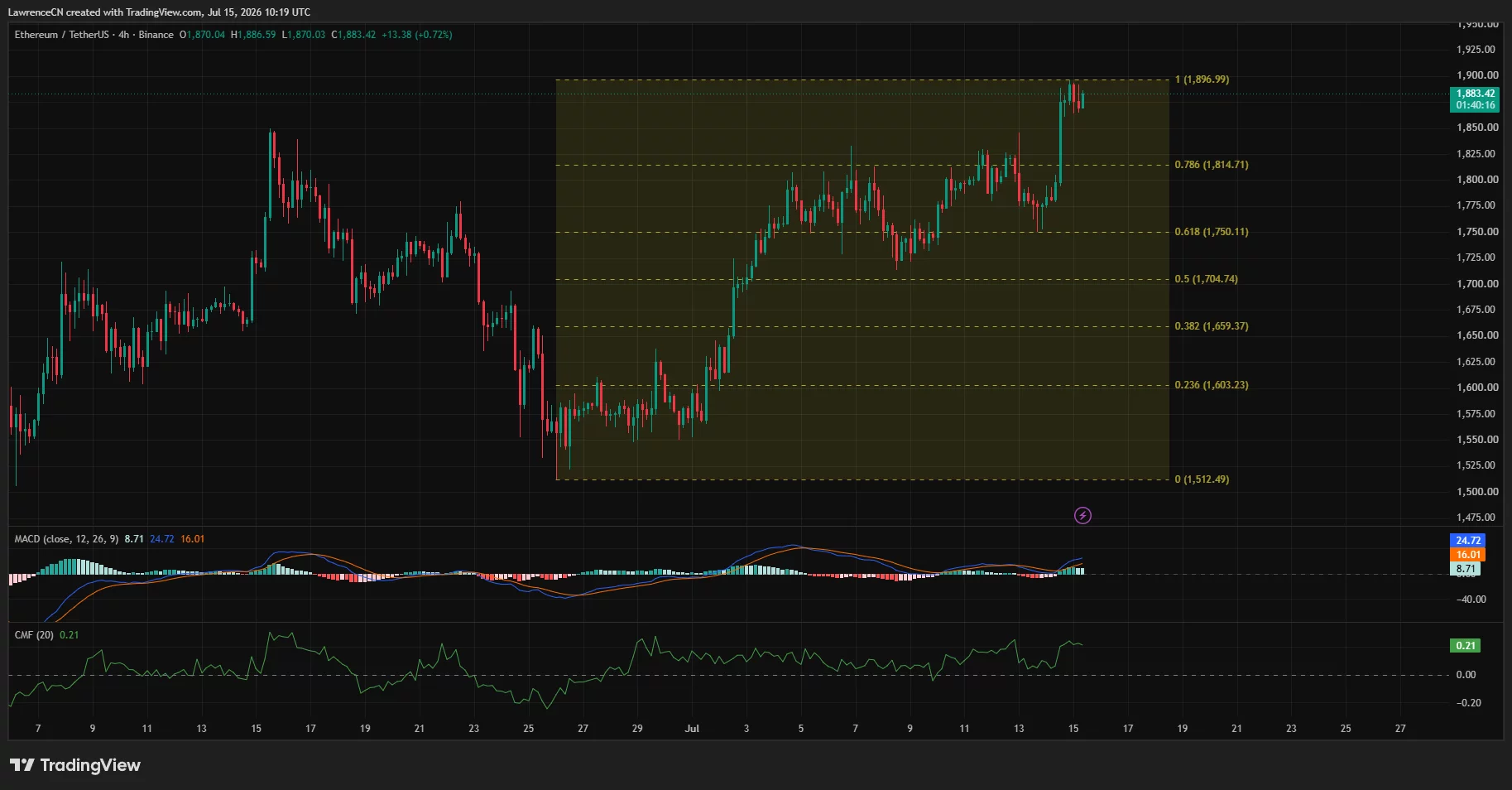
The 4-hour chart reinforces the bullish structure. Ethereum has reclaimed the 100% Fibonacci retracement level near $1,897 after holding above the 78.6% retracement around $1,815. MACD remains in positive territory with widening bullish momentum, while the Chaikin Money Flow reading above zero suggests capital continues to enter the market rather than leave it.
Commenting on the breakout, crypto analyst Daan Crypto Trades wrote on X:
“ETH Breaking above the $1.8K level and saw some good continuation so far. The market structure has flipped back to bullish on this timeframe.”
He added that the next major high-timeframe resistance sits near the $2,100 region, while maintaining $1,800 as support remains critical for bullish momentum.
Another closely followed trader, Ted Pillows, believes the next milestone could arrive quickly if buyers defend current levels. “$ETH has fully reclaimed its key resistance level. If Ethereum manages to hold above the $1,850 level, the pump towards $2,000 will be next,” he wrote.
Outside the charts, Ethereum continues to benefit from tightening on-chain supply. A large share of circulating ETH remains locked in staking, limiting readily available exchange balances even as demand improves.
At the same time, regulatory progress surrounding U.S. crypto legislation and spot ETF adoption has kept institutional interest intact after several weeks of macro-driven volatility tied to Middle East tensions and government-linked crypto transfers.
Loss of $1,850 support would weaken the bullish case
Despite the improving setup, Ethereum still faces several hurdles before reclaiming $2,000. The liquidation heatmap shows heavy leveraged positioning between $1,900 and $1,950, where sellers may attempt to defend resistance. Failure to absorb that supply could trigger another round of profit-taking after the recent rally.
Macro risks also remain. Any resurgence in inflation, renewed geopolitical tensions that drive oil prices sharply higher, or unexpectedly hawkish comments from Federal Reserve officials could reverse sentiment across risk assets.
From a technical perspective, losing the newly reclaimed $1,850 support would invalidate the breakout and shift attention back toward $1,815, followed by the stronger demand zone around $1,750. As long as Ethereum continues to post higher highs while defending $1,850, however, the probability of a move toward $2,000 and potentially the $2,100-$2,190 resistance region remains favorable.
Disclosure: This article does not represent investment advice. The content and materials featured on this page are for educational purposes only.

The Czech Ministry of Finance has added Polymarket to its list of unauthorized online gambling websites, triggering mandatory blocking by internet service providers (ISPs). The move brings another European jurisdiction into the growing crackdown on prediction markets that regulators argue operate without the right licenses.
According to the ministry, Polymarket’s website was included under the Czech Gambling Act, which bars operators from offering unlicensed online gambling services to people in the country. ISPs are required to block the listed site within 15 days of the blacklist publication, as described in the ministry’s published data and the relevant law.
Key takeaways
- The Czech Ministry of Finance has formally blacklisted Polymarket under the Gambling Act and ordered ISP blocking within 15 days of listing.
- Regulators across Europe are increasingly scrutinizing prediction-market contracts, particularly when they resemble binary options.
- ESMA warned that marketing labels like “event contracts” may not change the legal assessment if a product meets the definition of a financial instrument.
- Similar restrictions have emerged beyond Europe, including actions tied to gambling concerns in other jurisdictions and state-level disputes in the US.
How the Czech blacklist affects access
In a notice published by the Czech Ministry of Finance, Polymarket was added to the publicly available list of unauthorized internet gambling websites. The ministry’s classification is tied to the country’s Gambling Act framework, under which offering online gambling to Czech users without authorization is prohibited.
The practical effect is straightforward: once a domain is included on the ministry’s blacklist, ISPs must block access. The ministry’s materials point to the legal obligation to implement such blocks within 15 days after the name is published.
For Polymarket, which operates as a prediction market where users trade contracts tied to the outcomes of future events, this kind of restriction can directly limit retail participation from affected networks, even if the platform remains accessible in other countries.
Why prediction markets keep running into regulation
The Czech action follows a broader regulatory pattern. Regulators in multiple jurisdictions argue that some prediction-market contracts effectively function as gambling products—or, in certain cases, fall within existing financial market rules—depending on how the contracts behave.
Earlier this year, the European Securities and Markets Authority (ESMA) issued guidance warning that many prediction market contracts could already be captured by restrictions on binary options under EU rules. ESMA emphasized that firms cannot sidestep regulatory obligations merely by branding binary-style products as “event contracts” instead of derivatives.
ESMA’s point was technical but consequential: whether a contract is treated as a financial instrument depends on its characteristics rather than its marketing label. ESMA further noted that companies offering qualifying contracts to retail investors may already face national restrictions reflecting the EU’s 2018 ban on binary options, while offerings to professional clients may require authorization under MiFID II (the Markets in Financial Instruments Directive).
For market participants, the implication is that compliance risk does not hinge on naming conventions. Platforms may need to evaluate contract structures—such as how payouts are determined, how the products are offered, and the target investor base—because regulators are increasingly treating substance as the deciding factor.
EU scrutiny is part of a wider global trend
While EU authorities have been vocal about the potential overlap between prediction-market contracts and regulated financial products, the issue is not limited to Europe. Cointelegraph previously reported that regulators in several other countries have restricted access to Polymarket citing gambling-related concerns.
In the Asia-Pacific region, similar actions have been described in Australia, Indonesia, and Singapore. Elsewhere, the core debate has also played out in the United States, where Polymarket and rival platform Kalshi have faced regulatory challenges at the state level over whether their event contracts are illegal gambling.
At the same time, the Commodity Futures Trading Commission (CFTC) has maintained that such products fall under its exclusive jurisdiction as federally regulated derivatives. This disagreement has contributed to a patchwork environment, including conflicting court outcomes, and has fueled calls for clearer congressional guidance on whether sports and political event contracts should be treated as gambling or handled as derivatives under federal frameworks.
The result for users is uneven market access: depending on where they live and how regulators classify the same underlying contract mechanics, the same platform can be permitted, restricted, or blocked.
What to watch next
With the Czech blacklist now active and ESMA continuing to frame the issue around contract characteristics, investors and users should expect more compliance-driven changes across jurisdictions—either through licensing, product redesign, or restricted access. The key uncertainty remains how quickly courts and regulators converge on a consistent legal classification for prediction-market contracts that sit between gambling and financial derivatives.
For Polymarket specifically, the immediate question is whether it will take steps to operate within Czech requirements or adjust its distribution approach to mitigate access blocks. More broadly, market watchers should monitor how EU guidance translates into enforcement actions and whether similar measures spread through additional member states.
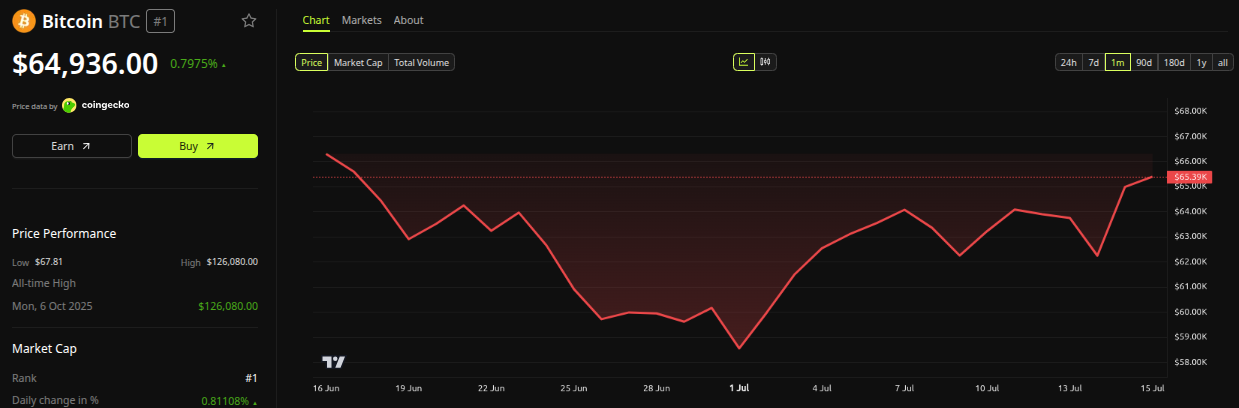
Peter Schiff attacked Bitcoin and Michael Saylor on July 15, predicting a slide to $20,000 (nearly 70% below current prices) and questioning MicroStrategy’s decision to sell stock rather than BTC.
The economist argues that Saylor is trapped and that holders who refuse to sell today will regret it soon.

Schiff Targets Strategy’s $450 Million Stock Sale
Strategy (formerly MicroStrategy) is the corporate vehicle through which Michael Saylor accumulated more than 847,000 Bitcoin, making it the largest public holder of the asset.
Schiff dedicated part of his latest podcast episode to dissecting the company’s latest financial moves. His conclusions were predictably harsh.
The firm has gone three consecutive weeks without buying Bitcoin. It has not sold any either since disposing of 3,588 BTC last week, opting instead to raise $450 million through a common stock sale.
That decision pushed cash reserves to $3 billion while the stock traded at a steep discount to its Bitcoin holdings. Schiff called the operation a needless dilution of shareholders. The company chose paper over its own reserves.
His reasoning centers on a trap. According to the economist, Saylor avoids selling BTC because any meaningful liquidation would sink the price. The market, he claims, already understands that perfectly well.
“Saylor knows if he starts really selling Bitcoin, the price is gonna crash. Now, the problem is it’s gonna crash anyway because the market realizes the bind that he’s in, and even if he doesn’t sell, the market is gonna crash out from under him. But he is so nervous about selling Bitcoin that he’s willing to sell his own stock at a massive discount,” Schiff noted.
Follow us on X to get the latest news as it happens.
Why Does Schiff Expect Bitcoin to Reach $20,000
Schiff went further with his forecast. He identified resistance near $65,000 and support around $58,000, warning that a break below could drag Bitcoin under $50,000. His floor sits between $30,000 and $20,000, a level not seen for years.
Curiously, the critic admitted some regret. He said buying Bitcoin 15 years ago would have made perfect sense, though he feels absolutely no remorse about skipping the last five years of the rally.
“I don’t regret not buying it three, four, five years ago… But yeah, 15 years ago, sure, I should have bought it,” the economist confessed.
The timing of the criticism, however, looks awkward. Bitcoin trades just under $65,000 at the time of writing, up nearly 5% in the last week, according to BeInCrypto data.
Subscribe to our YouTube channel to watch leaders and journalists provide expert insights.
The broader debate, however, extends beyond Schiff’s predictions. Analysts have been reassessing the corporate Bitcoin accumulation model, and Strategy sits at the center of that reevaluation.
Investors now scrutinize cash reserves, equity issuances, and funding conditions before assuming that future purchases will remain sustainable. Headline-grabbing buys no longer carry the same automatic credibility they once did in the market.
The post Peter Schiff Predicts a 70% Bitcoin Crash and Warns Holders Will Regret Not Selling appeared first on BeInCrypto.
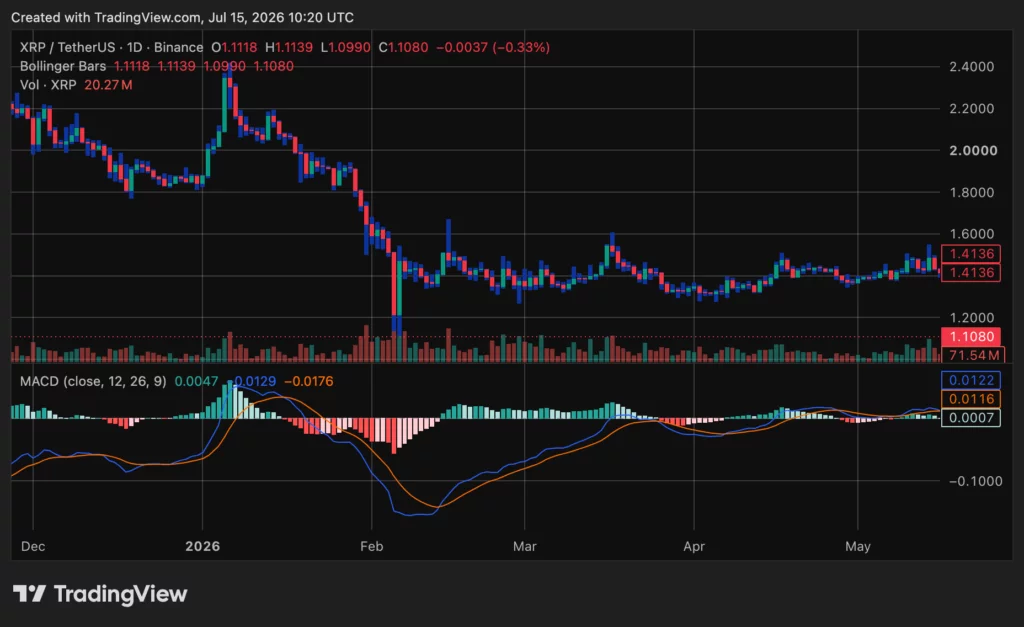
XRP rebounded to around $1.11 on July 15, recovering from the $1.07 area after gaining about 3.8% over 24 hours.
Summary
- XRP rebounded to $1.11, but analysts still view $1.12 as crucial near-term resistance for buyers.
- Bearish targets extend toward $1.058 and $1.00 if XRP fails to hold its latest recovery.
- A $50 XRP scenario requires a hypothetical $100 trillion crypto market and unchanged market dominance.
The token traded between $1.07 and $1.12, while daily trading volume increased to roughly $1.29 billion, according to the latest crypto.news XRP market data.
Despite the recovery, XRP remains about 6% lower over the past month and nearly 70% below its July 2025 record high of $3.65. Analysts are now watching whether buyers can break resistance around $1.12 or whether the latest rebound will give way to another test of the $1 psychological level.
XRP price reaches a major resistance zone
The XRP/USDT chart still shows a broader bearish structure after the token fell from above $2 earlier this year. Recent price action has stabilized near the lower end of that decline, but XRP has yet to recover the stronger resistance zones that would confirm a wider trend change.
The MACD shows limited improvement, with its histogram slightly above zero and the MACD and signal lines close together. This points to mild recovery pressure rather than strong bullish momentum. A sustained move above $1.12 could strengthen the short-term structure, while the $1.30 to $1.40 region remains a larger hurdle.
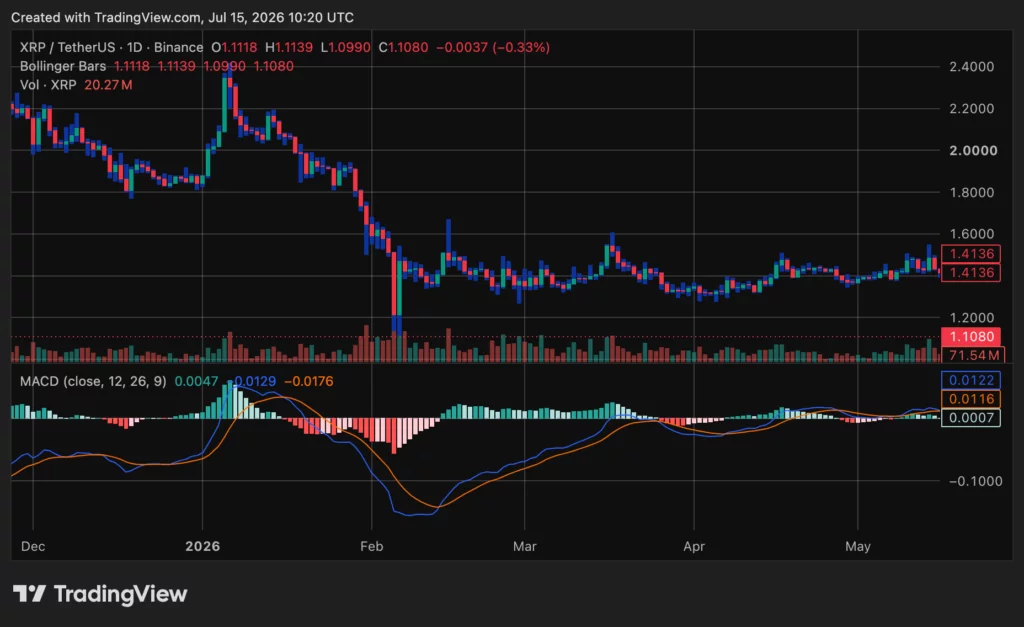
XRP price chart, source: crypto news
Crypto analyst Crypto Patel said XRP had entered a high-confluence resistance area following a bearish market structure shift. He identified a bearish order block, fair value gap and breakdown retest around the current price area.
Patel said the bearish setup remains active while XRP stays below $1.12. His downside targets sit at $1.058, $1.013, $0.95 and $0.90. The levels represent a technical scenario rather than guaranteed future prices.
Analysts remain cautious despite XRP rebound
Cryptorphic also warned that XRP’s short-term structure continues to favor sellers. The analyst wrote that “lower levels seem likely as long as $1.08 remains resistance.” XRP has since moved above that level, making $1.12 the next immediate test for the recovery.
A close above $1.12 could weaken the bearish setup and allow buyers to challenge higher resistance. Failure to hold the recent rebound would return attention to $1.058 and the broader $1.00 to $1.06 support zone.
Notably, XRP recently faced persistent selling pressure on Binance while struggling below $1.08. Negative spot order flow had kept sellers in control even as social sentiment remained heavily bullish.
The latest rebound has improved the immediate price picture, but XRP still needs stronger buying volume to confirm that the previous selling pressure has eased. Recent crypto.news analysis identified $1.00 to $1.06 as the main support zone and $1.18 to $1.20 as the larger resistance range for July.
$50 XRP scenario depends on massive crypto market growth
Under that assumption, XRP could theoretically trade near $50.10. A 1% market share would imply about $16.01 per XRP, while 5% would produce a value near $80.08. Moon Lambo stressed, “I’m not making a prediction.”
The scenario depends on the entire crypto market growing to $100 trillion while XRP retains the assumed market share. Changes in circulating supply and market dominance would also alter the calculation.
For the near term, the market remains focused on much closer levels. XRP must hold above the recent recovery zone and clear $1.12 before testing the $1.18 to $1.20 resistance area. Failure to maintain the rebound could place $1.058 and $1.00 back in focus as sellers attempt to regain control.
Disclosure: This article does not represent investment advice. The content and materials featured on this page are for educational purposes only.


Actor and cryptocurrency critic Ben McKenzie has taken his campaign against the Digital Asset Market Clarity Act to Capitol Hill as the legislation approaches a possible Senate vote.
Summary
- Ben McKenzie lobbied senators against the CLARITY Act as lawmakers prepare for possible floor action.
- His campaign joins Democratic calls for stronger ethics rules covering President Trump’s growing cryptocurrency interests.
- The bill needs sixty Senate votes, making bipartisan support essential before lawmakers leave for recess.
McKenzie spent Tuesday meeting with lawmakers and joined Democratic senators at a Capitol Hill press conference opposing the CLARITY Act. The former The O.C. actor argued against legislation that he and other critics say lacks adequate consumer protections and government ethics rules.
McKenzie joins senators opposing CLARITY Act
McKenzie appeared alongside Senators Chris Murphy, Jeff Merkley and Chris Van Hollen, as well as representatives from Americans for Financial Reform and Indivisible. The group called on senators to reject the current bill unless lawmakers address their concerns.
The opposition centers partly on President Donald Trump’s financial ties to digital assets. Critics have called for restrictions preventing senior government officials and their families from benefiting financially from industries they oversee. The White House has rejected allegations of improper conflicts and has argued that ethics rules should apply equally to officials rather than target the president specifically.As previously reported, the ethics dispute has become one of the main barriers to securing the Democratic votes needed for passage.
Actor has become a prominent crypto critic
McKenzie is best known for playing Ryan Atwood in The O.C. and later appearing in Southland and Gotham. In recent years, he has become an outspoken critic of cryptocurrency markets, celebrity token promotions and claims that blockchain technology can remove the need to trust financial intermediaries.
His work has included interviews with investors, industry critics and former FTX CEO Sam Bankman-Fried. McKenzie has argued that software cannot fully remove human control from financial systems, pointing to failures at centralized crypto companies as examples of why management and oversight still matter.
His latest lobbying effort moves that campaign directly into the legislative debate. A social media post documenting his Capitol Hill activity showed McKenzie participating in the campaign against the market structure bill.
CLARITY Act faces a narrowing Senate window
The CLARITY Act would create a federal market structure for digital assets and establish clearer regulatory roles for the Securities and Exchange Commission and Commodity Futures Trading Commission. It would also introduce rules covering exchanges, token issuers and other crypto businesses.
The measure passed the Senate Banking Committee in May by a 15-9 vote after receiving support from two Democrats. It has since reached the Senate legislative calendar, making it eligible for floor consideration, but Senate leaders had not publicly scheduled a final vote as of July 15.
Recent crypto.news coverage noted that the legislation still faces a narrowing path before the Senate’s August break. A July 17 House hearing will also examine the bill, although that hearing cannot move the Senate legislation itself.
Ethics fight could determine whether the bill passes
The CLARITY Act needs enough support to clear the Senate’s 60-vote procedural threshold, making Democratic backing necessary. Ethics provisions have therefore become central to negotiations as lawmakers from both parties work on a final version.
As previously reported, lawmakers are also negotiating rules for decentralized finance and stablecoin rewards. Those disagreements add further pressure to an already limited legislative calendar.
Supporters argue that the bill would replace years of regulatory uncertainty with clearer federal rules. Opponents, including McKenzie and the senators who joined Tuesday’s event, say Congress should not approve the framework without stronger ethics and consumer safeguards.
McKenzie’s involvement does not give him a formal role in the legislative process, but his Capitol Hill campaign adds another public voice to the opposition. The outcome will depend on whether senators can settle the remaining disputes and build the bipartisan support required for a floor vote.


BitMine Immersion Technologies generated $45.7 million from Ethereum staking and validation during the three months ended May 31, making staking its main source of revenue.
Summary
- Ethereum staking generated $45.7 million, accounting for 98% of BitMine’s total quarterly revenue in May.
- BitMine now stakes 4.9 million ETH, equal to roughly 85% of its Ethereum treasury holdings.
- Tom Lee projects $284 million in annual rewards once BitMine fully stakes its ETH treasury.
The figure represented 98% of the company’s $46.5 million in total quarterly revenue, according to its latest 10-Q filing with the SEC.
A year earlier, BitMine reported total quarterly revenue of just $2.05 million. Machine leasing contributed $1.08 million, while Bitcoin self-mining generated $813,000. The latest results show how sharply the company’s business has shifted toward Ethereum after building one of the world’s largest corporate ETH treasuries.
Ethereum staking becomes BitMine’s core revenue source
BitMine began native Ethereum staking in November 2025 and later launched the Made in America Validator Network, or MAVAN, in March 2026. The institutional platform provides validator and staking infrastructure and is designed to expand beyond BitMine’s own treasury to serve custodians and other institutional clients.
The company also acquired Australian staking infrastructure provider Pier Two in March. The business contributed $3.53 million of quarterly staking revenue and now operates under the MAVAN brand. BitMine said staking and validation generated $56.9 million during the nine months ended May 31, or 95% of its total revenue for the period.
BitMine now has 4.9 million ETH staked
BitMine has continued expanding its Ethereum position since the quarter ended. As of July 12, the company held 5.77 million ETH and had 4,917,189 ETH staked through its operations and staking partners, equal to about 85% of its total holdings.
Notably, BitMine has steadily increased both its ETH treasury and the share placed into staking. Its long-term strategy targets ownership of 5% of Ethereum’s total supply, a goal Chairman Tom Lee calls the “Alchemy of 5%.”
Tom Lee projects $284M in annual staking rewards
Lee said BitMine could generate about $284 million in annualized ETH staking rewards once its entire Ethereum balance is staked through MAVAN and partner platforms. The estimate uses a recent seven-day annualized yield of 2.70%. The figure remains a projection and could change as Ethereum staking yields, ETH prices and validator conditions move.
The company itself identified that dependence as a business risk. Its SEC filing said staking and validation revenue is highly concentrated in MAVAN-related operations. Lower staking yields, validator disruption, Ethereum protocol changes or regulatory developments could therefore have a direct effect on future revenue.
BitMine shifts away from its Bitcoin mining roots
The quarter also showed how small BitMine’s older business lines have become. Bitcoin self-mining generated $624,000, while consulting brought in $168,000. Machine leasing and mining equipment sales produced no revenue after the company ended those operations.
Despite the revenue increase, BitMine reported a quarterly net loss of $83.6 million, driven partly by derivative losses and other expenses. The results show that staking has become the company’s dominant operating revenue engine, but its overall financial performance remains exposed to Ethereum prices, staking economics and its wider treasury strategy.
Recent crypto.news coverage showed BitMine’s ETH holdings reaching 5.77 million tokens as it moved closer to its 5% supply target. With about 4.9 million ETH already staked, future earnings will increasingly depend on whether MAVAN can maintain its validator performance and expand into institutional staking services.
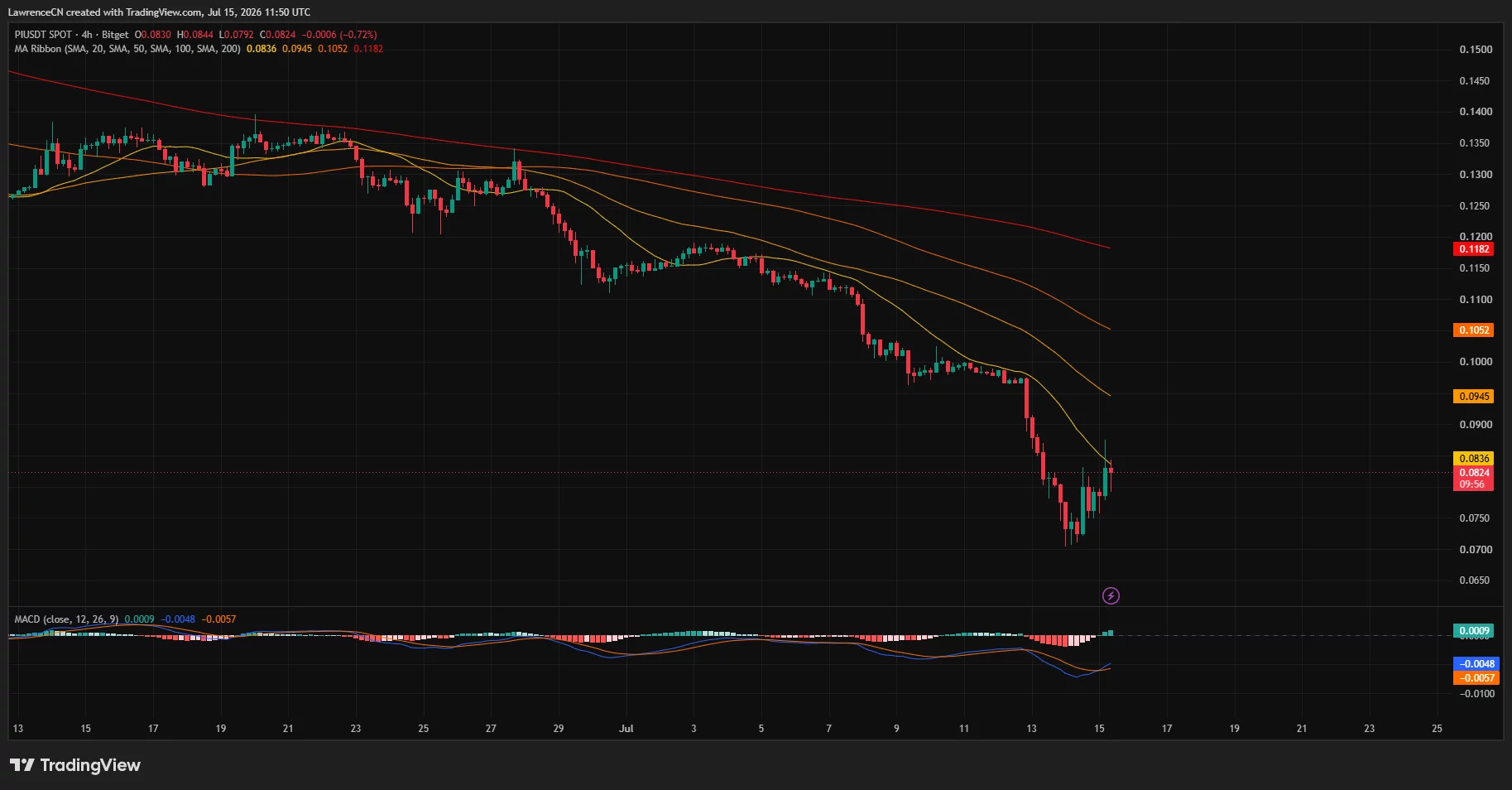
Pi Network price has climbed nearly 20% to around $0.086 on July 15 after an oversold rebound, with improving U.S. inflation data and renewed buying interest combined to lift the token from fresh record lows.
Summary
- Pi Network price surged nearly 20% after an oversold rebound and softer U.S. inflation data boosted crypto sentiment.
- A bullish MACD crossover and higher trading volume supported the recovery, though PI remains below key moving averages.
- Heavy July token unlocks continue to pressure the market despite new Pi2Day products and ecosystem upgrades.
According to data from crypto.news, Pi Network (PI) rebounded from the $0.070-$0.072 area before reaching an intraday high near $0.086, while the latest U.S. inflation figures helped fuel a relief rally across the cryptocurrency market.
The move followed several weeks of relentless selling that had erased roughly 40% of the token’s value and pushed momentum indicators into deeply oversold territory, encouraging bargain hunters and short-term traders to step back into the market.
Oversold conditions and macro relief have supported the rebound
The recovery gained traction after Pi’s daily Relative Strength Index dropped to around 15, a level that typically signals exhausted selling pressure.
At the same time, softer-than-expected U.S. consumer price data improved sentiment across digital assets, drawing fresh liquidity into high-risk cryptocurrencies that had suffered some of the steepest declines during the recent market correction.
Trading activity also accelerated during the rally, with daily volume climbing above $27 million as speculative buyers returned. On the 4-hour chart, Pi has also produced a bullish MACD crossover, while the histogram has turned positive for the first time in days, suggesting bearish momentum has weakened in the short term.
Even so, the technical picture has yet to fully recover. TradingView data shows PI remains below all of its key moving averages, including the 50-period, 100-period, and 200-period simple moving averages, leaving the prevailing downtrend intact despite the latest bounce.
The token briefly reclaimed its 20-period moving average near $0.084 before encountering resistance, indicating buyers still face selling pressure as price attempts to recover.
From a price structure perspective, the recent rebound has helped establish the $0.070 area as an important short-term support zone. However, stronger resistance now sits near the 50-period moving average around $0.094, followed by approximately $0.105 and $0.118, levels that would need to be reclaimed before the market could begin reversing the broader bearish trend.
Heavy token unlocks continue to weigh on sentiment
While macro conditions helped spark today’s rally, the factors behind Pi’s prolonged decline remain largely unchanged. Throughout July, the network has been absorbing substantial scheduled token unlocks, with roughly 103.7 million to 127 million PI entering circulation. The steady increase in available supply has repeatedly outpaced organic demand, contributing to sharp breaks below the $0.12 and $0.10 support levels.
At the same time, capital has continued flowing toward artificial intelligence-related equities in the United States and East Asia, reducing investor appetite for smaller, thinly traded crypto assets such as Pi. The combination of expanding token supply and weaker speculative demand has kept sustained buying pressure limited despite occasional relief rallies.
Developers have nevertheless continued introducing new products intended to strengthen long-term utility within the ecosystem. Recent Pi2Day releases added decentralized application hosting, developer software development kits, and an automated Know Your Customer verification service that requires payments in PI.
Alongside those launches, ongoing core upgrades based on newer versions of the Stellar protocol and continued community speculation surrounding potential listings on major exchanges such as Kraken remain among the key narratives that supporters believe could improve demand over time, although no such exchange listing has been officially confirmed.


SBI Global Asset Management has launched the world’s first tokenized Japanese equity fund on the Solana blockchain through a partnership with DigiFT, bringing a high-dividend equity strategy on-chain for institutional and accredited investors.
Summary
- SBI and DigiFT have launched the world’s first tokenized Japanese equity fund on Solana.
- The JX token offers accredited and institutional investors on-chain access to a high-dividend Japan equity strategy.
- SBI is expanding its blockchain business alongside Ripple partnerships and its upcoming 3% JPYSC stablecoin lending product.
According to an announcement shared by SBI Global Asset Management on July 15, the company has introduced the SBI Japan High Dividend Equity Strategy Token (JX token) in collaboration with DigiFT, a regulated real-world asset exchange.
The token gives accredited and institutional investors blockchain-based access to a Japanese high-dividend equity strategy managed by SBI Asset Management Co. The launch is also DigiFT’s first on-chain tokenization of a Japanese equity fund.
Solana powers SBI’s latest tokenized investment product
Built on the Solana blockchain through DigiFT’s tokenization infrastructure, the JX token expands SBI’s digital asset offerings beyond stablecoins and payments.
According to DigiFT, the product combines traditional Japanese equities with blockchain-based ownership while allowing investors to access institutional-grade assets on-chain.
Commenting on the launch, DigiFT founder Henry Zhang said the company has focused on bringing institutional assets onto blockchain infrastructure that investors and asset managers can trust.
“Our mission at DigiFT has always been to bring real, institutional-grade assets on-chain through infrastructure that investors and asset managers can actually trust. JX extends that mission to Japan for the first time.”
The platform also supports settlements in USDC, while DigiFT said integration with a Japanese yen stablecoin is planned for a later stage. According to the company, token holders will also be able to use the asset in decentralized finance applications, including lending and asset management protocols such as Morpho.
The rollout comes as interest in tokenized real-world assets continues to grow across financial markets, with asset managers increasingly exploring blockchain-based distribution for traditional investment products.
Ripple partnership continues alongside multi-chain expansion
Although SBI Holdings has worked closely with Ripple since 2016 through initiatives including SBI Ripple Asia and more recent collaborations around the RLUSD stablecoin, the new equity fund has been launched on Solana because DigiFT’s tokenization platform is built on that network.
The move adds another blockchain to SBI’s digital asset strategy rather than replacing its existing relationship with Ripple. SBI and Ripple continue to work together on expanding XRP and XRP Ledger adoption across Japan.
Most recently, the companies partnered with Doppler to encourage institutional use of XRP in the country. Earlier, SBI also selected Ripple to support RLUSD stablecoin distribution in Japan as part of its multi-stablecoin strategy.
SBI has simultaneously been expanding its yen-backed stablecoin business. As previously reported by crypto.news, the financial group is preparing to introduce a lending product offering a fixed 3% annual yield on its JPYSC stablecoin through SBI VC Trade. The service, which could launch as early as this month, is expected to require users to lock their JPYSC holdings for three months.
The planned lending product follows the release of JPYSC, Japan’s first trust bank-backed yen stablecoin issued by SBI Shinsei Trust Bank. SBI previously said the stablecoin was designed to reduce transaction costs, support large-value transfers, and serve both retail and institutional users, complementing the company’s growing portfolio of blockchain-based financial products.

XRPL EVM sidechain one year on: $25,741 in TVL

They Will Buy ALL Your XRP: The DTCC & Clarity Act Secret

From Hand of God to hand in marriage – the couple who met at England’s infamous 1986 Argentina match… and have been in love ever since


-

 Fashion7 days ago
Loro Piana Fall 2026 Enters Houston’s Art Scene
-

 Fashion5 days ago
Weekend Open Thread: Nutriplenish Leave-In Conditioner
-
 Sports6 days ago
2026 Genesis Scottish Open Thursday TV coverage: Round 1
-

 Sports6 days ago
Super Eagles star Moses Simon opens up on Liverpool transfer regret
-

 Tech6 days ago
Character.AI enters the microdrama arena with its own productions, but there’s a twist
-

 Politics12 hours ago
Young campaigners urge incoming PM to act on outdoor junk food ads
-

 News Videos1 day ago
XRP BOMBSHELL… XRP OMBOARDED FOR TRANSACTIONS!!!
-

 Tech2 days ago
Get Your ESP32 Sunny Side Up With This Solar Dev Board
-

 Tech1 day ago
Dark Secrets Emerge When Jailbreaking LLMs
-
 Sports3 hours ago
New Cornerback Enters Vikings Trade Rumor Mill
-

 Tech7 days ago
Level Infinite Launches Gangstar Mirage City in India with Pre-Registrations
-
 NewsBeat7 days ago
Major update after Huntingdon train attack as man enters plea
-
 Entertainment7 hours ago
Disney’s Most Ambitious Failed Star Wars Attraction Is Coming to SDCC
-

 News Videos2 days ago
how to make coin bank box with cardboard #scienceproject #money #diy #shorts
-
 Tech2 days ago
Cloudflare Precursor Watches Your Mouse and Keyboard To Decide If You Are Human
-

 Tech7 days ago
Entra passkey enrollment vishing targets Microsoft 365 users
-
 Entertainment6 hours ago
Vicki Gunvalson Defends Discussing Heather Dubrow’s Money
-
 Crypto World7 days ago
DeFi Dashboard Zapper to Shut Down After 7 Years
-
Crypto World1 day ago
Ripple, Coinbase, Circle Join Linux x402 Foundation to Help Shape AI Payments
-

 NewsBeat3 hours ago
Watch: Is Donald Trump facing a popular backlash on immigration?
You must be logged in to post a comment Login