
Crypto World
Anthropic IPO marketing reportedly moves to mid-October



Anthropic has reportedly pushed its IPO prospectus to late September and its investor roadshow to mid-October, while some investors have placed the potential listing valuation as high as $2 trillion.
Summary
- Anthropic’s IPO roadshow could begin in mid-October, later than previously expected.
- The company’s public prospectus is now expected in late September.
- Anthropic is working to finalize a $15 billion revolving credit facility.
- Morgan Stanley, Goldman Sachs, JPMorgan, and Citi are assisting with the offering.
Anthropic IPO timetable moves closer to US elections
Reuters reported on Friday that Anthropic could start marketing its initial public offering in mid-October at the earliest, citing people familiar with the preparations. The company could complete the listing days before the U.S. midterm elections in November, although the sources cautioned that the timetable remains subject to change.
Under an earlier schedule, Anthropic was expected to publish its prospectus as soon as the week beginning Sept. 7. Two people familiar with the matter told Reuters that the document is now unlikely to become public until late September.
Publishing the prospectus would move the offering into its final stages by giving investors access to the company’s financial performance, risk factors, management information and proposed IPO terms. The filing would also provide firmer figures than the estimates circulating in private-share and tokenized pre-IPO markets.
According to Reuters, some investors believe the listing could value Anthropic at as much as $2 trillion. A transaction at that level would rank among the largest IPOs attempted, though Anthropic has not publicly confirmed a valuation, share count, offering size, or final listing date.
The revised schedule follows an August report that placed the prospectus release shortly after Labor Day, with a listing expected in late September or early October. Companies often alter IPO calendars while responding to market conditions, regulatory reviews, and other preparations, Reuters noted.
A $15 billion credit facility precedes the filing
As part of its preparations, Anthropic is working to finalize a $15 billion revolving credit facility. Analysts from banks participating in the financing are expected to meet company representatives after the facility is completed, according to one Reuters source.
Companies commonly leave several weeks between analyst meetings and the release of an IPO prospectus. Anthropic could use a shorter interval because analysts already have extensive knowledge of its business, the source said.
Morgan Stanley, Goldman Sachs, JPMorgan Chase, and Citigroup are among the banks working on the offering. Each bank declined to comment to Reuters about its role.
The credit facility would give Anthropic access to borrowed funds when needed rather than transferring the entire amount at once. Reuters did not disclose the facility’s interest rate, participating lenders, maturity, or other terms, while Bloomberg had previously reported that the company was discussing an expansion of the credit line to $15 billion.
Anthropic’s capital requirements have risen alongside its spending on computing infrastructure. In July, the company proposed leasing up to $10 billion of computing capacity from Meta Platforms over two years, according to earlier coverage of the talks. The reported arrangement was tied to Meta’s Prometheus data center in Ohio and formed part of Anthropic’s work to obtain enough processing capacity for its Claude models.
Separate infrastructure commitments have added to the company’s future expenses. Reuters reported in August that Anthropic signed a $35 billion cloud computing agreement with Nvidia-backed Lambda for capacity at a Texas data center. Another six-year agreement would provide $45 billion of computing capacity through Nscale’s West Virginia campus.
Private markets have priced Anthropic above $1 trillion
Expectations surrounding the IPO have built on a steep increase in Anthropic’s private valuation. The company completed a Series G financing in February at a $380 billion post-money valuation, led by GIC and Coatue, according to on-chain valuation data reviewed by crypto.news in May.
By early May, tokenized pre-IPO trading on Jupiter’s Prestocks platform implied a value of about $1.2 trillion. Forge Global shares reportedly priced the company near $1 trillion, while OpenAI traded closer to an implied $880 billion valuation on the same private-share platform.
Private and tokenized markets do not establish the price Anthropic would receive in an IPO. Limited liquidity, special-purpose-vehicle structures, transfer restrictions, and small transaction sizes can produce valuations that differ from the price public investors accept for a full offering.
Anthropic announced another financing in May at a $965 billion post-money valuation and said its annualized revenue had exceeded $47 billion before the round. A recent report on seized shares also noted that secondary-market estimates later placed the company as high as $1.5 trillion, but limited private-share transactions may not represent the value available for the entire business.
Trading in crypto-linked products has shown similar uncertainty. Anthropic pre-IPO perpetual futures fell as much as 9% after their June debut on Coinbase and Binance, according to pre-IPO futures data. Coinbase warned that the company’s final IPO price could differ by as much as 25% from the futures level when the listing occurs.
Unlike common stock, the perpetual contracts do not provide ownership in Anthropic. Their prices track market expectations for a future reference value, leaving traders exposed to changes in IPO timing, valuation, and contract settlement rules.
US investors await Anthropic’s public disclosures
For U.S. investors, the prospectus will provide the first public set of detailed disclosures tied directly to Anthropic’s offering. The company confidentially filed for a U.S. listing earlier in 2026, allowing the Securities and Exchange Commission to review its registration documents before their expected public release.
According to an Investor.gov IPO bulletin, a company generally registers an offering with the SEC through a Form S-1. Its prospectus describes the business, financial position, management, proposed use of proceeds, risks and offering terms that investors can review before deciding whether to participate.
The preliminary document may not contain the final share price or every completed term. Investor.gov states that issuers generally file a final prospectus after the registration statement becomes effective, with the final document usually containing pricing information unavailable in the preliminary version.
Anthropic’s proposed timing places the investor roadshow shortly before the Nov. 3 U.S. midterm elections. Reuters did not report that the election calendar had caused the delay, and its sources said the IPO schedule could change again.
OpenAI may also enter the U.S. market during the same period. The ChatGPT developer confidentially filed for an IPO in June without disclosing the proposed size or terms. Reports at the time placed its possible valuation at up to $1 trillion, while OpenAI had previously disclosed more than 900 million weekly ChatGPT users and $2 billion in monthly revenue.


Less than two months after announcing a major partnership with the Kansas Jayhawks, the company behind XRP has doubled down on its US sports endeavors by collaborating with the Florida Gators.
Almost immediately after the news was announced, both parties shared a video showing that XRP’s logo was painted on the sports team’s ground.
$XRP and @FloridaGators.
Soon. https://t.co/AI7wKEy3xw— Ripple (@Ripple) September 4, 2026

Further details on the partnership indicate that the team will generate $5 million annually by placing the logos in the Swamp.
“Florida has a long history of embracing innovation and technology to enhance the experience of our fans and advance our programs,” athletic director Scott Stricklin said in a statement. “This partnership brings together two organizations that think boldly about the future, and we look forward to introducing XRP to our fans.”
The first game to host XRP’s logo will be played tonight at the Ben Hill Griffin Stadium, as the Florida Gators will face the Florida Atlantic Owls.
Recall that Ripple made a similar partnership with the Kansas Jayhawks, who represent the University of Kansas, and their teams have won 15 national championships, including 12 NCAA Division I titles. This one was more personal for Ripple’s CEO, who was raised in the state and holds a Bachelor of Arts in Economics from the University of Kansas.
The second news was shared by one of the most popular XRP Army members, BankXRP, on X. The user noted that Ripple will be the headline sponsor of Stable Launch – Stablecon USA’s startup competition.
The company’s Whittney Levitt will join the judging panel of the event, in which the winning startup gets a $200,000 investment.
The post 2 Major Ripple (XRP) News From The Past 24 Hours: Details appeared first on CryptoPotato.
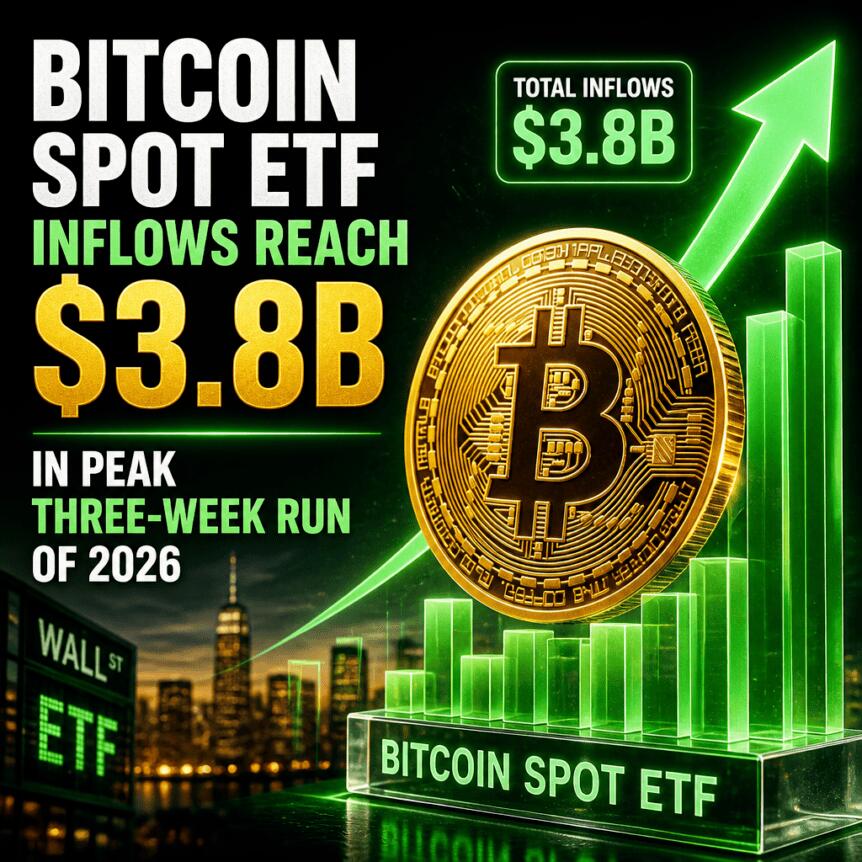
US-listed spot Bitcoin exchange-traded funds (ETFs) extended a late-summer demand surge, logging their strongest three-week stretch of 2026. The rebound coincided with Bitcoin trading around the $80,000 level, with weekly inflows accelerating into the week ending Friday.
SoSoValue data shows the funds pulled in $986.9 million during the week ending Friday. That pushed cumulative net inflows over the past three weeks to $3.8 billion. Total net assets across the suite were $101.3 billion on Friday, after rising to $103.3 billion the prior day. Since inception, cumulative net inflows reached $55.6 billion.
Key takeaways
- US spot Bitcoin ETFs attracted $986.9 million in the week ending Friday, lifting three-week net inflows to $3.8 billion.
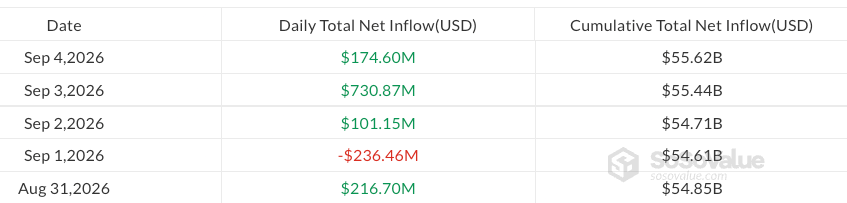
- Friday’s total net inflow was $174.6 million, down from a much larger Thursday surge of nearly $731 million.
- BlackRock’s IBIT led demand with $117.4 million on Friday, about 67% of that day’s inflows, per Farside Investors.
- Bitcoin ETF momentum is improving versus the prior week, but year-to-date flows remain about $1 billion negative, reflecting lingering uncertainty from earlier 2026 outflows.
- While Bitcoin inflows strengthened, spot Ether and XRP ETF flows fell sharply on a weekly basis.
Three-week rebound highlights a demand shift
The latest inflow sequence represents a significant improvement from earlier in 2026, when spot Bitcoin ETFs experienced heavy outflows. The contrast matters for market participants tracking whether institutional demand is broadening or simply reacting to short-term price moves.
According to SoSoValue, the three-week net inflow total of $3.8 billion is far more consistent than the earlier part of the year. Still, the broader picture remains mixed: year-to-date net flows are reported to be roughly $1 billion negative. That implies the ETF complex is recovering, but not fully reversing the cumulative drain from prior months.
Net asset values also underline the pace of the recovery. Total net assets across the US-listed spot Bitcoin ETFs stood at $101.3 billion on Friday, following a brief bump to $103.3 billion on Thursday.
Friday inflows cool after Thursday’s spike
Demand didn’t maintain Thursday’s intensity. US spot Bitcoin ETFs recorded $174.6 million in net inflows on Friday, according to the reporting in the week’s flow recap. That figure was a sharp drop from the nearly $731 million recorded a day earlier, as referenced by earlier market coverage linked in the source.
Within the broader total, BlackRock’s iShares Bitcoin Trust (IBIT) remained the dominant driver. Farside Investors data cited in the source shows IBIT received $117.4 million on Friday, contributing about 67% of the day’s net inflows.
Elsewhere, Fidelity’s Wise Origin Bitcoin Fund (FBTC) was the only other fund to post net inflows, attracting $57.2 million. All other US spot Bitcoin ETFs recorded no net flows for the day, highlighting how concentrated inflow activity can be even in a strong overall period.
Price action also provides context for the flow pattern. Bitcoin slid from around $81,200 to briefly under $79,000 on Friday. At the time of publication, Bitcoin traded at $79,716, up about 2.6% over the prior seven days, based on CoinGecko data included in the source.
Rotation away from Ether and XRP ETFs
The rebound in Bitcoin ETF inflows came alongside a noticeable weakening in other crypto-asset ETF demand. Compared with the previous week, Bitcoin ETF inflows were up by about 7%, while flows into US spot Ether and XRP ETFs fell by roughly 74% and 83%, respectively, based on SoSoValue figures.
SoSoValue shows spot Ether ETF inflows dropped to $218.4 million from $824.4 million a week earlier. For XRP, inflows declined to $19 million from $110.5 million over the same comparison period.
Despite the weekly pullback, both Ether and XRP ETF products remain net positive for the year. SoSoValue data cited in the source indicates US spot Ether ETFs have recorded about $863 million in net inflows year-to-date, while XRP ETFs have attracted roughly $515 million.
This divergence is a useful signal for investors: even when institutional allocation preferences shift, it often happens unevenly across asset classes rather than uniformly. For traders and allocators, the key is whether the Bitcoin-specific demand trend continues long enough to further erode earlier negative year-to-date positioning.
What to watch next as flows become the focus
With Bitcoin ETF inflows showing resilience after earlier outflows, the next question is whether the complex can sustain inflow momentum beyond this three-week window—especially given Friday’s cooling versus Thursday’s outsized day. Investors should watch for whether IBIT and FBTC continue to concentrate the bulk of inflows, and whether Ether and XRP ETFs remain under pressure or stabilize after their recent weekly declines.
US-listed spot Bitcoin exchange-traded funds (ETFs) have recorded their strongest three-week inflow stretch of 2026 as Bitcoin traded around $80,000.
The funds attracted $986.9 million in the week ending Friday, bringing net inflows over the past three weeks to $3.8 billion, according to SoSoValue data.
Total net assets across the funds stood at $101.3 billion on Friday after briefly rising to $103.3 billion a day earlier, while cumulative net inflows reached $55.6 billion.
ETF demand marks a sharp turnaround from heavy outflows earlier in 2026, though year-to-date net flows remain roughly $1 billion negative.
Bitcoin ETF inflows cool after Thursday surge
US spot Bitcoin ETFs attracted $174.6 million in net inflows on Friday, down sharply from the nearly $731 million recorded a day earlier.
BlackRock’s iShares Bitcoin Trust (IBIT), the largest spot Bitcoin ETF by assets, drew $117.4 million on Friday, accounting for about 67% of the day’s total net inflows, according to Farside Investors data.
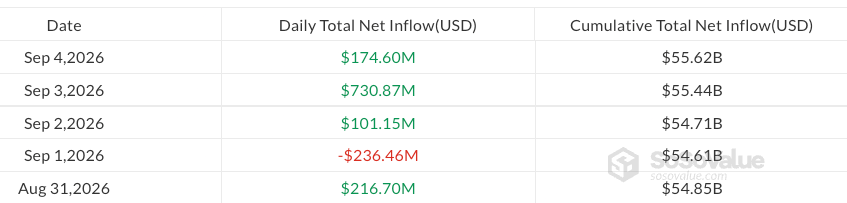
Daily spot Bitcoin ETF flows from Monday through Friday. Source: SoSoValue
Fidelity’s Wise Origin Bitcoin Fund (FBTC) was the only other fund to record net inflows, attracting $57.2 million, while all other US spot Bitcoin ETFs recorded no net flows for the day.
Related: Surprise nonfarm payrolls print sends Bitcoin back below 80K
The slowdown came as Bitcoin fell from around $81,200 to briefly below $79,000 on Friday. Bitcoin traded at $79,716 at the time of publication, still up about 2.6% over the past seven days, according to CoinGecko.
Bitcoin ETF demand strengthens as Ether, XRP flows fade
Compared with the previous week, Bitcoin ETF inflows increased about 7%, while inflows into US spot Ether and XRP ETFs fell about 74% and 83%, respectively.
Spot Ether ETF inflows dropped to $218.4 million from $824.4 million, while XRP ETF inflows declined to $19 million from $110.5 million, according to SoSoValue.
Despite weaker inflows, Ether and XRP ETFs remain in positive territory for the year. US spot Ether ETFs have recorded about $863 million in net inflows year-to-date, while XRP ETFs have attracted roughly $515 million.
Magazine: BTC will hit $1M by 2030… but Arthur Hayes is buying ETH instead


Disclosure: This content is provided by a third party. Neither crypto.news nor the author of this article endorses any product mentioned on this page. Users should conduct their own research before taking any action related to the company.
The cryptocurrency market, currently dominated by Bitcoin (BTC), is entering a new cycle and attracting numerous investors; however, as economic cycles shift and the industry experiences its ups and downs, no single investment can perform exceptionally well in every environment.
Summary
- EiCrypto markets Bitcoin-linked contracts as an alternative to actively trading BTC.
- Contract plans range from $100 to $24,000, with terms lasting two to 30 days.
- The platform says earnings are settled automatically 24 hours after contract activation.
- Advertised returns and customer income claims are promotional and are not independently verified.
Consequently, many BTC investors are seeking diversified investment strategies; by moving beyond the singular “buy low, sell high” speculative approach, they can more easily mitigate risk, generate stable returns, and build long-term wealth without having to sell their Bitcoin holdings.
A new choice for Bitcoin holders: the all-new EiCrypto contract strategy yield plan
As the market demand for stable investment solutions continues to grow, digital asset service provider EiCrypto has launched a new Bitcoin (BTC)-based contract product designed to offer BTC holders a potential avenue for generating returns.
This strategy allows Bitcoin to be held in EiCrypto’s independently managed accounts; upon the activation of a hash rate contract, the platform’s professional operations team assumes full responsibility for operational services, with earnings automatically settled to the client’s account.
Start your journey to earning with Bitcoin quickly in just four steps.
Register an account: Sign up here to receive a $15 new-user bonus.
Deposit methods: Users can deposit and withdraw funds using major cryptocurrencies such as BTC, USDT, ETH, LTC, USDC, XRP, SOL, BNB, DOGE, ADA, BCH, and more.
Select a contract: EiCrypto offers a variety of tailored contract plans to meet the diverse needs of users worldwide; simply choose the plan that suits you best and start mining with a single click.
Activate the contract: Once the contract is activated, earnings will be automatically settled to your account after 24 hours. You are free to withdraw your earnings or reinvest them; compound investing is one of the most effective ways to rapidly grow your assets.
Popular mining solutions:
Novice Contract Plan: $100 — 2-day term — Total return approx. $108
Basic Contract Plan: $600 — 5-day term — Total return approx. $639
Basic Contract Plan: $1,200 — 10-day term — Total return approx. $1,362
Stable Contract Plan: $2,500 — 15-day term — Total return approx. $2,025
Stable Contract Plan: $11,000 — 25-day term — Total return approx. $15,812
Stable Contract Plan: $24,000 — 30-day term — Total return approx. $38,040
Click here to view more contract details.
David Rodríguez Fernández, a Bitcoin holder from Barcelona, Spain, stated…
My investment in Bitcoin has been limited to the traditional approach of buying low and selling high; however, my assets often sit idle for long periods, and since I cannot accurately predict market direction, it is common for them to shrink in value.
EiCrypto’s contract strategy represents a truly significant innovation. I no longer need to trade Bitcoin frequently; instead, I simply use my Bitcoin to purchase an EiCrypto contract plan and log in via my phone each day to track my earnings. It requires no extra effort, and my daily income is now around $4,000.
The advantages of EiCrypto
Convenient services
The platform features a simple, intuitive interface, allowing users to view account information and service data at any time, making digital asset management easier and more efficient.
Security assurance
EiCrypto prioritizes the protection of user accounts and data through multi-layered security mechanisms—including account security, data protection, risk control, and encryption technology—to provide a robust service environment.
Efficient operations
Leveraging cloud computing and automation technologies, the platform automates the management of computing power resources and operational workflows; this minimizes manual intervention, enabling users to participate in cloud computing services with greater ease.
24/7 service
Cloud computing services operate continuously, supported by round-the-clock system maintenance and customer service, allowing users to check their accounts and manage services whenever they wish.
Conclusion
The cryptocurrency market is reshaping the world’s financial landscape, and EiCrypto’s unique contract strategy is becoming a preferred choice for speculators seeking diversified portfolios. Only by maximizing asset utilization and minimizing risk can one obtain the most substantial returns in cryptocurrencies.
If you also want to earn $8,400 a day through Bitcoin, ETH, or XRP, or learn more details…
Please take three minutes to visit the official website.:www.eicrypto.com
Click here to download the application.
Disclosure: This content is provided by a third party. Neither crypto.news nor the author of this article endorses any product mentioned on this page. Users should conduct their own research before taking any action related to the company.
In this week’s edition of the weekly recap, Polymarket pursued a $1 billion funding round at a proposed $21 billion valuation, while Cronos reversed its blockchain after a $75 million exploit. U.S. spot Bitcoin ETFs also posted their strongest daily inflow since January as BTC briefly crossed $82,000.
Summary
- Polymarket’s planned $1 billion round would value the prediction market platform at $21 billion.
- Cronos validators reversed the blockchain after a Tectonic exploit affected about $75 million in assets.
- U.S. spot Bitcoin ETFs recorded $730.8 million in net inflows on Sept. 3.
- FinCEN linked $12.7 billion in transactions to Southeast Asian crypto investment scams.
- The National Sheriffs’ Association withdrew its opposition to the CLARITY Act before a Senate vote.
Polymarket seeks $1 billion at $21 billion valuation
- Donald Trump Jr.’s 1789 Capital agreed to lead a planned $1 billion Polymarket funding round with an investment of roughly $300 million. The transaction would value the prediction market platform at $21 billion, up from nearly $15 billion.
- The planned investment would bring 1789 Capital’s disclosed Polymarket commitments to about $500 million. Polymarket returned to the U.S. through its $112 million acquisition of CFTC-licensed QCEX after restricting American users under a 2022 settlement.
Cronos reverses chain after $75 million exploit
- Cronos rolled back its blockchain following an exploit involving the Tectonic lending protocol and about $75 million in assets. Validators reverted the network to a point before the attack after initially halting block production.
- RedStone said the incident did not result from an oracle failure, challenging early claims about the exploit’s cause. The rollback restored the earlier network state but also raised questions about transaction finality and validator control.
Bitcoin ETFs draw $731 million as BTC reverses
- U.S. spot Bitcoin ETFs recorded $730.8 million in net inflows on Sept. 3, their strongest daily result since January. The inflow followed renewed institutional demand after an earlier period of withdrawals.
- Bitcoin briefly climbed above $82,000 before stronger-than-expected U.S. employment data lifted Treasury yields and reduced expectations for easier Federal Reserve policy. BTC subsequently erased its daily gains and returned to the $79,000 range.
FinCEN traces $12.7 billion to crypto scams
- The Financial Crimes Enforcement Network linked about $12.7 billion in transactions to suspected Southeast Asian crypto investment scams between 2020 and 2025.
- FinCEN said criminal networks used fraudulent investment platforms, social engineering, and forced-labor compounds to target victims. The agency asked U.S. financial institutions to monitor shell companies, rapid stablecoin transfers, and payments to platforms introduced through unsolicited online relationships.
CLARITY Act loses law enforcement opponent
- The National Sheriffs’ Association withdrew its opposition to the CLARITY Act and adopted a neutral position before the Senate’s scheduled Sept. 15 procedural vote.
- The group had raised concerns about anti-money laundering rules covering DeFi platforms and non-custodial software. Neutrality does not amount to endorsement, but the change removes an active source of law enforcement opposition as supporters seek the 60 votes needed to advance the bill.
Strategy buys 4,603 Bitcoin
- Strategy purchased 4,603 BTC for $369.7 million between Aug. 24 and Aug. 30, returning to accumulation after more than two months without a confirmed purchase.
- The company paid an average of $80,318 per Bitcoin and raised the acquisition funds through sales of MSTR shares. Its total holdings reached 845,050 BTC, acquired for approximately $63.73 billion at an average cost of $75,412 per coin.
Banks commit to joint stablecoin company
- Bank of America, Citi, Goldman Sachs and 18 other financial institutions committed to forming a stablecoin company during the second half of 2026, subject to closing conditions.
- The consortium plans to launch a U.S. dollar stablecoin in the first half of 2027 and may later issue tokens tied to other G7 currencies. The group has not disclosed the token’s name, blockchain, reserve custodian or final redemption model.
SEC proposes tokenized securities recordkeeping rules
- The Securities and Exchange Commission proposed its first major transfer-agent rule overhaul in more than four decades as tokenized securities enter regulated U.S. markets.
- The proposal would update registration, recordkeeping, transfer processing, and asset-protection requirements. Blockchain-based transfer agents would face controls covering digital records, cybersecurity, audit trails, and business continuity. Public comments will remain open for 60 days after Federal Register publication.
ICE taps tZERO for NYSE tokenization platform
- Intercontinental Exchange agreed to invest in tZERO and license its blockchain patents as the companies develop infrastructure for a planned NYSE-affiliated tokenized securities platform.
- tZERO will assist with transfer-agent and broker-dealer systems intended to support onchain issuance, trading, and settlement. ICE did not disclose its investment, while the proposed round-the-clock trading platform still requires regulatory approval.
Fairshake retains $122 million for U.S. elections
- Crypto industry-backed super PAC Fairshake entered the final stage of the 2026 U.S. election cycle with $122 million available after supporting nearly 50 successful primary candidates.
- Fairshake and its affiliates have backed candidates from both parties, including several lawmakers who supported digital asset legislation. The group’s largest primary defeat followed more than $10 million in spending against Illinois candidate Juliana Stratton.
Coinbase files for U.S. stock perpetuals
- Coinbase filed two SEC notices as it works with U.S. regulators to introduce perpetual futures tied to individual public companies.
- The planned contracts would offer continuous stock-price exposure without giving traders ownership of the underlying shares. The filings do not constitute regulatory approval, and Coinbase has not announced a launch date or list of supported companies.
Revolut receives conditional U.S. bank approval
- Revolut secured conditional approval from the Office of the Comptroller of the Currency to establish a national bank in Stamford, Connecticut.
- The fintech plans to contribute about $95 million in initial capital and aims to open the bank in the first half of 2027. Planned products include deposits, cards, loans, foreign exchange, and a stablecoin, although FDIC, Federal Reserve, and final OCC approvals remain outstanding.
Chainlink takes U.S. economic data onchain
- Chainlink introduced U.S. economic data feeds on 10 blockchains through the Department of Commerce’s blockchain data program.
- The feeds distribute Bureau of Economic Analysis indicators for use in smart contracts and financial applications. The rollout followed an earlier initiative that published U.S. gross domestic product data across nine networks, including Bitcoin, Ethereum, and Solana.
Russia opens regulated crypto trading
- Russia’s comprehensive framework for crypto trading, custody and cross-border settlements took effect on Sept. 1 under Bank of Russia supervision.
- Non-qualified investors can purchase up to 300,000 rubles of eligible crypto annually through each intermediary after passing a test. Qualified investors face no equivalent purchase cap. Crypto remains prohibited for domestic payments but can be used for foreign trade settlements.
Robinhood and AMC clash over stock tokens
- AMC Entertainment CEO Adam Aron objected to Robinhood’s token linked to AMC shares, arguing that the company had not authorized the product. The dispute later escalated into a legal threat after Robinhood refused to withdraw it.
- Robinhood’s stock tokens target eligible customers outside the United States and do not carry the same ownership or voting rights as registered shares. The conflict added pressure for clearer rules governing tokenized equity products.

The Core Team behind the popular project rolled out three new capabilities designed to make its ecosystem more attractive to app developers. The project also overhauled its developer documentation as it continues its broader push toward real-world utility.
The team said this update comes after several months of releases focused on enhancing Pi beyond simple crypto transactions and creating more reasons for users to actually explore and utilize the ecosystem.
3 New Features
The three new developer capabilities are local storage, access to app-specific staking data, and file and video sharing. Perhaps the most interesting is the first one.
Selected whitelisted Pi Browser apps can now store certain information directly on a user’s device instead of requiring devs to maintain their own backend infrastructure. Preferences, session inflation, and other applicable data can consequently be stored on the device, which can reduce infrastructure costs and complexity while providing a consistent experience across Android and iOS, added the post.
It’s worth noting that the data is not uploaded to Pi Network’s servers, even though the feature currently has several limitations. Only whitelisted apps have access, as storage capability is limited, and old data can eventually be removed.
Staking Data API, the second release, allows eligible developers to see how much effective Pi a user has staked specifically for their application through Ecosystem Directory Staking. Devs could potentially use this info to build app-specific features around their most committed supporters.
The last one, called Pi.shareFile, allows apps to use a phone’s native sharing functionality for files, images, and videos. Some of the examples outlined in the blog post range from marketplace customers sharing receipts or photos to gaming and content apps allowing users to share clips directly.
More Devs Wanted
In addition to the three new features, Pi Network announced that it has consolidated previously fragmented dev resources into a single documentation platform, which now covers everything from app registration and sandbox development to authentication, Pi payments, Mainnet preparation, and launch.
It also introduces AI-assisted guidance for integrating authentication and payments. The idea is quite clear as it reduces the friction involved in building applications for Pi and fits into the project’s broader strategy.
The team said that these releases tackle a problem that could be very important for the project and the native token’s long-term prospects: giving developers more tools and fewer technical obstacles to continue building apps that people actually want to use.
The post Pi Network Just Released 3 Major Upgrades: Here’s What They Mean for Pioneers appeared first on CryptoPotato.


Adam Aron discovered that Robinhood had tokenized AMC stock on its own blockchain without telling anyone at AMC. His reaction set off a corporate brawl that exposed the biggest unresolved question in tokenized finance: who gets to decide what happens to your stock?
Summary
- AMC CEO Adam Aron called Robinhood’s tokenized AMC stock “contemptible, outrageous, disgusting, detestable, inexcusable, vile” after discovering the listing on Robinhood Chain without AMC’s knowledge or consent.
- AMC shares surged 21% overnight to $3.07 as the public feud between Aron and Robinhood CEO Vlad Tenev played out on X, with Tenev responding “What’s the concern?” and Robinhood’s chief legal officer sarcastically offering to teach AMC’s lawyers securities law.
- Robinhood tokenized more than 190 companies through Robinhood Assets (Jersey) Limited, a Channel Islands affiliate operating outside US securities registration, creating synthetic exposure instruments that carry no ownership rights, no voting power, and no shareholder protections.
- Aron described the situation as “almost existential,” arguing that AMC spends millions annually on SEC compliance while Robinhood recreates the same market exposure from an offshore jurisdiction 3,000 miles away with none of the same obligations.
- The SEC’s 24-hour trading roundtable on September 17, featuring BlackRock, Nasdaq, NYSE, Robinhood, and Citadel, now carries dramatically higher stakes as the AMC confrontation forces regulators to address tokenized stock instruments directly.
The call came from inside the house. Or more accurately, from a blockchain that AMC Entertainment’s leadership did not know existed until someone flagged a tokenized version of their stock trading on it.
Adam Aron has never been accused of underreaction. The AMC chief executive built a second career out of theatrical corporate communication during the meme stock era, turning earnings calls into spectacles and his X account into a direct line to retail investors who treated AMC shares like a lifestyle brand. But when Aron discovered that Robinhood had listed a tokenized version of AMC stock on Robinhood Chain, the platform’s proprietary blockchain that launched July 1, his reaction went past theater into something closer to genuine corporate rage.
“Contemptible, outrageous, disgusting, detestable, inexcusable, vile.” Six adjectives, posted publicly, each one a legal signal flare. Aron was not performing. He was building a record.
The confrontation that followed has cracked open a fault line that the crypto industry, traditional finance, and regulators have all been tiptoeing around for years. When a company can be tokenized without its consent, without registration, and without granting any of the rights that make stock ownership meaningful, the question stops being about technology and starts being about power. Specifically: who has it, who lost it, and whether the SEC intends to do anything about it before every public company in America wakes up to the same surprise Aron did.
Adam Aron did not take it well
The timeline matters because it reveals how completely AMC was blindsided.
Robinhood Chain went live on July 1. Within weeks, it had accumulated $47 billion in cumulative DEX volume and was generating $4.01 million in daily revenue. The chain offered tokenized versions of stocks, and the list was not short. More than 190 companies were represented, all tokenized through Robinhood Assets (Jersey) Limited, a subsidiary incorporated in the Channel Islands.
AMC was one of those 190 companies. Nobody at AMC knew. Aron found out the way most CEOs find out about things they should have been told about weeks earlier: someone on social media pointed it out. His response was immediate and volcanic. The six-adjective post on X was just the opening. Aron followed it with a series of statements that escalated from angry to existential, calling the tokenization “almost existential” for AMC and every other public company caught in the same trap.
His argument was straightforward and, stripped of the theatrics, difficult to dismiss. AMC spends millions of dollars every year on SEC compliance. Lawyers, auditors, filings, disclosures, all the machinery that public companies maintain to operate within the regulatory framework that governs US securities markets. Robinhood, Aron argued, had recreated the economic exposure of AMC stock from a jurisdiction 3,000 miles offshore, with none of the same obligations, none of the same costs, and none of the same accountability.
He threatened to bring the SEC into it. Given the timing, that threat carries more weight than it might have six months ago.
What Robinhood actually built
To understand why Aron reacted the way he did, you need to understand what these tokenized stocks actually are. And more critically, what they are not.
Robinhood’s stock tokens are tokenized debt securities. That distinction is everything. A tokenized debt security is not a share of stock. It does not convey ownership in the underlying company. It does not grant voting rights. It does not come with the shareholder protections embedded in decades of US securities law. It does not entitle the holder to dividends in the traditional sense, though some structures attempt to mirror dividend payments.
What it does is create synthetic exposure to the price movement of the underlying stock. If AMC goes up, your token goes up. If AMC goes down, your token goes down. You participate in the economics without participating in the governance, the legal framework, or the relationship between company and shareholder that US securities law was built to protect.
This is not a new concept. Contracts for difference, or CFDs, have operated on similar principles in European and Asian markets for decades. But CFDs are regulated instruments with clear regulatory frameworks in the jurisdictions where they trade. Robinhood’s stock tokens exist in a different category: issued by an offshore affiliate, not registered under US securities law, and explicitly unavailable to US persons.
That last point is where the legal architecture gets interesting. Robinhood, the US brokerage that millions of American retail investors use to trade stocks, operates Robinhood Chain through a Channel Islands entity specifically because the tokens cannot legally be offered to Americans. The same company that democratized stock trading for US retail is running a parallel securities infrastructure offshore that its US customers cannot access. The irony is thick enough to cut.
The Jersey loophole and why every public company should care
Jersey, the largest of the Channel Islands, is a Crown Dependency with its own legal system, its own financial regulator, and a long history as a domicile for offshore financial vehicles. It is not a tax haven in the cartoonish sense, but it is a jurisdiction deliberately designed to accommodate financial structures that do not fit neatly within the regulatory frameworks of larger economies.
Robinhood Assets (Jersey) Limited is the entity that issues the tokenized stock instruments. By incorporating in Jersey, Robinhood places the issuance outside the jurisdiction of the SEC, outside the reach of US securities registration requirements, and outside the compliance obligations that companies like AMC bear.
This is the piece that made Aron describe the situation as existential. The asymmetry is real. AMC files 10-Ks, 10-Qs, 8-Ks, proxy statements, and every other document the SEC requires. It pays for audits, legal counsel, and compliance infrastructure. It subjects itself to the full weight of US securities regulation because that is what public companies do.
Robinhood, through its Jersey affiliate, creates instruments that track AMC’s stock price without bearing any of those costs. The tokens are not registered. The issuer is not subject to SEC oversight for those instruments. And AMC has no say in whether its stock gets tokenized, how the tokens are marketed, or what disclosures accompany them.
Aron is not wrong that this is a structural problem. If one company can do it, every company can. And if every company does, the result is a parallel securities market operating outside the regulatory framework that the traditional market depends on for legitimacy and investor protection.
The precedent implications reach beyond meme stocks. Apple, Tesla, Microsoft, and Nvidia are all on the list of 190 tokenized companies. Imagine Tim Cook discovering that a Jersey entity is issuing synthetic Apple exposure to global traders without Apple filing a single disclosure related to those instruments. The legal theory that permits AMC tokenization permits everything. And the companies that would have the resources and motivation to challenge it in court are the same companies whose stocks generate the most trading volume on Robinhood Chain.
The deeper structural question is who captures the economic value. When a global trader buys a tokenized AMC instrument, the fees go to Robinhood and its Jersey affiliate. AMC sees none of that revenue. The company bears the compliance costs that make its stock price credible, and a third party monetizes that credibility from an offshore jurisdiction. This is not a hypothetical concern. It is a business model built on top of someone else’s regulatory burden.
OpenAI raised the identical objection in 2025 when it discovered its own stock had been tokenized without consent. Nothing changed. The tokens stayed listed. The offshore structure stayed in place. The regulatory response was silence. That silence was not lost on the broader corporate legal community. Multiple law firms circulated memos to public company clients warning that their stocks could be next. The memos recommended monitoring but offered no clear legal remedy, which is itself a damning indictment of the current framework.
AMC is betting that louder noise produces a different outcome.
Vlad Tenev’s four-word dismissal
Tenev’s response to Aron’s tirade was four words: “What’s the concern?”
Read charitably, it was a genuine question from someone who sees tokenized stock exposure as an innovation that expands market access. Read less charitably, it was a provocation designed to make Aron look like he was overreacting to something harmless.
Either way, it was a miscalculation. Aron was already on a war footing, and “What’s the concern?” gave him exactly the ammunition he needed to frame Robinhood as dismissive of legitimate corporate interests.
But the real escalation came from Robinhood’s chief legal officer, Dan Gallagher. When AMC’s lawyers sent a cease-and-desist letter, Gallagher did not simply reject it. He rejected it with sarcasm, offering to teach AMC’s legal team about securities law. For a CLO responding to a formal legal demand from a public company CEO, that tone was a choice. It suggested that Robinhood’s legal team views AMC’s position as not just wrong but laughably wrong.
Gallagher is not some random corporate lawyer. He is a former SEC commissioner. His willingness to dismiss AMC’s legal position so publicly signals that Robinhood believes it is on solid legal ground. Whether the SEC agrees is a separate question that September 17 may begin to answer.
The exchange also revealed something about how Robinhood views the relationship between tokenized assets and traditional equity. In Tenev’s framing, tokenized stocks are a feature, not a threat. They expand access, create liquidity, and bring 24/7 trading to assets that are currently locked behind market hours and brokerage intermediaries. Robinhood is not apologizing for tokenizing AMC. It is confused about why anyone would object.
The case for Robinhood’s position
Dismissing Robinhood’s argument entirely would be intellectually dishonest, and the strongest version of their case deserves a full hearing.
Global markets do not operate on American hours. An investor in Singapore who wants exposure to AMC’s stock price should not have to wait for the New York Stock Exchange to open. Tokenized stock instruments solve a real problem: they create a 24/7 market for price exposure to assets that currently trade on schedules designed for a world that no longer exists.
The Channel Islands structure is not an attempt to evade regulation. It is an attempt to serve non-US customers in jurisdictions where these instruments are legal. Robinhood is not offering these tokens to Americans. The separation between Robinhood the US brokerage and Robinhood Assets (Jersey) Limited is deliberate and legally meaningful.
The tokens do not dilute AMC’s shares. They do not affect AMC’s share count, capital structure, or corporate governance. No new AMC shares are created. The economic exposure is synthetic. In this framing, Aron is objecting to the existence of a derivative instrument based on AMC’s publicly available stock price, which is a price that anyone with a Bloomberg terminal or a free brokerage app can already track and trade around.
CFD providers have offered similar products for decades without facing the kind of backlash Aron is generating. The tokenized version puts the same concept on a blockchain, which adds transparency, programmability, and composability with other DeFi protocols, but does not change the fundamental economic relationship.
Robinhood Chain’s numbers back up the demand thesis. Tokenized stocks hit $4.3 billion in 30-day volume. That is not a toy. That is a market telling you something about what global investors want.
And Gallagher’s confidence is not unfounded. The tokens are not US securities. They are not offered to US persons. The issuer is in a jurisdiction that permits them. The legal theory that AMC could force Robinhood to stop tokenizing its stock would require either a novel interpretation of existing law or new legislation. Neither exists today.
The 21% spike and the irony nobody is discussing
Here is the part that should make every participant in this drama uncomfortable.
AMC stock jumped 21% overnight, rising to $3.07, on the back of Aron’s public tantrum. The company’s market value increased by hundreds of millions of dollars because its CEO went on X and called another company’s product “vile.”
This is the meme stock dynamic in its purest form. The fundamentals of AMC’s business did not change. Its debt load did not shrink. Its box office numbers did not improve. Its streaming strategy did not suddenly become viable. What changed was attention, narrative, and the engagement of a retail investor base that has repeatedly shown it will buy AMC stock in response to drama, not data.
Aron knows this. He has spent four years cultivating exactly this dynamic. The man who embraced ape NFTs, promoted popcorn sales as corporate strategy, and turned shareholder meetings into rallies understands that attention is AMC’s most valuable asset.
Which raises an uncomfortable question: does Aron genuinely view tokenized stock as an existential threat, or does he recognize that fighting Robinhood publicly generates exactly the kind of attention that moves AMC’s stock price?
Both things can be true simultaneously. The legal concerns are legitimate. The compliance asymmetry is real. The lack of consent is a genuine governance issue. But the 21% spike is also real, and it happened because Aron chose to wage this fight in public rather than through quiet legal channels.
The market, in its infinite and occasionally cruel wisdom, rewarded the drama. That reward makes it harder to separate the genuine corporate concern from the performance.
The September 17 collision
The SEC has scheduled a roundtable on 24-hour trading for September 17. The participant list reads like a roster of every entity that have direct stakes in how this plays out: BlackRock, Nasdaq, NYSE, Robinhood, and Citadel.
Before the Aron blowup, this roundtable was going to be a relatively contained discussion about extended trading hours, market structure, and the technical infrastructure needed to support longer or continuous trading sessions. That conversation still matters, but the AMC confrontation has injected a much more volatile question into the agenda: what is the regulatory status of tokenized stock instruments issued offshore but tied to US equities?
The Clarity Act vote scheduled for September 15 adds another layer. If that legislation moves forward, it could reshape the regulatory framework for digital assets in ways that either validate or undermine Robinhood’s offshore tokenization model.
Robinhood will be in the room on September 17. Gallagher’s former colleagues at the SEC will be running it. Aron will not be at the table, but his argument will be. Every commissioner, every staffer, and every market participant in that room will have read the X thread, the cease-and-desist, and the sarcastic rejection.
The question the SEC faces is whether tokenized stock instruments require a new regulatory framework, whether existing law already covers them, or whether the offshore structure genuinely places them outside US jurisdiction. Each answer leads to a dramatically different outcome for the $4.3 billion tokenized stock market.
If the SEC decides these instruments fall under its authority regardless of where they are issued, Robinhood’s entire stock tokenization business is at risk. If the SEC decides the offshore structure is legally sound, every other fintech company will race to replicate it. And if the SEC punts, which is always the most likely outcome, the ambiguity will persist and the next Adam Aron will have the same tantrum about the same problem six months from now.
The timing compounds the pressure. Robinhood Chain is less than three months old and already generating millions in daily revenue. Every week the SEC stays silent is a week in which the tokenized stock market grows larger, more liquid, and harder to unwind without causing its own set of market disruptions. Regulators who wait too long to act often discover that the market they intended to regulate has become too large to touch.
What to watch
- **The SEC roundtable on September 17** will reveal whether regulators view tokenized stock instruments as a market structure innovation or a compliance evasion, and Robinhood’s presence at the table means the conversation cannot avoid the topic.
- **AMC’s formal legal strategy** beyond the cease-and-desist will indicate whether Aron intends to pursue litigation, lobby for legislative intervention, or use the threat of both as leverage for a private resolution.
- **Other public company responses** will determine whether AMC is an outlier or the first of many, because 190 companies were tokenized and Aron is the only CEO who has said a word about it publicly.
- **Robinhood Chain’s volume trends** after the controversy will show whether negative attention drives traders away from tokenized stocks or attracts them, and early data from DeFi markets suggests controversy tends to increase volume rather than suppress it.
- **The Clarity Act vote on September 15** could reshape the entire regulatory environment two days before the SEC roundtable, creating either a framework that addresses tokenized stocks directly or a gap that leaves the current ambiguity intact.
What are tokenized stocks on Robinhood Chain?
They are tokenized debt securities that track the price of real stocks. You do not own a piece of the company. You have zero voting rights and zero shareholder protections. What you get is synthetic price exposure, meaning your token moves with the stock price, but your legal relationship to the company is nonexistent.
Why was AMC’s CEO so angry about the tokenization?
Because nobody told him. AMC was one of 190 companies tokenized through a Robinhood offshore affiliate, and AMC’s entire leadership team found out through social media. Aron’s position is that AMC spends millions on SEC compliance while Robinhood recreates the same economic exposure from an offshore entity with none of those costs or obligations.
Can US investors buy these tokenized stocks?
No. The tokens are issued by Robinhood Assets (Jersey) Limited, a Channel Islands entity, and they are not registered under US securities law. They cannot legally be offered to US persons. This is the same Robinhood that US retail investors use for stock trading, but the tokenized stock product is walled off from American customers.
Did AMC stock actually go up because of this fight?
It did. AMC shares jumped 21% overnight to $3.07 after Aron’s public outburst on X. The irony is hard to miss: Aron was arguing that tokenized stocks threaten AMC, while the fight over those tokens was the best thing to happen to AMC’s stock price in months.
What did Robinhood’s legal team say to AMC’s cease-and-desist?
Robinhood CLO Dan Gallagher, a former SEC commissioner, rejected the demand and sarcastically offered to educate AMC’s lawyers on securities law. The tone was deliberately dismissive, signaling that Robinhood views AMC’s legal position as baseless.
Has any other company objected to being tokenized on Robinhood Chain?
OpenAI raised the same objection in 2025 when it found its stock tokenized without consent. The response was effectively nothing. The tokens remained listed, the offshore structure stayed in place, and no regulatory action followed. AMC is trying to get a different result with a much louder approach.
What happens at the SEC roundtable on September 17?
The roundtable was originally about 24-hour trading, with BlackRock, Nasdaq, NYSE, Robinhood, and Citadel participating. The AMC controversy has reframed the stakes. The central question is now whether tokenized stock instruments issued offshore but tied to US equities fall under SEC authority, and the answer will shape the future of a market that already moves $4.3 billion in 30-day volume.
Could this lead to new regulation of tokenized assets?
It could, and the Clarity Act vote on September 15 adds urgency. But regulatory timelines move slowly, and the SEC has a long track record of studying problems rather than solving them. The most likely near-term outcome is that the ambiguity persists, Robinhood continues operating through its Jersey entity, and more public companies discover they have been tokenized without their knowledge. This is educational analysis, not investment advice.
Disclaimer: This article is for educational purposes only and does not constitute financial or investment advice. Always consult a qualified professional before making investment decisions. Published Sept. 4, 2026.
A memecoin launchpad on Robinhood Chain is quietly outearning Solana’s biggest token factory. The fees are real, the volume is accelerating, and the gap is widening every day.
Summary
- Pons has outearned Pump.fun in daily fees every day since Aug. 29, hitting $4.89M on Aug. 31 alone against a chain where gas costs users nothing.
- The platform has processed $4B in cumulative volume with more than 10,000 token deployments per day, a pace that took Pump.fun months longer to reach.
- Creators on Pons have earned over $25M in cumulative fees through a 1% trading fee split that sends roughly 70% back to token deployers.
- The PONS token surged from $0.078 on Aug. 24 to $0.43 by Sept. 1, an 18,000% gain since July that pushed its market cap past $307M.
- Uniswap Labs purchased PONS tokens “for long-term alignment” and launched pools.trade on Robinhood Chain on Aug. 5, adding direct competition on the same network.
A memecoin launchpad nobody outside of onchain circles talks about is printing more revenue than the protocol that defined the category. Pons, the dominant token factory on Robinhood Chain, has beaten Pump.fun in daily fees every single day since Aug. 29. On Aug. 31, it pulled in $4.89M. Pump.fun, running on Solana where gas is already near free, did not come close.
This is not a fluke day or a cherry-picked metric. Pons is processing $4B in cumulative platform volume. It is launching more than 10,000 tokens per day. And the economics are structured so that the people deploying tokens keep most of the money, which is exactly why they keep coming back.
The question is no longer whether Pons can compete with Pump.fun. It already is. The question is what happens when Robinhood Chain’s 90-day gas waiver expires on Sept. 29 and users have to start paying for transactions again.
The fee machine behind Pons
Pons charges a flat 1% fee on every trade that happens on tokens launched through its platform. That fee splits roughly 70/30: creators take the larger share, the protocol keeps the rest. In a market where most launchpads extract value and give nothing back, Pons runs in the opposite direction. Creators have earned more than $25M in cumulative fees.
That split matters because it creates a flywheel. A creator launches a token, promotes it, drives volume, and earns fees from the trading activity their promotion generates. The incentive to launch another token the next day is obvious. So is the incentive to launch five.
Ten thousand token deployments per day is a staggering number. Most of those tokens will go to zero. That is the nature of memecoins and everyone involved knows it. But the volume those tokens generate while they are alive feeds the fee machine, and the fee machine feeds the creators, and the creators feed the volume. It is a loop that sustains itself as long as attention stays on the chain.
Pump.fun built this model first. Pons copied the playbook and dropped it onto a chain where gas costs nothing, which turned out to be the only variable that mattered.
Why zero gas changes everything
Robinhood Chain is an Arbitrum Orbit L2 that launched a 90-day gas waiver on July 1. Every transaction on the network is free until roughly Sept. 29. That single decision rewired the economics of memecoin trading.
On Solana, gas fees are close to zero but not actually zero. A fraction of a cent per transaction adds up when a degenerate trader is executing hundreds of swaps a day across dozens of tokens. On Robinhood Chain during the waiver period, that cost is literally nothing. The only fee a trader pays is the 1% Pons trading fee, and 70% of that goes to the person who created the token they are trading.
This is why Pons volume exploded. The friction that exists on every other chain, even low-fee chains like Solana, vanishes entirely. A user can launch a token, trade into it, trade out of it, and repeat the cycle without ever thinking about network costs. The behavioral difference between “almost free” and “actually free” is enormous.
Robinhood Chain generated $4.01M in daily revenue on Sept. 2. Solana, by comparison, earned $78,000 that same day. The L2 that most of crypto Twitter ignores is generating 50 times the daily revenue of the chain that dominates the conversation.
The PONS token rally and what it signals
PONS traded at $0.078 on Aug. 24. By Sept. 1, it hit $0.43. That is not a typo. The token is up 18,000% since July, and the rally accelerated as fee revenue numbers started circulating on social media.
The market cap sits around $307M with roughly 710M tokens in circulation. Twenty-nine percent of the supply has been burned, which tightens the float and amplifies price moves in both directions. Daily trading volume regularly exceeds $100M, which means the token is liquid enough for institutional-sized positions but volatile enough to lose half its value in a bad week.
What makes the PONS rally different from a typical memecoin pump is that it is backed by real revenue. The protocol is generating millions in daily fees. That does not mean the token is fairly valued at $307M or that it cannot crash 80% tomorrow. It means the speculation has a foundation, which is more than most tokens at this market cap can say.
The burn mechanism also creates an interesting dynamic. As more tokens are burned and supply shrinks, the remaining tokens represent a larger share of protocol fees if the team ever implements a fee-sharing mechanism. That is a big “if,” but the market is pricing in the possibility.
Uniswap enters the ring
Uniswap Labs did two things that signal where institutional money sees the opportunity. First, the team bought PONS tokens and publicly stated the purchase was “for long-term alignment.” Second, Uniswap Labs launched pools.trade on Robinhood Chain on Aug. 5 with lower fees than Pons.
The pools.trade launch is direct competition. Uniswap is not partnering with Pons or building on top of it. The team is building a competing product on the same chain with a fee structure designed to undercut the incumbent. That is a vote of confidence in Robinhood Chain and a declaration of war against Pons in the same move.
The PONS token purchase complicates that narrative. If Uniswap Labs is building a competitor, why buy the competitor’s token? The most likely answer is hedging. If Pons wins, the token appreciates and Uniswap profits from the position. If pools.trade wins, Uniswap captures the fee revenue directly. Either way, Uniswap has exposure to the growth of memecoin trading on Robinhood Chain.
For Pons, the Uniswap entry is both validation and threat. Validation because one of DeFi’s most respected teams is building on the same chain. Threat because Uniswap has brand recognition, engineering talent, and existing liquidity network effects that Pons cannot match. The next 60 days will determine whether Pons can defend its market share or whether the Uniswap brand pulls volume away.
The case against Pons
The bull case writes itself. The bear case deserves equal weight.
The entire Pons economy runs on a gas subsidy that expires on Sept. 29. When users start paying for transactions, the “actually free” advantage disappears. Volume could drop sharply. If the gas waiver was the primary driver of adoption rather than the product itself, the revenue numbers collapse the moment the subsidy ends.
Ten thousand token deployments per day sounds impressive until you consider what those tokens actually are. The vast majority are low-effort memecoins created to extract fees from the first wave of buyers. The security risks in DeFi are well documented, and memecoin launchpads concentrate those risks. Rug pulls, coordinated dumps, and wash trading are features of this market, not bugs.
The 70/30 creator fee split incentivizes volume at any cost. A creator who earns fees from trading activity has every reason to manufacture that activity artificially. Without serious wash trading detection, the $4B cumulative volume number could include a significant amount of recycled capital that inflates the real economic activity.
The PONS token itself has no formal claim on protocol revenue. Holding it does not entitle you to a share of fees. The 18,000% gain is driven by speculation about future utility that may never materialize. If the team announces a fee-sharing mechanism, the token could surge further. If they do not, holders are sitting on an expensive bet with no yield.
Robinhood Chain is also a single L2 controlled by a centralized sequencer. The regulatory environment for crypto assets is evolving, and a centralized chain running a memecoin factory is exactly the kind of thing that attracts attention from enforcement agencies. The Clarity Act vote on Sept. 15 could reshape the legal ground rules for tokens launched on platforms like Pons.
Pump.fun is not standing still
Pump.fun still processes enormous volume on Solana. The protocol has brand recognition, a larger user base, and a proven track record that spans multiple market cycles. Writing it off because Pons had a strong week would be premature.
Solana’s ecosystem is deeper. The chain has more wallets, more DEXs, more infrastructure, and more developer tooling than Robinhood Chain. A token launched on Pump.fun can immediately trade on Raydium, Jupiter, and dozens of other venues. A token launched on Pons trades on Pons and pools.trade. The liquidity surface area is not comparable.
Pump.fun also charges real fees on a chain where users already accept gas costs as part of the transaction. When Robinhood Chain’s gas waiver expires, Pump.fun’s cost structure will look relatively more competitive than it does today. The gap that Pons exploited narrows significantly once both platforms operate on chains where gas is cheap but not free.
The counter-argument is that user habits formed during a free gas period may stick. Traders who built their workflow around Robinhood Chain over the past 90 days might not leave even when gas costs return. But behavioral economics suggests that free-to-paid transitions always cause churn. The question is how much.
What to watch
- Daily fee comparison after Sept. 29. The gas waiver expiration is the single most important variable. If Pons maintains its fee lead over Pump.fun after users start paying gas, the bull case strengthens dramatically.
- Wash trading analysis. Independent researchers need to quantify how much of the $4B cumulative volume is organic versus recycled. If organic volume is even 50% of reported numbers, the economics still work. If it is lower, the story changes.
- Uniswap Labs pools.trade market share. Track whether pools.trade is taking volume from Pons or growing the total pie. If Pons volume stays flat while pools.trade grows, the chain is winning but the protocol is losing.
- PONS token utility announcements. Any fee-sharing, staking, or governance mechanism changes the valuation framework entirely. Without it, the $307M market cap is purely speculative.
- Regulatory signals from the Sept. 15 Clarity Act vote. A restrictive outcome could affect every memecoin launchpad, but centralized L2 platforms with identifiable operators face the most direct exposure.
What is Pons?
Pons is a memecoin launchpad on Robinhood Chain. You deploy a token, other people trade it, and you earn a cut of every trade. Think Pump.fun but on a chain where gas is free right now.
How does Pons make money?
It takes a 1% fee on every trade. About 30% goes to the protocol and 70% goes to the person who created the token. That creator split is why so many people keep launching tokens on it.
Why is Pons outearning Pump.fun?
Zero gas fees on Robinhood Chain. When every transaction is free except the trading fee, people trade more. A lot more. Pump.fun charges fees on Solana where gas is cheap but still real money if you are doing hundreds of trades a day.
What happens when the gas waiver expires?
Nobody knows for sure. The 90-day gas waiver on Robinhood Chain ends around Sept. 29. If volume holds up after users start paying gas, Pons proves the product works without the subsidy. If volume drops off a cliff, the whole thesis was really about free gas and not about the platform.
Is the PONS token a good investment?
It is up 18,000% since July and has a $307M market cap. The protocol generates real revenue, which is more than most tokens can say. But the token has no formal claim on that revenue, and an 18,000% gain means a lot of holders are sitting on profits they might take at any moment. Do your own research.
How does Pons compare to pools.trade?
Pools.trade is Uniswap Labs’ competing product on the same chain, launched Aug. 5 with lower fees. It is newer and smaller but backed by one of DeFi’s strongest brands. They are fighting for the same users on the same network.
Is memecoin trading on Pons safe?
Most tokens launched on any memecoin launchpad go to zero. Rug pulls and coordinated dumps happen constantly. The 70/30 fee split means creators are financially rewarded for generating volume, which can incentivize manipulation. Treat every trade as money you can afford to lose entirely.
Will Pons keep outearning Pump.fun?
That depends on what happens after the gas waiver expires, whether Uniswap Labs takes market share, and whether regulators start looking at memecoin launchpads on centralized L2 chains. The current numbers are real. Whether they persist is a completely open question. This is educational analysis, not investment advice. —
Disclaimer: This article is for informational purposes only and does not constitute financial, investment, or legal advice. Cryptocurrency markets are volatile and speculative. Always conduct your own research before making investment decisions. Published Sept. 4, 2026.
Zcash crossed the four-digit barrier for the first time on Sept. 4, 2026, riding a spot ETF, a closed SEC probe, and a hard money thesis that sounds a lot like Bitcoin. The question is no longer whether privacy coins can survive regulation. The question is whether the rest of the market has been wrong about them for years.
Summary
- ZEC surged 20% on Sept. 4 to breach $1,000 for the first time, with $34.5 million in short positions liquidated in 24 hours and trading volume spiking to $1.2 billion.
- Grayscale converted its nine-year-old Zcash Trust into the ZCSH spot ETF on NYSE Arca on Aug. 25, 2026, the first US-listed spot ETF for a privacy coin, launching with $304 million in assets under management that have since grown past $414 million.
- ZEC is up 2,300% year over year, climbing from roughly $42 in September 2025, and has displaced Dogecoin as the tenth-largest cryptocurrency by market capitalization at $16.8 billion.
- The shielded pool now holds over 30% of all ZEC supply, valued above $1 billion, with shielded transactions accounting for 59.3% of all network activity as of February 2026.
- A nearly two-year SEC investigation into the Zcash Foundation closed in January 2026 with no enforcement action, clearing the regulatory path that Monero has never received.
The morning ZEC printed $1,023 on Coinbase, a trader named Garrett Jin watched $18.5 million evaporate from a short position on 32,760 coins. He was not alone. Across derivatives exchanges, $34.5 million in bearish bets got wiped in a single session, the forced buybacks compounding the rally until what started as a 12% gap-up became a 20% face-ripper.
That kind of violence usually belongs to meme coins or leveraged micro-caps, not a nine-year-old privacy protocol that most of crypto had written off. At the start of 2025, ZEC sat below $50. It had spent years as the punchline of the “privacy coins are dead” thesis, delisted from exchanges across Japan, South Korea, and the European Union, shunned by compliance departments, and left to rot while Solana and Dogecoin absorbed the speculative energy. One year and a spot ETF later, Zcash is a top-10 asset trading above $1,000. That is not a pump. That is a repricing.
The story behind the repricing is stranger than the price chart suggests, and it has implications for every asset in crypto that touches the word “privacy.”
The ETF that was not supposed to happen
For five years, the consensus on privacy coins and regulated products was simple: never. Monero could not get a futures contract. Zcash could not get a trust conversion. The compliance risk was too high, the regulatory stance too hostile, the exchange delistings too frequent. And then Grayscale filed to convert its Zcash Trust, a vehicle it had maintained since 2017, into a full spot ETF.
The filing landed at a moment when the SEC’s posture had shifted. In January 2026, the agency closed a nearly two-year investigation into the Zcash Foundation without taking enforcement action. No fine, no cease-and-desist, no Wells notice. Just a quiet letter confirming the probe was over. That letter did more for ZEC than any technical upgrade in the coin’s history.
On Aug. 25, 2026, the Zcash ETF began trading on NYSE Arca under the ticker ZCSH. It launched with $304 million in assets, the legacy of the old trust, and in fewer than ten days, inflows pushed that figure past $414 million. The product is not registered under the Investment Company Act of 1940, meaning it carries different risk disclosures than a traditional ETF, but the listing itself was the signal. A US-regulated exchange was hosting a product that gave brokerage account holders direct exposure to a privacy coin.
The SEC’s evolving approach to crypto asset regulation has been uneven, but the ZCSH approval fits a pattern. The agency has moved from broad hostility toward case-by-case assessment. Bitcoin got its spot ETF in January 2024. Ethereum followed. Now Zcash. The progression is not random. It tracks a logic: assets with clear supply schedules, established networks, and no unresolved enforcement actions can pass through the regulatory gate.
Monero, the other major privacy coin, has received no such clearance. The SEC has not closed any comparable investigation into Monero’s ecosystem, and the coin remains absent from virtually every US exchange. The ZCSH listing created a two-tier system among privacy coins overnight: Zcash on one side with institutional access, Monero on the other without it.
From $42 to $1,000: anatomy of a 2,300% move
A year ago, ZEC traded around $42. The coin had been in a multi-year downtrend, bleeding value against both Bitcoin and Ethereum, while its community debated governance changes and funding mechanisms. The turnaround did not arrive as a single catalyst. It arrived as a sequence.
The SEC probe closure in January 2026 was the first crack. Multicoin Capital disclosed a significant ZEC position built during February, citing confidential finance as essential infrastructure for onchain markets. That was a credibility injection from a firm known for concentrated, thesis-driven bets. The fund did not buy ZEC as a trade. It bought ZEC as a category bet on financial privacy going mainstream.
Through the spring, ZEC climbed from the low $40s into the $200 range. The Ironwood upgrade, deployed on July 28, 2026, as Zcash’s NU6.3 network update, provided a new shielded pool and a mechanism to verify the total supply of ZEC. That last part mattered more than it sounds. A critical vulnerability had been discovered in the Orchard protocol that could have allowed counterfeiting of ZEC notes. The vulnerability was never exploited, but its existence had quietly spooked institutional buyers. Ironwood patched the hole and introduced supply verification, answering the one question that kept the most cautious allocators away: can you prove the supply is honest?
By mid-August, ZEC had crossed $500. The ETF listing on Aug. 25 sent it past $850, its strongest price since early 2018. Then came the September squeeze. Three straight sessions of short liquidations, culminating in the $34.5 million wipeout on Sept. 4, carried ZEC through $1,000 and briefly to $1,023.
The 30-day gain stands at roughly 94%. The year-over-year gain is 2,300%. Both figures are larger than anything Bitcoin, Ethereum, or Solana produced over the same periods.
The hard money argument that Grayscale is selling
Grayscale did not market ZCSH as a privacy product. It marketed ZCSH as hard money.
The pitch centers on ZEC’s supply structure, which mirrors Bitcoin’s almost exactly. Zcash has a fixed cap of 21 million coins. It follows a halving schedule that reduces block rewards over time. As of September 2026, roughly 78.6% of all ZEC has been mined, with the remaining supply set to trickle out over decades. The inflation rate is lower than Bitcoin’s current rate.
The relationship between monetary policy and crypto ETF demand adds context to this framing. With the Fed holding rates steady and inflation persistent, the pitch for fixed-supply digital assets has gained traction among allocators who already own Bitcoin. ZEC, in this framing, is not an alternative to Bitcoin. It is Bitcoin with a privacy layer.
That framing is doing real work. The $414 million in ZCSH assets represents meaningful capital for a mid-cap crypto ETF. If flows continue at the current pace, the fund could cross $500 million before October.
The opposing case deserves attention at full volume. Privacy is precisely what makes ZEC riskier than Bitcoin for institutional portfolios. A regulatory reversal, a new SEC chair with different priorities, a single high-profile case involving ZEC in illicit finance: any of these could freeze inflows overnight. Bitcoin has survived multiple regulatory cycles because its transparency is a feature. Every transaction is visible on the base chain. ZEC’s shielded transactions are opaque by design. The same property that makes ZEC attractive to privacy advocates makes it a compliance liability for funds that answer to boards and LPs.
There is also the question of whether the hard money thesis holds for an asset that nearly suffered a stealth inflation bug. The Orchard vulnerability was patched, but its discovery revealed that Zcash’s cryptographic complexity introduces risks that Bitcoin’s simpler architecture does not carry. Zero-knowledge proofs are powerful. They are also harder to audit than a transparent ledger.
The shielded pool tells the real story
Price charts move on speculation. The shielded pool moves on usage.
As of mid-2026, more than 30% of all ZEC supply sits in shielded addresses, up from 8% in prior years. In dollar terms, the shielded pool crossed $1 billion around Aug. 9, 2026. In February 2026, shielded transactions hit an all-time high of 59.3% of all Zcash network activity, the first time encrypted transactions accounted for a majority of the chain’s volume.
These are not vanity metrics. They represent a behavioral shift among ZEC holders. For years, most ZEC users kept their coins in transparent addresses, treating Zcash like any other cryptocurrency and ignoring its privacy features. The criticism was fair: if nobody uses the privacy features, the coin is just a slower Bitcoin with extra complexity. That criticism has lost its teeth. The shift toward shielded usage suggests that the people holding ZEC are increasingly holding it for the reason it exists: privacy. And the timing is not coincidental. Global surveillance of financial transactions has expanded in every jurisdiction that touches crypto, from the EU’s transfer-of-funds regulation to the IRS’s expanded reporting requirements. The more governments demand visibility into financial activity, the more valuable genuine privacy becomes.
The Ironwood upgrade accelerated this trend by making the shielded pool more efficient and introducing supply auditability. Users can now verify that the total shielded supply matches expected issuance without revealing individual balances. That combination, privacy for users and verifiability for the network, is the technical case for Zcash over Monero, where supply audits are mathematically impossible.
The ongoing wave of DeFi exploits has also pushed capital toward privacy. When bridge hacks and protocol exploits expose user wallets to tracking and targeted attacks, the argument for shielded balances becomes practical, not philosophical. Users who lost funds in 2026 exploits had their entire transaction histories exposed. Shielded ZEC holders do not carry that risk.
The paradox: delisted everywhere, ETF on Wall Street
Here is the contradiction that no one in crypto has resolved.
At least ten countries impose bans or strict exchange restrictions on privacy coins as of 2026. Japan’s registered exchanges dropped privacy coin support entirely. South Korea’s top five exchanges removed privacy tokens in early 2025. The European Union’s MiCA framework is set to ban privacy coins outright by 2027. Kraken exited the Canadian market for privacy coins due to updated anti-money-laundering rules. Privacy coins have been removed from nearly every major centralized exchange in the US, Europe, and East Asia.
And yet: a US-regulated ETF tracking Zcash is trading on NYSE Arca.
The paradox is real and it has no clean resolution. One arm of the regulatory apparatus, exchanges and their compliance teams, treats privacy coins as untouchable. Another arm, the SEC’s ETF approval process, just gave one a stamp of legitimacy. The same asset that Kraken will not list for retail traders in Canada is available through Fidelity and Schwab brokerage accounts as an ETF share.
The CLARITY Act headed to a Senate vote on Sept. 15 could sharpen or muddle this picture further. If the bill passes with provisions that define privacy coins as a distinct regulatory category, it could either normalize them or restrict them more aggressively. The current legal ambiguity is, paradoxically, what allowed the ETF to happen. A clear legal framework might close the window.
For Monero, the implications are pointed. Monero’s privacy is mandatory, meaning every transaction is shielded. That makes compliance tools harder to build and regulatory clearance harder to obtain. Zcash’s optional transparency, the ability to disclose transaction details when required, gave it just enough regulatory flexibility to pass through the ETF gate. Monero may never get that flexibility.
Dash, for its part, is hedging. In August 2026, Dash Evolution launched its own shielded pool built on Zcash’s Orchard zero-knowledge architecture. It is a technical acknowledgment that Zcash’s approach to privacy, optional and auditable, has won the regulatory argument even if the philosophical debate continues.
What a top-10 privacy coin means for the rest of crypto
ZEC displacing Dogecoin as the tenth-largest cryptocurrency is more than a market cap curiosity. It is a category statement.
Dogecoin sits at the intersection of meme culture and retail speculation. It has no supply cap, no privacy features, and no institutional thesis beyond Elon Musk’s occasional tweets. It reached and held a top-10 position on momentum and name recognition. ZEC overtaking it suggests that the market is beginning to price utility over virality, at least at the margin.
The broader privacy coin segment has outperformed the cryptocurrency market by roughly 290% since 2025. Peer-to-peer marketplaces like LocalMonero saw a 19% surge in user activity after centralized exchange delistings, indicating that demand for financial privacy is not disappearing. It is migrating. The pattern is familiar from other sectors where regulatory pressure creates demand rather than killing it. Prohibition did not end alcohol consumption. It moved it underground and made the supply chain worse. Privacy coin delistings have not ended demand for financial privacy. They have pushed it toward less regulated venues while simultaneously proving that the demand is durable enough to survive official hostility.
Multicoin Capital’s February position is worth revisiting in this context. The firm did not frame its ZEC investment as a trade on price. It framed confidential finance as essential infrastructure for onchain markets. The thesis: as more economic activity moves onchain, the ability to transact without broadcasting your portfolio, your counterparties, and your strategy to every observer on the network becomes a competitive requirement, not a luxury. Hedge funds do not publish their order books. Corporations do not broadcast their vendor payments. The argument is that crypto needs the same capability, and Zcash is the most regulatory-viable way to get it.
For Bitcoin maximalists, the ZEC rally presents an awkward question. If the hard money thesis is the reason to own Bitcoin, and Zcash shares the same supply structure but adds privacy, why would an allocator choose the version without privacy? The standard answer is network effects and liquidity. Bitcoin’s market cap dwarfs ZEC’s by a factor of 40. Its liquidity is deeper, its regulatory standing more established, its brand more recognized. Those advantages are real. But they are advantages of incumbency, not design. On the technical merits of the hard money argument alone, Zcash matches Bitcoin and adds a feature Bitcoin does not have.
Bitcoin developers are aware of this gap. Proposals for privacy improvements on Bitcoin, including various covenant designs and confidential transactions, have circulated for years without gaining consensus. The conservative governance that makes Bitcoin stable also makes it slow to adopt new features. Zcash moved faster on privacy because it was built for privacy from the start. Whether that speed advantage translates into sustained market share depends on whether the market values privacy enough to pay the premium of holding a smaller, less liquid asset.
That is not a prediction that ZEC will flip Bitcoin. It is an observation that the hard money thesis, once Bitcoin’s exclusive territory, now has a competitor making the same case with better privacy properties. How the market resolves that tension over the next cycle will say something about whether crypto investors actually care about the principles they claim to hold.
What to watch
- ZCSH ETF daily inflows and redemptions. The fund crossed $414 million in fewer than ten days. Sustained inflows above $10 million per day would signal genuine institutional adoption rather than one-time trust conversion momentum. A reversal to net redemptions would signal the opposite.
- Shielded pool percentage of total supply. Currently at 30%, up from 8% in prior years. If this figure climbs toward 40% by year-end, it confirms that the rally is backed by actual usage of Zcash’s privacy features rather than pure speculation.
- MiCA enforcement timeline and scope. The EU’s ban on privacy coins is scheduled for 2027. Any acceleration of that timeline, or any signal that it will extend to ETF products, would pressure ZCSH inflows and ZEC’s price.
- The CLARITY Act vote on Sept. 15. A Senate vote that defines privacy coins as a regulatory category could either legitimize or restrict them. The outcome will set the terms for every privacy-adjacent crypto product for years.
- Monero’s regulatory trajectory. If the SEC opens or closes an investigation into Monero in the coming months, it will clarify whether the ZCSH approval was a one-time event or the start of a broader privacy coin on-ramp.
The Cronos chain rollback after a $75 million hack showed what happens when transparency meets crisis. Zcash’s privacy model poses the inverse question: what happens when opacity meets legitimacy?
Why did Zcash hit $1,000?
Three things converged at once. Grayscale launched the ZCSH spot ETF on NYSE Arca in late August, which unlocked brokerage account access for millions of investors. The SEC had already closed its probe into the Zcash Foundation in January 2026 without action, removing the biggest regulatory overhang. And $34.5 million in short liquidations on Sept. 4 created a mechanical squeeze that pushed the price through $1,000 in a single session. The year-over-year gain from $42 to $1,000 works out to roughly 2,300%.
What is the Grayscale ZCSH ETF?
ZCSH is a spot Zcash ETF that Grayscale converted from its nine-year-old Zcash Trust. It began trading on NYSE Arca on Aug. 25, 2026, with $304 million in assets that have since grown past $414 million. It is the first US-listed spot ETF for a privacy coin. The product is not registered under the Investment Company Act of 1940, so it carries different risk disclosures than a standard ETF.
How does Zcash compare to Bitcoin on the hard money thesis?
Both have a fixed supply cap of 21 million coins and follow a halving schedule. ZEC has roughly 78.6% of its supply in circulation, and its current inflation rate is lower than Bitcoin’s. The difference is that Zcash adds optional privacy through shielded transactions, meaning users can choose whether their activity is visible on the blockchain. Bitcoin’s transactions are fully transparent by default.
Is Zcash actually private?
Privacy on Zcash is optional, not mandatory. Users choose whether to send funds through shielded (encrypted) or transparent addresses. As of 2026, about 30% of all ZEC sits in shielded addresses, and 59.3% of transactions used the shielded pool in February 2026. The Ironwood upgrade in July 2026 patched a vulnerability in the Orchard protocol and added supply verification, so the network can prove its total supply is accurate without revealing individual balances.
Why was Zcash delisted from so many exchanges?
Compliance departments at major exchanges in Japan, South Korea, the EU, and parts of North America decided that privacy coins posed too much anti-money-laundering risk. At least ten countries impose bans or restrictions on privacy coin trading as of 2026. The EU’s MiCA regulation is set to ban them entirely by 2027. The paradox is that the same asset rejected by exchange compliance teams now has a US-listed spot ETF.
Can Monero get a spot ETF too?
Probably not any time soon. The SEC closed its Zcash investigation cleanly, but no comparable clearance exists for Monero. Monero’s privacy is mandatory on every transaction, making it harder for compliance tools to work and for regulators to approve investment products. Zcash’s optional transparency gave it just enough flexibility to pass the regulatory bar. Monero would need a similar regulatory green light, and there is no sign one is coming.
What risks could derail the Zcash rally?
Several are worth taking seriously. A new SEC enforcement action could freeze ETF inflows overnight. The EU’s MiCA ban on privacy coins in 2027 could cut off European demand. A high-profile criminal case involving shielded ZEC transactions could trigger political backlash. And the Orchard vulnerability, while patched, showed that Zcash’s zero-knowledge cryptography is complex enough to harbor bugs that simpler chains like Bitcoin do not face. The hard money thesis is clean, but the execution risk is real.
Should I buy Zcash at $1,000?
That is a question for your own risk tolerance and financial situation, not for an article. The facts in this piece show both the bull case (hard money thesis, institutional ETF access, growing shielded adoption) and the bear case (regulatory fragility, cryptographic complexity, exchange delistings). A 2,300% annual gain means that a lot of the good news is already priced in. The people who made money on this trade bought at $42, not $1,000. This is educational analysis, not investment advice.
Disclaimer: This article was published on Sept. 4, 2026, and reflects market conditions as of that date. Cryptocurrency prices are volatile. This content is for informational and educational purposes only and does not constitute financial, investment, or legal advice.


The brokerage that brought zero-fee trading to millions just did the same thing to Layer 2. In 60 days, Robinhood Chain has gone from launch to $791 million in TVL, flipped Base in daily active users, and is now generating more daily revenue than Solana. The question is no longer whether Robinhood belongs in crypto infrastructure. The question is how far this thing goes.
Summary
- Robinhood Chain launched July 1, 2026 as an Arbitrum Orbit L2 and reached $791M in TVL within 60 days, up from $4M at genesis.
- Daily revenue hit $4.01M on Sept. 2, dwarfing Solana’s $78K on the same day, while cumulative DEX volume crossed $47B.
- The Pons launchpad is driving $500M per day in memecoin volume, outpacing Pump.fun since Aug. 29, and Uniswap Labs acquired PONS for long-term alignment.
- Tokenized stocks on the chain recorded $4.3B in 30-day volume with an $85M daily peak on Aug. 25, creating a product no other L2 offers at that scale.
- With 24 million brokerage users, a native wallet, and zero bridging friction, Robinhood owns something Solana does not: a direct line to retail that requires no onboarding.
Two months is nothing in crypto time. Protocols spend years grinding toward product-market fit, burning through grant programs and ambassador campaigns, hoping that one cycle will be the one where users show up and stay. Robinhood Chain skipped the line.
Launched on July 1, 2026, as an Arbitrum Orbit Layer 2, the chain did not arrive with the usual “we are building the future of finance” blog post and an airdrop teaser. It arrived with 24 million brokerage accounts already connected to a wallet that already existed inside an app that already had regulatory approval to operate in all 50 states. That is not a go-to-market strategy. That is a cheat code.
Within three weeks, the chain flipped Base in daily active users. By the end of August, it had processed 576 million transactions across 12.3 million addresses. On Sept. 2, Robinhood Chain generated $4.01 million in daily revenue. Solana, the chain that was supposed to be the retail champion of this cycle, managed $78,000 on the same day. Read that comparison again. It is not a typo.
The numbers that made people pay attention
Raw transaction counts and TVL figures can be gamed. Everyone in crypto knows this. So the right move is to look at the numbers that are harder to fake: revenue, sustained DEX volume, and user retention across multiple product categories.
Robinhood Chain’s TVL climbed from $4 million at launch to $791 million by early September. That growth curve looks less like a typical L2 ramp and more like a product launch at a company that already had distribution sorted out before writing the first line of chain code. Cumulative DEX volume crossed $47 billion, with Uniswap serving as the dominant trading venue. The chain is not just moving tokens around. People are trading real size.
The revenue number deserves its own paragraph. $4.01 million in a single day is the kind of figure that L1s dream about. Solana has been running for years with thousands of applications, a massive developer community, and deep institutional partnerships. It recorded roughly $78,000 to $81,000 in daily revenue during the same window. Robinhood Chain, at two months old, is pulling in roughly 50 times more daily revenue. Even accounting for the gas subsidy distortions (more on that later), the gap is striking.
And then there is the DEX volume that slipped under the radar. Crypto Twitter was busy arguing about Solana memecoins while Robinhood Chain was quietly posting nearly $1 billion in daily DEX volume. The chain did not need a marketing campaign. The users were already inside the app.
Pons ate Pump.fun’s lunch
The memecoin launchpad wars of 2025 and 2026 produced a clear winner: Pump.fun on Solana. It was the fastest, cheapest, most viral token launcher in crypto. Until it was not.
Pons, the native launchpad on Robinhood Chain, started generating $500 million per day in memecoin volume. Since Aug. 29, it has been outperforming Pump.fun on raw throughput. The acquisition of PONS by Uniswap Labs was not a casual investment. It was a strategic move to lock in alignment between the dominant DEX on the chain and the launchpad driving the most speculative activity.
This matters because memecoin volume is, for better or worse, the clearest signal of retail engagement in crypto. Institutions do not trade dog tokens at 3 a.m. Regular people do. And regular people are choosing to do it on Robinhood Chain instead of Solana, which means something shifted in the plumbing of how retail users access onchain markets.
The reason is not complicated. A Robinhood user can go from checking their stock portfolio to launching a memecoin without downloading a separate wallet, without bridging assets from another chain, and without joining a Discord server to figure out how gas works. The friction is gone. And in consumer products, friction is the only thing that matters.
Tokenized stocks changed the math
Memecoins get the attention. Tokenized stocks might get the revenue.
Robinhood Chain recorded $4.3 billion in 30-day tokenized stock volume, with an $85 million daily peak on Aug. 25. This is not a concept paper or a testnet demo. Real users are trading tokenized equities onchain, at scale, through a platform that already has the brokerage license to make it legal.
No other Layer 2 can offer this. Base does not have it. Optimism does not have it. Arbitrum One does not have it. The reason is simple: building a tokenized stock product requires a brokerage license, regulatory relationships, and the willingness to put a company’s core business on the line. Robinhood already had all three. Everyone else would need years and tens of millions of dollars in legal fees to get there.
The tokenized stock product also explains why Robinhood’s stock price sits above $130, giving the company a market cap north of $40 billion. Wall Street sees what crypto natives are still processing: Robinhood is not just adding a chain to its product. It is turning its entire brokerage into an onchain platform. The chain is the product. The brokerage is the distribution.
Vertical integration is the moat
Tech history has a reliable pattern. The company that owns the user wins, even if its technology is not the best. Apple did not build the best phone. It built the best ecosystem. Amazon did not build the best cloud. It built the customer relationship that made the cloud inevitable.
Robinhood is running the same playbook. One company controls the brokerage (24 million users), the wallet, the chain, and the tokenized stock product. A user can go from seeing a headline about a memecoin to owning it in under 30 seconds, without leaving the Robinhood app. No wallet downloads. No bridges. No Discord. No seed phrases written on napkins.
Compare that to the Solana experience. A new user who wants to trade on Solana needs to create a Phantom wallet, fund it through a centralized exchange, bridge assets if they are coming from another chain, navigate to a DEX, and figure out slippage settings. Each step loses users. The crypto industry has spent years pretending these friction points do not matter. They do. They always have.
Robinhood’s vertical integration is not just a convenience feature. It is a structural advantage that compounds over time. Every new product Robinhood adds to the chain benefits from the existing user base. Every existing user who tries one onchain product is more likely to try the next one. The flywheel is already spinning.
Solana is still Solana
It would be dishonest to write about this competition without acknowledging what Solana brings to the table. Solana is not going anywhere.
The chain holds $5.9 billion in TVL, over $16 billion in stablecoins, and more than 1,000 live applications. Mastercard and Western Union are building on it. Firedancer, the second validator client from Jump Crypto, is coming and should improve throughput and resilience. The Solana Developer Platform launched in March and has been steadily expanding tooling. In August alone, Solana processed 5.2 billion transactions, roughly nine times Robinhood Chain’s total since launch.
These are real advantages. Solana has a deep developer community, years of battle-tested infrastructure, and institutional relationships that took a long time to build. Robinhood Chain is two months old. It has not survived a major exploit, a network outage, or a sustained bear market. Solana has survived all three and came back stronger each time.
The challenge for Solana is not that Robinhood Chain is better technology. It is that Robinhood Chain has better distribution. And in consumer markets, distribution usually wins. Solana’s response will matter. If the chain can simplify its onboarding, partner with consumer apps that bring non-crypto users onchain, and ship products like tokenized stocks that compete with Robinhood’s offering, it will hold its position. Solana has the developer talent and the ecosystem depth to do all of that. The question is speed.
The gas subsidy question
Every honest analysis of Robinhood Chain needs to address the gas subsidy. Robinhood launched the chain with a 90-day gas subsidy that eliminates transaction fees for users. That subsidy expires on Sept. 29. Critics argue, fairly, that the chain’s usage metrics are inflated by free transactions and that activity will fall off a cliff when users have to start paying.
This criticism has merit but misses the bigger picture. First, subsidized launches are standard in tech. Uber subsidized rides. DoorDash subsidized deliveries. Amazon sold books at a loss for years. The strategy works when the company has the balance sheet to sustain it and the product quality to retain users after the subsidy ends. Robinhood, with a $40 billion market cap and a profitable brokerage business, has the balance sheet. Whether it has the product retention is the open question.
Second, Robinhood has options. It can extend the subsidy. It can restructure it to cover certain transaction types while charging for others. It can implement a tiered fee structure that keeps casual users free while monetizing power traders. The 90-day window was always a user-acquisition tool, not a permanent business model. What Robinhood does after Sept. 29 will tell us more about its long-term chain strategy than anything that happened in the first 60 days.
Third, even if usage drops 50 percent after the subsidy ends, the remaining activity would still make Robinhood Chain one of the most active L2s in crypto. The base of 24 million brokerage users is not going anywhere. The tokenized stock product has no real competitor. The vertical integration means switching costs are high even when gas is not free.
The regulatory tailwind
The SEC’s approach to crypto asset regulation has been the biggest wildcard for the industry. But for Robinhood specifically, the regulatory environment is turning into a tailwind rather than a headwind.
The SEC is hosting a 24-hour trading roundtable on Sept. 17. The conversation has shifted from “should crypto exist” to “how do we let people trade it around the clock.” That is Robinhood’s entire thesis. A brokerage that already offers crypto, stocks, and options wants to let users trade all of them, 24/7, onchain. The roundtable could accelerate the regulatory clarity that makes tokenized stocks a mainstream product rather than a niche experiment.
The Clarity Act moving toward a Senate vote around Sept. 15 adds another layer. If the legislation passes, it would provide clearer rules for which digital assets are securities and which are commodities. That clarity benefits Robinhood more than almost any other company in crypto because Robinhood is already regulated as a broker-dealer and can move quickly once the rules are defined.
Meanwhile, stablecoin infrastructure is maturing across the industry, creating the payment rails that tokenized stock trading needs to function smoothly. Circle’s Arc mainnet launch signals that the plumbing for institutional-grade stablecoin settlement is falling into place right as Robinhood needs it.
What to watch
The next 90 days will determine whether Robinhood Chain is a real platform or a subsidized sugar rush. Five indicators will tell the story:
- Post-subsidy retention rate. The gas subsidy expires Sept. 29. If daily active users hold above 60 percent of their Aug. peak after two weeks without free gas, the chain has real product-market fit. If they drop below 30 percent, critics were right.
- Tokenized stock volume after the SEC roundtable. The Sept. 17 roundtable could either accelerate or complicate tokenized stock trading. Watch the 30-day volume number in October. If it climbs past $6 billion, institutions are paying attention.
- Pons vs. Pump.fun divergence. Memecoin launchpads are fickle. If Pons maintains its lead over Pump.fun through October, it means Robinhood Chain has captured the marginal retail trader, not just the curious one.
- TVL composition shift. $791 million in TVL is impressive. But if that TVL is mostly stablecoins parked for gas subsidy farming, it will evaporate. Watch for a shift toward locked liquidity in DEX pools and lending protocols as the sign that capital is committed, not tourist.
- Developer activity outside Robinhood. The chain needs third-party applications to survive long term. If independent teams start deploying on Robinhood Chain in Q4, the ecosystem is growing beyond one company’s product roadmap.
Is Robinhood Chain a Layer 1 or Layer 2?
It is a Layer 2, specifically an Arbitrum Orbit chain. That means it inherits Ethereum’s security while running its own execution environment. Robinhood chose this architecture for speed to market and because Arbitrum’s tooling let them customize the chain for their specific products like tokenized stocks.
How is Robinhood Chain making more revenue than Solana?
The short answer is volume and fees. Robinhood Chain is processing massive DEX and tokenized stock volume through a small number of high-value products. Solana spreads activity across over 1,000 applications, many of which generate minimal fees. Revenue is not the same as adoption. Solana has far more developers and applications. But on a pure dollar-in, dollar-out basis, Robinhood Chain is pulling ahead right now.
What happens when the gas subsidy ends on Sept. 29?
That is the million-dollar question. Robinhood has the balance sheet to extend or restructure the subsidy, and most analysts expect some form of continued incentive rather than a hard cutoff. Even if fees kick in, Robinhood can keep them low because Arbitrum Orbit L2s have cheap operating costs. The real test is whether users who came for free gas stay for the products.
Can Solana respond to this?
Absolutely. Solana has a massive developer community, deep institutional relationships, and Firedancer coming to improve performance. Solana’s path forward is to simplify onboarding for non-crypto users, build or partner for tokenized stock products, and leverage its ecosystem breadth. The challenge is doing all of that fast enough. Robinhood is moving at startup speed with Fortune 500 resources.
Are tokenized stocks on Robinhood Chain real securities?
They are tokenized representations of real equities, issued through Robinhood’s existing brokerage infrastructure. Robinhood already has the regulatory licenses to offer stock trading, and the tokenized versions operate within that framework. The exact regulatory classification may evolve as the SEC clarifies its position, but Robinhood is better positioned than almost anyone to operate within whatever rules emerge.
Why did Uniswap Labs acquire PONS?
Uniswap is the dominant trading venue on Robinhood Chain. PONS is the dominant token launchpad. By acquiring PONS, Uniswap Labs locked in vertical integration on the chain’s most active product. Every token launched on PONS gets traded on Uniswap. The acquisition makes sure that relationship stays permanent rather than being disrupted by a competing DEX.
Is Robinhood Chain a threat to Ethereum?
Not directly. Robinhood Chain is built on top of Ethereum’s security through Arbitrum. In many ways, Robinhood Chain’s success is Ethereum’s success because it drives demand for Ethereum’s data availability and settlement layers. The chains it most directly threatens are other L2s like Base and Optimism, and L1s like Solana that compete for retail trading activity.
Should I move my assets to Robinhood Chain?
That depends on what you are trying to do. If you want access to tokenized stocks and low-friction memecoin trading, Robinhood Chain offers something unique. If you want a deep DeFi ecosystem with hundreds of protocols, Solana or Ethereum mainnet still have more options. Every chain involves trade-offs, and moving assets always carries smart contract risk. This is educational analysis, not investment advice. —
Disclaimer: This article is for informational purposes only and does not constitute financial, investment, or trading advice. Crypto markets are volatile. Always do your own research. Published Sept. 4, 2026.
Foxconn says third quarter to outperform market expectations on AI strength

Amazon Shoppers Swear by This Office-Ready Blazer Jacket

Ukraine’s labour market has been surprisingly resilient during the war with Russia





-

 Crypto World20 hours ago
Bitcoin price stalls near $82K as key resistance holds
-

 Politics20 hours ago
Best Gaming Laptops, CPUs, TVs, And Keyboards To Upgrade Your Set Up For GTA VI
-

 Tech21 hours ago
The Birds Outside, Drawn For You Automatically
-

 Crypto World23 hours ago
IMF Says El Salvador’s Post-Review Bitcoin Purchases Used No Public Funds
-

 Crypto World20 hours ago
U.S. added stronger than expected 162,000 jobs in August as labor market bounced back
-

 Sports23 hours ago
Alexandre Pato consortium’s Northampton Town investment approved
-

 Sports18 hours ago
Golden Eaglets Drawn in Group B for 2026 WAFU B U17 Championship
-

 Sports24 hours ago
Commanders’ Chig Okonkwo is a top breakout fantasy football candidate
-

 Crypto World18 hours ago
XRP price breaks falling channel as bulls target $1.53
-

 Politics1 day ago
A new European chapter for Gibraltar
-

 Politics22 hours ago
The House | Bin the lectures, bring gossip and be ready to banter: how the new PM should prepare for his Trump encounter
-

 Politics18 hours ago
How To Avoid Winter Colds: 4 Everyday Habits That Spread Germs, Says Pharmacist
-

 Crypto World18 hours ago
From warning to listing: UK’s largest retail investment platform opens access to crypto ETNs
-

 Tech20 hours ago
A Worthy Android Ereader, With Some Tradeoffs
-

 Crypto World19 hours ago
FinCEN flags $12.7B tied to Southeast Asia crypto investment scams
-

 Crypto World19 hours ago
Trezor Data Breach Impacts 67,000 More US Customers
-

 Politics23 hours ago
33 Cosy Autumn Home Decor Ideas: Blankets, Pumpkin Decorations, And Candles
-

 Sports1 day ago
Seven wickets in 21 balls: Sri Lanka’s Chamari Athapaththu scripts history with record-breaking spell
-

 Tech19 hours ago
How To Edit Claude’s Memory
-

 Tech19 hours ago
beyerdynamic AVENTHO Y Debuts at IFA 2026 and Makes Wireless Headphones Less Disposable
You must be logged in to post a comment Login