
Crypto World
Anthropic's Path to the Public Markets Just Got 2 New Developments



Anthropic is weighing two key decisions as the firm plans to debut in public markets this year.
One concerns the timing of the listing, the other what it ships before the roadshow begins. Each decision may shape how investors price what could be the largest listing ever.
Anthropic Sets a November IPO Window
The Wall Street Journal reported that Anthropic is targeting November, later than the October listing investors expected. Advisers say the delay lets Anthropic show third-quarter financials before it meets investors.
Reuters reported separately that the listing could slip past the November midterm elections. Furthermore, according to the New York Times, Anthropic could release its offering documents publicly within weeks. The people also added that the plans could still change.
Concerns over AI safety have meanwhile pushed one rival’s plans back. OpenAI cleared the calendar this month, with Sam Altman ruling out a 2026 listing and calling the moment ill-advised.
Follow us on X to get the latest news as it happens
Astra Puts A Clock On The Second Decision
In addition to the IPO timing, three sources told Reuters that Anthropic is evaluating a new model after OpenAI released Astra on September 3. A safety review forms part of that decision.
The review sits against the case Chief Executive Dario Amodei made last week, in a 3,800-word essay titled We Must Pace the Frontier.
“We must slow the pace at which we improve the capabilities of AI models,” he said.
OpenAI’s Astra has seen strong enterprise adoption. The model took about 13% of enterprise AI spending tracked by Ramp. Claude Fable held roughly 8%.
OpenRouter also said its users spent more on OpenAI than Anthropic last week. That had not happened in over two years. Prospective backers want to know if Anthropic’s hold on enterprise AI is loosening, after a long stretch in which that position looked settled.
Meanwhile, Anthropic is expected to top $100 billion in annualized revenue by year’s end, against $65 billion in July. Investors are using that curve to argue for a valuation near $2 trillion.
However, investors who expect to buy into both offerings told Reuters that Astra has not dented Anthropic’s lead. Whether Anthropic ships a model before the roadshow will show investors which version of the pacing argument it is making.
Subscribe to our YouTube channel to watch leaders and journalists provide expert insights
The post Anthropic's Path to the Public Markets Just Got 2 New Developments appeared first on BeInCrypto.



HotShort has joined the Feixiaohao × GWDC 2026 Innovation Forum as a co-organizer and will present its model for turning short-drama content and related revenue into blockchain-based assets at the Sep. 29 event in Seoul.
Summary
- HotShort will discuss short-drama RWAs and onchain revenue sharing at the Seoul forum.
- The Sep. 29 event will cover stock tokenization, Web3 applications and AI leadership.
- HotShort co-founder Answer is scheduled to explain the platform’s content-asset model.
- Any U.S. offering tied to revenue rights could fall under federal securities rules.
Feixiaohao said the forum will take place at AT Center in Seoul, with HotShort participating as a co-organizer. The program will focus on stock tokenization, Web3 and AI, while HotShort’s contribution will center on short-form drama rights, token issuance and blockchain-based revenue distribution.
The announcement identifies Tron founder Justin Sun and representatives from Microsoft, South Korean crypto exchange Bithumb, and Animoca Brands among the expected participants.
HotShort will explain its short-drama RWA model
HotShort describes itself as a Southeast Asia-focused platform that converts short-drama content into digital assets. According to the company description included in the announcement, its work covers mobile short dramas, real-world asset representation, token issuance, and transactions linked to onchain revenue sharing.
At the forum, HotShort co-founder Answer is scheduled to speak about how the company connects short-drama content with RWAs and distributes related revenue onchain.
Such details matter because the term RWA can cover several structures. A token may represent direct ownership of an asset, a claim against a custodian or issuer, or only economic exposure under a contract. The token itself does not establish what the buyer owns; the governing agreement, custody arrangement, and applicable law determine the holder’s rights.
Short dramas are mobile-first scripted videos built around brief episodes, making the content format different from the stocks, bonds, and funds commonly discussed in RWA markets. HotShort’s presentation is set to apply the tokenization model to entertainment content and the cash flows associated with it, according to the event announcement.
The Seoul forum will also cover stock tokenization
The Feixiaohao × GWDC program places HotShort’s content model alongside talks about stock tokenization and other Web3 uses. Although both involve blockchain records, a token linked to video revenue is not automatically comparable with a tokenized share carrying ownership in a public company.
Legal rights can differ even among products marketed with the same tokenization label. A recent ownership analysis found that tokenized stocks may take the form of direct shares, custodial claims, or synthetic contracts, leaving holders with different voting, dividend, and redemption rights.
For content-based RWAs, those terms would determine whether a token tracks a defined receivable, gives its holder a contractual share of revenue, or performs another role within the platform. They would also determine how production costs, platform fees, licensing payments, refunds, and other deductions affect the amount available for distribution.
Onchain revenue needs rights beyond a token record
Recording transfers on a blockchain can show when tokens move between wallets, but the ledger alone does not prove that income from an offchain asset reached the issuer or that a holder has a legally enforceable claim. A content-revenue model therefore depends on the agreements connecting producers, distributors, the token issuer and buyers.
Comparable questions have emerged in tokenized equity markets. As crypto.news previously reported, an SEC proposal covering blockchain-based transfer-agent records would modernize the system used to record securities ownership, but it would not by itself turn every token into a legal share or grant shareholder rights.
Coinbase has taken a more detailed route with some offshore stock tokens by linking them to underlying securities held through a special-purpose company and a regulated U.S. broker. The exchange says eligible holders can seek redemption, although its documents make those rights subject to identity, location and compliance checks. The products remain unavailable to U.S. persons and are not registered under the Securities Act, according to a Sep. 14 report.
U.S. rules would depend on how the tokens are sold
For U.S. buyers, calling an instrument an RWA does not remove it from federal securities law. The SEC’s published framework says a digital asset may qualify as an investment contract when buyers invest money in a common enterprise and reasonably expect profits based on the efforts of others. The analysis depends on the facts and how the product is offered and sold.
A token marketed as a passive claim on revenue generated by a production team, distributor, or platform could therefore raise U.S. securities questions. Any conclusion would depend on the offering documents, contractual rights, marketing statements, and operating structure.
Intellectual-property ownership would present a separate issue. A blockchain entry can record a token transaction, but copyrights, licensing authority and royalty obligations remain governed by contracts and the laws that apply to the content and its owners. U.S. purchasers would need to know whether a token conveys an ownership interest, a license, a payment claim, or only access to a platform feature.
The Sep. 29 presentation is scheduled to cover HotShort’s approach to content assetization and onchain revenue sharing, with Answer appearing as the project speaker.
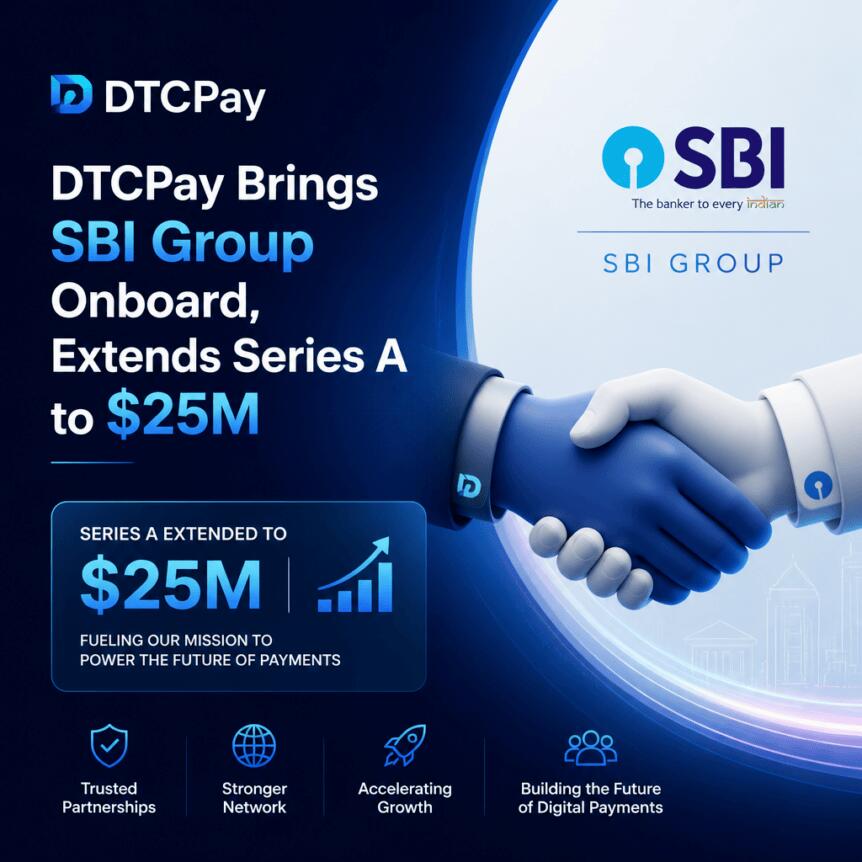
Singapore-based payments firm dtcpay has closed a $25 million Series A funding round, bringing in Vertex Ventures Southeast Asia & India as the lead investor and adding further backing from SBI Group, the Japanese financial conglomerate. The round—completed after dtcpay’s initial April fundraising—also included participation from Genedant Capital and existing investor Kwee Liong Tek.
dtcpay positioned the funding as a step toward making stablecoin payments feel as routine as conventional financial rails, stating that it aims to improve how money is moved across borders. In a statement shared with the public, the company said the strategic investment reflects institutional confidence in that direction, with dtcpay’s CEO and founder Alice Liu describing the raise as intended to transform cross-border payments rather than simply maintain the current business momentum.
Key takeaways
- dtcpay completed a $25 million Series A, led by Vertex Ventures Southeast Asia & India.
- SBI Group joined the round as a strategic backer, alongside Genedant Capital and existing investor Kwee Liong Tek.
- The company’s payments stack centers on stablecoin-based transactions, building on prior launches in retail and online payment support.
- dtcpay states it offers a Visa card usable for spending via both fiat and stablecoins at 150+ million merchant locations.
Series A closes with SBI Group joining
The completion of dtcpay’s Series A adds a major financial-services heavyweight to a stablecoin-focused payments narrative that has been building over the past few years. According to dtcpay’s company announcement, Vertex Ventures Southeast Asia & India led the initial tranche of the round, and the final close now brings in SBI Group as a strategic anchor.
Vertex’s involvement matters beyond capital: as part of Vertex Holdings, a wholly owned subsidiary of Temasek Holdings, the firm has emphasized scaling technology businesses. dtcpay also highlighted additional value from investors including Genedant Capital—a Singapore-licensed fund manager that the company describes as operating with more than $2 billion in assets under management and advisory—and existing backer Kwee Liong Tek.
While dtcpay framed the round around broad operational change in cross-border payments, the investor mix signals an emphasis on bringing deeper institutional capabilities into an area where regulatory compliance and distribution partners often determine long-term viability.
A stablecoin-first payments strategy, built for everyday use
dtcpay has been working on payment products that aim to reduce friction for users and merchants—an approach that the company says its current offerings reflect. The firm previously moved through key milestones in the stablecoin payments category, including a retail and online payment system that uses both fiat and cryptocurrencies, which Cointelegraph reported in 2023.
In 2024, Cointelegraph reported that dtcpay shifted toward a stablecoin-only transaction model—phasing out support for cryptocurrencies such as Bitcoin in favor of stablecoin usage. That pivot is important for understanding why this Series A may be positioned around reliability and usability: stablecoins are generally marketed as aiming for stable value, which can simplify merchant settlement and user expectations compared with more volatile crypto assets.
dtcpay also points to a product layer that goes beyond app-to-app settlement. Its Visa card enables spending in both fiat and stablecoins. The company says it can be used at more than 150 million merchant locations worldwide, tying stablecoin payments to a familiar consumer spending network.
Regulated footprint across regions
For payment companies pursuing stablecoin infrastructure, licensing and geographic permissions can be as consequential as the technology itself. dtcpay says it is licensed by the Monetary Authority of Singapore and also holds an Electronic Money Institution license in Luxembourg. The company further states it is authorized to deliver regulated payment services across the European Economic Area, with licenses and registrations in Hong Kong, Australia, the United States, and Canada.
Those details matter because stablecoin adoption often runs into uneven policy treatment across jurisdictions. Even when market interest is strong, companies must navigate compliance regimes that may differ materially from one region to the next. Earlier reporting by Cointelegraph referenced how fragmented regulations can limit stablecoin adoption in international finance—a backdrop that provides context for why dtcpay’s regulatory footprint and multi-region permissions could influence its ability to scale.
Why the new capital is likely to matter now
Funding rounds in payments tend to be judged not only on runway but on execution—whether the firm can translate licensing, merchant access, and product design into real usage. dtcpay’s messaging around the Series A suggests it wants to move from building toward broader deployment.
The company’s CEO Alice Liu said dtcpay did not raise the round to simply sustain what has already been built, adding that the objective is to change how money moves across borders. That framing aligns with the way the company has concentrated its product direction on stablecoins and a Visa-based spending experience rather than a broader basket of cryptocurrencies.
With SBI Group now participating, investors may also be expecting dtcpay to accelerate partnerships and operational scale—particularly in areas where banks, regulated payment ecosystems, and settlement rails play a central role. At the same time, markets will likely watch for clarity on how dtcpay plans to turn stablecoin rails into more consistent throughput, higher merchant adoption, and smoother user onboarding.
Next, investors and users will likely focus on whether dtcpay can broaden its stablecoin payment footprint beyond its current distribution model and how it navigates regulatory complexity across key markets—especially as stablecoin policy continues to develop unevenly worldwide.
Kevin O’Leary says Bitcoin (BTC) can reach $1 million. He attaches one condition, which is resolving doubts about quantum computing breaking the encryption behind the network.
The O’Leary Ventures chairman set out that condition, speaking with The Rollup podcast at Avalanche Summit in New York.
Why Quantum Doubt Stands Between Bitcoin and $1 Million
Interviewers asked O’Leary directly whether Bitcoin would ever trade at seven figures. He said it would, then named the obstacle.
“It will if it can resolve the doubt creeping in around quantum computing, you know, breaking the algorithms and the chain and the encryption,” O’Leary said.
Follow us on X to get the latest news as it happens
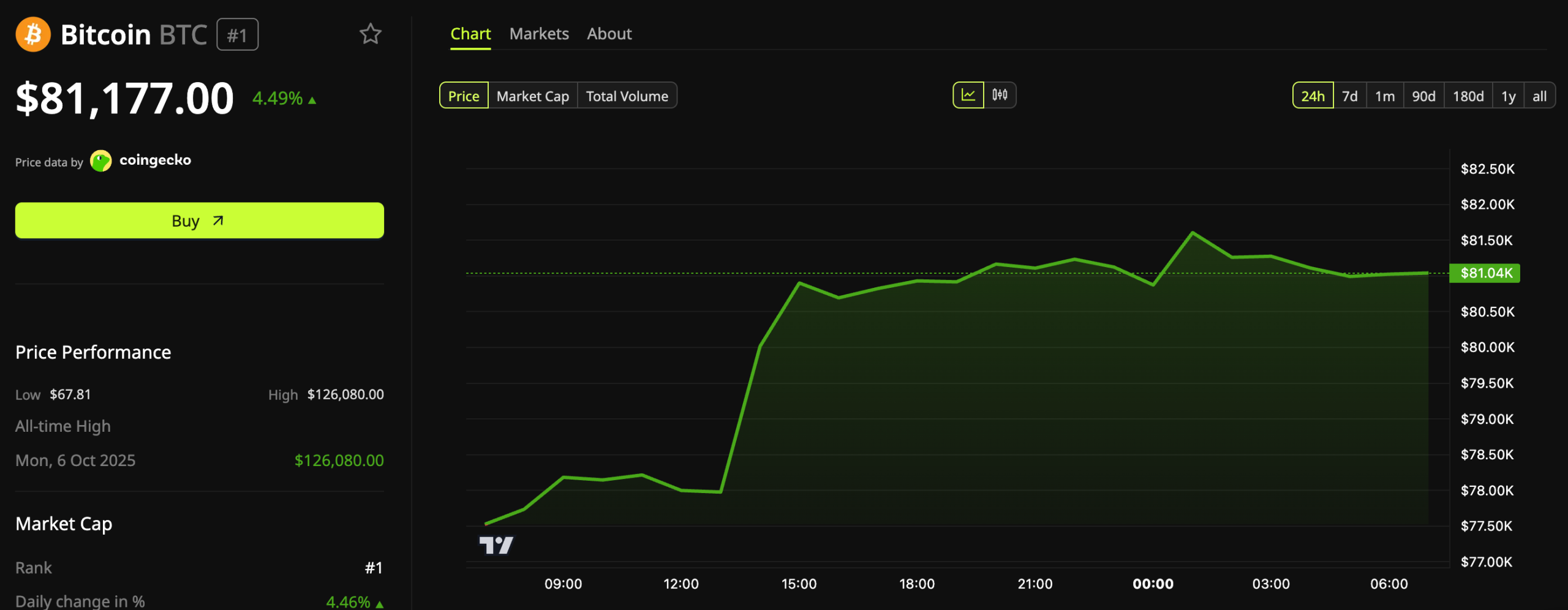
Bitcoin traded near $81,177 on September 19, according to BeInCrypto Markets. Reaching $1 million means a gain of about 1,132%, or more than 12 times the current price.

Meanwhile, the risk he describes is known as Q-Day. The term describes the moment when a quantum computer becomes powerful enough to break public-key cryptography. No such computer exists yet.
How Much Bitcoin Already Sits Exposed
Glassnode calculated in May that about 6.04 million BTC, or 30.2% of the issued supply, already sat in addresses whose public keys are already visible. Those coins would offer the clearest targets once quantum key-breaking becomes practical.
The hardware bar has dropped, too. Google Quantum AI said in March that breaking Bitcoin’s elliptic curve cryptography could need fewer than 500,000 physical qubits. Earlier estimates put that figure in the millions.
The threat timeline is also shortening. NIST wants vulnerable encryption phased out by 2030 and banned by 2035. Google has set its own post-quantum migration deadline at 2029. That makes preparation urgent while Q-Day is still years away.
The fear already shapes behavior. O’Leary said in February that institutions would not go beyond a 3% Bitcoin allocation until it is resolved.
Some have gone further. Jefferies strategist Christopher Wood removed a 10% Bitcoin position from his model portfolio over the same worry.
Subscribe to our YouTube channel to watch leaders and journalists provide expert insights
The post Kevin O'Leary Names the One Thing Standing Between Bitcoin and $1 Million appeared first on BeInCrypto.
It was difficult to imagine, after the developments that took place in the middle of the week, what would transpire on Friday, but BTC’s price somehow skyrocketed past $81,000 for the first time in half a month.
The altcoins have also turned green today, with ETH reclaiming $2,600, XRP bouncing above $1.40, and SOL rocketing past $110.
BTC Flies Above $81K
After the heightened volatility on the previous Friday following the release of the US CPI Data, bitcoin’s price calmed over the weekend at around $77,000. All eyes turned to the subsequent business week, which was expected to be a big one.
The first major event took place on Tuesday when the CLARITY Act was scheduled to be voted on in the US Senate. The vote didn’t go well, and the Senate rejected advancing the key bill. The largest cryptocurrency reacted with an immediate leg down that drove it to $75,000. More fluctuations ensued a day later when the US Federal Reserve hiked the rates for the first time in over three years, and BTC went down but then back up to $76,500 within minutes.
The bulls started to reemerge at this point and didn’t allow bitcoin to slip any further. In fact, the cryptocurrency jumped to $78,000 on Friday morning and then initiated a massive leg up during US trading hours, jumping past $80,000 and $81,000 for the first time in two weeks.
Unlike the previous such run, though, this one was maintained over the weekend as well, at least for now, and BTC now sits above $81,000 after a negative macro week. Its market cap is up to $1.630 trillion, while its dominance over the alts remains at 58.7% on CMC.

Alts See Green
Ethereum is up by 5% daily and has reclaimed the $2,600 level, which was tested earlier this month. XRP has jumped past $1.40 after a 6.4% increase, while SOL is above $110 now after a 5.4% pump. Impressive gains are also evident from the likes of XMR, RAIN, ZEC, LINK, TAO, AAVE, and SUI.
The double-digit price pump club consists of ENA, AVAX, MORPHO, SKY, INJ, PIEVERSE, and a few others. In contrast, BTW has slumped by over 9% and now sits below $0.60.
The cumulative market cap of all crypto assets has increased by $150 billion in a day and is up to $2.780 trillion on CMC.

The post Crypto Market Cap Adds $150B Daily as Bitcoin (BTC) Soars Past $81K: Weekend Watch appeared first on CryptoPotato.
At the press conference following his first FOMC meeting in June, Warsh announced several initiatives covering the Fed’s communications strategy, balance sheet, data sources, productivity and jobs, and inflation framework. Each is led by three outside experts drawn from academia and industry. The groups are expected to deliver preliminary findings this fall, with most wrapping up by year’s end.
The pace and ambition of the efforts signal that Warsh is serious. Whether it proves truly transformative remains an open question.
Watch the data, not the Fed
Of his five reform areas, communication has drawn the most attention, and Warsh moved on it before the task force even convened. He stopped offering long-term projections on Fed policy actions and simplified its press releases, signaling a clear break from recent practice. At the heart of this shift is Warsh’s belief that markets have grown too dependent on Fed communication, paying more attention to what officials say than to the underlying economic data. He argues this creates a feedback problem: if markets are reacting to the Fed rather than to the data, the Fed gets a distorted read on where markets actually stand.


Lemon has decided to close its Brazilian operations and terminate about 15,000 local accounts after finding the country’s new crypto licensing capital requirements too costly for its business.
Summary
- Lemon will close Brazilian accounts on Oct. 16 and assist users with withdrawals.
- BRL deposits have stopped, while Lemon Card payments will end on Sep. 30.
- Brazil’s first virtual-asset licensing deadline falls on Oct. 30.
- Lemon will redirect resources toward Argentina, Peru and Colombia.
Lemon said Brazil’s new capital requirements were “disproportionate” to the size of its local business, prompting the Argentine crypto app to withdraw rather than finance a licence under the country’s new virtual-asset rules.
About 15,000 users still hold balances through Lemon’s Brazilian operation. The company plans to contact each customer and provide withdrawal assistance before closing the remaining accounts on Oct. 16, 2026.
New deposits in Brazilian reais have already been suspended. Lemon Card, a Visa payment card introduced with payments infrastructure provider Pomelo only weeks before the closure decision, will stop processing transactions on Sep. 30.
Lemon exits Brazil before the licensing deadline
Brazil’s framework for virtual-asset service providers, locally known as PSAVs, took effect on Feb. 2. Companies covered by the rules face an Oct. 30 deadline for the first stage of the licensing process.
Under the framework described by Lemon, providers that continue operating without regulatory approval after the deadline face restrictions on serving the Brazilian market. Compliance would require the company to commit more capital to its local entity.
Lemon chose to redirect that money to its operations elsewhere in Latin America. The company attributed the decision to the cost of meeting Brazil’s licensing standards compared with the size of its customer base and revenue in the country.
“Brazil’s requirements ended up expelling players that wanted to invest, innovate, and widen the service offer,” Lemon said.
The company’s statement frames the closure as a regulatory and financial decision rather than a response to falling demand for cryptocurrency services. No figures were provided for the amount of customer assets held in the Brazilian accounts or the capital that Lemon would have needed to secure a licence.
Customer withdrawals are now the immediate priority. Users who leave balances on the platform face the Oct. 16 account deadline, two weeks before the first-stage filing date for crypto providers seeking to remain in the market.
Brazil’s capital rules divide local crypto providers
Lemon is not the only crypto company changing its Brazilian business under the licensing regime. Coinext shut down after failing to meet the minimum capital threshold, while Digitra ended its retail trading service.
Crypto.com has taken a narrower approach. The exchange is retaining its Brazilian entity but plans to close accounts denominated in reais on Oct. 25.
Companies with more capital or deeper local operations are proceeding with their Brazilian expansion plans. Binance has obtained regulatory approval in the country, while Ripple is pursuing a Brazilian virtual-asset service provider licence as it expands the use of its RLUSD stablecoin across Latin America.
Coinbase has also expanded access to USDC lending products in Brazil through Morpho. The service gives eligible users exposure to onchain lending, placing the US exchange among the international companies continuing to invest in Brazil despite the higher regulatory costs.
Card products show the same divide. Lemon is withdrawing its Visa card shortly after launch, while Binance has relaunched its Brazilian crypto card through Mastercard following a two-year absence.
The contrasting decisions leave companies to weigh the revenue available from Brazilian users against the capital, compliance and operating costs attached to the new system. Lemon’s 15,000 accounts were not enough to justify that investment, according to the company’s explanation.
For US crypto companies, Brazil’s approach presents a separate entry cost rather than a direct change to their domestic obligations. American exchanges entering the country must meet Brazilian licensing conditions through their local operations while continuing to follow applicable US federal and state requirements at home.
Lemon redirects capital across Latin America
Argentina will receive part of the capital released by the Brazilian closure. Lemon described the country’s regulatory system as providing “clear rules and a security environment,” contrasting it with the economics of operating under Brazil’s framework.
Bitcoin purchases through Lemon in Argentina recently reached a 20-month high, according to the company. Lemon cited the increase as evidence of stronger growth in its home market, although it did not disclose the volume or value of the purchases.
Peru is another priority. Lemon reports more than 1 million users there and operates with a licence from the country’s banking and insurance supervisor, the SBS.
In Colombia, where Lemon says it has more than 150,000 users, the company plans to devote additional resources to its existing operation. The redistribution covers three markets where Lemon believes its current licences, customer numbers and operating costs provide a stronger basis for expansion.
Other international exchanges have also continued pursuing Latin American markets outside Brazil. Bitget obtained PSAV registration in Argentina, giving the exchange a regulated route to serve customers in Lemon’s largest market.
Lemon described its regional plan as a reallocation rather than a general retreat from Latin America. The company will close one national operation while retaining businesses in Argentina, Peru and Colombia.
Brazil continues attracting larger crypto companies
Brazil remains one of Latin America’s most active cryptocurrency markets despite the departure of smaller providers. Local lawmakers are considering a proposal for a national Bitcoin reserve that could eventually hold as much as 1 million BTC.
The proposal remains separate from the central bank’s licensing system and has not created a purchase commitment. Its progress through Congress nevertheless shows that Brazilian policymakers are considering state-level exposure to Bitcoin while financial regulators impose higher requirements on companies serving retail customers.
Brazil’s model also differs from the US Strategic Bitcoin Reserve established in March 2025. The White House framework capitalized the US reserve with Bitcoin forfeited through criminal or civil proceedings and allowed officials to examine budget-neutral acquisition methods.
Meanwhile, Lemon’s remaining Brazilian customers have until Oct. 16 to remove funds from the platform, while cardholders will lose access to Lemon Card payments after Sep. 30.
Crypto World
From Florida to Nevada, retirees are fleeing to no-tax states in search of financial ‘heaven.’ They don’t always find it


Sunny, low-tax states like Florida, South Carolina and Nevada have become a magnet for U.S. retirees, with Florida alone placing four cities in the top 10 WalletHub’s Best Places to Retir survey. Scottsdale, Arizona and Las Vegas, Nevada also placed in the top 12 slots in the survey.
Relocation and family finance experts say retirees are drawn to sunnier, usually southern U.S. locales not only due to the warmer climate, but for a lower, or no, tax-rate. Now, data is showing that many retirees are finding their new states bring countering cost of living issues to the buffet table, most notably homeowners association fees and sky-high home insurance rates.
Must Read
“Florida has no personal state income tax, which can be very attractive, particularly to higher-income retirees, but “no income tax” and “lower cost of living” are not the same thing,” Nicole Brown, CEO of Pathways International Inc., a real estate and capital advisor, told Moneywise.
“The number that matters is net disposable income after the entire lifestyle is considered, not just the tax rate,” she noted.
Here’s what’s happening on the low-tax retirement destination front
The rebound move is alive and well in the Sunshine State, with just the same numbers of retirees entering and leaving Florida. According to data from HigherAHelper’s New Retirement Map, 45,696 Americans aged 65-or-over moved to Florida in 2025. Yet 44,881 retirees exited the state the same year, leaving Florida with an 815-retiree net gain for 2025.
No doubt, personal income flow plays a big role in who moves to a state like Florida and who leaves, retiree-wise. “The income issue is huge,” Brown noted. “Two retirees with the same net worth can experience a move very differently depending on whether their cash flow comes from Social Security, pensions, tax-deferred retirement accounts, taxable investments, real-estate income or some combination.”
What to do before making a move to a low-or-no tax state
If you’re thinking of moving to Florida or any other low- or-no-tax state, consider these things beforehand.
Factor in taxes right away
Brown said that someone generating significant taxable working or investment income may place a much higher dollar value on moving to a state without personal income tax than someone whose income receives better treatment in their original state.
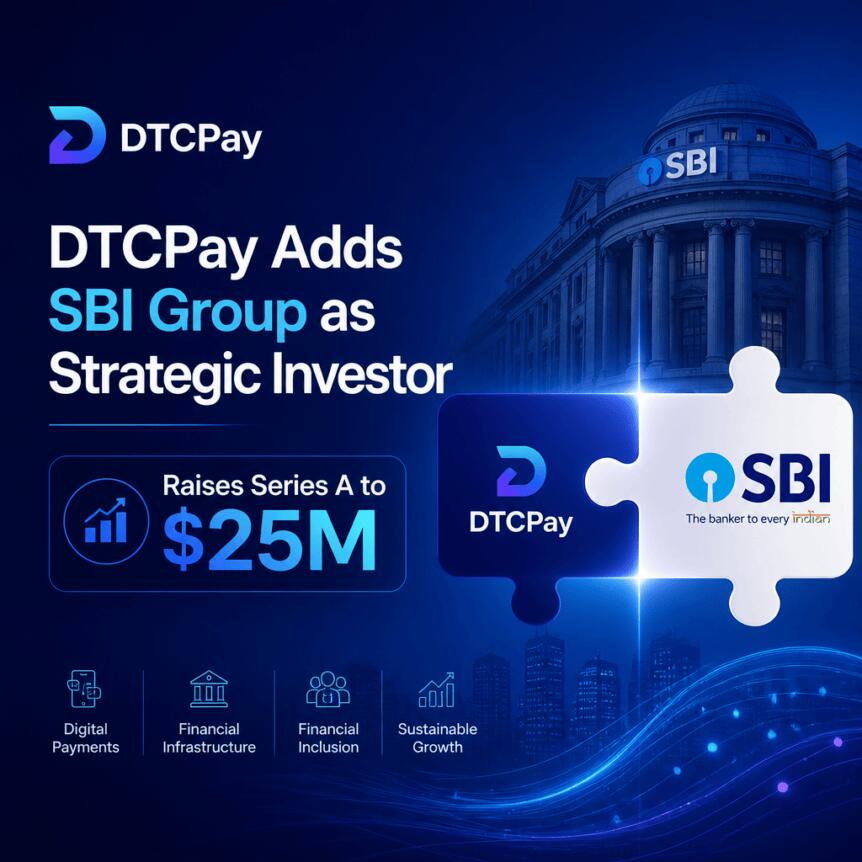
Singapore-based payment firm dtcpay has closed a $25 million Series A funding round, initially led by Vertex Ventures Southeast Asia & India and now bolstered by an additional anchor from Japan’s SBI Group. The company says the investment underscores growing institutional interest in stablecoin payments that aim to work with everyday finance instead of sitting on the margins of crypto.
dtcpay previously secured the Series A’s initial tranche in April, and the final round now includes participation from Genedant Capital and existing investor Kwee Liong Tek. In a company statement released Friday, dtcpay positioned the funding as a step toward making cross-border value transfers as frictionless as traditional payments.
Key takeaways
- dtcpay has completed its $25 million Series A round, with SBI Group joining as a strategic anchor investor.
- Vertex Ventures Southeast Asia & India led the April portion of the raise, with additional participation from Genedant Capital and existing backer Kwee Liong Tek.
- The company markets its platform around “stablecoins as seamless and accessible” payments rather than a crypto-only experience.
- dtcpay’s Visa card reportedly enables spending using both fiat and stablecoins across 150 million+ merchant locations.
- Licensed operations span Singapore and the EEA, supporting the company’s focus on regulated payment services.
SBI Group joins dtcpay’s Series A
dtcpay said the completed Series A was led by Vertex Ventures Southeast Asia & India, part of Vertex Holdings, which is wholly owned by Temasek Holdings. The company described the funding as coming at a time when stablecoins are increasingly being discussed by traditional finance players—particularly in contexts where settlement speed and cross-border transfer efficiency matter.
Japanese financial conglomerate SBI Group now adds further institutional weight to the round. The firm’s broader footprint across banking, securities, insurance, asset management, and digital assets gives dtcpay additional industry exposure as it scales its payment rails.
In its statement, dtcpay emphasized that the raise was not intended to simply extend existing operations. Founder and CEO Alice Liu said, “We did not raise this round to sustain what we have built. We raised it to fundamentally change how money moves across borders.”
From crypto payments to stablecoin-first transactions
dtcpay’s pitch centers on stablecoins as a payments layer that can integrate with consumer spending rather than requiring users to actively manage cryptocurrency portfolios. Cointelegraph previously reported that dtcpay launched a payment system for both in-store and online transactions using fiat and cryptocurrencies (coverage from 2023). In 2024, Cointelegraph reported dtcpay shifted toward stablecoin-only transactions, including support for stablecoins rather than assets such as Bitcoin.
This evolution matters for adoption because stablecoins align more closely with how most users experience pricing and budgeting—where volatility is a critical friction point. dtcpay’s current framing suggests the company is aligning product design with the needs of regular commerce: payments that behave more like digital cash and less like a speculative asset.
A Visa card built for fiat and stablecoin spending
A key element of dtcpay’s go-to-market strategy is its Visa card. The company says the card enables spending using both fiat and stablecoins across more than 150 million merchant locations worldwide. That distribution signal is part of why dtcpay describes stablecoin access as “seamless and accessible” in everyday settings, rather than limited to crypto-native venues.
For investors and market observers, this approach highlights the operational challenge behind many stablecoin payment narratives: the ability to move from a backend token settlement concept to a front-end experience that consumers can use without changing their payment habits. dtcpay’s mention of Visa merchant coverage suggests an emphasis on real-world usability and merchant acceptance at scale.
Regulated footprint across multiple jurisdictions
dtcpay also stresses its regulatory positioning. The company says it is licensed by the Monetary Authority of Singapore and holds an Electronic Money Institution license in Luxembourg. It also states it is authorized to deliver regulated payment services across the European Economic Area, while maintaining licenses and registrations in Hong Kong, Australia, the United States, and Canada.
It’s also worth noting that Genedant Capital—one of the participants in the round—is described by the company as a Singapore-based fund management firm licensed by the Monetary Authority of Singapore, with more than $2 billion in assets under management and advisory. Genedant’s involvement adds another layer of compliance-aware capital alongside the strategic capabilities dtcpay is seeking from its broader investor base.
In practical terms, the regulatory footprint is central to why institutional investors may be more willing to engage with stablecoin payment startups now than in earlier crypto cycles. While stablecoins themselves remain an area of ongoing policy debate globally, regulated payment licensing and cross-border authorization can reduce uncertainty around how value moves and how customer funds are handled.
As dtcpay takes this Series A forward with SBI Group and prior lead investor Vertex Ventures Southeast Asia & India, the next question for users and the market is how quickly the company can expand stablecoin-enabled payment features within its licensed framework—and whether more mainstream financial partners follow the same path.
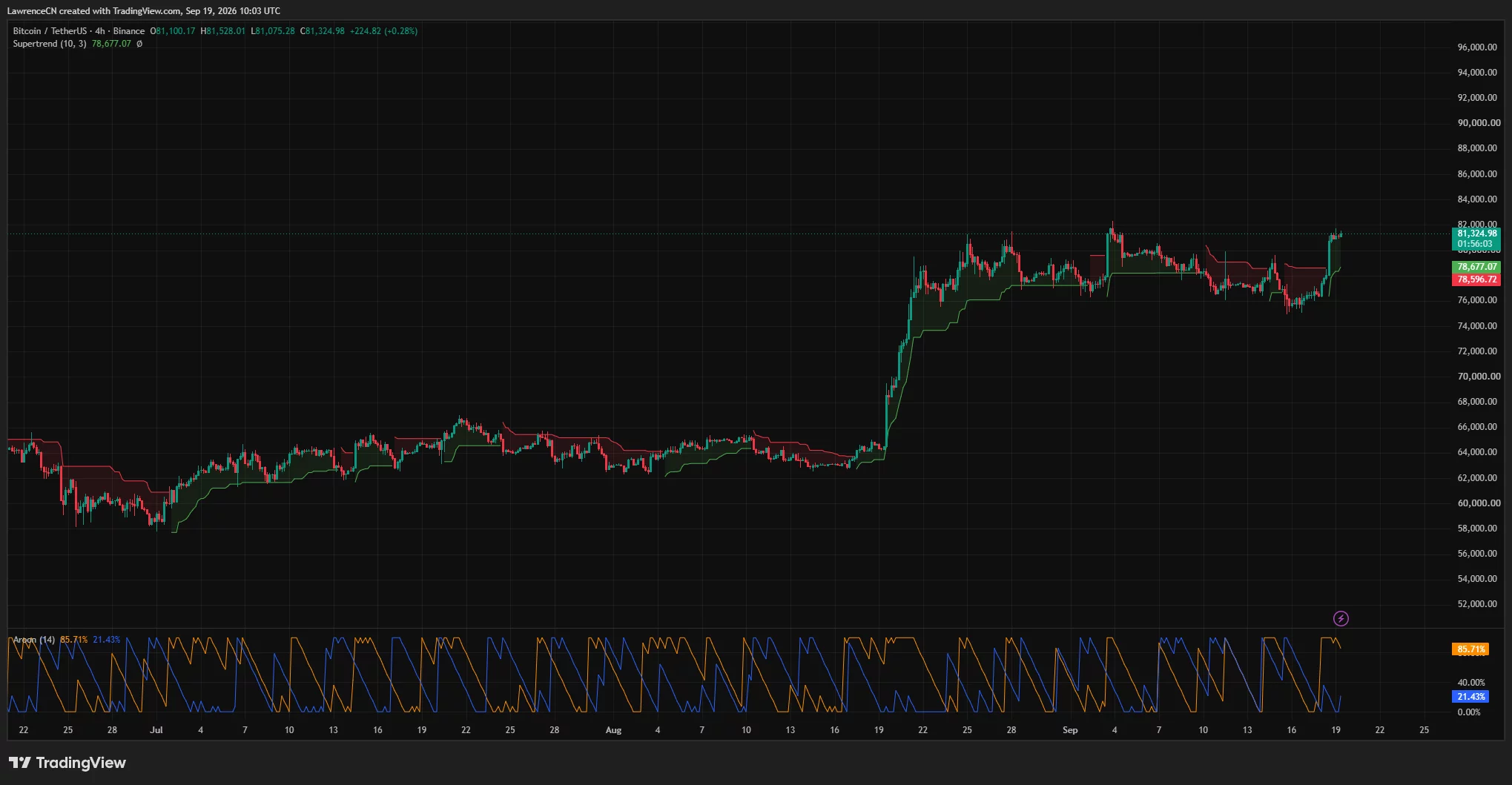
Bitcoin price rebounded about 6% over the past 24 hours to trade near $81,300, with a short squeeze and improving technical momentum carrying the price to its highest level in two weeks.
Summary
- Bitcoin price recovered from below $77,000 and climbed past $81,000 within 24 hours.
- The 4-hour Supertrend flipped bullish, with support now near $78,677.
- Daily RSI rose to 64.48, showing strong momentum without reaching overbought territory.
- A break above $83,000 could confirm a broader bottom, according to analyst Ted Pillows.
Bitcoin price action today
Bitcoin (BTC) price traded at approximately $81,330 at the time of writing after reaching an intraday high near $81,741, according to the daily chart. The move extended a sharp recovery from the $75,000–$76,000 area and erased the losses recorded earlier in the week.
The cryptocurrency gained roughly 6% over 24 hours, outperforming after a week dominated by tighter monetary policy and uncertainty surrounding U.S. crypto legislation.
The rebound accelerated after BTC reclaimed its True Market Mean near $76,660. The move forced traders holding leveraged short positions to buy back Bitcoin as prices moved against them, contributing to more than $250 million in short liquidations over the past day.
Forced buying helped BTC clear resistance at $78,000 and $80,000 before testing the low-$81,000 range. Bitcoin-related U.S. stocks also rallied, with Coinbase, Strategy and Robinhood recording strong gains during Friday trading.
The price recovery came despite the Federal Reserve’s first interest-rate increase in three years and the failure of the CLARITY Act in the U.S. Senate. Both developments had weighed on sentiment earlier in the week.
Bitcoin technicals turn bullish above $78,600
Bitcoin’s 4-hour chart shows that the Supertrend indicator has flipped from bearish to bullish. Its current support line sits near $78,677, leaving the short-term bullish structure intact while the price remains above that level.
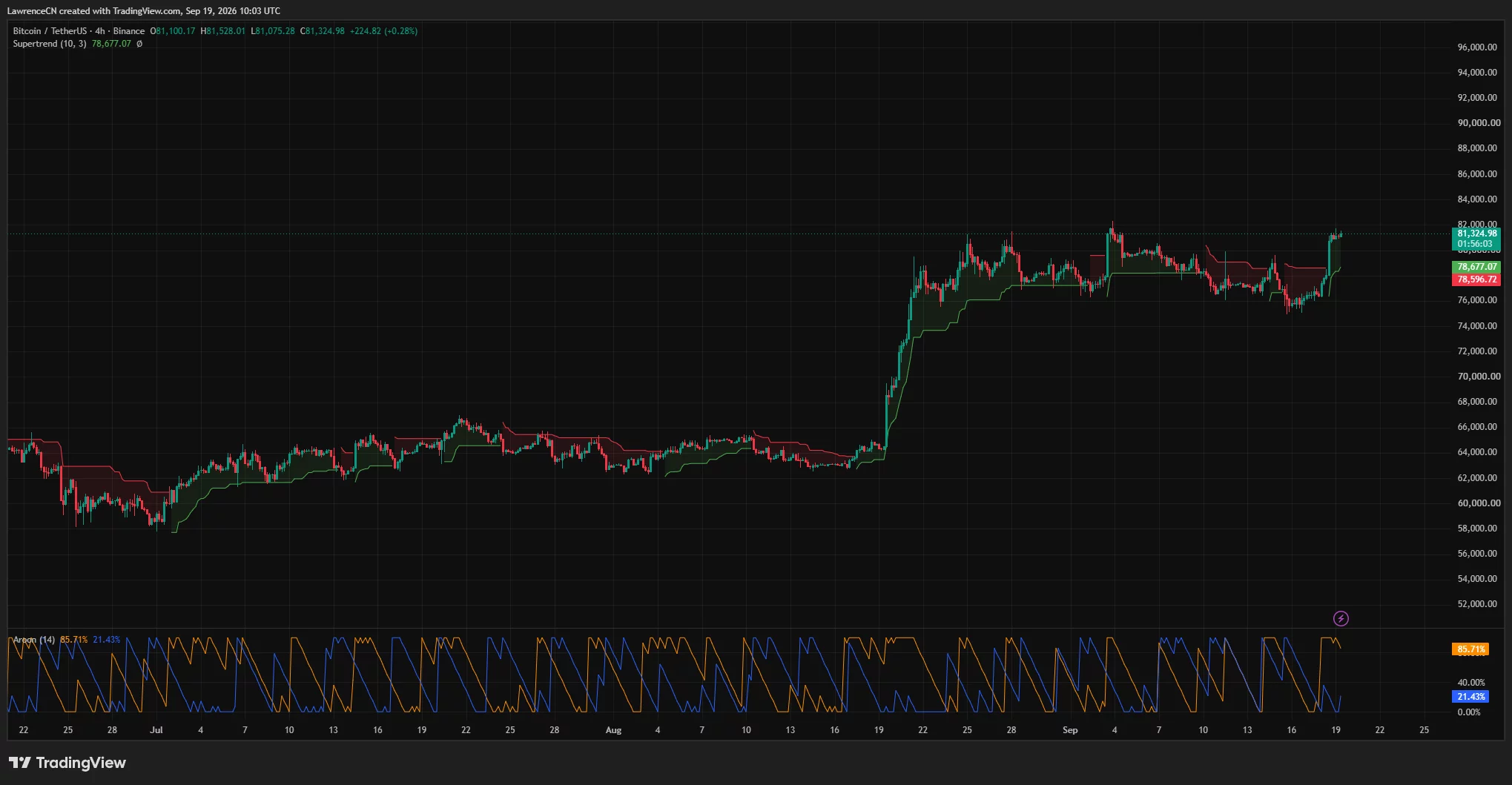
The Aroon indicator also points to stronger upward momentum. Aroon Up stood at 85.71%, compared with an Aroon Down reading of 21.43%. The gap suggests that Bitcoin has recently recorded stronger highs while downside momentum has weakened.
However, Aroon Up has started to turn lower from 100%, meaning buyers may need another push above the recent high to maintain the strength of the signal.
On the daily chart, Bitcoin has moved above the Bollinger Bands’ 20-day middle line at $78,346 and is approaching the upper band at $81,745. A daily close above the upper band could support an extension toward the next resistance zone, although a rejection may send the price back toward the middle band.
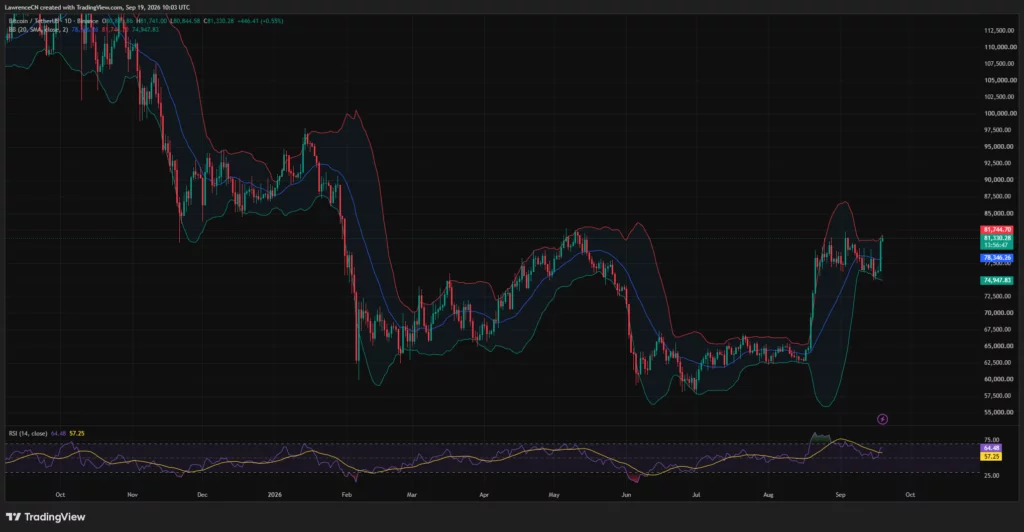
Daily RSI has risen to 64.48 from its signal average of 57.25. Momentum remains bullish, but the indicator is approaching the 70 level commonly associated with overbought conditions.
The combination of a bullish Supertrend, a positive Aroon spread, and an RSI reading above 60 favors buyers. However, Bitcoin is now testing an area that has repeatedly limited gains since late August.
Liquidation heatmap points to $82,000 resistance
CoinGlass’ three-day liquidation heatmap shows a dense band of leveraged positions between approximately $81,800 and $82,000. The cluster sits directly above the current price and could attract Bitcoin if buyers sustain the rally.
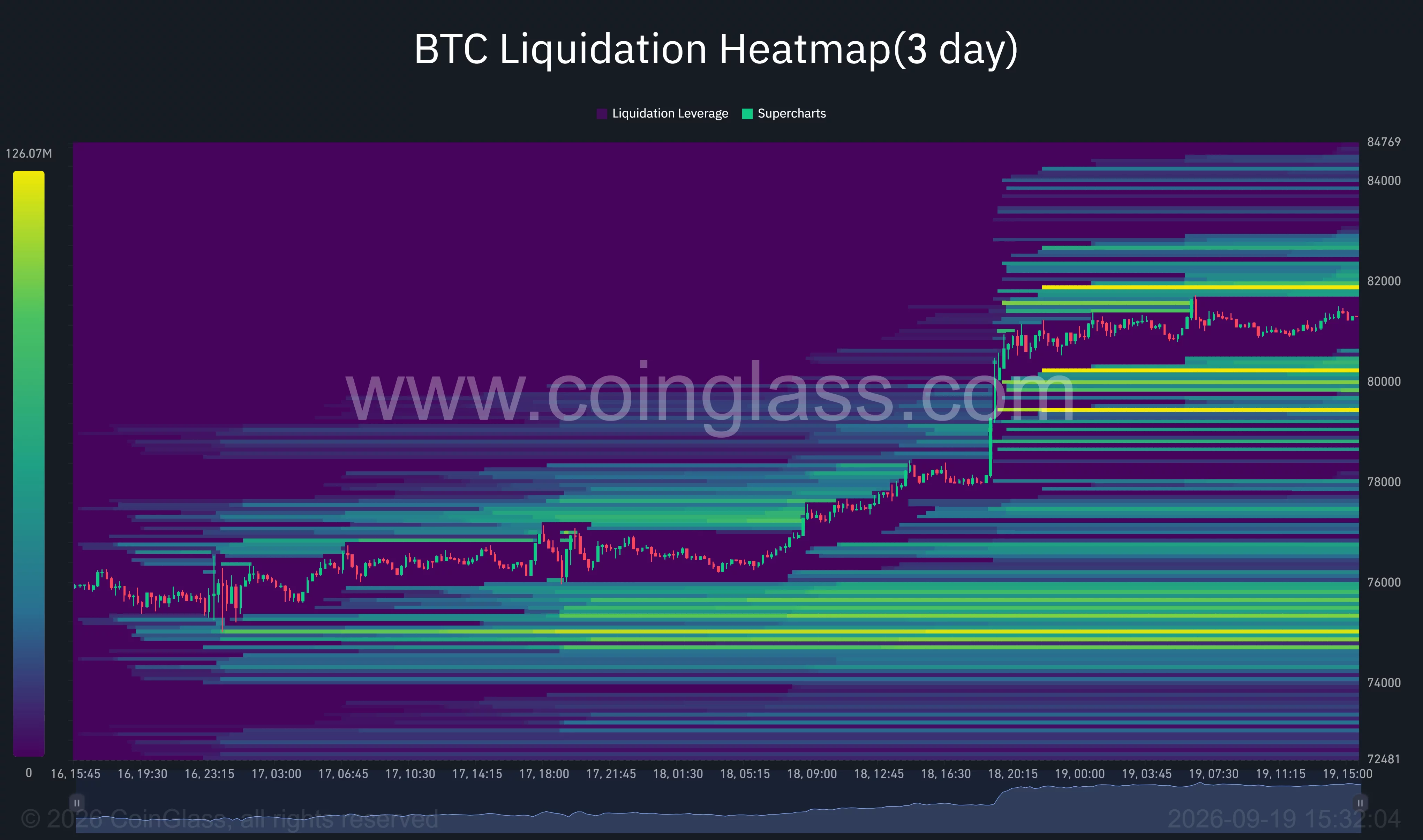
A move through $82,000 would expose additional liquidity near $82,500–$83,000. Further liquidation bands appear around $84,000, giving bulls a sequence of possible upside targets if the short squeeze continues.
The largest nearby pools below the market sit around $80,000 and $79,400. Bitcoin could revisit either area if traders take profits following the rapid advance.
Liquidity is also concentrated between $78,500 and $79,000, close to the 4-hour Supertrend and daily Bollinger midpoint. The overlap makes the region an important support zone for the current recovery.
A deeper decline would bring $75,000–$76,000 back into focus. The heatmap shows a broad concentration of leveraged positions in that range, while the daily lower Bollinger Band stands near $74,948.
Heatmaps identify areas where leveraged positions may face liquidation, but they do not guarantee that price will reach those levels.
Analysts watch $83,000 for bottom confirmation
Crypto analyst Ted Pillows said Bitcoin appeared set to close above its 50-week moving average. He identified $83,000 as the level BTC must clear to confirm that a market bottom has formed.
A sustained move above $83,000 would also break the upper part of the range that has contained Bitcoin since its August rally. Confirmation would place $85,000 in view before the market attempts a larger recovery.
Analyst Gerla said Bitcoin was holding the $81,000–$85,000 area after a bullish RSI divergence played out. According to the analyst, converting the zone into support could open a path toward $101,000–$105,000.
The higher target remains conditional because Bitcoin has not yet cleared either $83,000 or the full $81,000–$85,000 resistance range. Immediate technical conditions support the rebound, but a rejection below $82,000 would leave BTC vulnerable to another test of $80,000 and $78,600.
US macro risks remain in focus
The rally followed a difficult week for U.S. crypto investors. The Senate’s rejection of the CLARITY Act delayed efforts to establish a federal digital-asset market structure, while spot Bitcoin ETFs recorded nearly $746 million in net outflows during the midweek selloff.
The Federal Reserve also raised interest rates by 25 basis points, increasing the appeal of yield-bearing government debt relative to assets such as Bitcoin. The Bank of Japan then lifted its benchmark rate to 1.25%, adding another source of uncertainty for global liquidity.
Bitcoin has so far absorbed those pressures, but $83,000 remains the main test for the recovery. A confirmed breakout could extend the squeeze toward $85,000, while a failure to hold $80,000 would shift attention back to the $78,300–$78,700 support region.
Disclosure: This article does not represent investment advice. The content and materials featured on this page are for educational purposes only.
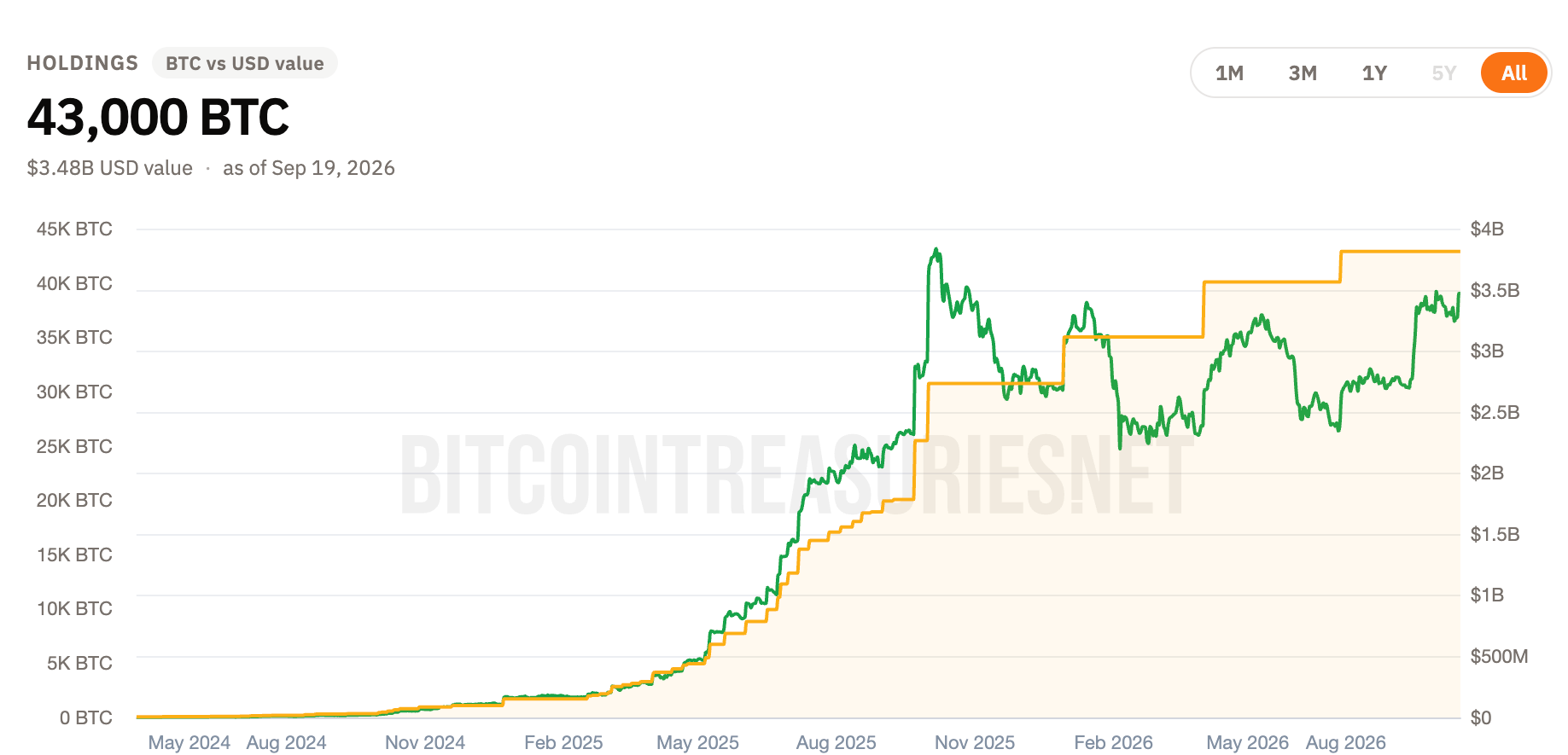
VanEck rated Metaplanet “Bad” on executive compensation practices, the only company among the 10 largest digital asset treasuries to get that grade. It fails all four of the firm’s tests.
The research note landed on September 18. That grade holds even after Metaplanet cut its executive option pool twice in the past month.
What a Digital Asset Treasury Company Is
A digital asset treasury company is a public company whose main business is holding crypto on its balance sheet. Metaplanet is a Tokyo-listed one holding 43,000 Bitcoin (BTC). It funds those purchases by issuing new shares, alongside debt and preferred stock.

Issuing new shares means the pie gets cut into more slices. The slice gets smaller. That is dilution.
The deal investors accept is straightforward. The company buys enough Bitcoin that each remaining slice is still worth more than before.
Where Executive Pay Comes In
Companies pay executives partly in stock options. An option is the right to buy company shares later at a fixed price. If the share price rises, that right is worth money.
Those options sit in a pool. A pool worth 2% of the company means executives could eventually claim 2% of all shares.
The bigger the pool, the more of the company’s value goes to management instead of shareholders.
Where Metaplanet’s Option Pool Came From
Metaplanet was a struggling hotel operator in 2022. Shareholders approved a rescue plan in February 2023, granting seven staff options over 46 million shares at a ¥10 strike price.
That figure was never fixed. A clause inside the plan reset the award to 20% of every share the company could issue.
Once Metaplanet adopted its Bitcoin strategy in April 2024, it began issuing equity to fund purchases, alongside debt and preferred stock. Only the share sales diluted holders, and the clause tracked those.
Each one, therefore, cut shareholders’ stake and enlarged the executive pool in the same move.
Metaplanet’s share count climbed from 153.9 million to roughly 1.35 billion in two years. The pool grew with it, from 46 million shares to 319.5 million.
The Result for Shareholders
Shareholders were diluted to buy Bitcoin. Management’s claim grew alongside that dilution.
Until the recent cuts, VanEck estimates Metaplanet passed roughly 80% of the Bitcoin it bought through to shareholders. Management dilution absorbed the other fifth.
No committee decided this. A formula did it automatically, which is why VanEck singles the company out.
Not everyone reads the pool as excessive. David Bailey, chief executive of Nakamoto, defended its scale.
Follow us on X to get the latest news as it happens
What VanEck Actually Measured
VanEck took the 10 biggest treasury companies and asked four questions.
- How big is the option pool against fully diluted shares
- How much of it sits with named executives
- Can the pool grow without a shareholder vote
- Does the largest award carry a performance hurdle
Metaplanet’s pool is 14.7% of shares against a 4.0% peer average. Its executives hold 8.2% against 0.8%. That works out to roughly 4 times the peer level on pool size and 10 times on officer exposure.

Shareholders never voted on the growth or the two 2026 amendments, and the awards require nothing beyond staying employed.
Metaplanet failed all four. The other nine passed, with Strategy, BitMine, and four others earning good marks.
“We rank Metaplanet (MTPLF) as the only company among the top 10 DATs we classify as ‘Bad’ on executive compensation practices and it falls well short of ‘Acceptable,’” the firm said.
What Changed Recently
The board has moved twice under shareholder pressure.
- August 18. The board repealed the evergreen dilution clause. Yet, the pool stayed at its swollen size.
- September 11. The board rolled the terms back to where they stood before a September 2025 share sale. That rollback cut the pool 41% to 188.2 million shares.
However, 82.8 million shares had already reached insiders under the old terms. Only 105.4 million potential new shares remain, roughly 7% of the company. VanEck says that it is still far worse than any peer, so the bad grade stands.
The firm lists four changes that would lift it. Cancelling the roughly 273 million shares the clause created is the first, followed by a smaller stockholder-approved plan, pay tied to Bitcoin per share, and a written grant-timing policy.
Subscribe to our YouTube channel to watch leaders and journalists provide expert insights
The post Metaplanet Fails All 4 VanEck Tests on Treasury Executive Compensation appeared first on BeInCrypto.

4 Levels of Financial Freedom or FIRE | Case Studies with Parimal Ade

Putin’s war economy is under strain. One thing is keeping it afloat

PagerDuty: Dirt Cheap And AI Is Creating A Great New Opportunity




-

 Tech6 days ago
The Latest Weird Thing to Play Doom Is the Mapped-Out Brain of a Fruit Fly
-

 Fashion18 hours ago
Weekend Open Thread: Talbots – Corporette.com
-

 Crypto World4 days ago
Kraken Lets xStocks Holders Earn Yield Through DeFi
-

 Crypto World2 days ago
US Charges Robinhood Engineers Over Crypto Listing Trades
-

 Crypto World7 days ago
Can AI Build a Startup in 72 Hours? Elon Musk's Team Will Livestream the Test
-

 Crypto World3 days ago
What Is the Status of the U.S.-Iran Peace Talks? Here's What Both Sides Are Saying
-

 Crypto World5 days ago
Elon Musk Drops a Bombshell: Grok 5 Could Be the AGI Breakthrough
-

 Business6 days ago
Rivals Sam Altman and Elon Musk Rally Behind Dario Amodei’s Call for a Slowdown in AI Development
-

 Crypto World4 days ago
Revolut Attackers Warn of Ongoing Daily Customer Data Leaks
-

 Crypto World6 days ago
New Tesla Roadster Uses SpaceX Tech. Will It Impact the Stock Price?
-
 NewsBeat5 days ago
‘Sick conspiracy’: Trump says only guardrails AI needs is ‘a strong and smart (High IQ!) president’ in all-caps rant
-

 Crypto World4 days ago
NVIDIA Analysis: Attempted Rising Wedge Breakout Amid Pressure on the AI Sector
-
Business5 days ago
SK Hynix ADRs Fall More Than 6% as Memory Rally Breaks on Fears of Slower AI Spending
-

 Crypto World4 days ago
DOJ Seeks to Seize $61M in Iran Oil Funds From Binance Accounts It Vouched For
-
 NewsBeat6 days ago
Last Night of the Proms pays moving tribute to Dolly Parton as Sheridan Smith wears a gold sequin jumpsuit in memory of the Queen of Country
-
Crypto World5 days ago
Can Circle’s Arc Repeat Robinhood Chain’s Meme Coin Boom?
-

 Crypto World5 days ago
3 Token Unlocks to Watch in the Third Week of September 2026
-
 Crypto World6 days ago
AI Safety Burden Falls on Chief Executives as Trump Prioritizes China Race
-
 Crypto World6 days ago
Goldman Sachs backs 25bp Fed hike after CPI
-

 Tech3 days ago
Webb’s IC 348 Mosaic Includes Two-Jupiter Dwarfs, Twin Jets, and a Nursery Still Making Worlds
You must be logged in to post a comment Login