

Crypto World
Apple Stock Hits a Record as the AI Memory Crisis Guts Cheap Phones

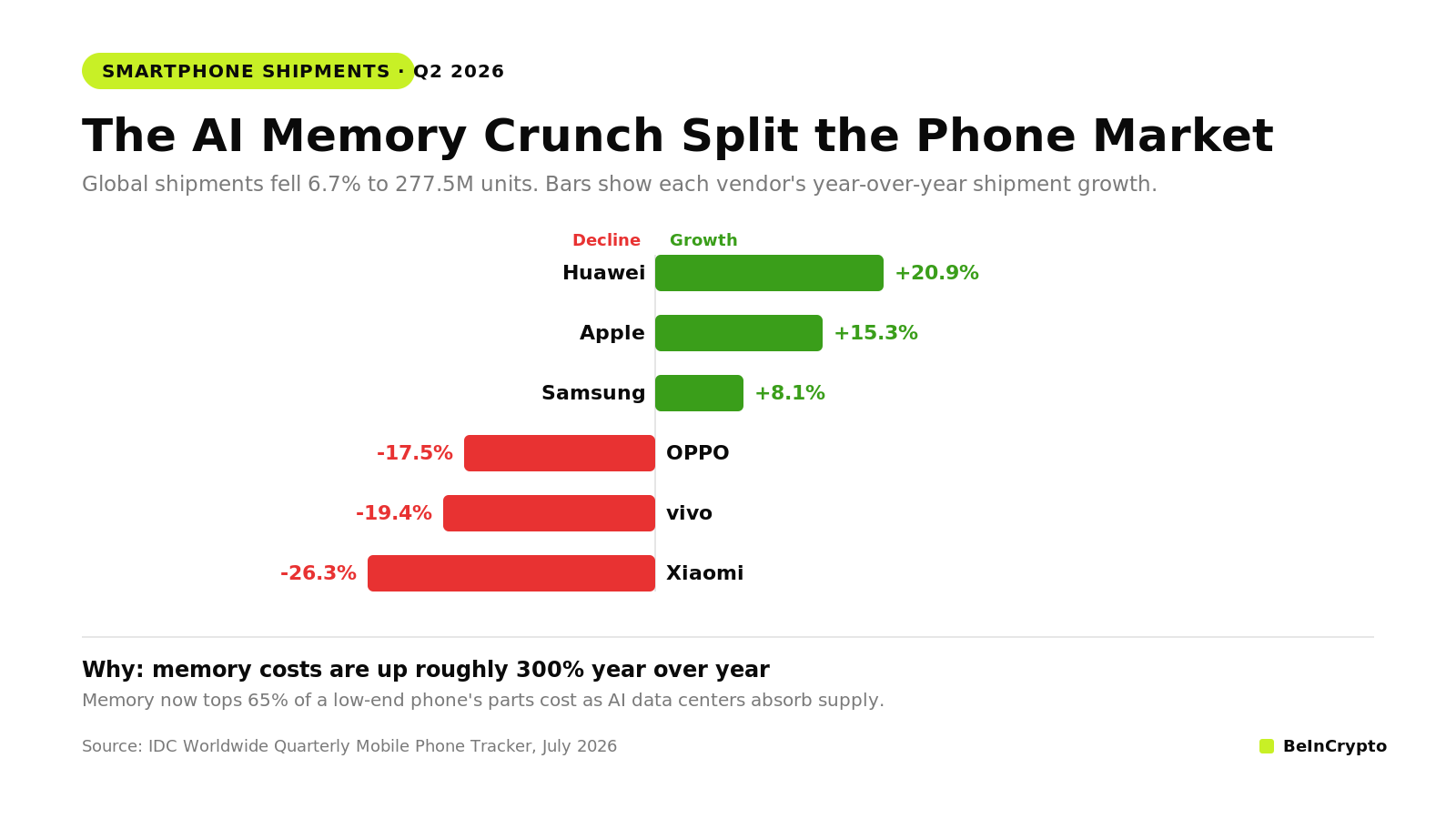
An AI-driven memory crisis is reshaping the global phone market, and Apple stock sits at a record high. Global smartphone shipments fell 6.7% last quarter, yet Apple grew 15.3% and posted record shipments.
The reason is cost. Memory chips now sell for nearly triple last year’s price, so budget phone makers raised prices and lost buyers, while premium brands with locked-in supply pulled away.
How AI’s Memory Grab Is Squeezing Phones
The squeeze starts in AI data centers. Hyperscalers are buying huge volumes of memory to train and run AI models, and that demand has drained supply for phones and PCs.
Want more insights like this? Sign up for Editor Harsh Notariya’s Daily Newsletter here.
Meanwhile, the biggest chip suppliers have chased profit. Samsung, SK Hynix, and Micron steered output toward high-margin AI memory, leaving less for consumer devices.
As a result, memory costs have climbed close to 300% over the past year, according to IDC or the International Data Corporation. Memory now makes up more than 65% of the parts cost in a cheap phone.
That shift has hit low-cost vendors hardest. Apple already passed some of the pain to buyers, raising Mac and iPad prices in June while holding iPhone prices steady.
A Smartphone Market Split In Two
The downturn is not uniform. IDC says the memory crisis has split the market, rewarding scale and premium supply while punishing cheap, high-volume phones.
The gap is stark. Apple and Samsung were the only top-five vendors to grow, up 15.3% and 8.1%. Xiaomi fell 26.3%, vivo dropped 19.4%, and OPPO slid 17.5%.

In China, Huawei and Apple stood alone with roughly 15%+ growth each, as rivals raised prices and lost hesitant buyers. Budget brands leaned on older 4G models to defend low prices as government subsidies faded.
The pattern is consistent. When the price gap narrows, buyers trade up to trusted brands rather than upgrade on the cheap.
Why The Squeeze Lifts Apple Stock
For Apple, a smaller market has meant a bigger lead. It is on track for a record 22% annual market share. Apple stock also hit an all-time high on July 13, closing at $317.31 after an intraday peak of $323.45, worth about $4.7 trillion.

Big investors positioned early. Institutions own about 81% of Apple and net-added roughly 1.24 billion shares last quarter, before its China rebound fully showed in the data.
Apple is also defending margins at the source. It is in talks with Chinese suppliers CXMT and YMTC to source memory for iPhones sold in China, which would ease the cost hit at home.
Even so, the win is relative, not absolute. The memory crisis lifts Apple against weaker rivals, but it still raises Apple’s own chip costs. So far the company has offset that by charging more, from higher Mac and iPad prices to an expected iPhone increase.
That defense has a limit. If Apple keeps raising prices, even loyal buyers may hold off, which would slow the growth now lifting the stock. The memory shortage could last into 2028, so those cost pressures are unlikely to ease soon.

The next test is close. Apple reports earnings on July 30, and that print will show whether premium demand can hold as the squeeze drags on.
The post Apple Stock Hits a Record as the AI Memory Crisis Guts Cheap Phones appeared first on BeInCrypto.


South Korea is preparing a major overhaul of how the government manages “state assets,” including digital assets and intellectual property, as part of efforts to modernize public-sector finance. The Ministry of Economy and Finance (MOEF) says it plans to replace the State Property Act—dating back to 1950—with a new National Asset Basic Act, using a broader definition of what qualifies as state-owned value.
Officials also reiterated plans to test the tokenization of government bonds on a blockchain as early as a 2027 pilot, with an eye toward reducing transaction friction. Beyond securities, the ministry said it will examine tokenizing state-owned real estate to widen retail participation and share a portion of the generated returns with the public.
Key takeaways
- MOEF is moving toward a new National Asset Basic Act to modernize public asset management and expand the legal definition to cover digital assets and intellectual property.
- The government bond tokenization plan is targeted for a 2027 pilot, framed as a way to streamline transactions.
- South Korea is also considering tokenized real-estate models designed to attract retail users and share returns.
- Separately, Seoul’s 2026 growth strategy includes a study period aimed at connecting tokenized government bonds with the Bank of Korea’s CBDC infrastructure.
- Upcoming legal changes to tokenized securities frameworks are scheduled to take full effect in early 2027, with blockchain-ledgers recognized as valid securities registries.
Replacing a decades-old asset framework
MOEF’s proposal centers on updating the legal structure for state asset management. According to the ministry, the National Asset Basic Act is intended to shift policy from a legacy approach—historically focused on tangible, real-estate-heavy state property—toward a framework centered on value creation.
The MOEF briefing held at the President’s Blue House on Wednesday emphasized that the reform would explicitly bring digital assets and intellectual property into the umbrella of state assets. The ministry linked this to a broader modernization goal: aligning the governance of government-held resources with how value is increasingly stored, transferred, and monetized in digital form.
For market participants, the significance is twofold. First, clearer legal coverage can reduce uncertainty around how non-traditional assets may be handled in government programs or public investment strategies. Second, it sets a policy foundation that can support later pilot initiatives—such as bond and real-estate tokenization—without relying on narrow interpretations of older statutes.
Tokenized government bonds and the push toward a “blockchain economy”
Regulatory and infrastructure plans are converging around tokenized government debt. Earlier coverage noted that South Korea’s government unveiled a 2026 Economic Growth Strategy for the second half, which includes a 2027 pilot intended to link tokenized government bonds to central bank digital currency (CBDC) infrastructure. As described in the government strategy, authorities plan to study how to make the Bank of Korea’s (BOK) CBDC system interoperable with other blockchains.
The interoperability concept was first publicly discussed on July 1, when BOK Governor Hyun Song Shin outlined the idea at the European Central Bank Forum on Central Banking. Building on that, the latest strategy positions the research and pilot work as part of a broader effort to develop a “blockchain economy.”
In practice, this matters because interoperability between a CBDC infrastructure layer and public or permissioned blockchain networks can affect how tokenized instruments are issued, transferred, and settled. A pilot that tests that connection in the context of government bonds—an asset class that is typically central to liquidity and price discovery—could serve as a benchmark for future tokenized issuance across other sectors.
From pilots to legal recognition for tokenized securities
South Korea’s push for tokenization is not only about infrastructure; it is also about legal status. The MOEF previously announced a pilot using tokenized deposits to execute government operational spending, with a full rollout planned for the fourth quarter of 2026. That initiative reflects a wider pattern: tokenized rails are being tested in day-to-day state functions before scaling.
Separately, changes to South Korea’s Capital Markets Act and Electronic Securities Act—designed to support the country’s early tokenized securities framework—are scheduled to take full effect on Feb. 4, 2027. The reforms aim to legally recognize blockchain-ledgers as valid securities registries.
Officials say this would bring tokenized assets under the Financial Services Commission’s jurisdiction, moving them out of a purely experimental stage. For investors, that shift is particularly important: securities registration is a core component of custody, ownership tracking, and compliance. Legal recognition of blockchain-ledgers as registries can improve clarity around operational responsibilities and investor protections, although the practical impact will depend on how regulators implement standards and supervision.
Tokenizing state real estate for retail access
Alongside the bond and CBDC-related work, MOEF is exploring tokenization of state-owned real estate. The stated goal is to encourage retail participation and share part of the returns generated from these assets with the public.
While the proposal is framed as an area for further exploration rather than a fully specified rollout, it fits the broader theme of shifting government asset management toward models that can potentially broaden access and reduce barriers to entry. Real estate has historically been difficult for retail investors to access at scale due to high capital requirements and complex transaction processes. Tokenization, at least in theory, could address parts of that problem by enabling smaller ownership units and faster transfer mechanisms.
Still, major details typically determine whether tokenized real estate becomes commercially viable—such as custody arrangements, investor suitability rules, valuation practices, and the regulatory treatment of tokenized property rights. Until those elements are clarified, the move should be viewed as a policy direction that may shape future pilots and rulemaking.
Looking ahead, investors and builders should watch for how MOEF’s National Asset Basic Act language translates into implementation, particularly regarding digital asset classification and governance. The 2026 strategy’s 2027 CBDC interoperability and the Feb. 4, 2027 legal changes to securities registries are likely to be the clearest near-term signals of how quickly tokenization can move from pilots into regulated, scalable markets.

Ethereum price is heating up as it pounces higher above $1,850, gaining more than 5% over the past day. The $2,000 level is finally back in view, although that ceiling has humbled plenty of eager bulls before. The setup looks encouraging, but resistance is still looming.
The Ethereum Foundation has spun out a new entity called EthSystems. Its mission is to build technology and consulting services that help institutions operate on Ethereum while keeping transactions confidential. That targets one of the biggest hurdles for traditional finance, where privacy expectations often clash with public blockchain transparency.
Moving the project outside the Foundation also changes the narrative. Instead of treating privacy tools as research, Ethereum is packaging them as enterprise-ready infrastructure. If institutions gain confidence in deploying on-chain, that could support long-term network activity and, eventually, ETH demand.
Meanwhile, the market has offered a helping hand. Capital has rotated back into major smart contract platforms, giving Ethereum price room to recover after weeks of hesitation. Still, the real test sits near $2,000.
Discover: The Best Token Presales
Can Ethereum Price Hit $2,000 This Week?
Ethereum price is technically constructive as it has broken above the $1,845 to $1,865 resistance zone. The next key hurdle sits around $1,975 to $2,000, where sellers may finally wake up. Trading activity also backs the move, with 24-hour volume approaching $14 billion instead of a quiet climb.
The bullish path stays intact if ETH holds above the former $1,845 to $1,865 resistance zone, now acting as support. A brief pause would not hurt the trend. Instead, it could give buyers enough fuel for another run at the $2,000 mark. The EthSystems and Dashlink announcement also gives investors another reason to stay interested.

Meanwhile, the base case is a rejection near $1,975 to $2,000, followed by profit taking and a pullback toward support. That would not be unusual after a strong rally. Markets rarely climb in a straight line, no matter how much the bulls wish they did.
The bullish outlook weakens if ETH closes below the $1,750 to $1,770 support area. A break there shifts attention toward $1,620, with $1,530 as the next meaningful floor. In that case, traders could view the recent EthSystems catalyst as positive news, but not enough to keep momentum alive.
Even so, ETH still trades about 62% below its all-time high above $4,950. That leaves room for upside over time, although $2,000 remains a realistic ceiling in the near term. If buyers clear that level with convincing volume, the next chapter could get much more interesting.
Trade Ethereum Before It Breaches $2,000 on Bybit and Get Our $1,000 USDT Airdrop
LiquidChain Targets Early-Mover Upside as Ethereum Tests Key Levels
ETH at $1,870 is a meaningful recovery, but a 6% daily move on a $226 billion asset carries proportionally modest return potential for new capital entering here. Traders chasing the $2,000 breakout are essentially pricing in a move already in progress. That’s where early-stage infrastructure plays draw attention, particularly those positioned at the intersection of the ecosystems driving current market momentum.
LiquidChain ($LIQUID) is a Layer 3 infrastructure project building what it describes as a unified cross-chain liquidity layer. It is fusing Bitcoin, Ethereum, and Solana liquidity into a single execution environment.
LiquidChain is cooking.
The Order doesn't sleep. ⟁pic.twitter.com/CXY4ya0MC5
— LiquidChain (@getliquidchain) June 3, 2026
The architecture centers on four components: a Unified Liquidity Layer, Single-Step Execution, Verifiable Settlement, and a Deploy-Once Architecture that lets developers ship to all three ecosystems simultaneously.
As of now, the presale is currently priced at $0.0148, with $900K raised. For traders who want exposure to cross-chain infrastructure before it’s priced in, research LiquidChain before the next pricing tier moves.
Discover: The Best Crypto to Diversify Your Portfolio
The post Ethereum Price Approaches $2,000 as Foundation Team Spins Out EthSystems appeared first on Cryptonews.


Revolut has secured in-principle approval from Dubai’s Virtual Assets Regulatory Authority to expand its regulated crypto business in the United Arab Emirates, adding another regulatory milestone to its global digital asset strategy.
Summary
- Revolut has received in principle approval from Dubai’s VARA to offer regulated virtual asset services in the UAE.
- The company plans to launch crypto trading, exchange, and investment services through its app and Revolut X after final regulatory approval.
- The approval follows recent regulatory moves in Europe and the United States as Revolut expands its crypto business across regulated markets.
According to a company announcement on Tuesday, the approval allows Revolut to move toward offering virtual asset broker-dealer, management, investment, and exchange services in the UAE, subject to receiving final authorization from Dubai’s Virtual Assets Regulatory Authority (VARA).
Once fully licensed, Revolut said eligible customers in the UAE will be able to buy, sell, and hold digital assets through its main retail app and its dedicated trading platform, Revolut X.
The latest approval follows an earlier authorization from the Central Bank of the UAE for Revolut’s payments business, as the fintech continues building a locally regulated financial platform in the country.
Joseph Khair, head of Revolut Digital Assets FZE, UAE, said the UAE has established “a robust and transparent framework for virtual assets” and added that the approval creates the foundation for the company to launch regulated crypto services while supporting VARA’s efforts to develop a safe and innovation-focused digital asset ecosystem.
UAE becomes the latest step in Revolut’s regulated crypto expansion
Outside the UAE, Revolut has continued to adapt its crypto business to local regulatory requirements across several markets.
Earlier this month, the company confirmed it would remove Tether’s USDT from eligible European accounts after the European Union’s Markets in Crypto-Assets (MiCA) framework entered full enforcement. Revolut said affected users can continue selling or transferring their USDT until Aug. 31 before the stablecoin is removed from supported accounts.
The company said the restriction applies only to notified customers in eligible European jurisdictions and does not affect markets where USDT remains supported.
MiCA requires crypto service providers and stablecoin issuers operating in the European Union to comply with licensing, reserve, disclosure, and supervisory requirements. Tether has not received MiCA authorization, and Chief Executive Officer Paolo Ardoino has previously argued that some of the framework’s reserve rules were not suitable for the issuer.
The UAE approval also comes as Revolut continues preparing for its U.S. expansion. Reuters reported in June that the fintech plans to launch a U.S. bank next year after filing for a national bank charter with the Office of the Comptroller of the Currency. According to Reuters, the planned platform will combine FDIC-insured banking products with crypto trading, stablecoins, and multi-currency services.

June PPI came in at -0.3% month over month against a consensus of 0.0%, and 5.5% year over year versus an expected 6.2%. The downside surprise followed softer-than-expected CPI data, prompting investors to reassess expectations for the Federal Reserve’s rate cut policy.
The full June PPI breakdown from XTB shows PPI Core MoM at +0.2% versus +0.3% expected, and PPI Core YoY at 4.7% versus 5.1% expected. Every measure printed below the consensus.
— Coin Bureau (@coinbureau) July 15, 2026
 U.S. PPI DATA IS OUT
HEADLINE PPI (YoY): 5.5 %
Forecast: 6.2% | Previous: 6.5%
CORE PPI (YoY): 4.7%
Forecast: 5.2% | Previous: 4.9%
Both headline and Core PPI comes in lower than expected, signaling easing inflation pressure.
After the market reacted sharply to yesterday’s… pic.twitter.com/nYtV1deB8q
Tuesday’s CPI data also surprised to the downside, with headline inflation falling 0.4% month over month against expectations for a 0.1% decline, cooling to 3.5% year over year from 4.2% in May. Core CPI was flat on the month and rose 2.6% annually.
The May context matters here. PPI reached 6.0% year over year in May, reinforcing concerns that inflation pressures were reaccelerating. June’s slowdown to 5.5% eased some of those concerns and encouraged investors to reconsider how restrictive Federal Reserve policy may need to remain.
According to Cryptonews analysis, markets are now likely to lean further into pricing a less aggressive Fed path, even as the central bank remains cautious about easing policy before inflation is firmly under control. That caution had weighed on risk assets, including crypto markets, and softer inflation data may help unwind some of that positioning.

Discover: The Best Token Presales
Rate Cut Expectation, The Dollar Breaks, Bitcoin Benefits
The dollar weakened modestly following the PPI release, consistent with historical patterns where softer producer prices reduce the case for a hawkish Federal Reserve. A softer dollar can also lower the opportunity cost of holding non-yielding assets, which has historically supported Bitcoin and other risk assets.
The latest CPI and PPI reports suggest inflation pressures eased in June after stronger readings in May. While the data points toward moderating price growth, it does not by itself confirm that inflation is on a sustained path back to the Fed’s 2% target.
What it does not confirm is a guaranteed Fed rate cut in the near term. The Federal Reserve has repeatedly said it wants sustained evidence that inflation is moving toward its target before easing policy. One month of softer inflation may improve expectations for future rate cuts, but additional data will likely determine whether June marks the start of a lasting trend or a temporary slowdown.
For Bitcoin, the medium-term backdrop has improved as easing inflation reduces pressure on interest rate expectations. Whether that translates into a sustained rally will depend on upcoming inflation reports, Federal Reserve guidance, and broader market sentiment. Technical analysts covering BTC will now be watching whether the asset can build on the macro-driven move rather than fade as the next round of economic data approaches.
Don’t Miss Out on Our $1,000 USDT Airdrop on ByBit
The post June PPI Misses Forecast by 0.7 Points, Boosting Rate Cut Expectations appeared first on Cryptonews.
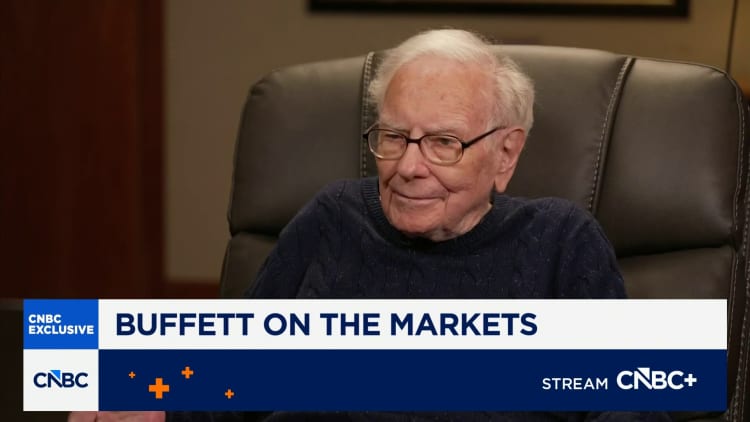

Warren Buffett was critical of a stock market that he said is increasingly driven by speculative trading, as opposed to investing for the long term.
“It’s tough to find values when everybody is preferring gambling,” Buffett told CNBC’s Becky Quick.
The chairman of Berkshire Hathaway had sharp words on the stock market earlier this year. In May, he likened the stock market to “a church with a casino attached,” specifically calling out the surge in one-day options trading as “gambling.”
The stock market has rallied to all-time highs this year, climbing a wall of worry that included an energy shock from an ongoing war with Iran. Skeptics have said there’s too much speculation in stocks tied to the artificial intelligence buildout, with vehicles such as options and leveraged exchange-traded funds adding fuel to the fire. Equities have increasingly attracted retail traders en masse, who are buying shares of memory chipmaker Micron and recent IPO SpaceX.
The billionaire investor, 95, known for his stout adherence to value investing expressed his belief that the most meaningful investment opportunities are fewer and far between, requiring a patient and disciplined approach.
“There are times when opportunities are just thrown at you so fast you can’t, you know, it’s unbelievable,” the Berkshire chairman said. “And then there’s other times when you’re very, very lucky if you find one thing in a couple of years. And it should always be that the the latter is what prevails.”
“But since humans love to gamble so much, there’s more money in in actually cultivating gamblers than there are cultivating investors,” he said.
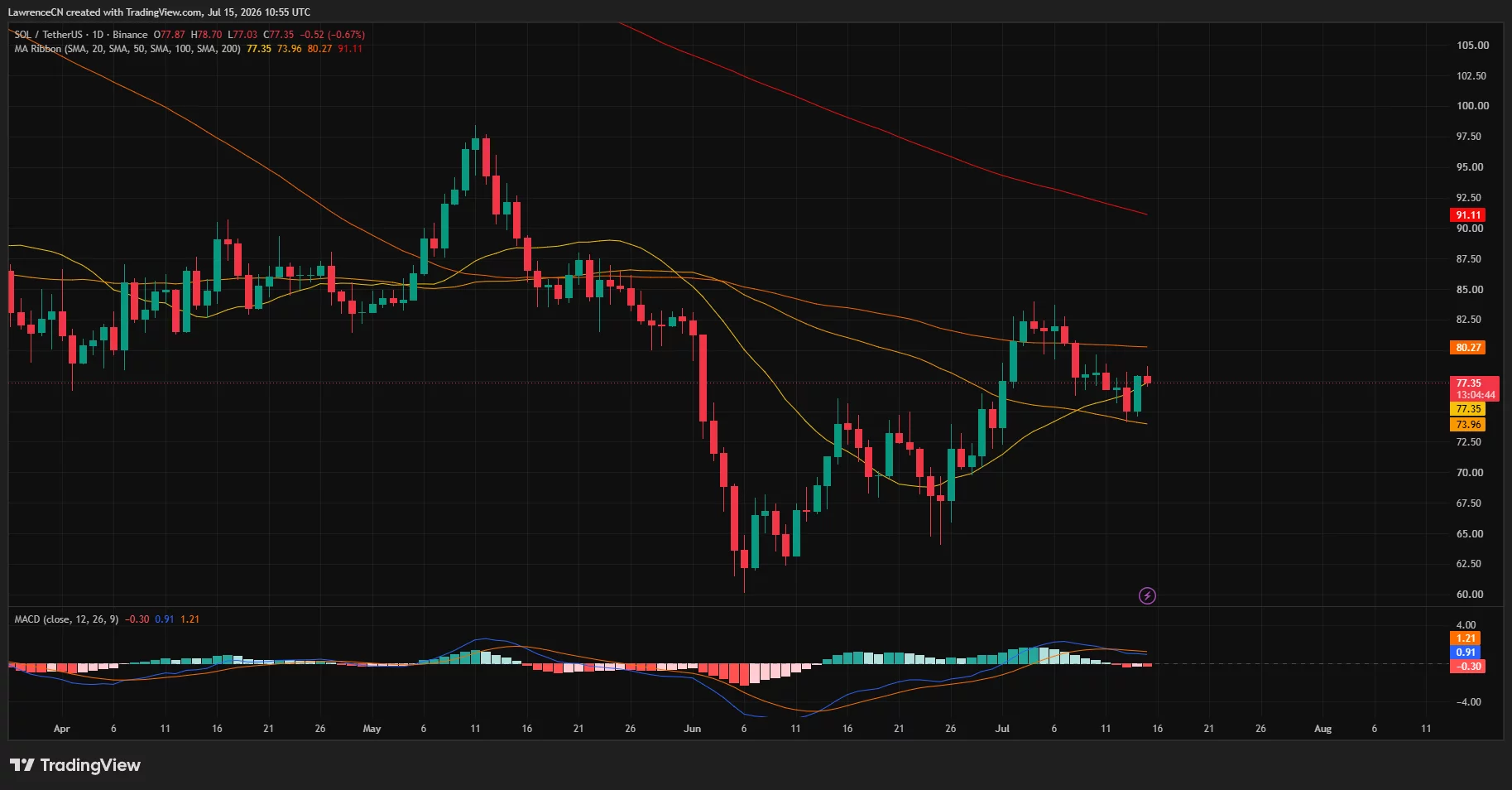
Solana price has climbed to around $78 on July 15 after a 250 million USDC mint on the network, combined with softer U.S. inflation data, injected fresh buying momentum across crypto markets.
Summary
- Solana price jumped toward $78 after a 250 million USDC mint boosted on-chain liquidity and risk appetite improved.
- Technical charts show a breakout above a descending channel, with $80 emerging as the next key resistance.
- Rising active addresses, institutional developments, and liquidation clusters support upside, while $70-$75 remains critical support.
The move gathered pace after the USDC Treasury minted 250 million USDC on Solana, adding immediate liquidity to the ecosystem as traders returned to risk assets following the latest U.S. inflation print. Capital quickly rotated into Solana-based decentralized exchanges, helping SOL recover from recent weakness while the wider crypto market also moved higher.
Earlier selling pressure had left Solana trading well below its May highs as geopolitical tensions, institutional distributions and weaker on-chain activity weighed on sentiment.
Today’s rebound, however, arrives with stronger participation. Daily trading volume has climbed above $2.1 billion, suggesting buyers, rather than short-term speculation alone, have supported the advance.
Technical structure favors another test of $80
The daily chart shows Solana (SOL) price holding above a long-standing support area between $70 and $75 after repeatedly defending that range over recent weeks. Price now trades above the 20-day and 50-day moving averages near $73.3-$74 while remaining below the declining 100-day moving average around $80.3 and well beneath the 200-day moving average near $91.
A sustained close above the 100-day average would expose the psychologically important $80 level before opening room toward the May swing high near $82.
The 4-hour chart adds another constructive development. SOL has broken above a descending channel that had contained price action since early July, while the RSI has recovered to roughly 52 after bouncing from oversold territory.
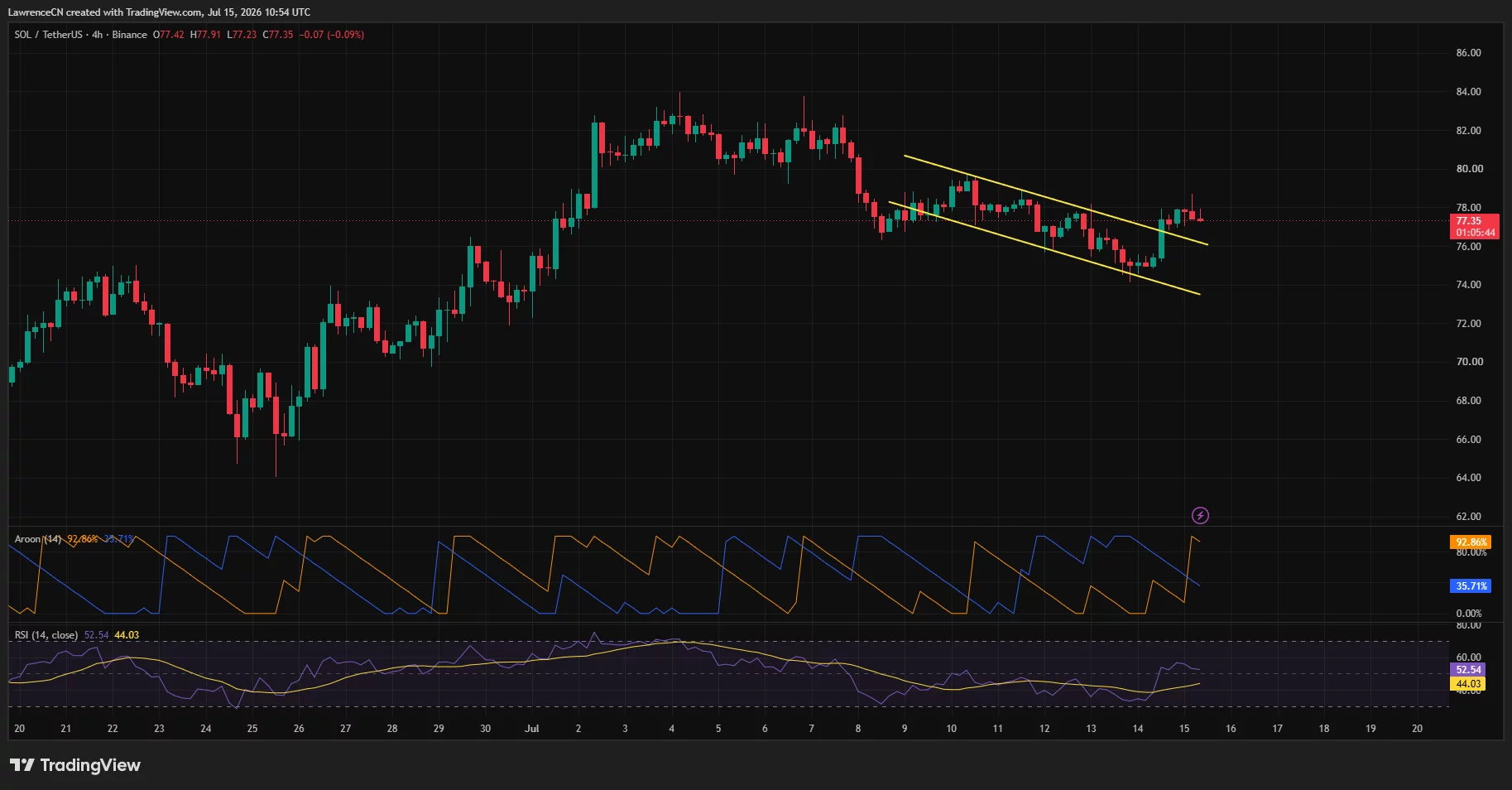
The Aroon Up reading near 93 also holds well above the Aroon Down line, suggesting buyers currently control short-term momentum, although resistance remains concentrated just below $80.
Derivatives positioning reinforces that technical picture. CoinGlass liquidation data shows dense short liquidation clusters stacked between $78.5 and $80, with another concentration extending toward $81.5.
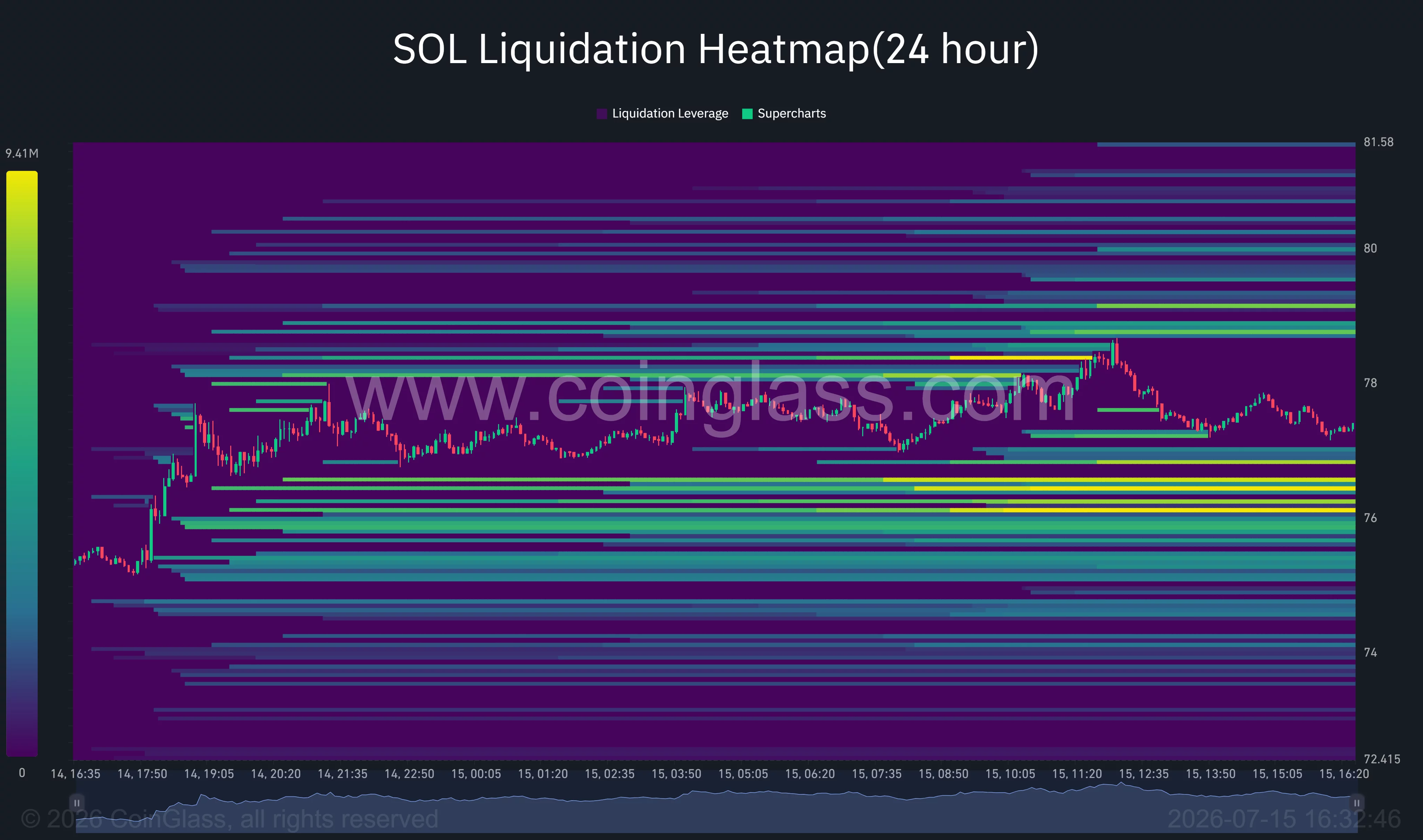
A decisive push through those levels could trigger forced buying from bearish positions, while the largest long liquidation pockets remain clustered around the $76-$76.5 region, making that zone an important area for bulls to defend.
Commenting on the latest setup, analyst Ali Martinez argued that Solana has regained a bullish structure after its SuperTrend indicator flipped positive for the first time since October. He wrote:
“If buying pressure continues to build, $SOL could rally toward $96 or even $121. However, $60 remains the key level to watch.”
Outside the charts, network fundamentals have also improved. Active addresses have climbed toward seven million, while anticipation continues to build ahead of the Alpenglow upgrade, which is expected to reduce transaction finality to around 150 milliseconds later this quarter.
Solana has also strengthened its institutional footprint through its partnership with SBI Holdings to expand on-chain financial infrastructure in Japan, while tokenized real-world assets on the network have grown to roughly $3.3 billion.
A break below key support would weaken the bullish outlook
Bullish momentum still faces several hurdles. The declining 100-day moving average around $80 represents the first major technical barrier, and failure to clear that level could keep SOL trapped inside its multi-week consolidation range.
A return below the 20-day and 50-day moving averages would shift attention back to the $75 support area, where leveraged long positions remain concentrated.
Macro risks also remain unresolved. Fresh geopolitical tensions, another rise in Treasury yields, or stronger-than-expected U.S. economic data could reduce expectations for monetary easing and pressure risk assets across the crypto market.
If selling accelerates and Solana loses the $70-$75 support zone, the bullish breakout thesis would weaken considerably, while Ali Martinez’s longer-term invalidation level near $60 would return to focus.
Disclosure: This article does not represent investment advice. The content and materials featured on this page are for educational purposes only.


Strategy (MSTR), the largest public holder of bitcoin , won’t panic unless BTC sinks to the $8,000-$10,000 range, its CEO has said.
Phong Le identified that range as when the company “would have to consider some of the risk associated with our debt,” in an interview with Bloomberg TV on Tuesday.
Such a drop would represent a drop of around 85% based on bitcoin’s current price of around $64,500 as of writing.
“Until that point in time, we feel very secure about the balance sheet,” Le said. “What we need to do is build a capital structure that can withstand bear markets and of course benefit from bull cycles.”
Strategy’s preferred stock STRC, which is designed to give it the cash flow to fund its bitcoin buying in return for a regular dividend — currently a 13% annual yield, has been under pressure in recent months. The stock is designed to maintain a $100 par, which it lost in April and falling below $75 in late June.
When STRC falls below $100, it restricts Strategy’s ability to issue new shares and then use the cash to buy bitcoin.


Japan reclassified cryptocurrencies as financial instruments, a structural shift that establishes the legal framework for separate taxation of crypto assets and for future crypto exchange-traded funds (ETFs).
The legislation approved by Parliament on Wednesday amends the Financial Instruments and Exchange Act and the Payment Services Act (PSA). It shifts crypto from a framework in which it was primarily treated as a payment tool to one that treats it as an investment alongside other financial instruments. The new rules are expected to take effect in 2027.
The new framework also removes a key legal hurdle for future spot bitcoin exchange-traded funds (ETFs), although lawmakers did not approve any ETF products. Financial Services Agency officials said Japan will now consider developing a regulatory framework for crypto ETFs.
The legislation raises the maximum prison term for unregistered crypto operators from three years to 10 years and increases the maximum fine from 3 million yen ($18,500) to 10 million yen. It also introduces stricter insider-trading rules and expands disclosure requirements for crypto issuers and exchanges.


Noxa, the largest token launchpad on Robinhood Chain, stopped operating after earning an estimated $12 million in fees, according to DefiLlama, in the past week, citing concerns about low-quality tokens flooding the platform.
The shutdown unfolded in a matter of days. On July 11, just as CASHCAT, the chain’s breakout memecoin, was hitting peak trading volume, Noxa said it would stop accepting new token launches.
Two days later, the platform’s website went dark. The team blamed a Cloudflare issue. On July 14, it said the domain would redirect to ENS services and creator earnings would be available for withdrawal. Late Tuesday night, Noxa posted that the platform would no longer collect fees, redirecting 100% of transaction revenue to creators instead.
The decision divided Crypto Twitter.
“Half the timeline called it based because someone finally pushed back against the spam,” wrote @zubic_eth in a widely shared post summarizing the situation. “The other half called it a generational fumble and said they killed the golden goose while making $3 million a day.”


The figures contrast with BlackRock’s broader business, which posted record assets under management (AUM) of $15.3 trillion after attracting $192 billion in net inflows during the quarter. The company also beat Wall Street expectations with adjusted earnings per share of $13.91 on $7.08 billion in revenue.
BLK shares traded 4.15% higher at £1,068 in pre-market trading Wednesday.
BlackRock’s crypto target
BlackRock is targeting $500 million in annual revenue from the business under its 2030 plan, the firm said in its earnings call.
This would represent an increase of more than tenfold, compared to the $40 million BlackRock currently generates in base fees and securities lending, accounting for less than 1% of the firm’s total fee revenue.
BlackRock has steadily expanded its crypto ETF lineup since listing its spot bitcoin ETF (IBIT) and spot ether ETF (ETHA), in 2024. More recently, the firm introduced the iShares Bitcoin Income ETF (BITY), which seeks to generate income by writing covered call options on bitcoin exposure, offering investors an alternative to simply tracking the cryptocurrency’s price.
The asset manager also manages $60 billion of Circle’s reserves, about one-quarter of the $300 billion stablecoin market, and wants to become the industry’s reserve manager of choice, it added.
BlackRock pointed to 5 billion crypto wallets as a new distribution channel for its traditional investment products during the earnings call.

South Korea to Move Digital Assets Into New State Asset Framework

Baruipur rape case shows India’s unrelenting violence against Muslims and oppressed castes

Florida State lands pledge from 4-star DB Za’Kari Johnson


-

 Fashion6 days ago
Loro Piana Fall 2026 Enters Houston’s Art Scene
-

 Fashion5 days ago
Weekend Open Thread: Nutriplenish Leave-In Conditioner
-
 Sports6 days ago
2026 Genesis Scottish Open Thursday TV coverage: Round 1
-

 Sports5 days ago
Super Eagles star Moses Simon opens up on Liverpool transfer regret
-

 Tech6 days ago
Character.AI enters the microdrama arena with its own productions, but there’s a twist
-

 News Videos18 hours ago
XRP BOMBSHELL… XRP OMBOARDED FOR TRANSACTIONS!!!
-

 Tech1 day ago
Get Your ESP32 Sunny Side Up With This Solar Dev Board
-

 Tech17 hours ago
Dark Secrets Emerge When Jailbreaking LLMs
-

 News Videos7 days ago
Crypto Just Entered Its Most Important 6-Month Candle (Could Decide Everything!)
-
 NewsBeat6 days ago
Major update after Huntingdon train attack as man enters plea
-

 Tech6 days ago
Level Infinite Launches Gangstar Mirage City in India with Pre-Registrations
-

 Politics1 hour ago
Young campaigners urge incoming PM to act on outdoor junk food ads
-

 News Videos2 days ago
how to make coin bank box with cardboard #scienceproject #money #diy #shorts
-

 Sports7 days ago
39-year-old Djokovic wins five-hour thriller to enter Wimbledon semis | Other Sports News
-
 Tech2 days ago
Cloudflare Precursor Watches Your Mouse and Keyboard To Decide If You Are Human
-

 Tech6 days ago
Entra passkey enrollment vishing targets Microsoft 365 users
-
 Crypto World6 days ago
DeFi Dashboard Zapper to Shut Down After 7 Years
-

 Crypto World6 days ago
Mark Cuban-Backed DeFi Dashboard Zapper Shuts Down After 7 Years
-

 Tech6 days ago
Claude’s New Reflect Dashboard Wants To Help You Log Off Of Claude
-

 Crypto World7 days ago
Fed minutes June 2026: officials split on rates
You must be logged in to post a comment Login