
Crypto World
Aptos-Based Perp DEX Merkle Trade Shutters Business

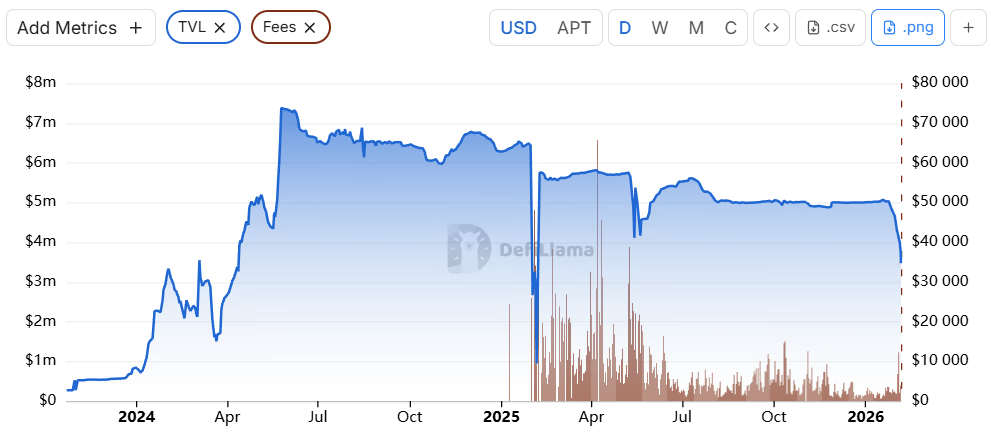
The move comes amid a broader Aptos TVL decline and less than two years after Merkle closed a $2 million seed round with participation from Aptos Labs.
Merkle Trade, the largest decentralized perpetual futures exchange on Aptos by trading volume, said in an X post on Feb. 3 that it will begin winding down operations over the coming weeks.
The team said the decision followed “careful consideration” and comes after the platform processed nearly $30 billion in cumulative trading volume since launch. Without specifying a reason for the winddown, the statement concludes: “But we are proud of what we built, and grateful to everyone who was part of it.”
According to the announcement, new positions will be disabled on Feb. 6, with all remaining positions forcibly closed on Feb. 10. Merkle Trade’s native MKL token will become redeemable without fees or withdrawal delays, while a final revenue distribution is scheduled for Feb. 12, after which staked MKL can also be redeemed, the announcement said.
The price of MKL spiked 11.5% in the past 24 hours, though the token is down 90% from its all-time high in December 2024.
Launched in late 2023, Merkle Trade offered non-custodial derivatives trading alongside features such as trading missions and loot boxes, leaning heavily into game-like mechanics.
That approach helped Merkle raise $2.1 million in a seed round in April 2024 led by Hashed and Arrington Capital, with participation from Aptos Labs, Morningstar Ventures, Amber Group and others.

By May 2024, total value locked (TVL) on the platform peaked at more than $7.4 million, according to DefiLlama data. Since then, TVL has fallen by more than half to about $3.47 million, making Merkle Trade the 17th-largest protocol by TVL on Aptos at press time.
Among the four Aptos-based perp DEXs listed on DefiLlama, however, Merkle is the leader by far, accounting for $12.4 million of the total $13.68 million in perp volume on the chain in the past 24 hours.
Aptos Struggles
Merkle’s slide in TVL since 2024 reflects weakness across the broader Aptos ecosystem, where total value locked is currently around $332.6 million, making it the 16th-largest chain by DeFi TVL.
Current TVL across the ecosystem is down more than 70% from December 2024 where it was over $1.2 billion, and back to levels last seen in the summer of 2024.

App revenue on the network, however, increased in 2025, though it remains relatively low. Weekly revenue from decentralized applications (DApps) on Aptos is led by DEX PancakeSwap, with $44,396 followed by Merkle Trade with $29,575.
By comparison, the top-four chains by app revenue today — Solana, Hyperliquid L1, Ethereum and EdgeX — have all recorded over $1 million in the past 24 hours.
The broader perp DEX sector exploded in 2025, with 24-hour volumes now outpacing most centralized exchanges. Hyperliquid has led the sector by trading volume, with rivals Lighter and Aster sometimes taking the lead.

Key Highlights
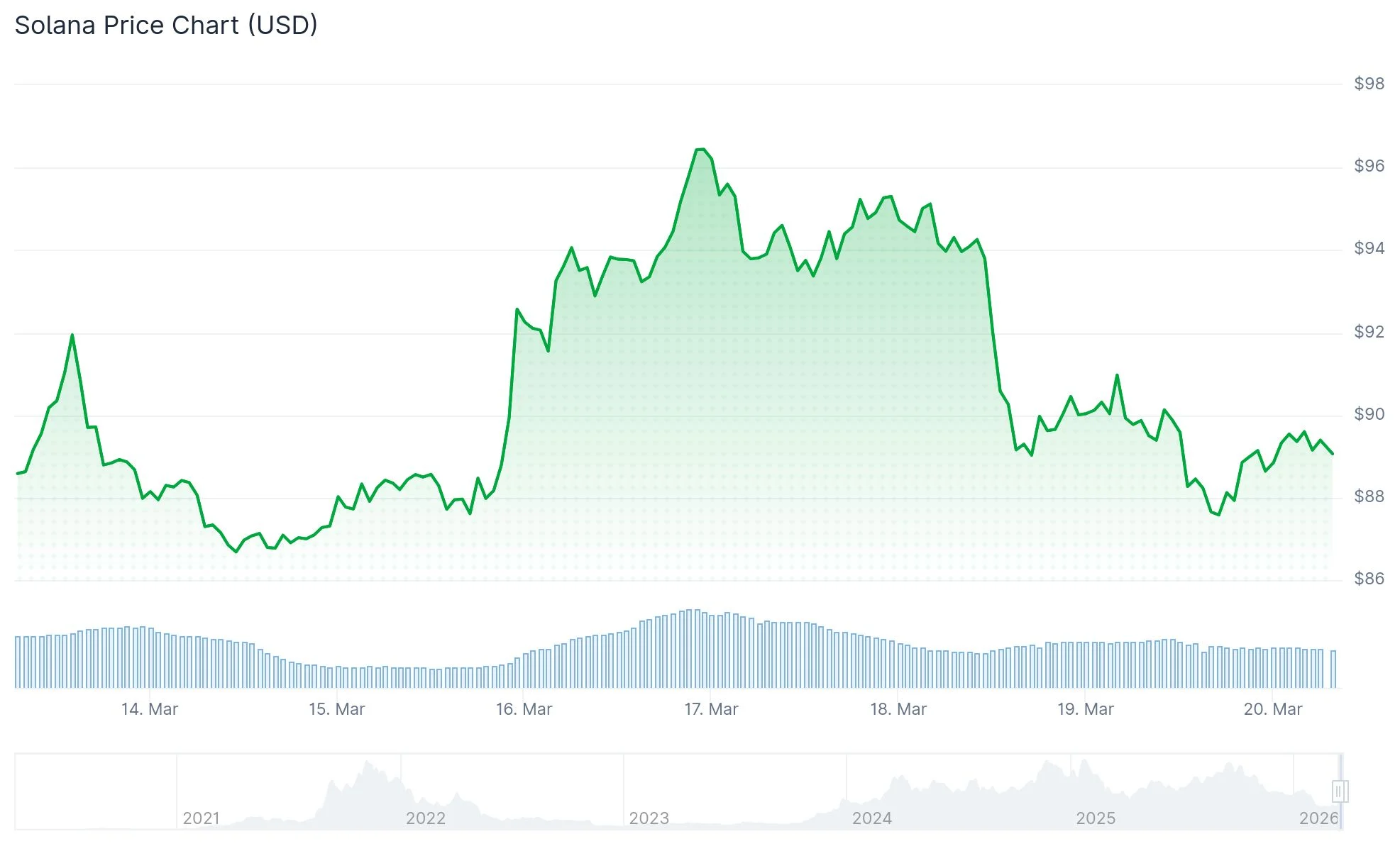
- Solana’s SOL token plummeted 11% over a three-day period, declining from $97.70 to $87 and triggering $25 million in liquidations.
- Perpetual futures funding rates for SOL have reached 0%, indicating minimal bullish interest in leveraged trading.
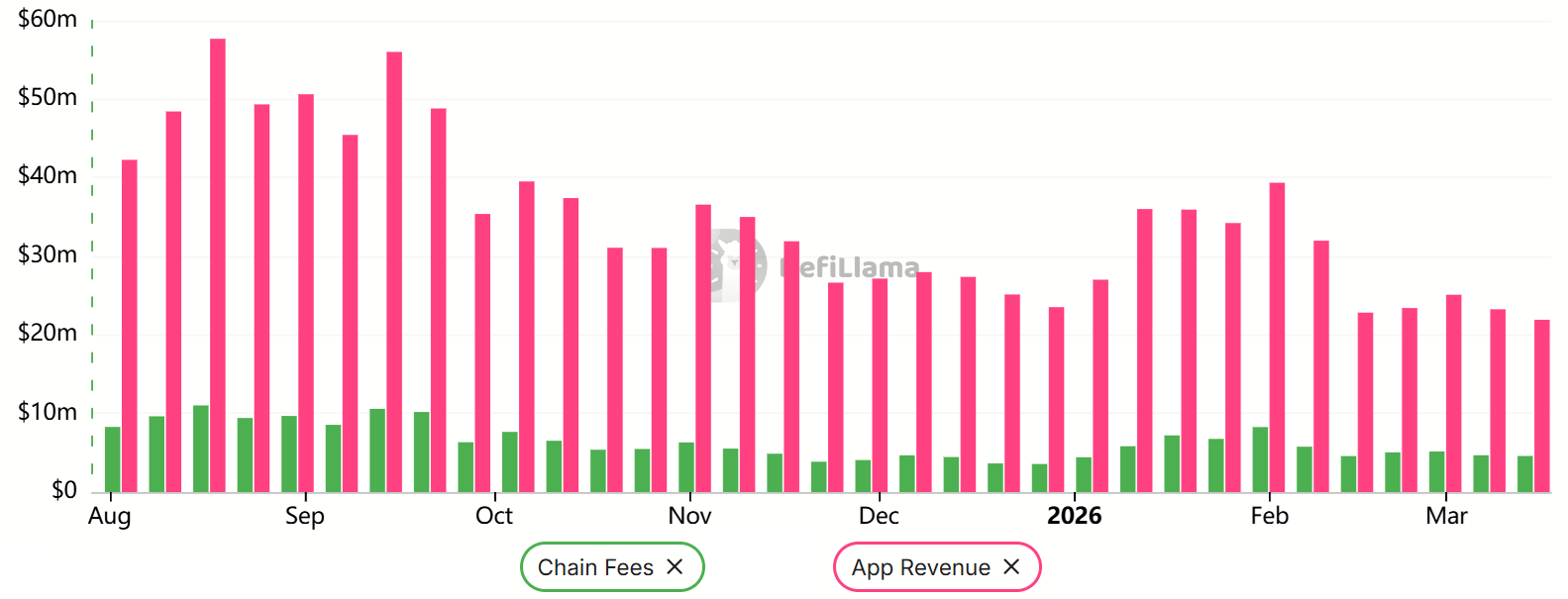
- DApp revenue on the Solana network plunged to $22 million, marking an 18-month low from $36 million recorded eight weeks earlier.
- Specialized derivative platforms like Hyperliquid now dominate with over 80% of perpetual futures trading volume.
- Corporate SOL holders including Forward Industries and DeFi Development Corp. are experiencing losses on their treasury positions.
The Solana ecosystem has encountered significant headwinds this week. Following a peak of $97.70 earlier this week, the SOL token experienced an 11% correction over 72 hours, bottoming out at $87. This sharp decline resulted in $25 million worth of long position liquidations, dampening market sentiment among traders.
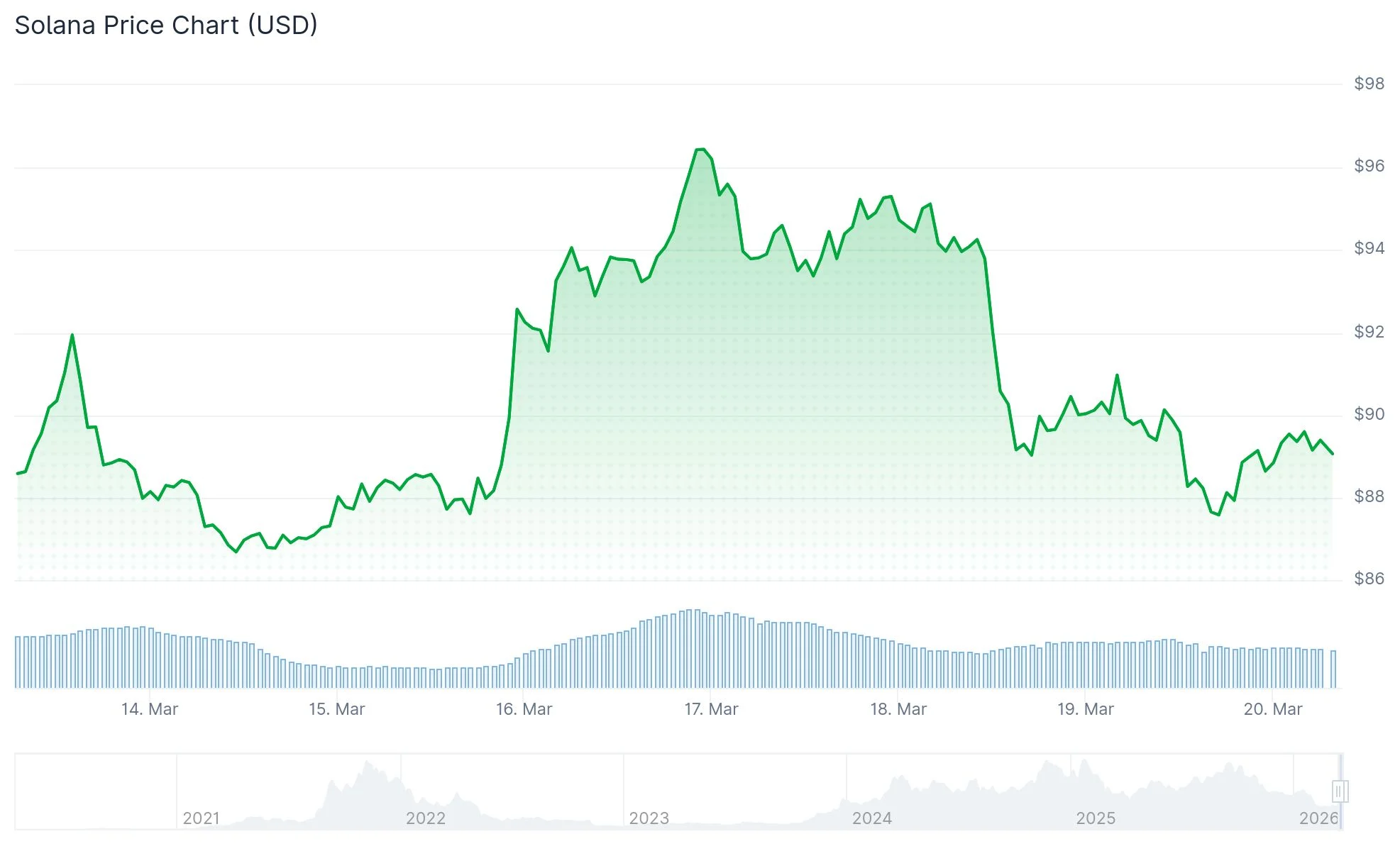
The futures market signals are equally concerning. Funding rates for SOL perpetual futures contracts have collapsed to approximately 0%, indicating a complete absence of bullish appetite for leveraged long positions. Typically, these rates maintain levels around 9% when market participants exhibit optimistic positioning. For the past 30 days, bearish traders have dominated the derivatives landscape.
The options market reflects similar pessimism. Deribit’s 30-day delta skew metric surged to 12% this Thursday, suggesting that put options—which generate profits from declining prices—command higher premiums than call options. This premium structure reveals that sophisticated market participants and institutional traders are positioning defensively against additional downside, despite SOL already trading 70% beneath its record high.
Network Revenue Decline Compounds Market Weakness
The revenue generated by Solana’s decentralized applications has contracted to an 18-month nadir of $22 million. This represents a significant decline from the $36 million recorded merely two months prior. While this deterioration isn’t exclusive to Solana—BNB Chain witnessed a 52% revenue contraction during the same timeframe—it underscores widespread weakness in blockchain network activity.
Solana maintains its position as the leading blockchain for decentralized exchange activity, powered by platforms such as Pump, Raydium, and Orca. However, the derivatives trading landscape tells a different narrative. Purpose-built derivative chains—including Hyperliquid, Edgex, Zklighter, and Aster—have captured more than 80% of the perpetual contract trading market.
The introduction of an officially sanctioned S&P 500 Index perpetual futures product on Hyperliquid, created by Trade[XYZ], has further diverted liquidity and trader attention from Solana-based protocols. The tokenized equities sector is now approaching $1.1 billion in aggregate assets.
Technical Analysis Shows Bearish Pattern Formation
From a technical perspective, market analysts have identified a bearish fractal developing on Solana’s price chart. Analyst Elja highlighted that the current price action bears striking resemblance to a January 2026 pattern where SOL rallied into resistance zones before experiencing a sharp reversal. Both instances feature similar characteristics: upward movement into resistance following a decline, followed by rapid momentum loss.
https://twitter.com/Eljaboom/status/2034310769488416909?s=20
With a market capitalization of $51 billion, SOL trades at a 42% discount relative to BNB’s $88 billion valuation. Nevertheless, Solana demonstrates superior fundamentals in certain metrics—generating $20.8 million in 30-day network fees compared to BNB Chain’s $9.1 million, while maintaining a total value locked (TVL) of $6.9 billion versus BNB Chain’s $5.7 billion.
Corporate entities such as Forward Industries and DeFi Development Corp., which incorporated SOL into their balance sheet strategies, are presently facing unrealized losses on these holdings.

Crypto World
Geopolitical Tensions and Energy Markets Drive Bitcoin to $70,800 as Traditional Markets Struggle
Key Highlights
- Bitcoin surged above $70,800, registering gains exceeding 1% following announcements from six leading economies aimed at securing energy supply routes and stabilizing global markets.
- Crude oil retreated nearly 2%, with WTI sliding to $93.80 following a coordinated statement from Britain, France, Germany, Italy, the Netherlands, and Japan.
- Alternative cryptocurrencies including Ether, XRP, and Solana posted modest increases under 1%, underperforming Bitcoin’s rally.
- The S&P 500 crossed beneath its 200-day moving average for the first occasion since May of the previous year, indicating potential bearish momentum.
- Federal Reserve officials have indicated interest rates will likely remain unchanged, with market participants not anticipating cuts despite one potential reduction still being discussed.
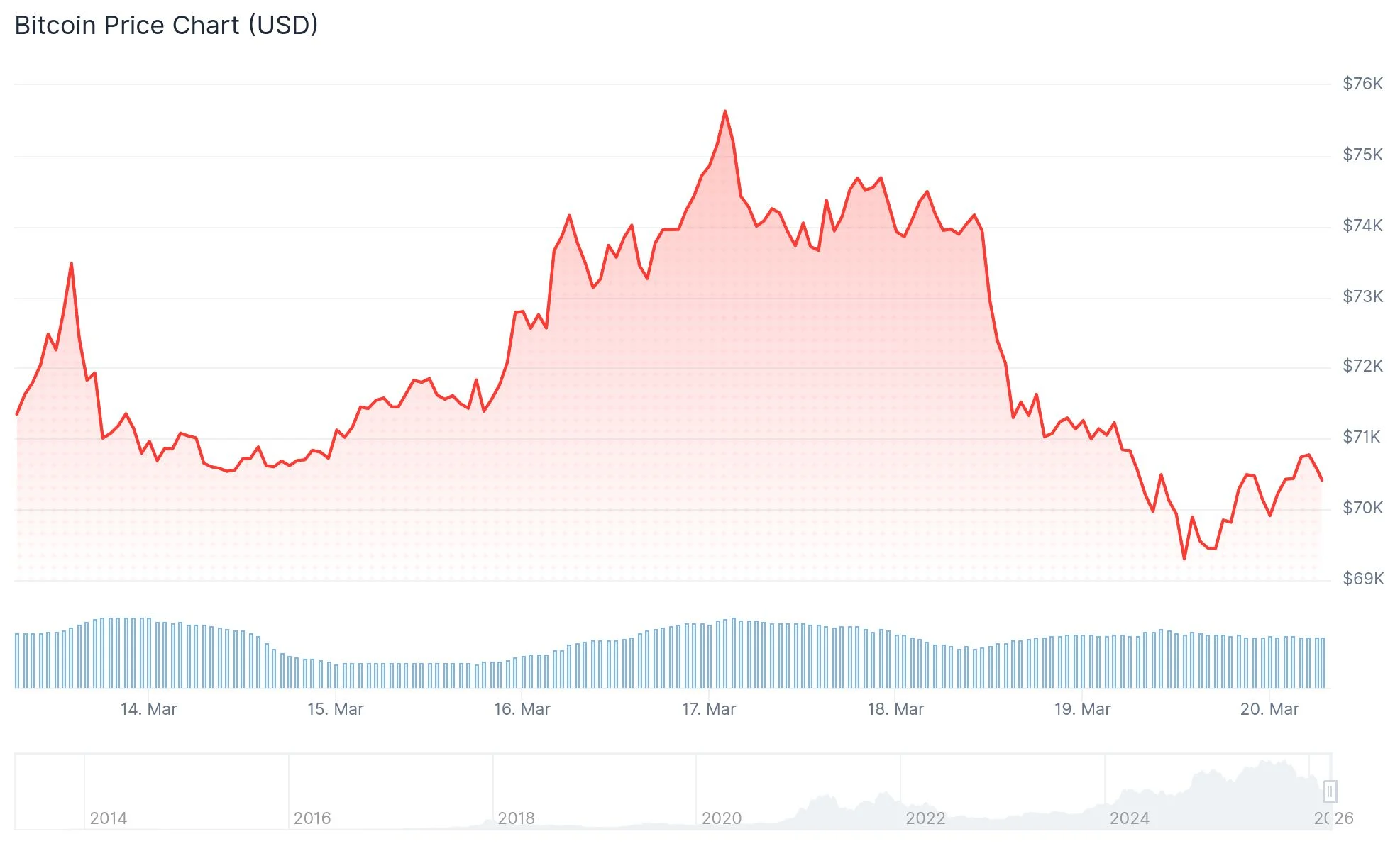
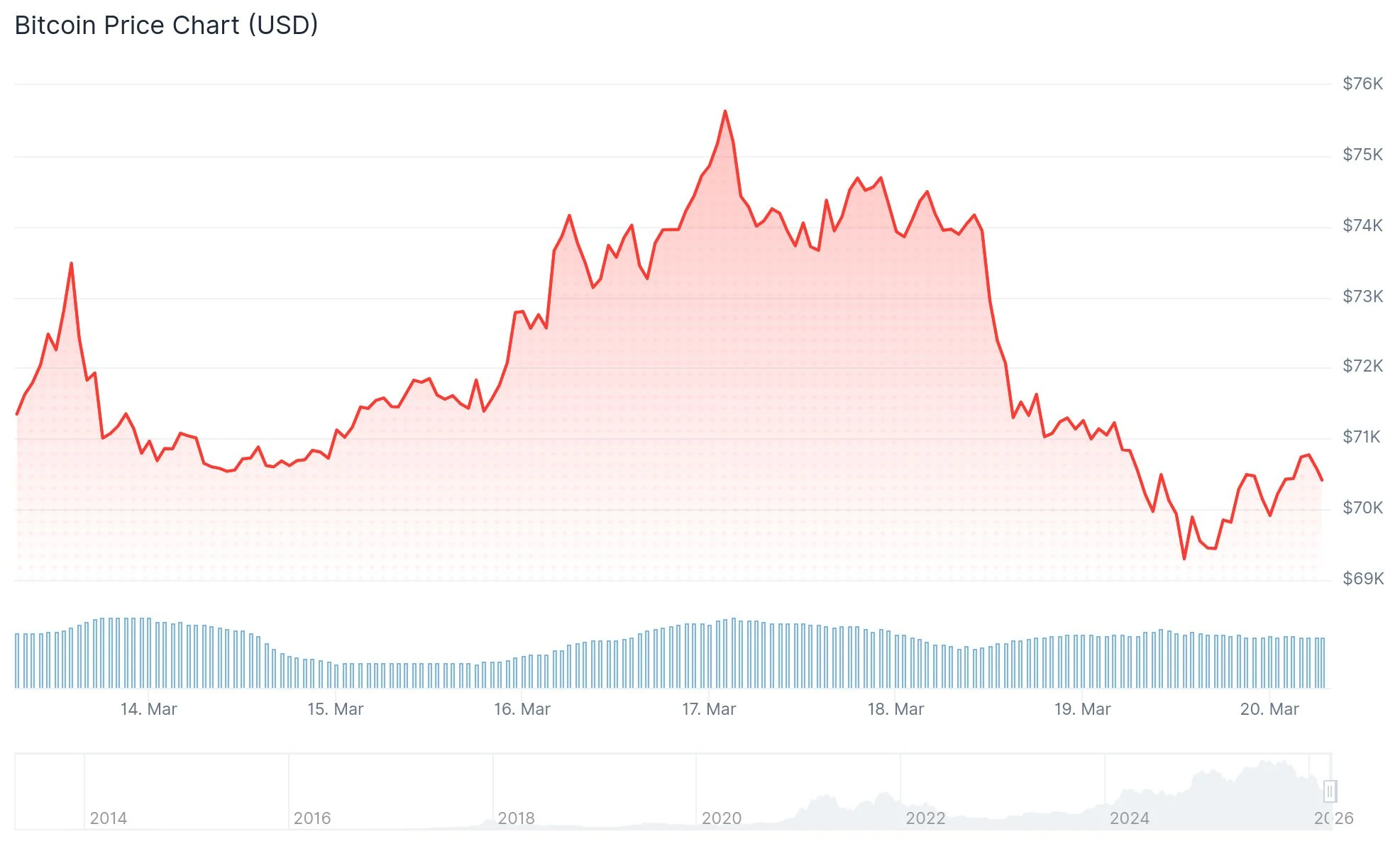
Bitcoin spearheaded a widespread cryptocurrency market rebound on Friday as declining oil prices provided relief for risk-sensitive assets. The leading digital currency advanced to $70,800, posting daily gains exceeding 1%, following an overnight decline that saw prices touch $68,900.
The cryptocurrency’s upward movement coincided with a coordinated announcement from six leading industrialized nations — the United Kingdom, France, Germany, Italy, the Netherlands, and Japan — who collectively denounced Iran’s recent military actions and committed to guaranteeing secure transit through the strategically vital Strait of Hormuz. The declaration was distributed through UK Prime Minister Keir Starmer’s official channels.
West Texas Intermediate crude oil declined approximately 2% to reach $93.80 in the wake of the announcement. Brent crude experienced comparable reductions. Additionally, U.S. Treasury Secretary Scott Bessent indicated on Thursday that the administration might consider removing sanctions on Iranian oil tankers and potentially utilize the nation’s Strategic Petroleum Reserve.
Other digital assets experienced more moderate movements. Ether, XRP, and Solana each posted gains below 1%, underperforming Bitcoin’s recovery.
Neverthstanding the rebound, market volatility persists. The Middle Eastern conflict continues to unfold, and WTI crude maintains trading levels significantly elevated compared to pre-conflict prices, hovering near crucial support around $92. Market analysts from Mott Capital Management noted that oil maintains an upward bias as long as it sustains that support threshold.
Equity Markets Face Continued Headwinds
Traditional stock markets continued experiencing pressure as the week drew to a close. U.S. futures contracts showed modest improvement Friday morning, with Dow futures advancing 0.2% and S&P 500 futures climbing 0.1%. However, the overarching trend remains decidedly negative.
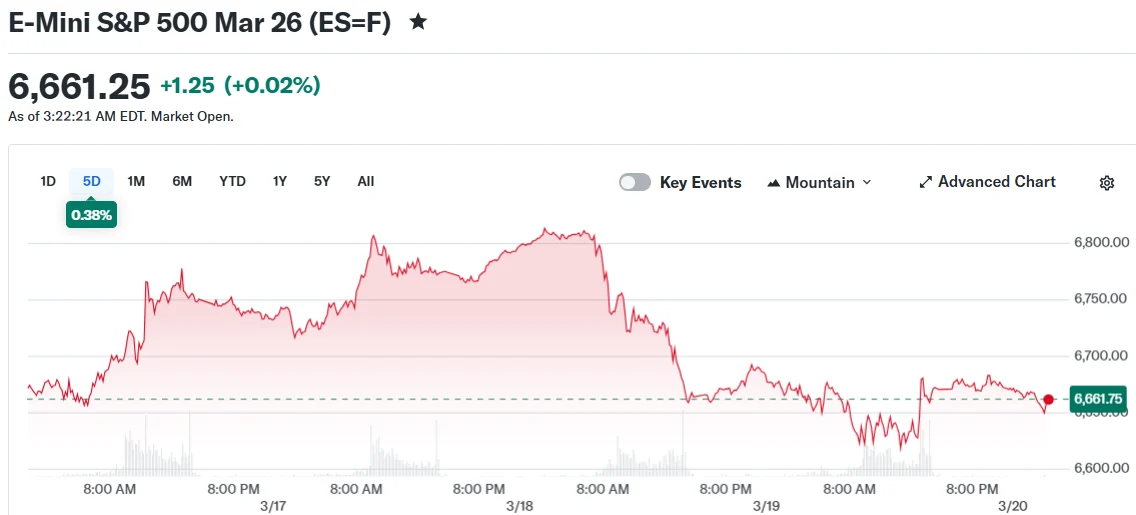
Primary U.S. equity indexes are positioned for their fourth consecutive week of declines. The Dow has fallen approximately 1.2% over the week, while the S&P 500 has retreated about 0.4% and the Nasdaq has declined roughly 0.1%. Both the Dow and Nasdaq are currently trading approximately 8% beneath their recent all-time peaks.
During Thursday’s session, the S&P 500 finished trading beneath its 200-day simple moving average for the initial time since May of last year. This technical development is closely monitored by market participants as an indicator of changing market dynamics.
https://twitter.com/TrendSpider/status/2034691377775145236?s=20
Market sentiment received a modest boost following comments from Israeli Prime Minister Benjamin Netanyahu, who stated Israel was contributing to U.S.-led efforts through intelligence cooperation and additional support directed at reopening the Strait of Hormuz. He also implied the regional conflict might conclude earlier than widespread expectations suggest.
Central Bank Policy Maintains Market Uncertainty
The Federal Reserve this week communicated increasing ambiguity regarding both economic expansion and inflationary pressures. Fed Chair Jerome Powell’s recent statements have led market participants to anticipate stable interest rates in the near term, despite policymakers acknowledging that one rate reduction could materialize before year’s end.
This positioning has left both cryptocurrency and conventional financial markets vulnerable to energy price fluctuations, with minimal cushion from anticipated monetary policy easing.
Regarding corporate developments, the quarterly earnings reporting period has largely concluded. GameStop and Carnival are scheduled to announce their financial results in the coming week.


Decentralized social platform Bluesky has disclosed that it had raised $100 million in a Series B round back in April 2025.
Summary
- Bluesky disclosed a previously unannounced $100 million Series B round led by Bain Capital Crypto, with backing from multiple venture and institutional investors.
- The platform has grown its user base from 13 million to over 43 million since its Series A, alongside expansion of its AT Protocol ecosystem.
According to the official announcement, the round was led by Bain Capital Crypto, while other notable investors include Anthos Capital, Bloomberg Beta, Knight Foundation, Alumni Ventures, and True Ventures.
Bluesky said it had already started using the capital to expand its team and scale its infrastructure as it enters a new phase of leadership and growth.
“This new funding gives us the foundation upon which to build the future of the open social web without compromising our mission and values,” it added.
As covered previously, the social media platform raised funding in October 2024 in a Series A round, where it secured $15 million from lead investors such as Blockchain Capital.
Since then, the company has reportedly witnessed a surge in its user base from 13 million to over 43 million globally, while its broader ecosystem of developers, apps, and users building on the AT Protocol has also expanded, per the announcement.
A decentralized social network
Bluesky positions itself as a decentralized social network built on the AT Protocol, which standardizes how identity, social graphs, and content are structured across applications.
Unlike traditional social platforms controlled by a single company, the protocol enables multiple apps and services to interoperate within the same network.
According to the company, the design allows users to move between services without losing their identity, followers, or data, offering greater portability and control over their social presence.
Key Takeaways
- XRP has declined 10.5% across a three-day period but maintains position above a critical bull flag breakout zone between $1.40 and $1.45
- South Korean investors are removing XRP from Upbit at unprecedented rates, mirroring behavior seen during previous accumulation cycles
- Large holder net flows have flipped positive for the first time since the beginning of 2024, indicating potential shift from distribution to accumulation
- The March 18 Federal Reserve decision maintained rates at 3.5%–3.75%, creating headwinds for risk-on assets across cryptocurrency markets
- XRP spot ETF products in the United States reported no net capital inflows on Wednesday, though total cumulative inflows remain at $1.21 billion
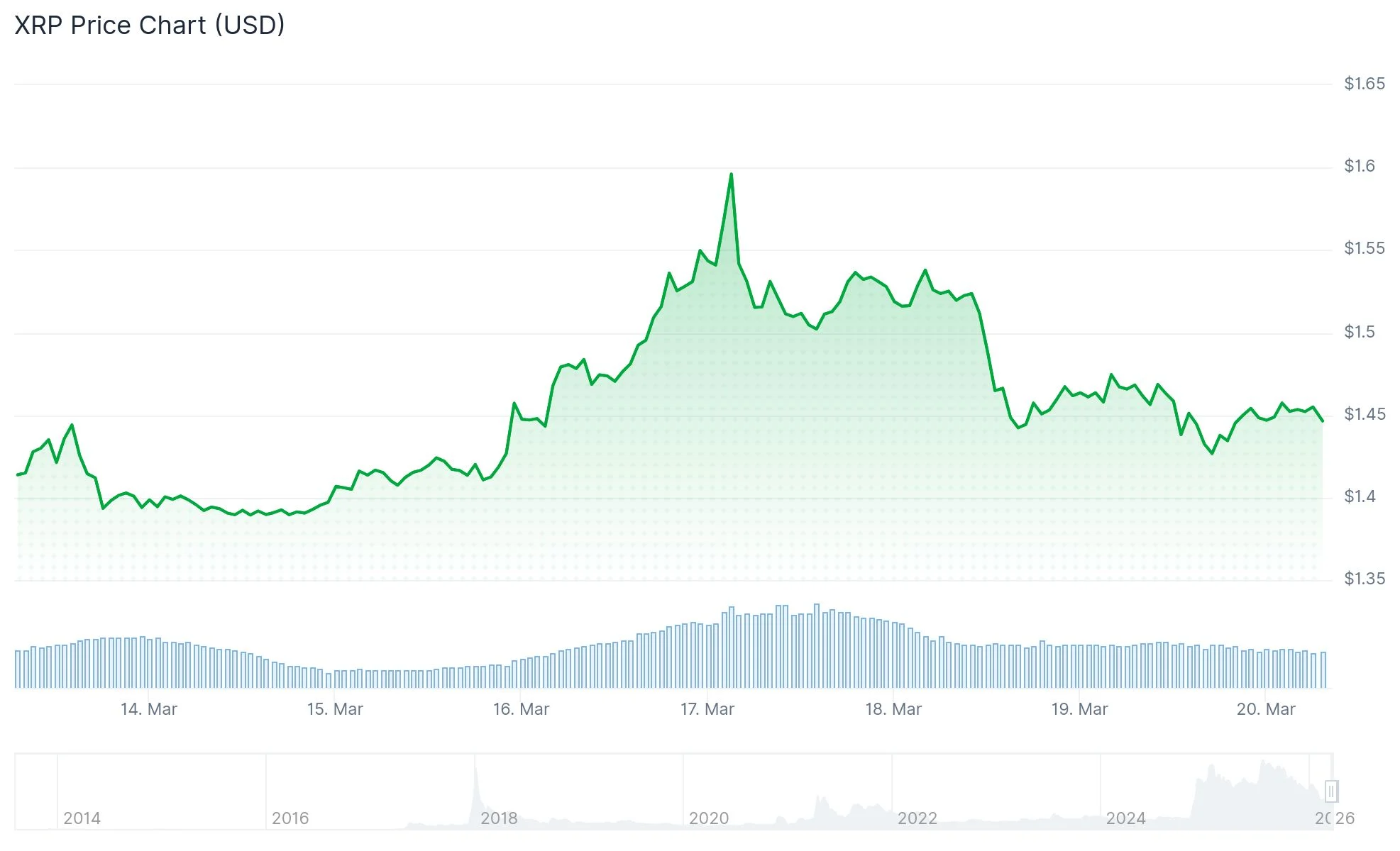
XRP currently trades within the $1.42–$1.45 range following a steep three-day retracement exceeding 10%. This pullback occurred amid widespread cryptocurrency market volatility, yet multiple blockchain metrics suggest conditions may be developing for a reversal.
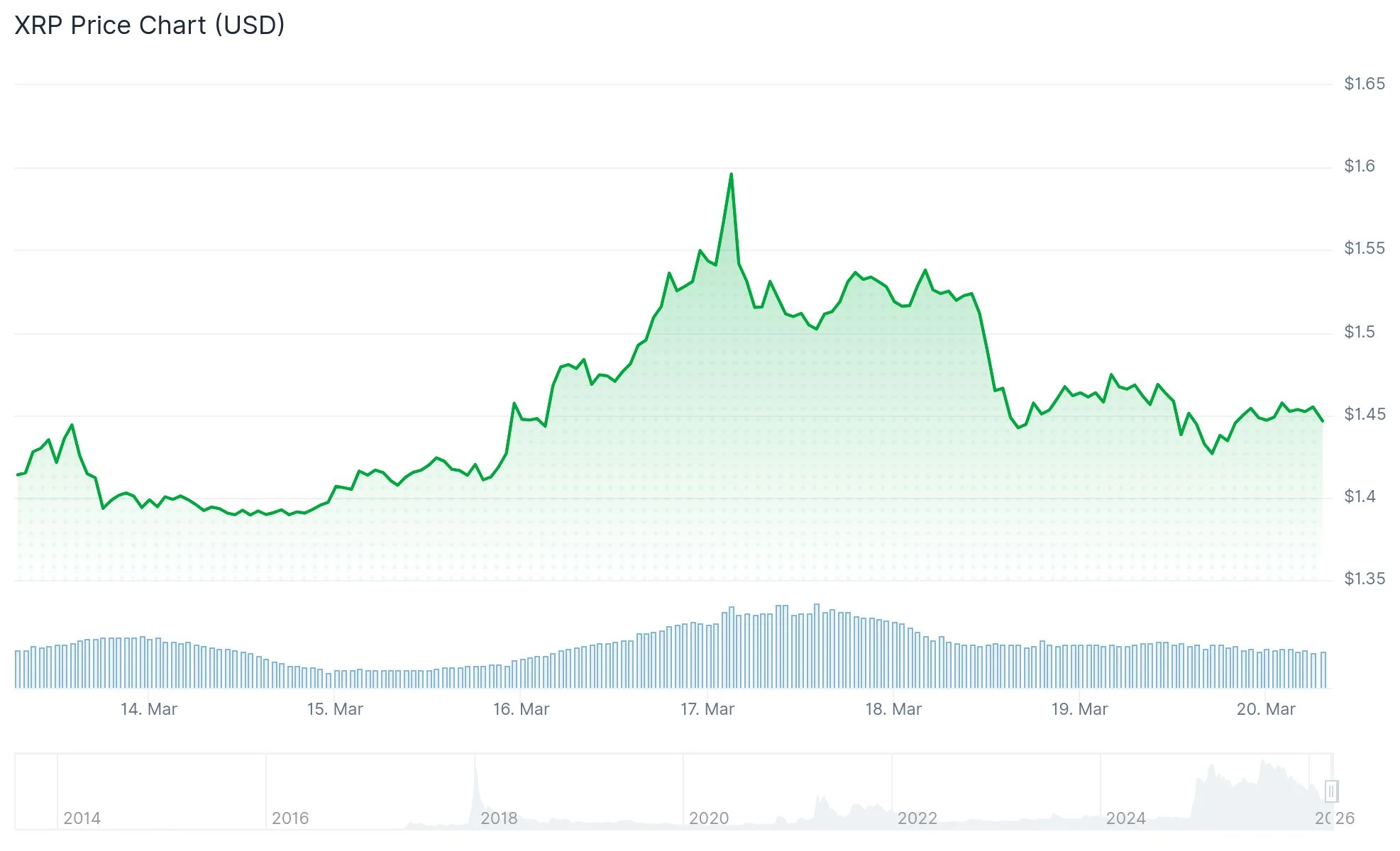
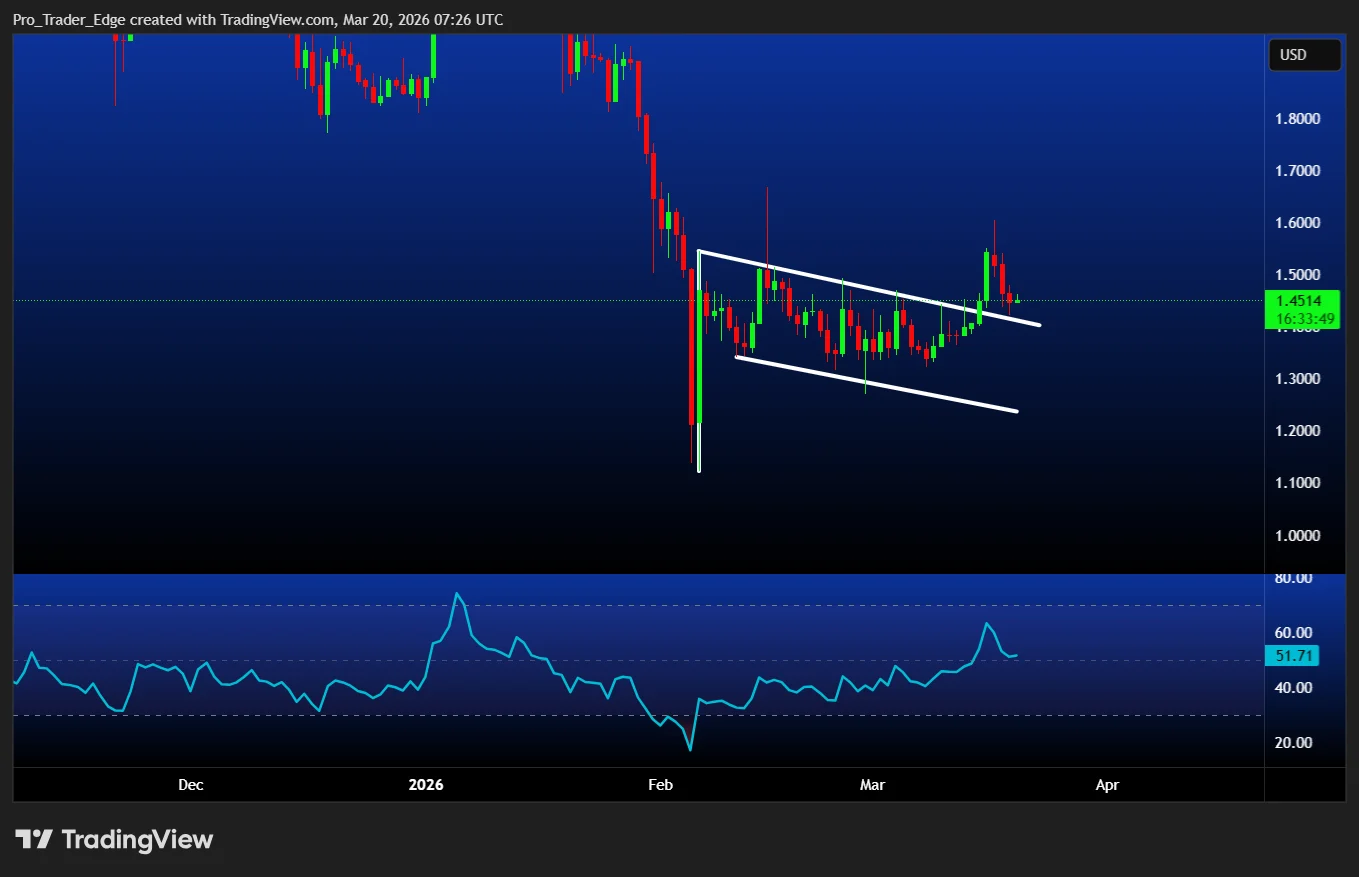
The recent price action follows last week’s breakout from a bull flag formation. In chart pattern analysis, bull flags develop when an asset consolidates within a descending channel following a significant upward move. After clearing the upper boundary of this channel, assets frequently retest the former resistance zone as newly established support — a scenario that appears to be unfolding currently.
The critical support region resides in the mid-$1.40 area, which aligns with the 20-day exponential moving average. Should XRP maintain levels above this threshold, the bull flag’s projected upside target reaches approximately $1.70–$1.72, representing roughly 20% upside potential from present levels.
South Korean Exchange Withdrawals Reach Historic Highs
Blockchain intelligence from CryptoQuant reveals significant XRP withdrawal activity from South Korea’s Upbit platform beginning in December 2025. Wallet holders across virtually every size category have been removing XRP from the exchange at unprecedented volumes. Reduced exchange balances generally indicate diminished immediate selling pressure.
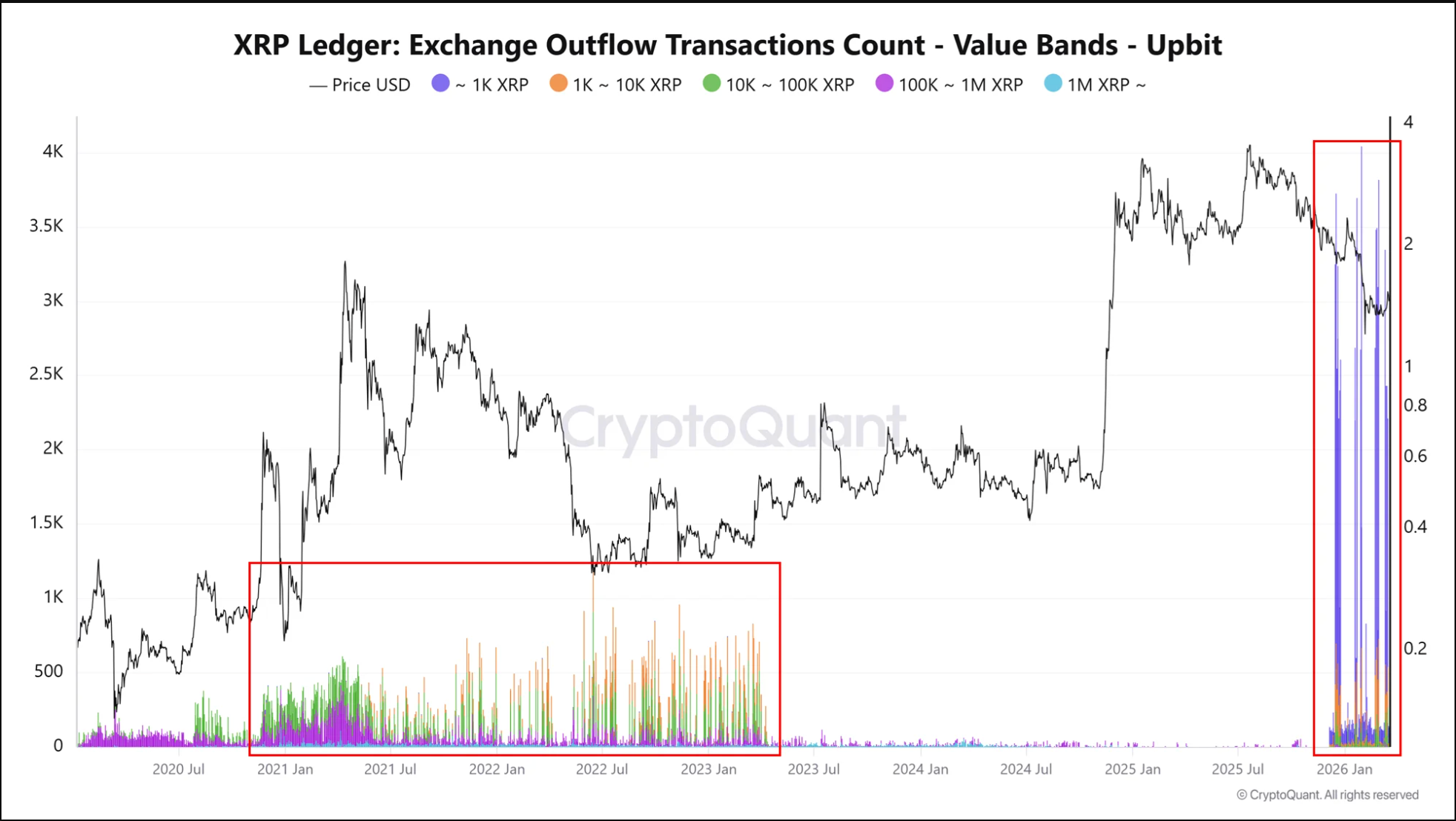
CryptoQuant analyst CW identified comparable withdrawal patterns between 2021 and early 2023, when heightened Korean exchange outflows aligned with an accumulation phase. This period preceded XRP’s substantial rally from under $1 to above $3 — representing approximately 500% gains.
As of Thursday, XRP trading pairs denominated in South Korean Won ranked as the fourth-largest market by 24-hour trading volume according to CoinMarketCap data.
Large Holder Behavior Shows Notable Reversal
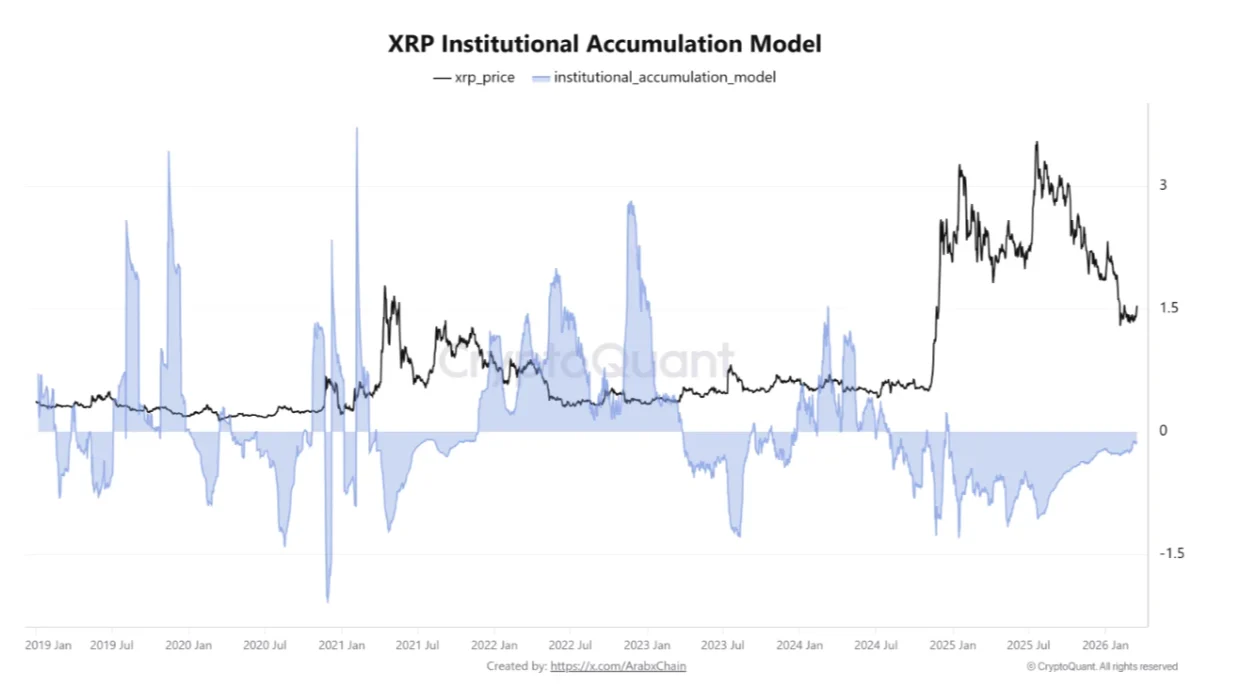
XRP’s 90-day moving average for whale-sized transactions has registered positive territory for the first time following an extended negative period throughout 2024 and into early 2025. During the negative phase, substantial holders were engaged in consistent selling activity. This recent reversal indicates that heavy distribution pressure may be subsiding.
A comparable transition took place during the April–September 2025 timeframe, when XRP advanced from approximately $2.20 to $3.55.
Regarding macroeconomic developments, the Federal Reserve maintained its benchmark interest rate at 3.5%–3.75% during the March 18 policy meeting, referencing persistent inflation concerns and geopolitical uncertainty. Financial markets interpreted this stance as restrictive policy continuation. The CMC Crypto Fear and Greed Index registered 29 at the time of analysis, reflecting heightened market anxiety.
Institutional engagement remains limited. US-listed XRP spot exchange-traded funds recorded zero net capital inflows on Wednesday. Total assets under management currently stand at approximately $1.02 billion, compared to cumulative net inflows of $1.21 billion.
Based on CoinGlass liquidation mapping data, significant liquidity concentration exists around the $1.35 price level. A breakdown beneath current support could activate cascading forced liquidations within that zone.
Examining the four-hour timeframe, XRP displayed a bearish MACD indicator crossover near the $1.54 resistance threshold. For bullish momentum to rebuild, a recapture of the $1.50 level would be necessary, with $1.55 representing the subsequent key resistance before any potential advance toward $1.60.

TLDR
- White House crypto advisor Patrick Witt met with Senate Republicans to negotiate stablecoin yield provisions in the CLARITY Act
- An April committee markup is Senator Cynthia Lummis’s target, with lawmakers aiming for passage by year’s end
- Banking institutions express concern that yield-bearing stablecoins may drain deposits from conventional financial systems
- A potential strategy involves combining the crypto legislation with housing reform bills to enhance passage prospects
- Democratic lawmakers demand restrictions on official crypto trading and complete CFTC appointments before rule implementation
Discussions surrounding the Digital Asset Market Clarity Act — America’s primary crypto legislative initiative — continue to evolve, with legislators reporting meaningful advancement. On Thursday, Senate Banking Committee Republicans convened in Washington with Patrick Witt, the White House’s crypto policy advisor, to address outstanding matters, particularly the regulatory treatment of stablecoin yield mechanisms.
https://twitter.com/BSCNews/status/2034513952130863404?s=20
The Thursday session brought together Senators Cynthia Lummis, Thom Tillis, and Tim Scott. Revised legislative language was anticipated to arrive at the White House that same day, though negotiations remain active.
Lummis characterized the discussions as being in a “delicate state” while noting that the session revealed previously unexplored approaches. She indicated that efforts have transitioned from text finalization toward stakeholder engagement.
Stablecoin Yield at the Center of the Debate
The stablecoin yield issue has emerged as among the most challenging elements to settle. Traditional banking institutions have voiced apprehension that yield-generating stablecoins might siphon deposits from established financial entities.
Throughout Thursday’s private meeting, senators urged Witt to publicly disclose a White House economic analysis examining stablecoin yield and its influence on banking deposits. While legislators have reportedly accessed the document, it remains unreleased to the public.
According to Lummis, stablecoin incentive programs that steer clear of terminology associated with savings accounts or interest accrual may remain in the final legislation. She drew parallels to credit card reward systems rather than traditional bank interest structures.
Brian Armstrong, CEO of Coinbase, whose previous resistance contributed to blocking an earlier bill iteration, has demonstrated increased willingness toward compromise during recent discussions, Lummis reported. Coinbase did not respond to a request for comment.
Speaking Tuesday at the DC Blockchain Summit, Senator Tim Scott anticipated that a stablecoin yield framework would be finalized shortly, acknowledging the contributions of Lummis, Angela Alsobrooks, and Thom Tillis in advancing negotiations.
Housing Bill Could Be Tied to Crypto Legislation
Senate Republicans are exploring the possibility of incorporating community bank deregulation provisions into the crypto legislation as a strategic maneuver to strengthen its passage likelihood. This approach would connect the CLARITY Act with housing reform measures, merging two distinct policy battles.
The Senate approved its housing legislation earlier this month, while House Republicans have developed their own alternative. Some senators believe that consolidating these issues could facilitate the advancement of both initiatives.
Whether House Republicans would support such an arrangement remains uncertain.
Democratic lawmakers have also established requirements. They seek prohibitions preventing senior government officials and congressional members from gaining financially through personal crypto investments — a demand primarily aimed at President Trump. Additionally, they want Democratic appointments to the Commodity Futures Trading Commission confirmed before the agency initiates new crypto rulemaking processes.
Both conditions are anticipated to be among the final hurdles addressed before a complete bill can advance to a full Senate vote.
The Securities and Exchange Commission has already initiated crypto policy actions. Earlier this week, the agency unveiled its inaugural taxonomy establishing regulatory classifications for U.S. digital assets. SEC Chairman Paul Atkins indicated the agency stands prepared to collaborate with the CFTC on CLARITY Act implementation following congressional approval.
Prediction market Polymarket currently assigns the CLARITY Act a 62% probability of becoming law in 2026.
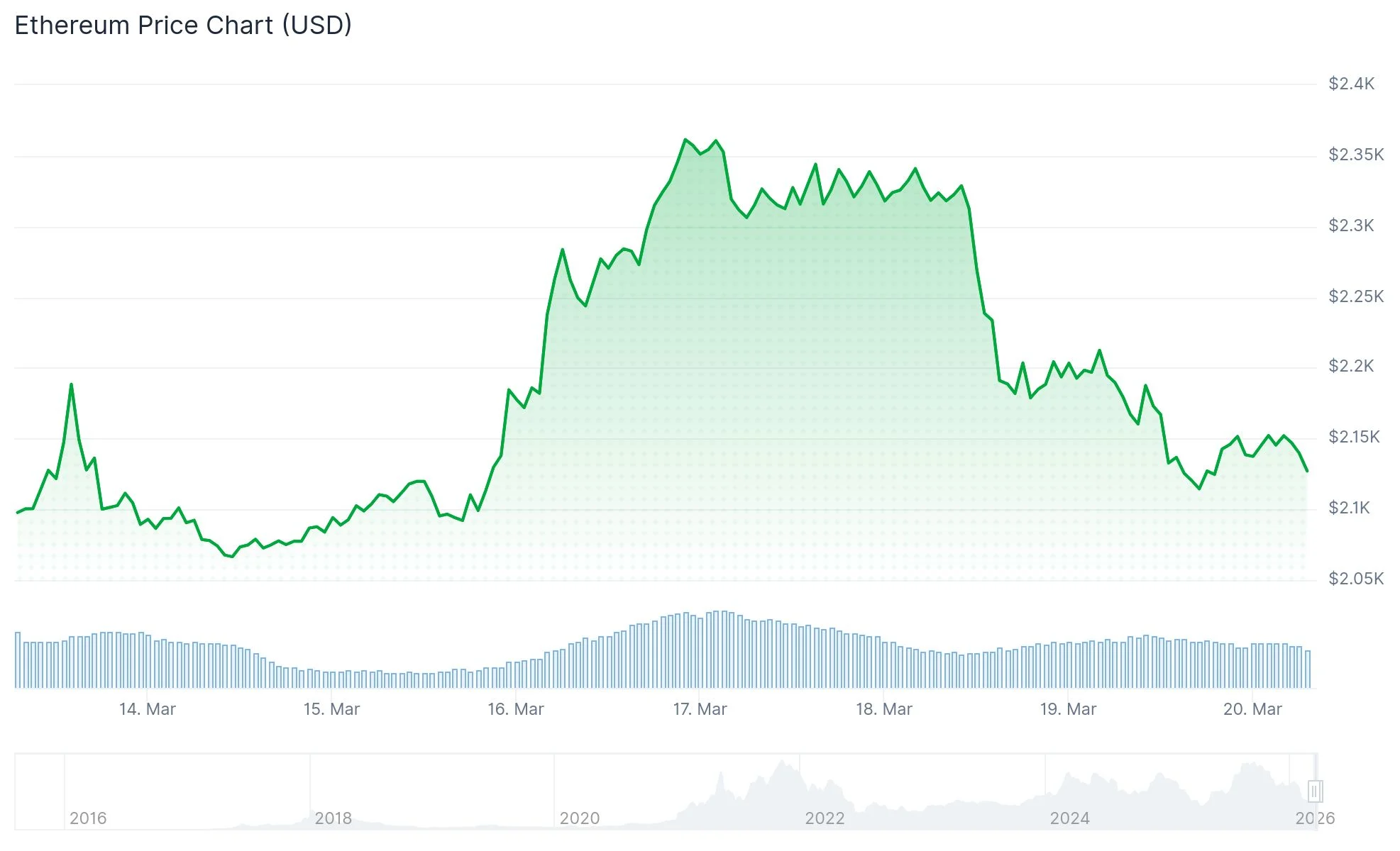
Key Takeaways
- ETH has moved into a historically significant MVRV value zone ranging from 0.8 to 1.0, indicating potential market bottom formation
- Following rejection near $2,400 resistance, Ethereum declined sharply to test $2,100 support
- Current trading action positions ETH beneath $2,200 and its 100-hour Simple Moving Average
- Critical near-term support exists between $2,100–$2,150, while deeper support emerges around $1,770 should selling intensify
- Breaking above $2,200 could trigger upward momentum toward $2,240, $2,275, and possibly $2,385
Ethereum currently hovers near $2,100 following a significant pullback from the $2,385 region. The digital asset breached multiple support levels including $2,320 and $2,250, eventually breaking a significant uptrend line that had provided support around $2,160 on shorter timeframes.
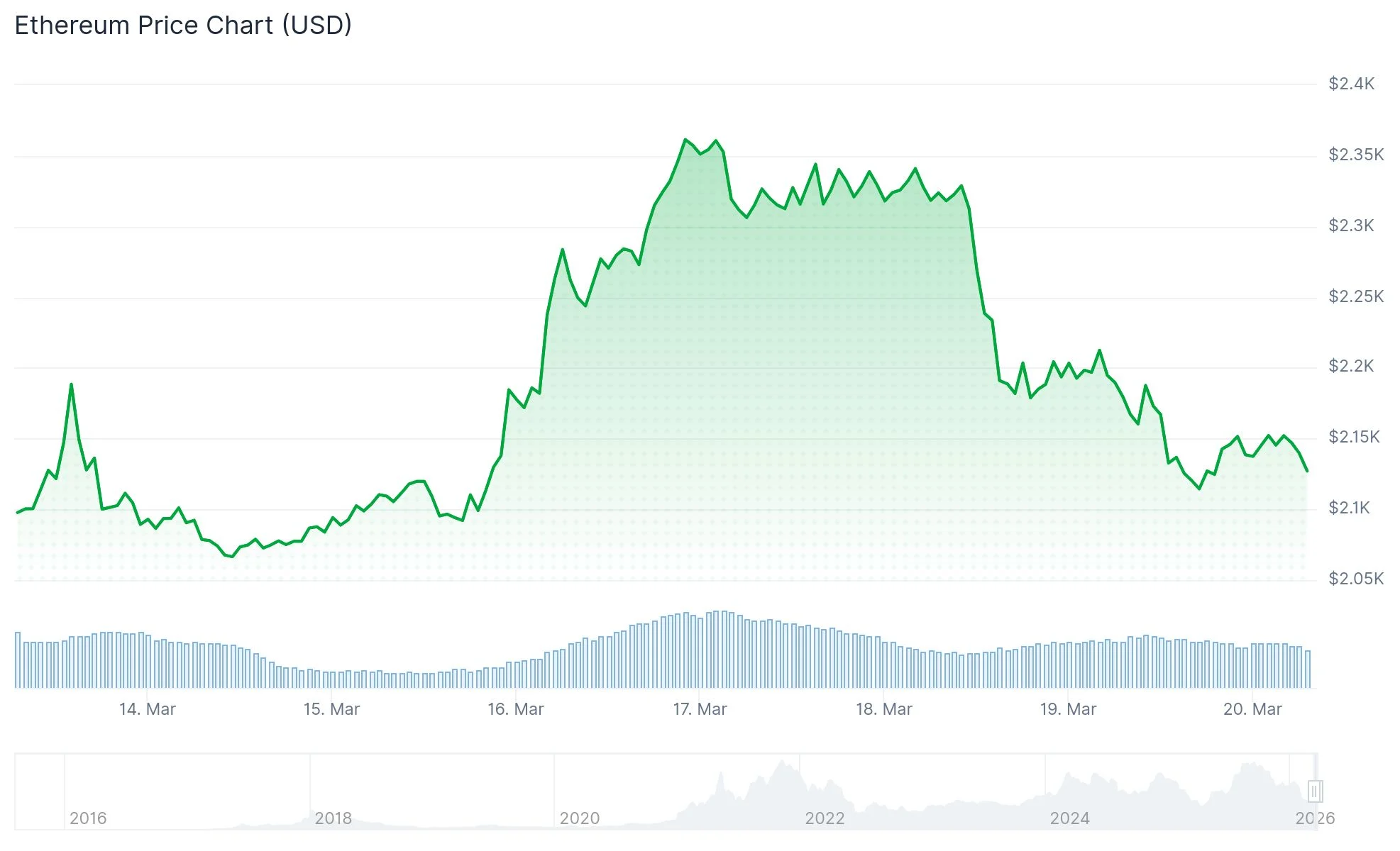
The recent session low touched $2,100. ETH now trades just above this threshold, positioned below the 23.6% Fibonacci retracement level measured from the $2,385 high to the $2,100 low.
The asset remains beneath its 100-hour Simple Moving Average, reinforcing the near-term bearish momentum in play.
Immediate resistance appears at $2,165, with the next significant barrier at $2,200, coinciding with the 100-hour SMA. Reclaiming the $2,200 threshold represents the initial requirement for any meaningful recovery.
Should Ethereum breach $2,200, additional resistance targets include $2,240, aligned with the 50% Fibonacci retracement, followed by $2,275 and $2,320. Extended strength could challenge the $2,385 level.
Regarding downside risk, a breakdown below $2,100 would expose support zones at $2,060 and $2,020. The psychological $2,000 mark stands as major support.
On-Chain Metric Signals Historical Value Territory
From a broader perspective, Ethereum’s Market Value to Realized Value ratio has descended into the 0.8 to 1.0 territory. Market analyst Ali Charts, utilizing Glassnode data, identifies this range as historically significant, often preceding substantial multi-month rallies.
https://twitter.com/alicharts/status/2034559606668570900?s=20
Historical recoveries from this MVRV zone have produced gains ranging from approximately 129% to exceeding 5,000%, though market conditions varied considerably across cycles. While this indicator doesn’t guarantee immediate price appreciation, it suggests limited downside potential compared to elevated valuation levels.
ETH achieved a cycle peak near $4,955 before entering the current correction phase. Trading around $2,100 marks a decline exceeding 57% from that high.
Technical Analyst Highlights $2,150 Critical Zone
Market analyst Ted Pillows shared insights on X regarding Ethereum’s technical position. He emphasized that ETH experienced strong resistance at the $2,400 level and is now challenging $2,150 as potential support.
https://twitter.com/TedPillows/status/2034554720593772615?s=20
The technical chart presented by Ted Pillows illustrates a series of descending peaks, with each recovery attempt failing to generate sustained upward movement. This formation suggests additional downside risk remains viable if support zones fail.
The $2,150 region corresponds to a previous consolidation area and serves as an important short-term inflection point for traders.
Crypto World
Bitcoin’s (BTC) price action looks dangerously similar to the pattern that sent it crashing to $60,000
Bitcoin’s price action is giving us a sense of déjà vu, and it’s not the good kind.
If you look at the price swings since early February, a very specific, ominous pattern is forming that looks strikingly similar to the setup we saw between November and January. That set up eventually paved the way for a crushing sell-off to nearly $60,000.
We are looking at what technical analysts often call a counter-trend recovery – a modest bounce within a downtrend.
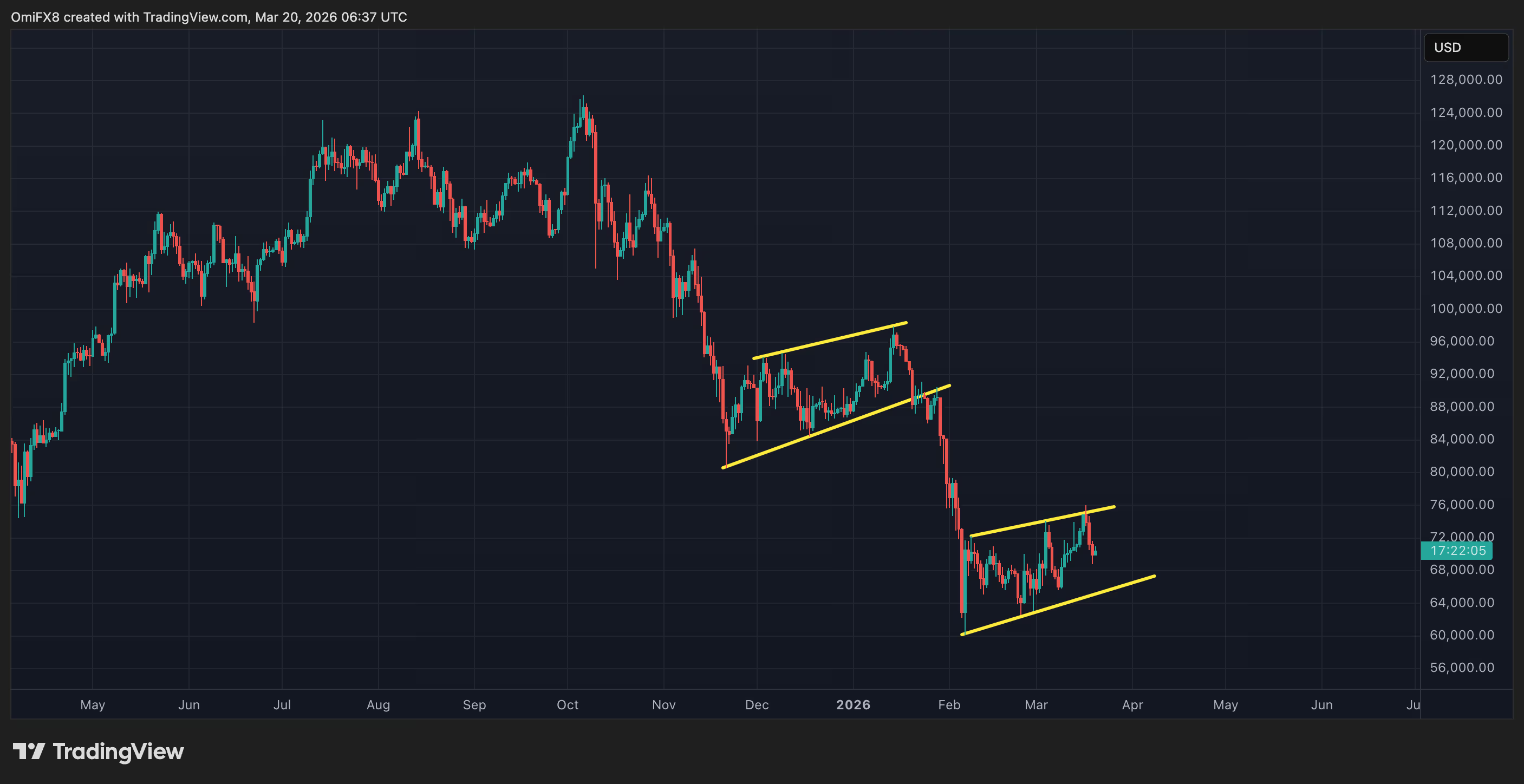
Here is the chart. Check out the two yellow channels.

The first yellow channel, on the left, shows price action from Nov. 20 to Jan. 20. Back then, bitcoin traded in a narrow range, with a slight upward tilt after a drop from $100,000. It looked like the price was recovering, but in reality it was just a pause – or a small bounce – within a larger downtrend.
The result was that the price eventually broke below the bottom of that trading range. Essentially, the level traders had been treating as a “floor”, or support, gave way, and bitcoin plunged in a straight line from about $90,000 down to nearly $60,000 by Feb. 6.
Now look at the second channel on the right.
Since hitting those lows in early February, bitcoin has once again traded in a narrow range with an upward tilt, contained perfectly between those two trendlines.
The similarity with the earlier pattern is undeniable. The present relief rally lacks the explosive momentum just as the November-January pattern did. It’s a slow, choppy grind upwards. In technical analysis theory, this is a sign of bullish exhaustion, with the market simply pausing for breath before the bears recharge their engines.
What next?
Charts aren’t a holy grail, and past performance doesn’t guarantee future results. Still, traders use them to read market psychology, and right now, they’re telling a tale of a “buy the dip” crowd that lacks strength and conviction.
If bitcoin falls below the lower trendline of its current channel, around $65,800, it could signal a return of bearish control.
The takeaway is that bitcoin is at a major decision point. The bear market could deepen, as some anticipate, if prices break below the channel formation. If it breaks out above the channel, the downtrend could lose steam, and the bulls could then make a strong comeback.
Key Highlights
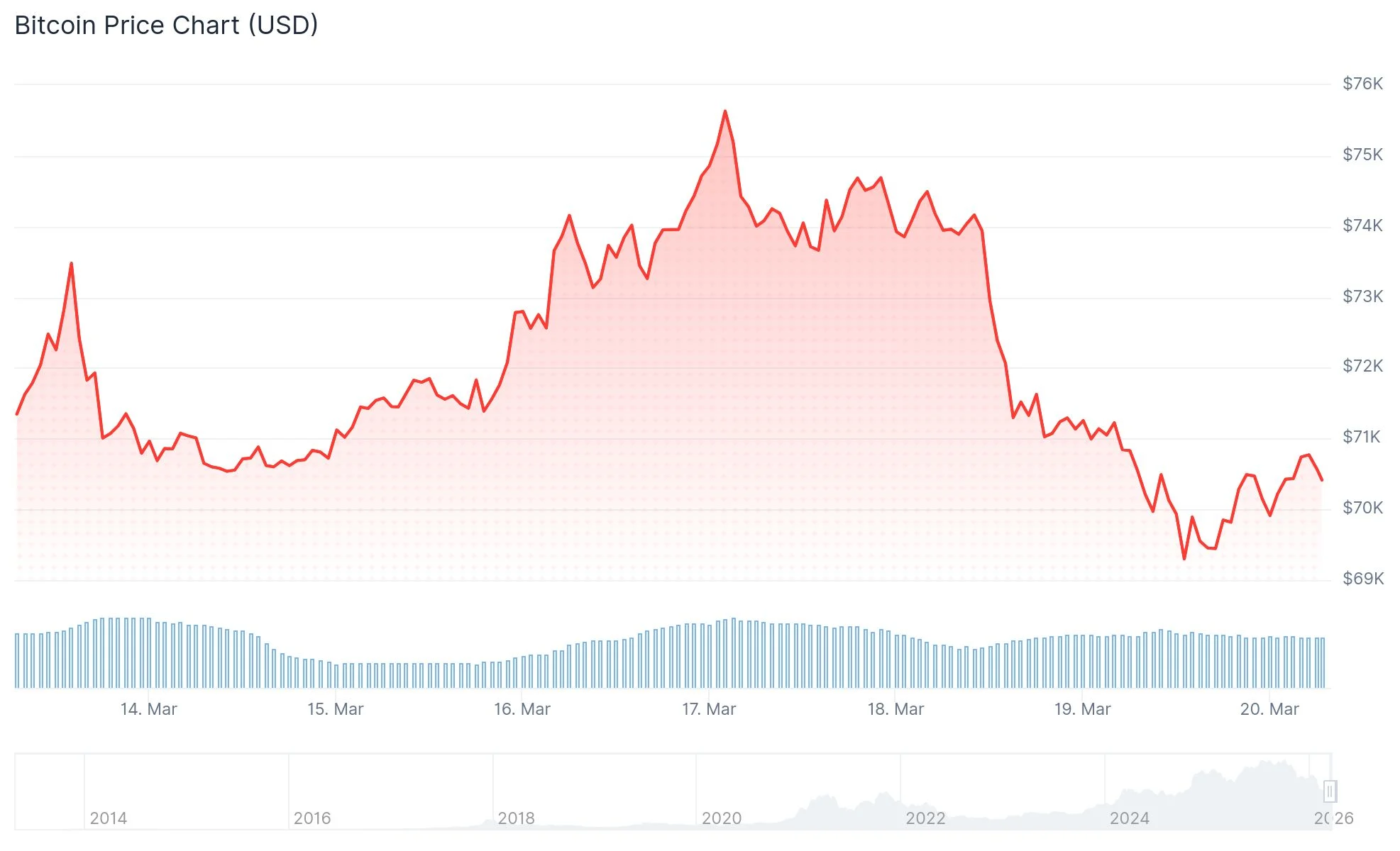
- Bitcoin slipped beneath $69,000, declining more than 4% as crude oil prices jumped to $119 per barrel
- Brent crude temporarily spiked to $119 following escalating U.S.-Iran tensions that disrupted Middle Eastern energy infrastructure
- Energy analysts caution that oil prices could potentially climb to $200 per barrel if Strait of Hormuz disruptions persist
- The Federal Reserve maintained current interest rates and indicated potential postponement of rate reductions amid inflation concerns
- Blockchain analytics reveal whale addresses containing 100+ BTC increased by 753 wallets during the last three-month period
Bitcoin experienced a significant downturn this week, sliding beneath the $70,000 threshold as escalating crude oil prices and conservative Federal Reserve messaging dampened investor confidence throughout global financial markets.
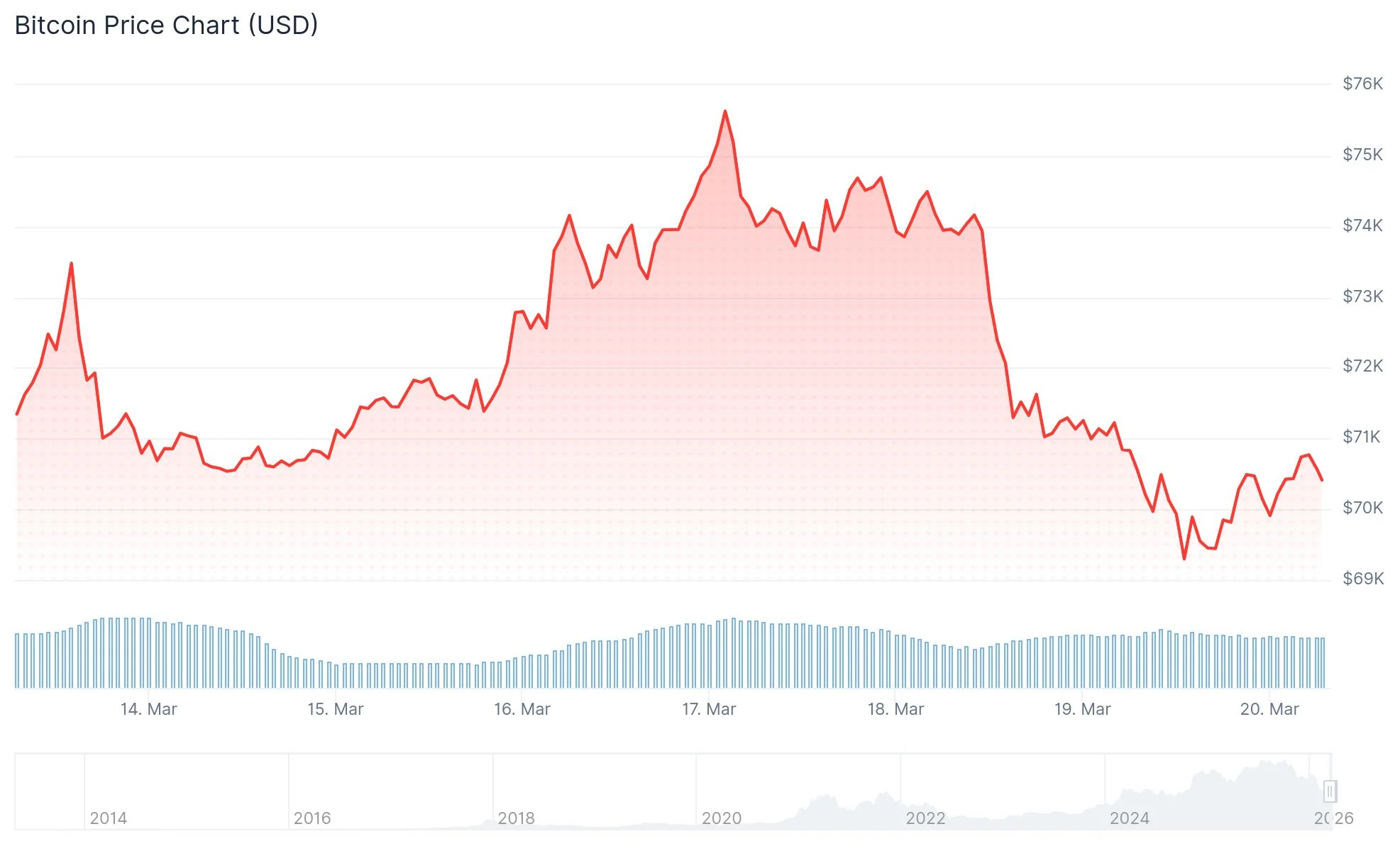
The leading digital currency by market capitalization descended to an intraday bottom of $68,814 on Thursday, representing a decline exceeding 4% from its session peak above $71,000. By Friday’s opening hours, the cryptocurrency had recovered slightly to hover around $70,675, though remaining marginally negative.
This downturn coincided with Brent crude oil’s temporary surge to $119 per barrel on Thursday. The dramatic price increase stemmed from intensifying hostilities between the United States and Iran, with reports indicating both nations had targeted energy infrastructure.
Regional Middle Eastern crude benchmarks including Oman and Dubai had already exceeded $150 per barrel. Vandana Hari, who founded the oil analysis company Vanda Insights, informed Al Jazeera that oil reaching $200 “was already within sight.”
“How much further crude climbs from here almost entirely hinges on how much longer the Strait of Hormuz remains closed,” Hari commented.
Adi Imsirovic, an energy specialist at the University of Oxford, similarly told Al Jazeera that $200 oil remained “perfectly possible” and characterized it as “a major handbrake to the world economy.”
Energy Price Volatility Pressures Risk Markets
Financial analyst The Kobeissi Letter observed that Bitcoin’s decline represented part of a widespread market retreat connected to surging energy costs. “The world is quite literally facing what appears to be the largest energy crisis in history,” they posted on X.
https://twitter.com/KobeissiLetter/status/2034608583887700121?s=20
Crude oil prices subsequently moderated following multiple interventions. Israeli Prime Minister Benjamin Netanyahu announced that Israel would refrain from additional strikes on Iranian energy infrastructure. U.S. Treasury Secretary Scott Bessent indicated Washington might tap the Strategic Petroleum Reserve and potentially permit sanctioned Iranian oil currently in transit to enter global markets.
Brent crude retreated below $110 per barrel by Friday, contributing to improved market stability.
Federal Reserve Postpones Rate Cut Timeline
The Federal Reserve maintained existing interest rates unchanged this week. Fed Chair Jerome Powell cautioned during his subsequent press conference that elevated oil prices might drive near-term inflation higher, and indicated the central bank would postpone rate reductions until inflation demonstrated definitive improvement.
Producer Price Index data released Thursday revealed inflation had already climbed to 3.4% the previous month, preceding the Iran conflict escalation. Market participants are now reducing expectations regarding potential Fed rate cuts throughout 2025.
https://twitter.com/santimentfeed/status/2034746092546662873?s=20
Despite the price retreat, blockchain analytics demonstrated that Bitcoin whale addresses containing 100 or more BTC expanded by 753 wallets during the preceding three-month period, representing a 3.9% growth, even as overall market valuation decreased 20.2% throughout the identical timeframe.


Nevada state authorities have been cleared to issue a temporary restraining order against prediction market platform Kalshi.
Summary
- A federal appeals court denied Kalshi’s request to halt proceedings, clearing the way for Nevada regulators to pursue a temporary restraining order against the platform.
- Industry experts say Kalshi may be forced to exit Nevada for at least 14 days if the order is issued, as such rulings are not appealable under state law.
On Thursday, the Ninth Circuit Appeals Court denied Kalshi’s emergency request to stay proceedings. The case will now be sent back to federal court, where Nevada regulators can proceed with enforcement action.
According to Gaming lawyer Daniel Wallach, this would likely result in a temporary restraining order and noted that Kalshi would not be able to operate in the state for at least 14 days, as the order is “not appealable under Nevada law.”
“Kalshi would be required to exit the state in the interim,” he added.
The case stems from a cease and desist issued against the platform in March, where regulators claimed that the platform offered unlicensed sports betting under the state’s gaming laws.
Kalshi, in the meantime, has countered these claims, arguing that its contracts fall under the federal jurisdiction of the Commodity Futures Trading Commission, which means any restriction imposed by the state would conflict with federal oversight and would also cause its business imminent harm.
Similar actions have emerged across a number of other U.S. states, with lawmakers claiming that sports event contracts may violate local gambling laws. States like Connecticut, New York, and New Jersey have taken steps against sports event contracts that have targeted Kalshi and many of its competitors, like Polymarket and Crypto.com.
Meanwhile, the U.S. Commodity Futures Trading Commission chairman, Michael Selig, has said that the commission will establish a federal rulebook for prediction markets while asserting exclusive jurisdiction over such products.
Prediction markets like Kalshi and Polymarket have recently surged in activity, with weekly trading volumes exceeding $2 billion. As previously reported by crypto.news, ultra-short duration contracts have become increasingly popular, with five to 15-minute bets now accounting for a significant share of trading on these platforms.
TLDR:
- Binance altcoin trading volumes have fallen to $7.7B, down sharply from the $40–$50B recorded in late 2024.
- Combined altcoin volumes on other major exchanges now sit at $18.8B, well below prior peaks of $91B.
- Binance currently accounts for roughly 40% of total altcoin trading volume across all major exchanges.
- Historical data shows the best crypto opportunities often emerge when trading volumes and market interest are at their lowest.
Altcoin trading volumes across major cryptocurrency exchanges have declined sharply in recent months. Data from Binance and other top platforms points to a clear reduction in investor participation.
The ongoing bear market, combined with persistent geopolitical tensions, continues to suppress risk appetite. Altcoins are now trailing Bitcoin in performance by a wide margin.
Current volume levels are well below those recorded during more active trading phases of late 2024 and early 2025.
Altcoin Trading Volumes on Major Exchanges Hit Multi-Month Lows
Altcoin trading volumes on Binance currently stand at approximately $7.7 billion. This marks a steep drop from the $40 to $50 billion the platform saw in October 2024. Other major exchanges combined now account for about $18.8 billion in total volume.
During those earlier peak periods, other exchanges collectively recorded volumes of $63 billion and $91 billion. The gap between those highs and current figures reflects the scale of the decline. Trading activity has fallen across the board, not just on a single platform.
Crypto analyst Darkfost_Coc flagged this trend in a recent post on X. The data shows altcoins are underperforming Bitcoin considerably in the current market. Investor interest in smaller digital assets appears to be fading steadily. On Binance specifically, the platform now represents about 40% of total altcoin trading volume.
Ongoing geopolitical tensions continue to create an unfavorable environment for risk assets. This has further reduced the appeal of altcoins among traders seeking stability.
As a result, capital has been moving away from smaller tokens toward safer market positions.
Historical Volume Patterns Point to FOMO-Driven Tops and Future Opportunity
The volume spikes recorded in October 2024 and February 2025 coincided with local price tops in the market. These surges were largely fueled by FOMO, or fear of missing out, among retail traders. Well-positioned investors used that demand surge as an opportunity to exit their positions.
Darkfost_Coc noted that volume spikes at market tops often reflect retail participation rather than institutional accumulation. By the time most traders enter during a surge, smarter money is already reducing exposure.
This pattern has repeated itself across multiple previous crypto cycles. Binance’s roughly 40% share of total altcoin volume further reflects this concentration of activity.
Currently, altcoin trading volumes remain at depressed levels with no clear recovery signal yet. However, historical data from past cycles show that low-interest periods often precede strong market reversals. Volume trends tend to shift before price movements become widely visible.
According to the analysis, the most attractive opportunities have historically appeared when market interest is at its lowest. Most investors tend to remain on the sidelines during these phases. Those who track volume data closely are often better positioned when conditions eventually improve.

Solana (SOL) Tumbles 11% Amid Plunging DApp Revenue and Zero Funding Rates

Darren Millar: Wales has had enough of Labour – but there is a pathway to real change
This Dallas Cowboys-themed practice range is outrageous in best possible way


-
Crypto World6 days ago
HYPE Token Enters Net Deflation as HyperCore Buybacks Outpace Staking Rewards
-

 Tech4 days ago
Your Legally Registered ‘Motorcycle’ Might Not Count Under Proposed US Law
-

 Fashion7 days ago
Weekend Open Thread: Addict Lip Glow
-
 Tech3 days ago
Are Split Spacebars the Next Big Gaming Keyboard Trend?
-
Sports6 days ago
Why Duke and Michigan Are Dead Even Entering Selection Sunday
-

 Business5 days ago
Search for Savannah Guthrie’s Mother Enters Seventh Week with No Arrests
-

 Business6 days ago
US Airports Launch Donation Drives for Unpaid TSA Workers as Partial Government Shutdown Enters Fifth Week
-
Crypto World6 days ago
Coinbase and Bybit in Investment Talks: Could Bybit Finally Enter the US Crypto Market?
-

 Business4 days ago
Australian shares drop as Iran war enters third week
-

 Business6 days ago
Country star Brantley Gilbert enters growing non-alcoholic beer market
-

 Crypto World4 days ago
Crypto Lender BlockFills Enters Chapter 11 with Up to $500M in Liabilities
-

 Sports7 days ago
College Basketball Best Bets: Conference Tournament Semifinal Picks
-

 Politics2 days ago
The House | The new register to protect children from their abusers shows Parliament at its best
-

 Fashion4 days ago
25 Celebrities with Curly Hair That Are Naturally Beautiful
-

 News Videos2 days ago
RBA board divided on rate cut, unusually buoyant share market | Finance Report | ABC NEWS
-

 Tech3 hours ago
inKONBINI Lets You Spend Summer Days Behind the Register
-

 Crypto World2 days ago
Canada’s FINTRAC revokes registrations of 23 crypto MSBs in AML crackdown
-
 Politics3 days ago
Real-time pollution monitoring calls after boy nearly dies
-

 Crypto World6 days ago
Crypto Losses Drop 87% in February, But Hackers Are Now Targeting People, Not Code
-
 NewsBeat1 day ago
Residents in North Lanarkshire reminded to register to vote in Scottish Parliament Election


You must be logged in to post a comment Login