Crypto World
Are Whales Responsible For Ethereum (Eth) Price Decline

The price of Ethereum has declined consistently over the last seven days. Many factors could be responsible for this trend, including the activity (buying and selling of ETH) of large traders, commonly known as whales.
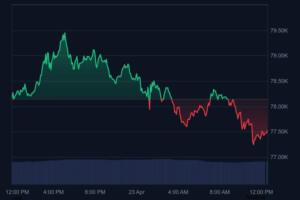

Ethereum price chart for the last 7 days. Source: Coinmarketcap.com
To find out if whales are responsible, we analyzed Ethereum trading data for decentralized exchanges (DEX) from Dune Analytics for the last seven days and answered four important questions.
- Have large traders been buying or selling ETH?
- Has their activity increased or decreased over this period?
- Which whale groups are driving the activities and capital flows?
- Are these activities responsible for the ETH price decline?
We categorized whales into three cohorts, placing them in $100K–$500K, $500K–$1M, or $1M–$5M. The analysis shows that while whales have been active within this period, they are not directly responsible for the price decline.
No Strong Buying Or Selling Bias
The data shows that large DEX traders had a slight buying bias, buying approximately $358 million of WETH and selling approximately $352M during the period, with a $6M net difference. This difference isn’t significant, indicating a nearly balanced buying and selling pattern within the last seven days.
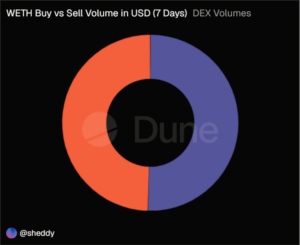

Whale buy vs sell volume for the last seven days. Source: Dune.com
High Volatility But No Clear Trend
Whale activity showed no clear trend over the last seven days, as there is no clear increase or decrease. However, sharp differences in activity are clear, with a huge decline over the weekend indicating significant volatility. This shows that large traders have been active in the market.
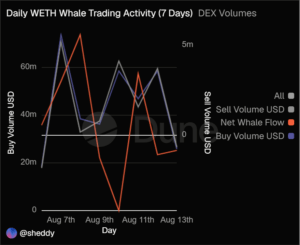
Whale activity showing volatility in the last 7 days. Source: Dune.com
Smaller Size Whales Drive Activity But Capital Flow
Large traders with amounts ranging from $100K–$500K accounted for 86% of whale activity by transaction count. This shows that moderately large traders were the most frequent participants over the period.
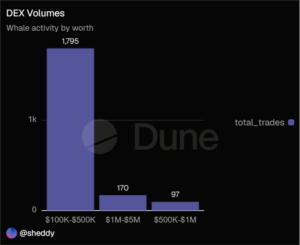
Whale trading counts. Source: Dune.com
However, the $1M–$5M cohort, with only 8.7% of trades, comes very close in terms of trading volume at 45.13%, compared to 45.64% for the $100K–$500K cohort. This indicates that while moderately sized whales are the most frequent participants, larger whales have a disproportionately greater impact on capital flows despite their significantly fewer transactions.
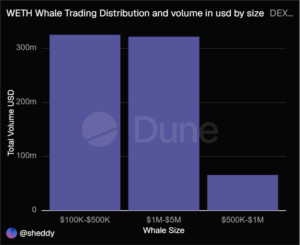
Whale trading volume in USD. Source: Dune.com
ETH Price Decline Unrelated To Whale Activity
Despite sharp differences in the large traders’ activities by day, ETH price declined consistently, while whale trading volume fluctuated without a corresponding trend over the period in focus. This shows that the price decline has no direct link with large trader activities in the last seven days.
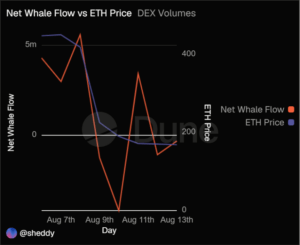
Ethereum price with respect to whale activity. Source: Dune.com
Conclusion
The data reveals that while there is no clear trend in the activity of whales over the last seven days, ETH price continued to fall. The findings suggest that whale activity over this period is not directly responsible for the price decline.
However, the analysis only considers data for the last seven days, which may be too short a period to give an accurate picture of what is really going on. Also, the price decline may be driven by other factors such as general current sentiment among retail traders, who ultimately are the majority of the market.
An interesting direction to also consider, which this analysis doesn’t cover, would be to determine where large traders are sending their ETH to—whether to centralized exchanges (CEX) or to private wallets. The finding could give important insight into the minds of these big players and tell us what to expect from the market next.
You must be logged in to post a comment Login