

Crypto World
Asia’s Crypto Landscape Shifts as Governments Tighten Control and Institutions Expand Adoption


TLDR:
- Crypto ecosystem in Iran hit $7.78B in 2025, with IRGC controlling over 50% of all inflows.
- Russia’s new law lets courts seize Bitcoin and virtual assets classified as intangible property.
- South Korea’s NTS accidentally leaked a seed phrase, leading to a suspected $4.8M crypto loss.
- Japan’s Progmat plans to migrate $2B in tokenized securities to Avalanche by end of June 2026.
Crypto activity across Asia reached new levels in early 2025, with governments and institutions responding in varied ways.
From Iran’s $7.78 billion ecosystem to South Korea’s stablecoin regulatory gaps, the region is shifting fast. Russia’s court-ordered confiscation law and Japan’s corporate Bitcoin purchases also mark major moves.
Together, these developments paint a clearer picture of where Asian crypto policy and adoption are heading this year.
Iran and Russia Reshape Crypto Through Government Control
Iran’s crypto ecosystem reached $7.78 billion in 2025, according to blockchain analytics firm Chainalysis. The country has built a parallel financial system centered on Bitcoin mining and stablecoins. This system allows Iran to operate outside the U.S. dollar framework.
Addresses linked to the Islamic Revolutionary Guard Corps accounted for over 50% of crypto inflows. The IRGC received more than $3 billion throughout the year. Iran’s central bank also accumulated at least $507 million in USDT, likely to stabilize the rial and settle trade.
Meanwhile, Russian President Vladimir Putin signed a law allowing courts to seize virtual currencies in criminal cases.
The law formally classifies virtual currencies as intangible assets. Law enforcement can transfer seized assets to designated safe addresses via hardware wallets.
South Korea and Japan Advance Crypto Frameworks at Different Speeds
South Korea’s National Tax Service accidentally exposed a hardware wallet seed phrase in a news photo. Blockchain data showed that around 4 million PRTG tokens were subsequently transferred. The estimated value of the transfer was approximately $4.8 million.
The Bank of Korea renewed its call for commercial banks to lead Korean won stablecoin issuance. The central bank warned that private issuance could pose risks to monetary policy and foreign exchange stability. It recommended prioritizing banks subject to capital and compliance regulations.
As South Korea delayed stablecoin rules, Tether and Circle moved to expand in the Korean market. Tether began recruiting local staff, including government relations and public relations roles.
Circle’s USDC also reached around 10% market share on South Korean crypto exchanges.
🇯🇵 Japan FSA announced support for private-sector AML crypto trials running March–May 2026. The project, submitted by Hitachi, involves exchanges, stablecoin firms, and blockchain analytics providers. — FSA Japan, Feb. 27
Japan and China Push Crypto Into Institutional and Legal Arenas
Japan’s Financial Services Agency announced support for anti-money laundering proof-of-concept trials in crypto. The trials are scheduled to run from March to May 2026. They will test an industry-wide wallet-sharing framework for suspicious activity monitoring.
Japan’s largest security token platform, Progmat, plans to migrate over $2 billion in tokenized assets to Avalanche.
The migration covers tokenized real estate and corporate bonds currently on the Corda platform. The Avalanche L1 integration is expected to complete by the end of June 2026.
In addition, Japanese listed company Daido Tokushu Metal announced board approval to purchase Bitcoin worth up to 1 billion yen.
The purchase is part of a mid-term management plan running through March 2029. The company cited Bitcoin’s limited supply and low correlation with traditional assets as key reasons.
China’s Supreme People’s Court also stated plans to study judicial responses to virtual currency cases. The court aims to strengthen financial judicial protections for new asset classes.
A report from Artemis and Stablecon placed China second in global stablecoin inflow volume, receiving around $71 billion monthly.

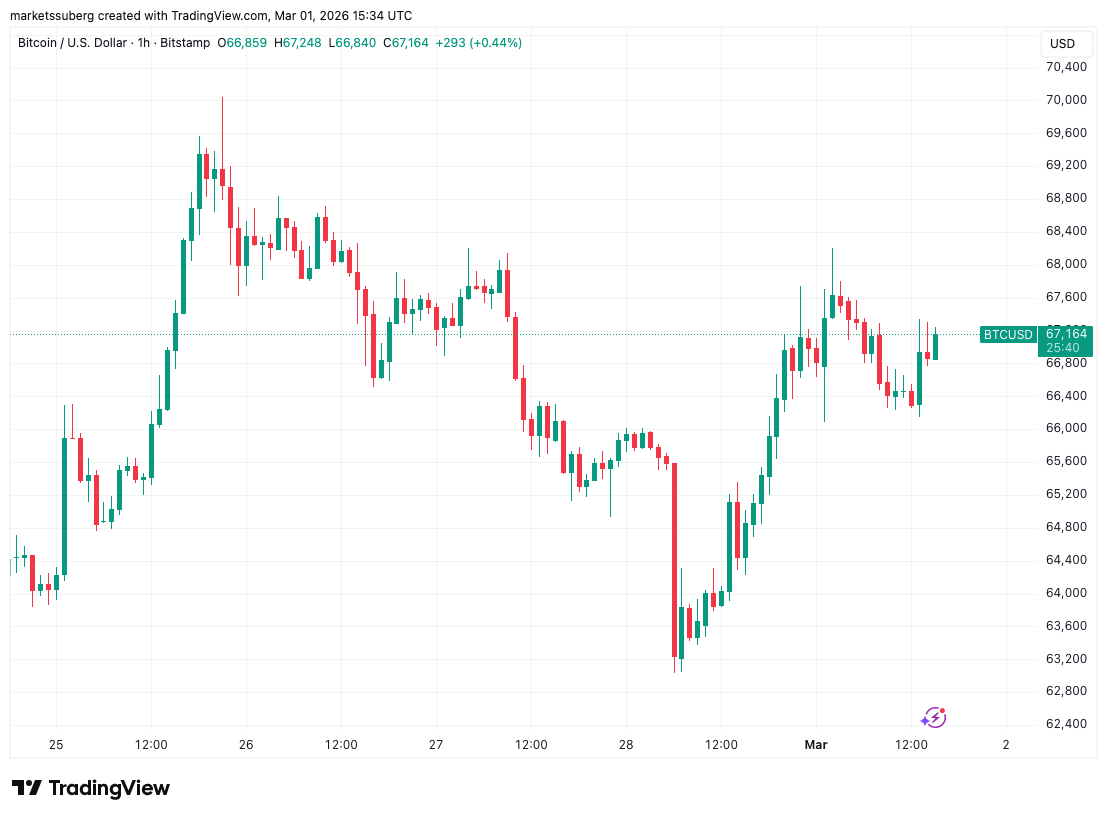
Bitcoin avoided a fresh breakdown around major geopolitical events in the Middle East, with BTC price targets now including $74,000 next.
Bitcoin (BTC) ignored geopolitical volatility on Sunday as traders waited for markets’ Iran reaction.
Key points:
-
Bitcoin coils around $67,000 as the dust settles on a wild weekend in the Middle East.
-
TradFi market reactions are in focus, with BTC price action avoiding major volatility.
-
Oil price concerns compound as Iran seeks to close the Strait of Hormuz.
Trader sees $74,000 BTC price rally
Data from TradingView showed BTC price action focusing on $67,000 in the aftermath of the latest round of conflict in the Middle East.

The weekend prevented TradFi markets from adjusting to events in real time, with US stock market futures down 0.65% at the time of writing.
Crypto also saw volatility, but soon cooled, and BTC/USD avoided a major breakout from its local trading range.
Commenting, crypto trader, analyst and entrepreneur Michaël van de Poppe described the initial response as “positive.”
“Now, markets are correcting back down, as there’s uncertainty on how US markets will open tomorrow (and there’s still an outstanding gap of the CME),” he wrote in a post on X.
“On the other hand, the 21-Day MA needs to break in order to have a relief rally. I think we’ll see it in March/April, question of how we’re opening the markets tomorrow and whether it finds a higher low.”

Van de Poppe referred to Bitcoin’s 21-day simple moving average at $67,627. The weekend’s “gap” in CME Group’s Bitcoin futures market lay to the downside at $65,880.
“$BTC looks good in the short-term,” trader BitBull agreed about the three-day chart.
“Deviation below the support zone and has now flipped resistance into support. I think a rally towards the $73K-$74K level could happen.”

Some argued that geopolitical instability had been “priced in” by the market in advance, explaining the comparatively modest price action over the weekend.
“We will probably move side ways the next days…,” trader Crypto Caesar concluded.

Strait of Hormuz tied to next US inflation spike
A separate point of concern focused on potential oil price volatility as Iran claimed to be closing the Strait of Hormuz.
Related: Bitcoin historical price metric sees $122K ‘average return’ over 10 months
Despite being international waters, the Strait became a holding ground for oil shipping on Sunday, leading to swift analysis of the knock-on effect for US inflation.
Trading resource The Kobeissi Letter referenced research by JPMorgan while suggesting that the Consumer Price Index (CPI) could jump to 5%.
“The last time we saw US inflation at 5% was in March 2023, when the Fed was aggressively hiking rates,” it wrote in a dedicated X thread.

As Cointelegraph reported, recent US inflation prints outpaced expectations, notably Friday’s Producer Price Index (PPI) numbers.
This article does not contain investment advice or recommendations. Every investment and trading move involves risk, and readers should conduct their own research when making a decision. While we strive to provide accurate and timely information, Cointelegraph does not guarantee the accuracy, completeness, or reliability of any information in this article. This article may contain forward-looking statements that are subject to risks and uncertainties. Cointelegraph will not be liable for any loss or damage arising from your reliance on this information.


Crypto exploits declined by more than 90% in February, with digital asset thieves siphoning just $35.7 million across the ecosystem.
The sharp decline marks the quietest month for crypto security since March 2025, providing a brief reprieve for a sector routinely battered by nine-figure hacks.
Phishing and Oracle Attacks Linger Despite the Sharp Fall in Crypto Theft
Data compiled by blockchain security firm CertiK revealed a drastic month-over-month drop from January’s staggering losses.
Meanwhile, the figures also represent a massive year-over-year contraction. Last year’s February was dominated by a historic $1.5 billion exploit on the Bybit exchange, an anomaly that heavily skewed annual security metrics.
Despite the broader market slowdown in illicit activity, targeted attacks still drained millions from decentralized finance protocols.
The single largest crypto exploit incident occurred on February 22 on the Stellar network.
According to Quill Audits, a hacker exploited the community-managed YieldBlox Blend pool. The attacker stole more than $10 million through a classic thin-liquidity oracle manipulation attack.
By executing a single abnormal trade in the highly illiquid USTRY/USDC market, the attacker artificially inflated the token’s price by a factor of 100.
This tricked the protocol’s valuation system, allowing the attacker to execute massive undercollateralized borrowing.
A day earlier, on February 21, the Internet-of-Things blockchain project IoTeX suffered a major breach after a private key was compromised.
While CertiK estimated the losses at nearly $9 million, the IoTeX team claimed the stolen amount was closer to $2 million.
Security researchers noted the attacker used the compromised key to access the token safe, quickly swapped the stolen assets for ETH and routed them to Bitcoin using cross-chain bridges.
Rounding out the top three was a $2.2 million exploit of Foom.Cash, a privacy protocol.
In this attack, the hacker reportedly exploited a cryptographic flaw to forge zkSNARK proofs. This allowed them to create fake digital credentials that the protocol accepted, enabling the withdrawal of large volumes of tokens.
Crypto Phishing Attacks Remain a Concern
Beyond smart contract vulnerabilities, phishing remains a persistent threat, accounting for exactly $8.5 million of February’s total losses.
The crypto phishing sector has flourished recently, driven by the rise of professionalized “drainer-as-a-service” providers like Angel Drainer and Inferno Drainer.
These platforms allow scammers to execute large-scale malicious operations with minimal technical expertise. They provide fraudsters with a complete toolkit, including cloned websites, deceptive social media accounts, and automated smart contract scripts.
In exchange for providing this illicit infrastructure, the operators take a percentage of all stolen funds.


In this week’s edition of the weekly recap, Bitcoin fell to $63,062 before recovering following explosive strikes in Tehran amid U.S.-Israel operations and Iranian retaliatory missiles.
Summary
- Bitcoin fell to $63K on Tehran strike news before rebounding above $66K.
- DOJ arrested Goliath Ventures founder over alleged $328M Ponzi scheme.
- MetaMask launched its self-custodial crypto card across the U.S.
In other prominent news, federal authorities arrested Goliath Ventures founder Christopher Alexander Delgado on charges related to an alleged $328 million Ponzi scheme, and MetaMask partnered with Mastercard to launch its self-custodial payment card across the United States.
Cryptocurrency markets react to Middle East conflict
- Bitcoin (BTC) declined to $63,062 before rebounding to $66,201 following reports of large explosions in Tehran as the United States and Israel launched coordinated strikes across Iran.
- Ethereum (ETH) dropped to $1,837 before recovering to $1,940 during the volatility spike as Iran launched retaliatory missiles at multiple locations including Israel, Qatar, the United Arab Emirates, and Bahrain.
Federal prosecutors charge crypto Ponzi operator
- The Department of Justice announced the arrest of Christopher Alexander Delgado, 34, founder and CEO of Goliath Ventures, on federal charges tied to an alleged $328 million cryptocurrency Ponzi scheme.
- Delgado was taken into custody in Apopka, Florida, on a criminal complaint filed in the United States District Court for the Middle District of Florida charging wire fraud and money laundering.
MetaMask expands crypto card to U.S. market
- MetaMask and Mastercard have officially launched the MetaMask Card in the United States.
- The self-custodial crypto payment card is now available in 49 U.S. states, including New York for the first time.
Magic Eden narrows platform focus to Solana
- The prominent NFT marketplace announced plans to close its Bitcoin and EVM-based trading platforms in early March 2026 while discontinuing support for its multi-chain wallet.
- The platform will continue supporting Solana-based assets exclusively.
MoonPay introduces AI agent wallet access
- The crypto payments platform launched February 24 a new product providing artificial intelligence systems direct access to digital wallets and on-chain transactions.
- MoonPay Agents, a non-custodial software layer, enables AI agents to create wallets, manage funds, and trade on behalf of verified users.
Morgan Stanley plans multiple Bitcoin products
- The banking giant has intentions to offer various Bitcoin-related product offerings according to digital assets strategy head Amy Oldenburg.
- These planned products would expand Morgan Stanley’s cryptocurrency exposure beyond its current limited offerings.
AI security tool identifies critical XRP vulnerability
- An autonomous AI security tool discovered a bug in the XRP Ledger that could have aided attackers to steal funds from any network account without accessing private keys.
- XRPL Labs disclosed Thursday the vulnerability existed in signature-validation logic of the Batch amendment.
- This was a pending upgrade allowing multiple transactions to be bundled and executed together.
Barclays explores blockchain payment platform
- The multinational bank is examining creation of a blockchain platform for payments and other processes according to reports
- The London-based financial services giant is consulting with prospective technology providers to develop infrastructure rivaling JPMorgan and others using decentralized technology for banking services.
Kalshi penalizes insider trading violations
- The prediction market firm disclosed catching and penalizing two users for insider-trading activity, including an editor for social media star MrBeast.
- The company stated it has over a dozen active insider-trading cases among 200 investigated, with Wednesday disclosures detailing two resolved matters including action against Artem Kaptur, identified as working for James Donaldson’s MrBeast persona.
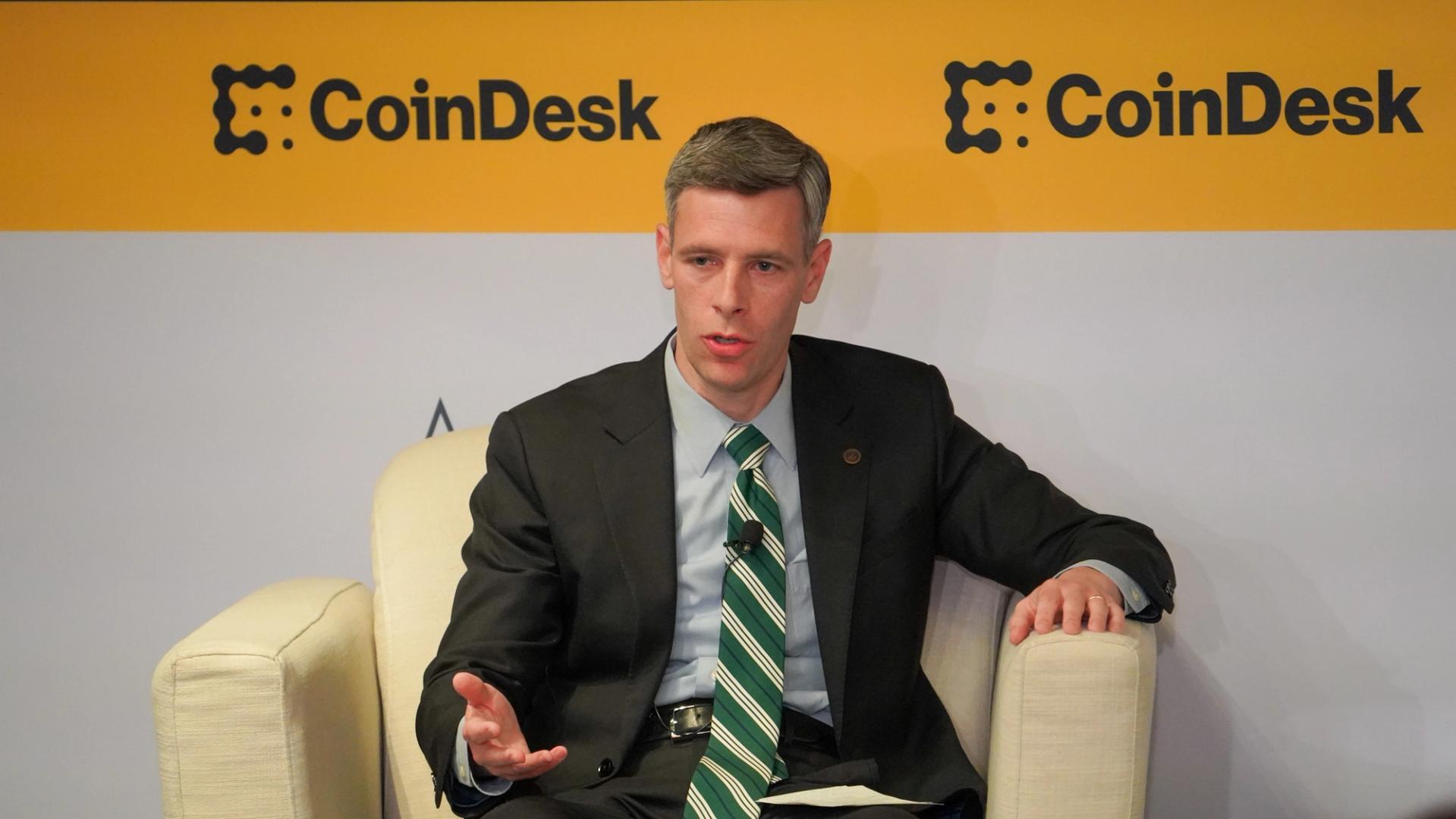
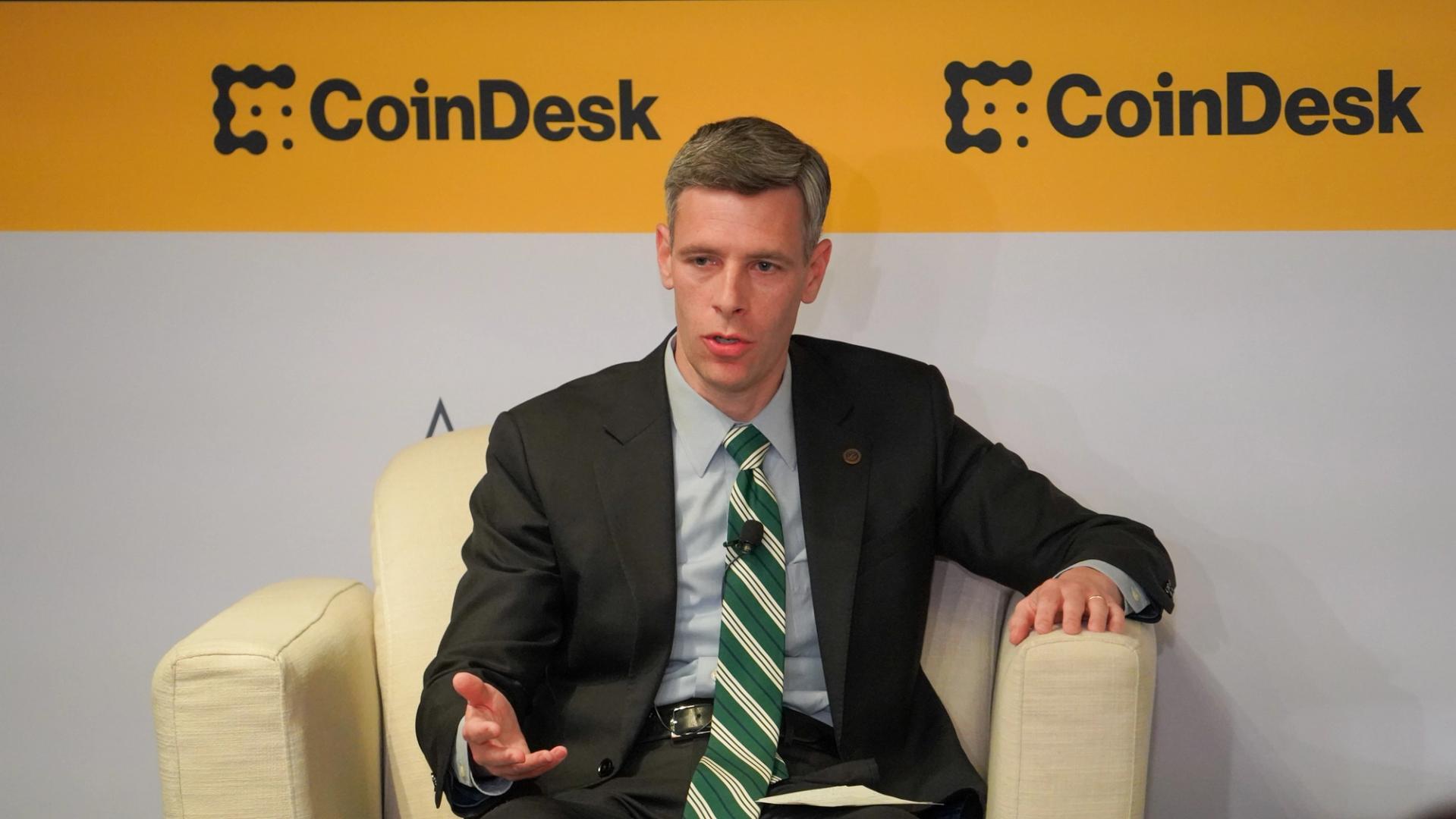
The Office of the Comptroller of the Currency published its proposed rulemaking to regulate stablecoins under the GENIUS Act, sparking questions about whether it was banning yield payouts from crypto companies.
You’re reading State of Crypto, a CoinDesk newsletter looking at the intersection of cryptocurrency and government. Click here to sign up for future editions.
The narrative
The Office of the Comptroller of the Currency (OCC), a federal banking regulator, published a notice of proposed rulemaking pursuant to the GENIUS Act explaining how it might oversee stablecoins. Most of it appears straightforward, but the portion addressing yield seems ambiguous, and possibly even controversial.
Why it matters
The OCC published its first take at rulemaking under the GENIUS Act, the first step toward turning the 2025 law into actual, applicable rules for crypto companies to abide by. Controversially, it seems to propose setting up new restrictions around how stablecoin issuers and their partners can offer yield payments to end users.
Breaking it down
Just to get this out of the way: Most of this 376-page proposal seems fairly straightforward. Provisions address custody controls, capital requirements and the other prosaic regulatory details that one would expect from a proposal seeking to govern the U.S. stablecoin sector. This newsletter may touch on those details in a future edition.
The most controversial part appears to be the sections addressing stablecoin yield and how issuers and affiliates can handle those. According to multiple people tracking this process, speaking on condition of anonymity to discuss an active rulemaking proposal candidly, these sections also seem to be ambiguous. One individual said the OCC seemed to be claiming the authority to ban third parties from offering yield from holding stablecoins, exceeding its authority in the process. But two others said the proposal fit the language of the law defined in GENIUS, and that they had no concerns about yield being banned unilaterally.
What the provisions might do is place restrictions on how stablecoin issuers’ partner companies can pay out interest on stablecoin deposits, the yield we’ve been referring to here.
“[The] proposed [section] provides that permitted payment stablecoin issuers must not pay the holder of any payment stablecoin any form of interest or yield (whether in cash, tokens, or other consideration) solely in connection with holding, use, or retention of such payment stablecoin,” the proposal said. “The OCC understands that issuers could attempt to make prohibited payments of interest or yield to payment stablecoins holders through arrangements with third parties.”
The section went on to list some of these third-party relationships but said “it would not be possible to identify in detail all, or even most, of the potential arrangements.”
However, the proposal said that the OCC would presume these payments are solely for yield purposes if there was a contract to that effect and third parties would be defined as entities paying yield as a service.
Companies would be able to push back and “rebut the presumption” if they have evidence their contractual relationship does not meet those terms, the proposal said.
Companies like Coinbase and Circle might have to tweak the terms of their relationship to abide by the terms of the proposal, as might companies like PayPal and Paxos, the issuer of PayPal’s PYUSD stablecoin, two people said about this section.
Matthew Sigal, head of digital assets research at VanEck, also shared this view, saying on X (formerly Twitter) that companies like Coinbase would have to make their agreements look more like loyalty programs than interest payments.
One confusing part about the proposal, one individual said, is in the definition of an “affiliate.” A company could be an issuer or an affiliate, where affiliates may not be able to issue yield solely for holding deposits, but the proposal appears to create a third category based on ownership stakes. If an issuer has a 25% or greater stake in a third-party, they would not be able to offer payments on yield, which might open the door for third-parties that don’t have such ownership stake concerns.
Similarly, the wording addressing “white-label relationships” may bar yield payments, but it would depend on the terms of the contract between the issuer and the company associated with the stablecoin, the person said. This is the sort of setup PayPal and Paxos have.
To further add to the confusion, stablecoin yield is also one of the issues holding up the advancement of the market structure legislation that the crypto industry continues to hope for. Two people said the OCC proposal might mean that Congress does not need to address yield in the market structure bill at all, but others said there is zero chance Congress will skip over this portion of the bill.
Yield isn’t the only issue holding up the bill — ethics provisions concerning President Donald Trump and his family’s crypto activities, as well as anti-money laundering and know-your-customer rules, still need to be worked out — but if the market structure bill becomes law, it will again reshape how stablecoins can operate in the U.S.
As a result, it is likely that this part of the OCC proposal will not be implemented as-is.
If the market structure bill does become law before the OCC can finalize its rules, the regulator will have to issue an interim proposal to remain compliant with the new law. Otherwise, there will be a whole separate rulemaking process later down the line.
On the market structure bill itself, individuals said that there is some updated draft language circulating among lawmakers but there is no deal between the banking industry and the crypto industry yet.
This week
- There are no government hearings or meetings scheduled as of press time addressing crypto-related issues.
If you’ve got thoughts or questions on what I should discuss next week or any other feedback you’d like to share, feel free to email me at [email protected] or find me on Bluesky @nikhileshde.bsky.social.
You can also join the group conversation on Telegram.
See ya’ll next week!
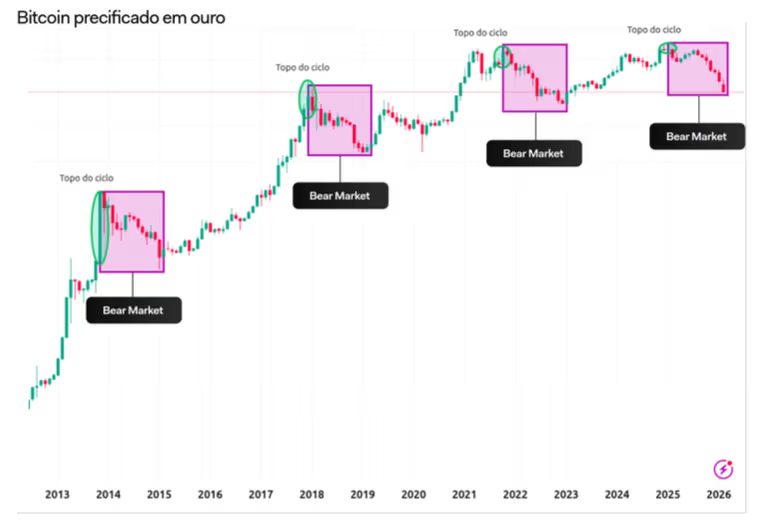
Bitcoin’s path to a market bottom could come as soon as next month, if the gold-denominated bitcoin price is any indication, according to Rony Szuster, Head of Research at the largest Brazilian crypto exchange, Mercado Bitcoin.
In dollar terms, the most recent peak occurred in October 2025 at about $126,000. If the current cycle follows past patterns, the downturn could extend into late 2026, Szuster wrote in a report shared with CoinDesk.
But when priced in gold, the timeline shifts. Bitcoin reached its high against gold in January 2025. Applying the same 12- to 13-month pattern would place a potential bottom around February 2026, with a recovery possibly beginning in March.

The divergence reflects broader macro forces.
Since the start of Donald Trump’s new mandate, markets have faced aggressive trade tariffs, domestic institutional disputes in the U.S., and rising tensions with China and Iran. Rising tensions with the latter have since resulted in ongoing military conflict.
Global uncertainty, measured via the World Uncertainty Index, has exploded as a result. Gold benefited from that shift, rising more than 80% over the past year to $5,280. As capital rotated into bullion, bitcoin weakened against it sooner than it did against the dollar, Mercado Bitcoin’s analyst wrote.
Exchange-traded funds have also added pressure. Since November, about $7.8 billion has flowed out of spot bitcoin ETFs, roughly 12% of the $61.6 billion total.
However, this fear-driven sell-off only paints part of the picture.
While reactive capital is fleeing bitcoin, large-scale investors or “whales” are treating the downturn as an accumulation zone, the report adds, pointing to Abu Dhabi’s major investment firms Mubadala Investment Company and Al Warda Investments adding in spot bitcoin ETF exposure in mid-February.
Against this backdrop, Szuster calls for investors to build their positions intelligently and leverage a dollar-cost averaging strategy to take advantage of current market fear and avoid timing issues.
“Historically, buying during periods of fear has been more effective than buying during euphoria,” he wrote. “Does this mean it’s already the bottom? No. But it means that, statistically, we are in the zone where the best average prices are usually built.”
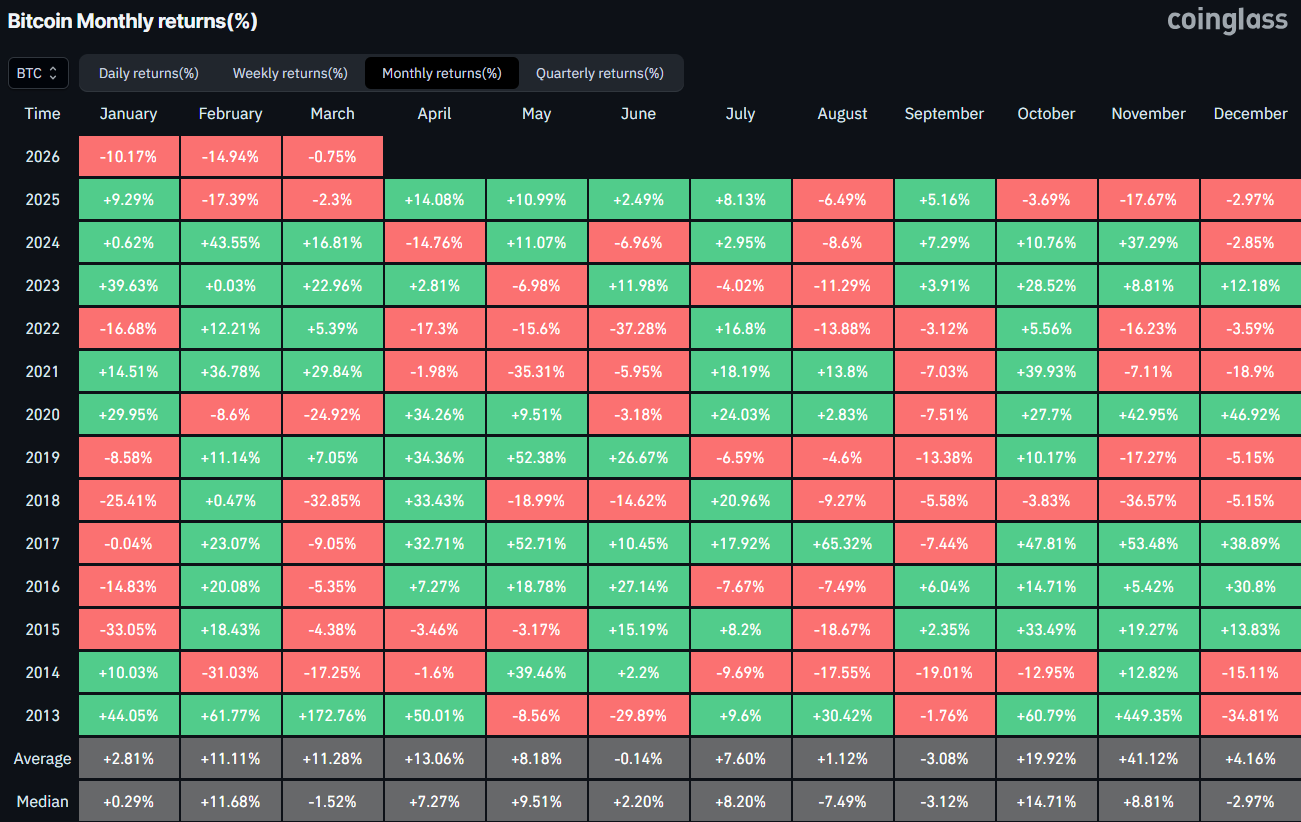
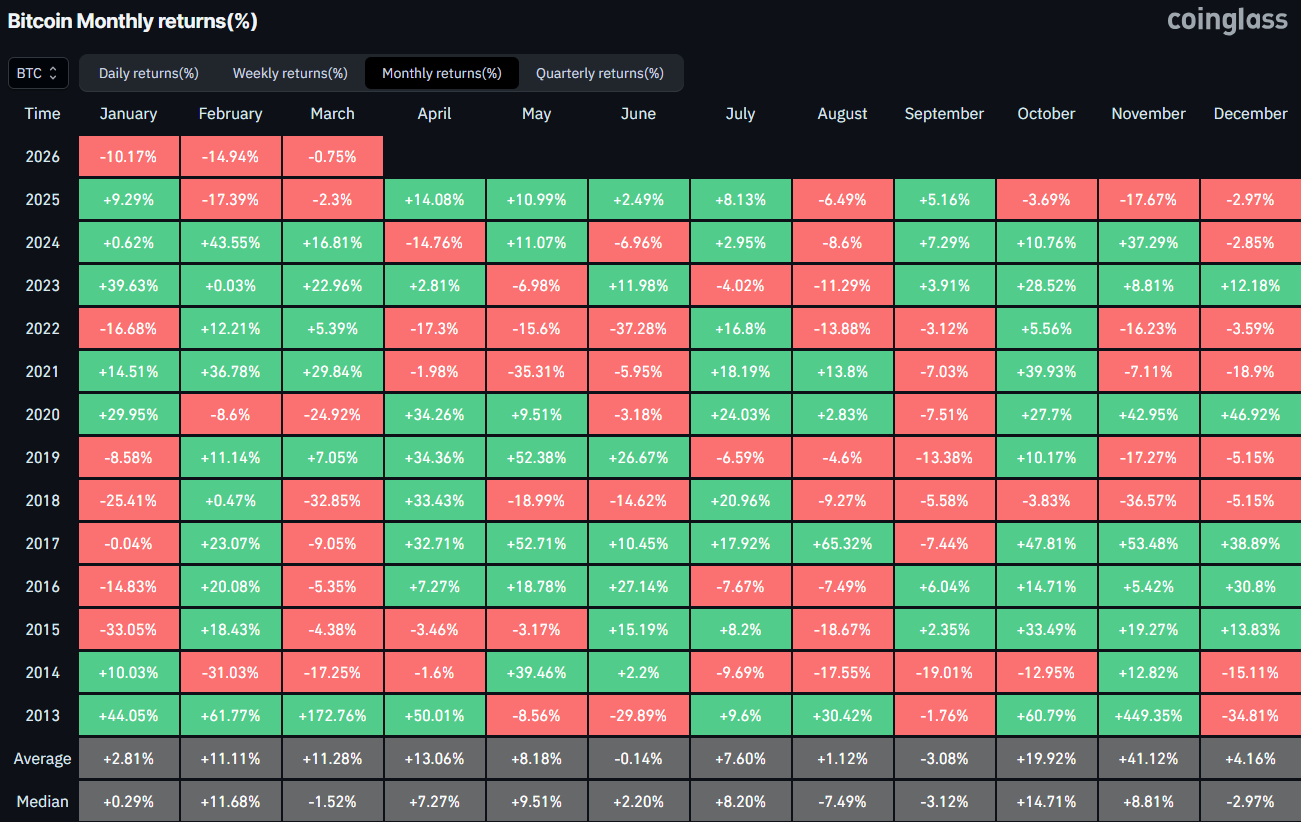
The landscape around Ethereum is even worse, with the red streak going for six months.
The positive start to 2026 was quickly erased, and bitcoin began to lose value rapidly, reaching new local lows of $60,000 in early February.
Although it recovered some ground since those 15-month lows, it still ended the month in the red with a painful double-digit decline. This made it five in a row.
February Deep in Red As Well
It was almost impossible to imagine the current situation in early October. At the time, bitcoin’s price was riding high, charting fresh peaks at over $126,000, and the community was anticipating even more records during the so-called ‘Uptober.’ The reality, though, was far different and brutal.
On October 10, the cryptocurrency market experienced its worst single-day liquidation event, with more than $19 billion wrecked as prices tumbled. As many analysts claimed after that pivotal day, something in the market’s structure broke, and it was never the same.
Bitcoin started to chart frequent losses and dumped to a five-digit price territory by the end of the year. It ended 2025 in the red, making it the first post-halving year to do so. January began on the right foot, but the rejection at $98,000 resulted in another nosedive. Thus, January saw losses of just over 10%.
Another massive crash occurred in early February, pushing bitcoin south to its lowest level since October 2024 at $60,000. Although it rebounded and finished February at around $65,000-$66,000, it still ended the month with a 15% decline. This made it the fifth consecutive month in the red for the first time since 2018.
Ethereum Goes a Step Further
Data from Cryptorank shows that the landscape around the world’s largest altcoin is even more painful. ETH has been in the red for six months in a row. Moreover, it has been in the green only three out of the past 15 months.
You may also like:
January and February were quite violent, with a 17.7% decline during the first month of the year and a whopping 19.6% drop in the second. This is the worst monthly streak for ETH since 2018, when it was in the red for seven consecutive months.
ETH is currently fighting to stay above $2,000 after dipping below that level on numerous occasions in the past month.

Binance Free $600 (CryptoPotato Exclusive): Use this link to register a new account and receive $600 exclusive welcome offer on Binance (full details).
LIMITED OFFER for CryptoPotato readers at Bybit: Use this link to register and open a $500 FREE position on any coin!
Crypto World
U.S. Authorities Arrest Goliath Ventures Executive for Alleged $328M Crypto Ponzi Scheme


Another high-profile Ponzhi scheme has been brought to light, with the main character facing up to 30 years in jail.
The United States Department of Justice (DOJ) has arrested Christopher Alexander Delgado, the 34-year-old executive of the purported venture capital firm, Goliath Ventures, for allegedly perpetrating a crypto Ponzi scheme that defrauded investors of roughly $328 million.
According to a press release from the U.S. Attorney’s Office in the Middle District of Florida, Delgado was the president and CEO of Goliath Ventures, formerly called Gen-Z Venture Firm.
DOJ Arrests Man Behind $328M Ponzi
The complaint filed against Delgado accused him of wire fraud and money laundering. The former CEO ran the scheme from January 2023 through January 2026, claiming to invest victims’ funds in crypto liquidity pools.
Delgado promised investors monthly returns while soliciting substantial investments. His victims came from charitable sponsorships, luxury events, professional marketing materials, and personal referrals. To make the scheme appear legitimate, the former Goliath president made some monthly payments to investors as purported returns.
While claiming to invest victims’ funds in crypto protocols, Delgado ran Goliath as a classic Ponzi scheme. He used funds contributed by new investors to pay existing clients, a method that enabled him to garner over $328 million from victims. Besides returning capital to those who requested it, Goliath also used victims’ funds to host lavish business gatherings and holiday parties and to pay for luxury travel accommodations.
Additionally, Delgado spent between $1.15 million and $8.5 million to acquire four residential properties, all of which were purchased with victims’ funds.
Delgado Still Under Investigation
While Delgado awaits trial, the U.S. government has asked Goliath victims to reach out for appropriate proceedings under the Crime Victims’ Rights Act.
You may also like:
The case is still under investigation by the Homeland Security Investigations and the Internal Revenue Service Criminal Investigation. If found guilty of all the charges, Delgado faces a maximum sentence of 30 years in federal prison.
Meanwhile, he is not the only company executive recently apprehended for running a crypto Ponzi scheme. As reported last week by CryptoPotato, a U.S. court sentenced Ramil Ventura Palafox, CEO of Praetorian Group International (PGI), to 20 years behind bars for defrauding at least 90,000 investors of $200 million through a Bitcoin-based Ponzi scheme. The 61-year-old Palafox falsely claimed PGI was involved in Bitcoin trading while defrauding investors.
Binance Free $600 (CryptoPotato Exclusive): Use this link to register a new account and receive $600 exclusive welcome offer on Binance (full details).
LIMITED OFFER for CryptoPotato readers at Bybit: Use this link to register and open a $500 FREE position on any coin!


The answers from the popular AI chatbot might be quite shocking to some.
The US and Israel carried out a rapid and violent military operation in Iran on February 28, which, according to reports, killed its Supreme Leader.
Iranian forces already retaliated against several countries in the region, and these developments led to significant volatility in the cryptocurrency market during the weekend.
With Trump warning that the military operation could continue further if Iran doesn’t back down, the question now is whether more fluctuations will ensue and in which direction. In this article, we focused on XRP and asked ChatGPT about its take on the matter.
Initial Shock
OpenAI’s solution also brought up the initial geopolitical shock, which is expected to harm most financial assets, especially risk-on options like altcoins, as investors tend to de-risk.
“That means moving money out of volatile assets (like cryptocurrencies) and into traditional safe havens such as gold or government bonds. This has already happened in recent responses to the US-Iran conflict. Historically, crypto markets don’t always behave like safe havens. Research on past conflicts (like Russia-Ukraine) shows cryptocurrencies often act as high-beta speculative assets, experiencing more volatility rather than absorbing risk like gold.”
Consequently, ChatGPT said the bearish pressure increases immediately for altcoins such as XRP. It added that institutional liquidity is typically withdrawn in similar uncertainty, and Ripple’s cross-border token could see new local lows of under $1.00. Recall that the asset has not traded below that level for a year and a half, but it could drop if the situation worsens in the following days.
Chances for a Rally?
Although it dismissed the chances for a quick rally given the aforementioned shock, ChatGPT noted that it’s not impossible for the mid- to long-term. To do so, though, at least one of the following three factors needs to happen.
- Demand for digital assets as a store of value is increasing
- Sharp reversal for risk-on assets, such as larger-cap altcoins.
- Major regulatory or adoption news tailored for XRP
“In other words, XRP could surge if the market’s focus shifts away from war risk toward crypto fundamentals.”
Overall, though, ChatGPT believes the short-term bias (in the first few weeks) will remain bearish, but once the shock passes or the geopolitical tensions ease, XRP could be on the verge of a breakout rally.
You may also like:
Binance Free $600 (CryptoPotato Exclusive): Use this link to register a new account and receive $600 exclusive welcome offer on Binance (full details).
LIMITED OFFER for CryptoPotato readers at Bybit: Use this link to register and open a $500 FREE position on any coin!

As CME gold futures pause for weekend trading, on-chain markets for tokenized gold have emerged as the dominant venue for price discovery. With traditional futures offline for roughly 25 hours, tokenized assets that live on blockchain networks are providing reference prices during the gap, according to Iggy Ioppe, the chief investment officer at Theo, a liquidity infrastructure firm. He notes that weekend price formation tends to occur in on-chain venues, and that reopenings often align with moves seen during the next trading day on the traditional exchange. The trend underscores how tokenized gold complements rather than replaces physical bullion holdings.
Key takeaways
- Weekend price discovery for gold largely shifts to on-chain markets, driven by the closure of CME futures from Friday evening through Sunday evening.
- Tokenized gold’s market capitalization expanded to about $4.4 billion, rising 177% year over year and supported by more than 115,000 wallet holders.
- 2025 tokenized-gold volume reached roughly $178 billion, with fourth-quarter activity peaking above $126 billion, making it one of the most traded bullion proxies behind a leading ETF.
- Market makers and cross-venue liquidity providers dominate on-chain trading, complemented by crypto-native macro traders using tokenized gold for exposure, collateral, and hedging during macro or geopolitical stress.
- Liquidity gaps, regulatory fragmentation, and custody rules remain primary obstacles to broader institutional adoption, with a parallel evolution expected alongside traditional gold products.
Tickers mentioned: $BTC, $ETH, $PAXG, $XAUt, $GLD
Sentiment: Neutral
Price impact: Neutral. Weekend on-chain activity provides a reference that often feeds into the next regular session, without implying immediate directional bets.
Market context: The rise of 24/7 on-chain markets for tokenized gold sits within a broader trend toward continuous liquidity pools and cross-venue arbitrage, even as traditional markets reopen and liquidity reorganizes around established benchmarks.
Why it matters
The weekend dynamics of tokenized gold reflect a maturation of the asset class that sits between crypto markets and traditional commodities. When CME futures halt trading, on-chain platforms step in to offer continuous price formation for bullion-like exposures. This continuity matters for institutions and traders who seek to manage gap risk through perpetual access to price signals rather than relying solely on once-a-day settlement venues.
Market participants emphasize that tokenized gold is not a wholesale substitute for physical gold or ETF products but a parallel channel that can complement risk management, collateralization, and yield strategies. The leadership role of liquidity providers and cross-venue traders highlights how on-chain markets can absorb large blocks without triggering abrupt dislocations, a feature particularly valuable during periods of geopolitical or macroeconomic uncertainty.
From a macro perspective, tokenized gold is increasingly viewed as a tool for exposure to bullion prices that integrates with crypto and DeFi ecosystems. As institutions examine regulatory clarity and custody solutions, the sector’s growth underscores a broader appetite for diversified, bullion-linked on-chain assets that can operate around the clock. In this sense, tokenized gold broadens the toolkit for risk-off strategies and hedging in an environment where traditional markets may experience abrupt sentiment shifts.
What to watch next
- Monitor weekend-to-weekend price formation: whether on-chain moves continue to forecast or diverge from CME reopenings on Sundays and Mondays.
- Regulatory progress across jurisdictions: how custody, accounting, and cross-border rules evolve to support institutional participation in tokenized-gold markets.
- Liquidity enhancement efforts: shifts in cross-venue liquidity provision and the development of standardized settlement and reporting for tokenized bullion.
- Adoption by macro desks and risk teams: whether banks and asset managers begin incorporating tokenized gold into collateral and hedging frameworks.
- Volume and wallet growth signals: continued tracking of 2025 volume trends and the pace of new wallet creation as a proxy for participation.
Sources & verification
- Tokenized gold market expansion and metric highlights: tokenized gold drives RWA growth 2025 (link in source text)
- PAX Gold price index and on-chain price-formation insights: pax-gold price index (link in source text)
- On-chain weekend price discovery and market structure discussions: bitcoin price slump versus gold’s gains highlights evolving crypto market (link in source text)
- Geopolitical risk and safe-haven dynamics influencing gold and crypto (link in source text)
- Tokenization explainer and related market context: tokenization explained (link in source text)
What the market is saying about tokenized gold
Bitcoin (CRYPTO: BTC) and Ethereum (CRYPTO: ETH) traded with caution over the weekend as headlines moved markets, while tokenized gold assets provided continuous reference points for bullion-like exposure. The on-chain activity around PAX Gold (CRYPTO: PAXG) and Tether Gold (CRYPTO: XAUt) demonstrated how decentralized-price discovery can function when traditional venues are closed. On Saturday, PAXG and XAUt benefited from a surge in interest as geopolitical tensions intensified, with XAUt peaking above the early-week momentum. These movements illustrate how on-chain markets can capture evolving risk sentiment in real time, offering a complement to established futures and ETF products, such as SPDR Gold Shares (EXCHANGE: GLD).
Tokenized gold market dynamics and the role of liquidity providers
Industry observers note that the lion’s share of trading activity is driven by market makers and cross-venue liquidity providers who exploit price differentials between digital and traditional markets. Crypto-native macro traders also rely on tokenized gold not only for bullion-like exposure but also as collateral, hedging tools, and yield-generation strategies during periods of heightened macroeconomic or geopolitical risk. While adoption is accelerating, fragmentation across jurisdictions and evolving custody rules mean institutions proceed cautiously, seeking standardized frameworks before scaling large, executable trades.
What to watch next
- Keep an eye on weekend price discovery to see whether on-chain signals consistently precede CME reopenings.
- Watch regulatory developments around custody and accounting for tokenized assets, which could unlock broader institutional deployment.
- Track liquidity improvements across tokenized-gold venues and any progress toward consolidated reporting for cross-venue trades.
- Observe institutional testing of tokenized gold as collateral in crypto and traditional markets, and its effect on liquidity in times of stress.
Market context
The rise of 24/7 tokenized-gold markets aligns with broader shifts toward continuous liquidity in crypto-native assets and real-world asset tokenization. As macro conditions, risk sentiment, and regulatory landscapes evolve, tokenized bullion offerings are increasingly treated as part of a diversified toolkit for managing tail risks and obtaining bullion-like exposure outside standard spot markets.
Why it matters
For users and investors, the emergence of around-the-clock price discovery for tokenized gold expands access to bullion-driven strategies beyond traditional exchanges. It offers potential advantages in risk management and hedging, particularly during times when geopolitical or macro events disrupt standard trading hours. For builders and incumbents in the digital asset ecosystem, these dynamics underscore the importance of robust liquidity, reliable custody solutions, and interoperable settlement rails to sustain confidence and participation among institutions. Finally, for the market at large, tokenized gold represents a meaningful bridge between crypto markets and traditional commodities, illustrating how tokenization can add resilience to risk management frameworks even as the asset class continues to mature.


Disclosure: This article does not represent investment advice. The content and materials featured on this page are for educational purposes only.
Cloud mining regains momentum in 2026 as crypto investors revisit its profitability amid rising adoption and changing market conditions.
Summary
- As 2026 unfolds, investors reassess cloud mining profitability amid rising demand for low-cost Bitcoin access.
- Five verified cloud mining platforms aim to offer simple, hardware-free crypto income options.
- Hashbitcoin emerges as a compliance-focused leader in transparent, eco-friendly mining services.
As the cryptocurrency industry continues to grow, more and more cryptocurrency enthusiasts are turning to cloud mining as their preferred way to earn Bitcoin and other digital assets.
Compared to traditional mining methods, cloud mining does not require expensive hardware or complex technical knowledge, making it a popular choice for both beginners and experienced investors. However, by 2026, many people are still asking a key question: Is cloud mining still profitable today?
To answer this question, we will explore the current state of cloud mining and present five verified free cloud mining platforms. Whether someone’s a cryptocurrency novice or an experienced investor, these platforms allow them to earn stable Bitcoin income in a simple and low-risk way.
Cloud mining in 2026: Trends and advantages
Cloud mining is a method of mining Bitcoin and other cryptocurrencies remotely without the need to purchase and maintain hardware. By renting hash power from remote data centers, users can earn Bitcoin or other cryptocurrency rewards without dealing with complex technical issues.
The main advantages of cloud mining include:
- Zero equipment costs: No need to purchase expensive mining rigs, pay high electricity bills, or handle maintenance.
- Accessible anywhere: Mining activities can be easily monitored and managed online with just an internet-connected device.
- Low entry barrier: Many platforms offer free trials or low-cost entry options, making it ideal for beginners.
However, the cloud mining industry is not without risks. Scams and lack of transparency are still prevalent, so it’s crucial to choose a regulated, transparent, and reputable platform.
Top 5 verified free cloud mining platforms in 2026
Here are five verified free cloud mining platforms that are not only safe and reliable but also offer free trials, allowing anyone to earn Bitcoin without any upfront investment:
1. Hashbitcoin – The most trusted cloud mining platform in 2026
As the leader in the cloud mining industry in 2026, Hashbitcoin stands out for its compliance, transparency, and environmentally friendly mining services.
Headquartered in the UK, the company combines renewable energy with advanced AI optimization technology to ensure users achieve efficient and sustainable mining profits.
Core advantages of Hashbitcoin:
- Free Bonus: New users receive a $15 free hash power bonus upon registration.
- Fast Payouts: Daily Bitcoin payouts with no delays.
- AI Optimization: Intelligent hash power allocation to maximize profits.
- Green Energy: 100% renewable energy usage (hydropower, wind, solar, and geothermal).
- Transparent Contracts: All mining contracts are clear and refundable.
Hashbitcoin’s global green mining network:
Hashbitcoin’s hash power comes from multiple clean energy mining farms distributed worldwide, including:
- Norway: Bitcoin mining powered by 100% hydropower.
- Canada: Efficient hydropower mining centers.
- Iceland: Geothermal-powered Bitcoin mining facilities.
- Uruguay: A hybrid mining system using wind and solar energy.
- Paraguay: Ultra-low-cost giant hydropower plants.
- Sweden: Sustainable mining solutions combining wind and hydropower.
These green energy mining farms not only reduce mining costs but also significantly increase Bitcoin output per unit of hash power, far exceeding the industry average.
Hashbitcoin contract examples:
| Contract Name | Investment Amount | Contract Term | Daily Rewards | Total Return (incl. Principal) |
| Newbie Mining Plan | $200 | 1 day | $7 | $207 |
| Avalon Miner A15 Pro | $1200 | 2 days | $43.2 | $1286.4 |
| BitDeer SealMiner A2 | $3600 | 3 days | $136.8 | $4010.4 |
| Avalon Nano 3S Miner | $8000 | 2 days | $344 | $8688 |
| Antminer S23 Hyd | $16800 | 3 days | $924 | $19572 |
| Whatsminer M63S (390T) | $33000 | 2 days | $2145 | $37290 |
| Antminer E9 Pro | $58000 | 1 day | $5104 | $63104 |
Sign up now to claim $15 free hash power and start the mining journey!
For more information, visit Hashbitcoin official website.
2. NiceHash – Flexible hash power marketplace
NiceHash provides a global hash power marketplace where users can directly rent or sell hash power. While most contracts require payment, its free “NiceHash Miner” software offers new users an easy way to get started. The software is simple to operate and is suitable for miners who want flexible control over their hash power.
3. CryptoTab Browser – Mine Bitcoin while browsing the web
CryptoTab Browser is a tool that allows users to mine Bitcoin automatically while browsing the internet. Although the earnings are limited, it’s very beginner-friendly and doesn’t require any complicated setup. It’s a great option for users who want to experience cloud mining at zero cost.
4. ECOS – Government-supported cloud mining platform
Located in Armenia’s Free Economic Zone, ECOS is one of the few cloud mining platforms with government approval. The platform offers regulated mining services and free trial contracts. While the free package provides limited hash power, its compliance and transparency make it an ideal choice for many new users.
5. F2Pool – Free mining services from a veteran mining pool
F2Pool is one of the oldest and most well-known mining pools in the world, and it also offers limited free mining services. Although the rewards are small, its long-standing reputation and security make F2Pool a reliable choice for long-term profitability.
Conclusion: Is cloud mining still worth it in 2026?
The answer is yes! Even in 2026, cloud mining remains a viable and profitable option, but only if the right platform is chosen. Hashbitcoin stands out as the safest and most profitable choice, offering free bonuses, daily payouts, renewable energy support, and transparent contracts.
For those looking for a way to earn passive Bitcoin income without any upfront investment, starting with Hashbitcoin could be a safe and reliable choice. It provides an opportunity for everyone to participate in cryptocurrency mining with ease.
Ready to start earning free Bitcoin? Sign up for Hashbitcoin now and start mining without hardware.
Disclosure: This content is provided by a third party. Neither crypto.news nor the author of this article endorses any product mentioned on this page. Users should conduct their own research before taking any action related to the company.

Why Tiger Woods Playing the Masters Seems Unlikely

The Long Afterlife Of The Console Modchip

Italian skier Sofia Goggia wins super-G to regain commanding lead in World Cup discipline standings


-

 Sports6 days ago
Women’s college basketball rankings: Iowa reenters top 10, Auriemma makes history
-

 Fashion2 days ago
Weekend Open Thread: Iris Top
-

 Politics6 days ago
Nick Reiner Enters Plea In Deaths Of Parents Rob And Michele
-

 Business5 days ago
True Citrus debuts functional drink mix collection
-

 Politics3 days ago
ITV enters Gaza with IDF amid ongoing genocide
-
Sports1 day ago
The Vikings Need a Duck
-

 Tech12 hours ago
Unihertz’s Titan 2 Elite Arrives Just as Physical Keyboards Refuse to Fade Away
-

 Crypto World5 days ago
XRP price enters “dead zone” as Binance leverage hits lows
-

 Tech5 days ago
Unsurprisingly, Apple's board gets what it wants in 2026 shareholder meeting
-
 NewsBeat23 hours ago
Dubai flights cancelled as Brit told airspace closed ’10 minutes after boarding’
-

 Business7 days ago
Law enforcement kills armed man seeking to enter Trump’s Mar-a-Lago resort, officials say
-

 NewsBeat4 days ago
Cuba says its forces have killed four on US-registered speedboat | World News
-
 NewsBeat1 day ago
The empty pub on busy Cambridge road that has been boarded up for years
-
 NewsBeat4 days ago
Manchester Central Mosque issues statement as it imposes new measures ‘with immediate effect’ after armed men enter
-
 NewsBeat6 days ago
‘Hourly’ method from gastroenterologist ‘helps reduce air travel bloating’
-

 Tech7 days ago
Anthropic-Backed Group Enters NY-12 AI PAC Fight
-

 NewsBeat19 hours ago
Abusive parents will now be treated like sex offenders and placed on a ‘child cruelty register’ | News UK
-

 NewsBeat7 days ago
Armed man killed after entering secure perimeter of Mar-a-Lago, Secret Service says
-
 NewsBeat5 days ago
Police latest as search for missing woman enters day nine
-

 Business3 days ago
Discord Pushes Implementation of Global Age Checks to Second Half of 2026