
Crypto World
ASML (ASML) Stock: Why TD Cowen Sees This 7% Dip as a Prime Buying Opportunity


Key Takeaways
- ASML’s American depositary shares have declined 7% over the last 30 days amid a broader retreat from AI-linked semiconductor equities.
- TD Cowen’s Krish Sankar maintains a Buy recommendation with a €1,500 price objective (approximately $1,735).
- The company’s valuation multiple relative to semiconductor equipment competitors has contracted from 120% to roughly 20% since Q4 2022.
- Next-generation logic processors and DRAM memory chips are projected to demand increased EUV lithography layers.
- Nvidia CEO Jensen Huang recently projected $1 trillion in cumulative AI chip orders extending through 2027, reinforcing ASML’s growth trajectory.
ASML shares have retreated from their recent peak levels, creating what TD Cowen analyst Krish Sankar characterizes as a “very attractive” entry point for investors. His optimistic stance centers on compressed valuation metrics and robust long-term expansion potential linked to surging AI semiconductor demand.
The company’s U.S.-traded shares have fallen 7% during the past month. This decline occurred as market participants shifted capital away from AI-adjacent chip stocks, despite ASML posting record-breaking orders for its advanced lithography equipment.
ASML occupies a strategic position within the semiconductor manufacturing ecosystem. The Dutch firm maintains an effective monopoly on extreme ultraviolet (EUV) lithography technology, which remains essential for producing cutting-edge microchips. No competing vendor currently offers comparable systems.
Since late 2022, ASML’s valuation premium compared to semiconductor equipment manufacturers such as Applied Materials, Lam Research, and KLA Corp has narrowed dramatically from 120% to approximately 20%. Sankar attributes this compression to current chip production techniques that utilize fewer EUV processing steps.
However, Sankar contends this dynamic is poised to shift. Upcoming generations of both logic semiconductors and memory technology — particularly DRAM — will require additional EUV layers during fabrication. He emphasizes that the memory sector implications remain “underappreciated” among investors.
High-NA EUV Technology: Emerging Growth Catalyst
ASML’s latest High-NA EUV equipment remains in the initial stages of commercial deployment. The company reported revenue from only two High-NA units during Q4 2025, contrasted with 94 conventional lithography systems delivered during that same quarter.
TSMC has demonstrated reluctance in publicly embracing High-NA EUV adoption. The foundry giant has indicated it can maximize existing equipment capabilities. Nevertheless, Sankar expects enhanced system reliability will ultimately drive broader customer adoption.
TD Cowen’s financial models project 60 lithography system shipments in 2026, expanding to 68 units in 2027 as High-NA equipment volumes double and legacy platforms transition to upgraded variants.
Sankar rates ASML’s Amsterdam-traded shares as Buy with a €1,500 price objective, calculated at 48 times his 2027 earnings per share projection. ASML’s European-listed equity closed Thursday at €1,165. The U.S.-listed American depositary shares traded down 1.4% at $1,347.40 during premarket hours.
AI Capital Expenditure Underpins Long-Range Demand
The fundamental demand environment for ASML remains robust. Nvidia CEO Jensen Huang, presenting at GTC 2026 on March 16, elevated his AI chip order projection to at least $1 trillion through 2027. Broadcom CEO Hock Tan has independently forecasted $100 billion in AI semiconductor revenue for fiscal year 2027.
Amazon, Microsoft, Google, and Meta are anticipated to deploy nearly $600 billion in combined capital expenditures throughout 2026, with substantial portions allocated to AI infrastructure investments.
ASML also generates predictable recurring revenue. Maintenance and service contracts for its deployed equipment base represented approximately 25% of total 2025 revenue.
ASML currently commands a forward price-to-earnings ratio of 39.8, exceeding its 10-year median of 35.8. The company’s market capitalization stands at approximately $527 billion.


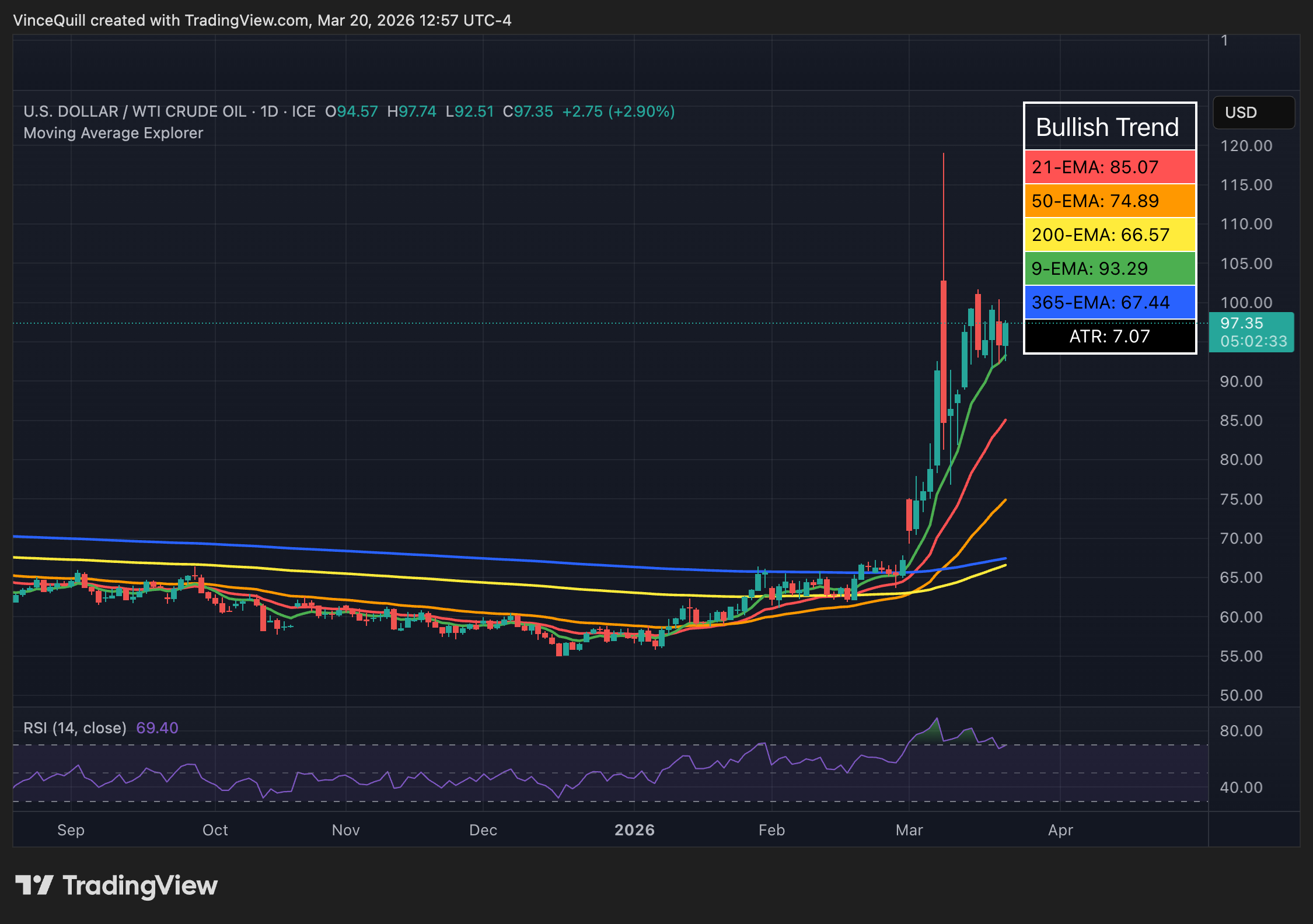
Traders are miscalculating the severity and the duration of economic fallout from the Middle East conflict and are pricing in a “TACO” trade, which stands for “Trump always chickens out,” according to market analyst and founder of the Coin Bureau, Nic Puckrin.
The term was coined by Wall Street and refers to US President Donald Trump backing down in geopolitical conflicts. However, Puckrin warned that “Trump is not in sole control of the situation,” and there are no easy or quick exits from the war.
If oil continues to trade above $100 per barrel, economic growth will slow, and Personal Consumption Expenditures (PCE) inflation will rise by up to 1 percentage point, Puckrin said.

This environment could lead to stagflation, an economic scenario where inflation rises, while economic growth and employment fall, a “dreaded” situation, Puckrin said. He added:
“If oil stays above $100 throughout Q2 and into Q3, stagflation becomes a real problem for the Fed. In the 1970s, the S&P 500 went essentially nowhere in real terms for an entire decade once stagflation took hold.”
Markets might have a “rude awakening” to the war in the Middle East, Puckrin said, stressing that the longer the Strait of Hormuz, a waterway that 20% of the global oil supply passes through, remains closed, the economic effects will worsen.
“Even if the Strait of Hormuz were to open today, the disruption to the Gulf’s oil-producing infrastructure will take months to rebuild,” he said.

Energy is a critical input to all economic activity, and a rise in energy prices typically raises the price of all other goods and services.
Elevated inflation means interest rate cuts, which are stimulative to risk assets like crypto, will not materialize, and the Federal Reserve may raise rates to combat inflation, quashing any hopes of easing liquidity conditions to spur a crypto market rally.
Related: Bitcoin whales shift $100M+ as oil spike rattles markets
Federal Reserve chairman says Middle East war clouds the central bank’s forecasts
The Federal Open Market Committee (FOMC), the group that determines interest rate policy in the United States, held interest rates steady in March, leaving the Federal Funds rate between 3.5% and 3.75%.
Rate cut odds have all but vanished for the upcoming April FOMC meeting. Meanwhile, there’s a small but growing probability — aorund 12% — that the FOMC will raise rates next month, according to the Chicago Mercantile Exchange’s (CME) FedWatch tool.

“The implications of events in the Middle East for the US economy are uncertain in the near term. Higher energy prices will push up overall inflation,” Federal Reserve Chairman Jerome Powell said at a press conference on Wednesday.
However, Powell clarified that it is still “too soon” to accurately gauge the scope and severity of the potential economic effects from the war and the disruption to the global energy infrastructure.
Magazine: Bitcoin is ‘funny internet money’ during a crisis: Tezos co-founder
Crypto World
Solana Price Prediction for 2026 as SEC Clarifies Crypto Assets and Pepeto’s Working Exchange Sets Up for 100x Before the Binance Listing
The SEC just clarified that it considers most crypto assets not securities under federal law, and the ruling changes the regulatory deck for every digital asset from Solana to the smallest presale. Japan rolled out retail USDC yield through SBI, and Circle is pushing the UK to shape global stablecoin rules. Three major economies are simultaneously building regulated stablecoin infrastructure.
While the solana price prediction hinges on macro cooperation, Pepeto’s working exchange ecosystem is already measurable, and the presale at $0.000000186 gives you the chance to see exactly what you are buying at pre listing pricing before the Binance listing changes everything.
The SEC issued its most definitive statement on crypto classification, with Chair Paul Atkins calling it clear lines in clear terms according to CoinDesk. Japan’s SBI VC Trade launched a retail USDC lending service for consumer yield on regulated stablecoins.
SOL trades at $88 after hotter than expected PPI data reinforced fears of delayed rate cuts according to CoinMarketCap. The solana price prediction depends heavily on the Fed’s tone, which remains uncertain.
Solana Price Prediction and the Presale Where the Tools Are Already Working and the 100x Math Is Conservative
Pepeto’s Exchange Went Live During Presale and the Entry at $0.000000186 Is the Chance to Position Before the Listing Changes the Price
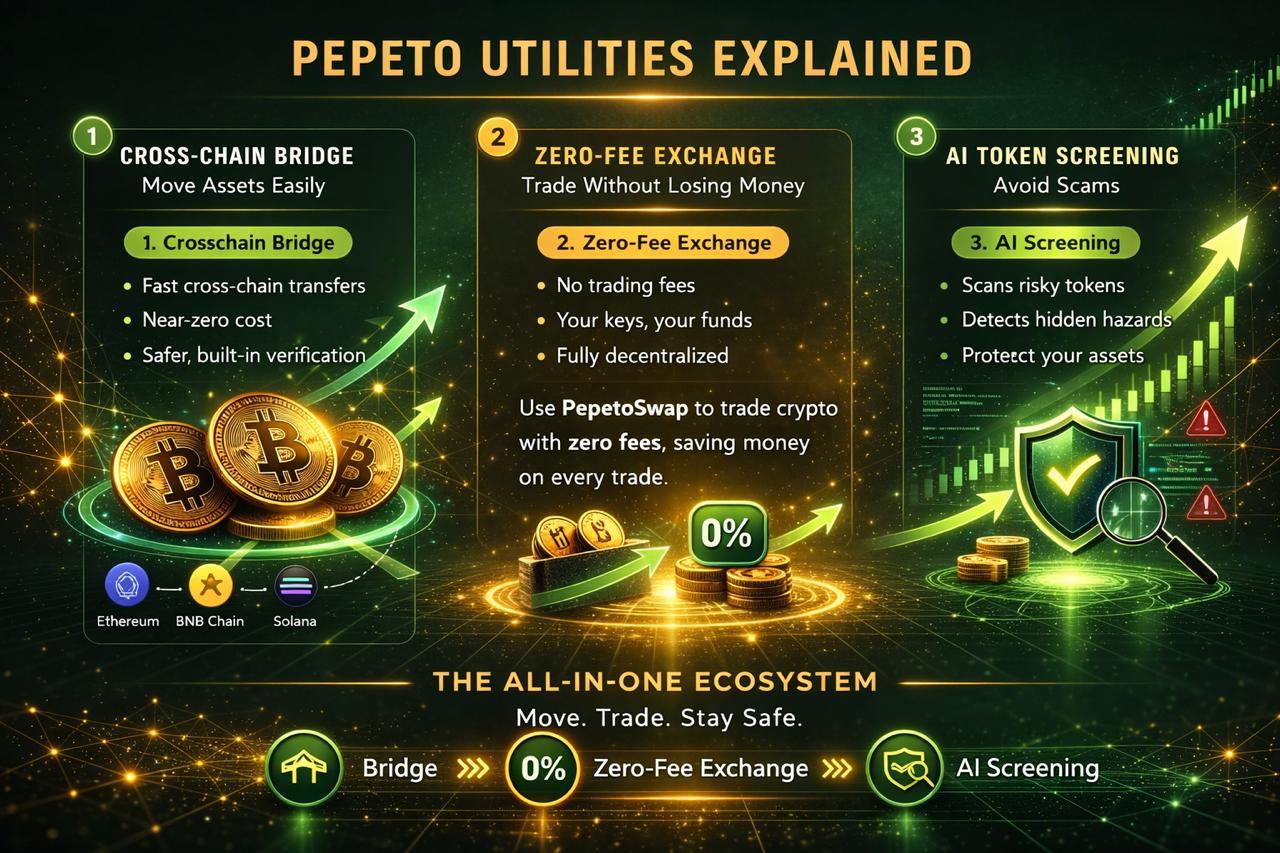
Pepeto’s exchange tools went live during presale, and the daily workflow they enable is simple compared to the hours of manual research traders do right now. PepetoSwap handles every trade at zero cost. The bridge moves capital across Ethereum, BNB Chain, and Solana without fees. The risk scorer gives you a breakdown of any contract’s danger signals before your wallet approves.
Five minutes of due diligence done with tools that are sharper than anything else out there, and all of that would normally take hours and be less reliable. The ecosystem is built to change the way retail traders protect their capital, and the reason this token has 100x to 150x potential is not just the utility. It is the timing.
Created by the mind who took the original Pepe to $7 billion, Pepeto is approaching the Binance listing at exactly the moment when the market is crying out for trust and transparency. Nothing like this set of tools has existed before at presale pricing, and the need is real across every trading demographic. When something this useful becomes a daily habit for traders worldwide, and each new user adds buying pressure on PEPETO, the token does not need manufactured hype because the product is the catalyst.
The presale is in its final stretch now, with the listing approaching fast. Since the tools are already live, you can see exactly what you are buying and still pay presale pricing. Anyone who recognizes what a 100x entry looks like before launch will spot that potential in Pepeto, but buying in now is crucial to personally benefit from the explosive move that follows the listing.
Solana Price Prediction for 2026 at $88
SOL trades at $88 after PPI data reinforced delayed rate cut fears according to CoinMarketCap. Derivatives funding rates went negative and the price was rejected near $97. The $88 level is critical, and holding it keeps a rebound toward $94 within view.
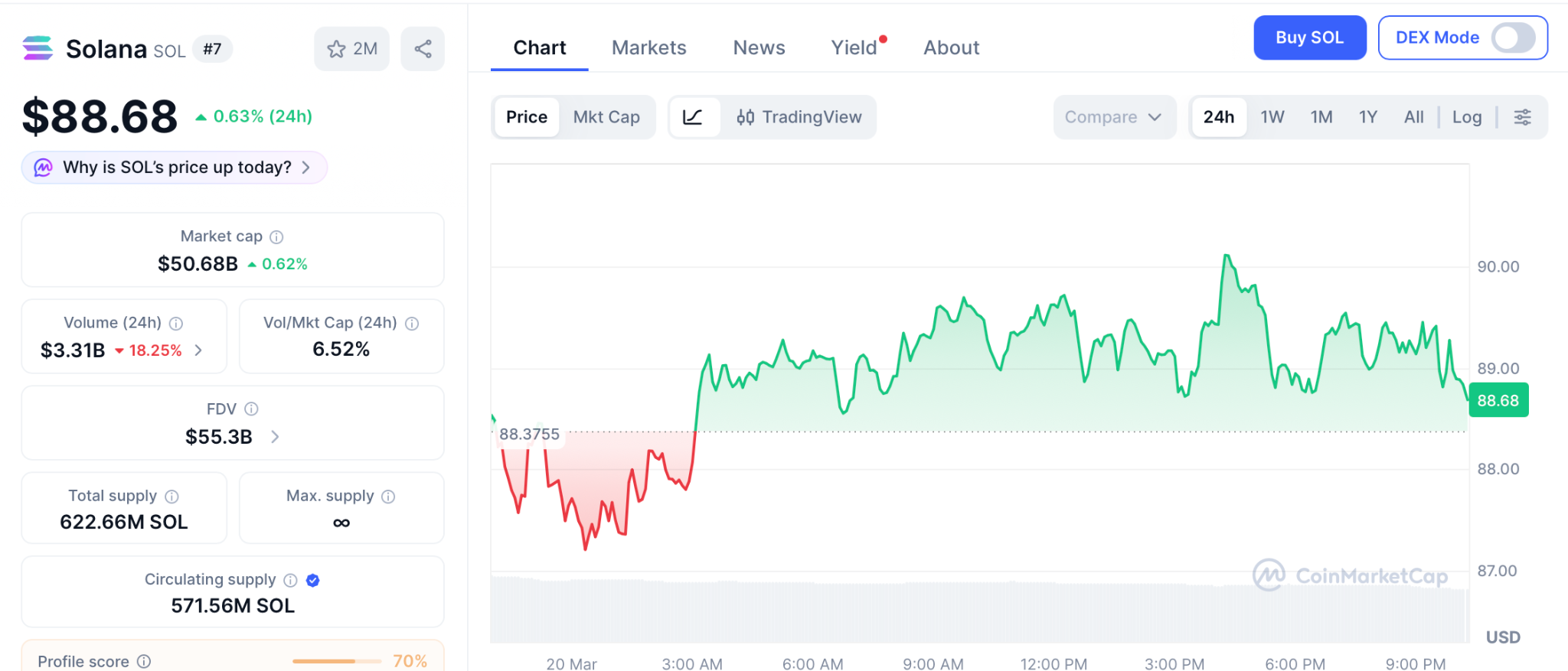
Still, the solana price prediction for 2026 depends on the Fed’s tone. From $88, even a move to $137 is roughly 55%, and that takes the rest of the year.
Chainlink Trades Sideways at $9
LINK trades at $9 after a 6.5% weekly drop according to CoinGecko. Despite positive regulatory news classifying LINK as a digital commodity, the macro selloff overpowered it. If LINK defends $9.00, a sideways range between $9.00 and $9.50 is most likely.
Chainlink’s oracle infrastructure underpins DeFi, but like the solana price prediction, the near term path needs macro relief that has not arrived.
The Solana Price Prediction Needs Macro Cooperation but Pepeto Needs Only the Listing
The solana price prediction’s technical setup stays positive if SOL holds $88, and Chainlink’s oracle role keeps it structurally important. But both are waiting on external triggers: Fed rhetoric, market structure legislation, and institutional rotation. Pepeto is not constrained by any of those factors.
It has a working exchange, staking that compounds at 196% daily, and holders who already see exactly what the tools do. At $0.000000186, the token is still at presale pricing, but that changes the moment the Binance listing arrives. The Pepeto official website is where the traders who understand the difference between waiting on macro and entering a presale with live products are positioning right now.
Click To Visit Pepeto Website To Enter The Presale

FAQs
What is the solana price prediction after the recent dip?
SOL trades at $88 with a rebound toward $94 to $97 possible if support holds. The solana price prediction depends on the Fed’s tone and macro conditions improving.
How does Chainlink fit into the solana price prediction outlook?
LINK’s oracle infrastructure is foundational to DeFi but like the solana price prediction, its near term path depends on macro relief that has not arrived yet.
Why is Pepeto a stronger entry than SOL right now?
Pepeto at $0.000000186 with three live tools and a Binance listing does not depend on external catalysts. Visit the Pepeto official website before the listing closes the presale.
Disclaimer: This is a Press Release provided by a third party who is responsible for the content. Please conduct your own research before taking any action based on the content.

New entries consist of large companies and ETFs
The securities added span fields such as technology, energy and aerospace. In addition, IonQ, Eaton, Rocket Lab, GE Vernova, and VinFast Auto have become tokenized companies. Also, exchange-traded funds such as iShares MSCI India ETF and Vanguard Real Estate ETF have entered the platform.
Ondo Global Markets is currently working with over 250 tokenized instruments on various blockchain networks. They are accessible on Ethereum, Solana, and BNB Chain, enabling access to more global markets. In addition to this, any new securities are listed immediately on the platform and can be traded.
The growth comes with increasing regulatory transparency regarding tokenized securities in the U.S. Notably, Nasdaq’s proposal to trade tokenized securities was endorsed recently by the U.S. Securities and Exchange Commission. This trend has fostered the scaled offering of platforms based on real-world assets. Institutional investors are still increasing their demand for tokenized real-world assets. In addition, tokenization provides quicker settlement and underlies fractional ownership, which enhances accessibility. These aspects have helped blockchain-based financial products grow steadily.
RWA value is close to 2.6 billion
Statistics indicate that the aggregate real-world asset value in Ondo Finance is approaching 2.6 billion. The portfolio consists of tokenized US Treasuries, equities, and commodities. This increase also shows rising use of blockchain infrastructure in conventional finance. Although the ONDO token has seen a minor negative growth in recent trading sessions. The token is experiencing a 1% decline on the day and over 3% in the last week. Nevertheless, the wider crypto market has not been favorable and has impacted price action.
The deal doubles the valuation from Kalshi’s previous round in November.
CFTC-regulated prediction market platform Kalshi is raising around $1 billion at a $22 billion valuation in a new funding round, according to multiple reports. The new round is led by Coatue Management, per The Wall Street Journal, which was first to report the news on Thursday. March 19.
The deal doubles the valuation from Kalshi’s previous round in November, which also raised $1 billion, but at an $11 billion valuation, as The Defiant reported.
A person familiar with the matter told Bloomberg yesterday that Kalshi’s annualized revenue stands at $1.5 billion.
The latest raise marks an 11x valuation from less than a year ago. Last June, Kalshi raised $185 million at a $2 billion valuation, led by Paradigm, followed by a $300 million raise in October at $5 billion.
Regulatory Questions
The raise comes despite regulatory hurdles in the U.S., as Kalshi remains embroiled in several lawsuits with U.S. state gambling regulators. The ongoing battle between prediction market platforms like Kalshi and state regulators centers on the question of whether state or federal regulators are responsible for the oversight of these platforms.
Kalshi is licensed by the Commodity Futures Trading Commission’s (CFTC), and thus argues it should be subject to federal oversight, without requiring licensing on a state by state basis.
The Trump administration’s CFTC has vocally backed the company’s position that its contracts fall under federal jurisdiction. Last week, the agency launched a sweeping review of prediction markets and issued an advance rulemaking notice and a staff advisory.
Just yesterday, the same day the fundraising news came out, a U.S. federal appeals court denied Kalshi’s emergency motion to block a potential temporary restraining order from the state of Nevada. The court decision clears the way for Nevada state regulators to seek a temporary ban on Kalshi’s operations there.
Earlier this week, Arizona hit the company with 20 criminal counts accusing it of operating an illegal gambling business and offering election wagering. At least nine other states have taken some form of legal action against Kalshi, with outcomes so far split across jurisdictions, ESPN reported.
Prediction Market Sector
Kalshi sees an average of more than $30.5 million in trading volume daily, per data from KalshiData. Meanwhile, on-chain prediction market Polymarket continues to lead the sector by volumes, consistently seeing over $150 million in daily trading volume in the past month, per data from TokenTerminal.
Last year, monthly prediction market volumes grew 130-fold from early 2024, making the sector one of the fastest-growing in finance, as The Defiant reported previously.
Polymarket received CFTC approval to operate in the U.S. in November 2025, backed by a $2 billion strategic investment from Intercontinental Exchange. Polymarket has also reportedly been exploring a raise at roughly a $20 billion valuation, meaning Kalshi’s new mark would put it modestly ahead of its rival on paper.
This article was written with the assistance of AI workflows. All our stories are curated, edited and fact-checked by a human.


DeFiance Capital CEO Arthur warns that Middle East tensions and possible action around Iran’s Kharg Island and the Strait of Hormuz could deepen supply shocks and rattle risk assets, including crypto.
Summary
- Arthur says a quick “TACO” reversal in Trump’s Middle East policy is unlikely, with the U.S. and Israel instead set to keep tightening pressure on Iran.
- He highlights risks around a potential U.S. move to occupy or blockade Kharg Island to force the reopening of the Strait of Hormuz, through which about 20% of global oil flows.
- Arthur warns that further supply-chain damage and oil shocks could sap risk appetite, hitting equities and leaving Bitcoin and crypto exposed if safe-haven flows dominate.
Arthur, CEO of crypto-focused venture firm DeFiance Capital, issued a stark warning on March 20 regarding the trajectory of geopolitical tensions in the Middle East, cautioning that a near-term de-escalation is unlikely and that the consequences for global supply chains — and by extension, financial markets — could intensify in the weeks ahead.
Writing on X, Arthur dismissed the possibility of a so-called “TACO” moment — a term that has gained traction in market circles to describe a Trump last-minute retreat from confrontational policy positions. In his assessment, neither the United States nor Israel shows any sign of pulling back from their current posture toward Iran, and the pressure on Tehran is likely to continue building rather than easing.
The remarks came in the context of a broader geopolitical flashpoint centered on Iran’s Kharg Island and the Strait of Hormuz. According to a prior report by Axios, the Trump administration has been actively considering occupying or blockading Kharg Island — Iran’s primary oil export terminal — as leverage to force the reopening of the Strait of Hormuz, one of the world’s most critical chokepoints for energy shipping. Approximately 20% of global oil supply passes through the strait, and any sustained disruption to traffic through the waterway would send shockwaves through commodity markets and the broader global economy.
For crypto markets, the implications are indirect but real. Geopolitical risk of this magnitude tends to drive capital toward perceived safe havens and away from risk assets — a category that Bitcoin and other cryptocurrencies have historically occupied during periods of acute uncertainty. A spike in oil prices driven by Hormuz disruptions would also feed inflationary pressure globally, complicating central bank policy and further weighing on risk appetite.
Arthur’s warning lands at an already delicate moment for digital asset markets. Bitcoin has been struggling to establish directional momentum, with open interest data suggesting the recent rebound lacks genuine bullish conviction. Ethereum is hovering near key liquidation thresholds. Equity markets are showing signs of strain, with the Nasdaq, Dow, and S&P 500 all logging pre-market losses, and the VIX fear index climbing to 25.44 — a level that signals elevated investor anxiety.
The DeFiance CEO did not offer specific price targets or trading recommendations, but the broader message was clear: macro conditions are deteriorating, and crypto traders who are not accounting for geopolitical tail risk in their positioning may be caught off guard. In an environment where global supply chains are already fragile and institutional confidence is cautious, a further escalation in the Middle East could prove to be the catalyst that tips risk markets into a more pronounced correction.
Lawyers say the joint SEC-CFTC framework is the most significant crypto regulatory development in years. But who decides when a token sheds its investment contract status, and what happens to DeFi, are still unanswered.
The SEC and CFTC’s landmark crypto taxonomy has been widely hailed as a decisive break from years of regulatory limbo but legal experts say one of its most consequential provisions raises more questions than it answers, with no formal process for issuers to find out if they’ve gotten it right.
At issue is the guidance’s framework for when a token initially sold as part of an investment contract can “separate” from that contract and trade freely.
Under the release, a non-security token becomes subject to an investment contract when an issuer sells it with promises to undertake “essential managerial efforts.” That investment contract ends when the issuer either fulfills those promises or publicly abandons the project.
But the document provides no mechanism for an issuer to obtain a definitive determination, leaving founders to make the call themselves, with enforcement as the backstop.
“This is the biggest open question in the entire 68 pages,” said Mike Katz, partner at law firm Manatt, Phelps & Phillip. “You are left to make that judgment yourself, and if the SEC disagrees, you find out in an enforcement action.”
Consider a team that launches a token promising a decentralized exchange, a governance module, and a cross-chain bridge. Two years later, the DEX and the governance module are live, but the bridge is still in development. Are the promises fulfilled? Partially? Does partial delivery count?
“The guidance does not say,” Katz said, “and there is no application process, no safe harbor letter, no bright-line test.”
Promising Less
Steve Yelderman, General Counsel of Etherealize, argues the provision inverts the incentive structure of the prior regime, where detailed roadmaps could be weaponized against founders in enforcement actions, and tokens could be stuck in regulatory limbo with no path out.
“Promising less can be a good thing,” he said. “A big point of the securities laws is to discourage managers from making false promises to investors,” Yelderman said. “If the law is making people think twice before making difficult promises, that’s not perverse, that’s the law working as intended.”
Yelderman also flagged a widely misread nuance in the provision.
“It’s not that the token sheds its security status,” he clarified. “We’re talking about when and how non-security tokens might be sold subject to an investment contract. The token itself was always a non-security — what changes is whether the surrounding transaction is a securities transaction.”
DeFi’s Hard Question
The guidance’s most notable silence is on fully permissionless DeFi protocols, platforms with no identifiable issuer, no pre-sale, and governance controlled entirely by on-chain token holders.
The SEC’s entire investment contract framework is built around an identifiable issuer making identifiable promises through official channels. That framework does not map when there is no one to hold responsible for “essential managerial efforts.”
Katz was direct.
“The SEC built a framework for the cases it knows how to analyze, centralized launches with identifiable actors. and deferred the cases it does not.” he said. “Silence from a regulator is not the same as approval.”
He expects a forthcoming rulemaking to include an “innovation exemption” that Chair Paul Atkins has referenced publicly, but said DeFi’s hard questions may not be resolved until that rulemaking arrives.
Yelderman said the document provides extensive characteristics for what constitutes a digital commodity, the category most mature DeFi governance tokens aspire to, and the 16 named examples give projects a concrete benchmark.
“Early on, a new DeFi protocol might need to navigate the investment contract guidance, depending on how it was initially funded and launched,” he said. “But the end game would be for the governance tokens to be recognized as a digital commodity. And there is a lot of guidance on the characteristics of digital commodities, which a project could use to get there with reasonable precision.”
Fractionalized NFTs
The guidance formally classifies NFTs and digital collectibles as non-securities, while flagging fractionalization as a potential securities offering.
Dividing a single NFT into fungible fractional shares, the document said, can constitute a securities offering because it introduces elements of shared investment and reliance on managerial efforts.
Yelderman said he thinks the market has overread the section. “Owning a digital collectible isn’t a security, any more than owning a physical Pokémon card would be,” he said. “But if you start doing things like fractionalizing the ownership, outsourcing management, and creating a fund to invest in collectibles, you need to do the full analysis. That’s all they’re saying, in my opinion.”
Katz was less sanguine.
“For protocols that have been offering fractionalization as a core product, this guidance is not ambiguous,” he said. “The SEC is saying: we see what you are doing, we get it, and it is a securities offering.”
Both Reg D and Reg A+ registration pathways exist, he noted, but represent a substantial compliance lift that most of these platforms have not taken on.
A Watershed Moment
Against that backdrop of open questions, experts were emphatic that the guidance represents a watershed moment for the industry. The core shift, according to Katz, is that the SEC has effectively reversed the presumption that defined the Gensler era.
“The Gensler-era position was that virtually every token was a security until proven otherwise,” Katz said. “This guidance inverts that presumption. Three of the five categories in the taxonomy are explicitly non-securities. The Commission is telling the market: we are regulating securities, not regulating crypto.”
For Yelderman, having any guidance at all is already significant.
“For years some in the government very openly used ambiguity and uncertainty to their strategic advantage,” he said. “It’s very good to see that era fully brought to a close.”
Arguably more important than any single classification, Katz said, is the fact that both agencies co-signed the taxonomy. It’s the first time the SEC and CFTC have publicly agreed on which assets belong to whom. “
David Carlisle, VP of Policy and Regulatory Affairs at Elliptic, said the guidance carries particular weight for traditional financial institutions that have been sitting on the sidelines.
“A more consistent taxonomy and aligned oversight give firms a clearer foundation to engage with digital assets in the US,” he said, “especially traditional financial institutions that have been reluctant to undertake certain activities owing to regulatory ambiguity.”
What Comes Next
The guidance is an interpretive release, not a formal rulemaking, which means it carries persuasive authority but does not bind future administrations. Chairman Atkins has signaled that formal rulemaking is forthcoming. Until that happens, Katz said, “this is a strong signal, not a guarantee.”
The SEC has invited public comment on the taxonomy and indicated it may refine the framework based on feedback, leaving open the possibility that some of the gray zones identified by legal experts could be addressed before the ink dries on a final rule.
For Carlisle, the shift in dynamic is already meaningful regardless of what comes next.
“The challenge now shifts to applying the SEC/CFTC interpretation in practice,” he said. “But there is now a more meaningful conceptual framework they can use to do so.”
Crypto World
Wall Street is ‘ring-fencing’ the blockchain tech as Nasdaq’s tokenization plan wins a major regulatory battle


The SEC’s fresh approval of Nasdaq’s tokenized securities framework marks a key turning point for how stocks could trade in the future: it brings blockchain into the core of U.S. equity markets, but on Wall Street’s terms.
The regulatory green light allows Nasdaq to test a system where certain stocks and ETFs can be issued and settled as blockchain-based tokens while trading alongside traditional shares. In practice, investors could hold tokenized versions of securities in digital wallets, with clearing and settlement handled by the Depository Trust & Clearing Corporation (DTCC).
However, the effort isn’t a sweeping overhaul of market operations; rather, it focuses on post-trade plumbing.
DTCC executive Brian Steele said the firm aims to build “safe, secure tokenization services to advance a more resilient, inclusive, cost-effective and efficient financial system,” while working with exchanges and market participants to scale adoption.
Read more: Here is why Nasdaq and owner of NYSE are putting the $126 trillion equity market on blockchain
‘Biggest beneficiaries’
One of the main reasons Wall Street giants are moving to tokenizing stocks is that they can offer traders around-the-clock trading.
Traditional equity markets operate within fixed trading hours and rely on multi-day settlement cycles. Creating tokens of stocks on blockchain rails brings the possibility of near-instant settlement and, eventually, around-the-clock trading.
Val Gui, general manager at Kraken’s tokenized stock platform xStocks, called the approval “a clear signal the $126 trillion equity market will be shifting onto blockchain rails,” pointing to a future where stock ownership becomes “24/7 and global.”
“This builds on the SEC’s work with the DTC, and it’s an encouraging one,” said Ian De Bode, president of tokenization firm Ondo. “Progress toward 24/7 markets, even in permissioned form, is positive.”
“The biggest beneficiaries will be global investors… who have long lacked seamless, around-the-clock access to U.S. equities,” he added.
For that connection, Nasdaq said it is tapping crypto exchange Kraken to distribute stock tokens globally.
Wall Street keeps control
Still, Nasdaq’s model does not replace the old financial system. It only extends it to onchain securities.
Tokenized shares will still trade through brokers and settle via DTCC, with blockchain used mainly as an alternative record of ownership.
“Nasdaq is effectively ring-fencing the benefits of blockchain within the existing TradFi [traditional finance] stack,” said Maylea Ma, deputy general counsel at 1inch, a decentralized exchange (DEX) aggregator.
Investors may see faster settlement or more flexible ownership features, she said, but only inside a permissioned system that still relies on intermediaries.
“If tokenized equities cannot connect to broader onchain liquidity and non-custodial execution, the efficiency gains will be incremental rather than transformational,” Ma said.
‘Still a step behind’
While the move is a step towards the future of trading, U.S. is still lagging behind other jurisdictions.
Jesse Knutson, head of operations at Bitfinex Securities, who has worked on tokenized issuances in frontier markets like Kazakhstan and El Salvador, said the approval reflects regulatory progress but also highlights how far U.S. efforts still have to go.
“The flexibility of tokenization is what markets really want” offering 24/7 trading, fractionalization, real-time settlement and the ability to self-custody, he said.
In places like Kazakhstan’s Astana International Financial Centre (AIFC) and El Salvador, regulators have already allowed tokenized securities to be issued and traded with fewer legacy constraints, including more direct investor access and blockchain-native settlement. Other hubs such as Switzerland and the UAE also moved faster to establish frameworks for digital asset issuance and trading, giving firms room to experiment.
“It’s an encouraging move… but it’s still a step behind more progressive jurisdictions,” Knutson said.
To be fair, U.S. regulators oversee the world’s largest and most dominant equity market — worth roughly $62 trillion — which leaves less incentive and flexibility to overhaul the existing systems in favor of newer blockchain-based models. Any changes must fit within a deeply entrenched market structure built around investor protection, intermediaries and centralized clearing.
But for now, the SEC’s decision suggests a clear direction: Tokenization is coming to public markets, and it will be shaped, at least initially, by the same institutions and rules that define them today.


Over $3b in leveraged Bitcoin and Ethereum longs sit just above key support levels, with Coinglass data showing a liquidation cascade risk in either direction.
Summary
- Investors allege Gemini concealed a preplanned pivot to a Gemini 2.0 prediction-market model in its IPO filings.
- The suit follows a 77% stock plunge, mass layoffs, and withdrawals from key international markets after the IPO.
- Plaintiffs say these post-IPO shocks were foreseeable outcomes of a strategy Gemini chose not to disclose.
Leveraged long positions across Bitcoin (BTC) and Ethereum (ETH) are sitting on a knife’s edge, with more than $3 billion in combined exposure at risk of forced liquidation if prices slip to critical support levels, according to data published by Coinglass on March 20.
For Bitcoin, the figures are stark. If BTC falls below $66,827, the cumulative long liquidation intensity across major centralized exchanges would reach $1.878 billion. That would represent one of the more significant cascading liquidation events in recent months, as stop-losses and margin calls trigger a wave of automatic selling that could further accelerate any downward move. On the upside, a break above $73,757 would flip the pressure onto short sellers, with $1.062 billion in short positions vulnerable to a squeeze.
Ethereum presents a similarly precarious picture. A drop below $2,029 would trigger $1.204 billion in long liquidations on mainstream CEXs, while a rally above $2,240 would put $881 million in short positions at risk of being unwound.
The data arrives at a sensitive moment for both assets. Bitcoin has been trading in a narrow range around $69,700 following a recent dip that attracted bearish interest. Notably, open interest data tracked by Coinglass showed that during yesterday’s price decline, BTC’s open interest actually increased as prices fell — a sign that short sellers were actively adding positions rather than covering. The subsequent rebound has done little to change the OI picture, suggesting the recovery lacks conviction from new buyers and that the market remains range-bound rather than in the early stages of a trend reversal.
Ethereum has likewise struggled to find direction, hovering near $2,130 with traders watching the $2,029 floor closely. With ETH already under moderate selling pressure on the day, the proximity to that liquidation threshold is not lost on market participants.
Liquidation maps of this kind serve as a window into the market’s structural vulnerabilities. When large clusters of leveraged longs accumulate just above key support levels, they can create a self-reinforcing dynamic: a price drop triggers liquidations, which push prices lower still, triggering more liquidations in turn. This “liquidation cascade” effect has been behind some of crypto’s most violent short-term price dislocations.
For traders navigating the current environment, the message from the data is clear: the market is coiled tightly around these levels, and a decisive move in either direction could trigger outsized volatility. With macro headwinds persisting — including rising geopolitical tensions in the Middle East and a risk-off mood in traditional equity markets, where the Nasdaq fell 0.88% in pre-market trading — the path of least resistance for crypto in the near term remains highly uncertain.
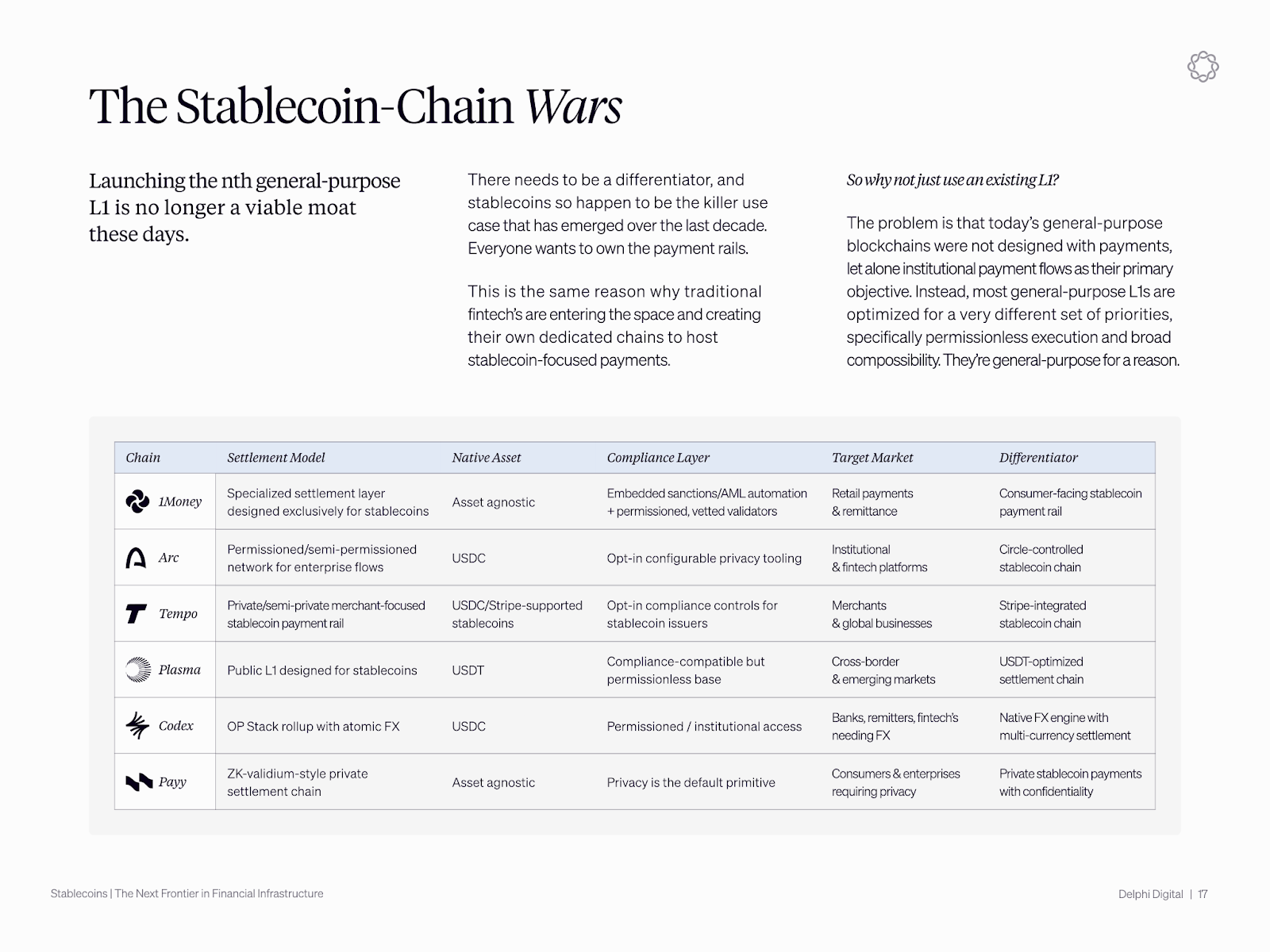
Stablecoin issuers and fintech-linked firms are launching payment-focused blockchains as they try to control more of the settlement infrastructure behind US digital-dollar transfers.
Some stablecoin issuers and fintech-linked companies are building a new wave of blockchain networks designed for institutional payment flows rather than the broader token issuance and smart-contract activity associated with general-purpose layer-1 networks, according to Delphi Digital.
These include stablecoin giant Tether-backed Plasma, a public L1 network optimized for cross-border USDt (USDT) transactions, which launched on mainnet on Sept. 25, 2025 after it raised $24 million in February. A month later, stablecoin issuer Circle launched the public testnet for Arc, which it describes as an open L1 blockchain purpose-built for stablecoin finance.
The developments add to signs of a structural shift from generic blockchain infrastructure toward payment-focused networks, as companies compete to control the rails underpinning stablecoin settlement, which Delphi Digital described as one of crypto’s clearest real-world use cases.
Fintech companies have also joined the payments infrastructure push, seeking to carve out a market share of the growing stablecoin payments sector.

Owning the payment rails is becoming “strategically important,” Ran Goldi, senior vice president of payments and network at digital asset custody platform Fireblocks, told Cointelegraph. He said:
“Instead of relying on external networks and paying fees to ecosystems like Ethereum, companies are looking to capture more of that value themselves by building or controlling the settlement layer.”
For payment companies, owning the underlying rails means they avoid being “taxed” for the mint and burn operations of the stablecoin, added Goldi.
Fintech companies are also joining the stablecoin chain wars
Tempo said Wednesday that its mainnet is live, describing the network as a merchant-focused settlement layer built for high-throughput stablecoin transactions. The project says it is incubated by Paradigm and Stripe.

In October 2024, Stripe acquired stablecoin infrastructure startup Birdge for $1.1 billion. In June 2025, it acquired crypto wallet infrastructure provider Privy and later bought billing platform Metronome on Jan. 14.
Delphi Digital said those deals positioned Stripe to control more of the issuance, wallet and billing layers around stablecoin payments alongside settlement infrastructure.
Stablecoin payment infrastructure is increasingly seen as a new “revenue layer,” positioning entities controlling the end-to-end payment workflow to capture fees on every transaction, according to Alvin Kan, chief operating officer at Bitget Wallet.
“As settlement costs at the protocol level trend lower, value capture shifts to the orchestration layer around the rail: compliance, FX conversion, wallet infrastructure, on- and off-ramps, local payout connectivity and merchant integration,” he told Cointelegraph.
Related: Stablecoins to replace old FX rails, but off-ramps remain a chokepoint
Controlling the settlement infrastructure behind stablecoins is the next battleground among crypto and fintech firms, according to Irina Chuchkina, chief growth officer of Wallet in Telegram. She said:
“Stablecoin payment rails could become the defining revenue driver of this cycle, for the same reason Visa and Mastercard became indispensable: not because they issued currency, but because they owned the pipes.”
Companies building settlement rails interoperable with agentic artificial intelligence stand to “capture a disproportionate share of the value flowing through these networks,” she added.
Magazine: Crypto wanted to overthrow banks, now it’s becoming them in stablecoin fight


In the latest Cointelegraph interview, professional trader Alessio Rastani warns that Bitcoin could fall below $60,000 before a meaningful bottom forms.
Professional trader Alessio Rastani is back with a fresh market update, and the key question remains: has Bitcoin (BTC) already found its bottom — or is the real move still ahead?
In this latest interview, Rastani revisits his previous outlook and explains why his view has shifted as price action unfolded. While Bitcoin managed a short-term recovery earlier this year, he argues that the structure of the recent bounce is not yet convincing enough to signal a sustained uptrend.
In fact, he warns that the probability still favors another move lower, potentially below the $60,000 level, before a more meaningful bottom forms.
But that’s only part of the picture.
Rastani highlights a range of key levels he’s closely watching, suggesting that even if Bitcoin does break lower, the downside may be more limited than many fear. According to his analysis, major support zones could emerge between roughly $59,000 and $46,000, where conditions may become increasingly attractive for longer-term opportunities.
At the same time, he remains skeptical that Bitcoin will reach new all-time highs in 2026, pointing instead to a more delayed recovery timeline.
Beyond crypto, the conversation expands to the broader macro landscape. Rastani shares his outlook on the stock market, noting a possible top forming in the coming months. He also explains why relying too heavily on fixed frameworks, such as the four-year halving cycle, can lead investors astray in unpredictable markets.
If you want to understand where Bitcoin could be headed next — and where the real opportunities might lie — check out the full interview on our channel and don’t forget to subscribe!
This interview has been edited and condensed for clarity.

Tanvi Sharma Stuns Japan’s Sixth Seed Natsuki Nidaira To Storm Into Orleans Masters Semi-Finals

Workshop to support young carers in North Yorkshire

Hints, Answer and Strategies for Puzzle #1736 on March 21, 2026


-
 Crypto World7 days ago
HYPE Token Enters Net Deflation as HyperCore Buybacks Outpace Staking Rewards
-

 Tech5 days ago
Your Legally Registered ‘Motorcycle’ Might Not Count Under Proposed US Law
-
 Tech3 days ago
Are Split Spacebars the Next Big Gaming Keyboard Trend?
-
Sports6 days ago
Why Duke and Michigan Are Dead Even Entering Selection Sunday
-

 Business5 days ago
Search for Savannah Guthrie’s Mother Enters Seventh Week with No Arrests
-

 Business6 days ago
US Airports Launch Donation Drives for Unpaid TSA Workers as Partial Government Shutdown Enters Fifth Week
-
Crypto World6 days ago
Coinbase and Bybit in Investment Talks: Could Bybit Finally Enter the US Crypto Market?
-

 Business4 days ago
Australian shares drop as Iran war enters third week
-

 Business6 days ago
Country star Brantley Gilbert enters growing non-alcoholic beer market
-

 Crypto World4 days ago
Crypto Lender BlockFills Enters Chapter 11 with Up to $500M in Liabilities
-

 Politics2 days ago
The House | The new register to protect children from their abusers shows Parliament at its best
-

 Sports7 days ago
College Basketball Best Bets: Conference Tournament Semifinal Picks
-

 News Videos2 days ago
RBA board divided on rate cut, unusually buoyant share market | Finance Report | ABC NEWS
-

 Fashion4 days ago
25 Celebrities with Curly Hair That Are Naturally Beautiful
-

 Tech13 hours ago
inKONBINI Lets You Spend Summer Days Behind the Register
-

 Crypto World2 days ago
Canada’s FINTRAC revokes registrations of 23 crypto MSBs in AML crackdown
-
 Politics3 days ago
Real-time pollution monitoring calls after boy nearly dies
-

 Crypto World6 days ago
Crypto Losses Drop 87% in February, But Hackers Are Now Targeting People, Not Code
-
 NewsBeat2 days ago
Residents in North Lanarkshire reminded to register to vote in Scottish Parliament Election
-

 Business4 days ago
Meta planning major layoffs as AI spending and automation reshape workforce


You must be logged in to post a comment Login