

Crypto World
ASTER Price Trades Sideways Near $0.70 as Resistance Holds


TLDR:
- ASTER price has remained in a tight consolidation range between $0.67 and $0.74 for over a month despite broader crypto market weakness.
- A major resistance zone between $0.75 and $0.80 continues to cap upward momentum, with sellers defending the level on multiple attempts.
- The October 2025 liquidation event wiped out roughly $12.43 million in leveraged positions, largely resetting long exposure in the derivatives market.
- Binance dominates ASTER futures trading, leading both daily volume and trade count while major exchanges hold significant open interest.
ASTER price continues trading in a narrow range after earlier volatility shook leveraged traders. The asset moves sideways while many cryptocurrencies decline, keeping attention on a resistance area near $0.80.
Market Stability Emerges After Earlier Decline
The ASTER price entered a consolidation after a sharp decline earlier in the market cycle. That drop triggered forced liquidations and removed a large portion of leveraged long exposure.
Since then, the asset has traded between roughly $0.67 and $0.74. The narrow range has remained intact for more than a month.
Market observers pointed to this behavior in recent commentary online. A widely circulated post stated that the asset outperformed the broader market by simply moving sideways.
The comment came from a tweet published by Nebraskangooner. The post noted that prolonged sideways trading can signal relative strength during weak market conditions.
Resistance Zone Continues To Limit Upward Moves
The consolidation range sits directly below a clear technical resistance zone. That area forms between approximately $0.75 and $0.80 on the trading chart.
The region previously provided support before the earlier breakdown. Market structure shifted when that support level turned into overhead resistance.
Price has approached that band several times during the consolidation period. Each attempt was met with resistance as sellers defended the level.
Despite the resistance, the asset has not moved sharply lower. Buyers continue to hold positions near the upper part of the range.
Liquidation Event Reset Leveraged Positions
Derivatives market data show a large liquidation event in October 2025. At that time of writing, ASTER price traded near $1.1575 before selling pressure increased.
Total liquidations reached approximately $12.43 million during that period. Long positions accounted for about $10.15 million of those liquidations.
The forced closures triggered a rapid decline in market price. The cascade occurred as leveraged traders failed to meet margin requirements.
Exchange data shows strong participation from major derivatives platforms. Binance and Bybit accounted for a large share of the liquidated positions.
Derivatives Activity Remains Concentrated On Major Exchanges
As of writing, derivatives metrics show large open interest across multiple trading platforms. The Aster exchange records the largest open interest near $120.98 million.
Binance follows with open interest close to $84.61 million. Hyperliquid holds the third position with roughly $60.23 million.
Trading activity remains concentrated on a few exchanges. Binance leads daily trading volume with roughly $69.97 million.
Futures trade count also favors the same platform. Binance processes more than 867,000 ASTER futures trades, exceeding activity on other exchanges.


Crypto World
Market Turmoil: How $100 Oil, Inflation Concerns, and Earnings Shaped This Week’s Trading
TLDR
- Major U.S. equity indexes recorded their third consecutive weekly decline, pressured by crude oil surpassing $100 per barrel and renewed inflation concerns.
- Oil prices jumped approximately 9% following Middle Eastern geopolitical tensions that disrupted critical shipping routes through the Strait of Hormuz.
- Oracle exceeded earnings projections with revenue growth exceeding 20%, driven by robust AI infrastructure and cloud computing demand.
- Gold prices retreated roughly 1% despite heightened geopolitical uncertainty, constrained by U.S. dollar strength that dampened safe-haven appeal.
- Energy sector equities led weekly gains, while consumer staples and healthcare sectors tumbled 4–5%.
American equity markets extended their losing streak to three consecutive weeks as crude oil prices breached the $100-per-barrel threshold and escalating Middle Eastern conflicts unnerved market participants. The three primary benchmarks all concluded the week ending March 13, 2026, in negative territory.
The S&P 500 declined approximately 1.6%, the Dow Jones Industrial Average retreated around 2%, and the Nasdaq Composite dropped roughly 1.3%. Smaller-capitalization stocks mirrored this weakness, with the Russell 2000 shedding about 1.8%.
Energy markets dominated headlines. Crude oil prices skyrocketed approximately 9% after military tensions involving the United States, Israel, and Iran created significant disruptions to maritime traffic through the strategically vital Strait of Hormuz. Market observers characterized the move as one of the most dramatic weekly spikes in oil futures witnessed since the 1980s.
Just 2 hours after markets closed:
President Trump is now threatening to strike oil infrastructure on Iran’s Kharg Island, which accounts for 2% of global supply, if Iran doesn’t open the Strait of Hormuz.
In fact, last month, production coming from Kharg Island hit 3 million… https://t.co/pzI2GuoCoz
— The Kobeissi Letter (@KobeissiLetter) March 14, 2026
The surge in energy costs reignited inflation anxieties across financial markets. Producer price index readings exceeded forecasts marginally, stoking fears that elevated costs might cascade to end consumers in coming weeks.
This development places the Federal Reserve in a challenging position. While market participants continue anticipating interest rate reductions later in 2026, the timeline has grown increasingly uncertain as energy-fueled inflation muddles the monetary policy landscape.
Oracle Shines During Earnings Season
Oracle emerged as the week’s most impressive earnings performer. The technology giant delivered fiscal third-quarter results that surpassed analyst estimates, with consolidated revenue expanding beyond 20% and artificial intelligence infrastructure sales exhibiting triple-digit percentage gains.
Company executives provided optimistic forward guidance, forecasting high-teens revenue expansion continuing through fiscal year 2027. Shares surged during extended trading sessions but concluded the week essentially unchanged as market participants balanced the positive outlook against a stock price still trading more than 50% beneath prior-year peaks.
Campbell Soup presented a contrasting narrative. While the packaged food manufacturer marginally exceeded adjusted earnings expectations, management issued conservative 2026 projections that disappointed Wall Street, triggering share price declines.
Energy and industrial companies defied the broader market weakness, with numerous mid-capitalization firms delivering solid quarterly reports supported by improving demand fundamentals and expanding export markets.
Precious Metals Retreat While Energy Equities Surge
Gold momentarily reclaimed the $5,100-per-ounce level Friday morning but ultimately closed the week approximately 1% lower. U.S. dollar strength combined with diminishing rate-cut expectations counterbalanced traditional safe-haven buying interest.
Energy stocks emerged as unambiguous weekly leaders. Leading U.S. energy-focused exchange-traded funds advanced 2–3% over the five-day period. Marathon Petroleum and competing refining companies climbed high-single-digit percentages as investors anticipated enhanced profit margins stemming from elevated crude prices.
Consumer staples and healthcare represented the weakest performing sectors, each surrendering 4–5%. Market participants rotated capital away from these defensive categories as input cost pressures mounted and earnings vulnerability increased.
Financial stocks also underperformed, weighed down by emerging concerns regarding private-credit exposures at systemically important institutions. Technology ended modestly lower overall, although mega-cap technology names demonstrated greater resilience compared to smaller software enterprises.
The Cboe Volatility Index climbed from late-February readings as market participants increased spending on downside hedging strategies, signaling heightened caution entering the following week’s trading sessions.
Key Takeaways
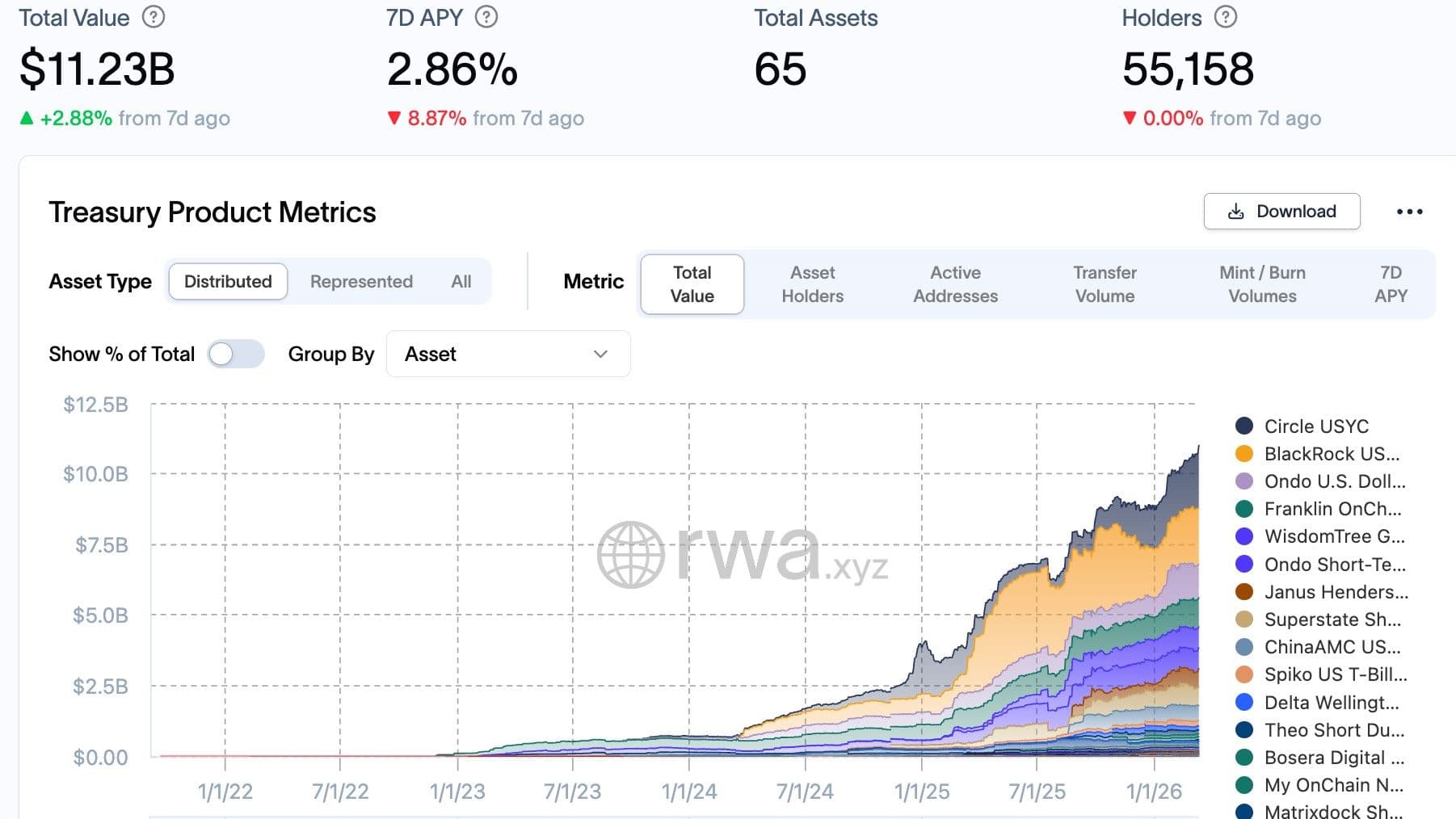
- USYC, Circle’s tokenized Treasury product, has expanded to $2.2 billion in supply, surpassing BlackRock’s BUIDL fund
- BUIDL’s dominance has declined significantly, with market share dropping from 46% at its height to approximately 18%
- A partnership with Binance enabled USYC to serve as off-exchange collateral on BNB Chain, resulting in $1.84 billion deployed on that blockchain
- Tokenized U.S. Treasury products have reached an all-time high of $11 billion in total value, climbing 27% year-to-date
- Market expansion intensified throughout January’s crypto market correction as traders sought yield-generating blockchain-based instruments
In a significant milestone for blockchain-based financial products, Circle’s USYC token has claimed the top position among tokenized U.S. Treasury offerings, displacing BlackRock’s BUIDL fund from its leading role. This development signals an evolution in the rapidly expanding sector focused on bridging traditional finance with distributed ledger technology.
USYC’s total supply has reached approximately $2.2 billion, based on analytics from RWA.xyz. This volume exceeds BlackRock’s USD Institutional Digital Liquidity Fund, which currently maintains around $2 billion in assets under management.
The USYC product came under Circle’s control in early 2025 following the company’s acquisition of Hashnote, which originally created the token. This investment vehicle provides holders with access to yields from U.S. Treasury securities while maintaining the benefits of blockchain-based asset management.
BlackRock introduced BUIDL to the market in early 2024 through a collaboration with Securitize, a specialized tokenization platform. During its strongest period in May 2024, BUIDL commanded 46% of the entire tokenized Treasury sector. However, increased competition has reduced that figure to roughly 18% today.
These tokenized Treasury products function by converting U.S. government debt instruments into digital tokens deployed on blockchain infrastructure. This structure enables investors to generate returns while simultaneously leveraging these tokens as collateral for trading activities — a capability that traditional Treasury investments cannot easily provide.
Binance Partnership Drives USYC Expansion
Much of USYC’s impressive recent expansion stems from its integration with Binance. The cryptocurrency exchange incorporated USYC as eligible off-exchange collateral for institutional derivative products on BNB Chain starting in July 2024.
This arrangement permits USYC to be maintained either through Binance Banking Triparty services or through Ceffu, the exchange’s institutional custody solution. Following this integration, USYC’s presence on BNB Chain has surged to $1.84 billion.
In a Friday post on X, Circle CEO Jeremy Allaire described the utilization of tokenized Treasury products as collateral as “a major emerging use case.”
The dual benefit of generating yield while simultaneously deploying an asset as trading collateral represents a substantial advantage compared to maintaining stablecoins or fiat currency, which generally produce no returns.
Market Reaches New Heights
According to data from RWA.xyz, the aggregate tokenized U.S. Treasury sector has achieved an unprecedented valuation exceeding $11 billion. This milestone represents approximately 27% growth, translating to roughly $2.5 billion in additional value, since the beginning of 2026.
Expansion accelerated notably during January’s cryptocurrency market volatility. This trend indicates that certain market participants redirected funds into tokenized Treasury products to secure consistent yields while awaiting more favorable conditions for crypto market re-entry.
Compared to conventional financial systems, blockchain-based tokens deliver near-instantaneous settlement, complete reserve transparency, and continuous availability — characteristics that continue to attract institutional capital.
Securitize, which co-manages the BUIDL fund, had not provided commentary by publication deadline.
As of mid-March 2026, USYC maintains its leadership position within a sector that has now surpassed $11 billion in aggregate holdings.
TLDR
- Investors acquiring TikTok’s U.S. operations will pay approximately $10 billion to the Trump administration
- Major investors include Oracle, Silver Lake, and Abu Dhabi’s MGX fund
- Initial payment of $2.5 billion has been transferred to Treasury, with additional installments scheduled
- The U.S. TikTok entity carries a valuation of approximately $14 billion, though experts debate whether this is accurate
- The transaction stems from legislation mandating ByteDance divest its stake in TikTok’s American business
The Trump administration negotiated an agreement that allowed TikTok to continue operating across the United States. Under the terms of this arrangement, the investors who assumed control of TikTok’s American operations committed to paying approximately $10 billion to the federal government.
This substantial fee comes in addition to the capital invested to establish a new domestically-based entity operating the popular social media platform. Key investors such as Oracle, Silver Lake, and MGX from Abu Dhabi transferred approximately $2.5 billion to the U.S. Treasury upon completion of the transaction in January. Additional payments are scheduled until the full $10 billion amount is satisfied.
ByteDance, TikTok’s parent company based in China, completed the transaction in January. The deal established a joint venture with majority American ownership called TikTok USDS Joint Venture LLC. This newly formed entity oversees U.S. user information, mobile applications, and proprietary algorithms.
ByteDance retains close to 20% ownership in the restructured entity and has licensed its algorithmic technology to the venture. The American entity must also distribute profits back to ByteDance.
Vice President JD Vance stated the restructured U.S. TikTok entity holds a valuation near $14 billion. Technology industry analysts have challenged this figure, suggesting it significantly underestimates the company’s true worth.
How the Fee Compares to Typical Deal-Making
The $10 billion government fee represents an almost unparalleled arrangement for a government facilitating a private sector transaction, according to business historians. To put this in perspective, investment banking fees on standard deals typically amount to less than 1% of total transaction value. Bank of America expects to collect approximately $130 million for its advisory services on Norfolk Southern’s $71.5 billion acquisition — representing one of the largest individual banking fees ever recorded.
Administration representatives defend the fee structure as appropriate. They emphasize Trump’s critical role in preserving TikTok’s presence in America and navigating complex negotiations with Chinese authorities while satisfying national security requirements from Congress.
The transaction was mandated by legislation enacted during Trump’s initial presidential term. That statute compelled ByteDance to significantly reduce its ownership position in TikTok’s American operations or face a complete shutdown. Congressional leaders had expressed significant concerns about a Chinese-owned corporation maintaining access to personal information of more than 200 million American citizens.
Earlier this month, Trump and Attorney General Pam Bondi faced legal action from retail shareholders of competing social media platforms. These investors are attempting to overturn the government’s approval of the ByteDance joint venture transaction.
The Broader Pattern of Government Stakes in Private Companies
The TikTok deal represents one element of a larger trend. The Trump administration has similarly secured nearly 10% ownership in Intel. It negotiated to receive a portion of chip sales to China from Nvidia as consideration for granting export authorization. The administration has also acquired equity positions in additional corporations and maintains a “golden share” in U.S. Steel after Nippon Steel’s acquisition.
The Wall Street Journal initially disclosed the $10 billion fee amount on March 13, 2026.
Crypto World
Oil Markets Surge Past $100 as U.S. Military Strikes Hit Iran’s Kharg Island Facilities
TLDR
- American military forces eliminated all defense installations on Kharg Island, Iran’s primary oil export facility responsible for approximately 90% of the nation’s crude shipments
- President Trump deliberately avoided targeting petroleum infrastructure but issued warnings that terminals face destruction if Iran continues Hormuz blockade
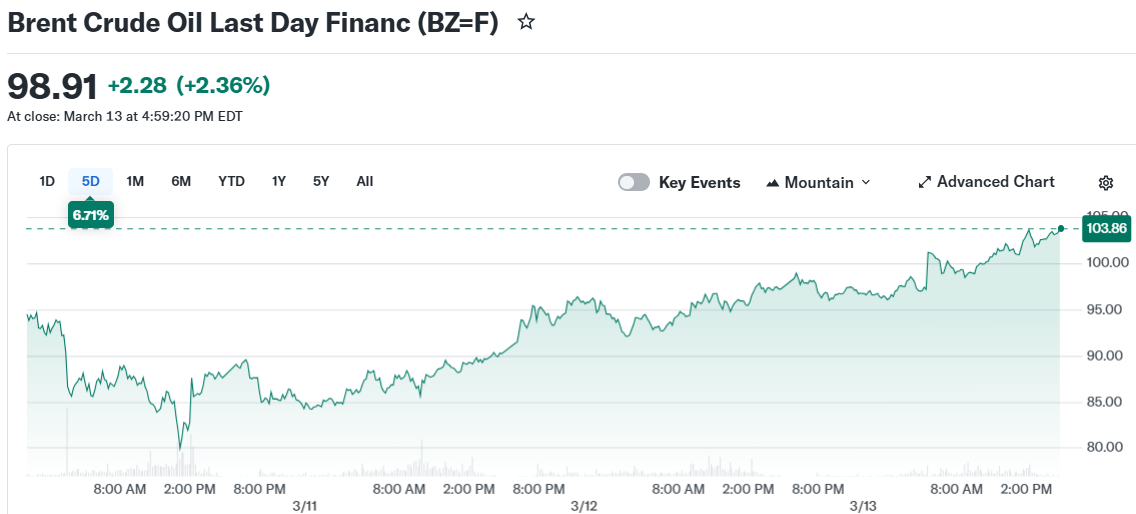
- Brent crude surged past the $100 threshold in the aftermath of the military operation
- Vessel traffic navigating the Strait of Hormuz has plummeted from 84 daily transits to under 10 ships
- Operation Epic Fury has claimed the lives of 13 American military personnel; Saudi-based refueling aircraft sustained damage in retaliatory action
In a Friday announcement, President Trump confirmed that American military forces successfully neutralized all defense positions stationed on Kharg Island, Iran’s critical petroleum export terminal.
The President utilized his Truth Social platform to disclose that U.S. Central Command executed the operation specifically to eliminate Iranian military defenses protecting the strategic island. In his statement, Trump emphasized his decision to preserve the petroleum facilities “for reasons of decency,” while simultaneously cautioning that such restraint hinges on Tehran permitting unobstructed maritime navigation through the Strait of Hormuz.
Tehran issued a swift response, declaring that any assault on its energy sector would trigger immediate retaliatory destruction of energy infrastructure belonging to nations providing assistance to Washington.
Vice President JD Vance revealed that Mojtaba Khamenei, Iran’s newly appointed supreme leader, sustained injuries during the military strikes. “We don’t know exactly how bad,” Vance said.
Operation Epic Fury has resulted in thirteen American military casualties to date.
At Prince Sultan air base located in Saudi Arabia, five refueling aircraft belonging to the U.S. Air Force were struck and suffered damage while grounded. Two defense officials verified the attack occurred, though no fatalities were reported.
The Defense Department is deploying a Marine expeditionary unit alongside additional naval vessels to the Middle Eastern theater. Trump further announced that the U.S. Navy will shortly commence escort operations for oil tankers traversing the Strait of Hormuz.
Oil Prices and Supply Disruptions
Brent crude has been hovering around the $100 per barrel threshold. The Kharg Island military operation propelled prices decisively above that psychological barrier.
Since March 2, the Strait of Hormuz has experienced near-complete maritime paralysis. Vessel traffic has crashed from a 2026 average of 84 daily transits to fewer than 10 ships, based on ACLED tracking data.
Kharg Island functions as the export point for approximately 90% of Iranian crude oil shipments. Energy analysts from SEB had previously highlighted significant global supply vulnerabilities should the island’s export terminals face military action, projecting potential price spikes far exceeding current conflict-driven levels.
The International Energy Agency orchestrated an unprecedented coordinated release of 400 million barrels from strategic petroleum reserves worldwide in an effort to stabilize energy markets.
Federal Reserve and Inflation Concerns
ING analysts suggest the Federal Reserve may be compelled to maintain elevated interest rates for an extended period. The primary concern centers on surging energy expenses driving inflation metrics further from the central bank’s 2% objective.
The Gulf region crisis has triggered cost increases for fertilizer and plastic feedstock materials, creating ripple effects throughout consumer pricing structures.
Market participants are closely monitoring potential counterattacks from Iran’s Revolutionary Guard forces. The Pentagon’s deployment of a Marine expeditionary unit to the region indicates preparations for potential conflict escalation.
Oil prices remain elevated above $100 per barrel while daily vessel movements through the Strait of Hormuz persist at fewer than 10 ships according to the most recent available information.
Crypto World
Meta (META) Stock Drops as Company Plans Major Layoffs to Finance Massive AI Investment

Key Highlights
- Meta may eliminate approximately 20% of its total workforce — potentially affecting 16,000 workers
- The workforce reduction aims to finance a massive $600 billion AI infrastructure investment extending to 2028
- Mark Zuckerberg has directed top executives to develop headcount reduction strategies
- The company recently purchased AI agent platform Moltbook and invested $2 billion in Chinese AI firm Manus
- Meta’s “Avocado” AI system has underperformed against internal benchmarks
Meta Platforms appears poised to execute its largest workforce reduction since 2022, with internal discussions pointing toward eliminating 20% or more of current staff. Given Meta’s December employee count of approximately 79,000, this translates to around 16,000 positions potentially being eliminated.
The information surfaced Thursday via Reuters, which spoke with three individuals with direct knowledge of the discussions. However, neither timing nor precise figures have been finalized. When contacted, a Meta representative characterized the reporting as “speculative” and focused on “theoretical approaches.”
These potential reductions stem from Meta’s ambitious artificial intelligence strategy. The social media giant has pledged to invest $600 billion in data center construction and AI infrastructure through 2028 — an expenditure requiring significant cost reductions in other areas.
Zuckerberg’s vision has become increasingly apparent. Speaking in January, he noted witnessing “projects that used to require big teams now be accomplished by a single very talented person.” This efficiency narrative underpins Meta’s current trajectory.
According to two Reuters sources, senior executives have already instructed department heads to develop workforce reduction plans. While still in preliminary phases, the strategic direction appears firmly established.
Aggressive AI Investment Strategy
These workforce changes coincide with Meta’s aggressive AI spending. Meta recently completed the acquisition of Moltbook, an AI agent-focused social platform. Additionally, the company is committing at least $2 billion toward Chinese AI startup Manus.
To attract elite AI researchers, Meta has extended compensation packages valued at hundreds of millions of dollars spanning four years to scientists joining its superintelligence division.
The paradox is striking: the very AI investments necessitating specialized hires may simultaneously trigger widespread job eliminations. The astronomical costs of constructing AI infrastructure are pushing the company toward operational streamlining across other divisions.
Should the 20% reduction materialize, it would represent Meta’s most significant downsizing since its “Year of Efficiency” initiative. That restructuring eliminated 11,000 positions in November 2022, with an additional 10,000 cuts following in early 2023.
Meta follows an industry-wide trend. Amazon announced 16,000 job eliminations earlier this year. Block reduced its workforce by nearly 50%, with CEO Jack Dorsey explicitly attributing the cuts to AI capabilities reducing staffing requirements.
Challenges with Avocado AI Model
Meta’s substantial AI investments haven’t guaranteed smooth execution. The company’s Llama 4 models faced scrutiny following questionable performance on initial benchmarks. Behemoth, the flagship variant, was ultimately canceled ahead of its anticipated summer launch.
Meta’s superintelligence division is currently developing Avocado, a new model designed to rebuild credibility in the company’s AI efforts. However, early results have reportedly disappointed internal stakeholders.
Bernstein analysts have identified a “trough of disillusionment” affecting consumer AI adoption — an apt description of Meta’s current AI product positioning.
META stock declined 3.83% during regular trading following the news, though shares recovered modestly in after-hours activity as market participants evaluated the potential margin benefits of reduced headcount.
Current figures show Meta employed 78,900 people as of its December regulatory filing. A 20% workforce reduction would decrease that total to approximately 63,000 employees.
TLDR
- The XRP Ledger recorded 2.7 million daily payments, marking a 12-month peak, even as XRP’s value dropped 26% since January
- Automated market maker pools expanded to nearly 27,000 while tokenized real-world assets on the platform climbed 35% over 30 days to $461 million
- The token currently hovers near $1.42, representing a 62% decline from its December 2025 high of $3.65
- Technical analysts highlight critical support between $0.80–$0.95, while a surge past $3.32 could unlock targets ranging from $27–$48
- Despite XRP’s $84 billion market capitalization, XRPL’s total value locked remains at a modest $47.54 million
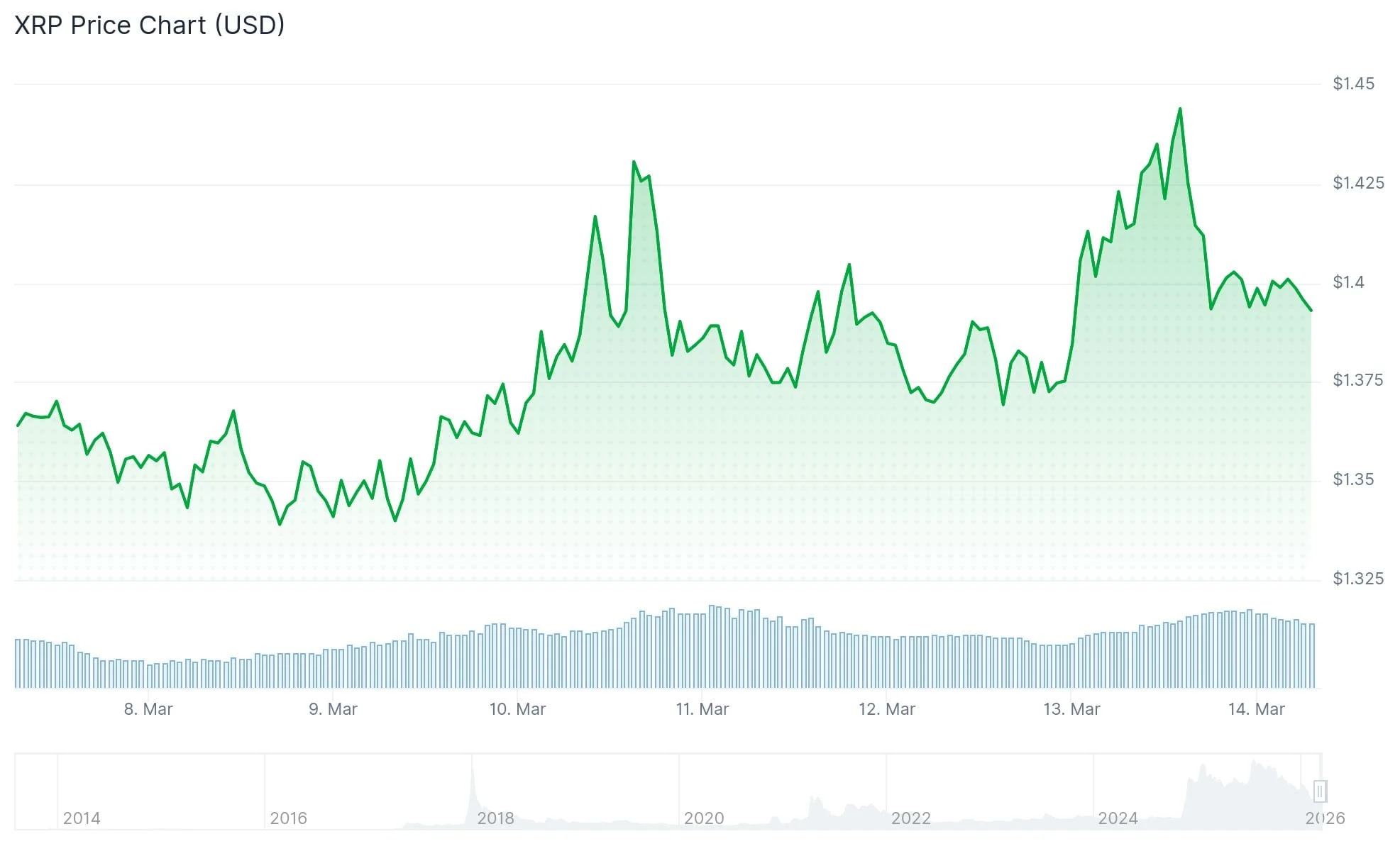
The XRP Ledger is experiencing unprecedented network utilization, yet the token’s market performance tells a contrasting story. Currently valued at approximately $1.42, XRP has shed 26% of its value year-to-date and sits 62% beneath its late-2025 zenith of $3.65.
Successful payment transactions on the XRP Ledger recently climbed above 2.7 million daily, establishing a new 12-month benchmark. This represents a substantial increase from approximately 1 million recorded in late 2025, with the blockchain consistently handling 20 to 26 transactions every second.
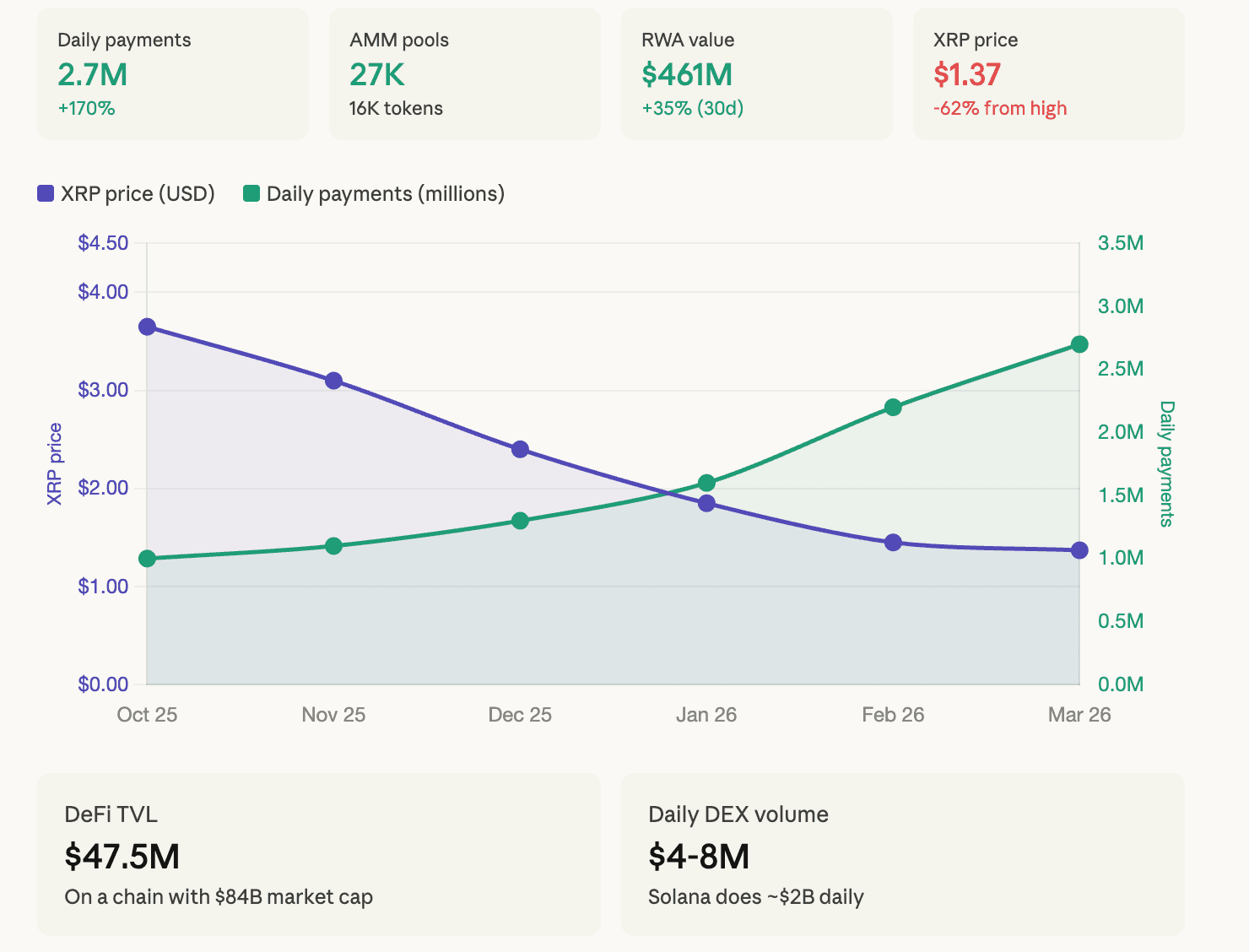
The platform’s automated market maker infrastructure has expanded to encompass nearly 27,000 pools, facilitating trading for more than 16,000 distinct tokens. Currently, twelve million XRP sits deposited within these liquidity pools.
The value of tokenized real-world assets on the ledger climbed to $461 million, representing a 35% expansion over the preceding 30 days. During this same timeframe, stablecoin transfer volume reached $1.19 billion, with the total stablecoin market cap on XRPL standing at $339 million distributed among 35,800 holders.
A significant portion of this network utilization connects to Ripple’s RLUSD stablecoin and tokenized instruments that employ XRP temporarily as a bridge asset. These operations don’t generate enduring demand for holding the token long-term.
Why Activity Isn’t Lifting XRP’s Price
When XRP facilitates a cross-border transaction for mere seconds to connect two fiat currencies, it doesn’t create persistent buying pressure. The blockchain processes more volume, but the token functions as a fleeting intermediary.
According to DeFiLlama, the XRP Ledger’s total value locked reaches only $47.54 million. By comparison, Solana maintains approximately $4 billion in TVL. Ethereum commands over $40 billion.
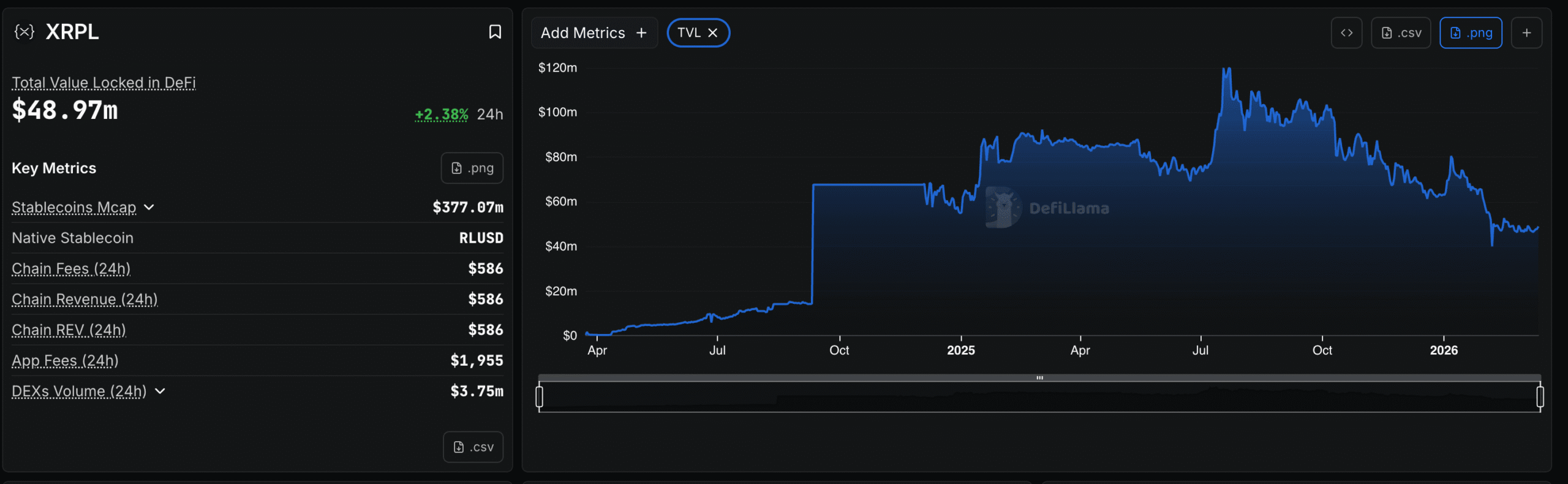
Daily decentralized exchange volume on XRPL fluctuates between $4 million and $8 million. For a Layer 1 blockchain carrying an $84 billion market valuation, these figures remain relatively modest.
The 30-day RWA transfer volume of $149 million — representing an increase exceeding 1,300% — does suggest genuine institutional participation in the asset tokenization sector.
What Analysts Are Watching
Analyst EGRAG CRYPTO highlights a critical accumulation zone spanning $0.80 to $0.95, where several technical signals align, including convergence of the 21, 50, and 100 exponential moving averages alongside a sustained ascending trendline.
Should XRP recapture the 21 EMA and escape its present corrective formation, the subsequent price objective would land near $2.20. The base-building phase could extend through Q2–Q3 2026.
Analyst Ali Martinez recognizes a long-term ascending triangle configuration with horizontal resistance positioned around $3.32. A decisive move above this threshold projects macro objectives spanning $27 to $48.
Analyst Crypto Patel observes a validated multi-year triangle breakout, with a projected bull-market target approaching $50.
The $1.27–$1.30 support region has withstood numerous retests. Historically, XRP delivers an average 18% gain during March.
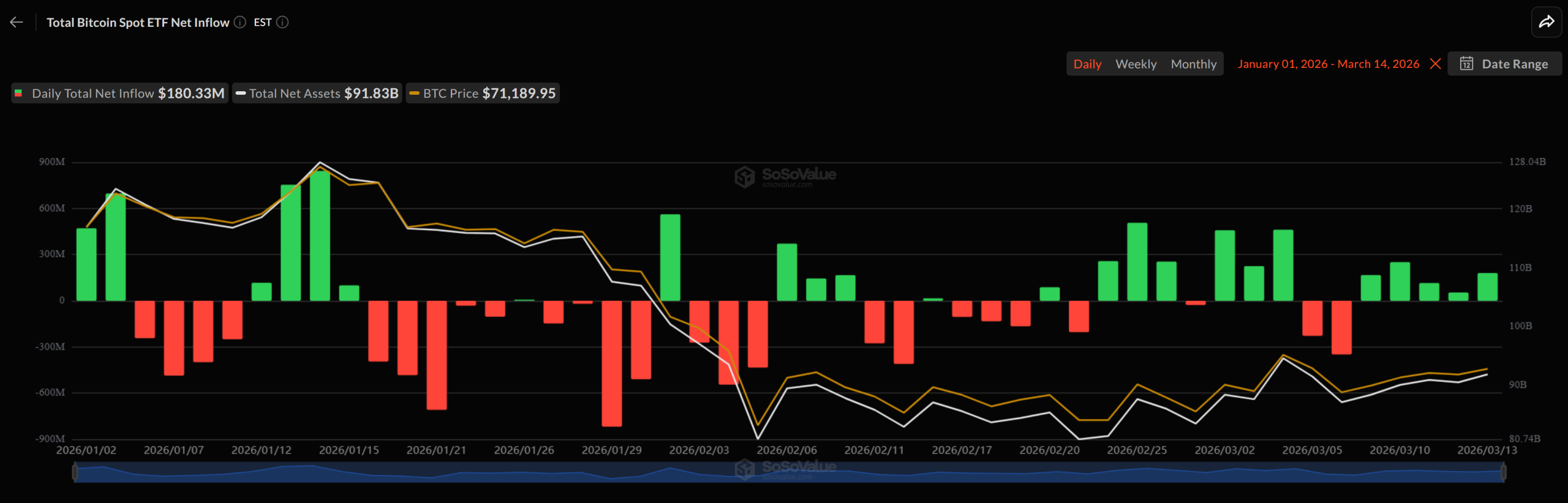
US spot Bitcoin exchange-traded funds (ETFs) logged their first five-day inflow streak of 2026, bringing in roughly $767.32 million this week.
The funds recorded $180.33 million in net inflows on Friday, extending the run of positive flows that began earlier in the week. The strongest day of the streak came on Tuesday, when spot Bitcoin (BTC) ETFs attracted $250.92 million, according to data from SoSoValue.
The last time the funds saw a comparable streak was in late November 2025, when spot Bitcoin ETFs logged five consecutive days of net inflows from Nov. 25 to Dec. 2, bringing in a combined $284.61 million.

Overall, the ETFs now hold $91.83 billion in net assets, with cumulative net inflows reaching $56.14 billion and roughly $4.93 billion in total value traded on the day.
Related: BlackRock says ‘exotic’ crypto ETFs not part of its strategy
Ether ETFs see 4-day inflow streak
Meanwhile, US spot Ether (ETH) ETFs recorded $26.69 million in net inflows on Friday, extending a four-day run of positive flows. The streak began on Tuesday, when the funds added $12.59 million, followed by $57.01 million on Wednesday and a stronger $115.85 million on Thursday, the largest inflow during the period.
The four-day stretch has brought roughly $212.14 million into spot Ether ETFs, reversing the outflows seen earlier in March. As of today, cumulative net inflows into US spot Ether ETFs stands at $11.79 billion, while total net assets across the funds reached $12.26 billion, with about $1.30 billion in value traded on the day.
The recent stretch marks the first sustained inflow run for spot Bitcoin and Ether ETFs this year after a volatile start to 2026 that saw several days of heavy outflows across the products.
Related: Bitcoin ETFs add $251M as Goldman Sachs tops XRP ETF holders
Bitcoin range-bound as Middle East tensions rise
Rising tensions in the Middle East and volatility in energy markets are weighing on global risk sentiment. According to Bitunix analysts, escalating conflict around the Strait of Hormuz and elevated oil prices have increased macro uncertainty and reduced expectations for aggressive Federal Reserve rate cuts, prompting investors to focus on short-term liquidity rather than long-term risk exposure.
Against this backdrop, Bitcoin remains range-bound. Bitunix said derivatives liquidation heatmaps show a key short-liquidity cluster near $71,300, which is acting as near-term resistance, with a larger concentration between $72,000 and $73,500.
On the downside, liquidity support sits around $69,000, with deeper long liquidation levels near $68,800, suggesting BTC may continue consolidating unless macro catalysts trigger a breakout.
Magazine: Bitcoin’s ‘narrative vacuum,’ Ethereum now inevitable: Trade Secrets
Crypto World
Stanley Druckenmiller Forecasts Stablecoin Dominance in Global Payment Systems Within a Decade
TLDR
- Renowned investor Stanley Druckenmiller forecasts stablecoins will become the foundation of worldwide payment systems in 10–15 years
- He emphasizes that stablecoins offer superior speed, reduced costs, and enhanced efficiency compared to legacy banking systems
- Stablecoin market valuation has reached an unprecedented peak of approximately $300 billion
- Despite his optimism on stablecoins, Druckenmiller views cryptocurrency as “a solution looking for a problem” when it comes to storing value
- Major payment platforms including Western Union, MoneyGram, and Zelle have revealed stablecoin integration strategies following the GENIUS Act
Legendary hedge fund manager Stanley Druckenmiller has projected that stablecoins will become the fundamental infrastructure for worldwide payment networks within the next 10 to 15 years, despite maintaining reservations about cryptocurrencies like Bitcoin functioning as reliable stores of value.
The billionaire investor shared these insights during a Morgan Stanley interview conducted between January 30 and 31, which was published this week. His remarks came during a rapid-fire word association exercise focused on blockchain technology and digital currencies.
“Blockchain and the use of stablecoins — if you want to throw crypto into that — tokens, incredibly useful in terms of productivity,” he said.
“I assume our whole payment systems will be stablecoins in 10 or 15 years — efficient, quicker, cheaper,” he added.
Druckenmiller established Duquesne Capital Management in 1981 and shuttered the fund in 2010. Throughout that remarkable 29-year span, he maintained an impressive 30% average annual return without experiencing a single losing year.
This perspective on stablecoins isn’t a recent development for Druckenmiller. During a May 2021 CNBC appearance, he suggested blockchain technology could supplant current US dollar payment infrastructure, citing diminishing confidence in central banking institutions.
“It’s Jerome Powell and the rest of the world, central bankers. There’s a lack of trust,” he said at the time.
The stablecoin sector has experienced explosive expansion. Data compiled by The Block reveals the aggregate stablecoin market capitalization has climbed to approximately $300 billion — representing a staggering 440% increase from roughly $55 billion recorded five years earlier.
Major Payment Companies Embrace Stablecoin Technology
Numerous established payment processors have begun integrating stablecoin capabilities. Industry giants Western Union, MoneyGram, and Zelle each unveiled initiatives to implement stablecoin-based settlement infrastructure throughout last year.
These strategic pivots emerged after the GENIUS Act became law in July, establishing comprehensive regulatory guidelines for payment companies seeking to incorporate digital asset offerings.
Administration representatives have also voiced support. Patrick Witt, who serves as executive director of the President’s Council of Advisors for Digital Assets, suggested this week that stablecoins complying with GENIUS Act standards could channel fresh deposits into American financial institutions by capturing worldwide appetite for dollar-backed instruments.
Bitcoin and Crypto Remain Questionable Store of Value, Says Druckenmiller
While championing stablecoins, Druckenmiller has consistently expressed doubts about the wider cryptocurrency ecosystem.
“Crypto? It’s a solution looking for a problem,” he said in the Morgan Stanley interview.
He conceded, however, that established cryptocurrencies such as Bitcoin have cultivated sufficient brand recognition that certain investors will persist in viewing them as value repositories.
In October 2023, Druckenmiller compared Bitcoin to gold and said he preferred gold because it was a “5,000-year-old brand.”
He disclosed that he currently holds no Bitcoin position, though he acknowledged he likely should consider acquiring some.
The stablecoin sector achieving a fresh all-time high market capitalization approaching $300 billion represents the most recent milestone in its accelerated evolution.


A meme coin linked to US President Donald Trump surged as much as 60% over the past 24 hours after promoters touted an exclusive gala at the president’s Mar-a-Lago resort, though the White House has not confirmed whether Trump will attend the event.
Key Takeaways:
- The TRUMP meme coin jumped as much as 60% after promoters advertised a Mar-a-Lago gala linked to the president.
- Trading activity surged, with daily volume topping $1.6 billion and derivatives open interest rising over 20%.
- Despite the rally, the token remains more than 90% below its peak price from early 2025.
The rally pushed the token, commonly referred to as the TRUMP meme coin, as high as $4.43 before easing to around $3.88, according to data from CoinMarketCap.
At the time of writing, the token is trading at around $4.07, up by 14.32% over the past day.
Trump Meme Coin Volume Tops $1.6B as Derivatives Interest Jumps
Trading activity spiked sharply following the announcement, with 24-hour volume surpassing $1.6 billion.
Derivatives markets also reacted to the surge, with open interest climbing more than 20%, data from Coinglass shows.
Despite the sharp rebound, the token remains far below its earlier highs. The TRUMP coin has lost more than 90% of its value since peaking near $44 shortly after launching in January 2025.
The event at the center of the latest surge is the Fight Fight Fight conference, scheduled for April 25, which organizers say will include a gala luncheon with the president at Mar-a-Lago.
However, Trump’s attendance has not been confirmed by the White House. A White House official, speaking anonymously, told Bloomberg that the president was not currently listed as attending the gathering.
The uncertainty is reflected in the event’s own terms. The conference website notes that Trump “may not be able to attend” and that the event itself could be canceled.
If that happens, qualified participants could instead receive a limited-edition TRUMP NFT, according to the terms.
Organizers have nonetheless insisted the president will appear. In an email statement, Fight Fight Fight reportedly told Bloomberg that Trump’s attendance had been confirmed, adding that the announcement would not have been posted on the official TRUMP token website otherwise.
Participation in the conference is tied directly to token ownership. According to the event rules, the top 297 TRUMP token holders who connect their wallets to a leaderboard, or verify holdings through brokerage Robinhood, will qualify to attend.
The top 29 holders will receive invitations to a smaller reception featuring Trump.
Eligibility is determined by time-weighted token holdings during the qualifying period, along with certain merchandise purchases tied to the project.
Mar-a-Lago Emerges as Hub for Trump-Linked Crypto Events
Mar-a-Lago has increasingly become a gathering place for crypto-related initiatives seeking proximity to Trump.
Earlier this year, the Trump family’s crypto venture World Liberty Financial hosted an event at the resort.
The meme coin itself traces back to promoter Bill Zanker, who helped organize a similar dinner with Trump for token holders last year.
That event briefly boosted the coin’s price before the rally faded. Attendees reportedlyincluded crypto entrepreneur Justin Sun.
As reported, Bitcoin has shed roughly 25,000 millionaire addresses in the year since Donald Trump returned to the White House, even as US policy shifted toward a more crypto-friendly stance.
Blockchain data shows the number of addresses holding at least $1 million in BTC fell about 16% year over year, suggesting regulatory optimism has not translated into sustained on-chain wealth growth.
The pullback was less severe among the largest holders. Addresses with more than $10 million in Bitcoin declined by about 12.5%, indicating that top-tier investors were better able to withstand price volatility, while wallets near the millionaire threshold were more exposed to market swings.
The post Trump Meme Coin Jumps 60% After Promoters Advertise Mar-a-Lago Gala appeared first on Cryptonews.
TLDR
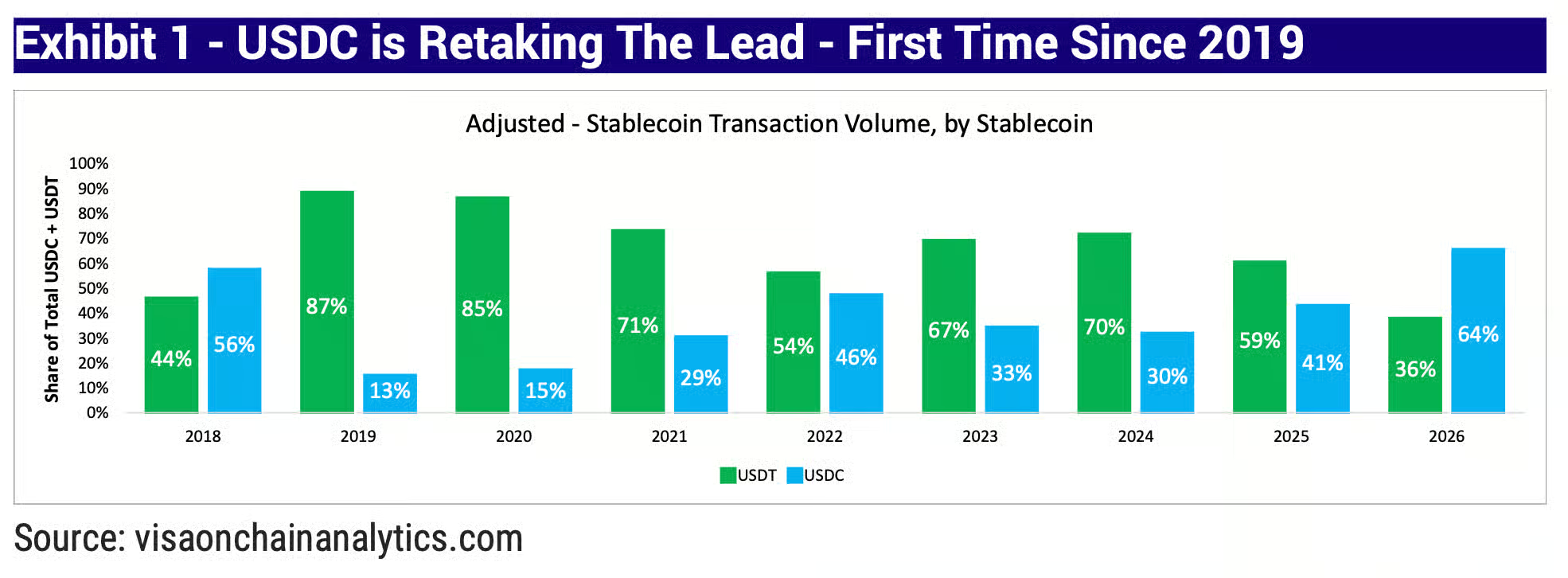
- USDC commands 64% of adjusted transaction volume market share, surpassing USDT in year-to-date metrics per Mizuho analysis
- First instance of USDC volume leadership since 2019
- USDT maintains market capitalization dominance with $184 billion versus USDC’s $79 billion
- Mizuho elevates Circle stock price target from $100 to $120
- According to Mizuho analysts, transaction volume rather than market cap will determine the ultimate stablecoin leader
Tether’s USDT has been surpassed by Circle’s USDC in adjusted transaction volume on a year-to-date basis, based on research findings published by Mizuho, a Japanese investment bank, on Friday, March 13.
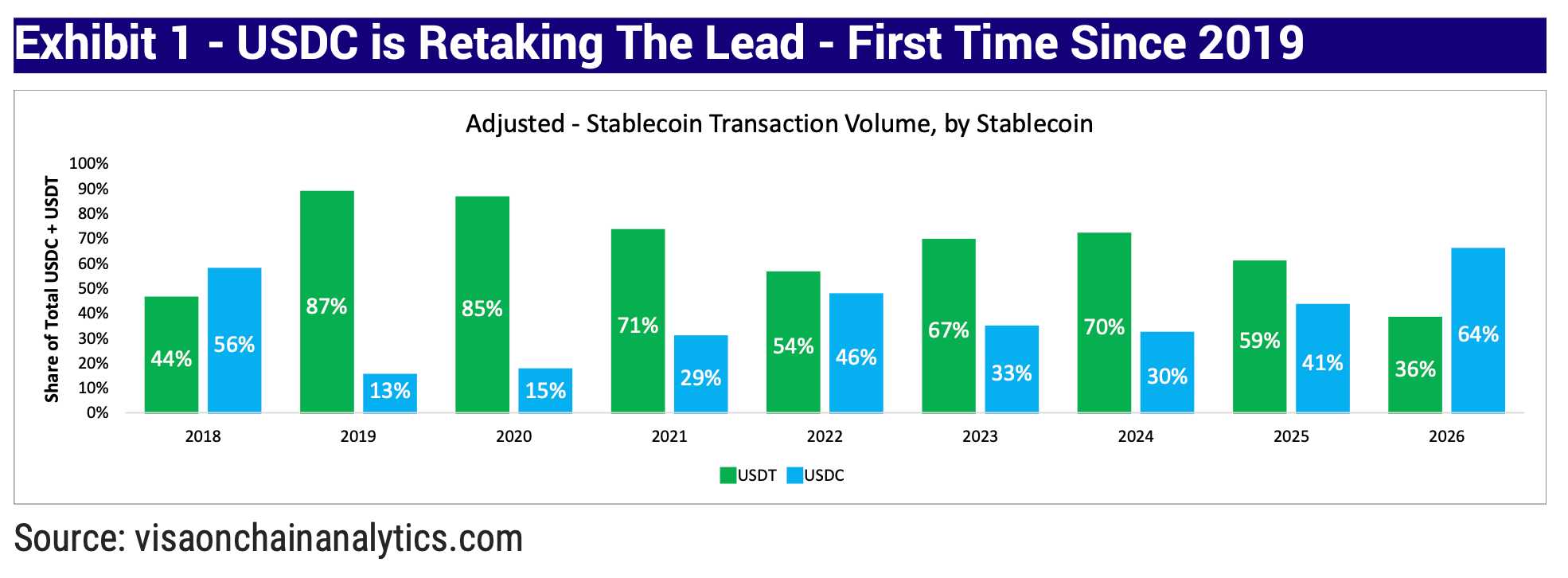
This development represents USDC’s first volume leadership position since 2019, bringing an end to USDT’s extended reign in this metric.
According to Mizuho’s data, USDC processed approximately $2.2 trillion in adjusted transaction volume year-to-date, while USDT recorded $1.3 trillion during the identical timeframe.
These figures translate to USDC controlling 64% of the adjusted volume when comparing the two leading stablecoins, per Mizuho’s calculations.
Mizuho’s methodology defines “adjusted volume” as transactions involving centralized exchanges, decentralized exchanges, and other identified entities — or participants who haven’t exceeded specific activity benchmarks. Essentially, transactions that appear to represent genuine person-to-person or institutional value transfers.
The analysts cited examples such as corporate supplier payments, user wagers on platforms like Polymarket, and capital flows between centralized exchanges and DeFi protocols.
What the Volume Shift Means
According to Mizuho analysts, transaction volume provides superior predictive value compared to market capitalization when forecasting long-term stablecoin dominance.
“We believe that longer term, the stablecoin winner will be the one mostly used in everyday economic activity, rather than just the highest market cap,” Mizuho wrote.
Market capitalization leadership remains with USDT. Tether’s stablecoin maintains approximately $184 billion in total value, substantially ahead of USDC’s $79 billion.
Circle completed its public listing on the New York Stock Exchange in June 2025. The company’s stock price exhibited minimal reaction to the Mizuho research release.
The investment bank upgraded its Circle price target from $100 to $120 within the same research publication.
Circle Stock and the Regulatory Backdrop
In the nation’s capital, proposed legislation affecting the stablecoin sector continues to face obstacles.
The CLARITY Act successfully cleared the House of Representatives but has encountered delays in the Senate. Discussions surrounding stablecoin yield distribution, ethics guidelines, and tokenized securities have impeded legislative advancement.
Senate Majority Leader John Thune indicated on Thursday that the Senate would focus on voting requirement legislation ahead of digital asset market structure bills. He projected that the market structure legislation would not advance before April.
The legislative gridlock contributes additional uncertainty to the comprehensive stablecoin regulatory environment as Circle’s shares maintain NYSE trading activity.
Based on Mizuho’s research published March 13, 2026, USDC controls 64% of adjusted volume among the two dominant stablecoins, marking its first leadership position since 2019.
Jennifer Lopez’s Comfy, Polished Airport Skirt Look Is on Amazon

What Virgins Over 30 Bring Up Most In Sex Therapy

MacOS isn’t too much of a safe haven than Windows as infostealers come for Apple computers


-
 Tech3 days ago
A 1,300-Pound NASA Spacecraft To Re-Enter Earth’s Atmosphere
-

 News Videos5 days ago
10th Algebra | Financial Planning | Question Bank Solution | Board Exam 2026
-

 Crypto World5 days ago
Paradigm, a16z, Winklevoss Capital, Balaji Srinivasan among investors in ZODL
-

 Business4 days ago
ExxonMobil seeks to move corporate registration from New Jersey to Texas
-
Crypto World5 hours ago
HYPE Token Enters Net Deflation as HyperCore Buybacks Outpace Staking Rewards
-

 Fashion15 hours ago
Weekend Open Thread: Addict Lip Glow
-

 Tech4 days ago
ChatGPT will now generate interactive visuals to help you with math and science concepts
-

 Sports7 days ago
Three share 2-shot lead entering final round in Hong Kong
-

 Sports6 days ago
Braveheart Lakshya downs Lai in epic battle to enter All England Open final | Other Sports News
-

 NewsBeat3 days ago
Residents reaction as Shildon murder probe enters second day
-

 Business6 days ago
Search for Nancy Guthrie Enters 37th Day as FBI Probes Wi-Fi Jammer Theory
-

 Business3 days ago
Search Enters Sixth Week With New Leads in Tucson Abduction Case
-
 NewsBeat4 days ago
Pagazzi Lighting enters administration as 70 jobs lost and 11 stores close across Scotland
-

 Tech5 days ago
Despite challenges, Ireland sixth in EU for board gender diversity
-

 NewsBeat3 days ago
I Entered The Manosphere. Nothing Could Prepare Me For What I Found.
-

 Business5 days ago
Search Enters 39th Day with FBI Tip Line Developments and No Major Breakthroughs
-

 Sports5 days ago
Skateboarding World Championships: Britain’s Sky Brown wins park gold
-

 Crypto World4 days ago
Will Chainlink price reclaim $10 amid volatility squeeze?
-

 Sports5 days ago
Tomorrow’s Top 25 Today: Florida jumps to No. 4; Louisville, Wisconsin enter projected rankings
-

 Sports3 days ago
PWHL, Senators discussing plan to keep Charge in Ottawa