
Crypto World
Balancer Labs shuts down after hack and revenue strain



Balancer Labs is preparing to shut down as the team behind the DeFi protocol moves to cut costs after months of financial strain. The plan would leave the protocol running under a leaner structure led by the Balancer Foundation and the DAO while the corporate entity winds down.
Summary
- Balancer Labs will shut down as the protocol shifts toward DAO and foundation management.
- The November hack and falling TVL increased financial pressure across the Balancer ecosystem.
- Executives want lower costs, zero BAL emissions, and more revenue flowing to the DAO.
Balancer co-founder Fernando Martinelli said he had decided to wind down Balancer Labs after reviewing the project’s position. He said the company had become a “liability rather than an asset to the protocol” and linked that decision to legal exposure tied to the November 2025 exploit.
Balancer Labs chief executive Marcus Hardt also said the business was spending too much to attract liquidity compared with the revenue the protocol was generating. He said that approach came with dilution for BAL token holders and could not continue in its current form.
Balancer was one of the better-known DeFi protocols during the 2020 and 2021 market cycle. Its total value locked reached about $3.3 billion in November 2021 before falling sharply over the following years.
The pressure increased after the November 2025 exploit, which reports said totaled more than $100 million. Balancer’s TVL had already dropped to about $800 million by October 2025, then fell by another $500 million in thetwo weeks after the hack. Recent reporting placed the protocol’s TVL near $158 million.
Furthermore, Hardt and Martinelli said they want the Balancer Foundation and the DAO to guide the protocol from here. Their plan calls for a lean continuation model with lower operating costs and fewer people involved in day-to-day work.
Martinelli also backed changes to tokenomics and treasury flow. Those include cutting BAL emissions to zero and adjusting fees so the DAO can keep more of the revenue generated by the protocol. DAO members have been asked to vote on proposals tied to the restructuring and BAL token design.
Protocol revenue remains part of the case
Even with the current pressure, Martinelli said Balancer is still producing revenue. He said the protocol brought in more than $1 million over the past three months and described it as a working system weighed down by weak economics and a heavy cost base.
That position now forms the core of the restructuring push. The protocol is expected to continue operating, but under a smaller and less expensive setup built around the DAO and foundation rather than Balancer Labs.

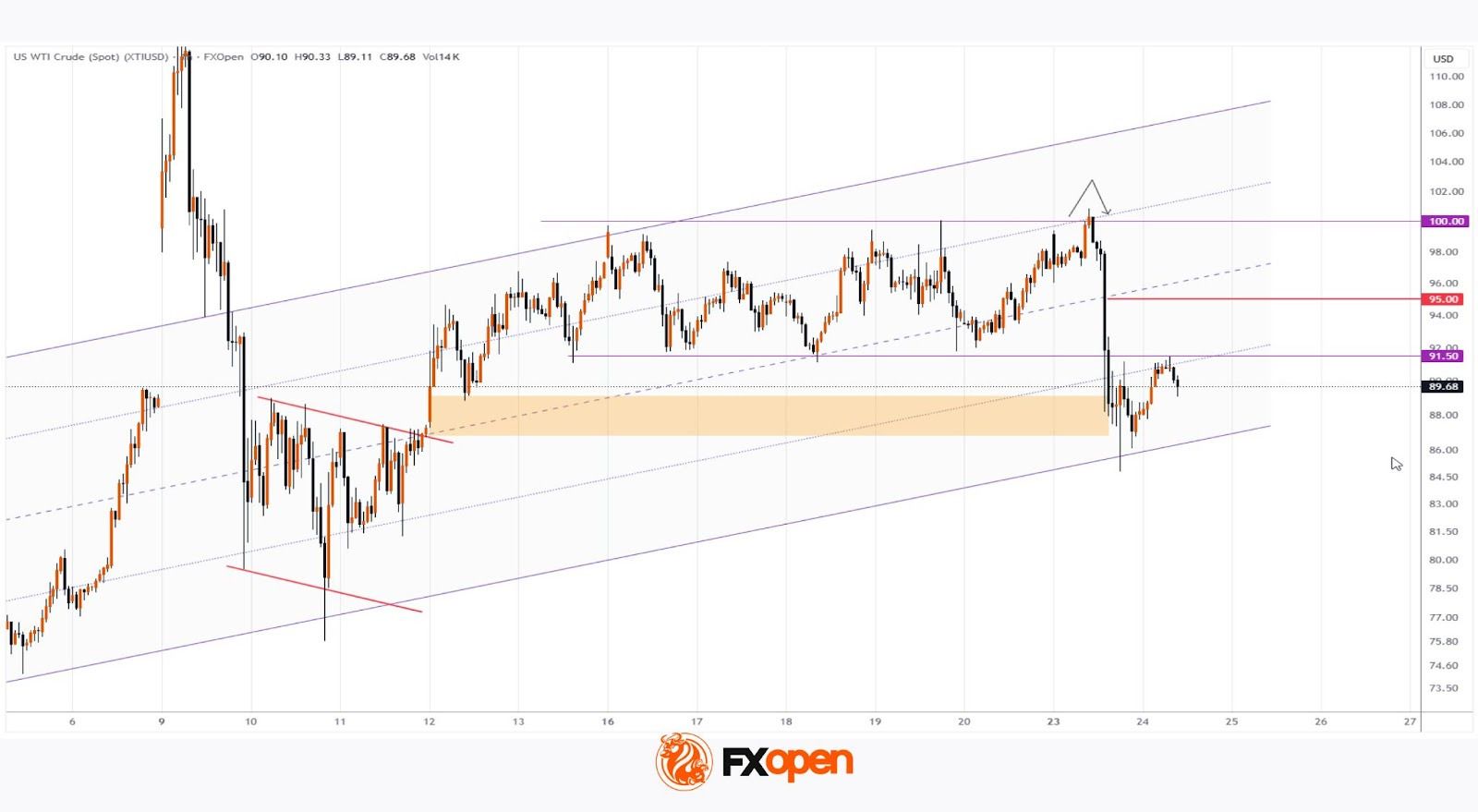
Yesterday, following a false bullish breakout above the psychological $100 level, WTI crude prices fell sharply towards the $85 area. The primary driver of this rapid decline was comments made by the US President.
According to Donald Trump:
→ the United States has postponed planned strikes on Iranian energy infrastructure for five days;
→ productive negotiations are ongoing.
However, Iran later denied these claims, stating that no negotiations to end the conflict were taking place. Moreover, Israel continued its strikes on Iran, while Tehran launched fresh attacks on US assets in the Middle East.
Against this backdrop, the US President’s remarks appear to be a form of verbal intervention aimed at pushing oil prices lower — and, as the XTI/USD chart shows, it is having an effect. Today, WTI crude is trading below last week’s lows.
Technical Analysis of XTI/USD
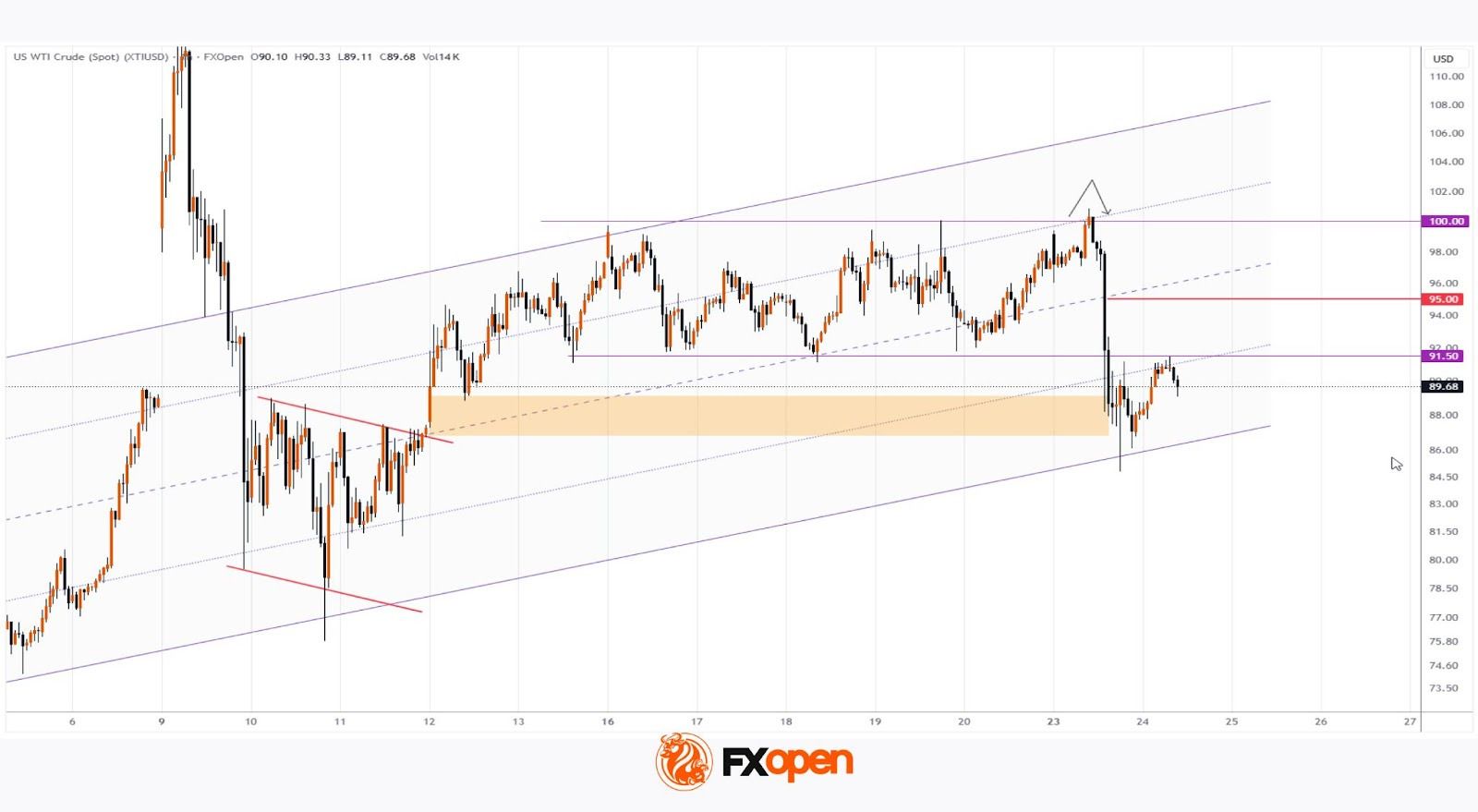
When analysing WTI price movements on 16 March, we highlighted:
→ strong selling pressure near the psychological $100 level;
→ a support zone that formed after the breakout from a local descending channel.
This support area significantly slowed yesterday’s decline in oil prices. At the same time, recent price action allows for the construction of a broad ascending channel, with its lower boundary acting as an important support level.
From a bearish perspective:
→ the $91.50 level, which acted as support last week, has now turned into resistance;
→ if bulls attempt to develop a rebound from the lower boundary, a key test of their strength will be the $95 level, where bears previously pushed prices below the channel median.
In the near term, a period of consolidation between the lower boundary of the channel and the $91.50 level cannot be ruled out, at least until stronger news catalysts emerge, particularly those related to developments around the Strait of Hormuz.
Start trading commodity CFDs with tight spreads (additional fees may apply). Open your trading account now or learn more about trading commodity CFDs with FXOpen.
This article represents the opinion of the Companies operating under the FXOpen brand only. It is not to be construed as an offer, solicitation, or recommendation with respect to products and services provided by the Companies operating under the FXOpen brand, nor is it to be considered financial advice.

Major US financial regulators have redefined the digital asset landscape, publishing joint guidelines that classify the vast majority of cryptocurrencies as commodities or “digital tools” rather than securities. The shift, spearheaded by SEC Chair Paul Atkins and his “token taxonomy,” effectively exempts most projects from strict oversight, a move insiders suggest will directly benefit the Trump family’s extensive crypto ventures.
This deregulatory signal also coincides with the expansion of the Strategic Crypto Reserve, which now holds approximately 200,000 BTC, ETH, and SOL.
Markets responded aggressively to the regulatory overhaul. This data suggests a market pivoting from defensive posturing to institutional accumulation.
Discover: The best pre-launch token sales
Forget Regulation: Can TRUMP Crypto Reclaim $4.00 Ahead of April Gala?
The TRUMP token is consolidating above local support at $3.27, recovering from volatility following the announcement of the April 25 Mar-a-Lago gala. While the token remains significantly below its 2025 highs, volume profiles indicate renewed interest as the event approaches.
Analysts identify the gala, where top holders gain private access to the President, as a critical liquidity event that could drive price action independent of broader macro trends.
TRUMP MEMECOIN: NEW PROMO AFTER 96% CRASH!
The $TRUMP memecoin is trading 96% below its ATH, but the team has launched a new Gala Promo!
√ The top 297 token holders are being given invitations to the Mar-a-Lago conference.
√ Even though the token is at record lows, the… pic.twitter.com/TQVeXgXlpj— Crypto Aman (@cryptoamanclub) March 13, 2026
Technical indicators show resistance clustering between $3.80 and $4.00. A clean break of $3.80 would confirm a bullish continuation pattern, potentially targeting the $4.50 region. However, failure to hold the $3.00 psychological level could see capital rotate back into major infrastructure assets, which current price analysis suggests is benefiting strongly from institutional inflows.

The chart itself paints a picture of a coiled spring waiting for a catalyst.
Discover: The best pre-launch token sales
LiquidChain Targets Interoperability as Reserve Assets Fragment
While TRUMP offers high-beta exposure to political headlines, the administration’s Strategic Crypto Reserve highlights a deeper structural issue: the government is hoarding distinct assets (BTC, ETH, SOL) that cannot easily interact. This fragmentation creates a massive opportunity for infrastructure layers capable of unifying these chains.
LiquidChain ($LIQUID) is emerging as a solution to this exact bottleneck. Defined as a Layer 3 (L3) infrastructure project, it fuses Bitcoin, Ethereum, and Solana into a single execution environment, allowing developers to deploy code once and access liquidity across all three diversified ecosystems. This “Unified Liquidity Layer” aligns perfectly with the new regulatory exemptions for digital tools.
Smart money appears to be hedging political volatility with this infrastructure play. The LiquidChain presale has already raised more than $600K. The token is priced at $0.0143 and offers more than 1700% staking rewards.
By offering Verifiable Settlement across the exact assets held in the Strategic Reserve, $LIQUID positions itself as the glue for the next market cycle. Investors looking for utility-driven upside beyond the Bitcoin major support levels are beginning to specifically research LiquidChain.
Disclaimer: This article is not financial advice. Cryptocurrency markets are highly volatile. Do your own research before investing.
The post Trump Crypto Ventures to Benefit From SEC? appeared first on Cryptonews.
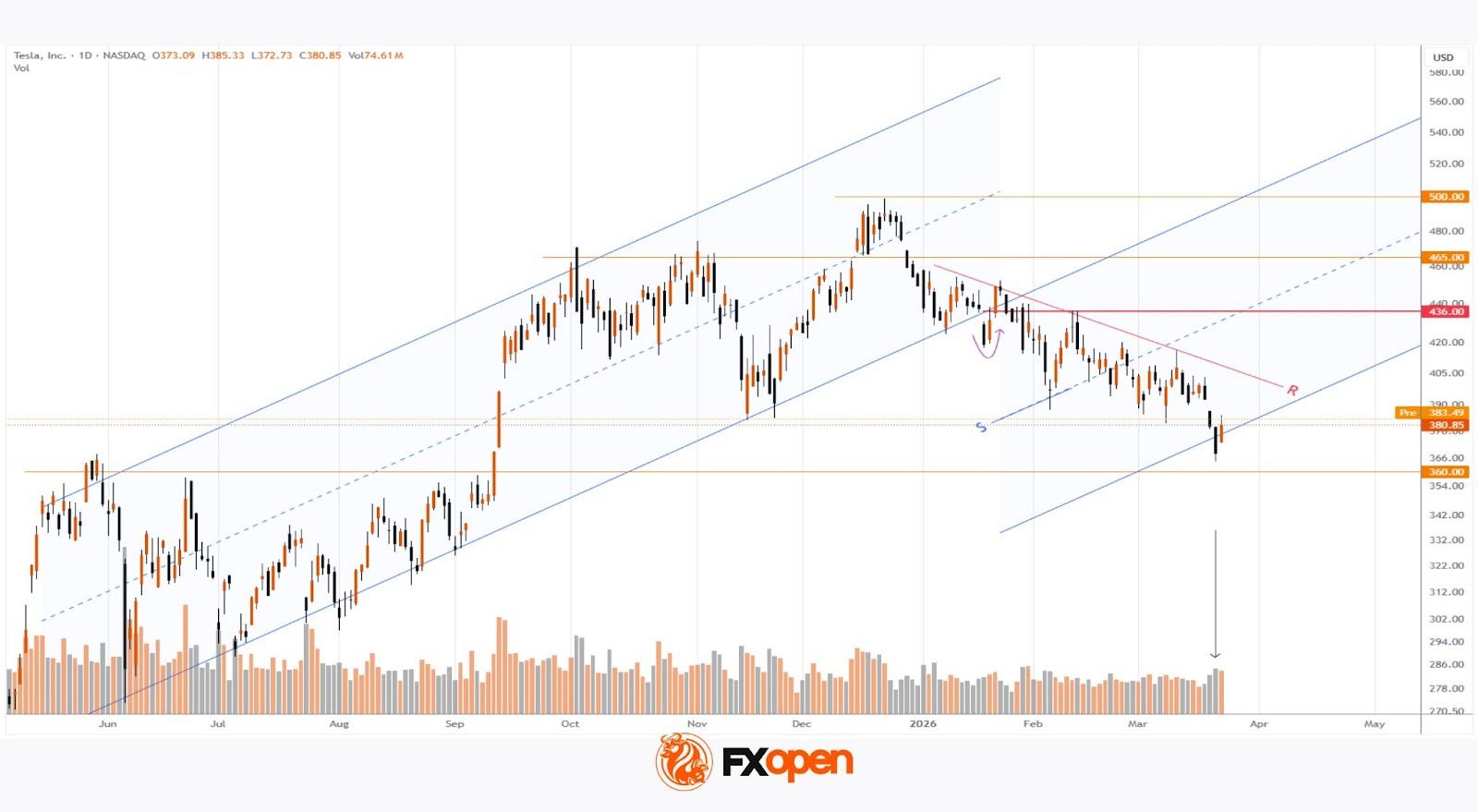
According to the chart, Tesla (TSLA) shares had been under significant pressure since the start of 2026: from their December high, they had lost around 25% of their value. The main bearish drivers included:
→ Intense competition from Chinese automakers, particularly BYD.
→ Falling margins. To maintain market share amid fierce competition, Tesla had to offer price concessions.
→ Doubts over whether Musk could launch the Robotaxi project on schedule, given incidents involving the Autopilot system in poor visibility conditions.
However, on 23 March, the shares staged a strong rebound — TSLA gained approximately 3.5% and closed above $380.
The rally was supported by Elon Musk officially unveiling the Terafab project over the weekend — a joint venture between Tesla, SpaceX, and the startup xAI, with investments estimated at $20–25 billion. The plan to build the world’s largest full-cycle semiconductor factory in Texas is intended to supply Tesla with its own advanced chips, including the new AI5 generation, for Full Self-Driving (FSD) systems, Cybercab robotaxis, and Optimus humanoid robots.
Technical Analysis of TSLA Shares
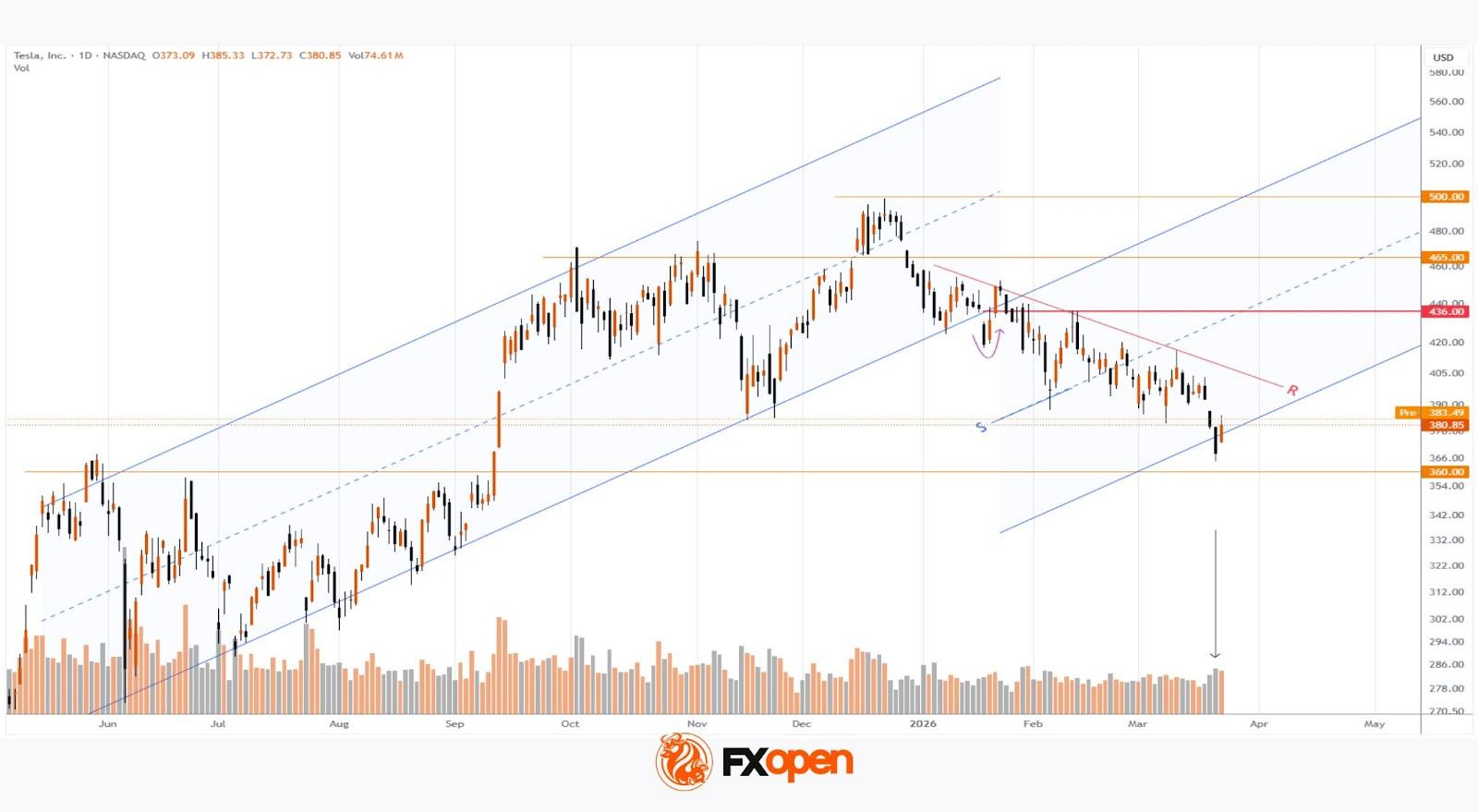
Analysing TSLA’s price on 23 January, we:
→ Updated the ascending channel, which had been in place since summer 2025;
→ Noted signs that bulls were regaining control near the lower boundary of this channel.
Despite this, the shares did not return to the main ascending channel, and the downtrend persisted. This led us to:
→ Draw a descending trendline;
→ Extend a parallel ascending channel downwards, which proved relevant on 5 February when TSLA bounced off its median.
The current upward reversal is notable:
→ It forms a bullish engulfing pattern;
→ It develops near the lower boundary of the parallel channel and the former resistance level at $360;
→ It suggests that Smart Money may be active, as indicated by the largest trading volumes since late January.
Thus, it is reasonable to suggest that the bearish trend for TSLA shares observed in 2026 may be approaching exhaustion.
Buy and sell stocks of the world’s biggest publicly-listed companies with CFDs on FXOpen’s trading platform. Open your FXOpen account now or learn more about trading share CFDs with FXOpen.
This article represents the opinion of the Companies operating under the FXOpen brand only. It is not to be construed as an offer, solicitation, or recommendation with respect to products and services provided by the Companies operating under the FXOpen brand, nor is it to be considered financial advice.


Delaware lawmakers have introduced two bills that would update state banking law and create a licensing framework for stablecoin issuers and digital asset service providers. The package is part of a broader effort to modernize Delaware’s financial rules as states and federal agencies move to define how crypto and stablecoins should be regulated.
Summary
- Delaware filed two bills to modernize banking law and regulate stablecoin issuers and service providers.
- The stablecoin measure would set licensing, reserve, redemption, custody, privacy, and anti-money laundering rules.
- Senate Bill 16 would define digital assets and update Delaware banking code after decades.
Senator Spiros Mantzavinos and Representative Bill Bush filed Senate Bill 16, the Delaware Banking Modernization Act, and Senate Bill 19, the Delaware Payment Stablecoin Act. Delaware Senate Democrats said the package aims to update the state’s banking code while adding consumer protections for newer financial products.
Governor Matt Meyer backed the proposal and said,
”This legislative package sends a signal loud and clear: here in Delaware, we’re democratizing our financial services and lowering the barriers to entry.”
The announcement said the effort is meant to help residents send, receive and store money more easily through digital financial tools.
Senate Bill 19 would create a licensing framework for payment stablecoin issuers and digital asset service providers working with or on behalf of Delaware residents. The bill uses definitions drawn from the federal GENIUS Act and other federal models, according to the announcement.
The proposal also lists reserve rules, redemption timing standards, capital standards, anti-money laundering duties, custody safeguards and data privacy floors. If the measure becomes law, the State Bank Commissioner would be directed to issue implementing regulations within set timeframes.
The stablecoin bill is part of a wider package. The same announcement said another proposal, the Delaware Money Transmission & Virtual Currency Modernization Act, will be filed in the coming days to standardize which activities require a license and to add more consumer protections.
Banking bill updates state code and defines digital assets
Senate Bill 16 would make the first major revision to Title 5 of the Delaware Code since 1981. The bill would define digital assets in state banking law, expand the State Bank Commissioner’s authority, and update governance and organizational requirements for state-chartered banks and trust companies.
Representative Bush said,
”It’s been more than four decades since we’ve made any meaningful updates to our state’s banking laws, and in that time, the way people bank and conduct transactions has changed significantly.”
The package also includes rules to support interstate trust company operations and broader fiduciary activity by out-of-state financial institutions in Delaware. Lawmakers said the aim is to keep Delaware competitive as financial services continue to change.
Bills move forward as crypto rules stay in focus
Both bills have been assigned to the Senate Banking, Business, Insurance & Technology Committee. They would still need committee approval, passage in the full Senate and House, and the governor’s signature before becoming law.
The Delaware move comes as crypto regulation remains active across the United States. In the same announcement, lawmakers said the package is part of an effort to build an innovative banking system while keeping protections in place for consumers and the wider market.
At the federal level, a Securities and Exchange Commission proposal titled “Crypto Assets” is now under Office of Management and Budget review. That review status adds to signs that both state and federal officials are moving toward more formal digital asset rules.


Nasdaq and Talos are expanding their work in digital assets with a new integration aimed at improving how institutions manage tokenized collateral.
Summary
- Nasdaq and Talos joined systems to improve tokenized collateral workflows for institutional market participants.
- The partnership targets about $35 billion in collateral tied up in inefficient measures.
- Nasdaq surveillance tools will help Talos clients monitor wash trading, spoofing, and layering risks.
Meanwhile, the plan links Nasdaq’s Calypso risk and collateral platform and its trade surveillance tools with Talos’s digital asset trading system, as firms look for smoother ways to handle tokenized assets across crypto and traditional markets.
Nasdaq and Talos said the new setup is designed to give institutional clients a more unified workflow. The integration connects execution, collateral management, risk controls and market monitoring in one structure for firms active in both traditional finance and digital assets.
On Monday, the companies said the partnership is aimed at tokenized collateral use cases that have so far faced operational barriers. Nasdaq said these barriers include the difficulty of fitting digital assets into existing collateral and risk systems used by large institutions.
Nasdaq said internal research points to about $35 billion in collateral being tied up in “corrective and non-interest-bearing measures.” The new integration is meant to reduce that friction by helping firms manage tokenized collateral more efficiently across different asset classes.
Talos chief executive Anton Katz said,
”The evolution toward tokenized collateral is a natural progression for institutional capital markets.”
He added that bringing Talos together with Nasdaq’s systems could reduce friction across onchain and offchain assets.
In addition, the integration also adds Nasdaq’s trade surveillance tools to Talos’s client workflow. That means users will be able to monitor trading activity for patterns linked to wash trading, spoofing and layering across the venues they access.
That focus comes as digital asset markets continue to face questions around market integrity. Nasdaq said the combined system is intended to bring “institutional-grade” compliance standards into workflows used for tokenized collateral and digital asset trading.
Tokenization push continues across large firms
The Nasdaq-Talos move comes as larger financial groups keep building tokenization tools for institutions. In BlackRock’s 2026 chairman’s letter, Larry Fink wrote that tokenization could help modernize market infrastructure by making investments easier to issue, trade and access.
Other firms are also building collateral programs around tokenized assets. Franklin Templeton said in February that eligible institutions can use tokenized money market fund shares as off-exchange collateral in digital markets, showing that large firms are moving beyond pilots into live institutional products.
Crypto World
Fund services giant Apex to tokenize Omnes’ Bitcoin mining note on layer-2 blockchain Base
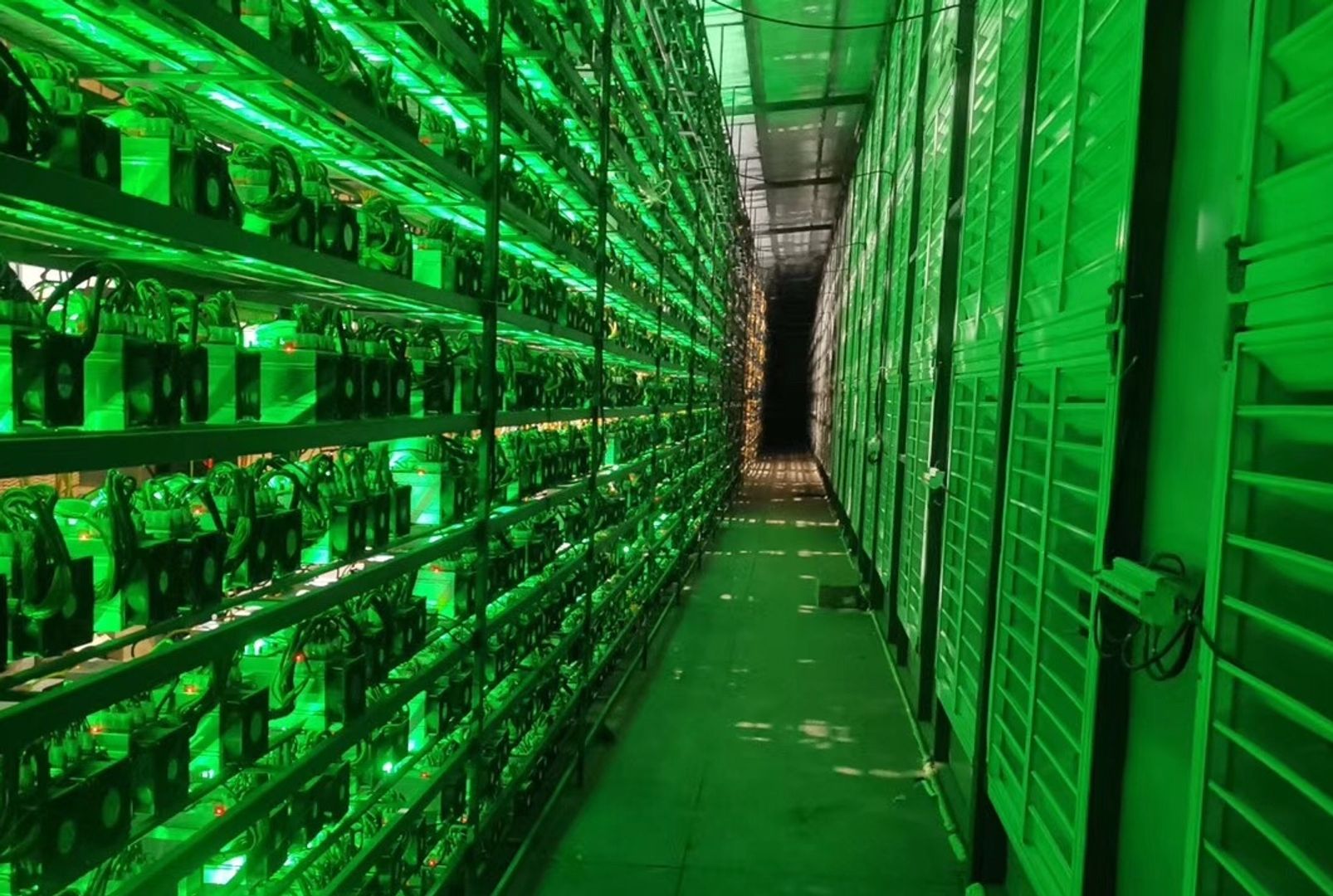
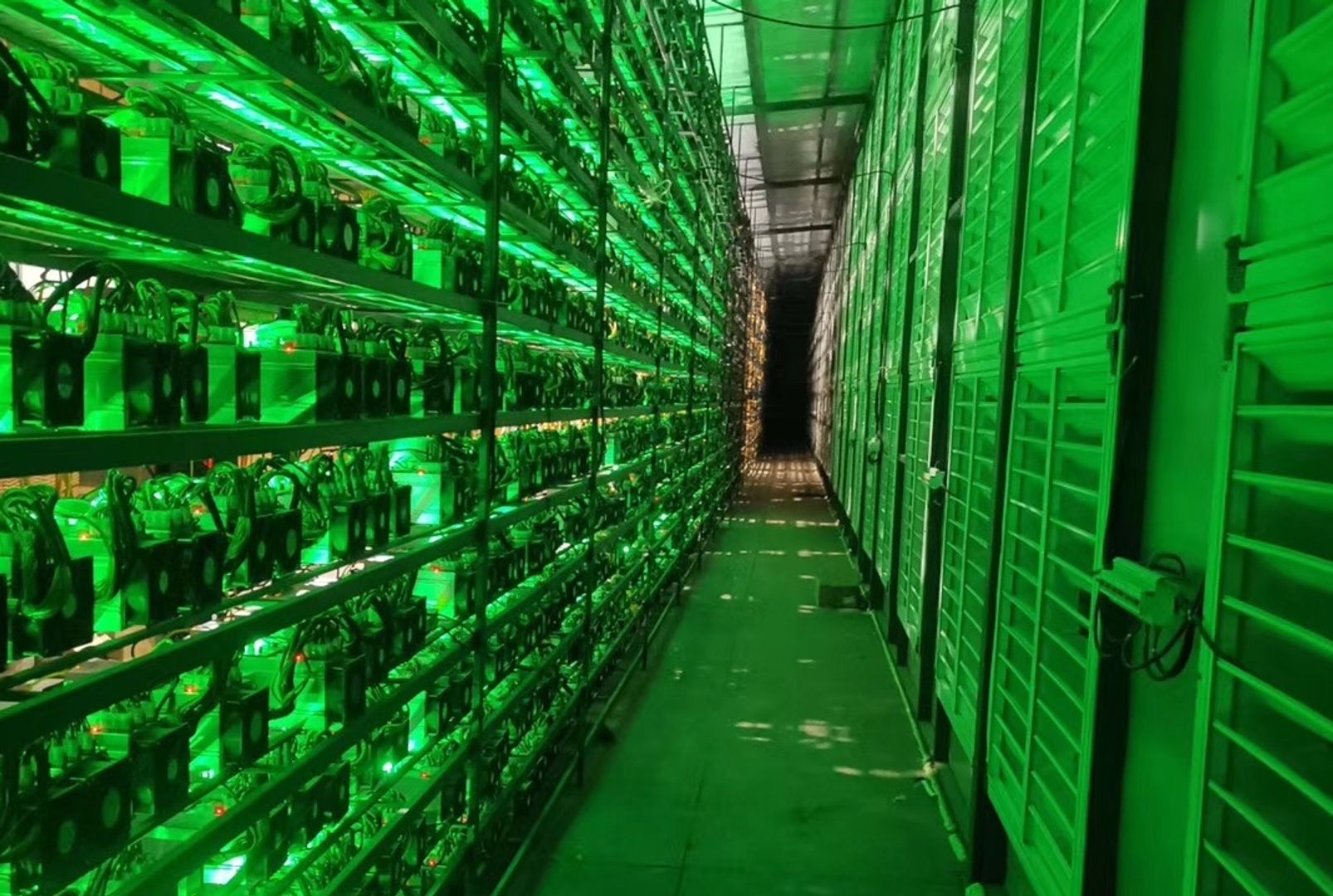
Apex Group, the fund services giant with over $3.5 trillion in assets under administrative care, extended its tokenization range with a structured product offering institutions exposure to bitcoin mining, to be issued and managed on U.S. exchange Coinbase’s Ethereum overlay platform, Base.
Since buying real-world asset (RWA) specialist Tokeny last May, Apex has been steamrolling into the tokenization industry, and on Tuesday said it will tokenize the Omnes Mining Note, OMN, an institutional-grade structured note backed by bitcoin hashrate.
The OMN provides professional non-U.S. investors with direct economic exposure to new bitcoin production measured in hashrate, which is the computational power used to validate transactions and produce the largest cryptocurrency, without the operational complexities of managing mining infrastructure, hardware, energy or regulatory hurdles, according to a release.
Each OMN is backed by a fixed 1 petahash per second (1 PH/s) of Bitcoin hashrate for the duration of the 36-month tenor. Ownership is recorded in book-entry form and mirrored onchain under the ERC-3643 standard, according to the Omnes website. ERC-3643 is an Ethereum-based protocol for tokenizing RWAs developed by Tokeny.
“Tokenization gives investors mobility and utility that traditional notes cannot,” said Peter Hughes, founder and CEO of Apex Group, in the statement. “Qualified investors can transfer OMN onchain and, over time, potentially use it as a form of collateral in permissioned lending without selling the asset. This enhances liquidity while giving Omnes a more scalable and globally distributable structure.”
Apex said last week that its partnership on the Coinbase Bitcoin Yield Fund, which it handles as a transfer agent and record keeper of the funds net asset value, would be available to investors on the Base network.
“Bringing a regulated debt product backed by mining onto Base is a huge win. It proves that onchain finance isn’t just for crypto-native assets – it’s for real-world industrial infrastructure too,” said Jesse Pollak, head of Base.
“Bitcoin mining is the only mechanism that creates new Bitcoin through protocol issuance. This is economically distinct from yield strategies that rely on redistributing existing Bitcoin,” said Emmanuel Montero, Omnes’ CEO.


The European Central Bank has renewed its push for tokenized central bank money as Europe works to build a larger tokenized financial market. ECB Executive Board member Piero Cipollone said tokenized deposits and stablecoins will need a public settlement base in central bank money if the market is to grow across the region.
Summary
- ECB says tokenized deposits and stablecoins need central bank money to scale in Europe.
- Pontes will connect DLT platforms with TARGET Services for settlement in central bank money.
- Cipollone said Europe still needs clearer tokenization laws and stronger public-private coordination efforts.
Cipollone made the case during a speech in Brussels on March 23. He said tokenized central bank money is needed as a settlement anchor for tokenized securities, deposits and stablecoins. He warned that without it, market participants may receive payment in assets they do not want to hold because of price swings or credit concerns. He said,
“Without tokenised central bank money, a seller of a tokenised security may receive payment in an asset they are not comfortable holding – one exposed to price volatility or credit risk – which limits the market’s ability to scale.”
His remarks place public money at the center of the ECB’s tokenization plan. The ECB has been building that plan through Pontes, the Eurosystem’s distributed ledger settlement project. Pontes is designed to connect DLT-based market platforms with the Eurosystem’s TARGET Services so transactions can settle in central bank money.
The ECB said Pontes is due for an initial launch in the third quarter of 2026. That first phase is meant to meet immediate market demand and let participants settle DLT-based transactions in central bank money.
Pontes is part of a broader two-track plan. The shorter-term track focuses on practical settlement tools, while the longer-term track is Appia, which is meant to help shape a wider European tokenized financial system by 2028.
The ECB said Appia will be built with market input. It is meant to map out how tokenized finance can develop in Europe while keeping central bank money as the base layer for trust and settlement.
Cipollone calls for legal clarity across the bloc
Cipollone also said settlement alone will not be enough. He called for closer work between public institutions and private firms, along with legal rules that fit tokenized finance across the European Union.
One part of Appia focuses on interoperability. The goal is to make tokenized assets transferable across different DLT platforms through shared data formats and compatible smart contract standards.
He said the European Commission’s plan to extend and improve the DLT Pilot Regime is “important and welcome.” At the same time, he warned that Europe may still need a dedicated legal framework so tokenized assets can be issued, held and transferred more smoothly across the bloc.
In addition, the debate has also drawn comments from private sector firms. Circle said in feedback submitted on March 20 that the Commission should widen the DLT Pilot Regime and allow authorized crypto-asset service providers to offer e-money token cash account services.
That feedback came just days before Cipollone’s speech. Together, the comments show that both public institutions and private firms are pushing for clearer rules as Europe tries to build tokenized markets that can work at scale.


Bitmine Immersion Technologies has increased its Ether holdings again as chairman Tom Lee said the token’s recent weakness may be nearing an end. The company disclosed a fresh purchase of 65,341 ETH worth about $139 million, lifting its total holdings to more than 4.6 million Ether.
Summary
- Bitmine bought 65,341 ETH, lifting total holdings above 4.6 million tokens this week.
- Tom Lee said Ether’s mini-crypto winter may be nearing its final stage now.
- Bitmine is nearing its goal of owning 5% of Ether’s circulating supply.
Bitmine said it has raised its buying pace over the past three weeks. Lee said the company’s base case is that Ether is in the final stages of a “mini-crypto winter” after several months of pressure across digital asset markets.
The latest purchase added 65,341 ETH to the company’s balance sheet. That brought Bitmine’s holdings to about 4.661 million Ether as of March 23, according to the company’s update.
Lee also pointed to policy and market signals that he said support a better outlook for crypto. In the company statement, he linked that view to progress on the CLARITY Act and to the way Ether and other digital assets have held up during recent geopolitical stress.
Bitmine’s total Ether position now equals about 3.86% of the circulating supply, based on Ethereum’s circulating supply of about 120.69 million tokens. The company has said it wants to accumulate 5% of the circulating supply over time.
To reach that goal at the current supply level, Bitmine would still need roughly 1.37 million more ETH. At prices near $2,156, that would require close to $3 billion in additional purchases.
Ether’s supply is not fixed. The total can rise or fall depending on issuance and token burning, so the amount needed to reach 5% can change over time.
Staking remains part of the strategy
Bitmine said more than 3 million of its Ether is now staked. That means the company is not only building a treasury position but also using the assets within Ethereum’s proof-of-stake system.
The company also reported other holdings on its balance sheet. These include about $1.1 billion in cash, 196 Bitcoin, a $200 million stake in Beast Industries, and a $95 million stake in Eightco Holdings.
Moreover, Bitmine is now one of the largest corporate Ether holders in the market. Strategic ETH Reserve data cited in public reports shows Bitmine ahead of other treasury firms, with SharpLink Gaming and Ether Machine trailing by a wide margin.
The company’s latest move also reflects a wider trend that grew across 2025 as more firms shifted capital into crypto treasury strategies.

Fraud networks work by using X accounts
ZachXBT determined that there was a group of X accounts on the network that shared updates related to war to gain some credibility and an audience. Most of these accounts would frequently post about the political happenings to become known to active users, and they also had the benefit of reposting similar content that would assist in increasing their reach as well as ensuring constant exposure.
The accounts later started to promote fraud involving crypto after gaining a following. They involved bogus giveaways and organized pump-and-dump operations on unsuspecting participants. As a result, the users, who interacted with content about the war, were exposed to false promises of easy returns with the help of digital assets.
The research revealed that operators used to switch usernames and account identities to minimize chances of detection. They also purchased older accounts that were already followed to sound more believable. In addition to that, the network employed the same message being sent repeatedly on a number of profiles, which enabled them to push scam campaigns within a short period and successfully.
Major Profits on Organized Plans
According to on-chain data, such synchronized operations brought a lot of money to the operators. One instance was the report by ZachXBT that a campaign generated six-figure profits during short-term token promotions. There was also one case where multiple accounts promoted the token known as ORAMAMA in a single day and then never promoted it again.
The emergence of the scams is a part of a bigger story with scammers exploiting major international events to target online audiences to trick them. The presence of fear and uncertainty in the current conflict has empowered purported scammers to integrate misinformation into financial frauds, although the social media platforms continue to be at the center of the operation plans. The results mention how scammers can use geopolitical tension to organize coordinated campaigns of financial frauds, whereas the social media platforms remain central to their operational strategies.
Bitcoin is experiencing a sharp sell-off, even as the U.S.-Iran war de-escalates, trading at the $71,000 level, and still is 4% lower than a week ago. The broader crypto market has underperformed significantly this week despite a bullish Bitcoin price prediction.
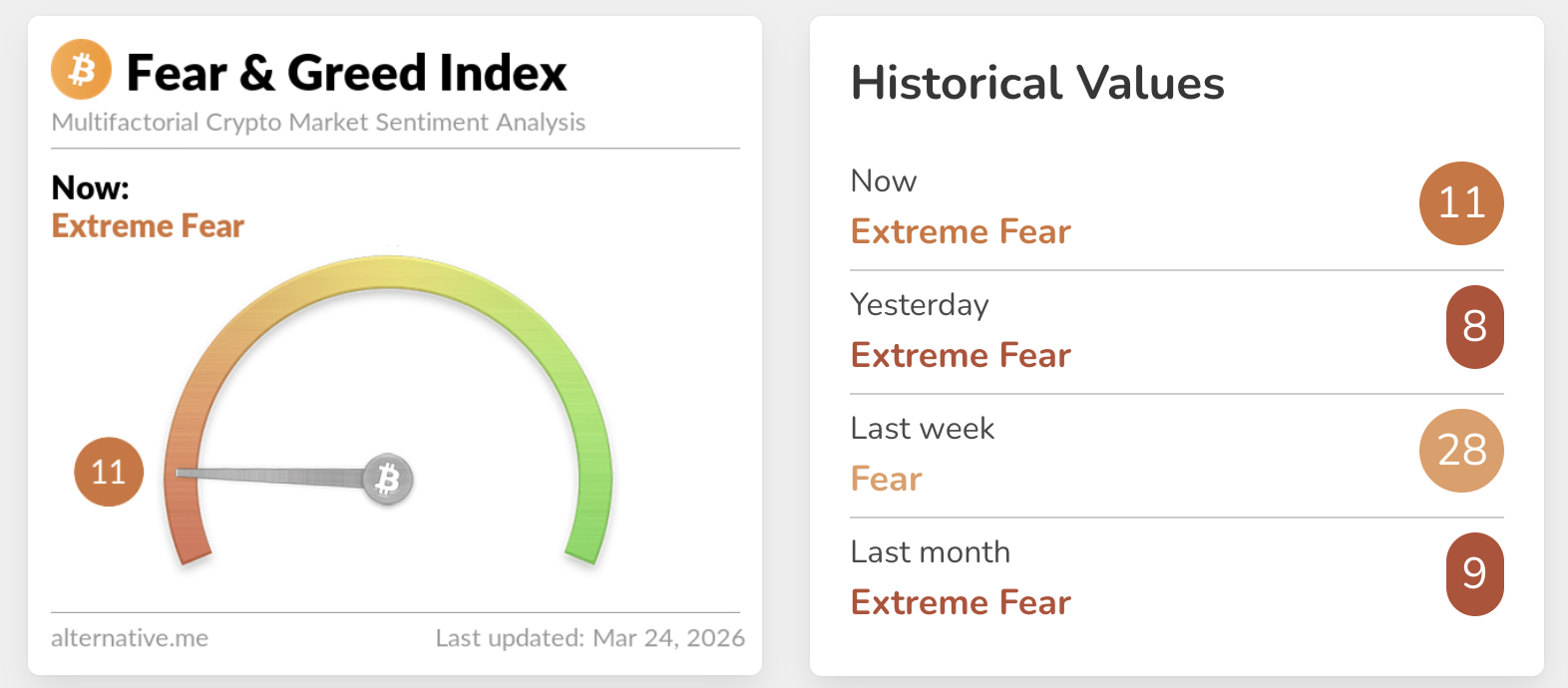
This retreat places BTC below its critical 20-day EMA of $70,515, signaling renewed bearish momentum in the short term. Amid the volatility, macro factors are heavily influencing price discovery, pushing the Fear & Greed Index down to a reading of 11, or extreme fear.

While the immediate outlook appears grim, a major catalyst looms: the SEC decision on 91 crypto ETF applications due by March 27. Market participants are bracing for extreme volatility; an approval could trigger a swift rebound, while rejection may force a deeper capitulation.
Can Bitcoin Price Reclaim $73,000 Before the Weekly Close? Here’s Our Prediction.
Bitcoin’s failure to hold the $69,000–$71,000 consolidation zone has exposed lower support levels. Currently, BTC is struggling against resistance at $71,500, blocked by the falling 20-day and 50-day EMAs.
The MACD histogram remains positive but is trading below the signal line, indicating that while selling pressure has eased slightly, bullish momentum is nonexistent. A critical defense line sits at $65,500; losing this level could validate a prolonged correction. Conversely, a successful breakout above immediate upper resistance at $73,600 could invalidate the bearish thesis.

For now, we should watch the $73,600 level closely; a clean break here is required to shift the 14-day RSI from its neutral 50.20 stance into bullish territory. This cycle, Bitcoin price prediction focuses more on sentiment than chart structures.
Discover: The best pre-launch token sales
LiquidChain Targets Early Mover Upside as Bitcoin Consolidates
While Bitcoin struggles to maintain the $67,000 floor, capital is beginning to rotate into infrastructure plays that solve the market’s fragmentation issues. The current bearish sentiment provides a pivotal moment for “pick-and-shovel” assets, or projects that gain utility regardless of whether the market trends up or down. As BTC dominates headlines, smart money often hunts for asymmetric returns in presale markets.
Enter LiquidChain ($LIQUID), a Layer 3 (L3) infrastructure project designed to fuse Bitcoin, Ethereum, and Solana liquidity into a single execution environment. The project has raised more than $600K in its ongoing presale, with tokens priced at $0.0143 at a very early stage.
LiquidChain’s “Deploy-Once Architecture” allows developers to write code once and access users across three major chains, eliminating the friction of bridging while giving more than 1700% APY on staking rewards.
It acts as “The Cross-Chain Liquidity Layer,” offering sub-second unified settlement. However, early-stage infrastructure carries development risk; the roadmap must be executed flawlessly to compete with established L2s. Investors looking for a hedge against BTC stagnation can research the presale below.
Disclaimer: Crypto is a high-risk asset class. This article is provided for informational purposes and does not constitute investment advice. You could lose all of your capital.
The post Bitcoin Price Prediction: War De-escalates, But Still Underperforming appeared first on Cryptonews.

XRP It’s Happening TOMORROW!! (JUST IN NEWS XRP Holders)

Millions of households urged to submit energy meter reading before next week

Wall Street Breakfast Podcast: Router Ban Plugs Into Gains


-
 Crypto World3 days ago
NIO (NIO) Stock Plunges 6.5% as Shelf Registration Sparks Dilution Worries
-

 Fashion4 days ago
Weekend Open Thread: Adidas – Corporette.com
-

 Politics4 days ago
Jenni Murray, Long-Serving Woman’s Hour Presenter, Dies Aged 75
-
 Tech7 days ago
Are Split Spacebars the Next Big Gaming Keyboard Trend?
-

 Crypto World2 days ago
Best Crypto to Buy Now: Strategy Just Spent $1.57 Billion on Bitcoin During Fear While Early Investors Quietly Enter Pepeto for 150x Potential
-

 News Videos6 days ago
RBA board divided on rate cut, unusually buoyant share market | Finance Report | ABC NEWS
-

 Crypto World3 days ago
Bitcoin Price News: Bhutan Sells $72 Million in BTC Under Fiscal Pressure, but the Smart Money Entering Pepeto Sees What the Market Does Not
-

 Politics6 days ago
The House | The new register to protect children from their abusers shows Parliament at its best
-

 Tech4 days ago
inKONBINI Lets You Spend Summer Days Behind the Register
-
 Politics7 days ago
Real-time pollution monitoring calls after boy nearly dies
-

 Crypto World6 days ago
Canada’s FINTRAC revokes registrations of 23 crypto MSBs in AML crackdown
-

 Sports23 hours ago
Remo Stars and Kano Pillars Strengthen Survival Hopes in NPFL
-
 NewsBeat6 days ago
Residents in North Lanarkshire reminded to register to vote in Scottish Parliament Election
-

 News Videos6 days ago
PARLIAMENT OF MALAWI – PAC MEETING WITH REGISTRAR OF FINANCIAL ON AMARYLLIS HOTEL – INQUIRY LIVE
-

 Politics5 days ago
Gender equality discussions at UN face pushbacks and US resistance
-

 Business2 days ago
No Winner in March 21 Drawing as Prize Rolls to $133 Million for Next
-

 Business6 days ago
Who Was Alex Pretti? 5 Key Facts About the ICU Nurse Killed by Federal Agents in Minneapolis
-

 Sports22 hours ago
Gary Kirsten Accuses Pakistan Cricket Board Of ‘Interference’, Mohsin Naqvi Responds
-

 Tech2 days ago
Give Your Phone a Huge (and Free) Upgrade by Switching to Another Keyboard
-

 Sports4 days ago
2026 Kentucky Derby horses, odds, futures, preview, date: Expert who nailed 12 Derby-Oaks Doubles enters picks
You must be logged in to post a comment Login