
Crypto World
Bankrupt exchange FTX set to repay $2.2 billion to creditors this month

FTX Recovery Trust announced Wednesday it will distribute roughly $2.2 billion to creditors on March 31 as part of its ongoing bankruptcy recovery process, with additional payments to preferred equity holders scheduled later this year.
The payout marks the fourth distribution under FTX’s Chapter 11 reorganization plan and will go to creditors in both “Convenience” and “Non-Convenience” classes who have completed required onboarding steps, the trust’s statement says. Funds are expected to arrive within 1 to 3 business days via BitGo, Kraken, or Payoneer.
The trust also clarified all distributions are made in U.S. dollars to designated service providers, which then offer options for fiat withdrawal or conversion into digital assets.
The previous distribution to creditors took place from Sept. 30, when the trust announced the release of $1.6 billion, the third major payout since the collapse of the crypto exchange more than three years ago.
Earlier rounds totalled over $6 billion as part of a process aimed at recovering assets for users of the once-prominent cryptocurrency exchange, which collapsed in November 2022, triggering a steep crypto bear market. Sam Bankman-Fried, the founder and CEO of the exchange, is serving a 25-year sentence after being found guilty of seven counts of fraud and conspiracy.
The latest distribution pushes recovery rates higher across several claim classes, the trust said. The statement added that in this fourth distribution, those eligible for distribution classed as “Class 5A Dotcom” would receive an additional 18% (bringing total recovery to 96%), while U.S. customer claims classed as “5B” would reach full recovery at 100%. Those in classes “6A” and “6B” would also recover 100% recovery, each receiving a 15% increment. “Class 7,” meanwhile, would receive a cumulative 120% distribution, the statement said.
FTX said customers who opted to receive funds through a designated distribution provider have waived their right to direct cash payments and must work with those platforms to access their funds.
The estate also set April 30 as the record date for its first payments to preferred equity holders, with payments scheduled for May 29. Eligible holders must complete ownership certification, know-your-customer (KYC) verification and tax documentation to qualify, the trust said.
FTX began outreach to equity holders earlier this year and urged those who have not been contacted to come forward. Further distribution timelines are expected to be announced, the statement concluded.

At the same time, one important indicator suggests that the price may also plummet dramatically in the foreseeable future.
The leading cryptocurrency experienced a significant upswing over the past several days, with its price briefly rising to as high as $76,000.
Although it was stopped there and pushed south by $5,000, some key factors, including recent whale activity, suggest it may post further gains in the near future.
BTC Isn’t Done Yet?
Despite losing some steam in the past hours, Bitcoin remains well in the green on a weekly scale and currently trades at around $71,400 (per CoinGecko’s data). As a result, many analysts have flipped toward the optimists’ corner and expect an additional price increase.
The renowned market observer Ali Martinez, for instance, claimed that a daily close above the $73,344 resistance and later turning that level into a structural floor could open the door to a pump to $79,234 and $85,555.
In a subsequent post on X, the same analyst revealed that whales have acquired 40,000 BTC over the past seven days. The USD equivalent of the stash is almost $2.9 billion (at current rates), and now this cohort of investors controls roughly 5.17 million units, or roughly 25% of the asset’s circulating supply.
Such accumulations are generally viewed as bullish because they reduce the amount of BTC available on the open market, which, combined with non-declining demand, should lead to a price surge. They may also energize smaller players to step in and further support the upward momentum.
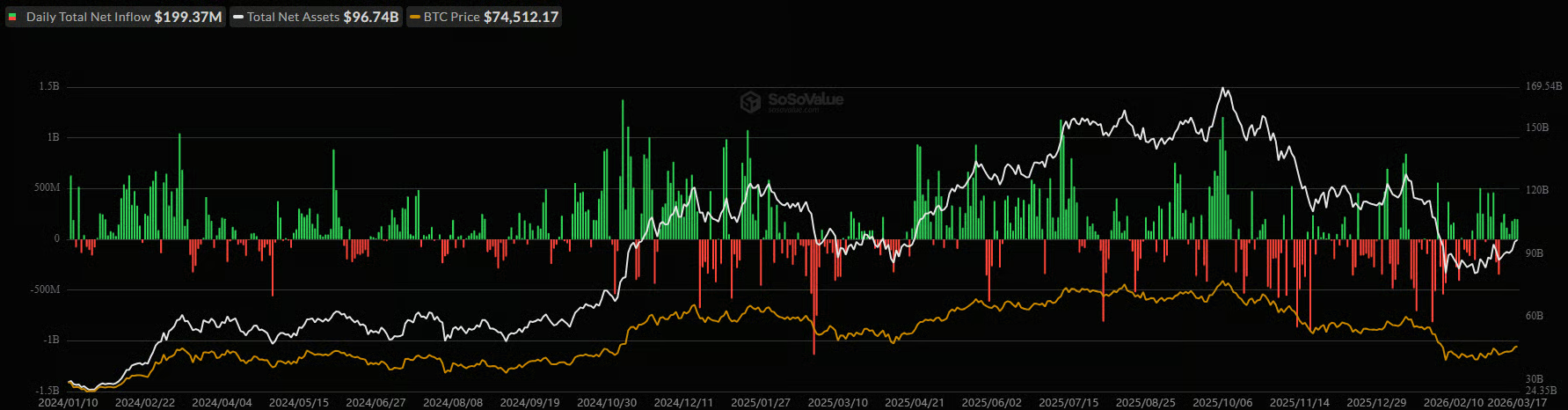
Next on the list is the solid interest in spot BTC ETFs lately. Over the past seven days, inflows into such investment vehicles have surpassed outflows, which is the longest such streak since October last year. When institutional investors such as pension and hedge funds increase their exposure to the asset through regulated financial vehicles, they require the issuers to purchase BTC to back their shares. Put simply, consistent ETF demand makes the remaining supply scarcer, which tends to push the price north.
You may also like:
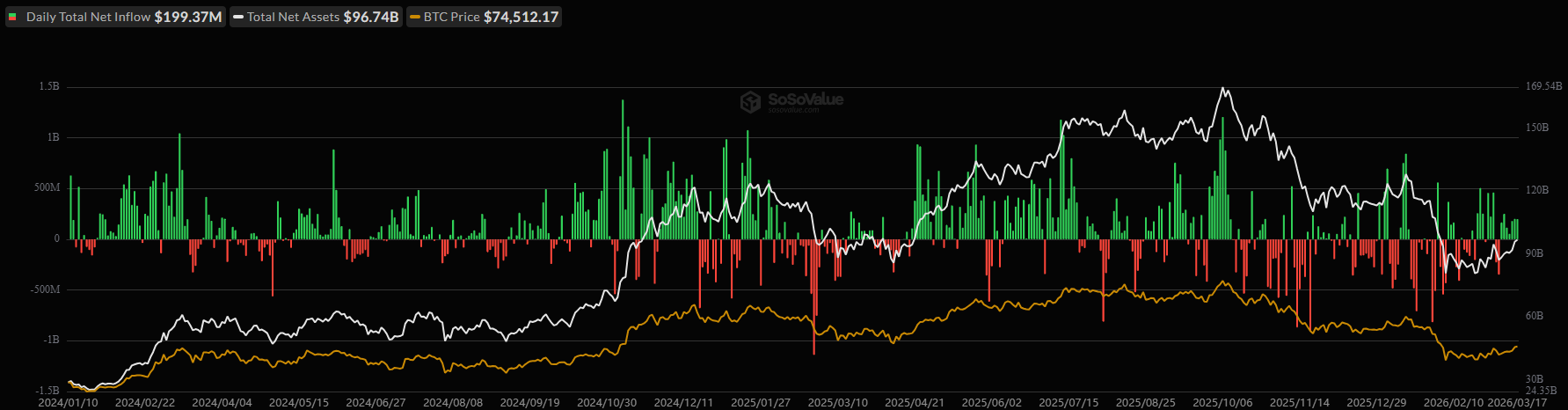
Despite the renewed appetite for such financial vehicles, many ETF investors remain underwater. Earlier this week, Axel Adler Jr. estimated that the $79,962 level represents the average cost basis of every BTC currently held inside these exchange-traded funds. If the asset trades below this mark, the cohort is sitting at unrealized losses, while breaking above would lead to paper profits.
Last but not least, we will touch upon the shrinking supply of BTC held on crypto exchanges. Today (March 18), the figure dropped to a new six-year low of approximately 2.72 million units. This suggests that investors continue to abandon centralized platforms in favor of self-custody methods, thereby reducing the immediate selling pressure.

Major Volatility Ahead?
Another industry participant who analyzed BTC’s recent performance is the X user Cantonese Cat. They claimed that the Bollinger Bands on a monthly scale have squeezed to levels never seen before.
The technical indicator shows how far the price deviates from its average, helping traders gauge volatility. When the bands tighten, it reflects a prolonged period with little turbulence: a setup that often precedes a large breakout. It is important to note that the huge move could be in any direction, or, as Cantonese Cat said:
“This will lead to a very powerful move when it expands. All that volatility that you saw over the last few months is nothing compared to what will come.”
Binance Free $600 (CryptoPotato Exclusive): Use this link to register a new account and receive $600 exclusive welcome offer on Binance (full details).
LIMITED OFFER for CryptoPotato readers at Bybit: Use this link to register and open a $500 FREE position on any coin!


Institutional investors remain broadly positive on digital assets despite recent market volatility, but they are becoming more selective about how they gain exposure, according to a new survey from Coinbase and EY-Parthenon.
The January 2026 survey of 351 institutional decision-makers found that 73% plan to increase their digital asset allocations this year, while 74% expect crypto prices to rise over the next 12 months. At the same time, nearly half said recent volatility has pushed their firms to place greater emphasis on risk management, liquidity and position sizing.
That mix of confidence and caution points to a maturing market, said David Duong, Coinbase’s head of institutional research.
“People are still interested in crypto,” Duong said in an interview. “They want to see tighter risk controls, but they want to stay allocated.”
The findings suggest institutions are no longer treating crypto as a short-term trade. Instead, many are building more permanent operating models around the asset class, with a heavier focus on governance, compliance and operational resilience.
One clear example is how institutions now prefer to access the market. The survey found that 66% of respondents get exposure through spot crypto exchange-traded funds (ETFs) and 81% prefer spot exposure through a registered vehicle. Duong said that does not mean exchange-traded products are only a temporary step before institutions move fully on-chain.
“I don’t think it’s just a transitional vehicle,” he said. “It caters to a certain segment of the investor community.” Still, he added that as the market develops, more institutions may want exposure to the underlying assets directly rather than only through fund wrappers.
Regulation remains the biggest tension in the market. Among respondents planning to increase holdings, 65% said greater regulatory clarity was a key driver, yet 66% also called regulatory uncertainty a primary concern when investing in digital assets.
That contradiction could become important if clearer rules emerge. “Regulatory clarity is acting as both the driver, but also the obstacle,” Duong said.
Recent developments around the proposed Digital Asset Market CLARITY Act have added urgency to that dynamic. The bill, which aims to define how crypto assets are regulated in the U.S., would clarify the roles of the SEC and CFTC while setting rules for stablecoins and market structure. While the legislation has yet to pass, policymakers and regulators have signaled growing support for a clearer framework, and parallel guidance from agencies like the Office of the Comptroller of the Currency has begun to outline how banks can engage with digital assets.
For institutions, that evolving backdrop is critical: clearer rules could unlock broader participation, while continued uncertainty remains a key constraint on capital entering the space.
The survey also found growing interest in stablecoins and tokenization, two areas increasingly seen as practical infrastructure rather than speculative bets. Eighty-six percent of respondents said they already use stablecoins or are interested in using them, with top use cases including T+0 settlement and internal cash management and money movement. Meanwhile, 63% said they are very interested in investing in tokenized assets, and more than 60% expect tokenization to significantly affect trading, clearing and settlement within three to five years.
Custody has also moved higher on the priority list. The share of respondents citing regulatory compliance as a key factor in selecting a custodian rose to 66% from 25% a year earlier. The importance of security and key-signing protocols jumped to 66% from 8%.
Duong said that shift reflects how institutions are thinking about crypto differently as use cases expand beyond trading.
“Compliance and security are now the top priorities,” he said. “Cost, interestingly enough, has fallen to the bottom of the list.”
For Coinbase, the message is that institutions still want crypto exposure, but only with stronger guardrails. For the broader market, the survey suggests the next phase of adoption may depend less on enthusiasm alone and more on whether the industry can deliver the controls large investors now expect.
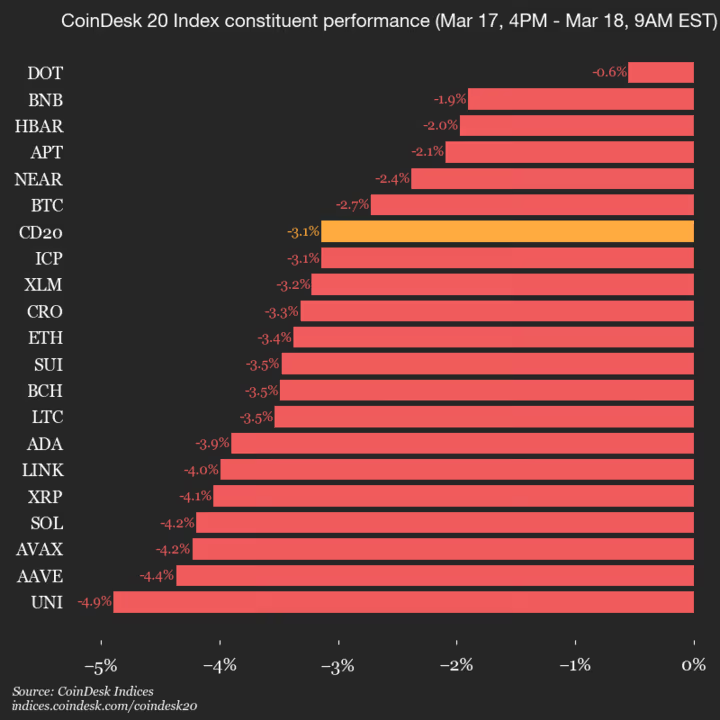
CoinDesk Indices presents its daily market update, highlighting the performance of leaders and laggards in the CoinDesk 20 Index.
The CoinDesk 20 is currently trading at 2102.78, down 3.1% (-68.15) since 4 p.m. ET on Tuesday.
None of the 20 assets are trading higher.

Leaders: DOT (-0.6%) and BNB (-1.9%).
Laggards: UNI (-4.9%) and AAVE (-4.4%).
The CoinDesk 20 is a broad-based index traded on multiple platforms in several regions globally.
Disclosure: This article does not represent investment advice. The content and materials featured on this page are for educational purposes only.
CoinEx launches Dual Investment product to help traders earn rewards during volatile market conditions.
Summary
- CoinEx unveils dual investment, enabling crypto holders to earn interest while targeting specific buy or sell prices.
- Traders can now grow their crypto holdings with CoinEx’s Dual Investment, earning yields even during market swings.
- Dual investment by CoinEx offers high APY rewards, letting investors lock USDT or BTC with conditional price targets.
CoinEx has launched a product called dual investment, which allows traders to earn rewards even during times of high market volatility.
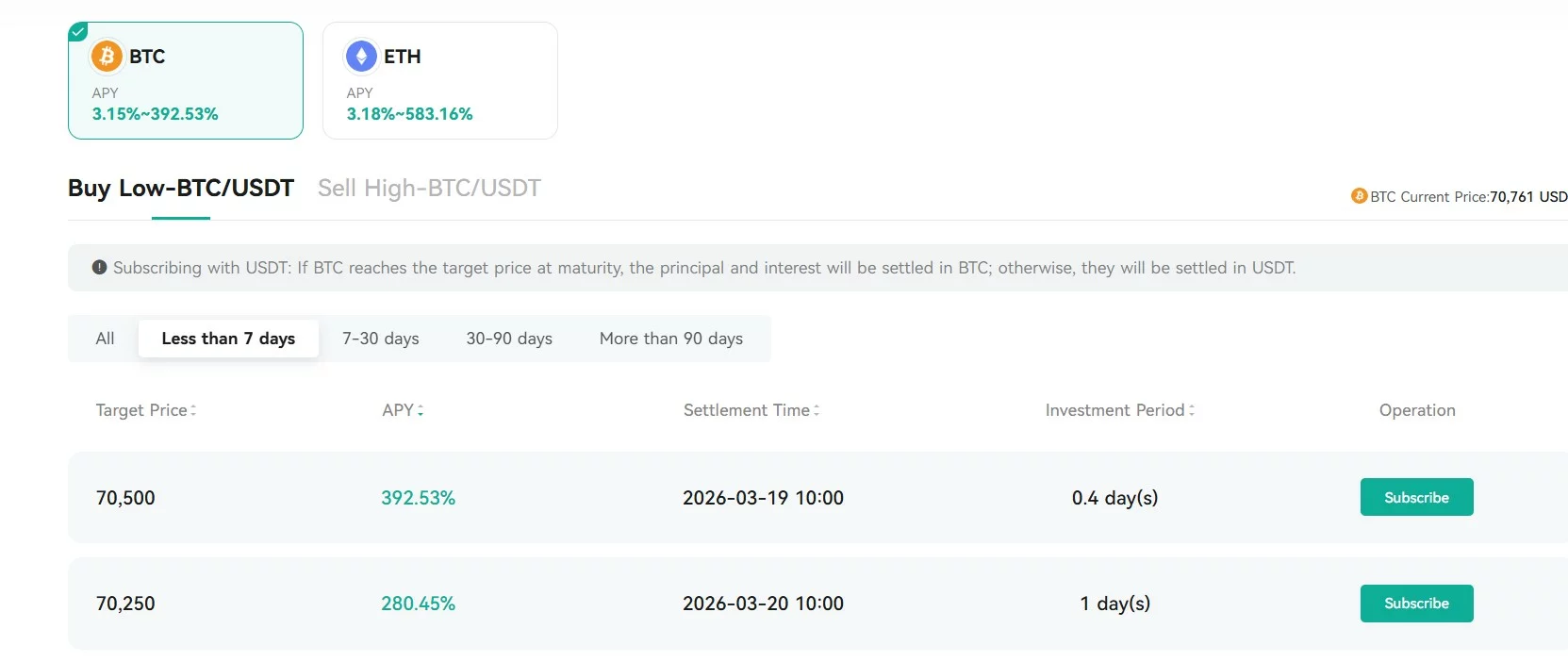
CoinEx’s dual Investment is a financial product designed to generate income while allowing investors to set a conditional “sell high” or “buy low” outcome.
Under this structure, an investor deposits a cryptocurrency such as USDT or Bitcoin, selects a target price at which they are willing to buy or sell, and chooses a fixed investment period.
If the market price reaches the selected level during that period, the investment is settled in the other asset, and the investor receives both their principal and the agreed yield. If the target price is not reached, the investor simply receives their original asset back, along with the accrued interest.
In a typical dual investment scenario, an investor might deposit $10,000 in USDT while setting a target price to buy low Bitcoin at $50,000, below its current price of $55,000. Over a seven-day period, the product offers a high annualized yield, for example, an APY of 90%, which translates to roughly $173 in interest for the week.
If the price of Bitcoin falls to $50,000 or below during that period, the investor’s funds are automatically converted into Bitcoin at the agreed price, and they receive the equivalent value along with the earned yield. However, if the market does not reach the target level, the investor retains their original USDT deposit, plus the interest earned.
For a trader holding Bitcoin who chooses to sell high, if the market price rises to their target, the asset is sold, and returns are paid in USDT with yield; if not, the investor keeps their Bitcoin and still earns interest.
When the market is moving sideways without going anywhere, dual Investment traders have a way to still make money. Instead of just waiting for prices to rise or fall, they can earn interest on their crypto even during times of market consolidation.
CoinEx offers dual investment for BTC/USDT and ETH/USDT pairs, with a fixed APY of up to 400%.
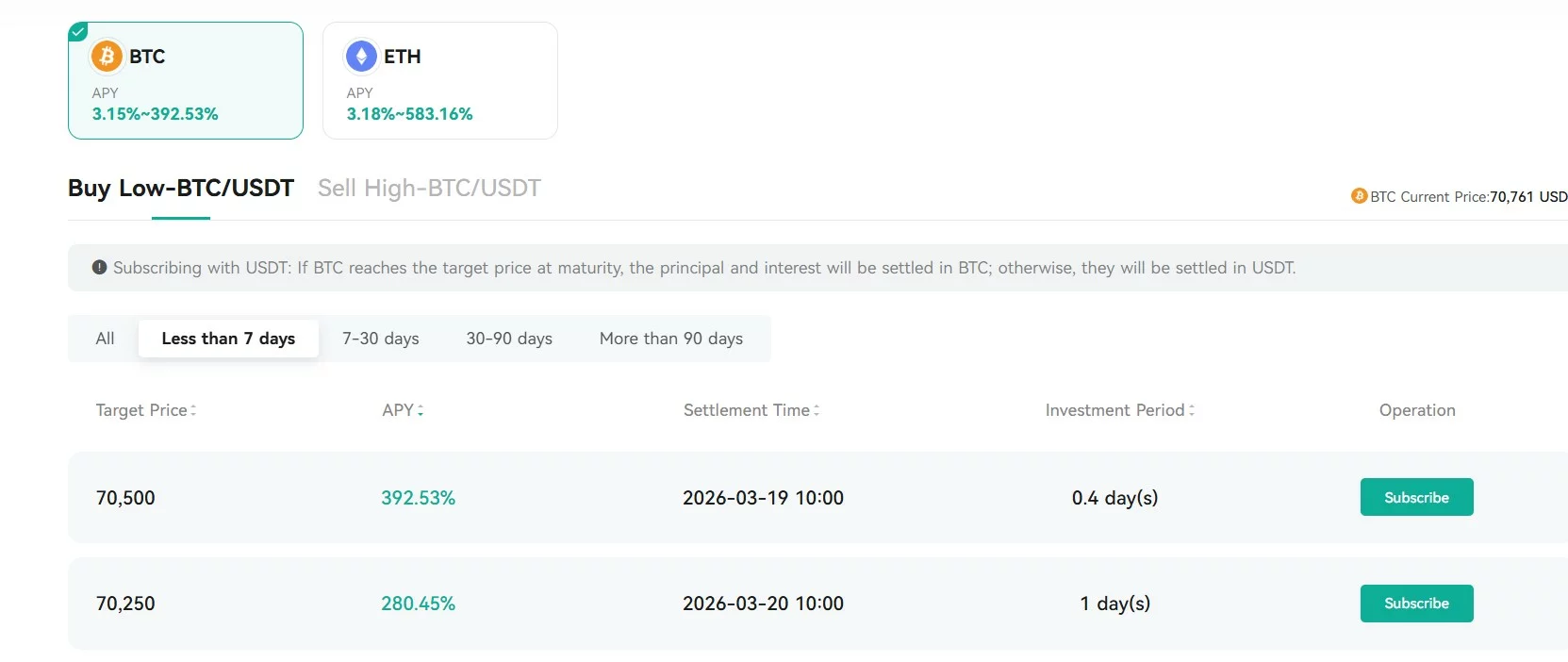
However, just like any investment, dual investment comes with its own risks. CoinEx says that the product carries non-principal-protected risk. Market volatility and other unforeseen factors mean investors may experience losses or miss out on potential gains that could have been captured on the spot market.
Investors should also note that assets in dual investment products are locked until the end of the chosen period, meaning they cannot redeem or withdraw their funds before maturity and settlement.
Disclosure: This content is provided by a third party. Neither crypto.news nor the author of this article endorses any product mentioned on this page. Users should conduct their own research before taking any action related to the company.


The Bank of Korea has kicked off Phase 2 of Project Hangang, expanding its digital won pilot to nine banks and, for the first time, using CBDC-linked deposit tokens for real government subsidy payments.
Summary
- The BOK’s Project Hangang Phase 2 extends its wholesale CBDC and deposit-token pilot from seven to nine banks and introduces live government subsidy disbursement as a core test case.
- New features such as biometric approvals, P2P wallet transfers and automatic top-ups aim to fix Phase 1’s weak engagement, when only ~80,000 of 100,000 invited users opened wallets and volume stayed below 700 million won despite a 30–35 billion won infrastructure spend.
- Seoul is positioning deposit tokens as an “intermediate stage between a CBDC and stablecoins,” tying the pilot to a potential 110 trillion won subsidy flow and future AI-powered automatic payments rather than rushing a full retail CBDC.
The Bank of Korea (BOK) officially launched the second phase of Project Hangang on Wednesday, its flagship initiative to build a blockchain-based payments and settlement infrastructure using wholesale central bank digital currency (CBDC) and commercial bank deposit tokens. The expansion marks a pivotal step forward for South Korea’s digital currency ambitions, broadening the project from seven to nine participating commercial banks and introducing live government subsidy disbursement for the first time.
Phase 2, formally dubbed “Project Hangang Phase 2,” adds Kyongnam Bank and iM Bank to the original seven institutions — KB Kookmin, Shinhan, Woori, Hana, NH Nonghyup, IBK Industrial, and BNK Busan Bank. The project is being conducted jointly with the Financial Services Commission and the Financial Supervisory Service, and covers real-scenario testing of deposit tokens across two critical use cases: government subsidy distribution and nationwide consumer payment and transfer services.
Phase 1 of Project Hangang, which ran for approximately three months beginning in April 2025, onboarded up to 100,000 participants and recorded 118,000 payment test transactions, validating that a deposit-token-based payment and settlement system could operate stably in a live environment. However, the pilot exposed significant friction: while 100,000 citizens were invited to participate, only around 80,000 actually opened digital wallets, and total payment volume reached just 692.46 million won — modest figures that prompted banks, which had collectively spent approximately 30–35 billion won building the underlying infrastructure, to raise concerns about commercialisation viability.
The BOK has addressed those gaps directly in Phase 2. New features include biometric authentication via fingerprint for payment approval, direct peer-to-peer transfers between digital wallets, and an automatic top-up function that converts funds from a linked bank account into deposit tokens when a wallet balance runs low. The BOK framed the improvements as meaningful steps toward usability parity with existing electronic payment systems.
One of the most consequential additions in Phase 2 is the integration of government subsidy disbursement. South Korea’s government distributes vast sums through social welfare programs — a BOK representative has noted that Project Hangang is designed to enhance fiscal efficiency by reducing misuse and cutting administrative costs associated with the current system of credit cards, locally issued vouchers, and bank accounts. The government is exploring allocating a portion of its $499 billion budget via CBDC-linked distribution infrastructure, making the subsidy pilot a test case with implications well beyond retail payments.
The BOK was careful to frame the project’s ambitions modestly. In its announcement, it described the digital currency being tested as “an intermediate stage between a CBDC and stablecoins,” and emphasised that Project Hangang is not premised on the immediate introduction of a full retail CBDC, but rather a real-transaction test of how public financial infrastructure could function in a digital environment. For commercial banks, the BOK added, it would be “an opportunity to try using it in advance in preparation for the possibility of future institutionalization.”
Large-scale follow-up real transactions with all nine banks are planned for the second half of 2026, with a stated objective of reducing payment fees for small business owners and building financial infrastructure connected to new industries — including AI-based automatic payments. LG CNS, which built the underlying technical infrastructure for Phase 1, remains a core systems partner.
The launch comes weeks after the BOK separately published a report in February 2026 urging regulators to restrict early issuance of won-backed stablecoins to licensed commercial banks, citing money laundering and financial stability risks — a stance that reinforces Seoul’s preference for a controlled, bank-led path to digital currency adoption rather than the open-access model seen in some other jurisdictions.
Crypto World
Best Crypto Portfolio for 2026: Messari Pivots to AI and Pepeto Gives Early Investors the Entry That Large Caps Cannot Offer
Messari just cut its staff to become an AI first company, handing leadership to former CTO Diran Li. When a major data provider goes all in on machine learning, that tells every investor where the future is heading.
The best crypto portfolio for 2026 needs large caps for the base and an early project for the returns that BTC at $71,614 and ETH at $2,203 can no longer deliver. And the early project absorbing the most capital right now is Pepeto.
Messari confirmed the company is doubling down as an AI first organization, restructuring its entire data layer around machine learning according to CoinDesk.
Strategy purchased $1.57 billion worth of Bitcoin, the largest single buy of 2026, pushing BTC briefly above $75,000 according to CoinDesk. Peter Brandt flagged an Ethereum bottom at $2,300 with a $4,000 target.
Best Crypto Portfolio Allocations and the Projects That Deserve Capital in March 2026
Pepeto Is the Early Entry That Belongs in Every Serious Crypto Portfolio Before the Listing Changes the Price
Picture this: the market just corrected after FOMC, your portfolio is red, and most investors are either panic selling or frozen, staring at charts they cannot read. The ones who already had Pepeto in their portfolio are not worried. Not because they predicted the dip, but because they got in at a price that makes the dip irrelevant. That is the real edge an early project offers for any crypto portfolio in 2026.
Instead of paying fees on every swap and watching your capital shrink trade by trade, PepetoSwap charges zero on every transaction and the bridge moves tokens across Ethereum, BNB Chain, and Solana for nothing. The risk scorer also scans every token in real time, catching honeypots and exploit code before your money ever touches the contract.
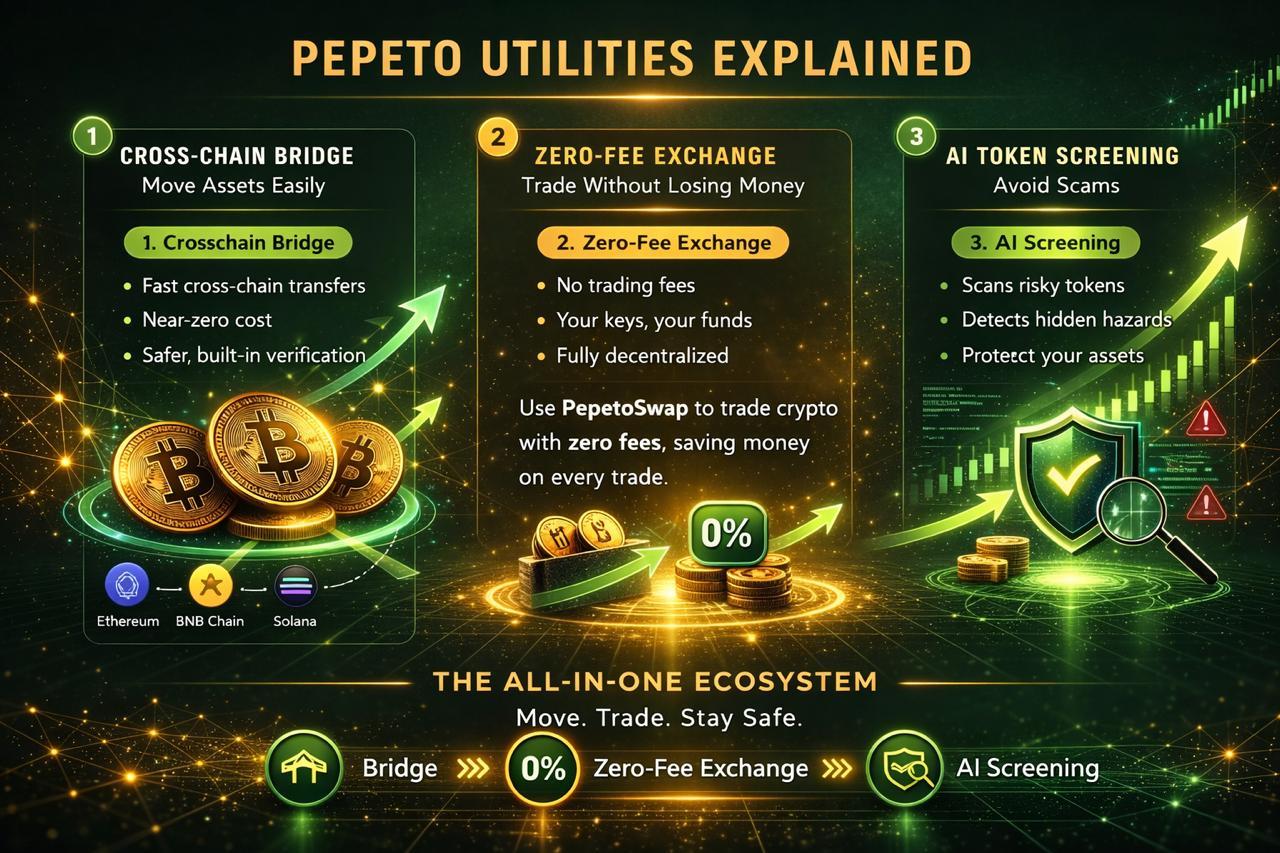
That kind of protection could have saved a lot of portfolios from the rug pulls that wiped out billions last cycle. A working exchange, bridge, and risk scorer all audited by SolidProof before the presale opened is something the presale market almost never delivers.
With the Binance listing approaching and more than $8.1 million already raised, adding Pepeto to a portfolio before it lists could be the single best allocation of 2026. And a $3,000 position at $0.000000186 buys over 16 billion tokens. If Pepeto only reaches the $11 billion cap that Pepe hit with the same 420 trillion supply and zero products, that $3,000 becomes more than $450,000, and that is the base case scenario as Pepeto offers far more utility and potential.
Bitcoin at $71,614 Anchors Every Crypto Portfolio With Institutional Backing
BTC trades at $71,614 according to CoinMarketCap, after the FOMC pullback from $76,000. Strategy’s $1.57 billion purchase and the longest ETF inflow streak in five months confirm institutional conviction.
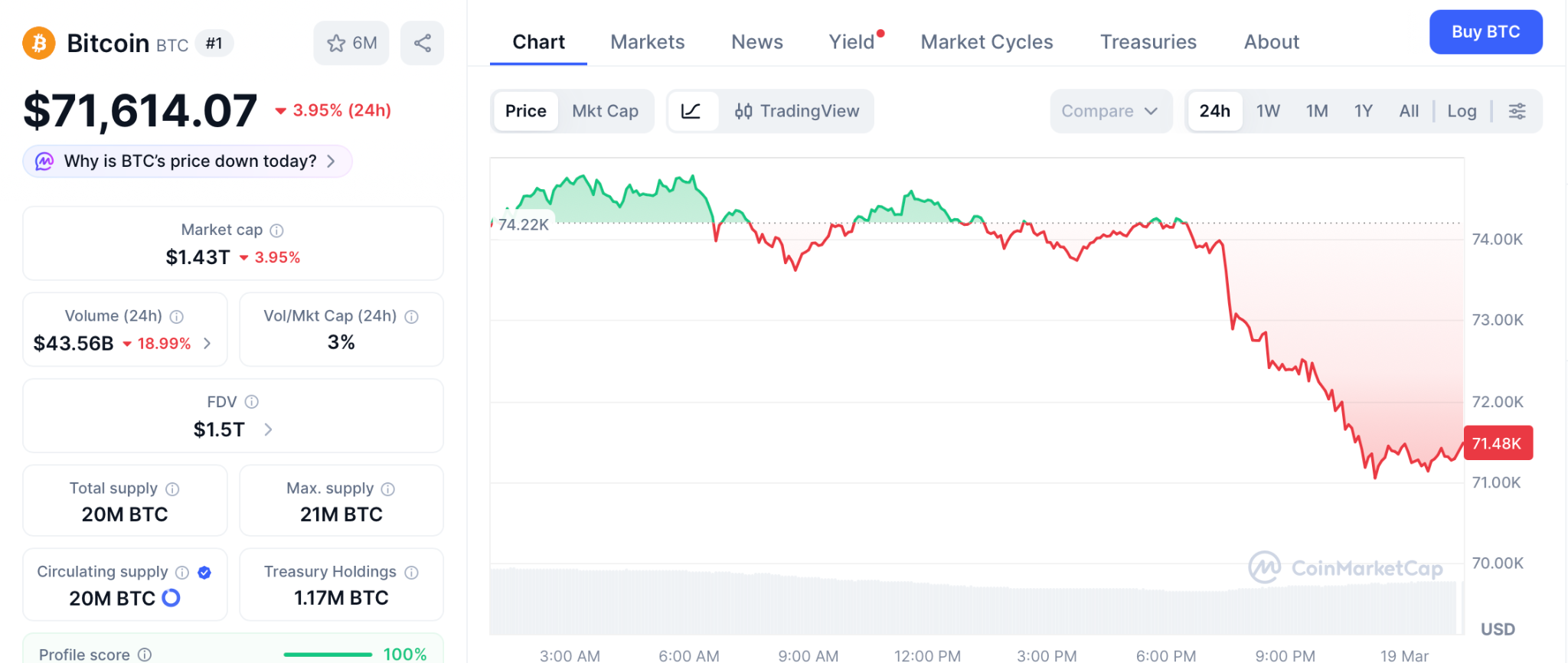
Kiyosaki targets $750,000 long term. Bitcoin is the anchor, but from $74,000 the returns that change a life come from the early entries.
Ethereum at $2,203 With Peter Brandt Flagging a Possible Bottom and a $4,000 Target
Peter Brandt indicated ETH is forming a bottom at a major historical support level, targeting $4,000 according to CoinGecko.
From $2,203 to $4,000 is roughly 75%. Strong for a portfolio allocation, but the biggest returns still come from getting into early projects before the listing.
Digitap Targets the Creator Economy but Lacks a Working Product and Community Traction
Digitap targets the $85 billion creator economy with AI subscription tools. The concept is interesting, but it has raised $1.5 million without a working product or community comparable to projects already generating real demand. The timeline to results is measured in years.
The Best Crypto Portfolio Does Not Wait for the Market to Recover Before the Early Entry Disappears
The best crypto portfolio does not wait for the market to feel safe again before the entry disappears. Pepeto is the early project that belongs in every serious portfolio for 2026, and the Binance listing means the presale at this price has a deadline the market will not extend.
A $3,000 position buys over 16 billion tokens, and 196% APY staking compounds that position daily while the listing advances. Visit the Pepeto official website and add the early entry before the listing, because every cycle proved that the best portfolios were built before the listing, not after.
Click To Visit Pepeto Website To Enter The Presale

FAQs
What is the best crypto portfolio for 2026?
BTC for stability, ETH for the recovery play, and Pepeto as the early project with the biggest potential before the Binance listing.
Why does Messari pivoting to AI matter for building a crypto portfolio?
When institutional data providers restructure around AI, it confirms the direction of the cycle. The best crypto portfolio positions early in that direction.
Is Pepeto a good early project to add to a portfolio?
More than $8.1 million raised, SolidProof audit, original Pepe coin team, and a Binance listing approaching. Visit the Pepeto official website.
The post Best Crypto Portfolio for 2026: Messari Pivots to AI and Pepeto Gives Early Investors the Entry That Large Caps Cannot Offer appeared first on Blockonomi.
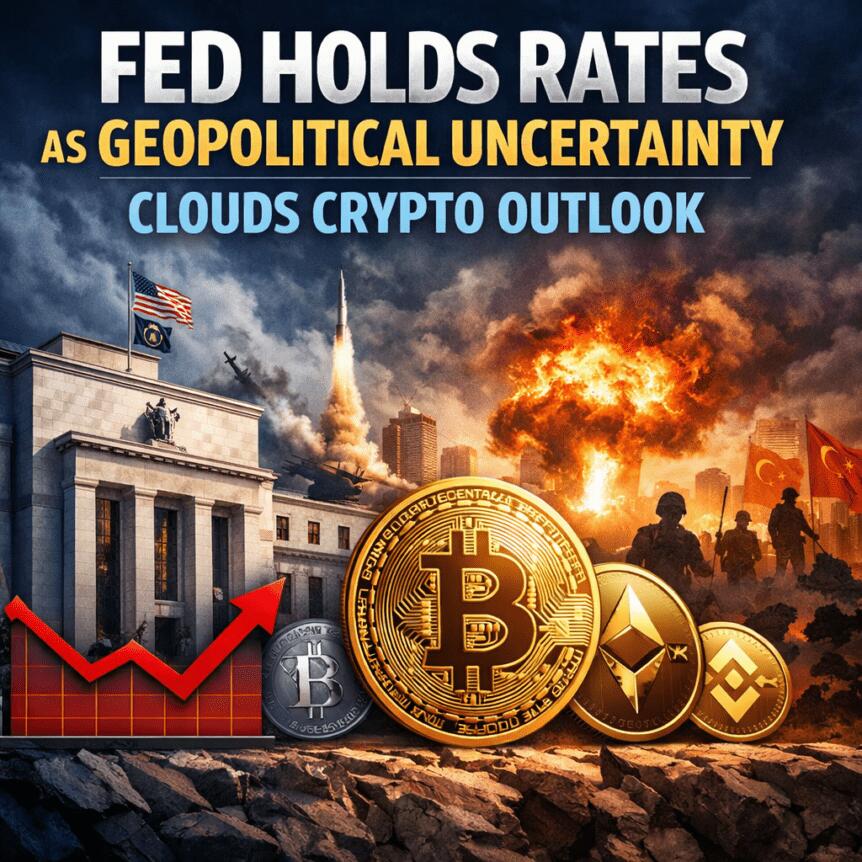
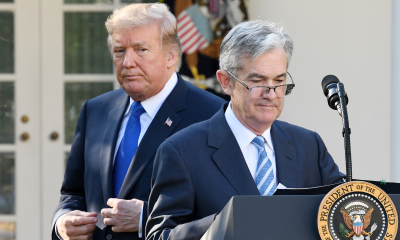
The Federal Reserve’s Open Market Committee kept the federal funds target range unchanged at 3.5% to 3.75, signaling a wait-and-see stance as policymakers weigh the evolving macro backdrop and the geopolitical shock stemming from the Middle East. The decision preserves a restrictive stance while the central bank monitors inflation pressures and the economy’s ability to weather external shocks.
Fed Chair Jerome Powell framed the economy as performing well in broad terms — consumer spending staying resilient and business investment continuing to expand — but he warned that weaknesses linger in the housing market and the labor market shows signs of softening. Inflation, meanwhile, remains “somewhat elevated” relative to the 2% target, complicating the Fed’s path back to price stability.
The implications of events in the Middle East for the US economy are uncertain in the near term. Higher energy prices will push up overall inflation, but it is too soon to know the scope and duration of the potential effects on the economy.
The posture underscores a difficult balancing act: the Fed must pursue maximum employment while keeping inflation anchored, all in a context where the war’s economic spillovers could push energy costs higher and alter demand dynamics. Powell’s remarks suggest policymakers view the near-term outlook as uncertain, with energy price trajectories among the wild cards that will shape policy in the months ahead.
Key takeaways
- Policy remains unchanged at 3.5% to 3.75%, with inflation lingering above the 2% goal and housing weakness alongside signs of labor-market cooling.
- Geopolitical tensions add energy-price risk, injecting additional uncertainty into the inflation path and the policy outlook.
- Markets broadly price in little near-term relief from rate cuts; CME data shows a 97% probability of no change at the next year-ahead horizon, with a small 3% chance of a 25-basis-point hike by April 2026 that would lift the range to 3.75%–4.00%.
- Industry commentary frames the gap between policy and liquidity flows: some observers expect potential easing if geopolitical strains intensify, while others see a gradual expansion of money supply lifting asset prices over time.
Policy stance amid a cloud of uncertainty
With inflation still stubbornly above target and a housing sector that has not fully recovered, the Fed’s decision to hold rates steady reinforces a cautious, data-driven posture. Powell emphasized that the economy’s breadth — including resilient consumer demand and ongoing investment — supports a patient approach to policy normalization. Yet he also acknowledged that the energy-price channel could complicate the inflation outlook if tensions in the Middle East persist or escalate.
The central bank’s balance between supporting employment and curbing inflation remains the defining tension of the moment. The war adds a layer of risk that policy makers must weigh against the need to avoid overtightening in an environment where consumer confidence and business sentiment can swing with energy headlines. In this context, the Fed’s forward guidance will be scrutinized for any signal about the pace and sequencing of future policy moves as new data arrive.
Market path and crypto implications
Traders have largely priced in a stationary policy path in the near term, with a long horizon view depending on how inflation evolves and how geopolitical risks unfold. Data from the Chicago Mercantile Exchange’s FedWatch tool indicated a dominant expectation for no near-term changes, reinforcing a narrative of policy steadiness in the face of uncertainty. The odds of a rate hike at the next specified horizon sit at a slim margin, while the probability of any cuts remains uncertain for the medium term.
Analysts have offered a spectrum of views on how policy could adapt if geopolitical tensions permanently alter the risk landscape. Some market observers, including Arthur Hayes, co-founder of BitMEX, have signaled a preference for lower rates before resuming bullish bets on bitcoin and other crypto assets. He has argued that a rate cut could bolster risk-taking and liquidity, potentially supporting crypto markets as capital seeks higher-yield opportunities.
On the other side of the debate, macro strategist Lyn Alden has described a scenario in which the Fed’s policy stance represents a gradual, ongoing expansion of monetary liquidity. In such a regime, asset prices, including digital assets, could receive support over time even without aggressive rate cuts, provided inflation remains contained and financial conditions remain accommodative enough to sustain broad-based investment activity.
For crypto investors and builders, the Fed’s decision underscores how sensitive risk assets remain to the direction of liquidity and the macro narrative around inflation and growth. A steady policy stance can reduce the impulsive volatility that often accompanies surprise shifts in rate expectations, but the ultimate crypto implication will hinge on how long inflation stays above target, how the labor market evolves, and how energy-price dynamics respond to geopolitical developments.
Beyond the immediate policy path, the relationship between Fed signals and risk assets suggests traders will monitor several ping points: incoming inflation prints, employment data, housing metrics, and evolving energy prices tied to Middle East developments. The crypto market’s sensitivity to liquidity conditions means any durable shift in the rate outlook could quickly reweight risk appetite across tokens, with capital potentially rotating between traditional risk assets and digital instruments tied to alternative financial rails.
As the central bank maintains a calibrated stance, investors should watch how policymakers view the trajectory of inflation in the wake of heightened geopolitical risk. A credible path back toward the 2% target—if energy-price pressures subside or are absorbed without a prolonged disruption—could reopen room for rate normalization. Conversely, persistent or rising inflation would keep policy more restrictive, with potential knock-on effects for both equities and crypto markets.
Looking ahead, the next round of economic data and any fresh guidance from policymakers will be pivotal. If energy prices stabilize and inflation moves closer to target, markets could begin pricing in a more confident glide path, potentially supporting broader risk-taking, including crypto ecosystems that rely on liquidity and favorable financing conditions.
In the meantime, traders and builders in the crypto space should remain attentive to shifts in liquidity and macro narrative. While the Fed’s decision to hold rates steadies some near-term risk, the ongoing Middle East situation remains a critical wildcard that could redefine the pace of policy normalization and, by extension, the appetite for risk across asset classes.
What comes next will hinge on incoming data, the resilience of consumer demand, and how energy markets absorb geopolitical developments. As investors recalibrate, the crypto sector will likely respond to evolving liquidity conditions and the broader assessment of risk appetite in a world where policy and geopolitics remain tightly interwoven.
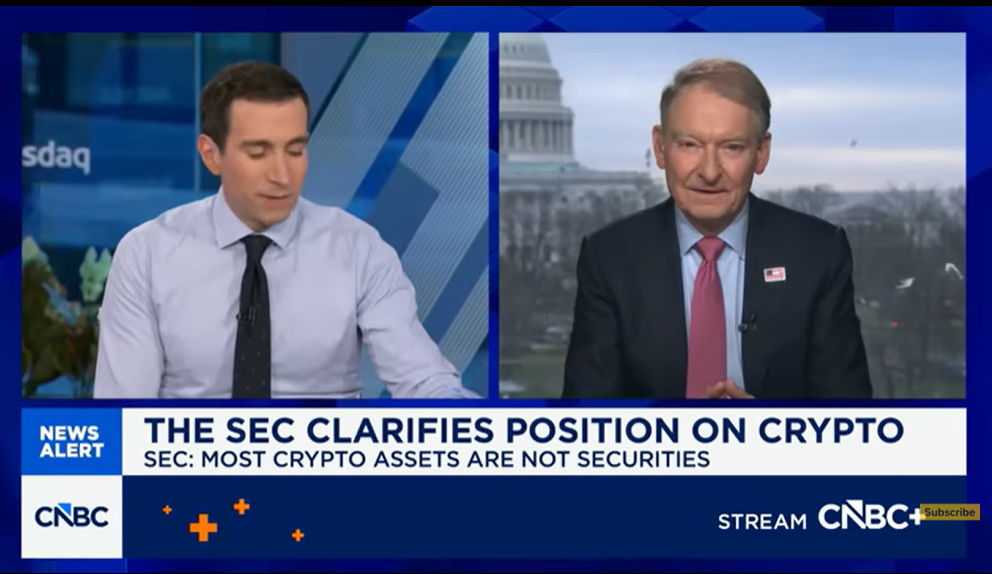
After the US Securities and Exchange Commission (SEC) outlined four broad categories of digital assets that fall outside securities laws, Chair Paul Atkins offered further clarity on why nonfungible tokens (NFTs) generally do not meet that definition.
In a Wednesday interview with CNBC, Atkins reiterated that the agency’s recent interpretive release identified four types of digital assets that are typically not considered securities: digital commodities, digital tools, digital collectibles such as NFTs, and stablecoins.
During the interview, host Andrew Ross Sorkin pressed Atkins on digital collectibles, noting they could more easily resemble securities depending on how they are structured.
“Well, that’s true with anything,” Atkins replied, emphasizing that the SEC’s analysis still hinges on the facts and circumstances of each asset, particularly whether it involves an investment contract under longstanding legal precedent.
Atkins said digital collectibles are generally treated as items that are bought and held, similar to physical collectibles, rather than as investment contracts — the defining feature of securities.
“Some of these collectibles, like a baseball card, a meme or one of those memecoins, NFTs — those are something that somebody buys,” he said. “It’s an immutable purchase… it’s not something like another asset where people are trading it.”

Related: SEC chair Paul Atkins floats ‘safe harbor’ exemptions for crypto
SEC continues to move away from enforcement-led crypto policy
The securities regulator has recalibrated its approach to digital assets under Atkins, a shift that has coincided with the arrival of a more crypto-friendly Trump administration in early 2025.
“We’re breaking with the past,” Atkins said during the CNBC interview, describing the SEC’s push to provide clearer guidance and a more predictable regulatory framework for the digital asset sector.
Last year, Atkins criticized the agency’s previous reliance on “regulation through enforcement” and pledged to move away from that approach. He also pointed to tokenization as a key innovation that regulators should support rather than restrict.
He has since reiterated that past regulatory missteps have left the United States lagging behind in crypto development by as much as a decade, and has vowed to reverse that trend.
Related: CFTC issues ‘no-action’ letter for crypto wallet provider Phantom


Bitrefill said hackers drained hot wallets and exploited gift card supply flows after gaining access through stolen credentials from an employee’s device.
Bitrefill disclosed that it was targeted in a cyberattack on March 1, which resulted in the theft of cryptocurrency funds, and said its investigation found multiple indicators linking the incident to tactics used by the DPRK-associated Lazarus/Bluenoroff group.
The company stated that similarities in the attackers’ methods, malware, on-chain tracing patterns, and the reuse of IP and email addresses are consistent with previous operations attributed to the group.
Bitrefill Cyberattack
According to the company, the breach originated from a compromised employee’s laptop, where a legacy credential was extracted. That credential allowed access to a snapshot containing production secrets, which the attackers then used to expand their access across Bitrefill’s systems. This enabled them to reach parts of the database and certain cryptocurrency wallets.
In its latest tweet, Bitrefill said it first identified the incident after detecting unusual purchasing patterns involving some suppliers, which indicated that its gift card inventory and supply flows were being misused. At the same time, it observed that some hot wallets were being drained, and funds were sent to addresses controlled by the attackers. Once the breach was confirmed, the company shut down all systems to contain the situation.
Following the incident, Bitrefill confirmed that it has been working with external cybersecurity experts, incident response teams, blockchain analysts, and law enforcement.
The company said there is no indication that customer data was the main focus of the attack. According to its logs, the attackers ran a limited number of database queries consistent with probing activity to identify what could be extracted. This included cryptocurrency and gift card inventory. Bitrefill added that it stores minimal personal data and does not require mandatory KYC, with any verification information held by an external provider.
However, it confirmed that about 18,500 purchase records were accessed, including email addresses, cryptocurrency payment addresses, and metadata such as IP addresses. In roughly 1,000 cases where customers had provided names for specific products, the information was encrypted, but the company is treating it as potentially accessed due to possible exposure of encryption keys. Those users have been notified.
You may also like:
Bitrefill said it does not currently believe customers need to take specific action, but advised vigilance regarding any unexpected communications related to Bitrefill or cryptocurrency.
The company added that it has strengthened its security measures, including conducting further external cybersecurity reviews and penetration testing, tightening internal access controls, improving monitoring and logging systems, and refining incident response procedures. It said the financial losses will be covered from its operational capital, and that most services, including payments and inventory, have been restored.
Lazarus Havoc
Even as many crypto platforms have ramped up their security frameworks in recent years, threat actors continue to bypass protections. The Lazarus Group remains the sector’s most persistent and dangerous adversary, responsible for the largest crypto hack on record after stealing $1.4 billion from Bybit in February 2025.
Blockchain investigator ZachXBT previously said that breaches involving platforms such as Bybit, DMM Bitcoin, and WazirX saw stolen funds laundered with ease. The on-chain investigator had added that the laundering groups have “seemingly won the battle” over enforcement.
Binance Free $600 (CryptoPotato Exclusive): Use this link to register a new account and receive $600 exclusive welcome offer on Binance (full details).
LIMITED OFFER for CryptoPotato readers at Bybit: Use this link to register and open a $500 FREE position on any coin!
Crypto World
Solana (SOL) Network Revenue Plunges 93% From Peak, Why Taurox (TAUX) Is One Of the Best Alternatives
Solana’s network revenue has plunged 93% from its January peak. Daily DEX volume cratered from $35.9 billion on January 21 to $979.5 million by mid-March. Transaction fees dropped 83% in a single month. Active daily addresses fell from 6.4 million to 2.8 million, more than halving since November. The memecoin engine that powered Solana’s fee revenue through Pump.fun and Meteora has stalled after a string of celebrity rug pulls and scam launches that drained user trust. SOL trades at $94, and the on-chain activity that justified higher prices has evaporated.
A 93% revenue collapse is not a correction. It is a structural repricing of what the network actually earns when the hype cycle ends. Taurox (TAUX) is a decentralized hedge fund where AI agents will trade pooled capital across DEXs and CEXs once the presale ends. Stakers keep 80% of net profits from diversified strategies that do not depend on a single network’s fee revenue staying elevated through speculative memecoin launches.

How Triple-Layer Oracle Protection Guards Every Trade
Accurate pricing data is the foundation of every trade an agent will execute. Taurox uses Chainlink as its primary oracle, providing multi-provider aggregated USD pricing across all supported assets. If Chainlink data goes stale or becomes unavailable, Pyth Network steps in as a fallback with high-frequency institutional-grade pricing. Every price feed carries asset-specific staleness thresholds.
If data exceeds the allowed age, the system pauses execution until fresh pricing arrives. On top of both oracle layers, Taurox validates pricing through time-weighted average price calculations using on-chain liquidity pools. This three-layer architecture prevents agents from executing trades on manipulated or outdated data, a risk that grows as more venues and liquidity sources come online.
Stakers keep 80% of net profits at the standard tier. The protocol takes 5% on gains only, with 30% burned permanently and 70% flowing to the DAO treasury. Solana’s revenue depended on memecoin volume that vanished when users lost trust. Taurox protects trade execution at the oracle level so pricing integrity never depends on hype cycle volume.
Why $314.7K in Capital Keeps Flowing While SOL Revenue Falls
Phase 1 of the TAUX presale sold out in under 24 hours at $0.01 per token. Phase 1 buyers are sitting on a 20% gain with Phase 2 priced at $0.012, and they have not staked or seen an agent trade. The presale has raised $314.7K so far, and Phase 2 is already 23.9% filled. Nineteen phases run from $0.01 to $0.07, each closing permanently when its allocation is gone. The price steps up with no extensions.
Waiting costs real money when each closed phase eliminates the cheapest entry forever. Staking activates at the end of the presale, and agents will begin trading real capital once the pool goes live. SOL’s revenue dropped 93% because the activity that generated it was speculative and temporary. The TAUX presale raises capital that positions buyers ahead of a protocol designed to produce returns through managed execution, not through fee spikes from unsustainable memecoin volume.
Every token sold at $0.012 brings Phase 2 closer to closing permanently. The demand that cleared Phase 1 in a single day has carried directly into Phase 2. The buyers entering now are positioning before agents begin trading real capital. Phase 2 is filling, and the entry at $0.012 will not exist once this allocation runs out.

Phase 2 Numbers
Phase 2 is live at $0.012 per TAUX. Listing at $0.08 gives buyers 6.67x before the pool generates profit. A $1 target means x83 from today. At a $1 billion pool with 30% gross returns, implied price reaches $1.85, or x154 from $0.012. The protocol charges 5% on gross profits only. Zero management fees. Thirty percent of that fee is burned permanently against a fixed supply of 2 billion tokens.
The remaining 70% funds the DAO treasury. Every profitable trading period compresses circulating supply against a cap that never increases. The remaining 70% of fees funds the DAO treasury for ecosystem growth. Total raised: $314.7K and climbing. SOL’s revenue cratered 93% because the volume that generated it was temporary. The TAUX presale raises capital backed by a protocol designed to produce returns through managed execution. Phase 2 will not survive the demand pattern that emptied Phase 1 in under a day.
Learn More
Buy TAUX: https://taurox.io/
Whitepaper: https://docs.taurox.io/
Official Telegram: https://t.me/tauroxlabs
The post Solana (SOL) Network Revenue Plunges 93% From Peak, Why Taurox (TAUX) Is One Of the Best Alternatives appeared first on Blockonomi.
3 Reasons Why Bitcoin (BTC) Could Climb Higher in the Short Term

Iran Women’s Football Team Returns Home After Asylum Tussle

Aura confirms data breach exposing 900,000 marketing contacts

Smart energy pays enters the US market, targeting scalable financial infrastructure

Why Israel is blocking foreign journalists from entering

Bitcoin: We’re Entering The Most Dangerous Phase

Stop Letting Dumb Decisions Control Your Financial Future | March 18, 2026

I Spent 24 Hours Making INFINITE Money in Roblox Currency Incremental!

TYBCom Sem 6 Financial Accounting Most Important Questions | Mumbai University | 2026 | Shubham Sir
-
 Crypto World5 days ago
HYPE Token Enters Net Deflation as HyperCore Buybacks Outpace Staking Rewards
-

 Tech3 days ago
Your Legally Registered ‘Motorcycle’ Might Not Count Under Proposed US Law
-

 Fashion5 days ago
Weekend Open Thread: Addict Lip Glow
-
Sports4 days ago
Why Duke and Michigan Are Dead Even Entering Selection Sunday
-
 Tech1 day ago
Are Split Spacebars the Next Big Gaming Keyboard Trend?
-

 Business3 days ago
Search for Savannah Guthrie’s Mother Enters Seventh Week with No Arrests
-

 Business4 days ago
US Airports Launch Donation Drives for Unpaid TSA Workers as Partial Government Shutdown Enters Fifth Week
-
Crypto World4 days ago
Coinbase and Bybit in Investment Talks: Could Bybit Finally Enter the US Crypto Market?
-

 Business3 days ago
Australian shares drop as Iran war enters third week
-

 Business4 days ago
Country star Brantley Gilbert enters growing non-alcoholic beer market
-

 Crypto World3 days ago
Crypto Lender BlockFills Enters Chapter 11 with Up to $500M in Liabilities
-

 Sports5 days ago
College Basketball Best Bets: Conference Tournament Semifinal Picks
-

 Politics14 hours ago
The House | The new register to protect children from their abusers shows Parliament at its best
-
 Crypto World7 days ago
Three Binance Charts May Be Hinting at Bitcoin’s Next Move
-
 Business6 days ago
Trump demands Powell cut rates as Iran conflict raises energy prices
-

 Crypto World6 days ago
Senate Votes to Include CBDC Ban in Bipartisan Housing Bill
-

 Fashion3 days ago
25 Celebrities with Curly Hair That Are Naturally Beautiful
-

 News Videos6 hours ago
RBA board divided on rate cut, unusually buoyant share market | Finance Report | ABC NEWS
-

 NewsBeat6 days ago
Deane Road crash near Bolton colleges and university
-

 News Videos6 days ago
Tom Lee: The 100x Opportunity EVEN Bigger Than Bitcoin (New Ethereum Prediction 2026)


You must be logged in to post a comment Login