

Crypto World
Berkshire’s Equity Portfolio Is Rallying, but the Apple Sales Still Sting


Berkshire’s Equity Portfolio Is Rallying, but the Apple Sales Still Sting



Hyperliquid said its HIP-4 upgrade, which introduced “outcome trading” to the decentralized exchange, will support permissionless deployment of the contracts in a future enhancement.
Once live, anyone will be able to offer a prediction market on the platform, subject to templates approved by validators, Hyperliquid said on Telegram on Sunday. In the meantime, they remain under the authority of validators.
Prediction markets, a sector dominated by Polymarket and Kalshi, allow participants to bet on event outcomes and have evolved into a multibillion-dollar sector of the blockchain industry. Users take positions on events from central bank interest-rate decisions to who performs at the Super Bowl halftime show.
The growing popularity of the platforms — the FIFA World Cup, which wrapped up Sunday with Spain winning its third title, drew more than $50 billion in bets — has attracted centralized trading platforms like Coinbase and Robinhood into the sector to offer customers a one-stop shop for predictions markets alongside more conventional financial trading.
Crypto World
Bitcoin price slips under $64K as Middle East tensions and China’s Kimi K3 launch rattle markets
Bitcoin price has slipped below $64,000 as renewed US-Iran tensions, volatile oil prices, and a technology-sector sell-off tied to China’s Kimi K3 launch drove investors away from risk assets.
Summary
- Bitcoin price fell below $64,000 as Middle East tensions and Kimi K3 rattled risk markets.
- BTC must reclaim $65,047 to confirm a sustained recovery toward $67,000.
- A break below $62,708 could expose the $60,000 support and trigger further liquidations.
According to data from crypto.news, Bitcoin (BTC) price fell nearly 2% to $63,785 on Monday before recovering toward $64,000, still down about 1% over the past 24 hours. The Crypto Fear & Greed Index remained in “Fear” territory at 29, while Ether, XRP, BNB, and Dogecoin also posted slight daily losses.
Middle East risks intensified after a projectile set a vessel ablaze in the Strait of Hormuz, forcing its crew to abandon ship before a tugboat rescued them. US strikes also killed one person in Tabriz, while Tehran condemned attacks on the unfinished Darkhovin nuclear facility.
CENTCOM separately reported that a US service member died during the controlled detonation of an unexploded Iranian drone in northern Iraq.
The attacks initially drove crude oil higher as traders assessed the threat to Middle Eastern production and shipping. Brent briefly exceeded $85 per barrel before falling toward $82 after Iran’s Foreign Ministry confirmed that international mediators had submitted proposals to reduce tensions.
Tehran also left the door open to negotiations with Washington if talks served Iran’s national interests. The diplomatic opening reduced immediate supply fears, although attacks on vessels, Iranian cities, and nuclear infrastructure kept the risk of another oil-price surge in place.
Technology stocks added another source of pressure after Beijing-based Moonshot AI released Kimi K3, a 2.8 trillion-parameter model designed for coding and agent-based tasks. Moonshot’s internal tests placed Kimi K3 ahead of several Western rivals in frontend coding, although those performance claims await independent confirmation when the model weights become available.
The launch intensified concerns that cheaper Chinese models could disrupt US artificial intelligence companies and their semiconductor suppliers. Bitcoin has traded closely with technology-heavy equity indices during recent risk-off sessions, leaving the cryptocurrency exposed as investors reduced positions across speculative markets.
US equity funds recorded $4.8 billion in withdrawals during the week ended July 15, according to LSEG Lipper data cited by Reuters. The Philadelphia Semiconductor Index lost 8.48% during the same period, while growth funds suffered $7.18 billion in net redemptions.
Bitcoin price must reclaim $65,000 to confirm a sustained recovery
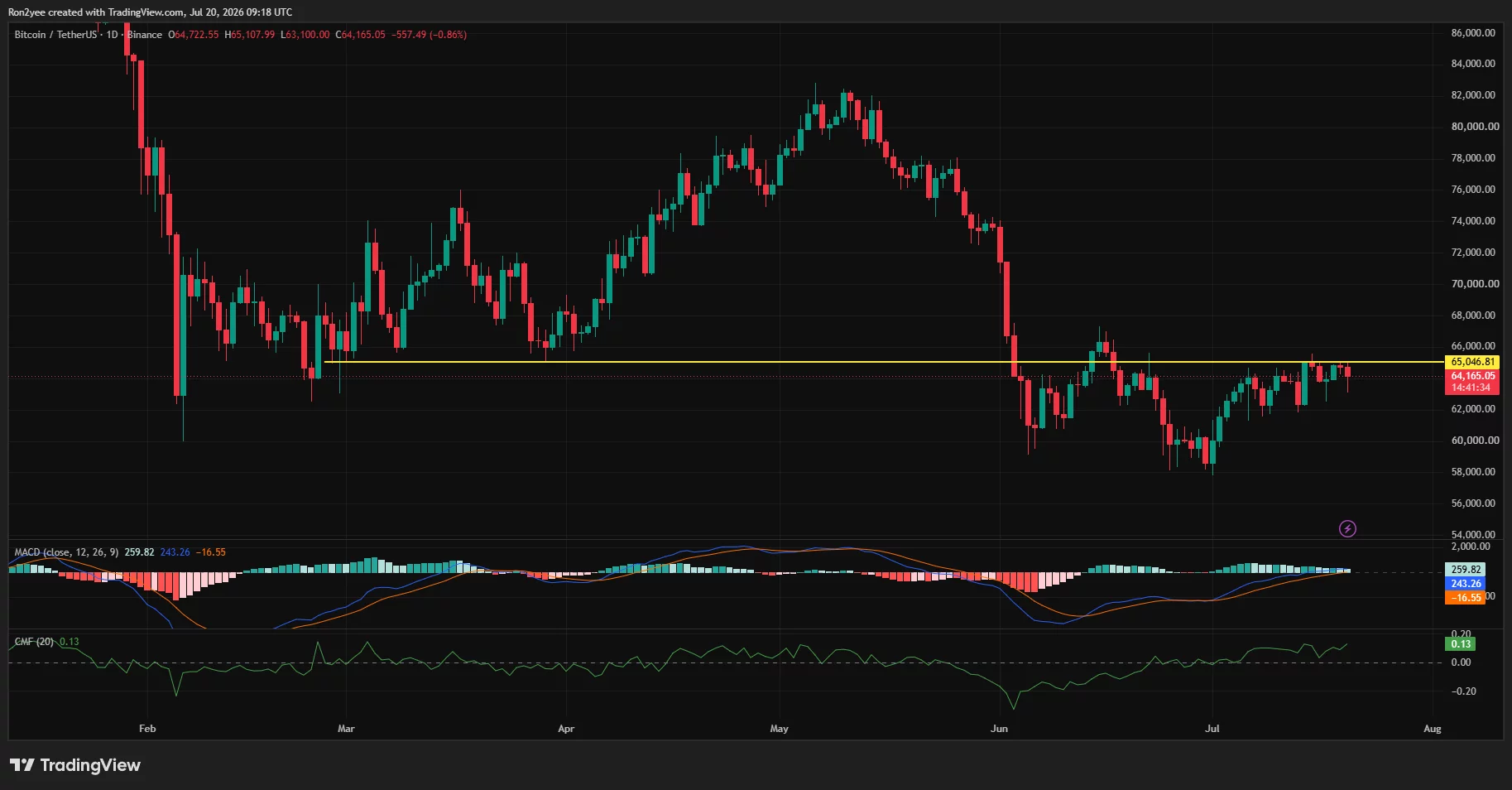
Bitcoin’s daily chart shows repeated failures around $65,047, a former support level that has turned into resistance. Buyers have tested the barrier several times since early July, but each attempt has ended without a daily close above it.
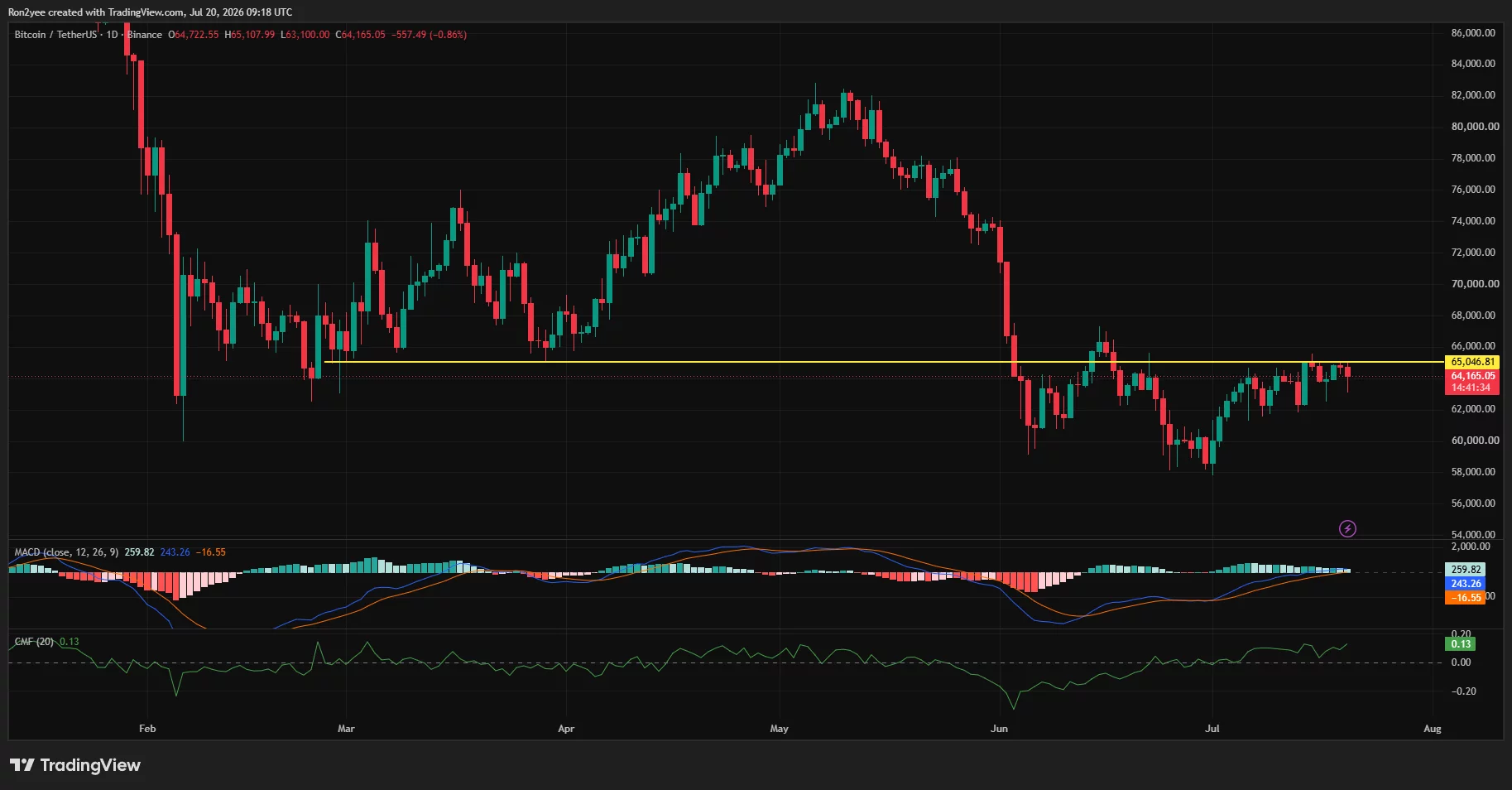
A decisive close over $65,047 would restore the recovery structure and expose the June swing high near $67,000. Until then, Bitcoin remains inside the range between roughly $60,000 and $65,000 that has controlled price action for most of July.
On the 4-hour chart, BTC has fallen below its 20-period simple moving average at $64,206 but remains close to the 50-period average at $64,024. The 100-period SMA at $63,642 offers the next support, followed by the 200-period SMA near $62,708.
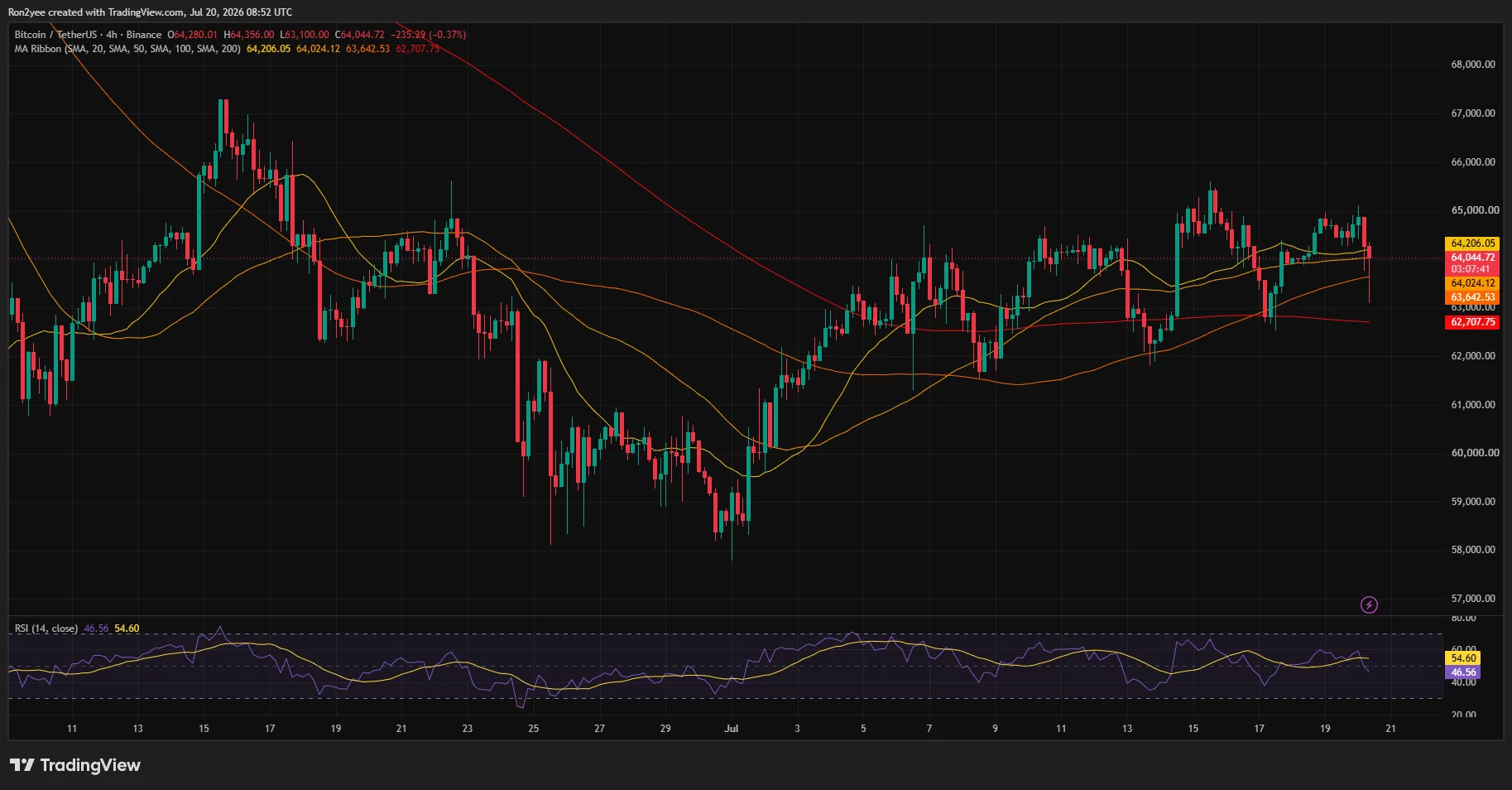
4-hour relative strength has dropped to 46.56, below its moving average of 54.60. The reading shows that sellers have regained control of short-term momentum, though BTC has not yet entered oversold territory.
Daily momentum presents a mixed picture. The MACD histogram has slipped below zero to -16.55 as the MACD and signal lines converge, raising the risk of a bearish crossover. However, the Chaikin Money Flow reading remains positive at 0.13, which shows that capital has not left the market at the same pace as the price decline.
According to trader Daan Crypto Trades, Bitcoin is still attempting to close above its weekly 200-period moving average, but a stronger advance is needed to challenge the weekly 200-period exponential moving average.
“Until then, we’re just caught in this $60K choppy price range.”
Spot Bitcoin ETFs have provided limited relief after more than eight weeks of heavy withdrawals, SoSoValue data shows. US-listed funds posted a second consecutive week of net inflows, while BlackRock’s IBIT helped drive a $132 million inflow on Friday despite a $4.2 million withdrawal from Fidelity’s fund. The improvement remains too small to establish aggressive institutional accumulation.
The three-day liquidation heatmap places the largest overhead liquidity concentration around $65,200 to $65,500. A move into that band could force leveraged short positions to close and help BTC challenge the daily resistance near $65,047.
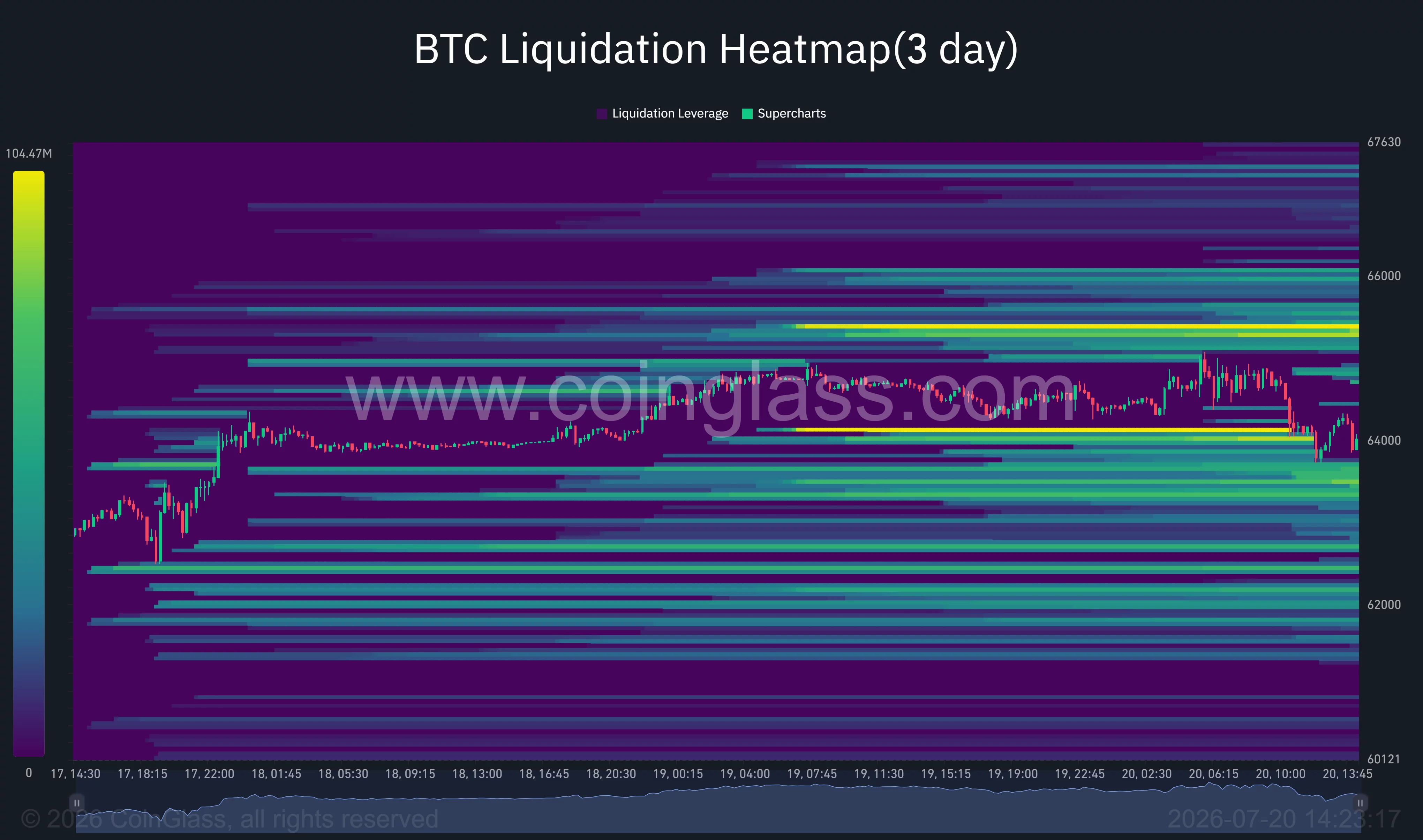
Below the market, liquidation pools sit between $63,300 and $63,600, with another concentration around $62,500 to $62,800. Price frequently moves toward dense leverage zones, making either cluster a potential target if volatility expands.
Loss of $62,700 would expose Bitcoin to another capitulation leg
Bitcoin’s recovery thesis would weaken if sellers force a 4-hour close below the 100-period SMA at $63,642. A subsequent break under the 200-period SMA at $62,708 would expose $60,000, followed by the late-June low near $58,000.
Analyst Ardi warned that the current bear-market decline has not produced the severe capitulation seen before previous cycle bottoms. In his view, either months of range-bound trading must exhaust sellers or a deeper liquidation event must clear the remaining leverage.
Oil remains the main external risk. Failed US-Iran negotiations or renewed threats to regional energy routes could send crude higher again, revive inflation fears, and reinforce the Federal Reserve’s higher-for-longer policy stance.
For bulls, a daily close above $65,047 would invalidate the immediate bearish setup and open the path toward $67,000. Without that breakout, Bitcoin remains vulnerable to another sweep of leveraged positions below $63,600.
Disclosure: This article does not represent investment advice. The content and materials featured on this page are for educational purposes only.
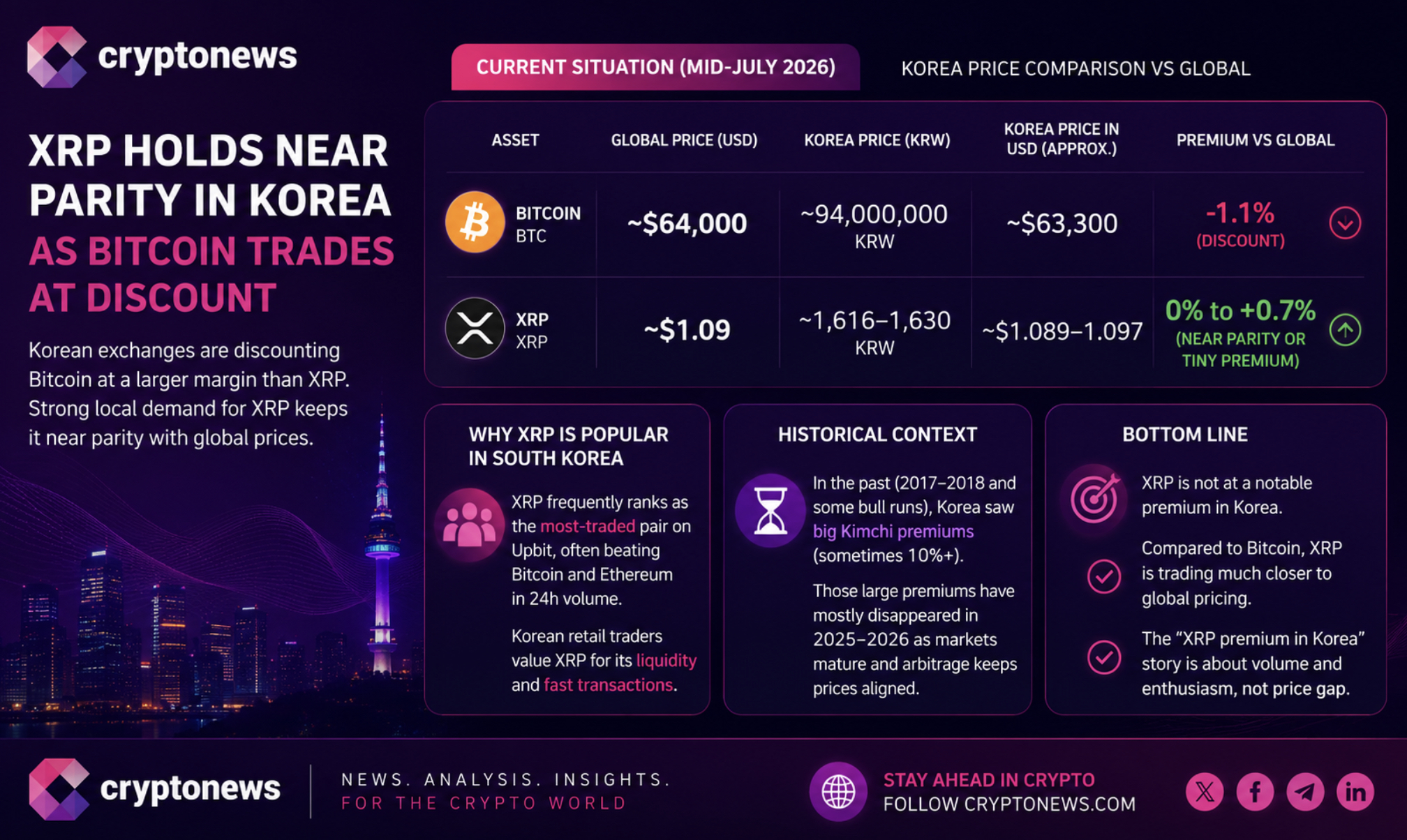
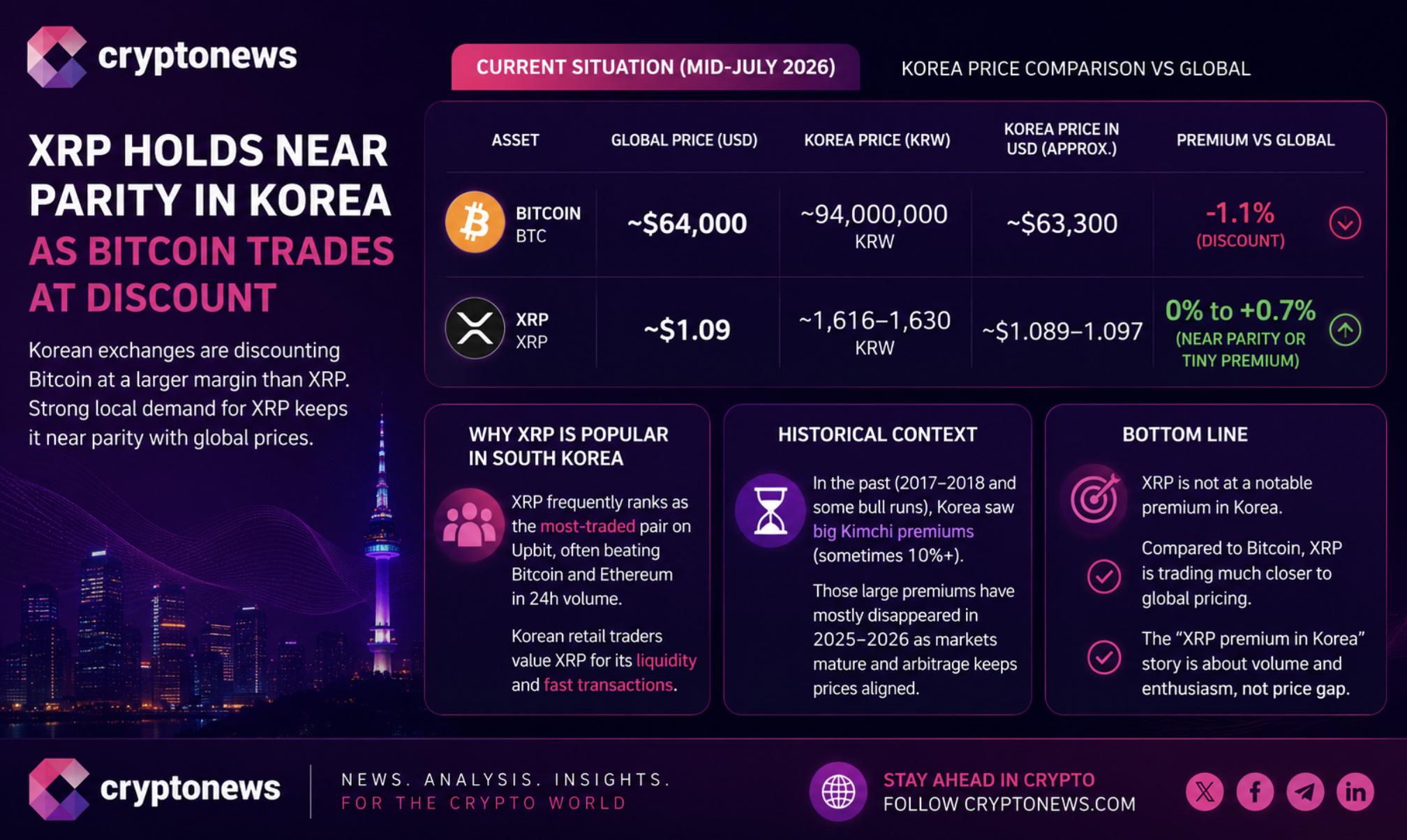
XRP is trading around $1.09 with little price change over the past 24 hours, but the prediction worth watching is not from the chart. It is in the premium spread. Korean exchanges are discounting Bitcoin more heavily than XRP, a subtle but telling divergence. When Korean traders hold one coin tighter, it often hints at stronger local conviction. That gap could matter more than the next flashy candle.
Over the past 48 hours, crypto markets have been trapped in a narrow range. Bitcoin hovers around the mid $64,000 area, while Asian altcoin activity has remained surprisingly lively despite the lack of a clear trend. South Korean exchanges, long known for driving retail momentum, continue showing stronger relative demand for XRP than for Bitcoin.
Meanwhile, macro events still call the tune. Inflation data and central bank comments remain the biggest catalysts for risk appetite across crypto. Even so, XRP has managed to defend the $1.05 area, keeping the current structure intact. That gives bulls something to work with, even if nobody is popping champagne yet.
The technical setup remains tight. The next resistance test should reveal whether the Korean bid is an early clue or just another market quirk. Either way, conviction usually shows up before the fireworks, not after.
Discover: The Best Token Presales
XRP Price Prediction: Can it Push Toward $1.30 on Korean-Driven Volume?
XRP is trading around $1.09, posting a modest weekly gain of about 1%. That is constructive, although nobody would call it a sprint. Its market capitalization sits near $68 billion, backed by roughly 62.4 billion circulating tokens. Trading volume remains fairly subdued, which is the honest catch. The Korean premium reflects positioning, not a volume-fueled breakout.
The chart still favors patience, as the $1.05 area has repeatedly attracted buyers, gradually building a solid base instead of a reversal. Meanwhile, resistance sits around $1.13, with a stronger ceiling between $1.20 and $1.30. Price action continues to hover just above $1.09, leaving momentum balanced rather than committed.

The bull case is straightforward. Korean demand strengthens, fresh regulatory headlines improve sentiment, and XRP clears $1.13 before challenging the $1.20 to $1.30 zone. If momentum traders join the move, that ceiling could finally crack. Markets rarely send engraved invitations, so the first breakout often feels awkward.
The base case remains a sideways grind between roughly $1.05 and $1.13 as traders wait for macro data. The bear case appears if Bitcoin stumbles on a hawkish surprise and XRP loses the $1.05 support zone. That would weaken the current base and delay any breakout story. XRP’s all-time high near $3.84 remains the long-term benchmark, but reaching it would require a very different market backdrop.
Trade XRP on Bybit and Get a Chance to Win Our $1,000 USDT Airdrop
LiquidChain Targets Early-Mover Positioning as XRP Tests Key Levels
XRP consolidating at $1.09 with a $68 billion market cap means the upside math is real but not dramatic at the current entry. A move to $1.30 is a 19% gain, worthwhile, but it requires macro tailwinds, regulatory news, and sustained Korean volume all cooperating simultaneously.
As of today, traders looking for asymmetric exposure in the current cycle are increasingly scanning early-stage infrastructure plays where the entry price reflects genuine risk, not institutional markup.
LiquidChain ($LIQUID) is an L3 infrastructure project positioning as a cross-chain liquidity layer. Its core proposition is the fusion of Bitcoin, Ethereum, and Solana liquidity into a single execution environment.
The Order builds. — LiquidChain (@getliquidchain) July 15, 2026
Brick by brick. Layer by layer.  ⟁https://t.co/vqvBcdSQYC pic.twitter.com/tcfMNP4lNq
The architecture includes a Unified Liquidity Layer, Single-Step Execution, Verifiable Settlement, and a Deploy-Once model for developers (one build, full ecosystem access). The presale is currently priced at $0.01481, with $910K raised to date.
The infrastructure thesis of solving cross-chain fragmentation rather than adding another chain is a credible problem statement at a stage where price reflects early positioning rather than market validation. Research LiquidChain here if the L3 infrastructure angle fits your current thesis.
Discover: The Best Crypto to Diversify Your Portfolio
The post XRP Price Prediction: Can Korean Demand Trigger XRP’s Next Breakout? appeared first on Cryptonews.


Crypto’s major events this week are set in Washington D.C. A House Financial Services subcommittee opens with a hearing on oversight of the Financial Crimes Enforcement Network.
The Office of the Comptroller of the Currency’s (OCC) comment period on proposed GENIUS Act rules extending anti-money laundering and sanctions standards to stablecoin issuers closes July 24.
The Commodity Futures Trading Commission’s (CFTC) window on 24/7 trading and perpetual-style bitcoin futures closes July 27, three months after the regulator cleared the first regulated bitcoin perpetual on Kalshi. The GENIUS Act turned one this month, and the rules built on it are still being written.
The macro calendar centers on Thursday’s European Central Bank decision, with markets pricing a hold.
Traders will also be monitoring geopolitical developments and oil prices for potential clues about what markets may do next.
What to Watch
(All times ET)
- Crypto
- Macro
- July 20, 8:30 a.m.: Canada CPI YoY for June (Prev. 3.2%); Core CPI YoY (Prev. 2.2%)
- July 22, 2:00 a.m.: U.K. CPI YoY for June (Prev. 2.8%); Core CPI YoY (Prev. 2.6%)
- July 23, 8:15 a.m.: European Central Bank interest-rate decision est. 2.4% (Prev. 2.4%), followed by press conference at 8:45 a.m.
- July 23, 8:30 a.m.: U.S. Initial Jobless Claims for period ending July 18 (Prev. 208K)
- July 23, 7:30 p.m.: Japan CPI YoY for June (Prev. 1.5%); Core CPI YoY est. 1.6% (Prev. 1.4%)
- July 24, 4:00 a.m.: Eurozone S&P Global Composite PMI Flash for July est. 50.0 (Prev.50)
- July 24, 9:45 a.m.: U.S. S&P Global Composite PMI Flash for July (Prev. 51.9)
- July 24, 9:45 a.m.: U.S. S&P Global Manufacturing PMI Flash for July (Prev. 53.9)
- July 24, 9:45 a.m.: U.S. S&P Global Services PMI Flash for July (Prev. 51.2)
- Earnings
- July 21: Interactive Brokers Group (IBKR), post-market, $0.61
- July 22: CME Group (CME), pre-market, $2.99
- July 22: Tesla (TSLA), post-market, $0.44
- July 23: Nasdaq (NDAQ), pre-market, $0.95
Token Events
- Governance Votes & Calls
- ENS DAO is voting on an executable proposal to establish a new security council for a two-year term, granting proposal-cancellation power to the newly elected multisig and contract. Voting ends July 20.
- Lido DAO is voting to launch a permissionless community staking module and adopt a case-by-case penalty framework for Curated Module v2 node operators. Voting ends July 20.
- Superfluid DAO is voting on the nominee selection phase for its security council election, where delegates can distribute votes among three contenders. Voting ends July 21.
- Compound DAO to vote on a proposal to update the cbBTC price feeds in its AERO, USDC, USDS and WETH markets on Base to use the new SVR price feeds. Voting ends July 21.
- Arbitrum DAO is voting to ratify improvements to its security council election process, including extending member terms from one to two years. Voting ends on July 23.
- ZKsync DAO is voting on the ZIP-16 v31 protocol upgrade to introduce Priority Mode and to unify the shared codebase between ZKsync Era and ZKsync OS. Voting ends July 23.
- Unlocks
- July 20: LayerZero (ZRO) to unlock 4.6% of its circulating supply worth $20.59 million.
- July 20: Starknet to unlock 2.6% of its circulating supply worth $5 million.
- July 21: Avalanche (AVAX) to unlock 0.7% of its circulating supply worth $23.3 million.
- July 21: to unlock 1.2% of its circulating supply worth $24 million.
- July 23: Arbitrum (ARB) to unlock 1.4% of its circulating supply worth $12.3 million.
- July 24: to unlock 1.5% of its circulating supply worth $57.7 million.
- July 25: Humanity Protocol (H) to unlock 2.7% of its circulating supply worth $15.6 million.
- July 26: Toncoin (TON) to unlock 0.9% of its circulating supply worth around $69.9 million.
- Token Launches
Conferences


Allbridge Core has paused its cross-chain stablecoin protocol after an attacker stole roughly $1.65 million from its Solana liquidity pools, according to security firms CertiK and PeckShield.
Allbridge is a bridge that lets users move assets between blockchains that do not communicate directly. Its Core product uses liquidity pools to transfer native stablecoins such as USDC and USDT without issuing wrapped versions of the assets.
The attacker used a $1.12 million flash loan from Solana lending protocol Kamino to rapidly swap USDC and USDT, manipulating the pools’ internal ratios before withdrawing assets at favorable rates, according to Onchain Lens. A flash loan is a loan taken and repaid within the same transaction.
The stolen assets were bridged to an Ethereum address and dispersed across additional addresses. It isn’t currently clear how much remains under the attacker’s control.
Allbridge said it paused the protocol while investigating, and told liquidity providers to withdraw from affected pools. The initial manipulation left the pools imbalanced and created a temporary arbitrage opportunity. Allbridge asked traders who profited from the pricing distortion to return funds for LP compensation.
Allbridge suffered a similar flash loan attack in 2023 that drained roughly $650,000 from its BNB Chain pools. The firm later said it recovered most of the funds and changed its liquidity and withdrawal calculations. Allbridge had raised $2 million in 2022 to expand the bridge and fund security audits.

CHANGCHUN, CHINA – JULY 11: People visit the 23rd Changchun International Automobile Expo on July 11, 2026 in Changchun, Jilin Province of China. The exhibition drew participation from 53 Chinese and foreign automobile manufacturers, with over a thousand vehicles on display. (Photo by Zhang Yao/China News Service/VCG via Getty Images)
China News Service | China News Service | Getty Images
China’s car market appears to be headed for its worst year since 2021, as consumer demand for passenger vehicles tumbles following record-high sales in 2025.
After passenger vehicle sales fell by 20.2% in the first half of the year, the China Passenger Car Association lowered its 2026 full-year retail sales projection to a decline of 14% from an earlier forecast of flat year-on-year sales.
It is forecasting a final delivery volume of 20.4 million units at the end of 2026, down from a record 23.7 million units last year. Cumulative sales for the first half of the year currently stand at 8.7 million units.
Xiao Feng, head of Hong Kong/China Industrials Research at Citic CLSA, expects a bleaker outlook than CPCA’s: he projects cumulative auto sales will fall 20% year-on-year, compared to the association’s full-year forecast decline of 14%. Feng remains slightly more optimistic for new energy vehicles (NEVs) such as electric and hybrid cars and vans, seeing NEV sales declining 5% to 6% year-on-year.
“This is going to continue to be a brutal year,” Sino Auto Insights founder Tu Le told CNBC, citing increased competition as original equipment manufacturers fight to seize faltering demand.
Rising fuel costs and a pullback in electric vehicle subsidies have contributed to the struggles of Chinese automakers’ as consumer demand slides.
Transportation energy costs soared 15.3% year-over-year in June, according to data from China’s National Bureau of Statistics, driving the collapse in demand for internal combustion engine (ICE) vehicles. Retail sales of ICE vehicles fell 39% year-on-year in June — with pure gasoline models down 42% — accounting for 78% of the total decline in passenger vehicle sales that month.
Beijing’s pullback of NEV subsidies, which had previously stimulated consumer appetite, has tempered demand for cars in 2026. “Policy only moves demand around,” Feng told CNBC, noting that the lackluster vehicle sales seen so far “could be paying back the frontloaded demand from last year.”
Chinese automakers are being squeezed by rising raw material and component costs, on the other end.
Battery-related input costs — including those for lithium and memory chips — are rising sharply, contributing to an industry-wide plunge in sales profit margins to 3.4% for the period between January and May 2026, while industry profits fell 20% year-on-year, according to CPCA Secretary General Cui Dongshu. Passenger vehicle prices fell by more than 1% year-on-year in June, further narrowing already-slim profit margins.
Feng expects the razor-thin margins to lead to a market shakedown, consolidating China’s fragmented EV market into seven or eight major players by 2030.
He predicts that American automakers won’t survive the fiercely competitive Chinese car market, leaving domestic makers BYD, Geely and Leapmotor, Germany’s Volkswagen and Japan’s Toyota among those left standing.
But even as Volkswagen pivots into electric cars in China, delivery figures reported by the automaker show a 25.9% year-on-year drop for the first half of 2026.
Maintaining sales at scale is crucial for survival at this point in the EV race, analysts say.
Feng estimates that a carmaker in China needs to achieve annual sales of 500,000 units to break even, 1million units for sustainable profits, and 2 million achieve full economies of scale. Smaller players who do not measure up to these figures will be “largely out of [the] market.”
Among the major domestic automakers, BYD reported 1.8 million sales in the first half of 2026, with Geely and Leapmotor trailing behind at 1.4 million and 356,000 deliveries respectively. For foreign companies, Volkswagen Group reported 973,000 deliveries during the same period, while Toyota posted 579,000 deliveries between January and May.
The world’s largest car carrier, BYD ”Shenzhen”, loads over 7,000 BYD new energy commercial vehicles at Haitong Terminal in Taicang Port Area, Suzhou Port, and sets sail for Brazil in Taicang City, Jiangsu Province, China, on April 27, 2025.
Nurphoto | Nurphoto | Getty Images
Export surge expected to fuel next year’s recovery
While experts remain pessimistic about the outlook for the industry into the second half of the year, Feng expects the downturn to give way to a rebound in 2027.
“[We] expect much better demand next year.” he said. Feng described China’s auto market as inherently cyclical — as vehicle fleets age and owners look to replace vehicles, sales are expected to recover.
“With [a] better economic outlook, even better growth [in the EV market] could be expected,” Feng said, reaffirming his confidence in a market rebound next year.

That recovery could get a boost from strong exports, as Chinese automakers capitalize on rising fuel costs in overseas markets.
Total passenger vehicle exports grew 11.5% month-on-month and surged 82.3% year-on-year, reaching 877,000 units in June, according to CPCA.
Overseas consumers are “pivoting [to] Chinese-made EVs because of the operation costs,” Fengming Lu, Assistant Professor in the Department of Political and Social Change at The Australian National University told CNBC’s “The China Connection”.
The war in the Middle East, which has resulted in shipping disruptions and soaring fuel prices worldwide, is “one of the major motivations” driving buyers toward EVs, Lu said.


For years, many online earning platforms have operated behind closed interfaces. Users could see balances, timers, referral structures and payout requests inside a dashboard, but they often had little ability to verify how funds moved, how rules were enforced or whether the system’s internal accounting matched reality.
Atlas System is entering that category with a different proposition: move the core logic on-chain. The project describes itself as a Web3 platform for voluntary mutual financing, built around Hybrid DAO mechanics, smart contracts and public blockchain verification. Its first product, Smart Cycle v1, is designed to place participation, claim logic and liquidity movement into a structure that users can inspect through BNB Chain and BscScan. The idea is not that blockchain removes risk. It does not. Instead, Atlas System’s pitch is that users should be able to verify more of what is happening under the hood.
From platform promises to contract-level visibility
Atlas System’s first release is built around Smart Cycle v1, a set of contracts deployed on BNB Smart Chain. The system uses USDT BEP-20 as its settlement asset and separates the architecture into several contract roles. The two main user-facing contracts are Lockup Flow and Daily Flow.
Lockup Flow is designed for fixed-term participation. A user selects a cycle, sends USDT into the contract and receives an on-chain order that records the amount, tier, maturity period and claim conditions. Once the selected term has ended, the user can submit a claim according to the contract’s logic and available liquidity.
Daily Flow follows a different structure. It is designed around a daily payout cycle, where calculated amounts become available progressively during the participation period rather than only at the end of a fixed lockup.
Atlas System also uses separate contracts for routing and partner-related accruals. Transport is used for routing and liquidity transfer, while Distribute is responsible for distributing and paying out partner accruals. This structure separates user participation flows from partner distribution mechanics, making each layer easier to inspect independently.
For users, this means activity is not limited to a private interface. Wallet interactions, token transfers, contract calls and claim-related transactions can be reviewed directly on BscScan.
Why BNB Chain matters
BNB Chain gives Atlas System a practical execution layer: low-cost transactions, BEP-20 support, high user familiarity and a widely used public explorer through BscScan.
That matters because the platform’s core claim is based on verifiability. A user can check whether their wallet interacted with the correct contract, whether USDT was transferred, whether a claim transaction was submitted and whether payout-related activity appears on-chain.
This does not make the platform risk-free. It does, however, change the information environment. In a closed online platform, users rely almost entirely on what the dashboard says. In an on-chain architecture, the dashboard can be compared against blockchain data. For a sector where trust has often depended on marketing, community momentum or the reputation of platform operators, that shift is meaningful.
PancakeSwap V3 and liquidity mechanics
A core part of the Smart Cycle v1 architecture is its interaction with PancakeSwap V3 liquidity infrastructure. Atlas System’s technical materials describe a shared base layer, PositionHandler, which handles interaction with PancakeSwap V3 liquidity positions.
In practice, PositionHandler connects Smart Cycle logic to an underlying liquidity position. It supports adding liquidity, removing liquidity and validating the active position used by the system.
This design makes liquidity a central part of the user experience. Claims and calculated payouts are not abstract numbers created outside the system. They depend on contract logic, liquidity routing and the conditions available inside the system at the time of the user’s request. That is also where the risk becomes clear.
Transparency does not equal safety
Atlas System’s own materials state that participation is voluntary and that return of contributed funds or additional calculated amounts is not guaranteed. Execution depends on available liquidity in the smart contract, which is formed by participants in the system. This distinction is important. Putting a model on-chain can make it more transparent, but it does not remove liquidity risk, smart contract risk, governance risk or operational risk. For an editorial audience, this is not a footnote. It is central to understanding the project.
A test case for online earning models
The broader question is whether on-chain infrastructure can change expectations for online earning platforms. Historically, users in this category have often accepted limited visibility. They joined platforms through referral networks, tracked balances through internal dashboards and trusted that payout logic was being applied as described.
Atlas System is trying to move that model toward a more verifiable standard. Its architecture gives users contract addresses, token flows, BscScan activity, published source code, whitepaper documentation and third-party audit reports.
That does not automatically make the model sustainable. Sustainability still depends on liquidity, participant behavior, contract design, operational decisions and whether the project addresses disclosed risk areas over time. But it does create a different baseline. Instead of asking users to trust a black box, Atlas System is asking them to inspect a system that exists, at least in part, on-chain.
About the Project
Platform | X | Facebook | TikTok | Telegram Channel | Youtube | GitHub
The post On-Chain, But Not Risk-Free: Inside Atlas System’s Smart Cycle Architecture appeared first on BeInCrypto.
Tether has faced renewed scrutiny over whether USDT can remain available on U.S. crypto platforms unless the stablecoin issuer meets the requirements of the GENIUS Act before its compliance window closes.
Summary
- Tether could face restrictions on USDT in the United States if it does not meet GENIUS Act requirements before the 2028 compliance deadline.
- Legal experts say foreign stablecoin issuers still have time to comply, though some obligations may begin once the law takes effect.
- Tether has continued expanding USAT, enterprise payments and Latin American investments while U.S. stablecoin rules are still being finalized.
According to a CoinDesk report, the first anniversary of the GENIUS Act has brought renewed attention to Tether’s regulatory path as the company remains the largest stablecoin issuer by market value while U.S. regulators continue working on rules needed to fully implement the law.
President Donald Trump signed the Guiding and Establishing National Innovation for U.S. Stablecoins (GENIUS) Act into law one year ago. Although the legislation introduced a three-year transition period for compliance, questions remain over how some of its deadlines apply to foreign-issued stablecoins such as Tether’s USDT.
While U.S.-based Circle has moved to align itself with the incoming framework, Tether has not publicly detailed how it intends to bring USDT into full compliance. The report also noted that Tether did not respond to multiple requests for an updated position before publication.
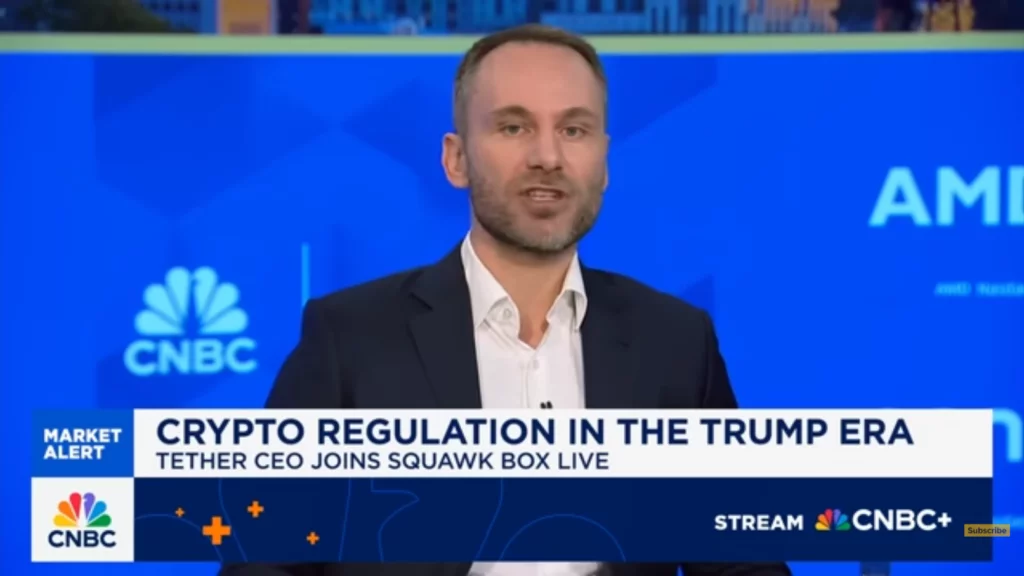
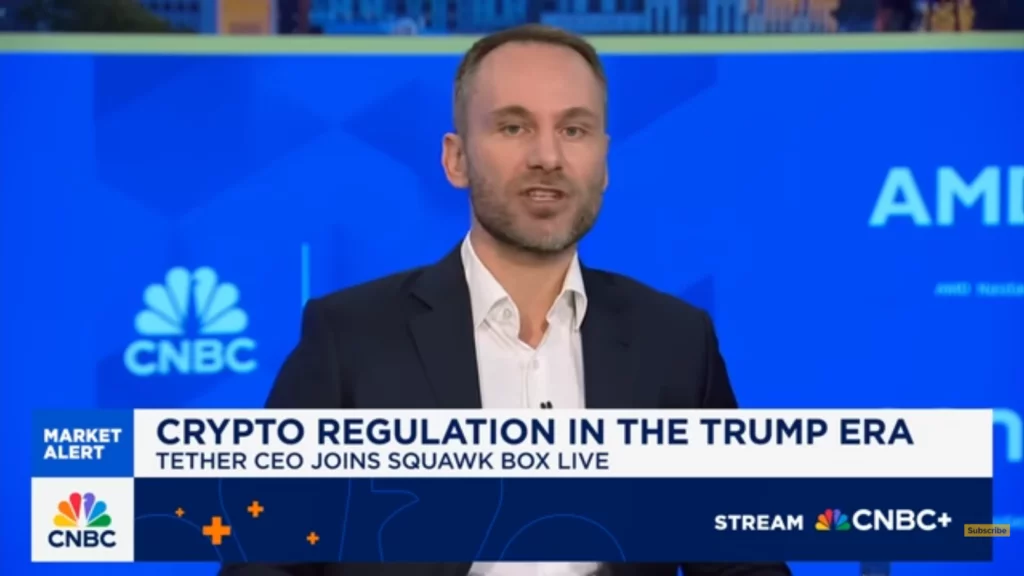
Last July, Tether chief executive Paolo Ardoino said the company intended to comply with the GENIUS Act. Speaking to CoinDesk after the bill was signed at the White House, Ardoino said, “Tether will comply with the GENIUS Act,” adding that the company planned to launch a separate U.S.-focused token while also ensuring USDT satisfied the law’s foreign issuer requirements.
Questions remain over compliance timeline
Even with two years remaining before the law’s general transition period expires in July 2028, lawyers continue to debate whether foreign issuers receive the same grace period as domestic companies.
Justin Levine, a lawyer at Davis Polk who advises clients on stablecoin regulation, told CoinDesk that foreign issuers will need to comply immediately with provisions allowing authorities to freeze and seize assets linked to illicit activity once the law becomes effective, which is expected around January. However, he said additional requirements tied to continued U.S. exchange listings would likely have a longer implementation period.
“Upon the effectiveness of the GENIUS Act, foreign issuers will need to immediately comply with lawful orders to seize and freeze coins held by illicit actors, but they will have a runway of approximately two more years to prepare for the additional requirements so that their coins may remain eligible for listing on U.S. centralized trading platforms,” Levine said.
He added that one of those future obligations, registration with the Office of the Comptroller of the Currency, would likely require a “significant undertaking.”
“So they do have time, as long as they comply with seize and freeze orders,” Levine said.
“But those that want to have their coins continue to be traded on U.S. centralized platforms and have that liquidity should still be thinking about it right now, even if it’s not imminent that they’re going to get delisted.”
CoinDesk also reported that an earlier legal interpretation published by law firm Paul Hastings had suggested foreign issuers could face a different compliance timeline. After the publication sought clarification, the report said the interpretation was removed from the firm’s website, while representatives did not immediately respond to requests for comment.
Further guidance from the Office of the Comptroller of the Currency has also left room for interpretation. CoinDesk said an OCC proposal includes a footnote indicating that 2028 remains the general compliance deadline but notes that certain requirements for foreign issuers begin once the law takes effect. These early obligations appear to center on cooperation with law enforcement requests involving asset freezes and seizures, while broader requirements would follow later.
Beyond these initial measures, foreign issuers are expected to satisfy additional conditions, including OCC registration, maintaining reserves at U.S. financial institutions, and operating under home-country supervision that the U.S. Treasury determines is comparable with the American regulatory framework.
Reserve structure draws attention
CoinDesk also pointed to Tether’s latest reserve disclosures, saying approximately one-quarter of USDT’s backing remained invested in assets that would not qualify under the GENIUS Act’s reserve standards. According to the report, those assets include bitcoin holdings, precious metals, and lending exposure.
The legislation instead requires qualifying stablecoins to be backed by highly liquid assets such as cash and short-term U.S. Treasury securities.
Although regulatory questions continue, Tether has already introduced USAT, a U.S.-focused stablecoin issued through banking partner Anchorage Digital with American compliance standards in mind. Adoption of the token has remained relatively limited compared with USDT.
Kevin Wysocki, head of policy at Anchorage Digital, told CoinDesk the company expects institutional adoption to move ahead of the legal deadline.
“Non-compliant stablecoins cannot be used by U.S. institutions when the safe harbor expires in 2028, but we don’t expect the market to wait,” Wysocki said. He added that Anchorage expects institutions to migrate toward “compliant, bank-issued digital dollars well ahead of that deadline.”
Expansion continues as regulation develops
Even as compliance discussions continue in the United States, Tether has expanded both its investment activity and enterprise payment strategy across several markets.
Earlier this month, the company led a $7 million funding round for Pact Labs to integrate USAT into payroll infrastructure serving a U.S. payroll market processing more than $11 trillion annually. Tether said the partnership is intended to allow employers to settle wages using blockchain payment rails instead of relying solely on conventional banking systems.
Outside payroll, Tether has also increased its focus on corporate treasury operations. Hyundai Motor America and Hyundai Motor Mexico recently completed a pilot cross-border treasury payment using USDT over the Avalanche blockchain, settling a $20,000 transfer in about seven minutes through infrastructure provided by Axiym, while Hyundai Card managed the compliance and operational framework for the transaction.
Latin America has remained another priority. Over recent weeks, Tether has invested $20 million in Brazilian exchange Mercado Bitcoin and another $20 million in Argentine digital bank Ualá as part of its latest funding round. The company also previously led a $14 million investment in Argentine crypto platform Belo to expand crypto payment products and financial services across the region.
Meanwhile, Bolivia is evaluating a proposal that would recognize USDT alongside the boliviano and the U.S. dollar within parts of its payment system. Local reports have indicated that Banco Unión and Banco FIE already provide services connected to USDT, although authorities have yet to publish a final legal framework.
Despite those international expansion efforts, the regulatory picture inside the United States remains unfinished. Federal agencies have yet to finalize the implementing rules required under the GENIUS Act, leaving stablecoin issuers without a complete regulatory framework to follow even as the first compliance obligations approach.
Trevor Tanifum, managing principal at consulting firm FS Vector, was cited in the report saying that some trading platforms with lower risk tolerance could choose to delist non-compliant stablecoins early, while larger exchanges with stronger legal resources may continue supporting them until regulators provide definitive guidance.
“It’s pretty much what has happened, I think, at every major crypto hurdle,” Tanifum said. “These platforms still count on a lot of transaction volumes, liquidity from non-U.S. issuers, and so I can’t see them giving up those volumes without a fight.”
At the same time, much of the crypto industry’s policy focus has shifted toward the proposed CLARITY Act, which lawmakers continue to debate in Congress. If enacted, the legislation could revise parts of the GENIUS framework, adding another layer of uncertainty as Tether, Circle and other stablecoin issuers prepare for federal oversight in the months ahead.
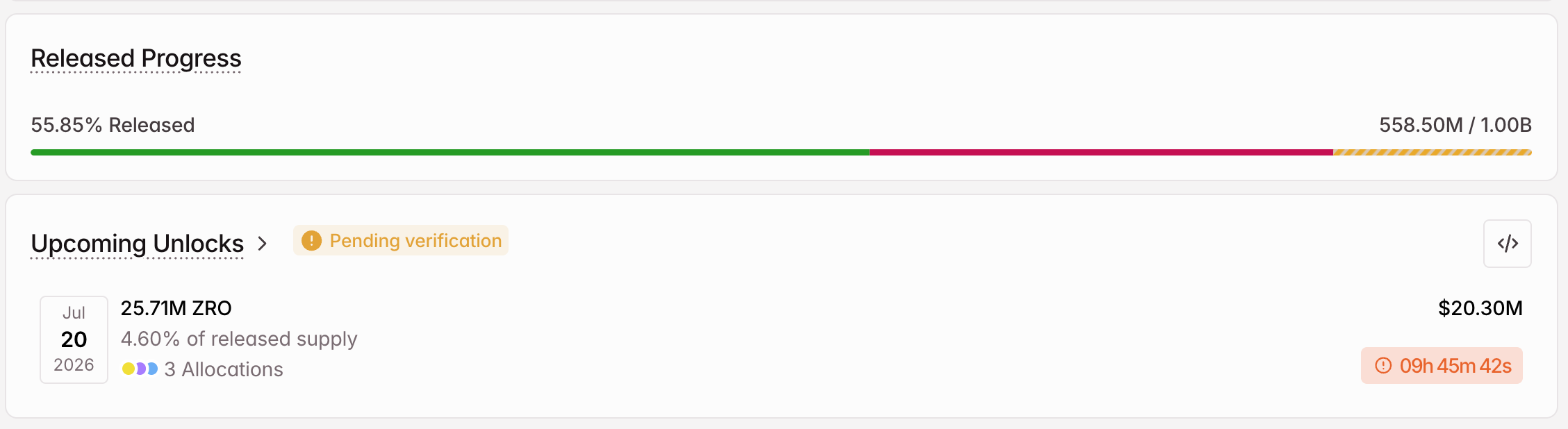
The crypto market will welcome tokens worth more than $704.5 million in the fourth week of July 2026. Major projects, including LayerZero (ZRO), Humanity (H), and Kaito (KAITO), will release significant new token supplies.
These unlocks could introduce market volatility and influence short-term price movements. So, here’s a breakdown of what to watch.
1. LayerZero (ZRO)
- Unlock Date: July 20
- Number of Tokens to be Unlocked: 25.71 million ZRO
- Released Supply: 558.5 million ZRO
- Total Supply: 1 billion ZRO
LayerZero is an interoperability protocol that connects different blockchains. Its primary goal is to facilitate seamless cross-chain communication. Thus, it enables decentralized applications (dApps) to interact across multiple blockchains without relying on traditional bridging models.
The team will unlock 25.71 million tokens on July 20, representing 4.6% of the released supply. Moreover, the supply is worth approximately $20.3 million.

LayerZero will award 13.42 million altcoins to strategic partners. Core contributors will get 10.63 million ZRO. Lastly, 1.67 million ZRO are for tokens repurchased by the team.
2. Kaito (KAITO)
- Unlock Date: July 20
- Number of Tokens to be Unlocked: 17.6 million KAITO
- Released Supply: 409.47 million KAITO
- Total Supply: 1 billion KAITO
Kaito is an artificial intelligence (AI)-powered Web3 information platform that aggregates and analyzes cryptocurrency market data from diverse sources like social media, governance forums, news, and more. The KAITO token serves as a medium of exchange, governance tool, and incentive mechanism within the platform.
On July 20, the team will unlock 17.6 million tokens, representing 4.3% of the current released supply. The supply is worth approximately $16.5 million.

The foundation will receive 1.19 million tokens. Core contributions will get 6.94 million tokens. Furthermore, early backers will receive 2.31 million KAITO. Finally, the team will direct 7.16 million KAITO for ecosystem and network growth.
3. Humanity (H)
- Unlock Date: July 25
- Number of Tokens to be Unlocked: 266.47 million H
- Released Supply: 3.1 billion H
- Total supply: 10 billion H
Humanity (H) is a decentralized identity protocol that utilizes biometric palm recognition, zero-knowledge proofs, and blockchain to verify the authenticity of real human users without exposing their personal data. It features a native Proof of Humanity (PoH) consensus mechanism.
On July 25, the protocol will unlock 266.47 million tokens. The tokens are worth $15.6 million and also account for 8.6% of the released supply.

The team will split the released supply six ways. Investors will get 55.56 million H. The ecosystem fund will receive 50 million H.
Furthermore, Humanity will allocate 42.86 million altcoins to identity verification rewards and 26.39 million H to Human Institute Strategic Reserve. Lastly, the foundation operations treasury will gain 12.50 million tokens.
In addition to these, other prominent unlocks investors can look out for in the fourth week of July include Plasma (XPL), Undeads Games (UDS), Soon (SOON), and more, which will contribute to the total market-wide releases.
The post 3 Token Unlocks to Watch in the Fourth Week of July 2026 appeared first on BeInCrypto.
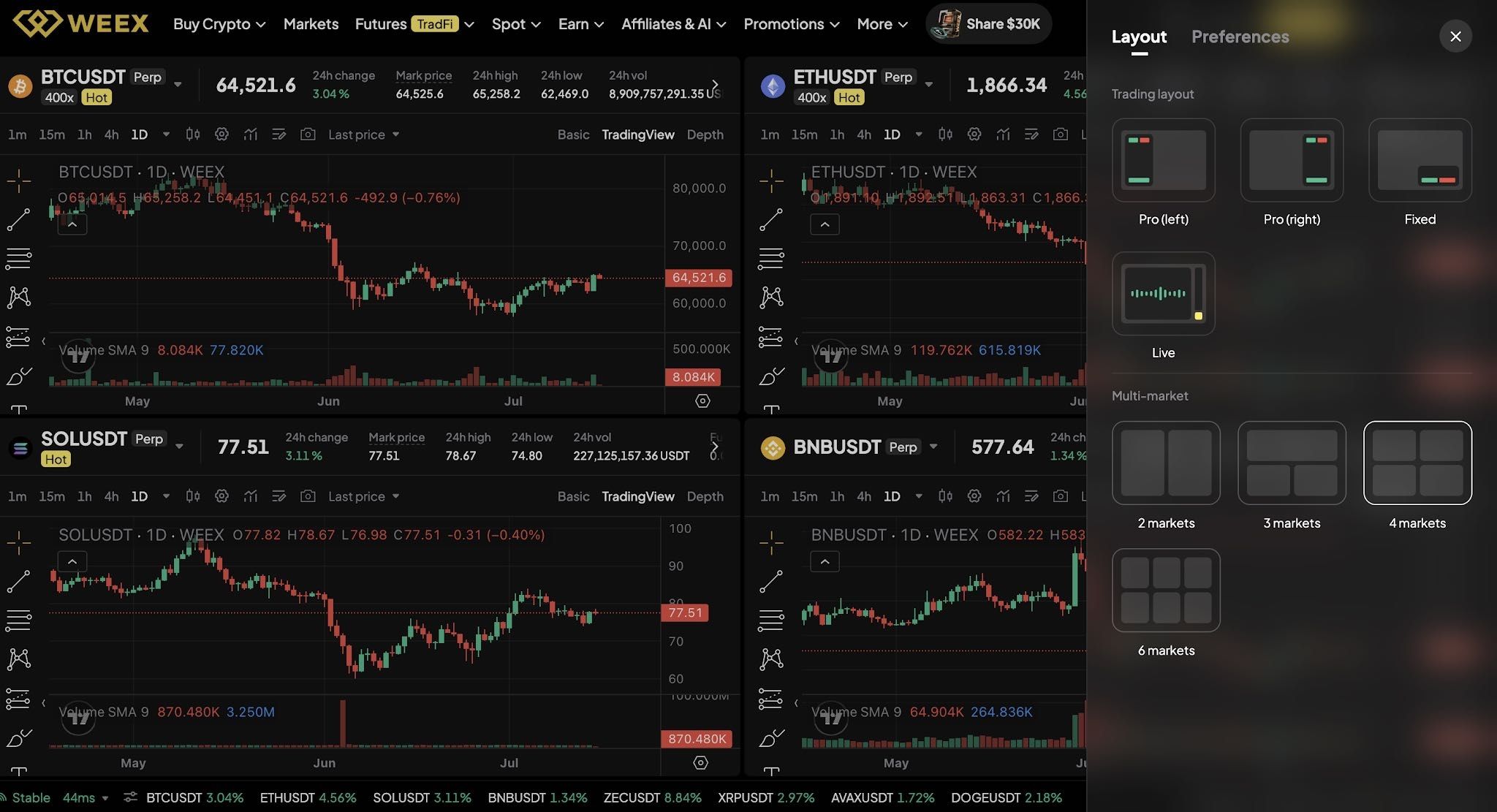

Global cryptocurrency exchange WEEX today announced the launch of Multi-Market Mode, a new screen layout designed for traders who need to track multiple assets in real time.
The feature splits a trader’s screen into 2, 3, 4, or 6 independent chart windows, each displaying a different trading pair — with every window functioning as its own fully independent, fully functional workspace. Rather than switching between tabs or losing sight of one market to watch another, traders can now monitor entire portfolios, correlated pairs, or cross-market opportunities side by side, all in a single view.
TL;DR
- What it is: A new layout option that splits your screen into 2, 3, 4, or 6 independent chart windows — each showing a different pair.
- Where to find it: Click “Layout” on any futures page, then pick your grid under “Multi-market.”
- What each window can do: Draw your own trendlines, drag the time range, switch timeframes, and switch assets — independently, per window.
- What’s fixed: Window sizes are locked, so your layout always stays clean and consistent.
- What’s remembered: Your setup saves automatically. Open the same layout again, and everything’s exactly how you left it.
Why Watching One Chart at a Time Is Costing You Trades
If you trade more than one coin, you already know the problem. You’re watching BTC, but the move happens on SOL. You switch tabs to check it, and by the time you’re back, BTC has already moved too. One chart at a time means you’re always one step behind whichever pair you’re not looking at.
Multi-Market Mode solves this the simple way: put more charts on the screen, so you stop having to choose which one to watch.
Introducing WEEX Multi-Market Mode: 2, 3, 4, or 6 Charts, One Screen
Open the Layout menu on any futures page and you’ll now see four new grid options under “Multi-market”: 2 markets, 3 markets, 4 markets, or 6 markets. Pick one, and it opens in a new tab — a clean, split-screen view where every window shows a different pair, side by side, all at once.
No more tab-switching. No more missed entries because you were looking somewhere else. Just pick your grid, and watch everything that matters, all at the same time.
Every Chart Works Independently — Draw, Drag, Switch, Repeat
Multi-Market Mode isn’t just charts sitting side by side doing nothing. Each window works on its own:
- Draw your own analysis — trendlines, annotations, whatever you use, on each chart independently
- Drag the time range — zoom into the last hour on one chart, the last month on another
- Switch timeframes — 1m on one window, 4H on the next, your call
- Switch coins — swap out any window for a different pair, anytime, without touching the others
Every window is its own workspace. What you do on one doesn’t affect the rest.
What’s Simplified in This View — And Why That’s a Good Thing
Multi-Market Mode is built for one job: watching several pairs clearly, at the same time. So a few tools that belong to deeper, single-coin analysis are left out here:
- No price alerts
- No fullscreen mode
- No quick market or limit order buttons
- A few chart icons and annotation toggles in the top-right are also removed to keep things clean
Everything else — your core drawing and annotation tools — stays fully usable. The difference is focus: Multi-Market Mode clears away the extras that only matter for one coin at a time, so nothing slows you down when your attention needs to move fast across 2, 3, 4, or 6 pairs at once. Less clutter per chart, more charts in view — that’s the trade that catches the moves a single-screen setup misses.
Your Layout Saves Automatically — Pick Up Right Where You Left Off
Set up your 4-market grid with your favorite pairs, your timeframes, your drawings — and it’s saved. Close the tab, come back tomorrow, open the same layout, and everything’s exactly how you left it. No rebuilding your setup every single session.
Who Should Be Using Multi-Market Mode?
| Type | Benefit |
| Swing traders | Track several setups at once and catch the moment your entry lines up |
| Arbitrage traders | Watch price gaps across multiple pairs in real time |
| Anyone tired of tab-switching | See it all on one screen, stop missing moves on the pairs you’re not actively watching |
How to Turn On WEEX Multi-Market Mode
- Log into WEEX
- Open any futures page
- Click the “Layout” button in the top right corner
- Under Multi-market, pick 2, 3, 4, or 6 markets
That’s it. Your new grid opens in a fresh tab, ready to go.
Stop choosing which chart to watch. Watch them all.
Try WEEX Multi-Market Mode now — watch more pairs, miss fewer moves.
About WEEX
Founded in 2018, WEEX has developed into a global crypto exchange with over 6.2 million users across more than 150 countries. The platform emphasizes security, liquidity, and usability, providing over 1,200 spot trading pairs and offering up to 400x leverage in crypto futures trading. In addition to the traditional spot and derivatives markets, WEEX is expanding rapidly in the AI era delivering real time AI news, empowering users with AI trading tools, and exploring innovative trade to earn models that make intelligent trading more accessible to everyone. Its 1,000 BTC Protection Fund further strengthens asset safety and transparency, while features such as copy trading and advanced trading tools allow users to follow professional traders and experience a more efficient, intelligent trading journey.
Follow WEEX on social media
X | Instagram | Tiktok | Youtube | Discord | Telegram
The post WEEX Multi-Market Mode: See 6 Crypto Pairs at Once, Catch Every Breakout appeared first on BeInCrypto.
FIIs and mutual funds increase stakes in Groww. Should you buy, sell, or hold?

Hyperliquid plans to introduce decentralized prediction markets in HIP-4 upgrade

Disney Officially Brings Back the Show That Launched Ryan Gosling and Britney Spears


-
 NewsBeat4 days ago
London Mayor Sadiq Khan handed a peerage by Keir Starmer alongside 15 other Labour figures… just days before the PM leaves No10
-

 Fashion3 days ago
Weekend Open Thread – Corporette.com
-

 Politics2 days ago
The House | The City of London can help the new chancellor deliver growth in every postcode
-

 Politics5 days ago
Young campaigners urge incoming PM to act on outdoor junk food ads
-

 Crypto World4 days ago
CFTC blocks Kalshi from unwinding Michigan trades after court order
-
 Crypto World3 days ago
Two July Windows Left: The CLARITY Act’s Senate Fight and What Failure Means
-

 Business4 days ago
Nvidia Stock Slips After Big Tuesday Rally as Huang Confirms Vera Rubin Chip Is Now in Production Today
-

 Crypto World2 days ago
Ripple Payments Joins MiCA With 14 Firms, Does It Mean Anything For XRP?
-

 Politics21 hours ago
Democrats look to World Cup watch parties to register thousands of voters
-

 Crypto World3 days ago
Ripple wins EU-wide access as ESMA adds it to MiCA register
-
 Entertainment5 days ago
Disney’s Most Ambitious Failed Star Wars Attraction Is Coming to SDCC
-

 Business4 days ago
Palantir Shares Rise After Expanded Nvidia Partnership and Fresh Analyst Upgrades Ahead of Earnings Day
-

 Crypto World4 days ago
Injective Submits SEC Transfer-Agent Registration to Onchain Ownership Records
-

 Tech6 days ago
Get Your ESP32 Sunny Side Up With This Solar Dev Board
-

 News Videos6 days ago
XRP BOMBSHELL… XRP OMBOARDED FOR TRANSACTIONS!!!
-

 NewsBeat3 days ago
Registration is now open for March for Men with Kev 2026
-

 Tech6 days ago
Dark Secrets Emerge When Jailbreaking LLMs
-
 Sports5 days ago
New Cornerback Enters Vikings Trade Rumor Mill
-

 News Videos3 days ago
Money | Class 12 Economics | CBSE Board Exam 2026-27
-

 Business3 days ago
Banco Bilbao Vizcaya Argentaria, S.A. (BBVA) Discusses Global Macro Environment and Economic Outlook for Core Markets Transcript
You must be logged in to post a comment Login