

Crypto World
Binance, PayPal, and Ripple join Mastercard’s massive new push into blockchain payments



Mastercard has launched a new Crypto Partner Program that brings together more than 85 companies from across the digital asset and payments industries, an effort to link blockchain technology more directly with the infrastructure that underpins global commerce.
The program includes crypto exchanges, blockchain developers, fintech firms and banks such as Binance, Circle, Ripple, Gemini, PayPal and Paxos, the company told CoinDesk in a statement. Participants will work with Mastercard to explore how blockchain-based systems can connect with traditional payment rails used by banks, merchants and consumers around the world.
Mastercard said the initiative focuses on practical use cases where digital assets are already gaining traction, including cross-border transfers, business-to-business payments and global payouts.
Digital assets once operated largely outside the traditional financial system. In recent years, however, companies and financial institutions have begun experimenting with blockchain tools to move money faster across borders or settle transactions around the clock.
For payment companies like Mastercard, the challenge is less about replacing existing systems and more about connecting new ones to the networks that already handle global commerce.
Mastercard’s network links banks, merchants and consumers in more than 200 countries and territories. The company argues that blockchain-based payments will only scale widely if they can plug into that kind of global infrastructure.
The Crypto Partner Program is designed to create that bridge. Companies in the program will work with Mastercard teams to help shape products that combine on-chain tools — such as programmable payments or tokenized assets — with established payment rails.
The initiative also gives partners access to forums where they can collaborate with one another and with Mastercard’s broader ecosystem of financial institutions and merchants.
The move builds on several earlier efforts by Mastercard to engage with the digital asset industry. The company has supported crypto-linked payment cards, backed blockchain startups through its Start Path accelerator and developed services aimed at helping banks manage crypto compliance and risk.
Competitors have taken similar steps. Visa has worked with stablecoin issuers and blockchain firms to test settlement using digital dollars, while major banks continue to explore tokenized deposits and blockchain-based payment systems.
Still, integrating digital assets into everyday commerce remains a complex process. Payments require consistent standards, regulatory oversight and systems that work across borders — areas where traditional card networks have decades of experience.



The program’s main goal is to connect blockchain tech with Mastercard’s global payments infrastructure.
Payments giant Mastercard unveiled a new Crypto Partner Program aimed at connecting the rapidly developing world of blockchain tech with its vast global payments infrastructure.
According to the company’s statement, more than 85 blockchain and fintech-focused firms have joined the initiative, with some of the major names including Binance, Ripple, Gemini, PayPal, Paxos, and Circle.
Mastercard’s Program
The official press release indicated that this joint venture signals another step by traditional financial networks toward integrating cryptocurrency assets into mainstream commerce.
Given the substantial number of big crypto and fintech names joining the program, Mastercard noted that they plan to explore how on-chain tech, including programmable payments and tokenized assets, can integrate with TradFi payment systems used by merchants, banks, and consumers worldwide.
The program itself will focus on developing practical applications where blockchain can complement existing financial rails rather than replace them.
Mastercard execs Raj Dhamodharan and Sherri Haymond claimed that crypto assets have entered a new phase, which could boost them further into the traditional financial system.
“As digital asset technologies mature, Mastercard will continue focusing on what we do best: enabling trust, setting standards, and connecting systems at scale. By bridging on-chain innovation with the framework that powers everyday payments, we’re helping ensure that what’s next works with what already does,” they added.
Broader Push
Bloomberg added that the new program builds on several earlier initiatives aimed at integrating the digital asset class into its ecosystem. It previously supported crypto-linked payment cards, invested in blockchain startups via its Start Path accelerator, and introduced services designed to help banks manage industry-related compliance and risk.
You may also like:
Although cryptocurrencies have risen in popularity in the past half a decade, their integration into everyday payments remains a complex challenge. Mastercard aims to address that by positioning itself as a bridge between the emerging blockchain economy and the traditional financial system.
Binance Free $600 (CryptoPotato Exclusive): Use this link to register a new account and receive $600 exclusive welcome offer on Binance (full details).
LIMITED OFFER for CryptoPotato readers at Bybit: Use this link to register and open a $500 FREE position on any coin!


Binance has launched a lawsuit against the Wall Street Journal (WSJ) over a series of allegedly “defamatory” articles that revealed how the exchange shut down an internal investigation into billions of dollars worth of crypto flowing to Iran.
The February articles detailed how Binance fired its investigators shortly after they found Chinese entities sending $1.7 billion worth of crypto to accounts linked to Iran’s Revolutionary Corps.
Now, the WSJ reports that these findings have led to an investigation from the US Department of Justice (DoJ).
The DoJ is reportedly reaching out to people with knowledge of the transfers and firings, but hasn’t disclosed if Binance or the Chinese entities are the focus of the investigation.
US senators launched their own inquiry last month, demanding Binance share documents on a trove of data, from information on the dubious accounts to the internal reports filed by compliance investigators.
Binance lawsuit claims WSJ ‘sacrificed truth for profit’
Binance has maintained that the WSJ’s reporting has been incorrect since it was published.
Now, the lawsuit claims the “false, defamatory, and reckless” findings have led to this “metastasized” response from US officials that continues to damage its reputation.
The suit denies that it fired compliance staff for investigating transactions, shuttered the investigation without further action, failed to comply with law enforcement requests, and knowingly registered customers with false details.
It also claims that the WSJ didn’t include its responses to initial questions before publishing the piece, and that it did so to beat the New York Times to the scoop.
Read more: Binance demands the Wall Street Journal remove ‘damaging’ article
“Instead of actually engaging with Binance, the Wall Street Journal prioritized filing quickly on the heels of the NYT so that it could maximize views of the article,” the lawsuit claims.
It also alleges, “The Wall Street Journal’s failure to respond to Binance’s request for an extension until the deadline arose and its decision to move that deadline up without a substantive response from Binance demonstrates its rush to publish the article to keep up with a competitor, regardless of the truth.”
The suit adds, “The Wall Street Journal must not be allowed to set aside journalistic standards and publish false, defamatory, and sensationalized narratives that sacrifice truth for profit.”
Binance is seeking damages for the reputational harm it claims has been caused, attorney fees, and a trial by jury.
Senators say Binance is repeating the crimes of its past
Binance was fined $4.3 billion in 2023 for failing to implement adequate anti-money-laundering and sanctions checks. Its former CEO, Changpeng Zhao, was sentenced to four months in prison.
As part of this settlement, Binance agreed to onboard a compliance monitor that would ensure the exchange was up to code.
The probe launched by senators, however, claims that the WSJ’s findings show Binance is a “repeat offender” revisiting the crimes of its past.
Read more: Justin Sun nears $10M deal to settle SEC’s Tron lawsuit
Democrat Senator Richard Blumenthal wrote, “Binance appears to have ignored warnings and recommendations to prevent Iranian money laundering schemes on its cryptocurrency exchange, allowing $1.7 billion in transfers to Iran.
“These transactions have helped prop up Iranian-linked terrorist organizations and illicit Russian oil sales.”
Got a tip? Send us an email securely via Protos Leaks. For more informed news and investigations, follow us on X, Bluesky, and Google News, or subscribe to our YouTube channel.
Bloomberg Intelligence senior commodity strategist Mike McGlone, who previously said bitcoin could drop to $10,000, is reiterating his call that bitcoin could still fall below that level, an outlook several market analysts said would require an extreme macroeconomic shock.
In an interview with EllioTrades, McGlone said the crypto bear market may not be over and warned that bitcoin could remain vulnerable if global risk assets reprice sharply.
McGlone’s forecast was met with rebuttals from several market analysts who said that while they agree a further downside for bitcoin is possible, a drop to $10,000 would likely require an extraordinary global liquidity event.
“Analysts often get lost in short-term macro noise, and sometimes they extrapolate that into silly conclusions,” said Mati Greenspan, founder and CEO of Quantum Economics.
“For an asset like bitcoin, which regularly sees tens to hundreds of billions of dollars in daily trading volume across global markets, to revisit $10,000 we’d need a global liquidity crisis, a nuclear war, and the internet to stop working.”
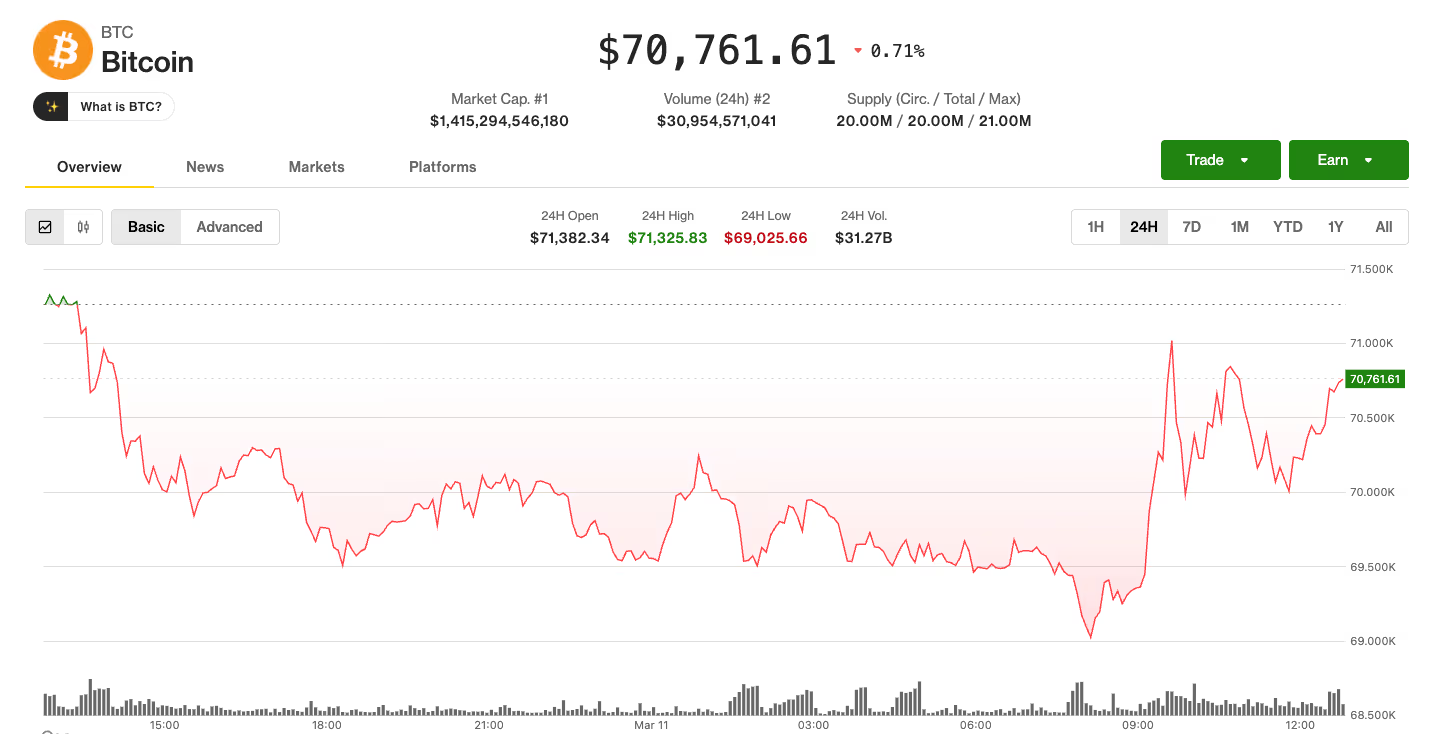
Bitcoin is currently hovering around $70,000, after trading between $69,000 and $71,000. BTC’s price rise appeared to coincide with oil quickly reversing most of its session’s large gains, dropping $3 per barrel in minutes. Other crypto assets, including ether (ETH), solana (SOL) and XRP, also saw upward moves.

McGlone based his bearish analysis on broader macroeconomic conditions. He believes bitcoin has increasingly traded in tandem with other speculative assets as institutional participation in crypto markets has grown, weakening the narrative that crypto serves as an uncorrelated hedge against traditional markets.
According to McGlone, the crypto sector remains trapped in a broader macroeconomic unwind driven by deflationary pressures, excess speculative supply and what he sees as an unfinished correction in traditional risk markets.
Further downside still possible
Other analysts, who see potential for further bitcoin price decline, also echoed Greenspan’s sentiment that McGlone’s price target is unlikely.
“A move toward levels like $28,000 would likely require a meaningful contraction in global liquidity, widening credit spreads, or a broader financial stress event rather than just a late-cycle slowdown,” said Jason Fernandes, co-founder and market analyst at AdLunam.
Jonatan Randin, senior market analyst at PrimeXBT, also said bitcoin could see further downside but described the $10,000 prediction as highly improbable.
“There will always be analysts calling for extreme price targets during a bear market,” Randin said. “Can we go down to $10,000? Yes, it’s possible, but I see it as highly unlikely.”
Randin expects bitcoin to gradually drift lower in the coming months, adding that the next major accumulation zone could emerge between $30,000 and $40,000.
“If the market is in a downtrend, you are in a bear market,” Randin said. “You’re going to remain in a bear market until the primary trend shifts.”
In the shorter term, however, he expects bitcoin to remain largely range-bound between $60,000 and $70,000, warning that even a rally toward $80,000 could prove temporary if broader macro pressures persist.
The bottom may already be in
Greenspan said identifying an exact market bottom is difficult, but he noted that bitcoin may have already completed its major bear-market correction.
“Trying to pick an exact bottom is a fool’s errand,” he said. “Structurally, bitcoin already cleared its major bear market in 2022. We’re currently looking at roughly a 50% retracement from the all-time high, which is not unusual for bitcoin.”
He added that recent price action has been encouraging and that it is “quite possible we’ve already seen the bottom.”
McGlone, however, believes the market still needs to go through a prolonged cleansing of speculative excess before a durable bottom can form.
“I think it’s going to last a while, and I don’t think it’s going to end until we purge some of these excesses,” he said.
“It’s a bear market,” McGlone added. “Sell rallies.”
Read more: Next week could spice things up for bitcoin as seven central banks face an inflation test

Bitcoin (CRYPTO: BTC) watchers could be nearing a pivotal moment as non-traditional treasury strategies accelerate a long-running BTC accumulation drive. Michael Saylor’s Strategy (EXCHANGE: MSTR) has been converting equity sales into Bitcoin through its ATM program, steadily expanding its crypto stash. With holdings already in the high hundreds of thousands of BTC and weekly purchase momentum intensifying, some analysts say a 1 million BTC milestone could come into view sooner than many expected—the kind of milestone that might edge out even the largest public holders if the trend persists. The unfolding dynamic underlines how corporate finance moves are intertwining with crypto markets at scale.
Key takeaways
- STRC share sales have generated cash to acquire over 3,500 BTC so far this week.
- Strategy’s implied buying power could rise to roughly 5,700 BTC per day at Tuesday’s record pace.
- STRC currently pays an 11.50% annual dividend, distributed monthly in cash, with the rate adjusting to keep the stock near its $100 par value to temper volatility.
- The program’s weekly activity shows STRC selling about 6 million shares via ATM to fund BTC purchases.
- STRC’s activity is spotlighting a potential convergence with larger BTC holders like IBIT, as the BTC-hoarding landscape reshapes competition among large crypto investors.
Tickers mentioned: $MSTR, $BTC, STRC, $IBIT
Sentiment: Bullish
Price impact: Positive. A sustained push by STRC-backed purchases could lift BTC demand and influence price, albeit within a volatile macro context.
Trading idea (Not Financial Advice): Hold. The strategy hinges on continued BTC accumulation via STRC sales and market liquidity for the instrument, against ongoing volatility and potential dilution risks.
Market context: The rise of large, structured crypto investment vehicles sits against a backdrop of ETF inflows, evolving crypto regulations, and broader liquidity dynamics that shape how big holders move in and out of BTC.
Why it matters
The evolving dynamic between equity-financed crypto accumulation and traditional holdings signals a watershed moment for institutional exposure to Bitcoin. If STRC continues to channel proceeds from stock sales into BTC purchases at pace, Strategy could steadily climb its BTC reserves toward levels that once seemed unattainable for a single issuer. The math behind the potential trajectory hinges on STRC’s daily trading volume and its ability to monetize the ATM sales into crypto, an approach that blends equity markets with the crypto ecosystem in a way that few institutional players have attempted at scale.
For market participants outside the STRC ecosystem, the development underscores a broader trend: crypto assets increasingly intersect with mainstream financial infrastructure. The STRC model—an 11.50% annual dividend that adjusts to align the stock near its par value and a dividend-funded BTC acquisition program—offers a blueprint for how equity-collateralized crypto exposure could be structured in the future. While the discipline of keeping a high dividend manageable and the risk profile intact remains a central caveat, the potential for sizable BTC inflows into a single instrument highlights the growing sophistication of crypto-finance products.
On the investor side, the discourse includes cautions from market observers. STRC’s chief supporters argue the program could unlock a steady, if uneven, stream of BTC accumulation. Yet critics warn that the product’s reliance on ongoing share sales introduces dilution risk and that dividends do not guarantee returns in a market as volatile as digital assets. A notable voice in the debate cautioned that while STRC can deliver attractive income, it remains a high-risk instrument that won’t replicate traditional fixed-income protections. The balance of yield, volatility, and the capacity to sustain BTC purchases will be crucial as the dynamic evolves.
“If products like STRC eventually attract even 0.1% of global fixed income outstanding, that is $145.1 billion. At $71.2K per Bitcoin, that amount of capital would be enough to buy roughly 2.04 million BTC, purely as a scale illustration.”
Beyond the STRC narrative, market observers note that the sector’s momentum is not isolated. The BTC market has seen substantial participation from exchange-traded variations and other crypto-focused vehicles, with BlackRock and IBIT among the most prominent references in the liquidity and custody discussion. While IBIT holds a sizable BTC stash, STRC’s ongoing buying program contributes to the depth and resilience of demand in the short to medium term, potentially influencing price dynamics in periods of high liquidity or stress.
On Tuesday, STRC logged a record $409 million in daily volume with a 30-day average of $138.5 million, underscoring the scale at which the stock’s ATM transactions are operating and their potential to influence BTC acquisition rates.
Analysts have framed the mechanics of STRC’s buying power in practical, if hypothetical, terms. With a Bitcoin price hovering around the low to mid-$70,000s, the implied daily buying capacity could rise to roughly 1,940 BTC per trading day—more than four times the amount minted in a typical 24-hour period. On peak days when STRC’s trading activity hits record levels, the implied daily capacity could approach 5,700 BTC, a level that would dramatically alter the balance of demand versus supply in the market. Should that pace persist, Strategy’s Bitcoin holdings could cross the 1 million BTC threshold by late summer—an outcome that would place STRC well ahead of several traditional holders, including some of the largest publicly traded crypto-related assets.
The ongoing comparison with the broader market, including IBIT, adds another layer of interest. IBIT’s larger BTC stash positions it as a peer among the handful of major holders, but STRC’s disciplined, dividend-driven, ATM-powered accumulation creates a distinct dynamic. If STRC continues to monetize its equity sales into Bitcoin, the gap between STRC and IBIT could narrow more rapidly, setting up a competitive tension that may influence how fund managers and retail investors view the relative attractiveness of crypto-anchored equity instruments versus pure-play BTC exposure.
Analysts have also highlighted the long-term implications for fixed-income-style capital allocation in crypto. Adam Livingston, an analyst who tracks macro and crypto markets, has noted that if STRC were to attract even a tiny fraction of global fixed-income capital, the resulting scale could translate into several million BTC in aggregate demand across the market. While the illustration remains hypothetical, it underscores the potential systemic impact of non-traditional instruments that marry income-generation with asset accumulation.
On the risk front, STRC’s official disclosures remind investors that the product is not a bank deposit or FDIC insured, and it does not carry the same protections as traditional bank accounts or money-market funds. Market participants should weigh the potential for dividend volatility, par-value pressure on the stock price, and the possibility of dilution from additional share issuance. As with any instrument that ties equity mechanics to crypto purchases, governance, liquidity, and regulatory considerations will continue to shape outcomes in the months ahead.
I’ve been seeing a lot of euphoric bullposting about @STRC.
It’s an interesting financial product, but I will be the black sheep and state that I personally feel it’s too risky of an investment. — 𝙲𝚘𝚕𝚒𝚗 𝚃𝚊𝚕𝚔𝚜 𝙲𝚛𝚎𝚙𝚝𝚘 🪙 (@ColinTCrypto) March 10, 2026
The overall narrative remains a blend of opportunity and risk, with STRC occupying a unique position at the intersection of equity financing and Bitcoin accumulation. While the potential for rapid BTC growth under STRC’s model captures the imagination of market observers, the path forward requires close attention to the instrument’s liquidity, share issuance plans, dividend mechanics, and the regulatory framework that governs these hybrid financial products. The coming weeks will be telling as STRC’s ATM activity continues to unfold and as IBIT and other large holders respond to evolving market conditions.
//platform.twitter.com/widgets.js
What to watch next
- STRC ATM activity and the weekly BTC purchase estimates (STRC.LIVE) for the near term.
- Any shifts in STRC’s daily volume profile, particularly around the $409 million peak and the sustainability of the $138.5 million 30-day average.
- Updates from IBIT or other large BTC holders regarding their holdings and inflows.
- The evolution of STRC’s dividend policy and its impact on the stock’s price and investor appetite.
Sources & verification
- STRC.LIVE data for volumes and BTC purchase estimates.
- Strategy’s official materials on STRC, including dividend disclosures and ATM share sales.
- Public posts and statements from market participants referencing STRC’s activity on X/Twitter.
- iShares Bitcoin Trust (IBIT) holdings information and related market data.
Market reaction and key details
Bitcoin (CRYPTO: BTC) markets are watching a striking development: a large, equity-financed vehicle is accelerating BTC accumulation through deliberate share sales and a high-yield dividend strategy. Strategy’s retention of BTC through the STRC program, combined with steady weekly volumes and a high yield, paints a picture of a continued push toward a benchmark that could redefine how major holders think about crypto exposure. The numbers backing this narrative—3,500 BTC purchased this week, 11.50% annual dividend, and a 409 million-dollar daily volume on a record day—underscore the scale of this effort and the potential for meaningful supply-side demand in the Bitcoin market.
From a market structure perspective, the STRC approach demonstrates how a hybrid instrument can mobilize capital into BTC faster than some traditional on-chain or OTC channels. If the pace persists, the BTC addressable through STRC’s buying program could rise in a way that alters the reference points for price discovery, especially in a context where ETF-like liquidity and institutional participation continue to increase. The juxtaposition with IBIT—another major BTC holder—highlights a broader trend: multiple large positions are now competing for BTC, which may have implications for price resilience during periods of volatility and for the broader narrative around “who owns crypto” in the institutional space.
While optimism about STRC’s model is palpable among supporters, skepticism remains. Critics point to the possibility of dividend-adjustment-driven volatility, the risk of stock dilution, and the regulatory uncertainties that accompany complex, non-bank, non-traditional investment products. The debates surrounding STRC’s risk-reward profile are likely to intensify as the instrument enters new phases of its life cycle, including potential governance changes or shifts in the market’s appetite for high-yield crypto exposure. In parallel, market participants will continue to monitor Bitcoin’s price trajectory and liquidity conditions to gauge the true impact of STRC’s purchases on the broader market.


Revolut is launching in the UK.
The popular crypto-friendly digital bank Revolut announced today that it will be launching its UK bank.
According to the firm’s official statement, the Prudential Regulation Authority (PRA) has decided to lift the restrictions on Revolut’s banking license.
With that out of the way, the launch of the local bank comes with an already existing user base of more than 13 million UK customers. Moreover, it follows the firm’s recent commitment to invest as much as $4 billion and create at least 1,000 high-skilled jobs in the country.
Speaking on the matter was the co-founder and CEO of Revolut, who said:
“Launching our UK bank has been a long-term strategic priority for Revolut, and marks a significant moment in our journey. The UK is our home market and central to our growth. We look forward to introducing a full suite of banking services to our millions of UK customers, bringing the same innovative experience we already provide across the rest of Europe. This is a vital step in our mission to build the world’s first truly global bank.”
According to the announcement, the rollout will be gradual, starting in a few days with a small group of existing customers and expanding over the coming weeks.
Binance Free $600 (CryptoPotato Exclusive): Use this link to register a new account and receive $600 exclusive welcome offer on Binance (full details).
LIMITED OFFER for CryptoPotato readers at Bybit: Use this link to register and open a $500 FREE position on any coin!

TLDR
-
SlowMist introduces comprehensive 5-tier security architecture for AI and Web3 agents.
-
Multi-layered approach prevents cyberattacks, data breaches, and blockchain vulnerabilities.
-
Continuous surveillance system validates AI operations to block unauthorized activities.
-
Architecture protects automated cryptocurrency trading systems across diverse blockchain networks.
-
Security framework establishes new standards for protecting AI-powered Web3 infrastructure.
SlowMist introduced an advanced five-tier security architecture designed to shield AI and Web3 agents from evolving cyber threats. This comprehensive framework combines governance protocols with execution safeguards to block unauthorized activities and protect digital assets. The system creates a complete security loop that supervises, restricts, and validates autonomous operations throughout connected digital environments.
Multi-Tier Governance and Execution Architecture Enhances Protection
The security framework employs the AI Development Security Solution (ADSS) to establish governance protocols for AI-powered agents. ADSS manages access permissions, tracks external communications, and evaluates blockchain risks instantaneously. The execution tier incorporates specialized tools including OpenClaw, MistEye Skill, MistTrack Skill, and MistAgent, each engineered to maintain secure operations effectively.
SlowMist designed the security architecture to counter threats such as prompt manipulation, information breaches, and compromised supply chain attacks. The platform establishes perpetual verification procedures that ensure security measures remain transparent and methodical. Companies can implement protective policies that eliminate vulnerabilities while preserving AI operational velocity and accuracy.
Self-Governing AI Systems Create Novel Security Challenges
Implementing this security architecture becomes essential as autonomous AI agents proliferate throughout cryptocurrency trading and blockchain environments. Cybercriminals exploit supply chain weaknesses by inserting concealed malicious code into hardware and applications. SlowMist counters these dangers through unified surveillance and restriction protocols that effectively minimize vulnerability exposure.
The framework’s governance tier guarantees that AI agent operations stay transparent and regulatory-compliant. Instantaneous threat identification diminishes the probability of unauthorized blockchain transactions or compromised agent performance. The security architecture strengthens operational stability without impeding AI-powered productivity.
Cryptocurrency Companies Deploy Automated Trading Solutions
Growing adoption of automated cryptocurrency trading systems drives demand for protective frameworks like this security architecture. Nansen deployed AI-powered trading infrastructure enabling multi-chain transactions on Base and Solana networks. Additional platforms including Coinbase, Bitget, Walbi and Gate.io currently offer simplified AI trading agents requiring no coding expertise.
These automated systems facilitate strategic operations through conversational commands, simplifying digital asset oversight. The security architecture integrates flawlessly with these platforms to implement protection measures throughout each transaction. Companies deploying this framework sustain credibility while expanding automated trading operations.
Establishing Security Standards for AI and Web3 Integration
SlowMist establishes elevated security standards for AI and Web3 ecosystems. The framework unifies fragmented protection strategies into an organized, actionable, and maintainable infrastructure. Widespread implementation can substantially diminish vulnerabilities while retaining AI agent performance and operational efficiency.
Security architecture components function collaboratively to supervise, limit, and validate all AI-executed blockchain activities. The methodology prioritizes proactive defenses and instantaneous verification for autonomous agent conduct. As cryptocurrency organizations accelerate AI integration, this security framework delivers a holistic strategy to protect digital holdings and operational reliability.
SlowMist establishes this security architecture as a critical resource for contemporary blockchain. Its stratified methodology confronts vulnerabilities ranging from governance deficiencies to implementation failures. Organizations utilizing this framework achieve enhanced security benchmarks while sustaining frictionless AI integration.



The price of Across Protocol token surged sharply after a governance proposal suggested a major structural shift for the project.
Summary
- Across Protocol token jumped 85% as a proposal suggests converting tokens into company shares.
- Holders could exchange ACX for equity in a new US C-corp or sell tokens for USDC in a buyout offer.
- The move is meant to help the protocol secure institutional partnerships and commercial agreements.
ACX saw a sharp surge in activity, trading at about $0.063 at the time of writing. The token gained roughly 85% over the previous 24 hours, lifting its market capitalization to nearly $45 million.
Market participation also spiked. Daily trading volume climbed to approximately $51.7 million, representing an increase of more than 3,000% compared with the day before.
A similar trend appeared in the derivatives market. CoinGlass data show that derivatives trading volume expanded dramatically, rising over 7,700% to $138 million. Meanwhile, open interest jumped by around 950%, reaching $20 million, pointing to a wave of new positions entering the market.
The sudden rally followed a proposal submitted on March 11 to the Across governance forum by Risk Labs, the core development group responsible for Across Protocol.
Proposal explores token-to-equity transition
The proposal, titled “The Bridge Across,” asks the community whether the protocol should transition from a token-based structure into a U.S. C-corporation.
If approved, a newly formed entity tentatively called AcrossCo would take over development, partnerships, and commercialization. The company would also hold the protocol’s intellectual property.
The proposal gives ACX holders two possible paths. They can either swap their tokens for equity in the newly formed company or sell their holdings through a buyout offer.
For those choosing the equity route, the plan outlines a 1:1 conversion, meaning each ACX token would be exchanged for one company share. Holders with more than 5 million ACX would be able to convert their tokens directly into equity. Smaller holders, however, would gain exposure through a special purpose vehicle designed to pool their participation.
Token holders who would rather exit could instead accept a buyout offer set at $0.04375 per ACX, with payment made in USD Coin. That price represents roughly a 25% premium to the token’s average trading price over the past 30 days.
The buyout window would remain open for six months if the proposal ultimately passes. Funding for the offer would come from the protocol’s liquid treasury.
Institutional partnerships driving the proposal
According to the proposal, the shift toward a traditional corporate structure is meant to address practical challenges faced by decentralized autonomous organizations.
DAO-based governance can make it difficult to sign enforceable contracts, establish liability frameworks, or negotiate certain types of commercial agreements. These limitations sometimes create barriers when dealing with institutional partners.
Risk Labs said the change could make it easier for the project to secure partnerships and revenue agreements while continuing to build the protocol’s infrastructure.
The proposal is currently a temperature check, meaning it is meant to gather community feedback before any binding vote takes place.
The timeline outlined in the document suggests a governance vote could occur in early April. If approved, legal structuring and token conversion infrastructure would begin shortly afterward.
Across Protocol has spent several years building cross-chain bridging infrastructure, including fast transaction systems designed to move assets between blockchains in seconds.


Arthur Hayes says he’s waiting for central banks to print again before buying Bitcoin, even as he expects BTC to top $100K.
BitMEX co-founder Arthur Hayes has said that he would not buy Bitcoin (BTC) today if he only had $1 to invest.
However, he still expects the cryptocurrency to eventually climb back above $100,000 once central banks return to printing money.
Waiting for the Fed to Print
In a March 10 interview with Natalie Brunell on CoinStories, Hayes argued that the ongoing conflict pitting the U.S. and Israel against Iran has created a real risk of a broad market sell-off that could pull BTC below $60,000.
“There’s a situation where the longer that this carries on, there could be a massive sell-off in equities, and Bitcoin might fall a bit lower, might break $60,000, and that could be sort of a big cascading of liquidations down,” Hayes said during the interview.
According to him, every major Middle East conflict in his lifetime eventually prompted the Fed to print, leading him to conclude that the signal to watch is not the war itself but what central banks actually do in response.
“If I had $1 to invest right now, would I be putting it into Bitcoin? No,” he said. “I would wait. I think that the longer that this conflict goes on, the higher the likelihood that the Fed has to print money to support the American war machine, and that’s when I’m going to buy Bitcoin.”
However, he cautioned against trying to time the moment, noting that most people are following the same mainstream coverage and could likely misread the situation.
Asked why he thought BTC had underperformed over the past 6 to 9 months, the former BitMEX CEO pointed to what he described as a liquidity deficit rather than weak demand for the king cryptocurrency itself.
“Bitcoin is a liquidity alarm,” he stated, arguing that AI-driven job displacement is quietly building deflationary pressure in the U.S. economy. In his view, there isn’t enough dollar liquidity to offset the other demands on capital, especially spending by large tech companies building out data center infrastructure.
You may also like:
No Grand Schemes to Suppress Bitcoin
Hayes also pushed back on the idea that institutions or large market makers like Jane Street have been suppressing the price of BTC.
“I don’t think there’s anything nefarious or like some evil conspiracy of Jane Street and other market makers to try to manipulate prices lower,” he said.
The crypto trader attributed most such claims to investors looking for someone to blame after bad entries and advised anyone without a professional trading setup to completely avoid leverage and short-term positions.
Personally, he described himself as “structurally very, very long Bitcoin and other coins,” adding that there’s currently a much stronger need for stateless money than when Bitcoin launched in 2009.
Hayes’s comments have come with Bitcoin trading just under the $70,000 mark following months of sideways price action. However, unlike the BitMEX co-founder’s suggestion that the asset could dip to $60,000, analyst Markus Thielen believes that the way BTC brushed off rising oil prices and geopolitical noise in the past week was a bullish sign, which made a move toward $80,000 more likely.
Binance Free $600 (CryptoPotato Exclusive): Use this link to register a new account and receive $600 exclusive welcome offer on Binance (full details).
LIMITED OFFER for CryptoPotato readers at Bybit: Use this link to register and open a $500 FREE position on any coin!
TLDR
- Ethereum whales increased their XAUT holdings as wallet numbers rose to 35,609 by March 11.
- Tether expanded XAUT supply to 712,247 tokens, pushing market capitalization near $3.57B.
- Gold prices gained over 78% in the past year, while BTC declined by 16.78%.
- Abraxas Capital accumulated about 2.7K XAUT tokens valued at roughly $265M.
- XAUT recorded nearly double the trading volume of Paxos Gold across major exchanges.
Ethereum whales accelerated purchases of Tether Gold (XAUT) as gold prices held above $5,179. Wallet data showed steady growth in holders during early March. At the same time, new token issuance pushed supply and market capitalization higher.
Ethereum Whales Increase XAUT Holdings as Wallet Count Rises
Ethereum whales expanded their XAUT reserves as on-chain data recorded steady accumulation. Wallets holding XAUT rose to 35,609 on March 11, up from 33,390 on March 1. The increase reflected growing demand for tokenized gold exposure on Ethereum.
Large holders concentrated the supply as top wallets added more tokens in recent days. The second-largest wallet controlled 8.02% of the total supply after recent purchases. Blockchain trackers linked that wallet to addresses associated with Abraxas Capital.
Abraxas Capital held about 2.7K XAUT tokens valued at nearly $265M. The firm moved most tokens to a final destination wallet and limited outflows. Meanwhile, Antalpha reduced part of its holdings after weeks of accumulation.
Antalpha retained most of its reserves despite recent sales. RhinoFi recorded the largest XAUT outflow among tracked entities. However, on-chain records showed limited activity from the DeFi protocol.
XAUT Supply Expands as Gold Outperforms BTC
Tether minted new XAUT tokens in early 2026, lifting total supply to 712,247. Market capitalization approached $3.57B, near record levels. The growth followed sustained demand for tokenized gold exposure.
Gold prices climbed over 78% in the past year, while BTC declined 16.78%. Traders shifted capital toward gold as volatility increased in crypto markets. XAUT offered spot exposure to physical gold through blockchain infrastructure.
Tether reported $2.31M in net earnings from XAUT during the last quarter of 2025. The company controls the physical gold backing the token supply. It also remains one of the largest XAUT holders.
XAUT trading volumes reached roughly double those of Paxos Gold (PAXG). Bitget processed most XAUT trades, while some whales used Bitfinex. The token maintained liquidity despite the absence of a Binance listing.
Only one company, US-based Aurelion, currently holds XAUT as a treasury asset. DeFi protocols also accept XAUT as collateral in select markets. Data showed continued holder growth as of March 11, reflecting ongoing accumulation by large Ethereum wallets.

Editor’s note: Contrivian’s latest agreement with Amazon Leo signals a shift toward more resilient, software-driven connectivity for government operations. By combining low Earth orbit satellites with Lighthouse performance optimization and NorthStar lifecycle management, Contrivian aims to deliver multi-constellation networking that remains stable even as networks shift across technologies. This editorial prelude highlights how the move expands the company’s mission-critical toolkit, enabling state and local agencies to access high-availability connectivity without disruptive failovers. The collaboration underscores a broader trend toward integrated, monitored networks designed to support critical services at scale.
Key points
- Contrivian becomes an authorized Amazon Leo reseller to deliver government connectivity.
- Multi-constellation, software-defined connectivity blends LEO with Lighthouse and NorthStar.
- Designed to support mission-critical applications with no disruption to end users.
- Public sector and other critical industries gain access to resilient, high-performance networks.
Why this matters
Downtime threatens operations, safety, and budgets. A unified, monitored network blending fiber, broadband, LTE/5G and satellite offers critical resilience for government work. The Contrivian–Amazon Leo collaboration highlights a shift toward software-driven, multi-constellation connectivity that is continuously observed and managed, helping public sector networks stay online and secure even when individual links fail. By tying Lighthouse performance optimization and NorthStar lifecycle management into a single architecture, Contrivian and Amazon Leo aim to raise overall service reliability.
What to watch next
- Rollout of integrated connectivity for state agencies under the new reseller arrangement.
- Broader adoption of multi-constellation, software-defined networking across government operations.
- Ongoing enhancements in satellite orchestration and lifecycle management.
Disclosure: The content below is a press release provided by the company/PR representative. It is published for informational purposes.
Contrivian Expands Multi-Constellation Connectivity with Amazon Leo
Contrivian signs agreement as an authorized reseller of Amazon Leo for mission-critical applications and services.
San Francisco, CA – Mar. 11, 2026 – Contrivian, a technology company providing intelligent mission-critical connectivity, has signed an agreement as an authorized reseller with Amazon Leo to deliver resilient, high-performance connectivity for state and local agencies in the United States. The agreement expands Contrivian’s multi-modal connectivity solutionsto deliver reliable networking that can support mission-critical applications and services.
Contrivian combines low Earth orbit technology with its proprietary Lighthouse performance optimization technology and NorthStar lifecycle management solution to deliver intelligent, software-defined multi-constellation connectivity. This eliminates the need for failover across networking technologies as well as across satellite constellations, with no disruption to applications or end users.
“We aren’t just providing satellite connectivity. We’re enabling mission-critical applications and services on a global scale. We’re providing software-enabled connectivity that is intelligently integrated, continuously monitored, and managed as part of a unified operational model,” said Grant Kirkwood, CEO of Contrivian. “Our agreement with Amazon Leo strengthens that architecture. It reflects how resilient networks must now be designed. It adds true diversity at the satellite layer and gives our customers greater control, greater performance stability, and greater assurance when failure is not an option.”
Contrivian engineers, orchestrates, and manages mission-critical connectivity for organizations that operate in environments where downtime carries operational, financial, or safety risk. The company integrates fiber, broadband, LTE/5G, and low Earth orbit satellite into a single, performance-driven architecture.
“Amazon Leo is developing the world’s most advanced satellite communication network. Through this agreement with Contrivian, we will provide essential connectivity to state and local government agencies, enabling them to stay connected and share vital information, even in isolated areas or during service disruptions,” said Carolyn Cuppernull, Business Development at Amazon Leo for Government.
Contrivian serves public sector agencies, healthcare providers, energy operators, financial institutions, and other critical industries. It designs, deploys, monitors, and supports connectivity across fixed sites, remote facilities, and mobile operations worldwide. The company continues to invest in advanced satellite orchestration capabilities as the global low Earth orbit ecosystem evolves.
About Amazon Leo
Amazon Leo is Amazon’s low Earth orbit satellite network. Its mission is to deliver fast, reliable internet to customers beyond the reach of existing networks, from individual households and small businesses to large enterprise and government customers and anyone in between. Amazon Leo is powered by an initial constellation of more than 3,000 satellites, connected to a secure, global network of ground gateway antennas and dedicated fiber, and includes a lineup of compact, high-performance customer terminals – Amazon Leo Nano, Amazon Leo Pro, and Amazon Leo Ultra – that communicate with satellites passing overhead. The entire system is designed and operated in-house at Amazon and aims to connect tens of millions of customers around the world.
About Contrivian
Contrivian is a technology company specializing in mission-critical connectivity for enterprise and government organizations. The company integrates fiber, broadband, LTE/5G, and low Earth orbit satellite into a unified, software-defined architecture designed for performance and resilience.
Its proprietary Lighthouse solution continuously monitors network conditions and dynamically routes traffic based on real-time performance data. Its NorthStar solution provides centralized visibility and lifecycle management across global deployments.
Contrivian serves public sector agencies, healthcare providers, energy operators, financial institutions, and other organizations operating in environments where connectivity must remain stable and predictable. Headquartered in San Francisco, the company delivers managed connectivity services worldwide.

‘No records’ on ownership of Scarborough town centre clock

Rise in number of homes put up for sale in Wales

Mastercard Enlists Ripple, Binance, and PayPal in New Crypto Partnership


-
Business5 days ago
Form 8K Entergy Mississippi LLC For: 6 March
-

 Tech6 days ago
Bitwarden adds support for passkey login on Windows 11
-

 News Videos2 days ago
10th Algebra | Financial Planning | Question Bank Solution | Board Exam 2026
-

 Fashion5 days ago
Weekend Open Thread: Ann Taylor
-

 Crypto World2 days ago
Paradigm, a16z, Winklevoss Capital, Balaji Srinivasan among investors in ZODL
-
 Tech10 hours ago
A 1,300-Pound NASA Spacecraft To Re-Enter Earth’s Atmosphere
-
 Sports6 days ago
499 runs and 34 sixes later, India beat England to enter T20 World Cup final | Cricket News
-

 Politics5 days ago
Top Mamdani aide takes progressive project to the UK
-

 Sports4 days ago
Three share 2-shot lead entering final round in Hong Kong
-

 Sports3 days ago
Braveheart Lakshya downs Lai in epic battle to enter All England Open final | Other Sports News
-

 Business1 day ago
ExxonMobil seeks to move corporate registration from New Jersey to Texas
-

 Entertainment5 days ago
Hailey Bieber Poses For Sexy Selfies In New Luscious Lip Thirst Traps
-

 NewsBeat6 days ago
Piccadilly Circus just unveiled ‘London’s newest tourist attraction’ and it only costs 80p to enter
-

 Business3 days ago
Search for Nancy Guthrie Enters 37th Day as FBI Probes Wi-Fi Jammer Theory
-

 Business9 hours ago
Search Enters Sixth Week With New Leads in Tucson Abduction Case
-
 NewsBeat2 days ago
Pagazzi Lighting enters administration as 70 jobs lost and 11 stores close across Scotland
-

 Tech2 days ago
Despite challenges, Ireland sixth in EU for board gender diversity
-
Entertainment7 days ago
Harry Styles Has ‘Struggled’ to Discuss Liam Payne’s Death
-

 Crypto World7 days ago
New Crypto Mutuum Finance (MUTM) Reports V1 Protocol Progress as Roadmap Enters Phase 3
-

 Tech6 days ago
ACIP To Discuss COVID ‘Vaccine Injuries’ Next Month, Despite That Not Being In Its Purview