
Crypto World
Bitcoin Bottoms as 4-Year Cycle Ends, VanEck CEO Says

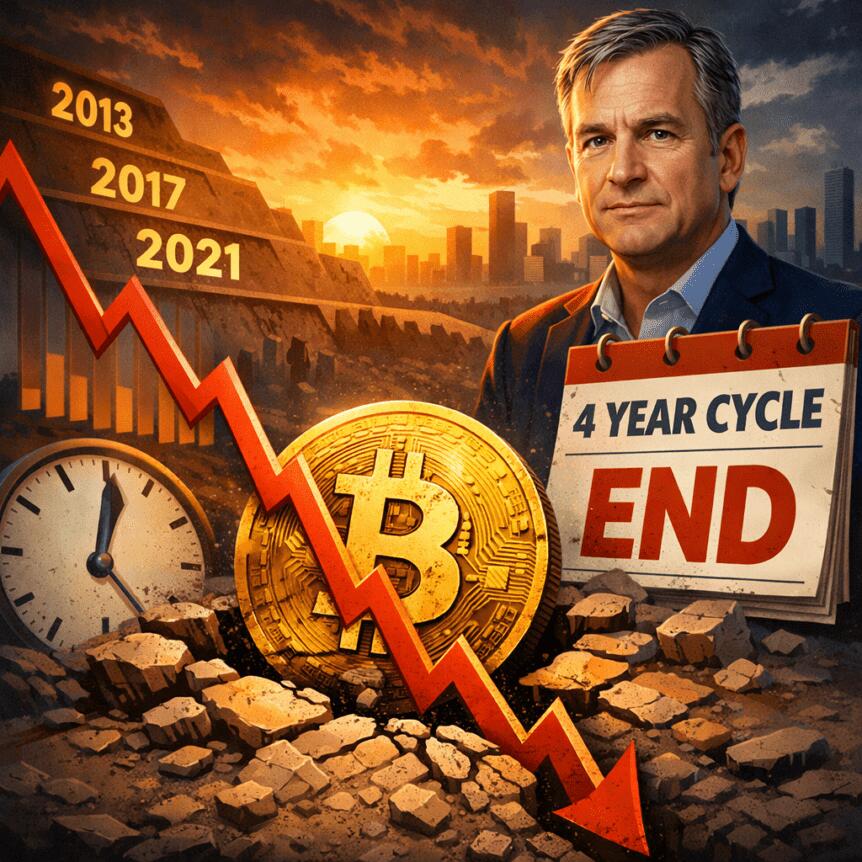
As investors weigh where the flagship cryptocurrency stands in 2026, VanEck’s chief executive says the market is likely near a bottom of its long-running cyclical pattern. The four-year cycle has framed price moves for years, with the reward halving compressing supply and influencing sentiment. While on-chain metrics and fundamentals have shown pockets of improvement, many observers remain cautious about the pace and durability of any rebound. In a recent interview, Jan van Eck argued that the asset may have found a base as it transitions through the cycle, a claim that dovetails with a wider debate about whether the old playbook still holds in a more mature market.
Key takeaways
- The CEO of VanEck sees Bitcoin’s price near a bottom as the four-year cycle winds down, arguing that the cycle has historically driven much of the recent price action.
- VanEck links the near-term bottom to the halving-driven supply dynamic, suggesting that 2026 represents the fourth year in a typical four-year pattern where gains fade and a bottom forms.
- BTC was around $68,400 at the time of writing, up roughly 2.6% in the prior 24 hours and about 7.6% over the past week, according to CoinGecko.
- Analysts remain split on the relevance of the four-year cycle, with macro catalysts such as ETF demand, USD movements, and regulatory progress cited as potential deviations from the historical script.
- Geopolitical tensions in the Middle East have coincided with a recent crypto rally, with some observers noting that crypto rails could facilitate cross-border flows when traditional banking channels face friction.
- VanEck suggested that the recovery may be tied to a broader shift toward crypto-centric mechanisms for moving value in uncertain political environments, pointing to regions like the UAE as more favorable for crypto activity.
Tickers mentioned: $BTC
Sentiment: Bullish
Price impact: Positive. The asset’s price has moved higher in the wake of remarks suggesting a bottoming process amid cycle dynamics.
Trading idea (Not Financial Advice): Hold. The argument centers on a potential transition from a cycle-driven bear to a gradual uptick, underscored by macro and regulatory developments that could sustain a cautious uptick.
Market context: The discussion sits at a time when crypto markets are weighing the durability of a four-year pattern against rising institutional adoption, ETF activity, and regulatory clarity, all of which can alter traditional cycle expectations.
Why it matters
The debate over whether the four-year Bitcoin cycle remains a reliable predictor has shaped investor expectations for years. Proponents of the cycle point to halving events—the mechanism by which miners’ block rewards are cut by half every four years—as a fundamental driver of price dynamics, creating multi-year bull phases followed by sharper downswings. Critics argue that as institutions enter the market and as macro conditions evolve, the cycle’s predictive power may wane. The VanEck view adds a new layer to the discussion by tethering the near-term bottom to this long-standing pattern while acknowledging a broader regime change in market maturity.
Beyond supply-side mechanics, macro factors loom large. ETFs and other institutional demand can alter price trajectories by providing channels for large-scale inflows, while a weakening U.S. dollar or a more favorable regulatory backdrop can bolster risk appetite. In the interview, VanEck framed the cycle as a lens through which to view price action but did not discount the possibility that external forces could support a more resilient recovery than in prior bear-market episodes.
The topic of the four-year cycle has persisted through recent months as analysts weigh macro risks against momentum-driven moves. While some observers argue that external drivers—such as ETF activation, macro liquidity, and policy signals—can override the cycle, others maintain that the underlying halving mechanism remains a meaningful structural factor in the market’s long-run equilibrium. The conversation is far from settled, but the proximity to a potential bottom is a focal point for traders watching for confirmation signals that the next leg higher is underway.
The interview also touched on the broader usefulness of crypto rails during periods of geopolitical strain. VanEck suggested that in scenarios where traditional financial channels face friction, digital assets and crypto payment rails could serve as an alternative for moving value, particularly in regions perceived as crypto-friendly. He pointed to the Middle East—specifically the UAE and Dubai—as an environment where crypto activity might facilitate cross-border settlement and capitalize on more permissive regulatory attitudes compared with some other corridors. The framing underscores a broader theme: as the crypto market matures, it increasingly intersects with real-world financial flows and geopolitical risk, shaping both price and adoption trajectories.
The price development around the remark mirrors a cautious but constructive tone in markets. The latest run has been modest by historical standards, but it has punctured bear-market rhetoric and raised the possibility that 2026 could mark the start of a renewed cycle, even if the path remains uncertain. The discussion also reflects a broader industry interest in how much of the narrative is driven by traditional macro factors versus on-chain fundamentals—an ongoing debate that will likely persist as more capital enters the space and as regulatory landscapes evolve.
The original article and linked materials also explore contrasting viewpoints on the cycle’s sustainability. Critics highlight macro demand from ETFs, a weaker USD, and favorable regulatory developments as signs that the market’s drivers are expanding beyond the classic halving-focused paradigm. Supporters, meanwhile, continue to emphasize the structural tightness of supply and the influence of miner economics on price behavior. In this tension lies the market’s current temperament: uncertain but attentive to any data point that could signal a durable bottom or the onset of a new cycle.
What to watch next
- Follow BTC price action around key milestones in 2026, including potential reaction to the next halving cycle’s window as the market digests supply dynamics.
- Monitor ETF-related inflows and regulatory developments in major markets that could alter institutional participation and liquidity.
- Track macro indicators such as USD strength, interest-rate expectations, and risk sentiment, which historically influence the pace of cross-asset capital allocation.
- Observe on-chain metrics for signs of accumulation or distribution, which could corroborate or challenge near-term bottoming narratives.
Sources & verification
- CNBC interview with VanEck on March 2, 2026 discussing Bitcoin’s bottoming potential and the four-year cycle.
- BTC price data and performance metrics from CoinGecko (as cited in the article).
- Cointelegraph reporting on bitcoin price movements and cycle debates.
- Iran-related crypto outflows and related commentary, as covered by Cointelegraph.
- In-depth magazine piece examining market narratives around liquidity, manipulation, and market structure.
Bottoming thesis as the cycle winds down
In a conversation that bridged investment strategy and market timing, Jan van Eck framed Bitcoin (CRYPTO: BTC) as entering a phase where the four-year cycle’s cooling effect on price could harmonize with an improving macro backdrop. The interview, conducted with CNBC, emphasized that the once-rapid gains associated with earlier cycles have given way to a more measured pace of appreciation, aligned with the notion that supply constraints and miner economics continue to shape price floors. The veteran investor’s view centers on a bottoming process that could precede a gradual reacceleration, albeit with the caveat that external forces may still alter the trajectory.
“There’s been an investing cycle, Bitcoin (CRYPTO: BTC) goes up three years in a row, goes down pretty massively in that fourth year. 2026 is that fourth year. So that’s why we are in a Bitcoin bear market. So I think we can overcomplicate it. Now I think we are making a bottom.”
VanEck’s perspective sits amid a broader debate over the cycle’s durability. Some analysts argue that external catalysts—macro demand from ETFs, a softer dollar, and regulatory breakthroughs—can override the historical rhythm. Others insist that the structural impulse provided by the halving remains a core fixture of price dynamics, even as the market expands to include more institutional players and sophisticated investors. The interview and surrounding discourse reflect a crypto ecosystem grappling with how much of its future is tethered to the cycle versus evolving fundamentals.
As markets digest the possibility of a bottom, attention also turns to capital flows in other regions where crypto rails could provide practical advantages in uncertain times. The discussion about using digital assets to move value away from traditional banking systems, especially in geopolitically sensitive contexts, underscores the potential for crypto to function as an alternative channel for settlement and liquidity. While such narratives can carry speculative risk, they also highlight the growing integration of digital assets into broader financial infrastructure and risk-management considerations.
What to watch next
- Public disclosures and filings related to ETF activity and exposure limits that could intensify or dampen institutional flows.
- Regulatory developments that signal a more mature market environment or prompt caution among new entrants.
- On-chain indicators (e.g., balance sheets of major exchanges, miner revenue trends) that could confirm or contradict a bottoming scenario.



BMO will let clients convert dollars into tokenized cash and deposits on CME and Google Cloud’s Universal Ledger, enabling 24/7 margin, collateral and B2B payments.
Summary
- Bank of Montreal announced on March 24 that it will introduce 24/7 tokenized cash capabilities built on CME Group’s network and Google Cloud Universal Ledger, making it the first bank to deploy CME’s tokenized cash solution on the platform.
- The initiative allows institutional clients to convert U.S. dollars into a tokenized instrument for use in derivatives, margin products, and round-the-clock settlement — with the full service targeted for H2 2026, pending regulatory approval.
- The announcement follows CME Group CEO Terry Duffy’s February disclosure that the exchange is evaluating its own digital token for collateral and settlement, reflecting a broader push to modernize the infrastructure underpinning the world’s largest derivatives marketplace.
Bank of Montreal (BMO), one of the largest banks in North America by assets, announced on March 24 that it will launch tokenized cash capabilities in collaboration with CME Group and Google Cloud, becoming the first bank to offer CME’s institutional tokenized cash solution on the Google Cloud Universal Ledger — a private, permissioned distributed ledger designed specifically for traditional financial institutions.
The platform allows BMO’s institutional clients to convert U.S. dollars into a tokenized instrument for use with margined products at CME Group, supporting high-value real-time settlement needs including margin calls, collateral movement, and derivatives trading — all on a 24/7 basis, free from the cutoff constraints of conventional banking infrastructure.
Two Products, Two Client Sets
BMO’s announcement introduces two distinct capabilities. The first — tokenized cash — is designed for mutual clients of CME Group and BMO operating in capital markets and commercial banking. The bank plans to offer this institutional settlement instrument to regulated financial services firms in the second half of 2026, subject to regulatory approval.
The second capability — tokenized deposits — is broader in scope. It will allow BMO to offer traditional commercial bank funds in digital form to a wider set of BMO clients, enabling general-purpose B2B payments, treasury movements, and programmable cash applications. Together, the two products represent a full-spectrum approach to digitizing dollar-denominated liquidity across institutional and commercial use cases.
The Infrastructure Behind It
The platform runs on Google Cloud Universal Ledger (GCUL), a programmable distributed ledger that CME Group and Google Cloud began piloting in March 2025 for secure wholesale payments and capital markets settlement. Following initial integration and testing, CME and Google Cloud had targeted 2026 for new service launches — BMO’s participation represents the first live institutional deployment of that infrastructure.
The timing is significant. CME CEO Terry Duffy had already signaled in February 2026, during the company’s Q4 earnings call, that CME was evaluating tokenized collateral frameworks and even exploring its own digital token for margin settlement. “So if you were to give me a token from a systemically important financial institution, I would probably be more comfortable than maybe a third or fourth-tier bank trying to issue a token for margin,” Duffy said, framing BMO’s participation as precisely the kind of bank-anchored model CME has been seeking.
Regulatory Momentum
The BMO announcement arrives as regulators have begun constructing frameworks to accommodate tokenized assets in derivatives markets. In December 2025, the CFTC launched a supervised pilot for tokenized derivatives collateral, allowing registered futures commission merchants to accept Bitcoin, Ethereum, USDC, and tokenized real-world assets as margin collateral under direct federal oversight. Industry leaders including Coinbase, Circle, and Ripple welcomed the move as a step toward faster, safer settlement.
BMO’s tokenized cash platform slots directly into that emerging regulatory architecture — a bank-grade, permissioned instrument designed to operate within the same capital markets rules that govern traditional futures and derivatives, while unlocking the round-the-clock settlement capabilities that crypto-native markets have long taken for granted.


NEW YORK — BNY Mellon CEO Robin Vince said the next phase of crypto adoption will depend on large financial institutions, arguing that banks are positioned to connect digital assets with the broader financial system.
“We can act as a very effective bridge between the traditional finance and the digital finance ecosystems,” Vince said during a conversation at the Digital Asset Summit in New York on Tuesday.
His comments come as long-established banks expand their role in digital assets after years of caution. BNY Mellon was among the first major custodians to offer digital asset custody, and Vince framed that move as part of a longer pattern of adopting new technologies. “We are a firm that’s grown up with a whole bunch of different technologies,” he said.
Rather than viewing decentralized finance as a replacement for banks, Vince pushed back on the idea that crypto will bypass incumbents. “A technology that’s in search of adopters can sometimes struggle, but we are an adoption vehicle,” he said, pointing to the bank’s existing client base and infrastructure.
That positioning allows the firm to support both sides of the market. “They look to us and say… you can actually be a bridge to us, the digital asset providers, through all the traditional things that you do,” Vince said.
He highlighted tokenization as a key area of focus, including work to create digital versions of traditional products. “We’ve created digital tokens, new share classes for money market funds,” he said, describing how existing funds can be issued in tokenized form to encourage adoption.
In the near term, he expects adoption to focus on areas where current systems fall short. “Loans are clunky. Real estate’s clunky,” he said, suggesting those markets may benefit first from tokenization.
‘Need clarity’
Still, Vince stressed that trust and regulation will shape how quickly the sector grows. “We need clarity and rules of the road,” he said. “That hesitancy slows adoption.”
His comments come as lawmakers are working to establish a regulatory framework for institutional investors to safely invest in the digital assets sector.
In the U.S., while the stablecoin-focused GENIUS Act has passed, a revised version of the Digital Asset Market Clarity Act is still in flux after lawmakers shared updated language with industry participants in a closed-door session on Capitol Hill this week, as they try to clear a path toward a Senate Banking Committee hearing.
Early feedback from crypto insiders suggests the draft’s approach to stablecoin yield remains a sticking point, with language described as narrow and unclear. The latest compromise, shaped in part by pressure from banks, would allow rewards tied to user activity but not interest on stablecoin balances, reflecting ongoing tension between the crypto industry and traditional lenders over how such products should be treated.
Vince added that safety and oversight remain critical for institutional participation. “If it’s the Wild West… the 90% of the financial services community… don’t want to have anything to do with it,” Vince said.
Even so, Vince cautioned that change will take time. “This will be a 5, 10, 15 year journey,” he said, adding that progress will depend on advances in technology, regulation and market participation.
“It’s all of the above,” Vince said. “That shouldn’t stop us from getting excited about getting going.”

Lombard, a project building Bitcoin-based lending rails, is joining forces with Bitwise Asset Management to give institutions a way to earn yield and borrow against Bitcoin without moving assets out of custody. The announcement, unveiled at the Digital Asset Summit in New York, introduces what Lombard calls Bitcoin Smart Accounts—a framework designed to bridge custody with on-chain finance and unlock capital tied up in sizable Bitcoin holdings.
Under the partnership, Bitwise will assemble yield strategies that blend DeFi lending with tokenized real-world assets, while Morpho, a decentralized lending protocol, will provide the on-chain lending infrastructure for borrowing against Bitcoin. The system relies on Bitcoin-native tools—such as partially signed transactions and timelocks—to verify collateral, allowing positions to be represented on-chain without transferring or rehypothecating the underlying assets. In Lombard’s view, this architecture addresses three major risk vectors that have historically constrained institutional Bitcoin lending: custody, bridges, and counterparty exposures.
“The breakthrough is Bitcoin Smart Accounts—connecting two previously isolated worlds: institutional custody and onchain finance,” said Jacob Phillips, CEO and co-founder of Lombard, during the announcement. The approach is designed to let high-net-worth individuals, asset managers, and corporate treasuries keep BTC in their trusted custody arrangements while still accessing yield and liquidity opportunities.
Phillips added that the model avoids triggering taxable events and eliminates the need to move Bitcoin across custody boundaries or expose assets to third-party risk. By representing positions on-chain without transferring the underlying coins, the system aims to preserve the security and control that institutions demand while enabling on-chain efficiency and programmability.
The rollout is slated for the second quarter of 2026, with Lombard planning to expand the ecosystem by incorporating additional custodians and DeFi protocols to broaden access to institutional Bitcoin holdings. “We’re moving Bitcoin from a pure store of value to productive institutional capital. That’s the shift,” Phillips said, framing the change as a tectonic rethinking of how Bitcoin is managed within large balance sheets.
From a market perspective, the development arrives amid a broader conversation about Bitcoin’s role beyond passive hodling. Lombard has estimated that roughly $500 billion worth of Bitcoin sits in institutional custody, much of which remains outside the reach of on-chain markets. If the model scales as envisioned, it could effectively reintroduce a large tranche of this capital into the on-chain financial ecosystem without forcing a custody break for the asset owners.
In terms of context, the Bitcoin DeFi space remains a relatively small sliver of the broader crypto market. Data tracked by DefiLlama places Bitcoin’s total value locked (TVL) in DeFi at about $2.93 billion, a tiny fraction of Bitcoin’s roughly $1.4 trillion market capitalization. Yet the momentum behind on-chain yield strategies has begun to pick up, with several high-profile initiatives in recent months illustrating a broader push to monetize BTC holdings through decentralized finance while preserving custody.
Notably, the push toward on-chain BTC yield and lending has been aided by a wave of vault-style products and automated investment strategies. In January, Bitwise announced a tie-up with Morpho to launch non-custodial vaults designed to generate yield through overcollateralized lending. The trend gathered further steam in February when Telegram added yield-generating vaults to its in-app wallet, enabling users to earn returns on Bitcoin, Ether, and USDT within the app. In March, Babylon Protocol integrated with Ledger to enable users to deploy BTC in DeFi applications while maintaining self-custody through hardware-based transaction signing.
Within this evolving landscape, Babylon Protocol appears to lead in Bitcoin-based DeFi TVL, with around $2.8 billion, according to Cointelegraph’s coverage, while Lombard sits in second place with approximately $744 million. The field is still nascent relative to the scale of Bitcoin’s custody footprint, but the trajectory suggests growing appetite from institutions and large holders to deploy BTC in yield-generating strategies without relinquishing custody.
For readers tracking the broader regulatory and product-quality implications, the Lombard announcement sits alongside a spectrum of custody-resilient lending experiments in the sector. Other institutions have explored multisignature custody and on-chain lending models as a way to reduce risk while expanding access to on-chain liquidity. Notably, Sygnum Bank has publicly pursued a Bitcoin lending approach built on multisignature custody, signaling that traditional financial players are increasingly comfortable with on-chain, trustless collateral frameworks. Sygnum’s initiative illustrates the broader convergence between institutional custody concepts and DeFi-style lending rails.
Key takeaways
- Bitcoin Smart Accounts unify custody and on-chain finance. The approach enables yield generation and borrowing against BTC without moving coins out of custody, using Bitcoin-native tools to verify collateral on-chain.
- Bitwise and Morpho anchor the initiative. Bitwise will develop yield strategies that blend DeFi lending with tokenized real-world assets, while Morpho provides the lending infrastructure.
- Rollout targets a 2026 timeline with expansion plans. The second quarter of 2026 marks the initial rollout, with plans to add more custodians and protocols to broaden access for institutions.
- Institutional BTC could migrate from store-of-value to productive capital. If scalable, the model could change how treasuries and asset managers view BTC allocations, potentially increasing liquidity and yield without custody changes.
- On-chain BTC DeFi remains nascent but shows expanding activity. DefiLlama tracks roughly $2.93 billion in BTC DeFi TVL, with leaders including Babylon Protocol (~$2.8B) and Lombard (~$744M), underscoring growth as vaults and lending options proliferate.
Bitcoin Smart Accounts: bridging custody and on-chain finance
The core concept relies on Bitcoin-native verification schemes rather than bridging or wrapping BTC across networks. Partially signed transactions and timelocks help ensure that collateral can be secured and represented on-chain without transferring the underlying coins. In Lombard’s framing, this reduces or eliminates custody risk, bridge risk, and counterparty exposure that have traditionally plagued on-chain Bitcoin lending.
The rhetoric around this approach centers on turning a largely passive asset into a dynamic treasury tool. If institutions can earn yield and access liquidity without disrupting their custody posture, Bitcoin could become a more versatile component of corporate treasuries, family offices, and asset managers’ portfolios.
DeFi vaults and Bitcoin yield expand across the ecosystem
The broader DeFi landscape on Bitcoin has evolved through vault-like products that automate capital deployment across on-chain strategies. In addition to Bitwise’s vault initiative with Morpho, other high-profile deployments have demonstrated how non-custodial strategies can produce yields while preserving self-custody or controlled custody arrangements. The growth of vaults and the emergence of yield-generating mechanisms on Bitcoin signal a shift in how the asset is perceived by sophisticated investors.
Looking ahead, the collaboration between Lombard, Bitwise, and Morpho could accelerate this trend by providing institutional-grade rails that combine custodial security with on-chain efficiency. The goal is not simply higher yields but a more integrated framework where Bitcoin can be deployed into DeFi protocols and tokenized assets without sacrificing trust, control, or regulatory comfort.
For readers watching the regulatory horizon, the success of such initiatives will depend on clear compliance pathways, tax treatment for on-chain positions, and the ability of custodians to adapt their risk and reporting frameworks to these novel mechanisms. Nevertheless, the momentum toward Bitcoin as a productive asset within institutional portfolios appears to be gathering pace, with the potential to reshape treasury management and liquidity strategies in the coming years.
As the industry tests Bitcoin Smart Accounts and similar constructs, observers will be watching not only for the technical viability but also for how custodians, regulators, and fund managers respond to the prospect of billions of dollars in on-chain Bitcoin activity that remains linked to traditional custody arrangements. The second-quarter 2026 rollout will serve as a critical inflection point to gauge adoption, performance, and the practical realities of integrating on-chain finance into institutional Bitcoin holdings.
Readers should keep an eye on how custodians respond to the new framework, how yield trajectories compare with existing custody-based products, and what the regulatory environment will allow in terms of on-chain representations of custody-backed positions. If the model proves scalable, it could redefine Bitcoin’s role in institutional finance and set a precedent for other asset classes seeking similar on-chain, custody-resilient yield opportunities.
Crypto World
Why DeepSnitch AI Is Getting Early Attention in AI Circles for a Potential 100x While Ionix Lags and Ozak Faces Competition in Its Niche

The AI crypto trend 2026 has seen the rise of several AI presales. However, DeepSnitch AI is the project investors won’t stop talking about because it’s already delivering real utility, while competitors remain theoretical.
Ionix is still building its AI blockchain infrastructure, while Ozak AI faces accuracy challenges with its predictive tools. On the other hand, DeepSnitch AI ($DSNT) provides a live intelligence platform that traders can use right now.
Over $2.4 million has already been raised at stage 7 presale at $0.04577 per token. DeepSnitch AI is creating early buzz within AI circles, as many recognize the project’s early potential and position themselves for 100x upside.
Deloitte and Stablecorp partner for Canadian stablecoin infrastructure
Deloitte Canada and Toronto-based fintech Stablecorp are collaborating to build institutional infrastructure for QCAD. This is a stablecoin pegged 1:1 to the Canadian dollar.
This partnership aims to integrate digital assets into payment and settlement workflows for banks and financial firms. The initiative focuses on enabling 24/7 transactions, transparency through blockchain recordkeeping, and improving settlement efficiency compared to traditional systems.
This move aligns with the Canadian government’s progress on Bill C-15, a federal framework designed to regulate fiat-backed digital assets. While no specific bank partners or timelines were disclosed, the project signals a shift in national policy.
DeepSnitch AI is turning heads in AI circles amid 100x predictions
Insiders are flocking to DeepSnitch AI within AI circles. It comes down to one simple difference: most AI presale projects are still promising future tools. Meanwhile, DeepSnitch AI already has a working intelligence platform that users can access today. It’s not building on hype. Instead, it’s deploying tools that traders can actually use in real time.
The DeepSnitch AI crypto narrative is impressive. The platform operates as a verification and intelligence layer for the crypto market. Using five specialized AI agents, it tracks critical market movements and reports them in real time. This kind of automation is becoming increasingly important as the market grows more complex.
Its dashboard is designed to be simple enough that even someone new to crypto can understand what’s happening without having to dig through complicated data.
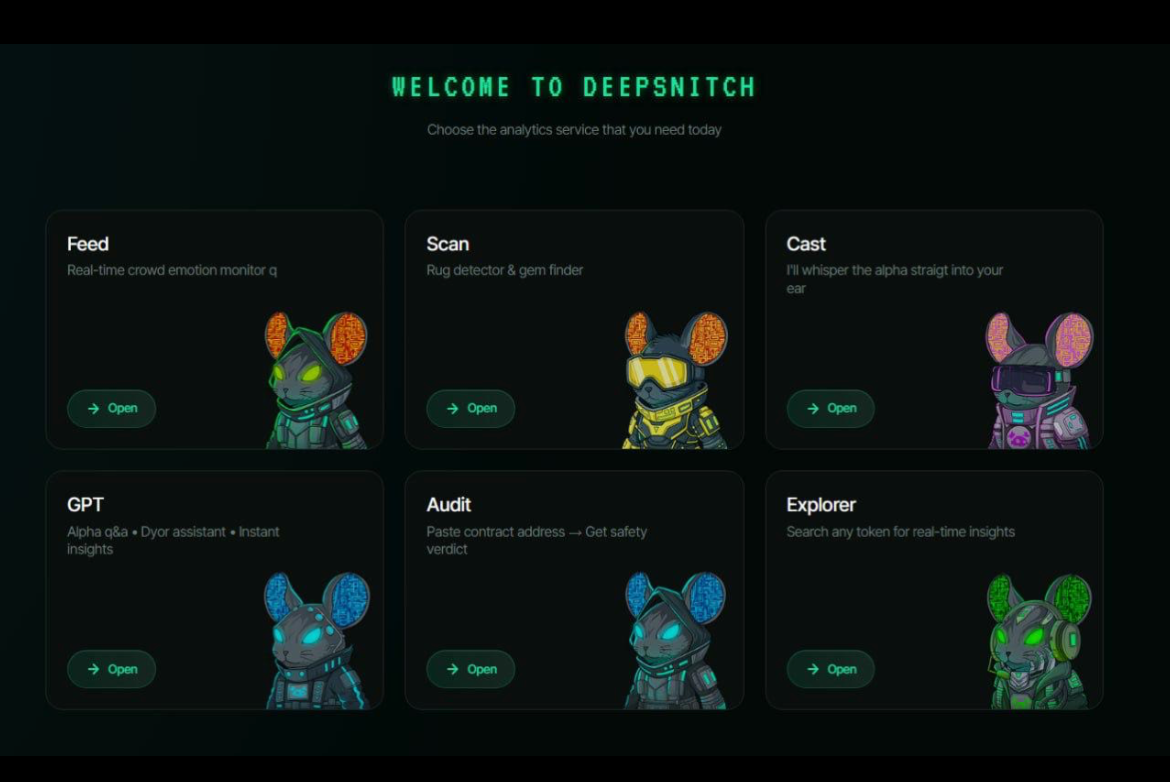
With the presale now in stage 7 at $0.04577, the project is approaching its March 31 presale deadline. After a seven-day claim period, $DSNT is scheduled to launch on Uniswap, which is another reason DeepSnitch AI is the talk of AI and crypto circles.
Many are anticipating a 100x rally considering its unique positioning in the crypto market. If $DSNT delivers, early entry will be what separates the millionaires from those who watched from the sidelines.
Ionix builds AI blockchain infrastructure, but adoption may take time
Ionix is one of the rising AI crypto blockchain projects. It’s focused on building an AI-powered Layer-1 blockchain designed to improve scalability and smart contract performance.
The idea sounds novel and could be truly valuable. However, infrastructure projects often face long development cycles.
That process can take years, not months. This means that investors are banking on a future that’s not yet certain. However, DeepSnitch AI is already operational, providing users with real-time intelligence. This is why DeepSnitch AI is the AI play everyone’s watching.
Ozak AI focuses on predictions, but prediction tools face accuracy pressure
Ozak AI is building a predictive analytics ecosystem powered by machine learning. Predictive AI is a popular AI crypto narrative. However, prediction tools are only as valuable as their accuracy.
Traders also often use multiple data sources rather than relying on a single platform. This makes the space highly competitive and performance-dependent over time.

However, DeepSnitch AI takes a different approach by focusing on verification. This gives it a more practical, daily-use case for traders who need reliable data before making decisions.
Conclusion
DeepSnitch AI’s early growth and live platform explain why DeepSnitch AI is the hidden gem AI insiders are talking about. While Ionix and Ozak AI are still building, DeepSnitch AI is already delivering actionable intelligence to traders today.
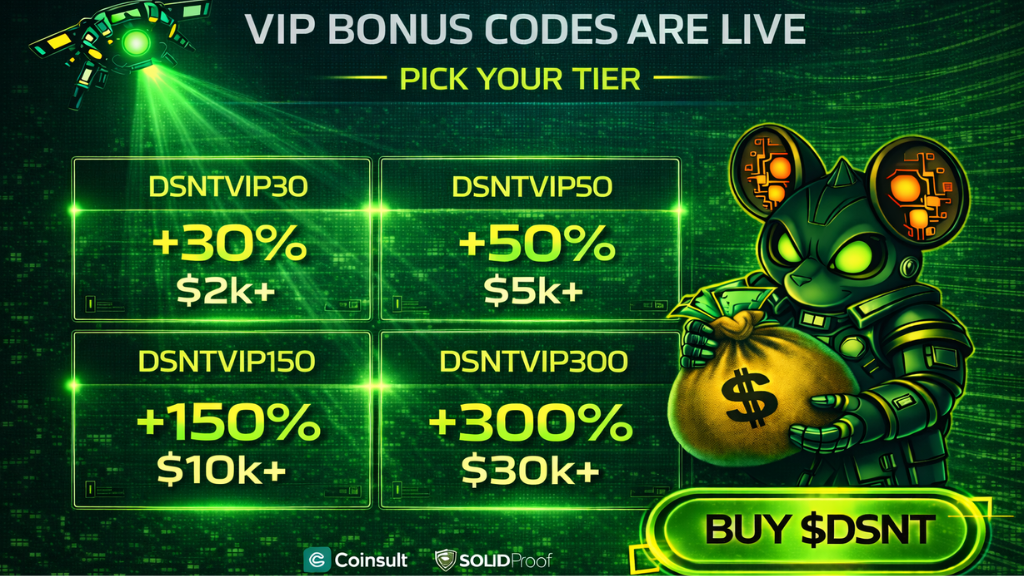
With the presale ending March 31 ahead of the Uniswap launch, strategic buyers can leverage bonus tiers to increase their positions. A $5,000 allocation currently secures 109,241 $DSNT tokens. It rises to 163,861 tokens with the 50% bonus.
With adoption growing, DeepSnitch AI offers one of the clearest paths to potentially 100x returns for early participants.
Visit the official website today and join the community on X and Telegram to stay on track.
Why is DeepSnitch AI getting noticed in AI circles?
DeepSnitch AI is winning over crypto AI circles as a live intelligence platform, even though it’s still in presale. However, other AI crypto presales are still in development, making it a practical investment for early participants.
How does DeepSnitch AI differ from other AI blockchain projects?
Unlike many AI blockchain projects, DeepSnitch AI emphasizes verification, risk detection, and wallet intelligence. Its live platform gives traders reliable data daily, rather than relying on theoretical tools or slow adoption cycles.
What AI crypto stands out amidst the current AI crypto trend in 2026?
Amidst the AI crypto trend 2026, DeepSnitch AI stands out as a project that is already live and delivering results. While other projects are promising tools for the future, $DSNT offers working intelligence agents, giving it a clear edge for traders and investors.
Disclaimer: This is a Press Release provided by a third party who is responsible for the content. Please conduct your own research before taking any action based on the content.



Private credit giant Apollo Global Management capped withdrawals on Monday. As a group, retail investors were able to take out just 45% of the money they’d originally asked to withdraw.
Escalating a well-publicized crisis in private equity and credit, Apollo is the sixth major asset manager this year to tell investors they need to slow down their withdrawal requests.
Apollo Debt Solutions, a non-publicly traded credit company with a net asset value of about $15 billion, received redemption requests exceeding 11% of its outstanding shares in the first quarter.
The fund enforced a 5% quarterly cap and returned roughly $730 million of the more than $1.5 billion in requests it received. Redeeming investors received less than half of the full disbursements they requested.
Private credit peers Blackstone and Blue Owl have also been restructuring their withdrawal policies under pressure. Apollo held its 5% withdrawal limit.
Apollo joins Blackstone, BlackRock, Blue Owl Capital, Morgan Stanley, and Cliffwater in gating investor withdrawals this quarter.
The industry sold these funds to individuals as a path to “democratization” of institutional-grade yields.
In fact, private equity (PE) and private credit companies merely democratized purchases by regular people who often didn’t understand that PE managers can choose the valuations of their assets with far less oversight and regulatory obligations than public fund managers.
Because the valuations of these assets occur privately, there’s no real-time price-seeking mechanism to determine the proper valuation of these assets.
As such, PE managers typically mark-up their assets consistently, quarter after quarter, until they suddenly plunge in value during a crisis or liquidity crunch, such as the current Iran war or AI-induced layoffs.
Because it’s impossible to sell out of these credit and equity instruments on secondary exchanges, investors may only request redemptions quarterly.
However, funds typically cap total withdrawals at 5% of their net asset value per quarter. If more people want out than the cap allows, everyone gets a haircut on their redemption request.
The problem, therefore, is structural. The underlying loans are illiquid and artificially marked-up. The quarterly redemption window created an illusion of liquidity for a small number of withdrawal requests that doesn’t match the immense size of the assets.
This is seen particularly during any type of bank run-type scenario where withdrawal requests arrive en masse.
About 80% of traditional private credit investors are institutions, according to JP Morgan, yet many retail investors have joined them in recent years.
Main Street investors, who piled in chasing yields of 8% to 10%, have far less patience.
PE giant Blue Owl, for example, drew roughly 40% of its over $300 billion in assets from individuals, according to Fortune.
Blackstone’s Private Credit Fund recorded a record 7.9% redemption request totaling nearly $4 billion. Blackstone actually raised its quarterly cap to 7% and injected $400 million of its own capital to help calm some of that panic.
Equally alarming, BlackRock’s $26 billion HPS Corporate Lending Fund received $1.2 billion in withdrawal requests, or 9.3% of assets, and paid out $620 million.
Morgan Stanley’s North Haven Private Income Fund received requests for over 10% of shares and capped payouts at 5%.
Cliffwater’s $33 billion flagship fund saw the worst of it. Investors demanded 14% of shares back. The firm slashed that in half to a 7% limit.
Blue Owl nearly went off the deep end. In February, the firm permanently halted quarterly redemptions from its retail-focused Blue Owl Capital Corp II.
Read more: Tether: Ten years, 100,000,000,000 USDT, and still no audit
The wave of redemptions has many causes, not least of which is a sudden realization that PE managers have broad discretion to mark-to-market values of assets with little to no secondary market transactions forcing them to properly or conservatively value those holdings.
Moreover, there are fears that AI will trigger sudden job losses this year, creating a bank run-type scenario by fixed income investors.
The escalating war in Iran is also not helping.
Private credit funds loaded up on loans to mid-sized software firms during the boom years, as well, which are now at risk due to AI. Justifiably, investors now question how good those loans are.
The private credit default rate reached 5.8% through January 2026, according to Fitch. That’s the highest since the index launched.
UBS has warned that severe AI disruption could push defaults to 13%.
Wall Street spent years pitching private credit as a better way to optimize yield. Now investors are feeling the pinch of illiquidity and mark-to-market valuations.
You can always check in, but you can’t always check out.
Got a tip? Send us an email securely via Protos Leaks. For more informed news, follow us on X, Bluesky, and Google News, or subscribe to our YouTube channel.
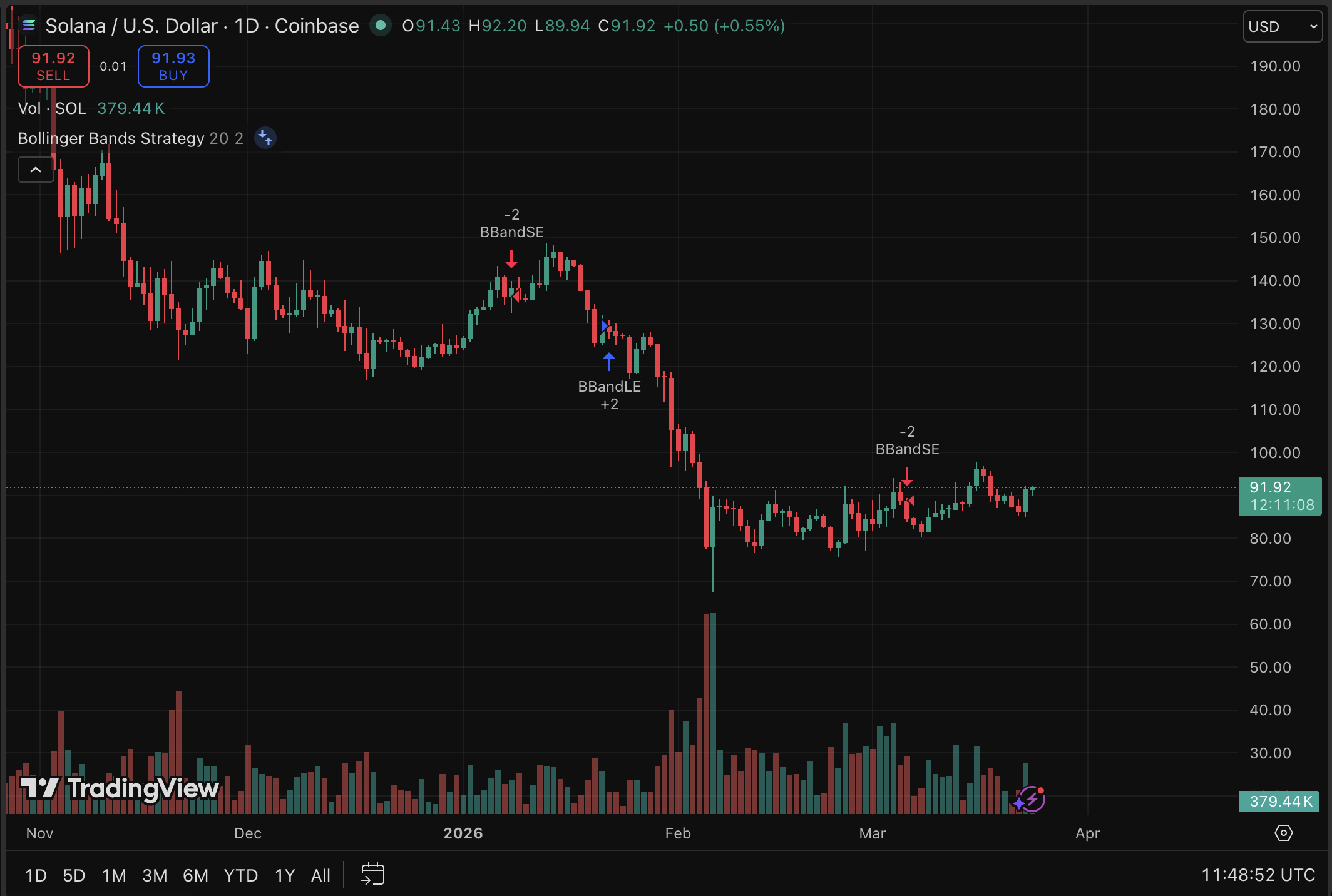
Solana price is trading at a pivotal $90.92, caught in a technical vice that creates a sharp dichotomy between immediate bearish signals and optimism prediction for a 2026 recovery.
Data indicate the asset is forming a “rising wedge” while trading below its critical 200-week moving average. This setup places SOL in a precarious spot following its breakdown from the $120–$145 consolidation zone earlier this cycle.
The market remains split. While long-term charts map a steady rebuild through the rest of the year, short-term indicators warn of a potential cascading drop if support levels fail, essentially creating a binary outcome for those navigating the current volatility.
Discover: The best pre-launch token sales
Solana Price Prediction: Can SOL Hold Support With $59 Drawdown Risk?
Solana’s price action shows a significant contraction, hovering in chopped consolidation near its 20-day EMA ($88.93) with a neutral RSI of ~51.63, pointing to market indecision. The chart structure below the $96 resistance level looks increasingly fragile; technical analysts point to a “horrendous” rising wedge on the 3-day chart.
If the lower trendline currently near the $80.27 “line in the sand” fails, the setup confirms a continuation, potentially opening the door to a 44% measured move toward $59.

Trading volumes reflect this hesitation, with major DEX activity dropping from $118bn to just $44.5bn weekly in early 2026. This contraction in on-chain volume suggests that institutional buy-side pressure is drying up at these levels.
A confirmed breakdown of the head-and-shoulders neckline near $107 has already occurred, shifting the probability toward the downside. Unless SOL reclaims the $104 pivot rapidly, the path of least resistance remains lower, forcing traders to evaluate hedging strategies against a deeper correction.
Discover: The best crypto to diversify your portfolio with
Maxi Doge Targets Early Mover Upside as Solana Tests Key Levels
While major caps like Solana grind through choppy consolidation and face potential 30-40% drawdowns, capital often rotates into high-volatility narratives seeking maximum leverage exposure.
The current market stagnation above $80 pushes traders toward assets that embrace risk rather than avoid it, specifically projects with lower market caps and higher momentum potential compared to established L1s.
Maxi Doge ($MAXI) enters this vacuum, targeting the “degen” trading culture directly. Positioned as a 240-lb canine juggernaut built for “1000x leverage trading mentality,” the project has raised $4.7 million in its current presale round.
At $0.000281 right now, Maxi Doge combines viral gym-bro humor with specific utility: holder-only trading competitions and a Maxi Fund treasury designed for liquidity management.
Unlike standard meme tokens that rely solely on hype, $MAXI integrates a “Leverage King” culture aimed at active traders who are bored by the sideways chop of altcoins like Solana. With features like 36% APY staking and leaderboard rewards, it attempts to capture the aggressive capital flow looking for early-stage multipliers.
Disclaimer: Cryptocurrencies are highly volatile and risky investments. Always do your own research (DYOR) before investing; this is not financial advice.
The post Solana Price Prediction: Can Solana Break The Bearish Structure? appeared first on Cryptonews.

TLDR
- Ledger completed a $50 million secondary share sale in the fourth quarter of last year.
- An existing investor sold shares, and the company did not raise new capital from the transaction.
- CEO Pascal Gauthier led the deal and said Ledger is preparing for all eventualities.
- Gauthier stated that the company could remain private or pursue a public offering based on market conditions.
- Earlier reports indicated that Ledger explored a potential U.S. IPO at a valuation above $4 billion.
Ledger disclosed a $50 million secondary share sale completed in the fourth quarter of last year. The company confirmed that an existing investor sold shares to provide liquidity. However, CEO Pascal Gauthier said Ledger will keep its public listing options open.
The company structured the deal as a secondary transaction rather than a primary capital raise. As a result, Ledger did not issue new shares or raise fresh funds. Instead, an early investor sold their stake, according to a Bloomberg report. A company spokesperson confirmed the details to The Block.
Gauthier led the transaction and coordinated with the selling shareholder. He told Bloomberg, “My job is to prepare the company for all eventualities.” He added that Ledger could remain private or pursue a public offering depending on market conditions.
Ledger completes $50 million secondary sale in Q4
Ledger executed the $50 million secondary sale during the fourth quarter. The transaction allowed one early investor to exit without affecting the company’s capital structure. The company confirmed that it did not receive proceeds from the share sale.
Bloomberg reported that Gauthier led the deal with the existing shareholder. A Ledger spokesperson later confirmed the transaction details publicly. However, the company did not disclose the identity of the selling investor.
Earlier reports stated that Ledger explored a potential U.S. IPO. Those reports suggested a valuation above $4 billion if the company proceeds. Still, Ledger has not finalized any listing plans.
Ledger last raised primary capital in 2023. That funding round valued the company at about $1.5 billion. The company has not announced a new primary funding round since then.
Ledger expands U.S. presence and product suite
Ledger has increased its focus on the United States in recent months. The company opened a new office in New York to support institutional outreach. It also appointed former Circle executive John Andrews as chief financial officer.
The company stated that the New York office will strengthen ties with banks and asset managers. It also aims to build relationships with other institutional clients. The CFO appointment supports this expansion strategy.
Over the past six months, Ledger has expanded beyond its hardware base. The company launched a next-generation Nano device for retail users. It also rebranded Ledger Live as the Ledger Wallet app.
The updated Ledger Wallet now includes in-app trading features. It also offers portfolio analytics and a redesigned “Earn” section. The company said the Earn section surfaces yield opportunities within the app.
Ledger continues to develop enterprise-focused security tools. These products target institutional clients seeking custody and infrastructure services. The company confirmed these initiatives as part of its broader expansion strategy.
Invesco, with over $2T in AUM, will become the first TradFi asset manager to use Superstate’s digital transfer agent infra.
Invesco, one of the world’s largest asset managers with $2.2 trillion in assets under management, will become the investment manager of Superstate’s flagship tokenized U.S. Treasuries fund USTB, the two firms announced Tuesday, March 24.
Under the arrangement, Invesco’s Global Liquidity team — which manages over $200 billion in money market and short-duration assets — will take over day-to-day portfolio management of USTB, while Superstate continues to run the fund’s on-chain infrastructure, including blockchain-based settlement and digital transfer agency services.
Invesco will be the first asset manager to use Superstate’s digital transfer agent rails, per the release. The transition is expected to close in Q2 2026, after which the fund will be renamed the Invesco Short Duration US Government Securities Fund while keeping the USTB ticker, smart contracts, and token address.
USTB, which launched in February 2024, has grown from a proof-of-concept into the sixth largest tokenized treasury product globally, per data from RWAxyz, with over $794 million in total value. The fund directly holds U.S. government securities, with assets tokenized across Ethereum, Solana and Plume, though the vast majority of value is on Ethereum.
The Invesco deal reflects a broader pattern of traditional finance partnership with blockchain native firms like Superstate, rather than building on-chain infrastructure itself. Robert Leshner, Superstate’s CEO and the founder of Compound, called the arrangement “the blueprint for how funds and ETFs will come onchain.”
Superstate expanded beyond tokenized treasuries into tokenized stocks with the launch of its Opening Bell platform last May. More recently, the firm announced direct on-chain equity issuance, enabling SEC-registered public companies to issue new shares directly on Ethereum and Solana.
For Invesco, the deal represents the payoff of a multi-year digital assets buildout the firm says dates back to 2019.
Also today, in similar partnership between a TradFi giant and a major tokenization player, the NYSE named Securitize as its first digital transfer agent to mint blockchain-native stocks and ETFs on its upcoming Digital Trading Platform.
This article was written with the assistance of AI workflows. All our stories are curated, edited and fact-checked by a human.
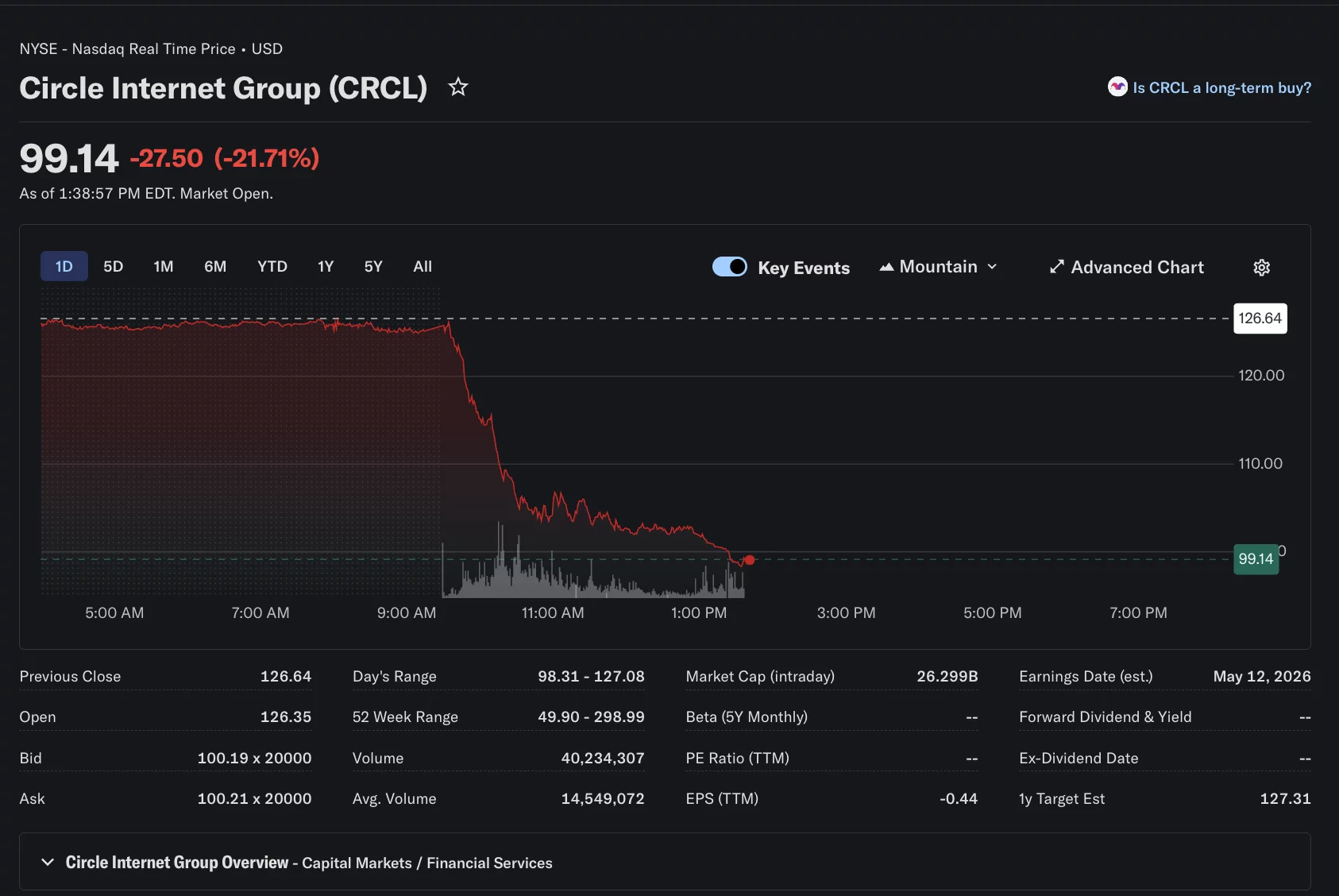
Circle (CRCL) sank about 22%, its worst drop since June 2025, after a tougher CLARITY Act draft threatened to ban stablecoin yield, clashing with booming USDC growth.
Summary
- Circle Internet Group (CRCL) stock is trading around $98.71, down about 22% on the day and roughly 18% below Monday’s close, its steepest slide since June 2025.
- The sell-off follows reports that the latest draft of the U.S. CLARITY Act would sharply limit or ban yield and rewards on stablecoins, directly hitting Circle’s USDC-centric business model.
- The move wipes billions from Circle’s market value even as USDC circulation and on-chain usage climb, highlighting the tension between regulatory risk and underlying product growth.
Circle Internet Group shares plunged on Tuesday after fresh reports that U.S. lawmakers are tightening a key stablecoin bill to restrict yield and rewards, triggering an aggressive sell-off in one of the market’s highest-beta crypto stocks.
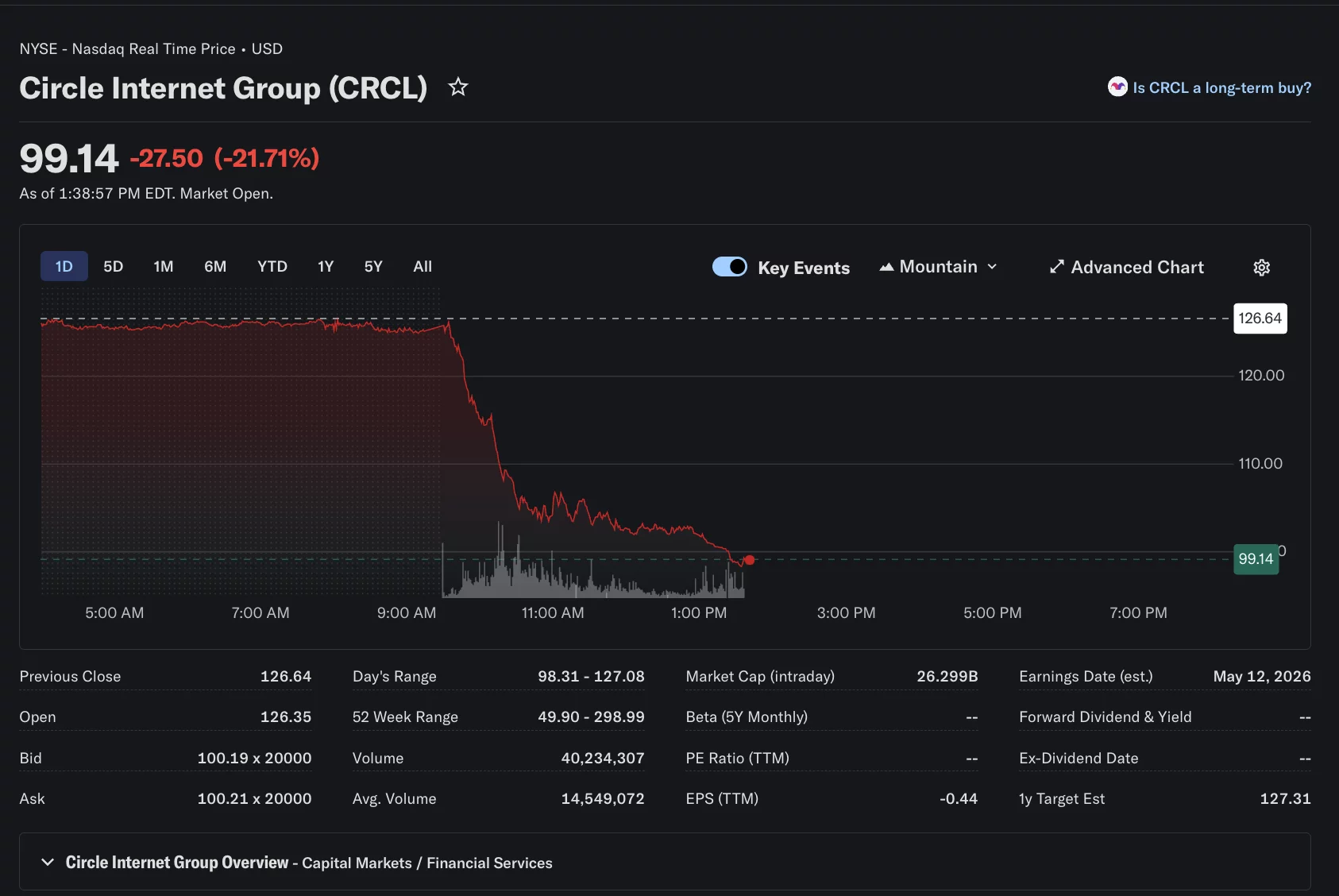
Real-time data shows Circle trading at about $98.71 on the NYSE under ticker CRCL, down $27.93 or 22.05% on the day, with intraday lows near $98.31 after opening at $126.35 and closing Monday at $126.64. Intellectia.ai and other market trackers said the drop reached roughly 18% by midday, marking Circle’s largest one-day percentage decline since June 2025.
Circle’s slump came alongside a broader crypto-equities sell-off, with Coinbase (COIN) down more than 7% to roughly $178.10 and Robinhood (HOOD) off 4.7%, after a draft of the CLARITY Act circulated in Washington. According to summary of the draft, the latest language would “ban yield on stablecoins across exchanges,” effectively prohibiting interest-style rewards on tokens like USDC, a core revenue lever for both Circle and Coinbase. The bill is being viewed as a direct threat to Circle’s stablecoin-payments and rewards infrastructure, calling the proposed limits on yield “critical” to its platform economics and a key driver of Tuesday’s 22% intraday fall.
The price action is striking because it collides with still-strong fundamentals for USDC. Yahoo Finance recently noted that Circle’s stock nearly tripled from its $31 IPO price on June 5, 2025 and at one point almost touched $299, buoyed by optimism around U.S. stablecoin legislation. Circle’s own “Internet Financial System in 2026” report highlighted that USDC in circulation has expanded sharply alongside rising reserve income, while Intellectia.ai cited Baird as telling clients that USDC outstanding averaged $75.2 billion through March 15, up 6% since the firm’s last earnings report. Baird raised its price target on Circle to $138 from $110 and reiterated an Outperform rating, arguing there is a “real path” to new revenue via products like Circle Payments Network and Arc Blockchain.
Reuters reported in February that Circle beat Wall Street expectations for fourth-quarter revenue on the back of stronger stablecoin circulation and higher interest income on reserves, sending the stock up nearly 30% in a single session at the time. Yet CRCL now trades below $100, roughly 35% below last week’s peak near $150 and more than 20% off the intraday highs it set earlier in March, even as USDC leads 2026 stablecoin flows and on-chain usage has jumped 600% year-to-date. That disconnect between booming token metrics and a stock that has just erased nearly a fifth of its value in one day captures the core investor dilemma: as long as U.S. lawmakers treat stablecoin rewards as quasi-banking, Circle’s equity seems to know be trading as much on the Hill’s mood as on USDC’s growth curve.

XRP has cleared virtually every fundamental prediction hurdle its community spent years anticipating, yet the price action tells a grimly different story. Despite the conclusion of the SEC case, the launch of spot ETFs, and a formal classification as a digital commodity alongside Bitcoin, XRP currently trades near $1.40, down over 40% since January highs. While the regulatory runway is clear, the token’s market response has been lethargic.
Data from recent ETF filings reveals a concerning gap between narrative and reality: XRP price predictions vary wildly, but actual institutional adoption is lagging. Despite $1.44 billion in total inflows, only 16% of XRP ETF assets are tied to institutional filers. This suggests the massive institutional wave bulls have priced in has not actually arrived.
— BSCN (@BSCNews) March 23, 2026
 ANALYSIS: 53% OF TRANSACTIONS ON $XRP LEDGER ARE FOCUSED ON PAYMENTS
A fresh analysis of 5,000 $XRPL blocks, roughly four hours of network activity, found that 53.2% of over one million sampled transactions were payment-related, with $RLUSD accounting for 92,699 transfers and… pic.twitter.com/0ZQzi3m2mO
The resulting XRP price prediction landscape is now fractured, with analysts offering long-term targets that range from capitulation to mathematical impossibility.
Discover: The best pre-launch token sales
XRP Price Prediction: Can Ripple Price Hit $4.00 Before 2030?
Five analysts with Wall Street and institutional credentials have published 2030 price targets for XRP, and the disparity is jarring. The forecasts range from under $1.00 to an eye-watering $1,000. It is critical to contextualize that upper bound: a $1,000 XRP price would necessitate a $61 trillion market cap, a figure larger than every stock market on the planet combined.
For those focused on probability rather than lottery tickets, the $4 to $10 range appears to be the “rational bull” zone. However, even the lower end of this target requires a market cap between $244 billion and $610 billion.

While top-five crypto assets have reached these levels in past cycles, XRP faces significant headwinds. Competing altcoins like BNB are eroding dominance, and the token currently struggles to reclaim the $1.50 resistance level.
The technical invalidation is clear. If XRP fails to convert $1.40 into support on the weekly timeframe, a retest of the psychological $1.00 support becomes the base case (what are bulls waiting for?). As Changelly analysts note, the divergence between successful corporate developments at Ripple and the stagnant token price suggests the market has structurally repriced the distinct value of the asset itself.
Discover: The best crypto to diversify your portfolio with
LiquidChain Targets Early Mover Upside as XRP Stagnates
While XRP investors wait for a multi-trillion dollar capitalization just to see a 3x return, smart money is increasingly rotating into infrastructure plays where market cap constraints are non-existent. The rotation trade is currently favoring Layer 3 (L3) protocols like LiquidChain ($LIQUID), which solves the liquidity fragmentation issues plaguing older networks.
LiquidChain is positioning itself as the “Cross-Chain Liquidity Layer,” utilizing a proprietary Deploy-Once Architecture that fuses Bitcoin, Ethereum, and Solana into a single execution environment. Rather than betting on a single payment rail like XRP, LiquidChain provides the infrastructure for developers to access liquidity across all major chains simultaneously.
The project’s metrics reflect high urgency from early adopters. LiquidChain has already raised more than $600K in its ongoing presale, with tokens currently priced at just $0.0143. This entry price offers a completely different risk-to-reward profile compared to mature, especially with more than 1700% APY in staking rewards. The protocol’s promise of “sub-second finality” and verifiable settlement addresses the speed limitations that legacy chains still struggle with.
Disclaimer: This article is not a solicitation or financial advice. Crypto assets are volatile and risky. Always do your own research (DYOR).
The post XRP Price Prediction: Fundamental Good, Price Lags appeared first on Cryptonews.

BMO brings tokenized cash and deposits to CME’s 24/7 settlement rails

Belfast docks fire sees more than 40 firefighters battle ongoing blaze at waste site

Delta suspends perk for Congress members, cites DHS shutdown


-
 Crypto World4 days ago
NIO (NIO) Stock Plunges 6.5% as Shelf Registration Sparks Dilution Worries
-

 Fashion4 days ago
Weekend Open Thread: Adidas – Corporette.com
-

 Politics4 days ago
Jenni Murray, Long-Serving Woman’s Hour Presenter, Dies Aged 75
-

 Crypto World3 days ago
Best Crypto to Buy Now: Strategy Just Spent $1.57 Billion on Bitcoin During Fear While Early Investors Quietly Enter Pepeto for 150x Potential
-

 News Videos6 days ago
RBA board divided on rate cut, unusually buoyant share market | Finance Report | ABC NEWS
-

 Crypto World3 days ago
Bitcoin Price News: Bhutan Sells $72 Million in BTC Under Fiscal Pressure, but the Smart Money Entering Pepeto Sees What the Market Does Not
-

 Politics6 days ago
The House | The new register to protect children from their abusers shows Parliament at its best
-

 Tech5 days ago
inKONBINI Lets You Spend Summer Days Behind the Register
-

 Crypto World6 days ago
Canada’s FINTRAC revokes registrations of 23 crypto MSBs in AML crackdown
-

 Sports1 day ago
Remo Stars and Kano Pillars Strengthen Survival Hopes in NPFL
-
 NewsBeat6 days ago
Residents in North Lanarkshire reminded to register to vote in Scottish Parliament Election
-

 News Videos6 days ago
PARLIAMENT OF MALAWI – PAC MEETING WITH REGISTRAR OF FINANCIAL ON AMARYLLIS HOTEL – INQUIRY LIVE
-

 Politics5 days ago
Gender equality discussions at UN face pushbacks and US resistance
-

 Business2 days ago
No Winner in March 21 Drawing as Prize Rolls to $133 Million for Next
-

 Business6 days ago
Who Was Alex Pretti? 5 Key Facts About the ICU Nurse Killed by Federal Agents in Minneapolis
-

 Sports1 day ago
Gary Kirsten Accuses Pakistan Cricket Board Of ‘Interference’, Mohsin Naqvi Responds
-

 Tech2 days ago
Give Your Phone a Huge (and Free) Upgrade by Switching to Another Keyboard
-

 Sports4 days ago
2026 Kentucky Derby horses, odds, futures, preview, date: Expert who nailed 12 Derby-Oaks Doubles enters picks
-
Sports5 days ago
Vikings Free Agency Enters Phase 2 with Key Questions
-

 Tech7 days ago
Subnautica 2 might finally be entering early access in May
You must be logged in to post a comment Login