
Crypto World
Bitcoin.com integrates UAE-regulated USDU stablecoin into its crypto wallet



Bitcoin.com has partnered with Universal Digital Intl. Limited to add UAE-regulated USDU to its self-custodial wallet, giving users access to a dollar-backed stablecoin with monthly reserve attestations.
Summary
- Bitcoin.com will add USDU to its web and mobile self-custody wallet.
- USDU is backed 1:1 by liquid dollar reserves held with regulated UAE banks.
- Universal publishes independent monthly attestations covering USDU’s reserves.
- Bitcoin.com plans to support USDU payments, with swaps and buy and sell features to follow.
Bitcoin.com said USDU will be supported across its web and mobile wallet as an ERC-20 token on Ethereum, allowing users to hold, send, and receive the stablecoin while keeping control of their private keys.
The integration brings USDU into a wallet used by millions of users globally and will also allow the token to be used for designated Bitcoin.com services. Bitcoin.com and Universal plan to work on USDU payments between users and merchants across the platform, while swap and buy-and-sell functions are expected once third-party providers add support.
USDU is issued by Universal Digital Intl. Limited, an Abu Dhabi Global Market-based company regulated by the Financial Services Regulatory Authority for issuing Fiat-Referenced Tokens to professional clients. Universal is also registered with the Central Bank of the UAE as a Foreign Payment Token issuer under the Payment Token Services Regulation.
Each USDU is backed 1:1 by liquid U.S. dollar reserves held with regulated UAE banks, according to Universal. A third-party accounting firm independently attests the reserves each month, with the reports published by the issuer for public review.
USDU brings regulated dollar reserves into self-custody
Under the integration, Bitcoin.com Wallet users will retain their own private keys instead of handing custody of USDU to the wallet provider.
Self-custody means the user controls the keys required to move assets, while custodial platforms hold those keys on their customers’ behalf. A July self-custody explainer detailed how the model removes dependence on an exchange or another custodian but leaves users responsible for protecting their keys and recovery credentials.
Bitcoin.com CEO Corbin Fraser said the reserve structure was an important part of choosing USDU for the wallet.
“People shouldn’t need to be forensic accountants to know what backs the stablecoin they hold,” Fraser said. “USDU’s registration with the UAE central bank and monthly attested 1:1 reserves mean users can verify the backing instead of trusting a logo.”
The wallet will also carry educational material covering fiat-backed stablecoins, reserve attestations and regulated issuance through Bitcoin.com’s Learn-to-Earn content and a dedicated stablecoin education series.
Alongside holding and transfers, users will be able to receive USDU from supported jurisdictions for uses including saving, invoicing and moving funds between wallets or applications. Bitcoin.com said availability will depend on local rules, while additional functionality will depend on support from outside service providers.
Universal Senior Executive Officer Juha Viitala said combining USDU with a self-custodial wallet would allow users to maintain control of their assets while accessing information on the stablecoin’s reserve backing.
“Good standards only matter if people can actually use them,” Viitala said, adding that users will have access to details about USDU’s regulatory status, dollar reserves and independent attestations.
USDU already operates under the UAE payment token framework
Universal launched USDU in January as the first U.S. dollar-backed stablecoin registered with the Central Bank of the UAE as a Foreign Payment Token.
At the time, crypto.news previously reported that Universal had received authorization to issue the token under the UAE framework, with dollar reserves held at regulated banks including Emirates NBD, Mashreq and Mbank. Universal also partnered with Aquanow to distribute USDU into the country’s regulated digital asset market.
USDU’s permitted use in the UAE is narrower than a general-purpose domestic payment stablecoin. Under its current registration, USDU can be used as a means of payment for purchases of digital assets and digital asset derivatives in the country, according to Universal.
The token cannot be used for general payment purposes in mainland UAE, meaning the registration does not permit USDU to function as an unrestricted substitute for the dirham in domestic retail payments.
Universal is separately regulated by the FSRA within ADGM to issue a Fiat-Referenced Token to professional clients. The two regulatory positions cover different parts of its operations, with the CBUAE registration governing its status as a Foreign Payment Token and the FSRA authorization covering issuance within the financial free zone.
USDU’s Ethereum smart contract has also undergone an independent audit by CertiK, according to the companies, while distribution is handled by Aquanow, a virtual asset service provider licensed by Dubai’s Virtual Assets Regulatory Authority.
USDU has also been linked with a dirham stablecoin
The Bitcoin.com agreement follows another distribution step for USDU earlier this year.
In May, AE Coin and Universal introduced a conversion rail connecting the dollar-backed USDU with AE Coin, a UAE dirham-backed stablecoin. The system was developed with support from Al Maryah Community Bank for institutional settlement, treasury operations and cross-border transactions.
Initial access to that framework was offered through regulated digital asset service providers Aquanow and Changer.ae. The companies said the system would allow eligible institutions to move between dollar and dirham-denominated payment tokens within the UAE’s regulated framework.
USDU’s role in the arrangement relies on its Foreign Payment Token status, while AE Coin operates as a locally approved dirham-backed stablecoin. Universal said at the time that the conversion infrastructure could later be used for additional services including trade finance and multi-currency settlement.
The UAE’s payment rules distinguish between foreign currency-backed tokens such as USDU and domestic payment arrangements denominated in dirhams. In May, Crypto.com also received a Stored Value Facilities license from the Central Bank, with its planned Dubai government payment service structured to settle transactions in UAE dirhams or approved dirham-backed stablecoins.
Bitcoin.com plans USDU payments and trading features
Bitcoin.com’s first stage will focus on custody and transfers through its wallet, with users able to store USDU on Ethereum and send the token directly to other supported addresses.
Payments will form another part of the rollout. Bitcoin.com said it will accept USDU for designated services and work toward allowing payments between users and merchants across its products, although the company did not provide a timetable for the additional payment functions.
Trading features will depend on integrations from third-party providers. Swaps and fiat buy-and-sell services are expected to follow when providers begin supporting USDU, and access will continue to vary depending on the user’s jurisdiction.
Universal said the underlying dollar reserves remain held 1:1 in liquid form with regulated UAE banks and are subject to monthly independent attestations. The issuer publishes the attestation reports for users to review directly.

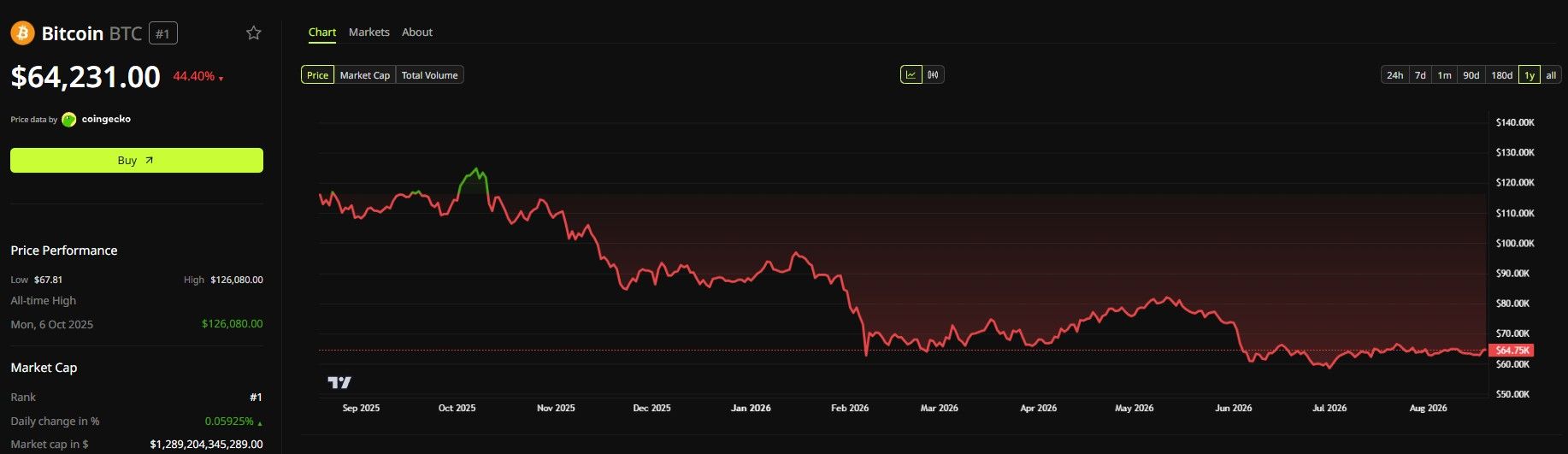
Gemini co-founder Cameron Winklevoss says the artificial intelligence (AI) trade has handed investors a Bitcoin (BTC) time machine, with the asset now trading near half of last year’s price.
He posted the argument on X, urging investors to treat the drop as an entry point rather than a warning sign.
Why Winklevoss Calls This a Bitcoin Time Machine
Winklevoss argues that capital chasing AI stocks has suppressed crypto prices. As a result, buyers can now reach levels that looked out of reach twelve months ago.
He ties the weakness to competition for capital. AI equities absorbed flows that once moved into risk assets such as BTC.
The comparison rests on a simple counterfactual. A year ago, BTC traded above $120,000, and a few holders expected a slide back toward $60,000.
Bitcoin peaked at $126,080 on October 6, 2025, according to BeInCrypto price data. BTC now changes hands at $64,231, roughly 49% below that record. Meanwhile, the market value of the asset sits near $1.29 trillion.

The chart shows where the damage landed. BTC broke down sharply in February 2026 and has traded below $80,000 ever since.
The pitch also echoes his earlier calls. In July, Winklevoss backed Bitcoin and Zcash as the AI rout dragged South Korea’s Kospi index down almost 11%.
His own trading record complicates the message. In March, the twins moved $130 million in BTC to Gemini wallets, which analysts read as preparation to sell.
Gemini has felt the downturn directly. The exchange cut roughly 30% of its workforce earlier this year and posted a $585 million loss for 2025.
Analysts Still See Room Below $64,000
Not everyone treats the discount as a floor. One BeInCrypto study of cycle timing placed the bear market bottom near $47,000.
Institutional demand also looks thin. Last week, spot Bitcoin exchange-traded funds (ETFs) recorded $390 million in outflows as oil prices climbed.
The AI question cuts both ways. Money rotating out of AI stocks could lift crypto. However, a broad risk selloff would probably drag BTC lower first.
Still, Bitcoin has shown some independence this week. On Monday, the S&P 500 slipped while BTC pushed above $64,000 ahead of the Federal Reserve minutes.
Winklevoss closed his post by asking when Bitcoin goes back to the future. Traders watching the current Bitcoin price may read part of that answer in this week’s Fed minutes.
The post Bitcoin Time Machine Hands Buyers a 50% Discount, Cameron Winklevoss Says appeared first on BeInCrypto.


Interlace has opened an office in Brazil and assembled a local team as the stablecoin infrastructure company expands its payment and digital asset operations across Latin America.
Summary
- Interlace has opened an office in Brazil and assembled a local team led by country manager Guilherme Santos.
- The company plans to support financial institutions, cross-border trade platforms and digital asset businesses through its payment infrastructure.
- Interlace recently attended Blockchain.RIO, where Santos discussed stablecoin payments, digital assets and financial infrastructure.
- The company will next attend the Argentina Crecimiento LATAM Digital Assets Conference from Aug. 20 to Aug. 21.
Interlace said the Brazil operation will connect local financial institutions, cross-border trade platforms, digital asset companies and Web3 projects with its global payment and digital asset infrastructure.
Interlace Brazil office brings a local team into the market
The expansion gives Interlace a physical presence in one of Latin America’s largest digital asset markets, with the company appointing Guilherme Santos as its country manager for Brazil.
Confirming the move on X, Interlace described its strategy as “Going global. Building local,” adding that the new office was part of its effort to make stablecoin-powered payments and digital financial infrastructure more accessible internationally.
“Our new office marks another step toward making stablecoin-powered payments and digital financial infrastructure more accessible worldwide,” the company said.
Interlace has also started building relationships with Brazil’s payment and digital asset sectors through local industry events. The company recently attended Blockchain.RIO in Rio de Janeiro, where its team met participants from the country’s financial, payments and crypto industries.
During the event, Santos joined a panel covering digital assets, stablecoin payments and financial infrastructure, placing the company’s local rollout alongside discussions about how blockchain-based settlement can connect with existing financial services.
Brazil already has significant stablecoin activity alongside an established instant-payment system. In June, crypto.news reported on Oobit, which integrated Tether’s USDT with Brazil’s Pix network, allowing users to deposit Brazilian reais, hold USDT, and make payments through Pix keys or QR codes.
According to that report, Pix had nearly 170 million users, while the system processed BRL 11 trillion in transactions during 2024. Oobit said blockchain settlement could run behind the payment process while users continued interacting with the same Pix-based payment methods already available through Brazilian banking apps.
Interlace has not disclosed specific banking or payment partners tied to its new Brazilian office. Its announcement instead identified local financial institutions, cross-border commerce platforms, digital asset businesses and Web3 projects as the groups it plans to support through its infrastructure.
Brazil stablecoin payments face tighter financial rules
Interlace is entering Brazil as regulators increase supervision of digital asset transactions, particularly those involving stablecoins and cross-border payments.
A July report on IMF scrutiny found that the International Monetary Fund had called for stronger oversight of Brazil’s stablecoin market after cross-border crypto flows expanded faster than traditional capital movements. The IMF said Brazil’s crypto sector had become more closely connected with the financial system, while additional rules were needed around customer asset protection, stablecoin issuance and anti-money laundering controls.
Banco Central do Brasil Governor Gabriel Galípolo had also said stablecoins accounted for about 90% of the country’s reported crypto flows, according to the same report. Regulators have cited taxation, money laundering and reserve-related risks when discussing the large share of dollar-backed tokens in local digital asset transactions.
Brazil’s central bank has already placed restrictions on how virtual assets can be used within supervised international payment channels. Resolution BCB No. 561 requires payments and receipts between regulated electronic foreign exchange providers and foreign counterparties to use foreign exchange transactions or movements through non-resident Brazilian real accounts. Virtual assets cannot be used to settle transactions inside those regulated eFX channels.
The restriction does not prohibit crypto trading or stablecoin transfers in Brazil. According to the IMF coverage, it separates regulated cross-border settlement infrastructure from private digital asset activity conducted through wallets, exchanges and other crypto services.
For infrastructure providers entering Brazil, local financial connections therefore sit alongside a developing compliance regime governing how digital assets interact with existing payment and foreign exchange systems.
Commercial interest in stablecoin payment rails has continued across Latin America at the same time. In June, Paradigm led a $9 million Series A investment in El Dorado, a regional payments company operating across 12 Latin American countries, including Brazil, Argentina and Colombia. Coinbase Ventures and Verda Ventures also participated in the round.
El Dorado said it had processed more than 5 million transactions and served more than 100,000 active users. The company also moved into business payments, combining fiat and stablecoin payment rails for corporate customers involved in cross-border commerce.
Paradigm partner Ricardo de Arruda said Latin America handles more than $100 billion in cross-border payments annually, while El Dorado CEO Guillermo Goncalvez estimated total flows could approach $1 trillion when additional business transactions are included. Goncalvez said roughly 60% of the activity involved business-to-business payments linked to imports and exports between Latin America and the United States.
Interlace plans its next Latin America stop in Argentina
Interlace is now taking its regional expansion to Argentina, where the company is scheduled to participate in the Argentina Crecimiento LATAM Digital Assets Conference from Aug. 20 to Aug. 21.
At the conference, the company said it will give a presentation covering practices from its global card-issuance projects and its plans for Latin America. The appearance follows its participation at Blockchain.RIO and comes one day after the Brazil office announcement.
Argentina has also seen financial groups experiment with stablecoins for business payments and treasury use. A July report on peso stablecoins detailed separate projects from BIND Group and Petersen Group that were being developed through digital asset subsidiaries while Argentine banks remained restricted from offering crypto services directly.
BIND Group, which manages more than $2 billion in assets and owns BIND Banco Industrial, has been developing a peso-backed stablecoin through virtual asset service provider BEN. BEN had also partnered with Circle to provide institutional clients with access to USDC for treasury management and payment applications under Argentina’s regulatory framework.
Petersen Group, meanwhile, has been working on the DIPE stablecoin with technical support from crypto infrastructure provider Lirium. According to the July report, both projects have focused on corporate functions including programmable payments, collateral management and treasury settlement instead of consumer payment products.
Interlace said its Aug. 20–21 appearance in Argentina will cover its global card issuance experience and the company’s plans for building its Latin American operations.

Metaplanet, the Tokyo-listed firm that has made Bitcoin its primary treasury asset, says it is preparing to expand its Bitcoin strategy into the United States through a controlling stake in Nasdaq-listed Super League Enterprise. The proposed move would create a U.S.-focused Bitcoin treasury platform while allowing Metaplanet to continue raising capital in Japan.
According to Metaplanet CEO Simon Gerovich, the company plans to contribute 2,100 Bitcoin (BTC) and $2.5 million in cash to Super League. The receiving entity is expected to be renamed “Superplanet,” positioning it as the group’s U.S. Bitcoin treasury vehicle.
Key takeaways
- Metaplanet plans to inject 2,100 BTC (about just under 5% of its 43,000 BTC holdings) plus $2.5 million cash into Super League.
- The deal would create a separate U.S.-oriented treasury platform while Metaplanet continues capital formation efforts in Japan.
- Because the BTC comes from Metaplanet’s existing holdings, the transaction is described as not involving a new BTC purchase.
- Closing is expected in Q4 2026, subject to shareholder approval and other customary conditions.
- Super League’s stock reaction has been dramatic, with trading volume reported to jump nearly 95x after the announcement.
Metaplanet’s U.S. expansion via Superplanet
Gerovich said the arrangement is designed to provide two channels for funding the group’s broader Bitcoin treasury approach. Under the plan, Superplanet would target U.S. markets, while Metaplanet would keep pursuing fundraising in Japan.
The company also suggested that the U.S. structure could widen the strategic options available to the group. Metaplanet said Superplanet may pursue acquisitions in the U.S. Bitcoin treasury sector that could be harder for the Japanese parent company to execute.
Metaplanet’s stated transfer of 2,100 BTC amounts to just under 5% of its reported 43,000 BTC holdings. At the time of the announcement, the value was described as roughly $135 million based on prevailing Bitcoin pricing. Importantly, the BTC would be sourced from Metaplanet’s treasury rather than obtained through a fresh market purchase.
Timing, governance, and how capital could flow
Metaplanet said the transaction is expected to close in the fourth quarter of 2026, assuming customary closing conditions are met. Those conditions include approval from Super League shareholders.
While details of the exact financing mechanics were not fully specified in the company’s remarks, the core premise is straightforward: capital raised by either entity could be directed toward expanding the group’s Bitcoin treasury strategy. This matters for investors because it frames the acquisition not only as a corporate restructuring, but as a capital-allocation expansion—essentially building a second fundraising venue alongside Metaplanet’s existing Japanese operations.
For traders and shareholders, the key unknowns to watch will be how the U.S. vehicle ultimately raises funds, how it is governed relative to the Japanese parent, and what acquisition criteria it uses if Metaplanet’s stated goal of U.S. consolidation comes to fruition.
Super League’s market reaction highlights investor appetite
Super League Enterprise currently operates an immersive gaming, content, and advertising business. Following the announcement, its shares surged more than 50%, and trading activity spiked sharply.
Yahoo Finance data cited in the announcement indicates trading volume reached about 37.3 million shares versus roughly 393,000 shares previously—an increase of nearly 95-fold. Such a move often signals that investors are recalibrating expectations for the company’s future direction and capital strategy, particularly when a publicly traded business is linked to large-scale Bitcoin treasury plans.
Metaplanet’s move also underscores a broader theme in the corporate Bitcoin space: listed companies are increasingly competing not just on treasury size, but on access to capital. By shifting part of that effort into a U.S.-listed wrapper, the strategy may reduce geographic constraints and broaden investor participation.
Corporate Bitcoin treasuries face growing capital-management pressure
Metaplanet has positioned itself among the largest corporate Bitcoin holders. The company is described as the third-largest corporate Bitcoin holder, trailing Twenty One Capital by roughly 500 BTC. Twenty One Capital is a publicly traded Bitcoin treasury company backed by Tether, Bitfinex, and SoftBank, formed to accumulate Bitcoin and increase holdings on a per-share basis.
Metaplanet’s most recent accumulation was last reported as occurring in early July, according to BitcoinTreasuries.NET.
Strategy is another prominent reference point in this market. Michael Saylor’s Strategy is still widely reported as the largest corporate Bitcoin holder, with more than 840,000 BTC. However, the article notes that Strategy has sold Bitcoin in recent months to fund dividends, share repurchases, and its U.S. dollar reserve. That detail highlights a central tension for corporate Bitcoin treasuries: maintaining Bitcoin exposure while also meeting the cash needs that come with being a public company.
Against that backdrop, Metaplanet’s planned U.S. expansion can be viewed as an attempt to strengthen the group’s capital toolkit. If Superplanet can raise funds efficiently in the United States, it may provide additional flexibility—whether for Bitcoin accumulation, strategic acquisitions, or supporting corporate liquidity demands—without relying solely on the Japanese market.
Investors should watch for two developments as this moves toward Q4 2026: the shareholder approval process at Super League, and how Superplanet’s planned fundraising and acquisition strategy will be structured in practice—especially given the ongoing trade-offs corporate Bitcoin holders face between Bitcoin accumulation and broader capital-management obligations.
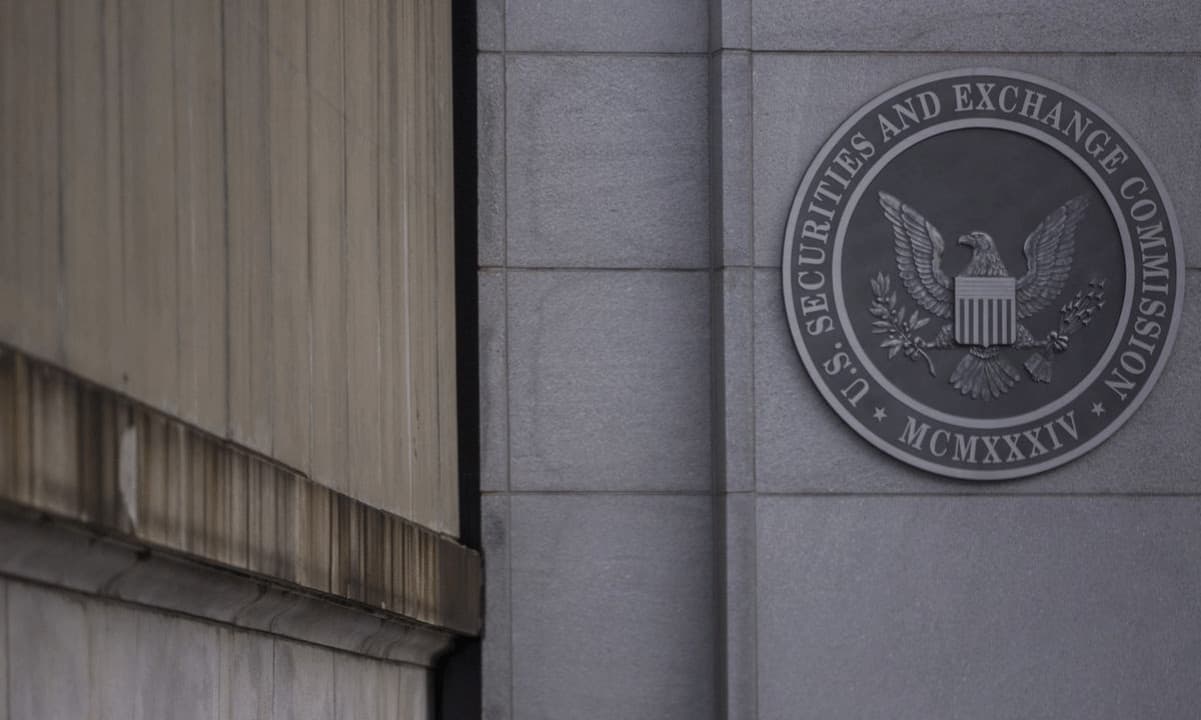
The Securities and Exchange Commission (SEC) proposed a new rule on August 18 that would let crypto companies raise money through two exemptions from standard securities registration.
The plan, called “Regulation Crypto Assets,” sets one path capped at $5 million every four years and another at $75 million per year, alongside a safe harbor that could pull certain crypto assets outside the legal definition of a security.
Two Paths to Raise Capital
Under the proposal, the smaller exemption is a one-time offering worth up to $5 million over a four-year period. Issuers using it would need to give investors narrative disclosures about the offering, written in plain language rather than the dense form typical of a full registration statement, and the requirements stay fairly informal by comparison.
The larger exemption goes up to $75 million in any 12-month stretch, but it comes with more paperwork: financial statements and ongoing reporting obligations for as long as a company keeps raising money under it.
The rules also includes a conditional safe harbor removing certain crypto assets from the “investment contract” definition found in both the Securities Act of 1933 and the Securities Exchange Act of 1934.
If a project meets the conditions, largely tied to whether management has finished or permanently stopped the work it promised investors, the token would no longer count as an investment contract, and by extension, not a security. Chairman Paul Atkins said the change would apply “once an issuer has completed or permanently ceased all essential managerial efforts” it promised.
“Congress designed our securities laws to amplify – within specific guardrails – opportunities for entrepreneurs to innovate and build new products,” Atkins added. “Advancing this regulatory framework is a key element in our strategy to advance the rule books for the modern era and another step by the Commission to onshore innovation in crypto asset markets for generations to come.”
The rule further preempts state securities registration and qualification requirements for offerings made under either exemption, plus some secondary market sales.
The Backdrop in Washington
The proposal builds on the SEC interpretation from March 2026 that first laid out how federal securities law applies to certain crypto assets and transactions. It also landed one day before a White House meeting scheduled for August 19, where executives from Ripple, Coinbase, Chainlink, Paradigm, Kalshi and a16z are expected to sit down with regulators as CryptoPotato had earlier reported.
President Donald Trump is reportedly expected to attend, and Atkins himself is also expected to show up, per updates from journalist Eleanor Terrett. Reports have suggested that some traditional finance executives could join too, though there is no official confirmation of a full guest list.
That meeting comes as the CLARITY Act, the broader bill meant to draw a line between SEC and CFTC authority over digital assets, sits stalled in Senate. Lawmakers left for their August recess without a vote, and Majority Leader John Thune has filed cloture for a vote on September 15.
Unresolved disputes over ethics provisions, anti-money laundering rules and stablecoin rewards for customers have slowed things down, with banks lobbying against the reward idea because it could pull deposits out of traditional systems.
The SEC will take public comments on Regulation Crypto Assets for 60 days once the proposal is published in the Federal Register.
The post SEC Unveils ‘Regulation Crypto Assets’: New $5M and $75M Path for Token Offering appeared first on CryptoPotato.


SkyBridge Capital founder Anthony Scaramucci said on Aug. 18 that Bitcoin’s latest bear market may contain one encouraging signal: its decline has remained smaller than losses recorded during previous cycles.
Summary
- Scaramucci called Bitcoin’s current decline a bear market despite its shallower drawdown than earlier cycles.
- Bitcoin traded near $64,000 after falling roughly 49% from its October 2025 record peak level.
- Scaramucci compared the latest downturn with historical bear-market losses of approximately 75% to 80% previously.
- He attributed weak prices partly to capital rotating from cryptocurrencies toward artificial intelligence investments recently.
- Scaramucci forecast Bitcoin above $100,000 after another halving, but offered no guaranteed recovery timeline publicly.
Speaking with CNBC’s Andrew Ross Sorkin at the Wyoming Blockchain Symposium, Scaramucci called the downturn a “clear Bitcoin bear market.” However, he argued in the interview that the depth of the selloff could indicate a more resilient buyer base.
Scaramucci referred to a roughly 55% peak-to-trough decline. Bitcoin has since recovered to around $64,000, narrowing its current drawdown from the October 2025 record to approximately 49%.
Bitcoin’s current drawdown is smaller than earlier crashes
Bitcoin reached a record near $126,000 in October 2025. It later fell below $60,000 during the June 2026 liquidation wave, representing a decline of approximately 53% to 55%, depending on the exchange and intraday price used.
Scaramucci compared that move with losses of roughly 75% to 80% during previous Bitcoin bear markets. He argued that the smaller decline could mean “there’s a lot of net buyers” preparing for the next market phase.
That interpretation remains his opinion rather than a confirmed market signal. A smaller drawdown does not establish that Bitcoin has reached its final bottom or that buyers will prevent another decline.
Bitcoin’s current price near $64,000 leaves it approximately 49% below its record, according to current drawdown data. The difference between that reading and Scaramucci’s 55% figure reflects Bitcoin’s recovery from its sub-$60,000 lows.
As crypto.news reported, Bitcoin recently reclaimed the $64,000 level after buyers defended support around $62,750. Compressed volatility and leverage still leave the market exposed to abrupt movements.
Scaramucci says AI absorbed cryptocurrency capital
Scaramucci attributed Bitcoin’s subdued performance partly to capital moving toward artificial intelligence investments. AI-linked equities and investment products attracted strong demand while cryptocurrency markets faced liquidations and weaker institutional flows.
He also pointed to Bitcoin miners redirecting infrastructure toward AI computing. Several publicly traded miners have pursued data-center and high-performance computing contracts as Bitcoin mining economics weakened.
BlackRock reached a similar conclusion about competition for investment flows. The asset manager reported that AI-focused funds received more than $46 billion following Bitcoin’s October peak, while spot Bitcoin exchange-traded products recorded approximately $5 billion in net outflows.
As previously reported, BlackRock said the 50% pullback reflected deleveraging and weaker flows rather than a change in its longer-term investment case. BlackRock’s assessment and Scaramucci’s comments remain institutional views, not guarantees of recovery.
The four-year cycle remains central to his forecast
Scaramucci also linked the bear market to Bitcoin’s four-year issuance cycle. Bitcoin completed its latest halving in April 2024, reducing the block subsidy from 6.25 BTC to 3.125 BTC.
The next halving is expected in 2028, although the precise date depends on block production. Scaramucci estimated that the event was approximately 18 or 19 months away when he spoke.
He said another reduction in newly issued Bitcoin could tighten supply and support prices. Based on that view, he expects Bitcoin to “move back up over 100,000,” though he warned that the market could continue grinding sideways beforehand.
The forecast has no stated deadline. Halvings reduce new issuance, but prices also depend on investor demand, leverage, interest rates, exchange-traded product flows and broader economic conditions.
Historical signals do not promise a quick recovery
VanEck’s latest cycle research provides a more cautious near-term view. Eight of its 12 Bitcoin capitulation signals were active on Aug. 12, while every tracked signal had entered capitulation territory during the preceding three months.
As crypto.news reported in its coverage of the potential accumulation phase, VanEck estimated that a cycle transition could occur between September and November.
However, its historical tests found that similar capitulation clusters did not outperform Bitcoin’s normal baseline over the following three or six months. Outperformance appeared only over a one-year period, based on a small and heavily overlapping sample.
Bitcoin’s next test remains whether buyers can establish support above the $64,000 to $65,000 region. U.S. spot exchange-traded product flows, leverage and upcoming economic data may shape the shorter-term direction.
Scaramucci’s argument therefore rests on relative resilience rather than evidence that the bear market has ended. The current decline has been shallower than earlier collapses, but Bitcoin remains almost 50% below its record.


Ripple Prime closed an upsized $275 million private placement of senior unsecured notes this week, yet the XRP price failed to react, trading just below $1.
The brokerage arm’s fundraising success stands in sharp contrast with the token’s persistent price weakness.
Inside Ripple Prime’s $275 Million Raise
A senior unsecured note is a form of corporate debt that ranks above other unsecured obligations in repayment priority, though it carries no collateral backing. Institutional investors across major financial markets purchased the notes.
Ripple Prime operates as the company’s non-bank prime brokerage arm, offering clearing, financing, and prime brokerage services to institutional clients. The firm said proceeds will cover working capital and general corporate purposes as it expands operations in the US.
Follow us on X to get the latest news as it happens.
Piper Sandler served as lead placement agent for the transaction. Kroll Bond Rating Agency assigned the notes a BBB investment-grade rating, matching the score it had already given Ripple Prime as an issuer.
Noel Kimmel, the unit’s president, said the funding provides additional capital to invest in the team and technology needed for growth.
“With the completion of this offering, we have an additional source of capital to invest in our team and technology as we execute on our ambitious growth roadmap and bolster our position as one of the largest non-bank prime brokers globally,” Kimmel said, quoted in Ripple’s official statement.
An investment-grade rating typically signals lower default risk to institutional buyers than unrated or speculative-grade debt. That distinction matters for a sector where conservative capital has historically stayed cautious.
Whether the rating and the raise translate into a meaningfully larger US client base remains to be seen. The company has not disclosed specific onboarding targets or a timeline for measurable growth.
Why XRP Price Still Isn’t Responding
XRP price told a different story entirely. The token traded near $0.9998, hovering just below the psychological $1 level after a modest 0.1% move over 24 hours, according to BeInCrypto data.
Market cap stood at $62.7 billion, with trading volume around $813 million. XRP recently posted one of its lowest weekly closes in nearly two years amid broader weakness in the crypto market.
That divergence fuels an ongoing debate. Community members increasingly question how closely Ripple’s corporate success actually correlates with the token’s market value.
The same day brought another announcement entirely separate from this raise. Ripple partnered with Jeonbuk Bank, becoming the first regional Korean bank to deploy Ripple Payments for cross-border remittances.
That deal adds to a growing list of Asian institutional wins, following earlier partnerships in insurance and digital banking. Those collaborations demonstrate practical infrastructure use cases beyond speculative trading.
For now, Ripple continues to secure institutional capital and banking relationships, while XRP continues to test the patience of holders awaiting a price response to match.
Subscribe to our YouTube channel to watch leaders and journalists provide expert insights.
The post Ripple’s Brokerage Arm Raises $275 Million: Why Doesn’t XRP Care? appeared first on BeInCrypto.
Binance published its 45th Proof of Reserves report using user balances recorded on Aug. 1, 2026. The snapshot showed customer Bitcoin holdings rising for another month, while Ethereum and Tether balances declined.
Summary
- Binance users held approximately 657,000 BTC on August 1, increasing balances by 16,349 BTC monthly.
- User Ethereum balances fell 2.57% to approximately 3.98 million ETH in Binance’s latest reserve snapshot.
- USDT holdings declined by roughly 870 million tokens, reaching approximately 32.9 billion USDT across accounts.
- Binance reported 100.25% reserve ratios for both Bitcoin and Ethereum at the snapshot time, respectively.
- Proof of reserves verifies point-in-time backing but cannot replace a complete independent financial audit process.
Users held approximately 657,000 BTC, up 2.55% from the July 1 snapshot. The increase amounted to 16,349 BTC, according to figures published through Binance’s reserve dashboard.
Ethereum balances moved in the opposite direction. Users held about 3.98 million ETH, down 2.57%, or 105,154 ETH. USDT balances also fell 2.57% to approximately 32.9 billion tokens, a decline of roughly 870 million USDT.
Binance user Bitcoin balances rose for a third month
The August snapshot continued a recent increase in customer Bitcoin balances. Binance users added 25,838 BTC during May and another 7,715 BTC during June.
As crypto.news previously reported, customer Bitcoin holdings had already increased in July even as ETH and USDT moved lower. The latest 16,349 BTC increase was more than twice the amount added during the previous reporting period.
The three monthly reports show users adding nearly 50,000 BTC between the May and August snapshots. However, that change does not establish that customers bought the same amount through Binance’s markets.
Reserve balances can rise through deposits from other exchanges, transfers from private wallets, purchases or movements between Binance products. The report does not separate those activities or identify the reasons behind individual balance changes.
Ethereum and USDT holdings extended their declines
Ethereum balances fell for a second consecutive snapshot after rising sharply in the June report. Users held approximately 4.14 million ETH on June 1 before the total declined to around 4.08 million ETH in July and 3.98 million ETH in August.
The latest decrease of 105,154 ETH was larger than the 58,591 ETH reduction recorded one month earlier. The figures could reflect withdrawals, sales, transfers to staking services or movements into other assets. Binance’s snapshot does not determine which explanation applies.
USDT balances followed a similar pattern. Customer holdings stood near 34.3 billion USDT in June and about 33.7 billion USDT in July. The latest report placed the total near 32.9 billion USDT.
That represents three consecutive monthly reports showing lower USDT balances. Still, the decline does not prove that users converted stablecoins into Bitcoin. Funds could have moved into other stablecoins, external wallets or different trading venues.
A comparable balance pattern has appeared elsewhere. In related coverage, Bybit and OKX reported rising Bitcoin balances alongside lower USDT holdings in their recent snapshots.
Binance reports reserves above customer liabilities
Binance reported reserve ratios of 100.25% for both BTC and ETH. A 100.25% ratio means the exchange reported holding approximately 1.0025 units in its reserve wallets for every unit attributed to users at the snapshot time.
USDT had a higher reported ratio of 103.62%. That ratio would place Binance’s corresponding USDT assets above the 32.9 billion tokens assigned to customers.
Binance says its Proof of Reserves system covers user assets on a 1:1 basis, with additional reserves. It uses Merkle trees and zero-knowledge proofs so customers can verify that their account balances were included without viewing other users’ information.
Customers can download the relevant verification data and compare their records with the published Merkle root. Binance also publishes wallet addresses associated with the assets included in its system.
No distinct BTC, ETH or USDT market movement could be reliably attributed to the reserve publication. The report measures customer and exchange balances rather than trading performance or directional demand.
Proof of reserves remains a limited snapshot
Proof of reserves helps determine whether disclosed on-chain assets cover the user liabilities included in a report. It does not provide a continuous record because asset and customer balances can change immediately after the snapshot.
It also does not independently assess every corporate liability, internal control, loan or off-chain obligation. The process therefore differs from a full financial audit covering an organization’s wider balance sheet and operations.
A crypto.news guide explaining how reserve verification works and where it falls short notes that useful disclosures should include assets, customer liabilities, frequent updates and user-verifiable evidence.
Binance has not announced a fixed date for its 46th report. Its recent monthly schedule suggests the next snapshot could use balances recorded around Sept. 1, although the exchange has not confirmed that timing.
The next publication will show whether customer BTC balances continued rising and whether the declines in ETH and USDT holdings persisted. Any interpretation should remain limited to reported account balances rather than assumed buying or withdrawal behavior.


US investors remain locked out of tokenized stocks, and Robinhood CEO Vlad Tenev wants that changed. In a Tuesday post, he pitched tokenization as the best path to modernizing the American financial system.
His post landed while federal regulators paused efforts to define how tokenized securities can trade on blockchain rails inside the United States.
SEC Pauses as Tokenized Stock Market Expands
Tenev noted that Stock Tokens are not yet available in the US. He called that absence the one glaring gap in the company’s tokenization push.
The door stays shut because the rules have not moved. The Securities and Exchange Commission (SEC) has not published its innovation exemption for tokenized equities.
Tenev framed the absence of US access as a key obstacle. He added that market participants are already shifting toward blockchain-based financial systems, but regulators need to update existing rules to accommodate the technology without weakening investor protections.
The executive warned that the US risks falling behind other jurisdictions if policymakers fail to move quickly, arguing that the implications extend well beyond the financial sector.
“Tokenization is the best path to modernizing the American financial system and expanding the dream of ownership to all–Americans included,” he said.
Follow us on X to get the latest news as it happens
Robinhood Trails Rivals in the Market It Wants Opened
Meanwhile, the market keeps growing without America. Tokenized stocks held $2.4 billion in distributed value as of August 19, up 6.6% over 30 days, according to RWA.xyz. Holders climbed 101% to 1.4 million, while monthly transfer volume rose 197% to $24.3 billion.
Robinhood ranks sixth among platforms with $32.2 million across 191 assets. Ondo leads at $882.9 million, followed by xStocks at $561.7 million and bStocks at $532.2 million.
The technology question may be settled for now. What remains is whether Washington writes rules before the market decides without it.
Subscribe to our YouTube channel to watch leaders and journalists provide expert insights
The post Tokenization Is Best Path to Modernizing US Finance, Says Robinhood CEO appeared first on BeInCrypto.
Goldman Sachs signage on the floor of the New York Stock Exchange (NYSE) in New York, US, on Tuesday, July 14, 2026.
Michael Nagle | Bloomberg | Getty Images
Artificial intelligence is starting to weigh on labor market across major developed economies, with effects varying across industries and seniority levels, according to Goldman Sachs.
The Wall Street investment bank found in its research that industries with greater exposure to AI automation have generally seen slower job openings growth since the second half of 2022, with the relationship particularly pronounced in Germany, Australia and the U.S.
Goldman said in its report published Wednesday that employment in information and communication services, among the industries most exposed to AI, has slowed across nearly all major developed economies since 2022.
However, employment in these industries remains near or above its long-run trend outside the U.S.
Looking more closely at highly AI-exposed industries, Goldman found a similar, though generally more muted, pattern of employment headwinds across other developed markets.
Employment in call centers, software publishing, management consulting and advertising has fallen sharply below its historical trend across developed markets, Goldman said.
Call centers stand out in particular. Employment in the industry is now below trend in the U.S., 39% lower, Canada, down 33%, and Germany 27% below trend, according to the report. Goldman said the pattern indicates that AI-related employment pressures are already visible in industries where tools capable of automating work are available.
Entry-level workers feel more pressure
The effects appear to be more pronounced for those looking to start their careers.
Goldman analyzed employment growth across more than 800 occupations and found that AI-related headwinds were the strongest among entry-level workers. It also found an additional, though smaller, negative effect among occupations considered to have a high risk of displacement from AI.
Across the broader labor market, a 10% occupational exposure to AI was associated with only a 0.1 percentage point drag on annual headcount growth in France, Canada and the U.S. But for entry-level workers, the impact ranged between more than 0.6 percentage point (Australia) and over 0.2 percentage point (U.S.).
Overall, the investment bank concluded that AI-related hiring pressures are clearly visible in employment data globally, but remain limited to a relatively narrow set of industries and workers.
Where AI adoption is highest
The labor market impact comes as AI adoption is spreading across developed economies.
Goldman combined 11 surveys measuring AI adoption across countries and found that major developed markets have adoption rates of roughly 15% to 20%.
France, the U.S., the Netherlands and the U.K. are leading AI adoption, while Italy, Japan and New Zealand were among the developed economies at the lower end of adoption.
Major emerging markets, meanwhile, had estimated adoption rates of between 10% and 15%.

Physicists Entangle Quantum Memories Across a Record-Breaking 420 Kilometers

UK weather: Will a September heatwave follow this week’s rain?
Why is Shurgard Self Storage stock sliding today?





-

 Fashion5 days ago
Weekend Open Thread: Ann Taylor
-
 Sports5 days ago
This U.S. Amateur is a glimpse into golf’s future in more ways than you think
-
 Tech5 days ago
11 Ways to Rank Your Videos
-
 NewsBeat4 days ago
Myanmar says over 300,000 Rohingya refugees verified for repatriation as exodus enters ninth year
-

 Sports4 days ago
Birmingham 2026: Day 6 Timetable for Irish Athletes
-

 Politics4 days ago
SEQ Code: The Three Letter Boarding Pass Code That Could Give You The Worst Seat
-
 Entertainment7 days ago
Keke Palmer Subtly Hints At Sean Evans Drama With Cryptic Post
-

 Sports7 days ago
DeQuan Jones in ‘high spirits’ after successful leg surgery
-

 Tech6 days ago
DeepSeek Harness launches as open source rival to Claude Code, alongside V4-Pro on API with higher prices
-
 Crypto World7 days ago
Perplexity AI Predicts an XRP Scenario Few Analysts Are Discussing
-
 Entertainment7 days ago
2026’s Most Ambitious Fantasy Movie Officially Scores Sequel Update
-

 Crypto World1 day ago
OCC Greenlights Trump Family Crypto Firm for Trust Charter
-

 Politics7 days ago
How Average Are You In The UK?
-
 Entertainment7 days ago
All 10 Hayao Miyazaki Fantasy Movies, Ranked
-

 Fashion7 days ago
Why Botanical Fashion Never Goes Out of Style
-
 Entertainment7 days ago
Travis Kelce Breaks Silence On ‘Crazy’ Taylor Swift Wedding
-
 Entertainment5 days ago
10 Netflix Shows That Quietly Became Modern Classics
-

 Fashion7 days ago
Wednesday’s Workwear Report: Stretch-Cotton Pleated-Waist Top
-

 Fashion6 days ago
The Details Do the Dressing
-

 Fashion5 days ago
Weekly News Update, 8.14.26 – Corporette.com
You must be logged in to post a comment Login