
Crypto World
Bitcoin, Ethereum outpace gold as ETF demand and corporate treasuries tighten BTC supply



Institutional spot ETF inflows and aggressive treasury buying are reinforcing Bitcoin’s “digital reserve” status while Ethereum grinds higher despite a bid for traditional safe havens.
Summary
- Institutional spot ETF inflows and balance-sheet buying are reinforcing Bitcoin’s role as a digital reserve while Ethereum grinds higher.
- MicroStrategy-style treasuries are concentrating a meaningful slice of free-floating BTC and acting like a quasi-central bank balance sheet.
- Gold ETFs see outflows as BTC and ETH post stronger year-to-date gains than bullion and broad equities despite the Iran conflict and higher oil.
Bitcoin (BTC) and Ethereum (ETH) are quietly beating gold and global equities again, with institutional flows doing most of the heavy lifting. A recent note argues that BTC’s resilience through the Iran conflict underscores a structural shift in ownership, with spot ETFs and balance‑sheet buyers now dominating the float. Analysts quoted in the report say Bitcoin and Ethereum have outperformed gold and broad stock indices this year, even as geopolitical risk and higher oil prices would typically favor bullion.
The same commentary highlights one listed software company, widely understood to be MicroStrategy, as acting like the “last central bank of Bitcoin.” According to Jinshi’s summary, the firm has added 22,337 BTC at an average price near $70,194, taking its total stash to 761,068 BTC with a blended cost basis around $75,696. That is functionally a monetary reserve strategy rather than a conventional treasury allocation, and it concentrates a non‑trivial share of free‑floating supply inside a single corporate vehicle.
At the same time, spot Bitcoin ETFs have seen roughly $2.1 billion in net inflows over the past three weeks, equal to about 6.1% of new available supply, even as retail investors have been net sellers. Jinshi’s recap notes that around 60% of outstanding BTC has not moved on‑chain for a year, a classic sign of long‑term holder conviction and a constraint on tradable float. That lock‑up effect is part of why each marginal dollar into a spot product, or a corporate treasury like MicroStrategy’s, can have an outsized impact on price compared with prior cycles.
Crypto markets are reflecting that dynamic in real time. Bitcoin is trading near $73,800, up about 5.8% over the last 24 hours, after moving between roughly $69,460 and $73,770 on volume above $55 billion. Ethereum sits around $2,201, higher by roughly 6.8% on the day, with a 24‑hour range between about $2,042 and $2,200 and turnover close to $27.8 billion. Those moves come as gold ETF products continue to leak assets, with one recent data set showing multi‑billion‑dollar outflows from the yellow metal even as Bitcoin funds attracted fresh capital after the Iran shock.



The U.S. Securities and Exchange Commission has dropped a multi-year case against Nader Al‑Naji, who had been accused of misleading investors and violating federal securities laws tied to the launch of the BitClout platform.
Summary
- SEC has dropped its fraud and securities case against BitClout founder Nader Al-Naji after the agency’s crypto task force reassessed the matter and moved to dismiss the litigation.
- Regulators had accused Al-Naji of raising more than $257 million through BTCLT token sales and using part of the proceeds to fund personal expenses, including a Beverly Hills mansion.
- The case was dismissed with prejudice, while the U.S. Department of Justice also ended a parallel wire fraud case tied to the BitClout project.
A joint stipulation of dismissal filed with the United States District Court for the Southern District of New York on Thursday said the SEC’s crypto task force had reassessed the matter and decided to end the litigation.
However, the filing warned that the decision should not be interpreted as a broader policy shift that would automatically extend to other crypto-related cases.
“The Commission’s decision to exercise its discretion and seek dismissal of this litigation is based on the particular facts and circumstances of this case,” the filing said.
Al-Naji, a former Google engineer and the founder of the DeSo blockchain, was first charged by the SEC in 2024, just years after launching BitClout in March 2021. Subsequently, a cease and desist order was issued against the platform.
In its complaint at the time, the SEC under former chair Gary Gensler accused Al-Naji of raising more than $257 million by selling BitClout’s native BTCLT token without properly disclosing that the proceeds could be used to pay BitClout team members.
The commission also accused Al-Naji of using funds raised from investors to finance a lavish personal lifestyle. According to the SEC, roughly $7 million of the proceeds were used to cover rent for a Beverly Hills mansion and to make cash gifts to family members.
Regulators further alleged that Al-Naji mischaracterized the inner workings of the platform by presenting BitClout as fully decentralized even though he was allegedly controlling the project behind the scenes.
Under the terms of the settlement, the case has now been dismissed with prejudice, and Al-Naji has agreed to waive any claims for reimbursement of legal fees or expenses from the SEC.
Simultaneously, the U.S. Department of Justice has also ended a parallel criminal case against Al-Naji that had accused him of wire fraud.
“After months of searching, using every method and tool at their disposal, including applying pressure to those around me, the government decided to dismiss their charges,” Al-Naji wrote in an X post.
“Perhaps the allegation that hurt the most was the government’s claim that BitClout/DeSo, the blockchain that I’ve been working on for years now, is not fully decentralized […] In the short term, I’ve got big plans for DeSo, Focus, Openfund, and HeroSwap (my team’s core products). Every single one is best in class at what it does and a potential billion dollar business on its own. Now that I’m able to operate at full capacity, free from stifling constraints, and with my reputation and network restored, I’m confident we’ll realize that potential,” he added.
Under President Donald Trump’s administration, the SEC has dropped several enforcement actions against crypto firms. At the same time, the agency’s crypto task force has said it intends to move away from regulation by enforcement and toward a more collaborative framework built around clearer rules for digital asset companies.
Earlier this month, the SEC also dropped its lawsuit against Justin Sun, which had accused the TRON founder of fraud and securities law violations.


Aave is rolling out a new protective feature called ‘Aave Shield’ after a trader lost $50 million swapping USDT for AAVE due to illiquid market conditions.
Aave announced the launch of ‘Aave Shield,’ a new protective measure, following a $50 million loss suffered by a trader during a token swap. In a post-mortem analysis, Aave clarified that the loss was caused not by slippage but by illiquid market conditions that decimated the trade’s execution price when the trader swapped USDT for AAVE tokens.
The incident occurred on March 12, 2026, when a trader attempted to exchange $50.4 million in USDT stablecoins but received only $39,000 worth of AAVE tokens, crystallizing a near-total loss. The launch of Aave Shield signals the protocol’s effort to prevent similar catastrophic trades by adding safeguards around illiquid or thin markets.
Sources: Aave
This article was generated automatically by The Defiant’s AI news system from publicly available sources.
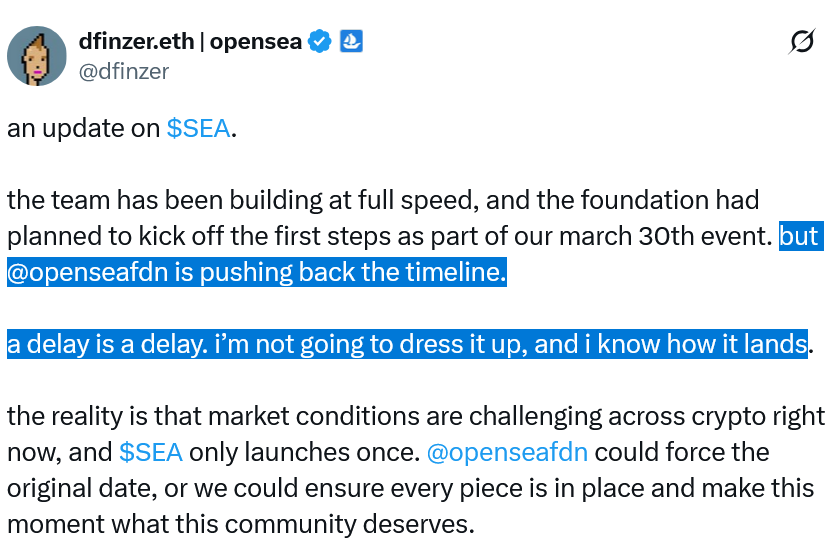
Nonfungible token marketplace OpenSea has postponed the launch of its native token SEA, initially slated for March 30, citing tough market conditions and it not being market-ready.
“The reality is that market conditions are challenging across crypto right now, and $SEA only launches once,” OpenSea CEO Devin Finzer posted to X on Monday.

The OpenSea (SEA) token, announced in October, was touted as part of OpenSea’s plan to transition into a “trade everything” app across multiple chains, which includes perpetual futures.
The SEA token would enable discounted trading fees to users on this platform, in addition to offering creator incentives and community voting. OpenSea users will also be able to stake SEA tied to NFT tokens and collections.
However, Finzer said OpenSea wants to make sure “every piece is in place” before launching the token rather than to “force the original date.” There is no new target date for the SEA launch.
Since October, OpenSea users have participated in the “Waves” reward program to be eligible for SEA token allocation. Finzer said that the campaign will be ending.
He also noted that users who participated in Waves 3, 4, 5 and 6 campaigns can opt to receive refunds for the platform fees OpenSea retained during that period, though anyone taking up the option would also lose any Treasure Chest rewards they have earned. Treasures were point-like rewards that OpenSea users earned to win certain prizes.
The move has prompted some users to question why OpenSea did not make refunds available for Wave 1 and 2 participants.
Dune Analytics shows that OpenSea’s token and NFT volume hit a four-year peak of $3.3 billion in October, which coincided with Wave 1 (which ran Sept. 15 to Oct. 15), and then hit $705 million in November, coinciding with Wave 2 (which ran from Oct. 15 to Nov. 15).
Cointelegraph reached out to OpenSea for comment.
OpenSea’s “trade everything” app
In October, Finzer said OpenSea’s everything app vision would enable users to trade everything from tokens, culture, art and ideas across multiple chains.
“All in one place that feels like a home, not a bank,” he said at the time.
OpenSea is building a new mobile app to drive that strategy, Finzer noted on Monday.
“We’re here for the long game. making all of non-custodial crypto delightful on mobile is just the beginning,” he said. “That means we have to set a very high bar for everything we do, and it’s why I’m so protective of delivering a launch that’s worthy of this community.”
Related: NFT lending protocol Gondi says platform secured after $230K exploit
NFT market continues to slide
The delay comes amid a continued NFT market slump. While it started strong in the first two weeks of 2026, rising to a market capitalization of $3.2 billion by Jan. 15, it has since fallen more than 50% to $1.62 billion.

Change in NFT market cap over the last three months. Source: CoinGecko
Data also shows OpenSea has generated more volume through tokens than NFTs for six successive months, including a record $2.8 billion in October.
OpenSea is now consistently seeing less than $500 million in NFT volume on a monthly basis, a fraction of the levels it saw throughout 2021 and 2022.
In January, NFT marketplaces Rodeo and Nifty Gateway announced that they would wind down operations, adding to the sector’s string of high-profile closures.
Magazine: China’s ‘50x’ blockchain boost, Alibaba-linked AI mines Bitcoin: Asia Express


BlockFills has filed for Chapter 11 bankruptcy in the US after suspending deposits and withdrawals last month amid poor market conditions.
BlockFills, an embattled crypto lender, has filed for Chapter 11 bankruptcy protection in the United States. The filing comes weeks after the platform suspended all deposits and withdrawals, citing difficult crypto market conditions. The bankruptcy marks a major failure in the centralized lending sector.
The collapse follows significant losses at the platform. Last month, BlockFills suspended customer access to funds after sustaining a $75 million loss, which also triggered the departure of CEO Nicholas Hammer. The lender’s troubles underscore ongoing stress in the crypto lending market and risks faced by centralized finance platforms.
Sources: BlockFills
This article was generated automatically by The Defiant’s AI news system from publicly available sources.
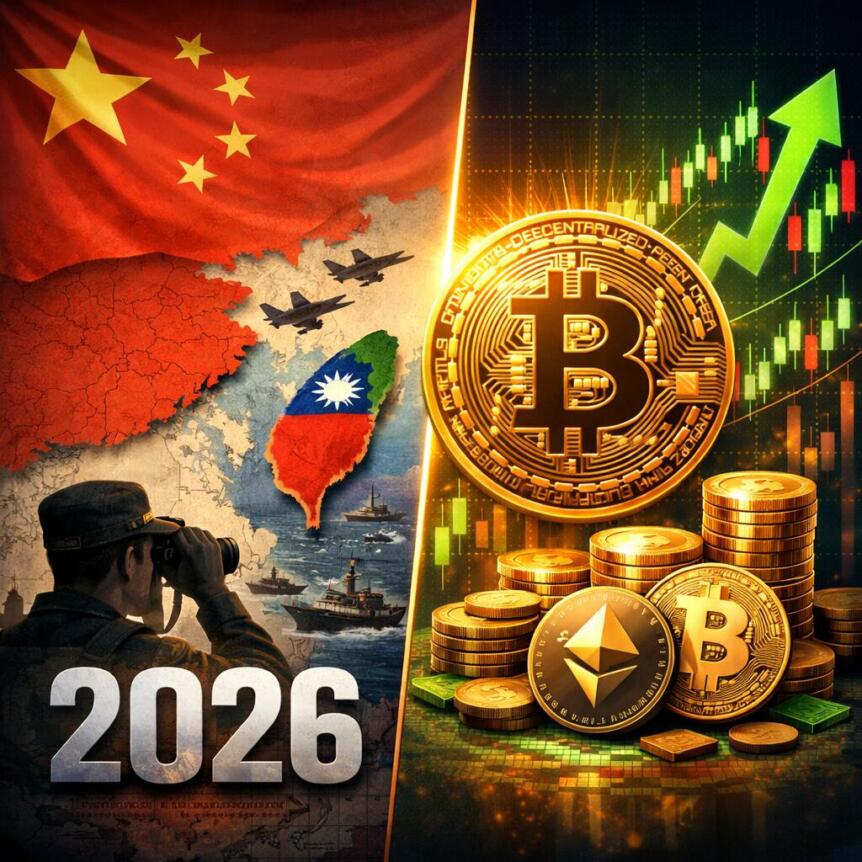
Incidents of military activities near Taiwan are on the rise
The latest news updates indicated that the Chinese army reinforcements augmented activities around Taiwan. The defense authorities of Taiwan have spotted a number of aircraft and naval ships navigating around the island in the recent days.In a case, at least twenty six aircraft of the Chinese military has flown close to the island on Saturday (as per the Taiwan defense ministry). Also, sixteen planes flew into various areas of Taiwanese Air Defense Identification Zone and seven Chinese vessels were also on the water.
The current action is also the part of the continued pressure development by Beijing which is aimed at putting pressure around Taiwan. We have also seen that the Chinese military has been carrying out patrols and exercises in the Taiwan Strait, which enables China to assert its position militarily and at the same time strengthens its self-assertion. There are also more air and naval activities that indicate that Beijing is keen on continuing its presence in the region.
Taiwan has retaliated by enhancing its defensive planning. The National Chung Shan Institute of Science and Technology confirmed fresh initiatives to come up with cost effective air defense ammunition.Lt. Gen. Lee Shih chiang clarified that the systems are meant to counter mass use of low cost weapons. The defense planners of Taiwan are of the view that this will curb the overpowering of the available missile systems.
Political Manoeuvre is a source of tension
Military activity also went along with the heightening of political tensions. Recently Taiwan President Lai Ching-te has highlighted increased defense budget and security of the democratic regime in Taiwan by the country China.Taiwan Affairs office China lamented against such comments and cautioned about any actions that may fuel tensions. Chinese authorities in Beijing mentioned that the leadership in Taiwan must not undertake any measures that enhance confrontation.
In the meantime the cryptocurrency market also began displaying recovery in spite of the geopolitical pressures. Bitcoin rose to almost seventy four thousand dollars and contributed to the general mood in the market since some digital assets appreciated as investors were lured back to risk markets following previous losses. The market players are still monitoring the political situation globally since the situation is still tense.
The geopolitical tensions worked out of Taiwan after China reinforced the timeline of reunification, which was 2026 and the military activity near the island. Taiwan has consolidated defense preparations as the international markets such as cryptocurrencies keep responding to the changing international trends.
Crypto World
OpenAI Targets $10B Private Equity Joint Venture to Accelerate Enterprise AI Deployment

TLDR:
- OpenAI is in advanced talks with TPG, Bain Capital, Brookfield, and Advent International for a $10B joint venture deal.
- Private equity firms will invest $4 billion in exchange for equity stakes and board seats inside OpenAI’s operations.
- OpenAI’s Frontier product lets enterprises deploy AI coworkers, with customers including Uber, Oracle, State Farm, and HP.
- Both OpenAI and Anthropic are racing to lock in enterprise contracts ahead of highly anticipated initial public offerings.
OpenAI is reportedly in advanced discussions with several major private equity firms to form a joint venture. TPG, Bain Capital, Brookfield, and Advent International are named as parties to the proposed deal.
The arrangement carries a pre-money valuation of roughly $10 billion. Private equity firms would collectively invest $4 billion in exchange for equity stakes and board seats.
This development positions OpenAI for rapid, large-scale corporate adoption across PE-managed portfolios worldwide.
Private Equity Opens the Door to Hundreds of Portfolio Companies
The proposed joint venture gives OpenAI access to hundreds of companies managed under private equity. TPG alone manages over $200 billion in assets across diverse industries.
These firms collectively control airlines, hospitals, retail chains, logistics networks, and media outlets. Rather than pursuing individual corporate clients, OpenAI would reach entire portfolios through a single deal structure.
Board seats as part of the arrangement also give PE firms direct influence over OpenAI’s deployment decisions. Their role goes beyond writing checks — it involves shaping how AI tools are rolled out.
As noted by @MilkRoadAI, these firms own companies spanning millions of workers and trillions in combined assets. OpenAI effectively gains a distribution network built over decades of PE operations.
At the center of this deal sits a product called Frontier, launched last month. Frontier allows enterprises to build and manage AI coworkers for real business functions.
Current customers already include Uber, State Farm, Oracle, and HP. The product targets organizations looking to automate core workflows using purpose-built AI agents.
Beyond software, OpenAI introduced Forward Deployed Engineers as a companion enterprise offering. These are full-time OpenAI staff who embed physically inside client companies.
They map existing workflows, integrate AI into systems, and hand back an operational solution. The minimum contract for this service starts at $10 million per engagement.
OpenAI and Anthropic Race to Lock In Enterprise Adoption Before IPO
OpenAI’s enterprise business already generates $10 billion in annualized revenue, reflecting strong corporate traction. That figure positions the company ahead of a possible public offering.
Anthropic is also pursuing enterprise customers through a similar deployment strategy. Both companies are working to secure corporate adoption before going public.
The competition to control enterprise AI infrastructure has grown considerably in recent months. Whoever embeds deepest into corporate systems holds lasting leverage over long-term contracts.
OpenAI’s Forward Deployed Engineers are already active inside global banks, telecoms, and automotive companies. Their presence now covers operations across three continents.
The private equity route sidesteps the traditional enterprise sales cycle entirely. Instead of pitching each company individually, OpenAI moves through PE firm relationships at scale.
MilkRoadAI described this as OpenAI finding “a backdoor” into PE-owned companies. That framing speaks to the speed and reach this deal structure could provide.
The proposed joint venture marks a shift in how AI companies pursue large-scale deployment. Private equity’s operational depth makes it a natural distribution channel for enterprise AI.
OpenAI appears to be constructing both a technology platform and a corporate access machine simultaneously. The outcome of these talks may define how AI reaches major organizations in the years ahead.



Prediction markets platform Polymarket says it has now banned and reported users who pressured an Israeli journalist with death threats to amend a news article about an Iranian missile strike that was the subject of a $17 million prediction market.
The Times of Israel military correspondent Emanuel Fabian wrote in a report on Monday that he began receiving messages to change his report about an Iranian missile that struck outside the Israeli city of Beit Shemesh on March 10.
“As far as I now understand, the emails I received were intended to confirm whether or not a missile had hit Israel on March 10 in order to resolve a prediction on Polymarket,” he wrote.
The market allowed bets on what date Iran would strike Israel, with over $17 million currently wagered on March 10.
The rules state the market “will resolve to ‘Yes’ if Iran initiates a drone, missile, or air strike on Israel’s soil on the listed date,” however, a clause in the rules adds that “missiles or drones that are intercepted” wouldn’t be counted even if they land in Israel.
“My minor report on a missile striking an open area was now in the middle of a betting war, with those who had bet ‘No’ on an Iranian strike on Israel on March 10 demanding I change my article to ensure they would win big,” Fabian wrote.
No injuries are reported in Iran’s latest ballistic missile attack on Israel, the fourth today.
One missile struck an open area just outside Beit Shemesh, first responders say and footage shows.
Sirens had sounded across the Jerusalem area, the West Bank, and parts of southern… pic.twitter.com/j6sovAsDwz
— Emanuel (Mannie) Fabian (@manniefabian) March 10, 2026
Trading volumes on prediction markets, the largest being Polymarket and Kalshi, have surged in the past year, but critics and lawmakers have warned that popular markets tied to war and political events could incentivize insider trading.
Journalist gets death threats over report
Fabian said he received emails, messages and calls to change his report to say the strike was a missile fragment, with one individual also fabricating a message to make it appear that Fabian agreed the missile was intercepted.
Fabian said he received lengthy, threatening messages in Hebrew from someone called “Haim,” who told him to alter the report or there would be “damage you have never imagined you would suffer.”
Fabian said Haim warned he was “at risk,” that they would invest money “to finish you,” that he “made a fatal mistake” and that he had made “enemies who will be willing to pay anything to make your life miserable.”
Haim also gave “specific details” about his parents, family and neighborhood, he added.
Fabian said he went to the police over the threats, who are now investigating.
Polymarket said in a statement posted to X on Monday that it “condemns the harassment & threats directed at Emanuel Fabian — or anyone else for that matter.”
Related: Israel arrests two over Polymarket trades on military operations
“This behavior violates our Terms of Service & has no place on our platform. We’ve banned the accounts for all involved & will pass their info to the relevant authorities,” it added.
Fabian added that, before the threatening messages, a colleague from another media outlet had contacted him, saying an acquaintance was requesting to change the report.
That journalist later confronted their acquaintance over the request, who admitted to placing bets on Polymarket and offering a portion of the winnings if the report was changed.
“The attempt by these gamblers to pressure me to change my reporting so that they would win their bet did not and will not succeed,” Fabian said. “But I do worry that other journalists may not be as ethical if they are promised some of the winnings.”
The results of the market over when Iran would strike Israel on Polymarket were in dispute at the time of writing, with “No” bettors asserting the explosion on March 10 was an intercepted missile.
However, Fabian later reported that the Israeli Defense Forces confirmed the missile that exploded outside of Beit Shemesh was not intercepted.
Magazine: How crypto laws changed in 2025 — and how they’ll change in 2026

Editor’s note: Bitcoin is testing a key resistance near $74,000 as ETF inflows help lift prices, but a convincing breakout remains elusive amid evolving macro signals. The upcoming Fed meeting and the potential impact of oil prices add a layer of policy risk that traders will weigh against the market’s appetite for risk, while AI tokens gain momentum and a major payments firm expands its crypto footprint. This note sets up the themes in the press release and what readers should monitor in the days ahead.
The consensus is for the Fed to hold rates on Wednesday, but if Chairman Powell signals in his press conference that the central bank is prepared to raise rates should oil prices remain elevated or continue rising, this could trigger a sell-off in cryptoasset prices,” said Peters.
Key points
- Bitcoin edged higher last week, gaining 11%, but it remains stuck below the $74,000 resistance.
- US bitcoin spot ETFs recorded $763 million in net inflows over the past week, with Strategy revealing a purchase of 17,994 BTC (~$1.28B).
- AI-related tokens TAO and FET surged about 47% as Nvidia’s AI remarks spurred interest in on-chain AI networks.
- Mastercard launched the Mastercard Crypto Partner Program, connecting 85+ firms to accelerate crypto initiatives.
- Bitcoin hit the 20 million supply milestone, underscoring scarcity dynamics as the final coins approach.
Why this matters
Bitcoin’s movement near a major resistance, supported by ETF inflows, shows liquidity and macro signals can drive crypto momentum. The Fed meeting and possible policy shifts linked to oil prices could influence risk appetite, while Nvidia’s AI comments and the AI-token rally reflect ongoing sector maturation. The 20 million BTC milestone also reinforces scarcity dynamics that may shape sentiment in coming months.
What to watch next
- Fed rate expectations and the dot plot release could impact crypto prices and risk assets.
- Bitcoin’s price action around the $74k level to determine breakout or correction.
- Continuation of Nvidia-related AI token momentum and implications for on-chain AI networks.
Disclosure: The content below is a press release provided by the company/PR representative. It is published for informational purposes.
Bitcoin struggles to break $74,000 resistance as ETF inflows rise
Abu Dhabi, United Arab Emirates – March 16, 2026: Bitcoin edged higher last week, gaining 11%, yet it continues to struggle to convincingly break through the $74,000 resistance level, according to Simon Peters, crypto analyst at eToro.
US bitcoin spot ETFs recorded $763 million in net inflows over the past week, helping to push prices higher. Strategy, the largest bitcoin treasury company by total holdings, also disclosed another significant purchase of 17,994 bitcoin for approximately $1.28 billion.
Looking ahead, the Federal Reserve meeting this week could prove pivotal in determining whether bitcoin breaks above the $74,000 level or experiences a correction. While markets had previously anticipated a dovish pivot, a sudden spike in oil prices due to the ongoing conflict in the Middle East may prompt the Fed to reconsider its outlook.
“The consensus is for the Fed to hold rates on Wednesday, but if Chairman Powell signals in his press conference that the central bank is prepared to raise rates should oil prices remain elevated or continue rising, this could trigger a sell-off in cryptoasset prices,” said Peters.
The meeting will also see the release of the Federal Reserve’s latest “dot plot”, offering insights into where each Federal Open Market Committee participant believes interest rates should be by the end of the year, next year and over the longer term.
AI tokens surge amid Nvidia comments
Among the biggest movers in the crypto market over the past week were AI-related tokens TAO and FET, both rising 47% as investors rotated into the sector following bullish remarks about artificial intelligence by Nvidia CEO Jensen Huang.
Ahead of Nvidia’s GTC AI conference this week, Huang described AI as “essential infrastructure”, stating that every company and nation will build and use it.
These comments have renewed interest in on-chain, decentralised AI networks, pushing tokens such as TAO and FET higher.
Mastercard launches crypto partner program
Mastercard has launched its Mastercard Crypto Partner Program, a new global initiative bringing together more than 85 companies across the crypto ecosystem, including exchanges, stablecoin issuers and blockchain development teams.
The program aims to foster dialogue and collaboration as the crypto sector continues to mature. Participants will work with Mastercard teams to combine the speed and programmability of blockchain technology with Mastercard’s merchant network spanning more than 210 countries.
The initiative builds on Mastercard’s existing digital asset activities, including its Start Path blockchain track, Engage platform and Crypto Card program.
Bitcoin reaches 20 million supply milestone
Bitcoin reached a historic milestone last week when the 20 millionth bitcoin was mined, marking the issuance of more than 95% of the cryptocurrency’s total capped supply of 21 million coins.
The milestone was reached on 10 March at block height 931200, 17 years after the network first launched. Due to Bitcoin’s halving schedule, the remaining one million coins are expected to take approximately another 114 years to be mined, with the final bitcoin projected to enter circulation around the year 2140.
Crossing the 20 million milestone again highlights Bitcoin’s scarcity dynamics. With demand continuing to outpace the new supply issued daily by miners and many holders unwilling to sell at current prices, the market could be positioned for a significant move higher over the coming months and years.
Media Contact:
PR@etoro.com
About eToro
eToro is the trading and investing platform that empowers you to invest, share and learn. We were founded in 2007 with the vision of a world where everyone can trade and invest in a simple and transparent way. Today we have 40 million registered users from 75 countries. We believe there is power in shared knowledge and that we can become more successful by investing together. So we’ve created a collaborative investment community designed to provide you with the tools you need to grow your knowledge and wealth. On eToro, you can hold a range of traditional and innovative assets and choose how you invest: trade directly, invest in a portfolio, or copy other investors. You can visit our media centre here for our latest news.
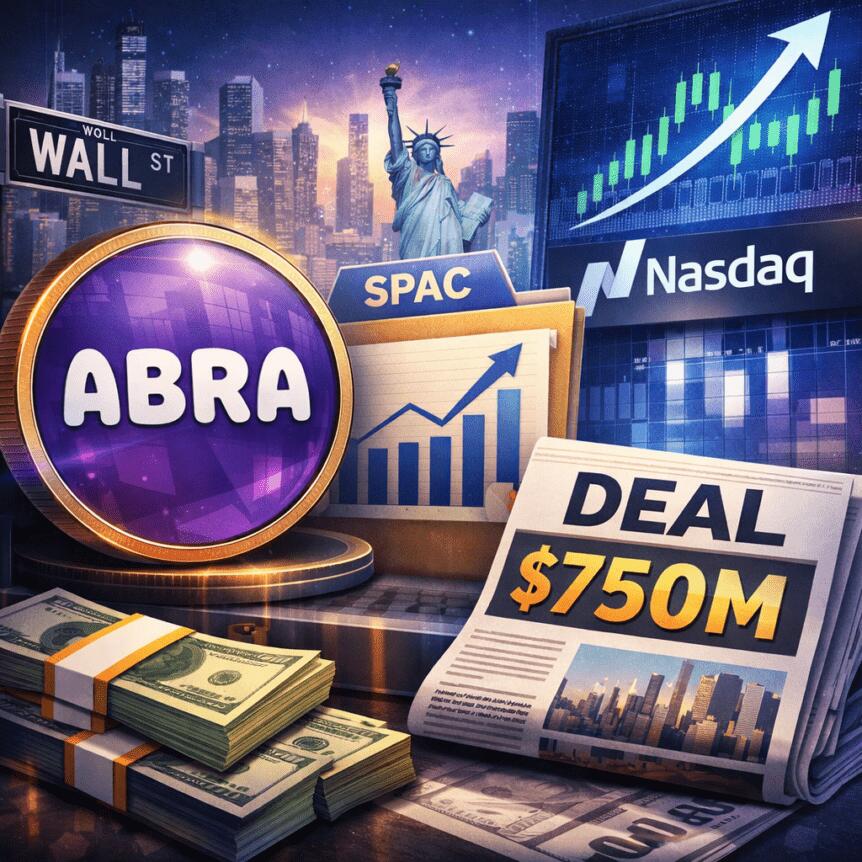
Abra, a digital asset wealth management platform, is pursuing a public listing via a reverse merger with New Providence Acquisition Corp. III, signaling another path for crypto-focused firms to access traditional capital markets as investor appetite for digital assets shows signs of revival. The parties announced that they had signed a definitive agreement that sets Abra’s pre-money equity valuation at $750 million. Existing investors, including Pantera Capital, Blockchain Capital, RRE Ventures, Adams Street and SBI, will roll over their shares into the combined entity rather than cashing out, aligning incentives as the company pivots toward public-market growth. Upon closing, the merged company is expected to trade on Nasdaq under the ticker ABRX (EXCHANGE: ABRX), expanding Abra’s reach into institutional custody, yield strategies, crypto-backed lending, treasury management and trading services.
Abra was founded in 2014 by CEO Bill Barhydt and has grown into a platform serving high-net-worth individuals, institutions and family offices. Its investment-management arm, Abra Capital Management LP, is registered as an investment adviser with the U.S. Securities and Exchange Commission, enabling portfolio management services for select clients. The strategic move comes as Abra reorganizes its U.S. operations in the face of regulatory scrutiny, a theme that has shaped many crypto-adjacent businesses over the past few years.
Abra’s regulatory trajectory has been a focal point of its recent evolution. In 2024, the company reached a settlement with regulators in 25 U.S. states related to its Abra Earn crypto lending product, agreeing to return assets to investors and wind down the program for U.S. clients. The settlement underscored the balancing act between expanding crypto-adjacent wealth management capabilities and adhering to evolving regulatory requirements. The company’s leadership has signaled a shift toward institutional and wealth-management services as part of its long-term strategy.
Public-market ambitions among crypto players have gained renewed attention, with SPACs re-emerging as a route for crypto-adjacent firms to access liquidity and institutional capital, though observers warn of notable risks. Jessica Groza, a partner at Kohrman Jackson & Krantz, noted that while the SPAC model can deliver rapid liquidity and valuation flexibility, it also entails volatility, potential dilution, opaque disclosures, technical complexity and regulatory uncertainty. The commentary reflects a broader industry debate about the best route to public markets as crypto firms balance growth with governance.
In contrast to SPACs, traditional initial public offerings have continued to attract some crypto players. Circle Internet Group stock started trading on the New York Stock Exchange in mid-2025 after a high-profile IPO, illustrating appetite for regulated access to public markets. Gemini followed later that year, debuting on Nasdaq. The broader trend includes other blockchain-focused firms pursuing public-market listings, as well as speculation around hardware and custody players that could follow in the footsteps of this IPO wave. For instance, Ledger has been linked to potential U.S. IPO discussions, and Copper has drawn interest from institutional investors as a crypto-custody and custodial-solution provider seeking public-market access.
Crypto companies increasingly eye public markets
Abra’s planned merger is part of a wider shift where digital-asset companies seek public-market visibility to attract traditional capital. SPAC-focused paths remain appealing to some, given the speed of liquidity and access to institutional investors, but market watchers emphasize the caveats that accompany SPACs, including valuation uncertainties and disclosure complexities. The public-market impulse in crypto wealth management also reflects a desire to standardize governance and reporting as institutions become more comfortable with on-chain and off-chain custody, reporting, and risk controls.
Why it matters
For investors, Abra’s move highlights the ongoing effort to diversify exposure to crypto wealth-management services within regulated structures. A Nasdaq listing could provide greater transparency and a clearer governance framework for clients and counterparties, potentially broadening institutional participation in a space that has historically been characterized by faster-moving private rounds and opaque disclosures. For builders and operators, the case underscores the need to align product strategy with regulatory expectations, particularly as custody, lending and treasury-management offerings mature in parallel with public-market access.
From a market perspective, the Abra transaction contributes to a narrative of crypto firms seeking traditional capital channels while navigating a shifting regulatory landscape. The balance between accelerating growth and maintaining rigorous compliance will shape how future public-market entrants are perceived by buyers, banks and asset managers. As SPAC activity re-emerges and IPOs continue to surface, the industry is watching whether this wave translates into durable liquidity and sustainable business models, or simply a shortened runway shaped by market volatility and evolving policy.
What to watch next
- Closing timeline for the Abra-NPAC III merger and any required regulatory approvals.
- Public trading commencement on Nasdaq for ABRX and subsequent liquidity milestones.
- Regulatory developments affecting Abra Earn-like products and the company’s broader wealth-management offerings.
- Progress of other crypto-adjacent firms pursuing public markets, including any updates on Circle (NYSE) and Gemini (Nasdaq).
Sources & verification
- Abra announces definitive agreement with New Providence Acquisition Corp. III via Business Wire (official press release and details).
- Abra Earn settlement coverage and regulatory context from Cointelegraph (regulatory settlement in 25 states).
- Industry context on SPACs and crypto revival from Kohrman Jackson & Krantz, including commentary by Jessica Groza.
- Public IPO activity in the crypto space: Circle Internet Group stock on NYSE and Gemini on Nasdaq (Cointelegraph coverage).
- Additional related IPO discussions for Ledger and Copper in crypto custody and infrastructure spaces (Cointelegraph coverage).
Abra eyes Nasdaq through SPAC merger, as crypto wealth platforms push into public markets
Abra’s strategy centers on delivering institutional-grade wealth-management services within a regulated structure, leveraging custody, yield strategies, lending and treasury-management capabilities. The SPAC merger with New Providence Acquisition Corp. III, driven by a $750 million pre-money valuation, frames Abra as a diversified, regulated-access platform aimed at institutional clients that demand robust risk controls and clear reporting. By rolling over existing investor positions, Abra signals confidence in the public-market journey and a commitment to continuity for its backers, a signal that could influence how other crypto-native wealth managers evaluate liquidity options in the coming years.
The company’s pivot follows a regulatory episode that underscores the careful navigation required when expanding crypto-backed financial products. Abra Earn’s wind-down and asset returns in 2024 illustrate the tension between growth ambitions and compliance obligations, a balance that public-market investors will scrutinize closely. The SPAC path, while time-efficient and capital-accessible, demands heightened transparency and governance that could reassure risk-averse institutions while presenting new challenges in disclosures and reporting.


The crypto market rose 3.5% to $2.6 trillion on Monday, March 16, as investors returned to risk assets after rotating from traditional hedges.
Summary
- The crypto market rallied as Bitcoin surpassed the $74K resistance as investors rotated away from traditional safe-haven assets.
- Demand for crypto ETFs returned with $1.34 billion in inflows into spot Bitcoin ETFs and nearly $180 million in inflows into Ether-linked funds this month.
- The Crypto Fear and Greed Index has moved back to neutral levels.
Bitcoin (BTC), the world’s leading crypto asset, rallied 4% to break above the $74,000 resistance level for the first time in over five weeks, while Ethereum (ETH) was up 6% over the past 24 hours, trading at $3,243 at press time.
Other major altcoins such as XRP (XRP), Solana (SOL), and Dogecoin (DOGE) recorded gains ranging between 4% and 5% each. Some of the top performers of the day were Pepe (PEPE), Polkadot (DOT), and Bonk (BONK), all of which brought in double-digit gains.
As prices rose, it triggered liquidations of highly leveraged traders in the crypto derivatives markets. According to data from CoinGlass, crypto liquidations mounted to $370 million, with the majority coming from short sellers who were forced to buy back their positions.
The total open interest of the market went up 8% over the last trading session, increasing liquidity across the board and providing the necessary momentum to push the market higher.
The crypto market surged as investors turned toward Bitcoin and other risk assets amid escalating geopolitical tensions in the Middle East that have driven crude oil prices to multi-year highs.
Notably, oil benchmarks like Brent and West Texas Intermediate (WTI) have moved above $95 each. Iran aims to push prices as high as $200 over the coming weeks, sparking global concerns regarding runaway inflation.
Investors seem to be rotating capital from safe-haven assets like gold into cryptocurrencies, likely eyeing digital assets as a better hedge against currency debasement. Notably, the gold price has dropped back under $2,500 after hitting record peaks earlier, while silver prices have dipped by 3% over the past 24 hours.
Data from SoSoValue shows that institutional demand for crypto ETFs has also seen an uptick. U.S. Bitcoin ETFs have drawn in $1.34 billion in net inflows so far in March, while their Ethereum counterparts have experienced $180 million in inflows. In comparison, the SPDR Gold Trust (GLD) has faced consistent outflows over the last two weeks.
The crypto market rebound was a standalone event that deviated from the traditional Asian stock markets today. Notably, Chinese stock indices like the Hang Seng and Shanghai Composite dropped by over 0.70%, while Japan’s Nikkei 225 dropped by over 1.2%.
Market rose as investors bought the U.S.-Iran war news
Crypto prices also rallied today as investors appear to be buying the dip following the initial shock of the U.S.-Iran conflict.
While Bitcoin fell sharply before military actions between the two nations escalated, hitting lows near $63,000 in late February, the current rally suggests the market has already priced in the immediate risks of war.
Crypto Fear and Greed Index returns to neutral threshold
The market rebound also comes as investor sentiment seems to have improved significantly from weeks earlier. The Crypto Fear and Greed Index reading has moved back to neutral levels of 40, up from the extreme fear zone of 16 seen at the beginning of March. As of now, the neutral sentiment seems to have stabilized the floor for major assets.
Will Bitcoin price keep rising?
Looking ahead, the key drivers that will decide the near-term trajectory for the crypto market include the Federal Reserve interest rate decision scheduled for Wednesday and the ongoing progress regarding the conflict in Iran.
Economists generally expect the Federal Reserve to leave interest rates unchanged between 3.50% and 3.75% while hinting at a continued status quo as inflation remains elevated.
If the military conflict shows signs of de-escalation, we could see a sustained relief rally in digital assets. However, any hawkish commentary from the Fed regarding sticky inflation could quickly dampen the current market enthusiasm.
Meanwhile, analysts at Marex also pointed to improving spot market signals that may be supporting the current recovery.
“The Coinbase premium turning positive for the first time in 10 weeks is the kind of detail investors should pay attention to,” Marex analysts noted in a statement to crypto.news.
“It suggests that spot demand is finally returning onshore rather than the move being driven purely by leverage. When the premium flips positive, rallies tend to hold better because real money is lifting offers instead of traders simply closing short positions.”
Disclosure: This article does not represent investment advice. The content and materials featured on this page are for educational purposes only.
Vikings Eye Another Rookie RB

Afghanistan says 400 people killed in Pakistan strike on Kabul hospital
Form 4 Cps Technologies For: 16 March

Smart energy pays enters the US market, targeting scalable financial infrastructure

Why Israel is blocking foreign journalists from entering

Bitcoin: We’re Entering The Most Dangerous Phase

#money #posh #luxury #couple #fashion #british #london #menswear #explore #reels #reelsinstagram #fy

Bitcoin HOLDS STRONG As Global Energy Crisis Unfolds! Should We Be Concerned?

Would you take a $10,000 flight with ANA??#money #finance #flight #travel #vacation
-
 Tech6 days ago
A 1,300-Pound NASA Spacecraft To Re-Enter Earth’s Atmosphere
-
Crypto World3 days ago
HYPE Token Enters Net Deflation as HyperCore Buybacks Outpace Staking Rewards
-

 Business6 days ago
ExxonMobil seeks to move corporate registration from New Jersey to Texas
-

 Fashion3 days ago
Weekend Open Thread: Addict Lip Glow
-

 Tech6 days ago
ChatGPT will now generate interactive visuals to help you with math and science concepts
-
Sports3 days ago
Why Duke and Michigan Are Dead Even Entering Selection Sunday
-

 NewsBeat5 days ago
Residents reaction as Shildon murder probe enters second day
-

 Business1 day ago
Search for Savannah Guthrie’s Mother Enters Seventh Week with No Arrests
-

 Business6 days ago
Search Enters Sixth Week With New Leads in Tucson Abduction Case
-

 Business3 days ago
US Airports Launch Donation Drives for Unpaid TSA Workers as Partial Government Shutdown Enters Fifth Week
-

 NewsBeat6 days ago
I Entered The Manosphere. Nothing Could Prepare Me For What I Found.
-
Crypto World2 days ago
Coinbase and Bybit in Investment Talks: Could Bybit Finally Enter the US Crypto Market?
-

 Sports5 days ago
PWHL, Senators discussing plan to keep Charge in Ottawa
-

 Business17 hours ago
Australian shares drop as Iran war enters third week
-

 Business3 days ago
Country star Brantley Gilbert enters growing non-alcoholic beer market
-

 Crypto World17 hours ago
Crypto Lender BlockFills Enters Chapter 11 with Up to $500M in Liabilities
-
 Crypto World7 days ago
Will Chainlink price reclaim $10 amid volatility squeeze?
-

 Sports3 days ago
College Basketball Best Bets: Conference Tournament Semifinal Picks
-

 Politics6 days ago
Trump Says Middle East Is ‘Very Lucky’ That He’s President
-
 Crypto World5 days ago
Three Binance Charts May Be Hinting at Bitcoin’s Next Move


You must be logged in to post a comment Login