
Crypto World
Bitcoin Holders Move to Cash as Volatility Remains High

Bitcoin (BTC) holders are gradually becoming less prone to panic selling and instead building up cash buffers to deploy during discounted BTC buying opportunities. Onchain data supports this view, highlighting a large surge in stablecoin activity, with USD Coin (USDC) and Tether’s USDt (USDT) transfers reaching a combined $440 billion on March 22.
This shift in investor behavior aligns with the increasing risk-off approach seen in markets as the United States Federal Reserve dismissed near-term interest rate cut expectations, amid rising energy prices due to the ongoing US and Israel-Iran war.
Bitcoin realized volatility expands, but investors are cool headed
Bitcoin’s recent price action highlights a volatile market. It dropped 3.75% to $67,300 on Sunday before rebounding above $71,700 on Monday, with the move largely driven by news around the US and Israel-Iran war.
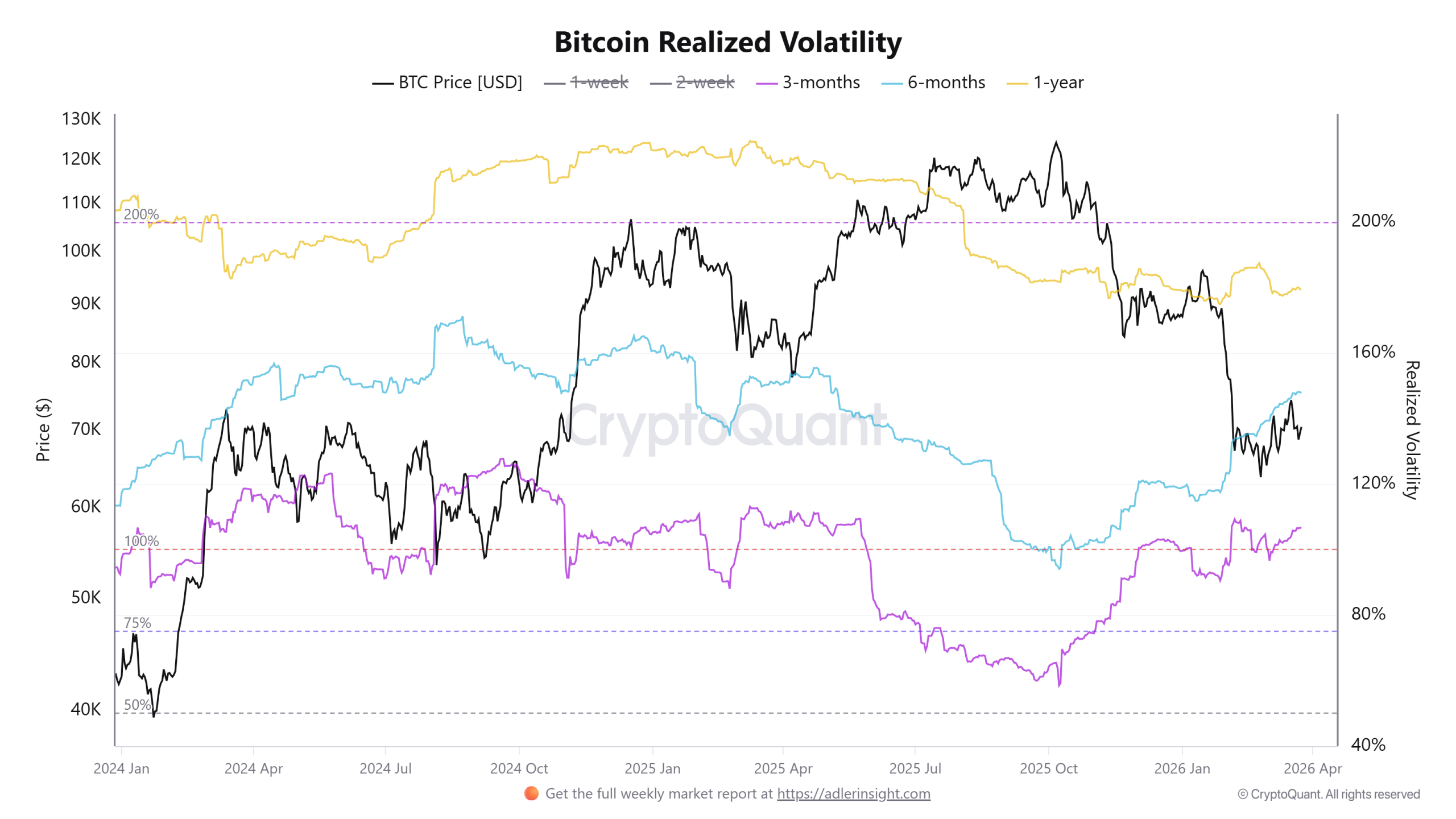
As a result, BTC’s realized volatility, which measures how much the price has actually moved over a given period, remains elevated across multiple time frames. The three-month and six-month realized volatility measures have climbed to 107% and 148%, respectively, up from 60% and 94.5% over the past six months.

However, the long-term one-year realized volatility has remained unchanged near 180% during this period. That suggests the market isn’t in full panic mode, and it is dealing with uncertainty without widespread forced selling.
Stablecoin flows provide important context for this environment. On March 22, the total number of USDC tokens transferred surged to 368 billion, marking a roughly 2,081% daily increase to an all-time high, while USDT transfers on the Ethereum network reached 72 billion.

These stablecoin flows point to a rapid capital rotation and repositioning. The market participants are actively moving funds into stablecoins as a temporary store of value, creating a “cash buffer” that can be redeployed quickly.
This dynamic often emerges in volatile conditions, where traders may prioritize monitoring the price over high exposure.
Related: What happens to Bitcoin if US bond yields soar above 5%?
Spot and futures activity remain below bull market highs
Futures data further reinforces the current sidelined sentiment. BTC open interest (in USD) is down $19 billion over the past six months, indicating a steady reduction in leveraged exposure. This unwind reflects a market that is de-risking rather than building aggressive positions.

Aggregated funding rates have cooled to 0.01% from overheated levels near 0.1% in July-August 2025, occasionally flipping negative, while the perpetual futures premium continues to trade at a discount to spot.
Together, these signals point to subdued leverage demand and a market lacking strong directional conviction, with a slight bearish tilt.
The spot market activity paints a similar picture. Cointelegraph reported that Binance is on track to record its lowest monthly spot volume since September 2023, with volumes hovering near $52 billion.
The current participation levels align more closely with periods of reduced engagement seen during prior bear market cycles in 2022-2023.
Thus, the crypto market has strong liquidity, with capital actively moving through stablecoins, but it isn’t being deployed into Bitcoin yet, and BTC holders continue to observe the current market.
Related: Bitcoin value ‘off the chart’ as BTC price metric hits record lows in 2026
This article does not contain investment advice or recommendations. Every investment and trading move involves risk, and readers should conduct their own research when making a decision. While we strive to provide accurate and timely information, Cointelegraph does not guarantee the accuracy, completeness, or reliability of any information in this article. This article may contain forward-looking statements that are subject to risks and uncertainties. Cointelegraph will not be liable for any loss or damage arising from your reliance on this information.


Key Highlights
- Meta shares decline 1.86% to $593.11 following AI processor collaboration announcement
- Company partners with Arm to create specialized CPUs for artificial intelligence operations
- Arm AGI CPU designed for AI model training, inference operations, and general computing
- Custom processor aims for enhanced data center efficiency and performance metrics
- Collaboration marks strategic pivot toward proprietary silicon and AI-focused infrastructure
Meta Platforms (META) shares traded down to $593.11, representing a 1.86% decline, after the social media giant announced a strategic CPU partnership with Arm. The stock experienced consistent downward movement throughout the trading session with sustained seller activity. The announcement underscored Meta’s evolving approach to building specialized infrastructure for enterprise-scale artificial intelligence operations.
Strategic CPU Collaboration Advances Meta’s Hardware Vision
Meta announced a strategic alliance with Arm to engineer a novel category of processors dedicated to artificial intelligence workloads. The initiative addresses escalating computational requirements throughout Meta’s expanding infrastructure footprint. This collaboration represents a significant step in the company’s ongoing commitment to proprietary hardware development.
The inaugural chip, designated as the Arm AGI CPU, specifically addresses AI model training and inference operations. The processor simultaneously handles general-purpose computational tasks throughout Meta’s technology stack. This dual capability enhances Meta’s capacity to deploy sophisticated AI systems at scale.
Meta actively expands its hardware portfolio through both internal innovation and collaborative partnerships. The Arm AGI CPU complements Meta’s existing MTIA silicon architecture for enhanced operational synergy. This multi-pronged strategy creates a more versatile and resource-efficient computing infrastructure.
Arm AGI CPU Delivers Advanced Performance Metrics
The Arm AGI CPU represents a novel architecture for data center computing optimized for artificial intelligence applications. The design prioritizes maximizing performance density per rack while minimizing power consumption. This engineering focus enables large-scale AI implementations with superior resource efficiency.
Arm engineered the processor to coordinate distributed AI operations across memory hierarchies, storage arrays, and network fabrics. Reference implementations demonstrate rack configurations delivering thousands of processing cores in space-efficient designs. Furthermore, liquid cooling implementations enable substantial scaling for computation-intensive applications.
The processor architecture targets superior performance compared to conventional x86 platforms in both density and operational efficiency metrics. Arm projects substantial cost reductions for enterprise-scale data center implementations. This value proposition addresses industry requirements for economically viable AI infrastructure expansion.
Industry Implications and Future Development Roadmap
Meta has substantially increased infrastructure capital allocation to enable sustained AI innovation. The company recently expanded GPU procurement through strategic agreements with leading chip manufacturers. Furthermore, internal roadmaps detail multiple proprietary AI processors currently under development.
Arm’s transition into direct data center processor manufacturing represents a departure from its historical licensing business model. The company now establishes itself as a primary contributor in AI-optimized silicon innovation. This strategic repositioning reflects transforming competitive dynamics within semiconductor architecture and commercial deployment.
Meta intends to distribute board specifications and rack blueprints via the Open Compute Project within the current calendar year. This open-source strategy may expedite implementation throughout data center infrastructure providers and technology enterprises. Expanded ecosystem engagement demonstrates increasing industry momentum toward AI-specialized computing platforms.


Key Highlights
- GameStop stock declines despite exceeding earnings forecasts and building substantial cash holdings
- Company surpasses profit expectations while total revenue experiences significant year-over-year contraction
- Aggressive expense management elevates profit margins despite declining sales figures
- Collectibles division expansion counterbalances softness in gaming hardware and software categories
- Robust financial position enhanced by $9B in liquid assets and cryptocurrency investments
GameStop Corp.(GME) experienced a downturn to $22.81, representing a 0.96% decrease, even as the company delivered stronger-than-expected profitability and maintained a formidable cash position. Extended trading hours witnessed additional pressure, with shares declining to $22.68, marking another 0.58% retreat. This negative momentum emerged during the final trading session despite the retailer showcasing enhanced earnings performance and substantial liquidity improvements.
Profitability Surges While Top-Line Sales Contract
GameStop delivered fourth-quarter adjusted earnings of $0.49 per share, surpassing Wall Street consensus estimates of $0.37. Conversely, total revenue came in at $1.1 billion, falling short of projections and marking a 13.9% year-over-year decrease. This divergence highlighted the company’s ability to enhance bottom-line performance while grappling with persistent sales challenges.
Adjusted operating income climbed substantially to $147.7 million, up from $84.4 million recorded in the corresponding quarter last year. Net income totaled $127.9 million, marginally trailing the previous year’s comparable result. Consequently, disciplined expense management and enhanced operational performance bolstered earnings despite ongoing revenue headwinds.
For the complete fiscal year 2025, GameStop generated adjusted net income of $647.4 million, representing a dramatic increase from $131.2 million previously. Operating income reversed course, delivering a positive $232.1 million versus the prior year’s loss. The retailer achieved a remarkable transformation in overall profitability throughout the entire fiscal period.
Liquidity Expands With Cryptocurrency Holdings
GameStop dramatically bolstered its cash reserves, with liquid assets and equivalents surging to $9.0 billion from $4.8 billion. Additionally, the retailer disclosed Bitcoin holdings and associated receivables totaling $368.4 million as of quarter close. Accordingly, the financial position demonstrated enhanced strategic flexibility and meaningful digital currency involvement.
Selling, general, and administrative costs decreased to $241.5 million from $282.5 million year-over-year. Reduced overhead expenses facilitated margin expansion and elevated adjusted profitability metrics. This strategic cost management underpinned financial gains amid persistent revenue challenges.
Full-year SG&A expenditures similarly contracted to $910.2 million from $1.130 billion in the prior fiscal year. Concurrently, adjusted operating income advanced to $289.5 million, completely reversing the previous year’s deficit. Thus, operational efficiency initiatives remained central to overall financial achievement.
Product Category Performance Reveals Strategic Pivot
GameStop’s collectibles division demonstrated impressive momentum, generating $365.0 million and representing 33.1% of overall revenue. Conversely, hardware and accessories revenue contracted to $535.6 million from $725.8 million. Likewise, software category sales dropped to $203.7 million from $286.2 million.
This evolving revenue composition demonstrated a strategic reorientation toward higher-margin product categories including collectibles. Core gaming merchandise categories encountered persistent demand weakness and diminished revenue generation. Management strategically reallocated resources toward divisions demonstrating superior growth characteristics.
Total annual sales decreased to $3.630 billion from $3.823 billion in the preceding fiscal year. Enhanced profitability metrics and aggressive cost management mitigated the revenue decline’s financial impact. Therefore, overall results illustrated a deliberate evolution toward a streamlined and more profitable business framework.


London-based crypto-friendly fintech giant Revolut reported record earnings for 2025 as it scales across new markets.
Profit before tax rose 57% year over year to $2.3 billion, while revenue climbed 46% to $6 billion, according to its annual report. The company posted its fifth straight year of net profit, which stood at $1.7 billion for 2025, with margins improving to 38%.
Growth came from a wider mix of services. Card payments, subscriptions, foreign exchange and wealth products each contributed meaningful income. Eleven business lines generated more than $135 million each, the firm said.
Customer activity also surged. Total balances increased 66% to $67.5 billion, while transaction volume reached $1.7 trillion. Revolut added 16 million retail users, bringing its total to 68.3 million. Business accounts rose to 767,000.
Regulatory progress remains central to its strategy. The firm now operates as a licensed bank in more than 30 markets, which earlier this month started including the U.K., and has filed for a U.S. banking license.
Revolut plans to invest $13 billion over five years and aims to reach 100 million customers by 2027, it said. The firm lets users buy and sell crypto through its platform, including through a dedicated exchange called Revolut X.
Crypto World
Tether Engages Big Four Firm for Its First Full Independent Audit in Digital Asset History

TLDR:
- Tether engaged a Big Four accounting firm for its first full independent audit in digital asset market history.
- The audit covers over $184 billion in USD₮ market cap, making it the largest inaugural audit in financial markets.
- CFO Simon McWilliams confirmed Tether already meets Big Four audit standards ahead of the formal review process.
- The audit moves Tether beyond standard stablecoin attestations, raising the accountability bar for all digital asset issuers.
Tether has engaged a Big Four accounting firm to conduct its first full independent financial audit. The stablecoin issuer, managing over $184 billion in market capitalization, made the announcement on March 24, 2026.
This move positions the company beyond standard attestation practices common among stablecoin issuers. With more than 550 million users globally, the audit is expected to be the largest inaugural audit in financial market history.
Tether Sets a New Benchmark for Stablecoin Transparency
The engagement followed a competitive selection process involving several major accounting firms. Each firm conducted a thorough assessment of Tether’s systems, internal controls, and financial reporting.
Multiple stakeholders participated during the onboarding phase, which concluded weeks before the announcement. The level of interest from audit firms reflects how closely the industry is watching this development.
CEO Paolo Ardoino spoke directly to the weight of the decision. “Tether’s mission has always been to build trust through action, not promises,” he said.
He further noted that trust is built when institutions are willing to open themselves fully to scrutiny. For users and businesses relying on USD₮ daily, this process is about accountability, resilience, and long-term confidence in the infrastructure they depend on.
CFO Simon McWilliams, appointed in early 2025, has been central to preparing the company for this process. He stated clearly that “the organisation is already operating at Big Four audit standard; the audit will be delivered.”
His appointment marked a turning point in the company’s internal governance and financial architecture. His leadership helped build the systems needed for a fully independent review.
Tether has consistently retained earnings within its ecosystem rather than distributing profits externally. Capital remains available in affiliated proprietary holding companies to support USD₮ stability.
As part of the audit process, the company will move listed securities in the coming days. The ongoing audit will provide full visibility into how those reserves are positioned.
Currently, attestations remain the industry standard for stablecoin issuers. Tether is moving beyond that floor toward a full audit that carries far greater scrutiny.
This shift reflects a broader push for institutional-grade accountability across the digital asset sector. Other issuers are now likely to face increased pressure to follow suit.
What the Audit Means for USD₮ Users and the Broader Market
Ardoino described the audit as representing “years of work to strengthen our systems so that Tether can meet the highest standards applied in global finance.”
That preparation involved expanding governance structures, tightening financial controls, and aligning reporting processes with Big Four expectations. The result is a company that entered the audit engagement from a position of readiness rather than obligation.
The audit process covers a uniquely complex mix of digital assets, traditional reserves, and tokenized liabilities. Few institutions outside major sovereign entities operate at a comparable scale.
That complexity makes the review one of the most technically demanding audits ever attempted. Completing it successfully would mark a major milestone for digital asset infrastructure.
Tether has also worked with global law enforcement to identify illicit activity and freeze unlawful funds. These efforts have strengthened USD₮’s reputation as a reliable digital dollar.
Combined with robust compliance systems, the audit adds another layer of credibility to its reserve management practices.
Tether’s broader mission centers on financial access in regions where traditional banking systems are limited or fragile. Open digital dollars, in the company’s view, are essential to enabling economic opportunity.
The audit supports that mission by reinforcing the trustworthiness of the underlying infrastructure. Users in underserved markets stand to benefit directly from greater institutional confidence in USD₮.
The company has invested heavily in governance, risk management, and internal controls over recent years. Those investments laid the groundwork for meeting Big Four audit requirements.
Moving forward, Tether aims to use this audit as a foundation for continued transparency efforts. The result could reshape how the broader market evaluates stablecoin issuers going forward.
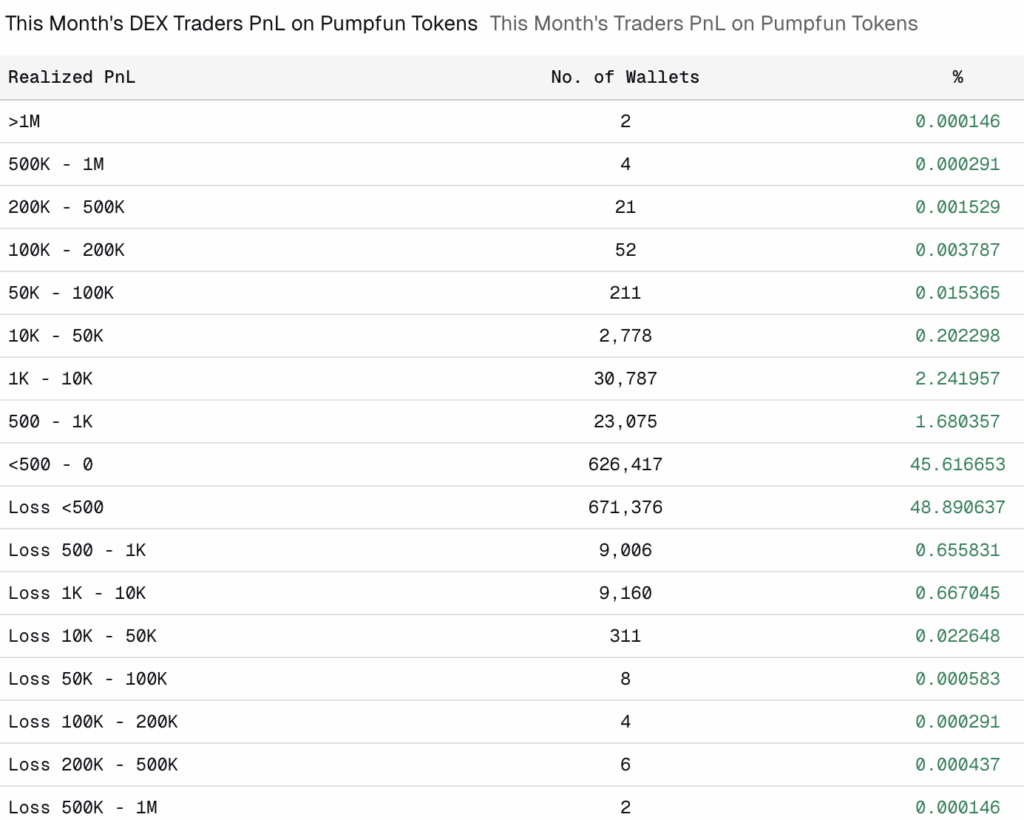
Around 96% of crypto wallets trading Pump Fun-launched tokens have made less than $500 in the past month, with over 50% posting a loss.
That’s according to Dune analytics compiled by analyst @oladee.
Oladee’s data shows that 45.6% of traders made profits up to $500, while 50.6% suffered losses.
The figures were apparently misreported by market analyst Ted Pillows who claimed that they showed 96% of Pump Fun token traders on decentralised exchanges had suffered PnL losses this month.
On the contrary, two wallets made over $1 million trading Pump Fun tokens this past month. On the other end of the scale, two lost anywhere between $500,000 and $1 million.
Read more: X Creators $1M prize winner exposed as memecoin pump-and-dumper
It’s worth noting that the data just shows the number of wallets, and that individual traders can create multiple wallets if they want to.
Pump Fun token launchers are making bank
While the majority of individuals trading these tokens aren’t making bank, the ones deploying them certainly are.
According to crypto analyst Dethective, the top 250 deployers of Pump Fun tokens have extracted $79 million from traders.
Dethective added that these 250 wallets only deployed around 10 tokens that managed to exceed a market cap of $5 million. The wallets also launched 194,000 tokens over the past six months.
Read more: Binance token listing no longer a ‘bullish’ event, research
Dethective notes that his findings don’t necessarily represent 250 different people, but are specifically 250 crypto wallets.
Pump Fun token down 80%, and there’s still no airdrop
Pump Fun has recently pivoted towards AI and the emerging sector of agentic trading that involves AI software trading on your behalf.
In this spirit, the memecoin platform announced a system of automated buyback options for third-party AI agents.
This feature wasn’t well received by Pump Fun traders on X who are still restless over the platform’s reluctance to roll out an airdrop that it said, 258 days ago, would be coming “soon.”
Read more: Crypto firms cut jobs as bear market and AI shift bite
Pump Fun hasn’t addressed its airdrop on X since then, and it’s unclear what its current status is. The price of its $PUMP token is down 80% from it’s all-time-high of $0.008819 in September last year.
One factor that might be delaying things is the ongoing crypto bear market and the wider economic fallout from the US-Israel war against Iran.
Indeed, last week, crypto exchange Kraken announced that it was delaying the launch of its initial public offering until “market conditions improve.”
NFT platform OpenSea also announced that it would delay launching its $SEA token due to the “challenging” market conditions across crypto.
Got a tip? Send us an email securely via Protos Leaks. For more informed news and investigations, follow us on X, Bluesky, and Google News, or subscribe to our YouTube channel.

Implied volatility indicators suggest peak fear has passed, with crypto markets leading traditional finance in pricing risk, even as BTC USD struggles to reclaim key support. Trading near $70,000 following a 2% corrective slide over the last 24 hours, the market leader is flashing conflicting signals.
While some traders worry BTC USD could see a deeper sell-off toward the mid-$50k region, one key metric suggests the bottom may already be behind us.
Currently, the Fear & Greed Index sits at a trepidatious 26 (Fear), yet prediction markets remain skeptical of immediate upside. As Bitcoin mirrors Wall Street structure post-ETF, savvy capital is beginning to rotate into high-beta infrastructure plays to outpace the grind.
JUST IN: $880 billion Bernstein says the Bitcoin bottom is likely in and BTC is set to go up from here — Bitcoin Magazine (@BitcoinMagazine) March 24, 2026

They're targeting $150,000  pic.twitter.com/Ng7KGMojQ8
Discover: The best crypto to diversify your portfolio with
Can BTC USD Reclaim $76,000 Before Month End?
Bitcoin is currently trapped in a corrective descending channel, and it is trading at the $70,000 level, down from recent attempts to breach resistance, signaling heavy overhead pressure.
However, the medium-term outlook retains bullish targets. Data projects a potential rebound to $76,000 by the end of this month, implying an 9% upside if bulls can defend immediate support levels. Conversely, failure to hold the $68,230 line could validate a steeper drop.

Sellers remain in control below $77,500. Their forecast warns that without a clean breakout, the price could revisit $55,500, or a brutal 21% haircut from current levels.
Discover: The best pre-launch token sales
Bitcoin Hyper Targets Early Mover Upside as Bitcoin Tests Key Levels
While Bitcoin navigates this choppy consolidation phase (often a prelude to violent moves), smart money is hedging against stagnation by targeting infrastructure scalability. The logic is simple: if Bitcoin is the gold, the rails moving it are the shovels. This shift has funneled massive volume into Bitcoin Hyper ($HYPER), the first-ever Bitcoin Layer 2 to integrate the Solana Virtual Machine (SVM).
The project has raised a staggering $32 million, capitalizing on the demand for high-speed programmability on Bitcoin. By utilizing the SVM, Bitcoin Hyper delivers transaction speeds faster than Solana itself, all while anchoring to Bitcoin’s security layer. It addresses the ecosystem’s “trilemma” by fixing slow transactions and high fees without sacrificing trust.
Priced at just $0.0136 on presale stage, $HYPER offers a distinct risk-reward profile compared to established caps.
Early backers are positioning for the high-staking 36% APY rewards and the Decentralized Canonical Bridge, which facilitates seamless BTC transfers.
Disclaimer: Crypto is a high-risk asset class. This article is provided for informational purposes and does not constitute investment advice.
The post BTC USD To Reserve: Is Now The Time to Buy? appeared first on Cryptonews.

BitMine pushed the corporate crypto race forward after it spent more on Ethereum than Strategy spent on Bitcoin last week. Arkham‑linked data put BitMine’s weekly ETH purchase at $140.74 million, while Strategy’s weekly Bitcoin buy reached $76.6 million. As a result, the week highlighted stronger balance-sheet demand from institutions across the two largest cryptocurrencies.
BitMine Drives Ethereum Treasury Higher
BitMine accelerated its Ethereum strategy and pushed its treasury closer to another major supply milestone in March. The company said it held 4,660,903 ETH on March 22, valued at about $10.03 billion. That stockpile represented 3.86% of Ethereum’s 120.7 million token supply and kept BitMine ahead in the treasury ranking.
Moreover, BitMine said its combined crypto, cash, and related holdings totaled $11 billion after the latest accumulation round. Those assets included $1.1 billion in cash, 196 Bitcoin, and several equity stakes outside its token reserves. Meanwhile, the company kept Ethereum as its primary treasury reserve asset and its main accumulation target.
TOM LEE JUST BOUGHT MORE CRYPTO THAN SAYLOR pic.twitter.com/1GSFLdvKdS
— Arkham (@arkham) March 24, 2026
BitMine also expanded staking, and that move strengthened its Ethereum exposure beyond simple token accumulation. As of March 23, the company had staked 3,142,643 ETH, worth about $6.5 billion at stated prices. That total equaled roughly 67% of BitMine’s ETH holdings and added another revenue stream from network validation.
Strategy Adds Bitcoin but Trails on Weekly Pace
Strategy still added Bitcoin last week, but its reported pace trailed BitMine’s Ethereum buying by a wide margin. Market reports said the company bought 1,031 BTC for about $76.6 million during the same period. Consequently, BitMine’s weekly purchase exceeded Strategy’s by more than $64 million and led the week’s treasury comparison.
Even so, Strategy remained the largest treasury holder across the public-company crypto market by overall asset size. BitMine’s latest company update valued Strategy’s Bitcoin holdings at about $52 billion, keeping Bitcoin ahead on scale. That position preserved Bitcoin’s lead in corporate reserves, while Ethereum gained ground through BitMine’s faster buildup.
The contrast reflected different treasury timelines, and it highlighted different methods of corporate crypto accumulation. Strategy built its Bitcoin position over the years, whereas BitMine scaled its Ethereum treasury within several recent months. Therefore, Ethereum treasury companies now command more attention in public-market coverage and treasury strategy discussions.
Institutional Adoption Broadens Across Both Assets
BitMine did not begin as an Ethereum treasury company, and that background adds context to its rapid expansion. The firm operated as a Bitcoin miner before it redirected excess capital into Ethereum reserves and staking activity. By August 2025, it had become the largest publicly disclosed Ethereum treasury, according to market reporting.
Now, BitMine aims to acquire 5% of Ethereum’s supply, and that target frames its current buying campaign. Arkham-linked reporting estimated another $359 million of ETH would take holdings to the 4% threshold. Accordingly, the latest purchase kept BitMine within reach of another symbolic marker in the Ethereum market.
Together, the latest moves showed institutional adoption through direct treasury allocation rather than passive market products. Ethereum gained a sharper corporate benchmark, and Bitcoin kept its established treasury leader in public markets. For now, public companies continue to widen crypto treasury competition across both assets and across balance sheets.
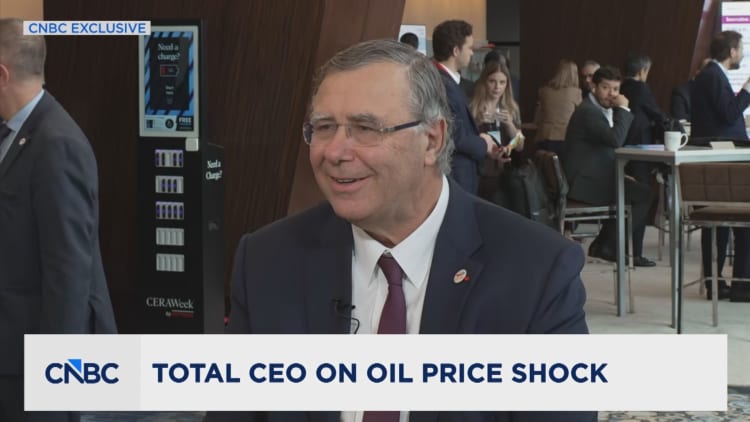

Roughly 15% of TotalEnergies’ production is offline, as the war with Iran nears the one-month mark, but surging oil prices have more than made up for the lost barrels, chairman and CEO Patrick Pouyanné told CNBC in an exclusive interview.
With Brent crude trading solidly above $100 a barrel, much of the attention has focused on oil prices, but Pouyanné said the crisis is having a much larger impact on product prices.
“The Brent market is ok, but the products market, which is the one which impacts customers … is much higher than Brent,” he told CNBC at S&P Global’s CERAWeek energy conference in Houston. He added, the world has “never experienced” refining margins from products including Asian jet fuel at current levels. In addition to petroleum products, about 30% of global fertilizer moves through the Strait of Hormuz, jeopardizing the spring planting season.
TotalEnergies is a major player in the global LNG market, including the largest exporter of U.S. LNG. The CEO said the company can still fulfill customer orders in Europe and Asia thanks to its diversified global portfolio.
Last week, QatarEnergy said its Ras Laffan plant suffered “extensive damage” following Iranian drone attacks, effectively taking 20% of global LNG supply offline. The shutdown has sent natural gas prices in Europe and Asia surging.
Pouyanné expects prices could move substantially higher if the war drags on through the summer, since Asian demand rises over the summer just as Europe looks to refill storage. European natural gas traded around $18 per million British thermal units Tuesday, but Pouyanné said prices could hit $40/MMBtu over the summer if the conflict continues.
TotalEnergies is a major investor in U.S. energy. On Monday, it struck a deal with the Trump administration to abandon its offshore wind projects in return for $1 billion. The company agreed to reinvest the money into U.S. oil and gas projects instead.
The federal government is key for offshore wind permitting, and the current administration has been a vocal critic of the industry. Pouyanné said he did not want to litigate with the administration over its offshore wind leases – acquired under former President Joe Biden – and so approached the administration with a deal. He added that in the U.S. offshore wind no longer makes sense given cheaper alternatives.
“In the specific situation of the U.S., where you have a lot of land, you have a lot of gas, you have a lot of coal, you have a lot of land to build onshore solar, onshore wind, batteries, we don’t need to have offshore wind,” he said. “It’s a marginal technology, which is not affordable.”
“I prefer to allocate my capital to technologies which are more efficient, which give affordable electricity to customers,” he said.
As part of its expanding U.S. portfolio, TotalEnergies recently inked a 15-year agreement with Google to supply renewable power for data centers. Pouyanné said other hyperscalers – including Amazon and Microsoft – are now speaking to TotalEnergies directly.
“These hyperscalers have understood that an energy company – like TotalEnergies – because we have also capacity, not only to build, to invest, to have land, to trade, we were quite a good partner for them,” he said.
BlackRock’s head of digital assets, Robbie Mitchnick, signaled a shift in how large investors view crypto, pointing to artificial intelligence (AI) as a more meaningful driver than the expansion of new tokens.
Speaking about client behavior, Mitchnick described a market that has moved away from broad exposure to smaller assets. He said the turnover among top tokens has been “pretty ferocious,” with only bitcoin and, later, ether (ETH) maintaining consistent positions. Many newer tokens, he suggested, fail to hold long-term relevance.
That pattern has shaped investor demand. “The majority of that is nonsense,” Mitchnick said at the Digital Asset Summit in New York on Tuesday, referring to the vast number of tokens in circulation. As a result, clients now focus on a narrow set of assets rather than building wide portfolios. Bitcoin and Ethereum dominate allocations, with limited interest beyond those names.
Against that backdrop, Mitchnick pointed to AI as a more significant force shaping crypto’s future role. He stressed that AI is a larger theme than digital assets, but said the two intersect in ways that could matter.
“AI agents are very unlikely to use, you know, Fedwire and SWIFT,” he said. “What is crypto? Crypto is computer-native money… AI is computer-native data and intelligence. And so there’s a natural symbiosis there.”
That framing casts crypto less as a speculative asset class and more as infrastructure. A growing number of bitcoin miners have begun shifting resources toward AI workloads, drawn by steadier revenue and rising demand for computing power. Several listed miners, including Hut 8 (HUT), Core Scientific (CORZ) and Iren (IREN), are either repurposing data centers or signing hosting deals tied to AI and high-performance computing. Others have signaled similar plans, even if mining remains their core business.
Mitchnick also linked AI-driven disruption to bitcoin’s appeal. As new technologies reshape industries and create uncertainty, he suggested bitcoin may serve as a stabilizing allocation. It can act as a diversifier during periods of rapid change.
“There are intersection points that are relevant… there’s clearly an advantage and an opportunity to play a role in the AI economy,” he said.

Circle is expanding the use of its USD Coin (USDC) across Africa through a strategic partnership with Sasai Fintech. The collaboration aims to weave USDC into Sasai’s payments fabric, covering cross-border transfers, enterprise payments, and consumer wallets, with the goal of lowering costs and shortening settlement times for users across multiple markets.
In a Business Wire release, Circle and Sasai described integrating USDC into Sasai’s infrastructure to unlock practical on-chain use cases for the stablecoin within Sasai’s network. Sasai operates digital payments services across several African markets, and the partnership would connect Circle’s on-chain rails with Sasai’s cross-border and mobile-payment ecosystem.
Circle CEO Jeremy Allaire framed the collaboration as part of the company’s broader focus on high-growth payment corridors in emerging markets, while Cassava Technologies Chairman Strive Masiyiwa highlighted the potential to broaden access to digital financial services for both businesses and consumers.
Data from DefiLlama shows USDC remains the second-largest stablecoin by market capitalization, at roughly $78.6 billion, trailing only Tether’s USDT, which sits around $184.1 billion. The size of USDC liquidity underscores the potential scale that could flow into Africa’s payments rails as the ecosystem grows.
The rise of crypto and stablecoins in Africa
Africa has witnessed a notable uptick in crypto activity, with Sub-Saharan Africa showing a 52% year-over-year increase in on-chain activity in the 12 months through June 2025, tallying more than $205 billion in on-chain value, according to Chainalysis data cited in recent market coverage. Nigeria accounted for the largest share of that activity—over $92 billion—followed by South Africa, Kenya, Ethiopia, and Ghana. Remittances, cross-border payments, and hedging against currency volatility are among the leading use cases driving this surge.
The region’s crypto expansion is drawing attention from global players expanding into Africa. For example, Blockchain.com announced Ghana-focused expansion as part of its broader push across the continent, reflecting growing demand for retail and institutional access to digital assets and stablecoins as a payment and settlement layer.
Regulatory developments are also beginning to mature alongside growth. Ghana’s Securities and Exchange Commission approved 11 crypto trading platforms to operate within a regulatory sandbox framework under the country’s Virtual Asset Service Providers Act, signaling a structured pathway for crypto services to scale with oversight.
Beyond the technology itself, policymakers and industry participants emphasize stablecoins as a faster, lower-cost alternative to traditional remittance routes. The World Bank continues to highlight an urgent cost challenge: while the global target is to bring average remittance costs below 3%, many economies in Sub-Saharan Africa still register higher levels. A World Bank analysis noted that in 2023 several economies, including Sierra Leone, Uganda, Angola, Botswana, and Zambia, faced remittance costs above 7%.
What this partnership signals for investors and users
The Circle–Sasai collaboration arrives as Africa’s payments ecosystem matures, with an emphasis on onboarding more people into digital finance through stablecoins and mobile-first services. For investors, the deal highlights a growing preference among builders and operators to anchor on-chain liquidity with regionally relevant rails. By anchoring USDC into Sasai’s breadth of services—cross-border transfers, enterprise payments, and consumer wallets—the collaboration could reduce settlement times and processing costs for a broad set of use cases, from small-business payments to worker remittances.
For users, the on-ramp to digital finance in Africa can become more accessible and affordable as stablecoin rails are integrated with everyday payment flows. The combination of Sasai’s regional reach and Circle’s global on-chain platform could create a more seamless experience for individuals and businesses moving money across borders or paying suppliers in other countries, with USDC serving as the common settlement asset.
On the regulatory front, the Ghana sandbox move demonstrates how governments are approaching crypto infrastructure with a combination of oversight and opportunity. This framework can help standardize participation for exchanges and wallets while preserving consumer protections, a development that could encourage broader adoption and more predictable interoperability between on-chain assets and traditional payment rails.
Another dynamic to watch is the broader regional push by established crypto firms into Africa. The combination of rising adoption, improving regulatory clarity, and the entry of global players into local ecosystems could accelerate the velocity of stablecoin use, especially in corridors where remittances and cross-border payments have historically been costlier and slower. If the trend continues, we could see more enterprise-grade solutions built on USDC that specifically target Africa’s fragmented payment landscape, potentially unlocking new business models for remittance corridors, supplier payments, and consumer wallets alike.
The next few quarters will be critical for measuring impact. Key questions include how quickly Sasai can operationalize USDC rails across its markets, what the actual cost savings look like for end users, and how regulators across the region balance supervision with innovation. Market participants will also be watching for concrete usage metrics—volume, settlement times, and cross-border transaction costs—as real-world adoption begins to take hold. As Africa’s crypto infrastructure evolves, collaborations like Circle and Sasai’s could lay the groundwork for a more inclusive digital economy where stablecoins help bridge traditional finance and mobile-first financial services.
Readers should watch for updates on deployment milestones, regulatory progress, and early usage data from Sasai’s network as USDC-enabled services begin to roll out across the continent. The collaboration represents more than a single partnership; it signals a notable shift toward scalable, on-chain payment rails tailored for Africa’s distinctive market dynamics.

Alix Earle Reveals What Really Happened During Podcast Hiatus

PLTY: Income Investment Based on Palantir (NYSEARCA:PLTY)
Meta Platforms (META) Stock Dips 1.86% Following Arm CPU Partnership Announcement

Smart energy pays enters the US market, targeting scalable financial infrastructure

Why Israel is blocking foreign journalists from entering

Bitcoin: We’re Entering The Most Dangerous Phase

Vile Cheater Exposed On Financial Audit | Caleb Hammer Clips

Financial Flex with SPEED #nfl #financialflex #ishowspeed #relatable #xyzbca #ronaldo

Nvidia’s one of the fastest growing companies with one of the lowest valuations, says Jim Cramer
-
 Crypto World4 days ago
NIO (NIO) Stock Plunges 6.5% as Shelf Registration Sparks Dilution Worries
-

 Fashion4 days ago
Weekend Open Thread: Adidas – Corporette.com
-

 Politics4 days ago
Jenni Murray, Long-Serving Woman’s Hour Presenter, Dies Aged 75
-

 Crypto World3 days ago
Best Crypto to Buy Now: Strategy Just Spent $1.57 Billion on Bitcoin During Fear While Early Investors Quietly Enter Pepeto for 150x Potential
-

 News Videos6 days ago
RBA board divided on rate cut, unusually buoyant share market | Finance Report | ABC NEWS
-

 Crypto World3 days ago
Bitcoin Price News: Bhutan Sells $72 Million in BTC Under Fiscal Pressure, but the Smart Money Entering Pepeto Sees What the Market Does Not
-

 Politics7 days ago
The House | The new register to protect children from their abusers shows Parliament at its best
-

 Tech5 days ago
inKONBINI Lets You Spend Summer Days Behind the Register
-

 Crypto World6 days ago
Canada’s FINTRAC revokes registrations of 23 crypto MSBs in AML crackdown
-

 Sports1 day ago
Remo Stars and Kano Pillars Strengthen Survival Hopes in NPFL
-
 NewsBeat6 days ago
Residents in North Lanarkshire reminded to register to vote in Scottish Parliament Election
-

 News Videos6 days ago
PARLIAMENT OF MALAWI – PAC MEETING WITH REGISTRAR OF FINANCIAL ON AMARYLLIS HOTEL – INQUIRY LIVE
-

 Politics5 days ago
Gender equality discussions at UN face pushbacks and US resistance
-

 Business2 days ago
No Winner in March 21 Drawing as Prize Rolls to $133 Million for Next
-

 Business6 days ago
Who Was Alex Pretti? 5 Key Facts About the ICU Nurse Killed by Federal Agents in Minneapolis
-

 Sports1 day ago
Gary Kirsten Accuses Pakistan Cricket Board Of ‘Interference’, Mohsin Naqvi Responds
-

 Tech2 days ago
Give Your Phone a Huge (and Free) Upgrade by Switching to Another Keyboard
-

 Sports4 days ago
2026 Kentucky Derby horses, odds, futures, preview, date: Expert who nailed 12 Derby-Oaks Doubles enters picks
-
Sports6 days ago
Vikings Free Agency Enters Phase 2 with Key Questions
-

 Tech7 days ago
Subnautica 2 might finally be entering early access in May
You must be logged in to post a comment Login