
Crypto World
Bitcoin holds $64,600 as Trump rules out Iran talks



Bitcoin has risen above $64,600 after U.S. President Donald Trump said Washington is not holding talks with Iran, while conflicting claims over the Strait of Hormuz kept oil above $91 per barrel.
Summary
- Bitcoin traded at $64,611 after moving between $64,005 and $64,926 during the session.
- Trump said no U.S.-Iran talks are underway or scheduled as the conflict enters its sixth month.
- Iran maintained that the Strait of Hormuz will remain closed until Washington meets its interim commitments.
- Strategy reported no Bitcoin purchases or sales last week after selling BTC for two consecutive weeks.
In an Aug. 18 Truth Social post, Trump said the United States and Iran were not holding discussions and had no negotiations scheduled, contradicting recent reports that diplomatic contacts could produce another temporary agreement.
“The Naval Blockade remains in full force and effect. The Hormuz Strait is open and operating,” Trump wrote.
The president also said all water mines in the strait had been removed or detonated. Iran disputed his account, with chief negotiator Mohammad Baqer Qalibaf saying Tehran would keep the waterway closed until the United States fulfilled conditions contained in a June interim agreement, according to Reuters.
According to Iran’s chief negotiator, Mohammad Baqer Qalibaf, Tehran’s conditions include lifting the U.S. blockade of Iranian ports, removing oil sanctions, releasing frozen Iranian assets, and ending U.S. military threats and operations. The memorandum, signed on June 17, established a 60-day period for negotiations toward a broader agreement that would include Iran’s nuclear program.
Its negotiating window has now expired without an extension.
Trump says Hormuz is open as Iran rejects the claim
Trump’s account of normal operations in the Strait of Hormuz remains at odds with shipping activity and statements from Tehran.
Although some vessels continue to pass through the route, Reuters reported limited traffic and a recent incident in which a ship was struck by an unidentified projectile. Data cited by Fox News showed 28 confirmed crossings from Friday through Sunday, compared with an average of about 130 ships per day before the war began in February.
Iranian officials have said passage will remain restricted until Washington honors the June agreement. Trump, however, said on Aug. 17 that Iran wanted a deal but would not accept the terms he considered necessary.
The dispute followed an earlier Truth Social post in which Trump shared a map labeling the strait as “New U.S. Territory.” Iran rejected the territorial claim, while Trump maintained that U.S. naval forces controlled the passage.
U.S. and Israeli forces launched attacks on Iran in late February, starting a conflict that is approaching its sixth month. According to Reuters, Tehran adopted what one senior official described as a “fully offensive” position on Aug. 17 after diplomacy failed to produce another agreement.
No new major Iranian attack had been reported immediately after the statement.
The Strait of Hormuz carried roughly one-fifth of global oil and liquefied natural gas supplies before the conflict. Any sustained restriction therefore affects crude availability, shipping costs, and energy prices paid by American households and businesses.
Bitcoin price recovers while oil stays above $91
Bitcoin (BTC) was trading at $64,611 at the time of writing, up about 0.6% from its previous close. The cryptocurrency had moved between an intraday low of $64,005 and a high of $64,926, placing the psychological $65,000 level within reach.
The advance came even as oil prices increased for a third consecutive session. Reuters reported that Brent crude rose 0.7% to $91.46 per barrel, while U.S. West Texas Intermediate gained 0.9% to $85.25.
Earlier in August, Bitcoin faced downside pressure when attacks on tankers near Hormuz lifted energy prices and strengthened demand for the U.S. dollar. BTC fell as low as $62,466 on July 31 after failing to hold above $65,000, while its four-hour chart placed the $62,000–$63,000 area at the center of the market’s next move.
The current recovery has brought Bitcoin back toward the same resistance region. A sustained break above $65,000 has not yet occurred, with Tuesday’s high stopping at $64,926.
For U.S. investors, the oil move matters because higher fuel and transport costs can feed into inflation data. Federal Reserve officials consider inflation when deciding interest rates, while elevated borrowing costs can reduce investor demand for assets such as Bitcoin and technology stocks.
U.S. equities remained under pressure during Tuesday’s session. The Nasdaq Composite fell about 1.4%, the S&P 500 lost 0.6%, and the Dow Jones Industrial Average slipped 0.1%, according to The Wall Street Journal. The publication also reported that the 10-year Treasury yield reached 4.72%, while the 30-year yield climbed to 5.33%, its highest level since 2007.
Strategy pauses Bitcoin sales after two weeks
Bitcoin also received relief from the absence of another sale by Strategy, the largest publicly traded corporate holder of the asset.
According to an Aug. 17 filing with the U.S. Securities and Exchange Commission, Strategy made no Bitcoin purchases or sales between Aug. 10 and Aug. 16. Its holdings remained unchanged at 840,447 BTC, acquired for an aggregate $63.36 billion at an average price of $75,385 per coin.
As crypto.news reported on Monday, the company raised $333.7 million by selling 3.46 million common shares during the week but did not use the proceeds to acquire more Bitcoin.
Strategy’s filing ended two consecutive weeks of BTC disposals. During the previous week, the company sold 1,690 BTC for about $108.6 million after selling roughly $105 million of Bitcoin one week earlier.
Because Strategy trades on the Nasdaq under the MSTR ticker, its Bitcoin decisions affect U.S. shareholders who use the stock as an indirect form of crypto exposure. The company’s latest filing also showed that its average Bitcoin purchase price remained above BTC’s current market value.
Strategy used its recent financing activity to increase its U.S. dollar reserves and repurchase preferred shares. Its Aug. 17 filing said the company bought back about $132.2 million of STRC preferred stock during the week.
White House meeting puts U.S. crypto rules in focus
Washington’s digital-asset policy calendar has supplied another point of interest for Bitcoin traders.
A White House meeting scheduled for Aug. 19 is expected to include representatives from Coinbase, Ripple, a16z, Chainlink, Paradigm, Kalshi, and the Digital Chamber. SEC Chair Paul Atkins and CFTC Chair Michael Selig are also expected to participate, according to people familiar with the plans.
The administration had not published a formal agenda or confirmed the final participant list at the time of reporting. Trump’s attendance had also not been officially announced, although Semafor reported that he was expected to take part.
The White House gathering comes as the Digital Asset Market CLARITY Act remains stalled in the Senate. The legislation would divide federal oversight of digital assets between the SEC and CFTC, placing qualifying digital commodity spot markets under the CFTC while keeping crypto securities within the SEC’s authority.
The House passed its version in July 2025 by a 294–134 vote. Senate progress has slowed over disagreements involving government ethics, decentralized finance, stablecoin rewards, and financial crime controls.
Polymarket traders placed the bill’s chance of becoming law in 2026 at about 20% on Aug. 17, down from more than 80% earlier in the year. Separately, the platform’s odds of at least one Federal Reserve rate increase in 2026 fell to 49% from a recent level above 60%.
Earlier in August, rate-hike odds reached 64% after Federal Reserve Bank of Minneapolis President Neel Kashkari warned that inflation remained too high. The Federal Reserve held its target range at 3.50%–3.75% in July, when three officials supported a quarter-point increase.



Disclosure: This article does not represent investment advice. The content and materials featured on this page are for educational purposes only.
Decentrawood is positioning DEOD at the intersection of AI and web3, with a new exchange reveal, Task AI Agent, and DEOD DAO launches planned for August 23–24.
Summary
- Decentrawood prepares for new exchange listing, AI Agent launch and DAO governance as DEOD AI expands its Web3 ecosystem.
- DEOD AI gains momentum with 6,900+ users as Decentrawood approaches key exchange, AI agent and governance milestones.
- Decentrawood targets fresh growth with a new exchange listing and DEOD AI agent and DAO launches scheduled for August 23–24.
Every crypto bull market has its biggest winners. In past cycles, meme coins, DeFi, NFTs, and metaverse tokens delivered 10x, 50x, and even 100x gains as new trends captured investor attention.
Many believe AI could be the next major crypto narrative in 2026. While nothing is guaranteed, projects building real AI infrastructure are attracting growing interest. One of them is Decentrawood.
With the launch of DEOD AI, an expanding ecosystem, multiple exchange listings, and several major catalysts approaching on 23–24 August, Decentrawood is positioning itself at the intersection of AI and Web3.
The upcoming milestones include a new exchange reveal on 23 August, followed by the Task AI Agent launch and DEOD DAO governance launch on 24 August. As these developments approach, crypto investors are watching to see whether DEOD can continue building momentum.
What is Decentrawood?
Launched in October 2022, Decentrawood combines several technologies into one ecosystem, including:
- AI-powered applications
- Blockchain gaming
- Web3 social experiences
- Creator tools
- Digital ownership
- Autonomous AI agents
Rather than focusing on a single product, Decentrawood is building an interconnected ecosystem where the DEOD token supports multiple products and use cases.
DEOD AI: Moving beyond traditional AI tools
The latest addition to the ecosystem is DEOD AI, an Agentic AI platform designed to help users build intelligent AI agents without requiring advanced technical knowledge.
The platform enables users to:
- Create AI agents
- Verify AI agents through blockchain technology
- Deploy autonomous agents
- Monetize AI agents
- Build multi-agent systems Additional capabilities include:
- No-Code AI Agent Builder
- Know Your Agent (KYA) Verification
- Blockchain Identity Layer
- Trust Score System
- AI-to-AI Communication
- Enterprise Deployment
- Agent Marketplace
- Retrieval-Augmented Generation (RAG) Knowledge Systems
The goal is to create trusted AI agents that businesses and individuals can use for automation, customer support, research, content creation, and digital workflows.
Growing adoption across the ecosystem
Since launching DEOD AI, the ecosystem has continued expanding. According to the latest platform statistics:
- 6,900+ registered users
- 70+ AI agents created
- 52+ verified AI agents listed
These early adoption metrics highlight growing participation as developers and users continue exploring the platform.
The upcoming AI Agent launch on 24 August could further expand this ecosystem by introducing additional functionality and use cases for AI-powered agents.
A major 24 August catalyst for DEOD
The next major phase of Decentrawood’s development is approaching, with multiple milestones scheduled around 23–24 August.
23 August — New exchange reveal
Decentrawood is expected to reveal a new exchange listing on 23 August.
DEOD has already expanded its availability across several trading platforms, and another listing could potentially increase accessibility, liquidity, and exposure to new markets.
24 August — AI Agent Launch
The AI Agent launch is scheduled for 24 August.
AI agents are becoming an increasingly important part of the broader artificial intelligence narrative, with autonomous systems capable of performing tasks and interacting with users and other applications.
For Decentrawood, this launch could further strengthen the role of DEOD AI within its broader Web3 ecosystem.
24 August — DEOD DAO Governance Launch
Another major milestone arrives on the same day: the DEOD DAO governance launch.
The DAO is designed to introduce a more community-driven governance structure, giving participants a greater role in decision-making and the future development of the ecosystem.
Together, the AI Agent launch and DAO launch make 24 August an important date for Decentrawood.
Expanding utility for the DEOD token
As the ecosystem grows, the DEOD token continues to gain additional utility. Today, DEOD is used for:
- AI ecosystem participation
- Staking
- Gaming rewards
- Marketplace transactions
- Governance
- Community incentives
The addition of AI Agents and DAO governance could further expand the token’s role across the ecosystem.
As more developers create AI agents and more users interact with the platform, the potential utility surrounding DEOD could continue to develop.
Exchange expansion continues
Exchange accessibility remains another important part of Decentrawood’s growth strategy.
DEOD is currently available on:
- MEXC
- Toobit
- WEEX
- CoinDCX Web3
- PancakeSwap
- BingX
The BingX listing, which was scheduled for 7 August 2026, added another major trading venue for DEOD and expanded its global accessibility.
With the project now moving toward its next milestones on 23–24 August, attention is shifting from exchange expansion toward the continued development of the AI and governance ecosystem.
Why investors are paying attention
Several trends are beginning to converge around Decentrawood:
- AI adoption continues accelerating worldwide.
- Demand for autonomous AI agents is increasing.
- Blockchain-based identity and verification are becoming more important.
- Web3 gaming continues to develop.
- Exchange accessibility continues expanding.
- Decentralized governance is becoming increasingly important for Web3 ecosystems.
Instead of relying on a single narrative, Decentrawood combines multiple sectors into one ecosystem powered by the DEOD token.
This diversified approach could become one of the project’s strengths if Decentrawood successfully converts its growing product ecosystem into sustained user adoption.
What could the 24 August catalyst mean for DEOD?
Major product launches and exchange announcements can attract increased attention to crypto projects, but their long-term impact depends on execution and adoption.
For DEOD, the upcoming sequence is notable because it combines three different catalysts across two days:
23 August: New exchange reveal
24 August: AI Agent launch
24 August: DEOD DAO governance launch
If these developments lead to greater user activity, developer participation, community engagement, and token utility, they could potentially support the next stage of Decentrawood’s growth.
Looking ahead
The crypto market continues rewarding projects that deliver working products rather than concepts alone.
With DEOD AI already live, 6,900+ users, 70+ AI agents, 52+ verified agents, staking, gaming, multiple exchange listings, and major AI and governance
milestones approaching, Decentrawood is entering another important phase of development.
The biggest date on the near-term roadmap could be 24 August.
The combination of the AI Agent launch and DEOD DAO governance launch, following a new exchange reveal on 23 August, gives the Decentrawood ecosystem several potential catalysts to watch.
As artificial intelligence and blockchain continue moving closer together, projects providing infrastructure for autonomous AI agents could become increasingly relevant within the broader Web3 sector.
Whether DEOD ultimately becomes one of the leading AI-powered blockchain ecosystems will depend on continued product development, user adoption, liquidity, and execution.
For now, 23–24 August stands out as a major milestone for Decentrawood — and one that $DEOD investors will be watching closely.
Disclosure: This content is provided by a third party. Neither crypto.news nor the author of this article endorses any product mentioned on this page. Users should conduct their own research before taking any action related to the company.

Disclosure: This article does not represent investment advice. The content and materials featured on this page are for educational purposes only.
Whitechain is relaunching as a distribution-first Ethereum Layer 2 focused on helping web3 projects overcome user acquisition and distribution challenges.
Summary
- Whitechain is relaunching as a distribution-first Ethereum Layer 2 focused on helping web3 projects reach users, liquidity and activity.
- Backed by W Group and WhiteBIT, Whitechain is building an exchange-powered Ethereum L2 designed to connect on-chain infrastructure with broad user distribution.
- Whitechain is shifting the Layer 2 conversation beyond scalability and fees, putting user acquisition and ecosystem distribution at the center of its Ethereum-based network.

Whitechain blockchain platform is relaunching as a distribution-first Ethereum Layer 2 designed to address one of the biggest challenges facing Web3 projects: reaching and acquiring users.
Whitechain is part of W Group, a global fintech ecosystem reaching more than 40 million users worldwide, alongside WhiteBIT, a cryptocurrency exchange with more than 10 million users. By bringing these capabilities together, Whitechain is designed to connect on-chain infrastructure with the distribution power of an established financial and crypto ecosystem — giving web3 projects a path to reach users beyond the blockchain itself.
While L2 networks have traditionally competed on technical performance, scalability and transaction costs, Whitechain is putting distribution at the center of its model. Relaunched on the OP Stack as an exchange-powered, distribution-first Ethereum L2, Whitechain is designed to address what often becomes the harder challenge after a product is built: attracting users, liquidity and sustained activity.
“There are many strong ecosystems, but what increasingly sets them apart is their ability to distribute,” said Volodymyr Nosov, Founder and President of W Group and Founder and CEO of WhiteBIT. “The industry has built increasingly sophisticated infrastructure, but great technology does not automatically translate into adoption. We want Whitechain to change that equation. Our ambition is to give builders a strong technical foundation and put the distribution power of our ecosystem behind the products that are ready to grow.”
Three tracks for projects at every stage:
The relaunch is supported by W Group and structured around three tracks for projects at different stages of development, including funding and growth opportunities for teams with high-potential ideas and projects that have already achieved product-market fit and are ready to scale.
- Builder Program for early-stage teams, with discretionary funding up to $300,000 per project for eligible applicants, with funding released against agreed milestones. The program is intended to support teams from testnet development through to acquiring their first users.
- Strategic Ecosystem Deals will target established protocols with demonstrated TVL and active user bases. Support will be tailored to individual projects and may include contract and liquidity migration support, co-marketing and direct collaboration with the Whitechain team.
- Chain Expansion Support is designed for existing multichain protocols seeking access to an additional audience without leaving the networks on which they already operate. Support is intended to be structured around incremental user growth, with no exclusivity requirement, subject to specific deal terms.
On August 18, Whitechain will open the public testnet, funding applications and migration track to Web3 teams, from early-stage builders to established protocols and multichain projects.
As the network progresses toward mainnet, Whitechain plans to introduce Day 1 primitives intended to include a native DEX, oracle and bridge, providing developers with the core infrastructure needed to build applications and move liquidity across the ecosystem.Because Whitechain launches into an established OP Stack tooling and infrastructure ecosystem, teams build on proven wallet, indexing and developer infrastructure from the start rather than waiting for it to arrive.
Projects interested in building, migrating or expanding on Whitechain can apply through the Whitechain ecosystem program.
Disclosure: This content is provided by a third party. Neither crypto.news nor the author of this article endorses any product mentioned on this page. Users should conduct their own research before taking any action related to the company.
BlackRock said in an August 2026 research report that Bitcoin’s decline of more than 50% from its October 2025 record did not change the asset manager’s long term investment case.
Summary
- Bitcoin fell more than 50% from October 2025’s record before reaching June lows below $60,000.
- Futures open interest exceeded $90 billion, with offshore perpetual contracts representing approximately 80% at peak.
- Spot Bitcoin ETPs lost roughly $5 billion after attracting $60 billion through October 2025 previously.
- Strategy sold 1,690 BTC in August, using $108.6 million to repurchase preferred shares during weakness.
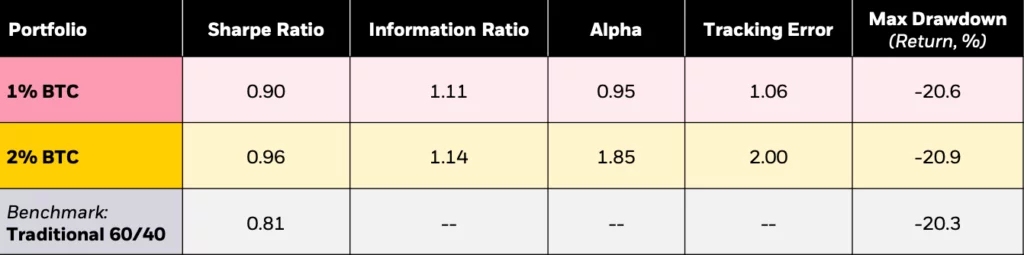
- BlackRock’s historical analysis found 1% to 2% allocations improved hypothetical portfolio risk adjusted returns historically.
The firm attributed the correction to excessive leverage, weaker institutional flows and slower purchasing by digital asset treasury companies. Its paper described the decline as a positioning and liquidity event rather than evidence that Bitcoin’s monetary or diversification properties had structurally changed.
BlackRock’s view is an investment assessment, not a prediction that prices will recover. The firm also manages the iShares Bitcoin Trust ETF and warned that Bitcoin remains volatile, speculative and capable of causing a total loss.
Bitcoin’s $90 billion leverage buildup amplified losses
Bitcoin climbed from $15,765 in late 2022 to a record $124,606 in October 2025, according to BlackRock’s Bloomberg and Coin Metrics data. Futures open interest exceeded $90 billion near the peak.
Approximately 80% of that exposure came from perpetual futures outside CME. Some platforms offered leverage of between 50 and 125 times, leaving traders vulnerable to automatic liquidation following relatively small adverse price moves.
The first major unwind followed U.S. tariff announcements involving China on Oct. 10, 2025. Bitcoin fell 6%, while open interest declined by $20 billion in one day. BlackRock described this as the largest daily open interest reduction in the data reviewed.
Further liquidation waves followed in February and June 2026, eventually pushing Bitcoin below $60,000. The sequence supported BlackRock’s argument that leverage accelerated the decline, although it does not prove that positioning was the only cause.
The U.S. derivatives market has also changed since the selloff. The CFTC approved KalshiEX’s onshore Bitcoin perpetual contract in May, finding that its structure complied with federal derivatives rules. The order brought a product long associated with offshore exchanges into a regulated U.S. market.
ETP outflows and AI funds competed for capital
Spot Bitcoin ETPs attracted approximately $60 billion between their January 2024 U.S. launch and October 2025, BlackRock found. The products then recorded roughly $5 billion in aggregate outflows through July 2026.
Over the later period, AI themed funds attracted more than $46 billion. BlackRock said the rotation “likely competed for capital” and became a drag on Bitcoin allocations. The wording reflects the firm’s interpretation because fund flow data alone cannot establish why every investor moved money.
The rotation was also visible in retail and institutional attention. As previously reported, both Bitcoin fund withdrawals and declining crypto search interest coincided with stronger interest in AI equities.
Recent U.S. fund data has been more constructive but remains uneven. Farside data showed $297.5 million of net inflows on Aug. 17 and $189.3 million on Aug. 18. The combined $486.8 million followed approximately $385.2 million of withdrawals during the previous week.
Treasury sales added supply during the correction
BlackRock also identified sales by miners, large holders and digital asset treasury companies as sources of pressure. MARA sold 15,133 BTC for approximately $1.1 billion during March, according to its regulatory filing.
Strategy later adopted a Bitcoin monetization program allowing sales to fund reserves, dividends, interest payments and security repurchases. The program does not require the company to sell and has no fixed expiration date.
An Aug. 10 SEC filing confirmed that Strategy sold 1,690 BTC for $108.6 million between Aug. 3 and Aug. 9. It used the proceeds to repurchase STRC preferred shares.
The transaction provided a verified update to BlackRock’s discussion of treasury related selling. In related coverage, crypto.news examined how corporate treasury selling pressure has increasingly interacted with U.S. spot fund demand.
BlackRock retains its small allocation argument
BlackRock’s ten year historical test found that adding a 1% or 2% Bitcoin allocation to a traditional U.S. 60/40 portfolio improved hypothetical risk adjusted returns. A 1% allocation produced a Sharpe ratio of 0.90, compared with 0.81 for the benchmark. A 2% allocation produced a ratio of 0.96.
Maximum drawdowns were similar across the tests. The traditional portfolio recorded a 20.3% decline, compared with 20.6% for the 1% allocation and 20.9% for the 2% allocation.
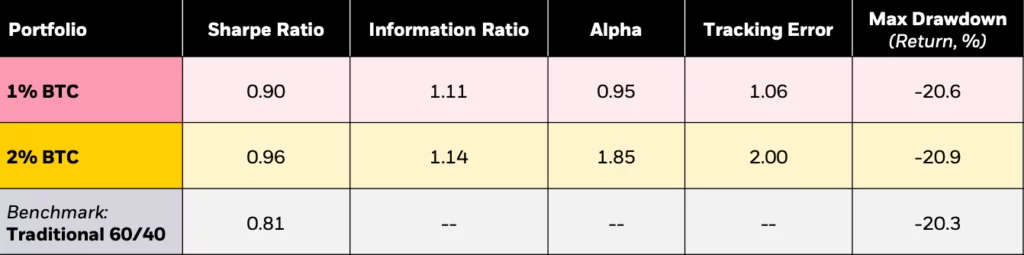
These results were hypothetical and benefited from hindsight. They did not include an actual BlackRock client portfolio and cannot establish how the allocations will perform in the future. Diversification also cannot prevent market losses.
BlackRock nevertheless said Bitcoin’s investment case “remains unchanged,” citing its capped supply, ten year correlation of 0.18 with the S&P 500 and possible use as a hedge against declining fiat purchasing power.
Bitcoin traded near $64,300 on Aug. 19 after reclaiming $64,000. As crypto.news reported, the latest price recovery coincided with renewed ETP inflows, although increasing leverage left the move exposed to another reversal.
The next evidence will come from ETP flows, futures positioning and corporate disclosures. Sustained inflows and lower speculative leverage would support BlackRock’s cyclical correction argument. Renewed liquidations or continued treasury sales would keep pressure on that assessment.
Disclosure: This article does not represent investment advice. The content and materials featured on this page are for educational purposes only.


Bitcoin held near $64,000 and every major except BNB gained, while Korean semiconductor stocks fell more than 7% and Fed minutes are due at 2 p.m. ET.
VanEck said on Aug. 18 that Bitcoin may be approaching an accumulation phase after eight of its 12 capitulation indicators remained active as of Aug. 12.
Summary
- Eight of VanEck’s 12 Bitcoin capitulation signals were active on August 12, indicating late cycle stress.
- All 12 indicators entered capitulation territory during the three months preceding VanEck’s August research update.
- Long term holder supply dropped 356,534 BTC, leaving 11.84 million BTC untouched for over one year.
- U.S. spot Bitcoin ETPs absorbed $663 million while realized volatility declined to 27.2% over 30 days.
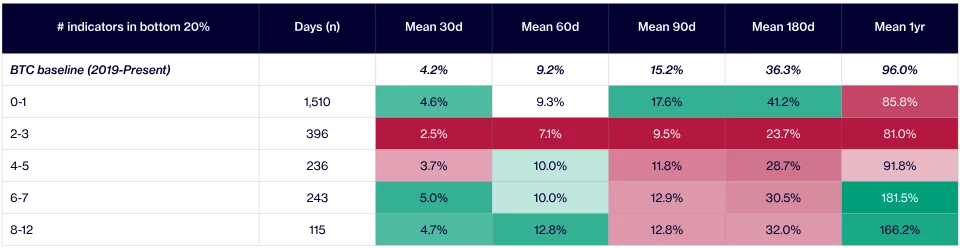
- Historical capitulation clusters lagged Bitcoin’s baseline for six months, outperforming only across one year holding periods.
The asset manager’s latest report placed the current correction in its tenth month, measured from Bitcoin’s October 2025 peak. VanEck estimated that the next turning point could arrive between September and November if the current cycle follows earlier patterns.
However, the firm did not present the historical timetable as a reliable price forecast. VanEck disclosed that it has exposure to Bitcoin and warned that its forward return study uses a small number of heavily overlapping observations.
Bitcoin capitulation signals point to late cycle stress
VanEck considers a signal active when its latest reading reaches an extreme historical percentile. Most indicators must fall within the bottom 15% of their recorded history, or the top 10% when a high reading represents stress.
Price drawdown uses a separate threshold. VanEck activates this signal when Bitcoin falls at least 35% from its peak. Bitcoin was down approximately 49% from its October record in the firm’s analysis, although that decline ranked only in the 35th percentile of its own history.
Applying the same percentile rule to the drawdown would reduce the total from eight active signals to seven. VanEck defended the separate threshold by arguing that institutional ownership and spot ETP demand could produce a shallower bear market than previous cycles.
The firm said it “expects a shallower trough this cycle,” but acknowledged that this remains an assumption rather than a confirmed market outcome. Earlier Bitcoin bear markets produced drawdowns ranging from 78% to 94%.
Historical returns offer no clear six month advantage
VanEck’s backtest provides a cautious reading for investors expecting an immediate rebound. When between eight and 12 indicators were in capitulation territory, Bitcoin returned an average 12.8% over the following 90 days. Its baseline return for all comparable periods was 15.2%.
The same group generated an average 32% return over 180 days, below the 36.3% baseline. Outperformance appeared only across the one year horizon.
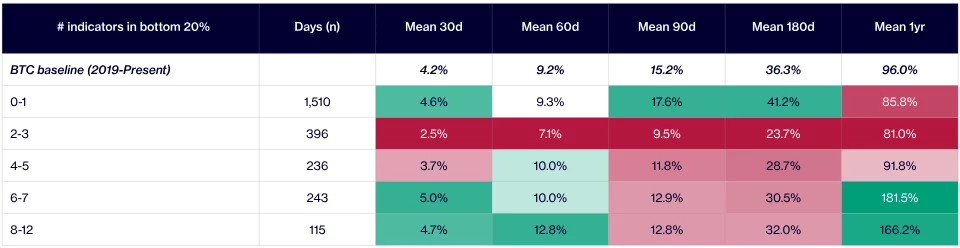
VanEck warned that the one year result came from 115 observation days that overlapped heavily. Those observations represent only a small number of separate market episodes. The firm said it does not place substantial weight on that result.
The findings suggest capitulation readings may identify late cycle conditions without identifying an exact bottom. They also leave room for prolonged sideways trading before a durable recovery begins.
U.S. fund inflows absorb long term holder selling
U.S. spot Bitcoin ETPs recorded approximately $663 million in net inflows during the 30 days covered by VanEck. The total represented about 10,400 BTC at prevailing prices and reversed roughly $2.4 billion of outflows during the preceding month.
Fund flows remained uneven after VanEck’s measurement period. U.S. spot funds lost about $385.2 million across the week ending Aug. 14, as crypto.news reported in its analysis of why liquidity has yet to return.
Demand then recovered. Farside data showed $297.5 million of net inflows on Aug. 17 and another $189.3 million on Aug. 18. The combined $486.8 million partly reversed the previous week’s withdrawals.
Those inflows followed earlier signs of ETF demand supporting the $64,000 area. Bitcoin traded near $64,250 on Aug. 19, above VanEck’s Aug. 11 closing reference of $63,549 but still below its 200 day moving average.
Long term holders complicate the accumulation case
Coins held for longer than one year declined by 356,534 BTC over 30 days, according to VanEck’s Glassnode based figures. Holdings fell 2.9% to 11.84 million BTC, equal to 59.1% of circulating supply.
All six long term age groups contracted. Coins aged between one and two years recorded the largest reduction at approximately 156,000 BTC. Holdings older than ten years fell by only about 4,000 BTC, suggesting the oldest wallets remained comparatively inactive.
VanEck said some movements may have involved wallet security rather than sales. The firm cited concern following the Coldcard security failure, which crypto.news examined in its coverage of the $89 million wallet drain.
It nevertheless called the security explanation difficult to verify. Confirmed losses were far smaller than the total movement by aged coins. Exchange inflows separated by coin age could help determine whether holders transferred funds to trading venues or moved them between private wallets.
The period from September through November now provides the next test of VanEck’s cycle framework. A sustained increase in spot demand, stronger trading volume and stabilization in long term holdings would support the accumulation case. Continued distribution or renewed fund outflows would weaken it.
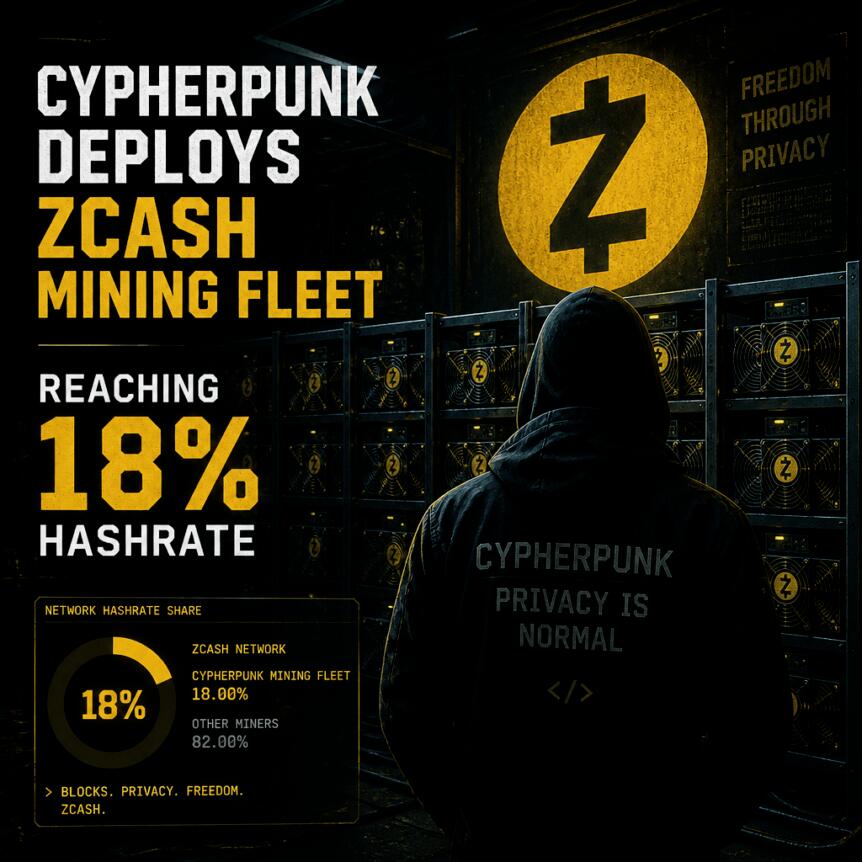
Cypherpunk Technologies has moved to scale its role in Zcash’s proof-of-work ecosystem by acquiring a mining fleet previously associated with Winklevoss Capital. The company says the purchase is now live across multiple locations in the United States and positions Cypherpunk as one of the largest public-sector participants in Zcash mining.
The deal, announced Tuesday, is structured as an equity-based transaction valued at $33.33 million. Cypherpunk reports that the acquired operation is already online and producing about 4.2 GSol/s—roughly 18% of Zcash’s current hashrate, based on the company’s figures.
Key takeaways
- Cypherpunk says it acquired a Zcash mining fleet via a $33.33 million equity transaction, with operations already running in the US.
- The reported 4.2 GSol/s output would make the company responsible for around 18% of Zcash’s current hashrate, if those numbers hold.
- The acquisition expands Cypherpunk’s existing Zcash holdings of 323,394 ZEC, about 1.9% of circulating supply, according to the company.
- Cypherpunk’s stated long-term goal is to reach 5% of ZEC supply held by the company.
- The move comes after renewed market attention to privacy-focused assets later in 2025, following a sharp ZEC price run.
Scaling a privacy-network mining footprint
Cypherpunk’s announcement frames the fleet acquisition as both an expansion of its mining operations and a way to deepen exposure to Zcash beyond spot holdings. In addition to bringing additional hashpower online, the company says it is adding to an existing inventory of ZEC it already holds—323,394 ZEC, or about 1.9% of circulating supply.
Cypherpunk also reiterated a longer-term accumulation target: eventually holding 5% of the ZEC supply. While the company’s filings or policy around the feasibility of that goal were not detailed in the provided text, the stated target alone is significant because it suggests a strategy that blends mining economics with balance-sheet accumulation.
Critically for investors and market observers, Cypherpunk’s claim that the purchased fleet contributes roughly 18% of the network’s hashrate points to concentration risk considerations that usually matter in proof-of-work systems. If a single publicly traded entity controls a large portion of mining power, the network’s block-production incentives and operational dependencies can become more complex—especially during periods of equipment downtime or changes in profitability.
Why Zcash mining economics may be shifting
Cypherpunk previously pitched Zcash mining as potentially more attractive than competing uses of capital—such as Bitcoin mining under prevailing conditions, or deployments driven by AI data center demand. However, the company’s own framing also acknowledges that mining profitability remains highly sensitive to several variables.
In the provided reporting, Cypherpunk links mining economics to ZEC’s price, network hashrate (and therefore mining difficulty), and operating costs. That matters because even if a mining company believes it has found superior economics compared with other sectors, its realized returns can still vary substantially with network conditions and market volatility.
The timing of the acquisition may be particularly relevant. Cypherpunk’s expansion follows a sharp rise in Zcash’s price during the second half of 2025. Renewed interest in privacy-focused cryptocurrencies was described as a catalyst, including attention after a hedge fund revealed a significant ZEC position—an event that earlier coverage from Cointelegraph noted helped pull the asset higher.
As privacy-preserving technologies regain mainstream attention after stretches of relative market quiet, mining capacity often follows demand signals—either through new capital entering the ecosystem or through incumbent operators scaling up when profitability improves. Yet the same lesson applies in reverse: if ZEC prices fade or difficulty rises faster than costs can be hedged, hashpower additions can become a headwind rather than a tailwind.
Network security: Ironwood update and the Orchard vulnerability
Cypherpunk’s scaling effort lands amid ongoing technical changes in Zcash’s privacy layer. The network underwent its Ironwood upgrade on July 28, introducing a new shielded transaction protocol designed to replace the Orchard pool and improve security architecture.
The upgrade was prompted by a flaw discovered in Orchard. The concern, as summarized in the provided text, was that under certain conditions an attacker could potentially create counterfeit ZEC inside the shielded pool without immediate detection. Even though there was no evidence the vulnerability had been exploited, the possibility underscored a persistent challenge for privacy networks: maintaining confidentiality while also ensuring robust supply integrity and verification.
From an investor’s perspective, these protocol updates matter even if day-to-day mining operations don’t change overnight. Ironwood’s improvements can affect how shielded transactions are processed and monitored, and they can influence confidence in the long-term soundness of privacy-preserving mechanisms—confidence that, in turn, can influence adoption narratives and liquidity for the underlying asset.
At the same time, the Ironwood upgrade illustrates that privacy-focused systems may carry distinct engineering risk profiles compared with more transparent networks. Zcash’s response—moving to a new protocol and addressing Orchard-related risks—signals ongoing iteration rather than a “set and forget” approach.
What to watch next for Cypherpunk and Zcash
Cypherpunk’s fleet acquisition raises immediate questions around how much hashrate its operation sustains over time and how its ZEC accumulation strategy develops relative to its liquidity and operational costs—especially given the sensitivity of mining economics to ZEC price and network difficulty. For the Zcash network, the key variable remains whether Ironwood’s security goals strengthen confidence in shielded supply integrity as privacy usage evolves.


The FASB said secondary-market liquidity alone would not be enough, with holders needing direct issuer redemption rights and one-to-one liquid reserves.

Bitcoin is struggling to hold its June range floor after $390 million left US spot BTC ETFs last week, according to Wintermute’s newest market update.
The trading firm says falling rate-hike odds have failed to lift BTC, while ETF redemptions and miner selling have left the market without a strong source of fresh demand.
ETF Flows Fail to Sustain Bitcoin’s August Recovery
As Wintermute pointed out, July CPI came in at 0.1% month-on-month, cutting September rate-hike odds from roughly even to about one-in-three, with retail sales also posting their steepest decline since May 2025.
Almost nothing rallied on it: the S&P 500 added just 0.40%, long-dated Treasuries fell 0.87%, and BTC sat at the bottom, down 3.12%. CoinGecko data shows the cryptocurrency is currently around $64,000, up 1.2% over 24 hours. However, it is down nearly 1% over 30 days and 49% below its October 2025 all-time high.
Brent crude jumped 7.91% as Hormuz ship transits collapsed from 31 the prior weekend to five Saturday and zero Sunday, with the 60-day ceasefire expiring and talks stalled. A re-escalation that holds Brent near $89 puts the August CPI print at risk.
For Wintermute, that combination matters. Lower rate-hike expectations would normally improve the case for risk assets, but Bitcoin failed to respond. The firm said the market was moving toward a situation where “the inflation problem seems to be moving from the Fed’s hands to oil’s.”
The ETF picture was also weak. Roughly $390 million left US spot Bitcoin ETFs between August 10 and 14, the largest weekly redemption since early July. As CryptoPotato reported, Bitcoin ETFs recorded only one positive session last week, with Monday seeing $145 million leave the funds, followed by $61 million on Wednesday, $131 million on Thursday, and nearly $58 million on Friday. Tuesday brought just under $5 million of net inflows.
“An asset that cannot rally on good news while its dedicated vehicles bleed is telling us the marginal seller is back, which weakens the depletion argument we have been carrying since W31,” wrote the trading company.
Miner Selling Adds Another Problem
Wintermute also pointed to Riot Platforms as evidence that miners may remain a source of Bitcoin supply. The firm sold 4,300 BTC during the second quarter after selling 3,778 BTC in the first quarter. Its treasury fell to 11,380 BTC as mining costs approached $91,000 per unit. Bitcoin was trading below $64,000, contributing to Riot’s $237 million quarterly loss.
Riot is also shifting part of its business toward AI data centers, with the miner reportedly agreeing to supply 191 megawatts of capacity to Anthropic under a 20-year contract worth $9.1 billion.
The ETF picture is not uniformly negative, though, as Jane Street disclosed more than $1 billion in US spot Bitcoin ETF holdings as of the second quarter, including about $828 million in IBIT. However, the filing only shows quarter-end holdings and does not capture the firm’s full derivatives exposure.
The post Wintermute: Bitcoin Range Breakout Delayed by ETF Outflows and Miner Selling appeared first on CryptoPotato.
Bitcoin price rose 1.7% to around $64,200 on Aug. 18 as ETF inflows supported the rebound, but rising leverage left the recovery exposed to a pullback.
Summary
- Bitcoin price recovered above $64,000 after buyers defended the $62,600–$62,800 area.
- The daily chart shows BTC holding above its 20-day and 50-day moving averages, though longer-term resistance remains overhead.
- Liquidation data places the nearest major liquidity cluster around $64,700, while a larger downside pool sits near $62,200.
The rebound from the $62,600 area improved short-term momentum, although the daily chart continues to show Bitcoin trading below its two longer-term moving averages. Leverage is also building while liquidity rests on both sides of the current price, leaving the recovery exposed to sharp moves if buyers fail to extend the advance.
U.S.-listed spot Bitcoin ETFs recorded more than $137 million in net inflows on Monday. The inflows followed over $385 million in net withdrawals during the previous week, suggesting institutional demand returned after several sessions of selling.
The recovery also came as buyers defended an area that has repeatedly attracted demand since June. Bitcoin (BTC) fell toward $62,600 on Aug. 14 and again tested the upper $62,000 region on Aug. 17 before climbing as high as $64,586 on Tuesday.
Bitcoin price moves back above short-term averages
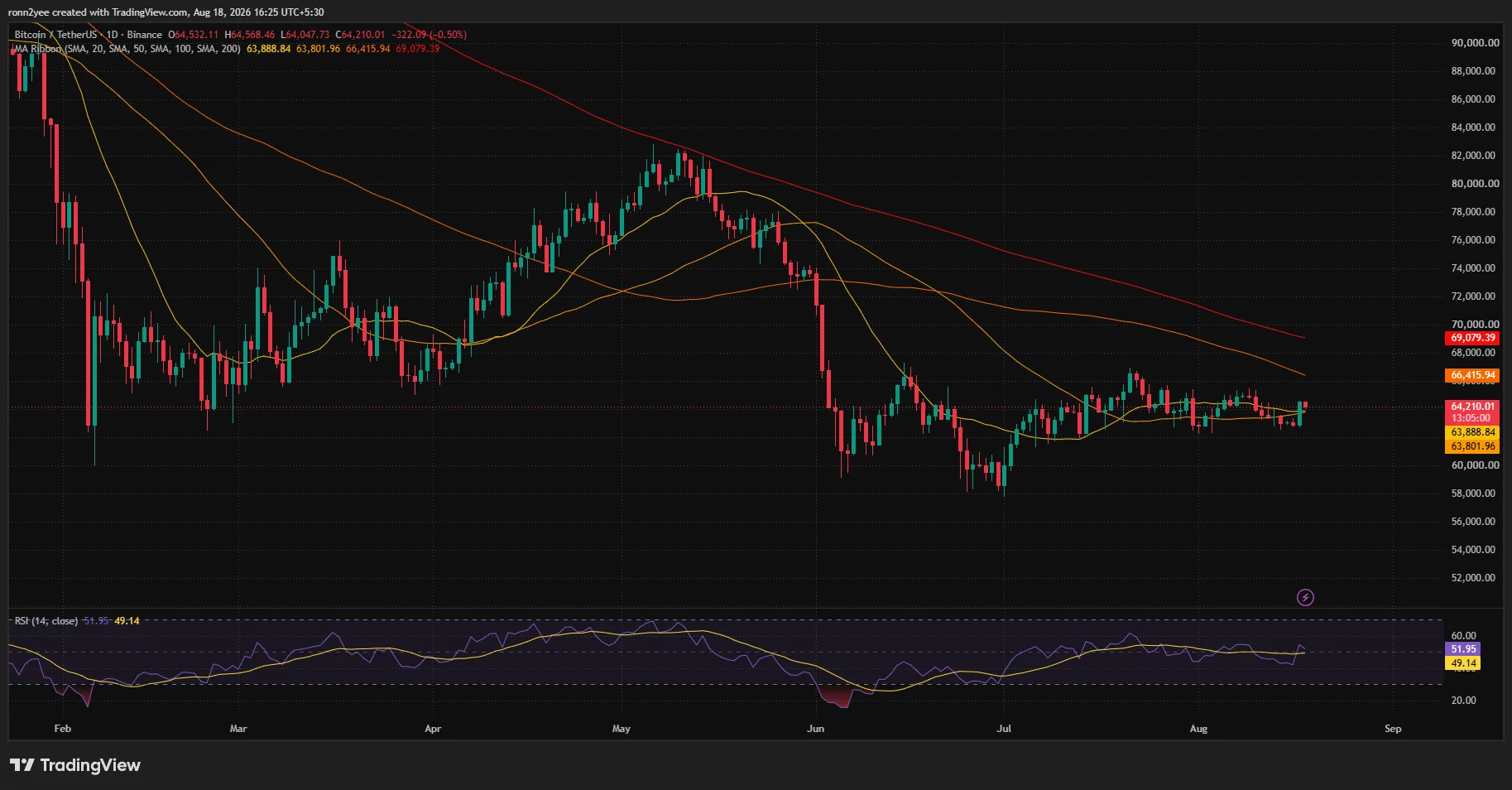
Bitcoin’s daily chart shows the price at $64,210, slightly above the 20-day simple moving average at $63,802 and the 50-day moving average at $63,889. Holding both levels would keep the short-term recovery intact and establish the $63,800–$64,000 region as the first support area.
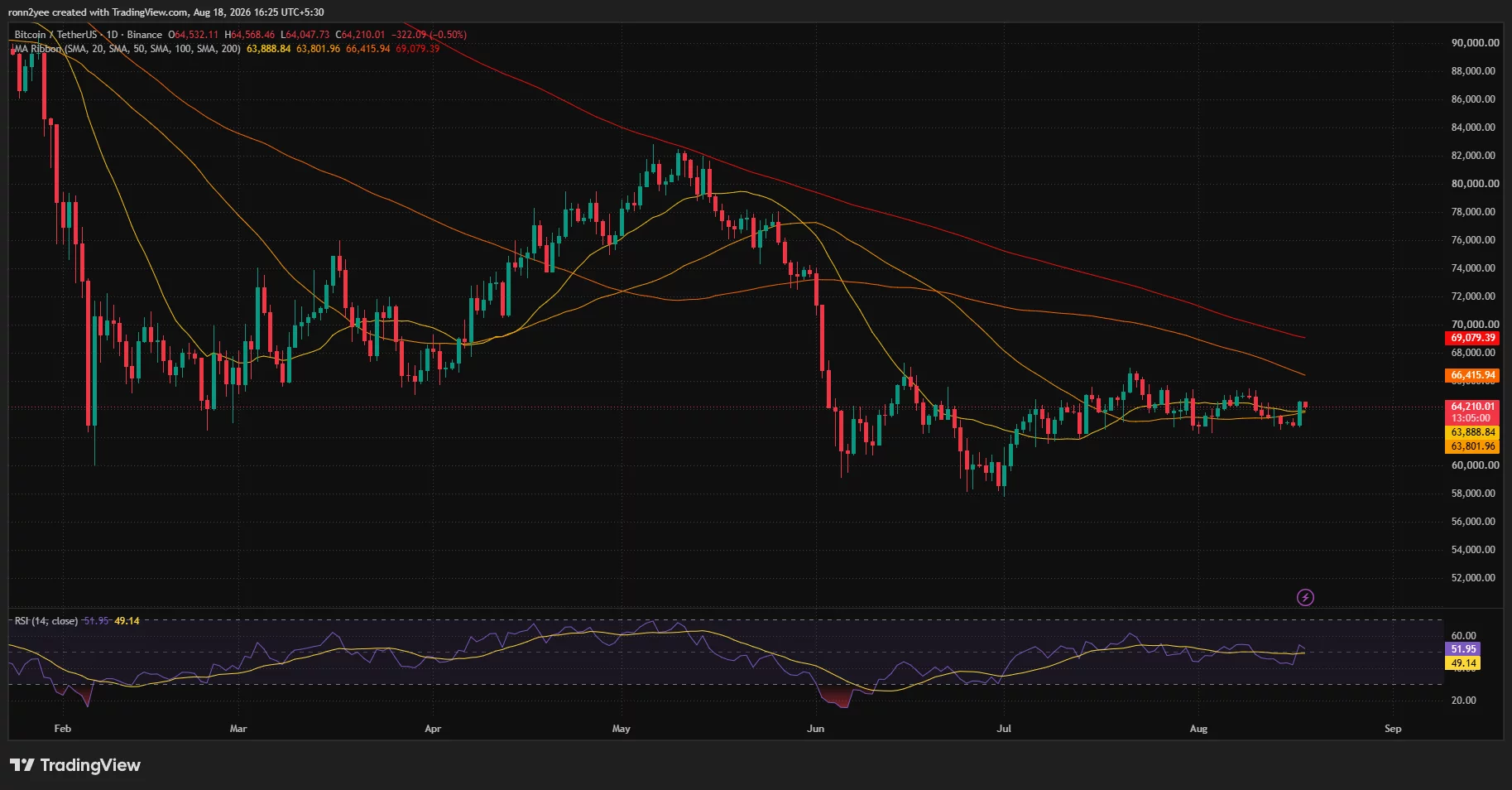
The daily relative strength index rose to 51.95 and moved above its signal average of 49.14. A reading above 50 indicates that buying momentum has gained a slight advantage, although the indicator remains close enough to the midpoint to show that neither buyers nor sellers have firm control.
Longer-term resistance continues to limit the recovery. Bitcoin remains below its 100-day moving average at $66,416 and its 200-day average near $69,079. Both lines are sloping downward, meaning BTC would need to reclaim several resistance levels before the broader daily trend turns decisively stronger.
The price has also traded in a narrow range since the end of June, with most daily closes concentrated between approximately $62,000 and $66,000. A daily close above the 100-day average would break the upper part of that structure and place $69,000 within reach.
Failure to remain above the short-term averages would weaken the latest rebound. The first downside levels are around $63,800 and $62,600, followed by the liquidity-heavy region close to $62,200.
4-hour chart points to $63,800 as the first test
Bitcoin’s 4-hour chart shows a stronger near-term setup after the price climbed from around $62,800 to above $64,000. The Supertrend indicator flipped to support, with its lower boundary near $63,251, while the bull-bear power histogram moved into positive territory at 697.
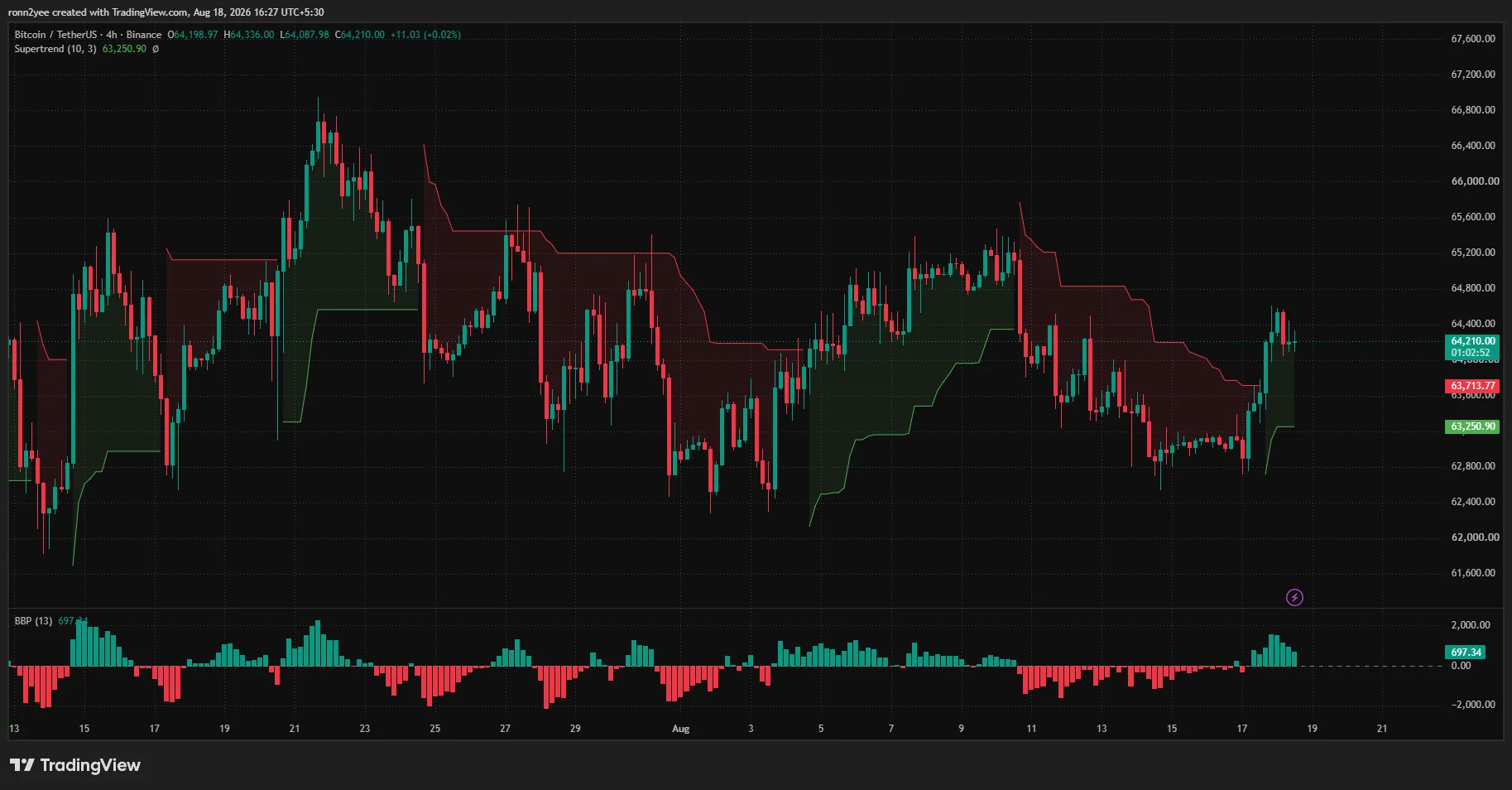
Positive bull-bear power indicates that buyers are currently pushing the price above its underlying average. However, the histogram began shrinking after its initial expansion, suggesting that the strength of the rebound was easing as Bitcoin approached $64,500.
Analyst Michaël van de Poppe said Bitcoin had produced a strong upward move but encountered resistance after reaching the mid-$64,000 region. He identified $63,800–$64,000 as a possible lower-time-frame entry area and maintained a $65,000 target for the coming days or week.
“BTC has hit resistance and should therefore find some level of support for buyers to be stepping in,” Van de Poppe said.
His support zone matches the daily moving-average cluster near $63,800–$63,900. A successful retest of that area would allow buyers to challenge $64,500 again, while a drop through it would shift attention to the 4-hour Supertrend support near $63,250.
A break above Tuesday’s $64,586 high would provide the first evidence that the recovery is extending. The next visible resistance levels sit around $64,800, $65,200, and $66,400, with the last level corresponding closely to the daily 100-day moving average.
Liquidation map places BTC between two large liquidity pools
CoinGlass’ one-week Bitcoin liquidation heatmap shows a dense concentration of leveraged positions around $64,700. The band is the closest major pool above the market and could attract price if BTC clears the $64,500–$64,600 resistance area.
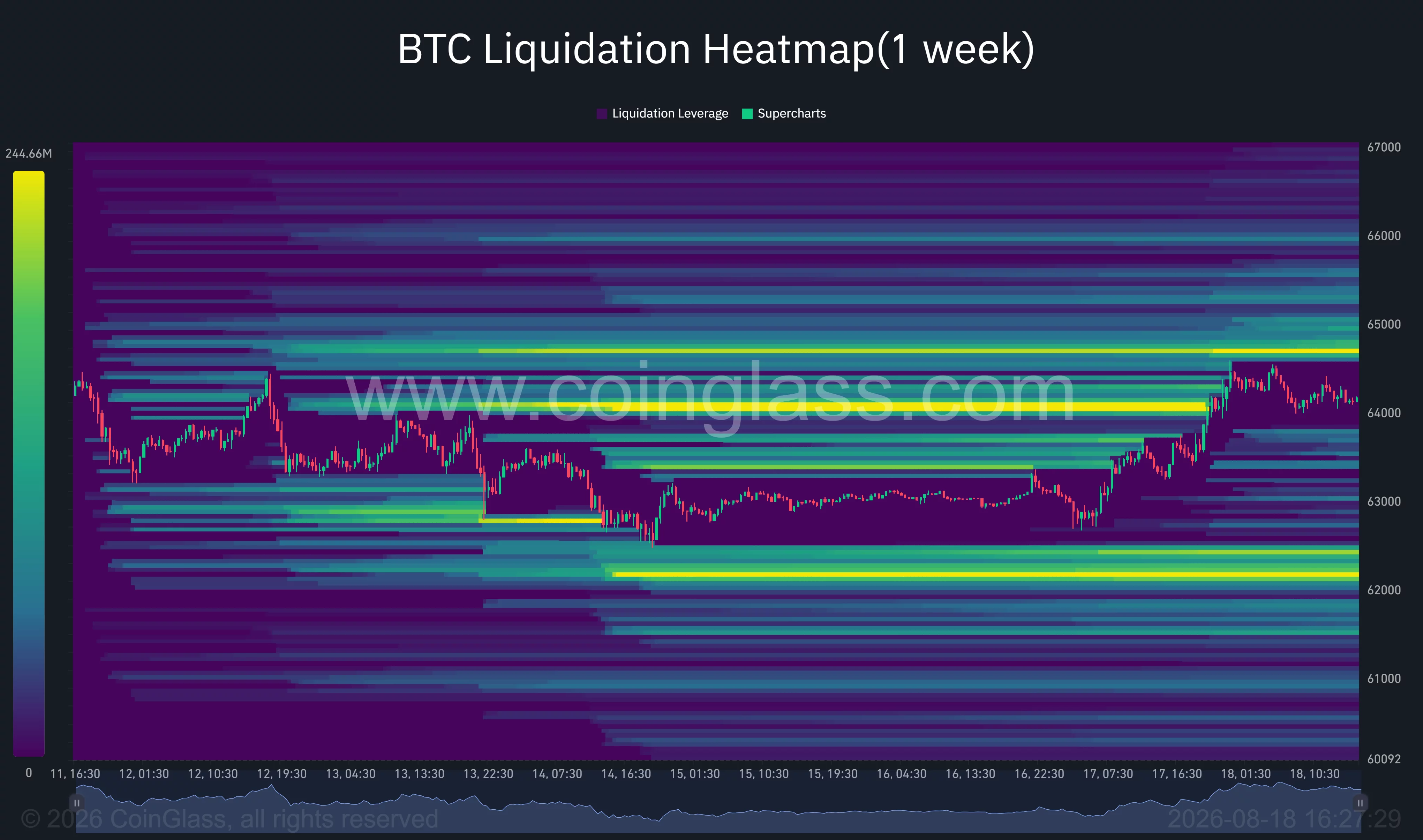
Additional liquidation concentrations appear near $65,000, $65,500, and $66,000. A move through $64,700 could force bearish positions to close, potentially accelerating the advance toward those higher levels.
The largest nearby downside pool sits around $62,200–$62,300. Smaller concentrations are visible near $63,500 and $62,800, giving sellers several potential targets if the price loses $63,800.
Crypto market commentator Rain said BTC’s ability to remain above $64,000 masked risks developing beneath the price. According to Rain, long leverage has been increasing while exchange liquidity has declined, creating a risk that a move toward the upper-$50,000 range could trigger forced selling.
Rain also said miners had reportedly reduced computing capacity by about 20% over three quarters as some operators shifted resources toward artificial intelligence. The commentator questioned whether institutional demand could continue absorbing the resulting pressure.
The charts do not yet confirm a fall into the upper-$50,000 region. Bitcoin would first need to lose the daily moving-average cluster, the $62,600 floor, and the large liquidation band near $62,200. Those levels currently separate the range-bound market from a deeper decline.
Bitcoin’s immediate direction therefore depends on whether buyers can turn $63,800–$64,000 into support. Holding that zone would leave $64,700 and $65,000 as the next targets, while a breakdown would expose $63,250, $62,600, and the leveraged positions concentrated near $62,200.
Disclosure: This article does not represent investment advice. The content and materials featured on this page are for educational purposes only.


Forget short-term price charts – Washington’s digital asset framework is the legal authorization that conservative wealth managers have been waiting for before they can put trillions to work.
Summary
- The CLARITY Act is a legal “permission structure” that allows conservative compliance officers and fiduciaries to safely allocate capital.
- Decentralized networks like Bitcoin and Litecoin don’t need a law to function; the institutions that want to hold and custody them need one.
- While Congress stalls before recess, capital and talent are not waiting. They are actively migrating offshore to jurisdictions with clear, actionable rulebooks.
Everyone seems to be watching the CLARITY Act for the same thing. From retail traders to institutional giants, people are waiting for the green light that confirms Washington has clarified the market.
They are watching the wrong metric.
Legislation doesn’t move markets through a single, uniform mechanism. The GENIUS Act has limitations on a single-asset framework for payment stablecoins. CLARITY works at a different layer: a horizontal market-structure bill covering how digital assets are classified, who regulates them, and who is allowed to custody and trade them. That’s why its success shouldn’t be benchmarked against a single price chart. The metric that matters here is the slower signal underneath: custody mandates being written, treasury policies being rewritten, allocation committees granting their first approvals.
That’s the real story. The CLARITY Act is fundamentally a legal permission structure. By handing institutional wealth managers and world-class operators the regulatory green light they need to enter the room, this law achieves something more durable than a market rally. It moves the people who build markets, not just the capital.
The real signal is access, not price
For years, compliance officers have killed crypto allocations for one reason above all others. As a Chief Executive, I’ve sat in meetings with teams waiting on a memo their Chief Legal Officer refuses to sign, arguing the legal landscape is too unsettled to defend or ambiguous. CLARITY speaks directly to that fear. It gives conservative, mandate-bound funds a federal framework they can point to when the investment committee asks the only question that matters, which is whether the position holds up if it is ever challenged.
The people running those funds are ready to act. A 2026 survey (Coinbase and EY-Parthenon Institutional Investor) found that roughly three in four institutional investors plan to increase their digital-asset allocations this year, that 66% named regulatory uncertainty as a top concern, and that 65% said greater clarity would lead them to allocate more. That said, obtaining regulatory clarity is the accelerant they name most often, and right now it is the input they do not have.
In institutional finance, risk managers matter as much as capital reserves. Clear rules attract disciplined, long-term capital alongside the veteran managers who direct it. Earlier milestones like the GENIUS Act and crypto ETFs widened access, but they didn’t resolve the foundational market-structure questions a Chief Legal Officer must sign off on, e.g. statutory definitions for qualified custodians and statutory exemptions for non-custodial software layer operators. The CLARITY Act tackles these regulatory bottlenecks head-on, and as legislation it would carry the force of law that other guidance, such as the SEC’s, does not. The moment one respected fund manager can legally justify an allocation, it creates the fiduciary precedent for everyone else to follow.
Another way to look at the CLARITY Act is through the underlying networks. A federal framework doesn’t change how a decentralized network functions. Bitcoin and Litecoin have run without a central issuer or a corporate board since their first blocks, and they have done so for over a decade without asking for permission. That said, CLARITY leaves the underlying software untouched. What it changes is who can legally operate alongside it. By codifying CFTC oversight of digital commodities, setting qualification standards for digital asset custodians, and creating a registration path for banks to offer custody and brokerage, the bill would establish a defined perimeter for regulated intermediaries. It changes nothing for the assets themselves, which already work, but transforms everything for the fiduciaries waiting for a legal framework to step through the door.
CLARITY is an accelerant, not a lifeline
Which is why the Senate calendar matters.
As of this writing, the Clarity Act has just secured a scheduled floor vote for 15th September, despite legislative delays that ran the bill up against – and now into – the August recess. But whether the vote happens this month or in the upcoming years, the underlying momentum of the industry remains unchanged. Institutional adoption is expanding, capital inflows are compounding, and world-class talent continues to migrate into the space every single day.
Passing the CLARITY ACT means taking this existing momentum to the next level.
The bill is an accelerant. If the vote slips past recess, the signal is delayed. Capital and talent won’t pack up or go home; they will simply adjust their velocity and focus. International hubs like the EU under MiCA and Dubai under VARA are already demonstrating that global adoption moves forward with or without Washington’s timeline.
In the end, the CLARITY Act isn’t deciding whether institutional finance adopts digital assets. That shift is already happening. But the decision matters to the human capital – the compliance officers, the corporate treasurers, and the world-class builders. It is for them to get the green light to do that work here in the United States.
The CLARITY Act was designed to move people. And the people it moves are going to build the next decade of finance regardless of when federal frameworks fall into place. It is simply a matter of time.
About the author:
Jay File | CEO & CFO, Lite Strategy, Inc. (Nasdaq: LITS) – brings more than three decades of leadership experience spanning public accounting, corporate finance, capital markets, and publicly traded companies. A Certified Public Accountant by training, he began his career in public accounting at Arthur Andersen and KPMG, where he specialized in SEC reporting across technology, software, biotech, and defense sectors. He later held senior finance roles at Sequenom, overseeing approximately $400 million in equity financings, a $130 million convertible notes offering, and treasury management of a $100 million cash position. During eight years as CFO of Nasdaq-listed Evofem Biosciences, he led financial reporting, investor relations, and capital-raising initiatives – raising $365 million in equity financings and $70 million in various debt offerings – before joining Lite Strategy in 2023. Under his leadership, the company has transitioned into a pioneering digital asset treasury business, becoming the first publicly traded company to adopt Litecoin as its primary reserve asset while working alongside digital asset market maker GSR and Litecoin creator Charlie Lee, who also serves on the company’s board.
Disclosure: The views and opinions expressed here belong solely to the author and do not represent the views and opinions of crypto.news’ editorial.

Why crypto investors are watching DEOD

Elina Svitolina withdraws from Cincinnati Open with ankle injury

New Google Ad Shows a Mysterious Wearable. Is It the Next Fitbit?





-

 Fashion4 days ago
Weekend Open Thread: Ann Taylor
-
 Sports5 days ago
This U.S. Amateur is a glimpse into golf’s future in more ways than you think
-
 Tech5 days ago
11 Ways to Rank Your Videos
-
 NewsBeat4 days ago
Myanmar says over 300,000 Rohingya refugees verified for repatriation as exodus enters ninth year
-

 Sports4 days ago
Birmingham 2026: Day 6 Timetable for Irish Athletes
-

 Politics4 days ago
SEQ Code: The Three Letter Boarding Pass Code That Could Give You The Worst Seat
-
 Entertainment7 days ago
Keke Palmer Subtly Hints At Sean Evans Drama With Cryptic Post
-

 Tech5 days ago
DeepSeek Harness launches as open source rival to Claude Code, alongside V4-Pro on API with higher prices
-

 Sports6 days ago
DeQuan Jones in ‘high spirits’ after successful leg surgery
-
 Crypto World7 days ago
Perplexity AI Predicts an XRP Scenario Few Analysts Are Discussing
-

 Tech7 days ago
SpaceXAI’s Grok Bot turns agents into persistent digital coworkers that can operate your apps for $120-per-month
-

 Crypto World1 day ago
OCC Greenlights Trump Family Crypto Firm for Trust Charter
-

 Politics7 days ago
How Average Are You In The UK?
-
 Entertainment6 days ago
2026’s Most Ambitious Fantasy Movie Officially Scores Sequel Update
-
 Entertainment6 days ago
All 10 Hayao Miyazaki Fantasy Movies, Ranked
-

 Fashion7 days ago
Why Botanical Fashion Never Goes Out of Style
-
 Entertainment6 days ago
Travis Kelce Breaks Silence On ‘Crazy’ Taylor Swift Wedding
-
 Entertainment5 days ago
10 Netflix Shows That Quietly Became Modern Classics
-

 Entertainment7 days ago
Cristiano Ronaldo, Georgina Rodriguez’s Relationship Timeline
-

 Fashion7 days ago
Wednesday’s Workwear Report: Stretch-Cotton Pleated-Waist Top
You must be logged in to post a comment Login