
Crypto World
Bitcoin Holds $75K Cost Basis as Key Support in Bull Run


Bitcoin is hovering around $76,350, keeping near a cluster of cost-basis levels that bind different investor cohorts and institutional benchmarks. The convergence of recent buyers’ breakevens with the cost foundation implied by U.S. spot ETFs hints at a delicate near-term support zone around $75,000, even as the market weighs whether the latest price action signals stronger conviction among long-term holders.
Key takeaways
- A tight cost-basis cluster around $75,000 is forming, potentially anchoring near-term price floors as BTC trades near $76k.
- The one-to-three-month holder average cost basis sits at about $75,620, marking a critical pivot point that previously acted as resistance in March and now could support the bounce.
- Bitcoin’s adjusted realized price sits at $72,300, with the market briefly closing above this mark, suggesting a broader base of accretive buying for circulating supply outside seven-year holders.
- US spot Bitcoin ETFs carry an institutional cost basis near $76,700, reinforcing the $75k–$77k band; short-term holders’ cost basis sits higher, near $81,800, which could influence conviction if price holds above it.
- Liquidity dynamics define the risk landscape: roughly $2.69 billion of long liquidations await near $74,000, while about $4.48 billion in short liquidations loom near $80,000. Recent activity cleared nearly $494 million in positions, underscoring how crowded bets sit around the $74k–$80k range.
Cost-basis convergence shapes the near-term floor
Data show a pronounced clustering of cost bases across investor cohorts. The one-to-three-month holder cohort averages about $75,620, a level that previously capped BTC when it dipped to $62,000 from $75,600 in a two-week span in March. Today, that same price region could act as a foothold for new demand, as a large fraction of recent entrants find themselves near break-even as price hovers around the mid-$70k zone.
Beyond the holding period cohorts, Bitcoin’s realized-price metric—which excludes coins held for more than seven years—has moved to $72,300. A close above this adjusted realized price indicates that a meaningful share of circulating supply has been acquired at costs below the current price, a traditional sign of growing conviction among investors who are less likely to sell quickly.
“A truly bullish signal would be for Bitcoin to start building a standard deviation above this average cost basis, pushing more investors into profit and encouraging them to hold due to increased conviction.”
Analysts note that the recent weekly close above the adjusted realized price points to stronger long-term conviction, though the picture remains nuanced. The cost-basis story is being reinforced, in part, by the price environments surrounding U.S. spot-Bitcoin ETFs, which tilt the landscape toward a steady institutional anchor in the $76,000s region.
Institutional baselines and what they imply for sentiment
Positioning around the U.S. spot ETF cost basis sits near $76,700, aligning price action with a wave of institutional accumulation that has characterized parts of the current cycle. Meanwhile, the short-term holder cost base sits higher, near $81,800, a level traders could use as a check against complacency if price maintains its hold above that threshold.
Together, these overlapping cost bases compress around $75,000, creating a framework where both realized and unrealized positions concentrate within a narrow corridor. For traders and fund managers, that means flows around this price can produce outsized moves, given the density of positions in the same neighborhood.
The broader pattern invites readers to watch whether the market can sustain a move above the $75,000 floor long enough to lift more short- and medium-term holders into the green, thereby widening the base of support for a potential new leg higher.
Where liquidity and risk sit in the near term
The derivatives landscape paints a precise picture of risk around the $75,000–$80,000 band. On one side, cumulative long liquidations near $74,000 carry about $2.69 billion at risk, while on the other, short liquidations near $80,000 total roughly $4.48 billion. This dynamic underscores how close price movements around this zone can trigger rapid resets in positions and potentially amplify volatility.
A recent swing between $77,873 and $74,868 cleared about $494 million in positions, highlighting the ongoing churn within high-leverage bets. Market observers note that the pool of high-leverage longs has diminished, while a larger cohort of short liquidations remains above the $80,000 threshold. In short, the $74,000–$80,000 corridor continues to anchor positioning, with cost-basis clustering intensifying sensitivity to incoming flows.
These liquidity contours echo broader market research that suggests investors are debating whether Bitcoin deserves the current price range and whether a breakout could be sustainable. For now, the crowd remains tethered to the mid-$70k zone as a fulcrum for near-term direction.
Related coverage: Most crypto investors believe Bitcoin is undervalued, according to a Coinbase survey. As readers consider the implications for risk appetite and allocation, the ongoing interaction between spot ETF demand, holder cost bases, and the evolving derivatives dynamics will be key to watch in the coming weeks.
This article reflects data and analysis from CryptoQuant and market commentary surrounding the latest price action and on-chain indicators. For readers seeking deeper context, ongoing coverage will monitor how cost-basis clusters evolve as new ETF flows and macro developments unfold.
Investors are advised to monitor whether BTC can sustain price action above $75,000, as this would not only validate the current cost-basis framework but also set the stage for exploring fresh demand from both retail and institutional participants in the months ahead.



Ripple-backed XRP treasury company Evernorth has named OpenAI Foundation CFO Robert Kaiden and Antalpha COO Derar Islim as independent directors in its second SEC S-4 amendment, bringing AI and institutional finance expertise onto the board of the company aiming to list on Nasdaq under ticker XRPN.
Summary
- The Evernorth XRP board now includes Robert Kaiden (OpenAI Foundation CFO), Derar Islim (Antalpha COO), Ted Janus, and Ripple CLO Stuart Alderoty, creating a governance structure that bridges AI, crypto, and traditional finance.
- Evernorth has raised over $1 billion in gross proceeds from investors including Ripple, SBI Holdings, Pantera Capital, Kraken, and Arrington Capital, with Ripple Labs contributing 126.79 million XRP directly.
- The company currently holds over 473 million XRP in treasury, valued at approximately $656 million, and plans to become the largest publicly traded XRP treasury company on Nasdaq.
Evernorth XRP treasury company filed its second amendment to its Form S-4 registration statement with the SEC, naming OpenAI Foundation CFO Robert Kaiden and Nasdaq-listed Antalpha COO Derar Islim as independent directors under Nasdaq rules. CoinGape reported that the appointments bring deep expertise in audits, financial oversight, and institutional digital asset leadership to a company that will hold XRP as its core balance sheet asset, similar in structure to how Strategy holds Bitcoin.
As crypto.news reported, Evernorth filed its initial Form S-4 on March 18, 2026, formally disclosing its business plan, leadership team, and strategy for the first time. The company is merging with Armada Acquisition Corp II, a SPAC sponsored by Arrington Capital, to achieve its public listing under XRPN. Ripple CLO Stuart Alderoty is also named as a board member, maintaining Ripple’s direct governance presence in the company after Ripple Labs committed 126.79 million XRP to anchor the deal. CEO Asheesh Birla, a longtime Ripple executive, leads the combined entity. As crypto.news documented, the $1 billion raise included $200 million from SBI Holdings, making it one of the largest pre-listing XRP-focused raises in history. As crypto.news tracked, the broader XRP institutional momentum — including Goldman Sachs’ $153.8 million XRP ETF position and the NYSE Arca commodity trust filing — provides the regulatory and institutional backdrop that makes Evernorth’s public market timing strategically significant.
The bridge between AI and XRP ecosystems in Kaiden’s appointment is not incidental. Kaiden’s role at the OpenAI Foundation gives Evernorth a board member with direct visibility into how AI infrastructure is being governed and financed at the highest level, a signal that the company intends to position XRP settlement infrastructure as a relevant layer for AI-driven financial applications.
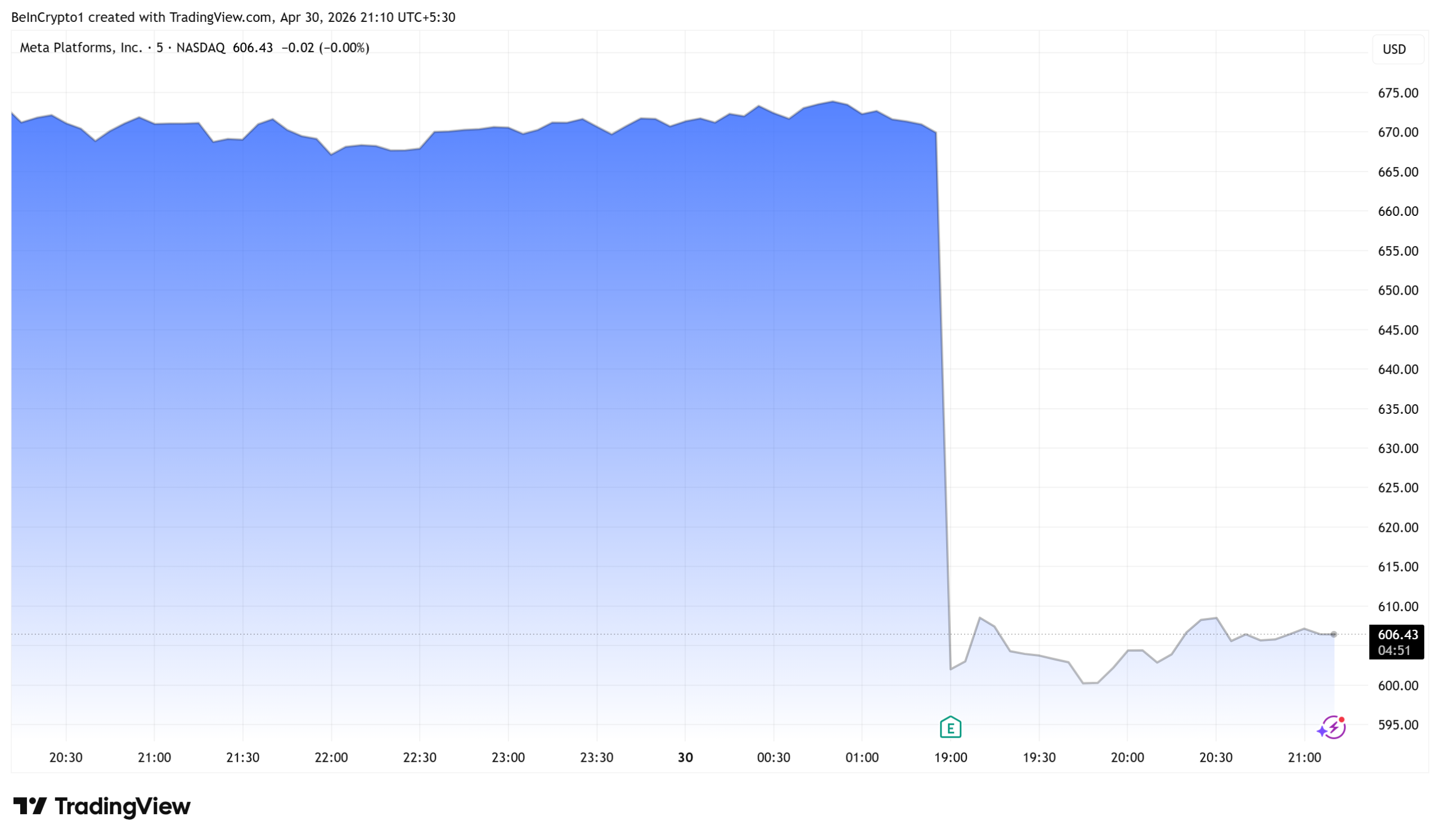
Meta Platforms (META) shares dropped roughly 10% on Thursday, erasing about $175 billion in market value. A higher 2026 capital expenditure forecast of $125 billion to $145 billion triggered the selloff.
The decline marked the stock’s largest single-day percentage drop in roughly six months. It came despite Q1 2026 earnings that exceeded Wall Street estimates on both revenue and profit.
Capex Hike Spooks META Investors
As of this writing, META stock was trading for $606.43, down by almost 10% in the last 24 hours, wiping out up top $175 billion from its market cap today alone.
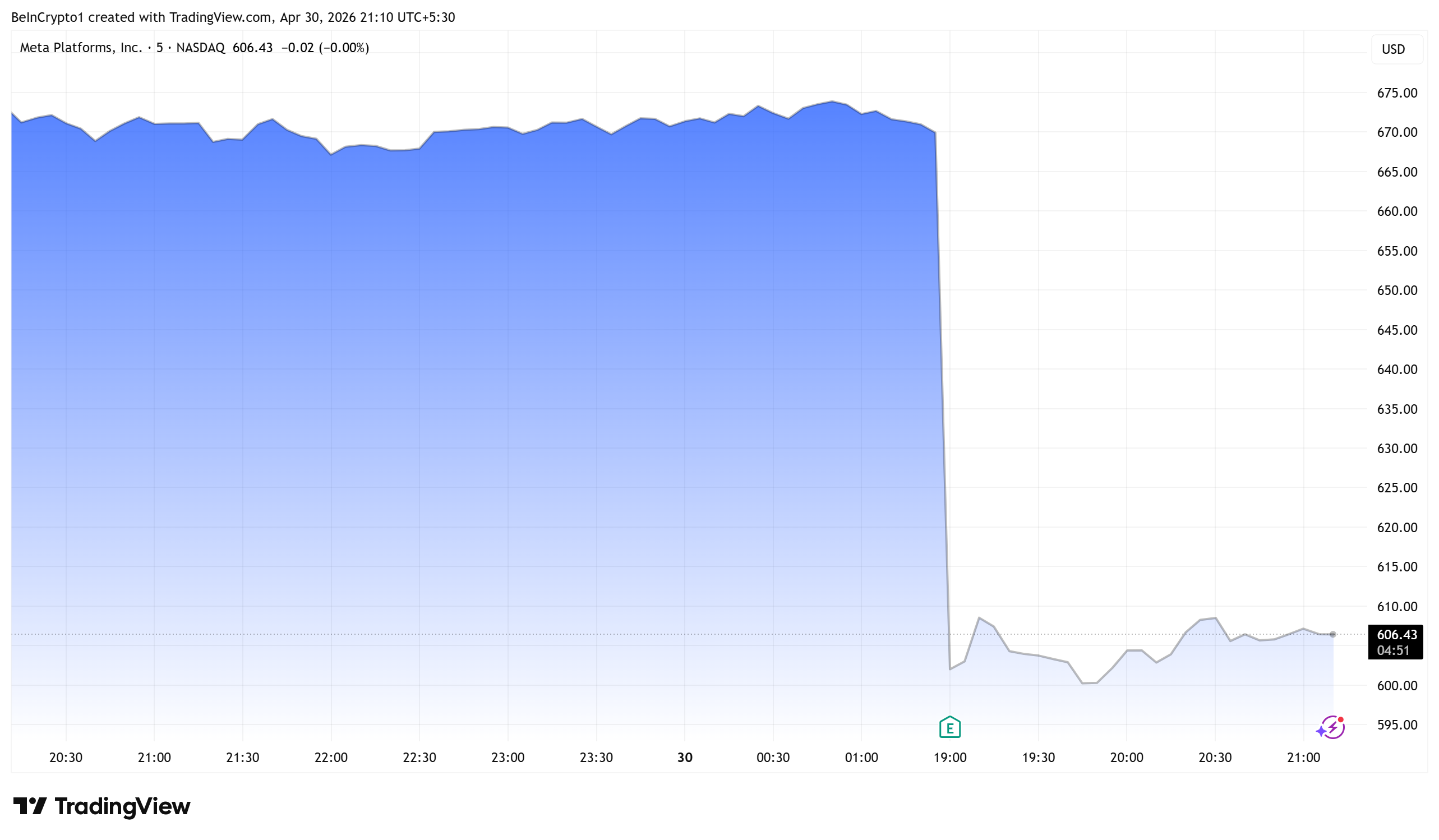
The new spending range sits roughly 7% above the previous January guidance of $115 billion to $135 billion.
Chief Financial Officer Susan Li attributed the increase to higher memory-chip pricing. She also cited additional data center costs tied to artificial intelligence (AI) infrastructure.
JPMorgan analyst Doug Anmuth downgraded Meta to Neutral and cut the bank’s price target to $725 from $825. The note flagged intensifying full-stack AI competition and a more challenging path to returns.
Q1 capex alone reached $19.8 billion, in line with the broader Big Tech race in AI infrastructure.
Earnings Beat Overshadowed
Meta reported revenue of $56.31 billion, up 33% year over year, the strongest quarterly growth since 2021. Net income reached $26.8 billion, or $10.44 per diluted share. An $8 billion one-time tax benefit tied to U.S. Treasury R&D guidance lifted that figure.
Ad revenue stayed strong as AI-powered content recommendations boosted engagement on Reels and video.
Yet the reaction echoed earlier sell-offs after prior Meta capex hikes. The pattern repeatedly overshadows strong fundamentals with spending fears.
CEO Mark Zuckerberg defended the strategy on the call. He framed the higher outlay as a vote of confidence in Meta’s AI roadmap.
Subscribe to our YouTube channel to watch leaders and journalists provide expert insights
The post Meta Stock Loses $175 Billion After AI Expense Estimate Shakes Shareholders appeared first on BeInCrypto.


Eric Trump predicted BTC would reach $1 million per coin at the Bitcoin 2026 conference in Las Vegas.
The statement marks continued Trump family support for cryptocurrency. It signals strong federal backing for the industry at the highest levels.
The $1 Million Bitcoin Prediction
Speaking at Vegas, Eric Trump was direct about his conviction.
“Bitcoin is going to hit $1 million. I absolutely believe it will,” he said to the assembled conference audience.
This prediction represents roughly a 13x increase from Bitcoin’s current price of $76,000. While such predictions are common at industry conferences, Eric Trump’s statement carries significant political weight. His family’s influence shapes federal policy and public perception.
Bullish Voices Clash With Skeptics
Michael Saylor pushed even further with his prediction. He argues that digital credit should drive Bitcoin to $10 million per coin. Saylor believes Bitcoin will become the world’s primary reserve asset through this mechanism.
However, skeptics strongly disagree with this narrative. Peter Schiff has criticized Strategy’s Bitcoin accumulation strategy. He warns that the company faces mounting pressure on dividends.
Additionally, Schiff predicted Bitcoin could fall to $10,000 if macroeconomic conditions worsen significantly. This contrasts sharply with Trump’s bullish stance and optimistic timeline.
Trump Administration Shows Pro-Crypto Support
The Trump administration signals clear pro-crypto backing at the federal level. The White House recently indicated strong interest in a strategic BTC reserve. This marks a major policy shift from prior administrations that viewed crypto skeptically.
Furthermore, the administration appointed pro-crypto SEC Chair Paul Atkins. This demonstrates deliberate federal support for the cryptocurrency industry. Such policy alignment creates favorable conditions for BTC appreciation.
What Bitcoin Needs to Reach $1 Million
Reaching $1 million requires several critical conditions to align. First, institutional adoption must accelerate dramatically across financial systems.
Second, digital credit instruments must transition from experimental to mainstream adoption. Third, Bitcoin must overcome significant macroeconomic headwinds, including the risk of stagflation and ongoing geopolitical risks.
Federal regulatory clarity remains absolutely essential for sustained growth. Eric Trump’s prediction implicitly assumes that pro-crypto policy will continue indefinitely. This assumption remains uncertain beyond the current electoral cycle.
Eric Trump’s prediction reflects the Trump family’s strong commitment to Bitcoin. Whether this target proves accurate depends on the development of digital credit infrastructure. It also hinges on macro conditions supporting risk-on asset appreciation.
The statement signals federal backing for Bitcoin moving forward. This contrasts sharply with prior administrations’ skeptical approach. Federal support could reshape policy in ways that support higher valuations.
The post Eric Trump Gives His Unsurprising Bitcoin Prediction in Las Vegas appeared first on BeInCrypto.


Treasury Secretary Scott Bessent confirmed on April 29 that the United States has seized almost $500 million in Iranian crypto assets under Operation Economic Fury, including a $344 million Tether freeze on two Tron addresses, while saying Iran’s currency has fallen 60 to 70% against the dollar and the country is in the middle of a currency crisis.
Summary
- Bessent said Operation Economic Fury has seized roughly $350 million in crypto assets plus an additional $100 million seized separately, bringing the total close to $500 million as part of a broader campaign targeting Iranian bank accounts, retirement funds, and overseas real estate.
- Tether froze over $344 million in USDT across two Tron addresses on April 23 after receiving direction from OFAC, with Chainalysis confirming on-chain patterns consistent with IRGC-linked wallets and Central Bank of Iran intermediary addresses.
- Bessent warned that the pressure campaign would leave the Iranian regime unable to pay its soldiers or fund proxy networks including Hezbollah and Hamas, and said secondary sanctions are now being deployed against buyers of Iranian oil.
Bessent Iran remarks on Fox Business’s Kudlow on April 29 confirmed the scope of Operation Economic Fury. CryptoTimes reported that Bessent said: “We were able to grab about 350 million crypto assets, and then on top of another 100 that we had recently gotten, so we’re almost at half a billion there, and we are freezing bank accounts everywhere.” Operation Economic Fury was ordered by President Trump in March 2025 and has been systematically cutting off Tehran’s financial access across crypto wallets, banking channels, foreign real estate, and retirement funds.
As crypto.news reported, OFAC has sanctioned more than 1,000 Iran-related individuals, vessels, and aircraft under Operation Economic Fury since February 2025, with the campaign recently expanding to secondary sanctions against Chinese oil refineries and shipping firms that handle Iranian crude. The largest single crypto action within the campaign came on April 23, when as crypto.news documented, Tether froze $344 million in USDT across two Tron addresses at OFAC’s direction, with one wallet holding approximately $213 million and the other $131 million, both identified by Chainalysis as matching IRGC wallet patterns and Central Bank of Iran intermediary addresses. As crypto.news tracked, the freeze is the largest single crypto enforcement action directly linked to Iran since the current conflict began in February 2026. Bessent said the combined economic pressure from Operation Economic Fury and the naval blockade has produced a 60 to 70% crash in the Iranian rial against the dollar and the collapse of Iran’s largest bank in December, and warned that Tehran will soon be unable to fund its military or its proxy networks.


The stablecoin issuer’s new payment rail enables USDC transfers as small as $0.000001, targeting AI agents that pay per API call, per second, or per dataset read.


The payments giant will fold PYUSD, Braintree, and merchant processing into a new Payment Services & Crypto division, marking the first time digital assets have a dedicated home within the company.
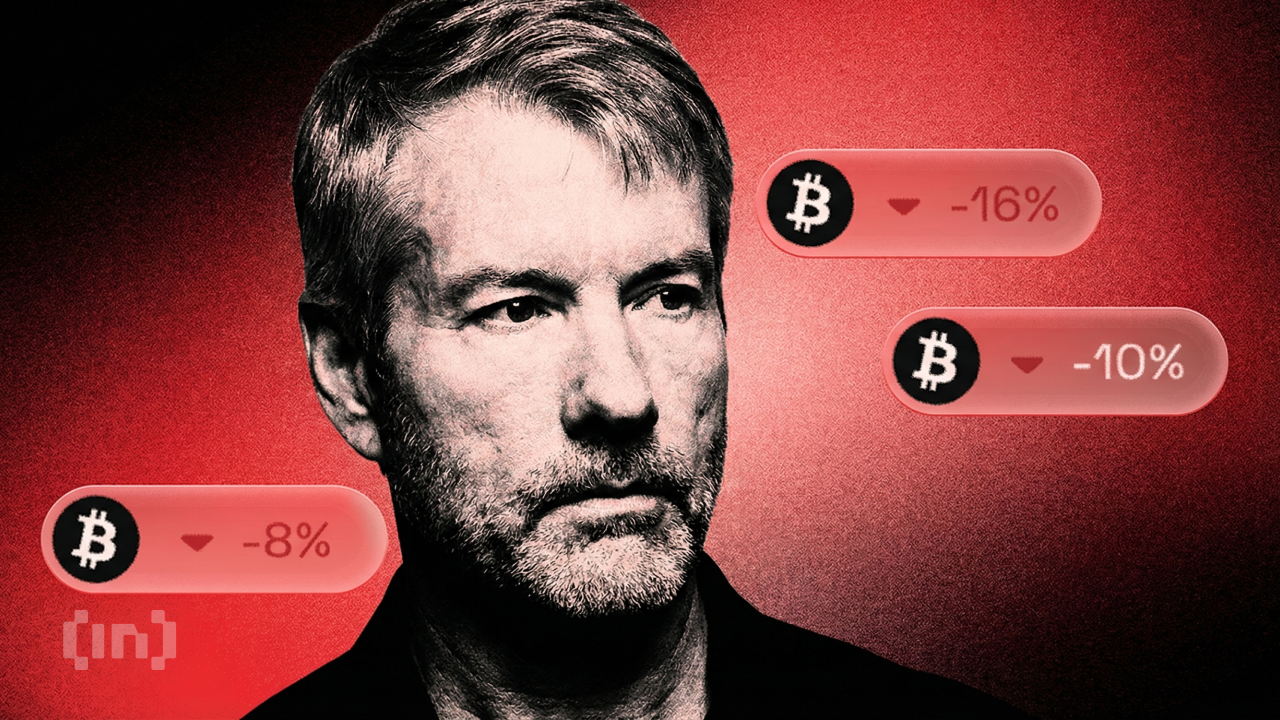
Peter Schiff has intensified his assault on Michael Saylor and Strategy, calling both the MSTR stock and STRC preferred equity scheme scams and comparing them to Nakamoto Games (NAKA), a cryptocurrency that collapsed 99% in the past year.
Schiff’s barrage of critiques comes as the Bitcoin conference season kicks off with renewed enthusiasm for digital credit instruments backed by Bitcoin holdings.
The NAKA Collapse Precedent
Schiff attended last year’s Las Vegas Bitcoin conference, where Nakamoto token (NAKA) generated massive hype and investor enthusiasm. Since then, the token’s price has collapsed by more than 99%, leaving investors who bought near the peak with devastating losses.
This year, Schiff argues, attendees are repeating the same pattern with STRC.
“By next year’s conference, attendees who buy STRC now may face similar losses to those who bought NAKA then,” Schiff warned, suggesting the preferred equity structure will eventually implode just as NAKA did.
Schiff’s Call-Out of Industry Complicity
Schiff went further, stating that every investment professional, government regulator, and financial journalist who does not publicly call out MSTR and STRC as scams and name Saylor as a fraud “can’t be trusted.”
The critique extends to the broader crypto industry. Schiff argued that crypto, “where hype and exaggeration rule,” was tailor-made for the Trump family and their ability to shill overpriced stocks to what he called “delusional investors.”
He suggested that after the bubble fully deflates, crypto industry workers will face a reckoning over which career path to take next.
Bitcoin’s “Hope” Problem
Schiff also attacked Saylor’s central thesis that digital credit denominated in Bitcoin will deliver superior returns compared to alternatives such as gold or the S&P 500.
“Expected by whom?” Schiff asked, noting that Bitcoin’s expected return is “more hope than forecast.”
He argued that investing based on hope rather than empirical data or fundamental analysis will end poorly for retail investors.
Beyond his Strategy critique, Schiff issued a broader economic warning. He cited Federal Reserve Chair Powell’s own admission that inflation remained uncontrolled except during crisis periods, averaging 3.7% per year over 30 years before 2010 and only dropping to 1.7% during the 2008 financial crisis and subsequent recession.
“Inflation is breaking out, bonds are breaking down, and stocks will follow bonds lower,” Schiff warned.
He predicted stagflation would worsen into recession, sending federal budget deficits soaring while the Fed cuts rates despite policy mandates to hike.
His conclusion: “Buy gold and silver.”
The Bigger Picture
Schiff’s sustained attack on MicroStrategy reflects a fundamental disagreement about where value lies in uncertain economic times. While Saylor and crypto advocates argue that Bitcoin offers superior returns and store of value properties, Schiff contends that precious metals offer more reliable downside protection.
For STRC investors betting on digital credit and Bitcoin appreciation, Schiff’s comparison to NAKA’s collapse serves as a cautionary reminder that crypto hype cycles have ended badly before and will likely do so again.
The post Peter Schiff Calls MicroStrategy’s MSTR Stock a Scam and Saylor a Fraud appeared first on BeInCrypto.


Bitcoin has failed to sustain a move above $78,000 in the 24 hours following Wednesday’s FOMC decision, with three straight sessions of Bitcoin ETF outflows totalling over $490 million signalling that institutional allocators are pausing rather than adding exposure as uncertainty over the Fed’s direction deepens.
Summary
- Bitcoin ETF products logged $137.77 million in net outflows on April 29, ending a nine-day inflow streak worth $2.1 billion, with every active issuer printing negative for the first time in the streak — including IBIT at $54.73 million and FBTC at $36.13 million.
- Glassnode data show Bitcoin is “trapped” below its True Market Mean at approximately $78,000 to $79,000, with perpetual futures at their most negative level on record — a positioning setup that contains both downside risk from continued selling and upside potential from a short squeeze if spot demand returns.
- April closed with $2.44 billion in total Bitcoin ETF net inflows, a strong monthly reversal despite the late-month outflow pressure, with XRP ETFs the only product category to print positive flows on April 29 at $3.59 million.
Bitcoin ETF data from SoSoValue confirmed $137.77 million in net outflows on April 29, the third consecutive outflow session and the one that ended a nine-day inflow run. As crypto.news reported, April 29 was the first session in the streak where zero issuers printed positive — every active fund was in net redemption territory, led by BlackRock’s IBIT at $54.73 million and Fidelity’s FBTC at $36.13 million.
“Bitcoin staying below the $78,000 mark isn’t really about crypto right now, it’s about what’s happening in the broader market,” said Daniel Reis-Faria, CEO of ZeroStack. “The Fed holding rates wasn’t a surprise, but there is no clear direction on what comes next, and that’s keeping investors from stepping in.”
Why the FOMC hold matters more than the rate
As crypto.news documented, Bitcoin has fallen after 8 of the last 9 FOMC meetings. The pattern is driven not by the decision itself but by the unwinding of pre-event positioning once the meeting passes. What made Wednesday’s outcome distinctly more negative than a standard sell-the-news event was the four-way dissent — the first such split since October 1992 — and Powell’s announcement that he will stay on the Federal Reserve Board past May 15, introducing leadership uncertainty on top of policy ambiguity. Kraken chief economist Thomas Perfumo said the market is now “more concerned about the policy uncertainties brought about by the division within the Federal Reserve rather than the inaction itself,” pointing to a leadership overhang that has no clear resolution timeline.
“You’re seeing that directly in ETF outflows and weaker demand,” Reis-Faria added. “The buying just isn’t strong enough to push Bitcoin higher. It doesn’t mean institutions are leaving the market, it just means they’re not increasing their exposure right now.”
That distinction — pause versus exit — is supported by the April data. Despite three consecutive outflow sessions, April closed with $2.44 billion in total Bitcoin ETF net inflows, a sharp positive reversal from a quarter that began with negative year-to-date flows. As crypto.news tracked, the ETF outflow and Bitcoin price relationship is not mechanically linear: concentrated outflows from large funds can compress price without indicating a structural exit from the asset class.
What brings Bitcoin back above $78,000
Glassnode data show Bitcoin currently below its True Market Mean and short-term holder cost basis clustered between $78,000 and $79,000, with the $65,000 to $70,000 range as the key downside support if selling accelerates. Perpetual futures have flipped to their most negative positioning level on record, a setup that historically precedes sharp short squeezes when spot demand returns. The 48-hour window from April 30 to May 1 is the critical observation zone: stable ETF flows, BTC holding above $74,500, and normalizing funding rates would collectively signal that the post-FOMC selling has exhausted itself.
“If money starts coming back in, especially from institutions or through ETFs, Bitcoin can move higher pretty quickly,” Reis-Faria said. “But until that happens, it’s likely to stay in this range.”
The catalysts that could shift that equation are concentrated in May: the CLARITY Act markup window, the Warsh Senate confirmation vote, Big Tech earnings outcomes from the prior session, and whether the Iran military briefing reported by Axios this morning produces a further risk-off escalation or opens a path toward diplomatic resolution.


XRP Las Vegas 2026 opened today, April 30, as Ripple covered the Las Vegas Strip with “Raise the Standard” billboards and Steven Zeiler of Yellow Network posted live from the floor calling XRP “only a step on the trajectory to becoming a global reserve currency.
Summary
- XRP Las Vegas 2026 runs April 30 to May 1 and draws Ripple executives, regulators, and institutional investors, coinciding with the listing of Ripple’s RLUSD stablecoin on OKX and a formal Ripple-OKX partnership announced April 29.
- White House advisor Patrick Witt hinted at major new developments for the national Bitcoin strategic reserve in the coming weeks, while speakers at XRP Las Vegas separately argued XRP occupies a different and complementary role as a bridge asset rather than a store of value.
- XRP is trading near $1.37 as the conference opens, down approximately 62% from its all-time high of $3.65 set in July 2025, as the broader community debates whether institutional adoption can convert conference momentum into price recovery.
XRP Las Vegas 2026 kicked off today at Las Vegas with Ripple’s most aggressive public marketing push in the event’s history. CoinGape reported that “Raise the Standard” XRP billboards blanketed the Strip across Resorts World, the Wynn, and beyond, setting the visual stage for an event that runs through May 1. Steven Zeiler of Yellow Network posted from the conference floor: “Live from Vegas. Impressed by seeing XRP promoted like this. But then again it’s only a step on the trajectory to becoming a global reserve currency.”
Crypto analyst Versan Aljarrah added broader context, saying: “The conversation around XRP is usually clouded by speculation and price predictions. The true potential for XRP isn’t just as a payments token or bridge asset.”
Why XRP supporters and Bitcoin advocates are not competing for the same reserve role
As crypto.news reported, XRP’s regulatory status shifted materially in March 2026 when the SEC and CFTC jointly classified it as a digital commodity, placing it on the same legal footing as Bitcoin and Ethereum for purposes of exchange-traded product approvals. That classification underpinned a record $81.63 million in April ETF inflows. The XRP Las Vegas argument, however, is structurally different from the Bitcoin strategic reserve conversation that Patrick Witt teased at the adjacent Bitcoin Conference. Bitcoin advocates frame the strategic reserve case around scarcity and store of value. XRP supporters argue the asset’s purpose is operational: a bridge currency that moves value between fiat rails in seconds at near-zero cost, a function that does not compete with Bitcoin’s role but sits alongside it. Ripple’s $190 billion processing partnership with Convera and integrations with Deutsche Bank and Société Générale reflect that operational framing, though those deals settle in RLUSD rather than XRP directly, meaning XRP’s utility depends on RLUSD volume growing through the XRP Ledger rather than on the partnerships themselves.
As crypto.news documented, a $59 million RLUSD settlement completed on April 29 for a fee of $0.000188 is precisely the kind of real-world infrastructure proof the XRP Las Vegas stage is highlighting — but approximately 82% of RLUSD currently resides on the Ethereum blockchain, not the XRP Ledger, meaning the network utility case for XRP specifically remains structurally dependent on RLUSD migrating to its native chain. As crypto.news tracked, Standard Chartered lowered its 2026 XRP price target from $8 to $2.80 in February amid macro headwinds, leaving the $1.37 conference open price well below even the revised institutional target heading into the CLARITY Act’s May markup window.

Key Highlights
- On April 27, 2026, CoreWeave’s Chief Development Officer McBee Brannin offloaded approximately $5 million in Class A shares via a pre-established Rule 10b5-1 plan.
- Executive Brian Venturo sold 375,000 shares worth around $40.9 million on the same date, also through a pre-arranged trading program.
- Shares of CRWV climbed approximately 8.2% to reach $114.19 amid robust trading activity, with the stock posting a 59% gain year-to-date.
- Wall Street maintains an optimistic outlook with 20 Buy recommendations and a consensus price target of $125.78.
- The company recently announced a $6 billion computing partnership with Jane Street, with quarterly results set for release on May 7.
Shares of CoreWeave have surged 59% since the start of the year, hovering near $114, yet two top executives just liquidated substantial positions — and investors didn’t seem to care.
CoreWeave, Inc. Class A Common Stock, CRWV
McBee Brannin, who serves as Chief Development Officer, disposed of Class A Common Stock valued at approximately $5 million on April 27, 2026. The transaction involved 45,850 shares executed at prices between $105.02 and $112.76 each.
Brannin’s sales occurred through a Rule 10b5-1 trading arrangement established in November 2025. Such plans allow executives to schedule stock sales ahead of time, shielding them from insider trading allegations.
The stock holdings were structured through two grantor retained annuity trusts — specifically the Canis Major 2025 GRAT and Canis Minor 2025 GRAT — a typical wealth management technique.
Concurrently, Brian Venturo, another company insider, divested 375,000 shares at approximately $109.03 apiece, generating proceeds of about $40.9 million. This sale also followed a predetermined 10b5-1 arrangement.
In total, both executives liquidated north of $45 million in holdings within 24 hours.
Market Response and Stock Trajectory
Notwithstanding the substantial insider transactions, CRWV shares climbed 8.2% to close at $114.19, with trading volume approaching the typical 27.8 million share daily average. The equity has traded within a 52-week band of $39.50 to $187.00, positioning current levels near the middle of that spectrum.
Since January, CRWV has appreciated 59%. On a trailing twelve-month basis, shares have rocketed 176%, although they dipped 2.8% during the previous week.
The enterprise commands a market capitalization fluctuating between $50 billion and $57 billion based on daily valuations. The balance sheet shows a debt-to-equity ratio of 4.46, while the company continues operating at a loss, posting a $0.89 per share deficit in its latest quarter — missing the analyst consensus estimate of a $0.61 loss.
Quarterly revenue registered at $1.57 billion, reflecting a robust 110.4% year-over-year expansion.
Wall Street Maintains Optimistic Stance
The financial community remains largely unfazed by the red ink or executive share sales. Among 33 analysts tracking the company, 20 recommend buying, 11 suggest holding, and only 2 advise selling. The mean price objective sits at $125.78.
Wells Fargo elevated its price forecast to $135 while maintaining an Overweight designation. DA Davidson pushed even higher, boosting its target to $175 with a Buy rating. Cantor Fitzgerald increased projections from $149 to $156 following CoreWeave‘s announcement of a $6 billion computing arrangement with Jane Street.
This agreement grants Jane Street access to CoreWeave’s computational infrastructure spanning multiple data centers. Jane Street also committed $1 billion in capital at $109 per share.
Oppenheimer analysts anticipate that CoreWeave will deliver first-quarter revenue toward the upper boundary of guidance and may potentially elevate its full-year 2026 projections.
Taking a more reserved position, Sanford C. Bernstein bumped its target from $56 to $67 while retaining an Underperform classification.
CoreWeave has additionally structured a $1 billion private placement of senior notes maturing in 2031 carrying a 9.75% coupon, with closing anticipated on April 21, 2026.
The company is slated to announce quarterly earnings on May 7, 2026.


Stormont leaders slam ‘deliberate’ Mournes wildfires as lives put at risk

Prelude hit with $58m Kogas impairment

Evernorth XRP names OpenAI CFO to its board

Manchester United reach agreement with Casemiro over contract clause amid transfer speculation

US brings back mandatory military draft registration

Steven Gerrard disagrees with Gary Neville over ‘shock’ Chelsea and Arsenal claim | Football


-

 Tech3 days ago
Register Renaming | Hackaday
-

 Fashion6 days ago
Weekend Open Thread – Corporette.com
-
 Crypto World5 days ago
Hyperliquid $HYPE Rally Builds Momentum as AI Sector Enters Prove-It Phase
-

 Politics3 days ago
Drax board avoid their own AGM, accused of greenwashing & environmental racism
-
 Sports5 days ago
IPL 2026: Ruturaj Gaikwad registers slowest fifty of the season, enters all-time unwanted list | Cricket News
-

 Tech3 days ago
Images of Samsung’s rumored smart glasses have leaked
-

 NewsBeat5 days ago
LK Bennett closes all stores after entering administration
-

 Tech4 days ago
Why Blue Badges Disappeared From Toyota Hybrids
-

 Crypto World7 days ago
Michael Saylor says BTC winter is over. Market analyst disagrees, says bitcoin was in a pullback
-

 Fashion2 days ago
Kylie Jenner’s KHY Enters a New Era with ‘Born in LA’
-
 Entertainment5 days ago
Mariah Carey Slams Deposition Claims In Brother’s Lawsuit
-

 Business2 days ago
Most Commercial Energy Audits Miss the Real Losses
-
 NewsBeat7 days ago
Trump threatens to review UK’s claim to Falkland Islands and punish Nato allies over Iran war disagreement
-
 Business6 days ago
Jeanine Pirro announces closure of Federal Reserve building cost probe
-

 Business3 days ago
(VIDEO) Charlize Theron Climbs Times Square Billboard to Promote New Netflix Thriller ‘Apex’
-

 Tech5 days ago
Microsoft to roll out Entra passkeys on Windows in late April
-

 Tech5 days ago
OpenAI’s Sam Altman apologizes for not reporting ChatGPT account of Tumbler Ridge suspect to police
-

 Crypto World2 days ago
CFTC’s AI will review U.S. crypto registration applications, chairman tells CoinDesk
-
 Crypto World6 days ago
Nvidia (NVDA) Stock Jumps 5% as Intel Earnings Ignite Semiconductor Rally
-
Entertainment7 days ago
Snooki says “Jersey Shore” cast plans to film show 'until we're in a nursing home': 'It's not over for us'
You must be logged in to post a comment Login