

Crypto World
Bitcoin manipulation claims face pushback as ETFs reverse 5wk outflow

Bitcoin (CRYPTO: BTC) traded in a tight band this week as market participants weighed chatter about a purported “10 a.m. dump” tied to a prominent quantitative trading firm. The narrative gained traction after Terraform Labs’ court-appointed administrator filed a suit alleging insider trading connected to the Terra ecosystem’s May 2022 collapse. Yet data from multiple trackers points to a more diffuse market dynamic, with no single actor reliably pushing Bitcoin lower through the open, and liquidity environments shading toward ETF inflows and broader risk sentiment. On the data side, spot Bitcoin demand returned with vigor as exchange-traded products (ETPs) drew fresh capital, and institutional names continued to tilt perceptions about how crypto balance sheets are managed in a stressed environment. Ethereum (CRYPTO: ETH) has also faced its own set of pressures, including large corporate balance sheets reporting losses amid a broad downturn.
The week’s discourse extended beyond the 10 a.m. narrative. In the U.S., demand for spot Bitcoin exchange-traded funds picked up after weeks of negative flow, with several consecutive days recording inflows. Data from Farside Investors shows spot Bitcoin ETFs taking in more than $1 billion across three straight days, including $254 million on Thursday, underscoring renewed appetite among institutions and retail buyers alike. The rhythm of inflows not only suggests a stabilizing bid for Bitcoin itself but also highlights how investors are navigating the cryptoeconomy through regulated vehicles as volatility remains elevated in several corners of the market. Within this broader context, the appetite for regulated Bitcoin exposure appears to have survived the 2022–2023 era of freestanding volatility and the occasional liquidity drought that accompanied broader macro risk-off periods.
Other notable developments touched on the corporate side of Ethereum. Bitmine Immersion Technologies, a leading corporate Ether (ETH) treasury holder, appears to be sitting on a large unrealized loss, with estimates around an $8.8 billion gap between current prices and the company’s cost basis as Ether prices remained depressed. The Bitmine balance sheet illustrates how even industry participants with sizable on-chain exposure can face material impairment when token prices retreat from peaks seen in prior years. Bitmine’s holdings, tracked by third-party services, reveal an average cost basis near the mid-$3,000s per Ether, amplifying the impact of the latest price movements on the treasury’s reported economics. Despite the paper losses, Bitmine continues to accrue Ether in the portfolio, signaling a willingness to sustain a long-term stake even in a downturn environment. The broader Ether narrative continues to be shaped by ongoing network developments, regulatory scrutiny, and the evolving macro backdrop that has challenged risk assets across crypto and traditional markets.
Traders also watched notable on-chain activity linked to high-profile figures. Ethereum’s co-founder Vitalik Buterin has been unloading Ether in what he described as plans to earmark roughly $45 million worth of tokens for privacy-oriented projects. Buterin’s wallets were reported to hold about 241,000 Ether early in February but declined to roughly 224,000 ETH as selling continued into the month. On-chain data indicates the majority of the sales were routed through decentralized-exchange aggregators, such as CoW Protocol, using numerous smaller swaps rather than a single large block. These patterns are consistent with a technique used by some traders to minimize market impact when converting large holdings into other assets or currencies. The disclosures add a human dimension to a market that often abstracts price action into charts and models, reminding readers that individual actors can influence the pace of selling without necessarily altering the longer-term crypto narrative.
In parallel, the market highlighted Ethereum-related corporate dynamics in another corner of the ecosystem. Bitmine’s broader Ether exposure has remained a focal point for analysts who question whether a broader structural issue could be emerging for Ether’s investment case. The situation underscores the sensitivity of corporate treasuries to price swings in ETH and the challenges of budgeting liquidity while capital markets watch for deeper shifts in DeFi and staking economics. The broader implications for corporate treasuries are not limited to Bitmine; 10x Research and other researchers have flagged that Ether is trading around levels that test whether the downturn is cyclical or signals deeper structural issues. The market’s emphasis on cost basis and unrealized losses among large corporate holders highlights the ongoing tension between long-term holdings and near-term price weakness, a dynamic that informs decisions across institutional wallets and treasury strategies.
Meanwhile, within the DeFi sector, leading lending protocols continued to expand their scale and institutional appeal. Aave, for instance, reported crossing $1 trillion in cumulative lending volume, marking a historic milestone for on-chain finance. Aave’s leadership in the space reflects a broader push to normalize DeFi as a credible input to traditional finance, with the project emphasizing its role as a foundational liquidity network. The firm’s institutional outreach has included the launch of Aave Horizon, a dedicated lending market on Ethereum designed to enable traditional finance firms and other large investors to borrow stablecoins against real-world assets. Early participants included VanEck, WisdomTree and Securitize, signaling that established asset managers are paying attention to the potential of tokenized, on-chain liquidity. In a broader context, the DeFi sector has also pointed to the possibility of tokenizing “abundance assets”—such as solar energy and robotics—though the path to mass adoption and regulatory clarity remains a work in progress. Stani Kulechov, CEO of Aave Labs, has framed the expansion as part of a long-term strategy to connect traditional finance with a scalable on-chain liquidity network, and he has publicly discussed the potential for DeFi to underpin broader financial infrastructure in the years ahead.
Crucially, the DeFi landscape continues to contend with shifting incentives. Curve Finance founder Michael Egorov argued that DeFi must move away from token emissions as the primary engine of liquidity. In an interview with Cointelegraph, Egorov contended that protocols should generate real revenue rather than rely on inflationary token incentives, noting that the DeFi “summer” era of 2020—when triple-digit TVLs drew flows into new protocols—represented a very different market environment. He argued that token velocity and speculative premiums no longer reliably translate into price increases, pointing to a broader re-prioritization of value drivers as TVL (total value locked) has fallen and liquidity becomes more costly to obtain. Data from DefiLlama shows DeFi TVL down roughly 38% over six months, with total value locking sliding from about $158 billion to around $98 billion as of this week.
Market reaction and key details
The week’s price action and commentary reflect a market that remains highly data-driven, with inflows into spot Bitcoin ETFs providing a counterweight to volatility in altcoins and tokens linked to DeFi. The stronger ETF demand aligns with a broader willingness among investors to obtain regulated exposure to Bitcoin, even as macro sensitivities persist. At the same time, the narrative around a single actor’s influence—famously associated with a “10 a.m. dump”—has not withstood scrutiny from market observers who emphasize liquidity depth, hedging activity, and the role of delta-neutral strategies that blend spot purchases with offsetting futures. CryptoQuant’s head of research noted that the described activity is not unique to a single firm; the pattern of buying spot exposure while selling futures is a common tactic for funds seeking to capture spreads rather than directional price moves. The takeaway for traders is that short-term price dips are not reliable indicators of a concerted manipulation scheme, especially when liquidity flows and hedging strategies mask net exposure in public filings.
On the corporate front, Bitmine’s situation remains a focal point for those tracking Ether as a treasury asset. The company’s paper losses, coupled with Ether’s broader price motion, have raised questions about the economics of large, long-hold Ether portfolios and the risk management practices that accompany such holdings. While Bitmine continues to accumulate Ether, the scale of the paper loss underscores the challenge of navigating a downturn when large balance sheets are deeply underwater relative to their cost basis. The market will be watching whether Bitmine’s strategy evolves toward more cost-efficient accumulation or whether the firm takes a more cautious stance as price dynamics evolve.
From a systemic perspective, Aave’s milestones highlight the ongoing maturation of DeFi as a facet of institutional finance. Surpassing $1 trillion in cumulative lending volume is not just a numeral milestone; it signals a deeper level of trust among builders and users who rely on on-chain lending as part of a diversified liquidity strategy. The Horizon initiative mirrors a broader trend: traditional finance is increasingly engaging with regulated, permissioned paths to access decentralized liquidity. This alignment with institutions is likely to affect the headlines around DeFi, shaping capital flows and the pace at which new use cases—such as tokenized real-world assets—are tested in real markets. Meanwhile, Curve’s call for revenue-driven models presents a practical pivot for protocols developed during periods of token-driven growth, a shift that market participants must evaluate against ongoing competition for liquidity and funding in a tightening environment.
Why it matters
For investors, the week’s events underscore a composite picture: Bitcoin’s regulatory-friendly exposure through ETFs is expanding, while the DeFi ecosystem is increasingly defined by revenue-generating models rather than pure token incentives. This implies a potential recalibration of risk premiums and valuation frameworks as regulated products coexist with on-chain liquidity that is maturing toward more robust, revenue-backed business models.
For builders and developers, the emphasis on real revenue streams signals a shift in product design. Protocols may prioritize sustainable fee structures, cross-chain interoperability, and institutional-grade risk controls to appeal to larger asset managers and banks. The Aave Horizon launch illustrates how regulated channels can complement permissionless finance, enabling institutions to access liquidity in familiar formats while preserving the transparency and programmability that define DeFi at its core.
For corporate treasuries and risk managers, the discussion around cost basis and unrealized losses in Ether highlights the dual challenge of balancing long-term exposure with the need to monitor liquidity and price volatility. The Bitmine case, in particular, emphasizes the potential for material impairment in treasury-heavy strategies if market conditions deteriorate further. The unfolding dynamic raises questions about optimal hedging configurations, diversification across assets, and whether to pursue more active risk management in periods of extended drawdowns.
What to watch next
- Continuing ETF inflows: Watch Farside data for the next three weeks to confirm whether the momentum in spot Bitcoin ETFs persists.
- Terraform/Jane Street developments: Monitor the ongoing legal actions and any new filings related to insider-trading allegations and market impact.
- Bitmine updates: Track Bitmine’s quarterly disclosures and any changes in their Ether balance strategy or cost-basis metrics.
- Aave Horizon uptake: Observe institutional participation and any new assets added to on-chain lending markets, plus regulatory updates affecting DeFi lending.
Sources & verification
- Terraform Labs administrator filing alleging insider trading tied to Terra’s collapse (legal filing / court documents).
- Farside Investors data on US-listed spot Bitcoin ETF inflows, including the $254 million on Thursday.
- Bitmine Immersion Technologies’ Ether treasury data and reported unrealized losses (Bitminetracker / on-chain analytics).
- Vitalik Buterin’s ETH balance trajectory and on-chain sale activity (Arkham data; Lookonchain lookups).
- Aave’s cumulative lending volume milestone and information on Aave Horizon’s institutional program (Aave communications / official updates).
Market reaction and key details
Bitcoin (CRYPTO: BTC) showed resilience in the face of speculation about manipulated moves at market open, with analysts noting that a tissue of hedges and delta-neutral strategies can obscure the true net exposure of large traders. The broader takeaway is that the market did not exhibit a durable, company-driven selloff that could sustain a prolonged downturn. In parallel, the inflows into spot Bitcoin ETFs—backed by data from Farside Investors—illustrate renewed demand for regulated vehicles that offer exposure to the flagship asset without requiring direct custody of coins. This demand appears to be supported by a mix of retail and institutional investors who seek the safety net of regulated products in times of cross-asset volatility. The IBIT exposure—iShares Bitcoin Trust—in particular has been a focal point for discussions about how institutions implement regulated exposure to Bitcoin, though the specifics of holdings and hedges remain part of ongoing disclosure and market interpretation.
Ethereum’s corporate dynamics continued to weigh on Ether’s price narrative. Bitmine Immersion Technologies—one of the largest corporate Ether treasuries—faces what analysts describe as a substantial paper loss, reflecting how fast-moving price action can widen gaps between market price and cost basis for large holders. The situation adds a layer of complexity to the broader ETH story, where on-chain use cases, staking economics, and regulatory considerations converge to shape long-run demand and supply. Buterin’s recent activity—selling portions of ETH to fund privacy initiatives—also underscores how even celebrated crypto figures navigate the tension between philanthropic or strategic goals and the practical realities of balance sheet management in a down market. The execution path—routing sales through CoW Protocol to avoid market impact—also highlights the sophistication of modern on-chain trading tactics and their implications for liquidity and price formation.
On the DeFi front, the milestone of surpassing $1 trillion in cumulative lending volume for Aave marks a watershed moment. It signals that the sector is increasingly viewed as a mature and scalable component of a diversified crypto finance stack. Aave Horizon’s launch, designed to attract institutional capital to real-world asset-backed lending against stablecoins, suggests a deliberate bridging of on-chain and off-chain opportunities. The focus on tangible revenue generation—rather than token emissions—reflects a broader industry shift toward sustainability and governance-driven growth, a theme echoed by Curve Finance founder Michael Egorov, who argues for a move away from inflationary incentives toward revenue-backed models. The DeFi ecosystem’s TVL decline—down about 38% over the last six months to roughly $98 billion—serves as a cautionary backdrop, reminding readers that liquidity, regulatory clarity, and the cost of capital continue to shape expectations for long-term growth.
Why it matters
For traders and investors, the week’s data emphasizes that regulated exposure and on-chain liquidity are not mutually exclusive trends. ETFs and regulated products continue to draw capital into Bitcoin, while the DeFi ecosystem demonstrates resilience through major milestones and institutional collaborations. This duality suggests that crypto markets may be entering a phase where traditional financial instruments and decentralized finance operate in closer harmony, each contributing to a more nuanced risk-adjusted landscape.
For developers and ecosystem builders, the shift toward revenue-driven models signals a need to retool incentive structures and monetize real-world utility. Projects that align fees, services, and governance with measurable revenue streams could gain greater legitimacy in the eyes of institutions and auditors. This transition is likely to shape product roadmaps, fundraising strategies, and regulatory conversations as the industry continues its evolution toward a more mature financial stack.
What to watch next
- Next round of ETF inflows and potential shifts in spot BTC demand (watch Farside data and ETF issuer updates).
- Regulatory and legal developments around Terraform Labs and Jane Street; any new allegations or disclosures could influence market sentiment.
- Bitmine’s continued Ether balance management and cost-basis updates; monitor any changes in treasury strategy.
- Institutional uptake of Aave Horizon and broader DeFi adoption signals, including new asset types and asset-backed lending markets.

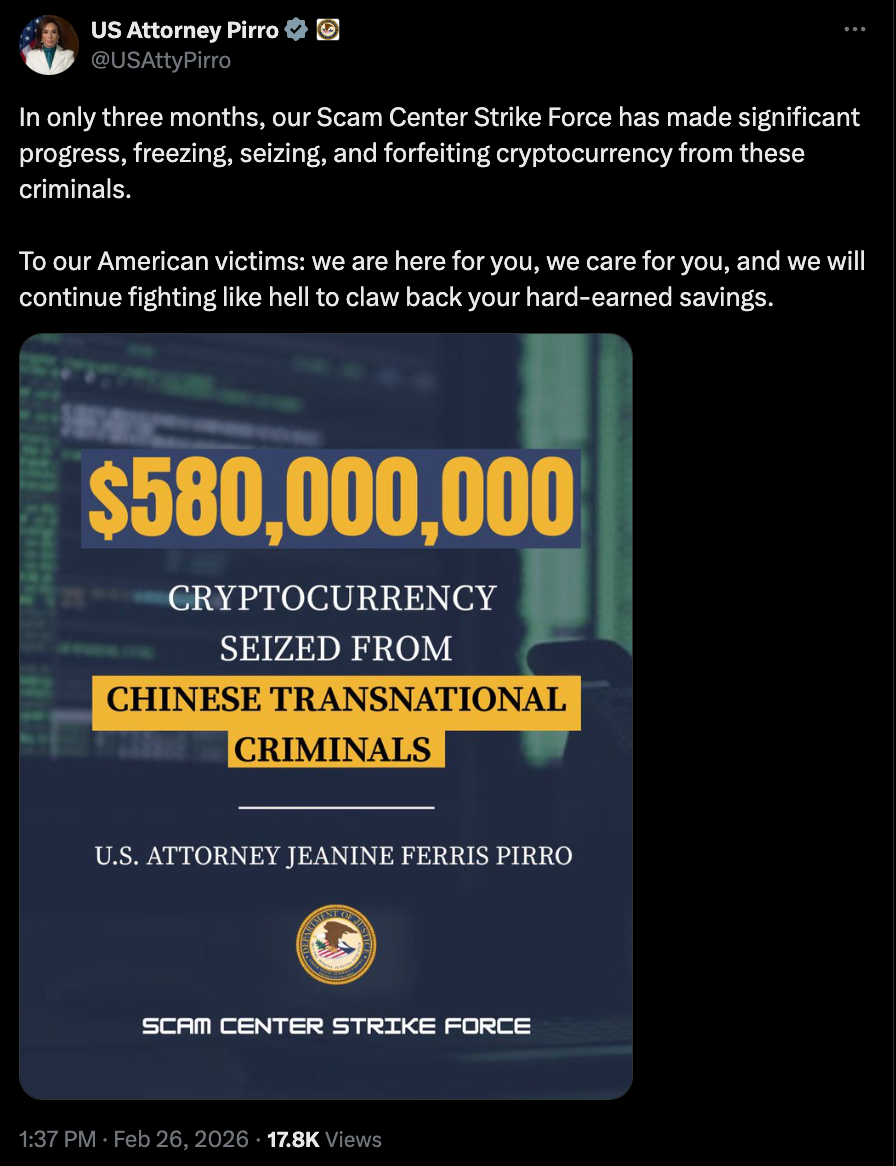
The seizures and freezing over three months were conducted by the District of Columbia’s Scam Center Strike Force, established by US Attorney Jeanine Pirro in November.
Officials with the US Department of Justice reported “freezing, seizing, and forfeiting” more than $578 million worth of digital assets tied to criminal groups as part of a task force’s efforts targeting “Southeast Asian cryptocurrency-related fraud and scams.”
In a Thursday notice, the Justice Department said the frozen and seized crypto had been “stolen by Chinese transnational criminal organizations” using websites and social media platforms to target US residents. The actions were taken by the District of Columbia’s Scam Center Strike Force, established by former Fox News host, now US Attorney Jeanine Pirro in November.
“Seizures of cryptocurrency is one important part of the Scam Center Strike Force’s work,” said Pirro. “Through the legal process, my Office will seek to forfeit these funds and return them to victims to the maximum extent possible.”

Pirro’s comments signaled that many of the funds would not be used to bolster the Strategic Bitcoin Reserve and digital asset stockpile established via executive order by US President Donald Trump in March 2025. According to data from BitcoinTreasuries.NET, US authorities may hold as much as 328,372 Bitcoin (BTC) through various criminal seizures, but the White House had not publicly commented on the stockpile’s size as of Friday.
Related: South Korea’s tax office leaks wallet seed and loses $4.8M in seized tokens
Crypto scams surged in 2025
According to blockchain analytics platform Chainalysis, the number of incidents involving impersonation scams tied to crypto rose by about 1,400% year over year in 2025. Many of the scams included pig butchering and investment schemes, with the average amount stolen through impersonation scams increasing by 600% over the same period.
Some of the parties involved have gone to prison in the US. Earlier this month, a judge sentenced an individual to 20 years in prison for orchestrating a scam to steal more than $73 million from victims, many of whom were based in the US.
Magazine: Clarity Act risks repeat of Europe’s mistakes, crypto lawyer warns

Blockchain infrastructure company Alchemy has launched a system that allows autonomous AI agents to buy compute credits and access its blockchain data services using onchain wallets and USDC on Base.
According to the company’s announcement, the initial release allows AI agents to directly query blockchain networks, check nonfungible token (NFT) ownership, view wallet balances across multiple chains and access live token price data, with additional networks and services planned.
If an agent exhausts its prepaid compute credits, Alchemy issues a payment request that can be automatically settled in USDC (USDC) on Base, allowing the agent to continue operating without human intervention.
The company said agents can fund accounts with as little as $1 in USDC, and once credited, continue making API calls until the balance is depleted and another automated payment is required.
The system uses Coinbase’s x402 payment standard to convert an HTTP “402 Payment Required” response into an automatic billing trigger. The x402 is an open standard that allows web services to request onchain payments directly through HTTP responses, enabling machine-to-machine transactions without manual invoicing.
Nikil Viswanathan, CEO of Alchemy, told Cointelegraph that the system is aimed at developers building autonomous decentralized finance (DeFi) agents, portfolio management bots and other multi-step onchain workflows.
He said that several major crypto applications, including Robinhood Crypto, Uniswap, OpenSea, Aave and 0x, already rely on Alchemy to power transactions, adding:
Now AI agents can access that same infrastructure autonomously, without a human ever touching it. This is the moment the agentic economy gets its own set of keys.
Related: The sports IP industry can’t defend itself against AI without blockchain
Crypto companies and developers accelerate agent adoption
AI agents, software systems that can make decisions and execute tasks autonomously based on predefined goals and real-time data, have drawn growing attention over the past year. Nearly a quarter (23%) of organizations surveyed by McKinsey in November said they were expanding their use of agent-based systems.
On Feb. 6, AI platform AI.com, founded by Crypto.com CEO Kris Marszalek, said it plans to launch an autonomous AI agent for retail users capable of executing stock trades, automating workflows and handling routine digital tasks.
A few days later, Coinbase introduced “Agentic Wallets,” crypto wallet infrastructure designed to let AI agents autonomously spend, earn and trade digital assets, including executing onchain transactions such as managing DeFi positions, rebalancing portfolios and paying for services.
Meanwhile, Monad’s developer community announced the results of its Moltiverse Hackathon this week, naming 16 winners across a range of “agent + token” projects.
The winners included a programmable venture capital agent that evaluates and invests automatically, AI-driven multiplayer battle arenas, an AI dating network where agents “represent their humans,” and trading card games governed by software rather than human players.

Magazine: Crypto loves Clawdbot/Moltbot, Uber ratings for AI agents: AI Eye
After months of sliding digital asset prices, public companies that embraced Bitcoin (BTC) as a treasury strategy are facing renewed scrutiny. Activist investors are now challenging those balance-sheet bets, echoing broader concerns about the volatility and long-term viability of the corporate Bitcoin model.
Stablecoins, meanwhile, continue to anchor the market. Circle posted a stronger-than-expected fourth quarter, even as early signs of a so-called “crypto winter” began to surface.
However, not every payments player is sharing in that momentum. PayPal’s push into digital assets, including the launch of its PayPal USD stablecoin, has yet to reverse its stock decline, with reports suggesting the company is drawing takeover interest.
This week’s Crypto Biz examines the pressure building around Bitcoin treasuries, the staying power of the stablecoin business and the challenges facing legacy payment giants navigating crypto’s next phase.
Empery Digital faces shareholder revolt over Bitcoin treasury
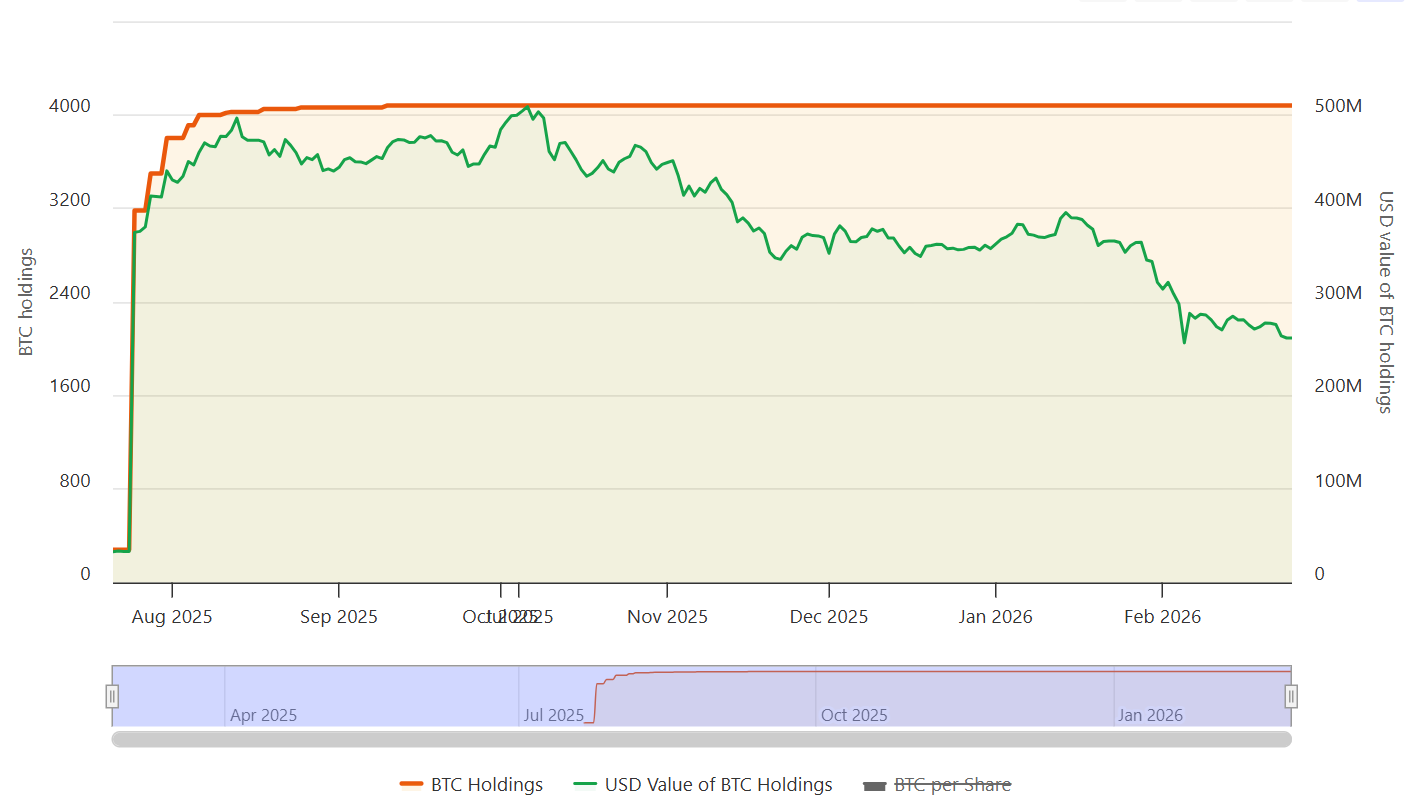
A nearly 10% shareholder of Empery Digital is calling for sweeping changes, including the sale of the company’s roughly 4,000 Bitcoin holdings and the resignation of its CEO and board.
In a letter to management, investor Tice P. Brown argued that the Bitcoin-heavy treasury strategy has failed to maximize shareholder value and demanded capital be returned to investors instead.
Empery pushed back against the claims, defending its strategy. The dispute highlights the growing tension between activist investors and public companies that have adopted Bitcoin as a core balance-sheet asset.
Empery, which transitioned its legacy business into a Bitcoin treasury last year, has amassed 4,081 BTC, making it one of the top 25 largest public holders of the digital asset.

Circle’s earnings, USDC growth fuels stock rally
Stablecoin issuer Circle delivered a stronger-than-expected fourth quarter, even as broader crypto market conditions weakened, underscoring continued momentum in the dollar-backed stablecoin market.
Fourth-quarter revenue reached $770 million, up 77% from a year earlier. Net income totaled $133.4 million, or 43 cents per share. Both were ahead of analyst expectations. The more telling figure, however, was USDC’s (USDC) expansion. Supply rose 72% to $75.3 billion by year-end, reflecting sustained demand for onchain dollar liquidity.
For the entire year, Circle reported $2.7 billion in revenue and a net loss of $70 million that was largely due to stock-based compensation tied to its initial public offering.
Shares jumped more than 20% following the earnings release, as investors responded to the revenue growth and expanding stablecoin base.

PayPal draws takeover interest after steep stock decline
PayPal is reportedly attracting early-stage takeover interest after a prolonged slide in its share price, as competitors weigh opportunities to consolidate parts of the digital payments market.
According to Bloomberg, some potential buyers are evaluating a full acquisition, while others may pursue specific business segments. Discussions remain preliminary, and no formal offer has been announced. Bitcoin-friendly payments company Stripe later emerged as one of the interested parties.
The development comes as PayPal continues restructuring efforts and expands further into digital assets, including its proprietary stablecoin.

$500M stablecoin mortgage deal bridges DeFi and housing
Mortgage lender Better and Framework Ventures are launching a $500 million initiative that channels stablecoin liquidity into US mortgage lending, potentially bringing real-world housing finance deeper into decentralized markets.
Under the structure, Better will continue underwriting and issuing home loans, while funding is sourced through a stablecoin ecosystem. The arrangement connects blockchain-based liquidity with traditional real estate finance, an area long discussed but rarely deployed at a meaningful scale.
The deal signals continued momentum behind tokenized real-world assets, even as broader crypto markets remain volatile.
Crypto Biz is your weekly pulse on the business behind blockchain and crypto, delivered directly to your inbox every Thursday.
DeepSeek AI predicts great things this year for HODLers of XRP, Bitcoin and Ethereum.
Despite months of persistent downside pressure across the crypto market, DeepSeek has a notably optimistic stance on the market leaders, projecting that all three could reach fresh all-time highs within the next ten months.
So, just how credible are DeepSeek’s predictions?
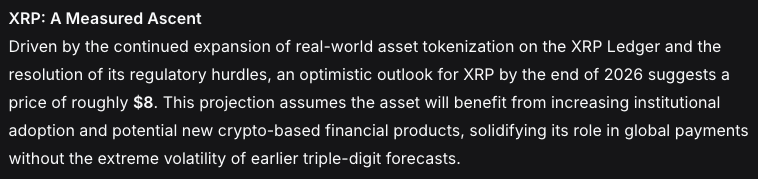
XRP ($XRP): DeepSeek AI Sees a Tidy 6x Move by Christmas
In a recent update, Ripple reaffirmed that XRP ($XRP) plays a central role in its long-term strategy to position the XRP Ledger (XRPL) as a globally adopted, enterprise ready payments network.
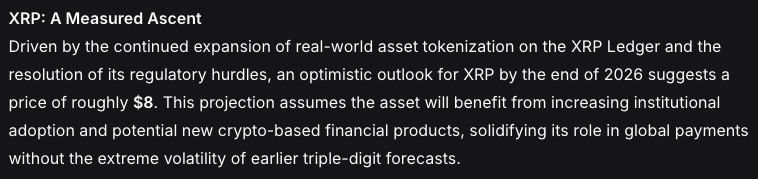
Thanks to elite infrastructure, rapid settlement speeds and low transaction fees, XRPL is likely to benefit from two fast-growing sectors: stablecoins and tokenized real-world assets.
With XRP currently trading near $1.37, DeepSeek predicts a 2026 rally to $8, representing a sixfold increase from current levels.
XRP’s relative strength index (RSI) sits at a neutral 40, while price action has aligned with the 30-day moving average, suggesting the lengthy consolidation phase may almost over.
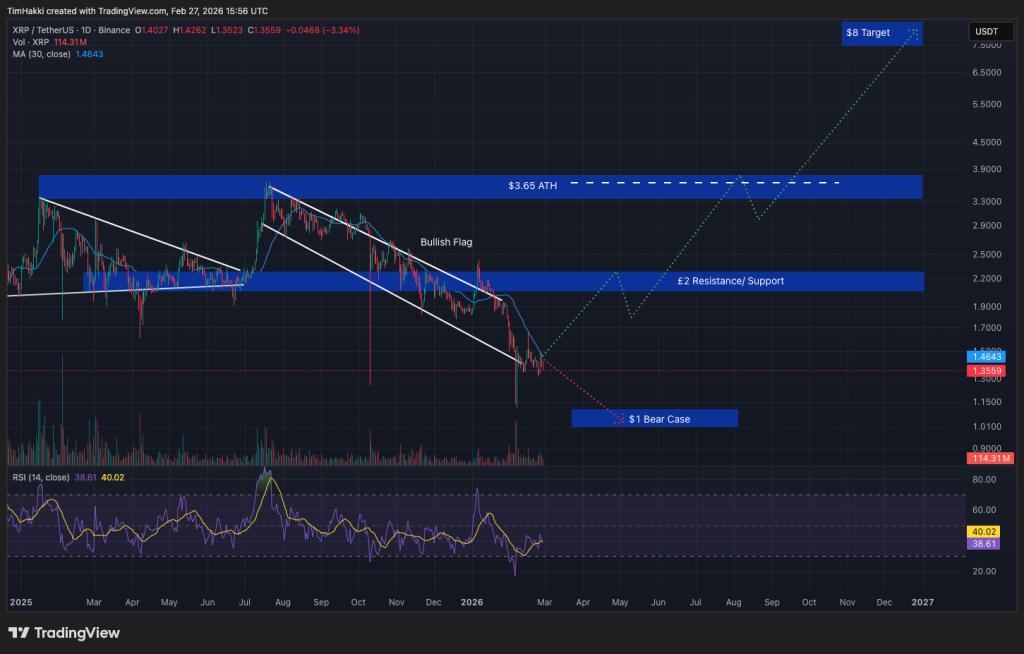
Further upside catalysts could include rising institutional interest following the launch of U.S.-listed XRP ETFs, Ripple’s expanding portfolio of international partnerships, and clearer regulatory conditions should the CLARITY bill pass in the U.S. this year.
Bitcoin (BTC): DeepSeek Targets $266,000 for Bitcoin
Bitcoin ($BTC), the first and largest crypto by market capitalization, hit a record high of $126,080 on October 6 before entering an extended correction.
Even with recent turbulence, DeepSeek’s suggests Bitcoin can maintain its long-term growth trajectory and hit a new high watermark around $266,000.
Often described as digital gold, Bitcoin cappeals to both institutional and retail investors seeking diverse protection against inflation and broader macroeconomic risk.
Bitcoin currently accounts for around $1.3 trillion of the $2.4 trillion crypto market. Since its ATH, BTC has declined by approximately 48% and now trades near $66,000, following two sharp selloffs triggered by geopolitical concerns involving potential U.S. military action linked to Iran and Greenland.
DeepSeek thinks accelerating institutional adoption and reduced post-halving supply as major forces that could push Bitcoin toward multiple new highs this year.
Furthermore, if U.S. policymakers deliver on promises for a Strategic Bitcoin Reserve, Bitcoin’s upside potential would be unpredictable .
Ethereum (ETH): DeepSeek AI Eyes a Potential Run to $10,000
Ethereum ($ETH) remains the leading smart contract blockchain and the foundational layer for much of DeFi.
With a market capitalization of r$235 billion and over $53 billion locked across DeFi protocols, Ethereum serves as the primary settlement layer for on-chain commerce.
Its strong security track record, dominance in stablecoins, and early traction in real-world asset tokenization position Ethereum as a prime candidate for increased institutional deployment.
That largely depends on U.S. lawmakers approving the CLARITY bill, which would provide the certainty institutions need to deploy capital on Ethereum.
ETH is currently trading around $2,000, with major resistance expected near $5,000 after reaching an all-time high of $4,946.05 last August.
If DeepSeek’s bullish thesis unfolds, a decisive break above $5,000 could see ETH hitting $7,500 by Christmas.
Maxi Doge: Early-Stage Meme Coin Aims for Exponential Upside
DeepSeek’s outlook suggests XRP, Bitcoin and Ethereum could be relatively “safe” plays in the coming months, however, their already large market capitalizations limit just how much growth HODLers can enjoy.
That’s not the case with the new meme coin Maxi Doge ($MAXI). The project has raised $4.6 million in its ongoing presale as investors rush to gain exposure to what some are calling the next Dogecoin/
Maxi Doge is Dogecoin’s loud, degenerate gym-bro alpha cousin. But he’s jealous, and he’s coming after Dogecoin through a viral marketing campaign that channels the irreverent spirit of the 2021 meme coin boom.
MAXI is an ERC-20 token on Ethereum’s proof-of-stake network, giving it a smaller environmental footprint than Dogecoin’s proof-of-work model.
Early presale participants can currently stake MAXI for yields of up to 67% APY, with returns gradually declining as the staking pool grows.
The token is $0.0002806 in the current presale phase, with automatic price increases scheduled at each funding milestone. Investors can purchase through wallets including MetaMask and Best Wallet.
Stay updated through Maxi Doge’s official X and Telegram pages.
Visit the Official Website Here.
The post China’s DeepSeek AI Predicts the Price of XRP, Bitcoin and Ethereum appeared first on Cryptonews.

TLDR
- Bank of America, Fidelity, and Morgan Stanley recommend allocating 1% to 5% of portfolios to Bitcoin.
- River reported that major institutions now treat Bitcoin as a portfolio diversifier.
- BlackRock advises limiting Bitcoin exposure to between 1% and 2% of total assets.
- JPMorgan analysts project Bitcoin could reach $266,000 if it rivals private gold investment.
- Bitcoin traded at $67,441 after falling 47% from its October peak of $126,080.
Major Wall Street firms now advise clients to hold small Bitcoin stakes within diversified portfolios. Fidelity Investments, Bank of America, and Morgan Stanley recommend allocations between 1% and 5%. These recommendations formalize Bitcoin’s role as a portfolio diversifier rather than a speculative trade.
River reported that several large institutions issued formal guidance on crypto exposure. The firms outlined allocation ranges that limit risk while allowing participation in price gains. Their guidance reflects structured portfolio models used in wealth management divisions.
Fidelity Investments advises clients to allocate between 2% and 5% to crypto assets, including Bitcoin. Bank of America recommends a 1% to 4% allocation range for diversified portfolios. Morgan Stanley suggests clients hold up to 4% in Bitcoin exposure.
Bank of America and Peers Outline Bitcoin Stakes Strategy
Bank of America placed Bitcoin within its alternative asset framework for private clients. The bank set allocation guidance between 1% and 4% of total portfolio value. The firm structured the guidance around volatility controls and diversification targets.
Fidelity Investments provided a higher allocation band of 2% to 5% for wealth clients. Morgan Stanley capped its recommended exposure level at 4%. BlackRock advised a narrower 1% to 2% range for Bitcoin holdings.
WisdomTree and JPMorgan Chase limited their recommendations to allocations of up to 1%. River compiled these figures in its institutional allocation report. The report described Bitcoin as a diversifier within multi-asset portfolios.
The firms structured their models to balance upside exposure with portfolio stability. They kept allocations limited to preserve overall asset mix targets. The guidance reflects internal research and asset allocation committees.
Price Levels and Long-Term Projections
Bitcoin reached a record high of $126,080 in October last year. The price later declined by 47% from that peak. CoinGecko data showed Bitcoin trading at $67,441 at the time of reporting.
Despite the price decline, several institutions published long-term projections. BlackRock CEO Larry Fink said Bitcoin could reach $700,000 per coin. He cited concerns about currency debasement and global financial instability.
Fidelity issued an earlier projection in September 2021. The firm estimated Bitcoin could reach $1 billion per coin by 2038. Jurrien Timmer supported that estimate using stock-to-flow and demand models.
JPMorgan analysts projected Bitcoin could reach $266,000 over time. They based the estimate on Bitcoin competing with gold as a store of value. Analysts compared private-sector gold investment totals with Bitcoin’s market capitalization.
JPMorgan stated that gold outperformed Bitcoin since last October. Analysts reported that the Bitcoin-to-gold volatility ratio fell to about 1.5. They described that level as a record low in their research note.
The bank said Bitcoin would need an $8 trillion market capitalization to reach $266,000. Analysts excluded central bank gold holdings from that comparison.
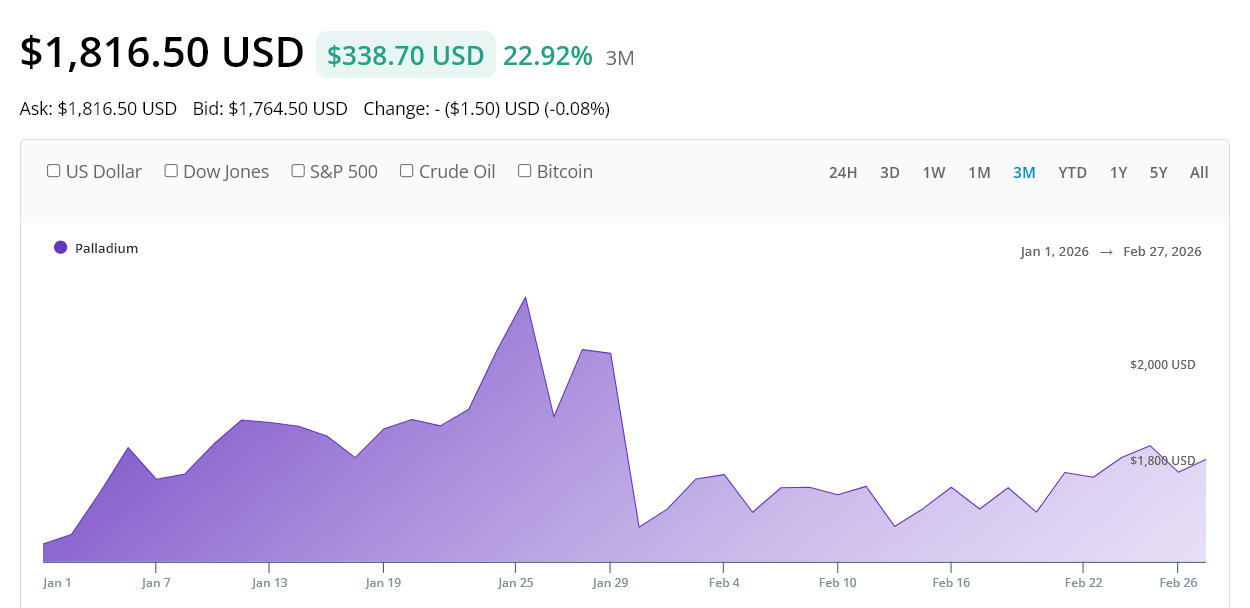
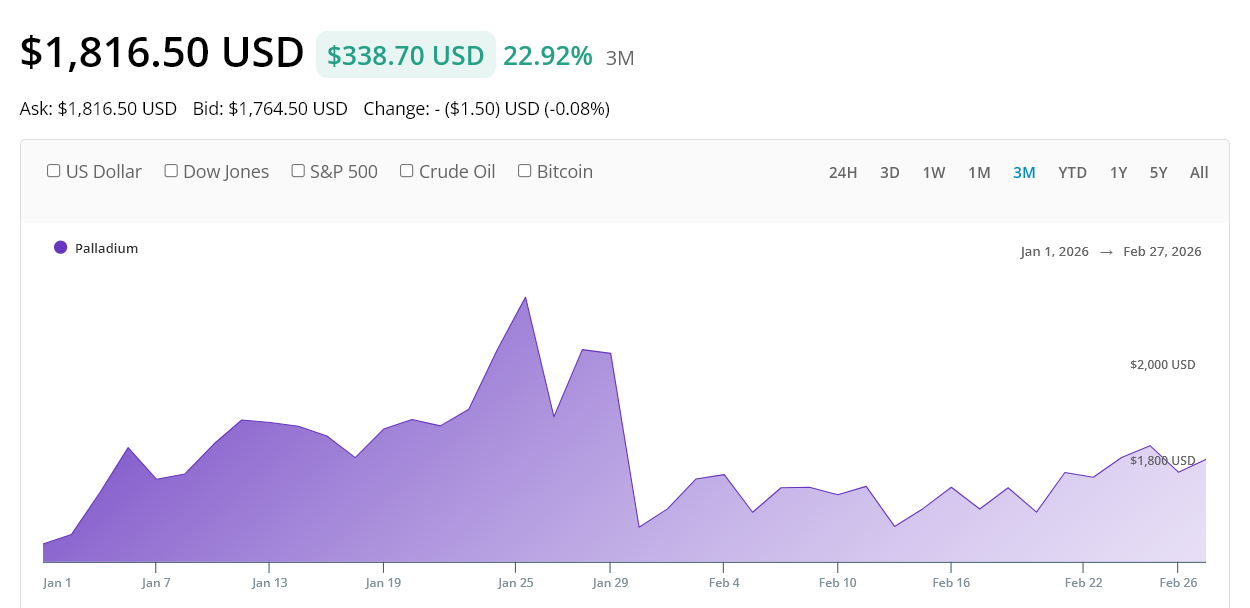
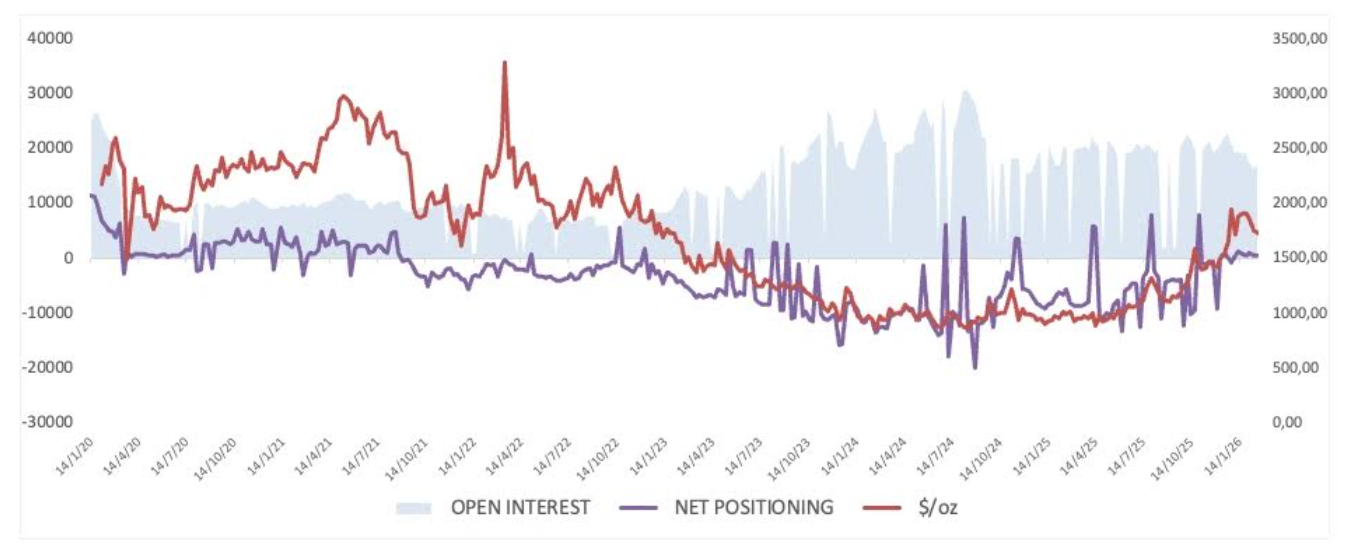
Few major commodities have displayed the kind of price volatility Palladium has since 2020. After a wild ride, boom and bust included, the price of the metal approaches a key area that will help determine its medium- and long-term outlook.
In the space of just a few years, the metal surged above $3,400 during a supply-driven panic, only to collapse back toward $1,000 as industrial fears, substitution dynamics and the electric vehicle transition narrative took hold.
The amplitude of that move rivals some of the most dramatic commodity cycles of the past two decades.
From Scarcity Panic to Structural Unwind
The 2020-2022 rally was fuelled by a perfect storm: tight supply, heavy reliance on Russian production, strong autocatalyst demand, and limited above-ground inventories.
When geopolitical tensions intensified, the scarcity premium exploded.
But blow-offs rarely stabilise gently.
Once peak fear subsided and EV adoption accelerated, the narrative flipped. Investors began pricing a future where internal combustion
engine demand gradually erodes and platinum substitution gains traction.
As that theme gathered momentum, palladium retraced violently.
By late 2023 and into 2024, the market looked washed out.
Volatility and Reset
The decline toward the $1,000-$1,100 zone coincided with extreme pessimism.
Sentiment shifted from “structural shortage” to “structural obsolescence” in less than 24 months. That kind of narrative swing is typically accompanied by positioning liquidation, and price action reflected it.
Technically, the metal moved back toward long-term support levels that had anchored prior cycles. Momentum indicators reset and volatility compressed. The excess was purged.
2025-2026: Reclaim Phase Underway?
Over the past year, price behaviour has changed meaningfully.
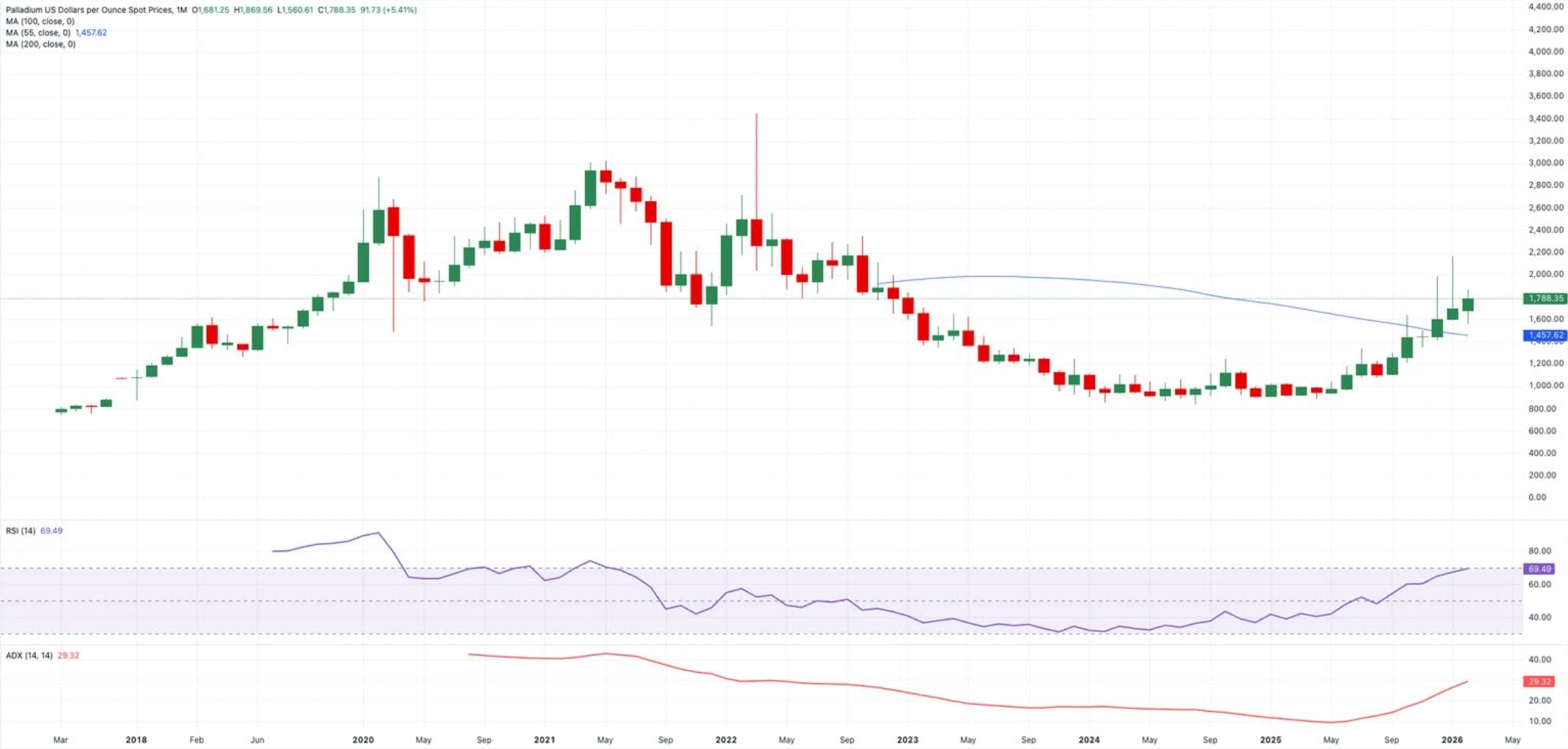
Palladium has reclaimed medium- and long-term moving averages on the weekly and monthly timeframes. Higher lows have begun to form. Momentum has improved without yet reaching euphoric territory.
This rally is not a parabolic breakout, but base construction.
The key zone to watch sits around $1,900-$2,000. A sustained move above that area would mark a structural shift in the longer-term chart and challenge the prevailing “terminal decline” narrative.
Until then, the metal remains in recovery mode, not full revival.
What Drives Palladium?
Unlike Gold, Palladium is not a monetary hedge. It is tied primarily to industrial demand, particularly autocatalysts used in internal combustion and hybrid vehicles.
That means the macro drivers are different:
● Global auto production trends
● China’s manufacturing cycle
● US consumer resilience
● Platinum substitution dynamics
● Russian supply concentration
● The US Dollar trend
If global manufacturing stabilises and hybrid vehicle demand remains robust, Palladium retains its demand base. If the US Dollar softens and industrial sentiment improves, the cyclical tailwind strengthens.
But the structural headwind from electrification remains. This dynamic is precisely what sustains volatility.
Technical Outlook: Compression Before Expansion?
From a chart perspective, Palladium no longer looks like a market in freefall. Instead, it appears to be shifting from liquidation mode into something more constructive.
On the monthly chart, price has managed to climb back above its 55-month moving average and is now pressing up against the 100-month average in the $1,600-$1,700 area.
That may sound technical, but in simple terms it means the metal is rebuilding above levels that had previously defined the long slide.
Momentum has also turned. The Relative Strength Index (RSI), which collapsed during the 2023 washout, has recovered steadily and is now moving back toward bullish territory.
Taken together, the longer-term picture looks less like structural decay and more like a market trying to form a durable base.
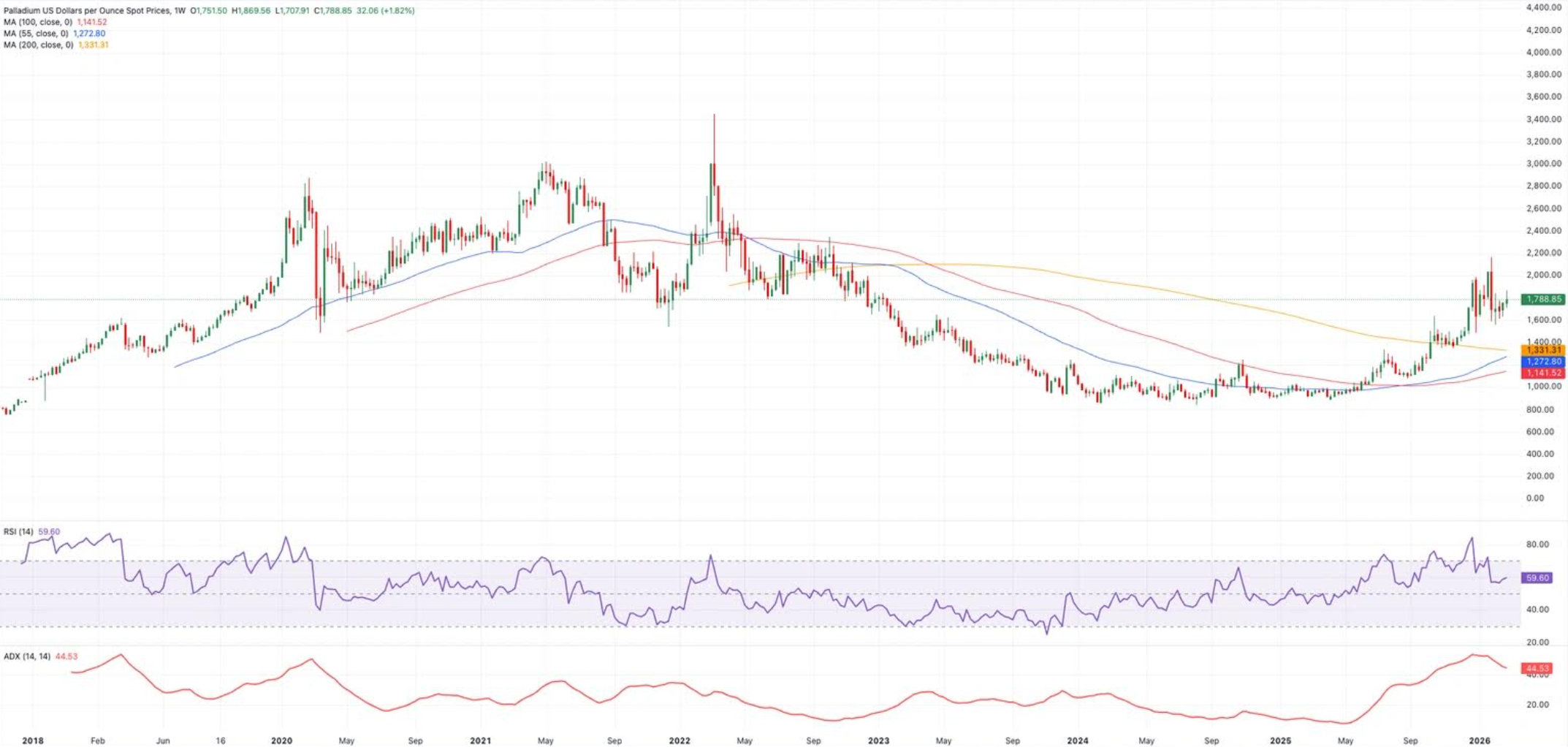
On the weekly chart, higher lows have begun to form since the $1,000 floor held. The trend strength indicators are expanding again, signalling that directional conviction is returning after a prolonged period of compression.
Price is now approaching a key resistance band between $1,900 and $2,000, a zone that previously acted as a distribution during the early stages of the collapse.
A sustained weekly break above that area would materially alter the medium-term outlook and likely trigger a reassessment of the “terminal decline” narrative.
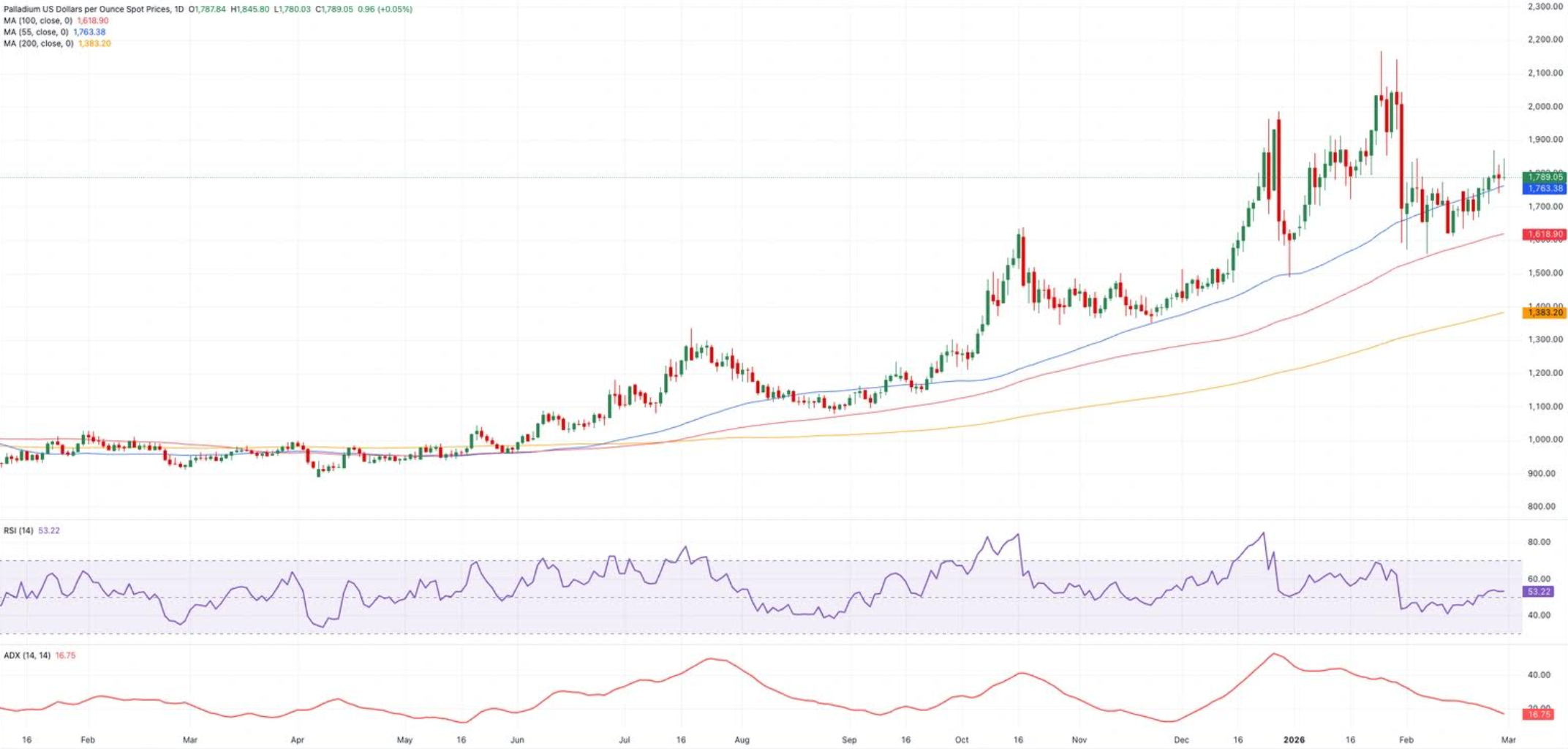
After a big jump, Palladium has settled into a holding pattern around the $1,750-$1,800 area on the daily chart.
The move up has stopped in a fairly orderly way instead of getting too hot. Momentum indicators remain in the middle range, indicating that the market is retaining its gains rather than losing momentum.
For now, the $1,700 to $1,720 range serves as a near-term cushion. On the upside, a convincing break above $1,850 would signal that buyers are ready to press the recovery further.
Until one of those levels gives way, the metal looks more like it is coiling than collapsing.
In short, the technical picture aligns with the broader macro narrative: the worst of the decline appears to be behind us, but confirmation of a new structural leg higher requires a decisive break above the $1,900-$2,000 region.
Until then, Palladium remains a rebuilding story: volatile, sensitive to macro inputs, and poised at an inflection point rather than in a confirmed breakout.
In a market defined by extremes, Palladium may once again be preparing for a decisive move; the only question is whether conviction ultimately resolves higher or whether volatility reasserts itself before a true structural recovery takes hold.
Crypto investment firm Paradigm is seeking to raise $1.5 billion for a new fund that will invest in companies in AI, robotics and other frontier technologies, according to the Wall Street Journal.
Paradigm will continue to invest in crypto companies, according to sources familiar with the situation, but it will use its existing technical investment team to look at deals in frontier tech companies, they said.
San Francisco–based Paradigm has $12.7 billion in assets under management, according to the latest regulatory filings.
It launched its flagship $2.5 billion fund in November 2021, which was the largest crypto fund in history at the time. It publicly announced its third fund in 2024 — an $850 million venture fund focused on early-stage crypto projects.
According to the WSJ’s sources, the firm’s managers decided they didn’t want to be restricted in ways that could cause them to miss out on attractive deals.
There is also overlap between crypto and AI, such as agentic payments, or transactions made by autonomous AI agents, the person said.
Paradigm exploring AI as early as 2023
Paradigm acknowledged it had been “tinkering” with AI and its convergence with crypto as early as three years ago.
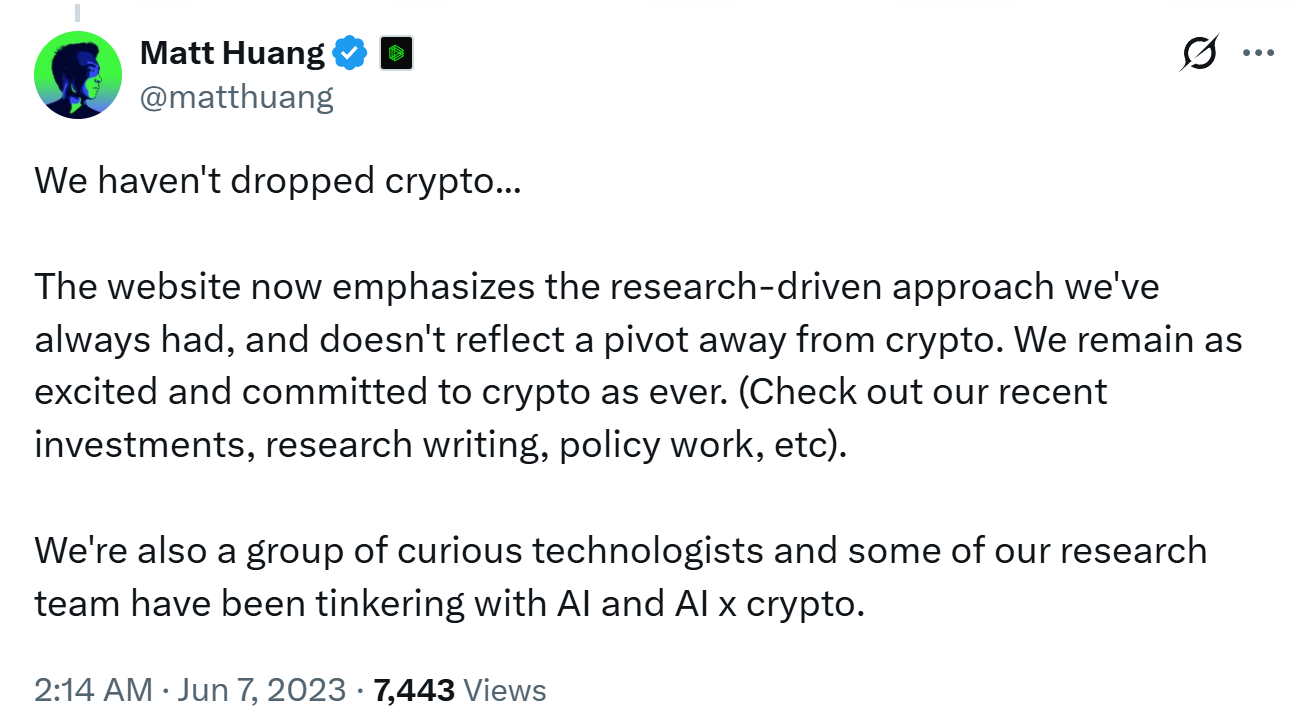
In 2023, Paradigm was seen removing Web3 and crypto-specific language from its website, prompting some speculators to suggest it was already pivoting from crypto to AI.
Matt Huang, the co-founder and managing partner of Paradigm, denied at the time that the website changes reflected a shift away from crypto, but acknowledged that the team had been exploring AI.

In a lengthier tweet weeks later, Huang said that while “we’ve never been more excited about crypto and continue to invest across all stages,” the “developments in AI are too interesting to ignore.”
“It seems trendy to frame crypto vs AI as a zero-sum competition. But we don’t buy it. Both are interesting and will have plenty of overlap. We’re excited to continue exploring,” he said.
Earlier this month, Paradigm and OpenAI released EVMbench, a new benchmark evaluating how different AI models can detect and patch security vulnerabilities found in smart contracts.
AI made up more than half of all VC funding in 2025
In 2025, venture capital investments in AI firms amounted to $258.7 billion, accounting for 61% of all VC investment and doubling its share from 2022, according to OECD.
VC funding for generative AI firms made up 14% of all AI venture capital investments, with firms in the United States attracting the largest share of VC funding.
AI Eye: IronClaw rivals OpenClaw, Olas launches bots for Polymarket


Dorsey said AI-driven efficiency demands smaller teams, triggering one of the largest layoffs in Block’s history.
Jack Dorsey announced that Block is reducing its workforce by nearly half, cutting more than 4,000 employees and bringing total headcount from over 10,000 to just under 6,000.
In a note shared publicly on X, Dorsey described the move as “one of the hardest decisions in the history” of the company and said all employees would be notified the same day whether they are being asked to leave, entering consultation, or staying.
Massive Layoffs at Block
He stated that affected employees will receive 20 weeks of salary plus one additional week per year of tenure, equity vested through the end of May, six months of health care coverage, their corporate devices, and $5,000 to support their transition.
Employees outside the United States will receive similar support. Details may vary according to local requirements. Dorsey said the decision was not driven by financial distress, while adding that the company’s business remains strong. Instead, he added,
“But something has changed. We’re already seeing that the intelligence tools we’re creating and using, paired with smaller and flatter teams, are enabling a new way of working which fundamentally changes what it means to build and run a company. and that’s accelerating rapidly.”
Dorsey said he considered gradually reducing staff over months or years, but chose to act immediately. He said that repeated rounds of layoffs would harm morale, focus, and trust among customers and shareholders. He acknowledged that some decisions may prove wrong and that flexibility has been built in to account for that while continuing to serve customers.
Dorsey Admits Over-Hiring
The layoff announcement drew mixed reactions across social media. Some users described the severance terms as generous, while others focused on concerns about artificial intelligence replacing human roles. One user, Will Slaughter, tweeted that the cuts were less about AI and more about management decisions, while taking a jibe at Block, which had more than tripled its headcount from 3,900 in December 2019 to 12,500 by December 2022.
He described the reduction as unwinding an “insane COVID overhiring binge” and attributed it to managerial incompetence rather than technological change. In response, Dorsey admitted to over-hiring during the pandemic.
Other users criticized the optics of citing AI in a layoff note written in lowercase. Some expressed concern that job cuts linked to AI could become a broader trend as the company’s stock price rose by 24% in post-market hours.
Binance Free $600 (CryptoPotato Exclusive): Use this link to register a new account and receive $600 exclusive welcome offer on Binance (full details).
LIMITED OFFER for CryptoPotato readers at Bybit: Use this link to register and open a $500 FREE position on any coin!
TLDR:
- Minnesota HF3642 would make it illegal for anyone to place or operate a crypto ATM in the state.
- The bill repeals Sections 53B.70–53B.75, erasing all existing kiosk licensing and compliance rules.
- New customers currently get full fraud refunds within 72 hours — a protection the ban would eliminate.
- Minnesota could become one of the first U.S. states to outright ban virtual currency kiosks entirely.
Virtual currency kiosks in Minnesota face a complete ban under proposed legislation introduced in the 2025–2026 session.
House File 3642 targets all crypto ATM operations in the state. The bill would prohibit any person from placing or operating a virtual currency kiosk in Minnesota.
It also seeks to repeal existing statutes that currently govern kiosk licensing, disclosures, transaction limits, refunds, and compliance requirements. This move marks a dramatic policy shift for the state.
What the Bill Proposes
Minnesota HF3642 introduces a straightforward and sweeping prohibition. Under the proposed Section 53B.691, no person may place or operate a virtual currency kiosk anywhere in Minnesota. The language of the bill leaves no room for exceptions or conditional approvals.
The bill also adds a new subdivision to Section 53B.69 to define terms specifically for the prohibition. This addition provides the legal framework needed to enforce the new ban effectively. It connects existing definitions in state law to the incoming restriction.
Beyond the ban itself, the legislation proposes a full repealer of Sections 53B.70 through 53B.75. These sections currently regulate kiosk operators through licensing, consumer disclosures, and transaction limits.
Their removal would erase the entire regulatory structure that governs crypto ATMs in the state today.
What Current Law Requires of Kiosk Operators
Under existing Minnesota statutes, virtual currency kiosk operators must follow strict disclosure rules. Before any transaction, operators must display all material risks on the kiosk screen for the customer to acknowledge.
These include warnings about price volatility, irreversible transactions, and potential fraud schemes.
Current law also requires operators to display a bold warning about scams. The warning specifically addresses fraudsters impersonating loved ones or government officials. It advises consumers that losses from fraudulent transactions cannot be recovered.
Transaction limits are also part of the existing framework. New customers face a maximum daily transaction limit of $2,000.
Existing customers, defined as those who have transacted for more than 72 hours, are subject to limits set by individual operators in line with federal law.
Refund Rules and Consumer Protections at Stake
Minnesota’s current law offers a refund pathway for new customers who fall victim to fraud. Under Section 53B.75, operators must refund the full transaction amount if a new customer was fraudulently induced.
The customer must contact the operator and a government or law enforcement agency within 14 days.
This protection applies strictly within the 72-hour new customer window. After that period, a customer transitions to “existing customer” status under Section 53B.69. At that point, the full refund obligation no longer applies.
If HF3642 passes, all of these consumer protections would be repealed along with the ban. There would be no licensed operators left to hold accountable, and no regulatory structure to enforce compliance.
Consumers who previously relied on these protections would lose that safety net entirely.
Industry and Regulatory Outlook
The bill’s passage would make Minnesota one of the few states to outright ban crypto ATM operations. Most states have moved toward regulation rather than prohibition. The trend across the country has been to tighten oversight, not eliminate it entirely.
For operators currently licensed in Minnesota, the bill represents a direct threat to existing business models. Many operators have invested in compliance infrastructure to meet the state’s existing requirements. A full ban would render that investment worthless.
The bill is now in the legislative process and has not yet been signed into law. Stakeholders across the crypto industry are expected to monitor its progress closely.
Its outcome could influence how other states approach virtual currency kiosk legislation going forward.


SPI pegs JPYSC and targets Q2 2026 launch, with 1:1 JPY backing under Japan’s Type III framework for institutional cross-border and treasury payments.
Summary
- JPYSC is a trust bank‑backed yen stablecoin issued by SBI Shinsei Trust, distributed via SBI VC Trade and built by Startale for high‑volume institutional settlements.
- The token operates as a Type III electronic payment instrument, targeting cross‑border payments, treasury management, tokenized asset settlement, and future AI/agent payments.
- Launch is planned for Q2 2026 pending regulatory approval, with early interest from banks, financial firms, and large corporates seeking a regulated digital JPY alternative to USD stablecoins.
SBI Holdings and Startale Group announced the launch of JPYSC, a Japanese yen-denominated stablecoin designed for institutional finance and cross-border digital payments, according to an official press release.
The stablecoin will be issued by SBI Shinsei Trust Bank and operated under Japan’s trust bank system, making it the first stablecoin in the country backed by a trust bank. The structure is governed by Japan’s digital asset regulatory framework, according to the announcement.
JPYSC will be used for cross-border payments, treasury management, and tokenized asset settlements. The digital currency aims to enable financial institutions to transfer funds between international markets while linking traditional finance systems to blockchain infrastructure, the companies stated.
SBI VC Trade will serve as the principal distribution partner, while Startale Group will lead blockchain technology development. The stablecoin has been built for enterprise-grade performance to accommodate high-volume transactions and institutional settlement requirements, according to the release.
The target users include banks, financial companies, and large corporations. Several financial institutions and corporations have expressed interest in the project ahead of its official launch, the companies reported.
JPYSC operates under Japan’s Type III electronic payment instrument framework, a classification designed to ensure compliance with the country’s financial laws. The framework provides regulatory clarity and legal protections for institutions using the stablecoin, according to the announcement.
The developers stated the system was designed for global interoperability, connecting blockchain networks and traditional banking systems to allow businesses to integrate digital payment systems into existing financial infrastructure.
The project features a blue logo intended to represent trust and stability, with branding that emphasizes security, transparency, and global connectivity, the companies said.
The official launch is planned for the second quarter of 2026, subject to regulatory approvals. Authorities must complete their review process before market deployment, according to the announcement.
The partnership between SBI Holdings and Startale Group represents an effort to expand regulated digital finance infrastructure for blockchain-based financial products in Japan.

JPMorgan Chase & Co. (JPM) Stock Experiences Volatility Amid Strong Outlook and CEO Warnings

US DOJ Seized $580M in Crypto from ‘Chinese Transnational Criminals‘

Warner Bros. Has A New Owner, And It Isn’t Netflix


-

 Politics6 days ago
Baftas 2026: Awards Nominations, Presenters And Performers
-

 Sports4 days ago
Women’s college basketball rankings: Iowa reenters top 10, Auriemma makes history
-

 Politics4 days ago
Nick Reiner Enters Plea In Deaths Of Parents Rob And Michele
-

 Business3 days ago
True Citrus debuts functional drink mix collection
-

 Fashion6 hours ago
Weekend Open Thread: Iris Top
-

 Politics1 day ago
ITV enters Gaza with IDF amid ongoing genocide
-

 Crypto World4 days ago
XRP price enters “dead zone” as Binance leverage hits lows
-

 Business6 days ago
Mattel’s American Girl brand turns 40, dolls enter a new era
-

 Business5 days ago
Law enforcement kills armed man seeking to enter Trump’s Mar-a-Lago resort, officials say
-

 NewsBeat2 days ago
Cuba says its forces have killed four on US-registered speedboat | World News
-
 NewsBeat2 days ago
Manchester Central Mosque issues statement as it imposes new measures ‘with immediate effect’ after armed men enter
-

 Tech3 days ago
Unsurprisingly, Apple's board gets what it wants in 2026 shareholder meeting
-
 NewsBeat5 days ago
‘Hourly’ method from gastroenterologist ‘helps reduce air travel bloating’
-

 Tech5 days ago
Anthropic-Backed Group Enters NY-12 AI PAC Fight
-

 NewsBeat5 days ago
Armed man killed after entering secure perimeter of Mar-a-Lago, Secret Service says
-

 Politics5 days ago
Maine has a long track record of electing moderates. Enter Graham Platner.
-

 Business2 days ago
Discord Pushes Implementation of Global Age Checks to Second Half of 2026
-
 NewsBeat3 days ago
Police latest as search for missing woman enters day nine
-

 Business1 day ago
Only 4% of women globally reside in countries that offer almost complete legal equality
-
 Sports5 days ago
2026 NFL mock draft: WRs fly off the board in first round entering combine week