

Crypto World
Bitcoin Mining Stocks Jump on AI Infrastructure Momentum

Shares of several Bitcoin mining companies surged Monday after Hut 8 and IREN announced major AI infrastructure deals, reinforcing investor optimism around miners expanding into artificial intelligence and high-performance computing.
IREN, Cipher Digital, CleanSpark, Hut 8 and MARA Holdings each gained at least 11% in early Monday trading. The rally followed Hut 8’s announcement of a 15-year, $9.8 billion lease for its AI data center campus and IREN’s disclosure of $2.8 billion in cloud services contracts with AI developers. Both companies began as Bitcoin (BTC) miners before accelerating a pivot toward AI infrastructure and cloud computing as mining economics weakened.
IREN now expects its AI cloud business to generate more than $4 billion in annual recurring revenue by the end of 2026.
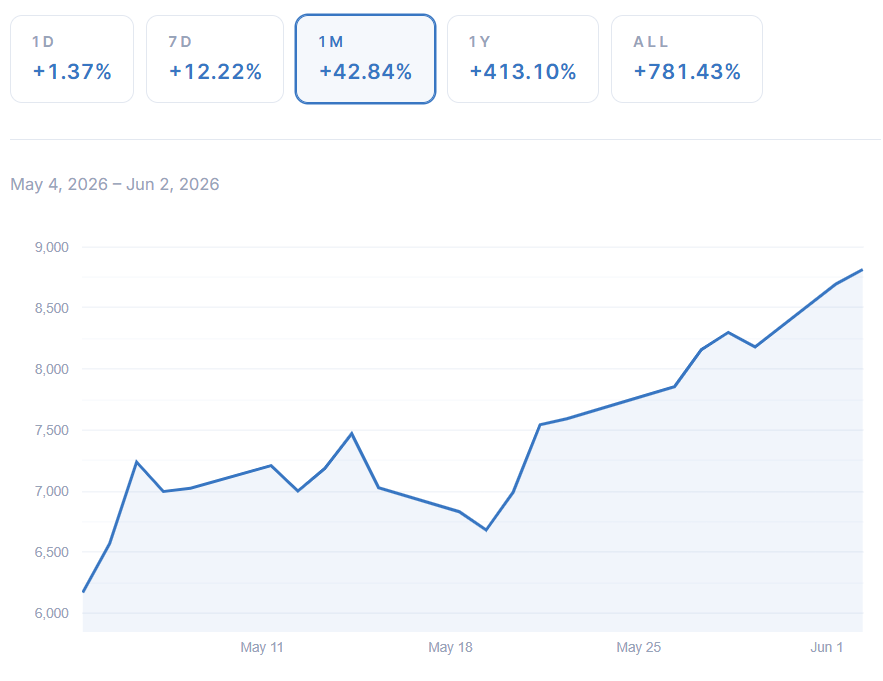
The rally was reflected in The Energy Mag’s TEM AI Infrastructure Growth Index, which tracks 20 companies spanning the Bitcoin mining, neocloud and AI infrastructure sectors. The index rose 1.4% on Monday and is up more than 12% over the past week.
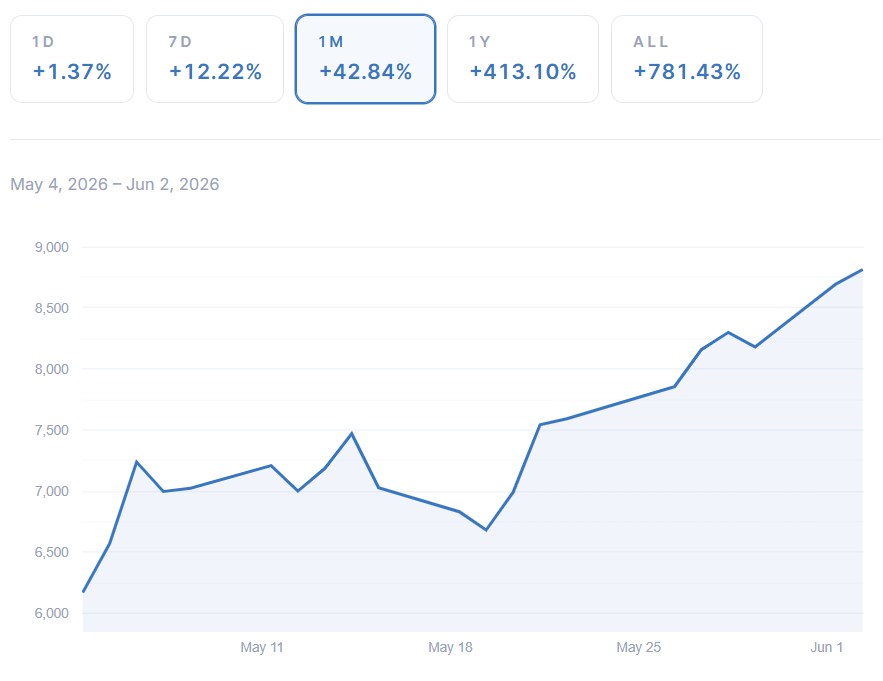
The performance of the TEM AI Infrastructure Growth Index.
Source: The Energy Mag
The rally in Bitcoin mining stocks coincided with a broader recovery in technology shares, as the Nasdaq Composite Index added 0.9% by midday. The Philadelphia Semiconductor Index, a closely watched gauge of chipmakers powering the AI boom, climbed 2% after entering a technical bear market last week, defined as a decline of 20% or more from its recent high.
Related: Bitdeer stock jumps 14% as company expands US mining hardware production
AI pivot fuels gains, raises questions
Bitcoin mining stocks have experienced sharp volatility this year as companies contend with a weak Bitcoin mining environment while increasingly pivoting toward AI infrastructure and cloud computing. According to Blocksbridge Consulting, the AI pivot has driven a sharp re-rating across the sector, but it has also attracted greater investor scrutiny over insider stock sales.
In a recent Miner Weekly newsletter, Blocksbridge said insider sales at TeraWulf, Riot Platforms, Core Scientific and Cipher Mining have drawn investor attention. Although the transactions were executed under prearranged trading plans, they have fueled questions about whether AI-driven enthusiasm pushed share prices high enough for executives to cash out.
To be sure, the AI pivot has already required substantial investment from Bitcoin miners, with much more capital still needed. Blocksbridge estimates the industry will require another $50 billion to realize its AI ambitions, with IREN facing the largest funding gap at roughly $21.1 billion.
Related: Crypto Biz: When dollars disappear, stablecoins step in

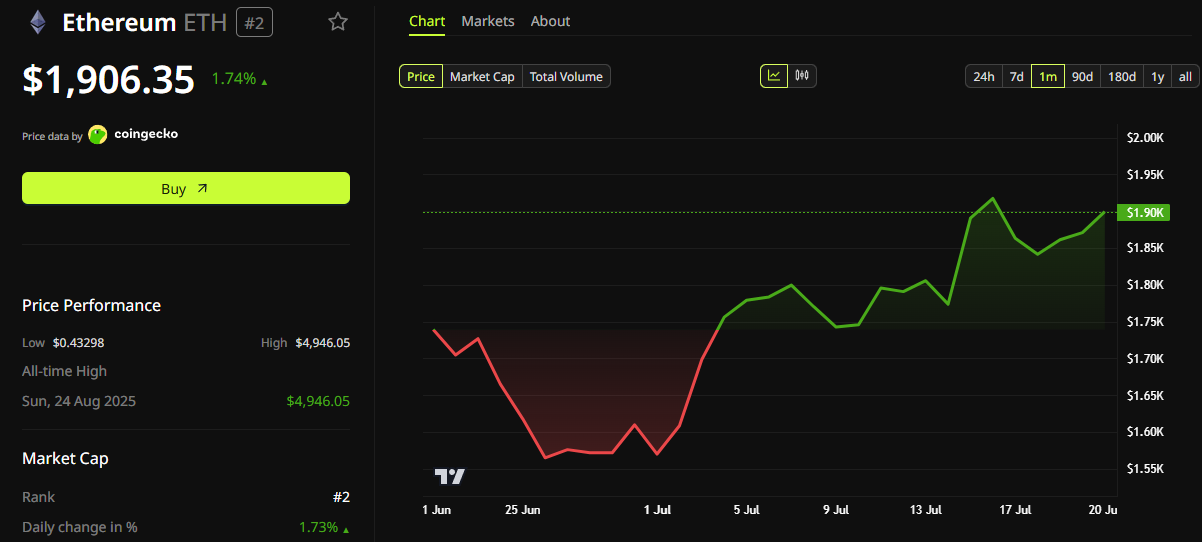
Arthur Hayes bought another 1,332.5 ETH ($2.53 million) today, according to on-chain tracking data shared on X. The purchase extends a buying streak from the BitMEX co-founder. It also renews attention on Ethereum’s institutional demand story.
Hayes sold 6,000 ETH at a roughly $606,000 loss in June. He then reversed course with a series of buybacks in July as some discuss Ethereum’s role in the next bull run for crypto.
Hayes Extends a Pattern of ETH Accumulation
The latest purchase follows Hayes’ return to Ethereum earlier this month. He acquired roughly 1,939 ETH then across two OTC-style transactions. That reversal came weeks after his June exit.
Critics have flagged Hayes’ record of praising tokens like HYPE, ZEC, and WLD before quietly exiting those positions. Ether trades at $1,906, up 1.74% over 24 hours, with a market capitalization over $230 billion.

Some See Institutional Demand Driving the Next Cycle
With some larger accumulation and whale movement around ETH, some are noting a broader shift in Ethereum’s bull case toward institutions. Bitmine Immersion Technologies Chairman Tom Lee argues that Wall Street adoption now drives Ethereum’s growth, not crypto-native speculation. He points to BlackRock’s tokenized BUIDL fund and Robinhood Chain’s use of ETH as a gas token.
“Unlike the crypto bear market of 2022, Wall Street is building on Ethereum.”
— Tom Lee
The staking data backs that thesis. Ethereum’s staking ratio hit an all-time high of above 33% at the end of June, according to CryptoQuant. BlackRock helped drive that shift when it launched the iShares Staked Ethereum ETF, which locks most of its holdings in staking contracts.
Institutions and ETFs held more than 9% of Ethereum’s total supply as of last year, and that share has likely grown since. Also last year, Standard Chartered’s Geoff Kendrick argued that Ethereum treasuries are among the strongest institutional crypto trades available, citing staking yield and stronger valuations compared with Bitcoin and Solana treasury vehicles.
Hayes’ latest buy may reflect conviction in that institutional thesis. Or it may just be another short-term trade. The coming days should make it clearer.
The post Ethereum Could Lead the Next Bull Market: Is Hayes Preparing with More Buys? appeared first on BeInCrypto.
Crypto World
Cramer Says Dump Tech Before Intel, Tesla, Alphabet Earnings: Will Inverse-Cramer Strike?

Jim Cramer told “Mad Money” viewers to avoid new tech buys just as Intel, Tesla, and Alphabet prepare to report earnings this week, reviving questions about whether the Inverse-Cramer Effect will strike again.
The host said he is directing new money into industrials and financials instead. He named FedEx, Honeywell Aerospace, and Goldman Sachs as safer bets during the current selloff.
A Pattern Already in Motion for Cramer
Cramer’s tech retreat follows his own Inverse-Cramer Effect moment. He called Intel his favorite chip stock on July 15. The shares sank roughly 8% hours later, even after ASML confirmed a manufacturing milestone.
That reversal revived a running Wall Street joke. Traders often profit more from betting against Cramer’s on-air calls than from following them. The same pattern hit Nike, which crashed 15% hours after a bullish Cramer call.
Cramer has swung bullish elsewhere too. He issued a call to buy Nvidia even as a broader AI chip stock selloff rattled the sector.
Three Earnings, One Test
Intel reports second-quarter results Thursday, July 23 and analysts expect earnings near $0.21 per share. That would mark a swing from a $0.10 per-share loss a year ago. They also expect revenue of roughly $14.4 billion, up close to 12% year over year.
Alphabet and Tesla both report Wednesday, July 22, after the close. Analysts expect Alphabet to post earnings of $2.87 per share, up 24.2% year over year. They project Google Cloud revenue will reach $22.79 billion, up 67.3%.
Tesla delivered 480,126 vehicles last quarter, well above estimates. Analysts expect revenue near $25.81 billion and earnings of $0.50 per share. The stock still trades at 177 times forward earnings, the richest multiple among its mega-cap peers.
Some analysts already see a bull case forming for chip stocks if Alphabet’s cloud and AI hardware numbers beat expectations.
If all three names rally on their reports, Cramer’s tech exodus will look premature. If they stumble, his rotation call holds, and the Inverse-Cramer Effect stays benched for at least one more week.
The post Cramer Says Dump Tech Before Intel, Tesla, Alphabet Earnings: Will Inverse-Cramer Strike? appeared first on BeInCrypto.


Key takeaways
- Stellar (XLM) continues to trade in narrow ranges as investors await the next major price catalyst.
- Derivatives data presents mixed signals, with bearish long-to-short ratios offset by positive funding rates for XLM.
- XLM remains below key moving averages, leaving its short-term outlook dependent on whether bulls can reclaim major resistance levels.
Stellar (XLM) is trading within narrow ranges on Tuesday as investors weighed conflicting signals from derivatives markets and on-chain activity. Stellar remains under pressure near an important support area.
The combination of bearish positioning in derivatives markets and improving funding rates suggests traders remain divided on the next major move, increasing the likelihood of heightened volatility in the coming sessions.
Derivatives data paints a mixed picture for XLM
Market positioning remains uncertain across both cryptocurrencies. According to CoinGlass, the long-to-short ratio stood at 0.81 for XLM on Tuesday.
Ratios below one indicate that short positions continue to outnumber long positions, reflecting a cautious outlook among derivatives traders.
However, funding rates tell a different story. Stellar’s funding rate flipped positive on Monday and reached 0.0068%.
Positive funding rates indicate that traders holding long positions are paying those with short positions, a sign that bullish sentiment is gradually improving despite the dominance of bearish bets.
Data from CryptoQuant indicates selling pressure continues to dominate both the spot and derivatives markets, with large whale orders pointing toward cautious investor sentiment.
This persistent selling activity could limit the token’s ability to sustain any meaningful upside in the near term.
Key support remains under pressure
Stellar was trading around $0.187, continuing to consolidate near a critical support zone.
The token remains below its 50-day EMA near $0.189, while hovering just above the 100-day EMA around $0.187, indicating that buyers are attempting to defend this level despite the broader bearish trend.
Momentum indicators remain relatively subdued. The RSI is positioned near 53, reflecting weak but stable momentum, while a slightly positive MACD reading points to consolidation rather than a strong directional move.
On the upside, Stellar faces immediate resistance at the 50-day EMA, followed by the 200-day EMA near $0.196 and the 61.8% Fibonacci retracement level around $0.200.

If selling pressure resumes, initial support lies at the 100-day EMA near $0.187, followed by the horizontal support at $0.177 and the 78.6% Fibonacci retracement around $0.173. A deeper correction could expose the long-term support level near $0.142.
With technical indicators sending mixed signals and derivatives markets reflecting growing indecision, both XRP and Stellar appear to be approaching a pivotal point where a decisive breakout or breakdown could determine their next medium-term trend.

Bitcoin momentum is rebuilding, but confirmation has not arrived yet, said analytics platform Swissblock on Monday as BTC tapped a five-week high of $65,700.
“Bitcoin has exited its capitulation regime and is once again inside the transition area,” they added.
Swissblock identified the current area as “where a new impulse begins, or momentum fades back into weakness.”
Where to Next for Bitcoin?
It added that the next test is clear and it needs to “reclaim the ignition line” to push above the “next Inflection point.” “Every sustained rally began with this sequence, but not every transition has succeeded,” it said.
Bitcoin has been in the capitulation zone since early June when it fell below $70,000, having remained below it ever since. It hit a current cycle low of around $58,000 at the end of June and has been trending higher ever since, gaining 12% over the past three weeks, which has moved it into a higher momentum or transition zone.
Is a bitcoin:native breakout on the verge of happening?
Momentum is rebuilding, but confirmation has not arrived yet.
Bitcoin has exited its Capitulation regime and is once again inside the Transition Area.
This is where a new impulse begins or momentum fades back into… pic.twitter.com/m0GBVttR7n
— Swissblock (@swissblock__) July 20, 2026
CryptoQuant analyst ‘Darkfost’ said on Monday that Bitcoin has spent 95% of its time at a higher MVRV. This metric compares market cap, calculated as price multiplied by supply, with its realized value, which reflects the price of each coin when it last moved.
“This shows just how significantly undervalued BTC is today compared to its historical evolution.”
Meanwhile, crypto trader ‘Daan’ said the $65,000 level has capped price for the entirety of July so far, before adding:
“But I do think the longer price spends here, the more likely the $65K level is to break. Especially with the higher lows being made over the past 3 weeks.”
BTC Price Outlook
Bitcoin was trading at $65,500 at the time of writing, following a 1% gain on the day. It tapped $65,700 in late trading on Monday, which is its highest level since June 15 when it topped $67,000 briefly.
Zooming out shows that the asset remains within a seven-week range-bound channel, but at resistance at the upper bounds of that channel.
“If BTC breaks above $66K, the next key level to watch is $66,700,” said Alphractal founder and CEO Joao Wedson.
“This is the Structural Midline, a key on-chain level from the Structural Market Bands that has historically acted as a highly reliable reaction zone,” he said before adding that bears will likely try to regain control around this area.
The post Bitcoin Has Exited Capitulation Regime as Momentum Rebuilds: Analysts appeared first on CryptoPotato.


The U.S. Commodity Futures Trading Commission ordered KalshiEX, LLC to fulfill trades that a Michigan state court had directed the prediction-market operator to cancel, escalating a fight over whether states can reach into federally regulated derivatives venues. In Release Number 9267-26, dated… Read the full story at The Defiant
Two other supports lined up behind the move. U.S. spot bitcoin ETFs have now drawn inflows for five straight sessions totaling more than $600 million, the most sustained institutional buying since mid-July and a reversal of the eight-week outflow run that ran through late June.
And oil, which had climbed for two days on the war, pulled back, with Brent falling 1% to about $88.58 as Iran said mediators were circulating proposals to ease hostilities, including a reported suggestion for a 10-day halt in strikes.
“Current bitcoin and ether prices are low but fair, given the macro uncertainties pervading markets,” said Jeff Mei, chief operating officer at BTSE, who pointed to the Fed meeting as the event traders are positioned around.
“Traders expect rates to hold steady but are looking for more signals as to what’s to come later in the year,” Mei added.
The read on that meeting is where the rally meets its limit. The Federal Reserve gathers July 28 and 29, and markets put the odds of a July rate increase at about 15%, though a September move is still live.
Spot-market volume across crypto stayed subdued even as prices rose, the sign of a tape lifted by returning risk appetite rather than fresh conviction, and higher oil and Treasury yields remain the levers that could keep the Fed hawkish and cap risk assets.
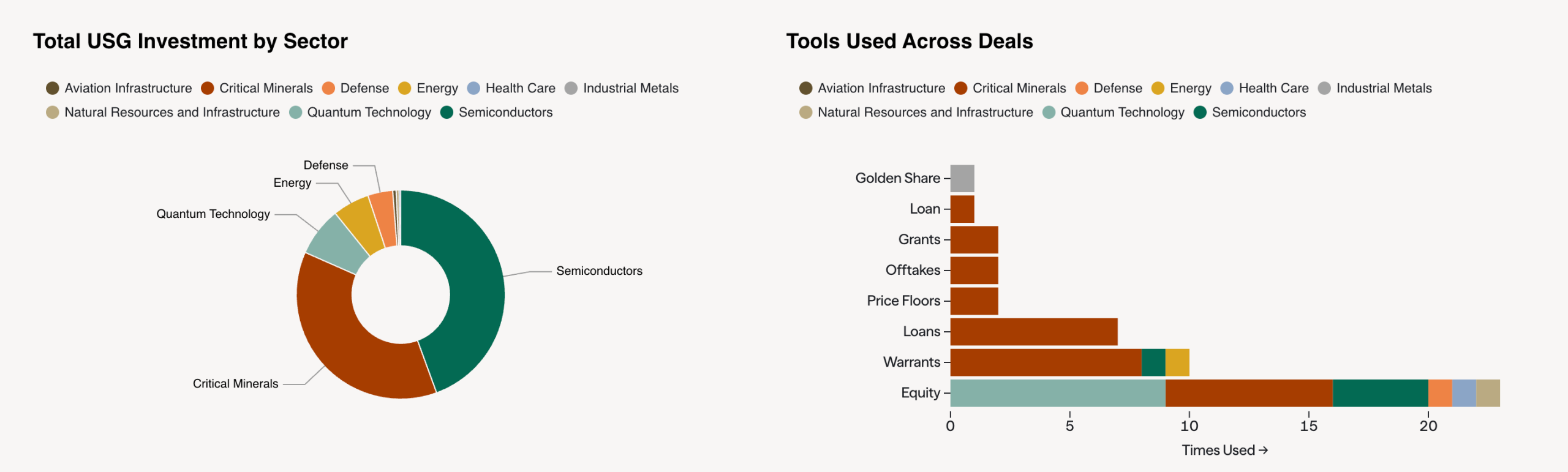
US voters remain deeply skeptical of the federal government owning stakes in American companies, a new poll found.
Their doubt comes as the government has made 30 deals worth $26.7 billion since 2025, according to the Council on Foreign Relations.
Follow us on X to get the latest news as it happens

US Voters Sour on Government Ownership Stakes in Companies
The CNBC survey polled 1,000 registered voters from July 8 to 12, with a 3.1-point margin of error. Only 19% found government stakes appropriate, while 49% did not. In addition, 32% stayed undecided.
Partisan gaps were wide. Some 66% of Democrats called the stakes inappropriate, against 34% of Republicans.
Even Trump’s base wavered. MAGA Republicans split evenly, with 31% in favor and 31% opposed. Another 38% held no view.
Opposition has softened since October 2025, when 56% of voters called government ownership inappropriate, against just 13% who approved. Disapproval has since fallen seven points as approval climbed, and a third of voters stayed on the fence.
CNBC noted that the Trump administration has treated some stakes as opportunistic bets and others as part of a broader economic strategy.
The largest arrived in August 2025. The government took a 10% stake in chipmaker Intel by giving $8.9 billion in grants approved under the Biden administration. That position has since climbed 372%. It was worth $42 billion at Thursday’s close.
Meanwhile, OpenAI has also reportedly pitched a 5% government stake, a position worth about $42.6 billion at its $852 billion valuation.
Subscribe to our YouTube channel to watch leaders and journalists provide expert insights
The post Half of US Voters Reject Government Taking Stakes in American Companies appeared first on BeInCrypto.
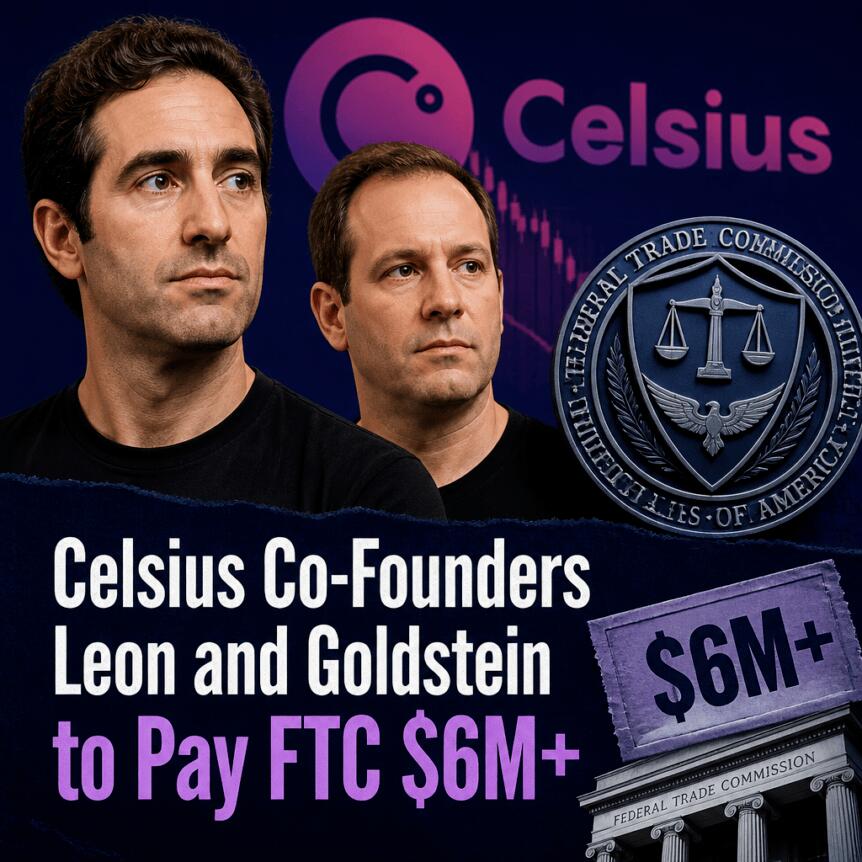
Federal regulators have extended the legal fallout from Celsius’ 2022 collapse by ordering two of the company’s former co-founders to pay more than $6 million to resolve Federal Trade Commission (FTC) allegations that they misrepresented the safety of the crypto lending platform.
On Monday, the FTC announced that Hanoch “Nuke” Goldstein, Celsius’ former chief technology officer, was ordered to pay $2.014 million. Shlomi Daniel Leon, the firm’s former chief strategy officer, was ordered to pay $4.1 million under a separate stipulated order entered on June 29.
Key takeaways
- Goldstein and Leon have been ordered to pay a combined $6.114 million to settle FTC consumer protection allegations tied to Celsius’ failure.
- The orders include marketing and sales bans affecting products or services that could be used to deposit, exchange, invest, or withdraw crypto assets.
- The FTC’s claims focus on alleged misstatements about Celsius’ reserves, insurance coverage, and whether loans were unsecured.
- The settlements build on a separate FTC resolution involving Alex Mashinsky, which already included a $10 million payment and a permanent marketing ban.
- Payments from the co-founders are also set to be credited against the FTC’s consumer-harm judgment tied to the case.
What the FTC says the co-founders got wrong
According to the FTC’s allegations, Celsius made assurances to customers about the platform’s financial safety that were not consistent with the company’s actual position as it moved toward bankruptcy. The regulator said Celsius falsely told customers it maintained sufficient reserves to satisfy withdrawal demands, claimed it had a $750 million insurance policy covering customer deposits, and represented that it did not issue unsecured loans.
The FTC further alleged that these public assurances persisted even shortly before the company’s collapse. As the agency put it in its statement Monday, the promises were allegedly false and “its top executives continued to claim that customers’ deposits were safe days before the company filed for bankruptcy.”
Goldstein and Leon are being held responsible for the misconduct the FTC described in connection with how Celsius marketed its operations during the period leading up to the shutdown.
Court-ordered bans restrict Celsius-related promotion and sales
Beyond the monetary payments, the FTC’s settlement terms also impose restrictions designed to limit future involvement in crypto custody and dealing workflows. The agency said the orders bar Leon from marketing or selling products or services that could be used to deposit, exchange, invest, or withdraw assets.
For Goldstein, the restrictions are similarly broad. The FTC’s statement Monday said Goldstein agreed to a ban on marketing or selling retail products or services that can be used to buy, sell, deposit, withdraw, distribute, or trade cryptocurrency.
“Similarly, Goldstein has agreed to a ban on marketing or selling retail products or services that can be used to buy, sell, deposit, withdraw, distribute or trade cryptocurrency.”
How the payments fit into the wider Celsius settlements
The settlements add another layer to the ongoing enforcement picture surrounding Celsius’ collapse and its impact on customers. The platform, which the settlement narrative places in a much larger consumer-harm context, held $25 billion in assets at its peak and owed $4.7 billion to users when it filed for bankruptcy in July 2022.
The FTC’s co-founder orders also relate directly to an earlier resolution involving Alex Mashinsky. In April, Mashinsky agreed to an FTC settlement that included a permanent ban from promoting asset-related products and a requirement to pay $10 million, alongside a broader, partially suspended $4.72 billion judgment.
In the current cases, the FTC said that the $2.014 million and $4.1 million payments from Goldstein and Leon, respectively, will be credited against the $4.72 billion judgment. That crediting mechanism is intended to prevent double-counting of consumer-harm-related penalties across related FTC outcomes.
Criminal case developments underscore the regulatory focus
While these are FTC consumer protection resolutions, other enforcement tracks have also advanced. Separately, US prosecutors have pursued criminal charges against Mashinsky. The filing timeline described in the source indicates Mashinsky pleaded guilty to commodities and securities fraud charges and was sentenced to 12 years in prison in May 2025.
Prosecutors, as described in the reporting referenced in the source, said he misled Celsius customers about the company’s profitability, investment risks, and the safety of customer funds. That criminal framing aligns with the FTC’s core theory in the co-founder cases: that customers were allegedly given assurances about safety and risk management that did not match reality.
For investors and industry participants, the practical takeaway is that Celsius-related enforcement is not confined to one executive or one courtroom. The FTC’s added restrictions on future marketing and sales of crypto asset-related products suggest regulators are targeting the ability of former insiders to re-enter similar distribution and promotion channels. Readers should watch whether additional Celsius-linked proceedings—civil or criminal—continue to expand the circle of accountability and how courts treat the scope of the marketing bans as the industry adapts to ongoing compliance demands.


Cuy Sheffield, Visa's head of crypto, said x402 has processed roughly $19 million across roughly 134 million transactions on an adjusted basis, according to a thread he posted Wednesday on X. x402 is a payments protocol for agent- and machine-initiated onchain transactions. The figures come from a… Read the full story at The Defiant


A federal judge approved Anthropic’s $1.5 billion settlement with authors on Monday, finalizing the largest known payout in a US copyright case.
US District Judge Araceli Martinez-Olguin granted final approval and overruled objections from authors who called the sum too small.
How Anthropic’s $1.5 Billion Settlement Reached Approval
Authors sued the artificial intelligence (AI) company Anthropic in 2024. They alleged that it used pirated copies of their books to train its Claude chatbot.
Now-retired Judge William Alsup ruled last June that training on the books was fair use. However, he found that Anthropic had broken the law by storing more than 7 million pirated books.
Martinez-Olguin took over after Alsup retired. She signed the final order on Monday.
“We reached this settlement in 2025, after the court’s landmark ruling that training AI on books is fair use under copyright law — which remains the law today,” Anthropic deputy general counsel Aparna Sridhar said.
Follow us on X to get the latest news as it happens
What the Payout Covers
The settlement pays roughly $3,000 per-work payment for over 480,000 works. Martinez-Olguin noted that the sum is four times the $750 minimum for standard copyright infringement.
Claimants covered 440,490 works, or 91.3% of the list, as of April. The deal also requires Anthropic to destroy the pirated book files. The judge rejected objections that the $1.5 billion figure was too low. According to her, the complaints were
“Not grounded in a realistic assessment of the overall risks and rewards of a trial.”
Some authors opted out and continue separate lawsuits against the company. The case is the first major US AI copyright dispute to settle.
Subscribe to our YouTube channel to watch leaders and journalists provide expert insights
The post Court Signs Off on Record $1.5 Billion Anthropic Copyright Payout appeared first on BeInCrypto.
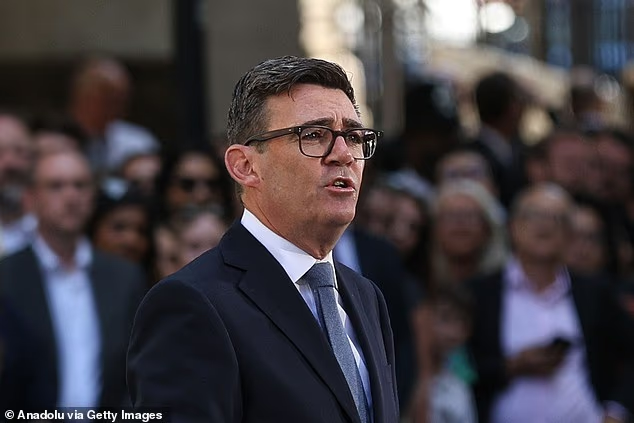
Andy Burnham to remove VAT from domestic electricity bills from October 1

Personalis, Inc. (PSNL) M&A Call Transcript

Ethereum Could Lead the Next Bull Market: Is Hayes Preparing with More Buys?


-
 NewsBeat5 days ago
London Mayor Sadiq Khan handed a peerage by Keir Starmer alongside 15 other Labour figures… just days before the PM leaves No10
-

 Fashion4 days ago
Weekend Open Thread – Corporette.com
-

 Politics3 days ago
The House | The City of London can help the new chancellor deliver growth in every postcode
-

 Politics6 days ago
Young campaigners urge incoming PM to act on outdoor junk food ads
-

 Crypto World5 days ago
CFTC blocks Kalshi from unwinding Michigan trades after court order
-
 Crypto World4 days ago
Two July Windows Left: The CLARITY Act’s Senate Fight and What Failure Means
-

 Crypto World3 days ago
Ripple Payments Joins MiCA With 14 Firms, Does It Mean Anything For XRP?
-

 Business5 days ago
Nvidia Stock Slips After Big Tuesday Rally as Huang Confirms Vera Rubin Chip Is Now in Production Today
-

 Politics2 days ago
Democrats look to World Cup watch parties to register thousands of voters
-
 Entertainment6 days ago
Disney’s Most Ambitious Failed Star Wars Attraction Is Coming to SDCC
-

 Crypto World3 days ago
Ripple wins EU-wide access as ESMA adds it to MiCA register
-

 Crypto World4 days ago
Injective Submits SEC Transfer-Agent Registration to Onchain Ownership Records
-

 Business5 days ago
Palantir Shares Rise After Expanded Nvidia Partnership and Fresh Analyst Upgrades Ahead of Earnings Day
-

 Tech6 hours ago
Sail Virtually Aboard The “Itanic” With IA-64 Emulator
-
 Tech3 hours ago
Turtle Beach Command Series KB7 review: a nifty screen-equipped gaming keyboard
-

 News Videos6 days ago
XRP BOMBSHELL… XRP OMBOARDED FOR TRANSACTIONS!!!
-

 Tech6 days ago
Dark Secrets Emerge When Jailbreaking LLMs
-

 NewsBeat4 days ago
Registration is now open for March for Men with Kev 2026
-

 NewsBeat19 hours ago
Unregistered fitter used Gas Safe logo on business flyers
-
 Sports5 days ago
New Cornerback Enters Vikings Trade Rumor Mill
You must be logged in to post a comment Login