
Crypto World
Bitcoin permabull Arthur Hayes: I wouldn’t bet $1 on BTC now


Bitcoin’s near-term trajectory remains tightly linked to U.S. monetary policy and the evolving geopolitical backdrop, according to Arthur Hayes, the BitMEX co-founder known for his bold price calls. In a recent appearance on the Coin Stories podcast with Natalie Brunell, Hayes said he would not deploy fresh capital into Bitcoin today, preferring to wait and see how the Federal Reserve navigates the post-pandemic economy and whether global tensions escalate further. While he has floated a bold target of 250,000 dollars for Bitcoin in the coming years, his immediate stance is to observe policy signals before committing new funds. At the time of publication, Bitcoin traded around $69,926, well off its October all-time high near $126,000.
Hayes emphasized that the macro environment—rather than purely market dynamics—drives his cautious stance. He warned that if the conflict between the U.S. and Iran persists, there could be broad risk-off pressure that weighs on equities and crypto alike. “The longer this conflict goes on, the higher the likelihood that the Fed has to print money to support the American war machine,” he argued, framing the central bank’s response as a potential catalyst for price moves in favored disinflation hedges like Bitcoin. He drew a sharp distinction between the wartime narrative and the monetization policy, stating plainly that he would start buying Bitcoin only when central banks begin printing money again. “That’s when I’m going to buy Bitcoin when the central banks start printing money,” he said in a direct quote during the discussion.
“That’s when I’m going to buy Bitcoin when the central banks start printing money.”
In his view, money printing—not war itself—has historically provided a supportive backdrop for Bitcoin’s rise. Still, he acknowledged that ongoing geopolitical frictions could drive the price lower in the near term, contrasting with arguments that war itself is a Bitcoin catalyst. While some market observers contend that geopolitical shocks can spark Bitcoin inflows as a non-sovereign store of value, Hayes warned of the possibility of a cascading liquidations scenario if risk assets slide in tandem. The conversation also touched on the notion that volatility could intensify as market participants reassess the pace and scale of monetary stimulus in a world of persistent geopolitical risk.
Bitcoin’s price action has been choppy. The asset briefly tested the $60,000 mark on February 6 before rebounding into a milder uptrend. Hayes noted that the current price level leaves room for further downside, particularly if macro signals deteriorate and liquidation risk rises. He remained steadfast on his longer-term projection, sustaining the idea that Bitcoin could reach a multi-hundred-thousand-dollar level in the next several years, a view that has colored his investment stance and public commentary for some time. The market’s tension between policy direction and geopolitical risk remains a driving force behind price discovery, and Hayes’ stance underscores a broader debate about whether macro catalysts will finally unlock a lasting uptrend for BTC.
As other analysts weigh in on the near-term picture, Michaël van de Poppe recently pointed to a “strong surge” in the Nasdaq as a supporting factor for Bitcoin, arguing that a calmer risk environment could broaden upside for both BTC and altcoins. His assessment aligns with a more optimistic near-term outlook, even as Hayes maintains a more cautious, policy-driven lens. The broader sentiment in the space remains mixed: investors are watching Fed communications, macro data, and geopolitical headlines for signals that could shift liquidity, risk appetite, and correlation dynamics between traditional markets and digital assets.
Hayes has long been known for a contrarian stance on Bitcoin’s price path. The recent discussion did little to dislodge his core thesis that the path to substantial gains hinges on central banks’ willingness to loosen policy rather than on any single development in the crypto space. He has publicly entertained a $250,000 target for Bitcoin, a figure he has echoed in various appearances and interviews, though the timing has varied in public commentary. The juxtaposition of a lofty long-term target with a cautious near-term posture reflects a broader tension in the market: the asset’s allure as a hedge against monetary expansion coexists with vulnerabilities tied to macro shocks and policy shifts.
Why it matters
The episode illustrates how macro policy and geopolitical risk continue to influence crypto narratives at a time when liquidity and risk sentiment are in flux. Hayes’ comments underscore a recurring theme: Bitcoin’s appeal as a non-sovereign instrument may depend more on the stance of central banks than on any single tactical catalyst. If the Fed signals faster-than-expected easing or if geopolitical tensions intensify, BTC could find a renewed bid as investors seek hedges against inflation and policy uncertainty. Conversely, a more aggressive stance on inflation containment or a risk-off shift could amplify downside pressures in the near term, particularly if equities step lower.
For investors, the takeaway is not a call to chase immediate moves but a reminder that macro dynamics—policy normalization, balance-sheet expansion, and global conflicts—can alter the rate and direction of Bitcoin’s price discovery. Hayes’ emphasis on waiting for a policy pivot serves as a caution against chasing a near-term breakout in a market that remains highly sensitive to Federal Reserve cues and to the unfolding geopolitical landscape. In this light, Bitcoin’s current risk-reward profile will hinge on how aggressively policymakers respond to ongoing macro and geopolitical surprises, rather than on crypto-market fundamentals alone.
Ultimately, the narrative around Bitcoin’s price path remains a blend of long-horizon conviction and short-term prudence. The market will likely continue to trade around the interplay of monetary policy expectations, liquidity conditions, and external shocks—factors that have historically driven both volatility and opportunity in the cryptocurrency space. Hayes’ position—to wait for signs of monetary easing before adding exposure—adds another data point to a crowded field of opinions about whether BTC can sustain a trajectory toward higher highs or face renewed headwinds in the months ahead.
What to watch next
- Upcoming Federal Reserve communications or policy adjustments that signal a shift toward easing or continued tightening.
- Geopolitical developments and any escalation in U.S. or regional conflicts that could influence risk sentiment and currency markets.
- Bitcoin price interactions with key technical levels around 60k and 70k, and how liquidity conditions evolve in a risk-on vs. risk-off environment.
- Macro-driven narratives, including Nasdaq performance and broader equity flows, which can affect correlations with BTC.
- Statements from prominent investors or analysts that could recalibrate Bitcoin’s short- to medium-term risk-reward outlook.
Sources & verification
- Hayes’ remarks on the Coin Stories podcast with Natalie Brunell (YouTube): https://www.youtube.com/watch?v=Ny9P1l0WKwo&t=2074s
- Bitcoin price reference page: https://coinmarketcap.com/currencies/bitcoin/
- Bitcoin price context referenced in the piece, including a February 6 dip toward $60,000 and the October all-time high near $126,000
- Reported long-term target of $250,000 for Bitcoin and the assertion that policy shifts (not war alone) drive bullish narratives
This article was originally published as Bitcoin permabull Arthur Hayes: I wouldn’t bet $1 on BTC now on Crypto Breaking News – your trusted source for crypto news, Bitcoin news, and blockchain updates.



In the latest interview with Cointelegraph, macro investor and former hedge fund manager James Lavish issued a stark warning to Bitcoin holders and global investors: markets may be pricing in a quick resolution to the Iran conflict — but if that assumption proves wrong, the consequences could be severe.
Lavish argued that if the conflict drags on and keeps pressure on oil prices, the result could be a fresh inflation shock, renewed fears of stagflation and a major repricing across global markets.
In his view, this scenario would put the Federal Reserve in an impossible position: unable to raise rates aggressively without risking recession, yet unable to cut rates due to persistent inflation.
That is where the conversation becomes especially relevant for Bitcoin (BTC). Lavish explains why Bitcoin has behaved differently from gold and equities in recent months, and why that relative resilience may not last in a true “correlation-to-one” panic event.
If markets suffer a deeper drawdown, he says, Bitcoin could fall another 10% to 20%, potentially revisiting the low $50,000 or even high $40,000 range.
And yet, Lavish is far from bearish in the long run.
One of the most compelling parts of the interview is his argument that such a sell-off would not destroy the Bitcoin thesis — it could actually create a major opportunity. He also explains why investors should avoid being either too levered or completely unexposed in a market driven by war headlines, bond stress and rapidly shifting expectations around Fed policy.
The interview also touches on safe haven investments, energy markets, Treasury yields and money printing.
If you want to understand how an experienced macro investor thinks about war risk, recession risk and Bitcoin’s next move, watch the full interview on our YouTube channel and don’t forget to subscribe!
This interview has been edited and condensed for clarity.


Gemini adds drag‑to‑modify tools to ActiveTrader, chasing speed‑focused traders even as GEMI stock trades well below its IPO price and users still complain about lag.
Summary
- Gemini’s ActiveTrader now lets users drag chart order lines and click “pills” to adjust price and size in real time.
- Tyler Winklevoss says the upgrade targets fast markets as Gemini stock trades under pressure post-IPO.
- The launch comes as Gemini’s GEMI shares lag Bitcoin’s rebound, raising questions about execution and product strategy.
Gemini has rolled out a new order modification feature for its ActiveTrader interface, allowing users to “drag order lines on charts to modify price and click order line pills to modify quantity,” according to co‑founder Tyler Winklevoss in a post on X. Winklevoss framed the update squarely around speed, telling followers that “markets move fast and you can too with @Gemini Active Trader,” alongside a short product demo video that had drawn roughly 29,400 views within hours of posting. The feature targets high‑frequency retail and professional users who need to adjust orders intraday without leaving the chart.
The enhancement builds on a broader Gemini push to make ActiveTrader more customizable, including earlier changes that let users drag and drop modules and activate a floating order form for chart‑centric workflows. On its support pages, Gemini notes that ActiveTrader already supports a full suite of market, limit, and advanced limit orders, including Immediate‑or‑Cancel (IOC), Fill‑or‑Kill (FOK), Maker‑or‑Cancel, and auction‑only instructions, in addition to stop‑limit functionality. By letting traders modify those orders directly from chart objects rather than static tickets, Gemini is closing the usability gap with established trading terminals that have long offered drag‑to‑adjust orders on price ladders and depth charts.
Early reactions on X highlight both enthusiasm and lingering pain points. “Fast moves fr,” wrote user @ZackD0x, while another former team member, @ignacio_ape, said the upgrade “brings me so much joy” and praised seeing ActiveTrader “continuing to grow even tho I’m no longer there.” Not all feedback was glowing: “Drag and drop is cool and all but I really just need the app to stop lagging during high volatility,” complained user @Steffan0xd, underscoring that execution reliability still matters more than interface polish when spreads blow out.
The product update lands as Gemini navigates a tougher market environment as a listed company. After a high‑profile Nasdaq debut in September 2025 that initially valued the exchange at about $4.4 billion, the firm’s GEMI stock has since fallen well below its IPO price, with Bloomberg reporting in February that Gemini “risks a hard landing” after a more than 40% plunge in Bitcoin and mounting operating losses. More recently, crypto.news reported that GEMI is trading below $6—down roughly 76% since the IPO—even as Bitcoin and Ethereum have rebounded, suggesting a growing decoupling between the exchange’s equity and the broader crypto rally.
That disconnect has forced the Winklevoss‑led platform to lean harder on product differentiation, rolling out features such as a self‑custody wallet, prediction markets and a more modular ActiveTrader interface in a bid to convert volatility into higher fee revenue. Whether the new drag‑to‑modify tools meaningfully move the needle will depend less on X engagement metrics and more on whether active traders actually route orders through Gemini instead of rival venues when the next leg of crypto volatility hits.


Bitcoin held above $67,000 on Good Friday as U.S. employers added 178,000 jobs in March — beating forecasts by a wide margin — while traditional markets sat closed for the Easter holiday, leaving crypto as the primary gauge of how investors are pricing the hawkish surprise.
Summary
- The U.S. added 178,000 nonfarm payrolls in March, well above consensus estimates, while unemployment fell to 4.3%, according to the Bureau of Labor Statistics.
- Bitcoin held above $67,000 on Good Friday with traditional markets closed, absorbing the hawkish macro signal with unusual composure.
- February’s payroll figure was simultaneously revised to a loss of 133,000 jobs, complicating the read on Fed policy going into Q2.
Bitcoin (BTC) held its footing above $67,000 on Good Friday, April 3, as the U.S. Bureau of Labor Statistics released a stronger-than-expected March jobs report that showed 178,000 nonfarm payrolls added last month — a figure that significantly exceeded consensus estimates of around 135,000. With traditional U.S. equity and bond markets closed for the Easter holiday, crypto was among the few liquid markets actively pricing in the data.
The BLS release, filed under code USDL-26-0580 and embargoed until 8:30 a.m. ET, showed the unemployment rate ticking down to 4.3% from 4.4% in February. At the same time, February’s payroll figure was sharply revised to a net loss of 133,000 jobs — a downward swing that softens the headline beat considerably and suggests the labor market has been weaker than previously reported entering 2026.
Bitcoin decouples — quietly
What stood out on Good Friday was what Bitcoin did not do. With stocks offline and macro traders watching from the sidelines, BTC held its ground rather than selling off on the hawkish implications of a strong jobs print. A 178,000-job print reduces the Federal Reserve’s urgency to cut rates, which typically pressures risk assets like crypto. But Bitcoin absorbed the signal without a meaningful downside.
That composure fits a pattern visible across recent weeks. As crypto.news has reported, Bitcoin has been trading primarily in response to geopolitical headlines around the ongoing U.S.–Iran conflict, with macro data playing a secondary role in near-term price discovery. The February jobs shock — when the economy shed 92,000 payrolls — had briefly pushed BTC below $70,000 before markets stabilized. Friday’s print delivered the opposite surprise, yet the price reaction was equally muted.
What this means for the Fed and crypto
“Relatively strong employment data means the Fed feels less pressure to reduce interest rates,” analysts at Bitfinex noted in a recent macro briefing. “It will likely remain laser-focused on inflation, which it sees as a major risk tied to Trump’s trade policy.” Higher rates tend to strengthen the dollar and weigh on Bitcoin ETF inflows — a dynamic that has shaped much of crypto’s performance in early 2026.
With U.S. markets closed until Monday, the full institutional reaction to Friday’s data will only become clear when equities reopen. Bitcoin’s ability to hold $67,000 through a holiday weekend — under both a strong jobs print and continued war risk from the Middle East — may offer early evidence that the asset is finding a floor.
Gold (XAU/USD) price trades near $4,676 on April 3, up roughly 17% since touching a low of $4,105 on March 23. The rally looks convincing. However, a proprietary correlation metric, shifting options positioning, and a nuanced reading of the latest Commitment of Traders report suggest the current advance may be building on the wrong foundation.
Gold’s strongest rallies have historically begun after the metal decoupled from oil, not while both moved higher together. The 17% bounce is riding the same trade that preceded every correction this cycle, and a controlled dip that breaks that link could end up being more constructive than further upside.
Gold Is Rising but the Correlation That Matters Is Already Turning
Since March 23, gold price has been climbing inside an ascending channel on the 8-hour chart. The structure is not a bear flag, as the channel has extended beyond the typical duration, but it is also not confirmed bullish until the upper boundary breaks decisively.
The XAU-WTI Correlation Matrix, a BeInCrypto custom indicator that measures the 50-period rolling correlation between gold spot (OANDA:XAUUSD) and WTI crude oil (TVC:USOIL), currently reads -0.10. The reading has declined from the positive zone it occupied in March but seems to be rising again.
The pattern is consistent. In mid-October, the correlation dropped to around -0.88. and stayed negative through early November. That was when gold price launched its strongest rally. This shows that Gold performs best when it decouples from oil entirely, acting as an independent safe haven.
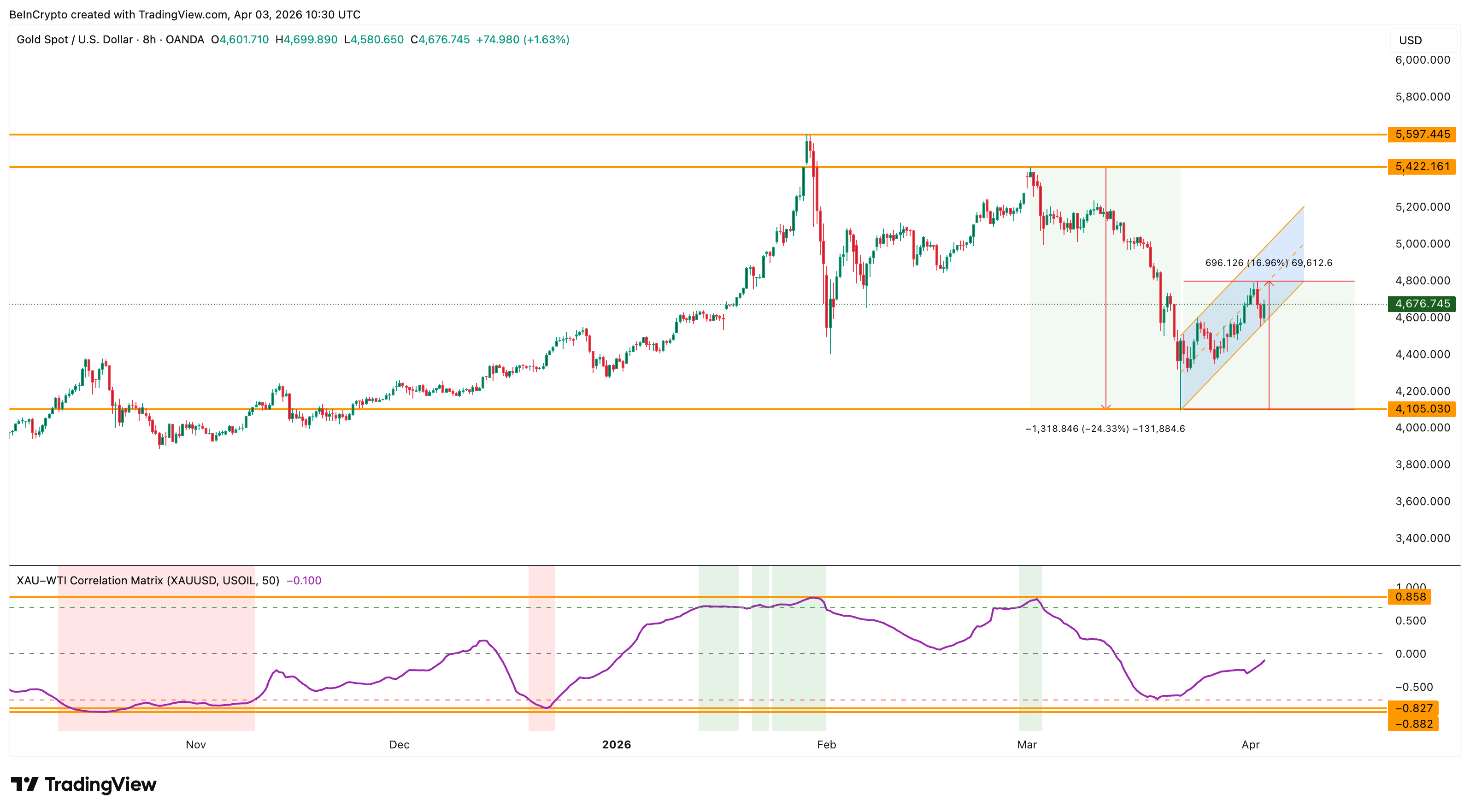
Every time the correlation peaked in positive territory, gold corrected. In late January, the reading hit approximately 0.85, and gold dropped over the following weeks. In early March, another positive peak aligned with the $5,422 high before the sell-off resumed.
The current -0.10 reading places the correlation in transition. The 17% bounce since March 23 happened during this transitional phase, which means it was partially driven by the same oil-linked sentiment rather than independent safe-haven demand.
This is why a controlled dip would be constructive. If gold price pulls back while oil continues to rise, the correlation would accelerate toward the -0.70 zone, exactly where gold has launched every sustained independent rally this cycle.
The rally does not need to continue to be bullish for gold. The correlation needs to finish resetting. Options traders have already begun reacting to the bounce, and their positioning reveals whether the current move has genuine conviction.
Bullish Bets Replaced Bearish Ones but the Foundation Is Reactive
The SPDR Gold Shares ETF (GLD) put-call ratio captures how options traders are positioning around gold price. On March 26, the put-call volume ratio stood at 1.35, meaning significantly more puts than calls were trading. Bearish sentiment dominated. The open interest ratio at the time was 0.53.
By April 2, the volume ratio had collapsed to 0.70 as call activity surged and put volume faded. The open interest ratio rose to 0.56, indicating new long positions were being opened. The bearish bets that dominated during the March sell-off have been replaced by fresh bullish exposure.
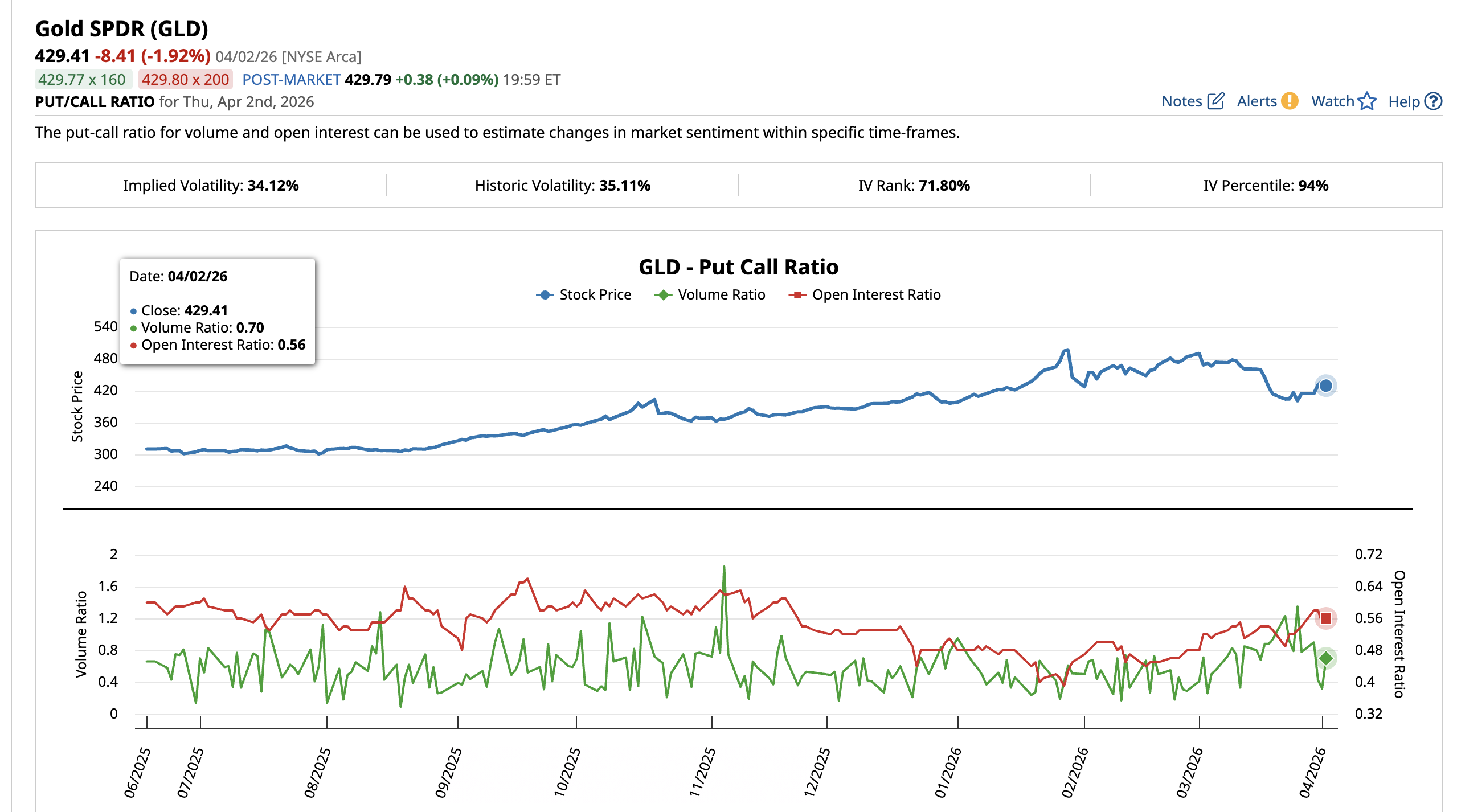
Traders likely responded to the 17% bounce by rotating from protective puts into directional calls. When bullish bets crowd in at the same time the oil correlation surges (current state), the newly opened long positions become vulnerable.
The Commitment of Traders (COT) report, published weekly by the Commodity Futures Trading Commission (CFTC), reinforces this reading. The March 24 report, the latest available, shows non-commercial (speculative) long positions increased by 4,900 contracts to 220,861. Short positions fell by 3,558 to 52,534. On the surface, this looks bullish.
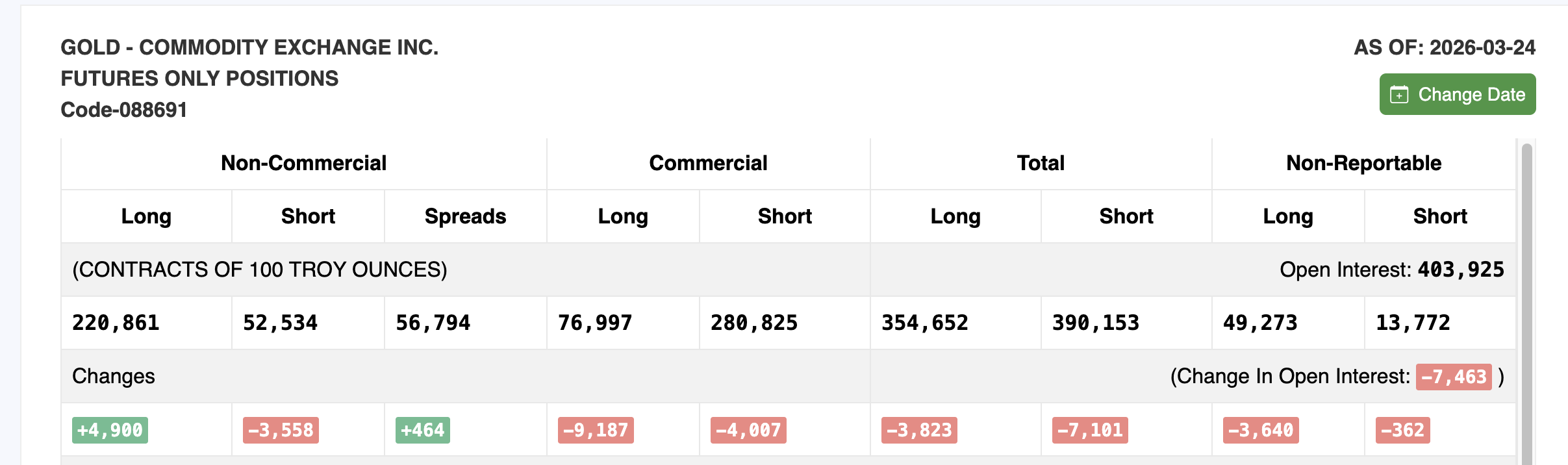
However, total open interest dropped by 7,463 contracts to 403,925 from the previous March 17 report. When longs increase but total open interest falls, it typically means the rally is being driven by short covering rather than fresh buying conviction.
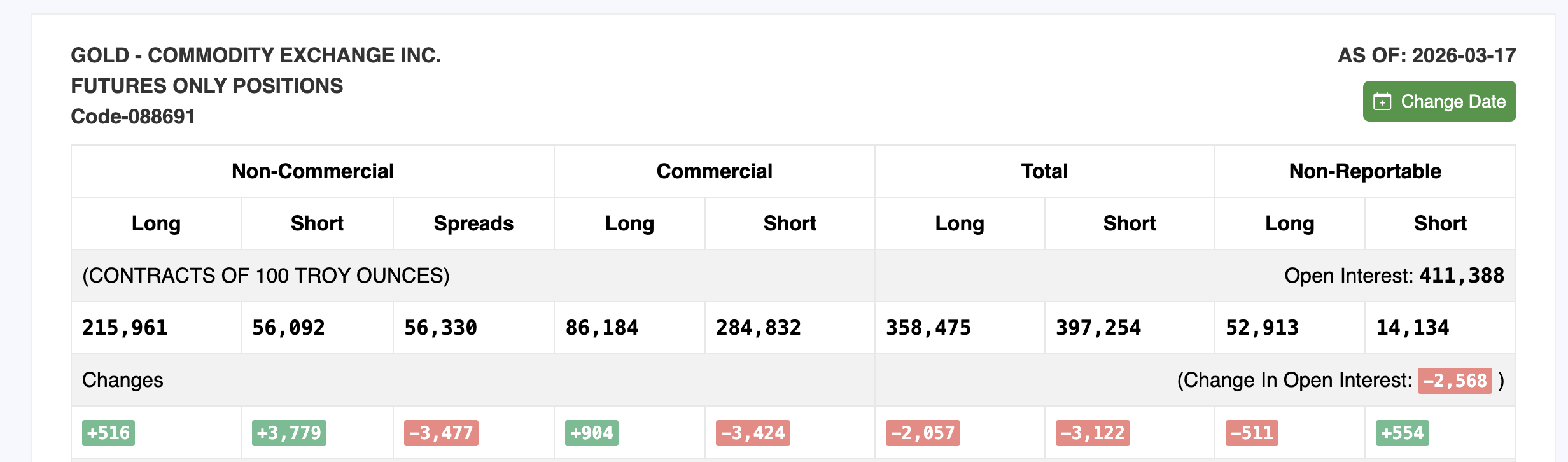
The shift between the two reports aligns with what the GLD put-call data shows. Bearish participants were caught by the 17% rally and scrambled to reposition. This dynamic can sustain a move temporarily but historically does not provide the foundation for a durable gold price advance. The price levels now determine the next path for gold.
Gold Price and the Correlation Paradox
The 8-hour chart with Fibonacci levels frames every critical gold price level. Gold currently sits at $4,676 within the ascending channel.
For the rally to extend, gold needs an 8-hour close above $4,802. Above that, $5,043 acts as the next major resistance. A move through $5,043 would bring $5,422, the March 1 high, back into focus.
However, if gold reaches $5,043 or higher before the correlation completes its reset into deep negative territory, the rally risks repeating the same pattern that preceded both prior corrections. A move higher while the correlation lingers near neutral rather than resetting below -0.70 would leave the advance on an incomplete foundation.
On the downside, $4,490 at the 0.236 Fib represents the first support. Below that, $4,297 at the 0.382 Fib and $4,141 at the 0.5 level come into play. The $4,105 floor from March 23 aligns closely with the 0.5 zone and represents the base of the 17% rally.
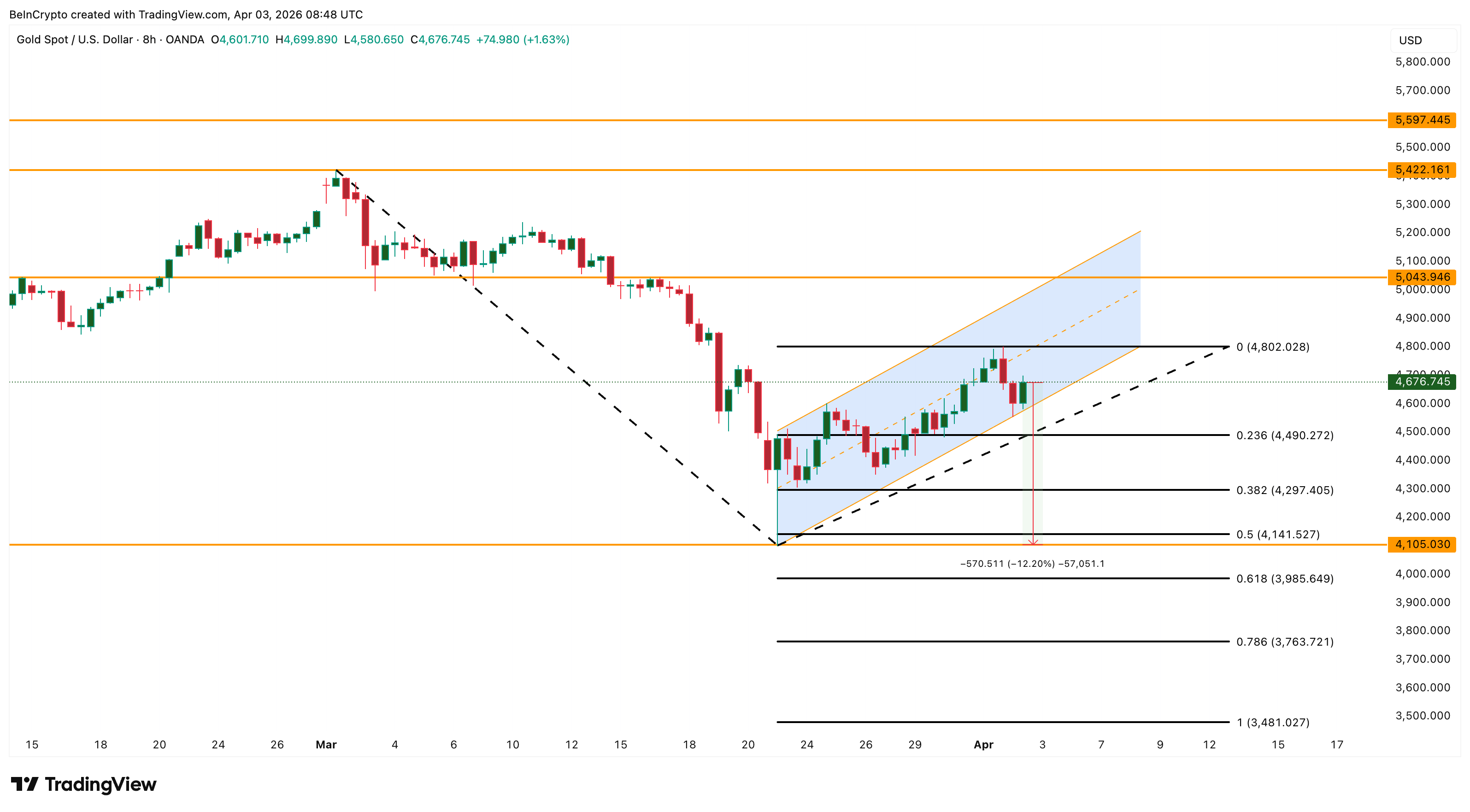
Here is where the paradox resolves. A gold price pullback toward $4,105 while oil continues to rise would possibly push the correlation back toward negative territory.
A dip that breaks the oil correlation sets up a stronger foundation for the next sustained move, while a continued rally that keeps both assets moving together leaves gold in the same overheated zone that triggered every correction this cycle. An 8-hour close above $4,802 extends the channel rally but keeps the correlation risk alive, while a pullback toward $4,105 that breaks the oil link could paradoxically be the most bullish outcome for gold’s medium-term path.
The post Why a Gold Price Dip Could Be More Bullish Than Its Current 17% Rally appeared first on BeInCrypto.
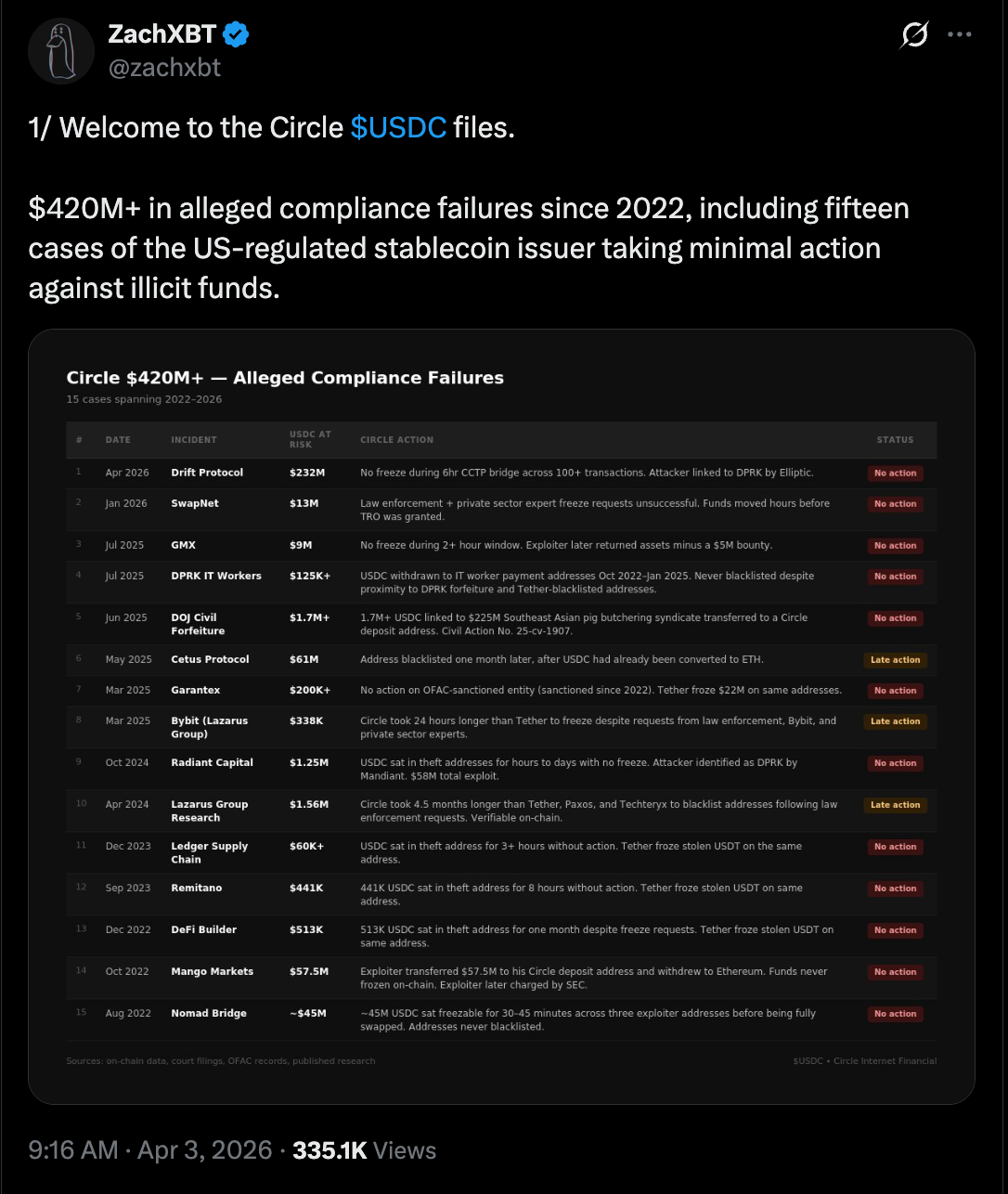
Onchain detective ZachXBT claims that Circle, the issuer of the USDC (USDC) stablecoin, has failed to freeze or blacklist about $420 million in illicit fund flows since 2022.
Circle can freeze illicit funds and blacklist wallet addresses, but either took “minimal” action to freeze illicit flows or failed to act in 15 separate hack-and-fraud cases, including those linked to North Korean (DPRK) state-affiliated hackers, ZachXBT said.
The stablecoin issuer allegedly failed to freeze $9 million in USDC from the GMX decentralized exchange (DEX) hack in July 2025, and blacklisted wallets linked to the $200 million Cetus DEX hack in May 2025 after USDC was converted into Ether (ETH), according to ZackXBT.

Circle failed to freeze $232 million in illicit flows from the Drift Protocol Hack on Wednesday, despite a six-hour window in which the attackers converted USDC to ETH in over 100 separate transactions, he added.
“Circle builds good products, and I hold USDC myself. This isn’t a post about hoping they collapse,” he said, adding that the failure to freeze these illicit flows has had “real consequences for real people.” He said:
“Nine figures were lost from the ecosystem because of repeated inaction across three years on law enforcement requests, private sector requests, and their own infrastructure. The $420 million-plus only accounts for major public cases. The real figure is likely significantly higher.”
Cointelegraph reached out to Circle but did not receive an immediate response by the time of publication.

The lack of asset freezes has sparked an online debate in the crypto community about the role and responsibilities of centralized service providers, as blockchain protocols and users continue to be targeted in hacks and cybersecurity exploits that drain funds.
Related: ZachXBT claims Circle wrongfully freezing exchange wallets
Circle explores “reversible” USDC transactions
In September 2025, Heath Tarbert, the president of Circle, said that the company was exploring “reversible” USDC transactions that could be rolled back or amended in the event of hacks, theft and fraud.
Circle has frozen USDC funds and blacklisted wallets on multiple occasions, including freezing USDC held by Tornado Cash addresses sanctioned by the US Office of Foreign Assets Control in 2022.
Magazine: Meet the onchain crypto detectives fighting crime better than the cops


Brokerage services giant Charles Schwab plans to roll out spot cryptocurrency trading in the first half of 2026, pushing it deeper into digital assets.
“We remain on track to launch our spot crypto offer in the first half of 2026, starting with bitcoin and ether (ETH),” a company spokesperson told CoinDesk on Friday.
The firm has opened a waitlist for clients seeking early access to what it calls a “Schwab Crypto” account, which will allow users to buy and sell the two largest cryptocurrencies. The firm will offer the service via Charles Schwab Premier Bank, SSB.
The move builds on comments from CEO Rick Wurster, who said last July that Schwab aimed to introduce crypto trading “sometime soon” in response to client demand. He framed the effort as a way to bring digital assets into the same account view as stocks and bonds in a push toward a more unified investment platform.
Schwab’s scale could give it an edge as it enters a market long dominated by crypto-native exchanges. The firm reported $11.9 trillion in client assets in 2025, offering a built-in base of retail and institutional investors who may prefer trading crypto within a familiar brokerage environment rather than using standalone platforms.
The firm already allows clients to invest in ETFs linked to cryptocurrencies and trade bitcoin futures on its platform. It also launched the Schwab Crypto Thematic Index (STCE), an ETF that tracks the performance of companies linked to the digital asset sector.

TLDR
- Charles Schwab plans to launch spot Bitcoin and Ethereum trading later this quarter through its brokerage platform.
- The firm manages over $12 trillion in client assets and will roll out the service in phases.
- Employees will receive early access, followed by invited clients, before a full public release.
- Clients will trade Bitcoin and Ethereum directly without using a separate crypto wallet or exchange.
- Charles Schwab Premier Bank, SSB, will operate the new crypto trading service.
Charles Schwab will introduce spot Bitcoin and Ethereum trading later this quarter through its brokerage platform. The firm manages more than $12 trillion in client assets and plans a phased rollout. CEO Rick Wurster confirmed the timeline during a prior earnings call and outlined internal testing before public access.
Charles Schwab to Enable Direct Bitcoin and Ethereum Trades
Charles Schwab will allow retail clients to buy and sell Bitcoin directly within existing brokerage accounts. The company will not require a separate crypto wallet or third-party exchange account. Instead, it will integrate spot trading into its current infrastructure for easier access.
The service will operate through Charles Schwab Premier Bank, SSB, which serves as a regulated banking subsidiary. Employees will receive early access during an internal testing phase before invited clients join. After that, Schwab will open the service to all eligible customers in stages.
Wurster confirmed the launch window during an earlier earnings call with analysts. He said Schwab expects spot crypto trading to go live later this quarter. He also stated that the firm prepared for this move as regulatory conditions evolved.
Brokerage Shifts From Indirect Exposure to Spot Crypto Access
Until now, Charles Schwab has offered digital asset exposure through exchange-traded products and crypto-linked equities. The firm also provided futures contracts and thematic investment portfolios tied to blockchain companies. However, clients could not trade Bitcoin or Ethereum directly on the platform.
The upcoming launch will change that structure by enabling direct spot transactions. Clients will execute trades within their standard brokerage accounts. Schwab will process orders without routing them to an external crypto exchange.
Wurster first signaled interest in spot crypto trading in late 2024. He said the firm monitored regulatory developments closely before expanding services. He added that Schwab positioned itself to act when conditions allowed.
The firm aims to compete with established crypto trading platforms. Schwab will offer Bitcoin and Ethereum trading alongside traditional securities. This structure places Schwab in direct competition with Coinbase, Robinhood, and Webull.
Wurster addressed competition during prior remarks about the rollout. He said, “We are ready to compete in spot Bitcoin and Ethereum trading.” He emphasized that Schwab intends to provide a familiar and regulated environment for clients.
Schwab already supports crypto-linked ETFs and futures within its brokerage accounts. However, the firm will now expand into direct ownership of digital assets. The rollout will follow internal testing and controlled client access before full availability.
The brokerage also plans to introduce a stablecoin product in the future. Wurster confirmed this plan after lawmakers passed the GENIUS stablecoin bill. He said the company will move forward once it finalizes operational details.
Charles Schwab expects to complete the phased rollout later this quarter. The company will announce broader access once testing concludes. For now, the firm continues internal preparations ahead of the public debut.

TLDR
- The tokenized real-world asset market reached $27.65 billion in April 2026 after a 4.07% monthly increase.
- Tokenized US Treasuries led the growth within the real-world asset sector during the crypto downturn.
- Bitcoin target markets showed low odds of reaching $100,000 by June 30.
- The US-Israel-Iran conflict contributed to a broader risk-off sentiment across crypto markets.
- Institutional inflows into Bitcoin products remained flat throughout April.
The tokenized real-world asset market climbed to $27.65 billion in April 2026 despite a broader crypto downturn. Data showed a 4.07% monthly increase even as digital asset prices weakened. At the same time, Bitcoin price target markets reflected low odds of reaching $100,000 by June 30.
Real-world Asset Growth Reflects Demand for Stability
The real-world asset sector expanded to $27.65 billion in April, according to market trackers. The market posted a 4.07% rise despite falling cryptocurrency valuations. Analysts attributed the increase to sustained demand for tokenized US Treasuries and similar products.
US Treasuries led issuance volumes within tokenized offerings during the month. Market data showed steady allocations from institutional participants. One market analyst said, “Institutions continue to allocate toward tokenized Treasuries for stability and liquidity.”
Trading volumes in tokenized debt products held firm during April. Platforms reported consistent settlement activity across blockchain networks. This flow supported the sector’s growth while crypto prices faced pressure.
Market participants shifted capital toward blockchain-based representations of traditional assets. As a result, tokenized Treasury products gained higher on-chain balances. The data showed continued expansion even as Bitcoin prices fluctuated.
Bitcoin Struggles as Geopolitical Tensions Weigh on Sentiment
Bitcoin target markets showed thin activity for the $100,000 June 30 contracts. Order books reflected limited participation from large traders. Pricing implied a low probability for the six-figure milestone within the set timeframe.
The US-Israel-Iran conflict contributed to a broader risk-off environment. Traders reduced exposure to volatile assets during heightened geopolitical tensions. A derivatives strategist said, “Geopolitical uncertainty has reduced appetite for leveraged crypto positions.”
On-chain metrics showed no major institutional inflows during the period. Exchange-traded products linked to Bitcoin recorded flat subscription data. This lack of fresh capital limited upward price momentum.
Futures market positioning indicated restrained leverage across major exchanges. Funding rates remained neutral to slightly negative through late April. These metrics aligned with subdued expectations for short-term price rallies.


After the $285 million Drift hack, the focus is shifting to Circle (CRCL) and whether it could have done more to stop the money.
The attacker siphoned off roughly $71 million in USDC as part of the exploit Wednesday, according to blockchain security firm PeckShield. After converting most of the rest of the stolen assets to USDC, the hacker used Circle’s cross-chain transfer protocol, CCTP, to bridge about $232 million in USDC from Solana to Ethereum, making recovery efforts more difficult.
That movement has drawn criticism from parts of the crypto community, including prominent blockchain investigator ZachXBT, who argued Circle could have acted faster to limit the damage.
“Why should crypto businesses continue to build on Circle when a project with 9 fig[ure] TVL [total value locked] could not get support during a major incident?,” he said in an X post following the attack.
To freeze or not to freeze
The company had tools at its disposal, ZachXBT pointed out. Under its own terms, Circle reserves the right to blacklist addresses and freeze USDC tied to any suspicious activity.
Preemptively freezing wallets linked to the exploit could have slowed or stopped the attacker’s ability to move funds, one stablecoin infrastructure firm founder told CoinDesk.
However, acting without a court order or law enforcement request might expose Circle to legal risk, the person added.
Salman Banei, general counsel of tokenized asset network Plume, said freezing assets without formal authorization could expose issuers to liability if done incorrectly. He argued regulators should address that legal gap.
“Lawmakers should provide a safe harbor from civil liability if digital asset issuers freeze assets when, in their reasonable judgment, there is strong basis to believe that illicit transfers have occurred,” Banei said.
That constraint was central to the company’s response.
“Circle is a regulated company that complies with sanctions, law enforcement orders, and court-mandated requirements,” a spokesperson said in an email to CoinDesk. “We freeze assets when legally required, consistent with the rule of law and with strong protections for user rights and privacy.”
‘Gray zone’
The episode highlights a deeper tension that’s drawing increasing scrutiny as stablecoins grow.
Tokens like USDC are becoming a core part of global money flows, especially for cross-border payments and trading. At the same time, they are also used in illicit activity, putting issuers under pressure to act quickly when things go wrong.
According to TRM Labs, roughly $141 billion in stablecoin transactions in 2025 were linked to illicit activity, including sanctions evasion and money laundering.
Blockchain security firms pointed to North Korean hackers as likely being behind the Drift exploit.
Stablecoins issued by centralized, regulated entities like Circle’s USDC are designed to be programmable and controllable, a feature that can help stop illicit flows but could also raise concerns about overreach and due process.
In the Drift exploit’s case, the situation isn’t that clear-cut, said Ben Levit, founder and CEO of stablecoin ratings agency Bluechip.
“I think people are framing this too simplistically as ‘Circle should’ve frozen,’” he said. “This wasn’t a clean hack, it was more of a market/oracle exploit, which puts it in a gray zone.”
“So any action by Circle becomes a judgment call, not just a compliance decision,” he added.
To him, the bigger issue is consistency. “USDC can’t be positioned as neutral infrastructure while also allowing discretionary intervention without clear rules,” Levit said. “Markets can handle strict policies or no intervention, but ambiguity is much harder to price.”
That leaves issuers in a difficult position. Moving too slowly risks criticism that they are enabling bad actors, while acting too quickly without legal backing raises concerns about overreach.
And in fast-moving exploits, that trade-off becomes especially stark, with the window to act often measured in minutes rather than weeks or months of legal processes.

The Independent Community Bankers of America has opposed the Office of the Comptroller of the Currency’s (OCC) conditional approval of Coinbase’s national trust bank charter, warning the application falls short of regulatory standards and could pose risks to consumers and the financial system.
On Thursday, ICBA said Coinbase’s application shows deficiencies in risk controls, profitability and resolution planning, and argued the OCC lacks statutory authority to expand trust powers for crypto-related activities without applying the full set of banking regulations.
The group said the decision reflects a broader trend of nonbank entities seeking access to the benefits of bank charters without meeting the same regulatory requirements. It wrote:
The sudden influx of applications demonstrates nonbank entities are seeking the benefits of a US bank charter without satisfying the full scope of US bank regulations.
Americans for Financial Reform Education Fund also criticized the decision, warning the approval departs from longstanding banking law and could expose the financial system to risks tied to crypto market volatility, fraud and money laundering.
The objections follows the OCC’s conditional approval on Thursday of Coinbase’s application to establish a national trust bank, after six months of review by the US regulator.

Coinbase released a statement on Thursday saying the charter would bring its custody and market infrastructure business under federal oversight, emphasizing that it does not plan to hold customer deposits or engage in fractional reserve lending, and adding that “the right path forward for crypto is through the system — not around it.”
Related: Crypto awareness tops 80% among young people in UK: Coinbase survey
Stablecoin yield dispute stalls crypto market structure bill
The opposition is part of a broader dispute between banking groups and crypto companies over the role of digital assets in the financial system, particularly around stablecoins and yield-bearing products.
In January, CEO of Bank of America Brian Moynihan warned that allowing stablecoin issuers to offer interest could draw as much as $6 trillion in deposits out of the banking system, reducing lending capacity and pushing borrowing costs higher.
Industry groups such as the Bank Policy Institute have also raised similar concerns in letters to lawmakers, arguing that regulatory gaps could allow yield-bearing stablecoin products to bypass restrictions and disrupt traditional credit channels.
The debate is currently playing out in Washington, where Coinbase is engaged in policy discussions over the US Digital Asset Market Clarity Act, a bill aimed at establishing federal rules for crypto oversight.

While Coinbase CEO Brian Armstrong said in January that the company could not support the legislation as drafted due to restrictions on stablecoin rewards, Coinbase chief legal officer Paul Grewal said on Thursday that lawmakers are nearing agreement on core elements of the bill, though the yield issue remains a key sticking point.
The dispute has delayed a Senate Banking Committee markup, a required step before the bill can advance to a full Senate vote, leaving broader efforts to establish a federal framework for digital assets unresolved.
Magazine: Nobody knows if quantum secure cryptography will even work

Bold and Beautiful: Sheila Carter’s Shocking Exit – Bad Girl Heads to Y&R in Major Crossover?

Another Chelsea star drops transfer bombshell with latest Real Madrid claim | Football
Bitcoin May Be Mispricing Prolonged Iran War Risk, Hedge Fund Veteran Says


-

 NewsBeat7 days ago
The Story hosts event on Durham’s historic registers
-

 NewsBeat1 day ago
Steven Gerrard disagrees with Gary Neville over ‘shock’ Chelsea and Arsenal claim | Football
-

 Sports7 days ago
Sweet Sixteen Game Thread: Tide vs Michigan
-
Entertainment4 days ago
Fans slam 'heartbreaking' Barbie Dream Fest convention debacle with 'cardboard cutout' experience
-

 Business20 hours ago
No Jackpot Winner and $194 Million Prize Rolls Over
-

 Crypto World2 days ago
Gold Price Prediction: Worst Month in 17 Years fo Save Haven Rock
-
 Entertainment6 days ago
Lana Del Rey Celebrates Her Husband’s 51st Birthday In New Post
-
Crypto World3 days ago
Dems press CFTC, ethics board on prediction-market insider trades
-

 Tech5 days ago
The Pixel 10a doesn’t have a camera bump, and it’s great
-

 Tech5 days ago
Avatar Legends: The Fighting Game comes out in July and it looks pretty slick
-

 Sports3 days ago
Tallest college basketball player ever, standing at 7-foot-9, entering transfer portal
-

 Tech3 days ago
EE TV is using AI to help you find something to watch
-

 Fashion6 days ago
Amazon Sundays: Soft Spring Layers
-

 Business2 days ago
Login and Checkout Issues Spark Merchant Frustration
-

 Tech5 days ago
Elon Musk’s last co-founder reportedly leaves xAI
-

 Fashion7 days ago
When Evening Dressing Gets Colorful for Spring
-

 Tech3 days ago
How to back up your iPhone & iPad to your Mac before something goes wrong
-

 Tech4 days ago
Apple will hide your email address from apps and websites, but not cops
-

 Politics4 days ago
Should Trump Be Scared Strait?
-

 Crypto World4 days ago
U.S. rule change may open trillions in 401(k) funds to crypto
You must be logged in to post a comment Login