

Crypto World
Bitcoin price coils into a triangle formation, why a breakout is looming

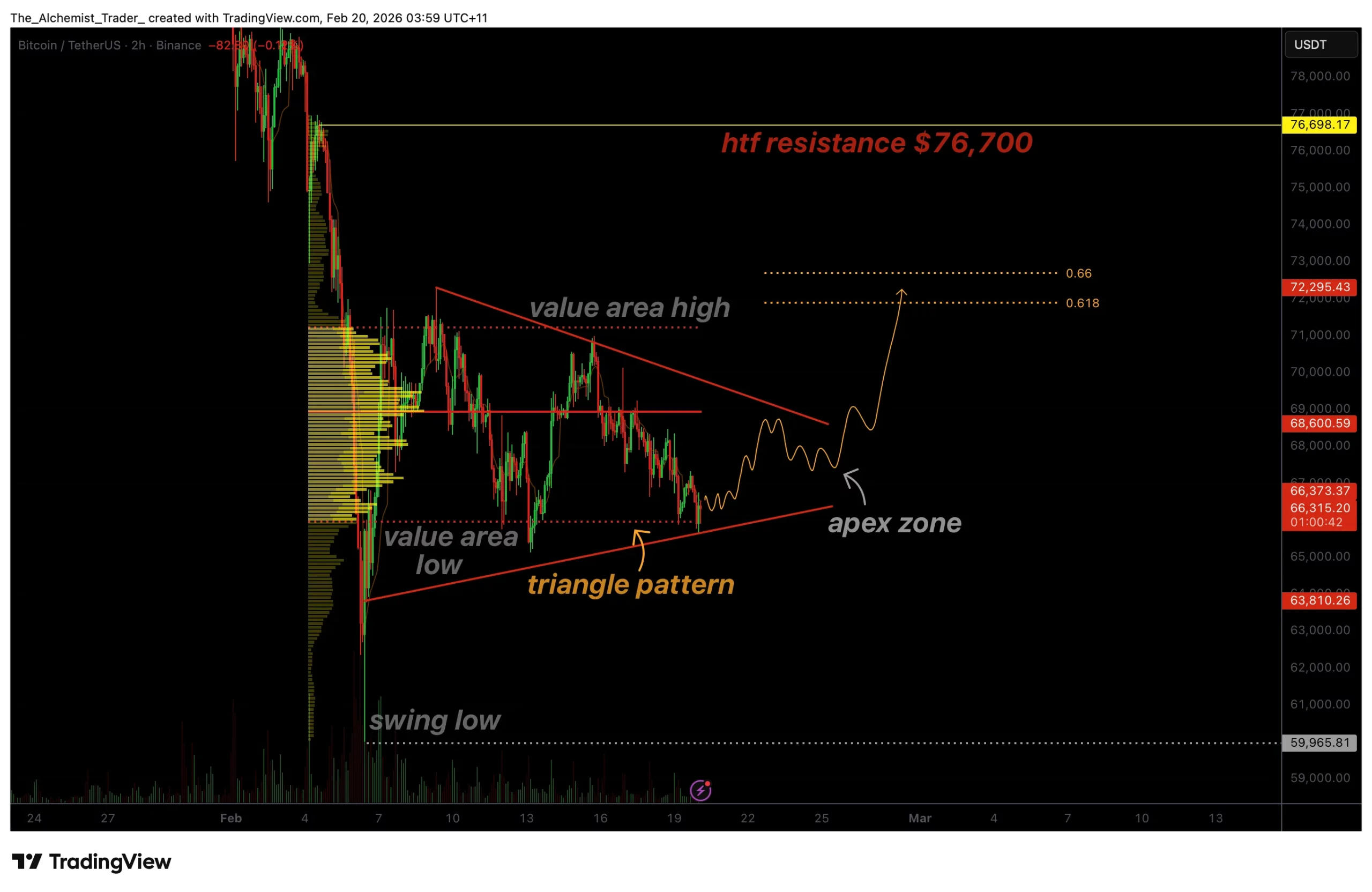
Bitcoin price is compressing into a tightening triangle structure, signaling a major decision point as converging support and resistance suggest an imminent volatility expansion in the near term.
Summary
- Triangle compression signals imminent breakout, volatility expansion approaching
- Higher lows indicate growing demand, favoring bullish resolution
- $76,700 resistance becomes key target, if breakout confirms with volume
Bitcoin (BTC) price action has entered a constructive consolidation phase, forming a clear triangle pattern that reflects growing market equilibrium. After recent volatility, the price has entered a period of compression, with dynamic support and resistance continuing to narrow. This behavior often precedes significant directional movement, as markets rarely remain compressed for extended periods.
Triangle formations typically represent a balance between buyers and sellers before a decisive breakout occurs. In Bitcoin’s case, price remains inside the structure, meaning the breakout has not yet been confirmed. However, as the price approaches the apex of the triangle, the probability of a volatility expansion increases substantially.
The market is now nearing a macro decision point where momentum will likely return and determine Bitcoin’s next trend phase.
Bitcoin price key technical points
- Bitcoin trading inside a clear triangle formation, signaling compression
- Apex zone approaching, increasing breakout probability
- $76,700 high-timeframe resistance becomes upside target, if bullish break occurs
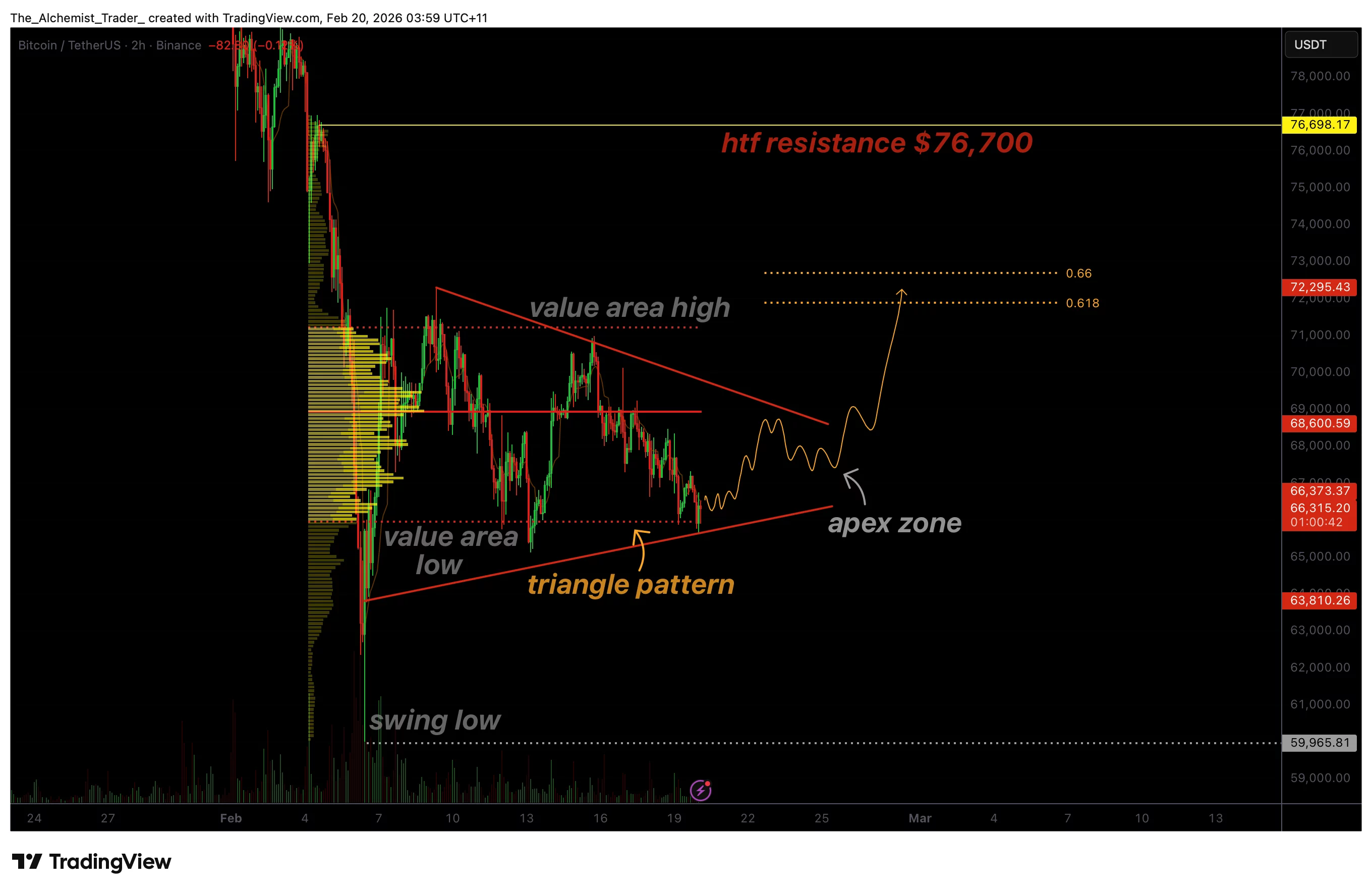
The current triangle formation is defined by converging dynamic support and resistance aligned closely with the value area low and value area high. Each rejection from resistance and defense of support has gradually tightened price action, reducing volatility and forming a classic apex structure.
Such formations indicate that neither buyers nor sellers currently dominate the market. Instead, liquidity builds on both sides as participants wait for confirmation of direction. As compression increases, even modest momentum can trigger a sharp expansion once price escapes the pattern.
Importantly, Bitcoin has not yet broken out. Until a confirmed move occurs, price remains in consolidation rather than trend continuation.
Higher Lows Suggest Constructive Momentum
One notable feature within the triangle is the development of higher lows forming near the value area low. These higher lows indicate that buyers are stepping in earlier on each pullback, gradually applying upward pressure on price.
While this does not guarantee a bullish breakout, it does suggest constructive underlying demand. Markets forming higher lows during consolidation often lean toward upside resolution, particularly when support continues to hold consistently.
This behavior reflects accumulation rather than distribution, strengthening the possibility of a bullish expansion once the triangle resolves.
Apex zone becomes the market decision point
The apex of the triangle represents the most critical area in the current structure. As the price reaches this narrowing zone, the market is forced into a decision. Breakouts from triangle patterns frequently occur near the apex because the price has little room left to consolidate.
However, direction alone is not enough. Volume confirmation will be essential. A breakout accompanied by increasing volume would validate participation returning to the market and significantly improve the probability of sustained follow-through.
Without volume expansion, breakouts risk becoming false moves that quickly reverse back into the range.
Upside scenario targets $76,700 resistance
If Bitcoin breaks to the upside with strong volume confirmation, attention shifts toward high-timeframe resistance near $76,700. This level represents a major technical objective and aligns with prior supply areas within the broader trading structure.
A successful breakout would signal the end of the consolidation phase and the beginning of a new expansion leg, potentially attracting momentum traders and renewed market participation.
What to expect in the coming price action
From a technical, price-action, and market-structure perspective, Bitcoin is approaching a macro decision point. The triangle formation indicates compression, and compression almost always leads to expansion.
In the immediate short term, traders should expect increasing volatility as price interacts with the apex zone. A confirmed breakout supported by rising volume will likely dictate the next major move.
While higher lows favor a bullish resolution, confirmation remains essential. Until the breakout occurs, Bitcoin remains in consolidation, but the technical evidence suggests that a significant move is approaching rapidly.
The upcoming sessions are likely to define Bitcoin’s next directional trend as the market prepares for an imminent expansion of volatility.


Disclosure: The views and opinions expressed here belong solely to the author and do not represent the views and opinions of crypto.news’ editorial.
To anyone who pays genuine attention to the stablecoin market, it comes as no secret that these assets have firmly entrenched themselves among the most important building blocks of the modern digital economy. By late 2025, the total stablecoin market cap had already surpassed the point of $300 billion, which tells us a lot about how much trust people are putting in them.
Summary
- Stablecoins have crossed the threshold: With $300B+ market cap and surging card usage, they’re no longer experimental — they’re becoming core payment infrastructure.
- Banks are reacting, not leading: Nearly half of banks are integrating stablecoins, while CBDCs signal central banks are adapting to rails already built by crypto.
- Liquidity is the real backbone: Yield-enhancing DeFi protocols transform idle capital into deep, 24/7 settlement infrastructure — making programmable money scalable.
Stablecoins get used so much today because they’re fast, borderless, and increasingly reliable. They move value instantly and behave predictably in ways that traditional payments increasingly don’t. It’s not really a question anymore whether stablecoins will stick around. The real question is how they will be adopted — and who will drive that adoption.
The passage of the GENIUS Act in the U.S. was a strong signal that payment stablecoins are entering a new phase. And regulation isn’t arriving just to slow the sector down; instead, it’s stepping up to give stablecoins a defined role in the broader financial system. For the first time, we’ve seen a clear path being introduced for payment stablecoins to operate alongside TradFi systems, rather than simply existing at their edges. They are actively becoming a settlement tool that can be used in practice alongside traditional financial instruments.
Adoption is already happening — but outside traditional rails
I find it important to mention that even outside any formal and large-scale integration by major payment platforms, adoption is spreading at its own pace. There is a growing number of fintechs that are building products at the intersection of crypto, stablecoins, and payments. Companies like ether.fi, Monerium, or Holyheld are already enabling real-world stablecoin usage through their financial tools and offerings. One particularly notable case of this is the exponential growth of crypto cards, utilized for everyday spending among crypto users. A study in Q3 2025 showed that a little over 60% of surveyed users already use these cards for transactions and commonplace purchases.
Meanwhile, we also have data from big names like Visa that their issuance and spending via crypto cards saw a massive rise over the course of the previous year. From January to December 2025, the total transaction volume jumped 525%, with the net spending climbing to $91 million by year-end. All of this evidence points to the rapid adoption of crypto instruments in the mainstream, and stablecoins are the primary way to power those cards.
This usage also highlights another trend that’s becoming more prominent: the growing role of non-USD stablecoins. Assets such as EURe and the more recent ZCHF are finding real demand in payment flows, especially in Europe and Switzerland, where users value on-chain settlement without taking unnecessary dollar exposure.
Euro-denominated stablecoins are rapidly developing under Markets in Crypto-Assets Regulation, and Europe now has multiple compliant euro stablecoins with real transaction volume and fintech integration. A recent report indicates that over the past several years, the total volume of euro stablecoin transactions has grown to surpass €8 billion, showing how non-USD stablecoins are increasingly gaining traction.
The role of banks in stablecoin adoption
Naturally, this shift raises questions about where traditional banks are supposed to fit into the picture. Many people assume banks will be central to stablecoin adoption going forward. And it’s true that they are paying more attention now: this asset class has grown into something large enough that they can no longer dismiss it, and public acknowledgements of their importance are becoming more common.
A recently conducted survey showed that in 2025, 49% of banks, including some Tier-1s, are already integrating stablecoins into their operations. In Switzerland, for example, over half of banks with active crypto offerings are planning to also include stablecoin-related services.
Looking ahead, I think that a much greater shift may come when central banks start introducing stablecoin-like CBDCs. Some among them, such as the European Central Bank (ECB), are already exploring this direction: particularly wholesale CBDCs intended for interbank settlements rather than retail use.
These projects involve active collaborations between central banks in France, Germany, Italy, and other countries. And if these efforts succeed and wholesale CBDCs eventually start operating on public blockchain infrastructure — potentially even platforms like Ethereum (ETH) — the impact would be tremendous. It would be a tectonic shift in what’s happening under the hood of the global financial system and how money moves across borders.
Consumers and the rise of redeemable stablecoins
Compared to banks, though, an even greater driver of specifically stablecoin adoption, to my mind, is going to be the consumer. Throughout 2025, we saw more and more use cases for redeemable stablecoins in commonplace financial activities. Major payment networks such as Visa and Mastercard are integrating these assets into their infrastructure, providing settlement solutions and merchant acceptance that extend stablecoin utility into mainstream payments.
Redeemable stablecoins give people more options for day-to-day transactions: payments, transfers, savings, and simple on-chain interactions. All without the friction of legacy systems. From the average user’s point of view, that’s a clear improvement.
Because of this, as we move deeper into 2026, I expect consumer adoption of redeemable stablecoins to be one of the main forces behind the continued growth of this market. Broadly speaking, people adopt financial tools because they work, and stablecoins do work. If a coin is easy to use, settles instantly, and can be redeemed without too much hassle, it will likely find users.
Banks may eventually integrate these tools, but as I said, in most cases, they will be responding to behavior that already exists, not initiating it.
The role of decentralized stablecoins
Alongside consumer-facing stablecoins, fully decentralized stablecoins remain essential for on-chain finance. While these assets can be used for retail payments, that’s not what they were primarily designed for. What they do in practice is power smart contracts, automated settlement, derivatives, and decentralized lending.
They form the programmable layer that allows financial logic to execute without intermediaries. In many cases, yield-enhancing protocols depend on these decentralized assets to function reliably. In other words, if consumer stablecoins expand usage, decentralized stablecoins power the infrastructure behind that usage. Together, they create a system that is both practical and resilient.
Yield-enhancing protocols: Liquidity as infrastructure
It should be noted that none of these scales has liquidity, which is the real backbone of stablecoin adoption. And this is where yield-enhancing protocols play a critical role.
Yield-generating DeFi protocols unlock idle capital and redirect it into productive use. Instead of liquidity sitting dormant, it can be deployed into automated market makers, lending pools, and cross-chain settlement layers. This creates deeper markets, tighter spreads, and more reliable execution — all of which are essential factors for payments to happen at scale.
In cross-border contexts, this matters even more. Yield-enhancing liquidity pools reduce the cost of moving value between currencies and jurisdictions. They replace fragmented correspondent banking networks with on-chain systems that are transparent, available 24/7, and economically incentivized to remain liquid. When liquidity is deep and incentives are aligned, users don’t need to worry about whether a payment will clear or whether value will be available on the other side.
What comes next
Ultimately, stablecoins are not here to replace banks overnight, and they don’t need to do it to find success, either. They have a more fundamental role to play, and that is to introduce a faster, programmable, and globally accessible financial layer. Stablecoins are meant to do what money should do in the first place: maintain value, move instantly when needed, and earn the trust of the people using them.
On all three fronts, they are evolving quickly — and in many cases, outperforming the incumbents. The digital dollar accelerates this shift, yield-enhancing protocols make it scalable, and consumer adoption makes it real. How far this can go depends only on what we build next.

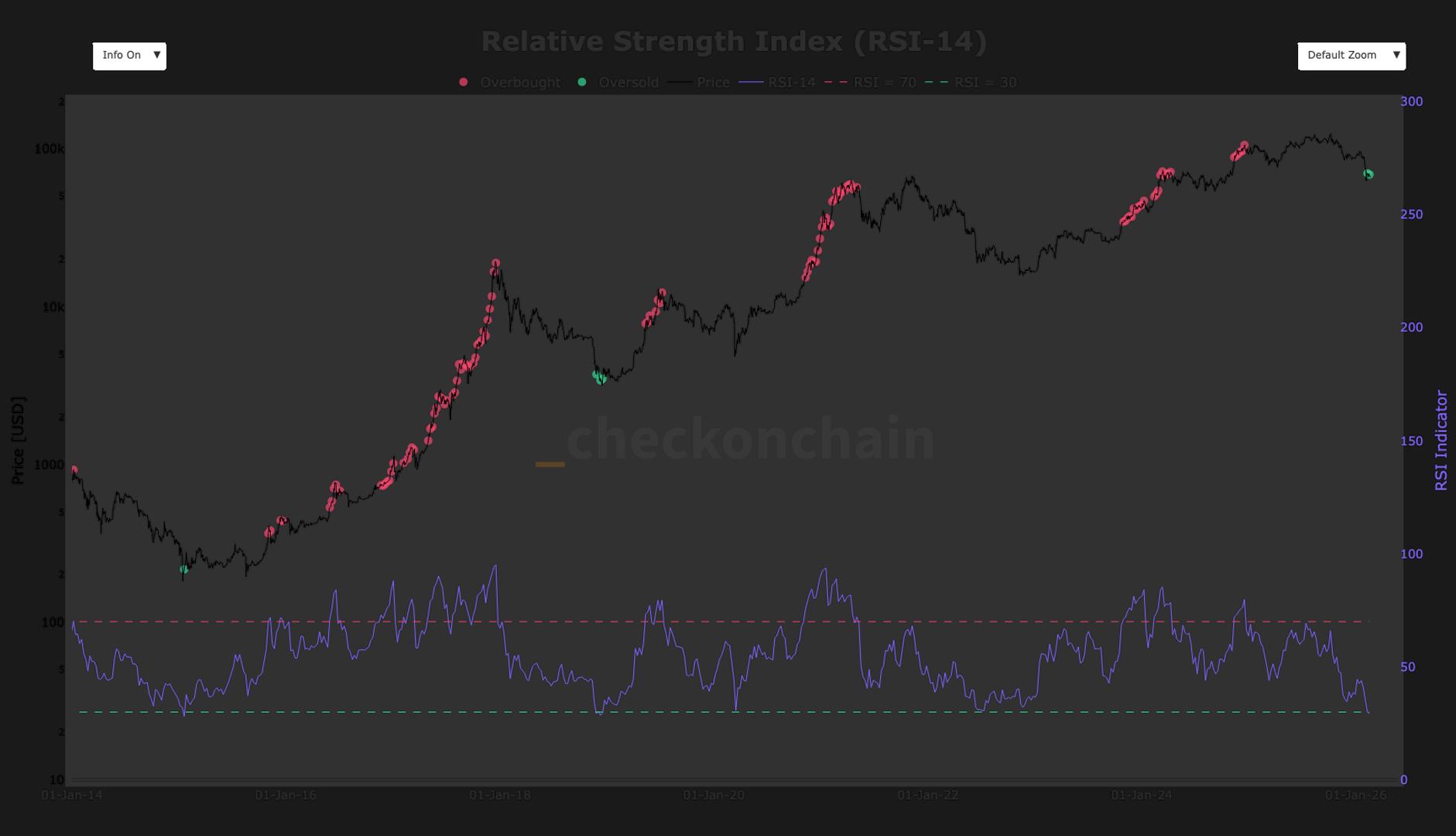
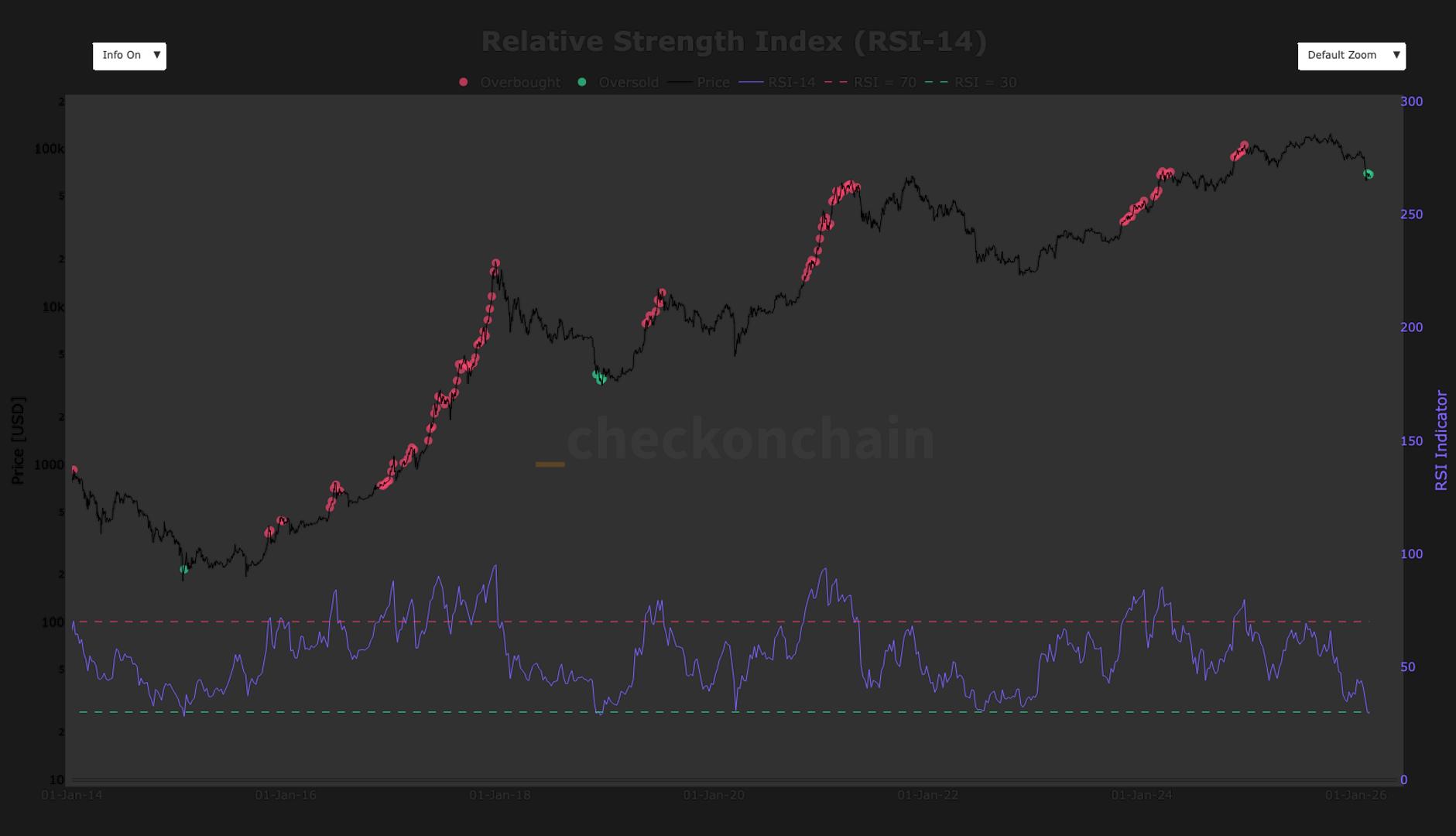
Bitcoin’s 14-day Relative Strength Index (RSI) dropped below 30 for only the third time in its history this month, according to checkonchain.
The RSI is a popular tool for detecting an asset’s momentum by measuring the speed and magnitude of recent price movements and comparing average gains and losses over a set period of 14 days.
The index produces a reading between 0 and 100, with levels above 100 generally considered overbought, while readings below 30 indicate oversold conditions, suggesting that selling may be overextended. Bitcoin’s 14-day RSI has not hit 100 since December 2024 when bitcoin first surpassed $100,000.
Previous readings below 30 marked prior cycle bottoms. In January 2015, bitcoin’s RSI fell to roughly 28 as price hovered near $200. The market then spent about eight months consolidating before a sustained recovery began. A similar pattern emerged in December 2018, when RSI dipped below 30 around $3,500. That period was followed by roughly three months of sideways accumulation before bitcoin broke higher.
BTC is trading around $66,000, with sentiment stuck in “fear” or “extreme fear” on the Crypto Fear & Greed Index for much of the past 30 days. Since peaking in October, bitcoin has shedded more than 50%, briefly falling toward $60,000.
History suggests the current move could lead to consolidation around the $60,000 region in the months ahead before the next leg upward.

TLDR:
- 83% of altcoins on Binance are trading below the 50-week moving average, signaling a broad bear trend.
- Bitcoin has dropped to roughly 46% of its $126,000 all-time high recorded back in October 2025.
- On February 7, a new record was set with over 92% of Binance altcoins falling below a key technical level.
- Rising altcoin token supply combined with constrained liquidity continues to suppress price recovery across markets.
Altcoins are facing mounting pressure as a liquidity crunch pushes 83% of them into a bear trend. Data from Binance shows most assets, excluding Bitcoin and stablecoins, are now trading below their 50-week moving average.
Investors still holding these positions are under considerable stress. Bitcoin has been in a downtrend since October 2025, following an all-time high of $126,000. Its price currently sits at roughly 46% of that record peak.
BTC Downtrend Weighs Heavily on Altcoin Performance
Bitcoin’s decline from its all-time high has created a difficult environment for altcoins. The broader market continues to follow BTC’s direction, which has remained uncertain in recent months.
At its current level, Bitcoin trades at approximately 46% below its record high. This has left many altcoin investors with little room to recover losses.
Macro factors are adding to the pressure felt across crypto markets. Rising geopolitical tensions between the U.S. and Iran have increased uncertainty among investors.
Meanwhile, the Federal Reserve has maintained a hawkish tone in its latest FOMC minutes. These conditions make highly volatile assets like altcoins especially difficult to hold.
According to analyst Darkfost_Coc, 83% of altcoins on Binance are now below the 50-week moving average. This level is widely considered a key threshold for identifying long-term trends.
Falling below it generally signals a corrective phase for an asset. The current reading shows how broadly the bear trend has spread.
A new record was set on February 7, when over 92% of Binance altcoins traded below this level. That marked the worst reading since the bear market ended in 2023.
It stands in stark contrast to March 2024, when only 6% of altcoins sat below this threshold. December 2024 posted a similarly low reading of just 7%.
Supply Surge and Constrained Liquidity Drive Market Imbalance
The altcoin market has also been shaped by a steady rise in token supply. More projects launching means more assets competing for the same pool of capital.
When liquidity is constrained, new supply puts further downward pressure on prices. This dynamic has made it harder for most altcoins to sustain any upward momentum.
Outside of brief recovery windows, at least 50% of altcoins have remained below the 50-week moving average. This pattern differs notably from the behavior observed in the previous market cycle.
The current cycle appears structurally different, with liquidity playing a much larger role. That shift has caught many investors off guard.
Darkfost_Coc noted that outperforming in this environment requires a clear understanding of how market dynamics have evolved.
Careful asset selection and a structured investment plan are also considered essential by analysts. Without both, navigating the current conditions becomes increasingly difficult. The market rewards preparation over speculation in periods like this.
The combination of macro headwinds, rising supply, and BTC uncertainty continues to define conditions for altcoins. Investors still holding positions face an extended and challenging road ahead.
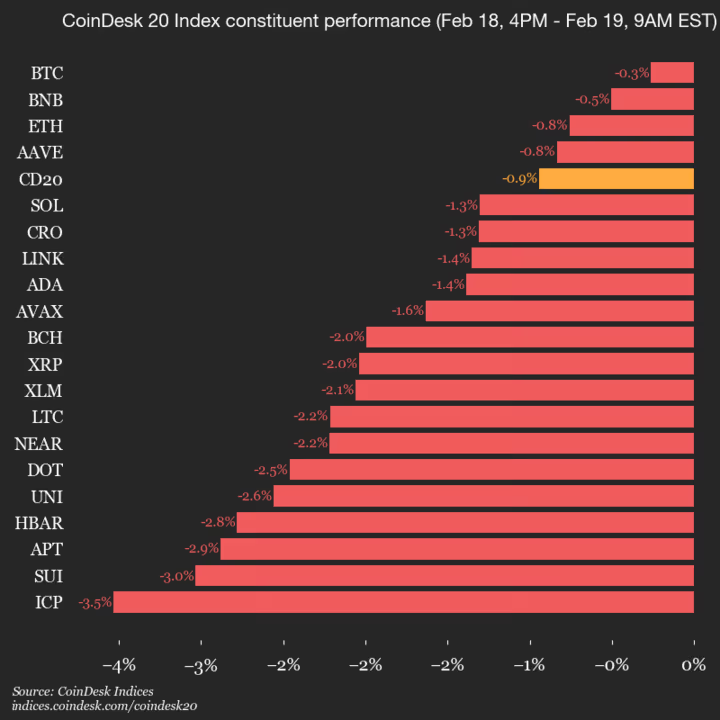
CoinDesk Indices presents its daily market update, highlighting the performance of leaders and laggards in the CoinDesk 20 Index.
The CoinDesk 20 is currently trading at 1909.21, down 0.9% (-18.15) since 4 p.m. ET on Wednesday.
None of the 20 assets are trading higher.

Leaders: BTC (-0.3%) and BNB (-0.5%).
Laggards: ICP (-3.5%) and SUI (-3.0%).
The CoinDesk 20 is a broad-based index traded on multiple platforms in several regions globally.
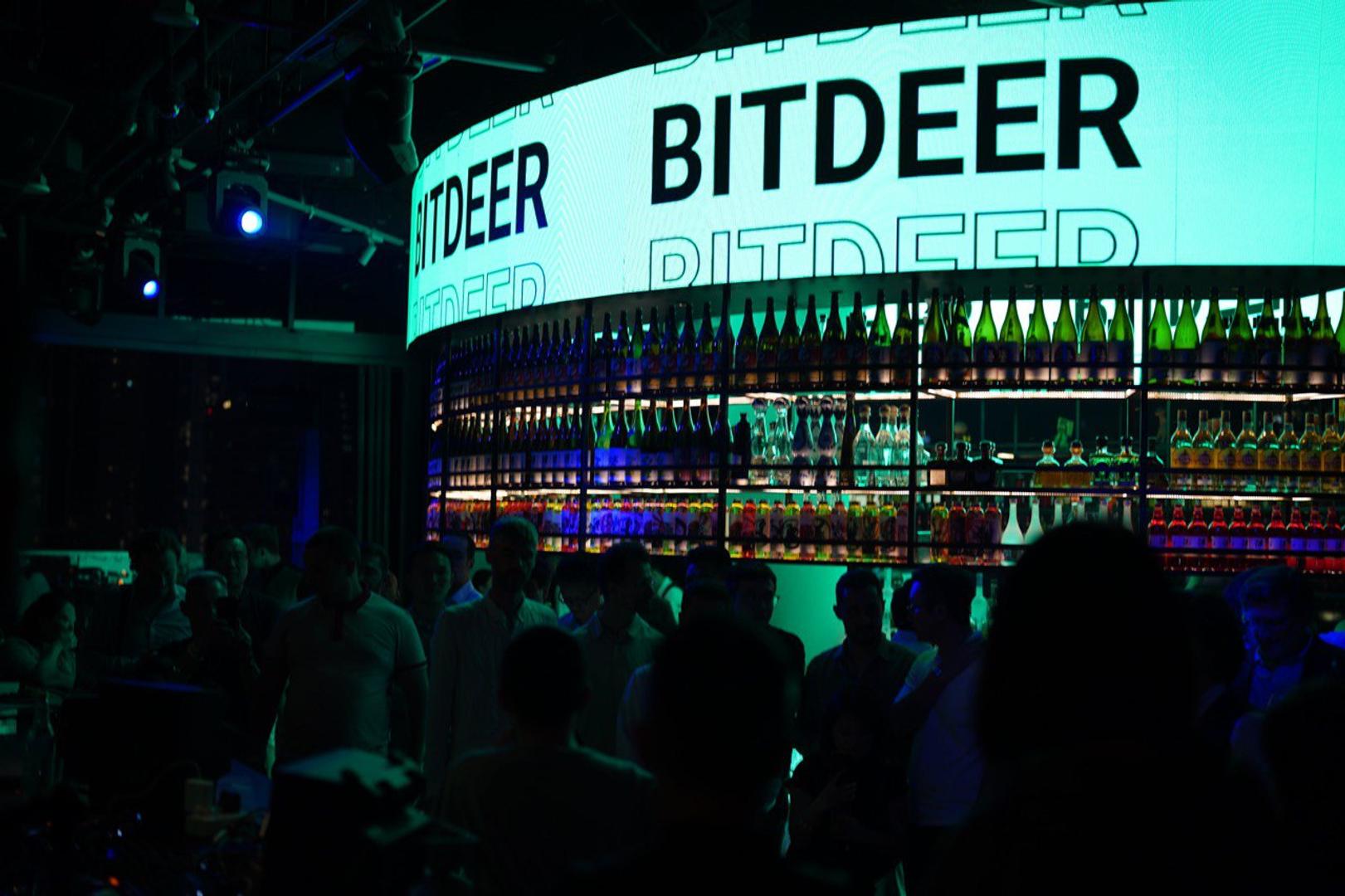
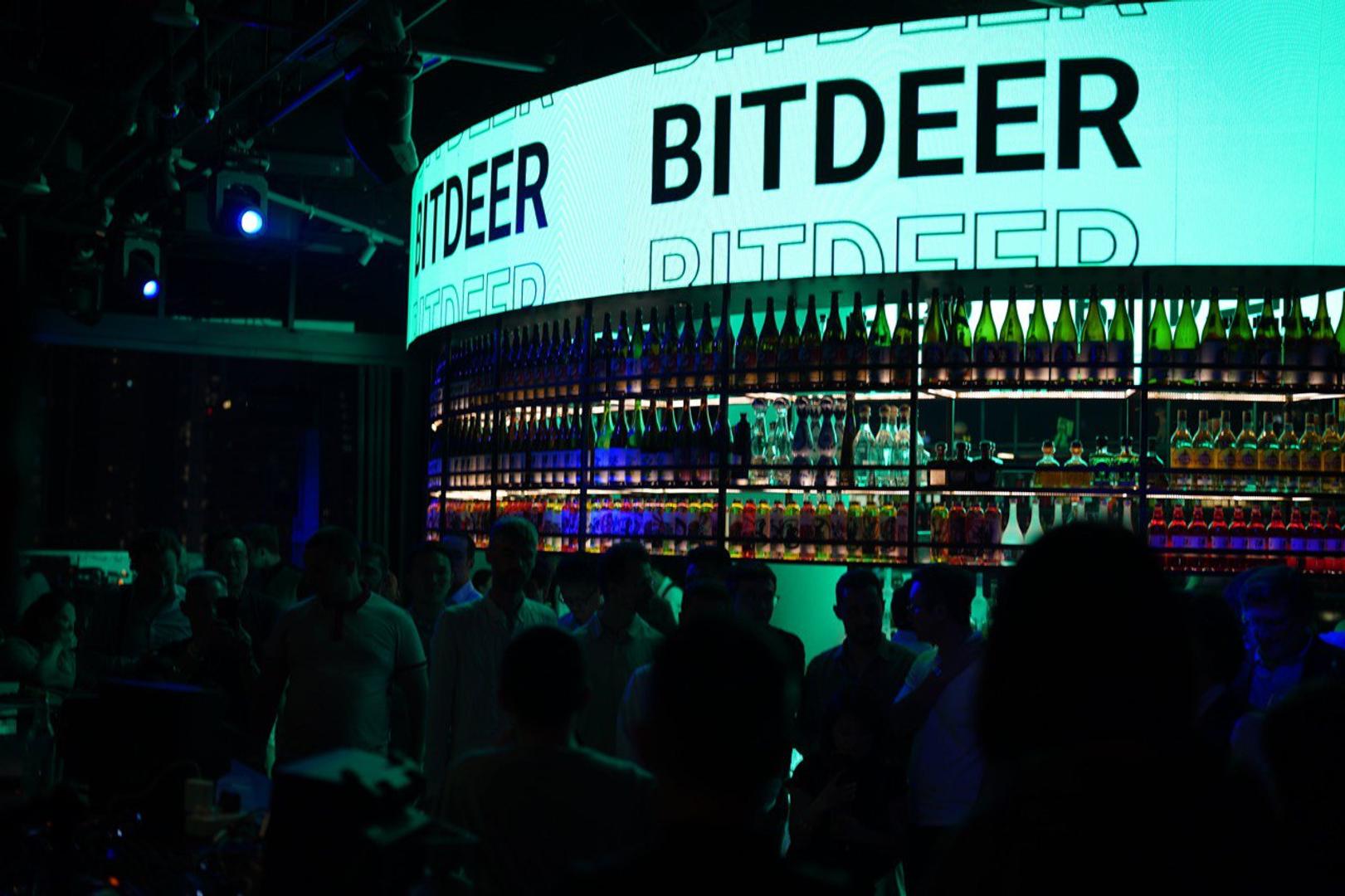
Bitdeer Technologies (BTDR) shares plunged on Thursday on plans to raise $300 million through a private sale of convertible senior notes, alongside a separate registered direct offering of Class A shares.
The notes, due in 2032, can convert into cash, shares or a mix of both at Bitdeer’s election. The underwriter greenshoe option is for another $45 million in notes.
The Singapore-based company also intends to sell an unspecified number of Class A shares directly to certain holders of its 5.25% convertible notes due 2029. It plans to use proceeds from both offerings to fund capped call transactions designed to limit share dilution if the new notes convert, and to repurchase a portion of the 2029 notes in private deals.
Any remaining funds will go toward expanding data centers, growing its high-performance computing and AI cloud businesses and developing ASIC-based mining rigs.
Convertible debt often puts pressure on shares because investors factor in the risk of future dilution. In simple terms, if the company’s stock rises, noteholders may convert their debt into equity, increasing the share count. Bitdeer’s use of capped calls aims to offset some of that effect, though such hedging can add volatility around pricing.
The registered direct offering depends on completion of the notes sale and related repurchases, while the notes offering can proceed on its own.
Bitdeer’s shares fell 17% in the early morning trading below $8 for the first time since April.
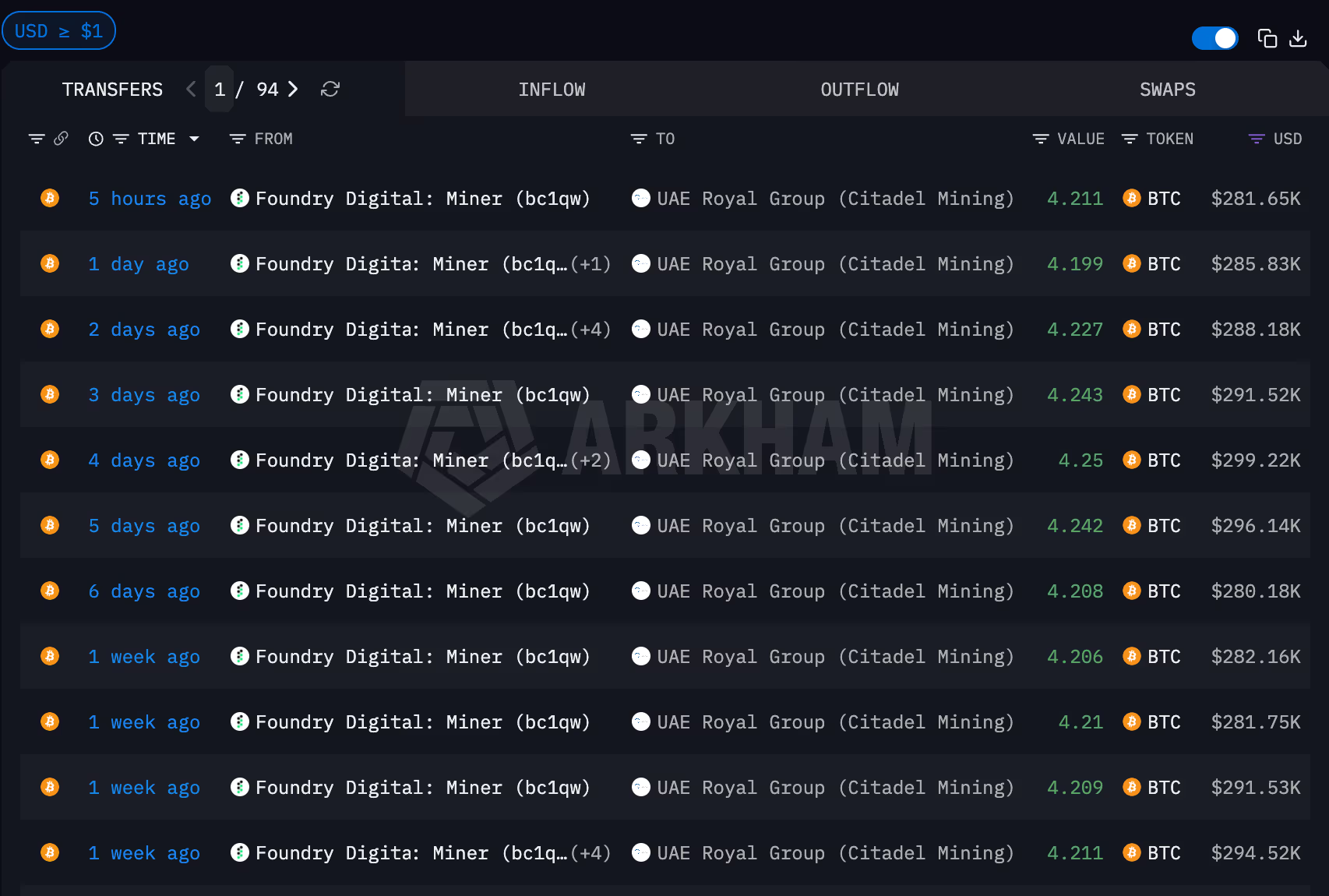
The United Arab Emirates is sitting on roughly $344 million in unrealized profit from its bitcoin mining operations, according to onchain data from Arkham, making it one of the world’s most significant sovereign crypto plays.
Wallets tied to the UAE Royal Group currently hold roughly 6,782 BTC valued about $450 million. Excluding energy costs, Arkham estimates the position is deep in the green, reflecting the lower-than-average cost from years of industrial-scale mining compared with open-market buying.
Over the past seven days, the operation has produced some 4.2 BTC a day, suggesting the country’s mining infrastructure remains active despite bitcoin’s recent slide from late-2025 highs and broader volatility across risk assets.

The UAE’s mining push dates back to 2022, when Citadel Mining, linked to Abu Dhabi’s royal family through International Holding Company, built large facilities on Al Reem Island.
In 2023, Marathon Digital (MARA), now renamed as MARA Holdings, partnered with Abu Dhabi-based Zero Two to develop 250 megawatts of immersion-cooled mining capacity, one of the largest disclosed deployments in the region.
In August, when bitcoin traded at higher levels, Arkham estimated the UAE’s mined holdings at closer to $700 million. The latest figures reflect updated wallet tracking and lower market prices rather than major sales, with the most recent notable outflows occurring roughly four months ago.
Unlike the U.S. or U.K., whose bitcoin holdings largely stem from asset seizures, the UAE’s stash is the product of sustained mining. By holding most of what it produces, the Gulf nation is effectively converting energy and infrastructure into a strategic digital reserve that compounds over time.
In a market where many miners have been forced to sell into weakness to fund their operations, the UAE appears to be doing the opposite, steadily accumulating duing the drawdown.
Crypto World
McGlone shifts bitcoin forecast to $28,000 after critics blast $10,000 call as ‘nonsense’


Bloomberg Intelligence’s Mike McGlone appeared to walk back his $10,000 forecast for bitcoin, instead highlighting $28,000 after being challenged on social media and accused of being an alarmist whose “nonsensical” forecasts put real capital at risk.
Earlier this week, McGlone warned that collapsing crypto prices could signal broader financial stress and that bitcoin could revert toward $10,000 if U.S. equities peak and recession follows. He framed the token as a high-beta risk asset vulnerable to a breakdown in the post-2008 “buy the dip” regime.
But in a subsequent post on X, McGlone pointed to $28,000 as a more probable level based on historical price distribution, a notable shift from his earlier base case. He also said his analysis “suggests why not to buy bitcoin or most risk assets.”
His correction upward also followed being challenged to a debate by market analyst and AdLunam co-founder, Jason Fernandes on X and LinkedIn posts.
Fernandes, whose LinkedIn challenge was liked but not accepted by McGlone, told CoinDesk his broader critique still stands, even after the Bloomberg analyst revised his target. “$28K is obviously more realistic than $10K,” Fernandes said. “Proportionately fewer things need to go wrong for $28K than $10K.”
Mati Greenspan, a market analyst and the Quantum Economics founder, said $28,000 was still unlikely, “but in markets we never want to rule anything out.”
Greenspan had also called McGlone out in a post on X following his lower forecast, saying, “Mr. @mikemcglone11 would have you believe that an asset with trillions of dollars in monthly volumes could crash to a market cap of 200 billion.” He said the forecast was “literally nonsense.”
Fernandes previously estimated a more likely reset in the $40,000 to $50,000 range absent a systemic liquidity shock. He noted that $28,000 now sits closer to his lower bound than to McGlone’s original call. “It bears mentioning that he has adjusted his near-term outlook closer to my low end than his previous prediction,” Fernandes said.
At stake in the debate is more than price targets. Fernandes said that deterministic, alarmist framing can materially influence positioning and put “real capital at risk,” particularly in reflexive markets like crypto.


World Liberty Financial is tapping real-world asset specialist Securitize to help tokenize loan interests tied to the Trump International Hotel and Resort in the Maldives.
Rather than direct equity in the properties, investors will be able to buy tokens tied to loan revenue, according to a Wednesday announcement timed for the privately held company’s Mar-A-Lago crypto conference.
World Liberty Financial is turning to one of the largest companies in digital securities. Securitize has worked with major asset managers such as BlackRock, Hamilton Lane and Apollo Global Markets to issue tokenized funds and private credit on public blockchains. BlackRock and Cathie Wood’s Ark Invest are also investors in the firm, which plans to go public by merging with a Cantor Fitzgerald-sponsored special-purpose acquisition company (CEPT).
“We built World Liberty Financial to open up decentralized finance to the world,” said Eric Trump, a co-founder of the company. “With today’s announcement, we are now extending that access to tokenized real estate.”
Eligible accredited investors will receive a fixed yield and payments linked to the loan’s performance. The sale will take place under U.S. private placement rules, with restrictions on resale.
Plans to tokenize the Maldives resort were unveiled in November. The resort, developed by DarGlobal in collaboration with the Trump Organization, is expected to include about 100 beach and overwater villas and reach completion in 2030. In October, Eric Trump said on CoinDesk TV that WLFI planned to tokenize a new real estate project.
The latest announcement focuses on who will handle the mechanics. Securitize will oversee issuance and compliance for tokens representing interests in a development loan connected to the project.
While tokenization of traditional assets like stocks and funds has gained the attention of Wall Street firms, real estate represents a smaller slice of the $25 billion tokenized asset market. Proponents argue that blockchain rails can streamline property ownership records and settlement, but uneven regulation and thin secondary trading pose a risk, an EY report noted last year.
The company’s WLFI token has dropped 6.6% in the past 24 hours to 11.63 cents.


Disclosure: This article does not represent investment advice. The content and materials featured on this page are for educational purposes only.
This week, several new projects were listed on CoinMarketCap, including Monstro DeFi, Espresso, and BitGW. The BitGW team states that this development is not simply about brand exposure. It represents integration into the global reference layer of the crypto market, a framework through which exchanges are continuously evaluated, compared, and monitored.
BitGW is spot on with this observation. CoinMarketCap is far more than a directory. For millions of users, institutional analysts, compliance professionals, and infrastructure providers, CMC data functions as a default reference point. As a result, a listing signals that an organization’s trading activity and platform metrics are now visible within a standardized, globally recognized data structure.
Transparency as a competitive edge
As the digital asset sector matures, transparency has become one of the most decisive competitive differentiators.
For example, in BitGW’s case, being listed on CoinMarketCap means operating within a framework that requires structured, continuously updated information. This level of openness allows market participants to independently observe platform performance over time.
Rather than relying solely on marketing narratives, BitGW’s metrics can now be evaluated directly within a neutral, third-party environment, an increasingly important factor in building long-term credibility.
Institutional visibility and market positioning
A CoinMarketCap listing also reshapes how a platform is perceived beyond retail audiences.
Institutional observers, liquidity providers, and compliance teams frequently consult CMC as part of their research and benchmarking processes. BitGW’s presence within this ecosystem strengthens its visibility across regions while positioning the exchange within a globally recognized data standard.
In a market driven by measurable performance and trust, this transition, from simply being available to being systematically trackable, carries significant weight.
Entering the market’s long-term memory
In crypto, hype is fleeting. Data is permanent.
By being listed on CoinMarketCap, companies like BitGW enter what could be described as the market’s long-term memory. Its trading metrics, consistency, and growth trajectory will now be observed and compared against peers over extended periods.
While this level of transparency introduces sustained scrutiny, it also creates opportunity. Platforms that demonstrate operational stability and disciplined growth over time are more likely to earn lasting market confidence.
Looking ahead
As the industry continues to prioritize transparency, data integrity, and institutional standards, exchanges that embrace this level of openness position themselves for long-term credibility.
Therefore, being listed on CoinMarketCap means more than just visibility. It represents commitment and signals an organization’s intention to compete where the standards are highest, and the scrutiny is constant.
Disclosure: This content is provided by a third party. Neither crypto.news nor the author of this article endorses any product mentioned on this page. Users should conduct their own research before taking any action related to the company.
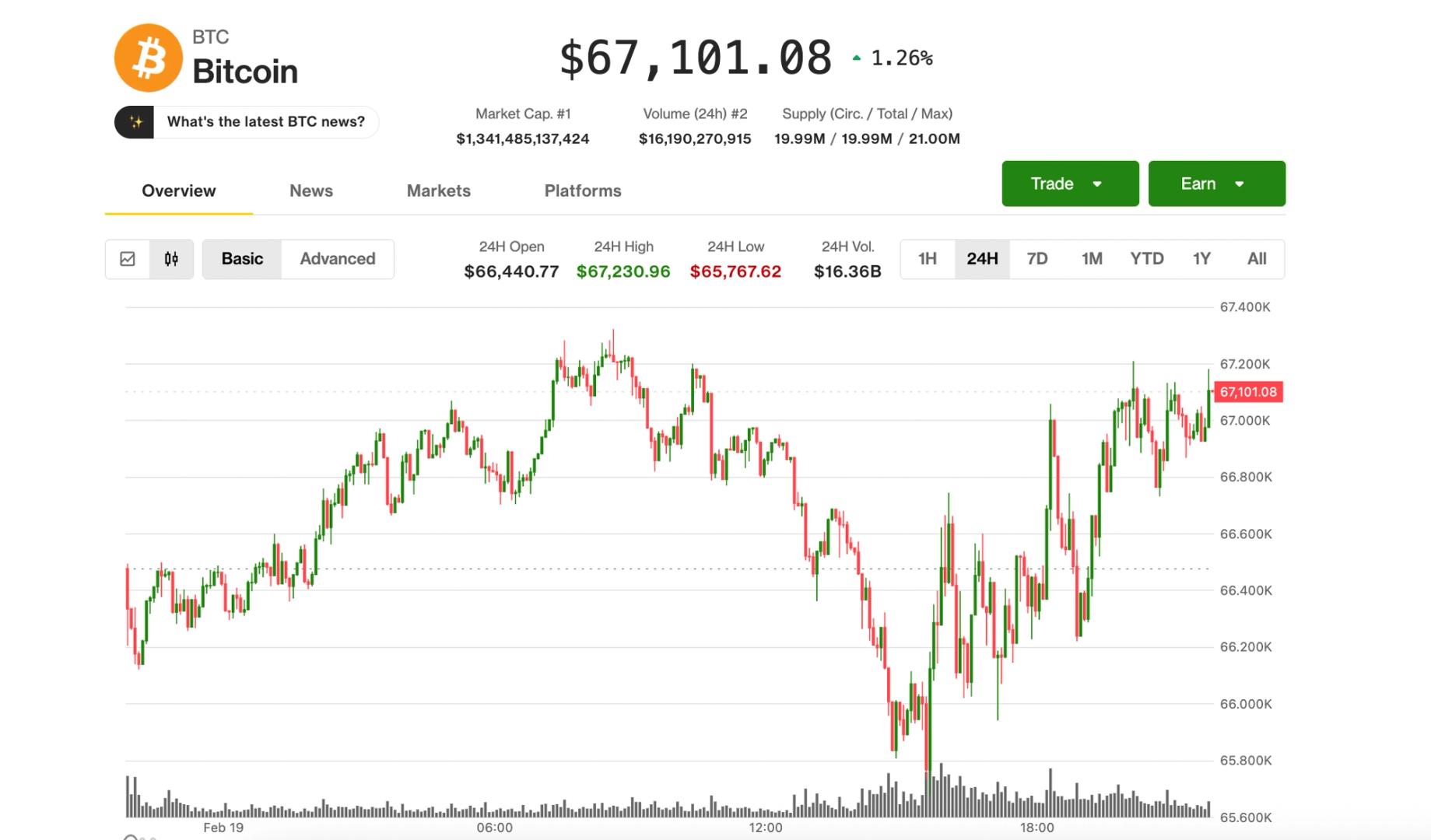
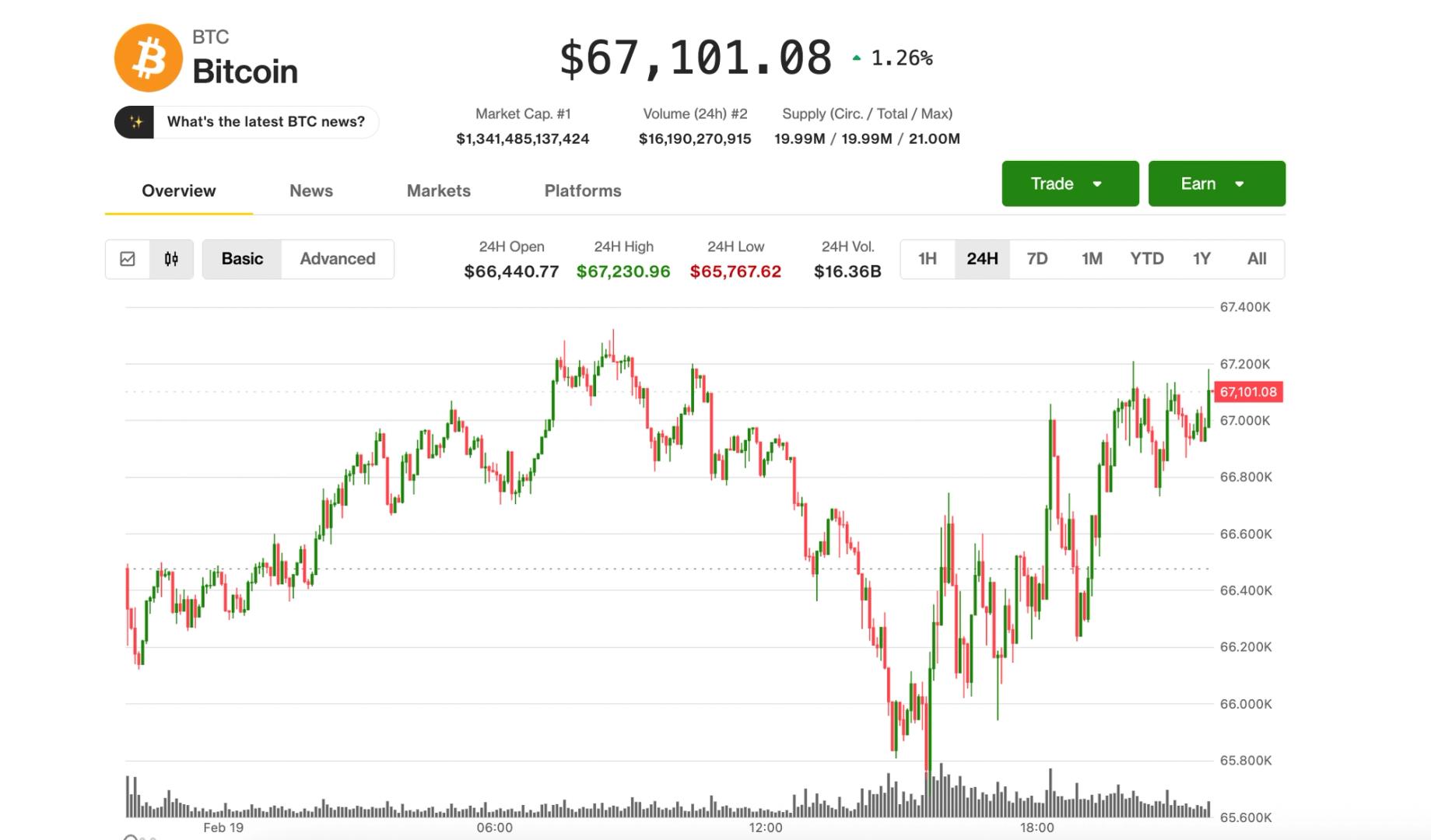
Bitcoin found its footing on Thursday, stabilizing above a key technical level after briefly slipping below $66,000 in early U.S. trading. The largest cryptocurrency recently changed hands at around $67,000, up roughly 1% over the past 24 hours.
The CoinDesk 20 Index lagged, with ether (ETH), XRP, BNB, and solana (SOL) flat to slightly lower during the same period, perhaps a signal of continued caution in altcoins amid shaky crypto markets.
Crypto-related stocks climbed modestly higher across the board, with bitcoin miners CleanSpark (CLSK) and MARA (MARA) standing out with 6% gains. Meanwhile, the S&P 500 and the tech-heavy Nasdaq 100 were 0.3% and 0.6% lower, respectively.
On the policy front, there were tentative signs of progress on the digital asset market structure bill. As CoinDesk’s Jesse Hamilton reported, White House-hosted talks between crypto industry representatives and bankers yielded incremental movement, though no compromise has yet emerged.
At the same time, cracks from the recent crypto downturn are still surfacing. Chicago-based crypto lender Blockfills, as CoinDesk reported, is exploring a sale after enduring a $75 million lending loss during the recent price crash and having temporarily suspended client deposits and withdrawals last week. With crypto prices tumbling sharply in recent months, investors have been bracing for potential blowups like those of Celsius and FTX in 2022. So far, however, the fallout appears contained — on the one hand, tempering worst-case fears, but on the other, avoiding the kind of complete washout that set the stage for the bottom of that brutal bear market and the beginning of the 2023-25 bull run.
Still, risks outside the crypto sphere continue to loom that leave investors hesitant to take risks.
Worries about mounting stress in credit markets flared up after private-equity company Blue Owl (OWL) permanently curbed redemptions in its $1.7 billion retail-focused private credit fund. OWL fell 6% on Thursday, while the shares of other major private credit managers, including Apollo Global (APO), Ares Capital (ARES) and Blackstone (BX) slid more than 5%.
Geopolitical tensions remain another overhang, with the prospect of U.S. military action against Iran still in play amid an ongoing regional buildup. Crude oil rallied another 2.8% over $66 per barrel, hitting its highest price since August.
Traders play defense
That caution is reflected in crypto derivatives markets, Jake Ostrovskis, head of OTC at trading firm Wintermute, pointed out. Many traders are buying downside protection while limiting upside participation, he noted, which means they are effectively paying for insurance against another drop while capping potential gains in a breakout to the upside.
The average U.S. bitcoin ETF cost basis now sits near $84,000, leaving a large share of ETF investors underwater — nursing a 20% paper loss on average — and potentially vulnerable to “capitulation selling” if prices slide further.
Still, total ETF holdings remain within about 5% of their peak in bitcoin terms, suggesting institutions are trimming exposure rather than rushing for the exits.

Before We Blame AI For Suicide, We Should Admit How Little We Know About Suicide

Nabung #nabung #savingchallenge #cash #tabungan #menabung #money

Army engineer took his own life at Catterick Garrison


-

 Video3 days ago
Bitcoin: We’re Entering The Most Dangerous Phase
-

 Tech5 days ago
Luxman Enters Its Second Century with the D-100 SACD Player and L-100 Integrated Amplifier
-

 Crypto World3 days ago
Can XRP Price Successfully Register a 33% Breakout Past $2?
-

 Sports3 days ago
GB's semi-final hopes hang by thread after loss to Switzerland
-

 Video6 days ago
The Final Warning: XRP Is Entering The Chaos Zone
-
 Tech3 days ago
The Music Industry Enters Its Less-Is-More Era
-

 Business2 days ago
Infosys Limited (INFY) Discusses Tech Transitions and the Unique Aspects of the AI Era Transcript
-

 Entertainment1 day ago
Kunal Nayyar’s Secret Acts Of Kindness Sparks Online Discussion
-

 Video3 days ago
Financial Statement Analysis | Complete Chapter Revision in 10 Minutes | Class 12 Board exam 2026
-

 Tech2 days ago
Retro Rover: LT6502 Laptop Packs 8-Bit Power On The Go
-
 Crypto World6 days ago
Bhutan’s Bitcoin sales enter third straight week with $6.7M BTC offload
-
 Sports18 hours ago
Clearing the boundary, crossing into history: J&K end 67-year wait, enter maiden Ranji Trophy final | Cricket News
-

 Entertainment24 hours ago
Dolores Catania Blasts Rob Rausch For Turning On ‘Housewives’ On ‘Traitors’
-

 Crypto World6 days ago
Kalshi enters $9B sports insurance market with new brokerage deal
-

 Business2 days ago
Tesla avoids California suspension after ending ‘autopilot’ marketing
-
 NewsBeat4 days ago
The strange Cambridgeshire cemetery that forbade church rectors from entering
-

 Crypto World1 day ago
WLFI Crypto Surges Toward $0.12 as Whale Buys $2.75M Before Trump-Linked Forum
-
 NewsBeat4 days ago
Man dies after entering floodwater during police pursuit
-

 NewsBeat5 days ago
UK construction company enters administration, records show
-
 Crypto World6 days ago
BlackRock Enters DeFi Via UniSwap, Bitcoin Stages Modest Recovery