

Crypto World
Bitcoin Price Prediction: Elon Musk’s X Money Could Beat Bitcoin, Claims Famous Analyst

The one asset Wall Street spent a decade trying to kill just got dissed by the guy who wrote the book on unpredictable events.
Nassim Taleb, author of The Black Swan and one of the most vocal Bitcoin critics in intellectual circles, called Elon Musk’s X Money “much, much smarter than Bitcoin” after Musk announced early public access to the payments service is coming next month.
The crypto bros were not happy. The debate lit up X within hours.
X Money is Musk’s play at turning X into an everything app. Beta rolled out earlier this month. It runs on fiat, backed by a real bank, has a Visa-partnered physical debit card personalized with your X handle, and has zero connection to any cryptocurrency.
Taleb’s argument is private currencies compete with each other. X Money, being issued by a private company with real infrastructure and mainstream reach, fits that framing better than a decentralized asset he has called fragile for years.
He previously argued Bitcoin fails as both a currency and a hedge. His position has not changed. It has just found a new target to contrast against.
The pushback was immediate. Critics pointed out Taleb has been consistently wrong on Bitcoin for years and that X Money is structurally no different from PayPal or Zelle.
And they are not entirely wrong. But noise from critics has never been what moves Bitcoin price. What moves it is institutional flow, macro conditions, and sentiment.
With that in mind, let’s look at the BTC chart.
Bitcoin Price Prediction: Can BTC Break This Resistance Zone?
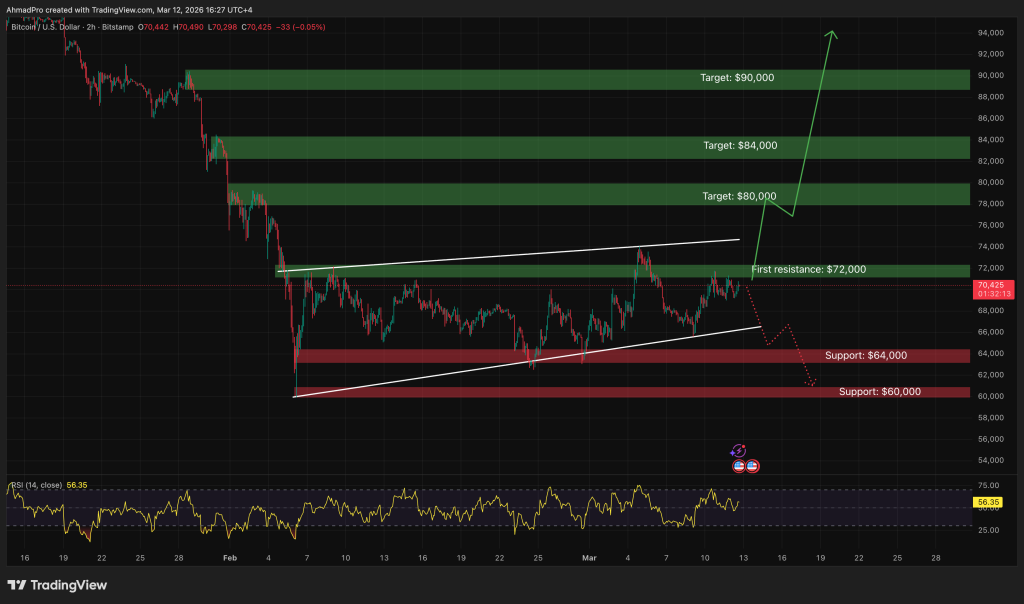
BTC is sitting at $70,471 on the 2h chart, trading inside a rising wedge that has been compressing since early February, with price currently pressing up against the $72,000 first resistance zone.
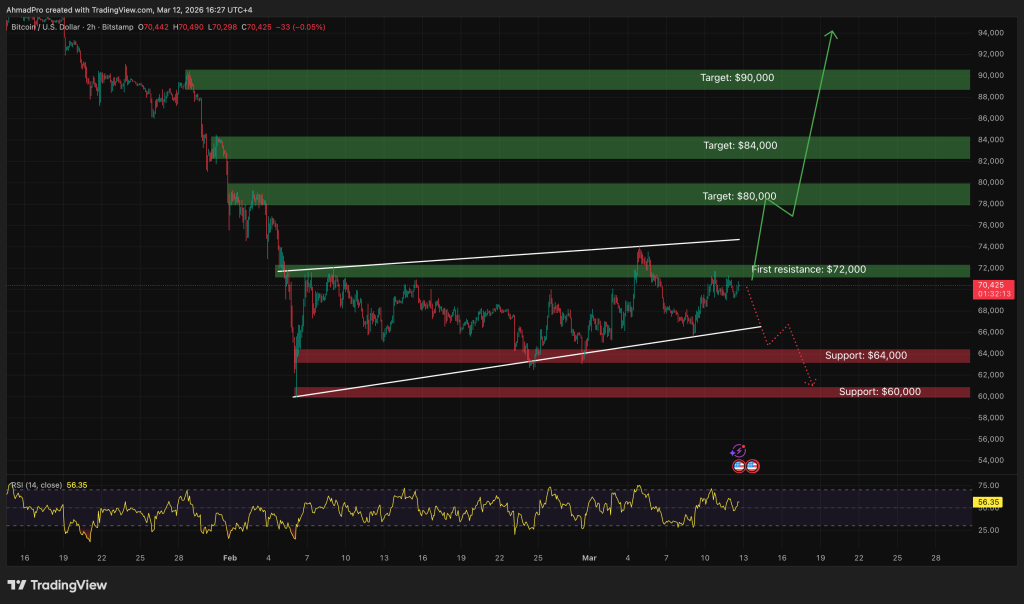
The wedge is the key structure to watch here because these patterns typically resolve to the downside, and the chart itself acknowledges that risk with a dotted path showing a potential flush toward $64,000 before any real recovery leg develops.
That $64,000 level has already proven itself as a serious demand zone, getting tested and holding twice within the wedge, and below that sits the $60,000 floor, which is the last major support before the structure fully breaks down.
On the bull case, a clean break and hold above $72,000 opens the ladder toward $80,000, then $84,000, and the full $90,000 target marked on the chart.
But until $72,000 flips to support, the breakdown scenario toward $64,000 remains on the table and cannot be ignored.
Bitcoin Hyper Is Turning Bitcoin From a Store of Value Into Something You Can Actually Use
Bitcoin reacts to every macro headline. Spikes, settles, repeats. Same cycle.
But the real issue with Bitcoin has nothing to do with inflation reports. It is slow. It is limited. And for everyday use, it just does not cut it.
That is exactly what Bitcoin Hyper is building around.

The idea is clear.
Take Bitcoin’s security and trust. Add Solana-level speed and efficiency on top. The result is a version of Bitcoin that actually does things. Faster payments, staking, decentralized apps, BTC that moves instead of just sitting in a wallet.
Not just a store of value. An ecosystem.
That opens the door for real activity on top of Bitcoin. Faster payments, staking opportunities, decentralized apps, and an ecosystem where BTC can actually move instead of sitting idle.
Investors are clearly paying attention to that vision. The Bitcoin Hyper presale has already raised more than $32 million, with $HYPER currently priced at $0.0136751 before the next scheduled price increase.
There is also a strong incentive for early participants. Buyers can stake their tokens and earn rewards of up to 37%, the kind of yield that often attracts early momentum when new projects start gaining traction across the market.
Visit the Official Bitcoin Hyper Website Here
The post Bitcoin Price Prediction: Elon Musk’s X Money Could Beat Bitcoin, Claims Famous Analyst appeared first on Cryptonews.


Bitcoin miners are facing a tougher profit environment as the current market cycle yields thinner returns and higher capital pressures. Market-maker Wintermute outlines a path forward that centers on strategic treasury management and new revenue streams, such as hosting AI workloads, rather than relying solely on traditional mining economics. The firm notes that miners built out substantial, low-cost energy infrastructure over years in favorable jurisdictions, yet are now sitting on assets that the AI industry urgently needs. The narrative around consolidation and pivot is reinforced by public issuer activity, including MARA Holdings’ recent securities filing to signal a shift toward AI opportunities, while industry peers have already begun trimming BTC holdings to fund diversification. These developments build a picture of an industry recalibrating its business model in real time.
Key takeaways
- Miners collectively hold roughly 1% of the total BTC supply, a validation of the HODL-era mindset that Wintermute describes as a “legacy” asset-management posture rather than a productive treasury engine.
- Active treasury management—using derivatives, covered calls, and cash-secured puts—could unlock new yield streams for miners beyond simple price appreciation of BTC.
- The AI pivot is economically compelling but requires substantial capital expenditure and operational retooling, making it a drastic shift from a traditional, energy-intensive mining model.
- Bitcoin’s market cycle has underperformed relative to prior halvings, failing to generate the two-times price return observed in earlier cycles and pressuring margins amid rising energy costs.
- Public miners have started reallocation moves, with some selling BTC to fund AI or infrastructure upgrades, illustrating a broader trend of capital reallocation within the sector.
- Despite the pressures, Wintermute argues the current shakeup could drive efficiency and resilience in the mining sector over the longer term, potentially yielding a structural edge for operators that translate BTC into working capital.
Tickers mentioned: $BTC, $MARA
Sentiment: Neutral
Price impact: Negative. Margin pressure from energy costs and lower revenue per BTC mined is prompting asset reallocation and cost-cutting measures across the sector.
Trading idea (Not Financial Advice): Hold. The sector is in flux as miners test new revenue streams, but the outcome hinges on broader crypto prices and the pace of AI-adoption-related deployments.
Market context: The shift mirrors a broader macro backdrop where liquidity conditions and energy costs compress traditional mining economics, prompting operators to explore active treasury management and AI-hosting opportunities as potential long-horizon diversifications. The dynamic sits at the intersection of crypto-cycle mechanics, energy markets, and the growth of AI compute demand behind industrial-scale data centers.
Why it matters
The underlying message from Wintermute is that the current cycle is forcing a re-evaluation of how Bitcoin miners generate and protect value. If the market continues to deliver limited price appreciation and the difficulty of mining remains a fixed cost anchor, the incentive to extract yield from BTC holdings through active treasury strategies grows stronger. This could reframe Bitcoin as a working asset for miners rather than a passive reserve, effectively turning balance sheets into sources of ongoing cash flow rather than static exposure to price swings.
On one hand, the potential transition toward AI hosting and AI-era data-center utilization reflects a natural expansion of the sector beyond core cryptocurrency mining. The logic is straightforward: mining facilities already sit on scalable, energy-intensive infrastructure that can be repurposed to service AI workloads, HPC needs, and other compute-intensive applications. The March 3 SEC filing by MARA Holdings is emblematic of this shift, signaling intent to pivot toward technology-adjacent opportunities rather than relying solely on BTC production. Several peers have walked similar paths, as evidenced by industry reporting on miners’ asset disposition and strategic pivots.
However, the path is far from simple. Wintermute characterizes mining as a “structurally rigid” business model, which means that even if yield opportunities emerge, the transition requires not just capital but careful risk management, talent, and a new operating playbook. The idea of monetizing market risk through derivatives structures or using cash-secured puts and covered calls to generate consistent income contrasts with the historical emphasis on maximizing hash rate and energy efficiency. In a market where the fee stream is episodic and not structurally supportive, miners may need to treat BTC holdings as working capital rather than reserves available only for sale during favorable price environments.
The industry’s recent activity — including notable BTC sales by publicly listed miners to fund AI-related upgrades or diversification — underscores a pragmatic approach to capital allocation. Reports noting that more than 15,000 BTC have been sold since October illustrate the pressure to finance strategic shifts in a regime where revenue from mining, even with improved efficiency, has not kept pace with the halving-driven revenue reductions. In this context, the oil-and-gas-like discipline of treasury management could become a core competitive differentiator for those miners that adopt a more dynamic, yield-focused posture.
Wintermute’s assessment also highlights a broader ecosystem transformation: the AI demand for energy-hungry compute clusters could become a new anchor for miners who can redeploy their scale and marginal energy advantages. The AI-hosting pathway aligns with other industry narratives about high-performance computing (HPC) adoption among mining and big-tech operators. As industry players explore this convergence, the conversation is no longer solely about Bitcoin price dynamics but also about how crypto infrastructure owners can monetize their balance sheets in a multi-asset compute economy.
Ultimately, the cycle’s current stage represents a healthy shakeup that may yield a more efficient and resilient mining sector. The shifts could reduce the reliance on episodic price-driven upside and instead foster a more predictable set of cash flows through active treasury management and serviceable AI compute capacity. The balance between capital efficiency and the risk borne by large capex programs will determine which operators emerge with durable competitive advantages and which retreat to simpler, more traditional models.
What to watch next
- Updates on MARA Holdings’ SEC filing and progress toward AI-related capital deployment in 2026.
- Public miners’ ongoing BTC disposition patterns and how those sales correlate with AI or HPC investments.
- Adoption of derivatives-based yield strategies among miners and the development of crypto-native treasury-management tools.
- Any new AI-hosting deployments or partnerships announced by mining operators or their affiliates.
- Market data on energy costs and hash-rate dynamics that could impact the pace of a potential structural upgrade in mining economics.
Sources & verification
- Wintermute, Epoch 5—A structurally different BTC mining cycle (post on insights site).
- MARA Holdings SEC filing on March 3 signaling intent to pivot to AI opportunities.
- Cointelegraph reports on miners selling BTC activities, including CleanSpark’s February BTC proceeds article.
- Cointelegraph coverage of miners unwinding BTC treasuries and margin pressure in the sector.
Mining sector recalibrates as AI hosting beckons and treasury yields gain attention
Bitcoin (CRYPTO: BTC) miners built extensive, low-cost energy footprints in favorable markets over the past years, but the current cycle is challenging those economics. Wintermute’s analysis emphasizes that the sector’s large-scale infrastructure and capital commitments were designed for a different price and reward regime. With the two-times price return benchmark not materializing this time around, and energy costs squeezing margins, the incentive to reallocate capital toward new, higher-growth opportunities has risen. The company argues that the “full toolkit of treasury management remains largely untapped” and that miners who treat their BTC holdings as working capital could gain a lasting edge into the next halving.
The narrative is not merely about abandoning mining; it’s about augmenting it with strategic treasury management and new lines of business. The possibility of monetizing market exposure through structured products, coupled with passive avenues like lending, offers a multi-pronged approach to yield that was less discussed in earlier cycles. Wintermute’s stance is that active balance sheet management could become a central driver of profitability as the industry navigates lower marginal returns per mined BTC and episodic fee revenue. This is particularly relevant for operators with scale and access to cheap energy—the exact mix that could unlock AI-hosting use cases and HPC workloads as long-run growth vectors.
In that sense, the MARA Holdings filing signals a broader industry tilt toward capital reallocation, where AI and data-center capabilities may become the defining growth engines for crypto miners. The market has already observed related movements: several miners have divested BTC holdings to fund expansion or strategic pivots, underscoring a pragmatic approach to capital management in a market where steady cash flow matters more than speculative price surges alone. As these shifts unfold, the question becomes not only how much BTC is held or sold, but how effectively balance sheets can be transformed into operating assets that generate durable yields in a new compute-driven economy.
Industry observers will be watching whether these efforts translate into meaningful margin stabilization and clearer paths to profitability for the next cycle. If the AI-hosting pathway proves scalable and the associated demand for energy-intensive compute remains robust, there could be a meaningful rebalancing of risk and reward for miners who reposition their assets. In the near term, the sector’s performance will likely hinge on macro price movements for BTC, energy price trajectories, and the pace at which miners implement treasury-management strategies and AI-centric expansions. As Wintermute notes, this could represent the beginning of a structural shift rather than a temporary reallocation, with the potential to redefine miners’ role in a broader crypto and AI-enabled economy.

New research examines how investor behavior, wallet architectures, and operational security practices determine what genuine self-custody requires in 2026.

The foundational promise of cryptocurrency is decentralized, sovereign ownership. But this promise has run into a far more sobering reality, as a lot of funds held on centralized exchanges have been lost over the years. Users have learned the same lesson in different forms: Not your keys, not your coins.
Cointelegraph Research’s latest report, produced in collaboration with Trezor, the original hardware wallet, and titled “The Future of Self-Custody: Turning Ownership Into Security,” examines how this realization has reshaped investor behavior. Drawing on survey responses, post-mortem analyses of exchange failures, and a breakdown of modern wallet architectures, the report explains why self-custody should be a defining topic for crypto security in 2026.
Survey data shows a decisive erosion of trust in centralized exchanges. A majority of respondents now trust exchanges less than they did a year earlier, with the memory of the FTX collapse remaining a key psychological driver. Even regulatory frameworks such as MiCA, which improve custodial oversight, do not alter the underlying dynamic. Users increasingly recognize that custodial access can be restricted or withdrawn by decisions outside of their control. Migration into self-custody has therefore become a form of risk management.

Once assets move into self-custody, security no longer depends on institutional controls but on the user’s operational discipline. The survey shows that most users converge on a simple architecture, yet many still misunderstand that while hardware wallets meaningfully reduce the risk of remote compromise, they do not eliminate losses caused by the user.

As a result, the report shifts the focus from device choice to behavior: how transactions are verified, how recovery material is stored, and how users model real-world threats.

The central conclusion is that turning ownership into security is not achieved through regulation, branding, or devices alone. It is a behavioral practice that depends on disciplined use of devices and an accurate understanding of what custody does and does not protect against.
Read the full report to understand why self-custody is important
This article does not contain investment advice or recommendations. Every investment and trading move involves risk, and readers should conduct their own research when making a decision. This article is for general information purposes and is not intended to be and should not be taken as, legal, tax, investment, financial, or other advice. The views, thoughts, and opinions expressed here are the author’s alone and do not necessarily reflect or represent the views and opinions of Cointelegraph. Cointelegraph does not endorse the content of this article nor any product mentioned herein. Readers should do their own research before taking any action related to any product or company mentioned and carry full responsibility for their decisions. While we strive to provide accurate and timely information, Cointelegraph does not guarantee the accuracy, completeness, or reliability of any information in this article. This article may contain forward-looking statements that are subject to risks and uncertainties. Cointelegraph will not be liable for any loss or damage arising from your reliance on this information.

[PRESS RELEASE – Tel Aviv, Israel, March 12th, 2026]
Playnance, a Web3 infrastructure company focused on blockchain-based digital entertainment platforms, is set to launch G Coin on March 18th, the utility token powering activity across its ecosystem of on-chain gaming, prediction markets, and interactive financial platforms.
Unlike many token launches that precede product adoption, G Coin enters the market as part of a live ecosystem already processing significant daily activity. According to Playnance’s public tracker, the token currently has more than 200,000 holders, with approximately 13 billion G Coin distributed during the presale phase and an estimated market capitalization of around $38 million ahead of its Token Generation Event.
G Coin functions as the unified economic layer of the Playnance ecosystem, facilitating gameplay activity, predictions, settlements, rewards, and other forms of participation across the network’s platforms. The token operates on PlayBlock, Playnance’s blockchain infrastructure, which enables fast, gasless interactions while maintaining non-custodial ownership and on-chain transparency.
The broader Playnance ecosystem operates at scale across a network of digital entertainment platforms. The infrastructure supports more than 300,000 registered accounts, integrates with over 30 game studios, and runs more than 10,000 on-chain games. Across the network, platforms process approximately 2 million on-chain transactions per day and support interaction with more than 2.5 million sports events annually. Together, these platforms form a high-volume on-chain environment where millions of daily interactions are powered by G Coin across gaming, sports events, and financial prediction markets.
“On March 18, G Coin will enter the market with real adoption already in place,” said Pini Peter, CEO of Playnance. “With more than 200,000 holders and millions of daily on-chain interactions, G Coin introduces a usage-driven token economy designed to grow alongside its expanding global community. There are many other surprises on the way to take the entertainment world to the next level, stay tuned”
Recent ecosystem developments have reflected continued activity growth ahead of the token launch. Earlier this year, Playnance reported that its “Be The Boss” program surpassed $2 million in real cash payouts to participants, while the broader ecosystem generated more than $5.3 million in total revenue.
G Coin operates within a fixed supply model capped at 77 billion tokens, with no future minting. Supply management is handled through a structured lock and release mechanism designed to moderate circulating supply. Tokens lost through gameplay are locked for 12 months before returning to circulation according to their original loss date, while unsold tokens at the Token Generation Event are subject to a 12-month cliff followed by a 24-month linear vesting schedule.
With the launch of G Coin, Playnance formalizes the economic layer supporting its digital entertainment infrastructure, connecting gameplay, sports events, prediction markets, and partner platforms within a single on-chain ecosystem.
About Playnance
Founded in 2020, Playnance is a Web3 infrastructure company developing live, non-custodial, on-chain products designed to onboard mainstream Web2 users into blockchain environments. The company develops consumer-facing platforms built on shared wallet systems and high-volume on-chain execution, currently processing approximately 2 million transactions per day. Playnance focuses on reducing friction between user experience and blockchain infrastructure by abstracting complexity while maintaining full on-chain transparency and non-custodial architecture.
Binance Free $600 (CryptoPotato Exclusive): Use this link to register a new account and receive $600 exclusive welcome offer on Binance (full details).
LIMITED OFFER for CryptoPotato readers at Bybit: Use this link to register and open a $500 FREE position on any coin!
US investment manager Ark Invest claims that the lion’s share of the Bitcoin supply is already safe from the quantum computing breakthrough, leaving ample warning signals for builders to quantum-proof the rest of the supply.
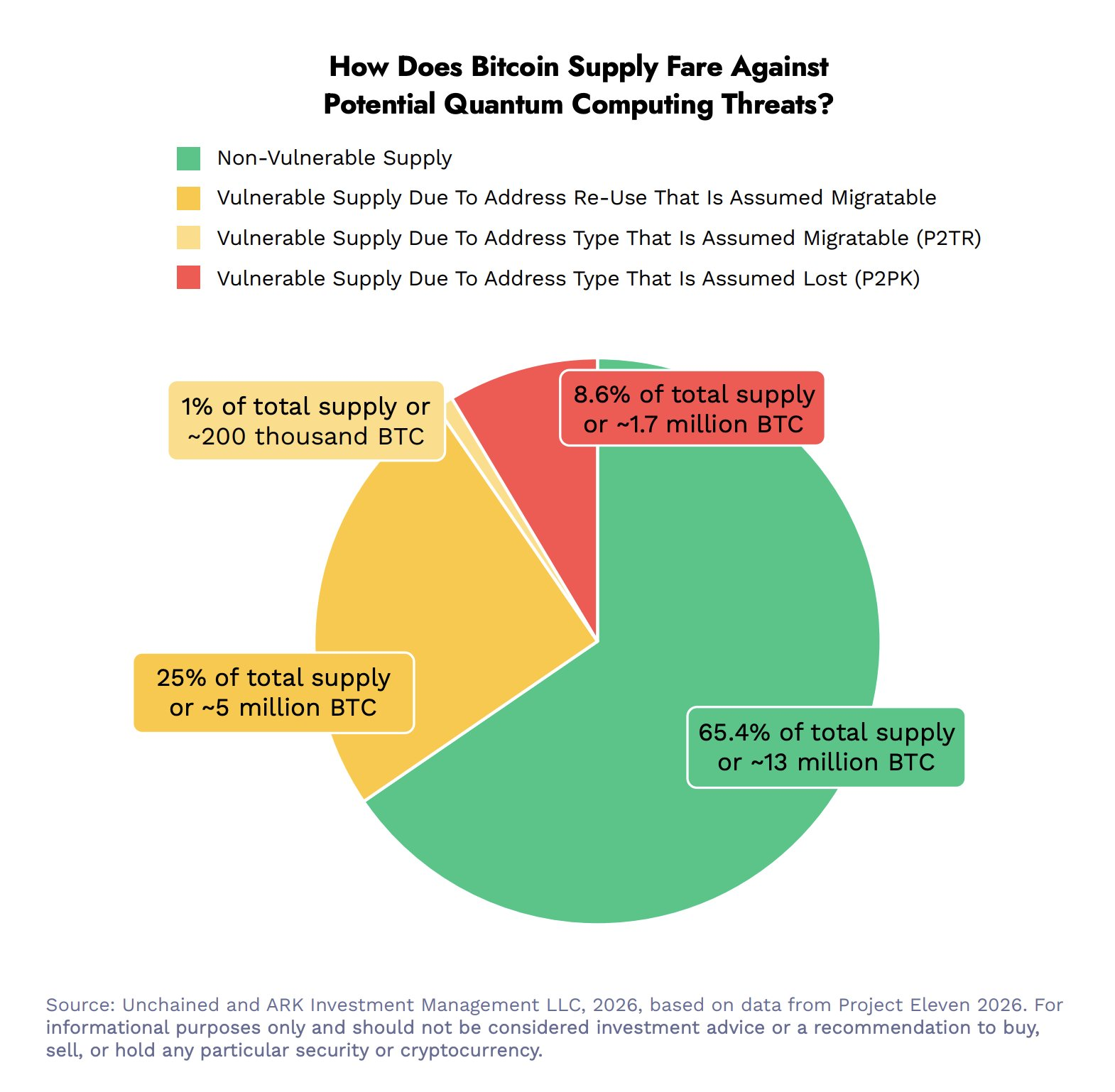
Around 65.4% of the Bitcoin (BTC) supply is not vulnerable to the threat of a quantum computing breakthrough, but about 34.6% of the BTC supply remains at risk, according to a Wednesday white paper published by Ark Invest and Bitcoin-focused financial services company Unchained.
This includes around 5 million BTC, or 25% of the total supply, assumed migratable due to address re-use, and 1.7 million BTC, or 8.6% of the supply, assumed lost in P2PK (Pay-to- Public-Key) addresses, the earliest form of transaction script on the Bitcoin blockchain, which locked funds directly to public keys. Another 200,000 BTC (around 1%) is assumed to be migratable due to the address type P2TR (Pay-to-Taproot).
This supply would be vulnerable to quantum theft if quantum computers can break Bitcoin’s elliptic curve cryptography (ECC), which would require about 2,330 logical qubits and tens of millions to billions of quantum gates, the report argued.
“Even so, their practical feasibility would require quantum systems to reach performance levels that our research suggests will take much time to achieve.”

The paper’s estimates are far broader than those in a February CoinShares analysis, which said the realistically market-relevant portion of quantum-vulnerable Bitcoin was about 10,200 BTC, or roughly 0.05% of supply, even though legacy P2PK addresses account for a much larger theoretical exposure.
Separately, the first quantum computer facility with one million physical qubits (the equivalent of tens of billions of typical computers) is expected to be finished in 2027 by Chicago-based PsiQuantum, which raised $1 billion from BlackRock-linked funds.
Quantum breakthrough remains “long-term risk” for Bitcoin
Ark’s white paper argues that quantum risks will evolve over an extended period with “many intermediate warning signals” rather than an abrupt single point of failure.
Related: Cathie Wood says ARK’s $1.5M Bitcoin bull price hasn’t changed as markets eye rally
Quantum breakthrough remains a “long-term risk,” rather than an imminent threat to the Bitcoin network, which gives the community time to “research and make plans for protecting the network” against the protracted development of quantum capabilities, the paper states.
Ark Invest foresees five stages for quantum computing advancements, but said that only the final stage of advancements will break ECC quicker than Bitcoin’s 10-minute block time.
Bitcoin held in quantum-vulnerable addresses should not be at risk until stage 3, when a quantum computer can break the 256-bit ECC key.
The white paper said that the first public key may be broken in the mid-2030s, citing a consensus target by companies including Google, IBM and Microsoft.

Bitcoin must implement quantum-safe address formats despite governance challenge
Quantum computers will inevitably reach stage 4 and become a threat to the Bitcoin network, which means that Bitcoin must implement a quantum-safe address format, the paper argues.
The measure will require the integration of post-quantum cryptography (PQC) into Bitcoin, such as the ML-DSA lattice-based signature scheme and the SLH-DSA hash-based signature.
“Those standards give us confidence in the capabilities of post-quantum cryptography,” wrote Ark Invest, cautioning that upgrading to PQC on the consensus level will be more difficult due to Bitcoin’s decentralized governance structure, which requires the majority of network participants to agree to a soft fork.
The paper said Bitcoin will eventually need quantum-safe address formats and, over time, post-quantum cryptography. One draft path under discussion, BIP-360, proposes a Pay-to-Merkle-Root output type designed to reduce long-exposure quantum risk by removing Taproot’s key-path vulnerability, though it does not itself add post-quantum digital signatures.
Related: Whale’s $9B Bitcoin sale was not due to quantum concerns: Galaxy Digital
However, BIP-360 is not the final solution to Bitcoin’s quantum threat, according to Chris Tam, president and head of quantum innovation at BTQ Technologies.
“The proposal introduces a new address format but critically does not include post-quantum digital signatures, which are essential for any meaningful long-term defense against quantum attacks,” he told Cointelegraph.
Magazine: Bitcoin may take 7 years to upgrade to post-quantum: BIP-360 co-author

Update (March 12 at 8:56 pm UTC): This article has been updated to include comments from CME Group Chief Executive Terry Duffy.
Michael Selig, chair of the US Commodity Futures Trading Commission (CFTC), has proposed a rule that could amend or issue new regulations over event contracts on prediction markets platforms like Kalshi and Polymarket.
In a Thursday notice, the CFTC issued a staff advisory classifying event contracts on prediction markets as a “financial asset class.” The regulator also submitted an Advanced Notice of Proposed Rulemaking to be published in the Federal Register, asking for public comment on how the Commodity Exchange Act (CEA) would apply to prediction markets.
“Prediction markets are one of the most exciting innovations in financial markets,” said Selig in a Thursday X post. “Yet for too long, the CFTC has failed to provide guidance for these markets being used by millions of Americans. This ends today.”

The staff advisory and proposed rule followed Selig publicly reiterating claims that the CFTC had “exclusive jurisdiction” over prediction markets in response to many state-level authorities filing lawsuits against companies like Kalshi and Polymarket for unlicensed sports betting. The CFTC chair said that he would take to court any state-level challenges to the agency’s authority over prediction markets.
Related: Utah set to block prediction markets as state-federal tensions rise
On Monday, an Ohio judge pushed back against Selig’s narrative in her denial of a preliminary injunction by Kalshi against Ohio gaming authorities and the state’s attorney general. She said in the ruling that the company had failed to show the CEA “would necessarily preempt Ohio’s sports gambling laws,” or that sports event contracts were subject to the “exclusive jurisdiction” of the CFTC.
“The courts have gone both ways here, as we’ve seen — some in favor and some opposed to the prediction markets,” said CME Group Chief Executive Terry Duffy, according to a Thursday Reuters report. “The states are all over the map on this. I don’t see how it doesn’t go to the Supreme Court for a definition of what is a prediction market on sports, and if that is the same as gambling.”
Selig is sole CFTC commissioner absent any White House nominations for vacant seats
Selig noted that he “voted in the affirmative” on the matter, while “no commissioner voted in the negative.” The CFTC chair sits alone in the agency’s leadership following the departure of acting chair Caroline Pham in December, on a panel normally filled with a bipartisan group of five commissioners.
Because only a majority of the quorum of CFTC commissioners are needed to sign off on a rule, Selig may have the sole authority to approve the prediction markets proposal after the required public notice and comment periods. As of Thursday, US President Donald Trump had not announced any additional nominations to the agency.
The public will have 45 days to submit comments following publication of the proposed rule in the Federal Register.
Magazine: Fly’s mind ‘uploaded,’ human brain cell wetware plays Doom: AI Eye

The Nasdaq is moving on AI spending again. Nvidia just invested $2 billion into an AI cloud company, and the GTC conference starts Monday. For stock investors, this is familiar territory: buy NVIDIA and hope the AI cycle has another leg.
But one asset class is producing returns that even the best NVIDIA stock price prediction cannot touch. Crypto presales with real revenue infrastructure are delivering pre IPO entries that Wall Street does not offer, and the math is not close.
Nvidia announced a $2 billion strategic investment in Nebius Group, an AI cloud infrastructure company, sending NBIS shares up over 15% according to CNBC. The GTC 2026 conference runs March 16 to 19 in San Jose, with multiple AI partnerships already announced per Motley Fool reporting.
The NVIDIA stock price prediction stays bullish, but $264 is a 42% gain on a $4.5 trillion company. The returns that change financial lives are not on the Nasdaq. They are in the presale market.
Where the Real Returns Live: Pepeto Exchange vs Wall Street’s Best Stocks in 2026
Pepeto: The Pre IPO Entry That Delivers What NVIDIA’s 42% Gain Cannot
The recent freeze of $5 million in Bitcoin at a centralized lending firm reminded the market how fast things can go wrong when you trust the wrong institution. That kind of vulnerability is exactly why smart capital is flowing into projects with audited infrastructure and transparent revenue models. Pepeto is one of those projects, and it is outpacing every presale in the market right now.
The presale is the equivalent of a pre IPO round still open to the public. The exchange is built, the SolidProof audit is complete, and the cofounder already took a previous project to a $7 billion market cap. In stock terms, that is like backing a founder who already built a company worth more than Palantir.
The presale has attracted $7.87 million and fills faster with every round. A former Binance expert on the advisory board is guiding the listing onto the largest crypto exchange in the world. The listing is the IPO moment, the event where the market prices this asset for the first time on the open market.
The 300x target follows the revenue model. The exchange processes trades across three blockchain networks with zero fees, and every trade sends revenue back to every holder through the audited smart contract. NVIDIA delivered a 10x over five years. The 300x math requires only the listing valuation that exchange tokens routinely achieve, in months, not half a decade.
Even if you have never touched crypto, the staking mechanics speak in a language every investor understands. At 209% annual yield, a $10,000 position generates roughly $20,900 in additional tokens over a year, which is about $1,741 per month. The S&P 500 averages 10%. Treasury bonds pay 4.5%. This is 209%, compounding daily, with no lock period on your capital. And the listing is approaching, which means the yield builds your position while the market prepares to price it for the first time. Every day you are not inside the presale is a day where that yield is working for someone else.
NVIDIA Stock Price Prediction: Analysts Target $264 but Return Math Has Changed
NVDA trades at $184, with a 12 month consensus target of $264 from 37 analysts, reflecting a 42% gain per Stock Analysis data. Revenue hit $215 billion in fiscal 2026, up 65% year over year.

Source : TradingView
The GTC conference supports the thesis. But at $4.5 trillion, even hitting $380 gives 104% over a year, which is solid for stocks but modest compared to pre listing entries.
Apple Stock Price Prediction: AAPL Consolidates Near $255
AAPL trades at $255, down 2.1% on the day per Yahoo Finance. The 52 week range spans $169 to $288. Medium term forecasts suggest a climb above $300, representing roughly 18% from current levels.
Apple generates strong cash flow, but at $3.8 trillion, the returns are single digit percentages that stock investors accept as normal.
Conclusion
The investors who bought Tesla at $17 before it listed on the mainstream exchange understood something that most people learn too late: the biggest gains come before the ticker goes public. Pepeto is sitting at that same stage right now, with a SolidProof audited exchange, 209% APY staking, and a Binance listing approaching.
Pepeto gives you 209% APY starting today and exchange token math that trillion dollar stocks cannot touch. Visit the Pepeto official website and enter the presale before the listing arrives and this pre IPO window closes behind every investor who missed it while it was still open.
Click To Visit Pepeto Website To Enter The Presale

FAQ
Is NVIDIA stock or Pepeto a better investment right now?
NVIDIA targets $264 for a 42% return. Pepeto at presale pricing with 209% APY and exchange infrastructure offers returns that trillion dollar stocks cannot produce. Visit the Pepeto official website for full details.
Can a crypto presale outperform the Nasdaq?
The Nasdaq averages 12 to 15% annually. Pepeto with $7.87 million raised, a SolidProof audit, and a Binance listing approaching offers multiples that decades of stock investing cannot match.
What is the NVIDIA stock price prediction for 2026?
Analysts target $264 with a high of $380 for NVIDIA. Pepeto at presale pricing targets the kind of returns that NVIDIA delivered once over five years, except the timeline is months, not years.
Disclaimer: This is a Press Release provided by a third party who is responsible for the content. Please conduct your own research before taking any action based on the content.



BlackRock’s newly launched staked Ethereum exchange-traded fund posted a strong first trading day, drawing roughly $15.5 million in volume as institutional interest in Ether investment products continues to grow.
Summary
- BlackRock’s staked Ethereum ETF (ETHB) recorded $15.5M in day-one trading volume.
- Bloomberg analyst James Seyffart called the debut “very, very solid” for a new ETF.
- Ethereum is trading around $2,110 at press time, hovering near the key $2K level amid market volatility.
BlackRock’s staked Ethereum ETF posts strong debut with $15.5M in trading
Bloomberg Intelligence ETF analyst James Seyffart said the debut performance of BlackRock’s staked Ethereum ETF, trading under the ticker ETHB, was impressive for a new listing.
“Vast majority of the trading is done and we are at $15.5 million in trading volume for the BlackRock staked Ethereum ETF — $ETHB. Very very solid for a day 1 ETF launch,” Seyffart wrote on X.
Earlier in the day, Seyffart noted that the fund launched with just over $100 million in assets and had already recorded approximately $11.1 million in trading volume by mid-afternoon in U.S. markets.
The ETF is managed by BlackRock and provides exposure to Ethereum while also incorporating staking, allowing the fund to generate yield from validator participation on the Ethereum network.
Trading data indicates that ETHB’s debut volume reached about $15.5 million with more than 590,000 shares changing hands during its first session. Analysts said that level of activity is considered a solid start for a newly launched ETF, even though some earlier crypto-linked funds recorded larger opening volumes.
The launch comes as Ethereum continues to hover around the psychologically important $2,000 level. Ether is currently trading at roughly $2,110, up about 4% over the past 24 hours.
Market data also shows the cryptocurrency has fluctuated near the $2,000 range in recent days after failing to sustain a rally above $2,200 earlier in the month, highlighting ongoing volatility in the second-largest digital asset.
BlackRock already operates other major crypto investment products, including spot Bitcoin and Ether ETFs.
BlackRock’s new staked ether (ETH) exchange-traded fund got off to a solid start Friday, pulling in more than $15 million in trading volume on its first day as Wall Street begins experimenting with yield-generating crypto ETFs.
The iShares Staked Ethereum Trust, trading under the ticker ETHB, launched with just over $100 million in assets and had already seen about $11 million in trading by early afternoon, according to Bloomberg ETF analyst James Seyffart. By late session, trading volume had climbed to roughly $15.5 million, suggesting strong initial demand for the product.
Those numbers are considered strong for an ETF launch, market watchers say.
“BlackRock’s Staked Ether ETF launched with just over $100 million in assets and has traded about $11.1 million through early afternoon,” Seyffart said on X, calling it “a pretty good start for any ETF.”
The product marks a significant evolution in crypto exchange-traded funds. Unlike traditional spot crypto ETFs that simply track the underlying asset, ETHB will generate yield by staking ethereum, distributing most of the rewards back to investors. Staking refers to locking coins in a cryptocurrency network in return for rewards. This is losely analogous to investing in fixed income instruments like bonds.
According to the prospectus, the fund will stake between 70% and 95% of its ether holdings at any given time. About 82% of the staking rewards will be paid out to investors through monthly distributions, similar to how dividend-paying ETFs distribute income.
The remaining 18% will be allocated among the trust, custodians and staking service providers.
The fund charges a 0.25% sponsor fee, though BlackRock is offering a temporary discounted rate of 0.12% on the first $2.5 billion in assets as it seeks to attract early investors.
ETHB is the latest addition to BlackRock’s growing digital assets ETF lineup. The firm already runs the iShares Bitcoin Trust (IBIT), which launched in January 2024 and quickly became the dominant bitcoin ETF, as well as the iShares Ethereum Trust (ETHA) introduced in July 2024.
Ethereum’s staking mechanism allows holders to lock up ETH to help secure the network in exchange for rewards, effectively creating a crypto-native yield. By packaging that yield inside an ETF wrapper, firms like BlackRock are attempting to make the structure accessible to traditional investors who cannot easily participate directly on-chain.
If staking ETFs gain traction, they may open the door to similar structures across other proof-of-stake networks — potentially turning crypto ETFs from passive exposure vehicles into income-generating financial instruments.


The crypto market rose 2.4% to $2.51 trillion on Friday primarily due to a shift in global risk sentiment following signals of potential de-escalation in the Middle East.
Summary
- Crypto prices rebounded on Friday after crude oil prices retreated following multi-year highs.
- A wave of short liquidations across leveraged markets and back-to-back inflows into major crypto ETFs also supported the recovery.
Bitcoin (BTC), the leading crypto asset by market cap, rallied nearly 4%, hitting close to the $72,000 mark. Ethereum (ETH) was up 4.3% over the past day, trading at $2,100 when writing. Other major crypto assets, such as BNB (BNB), XRP (XRP), Solana (SOL), and Dogecoin (DOGE), had also posted modest gains on the day.
It should be noted that today’s market rally was a standalone event as it detached from both the U.S. traditional stock indexes and tech stocks. The Dow Jones Industrial Average dropped by 739 points or 1.56% in U.S. trading hours, while tech-heavy stocks such as the S&P 500 and Nasdaq-100 fell by 103 and 431 points, respectively.
The crypto market rallied as Investor risk-on sentiment improved after oil prices dropped sharply across the globe. Notably, Brent crude oil fell over 7% today, easing immediate fears of inflation and providing a more favorable environment for digital assets.
Short liquidations mount
As crypto prices rallied, it caught short sellers off guard, triggering liquidations of these highly leveraged positions. Data from CoinGlass shows that nearly $246 million was liquidated from leveraged markets, with the majority coming from short positions.
The total crypto market open interest also rose 5.2% on Friday, signalling that investors were injecting fresh capital into the market.
ETF inflows and Coinbase premium
Inflows into spot ETF products have also supported the recent gains. According to data from SoSoValue, on Thursday, $53.87 had entered spot Bitcoin ETFs, which marks the fourth straight day of inflows for these funds. A similar trend was visible across their Ethereum counterparts, which have posted three back-to-back days of inflows.
At the same time, Coinbase Premium has also risen sharply over the past 24 hours, indicating that U.S. institutions are paying a premium over global prices to secure Bitcoin. Traders often view this as a strong bullish signal that institutional “smart money” is leading the current market charge.
Crypto market rallied following Trump’s recent comments
Crypto prices also benefited after U.S. President Donald Trump recently hinted that the ongoing war between the two countries may be coming to an end.
This seemed to have calmed investor fears of a prolonged war, which in turn sparked a risk-on sentiment among investors who have begun moving capital from safe havens back into risk assets like crypto.
Disclosure: This article does not represent investment advice. The content and materials featured on this page are for educational purposes only.
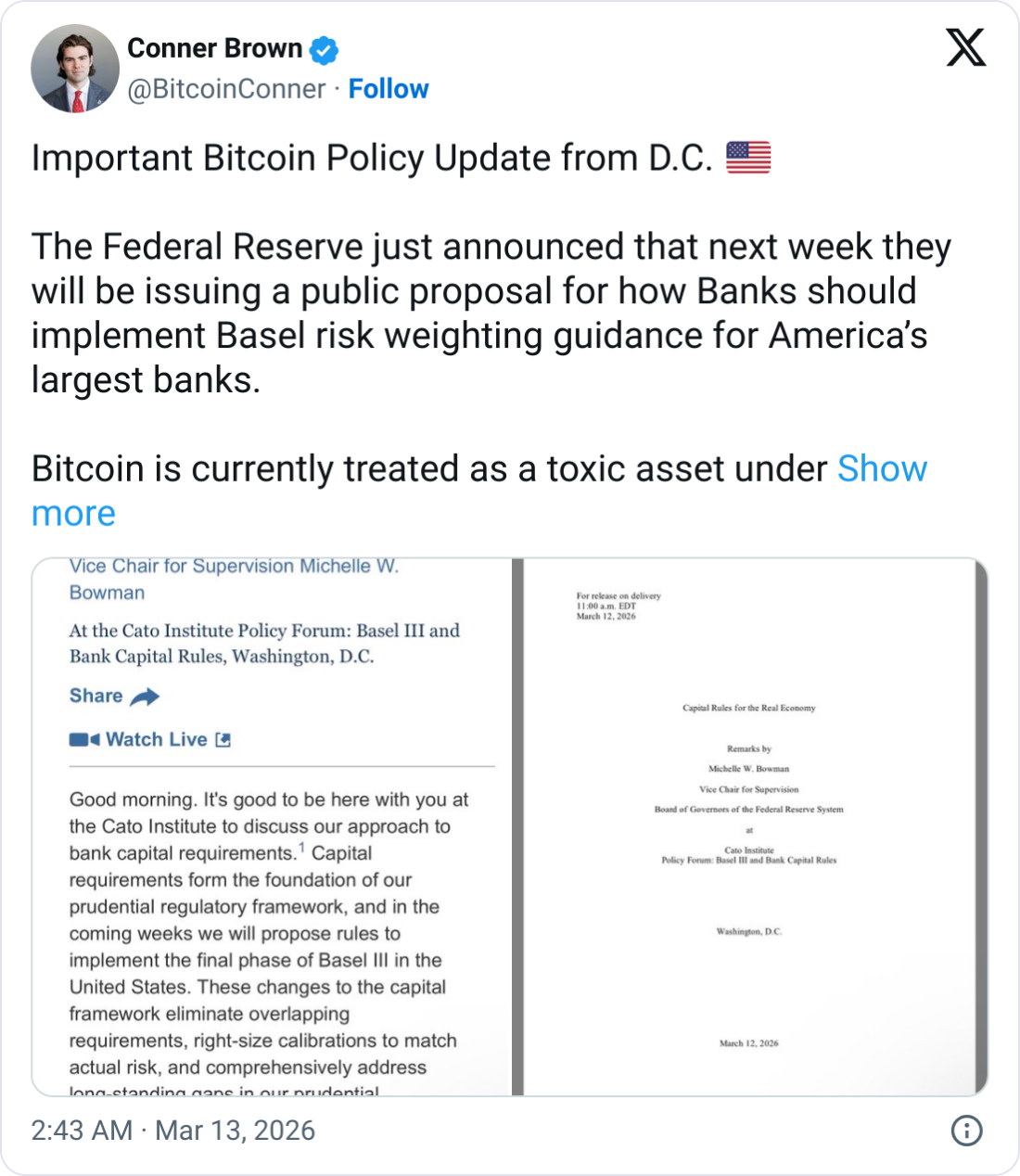
The Bitcoin Policy Institute (BPI) says it will push the US Federal Reserve to change how Bitcoin is treated, as the central bank is set to issue rules on how banks should implement international guidelines for asset risk weighting.
“BPI will be reviewing this proposal closely and submitting a public comment to ensure that US regulators get Bitcoin’s treatment right,” Bitcoin Policy Institute managing director Conner Brown said in an X post on Wednesday.
It comes just a day after the Fed announced it will issue a proposal for public comment on how US banks should implement risk-weighting guidance, which determines how risky different assets are on a bank’s balance sheet, from the Basel Committee on Banking Supervision.
Brown said Bitcoin (BTC) is “treated as a toxic asset under the Basel framework, a global standard for banking regulations.

He added it carries a 1,250% risk weighting, which was “harsher than virtually all other asset classes.”
“More efficient regulation” is the aim: Fed
Federal Reserve vice chair for supervision Michelle Boman said on Thursday that the agency will be proposing rules in the coming weeks to implement the final phase of Basel in the US.
Bowman said that the aim is “more efficient regulation and banks that are better [positioned] to support economic growth, while preserving safety and soundness.”
The 1,250% capital requirement means that banks must back any Bitcoin on their balance sheets at a 1:1 ratio with approved collateral, making holding the cryptocurrency more costly than other asset classes.
Cash, physical gold and government debt carry a 0% risk weight under the Basel framework.
“The most punitive classification”: Bitcoin Policy Institute
Brown said in a blog post last month that the treatment of Bitcoin is the “most punitive classification” in the Basel Committee’s capital framework and a “category error.”
Related: Bitcoin hugs $70K range as March Fed rate cut odds fall below 1%
In 2021, the Basel Committee proposed placing crypto in its high-risk Group 2 set of assets. Group 2 holdings were restricted to under 1% of the value of their Group 1 holdings.
“This risk weighting makes it extremely difficult for banks to provide financial services to Bitcoiners and Bitcoin companies,” Brown said.
Magazine: All 21 million Bitcoin is at risk from quantum computers

Google Is Not Ruling Out Ads in Gemini

Lanarkshire altitude chamber helps man with type 1 diabetes tackle Kilimanjaro

Stay patient in this market; earnings may face near-term pressure: Amnish Aggarwal


-
Business7 days ago
Form 8K Entergy Mississippi LLC For: 6 March
-

 News Videos4 days ago
10th Algebra | Financial Planning | Question Bank Solution | Board Exam 2026
-

 Fashion7 days ago
Weekend Open Thread: Ann Taylor
-

 Crypto World4 days ago
Paradigm, a16z, Winklevoss Capital, Balaji Srinivasan among investors in ZODL
-
 Tech2 days ago
A 1,300-Pound NASA Spacecraft To Re-Enter Earth’s Atmosphere
-

 Tech3 days ago
ChatGPT will now generate interactive visuals to help you with math and science concepts
-

 Politics7 days ago
Top Mamdani aide takes progressive project to the UK
-

 Business3 days ago
ExxonMobil seeks to move corporate registration from New Jersey to Texas
-

 Sports5 days ago
Three share 2-shot lead entering final round in Hong Kong
-

 Sports5 days ago
Braveheart Lakshya downs Lai in epic battle to enter All England Open final | Other Sports News
-

 NewsBeat2 days ago
Residents reaction as Shildon murder probe enters second day
-

 Entertainment6 days ago
Hailey Bieber Poses For Sexy Selfies In New Luscious Lip Thirst Traps
-

 Business5 days ago
Search for Nancy Guthrie Enters 37th Day as FBI Probes Wi-Fi Jammer Theory
-

 Business2 days ago
Search Enters Sixth Week With New Leads in Tucson Abduction Case
-
 NewsBeat3 days ago
Pagazzi Lighting enters administration as 70 jobs lost and 11 stores close across Scotland
-

 Tech4 days ago
Despite challenges, Ireland sixth in EU for board gender diversity
-

 Business3 days ago
Search Enters 39th Day with FBI Tip Line Developments and No Major Breakthroughs
-

 NewsBeat2 days ago
I Entered The Manosphere. Nothing Could Prepare Me For What I Found.
-

 Business6 days ago
Iran war enters second week as Trump demands ’unconditional surrender’
-

 Sports4 days ago
Skateboarding World Championships: Britain’s Sky Brown wins park gold