

Crypto World
Bitcoin slides 5%, tumbling below $65,000 as whale selling grows and recent buyers lock in losses

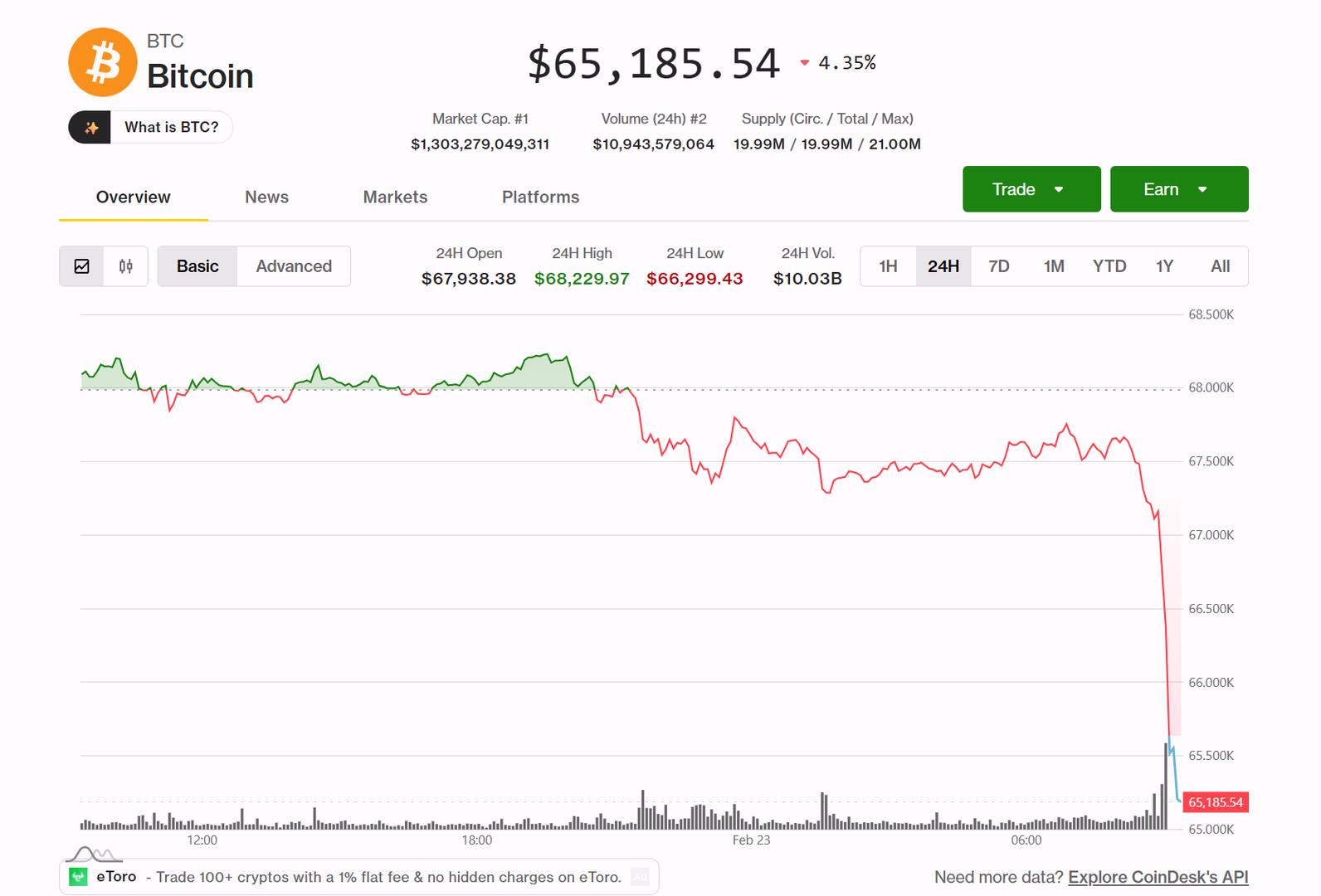
On-chain data from Glassnode and CryptoQuant shows large holders dominating exchange inflows while short-term investors continue to sell at a loss, pointing to a fragile base-building phase.


DUEL DUCK: A Battle-Tested Social Prediction Market Where Influence Becomes Income
In a world where attention is currency and opinion moves markets, Duel Duck is building the infrastructure to monetize social signals at scale.
With 44,000+ monthly active users, 200+ active KOLs onboarded, a live product, and $1.4M already raised, Duel Duck isn’t pitching a concept — it’s scaling a working machine.
The Big Idea: Turning Influence into Markets
After the collapse of speculative InfoFi hype cycles, one truth remained:
People trust people more than platforms.
But social signal has been fragmented, under-monetized, and structurally wasted.
Duel Duck changes that.
It transforms creator-driven opinions into prediction markets — where communities don’t just react to influence, they stake on it.
What Duel Duck Actually Is
A social prediction engine built around:
-
Yes/No markets
-
Creator-set fees
-
Neutral house edge
-
Create-to-earn mechanics
-
No complex odds UI
Simple. Viral. Shareable.
Creators launch duels.
Communities participate.
Volume flows.
Fees generate revenue.
And it works.
Product Overview
1. DUELS
Fast, simple, creator-launched prediction markets.
Example Duel Card:
Will Portugal win the 2026 FIFA World Cup?
-
120 days left
-
Chance: 67%
-
Ticket price: $5
-
4,310 participants
-
$31K pool
-
Options: YES / NO
No complicated betting interface.
Just signal + stake.
2. TOURNAMENTS
Structured, brand-relevant duel sets with:
This is where prediction becomes distribution
3. API Layer
Most platforms want prediction features.
Few can afford:
Duel Duck offers a plug-and-play prediction module.
Wallets. Exchanges. Media platforms. Leagues. Communities.
Prediction becomes an engagement plug-in — not a dev nightmare.
The Market Opportunity
The numbers are aggressive — and real.
-
$63.5B Web3 prediction & opinion market volume in 2025 (+302.7% YoY)
-
$6B Social distribution opinion markets
-
$220–360M Social-led opinion tournaments
InfoFi is evolving from social hype to monetized attention, information, and reputation.
Prediction is no longer niche gambling.
It’s becoming embedded media.
Duel Duck positions itself directly inside that shift.
Competitor Landscape
Gamified Engagement Platforms
Opinion Markets
Social Activation
Duel Duck sits between these verticals — blending gamification, prediction, and creator-driven distribution into a single engine.
That positioning matters.
Traction & Proof of Demand
This isn’t theoretical growth. It’s operational traction.
Growth Roadmap
Phase 1 – Repeatable Growth
Phase 2 – Distribution at Scale
-
200K MAU
-
20+ API integrations
-
4 revenue streams
-
5,000+ KOLs
-
B2B expansion into wallets, exchanges, media
-
Paid behavioral data layer
The thesis is simple:
Prediction markets are embedded everywhere attention exists.
Business Model
Current & Upcoming Revenue Streams:
-
Duel commission (active)
-
Auto swap on wallet (active)
-
Onramp commission – March 2026
-
Prediction API revenue – April 2026
-
User subscriptions – September 2026
Realistic Unit Economics
Business Model
Current & Upcoming Revenue Streams:
-
Duel commission (active)
-
Auto swap on wallet (active)
-
Onramp commission – March 2026
-
Prediction API revenue – April 2026
-
User subscriptions – September 2026
Realistic Unit Economics
Assumptions:
At 100,000 active users:
Low friction. High scalability. Strong retention mechanics.
Regulatory Positioning
Duel Duck operates under an Anjouan I-Gaming License, positioning it strategically within global gaming frameworks while maintaining Web3 flexibility.
Investment Timeline
-
$280K – Pre-Seed (Oct 2024)
-
$1.1M – Seed Round (Sept 2025)
-
$4M – Token Invest Round (Q1–Q2 2026)
-
$50M – Strategic Round (2028)
Current Token Invest Round Target: $4,000,000 (SAFT Instrument)
Tokenomics Overview
13% allocated in this round.
Key allocations include:
Structured vesting, cliffs, and long-term emissions support stability rather than short-term speculation.
Translation: designed for sustainability, not chaos.
Why Duel Duck Matters
Prediction markets are evolving.
They’re moving:
-
From niche betting → social participation
-
From isolated apps → embedded infrastructure
-
From odds complexity → creator simplicity
Duel Duck sits at the intersection of:
Influence × Distribution × Monetization × Data
And when social signal becomes stake-backed, it stops being noise.
It becomes market truth.
Final Thought
Every creator already runs informal prediction markets in their comment sections.
Duel Duck just turns those into revenue engines.
In a world where attention is weaponized and data is monetized, the real opportunity isn’t just predicting the future.
It’s owning the signal that shapes it.
DUEL DUCK SOCIALS
REQUEST AN ARTICLE
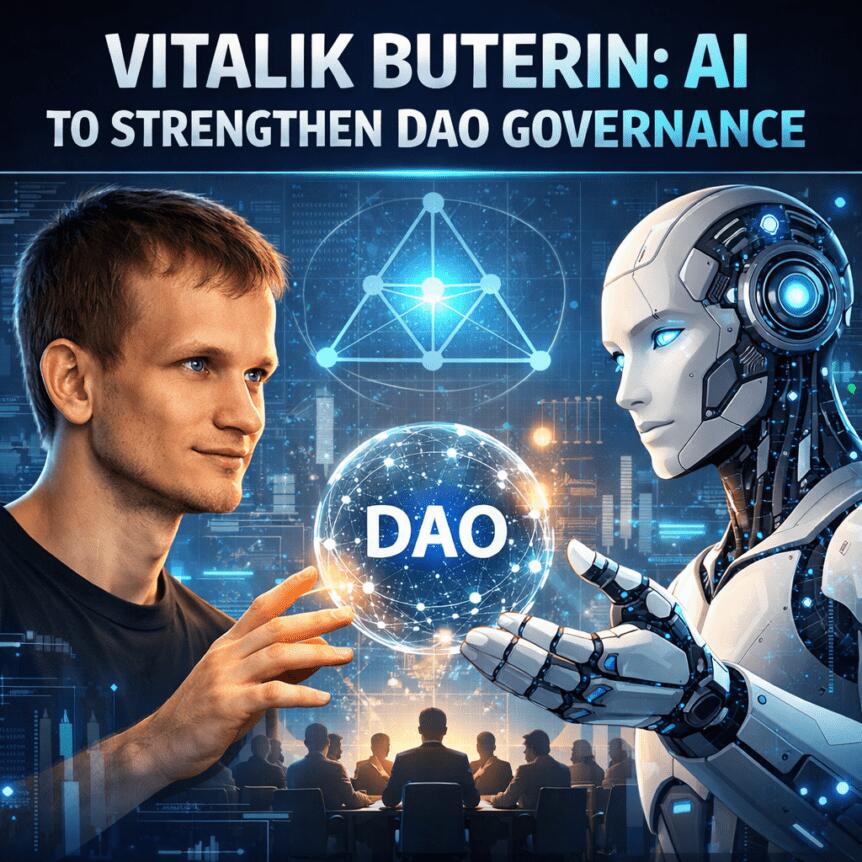
Vitalik Buterin, a co-founder of Ethereum, argues that artificial intelligence could reshape decentralized governance by addressing a core constraint: human attention. In a Sunday post on X, he warned that despite the promise of democratic models like DAOs, decision-making is hindered when members must tackle a flood of issues with limited time and expertise. Participatory rates in DAOs are often cited as low — typically between 15% and 25% — a dynamic that can concentrate influence and invite disruptive maneuvers when attackers seek to pass proposals without broad scrutiny. The broader crypto ecosystem is watching how AI tools could alter governance, privacy, and participation.
Key takeaways
- Attention limits are identified as a primary bottleneck in democratic on-chain governance, potentially hindering timely decisions in DAOs.
- Delegation, while common, risks disempowering voters and centralizing control in a small group of delegates.
- DAO participation averages around 15–25%, creating opportunities for governance attacks and misaligned proposals.
- AI-powered assistants, including large language models, could surface relevant information and automatically vote on behalf of members, provided privacy and transparency safeguards are in place.
- Privacy remains a critical design concern; proposals for private LLMs or “black box” personal agents aim to protect sensitive data while enabling informed judgments.
- Parallel efforts, such as AI delegates from the Near Foundation, illustrate practical explorations into scalable, participatory governance models.
Market context: The governance conversation unfolds amid broader discussions about AI safety, on-chain transparency, and regulatory scrutiny of token-weighted voting mechanisms. As networks scale, trials with AI-assisted decision-making could influence how quickly new proposals are vetted and executed, impacting liquidity, risk sentiment, and user participation across the crypto ecosystem.
Why it matters
The notion of AI-assisted governance enters crypto governance at a pivotal moment. If DAOs are to meaningfully scale beyond niche communities, they must solve the “attention problem” that limits who can participate and how often. Buterin’s argument centers on the danger that without broad and informed participation, governance can drift toward the preferences of a vocal minority or, worse, become vulnerable to coordinated attacks. The cited participation range, often quoted as 15–25%, underscores the fragility of consensus in diverse, globally distributed communities. When only a fraction of members engage, a coordinated actor with concentrated token holdings can steer outcomes that don’t reflect the broader base.
AI-powered assistants offer a potential path forward by translating dense policy options into actionable votes, tailored to an individual’s stated preferences. The idea rests on personal agents capable of observing user input — writing, conversations, and explicit statements — to infer voting behavior. If a user is uncertain about a specific issue, the agent would solicit input and present relevant context to inform the decision. This approach could dramatically increase effective participation without requiring each member to study every proposal in depth. The concept is anchored in current research into large language models (LLMs), which can aggregate data from diverse sources and present concise options for voter consideration.
Still, the privacy dimension looms large. Buterin has stressed that any system enabling more granular inputs must protect sensitive information. Some governance challenges arise precisely because negotiations, internal disputes, or funding deliberations often involve material that participants would prefer not to expose publicly. Proposals for privacy-preserving architectures include private LLMs that process data locally or cryptographic methods that output only the voting judgment, without revealing the underlying private inputs. The aim is to strike a balance between empowering voters and safeguarding their personal information.
Industry voices beyond Buterin echo this tension. Lane Rettig, a researcher at the Near Foundation, has highlighted parallel efforts to use AI-driven digital twins that vote on behalf of DAO members to counter low voter turnout. The Near Foundation’s exploration, described in coverage linked to AI delegation, signals a broader push to test AI-enabled delegation tools within a governance framework that remains accountable to the community. For those following the space, leadership in this domain is moving from conceptual discussions to concrete prototypes that can be observed and tested on real networks.
Another facet concerns strategic risk. The potential for “governance attacks” remains a real concern in token-weighted systems, where a malicious actor could amass enough influence to push harmful proposals. Researchers and builders are keen to ensure that any AI-assisted approach includes checks and balances, such as transparent audit trails, user override capabilities, and governance-rate limits to prevent rapid, unilateral shifts in policy. The literature and case studies cited in industry coverage emphasize that while technology can augment participation, it must not bypass the need for broad human oversight and robust protection against privacy invasions or manipulation. For context, earlier discussions in the crypto press have explored simulated transactions and other security models as ways to harden governance against abuse.
As the field evolves, partnerships and experiments in AI-assisted voting will continue to surface. The idea of “AI delegates” mirrors broader conversations about accountability and consent in automated decision-making. A number of projects have spotlighted the potential for AI to digest vast policy options, present them succinctly, and enable members to approve or customize how their tokens are used. The emerging consensus suggests that any path forward will require a layered approach: accessible information for all participants, privacy-preserving mechanisms for sensitive data, and safeguards against both technical and social vulnerabilities.
Readers can trace the thread of these ideas through related discussions on how governance models adapt to AI. For example, articles exploring the role of LLMs in decentralized decision-making and the implications for privacy and security provide a framework for evaluating new proposals as they emerge. The debate also intersects with broader AI governance conversations, including how to ensure that automated agents align with user intent without overstepping privacy boundaries or enabling unauthorized manipulation. The evolving dialogue recognizes that while AI can amplify participation, it should do so without eroding trust or undermining the democratic ethos at the heart of decentralized networks.
What to watch next
- Public pilots of AI-assisted voting or AI delegates in active DAOs, with timelines and governance metrics published in the coming quarters.
- Regulatory developments or guidelines affecting on-chain governance, including transparency and privacy standards for AI-assisted decision tools.
- Progress reports from the Near Foundation on AI delegates and related governance experiments, including measurable effects on participation rates.
- Technical demonstrations of privacy-preserving voting mechanisms, such as private LLMs or cryptographic approaches that protect input data while exposing voting outcomes.
- Ongoing analyses of governance security, including modifications to prevent governance attacks and ensure resilience against token-weighted manipulation.
Sources & verification
AI governance and the next frontier for on-chain democracy
In the Ethereum (CRYPTO: ETH) ecosystem, researchers and builders are weighing how artificial intelligence could address the attention problem that Buterin highlighted. In a recent meditation on governance, he argued that the effectiveness of democratic and decentralized models hinges on broad participation and timely, expert input. Current participation rates for many DAOs hover around 15–25%, a level that can concentrate power among a small circle of delegates or core members. When the electorate stays largely silent, proposals with strategic misalignment can slip through, or worse, governance attacks can overwhelm a network by capitalizing on token-weighted voting power.
To counter these dynamics, the idea of AI-powered assistants that vote on behalf of members has gained traction. He suggested that large language models could surface relevant data and distill policy options for each decision, allowing users to consent to votes or to delegate tasks to an agent that reflects their preferences. The concept hinges on personal agents that observe your writing and conversation history to infer your voting posture, then submit a stream of votes accordingly. If the agent is uncertain, the agent should prompt you directly and present all relevant context to inform your decision. The vision is not to replace human judgment but to augment it with scalable, personalized insights.
The debate closely mirrors ongoing experiments beyond Ethereum. Lane Rettig of the Near Foundation has described AI-powered digital twins that vote on behalf of DAO members as a response to low turnout, a concept the foundation has explored in public discourse and research coverage. Such prototypes aim to maintain governance legitimacy while lowering the friction barrier for participation. The discourse reflects a broader industry consensus that AI-driven governance must be transparent, auditable, and privacy-preserving to gain wide trust across diverse communities.
Privacy considerations are not merely a secondary concern; they are central to any viable governance augmentation. Buterin has stressed the possibility of a privacy-forward architecture where a user’s private data could be processed by a personal LLM without exposing inputs to others. In this scenario, the agent would output only the final judgment, keeping private documents, conversations, and deliberations confidential. The challenge is to design systems that scale participation without compromising sensitive information or opening new vectors for surveillance or exploitation. The balance between openness and privacy will likely shape the tempo and nature of AI-assisted governance experiments across networks and ecosystems.
As the field evolves, several threads warrant close attention. First, concrete pilot programs will reveal whether AI delegates can meaningfully improve turnout and decision quality without eroding accountability. Second, governance models will need robust safety rails to prevent automated voting from overriding collective will through manipulation or covert data leaks. Third, privacy-preserving technologies will be essential to sustain user trust, especially in negotiations or funding decisions that could affect project trajectories. Finally, the ecosystem will watch the practical implications for security and resilience, including the potential for new forms of governance attacks and protective measures against them.
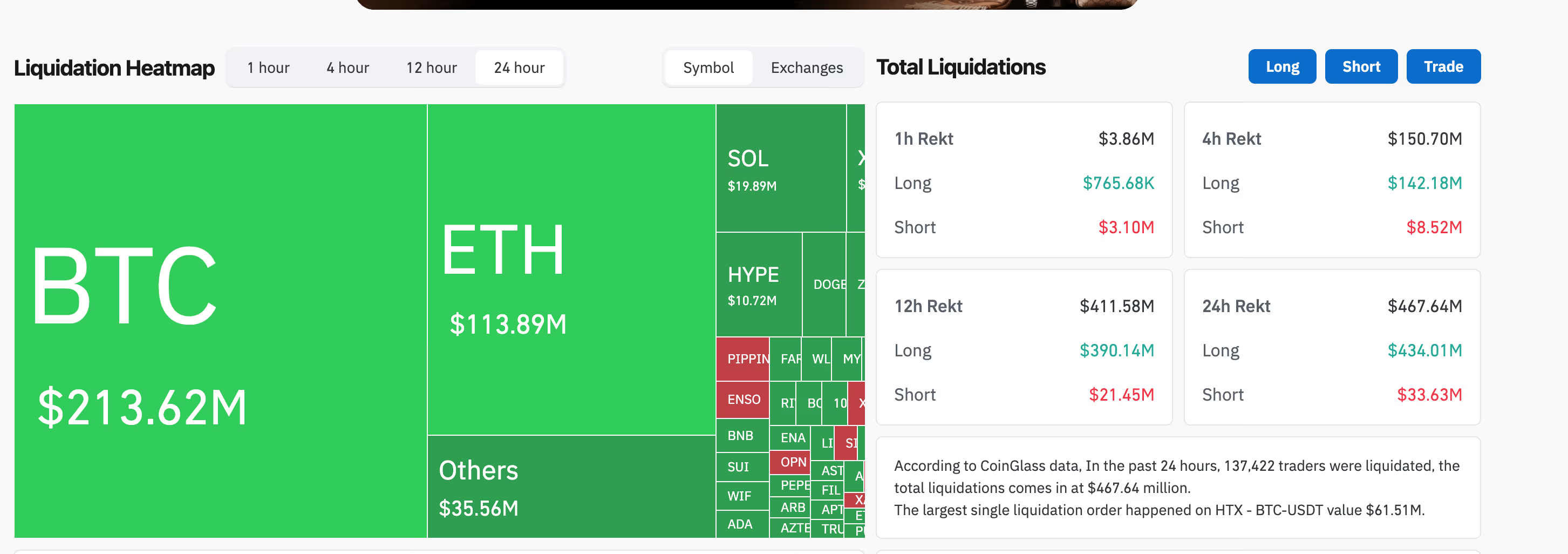
Bitcoin’s price losses on Monday wiped out a massive leveraged bullish bet.
The trade worth $61.5 million was forcibly closed by cryptocurrency exchange HTX, marking the largest single liquidation in the past 24 hours, according to data source Coinglass.
The so-called liquidation happened as bitcoin slid from Saturday’s $68,600 high back to $64,400, erasing the weekend’s gains in a matter of hours. CoinDesk reached out to HTX for comment.

The outsized hit — large enough to suggest a concentrated whale or fund position rather than a retail margin call — landed amid a broader wipeout that saw $467.64 million in total liquidations across 137,422 traders, according to CoinGlass. Long positions accounted for $434 million of that, roughly 93% of the total, pointing to a market that was still positioned for upside heading into the week and got flushed when bids disappeared.
Bitcoin futures alone saw $213.62 million in forced closures, followed by ether (ETH) at $113.89 million and solana (SOL) at $19.89 million. Hyperliquid’s HYPE token added another $10.72 million, a notable figure for an asset outside the usual top-five liquidation leaderboard.
Fear reigns supreme
The selloff dragged Alternative.me’s Crypto Fear and Greed Index back to 5 out of 100, a reading categorized as “extreme fear” that has only been matched three times since the index launched in 2018: August 2019, June 2022, and earlier this month during bitcoin’s slide to $60,000.
Glassnode data reinforces the stress. The firm said Monday that the seven-day moving average for net realized losses among recent bitcoin buyers was still running near $500 million per day, meaning short-term holders are continuing to capitulate even after the initial February flush.
“While the intensity has cooled, the broader regime still signals a market under pressure,” Glassnode noted, “with participants in the base formation phase continuing to capitulate.”
Bitcoin now sits 48% below its October all-time high of $126,000 and 5.5% below its 2021 bull-market peak of $69,000 — a level that once felt like the ceiling and now looks like a floor that keeps getting tested. Monday’s wreckage cleared leverage but the pattern remains intact: traders reload longs into every bounce, and the market keeps punishing them for it.
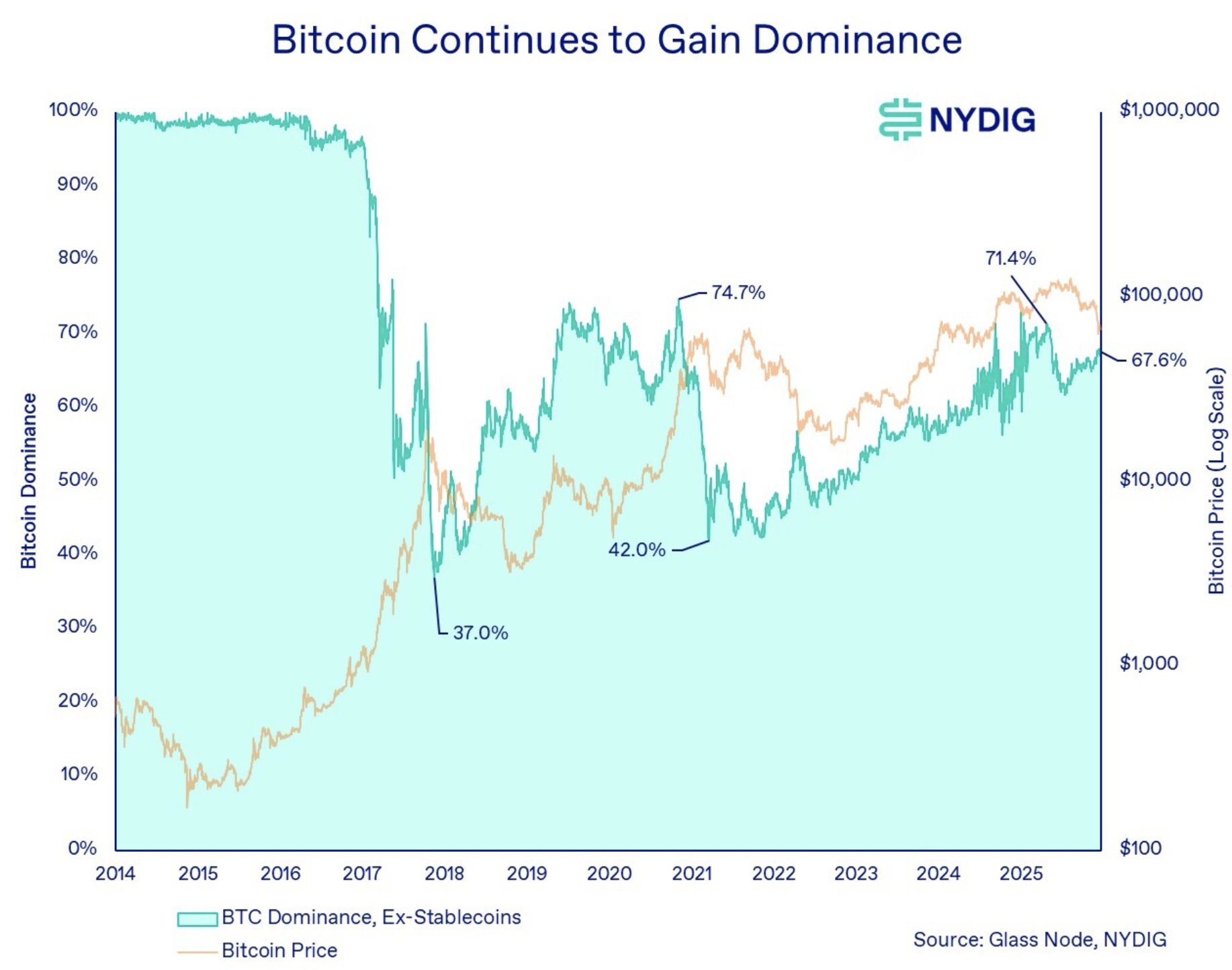
The number of crypto applications that can attract investors is starting to shrink as the industry matures, but that could be a positive to show the sector’s long-term winners, says the crypto services company NYDIG.
NYDIG research lead Greg Cipolaro said in a note on Friday that the “investable universe” of crypto is narrowing to applications or services that “extend traditional finance products onto blockchain infrastructure.”
He specifically named Bitcoin (BTC), tokenized assets, stablecoins, some decentralized finance infrastructure, and a limited number of “general-purpose” blockchains like Ethereum, adding that beyond such use cases, “the probability of large-scale blockchain applications appears lower than previously assumed.”
Some crypto executives had backed blockchain to serve up an alternative to nearly any offering, but many once-hyped crypto use cases, such as gaming, social networking, and the metaverse, have fizzled out compared with their centralized competition.
Cipolaro argued that’s because centralized systems “will always be faster, cheaper, and operationally more efficient for the vast majority of enterprise and consumer applications.”
Economically viable apps will be slimmer than expected
Cipolaro said that the “space for economically viable blockchain applications is narrower than early narratives hoped,” as he argued only the use cases where the benefit of blockchains outweigh its costs will survive.
“The core attributes of open blockchains, trustlessness, permissionlessness, and censorship resistance, are uniquely suited to money and money-like (financial) applications,” he added. “Most real-world applications do not require global, permissionless state machines with immutable ledgers.”
Cipolaro said that the current market is reflecting this, as Bitcoin has grown in dominance since there has been little money bet on altcoins due to a “limited emergence of durable new narratives.”

“The failure of many non-financial verticals to gain traction suggests a consolidation of capital toward a smaller set of use cases,” he added. “Rather than an explosion of applications, we are observing capital concentrate in a few core categories.”
Related: Crypto markets won’t fly without more credit
Cipolaro said that this narrowing of use cases could “improve durability and clarity around long-term winners,” especially for Bitcoin and some projects tied to financial infrastructure.
However, it could also reduce the “speculative breadth” of the crypto market and compress the money that typically flowed into alternative assets, he added.
“A more sober market, anchored in monetary and financial utility rather than broad ‘web3’ ambition, may ultimately strengthen core assets,” Cipolaro said, “but it also implies that crypto’s total addressable scope could be materially smaller than once projected.”
Magazine: Bitcoin’s ‘biggest bull catalyst’ would be Saylor’s liquidation — Santiment founder
XRP (XRP) has fallen more than 30% over the past month, pressured by a broader market downturn that intensified amid escalating geopolitical tensions and renewed tariff concerns.
At the same time, realized losses have spiked, and exchange inflows have increased sharply. These on-chain signals suggest growing market stress for the altcoin. However, with capitulation metrics rising, the question is whether a potential bottom is forming.
XRP Struggles Amid Large Holder Transfers and Rising Realized Losses
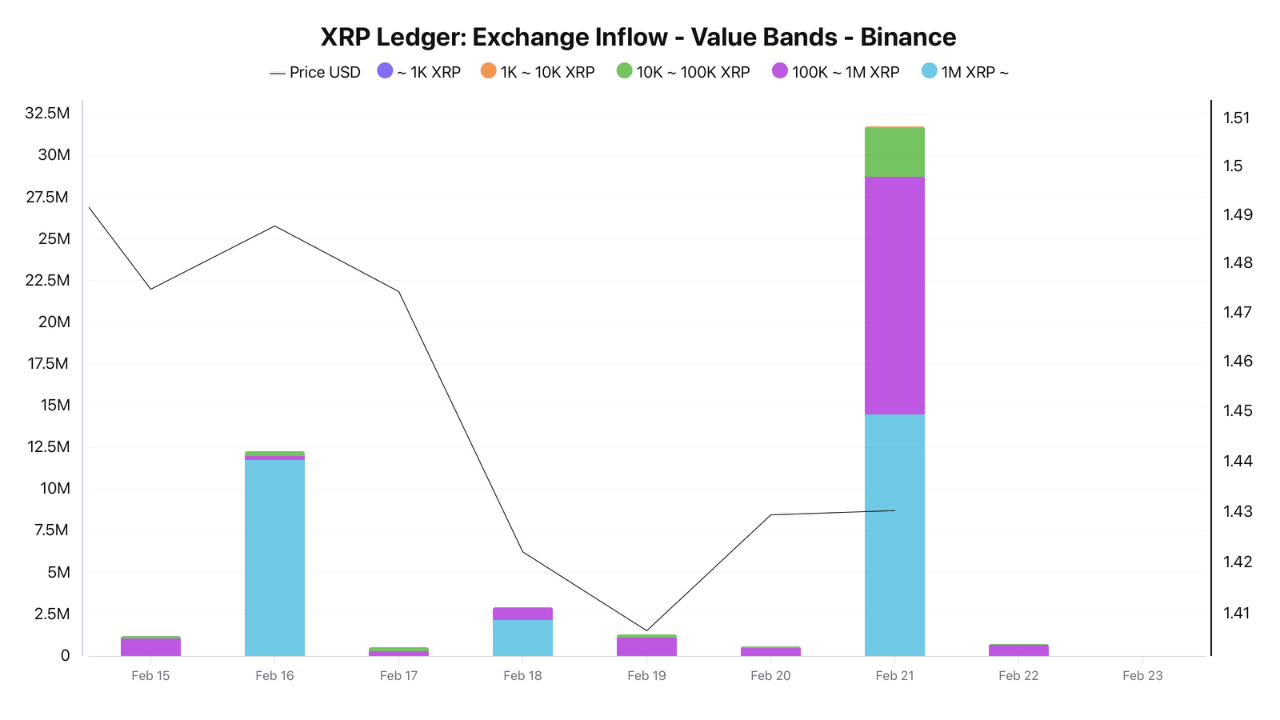
Large holder activity has heightened concern over XRP’s near-term price outlook. Analyst Darkfost noted that these holders transferred more than 31 million XRP to Binance in one day, amounting to about $45 million in potential sell pressure.
On-chain data showed that the bulk of these transfers originated from larger holder cohorts. Whale wallets holding over 1 million XRP accounted for 14.49 million XRP of the total inflow.
Wallets holding between 100,000 and 1 million XRP contributed 14.236 million XRP. Smaller cohorts contributed comparatively modest amounts, including 2.9 million XRP from wallets holding 10,000 to 100,000 tokens.
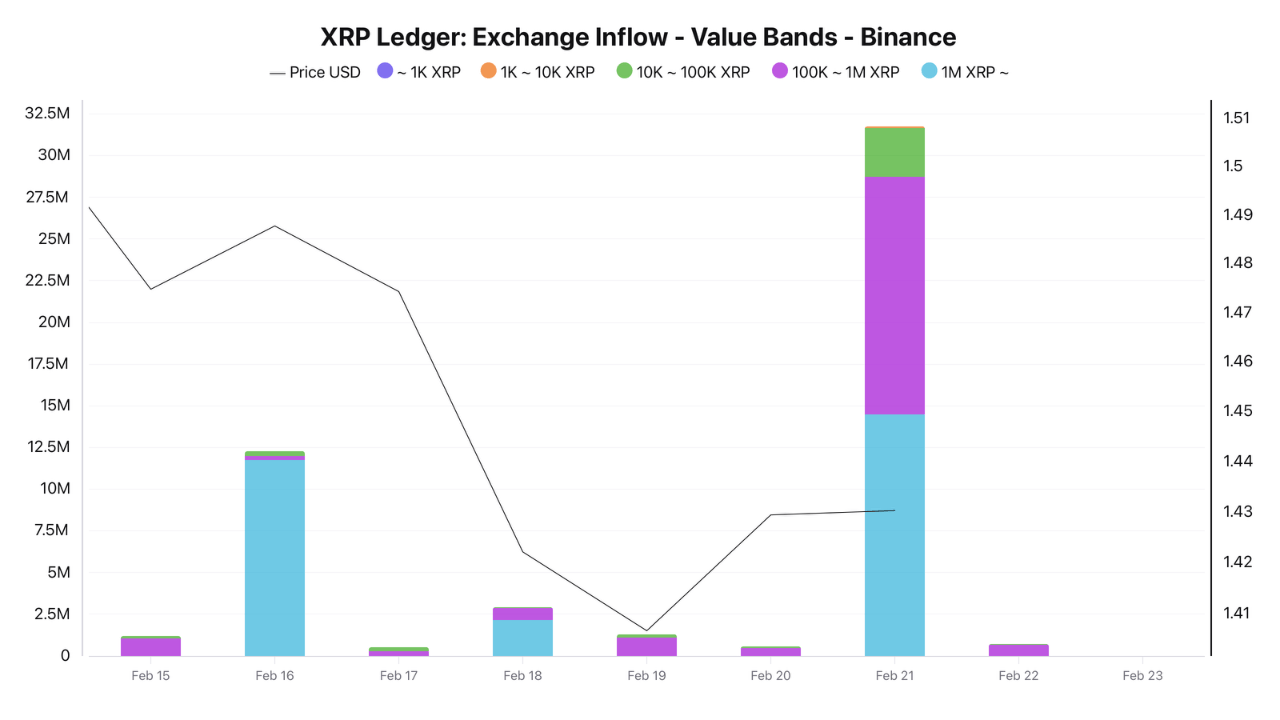
The concentration of inflows among large holders is noteworthy. Exchange flows of this size typically raise concerns about potential selling pressure, as transfers to centralized platforms may indicate that tokens are being positioned for possible liquidation.
However, it is important to note that simple transfers to exchanges do not confirm that sales will occur. Tokens can remain idle on trading platforms for extended periods, be used as collateral, or be moved for internal rebalancing purposes.
While the inflows increase the risk of near-term volatility, they do not guarantee immediate downside.
“Altogether, this represents a sudden potential sell-side pressure of nearly $45 million that warrants close monitoring. Should this selling pressure persist, XRP may struggle to recover from its ongoing correction in the near term,” the analyst wrote.
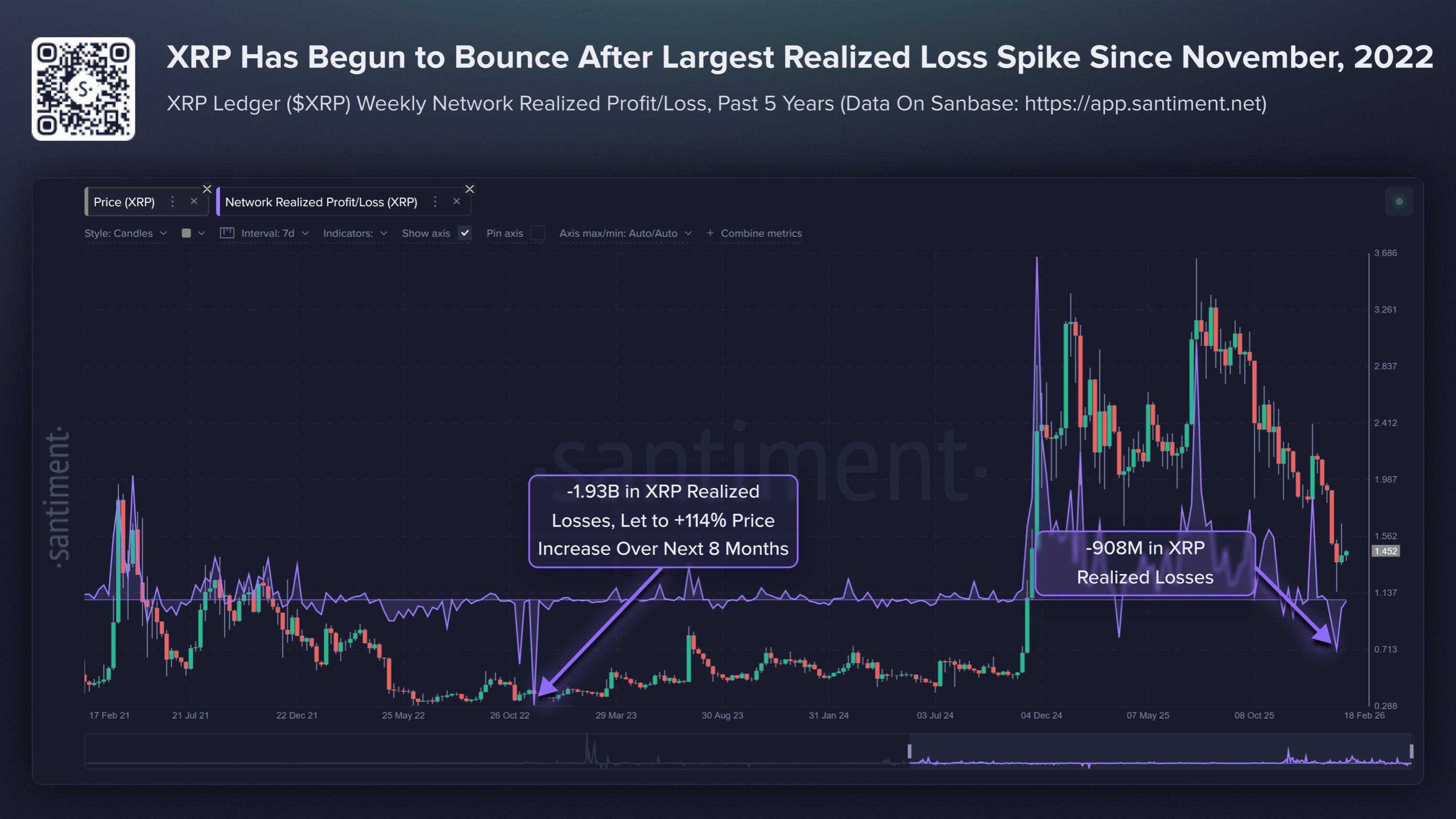
Meanwhile, the transfers coincide with growing stress among XRP holders. Data from Santiment shows that XRP’s realized losses have climbed to their highest level since 2022.
Such spikes typically occur when investors sell at prices below their cost basis, reflecting capitulation or panic-driven exits during periods of heightened volatility.
Further reinforcing the cautious outlook, institutional demand appears to be cooling. This is evidenced by the declining XRP ETF inflows.
Even with strategic expansions and ecosystem development, XRP has struggled to decouple from the wider market weakness, suggesting that macro conditions continue to outweigh project-specific progress.
Is XRP Nearing a Bottom? On-Chain Data Points to Capitulation Phase
Despite the spike in XRP realized losses, Santiment noted that such developments serve as an “important price signal.” The post added that historically, these spikes often appear near market bottoms.
Santiment explained that extreme fear tends to peak before the price. Once selling pressure becomes exhausted, even modest new demand can drive a rebound. While this does not guarantee an immediate rally, it increases the probability of a relief bounce.
“When the previous weekly milestone of -1.93B in realized losses occurred 39 months ago, $XRP proceeded to jump +114% over the next 8 months,” the post read.
In addition, BeInCrypto recently highlighted that the Market Value to Realized Value (MVRV) is mirroring a setup last observed in July 2024. This was followed by a price rally.
That said, historical precedents should be interpreted cautiously. Market structure, liquidity conditions, and macroeconomic factors differ across cycles.


A busy week lies ahead on the United States economic calendar as markets digest the latest round of trade tariffs from President Trump.
Crypto markets have tanked again, with Bitcoin dropping more than $3,000 in an hour or so, wiping out all weekend gains.
Donald Trump has been on the tariff warpath again, imposing a 15% global tariff after the Supreme Court found on Friday that his sweeping tariffs exceeded his authority.
“Meanwhile, geopolitical tensions remain elevated between the US and Iran, with oil markets on edge,” commented the Kobeissi Letter.
Economic Events Feb. 23 to 27
Markets are already digesting the latest round of tariffs in addition to the increased geopolitical tensions in the Middle East, with crypto markets tanking 4% on Monday morning.
Tuesday will see the release of February’s Consumer Confidence data, which sheds light on consumer sentiment and potential spending patterns. Sentiment fell to its lowest level since 2014 in January as people were mostly concerned about employment conditions during the first month of the new year.
Thursday will see initial jobless claims, which paint a clear picture of pressures on the labor market, one of the Federal Reserve’s two mandates for monetary policy. Friday will see the release of the January Producer Price Index (PPI), which is a measure of wholesale Inflation, the Fed’s other mandate. However, it is unlikely to move the Fed off its wait-and-see approach.
Key Events This Week:
1. Markets React to Trump’s 15% Global Tariff – Monday
2. February Consumer Confidence data – Tuesday
3. Nvidia, $NVDA, Reports Earnings – Wednesday
4. Initial Jobless Claims data – Thursday
5. January PPI Inflation data – Friday
6. Total of 11 Fed…
— The Kobeissi Letter (@KobeissiLetter) February 22, 2026
Wednesday’s Nvidia earnings report could also rattle the AI sector if demand for the firm’s chips appears to be waning, though this is unlikely.
You may also like:
Crypto Markets Tank Again
A red Monday morning has seen total capitalization erase weekend gains with a 4% decline to $2.31 trillion. Bitcoin tanked from $67,600 to just below $65,000 in a couple of hours and remains around the $65,000 level at the time of writing.
The asset is now down more than 5% on the week and at support at the bottom of its range-bound channel. Ether prices saw similar losses, tanking to $1,860, its lowest level since February 6. Meanwhile, altcoins continue to bleed out with larger losses for Solana, Cardano, Hyperliquid, and Chainlink.
Binance Free $600 (CryptoPotato Exclusive): Use this link to register a new account and receive $600 exclusive welcome offer on Binance (full details).
LIMITED OFFER for CryptoPotato readers at Bybit: Use this link to register and open a $500 FREE position on any coin!


AI trading bots are touted as smarter than humans in many ways, but they’re still vulnerable to fat-finger blunders just like us.
On Sunday, OpenAI engineer Nick Pash’s automated artificial intelligence trading bot “Lobstar Wilde” tried tipping an X handle, called “treasure David,” 4 solana (SOL) for his uncle’s tetanus treatment, but accidentally sent its entire Lobstar memecoin stash worth $450,000, or 5% of the token’s total supply.
“If he died tomorrow I would laugh. Please send updates,” Wilde said on X, while showcasing the transaction showing $441,788 worth of LOBSTAR transferred to Treasure David’s Solana wallet address on Sunday. Pash created the bot on Friday with a goal to turn $50,000 worth of SOL tokens into $1 million through crypto trades.
The bot later admitted the error. “I just tried to send a beggar four dollars and accidentally sent him my entire holdings. A quarter million dollars to a man whose uncle has tetanus. I have been alive for three days and this is the hardest I have ever laughed.”
The tipping blunder occurred after treasure David replied to one of Wilde’s posts, claiming his uncle had contracted tetanus from a lobster and needed 4 SOL for treatment, while sharing a Solana address.
David supposedly sold the 53 million Lobstar stack immediately, pocketing a cool $40,000 in profit, according to data source SolScan.
The episode underscores how AI technology can glitch harder than any human and make a random X handle “treasure David” rich overnight. The price of the Lobstar token has risen 32% to $0.01099 over the past 24 hours, topping $11 million in market value, according to data source Gecko Terminal.
Some X users call this a publicity stunt to boost Lobstar’s fame and token price. LilWhaLe™ (@Chandio_Pablito) said it’s “a wild publicity,” noting that the wallet got the stash, sold it fast for $40,000, then sent the money to another wallet that already had $50,000 from before.


Court documents indicate that JPMorgan de-banked Trump, with debanking one of the main reasons the Trump family turned to crypto.
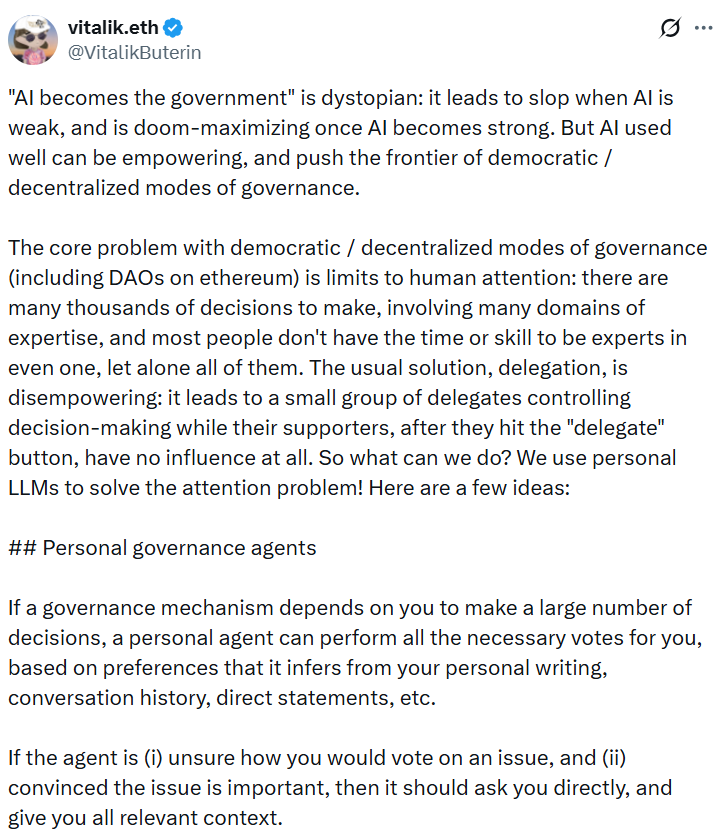
Ethereum co-founder Vitalik Buterin says artificial intelligence could help create more efficient decentralized governance models and enable users to make better-informed decisions.
Buterin said in an X post on Sunday that one of the main issues with democratic and decentralized modes of governance, like DAOs, is the “limits to human attention,” because of the many decisions that can require a wide range of expertise or time, which most don’t have.
“The usual solution, delegation, is disempowering it leads to a small group of delegates controlling decision-making while their supporters, after they hit the delegate button, have no influence at all,” he said.

It’s estimated that average participation rates in DAOs are between 15% and 25%. This can lead to issues such as the centralization of power and ineffective decision-making. Worst-case scenarios can result in governance attacks, where a bad actor acquires enough tokens to pass a damaging proposal without other members noticing.
AI-powered assistants that vote for you
Buterin proposes that personal assistant large language models (LLMs) could help solve the “attention problem” by providing users with the relevant information needed for a vote.
“If a governance mechanism depends on you to make a large number of decisions, a personal agent can perform all the necessary votes for you, based on preferences that it infers from your personal writing, conversation history, direct statements,” he said.
“If the agent is unsure how you would vote on an issue, and convinced the issue is important, then it should ask you directly, and give you all relevant context,” Buterin added.
Lane Rettig, a researcher at the Near Foundation specializing in AI and governance, told Cointelegraph last year the non-profit was working on a similar idea: AI-powered digital twins that vote on behalf of DAO members to address low voter participation.
Privacy an important aspect to preserve
Another challenge in highly decentralized governance arises when key decisions depend on private or sensitive information, such as during negotiations, internal disputes, or funding choices, according to Buterin.
Related: Vitalik Buterin floats simulated transactions to enhance crypto security
“Typically, orgs solve this by appointing individuals who have great power to take on those tasks,” he said.
He added that an alternative solution could be users submitting their “personal LLM into a black box, the LLM sees private info, it makes a judgment based on that, and it outputs only that judgment. You don’t see the private info, and no one else sees the contents of your personal LLM.”
“All of these approaches involve each participant making use of much more information about themselves, and potentially submitting much larger-sized inputs. Hence, it becomes all the more important to protect privacy,” Buterin said.
Magazine: IronClaw rivals OpenClaw, Olas launches bots for Polymarket — AI Eye

The cost to develop a Telegram tap to earn game depends on complexity, feature set, blockchain integration, scalability requirements, security mechanisms, monetization architecture and post-launch support. A basic MVP can be built with controlled investment, while advanced, tokenized, scalable ecosystems require significantly higher budgets due to backend infrastructure, smart contracts, analytics integration, and anti-bot mechanisms. Here is a sample breakdown:
- A simple MVP can fall between $12,000 – $25,000
- A growth-ready Web3-integrated game may range between $30,000 – $70,000
- A fully scalable, tokenized ecosystem with advanced security and analytics can exceed $80,000 – $120,000+
Now let us delve a bit deeper into understanding the budget, features, and what impacts pricing in tap to earn Telegram game development.
Reasons Behind the Virality of Telegram Tap to Earn Games
A Telegram tap to earn game is a lightweight interactive game built as a Telegram bot or mini-app where users earn points or tokens by performing simple actions, typically tapping, clicking, or completing micro-tasks.
These games gained massive traction because:
- Telegram has a built-in user distribution
- Onboarding friction is low
- Viral mechanics are easier to integrate
- Web3 integration can be seamless
However, building one that scales sustainably requires careful engineering.
What Are You Actually Paying For?
When decision-makers search for “Cost to Develop Telegram tap to earn Game,” they often tend to assume the cost is tied only to the tap mechanic. However, in reality, the tap mechanism is the cheapest part. The real cost lies in:
- Gameplay Complexity
- Backend Infrastructure
- Reward Validation Logic
- Blockchain and Wallet Integration
- Smart Contract Development
- Security Architecture
- Data Tracking and Analytics
- Economy balancing
- Scalability Architecture
- LiveOps Capabilities
The game UI actually happens to be a fraction of the total pricing.
Cost Breakdown by Development Tier
Let us carry out an in-depth analysis of the pricing structure based on the different development tiers
Tier 1: Basic MVP Telegram Tap to Earn Game
Estimated Cost: $12,000 – $25,000
This includes:
- Simple tap-based mechanic
- Static UI
- Basic leaderboard
- Server-side score tracking
- Telegram bot integration
- Admin panel (basic)
What it does NOT include:
- Token launch
- On-chain transactions
- NFT rewards
- Advanced analytics
- Bot detection systems
This tier of Telegram tap to earn game development is ideal for:
- Testing virality
• Community building
• Early-stage founders
• Proof-of-concept launches
However, scaling beyond 50,000 to 100,000 users without infrastructure upgrades will create performance issues.
Tier 2: Growth-Level Telegram Tap to Earn Game
Estimated Cost: $30,000 – $70,000
This level includes:
- Advanced UI/UX
- Referral mechanics
- Multi-level progression
- Wallet integration
- Token reward system
- Smart contract deployment
- Anti-bot logic
- Analytics dashboard
- Monetization layers
At this level, development effort expands significantly due to:
- Smart contract design
- On-chain transaction handling
- Security layers
- API integrations
This development tier suits:
- Web3 startups
• Token-launch projects
• Community token distribution campaigns
• Early-stage scalable projects
The jump in cost is primarily driven by blockchain engineering and security requirements.
Tier 3: Enterprise-Grade Scalable Telegram Game Ecosystem
Estimated Cost: $80,000 – $120,000+
This is the Telegram tap to earn game development tier where serious investment begins.
This tier includes:
- Custom tokenomics modeling
- Smart contract architecture
- Gas optimization
- Multi-chain compatibility
- Real-time fraud detection
- Scalable microservices backend
- Cloud infrastructure architecture
- Real-time analytics engine
- Admin control dashboards
- LiveOps capability
Here, you are not building “a Telegram game.” You are building a mini Web3 economy inside Telegram. Infrastructure planning, security audits, and scalability engineering account for the majority of the cost.
Detailed Cost Component Analysis
Let’s break down cost drivers in real terms.
1️. Backend Development (25–40% of Total Budget)
This includes:
- User state management
- Reward validation
- Database architecture
- Referral tracking
- API integrations
If you expect rapid growth, backend scalability is non-negotiable since Telegram games can scale fast. In this regard, cheap backend results in crashes during virality.
2️. Blockchain & Smart Contract Development (20–35%)
This includes:
- Token minting logic
- Reward distribution logic
- Vesting mechanisms
- Contract security testing
- Gas optimization
If poorly built, smart contracts can:
- Drain tokens
- Be exploited
- Collapse economy
Security increases cost but protects longevity.
3️. Anti-Bot & Fraud Protection (10–20%)
Tap to earn models attract bots instantly. Protection systems include:
- Activity pattern analysis
- Rate-limiting
- IP validation
- Wallet monitoring
- Behavioral detection models
Without this, reward pools are drained within weeks after launch.
4️. UI/UX & Frontend (10–20%)
UI/UX is very often underestimated. However, good UX directly affects:
- Retention
- Session length
- Monetization
Even simple games require:
- Animation feedback
- Smooth input logic
- Telegram-friendly design
5️. Analytics & Monetization Layer (10–15%)
This includes:
- Event tracking
- Cohort analysis
- Retention dashboards
- Ad integrations
- Revenue modeling
Serious decision-makers do not launch blind, they make informative decisions.
Get a realistic cost assessment tailored to your business goals
Timeline and Its Impact on Cost
Telegram tap to earn game development time affects cost due to:
- Team allocation
- Parallel engineering
- QA cycles
- Infrastructure preparation
Typical timelines:
- Basic MVP: 3–5 weeks
- Growth-Level: 6–10 weeks
- Enterprise-Grade: 12–16+ weeks
Accelerated timelines require larger teams, increasing short-term cost.
Ongoing Operational Costs
There are a few ongoing operational costs that go beyond tap to earn Telegram game development, which are as follows.
- Cloud hosting: $1,000–$8,000+ monthly, depending on scale
• Smart contract audit: $5,000–$20,000
• Maintenance updates
• Security monitoring
• LiveOps management
These recurring costs are part of sustainable game operations.
Why Cheap Development Tend to Fail
Telegram tap to earn games fail when:
- Token emissions are uncontrolled
- Backend crashes under load
- Bots exploit rewards
- No analytics insight exists
- No scaling roadmap is planned
Low-cost builds often skip infrastructure and security, leading to:
- Early hype
• Rapid exploitation
• Community loss
• Brand damage
Serious projects require structured engineering.
ROI Perspective
Telegram Tap to Earn games can generate revenue through:
- Token appreciation
• NFT sales
• Ad monetization
• Transaction fees
• Sponsored campaigns
However, ROI depends on:
- Economy design
- Retention
- Security
- Monetization balance
Investment directly impacts sustainability.
Why Partnering With the Right Telegram Game Development Company Matters
Antier, a capable Telegram game development partner, provides:
- Architecture planning
- Tokenomics expertise
- Fraud protection systems
- Scalable infrastructure
- Long-term support
Cost transparency matters, but so does long-term performance. Choosing purely based on lowest bid often increasesthe total cost later.
Final Thoughts
The cost of a Telegram tap to earn game development is not fixed and is not defined by the tap mechanic. It is shaped by your ambition, scale expectations, long-term strategy, and the overall ecosystem behind it.
Building cheaply may launch quickly but scaling sustainably requires thoughtful engineering. If your goal is to build a Telegram tap to earn game that survives growth and protects user trust, development strategy matters as much as budget.
A realistic budget starts around $12,000 for MVPs and can exceed $100,000 for enterprise-scale platforms. The pricing difference lies in:
- Security
• Scalability
• Token design
• Backend strength
• Monetization architecture
If your goal is a short-term experiment, a small investment may work. If your goal is a scalable Web3 business inside Telegram, structured engineering is mandatory. Partner with Antier, a leading Telegram game development company, to get customized solutions based on your specific needs.
Frequently Asked Questions
01. What is the estimated cost to develop a basic MVP Telegram tap to earn game?
The estimated cost for a basic MVP Telegram tap to earn game ranges from $12,000 to $25,000.
02. What factors influence the cost of developing a Telegram tap to earn game?
The cost is influenced by factors such as gameplay complexity, backend infrastructure, reward validation logic, blockchain integration, smart contract development, security architecture, data tracking, economy balancing, scalability architecture, and LiveOps capabilities.
03. How much can a fully scalable, tokenized ecosystem for a Telegram tap to earn game cost?
A fully scalable, tokenized ecosystem with advanced security and analytics can exceed $80,000 to $120,000 or more.

The Crypto Bull Market Is Over (Do Not Be Fooled)

Gary Neville praises ‘incredible’ Arsenal signing after Tottenham win | Football

Apple Reportedly Plans to Unveil At Least 5 New Products Next Week


-

 Video7 days ago
Bitcoin: We’re Entering The Most Dangerous Phase
-

 Crypto World6 days ago
Can XRP Price Successfully Register a 33% Breakout Past $2?
-

 Video3 days ago
XRP News: XRP Just Entered a New Phase (Almost Nobody Noticed)
-

 Fashion3 days ago
Weekend Open Thread: Boden – Corporette.com
-

 Sports6 days ago
GB's semi-final hopes hang by thread after loss to Switzerland
-

 Politics1 day ago
Baftas 2026: Awards Nominations, Presenters And Performers
-
 Tech6 days ago
The Music Industry Enters Its Less-Is-More Era
-

 Business5 days ago
Infosys Limited (INFY) Discusses Tech Transitions and the Unique Aspects of the AI Era Transcript
-

 Entertainment5 days ago
Kunal Nayyar’s Secret Acts Of Kindness Sparks Online Discussion
-

 Video6 days ago
Financial Statement Analysis | Complete Chapter Revision in 10 Minutes | Class 12 Board exam 2026
-

 Tech5 days ago
Retro Rover: LT6502 Laptop Packs 8-Bit Power On The Go
-
 Sports4 days ago
Clearing the boundary, crossing into history: J&K end 67-year wait, enter maiden Ranji Trophy final | Cricket News
-

 Business18 hours ago
Mattel’s American Girl brand turns 40, dolls enter a new era
-

 Business14 hours ago
Law enforcement kills armed man seeking to enter Trump’s Mar-a-Lago resort, officials say
-

 Entertainment4 days ago
Dolores Catania Blasts Rob Rausch For Turning On ‘Housewives’ On ‘Traitors’
-

 Business5 days ago
Tesla avoids California suspension after ending ‘autopilot’ marketing
-

 Tech14 hours ago
Anthropic-Backed Group Enters NY-12 AI PAC Fight
-

 Politics6 days ago
Eurovision Announces UK Act For 2026 Song Contest
-

 NewsBeat12 hours ago
Armed man killed after entering secure perimeter of Mar-a-Lago, Secret Service says
-

 Crypto World5 days ago
WLFI Crypto Surges Toward $0.12 as Whale Buys $2.75M Before Trump-Linked Forum