

Crypto World
Bitcoin Struggles to Hold $90,000 Despite Stocks and Gold Rallying



Altcoins posted mild losses as total crypto market capitalization dipped 1% to $3.11 trillion.



The Web3 gaming platform the9bit, has surpassed 7 million users while expanding the utility and reach of its native ecosystem token, $9BIT.
$9BIT’s value has skyrocketed sevenfold, driven by the9bit platform surpassing 7 million users and intensified efforts in its AI Game Economy. This period of notable expansion includes major ecosystem enhancements, such as a key alliance with AAA publisher Capcom and a full commitment to accelerating AI Game Development (AIGD). Additionally, the9bit is focused on offering significantly reduced game prices by cutting traditional markups and implementing integrated localized fiat gateways and crypto payment solutions.
Since its launch, $9BIT has experienced significant market growth, reflecting accelerating adoption across the the9bit ecosystem. The token is currently listed on major global exchanges, including KuCoin, MEXC, and BingX, with additional listings under consideration as the ecosystem expands.
But beyond market performance, the real story lies in ecosystem scale.
Bridging Web3 Integration with AAA Partnerships
Launched in August 2025, the9bit is pioneering the convergence of traditional AAA gameplay and Web3 incentives, establishing an interactive digital economy where gaming is rewarded.
As of 24 Feb 2026:
- Over 7 million registered users
- More than 38,000 active gamers and space owners
- Over 32.8 million $9BIT tokens distributed to ecosystem participants
$9BIT is the essential utility asset, empowering the ecosystem by facilitating governance, reward distribution, creator incentives, and access to premium in-platform services. This model shifts the user experience from passive consumption to active engagement, allowing users to:
- Earn rewards through direct gameplay and engagement.
- Participate in community governance via voting mechanisms.
- Redeem tokens for premium content and ecosystem utilities.
In a major leap for blockchain-integrated gaming, the9bit has secured its position as a main partner with Capcom. This collaboration will align closely with the highly anticipated global release of Resident Evil 9 on February 27, 2026, with more Capcom future works anticipated in the future, demonstrating the9bit’s capacity to bridge traditional gaming giants with Web3 infrastructure.
By partnering with major global releases, the9bit is elevating its platform beyond casual games, offering its community unique tokenized engagement opportunities and unprecedented access to major franchises.
Introducing AIGD: AI-Powered Game Creation
The next big leap forward for the9bit is AIGD (AI Game Development). This new, AI-assisted creation layer will dramatically lower the barrier for anyone to publish a game. Allowing users to turn a great idea into a fully playable game. This capability unlocks a vibrant, self-sustaining loop between creators and players. Builders use powerful AI tools to bring their games to life, players jump in and generate exciting ecosystem activity, and everyone is rewarded with $9BIT.
This whole system creates a fantastic new reward cycle:
1. Creators build games using AI tools, quickly develop and launch their games.
2. Players engage and generate activity which the community jumps in.
3. Engagement translates into rewards distributed across the ecosystem.
4. Creative and great creators directly benefit from the traction.
By aligning incentives between creators and players, the9bit is building a genuinely scalable, self-sustaining gamer-driven economy, a powerful model that puts the value right back into the hands of the people who make the ecosystem thrive.
Backed by Public-Market Infrastructure
According to its whitepaper, the9bit ecosystem allocates 1.9 billion $9BIT tokens to The9 Limited in recognition of its strategic and operational contributions. As of February 24, 2026, 950 million tokens have been delivered, with the remaining allocation expected in the coming months.
The9 Limited, listed on Nasdaq since 2004, brings public-market governance standards and infrastructure experience to the Web3 gaming space, bridging traditional Internet operations with blockchain-enabled economies.
What’s Next
As 2026 unfolds, the9bit plans to:
- Expand AIGD toolkits and AI-assisted publishing capabilities
- Deepen token utility across gameplay layers
- Expand AAA integrations through our main partnership with Capcom
- Accelerate user acquisition across MENA and Southeast Asia
- Strengthen community-driven governance initiatives
- Explore further exchange listings
With user growth accelerating and AI-powered creation lowering barriers for developers worldwide, the9bit is positioning itself at the intersection of gaming, AI, and Web3 infrastructure.
Play Together. Earn Together. Own Together.
About the9bit
the9bit is a Web3-enabled gaming platform that integrates traditional gameplay with tokenized rewards. The platform offers game purchases, mobile top-ups, casual gaming, and community features — while empowering creators through AI-driven development tools.
For more information, visit: the9bit.com
About The9 Limited
The9 Limited (Nasdaq: NCTY) is an Internet company listed on Nasdaq since 2004. The company operates in online gaming, Bitcoin mining, and AI-driven technology investments, with a growing focus on Web3 infrastructure.
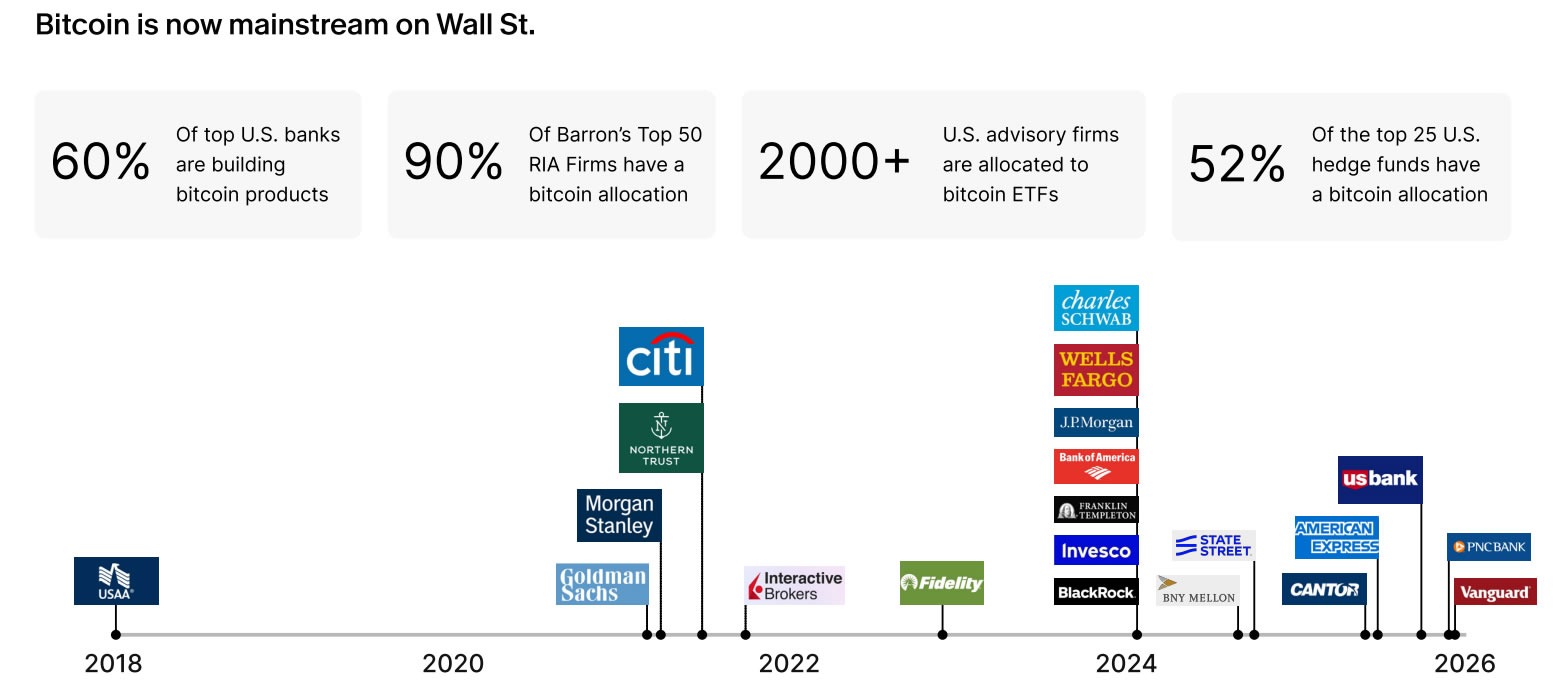
Bitcoin’s adoption by institutions, banks, merchants, public companies, and nation-states has boomed in 2025, despite the recent price drawdown, says the financial services company River.
“There is no bear market in Bitcoin adoption,” River said in a report published on Tuesday, which noted that while Bitcoin (BTC) is down 50% from its all-time high, “adoption is compounding in ways that aren’t affecting the price, yet.”
“Trust in Bitcoin has grown faster than that of any asset in history,” it said. “What began as an experiment is now a globally recognized store-of-value, with adoption patterns that rival the internet.”

Institutional, banking and public company adoption
River reported that institutions accumulated 829,000 BTC in 2025, including purchases by businesses, governments, funds, and exchange-traded funds.
Registered investment advisors have been net buying BTC for eight quarters in a row and have invested roughly $1.5 billion in Bitcoin ETFs per quarter over the past two years, River said.
It noted that these institutions represent “millions of underlying individuals” gaining exposure to Bitcoin for the first time through brokerage accounts, retirement plans, sovereign funds and corporate balance sheets.
Related: Public companies increase Bitcoin holdings despite range-bound prices
Additionally, 60% of the top US banks are building Bitcoin products. “With a favorable regulatory environment in the US, banks can now custody Bitcoin and offer Bitcoin products to their customers,” it stated.
Businesses were the largest buyers of BTC in 2025, with a majority of purchases driven by crypto treasury companies, whose adoption grew 2.5 times last year.

Merchant adoption and payments accelerate
Merchant adoption also surged with the number of businesses in the US accepting Bitcoin for payments tripling, while global usage grew by 74% in 2025, it noted.
Bitcoin payments on the Lightning Network grew by 300% in 2025 and, according to River’s estimations, the network is now processing over $1.1 billion in monthly transaction volume.
Five nation-states became new owners of Bitcoin in 2025, including purchases from two sovereign wealth funds in Luxembourg and Saudi Arabia, and from one central bank in the Czech Republic. The other two were Brazil and Taiwan.
River estimates that 23 nation-states hold Bitcoin through state-backed mining, seizures, or central bank exposure.
Bitcoin volatility is in decline
River said that Bitcoin volatility is also declining, nearing that of gold and the S&P 500, signaling that it is “increasingly viewed as a mature asset class.”
“As volatility falls, the hurdle for more risk-averse investors declines,” it said. “Over time, that opens the door to larger pools of capital.”

River added that Bitcoin is built on trust and claimed it is the world’s “only scarce and incorruptible form of digital money.”
“We expect that in the coming years, Bitcoin adoption will not only continue its current trend, but meaningfully accelerate.”
Magazine: Bitdeer sells all Bitcoin, Metaplanet rejects misconduct claims: Asia Express
Dogecoin pushed higher on outsized volume after repeatedly testing resistance, flipping a key ceiling into support and setting up a near-term test of the next supply zone.
News Background
- DOGE advanced alongside a stabilizing broader crypto market, with buyers stepping in after several sessions of tight consolidation.
- The move wasn’t driven by token-specific headlines but by technical positioning, as repeated failures at $0.0924 left the level primed for a breakout once liquidity expanded.
- The rally comes after DOGE spent hours coiling between $0.090 and $0.0927, building compression before volume returned.
- Open interest remains elevated but not extreme, suggesting moderate leverage participation rather than a crowded speculative push.
Price Action Summary
- DOGE gained 1.9%, rising from $0.0926 to $0.0944
- Breakout above $0.0924 occurred on 749M volume, 176% above baseline
- Price briefly probed $0.0950 before consolidating near $0.0940–$0.0945
- Higher lows formed during consolidation, confirming short-term strength
Technical Analysis
- The key technical development was the sustained break above $0.0924, a level that capped multiple attempts earlier in the session. Once cleared, momentum accelerated quickly, and the breakout volume suggests genuine participation rather than a low-liquidity spike.
- The subsequent consolidation near $0.0940 appears constructive, with shallow pullbacks and higher lows indicating buyers defending the breakout zone. That keeps short-term structure bullish, but the real test lies at $0.0946–$0.0950, where supply previously absorbed upside attempts.
- A decisive close above $0.0950 would expose $0.0955–$0.0960. Failure to hold $0.0940 would risk a pullback toward $0.0924, which now serves as the structural pivot.
What traders say is next?
- Traders view $0.0940 as the new line of defense. As long as DOGE holds above that level, momentum favors continuation toward $0.0955 and potentially $0.0960.
- If the breakout fades and price slips back below $0.0924, the move would resemble a false break, reopening the prior consolidation range and shifting near-term bias back to neutral.

One of the world’s most wanted drug lords is dead. Nemesio Rubén Oseguera Cervantes, known as “El Mencho,” was killed on Sunday. His death triggered a wave of violence across several Mexican states.
Beyond the security impact, attention is also turning to the cartel’s financial operations. In recent years, regulators and researchers have documented how Mexican criminal networks have incorporated cryptocurrency into their operations.
Who was El Mencho?
El Mencho was among Mexico’s most wanted fugitives and the leader of the Jalisco New Generation (CJNG) cartel. According to the US Department of State, the CJNG was formed in 2009. It has since evolved into one of the most violent drug cartels in Mexico.
“It has been assessed to have the highest cocaine, heroin, and methamphetamine trafficking capacity in Mexico, and over the past few years, includes the trafficking of fentanyl into the United States,” the text reads.
On February 20, 2025, the United States officially designated the cartel as a Foreign Terrorist Organization pursuant to Section 219 of the Immigration and Nationality Act.
In addition, the US State Department had offered a $15 million reward for information leading to the capture or conviction of El Mencho. He was killed on Sunday during a military operation.

Following his death, unrest spread across parts of the country. According to the BBC, at least 20 states experienced disturbances as cartel members blocked roads and torched vehicles and businesses.
While the immediate fallout played out in the streets, past data shows that CJNG’s impact has extended beyond territorial control.
Over the past years, investigators have tracked the cartel’s increasingly sophisticated financial infrastructure. This includes its use of digital assets to move and launder funds across borders.
Crypto and Cartel Finance
Cryptocurrencies such as Bitcoin (BTC) and Tether (USDT) are not inherently illicit. They are widely used for legitimate investment, payments, and financial innovation.
However, regulatory and law enforcement agencies have identified instances in which these digital assets were used in transactions linked to illegal activities.
As early as 2020, Reuters reported that US and Mexican authorities observed an increasing use of Bitcoin among major drug trafficking groups, including the CJNG and the Sinaloa Cartel, for laundering money.
In 2024, the US Treasury’s Financial Crimes Enforcement Network (FinCEN) stated that Mexico-based transnational criminal organizations were using virtual currencies, including Bitcoin, Ethereum, Monero, and Tether, to purchase fentanyl precursor chemicals and equipment from suppliers in China.
A March 2025 report by Chainalysis found that suspected China-based chemical traders received more than $37.8 million in cryptocurrency between 2018 and 2023. Major Mexican cartels, including the CJNG, were identified as buyers of these precursors used to manufacture synthetic opioids.
“Blockchain analysis reveals that precursor chemical suppliers advertise directly on darknet markets and messaging apps, accepting digital assets in exchange for chemicals shipped to Mexico. Once paid, crypto funds are laundered through complex transaction patterns including peel chains, layering, and cross-chain swaps, and often cashed out through Chinese exchanges or international mules,” TRM Labs revealed.
In August 2025, FinCEN also highlighted that the CJNG, the Sinaloa Cartel, the Gulf Cartel, and other Mexico-based transnational criminal organizations were using Chinese money laundering networks (CMLNs) to launder illicit proceeds.
Notably, Chainalysis reported that CMLNs now play a dominant role in cryptocurrency-related money laundering. In 2025, these networks accounted for approximately 20% of known cryptocurrency money laundering activity.
While the activity has scaled, regulatory focus has also intensified. According to the US Attorney’s Office for the Southern District of New York, Paul Campo, a former DEA official, and Robert Sensi were indicted for conspiring to provide material support to CJNG.
“As part of the scheme, CAMPO and SENSI agreed to launder approximately $12,000,000 of CJNG narcotics proceeds; laundered approximately $750,000 by converting cash into cryptocurrency; and provided a payment for approximately 220 kilograms of cocaine on the understanding that the payment would trigger the distribution and sale of the narcotics worth approximately $5,000,000, for which CAMPO and SENSI would (i) receive directly a portion of the narcotics proceeds as profit; and (ii) receive a further commission upon the laundering of the balance of the narcotics proceeds,” the press release said.
Thus, El Mencho’s death marks a significant moment in Mexico’s fight against organized crime. Yet the financial systems supporting major cartels remain complex, cross-border, and technologically adaptive, extending far beyond any single individual.


Debate is raging in the crypto community as Justin Bons, founder and CIO of Cyber Capital, argues that Ripple’s XRP Ledger (XRPL) is “centralized.”
Meanwhile, Ripple’s CTO Emeritus, David Schwartz, has firmly defended its architecture. This raises crucial questions about what makes a blockchain genuinely decentralized.
Justin Bons Labels XRP Ledger “Centralized”
In a recent post on X (formerly Twitter), Bons criticized what he calls “centralized blockchains.” He argued that several networks rely on permissioned validator structures, pointing to XRP Ledger’s Unique Node List (UNL) as an example.
“Ripple: Has a “Unique Node List”, which makes the validators effectively permissioned. Any divergence from this centrally published list would cause a fork, effectively giving the Ripple Foundation & company absolute power & control over the chain,” he wrote.
He also named Canton, Stellar, Hedera, and Algorand in his post. Bons framed decentralization as a binary choice, arguing that a blockchain is either fully permissionless or it is not. In his view, any permissioned element is “anti-thetical” to the ethos of crypto.
“The future of finance is decentralized & permissionless,” he wrote. “But let’s not pretend as if these chains are really playing a part in this revolution…if you care about crypto. Reject these permissioned chains & demand they decentralize.”
Bons also outlined what he described as the only three forms of blockchain consensus: Proof of Stake, Proof of Work, and Proof of Authority. He mentioned that any system not based on PoS or PoW then “it is, by definition, PoA.” The executive said that “choosing who we trust is not the same as trustlessness,” specifically referencing XRP and XLM.
David Schwartz Defends XRP Ledger
Bons’ post sparked notable reactions from the community. Schwartz, one of the chief architects of the XRP Ledger, rejected claims that Ripple has “absolute power & control.”
He explained that the XRP Ledger was designed so that Ripple could not control the network. Schwartz said this decision was intentional and rooted in regulatory considerations.
“Ripple, for example, has to honor US court orders. It cannot say no….But could a US court decide that international comity with an oppressive was more important than XRPL or Ripple? We were quite concerned that could come down either way. We absolutely and clearly decided that we DID NOT WANT control and that it would be to our own benefit to not have that control,” he replied.
Schwartz also pushed back against Bons’ claims about potential double-spending and censorship. He explained that validators cannot force an honest node to accept a double-spend or censor transactions.
Each node independently enforces protocol rules and only counts the validators it has chosen on its Unique Node List (UNL). If a validator behaves dishonestly, an honest node simply treats it as a validator it disagrees with.
Schwartz acknowledged that validators could theoretically conspire to halt the network from the perspective of honest nodes. However, he said this would be equivalent to a dishonest majority attack and would still not allow double-spending. In such a scenario, he argued that the remedy would be to select a new UNL.
“Transactions are discriminated against all the time in BTC. Transactions are maliciously re-ordered or censored all the time on ETH. Nothing like this has *ever* happened to an XRPL transaction and it’s hard to imagine how it could,” he remarked.
He also pointed out that XRPL resolves the double-spend problem through consensus rounds that occur roughly every five seconds. During each round, validators vote on whether transactions should be included in the current ledger.
Honest nodes may defer a valid transaction to the next round if a supermajority of trusted validators say they did not see it before the cutoff. According to Schwartz, this mechanism maintains consensus without granting unilateral control to any single party.
“There are only two reasons you need a UNL: 1) Otherwise a malicious party could create an unbounded number of validators causing nodes to need to do excessive work to reach consensus. 2) Otherwise a malicious party could create validators that just didn’t participate in consensus, leaving nodes unable to tell whether they actually had reached a consensus with other nodes,” he noted.
He further stressed that if Ripple had the ability to censor transactions or execute double spends, using that power would permanently damage trust in XRPL. Therefore, he said the system was intentionally architected to limit the power of any single actor, including Ripple itself.


By staking treasury ETH, the Ethereum Foundation now directly participates in consensus while generating native, ether-denominated yield.
The Ethereum Foundation announced that it has begun staking a portion of its treasury funds, following the Treasury Policy it released last year.
The latest move represents a formal step into direct participation in Ethereum’s proof-of-stake consensus.
Treasury Staking
As part of this initiative, the Foundation deposited 2,016 ETH on Tuesday and stated that it plans to stake approximately 70,000 ETH in total, with all staking rewards directed back to the Foundation’s treasury. The staking setup relies entirely on open-source infrastructure, and the Foundation picked Dirk as a distributed signing solution and Vouch to manage validator operations across multiple Beacon and Execution Client pairings.
According to the announcement, Dirk distributes signing responsibilities across several geographic regions to remove single points of failure, while Vouch enables configurable strategies designed to mitigate client diversity risks. The overall configuration uses a mix of minority clients alongside both hosted infrastructure and self-managed hardware deployed across multiple jurisdictions.
The Foundation also confirmed that its validators are using Type 2 (0x02) withdrawal credentials, which allow validator balances to be transferred through consolidations, reduce the number of required signing keys by supporting a higher maximum effective balance per validator, and enable flexible exits that can be triggered by the withdrawal address even if validators are offline.
This approach simplifies key management and supports faster changes in signing-key custody, according to the Swiss non-profit organization.
In terms of block production, the setup is being built locally rather than relying on proposer-builder separation sidecars. The Foundation stated that by solo staking its own ETH, it will generate native, ETH-denominated yield using Ethereum’s protocol mechanics.
You may also like:
Short-Term Weakness Dominates
On the price front, ETH traded sharply lower over the past 24 hours, extending its short-term downtrend as sellers remained in control throughout the session. The price slipped from around $1,920 during the early Asian trading hours of Tuesday to near $1,820, as brief attempts to stabilize failed to gain traction. While short-term price action remains under pressure, some analysts believe that the broader setup looks more constructive on a longer time horizon.
Analyst Merlijn The Trader said ETH is sitting in a five-year demand zone that has historically favored accumulation, not distribution. He noted that prices have returned to levels seen during prior bear market phases and momentum may be quietly building despite the slow pace.
Binance Free $600 (CryptoPotato Exclusive): Use this link to register a new account and receive $600 exclusive welcome offer on Binance (full details).
LIMITED OFFER for CryptoPotato readers at Bybit: Use this link to register and open a $500 FREE position on any coin!
SUI price is attempting a to reclaim a key psychological level as the 21Shares Spot SUI ETF begins trading on Nasdaq.
Summary
- SUI is trading near $0.87 after a sharp multi-week decline.
- The 21Shares Spot SUI ETF (TSUI) has officially launched on Nasdaq.
- Technical indicators suggest a potential short-term bounce if support holds.
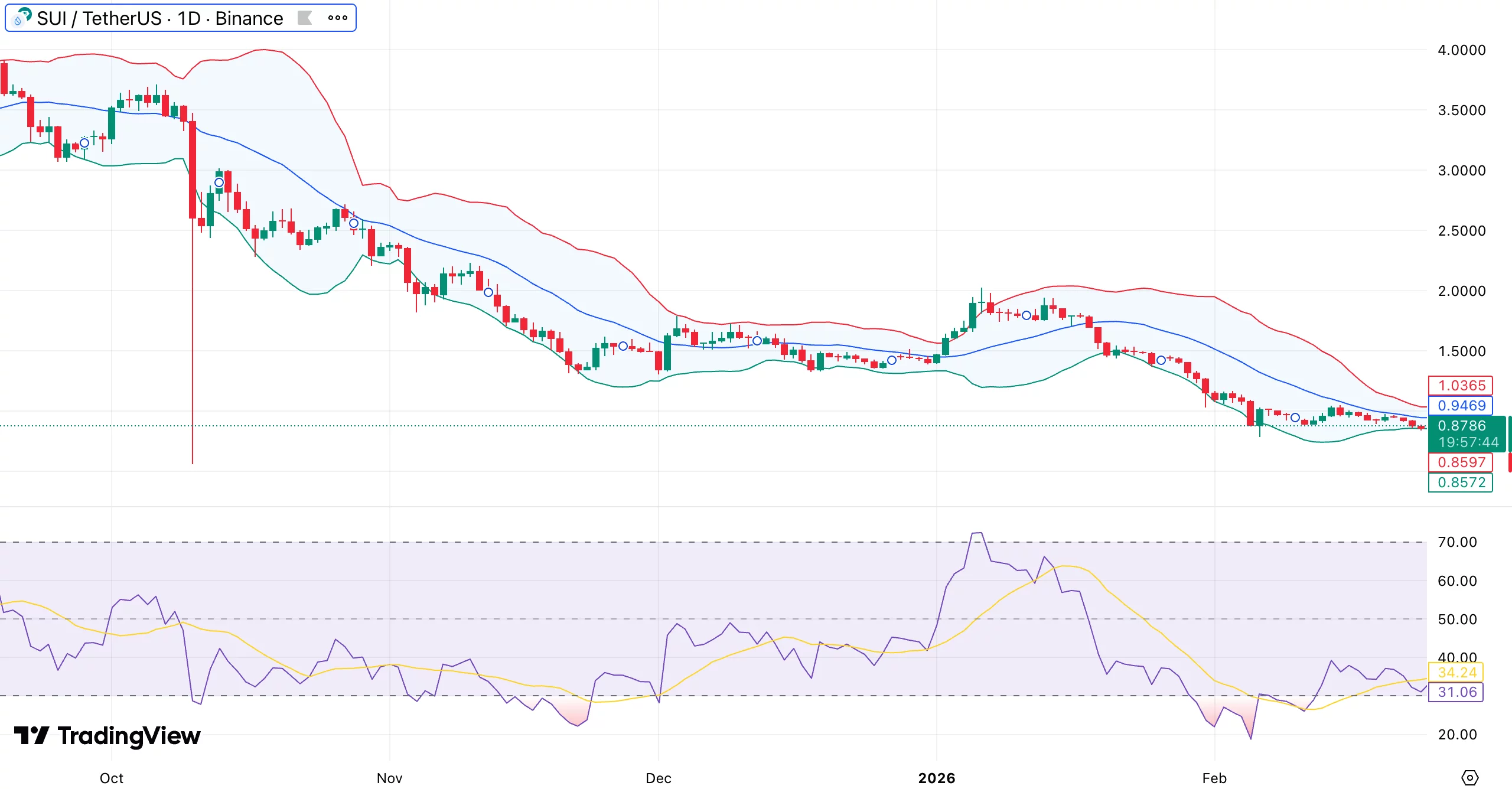
Sui was trading at $0.8786 at press time, up 3.4% in the past 24 hours. The token has struggled to reclaim the $1 psychological level in recent sessions.
Sui (SUI) has hovered between $0.8519 and $0.9783 over the past week. It has fallen about 8% in seven days and is down nearly 40% over the past month, showing continued selling pressure.
Spot volume reached $474 million, a 12% drop from the previous day, indicating weaker trading activity. CoinGlass data shows derivatives volume down 14% to $685 million, while open interest slipped 2.8% to $447 million, indicating leverage is cooling rather than expanding.
21Shares launches spot SUI ETF on Nasdaq
The minor price recovery comes as the 21Shares Spot SUI ETF (TSUI) launched on Nasdaq on Feb. 24.
The ETF allows U.S. investors to gain spot exposure to SUI through traditional brokerage accounts without directly holding the token. TSUI carries a 0.30% management fee, waived through October 2026, and launched with about $9.2 million in assets under management.
TSUI is not registered under the Investment Company Act of 1940 and does not offer the same regulatory protections as ‘40 Act ETFs. The product follows 21Shares’ earlier 2x leveraged SUI ETF introduced in December 2025
Sui, which focuses on payments, tokenization, and DeFi tools, was founded by former members of Meta’s Diem and Libra projects.
The network has handled more than $100 billion in stablecoin transfers in the last six months. Its decentralized exchanges saw a volume of $6.5 billion over the past 30 days, indicating active on-chain use.
ETF launches have often lifted crypto prices. Following the 2024 approval of Bitcoin ETFs, institutional capital poured in and liquidity rose, bolstering the market. The effect TSUI has on SUI’s price will probably depend on its ability to draw comparable inflows.
Sui price technical analysis
After falling from above $1.80 to about $0.85, SUI has been in a downward trend for several weeks. The daily chart indicates ongoing short-term weakness with lower highs and lows.
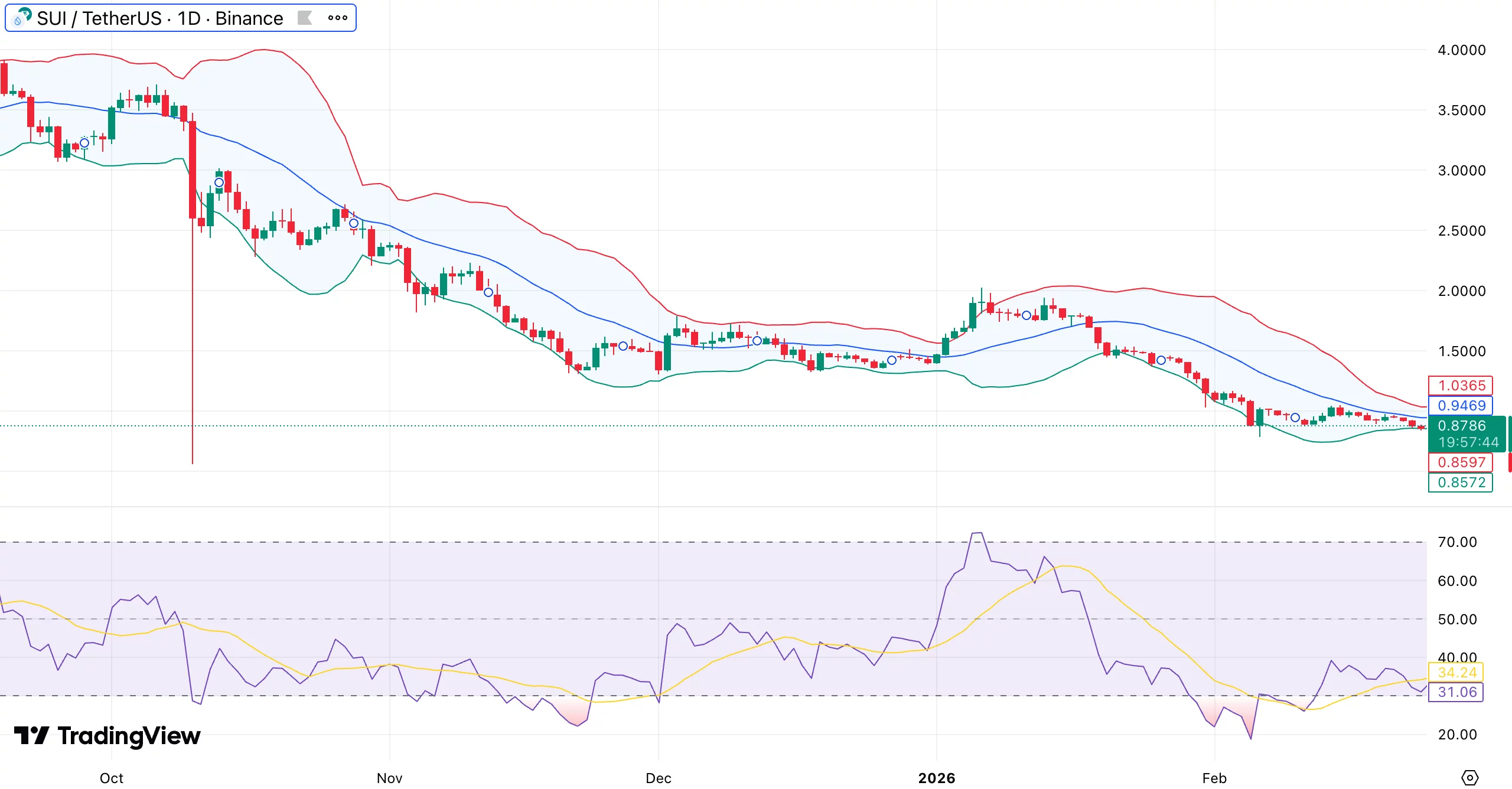
The price currently trades below the 50-day and 20-day moving averages, which serve as resistance. A move back above the 50-day average near $0.94 would be the first signal that short-term momentum is shifting.
The relative strength index recently dipped into the low-30 range, indicating near-oversold conditions, and is now turning upward. At the same time, price has been hugging the lower Bollinger Band, and the bands are beginning to contract. That setup often precedes a volatility expansion.
A relief rally toward $0.94 may emerge if SUI maintains the $0.85–$0.87 support zone and buying volume rises in tandem with ETF-related inflows. A clean break above $1.00 would strengthen the case for a broader recovery toward the $1.03–$1.20 area.
However, if $0.85 fails to hold, the oversold bounce thesis weakens, and the price could extend lower as sellers regain control.
Frontier AI developer Anthropic has publicly accused three Chinese AI labs—DeepSeek, Moonshot, and Minimax—of conducting distillation attacks aimed at siphoning capabilities from Claude, Anthropic’s large language model. In a detailed blog post, the company describes campaigns that allegedly produced over 16 million exchanges across roughly 24,000 fraudulent accounts, exploiting Claude’s outputs to train less capable models. Distillation, a recognized training tactic in AI, becomes problematic when deployed at scale to replicate powerful features without bearing the same development costs. Anthropic emphasizes that while distillation has legitimate uses, it can enable rival firms to shortcut breakthroughs and uplift their own products at a fraction of the time and expense.
Key takeaways
- Distillation involves training a weaker model on the outputs of a stronger one, a method widely used for creating smaller, cheaper versions of AI systems.
- Anthropic alleges that DeepSeek, Moonshot, and Minimax orchestrated mass-scale distillation campaigns, generating millions of interactions with Claude across tens of thousands of fake accounts.
- The attacks reportedly targeted Claude’s differentiated capabilities, including agentic reasoning, tool use, and coding, signaling a focus on high-value, transferable competencies.
- The firm argues that foreign distillation campaigns carry geopolitical risks, potentially arming authoritarian actors with advanced capabilities for cyber operations, disinformation, and surveillance.
- Anthropic says it will bolster detection, share threat intelligence, and tighten access controls, while urging broader industry cooperation and regulatory engagement to counter these threats.
Market context: The incident arrives amid heightened scrutiny of AI model interoperability and the security of cloud-based AI offerings, a backdrop that also touches on automated systems used in crypto markets and related risk-management tools. As AI models become more embedded in trading, risk assessment, and decision-support, ensuring the integrity of input data and model outputs grows ever more important for both developers and users in the crypto space.
Why it matters
The allegations underscore a tension at the heart of frontier AI: the line between legitimate model distillation and exploitative replication. Distillation is a common, legitimate practice used by labs to deliver leaner variants of a model for customers with modest compute budgets. Yet, when leveraged at scale against a single ecosystem, the technique can be co-opted to extract capabilities that would otherwise require substantial research and engineering. If confirmed, the campaigns could prompt a broader rethink of how access to powerful models is controlled, monitored, and audited, particularly for firms with global reach and complex cloud footprints.
Anthropic asserts that the three named firms carried out activities designed to harvest Claude’s advanced abilities through a combination of IP-address correlation, request metadata, and infrastructure indicators, with independent corroboration from industry partners. This signals a concerted, data-driven effort to map and replicate cloud-based AI capabilities, not merely isolated experiments. The scale described—tens of millions of interactions across thousands of accounts—raises questions about the defense measures in place to detect and disrupt such patterns, as well as the accountability frameworks that govern foreign competitors operating in AI spaces with direct national and economic implications.
“Distillation is a widely used and legitimate training method. For example, frontier AI labs routinely distill their own models to create smaller, cheaper versions for their customers,” Anthropic wrote, adding:
“But distillation can also be used for illicit purposes: competitors can use it to acquire powerful capabilities from other labs in a fraction of the time, and at a fraction of the cost, that it would take to develop them independently.”
Beyond the IP concern, Anthropic ties the alleged activity to strategic risk for national security, arguing that distillation attacks by foreign labs could feed into military, intelligence, and surveillance systems. The company contends that unprotected capabilities could enable offensive cyber operations, disinformation campaigns, and mass surveillance, complicating the geopolitical calculus for policymakers and industry players alike. The assertion frames the issue as not merely a competitive dispute but one with broad implications for how frontier AI technologies are safeguarded and governed.
In outlining a path forward, Anthropic says it will enhance detection systems to spot dubious traffic patterns, accelerate threat-intelligence sharing, and tighten access controls. The company also calls on domestic players and lawmakers to collaborate more closely in defending against foreign distillation actors, arguing that a coordinated, industry-wide response is essential to curb these activities at scale.
For readers tracking the AI policy frontier, the allegations echo ongoing debates about how to balance innovation with safeguards—issues that are already echoing through discussions about governance, export controls, and cross-border data flows. The broader industry has long grappled with how to deter illicit use without stifling legitimate experimentation, a tension that will likely be a focal point for future regulatory and standards-setting efforts.
What to watch next
- Anthropic and the accused firms may publish further details or clarifications about the allegations and their respective responses.
- Threat intelligence bodies and cloud providers could release updated indicators of compromise or defensive guidance related to distillation-style attacks.
- Regulators and lawmakers may issue or refine policies governing AI model access, cross-border data sharing, and anti-piracy measures for high-capability models.
- Independent researchers and security firms may replicate or challenge the methodologies used to identify the alleged campaigns, potentially expanding the evidence base.
- Industry collaborations could emerge to establish best practices for protecting frontier model capabilities and for auditing model distillation processes.
Sources & verification
- Anthropic blog post: Detecting and Preventing Distillation Attacks — official statement detailing the accusations and the described campaigns.
- Anthropic’s X status post referenced in the disclosure — contemporaneous public record of the company’s findings.
- Cointelegraph coverage and linked materials discussing AI agents, frontier AI, and related security concerns referenced in the article.
- Related discussions on the role of distillation in AI training and its potential misuse in competitive environments.
Distillation attacks and frontier AI security
The core claim rests on a structured abuse of distillation, wherein a stronger model’s outputs—Claude in this case—are used to train alternative models that mimic or approximate its capabilities. Anthropic contends this is not a minor leak but a sustained campaign across millions of interactions, enabling the three firms to approximate high-end decision-making, tool use, and coding abilities without bearing the full cost of original research. The numbers cited—more than 16 million exchanges across approximately 24,000 fraudulent accounts—illustrate a scale that could destabilize expectations about model performance, customer experience, and data integrity for users relying on Claude-based services.
What the allegations imply for users and builders
For practitioners building on AI, the case underscores the importance of robust provenance, access controls, and continuous monitoring of model usage. If foreign distillation can be scaled to produce viable stand-ins for leading capabilities, then the door opens to widespread commoditization of powerful features that were previously the result of substantial investment. The consequences could extend beyond IP loss to include drift in model behavior, unexpected tool integration failures, or the propagation of subtly altered outputs to end users. Builders and operators of AI-enabled services—whether in finance, healthcare, or consumer tech—may respond with heightened scrutiny of third-party integrations, stricter licensing terms, and enhanced anomaly-detection around API traffic and model queries.
Key considerations for the crypto ecosystem
While the incident centers on AI model security, its resonance for crypto markets lies in how automated decision-support, trading bots, and risk assessment tools depend on reliable AI inputs. Market participants and developers should remain vigilant about the integrity of AI-enabled services and the potential for compromised or replicated capabilities to influence automated systems. The situation also highlights the broader need for cross-industry collaboration on threat intelligence, standards for model provenance, and shared best practices that can help prevent a spillover of AI vulnerabilities into financial technologies and digital asset platforms.
What to monitor in the near term
- Public updates from Anthropic on findings, indicators of compromise, and any remediation milestones.
- Clarifications or statements from DeepSeek, Moonshot, and Minimax regarding the allegations.
- New guidelines or enforcement actions from policymakers aimed at foreign distillation and export controls for AI capabilities.
- Enhanced monitoring tools and access-control strategies adopted by cloud providers hosting frontier AI models.
- Independent research validating or contesting the methods used to detect distillation patterns and the scale of the claimed activity.


Nakamoto inks $107.3M all-stock deal for BTC Inc, UTXO to scale Bitcoin media and treasury platform.
Summary
- Nakamoto will issue 363.6m shares at $1.12 to fund the $107.3M all-stock acquisition.
- Deal consolidates Bitcoin Magazine, The Bitcoin Conference, and UTXO’s hedge fund advisory under one Nasdaq-listed BTC treasury firm.
- Management frames recurring media and advisory revenues as fuel for further BTC accumulation and M&A expansion.
Nakamoto, a bitcoin treasury firm founded by entrepreneur David Bailey, announced the acquisition of BTC Inc. and UTXO Management in an all-stock transaction valued at over $107 million, according to a company statement.
The deal includes BTC Inc., which operates Bitcoin Magazine and The Bitcoin Conference, as well as UTXO Management, an investment firm that backs bitcoin treasury companies. Shareholders will receive 363,589,816 shares on a fully diluted basis, the company said.
Bailey stated the acquisitions align with Nakamoto’s strategy to operate a portfolio spanning media, asset management, and advisory services. The transactions exercised prior call options, allowing Nakamoto to acquire BTC Inc. while BTC Inc. concurrently acquired UTXO Management, according to the announcement.
The acquisitions provide recurring revenue for Nakamoto, diversifying the company’s operations beyond capital markets activities. Other bitcoin treasury companies in the sector include Strategy, led by Michael Saylor, and Twenty One Capital.
Bailey indicated that Nakamoto has no plans to sell its bitcoin holdings except under extreme prolonged price declines, signaling a continued accumulation strategy.
Industry analysts have noted a consolidation trend among bitcoin treasury companies, with firms combining media, advisory, and investment services to strengthen recurring revenue streams. Through the acquisitions of BTC Inc.’s established brands and UTXO’s investment operations, Nakamoto aims to expand its institutional presence and operational scale, according to market observers.

TLDR
- Coinbase now offers stock and ETF trading to all U.S. customers through its platform.
- The company provides commission-free trading and supports fractional shares starting at one dollar.
- Users can fund their stock and ETF trades with U.S. dollars or USDC.
- Coinbase introduced this expansion to bring multiple asset classes together in one place.
- The platform now offers 24/5 access to U.S.-listed equities.
Coinbase introduced stock and ETF trading to all U.S. users, and the launch brings equities onto its platform. The company now lets customers trade multiple asset classes, and the move reshapes its broader product plan. The rollout also widens access to markets for users who prefer one combined interface.
Coinbase expands access to stocks and ETFs
Coinbase opened U.S.-listed stock and ETF trading to every U.S. customer, and the service supports 24/5 access. The platform includes commission-free trades, and it offers fractional shares starting at one dollar.
The company allows funding through U.S. dollars or USDC, and it maintains the same layout users already know. It confirmed the plan in December, and it framed the expansion as part of a broader multi-asset strategy.
Coinbase also introduced a predictions market earlier this month, and it lets users trade outcomes of real events. The firm stated that stock trading marks “another step” in its long-term roadmap.
The company aims to reduce its focus on one sector, and it wants steadier performance across cycles. It expects the mix of assets to diversify platform activity, and it continues updating user tools.
Robinhood and eToro respond in evolving market
Robinhood now pushes harder into crypto products, and its platform increases competition for users. Both companies widen their offerings, and they adjust tools as market interest shifts.
COIN and HOOD each lost around 35 percent this year, and both face a weak digital asset backdrop. eToro traded down about 13 percent, and its earnings report showed strong equities activity.
These trends outline a shifting landscape, and the platforms keep reshaping their services. Each provider now blends asset classes, and they adapt as user behavior changes.
The companies follow demand across sectors, and they attempt to maintain platform engagement. They highlight varied market access, and they refine features across trading categories.
Partnerships and infrastructure support rollout
Yahoo Finance will add a trading button, and it will route interested readers directly to Coinbase. It will also show real-time Coinbase data, and the feature links research with execution.
Coinbase works with Apex Fintech Solutions for clearing, custody, and execution, and the partnership supports operational flow. The company said it will expand 24/5 access to more stocks soon, and it will broaden coverage.
The firm also expressed interest in tokenized stocks, and it said tokenization could enable around-the-clock movement. It continues testing new formats, and it reviews blockchain applications for traditional assets.
Coinbase reported steady platform updates, and it is preparing to scale its next features. It also monitors user demand, and it builds tools that serve broader market access.

Mandelson Denies Plans To Leave Country Amid Jeffrey Epstein Scandal

Brad Widdup open-minded on 2026 Surround Stakes tactics for Savvy Hallie

Trump Administration Makes The Conscious Choice To Make America Less Prepared For The Next Pandemic


-

 Video5 days ago
XRP News: XRP Just Entered a New Phase (Almost Nobody Noticed)
-

 Fashion4 days ago
Weekend Open Thread: Boden – Corporette.com
-

 Politics3 days ago
Baftas 2026: Awards Nominations, Presenters And Performers
-

 Entertainment7 days ago
Kunal Nayyar’s Secret Acts Of Kindness Sparks Online Discussion
-

 Sports1 day ago
Women’s college basketball rankings: Iowa reenters top 10, Auriemma makes history
-

 Politics2 days ago
Nick Reiner Enters Plea In Deaths Of Parents Rob And Michele
-

 Tech7 days ago
Retro Rover: LT6502 Laptop Packs 8-Bit Power On The Go
-
 Sports6 days ago
Clearing the boundary, crossing into history: J&K end 67-year wait, enter maiden Ranji Trophy final | Cricket News
-

 Business3 days ago
Mattel’s American Girl brand turns 40, dolls enter a new era
-

 Crypto World22 hours ago
XRP price enters “dead zone” as Binance leverage hits lows
-

 Business3 days ago
Law enforcement kills armed man seeking to enter Trump’s Mar-a-Lago resort, officials say
-

 Entertainment6 days ago
Dolores Catania Blasts Rob Rausch For Turning On ‘Housewives’ On ‘Traitors’
-

 Business7 days ago
Tesla avoids California suspension after ending ‘autopilot’ marketing
-

 Tech3 days ago
Anthropic-Backed Group Enters NY-12 AI PAC Fight
-
 NewsBeat2 days ago
‘Hourly’ method from gastroenterologist ‘helps reduce air travel bloating’
-

 NewsBeat2 days ago
Armed man killed after entering secure perimeter of Mar-a-Lago, Secret Service says
-

 Politics3 days ago
Maine has a long track record of electing moderates. Enter Graham Platner.
-

 Crypto World6 days ago
WLFI Crypto Surges Toward $0.12 as Whale Buys $2.75M Before Trump-Linked Forum
-

 Tech12 hours ago
Unsurprisingly, Apple's board gets what it wants in 2026 shareholder meeting
-
 NewsBeat8 hours ago
Police latest as search for missing woman enters day nine