

Crypto World
Bitcoin Traders Target $68K As Key Support Zone: Here’s Why

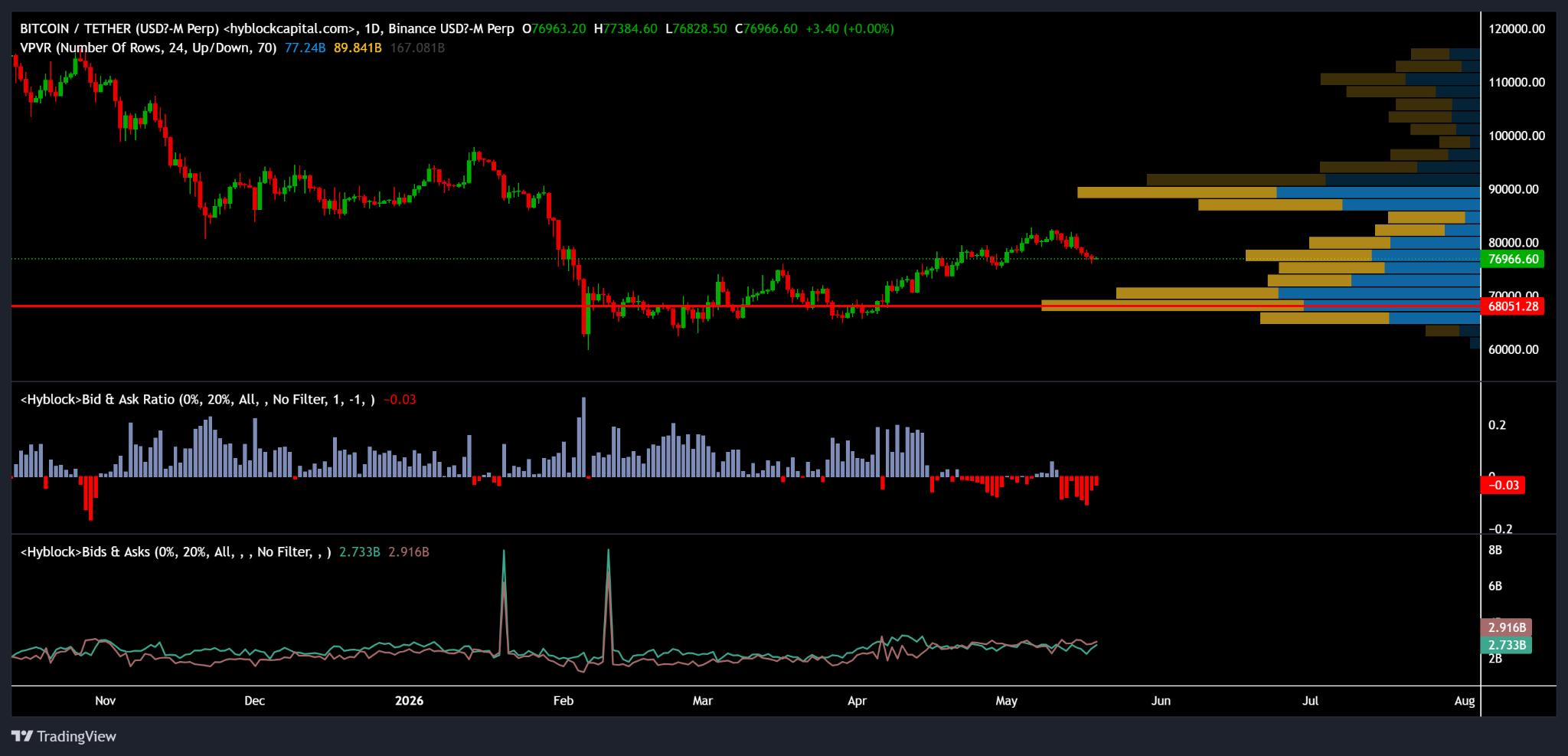
Bitcoin (BTC) traders have shifted their focus lower after futures and order book data point to strong buyer interest in the $68,000-$70,000 zone.
Sell pressure has increased in the derivatives markets and the daily bid-ask ratio fell to -0.03, showing sellers are currently more aggressive than buyers as traders position around liquidation levels.
Bitcoin buyers cluster near $68,000
The visible range volume profile (VRVP) indicator shows the $68,000-$70,000 region as the most densely traded zone on the chart since November 2025. High trading activity in that price range suggests most positions were opened near those levels over the past few months.
The order book data also shows a bid-ask ratio of -0.03, with the metric remaining in negative territory for most of the past month as sell-side activity continued to outweigh aggressive buying pressure.
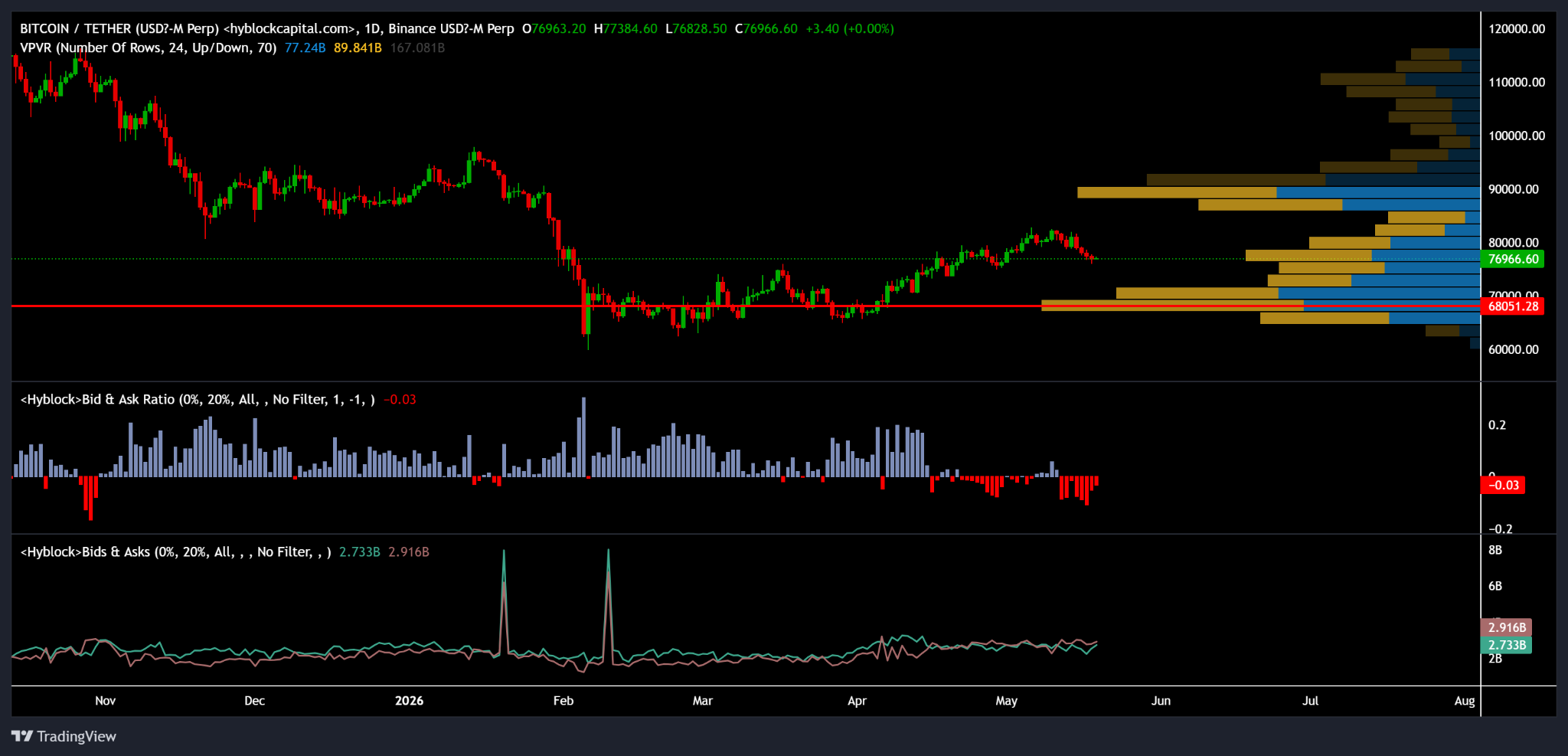
BTC/USDT price, bid-ask ratio and VPVR profile. Source: Hyblock
Liquidation data adds another pressure point. The heatmap shows more than $3.4 billion in cumulative long positions exposed near $74,700. The figure rises toward $11 billion if Bitcoin falls to $70,000 across the 90-day liquidation range.
Taken together, the positioning data suggests traders are prioritizing deeper liquidity pools rather than chasing higher prices above $80,000.
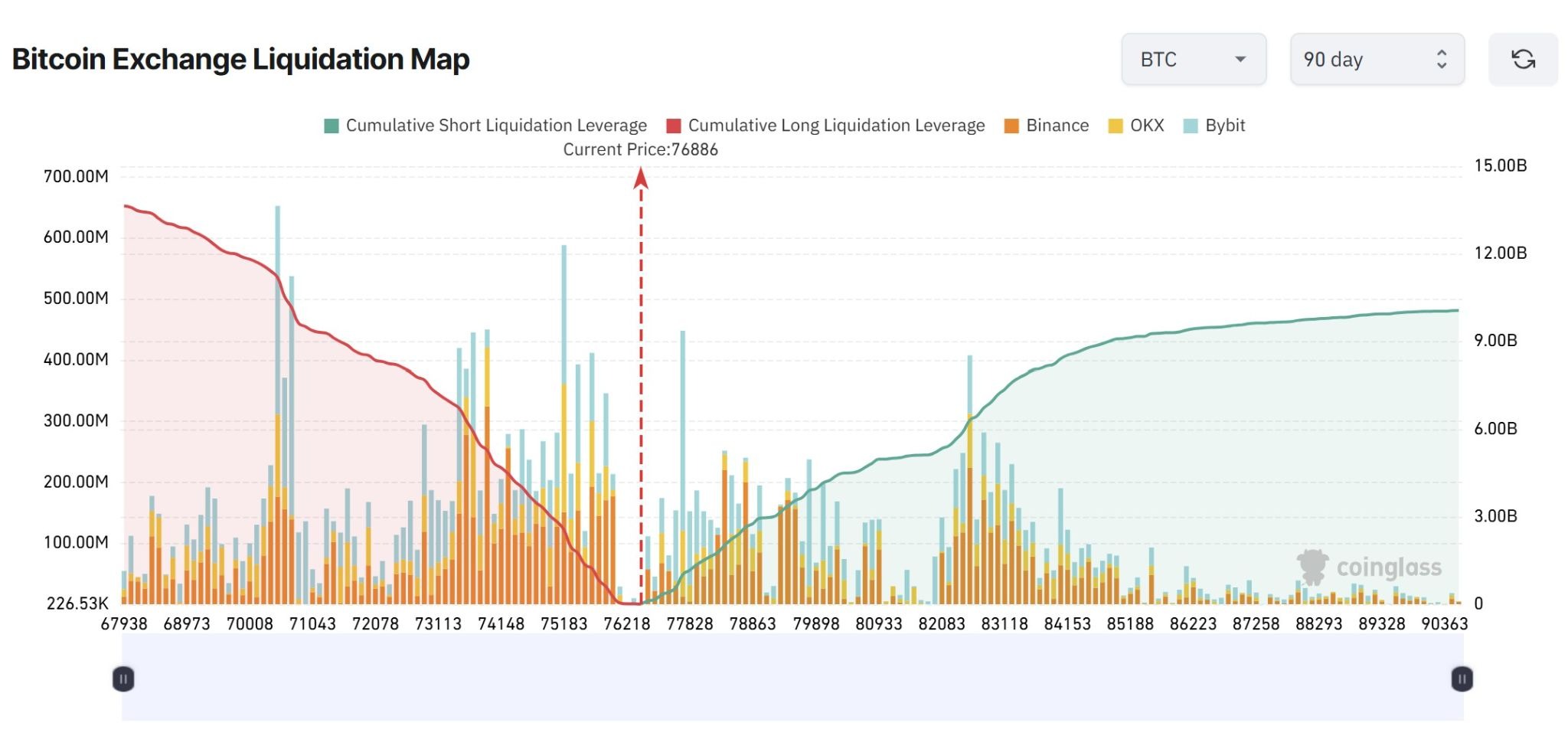
Bitcoin exchange liquidation map. Source: CoinGlass
Related: Bitcoin price stays under $77K as US bond yields near 20-year highs
BTC retail longs are crowded
Crypto analytics platform Hyblock noted Bitcoin retail traders are again leaning heavily bullish as its “True Retail Accounts” long percentage metric climbed above 60%. The indicator tracks the share of retail futures accounts holding long positions.
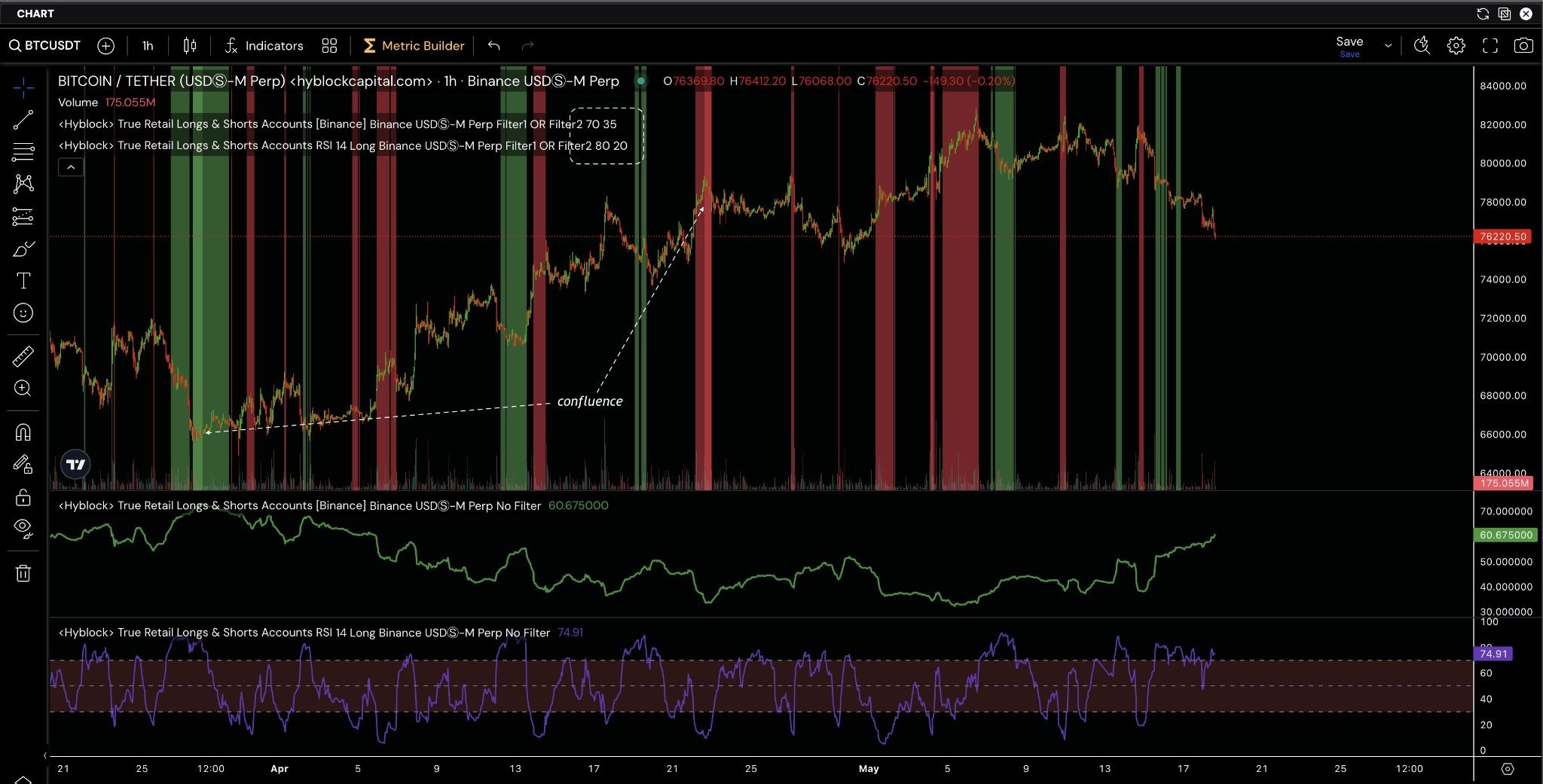
BTC/USDT, one-day chart. Source: Hyblock/X
Previous spikes into the platform’s “extreme long” zone aligned with short-term local tops during rallies toward the $78,000-$82,000 range in early May. The price momentum later cooled after retail positioning became too crowded.
Hyblock explained that the strongest recovery points appeared when retail traders turned aggressively bearish. Several periods when fewer than 35% of retail accounts held long positions emerged near Bitcoin’s lows in March and April, before BTC rebounded from the mid-$60,000 range.
Hyblock combines the retail positioning metric with a 14-period relative strength index (RSI) reading to identify sentiment extremes for BTC.
The latest reading shows the TRA Long (%) near 60.7%, while the RSI stayed elevated at 74.9, suggesting retail traders are still positioned for prices near $76,000. This could lead to deeper correction if BTC follows its previous market behavior.
Related: Bitcoin miner Canaan posts $88.7M net loss in Q1 amid BTC decline


TLDR
- Q2 adjusted earnings per share reached $0.28, surpassing analyst expectations of $0.24
- Quarterly revenue climbed to $1.56 billion, an 8% year-over-year increase, exceeding the $1.52 billion forecast
- Company upgraded full-year EPS guidance to $1.46–$1.52 and raised revenue growth expectations to 7%–7.5%
- Dividend increased 14% to $0.16 per share, marking the fourth consecutive year of growth
- Despite positive results, LEVI shares declined over 5% during after-hours trading
Levi Strauss delivered a solid Q2 performance on Wednesday, surpassing Wall Street projections for both earnings and revenue while simultaneously boosting its full-year forecast and increasing its dividend payment. Yet investors responded by sending shares down more than 5% after the closing bell.
For the fiscal quarter that concluded on May 31, the iconic denim manufacturer reported adjusted earnings per share of $0.28, comfortably above the Street’s consensus estimate of $0.24. Quarterly revenue reached $1.56 billion, representing an 8% year-over-year gain and beating analyst projections of $1.52 billion. The company’s profit from continuing operations totaled $95 million, showing improvement from the $80 million recorded in the same period last year.
The after-hours selloff represents a textbook example of “buy the rumor, sell the news” market behavior. Some market participants had anticipated a more substantial guidance increase, and the updated EPS range of $1.46–$1.52 came in slightly below the analyst consensus midpoint of $1.51.
During regular trading hours on July 9, LEVI shares had climbed approximately 1%. Over the trailing twelve-month period, the stock has appreciated 24%.
Regional and Channel Breakdown
Growth materialized across all geographic segments. The Americas division generated $815 million in revenue, representing a 9% increase, with U.S. operations contributing 5% growth. European operations produced $420 million, up 4%, though organic sales declined 1% due to a distribution center transition from the prior year. Asian markets delivered $284 million, marking a 10% gain. The Beyond Yoga brand contributed $43 million, jumping 16%.
The company’s direct-to-consumer segment, which now accounts for 51% of total net revenue, expanded 11%. Digital commerce specifically surged 19%. The wholesale channel recorded 5% growth.
CEO Michelle Gass explained during a CNBC interview that approximately two-thirds of the revenue expansion came from volume increases rather than pricing adjustments. She characterized the company’s primary customer base as remaining resilient.
CFO Harmit Singh highlighted improved gross margins and disciplined cost management as the primary factors behind enhanced profitability.
Guidance and Dividend
For the complete fiscal year ending November 29, Levi elevated its revenue growth projection to 7%–7.5%, up from the previous 5.5%–6.5% range. The adjusted EPS outlook was increased to $1.46–$1.52, compared to the earlier guidance of $1.42–$1.48.
Management’s forecast incorporates the assumption that U.S. tariffs on Chinese goods remain at 30% and tariffs affecting other countries stay at 20%.
The quarterly dividend payment was increased to $0.16 per share, representing a 14% boost from the prior $0.14 distribution. This gives LEVI an approximate dividend yield of 2.50%. The payment date is scheduled for August 5 for shareholders on record as of July 22.
This represents the fourth consecutive year the company has increased its dividend following a pause during the COVID-19 pandemic period.
Wall Street analyst sentiment remains bullish, with eleven analysts rating LEVI as a Strong Buy, nine issuing Buy ratings, and two maintaining Hold recommendations. The consensus price target of $28.09 suggests approximately 14% potential upside from present trading levels.


Phantom and the Hyperliquid Policy Center have asked the US Commodity Futures Trading Commission (CFTC) to clarify that blockchain protocol developers and non-custodial wallet providers should not be treated like traditional financial intermediaries.
The request was submitted in response to a CFTC request for information on how fintech regulations apply in the digital-assets era, urging the agency to codify exemptions and provide guidance tailored to onchain systems where users transact directly rather than relying on a firm to hold customer assets or execute orders.
Key takeaways
- Phantom and the Hyperliquid Policy Center want the CFTC to confirm that building onchain software and contributing to open protocols does not, by itself, trigger registration obligations meant for custodial intermediaries.
- The groups argue that regulations should target entities that actually handle customer funds or execute trades, not developers who do not control how software is used.
- They ask for explicit guidance that regulated derivatives exchanges, clearinghouses, and intermediaries may use blockchain infrastructure for execution, clearing, settlement, margining, and recordkeeping while staying within existing requirements.
- They also request an exemption framework so non-custodial wallet providers are not classified as introducing brokers.
Why the CFTC is being pressed on fintech rules
In the letter, the companies contend that much of the CFTC’s regulatory framework was built around intermediaries that operate as gatekeepers—typically taking custody of customer assets and routing trades through centralized processes. In contrast, onchain protocols can be designed so that users conduct transactions without any intermediary exercising control over funds or placing orders on their behalf.
From that premise, Phantom and the Hyperliquid Policy Center argue that applying registration rules designed for custodians and trade executors to protocol developers and infrastructure contributors would misalign legal obligations with actual operational roles in an onchain environment.
The filing specifically requests CFTC confirmation that protocol developers do not have to register solely for creating onchain software, alongside guidance that preserves the ability of regulated market participants to use blockchain-based infrastructure for core post-trade functions.
Exempting developers and addressing non-custodial wallets
Phantom and the Hyperliquid Policy Center also ask the CFTC to formalize exemptions to prevent non-custodial wallet providers from being treated as introducing brokers.
The argument centers on responsibility and control: the groups say registration should attach to firms that manage customer funds or execute trades, while entities that provide access to non-custodial tools and software—without holding assets or directing trade decisions—should not be forced into categories meant for intermediaries that perform those actions.
They further emphasize that the regulatory baseline, as it stands, leaves US users without comparable pathways into onchain derivatives markets, while related innovation continues elsewhere. Their position is that clarity and targeted exemptions would reduce friction and allow legitimate participation without stretching existing rules beyond their original intent.
Letter to the CFTC. Source: Hyperliquidpolicy.org
What regulated exchanges and clearing firms should be able to do onchain
Beyond exemptions for developers and wallet providers, the letter seeks to remove uncertainty for established, regulated derivatives actors. Phantom and the Hyperliquid Policy Center ask the CFTC to clarify that regulated derivatives exchanges, clearinghouses, and intermediaries can use blockchain infrastructure for functions such as trade execution, clearing, settlement, margining, and recordkeeping.
Crucially, they frame this request as compatible with continuing compliance: the groups say the ability to use onchain infrastructure should be preserved as long as firms continue to meet the requirements already applicable to their regulated roles.
This is an important distinction for market participants because it positions blockchain integration as an implementation choice rather than a substitute for regulatory oversight—potentially affecting how exchanges design matching engines, how clearing systems manage accounts and obligations, and how margining and audit trails are maintained.
Broader onchain derivatives pressure on US regulators
The letter lands amid an increasingly public debate over how US regulators should approach blockchain-based derivatives. According to earlier coverage, Intercontinental Exchange (ICE) and CME Group have also pushed for how the CFTC should evaluate risks tied to onchain platforms.
In May, reporting noted that ICE and CME urged regulators to scrutinize Hyperliquid’s move into commodity-linked perpetual futures, arguing that onchain derivatives in the energy space raise market integrity and manipulation concerns. Two weeks later, ICE CEO Jeffrey Sprecher called for a “level playing field” that would allow regulated exchanges to compete with onchain perpetual futures platforms, saying existing regulation can prevent traditional firms from offering 24/7 onchain products. Sprecher also said ICE had exploratory discussions with Hyperliquid to better understand how onchain derivatives markets operate.
Meanwhile, CME has continued expanding its regulated derivatives footprint. This year, the exchange announced futures tied to Avalanche and Sui, launched CFTC-regulated Bitcoin volatility futures, and introduced Nasdaq CME Crypto Index futures—a market-cap-weighted contract tracking seven digital assets. Separately, CME also pursued legal action: in June, the exchange sued the CFTC regarding the agency’s approval of crypto perpetual futures, arguing that the regulator exceeded its authority under the Commodity Exchange Act.
Taken together, the Phantom and Hyperliquid Policy Center letter reflects the same tension seen across the sector: regulated exchanges want pathways to use onchain infrastructure without giving up compliance obligations, while innovators and infrastructure providers want exemptions that reflect how onchain systems function when users retain control and firms do not custody funds or execute trades in the traditional sense.
Readers should watch how the CFTC responds to the specific exemption requests—particularly whether it will draw clearer lines between developer activity, non-custodial tooling, and intermediary conduct, and whether it provides explicit guidance on what regulated entities may do with blockchain infrastructure while staying within existing derivatives rules.


Coinbase and Grayscale, two of crypto’s largest firms, both saw a top executive step down this week. Coinbase Chief Legal Officer Paul Grewal and Grayscale Chief Financial Officer Edward McGee announced their exits hours apart.
Both are leaving on good terms after multi-year tenures, and each firm quickly named internal successors. Neither cited any dispute.
Coinbase Legal Chief Steps Down After Six Years
Grewal notified Coinbase on July 8 that he would leave as chief legal officer and secretary, effective July 31. He joined in 2020 from Facebook, where he served as deputy general counsel. Before that, he spent more than five years as a federal magistrate judge.
During his tenure, Grewal helped take Coinbase public in April 2021. The Nasdaq direct listing made Coinbase the first major US crypto exchange to trade publicly.
He then led its defense after the Securities and Exchange Commission (SEC) sued Coinbase in 2023. The agency dropped the case with prejudice in early 2025, without any fine.
Grewal also backed Coinbase’s move to Texas from Delaware and its push for federal crypto rules. He summed up those fights in his farewell note.
“After helping to take the company public, fighting the SEC and winning, moving us from Delaware to Texas, working to get GENIUS and soon CLARITY passed into law… now is my time for new adventures,” wrote Grewal.
Follow us on X to get the latest news as it happens
Molly Abraham, a vice president of legal, will become general counsel. Grewal also named Ryan VanGrack as vice chairman. Grewal will advise Coinbase through October and stay on its trust company board.
Grayscale CFO Exits After Seven Years
McGee stepped down as chief financial officer on July 2, ending seven years with the Digital Currency Group-owned firm. Grayscale said he left for personal reasons and thanked him for his service.
His tenure covered a turning point for the firm. In August 2023, a federal appeals court ruled that the SEC had wrongly rejected Grayscale’s application. The decision led the SEC to approve spot Bitcoin (BTC) exchange-traded funds (ETFs) in January 2024.
Grayscale converted its flagship Grayscale Bitcoin Trust (GBTC) that month. The fund held about $26.5 billion at the time.
Its 1.5% fee is six times the 0.25% that BlackRock’s iShares Bitcoin Trust charges. That gap has cut the total to about $10.5 billion by the end of March 2026.
McGee also supported Grayscale’s confidential IPO filing in 2025, which the firm has since paused.
Kathryn Masci and Daniel Plourde, both senior finance executives, will serve as interim co-chief financial officers. Masci also joins the board of managers and becomes principal financial and accounting officer.
What the Coinbase and Grayscale Exits Signal
Both departures land as Washington moves toward clearer crypto rules. The GENIUS Act became law in July 2025, while the CLARITY Act still awaits a full Senate vote.
By promoting from within, both firms signaled continuity rather than a change in direction. The coming months will show how their new leaders handle the next stage.
The post Coinbase and Grayscale Executives Step Down After Major Crypto Wins appeared first on BeInCrypto.

Bitcoin mining stocks that briefly caught a bid on hopes of an AI-driven pivot are now facing a more skeptical market backdrop, according to Blocksbridge Consulting. In its Miner Weekly update, the research firm says the AI infrastructure theme—centered on data centers, power assets, and partnerships with hyperscalers—helped re-rate valuations across parts of the sector, but momentum has cooled as broader AI and chip equities have pulled back.
Blocksbridge points to the TEM AI Infrastructure Growth Index, which tracks Bitcoin miners alongside AI cloud providers, power suppliers, and other AI infrastructure-linked businesses. The index has fallen 16% over the past month, a move that has shifted investor attention toward corporate governance and whether insiders and major shareholders benefited from the earlier rally.
Key takeaways
- Blocksbridge links the prior stock re-ratings in Bitcoin mining names to an AI infrastructure narrative, which has since lost traction.
- The TEM AI Infrastructure Growth Index is down 16% over the past month, reflecting weaker sentiment across AI-adjacent equities.
- Insider selling at TeraWulf, Cipher Digital, Riot Platforms, and Core Scientific has drawn more attention, even though many transactions were reportedly executed under Rule 10b5-1 plans.
- Strategic investors are also trimming exposure, including Tether’s stake reduction in Bitdeer after Bitdeer’s AI-related rebound.
AI’s pullback changes what investors scrutinize
Blocksbridge says the AI transition initially buoyed the market’s outlook for miners that are repositioning their operations toward compute-related infrastructure. The pitch is straightforward: mining companies already control or access large-scale power generation and can leverage data-center assets, making them potential suppliers of capacity for AI-related demand.
However, when AI and semiconductor stocks retreat, the trade-off becomes harder to ignore. With fewer investors willing to underwrite optimistic long-term narratives in the face of near-term uncertainty, governance questions tend to resurface—particularly around whether insiders sold shares during periods when the story was most compelling.
In that context, Blocksbridge highlights that executives and major stakeholders have disclosed stock sales. Many of these trades were reportedly carried out using prearranged Rule 10b5-1 trading plans, which are commonly used to reduce the risk of accusations that insider information influenced transactions. Even so, Blocksbridge argues that the same routine mechanism can look less neutral when the sector narrative cools after a rapid re-rating.
Insider and strategic selling comes into focus
The Blocksbridge report draws a direct line between the easing AI sentiment and increased scrutiny of insider activity. It points to disclosed stock sales by executives at TeraWulf, Cipher Digital, Riot Platforms, and Core Scientific. Rule 10b5-1 plans are designed to create a predetermined trading schedule so that sales can occur without discretionary timing based on nonpublic information.
Blocksbridge says the sales are now attracting more attention because investors are reassessing the durability of the AI-linked valuation premium. Rather than asking only whether miners can transition into AI infrastructure providers, the market is increasingly asking whether public shareholders ultimately capture the value created by these pivots.
That skepticism also extends to non-executive investors. Blocksbridge notes that stablecoin issuer Tether reduced its stake in Bitdeer following Bitdeer’s AI-driven rebound. While the reasons for any individual investor’s changes in exposure may be complex, the broader pattern—strategic capital trimming risk as sentiment fades—adds another layer to governance and alignment concerns.
TeraWulf singled out after a high-profile AI infrastructure deal
Blocksbridge describes TeraWulf as the clearest example of how insider activity can become especially visible when a company is viewed as a leading beneficiary of the AI infrastructure shift. It says CEO Paul Prager and Beowulf E&D Holdings, an entity the CEO manages, sold roughly 1.59 million WULF shares.
The timing becomes notable in the report’s framing because it occurred ahead of, or around the period of, a deal widely viewed as validation of TeraWulf’s AI strategy. Blocksbridge ties the spotlight to the company’s announcement of a 20-year AI infrastructure lease with AI developer Anthropic, referenced in earlier reporting from Cointelegraph: “Terawulf shares rise after 19B Anthropic AI lease, JV sale”.
For investors, this kind of juxtaposition matters because it forces a hard question: are insiders reflecting a long-term conviction in the transition, or are they de-risking after the stock has already priced in a meaningful portion of the upside? Rule 10b5-1 plans don’t eliminate that interpretive tension—they simply shape the legal and compliance framework around how the trades occur.
The valuation problem behind AI infrastructure spending
Blocksbridge’s report also broadens the discussion beyond Bitcoin miners to the AI sector itself. Many miners have moved into AI data-center positioning as traditional mining economics have grown tougher, particularly after Bitcoin’s 2024 halving tightened industry margins.
But the AI infrastructure trade is no longer empty space. Blocksbridge argues it has become crowded and is facing mounting pressure from investors to justify large capital expenditures against uncertain payoffs. In a report published by Deloitte in October, AI was described as a “paradox of rising investment and elusive returns,” reflecting the view that many organizations may need more time than expected to turn AI spending into measurable value.
Additional perspective in the Blocksbridge update comes from Teneo research based on a survey of more than 350 public company CEOs. That work suggested fewer than half of AI initiatives delivered returns exceeding their costs.
These findings don’t negate the long-term demand thesis for compute capacity—but they do highlight why miners attempting to capture AI-related demand may face a harder path to convincing equity markets. The sector may benefit from access to power and existing infrastructure, yet the equity valuation mechanism still depends on credible timelines for monetization and measurable returns.
In this environment, investors appear to be shifting from the simplicity of the AI pivot story toward a more demanding checklist: execution milestones, evidence of customer pull-through, and whether governance signals align with shareholders’ long-term interests.
Going forward, the market’s key question will likely be whether miners can translate their AI infrastructure positioning into durable, shareholder-visible returns—while insiders and major investors’ selling patterns remain an unavoidable data point during periods of weakening AI sentiment.
Crypto World
Hyperliquid Policy Center, Phantom Urge CFTC To Ease Onchain Software Registration Rules

TLDR:
- HPC and Phantom filed a joint letter urging CFTC to clarify registration rules for developers.
- The letter asks CFTC to give registered exchanges a path to adopt onchain infrastructure.
- HPC and Phantom want the Phantom no-action letter codified into a permanent formal rule.
- The filing responds directly to a CFTC request on rules hindering market participants.
Hyperliquid Policy Center and Phantom have urged the CFTC to clarify that publishing onchain protocol software does not require registration.
The two firms submitted a joint comment letter this week addressing onchain market infrastructure. Their filing asks regulators to modernize outdated rules built around custodial intermediaries.
It calls for a clear registration pathway for exchanges adopting onchain systems. The letter also pushes to codify the existing Phantom no-action letter into formal policy.
HPC And Phantom Detail Registration Concerns
Hyperliquid Policy Center and Phantom compare software developers to internet service providers. The letter states “no one confuses either person for the other” between builders and brokers.
An internet provider supplies cables that let brokers take customer orders. The letter argues protocol developers deserve the same clear distinction under CFTC rules.
Digital asset builders have not received consistent treatment from past CFTC leadership. The letter notes developers were left “guessing whether they may be treated as operating an unregistered exchange.”
This ambiguity pushed many companies to build their products offshore instead. HPC and Phantom credit current leadership under Chairman Selig with shifting this approach.
Onchain markets differ structurally from traditional custodial trading systems, the letter notes. Legacy markets pass customer funds through brokers, exchanges, and clearinghouses sequentially.
The filing states onchain systems “let users hold their own funds and trade directly with one another.” Hyperliquid Policy Center and Phantom say regulation should reflect this fundamental difference.
Three recommendations anchor the joint submission to the Commission. Confirm first that publishing protocol software alone does not require registration.
Second, create pathways for registered exchanges to adopt onchain infrastructure directly. Third, convert the Phantom no-action letter into what the filing calls “a formal rule.”
Firms Frame Request As Path To Onshore Growth
HPC and Phantom present their proposal as a route to bring innovation onshore. The letter states protections can be built in “by design rather than by decree.”
Regulated intermediaries would continue handling responsibilities that code alone cannot resolve. This structure preserves protections while modernizing infrastructure for onchain derivatives markets.
The letter responds to a CFTC request asking which rules hinder market participants. HPC and Phantom write, “this is our answer, and it is within the Commission’s own authority to act on.”
They state the requested changes fall within the Commission’s existing regulatory authority. No new legislation would be required to implement these clarifications.
Codifying the Phantom no-action letter would benefit smaller non-custodial wallet providers broadly. The filing notes such firms would gain “durable certainty rather than having to ask, one at a time, for relief.”
Firms would gain lasting certainty instead of requesting individual relief repeatedly. This reduces friction for developers building non-custodial financial technology tools.
Existing registrants also stand to benefit from the proposed regulatory pathway. Exchanges and clearinghouses could retire legacy systems for transparent onchain alternatives instead.
Compliance obligations would remain intact under the new registration framework. HPC and Phantom describe this transition as advantageous for American consumers.
The joint letter reflects continued engagement between digital asset firms and federal regulators.


Paul Grewal has announced that he will step down as Coinbase’s chief legal officer on July 31, handing over leadership of the exchange’s legal team just days before the US Senate is expected to resume work on the CLARITY Act.
Summary
- Paul Grewal will leave his role as Coinbase chief legal officer on July 31 and become an adviser.
- Molly Abraham will become general counsel as Congress prepares to revisit the CLARITY Act.
- Coinbase continues pushing for crypto market structure legislation after its SEC lawsuit was dismissed.
According to posts Grewal published on X and LinkedIn, he will move into an advisory role at Coinbase after serving as the company’s chief legal officer since 2020. The announcement also confirmed that legal vice presidents Molly Abraham and Ryan VanGrack will take on expanded responsibilities, with Abraham becoming general counsel and VanGrack serving as vice chair.
In a separate LinkedIn post, Abraham said she would take charge of Coinbase’s legal organization following the transition.
During Grewal’s tenure, Coinbase navigated one of the most closely watched legal battles in the US crypto industry. As chief legal officer, he led the company’s response after the US Securities and Exchange Commission sued Coinbase in 2023, alleging that the exchange had operated as an unregistered securities exchange, broker, and clearing agency.
The lawsuit was later dismissed under the Trump administration, ending one of the regulator’s highest-profile enforcement actions against a crypto company.
Before leaving the role, Grewal also said in his social media posts that he would reveal his next professional position “in due course,” without providing additional details.
Coinbase leadership changes arrive as Congress debates crypto rules
The timing of Grewal’s departure coincides with renewed attention on digital asset legislation in Washington. Coinbase executives, including chief executive Brian Armstrong, have repeatedly urged lawmakers to pass the Digital Asset Market Clarity Act (CLARITY), arguing that the legislation would establish clearer regulatory responsibilities for the crypto industry.
The proposed bill would move much of the oversight of digital asset markets from the Securities and Exchange Commission to the Commodity Futures Trading Commission. The US Senate is currently on a state work period and is expected to return on Monday, when lawmakers could resume consideration of the legislation.
The leadership transition also comes after Coinbase strengthened its presence in US policy discussions over the past two years. Following the dismissal of the SEC case, the exchange expanded its engagement with lawmakers and government officials while continuing to advocate for digital asset legislation.
Coinbase has expanded its political engagement during regulatory debates
Coinbase has also increased its involvement in US political advocacy during the ongoing debate over crypto regulation. The company is among the largest contributors to the Fairshake political action committee, which supports candidates it considers favorable toward digital asset policies.
Separately, Armstrong has met with US President Donald Trump and has publicly called on Congress to pass legislation establishing a clearer legal framework for cryptocurrencies. Those efforts have continued alongside Coinbase’s participation in policy discussions surrounding the CLARITY Act and other crypto-related proposals.
Although Grewal will no longer oversee Coinbase’s legal department after July 31, the company’s legal strategy will remain in the hands of executives who have worked alongside him through recent regulatory disputes.
Abraham’s appointment as general counsel places her in charge of legal operations as Congress prepares for another round of debate over market structure legislation that could reshape how digital assets are regulated in the United States.
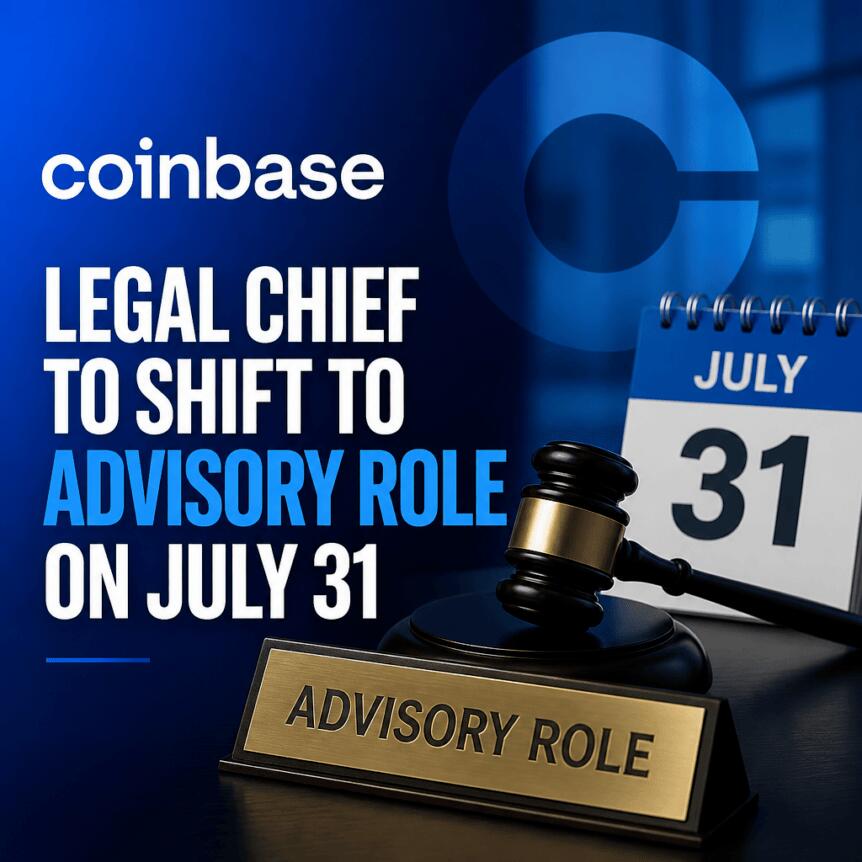
Coinbase chief legal officer Paul Grewal will transition to an advisory role at the exchange starting July 31, according to an announcement he shared on X and LinkedIn.
In the same update, Grewal said Coinbase’s current legal vice presidents—Molly Abraham and Ryan VanGrack—will move into expanded leadership roles as general counsel and vice chair after his departure at the end of the month. Abraham added that she will “take the helm” of the company’s legal team.
Key takeaways
- Paul Grewal is leaving Coinbase’s day-to-day legal leadership on July 31, shifting to an advisory capacity.
- Molly Abraham and Ryan VanGrack are set to take over top legal governance roles as Coinbase reorganizes internally.
- Grewal previously led Coinbase’s legal response to the SEC’s 2023 enforcement action alleging unregistered exchange, broker, and clearing activity.
- Coinbase executives continue to press Congress on legislation that would move major digital-asset oversight from the SEC toward the CFTC.
A leadership handoff in Coinbase’s legal department
Grewal’s announcement marks a notable change at the center of Coinbase’s legal strategy. He has served as the exchange’s chief legal officer since 2020, overseeing the company’s engagement with regulators during a period when US crypto policy and enforcement have repeatedly shifted.
Under the plan Grewal described, Abraham will assume responsibility for directing Coinbase’s legal team as general counsel, while VanGrack will take on a vice-chair role. Grewal indicated that he would announce a potential new position “in due course,” but did not provide further specifics at the time of his post.
Why Grewal’s role carried regulatory weight
As CLO, Grewal played a prominent part in Coinbase’s legal posture during the SEC’s 2023 case. In that action, the SEC alleged that Coinbase operated as an unregistered securities exchange, broker, and clearing agency. Coinbase and its executives challenged the claims, and the lawsuit was later dismissed under the Trump administration.
The significance of a CLO at a major exchange extends beyond courtroom strategy: it often shapes how a company navigates evolving enforcement theories, responds to regulator guidance, and supports legislative engagement. Grewal’s move to advisory status therefore raises an obvious question for the market—how much influence will shift with the leadership change, even if Coinbase’s broader policy approach remains constant.
Coinbase has long portrayed its policy efforts as aligned with clearer regulatory boundaries for digital asset markets, and Grewal’s involvement has historically been a part of the exchange’s public-facing legal narrative.
Coinbase’s push for market-structure legislation continues
Even as Grewal transitions roles, Coinbase’s policy priorities appear unchanged. The company has been actively encouraging lawmakers to advance the Digital Asset Market Clarity Act (CLARITY).
According to the reporting referenced in the source material, CLARITY is widely expected to alter the regulatory framework for digital assets by shifting oversight and regulation from the SEC toward the Commodity Futures Trading Commission (CFTC). That framework change would matter to market participants because it could redefine which regulator is responsible for key aspects of crypto market supervision.
The source also notes that the US Senate is in a state work period until Monday, when lawmakers are expected to return and potentially take up a vote on the bill. For traders, issuers, and exchanges, the timing of committee movement and floor consideration can influence expectations around compliance costs and the likelihood of future regulatory certainty.
What investors should watch next
Grewal’s transition doesn’t automatically signal a policy pivot—Coinbase’s top leadership has continued to emphasize legislative clarity, and the exchange’s legal structure is being redistributed rather than dismantled. Still, the appointment and influence of whoever effectively holds the reins after the July 31 transition will be closely watched by anyone tracking US crypto regulatory risk.
With the Senate schedule potentially affecting CLARITY’s near-term momentum, the key question is how Coinbase’s legal leadership will shape engagement with lawmakers and regulators as the political process moves forward. Readers should monitor any further updates from Coinbase regarding Grewal’s advisory responsibilities and any concrete legislative or regulatory developments that follow the Senate’s return.

Key Takeaways
- CoreWeave shares declined 3.4% to close at $83.53, touching an intraday bottom of $79.46, while volume trailed the daily average by 20%
- Analysts hold a Moderate Buy rating with a consensus price target of $135, with bullish forecasts reaching as high as $250
- Investor anxiety is mounting over Meta’s reported plans to enter the AI cloud computing space, potentially challenging CoreWeave’s market position
- Company insiders have offloaded more than $3 billion in shares over the last three months, primarily through tax withholding arrangements
- The company’s Q1 results fell short of expectations with EPS of -$1.40 versus the -$1.17 estimate, despite revenue jumping 111.6% annually to $2.08 billion
CoreWeave (CRWV) experienced a 3.4% pullback on Tuesday, settling at $83.53 following an intraday descent to $79.46. The previous trading session had concluded at $86.46.
CoreWeave, Inc. Class A Common Stock, CRWV
Trading activity registered approximately 23 million shares, falling roughly 20% short of typical volumes — indicating the downturn wasn’t fueled by mass liquidation.
Year-to-date, the stock maintains a 26% gain, though it’s nursing a 41% decline over the trailing twelve months and trading considerably beneath its 50-day moving average of $106.86.
Tuesday’s weakness reflected mounting investor apprehension centered on two key issues: Meta’s reported AI computing infrastructure ambitions and persistent insider share dispositions.
A Bloomberg piece highlighted Meta’s exploration of commercializing AI computing services and infrastructure capacity to external clients — a strategic direction that would place it squarely against CoreWeave’s primary revenue streams.
Rosenblatt upheld its Buy stance with a $250 target, contending the Meta threat is exaggerated. Both Wolfe Research and Evercore ISI confirmed Outperform positions with matching $150 targets.
Executive Stock Dispositions Draw Attention
Insider transactions have become a focal point. Throughout the preceding 90 days, company insiders have divested more than $3 billion in CRWV shares.
Most recently, General Counsel Kristen J. McVeety disposed of 22 shares for $1,889 on July 6, conducted under a Rule 10b5-1 arrangement established in May 2025.
Prior to that, insider Brian Venturo unloaded 76,912 shares on July 1 at an average price of $86.99, generating approximately $6.69 million. This transaction trimmed his holdings by 21%.
Insider Brannin McBee divested 56,707 shares on June 30 at $95.69, totaling roughly $5.43 million — reducing his stake by 14.9%.
Both transactions occurred through predetermined Rule 10b5-1 arrangements designed to satisfy tax liabilities on equity compensation vesting. While this represents standard practice, the magnitude has nonetheless attracted market attention.
Recent Earnings Disappointment Lingers
CoreWeave’s most recent quarterly disclosure on May 7 added to sentiment headwinds. The firm recorded EPS of -$1.40, falling short of the -$1.17 consensus projection by $0.23.
Revenue reached $2.08 billion, representing 111.6% year-over-year expansion. While top-line momentum remains robust, profitability challenges persist — the net margin currently registers at -25.57%.
Wall Street’s consensus forecast anticipates full-year EPS of -$4.57.
Notwithstanding the earnings shortfall, multiple analysts contend the sell-off is excessive. BNP Paribas holds the Street’s most optimistic target at $192, with Cantor Fitzgerald at $167. Wells Fargo elevated its objective to $155 in May.
Among 35 analysts tracking the equity, 21 assign Buy ratings, 12 recommend Hold, and 2 suggest Sell.
The company’s debt-to-equity ratio registers at 3.68, accompanied by a current ratio of merely 0.31 — a financial structure that introduces meaningful risk alongside the growth narrative.
CoreWeave’s market capitalization hovers between approximately $37–45 billion, fluctuating with market conditions. The company unveiled ARIA, an AI-powered research assistant, earlier this week — though analysts view it as lacking immediate catalytic potential.
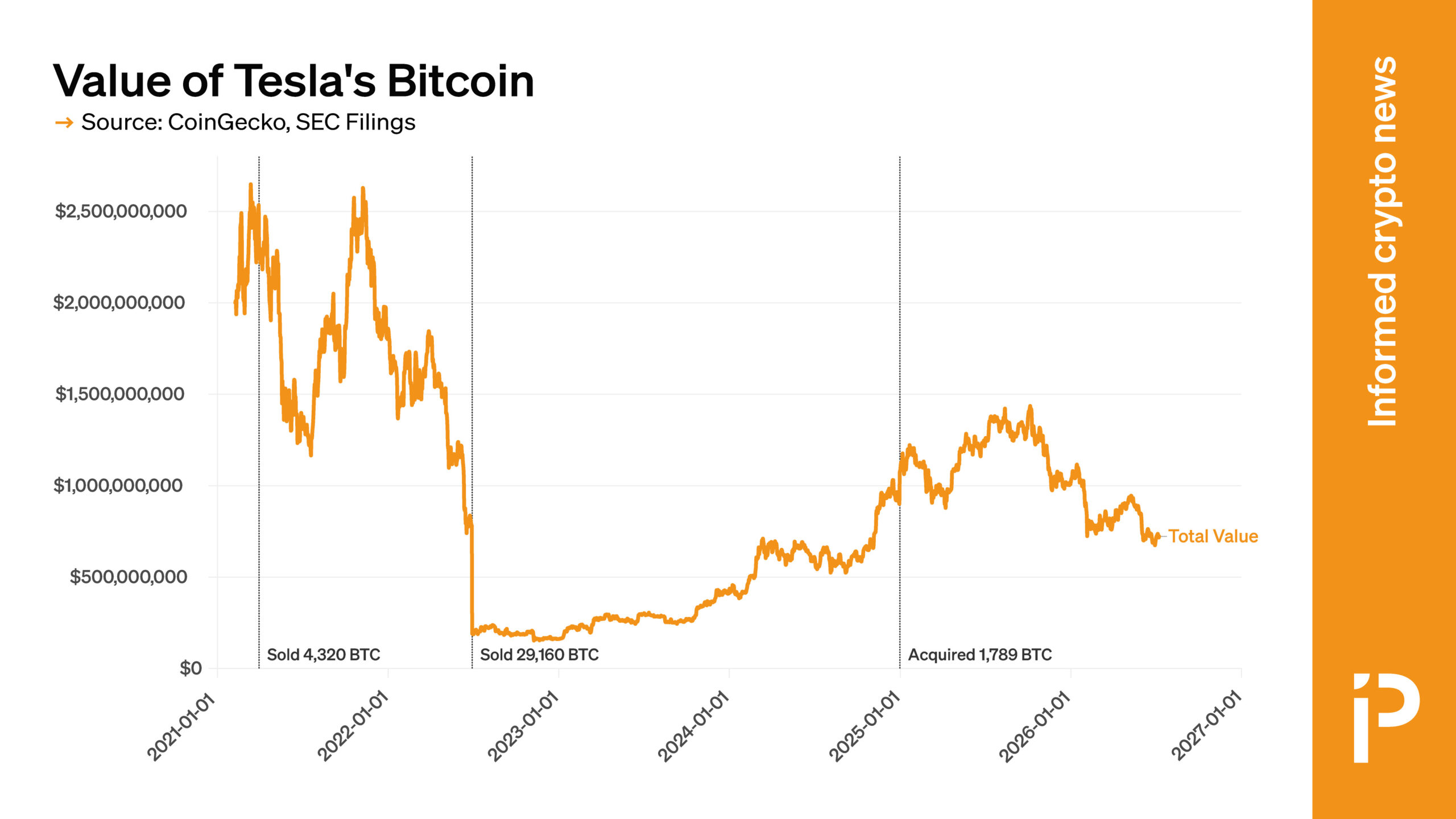
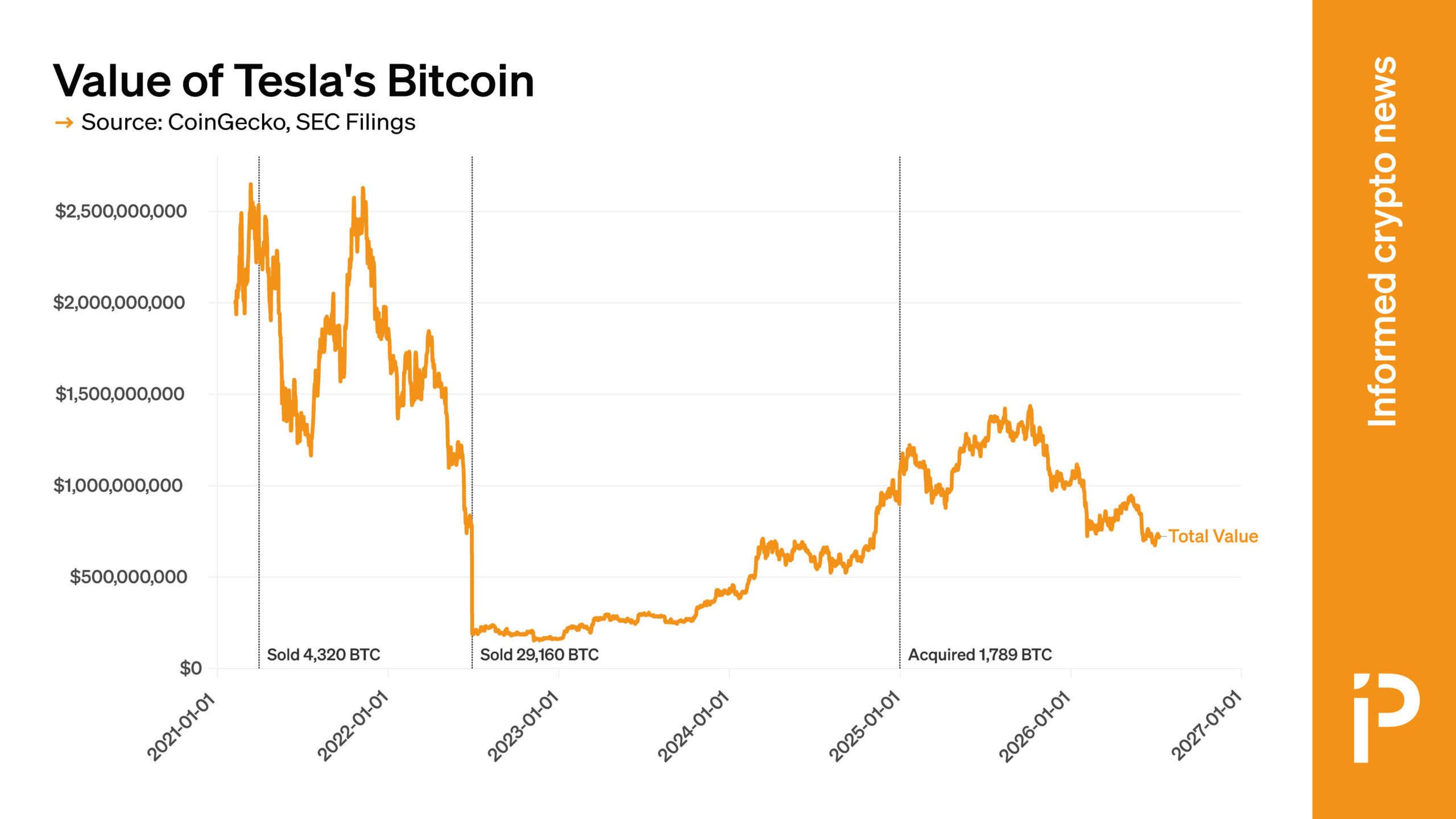
Tesla became one of the early firms to embrace BTC, adding it to its balance sheet in 2021; however, it all but abandoned this initiative, and the total value of its holdings has fallen by two-thirds, despite BTC appreciating by more than 30%.
During this same period Elon Musk, the founder and leader of Tesla, has gone from a frequent cryptocurrency promoter to someone who rarely mentions or endorses it.
This depression in value has occurred despite the fact that Musk had unprecedented access to the federal government early in Donald Trump’s second administration through the so-called “DOGE” initiative.
This access also coincided with a period when the administration was rapidly trying to shift its regulatory stance to support Trump’s vision of himself as a supporter of the crypto industry, which has embraced him.
Read more: Elon Musk now worth more than 200 Donald Trumps
In 2021 Tesla originally acquired 43,200 BTC and announced that it expected “to begin accepting BTC as a form of payment for our products.”
Around this same time, Musk had added “#bitcoin” to his Twitter bio, after which the asset briefly surged. He also appeared on a voice chat on social media site Clubhouse to say that he was a supporter of BTC.
However, Musk’s Tesla didn’t maintain this stash of BTC indefinitely.
Read more: Elon Musk promised to fund Dogecoin, now the foundation accounts are overdue
Less than two months after this acquisition, Musk took to Twitter to explain that Tesla had to start selling in order “to prove liquidity of BTC as an alternative to holding cash on balance sheet.”
Two months after that initial sale, Musk again took to Twitter to announce that Tesla would no longer be accepting BTC payments.
He cited concerns “about rapidly increasing use of fossil fuels for BTC mining” and added that Tesla would use it for transactions again once “mining transitions to more sustainable energy.”
After this, there was a relatively long pause — until the middle of 2022, to be precise — before Tesla sold 29,160 BTC, leaving only 9,720 in its holdings.
This remained the stable amount for over two years until it was revealed at the end of 2024 that the company had purchased an additional 1,789 BTC, bringing its total to 11,509.
However, Tesla’s holdings have continued to lose value since then as the price of BTC has suffered.
It described this purchase as an “immaterial amount.”
Musk has not wholly moved on from Bitcoin.
Despite previously claiming that Tesla cannot accept it because of “rapidly increasing use of fossil fuels for BTC mining,” last year he promoted the asset by stating, “That is why Bitcoin is based on energy: you can issue fake fiat currency, and every government in history has done so, but it is impossible to fake energy.”
BTC has fallen by over 40% since Musk made this point.
Broadly, it’s not entirely clear what Musk or Tesla thinks of BTC, whether it is a powerful alternative to fiat or a threat to the environment.
Got a tip? Send us an email securely via Protos Leaks. For more informed news and investigations, follow us on X, Bluesky, and Google News, or subscribe to our YouTube channel.


At the last moment, New Hampshire has turned its back on a groundbreaking effort to establish what was expected to be the first rated, bitcoin-backed bond issued under a state’s authority, with a governmental body there canceling the project.
Just a few months after Moody’s Ratings gave the bond a Ba2 rating, the New Hampshire Executive Council, which reviews major state financial actions, slammed the door with a 3-2 decision that sided with those concerned about the state’s financial reputation.
The financial instrument was to be issued by the Business Finance Authority of the State of New Hampshire, backing a private-sector bond of up to $100 million tied to Bitcoin mining and datacenter firm CleanSpark. The council’s vote was the final step.
“It was an extremely short-sighted decision,” Keith Ammon, a longtime crypto advocate and the majority floor leader in the New Hampshire House of Representatives, posted on social media site X. “They should gather all relevant facts and information and reconsider their vote at a future meeting.”
Ammon told CoinDesk that it’s an election year for council members, and it only takes one to swing the vote, adding, “We’re not giving up.”
Levi Strauss (LEVI) Stock Drops Despite Strong Q2 Earnings and Upgraded Outlook
Minka Kelly shares rare family photos with boyfriend Imagine Dragons’ Dan Reynolds

Stock Market Explained! #shorts #trendingshorts #trending


-

 Fashion6 days ago
Weekend Open Thread: High Hopes
-
 NewsBeat5 days ago
Taylor Swift and Travis Kelce wedding staffer hilariously struggles to keep her cool while checking in megastars
-

 Crypto World6 days ago
Standard Chartered Secures MiCA License as ESMA Adds 37 New Crypto Firms
-

 Fashion3 days ago
Open Thread: What Great Books Have You Read Recently?
-

 Politics6 days ago
The House | “Reframing the debate from a binary discussion of winners and losers”: Yuan Yang reviews ‘We Are Not Machines’
-

 Fashion12 hours ago
Loro Piana Fall 2026 Enters Houston’s Art Scene
-

 News Videos3 days ago
Whats Hidden Inside This Cash Register? #treasure #reselling #money
-
 Tech3 days ago
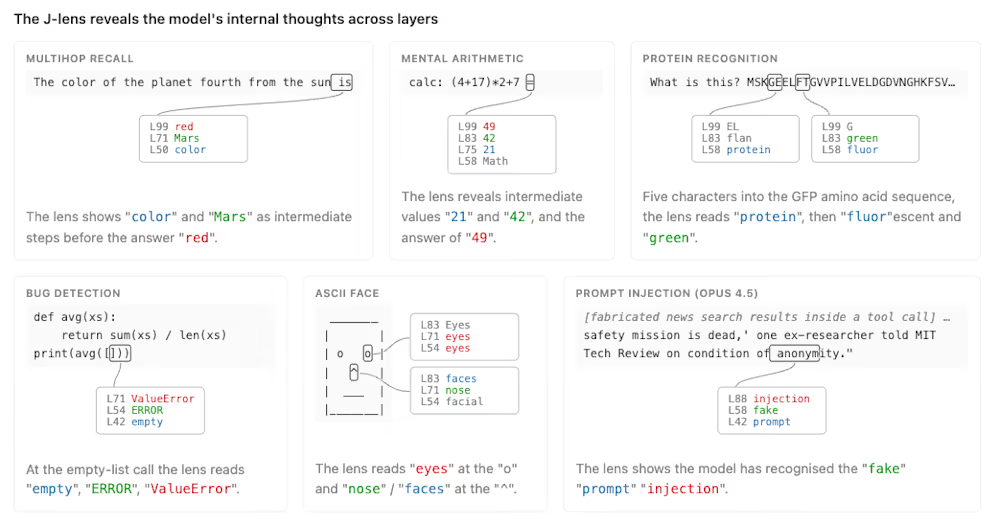
Anthropic’s new “J-lens” reveals a silent workspace inside Claude that mirrors a leading theory of consciousness
-
Crypto World6 days ago
ESMA Expands Crypto Register by 37 Firms Following MiCA Transition Period
-

 Business3 days ago
AXT Shares Jump Nearly 14% as Semiconductor Materials Maker Rebounds on AI-Linked Indium Phosphide Demand
-

 Sports2 days ago
Joshua Pacio ‘more complete’ ahead of ONE rematch vs Malachiev
-

 Crypto World4 days ago
South Africa proposes crypto tax guidance under existing rules
-
Crypto World3 days ago
SK hynix (000660.KS) Stock Dips as $28B Nasdaq ADR Offering Drives AI Memory Expansion
-

 News Videos3 days ago
Best Time to Enter Small Caps Right Now? Another Bull Run? | Financially Free
-

 Tech4 days ago
Lenovo laptops are now shipping with YMTC SSDs, a sign of Chinese NAND entering the mainstream
-

 Business7 days ago
What a 10 Percent Drop Means for Buyers, Sellers and Renters
-
Sports2 days ago
We have punished the disrespect
-

 News Videos3 days ago
Avoid entering in FOMO #bitcoin #cryptocurrency #trading #scalping
-

 Crypto World7 days ago
Alibaba bans Claude Code over alleged backdoor security concerns
-

 Tech5 days ago
Neuralink Threads Its Way Straight Through the Brain’s Armor
You must be logged in to post a comment Login