

Crypto World
Bitcoin Trades Near $60K as US Stocks Rise on Iran Deal Hopes

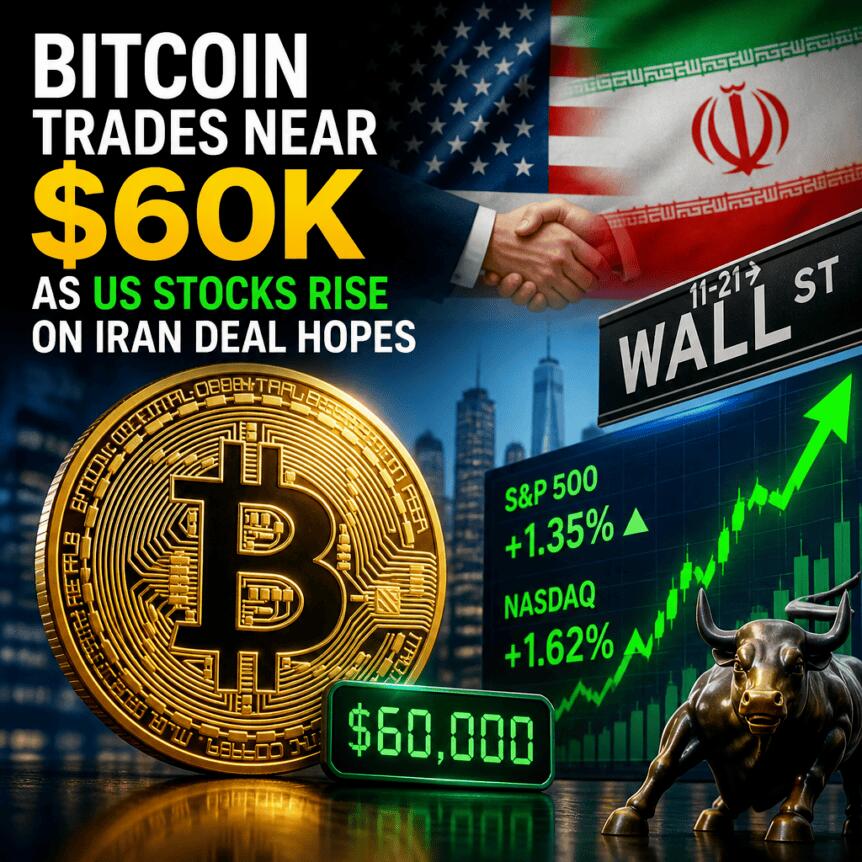
Bitcoin traded cautiously just below and around the $60,000 area as the market opened for another week, with traders increasingly focused on whether that level can flip from resistance back into support. Even as broader risk sentiment improved, analysts pointed to a lack of sustained demand from spot buyers—suggesting the current range may persist until conviction returns.
Monday’s price action also reflected a tug-of-war between crypto and traditional markets. US equities started the session higher on renewed hopes for a US-Iran de-escalation, but Bitcoin’s strength did not clearly keep pace with the pickup in stocks, reinforcing the idea that traders are staying selective rather than chasing.
Key takeaways
- Bitcoin is struggling to reclaim $60,000 as support, leaving the market vulnerable to another range-bound push.
- Improving US risk sentiment tied to an announced US-Iran meeting hasn’t translated into clear, sustained crypto buying.
- Trading commentary suggests a “choppy” tape, with attention on potential moves toward $58,000 or $61,000 if the range breaks.
- Glassnode data indicates buyers have not shown the conviction needed for a sustained recovery, with spot activity still characterized by net selling.
- Oil-price uncertainty remains a potential headwind for crypto risk assets, according to QCP Capital’s market color.
Stocks rise on US-Iran meeting hopes, but Bitcoin holds back
According to TradingView data, Bitcoin’s technical battle around $60,000 continued as price strength failed to match the momentum seen in US equities. The S&P 500 and Nasdaq Composite both began the week higher as sentiment improved around efforts to salvage the US-Iran peace deal.
In a post on Truth Social, US President Donald Trump said Iran had “requested a meeting,” to be held in Doha, United Arab Emirates, on Tuesday. While the announcement lifted the tone for risk assets, Bitcoin remained pinned near a key level that traders have been watching for a decisive shift.
That divergence matters because, historically, Bitcoin often responds to broader liquidity conditions and risk appetite. When equities strengthen but crypto doesn’t follow through, it can signal that either (1) participants are waiting for confirmation, or (2) crypto-specific supply and positioning pressures are outweighing macro tailwinds.
Oil volatility risk stays on the radar
QCP Capital cautioned that even if US-Iran tensions appear to have “stood down for now,” the situation remains uncertain—particularly for oil, which can influence global risk appetite. In its latest Market Color analysis, QCP noted that oil prices were largely stable in the low $70s, implying cautious optimism that tensions may ease.
“However, this relatively muted market reaction also leaves significant upside risk for oil prices should supply recovery prove slower than expected.”
WTI crude had fallen below $68 per barrel for the first time since early March on Friday, but it was back above $70 at the time of writing. QCP also pointed to the likelihood of volatility staying elevated, noting that the US market is set to close on Friday and that the geopolitical situation remains fluid—factors that can amplify moves when liquidity thins.
For Bitcoin traders, this connection is practical: if oil spikes or volatility rises abruptly, it can tighten financial conditions and reduce appetite for risk assets, potentially making it harder for BTC to break out of its current range.
$60,000 remains the pivot as traders watch for range breaks
On the crypto side, short-term price action was described as “choppy,” with momentum struggling to build. Trader Daan Crypto Trades, in an update shared on X, said BTC has been trading around “previous June lows,” and that the $60,000 region has continued to cap price.
“The longer price spends moving around in this region, the bigger the following move upon a range break will be. Eyes on $58K & $61K.”
The significance of those levels is straightforward: when price repeatedly tests a range boundary without a clean breakout, traders often begin to position for an eventual expansion move. That doesn’t guarantee direction, but it raises the probability that a decisive break could be more impactful than the incremental chop seen so far.
On-chain signals point to defensive spot behavior
Glassnode’s latest Market Pulse bulletin added an on-chain dimension to the cautious tone. The analytics platform said Bitcoin buyers have “so far lacked the conviction required to establish a sustained recovery,” leaving price range-bound near local lows.
Glassnode also described the market as being in a “structural adjustment” phase, with capital contracting and participants adopting a more defensive posture. The most notable detail was its assessment of spot flows: despite increased trading activity, Glassnode reported persistent net selling.
“Spot markets are still experiencing persistent net selling despite an increase in trading activity, suggesting that available liquidity is being used primarily to distribute rather than accumulate Bitcoin at current prices.”
While Glassnode noted some signs of “more balanced” data beneath the surface, it warned that supply ownership may be shifting toward more speculative participants. According to the bulletin, that mix can increase the potential for sharper volatility swings—even if Bitcoin appears to be stabilizing around the $60,000 area.
In its summary, Glassnode concluded that a sustained recovery is likely to require a “meaningful return of buyer conviction,” citing continued defensiveness across spot order flow, derivatives positioning, and institutional demand.
That framing is useful for investors and traders because it distinguishes between two common scenarios: (1) price holding up due to technical support while demand remains weak, versus (2) price holding up because real accumulation is building. Right now, the on-chain narrative leans toward the first scenario.
Going forward, traders will likely watch whether spot net selling can fade and whether Bitcoin can convert $60,000 into support. With geopolitical headlines still capable of moving risk sentiment and oil volatility potentially reintroducing uncertainty, the next breakout may depend less on macro optimism alone—and more on whether buyer participation becomes consistent enough to break the range decisively.

David Schwartz, who co-founded the XRP Ledger, has proposed a transaction reservation scheme as a potential fix for front-running on the network’s decentralized exchange and automated market maker.
His proposal was in response to a post from the XRP-focused account XRPresso.io, which argued that validators and well-connected nodes can exploit pre-validation transaction visibility to extract value from regular traders.
Front-Running Concerns on XRPL
According to XRPresso, transfers usually sit in a publicly visible queue before a ledger closes on the XRPL, with validators and some nodes able to see these pending trades. As such, they are in a position to assess whether sandwiching them would be profitable, and then to submit multiple entries to game their position in the final canonical ordering.
And because that ordering is decided by a known, deterministic formula involving transaction hashes, submitting similar entries increases the odds of landing in a favorable slot relative to the target trade. That, as XRPresso claimed, could see everyday users trading through standard wallets and apps getting systematically disadvantaged while more sophisticated operators extract value from their trades.
Schwartz acknowledged that the issue is real but pushed back on parts of the framing. He pointed out that all participants have an equal opportunity to see transfers and argued that validators don’t gain any structural advantage unless several of them conspire. Such an action, he said, would be visible on-chain and lead to the removal of the offending validators from the trust lists.
“If multiple validators did conspire, or a single validator attempted it, it would be *very* obvious to everyone exactly who was doing this,” he wrote.
Furthermore, he said that there have never been any reports of anyone attempting something like that, except as a proof of concept. The biggest issue, according to him, has been profitability, since to make money, the actors would need both high liquidity that would make volumes worth the effort available and low liquidity to move the price measurably and at a reasonable cost.
Still, he offered a solution in which a user would submit a reservation transaction specifying a ledger sequence number and a transaction ID, and pay a reservation fee. If the reservation succeeds and the actual activity is broadcast before that ledger closes, it gets guaranteed priority over any other formed after the original was disclosed.
“This guarantees that you can execute your transaction ahead of any transaction that was formed after your transaction was disclosed,” explained the developer. “You would use this approach any time you want to perform a transaction that you want to ensure cannot be sandwiched or front run.”
The Front-Running Debate in DeFi
XRPresso responded that while Schwartz’s reservation idea is worth exploring, it would add cost and complexity and does not fully address the underlying visibility problem in the pre-validation stage. According to them, targeted confidentiality for the details of pending actions would be a cleaner long-term fix, with such approaches already being used on other chains.
The front-running problem isn’t unique to the XRP ecosystem, and Binance co-founder Changpeng Zhao proposed a dark pool perpetuals DEX last year that uses zero-knowledge cryptography to hide order data until execution. That idea drew criticism too, with some decentralization advocates claiming that hiding order books will just recreate the insider dynamics that crypto was meant to move away from.
The post Ripple CTO Emeritus Unveils Plan to Tackle XRPL DEX Front-Running appeared first on CryptoPotato.
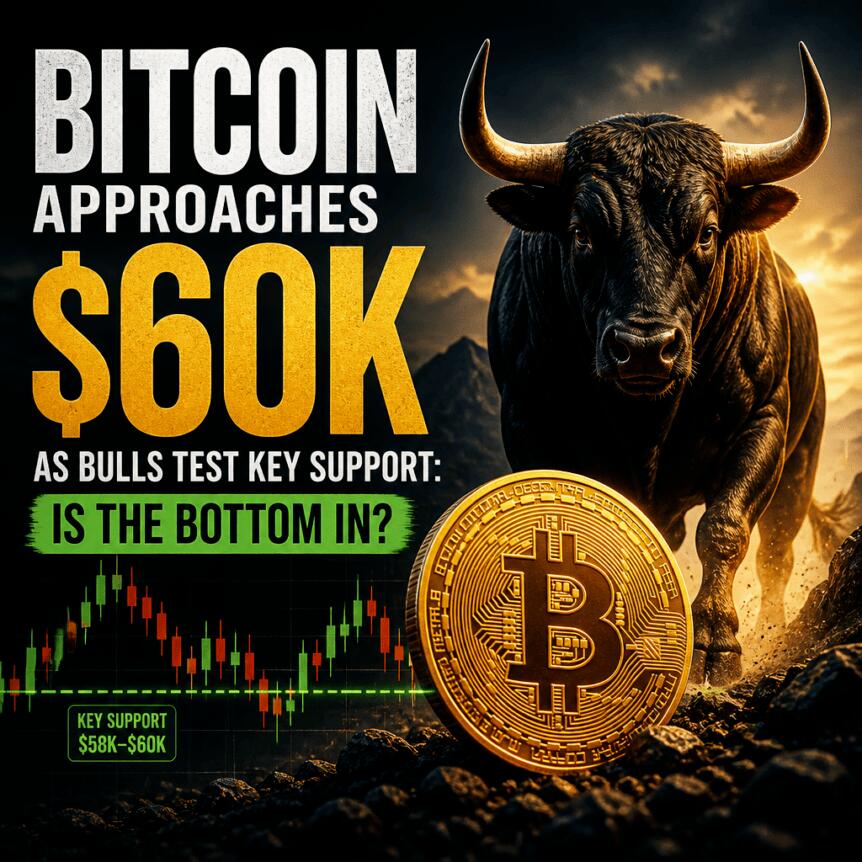
Bitcoin is hovering around a critical decision point, with retail investors leaning toward the exit while parts of the broader market—especially corporate and long-oriented players—appear more willing to wait. At the time of writing, BTC is trading near $60,300, and the market’s behavior suggests hesitation rather than panic or strong risk-on conviction.
Under the surface, multiple signals are pointing to a fragile stabilization: US spot Bitcoin ETF outflows have been a major headwind, leverage dynamics in Bitcoin futures are cooling, and trading activity is subdued as participants wait for the next catalyst.
Key takeaways
- ETF outflows remain a drag: In June, investors withdrew $4.4 billion from US spot Bitcoin ETFs, the worst month this year.
- Institutions are not in “sell mode”: While some buying has slowed, the majority of corporate BTC treasuries have not reduced existing positions, and Strategy continues to buy BTC at a slower pace.
- Leverage is unwinding without chaos: Total open interest across Bitcoin futures is $19.92 billion, down slightly from about $20.1 billion two weeks ago, while long borrowing costs have fallen from 0.25% to 0.12%.
- Downside risk is tied to a specific level: A break below $58,800 is flagged as the “danger zone,” with roughly $500 million of long positions potentially forced out.
- Near-term direction depends on confirmation: Price needs to reclaim $62,000 to improve the odds of a sustained push higher; macro events could quickly reverse sentiment.
Retail pressure meets institutional restraint
The clearest tension in the current setup is between retail sentiment and larger, slower-moving capital. The Crypto Fear & Greed Index sits at 36 out of 100, signaling fear but not total capitulation. That aligns with a market that is not fully breaking—yet capital is still flowing out in meaningful amounts.
According to SoSoValue, June saw investors pull $4.4 billion from US spot Bitcoin ETFs, the worst month so far in 2024. ETF flow data is often a useful proxy for retail and mainstream allocation behavior, and the trend suggests many participants have either de-risked or waited for a better entry.
At the same time, institutional behavior looks more defensive than bearish. The same reporting notes that although Strategy continues to purchase BTC, the pace and size of buying have slowed. Importantly, while ETF and treasury accumulation are not described as a fresh “buying phase,” a majority of corporate BTC treasuries have not reduced their existing holdings. That matters because it reduces the likelihood of a broad, synchronized corporate unwind—one of the catalysts that can accelerate drawdowns.
Futures positioning: leverage unwinds, but confidence isn’t fully restored
While ETF flows paint a cautious picture, Bitcoin’s derivatives data points to gradual deleveraging rather than forced liquidation. Total open interest across Bitcoin futures on all exchanges is reported at $19.92 billion, compared with roughly $20.1 billion two weeks earlier. That change implies risk is being trimmed, but not in a sudden stampede.
Borrowing costs also support the idea that the sharpest stress may have eased. The long funding rate—described here as the cost of holding long positions—has dropped from 0.25% to 0.12%. Lower carry costs can signal fewer participants crowding into longs, but the level still reflects that traders are paying to hold—suggesting they’re positioning for recovery without fully leaning in.
Crucially, a specific downside threshold is being highlighted at $58,800, noted as Bitcoin’s low for the day. If BTC breaks below that level, the market could see a delayed liquidation cascade: an estimated $500 million worth of traders holding long positions may be forced to close. In practical terms, that kind of shift can transform a slow grind lower into faster downside momentum, which in turn can spread selling pressure beyond the initial break.
Why volume is quiet: the market appears to be waiting for a trigger
A common feature of consolidation phases is muted price action accompanied by limited confirmation in the flow and positioning data. Here, trading volume is described as down, and changes in open interest are small—signals that the market may be paused between participants who have already sold and those who want to buy but are not yet convinced.
This “waiting” dynamic can be interpreted in two directions at once. Retail may be done selling for now, but the absence of a volume-led rebound suggests buyers are not willing to step in at size while uncertainty persists. The result is a narrower range where breakouts can fail quickly if the catalyst is missing.
Corporate activity underscores that asymmetry. MicroStrategy reportedly bought 3,600 Bitcoin in June for $236 million, a clear example of a company treating volatility as an opportunity. However, the broader institutional picture is characterized as a hold rather than a surge into accumulation. That pause can keep the market range-bound—until either downside pressure forces risk reduction or renewed confidence brings fresh demand.
What levels and macro events could decide the next move
From a technical standpoint, the article frames $62,000 as a key reclaim level for Bitcoin to make a meaningful upward move. Without that, any rallies may struggle to attract sustained follow-through, especially if ETF outflows continue.
On the downside, the risk is not only price-based but catalyst-driven. The reporting points to potential macro developments that could weigh on sentiment during the week—specifically citing the June employment report and any escalation or resumption of military action related to Iran. Even when crypto-specific demand is the dominant narrative, broader risk appetite often determines whether traders treat pullbacks as buying opportunities or as reasons to step aside.
For now, the market appears suspended between cooling leverage and persistent capital caution. If BTC holds above $58,800, the current pause could evolve into a stabilization phase. If it slips below, the liquidation risk tied to long positioning could accelerate the move toward $56,000, potentially extending pressure into the following week.
Traders and longer-term investors should watch whether ETF outflows continue to improve or worsen, and whether futures positioning remains orderly as Bitcoin tests the $58,800 and $62,000 thresholds—especially around the next macro headline that could quickly change risk appetite.

Key Takeaways
- Alphabet (GOOGL) jumped 3.7% to $350.24 during its inaugural trading session as a Dow Jones Industrial Average constituent, taking over from Verizon Communications.
- The index reshuffle was revealed by S&P Dow Jones Indices on June 23; Alphabet’s elevated share price makes it one of the Dow’s heaviest-weighted stocks.
- With this addition, five of the Magnificent Seven tech giants—Alphabet, Nvidia, Amazon, Apple, and Microsoft—are now Dow components.
- Reports indicate Google has restricted Meta Platforms’ access to Gemini AI infrastructure as computing resource demand reaches unprecedented levels.
- Cloud services revenue at Alphabet surged 63% in Q1 2026—the fastest expansion since the segment’s disclosure began in 2019—with projections hitting $480 billion by 2031.
Alphabet (GOOGL) made its official entrance into the Dow Jones Industrial Average on Monday, and investors responded enthusiastically. Shares advanced 3.7% to reach $350.24 during its debut session as a Dow constituent.
S&P Dow Jones Indices publicly disclosed the index modification on June 23. Alphabet secured the position formerly occupied by Verizon Communications, which ranked among the index’s least impactful members.
Given the Dow’s price-weighted methodology, Alphabet instantly assumes significant influence within the 30-company benchmark. Its premium share valuation grants it substantially greater weight than Verizon commanded.
This development elevates the Magnificent Seven representation in the Dow to five companies. Alphabet now joins Nvidia, Amazon, Apple, and Microsoft within this prestigious index.
The previous restructuring occurred in November 2024, when Nvidia and Sherwin-Williams displaced Intel and Dow Inc.
Passive funds that replicate the Dow must acquire GOOGL shares to maintain proper index tracking. Approximately $115 billion in assets were indexed or benchmarked to the Dow as of December 31, 2024—considerably less than the roughly $20 trillion following the S&P 500, where Alphabet already maintains membership.
Consequently, mandatory purchasing activity stemming from this index revision remains modest compared to potential S&P 500 inclusion.
Tech Giants Rebound and Gemini Capacity Constraints
Monday’s upward movement extended beyond mere index mechanics. The broader Magnificent Seven cohort experienced a robust recovery. Meta, Amazon, and Tesla each advanced over 3%. Nvidia and Microsoft recorded gains exceeding 1%. Apple trailed with a modest 0.1% increase.
The Roundhill Magnificent Seven ETF had declined 13% throughout June leading up to Friday—tracking toward its steepest monthly decline since its April 2023 inception. Monday provided welcome respite.
Additional developments contributed momentum to Alphabet’s rally. The Financial Times disclosed that Google has been throttling Meta Platforms’ access to its Gemini AI infrastructure, alongside certain smaller customers, citing overwhelming demand for computational resources.
Neither Google nor Meta provided immediate commentary on the matter.
Cloud Expansion Validates AI Investment Thesis
While restricting client access might superficially suggest revenue constraints, it actually underscores extraordinary demand for Google’s artificial intelligence capabilities.
Alphabet’s cloud business delivered 63% revenue expansion in Q1 2026—representing the division’s most robust performance since the company initiated segment reporting in 2019.
TD Cowen analyst John Blackledge projects cloud revenue will compound at a 37% annual rate, escalating from approximately $100 billion this year to $480 billion by 2031.
Alphabet shares had appreciated roughly 11% year-to-date through the preceding Friday, positioning it among the strongest performers within the Magnificent Seven collective this year.



The chances of the CLARITY Act becoming law in 2026 have narrowed after Galaxy Digital reduced its approval odds to 50%, even as Senate Republicans continue pushing for a vote when lawmakers return from recess.
Summary
- Galaxy Digital has lowered the probability of the CLARITY Act becoming law in 2026 to 50% despite ongoing Senate negotiations.
- Senator Tim Scott has backed a July Senate vote while lawmakers continue working to resolve key policy differences.
- Negotiators are still discussing ethics rules, anti-money laundering measures, and digital asset market oversight before the Senate returns.
According to journalist Eleanor Terrett, congressional staff, White House officials, and crypto industry representatives have continued negotiating behind closed doors while the U.S. Senate remains in recess until July 13. Their discussions are focused on resolving differences between separate versions of the crypto market structure bill produced by the Senate Banking and Agriculture Committees before senators reconvene.
The negotiations are centered on several unresolved issues, including ethics requirements, anti-money laundering provisions, and the framework for regulating digital asset markets. Reaching agreement on those points is considered necessary before the legislation can move toward a Senate floor vote.
July timeline faces procedural hurdles
Even if negotiators finalize the bill before lawmakers return, the Senate calendar could delay its progress.
Terrett reported that Senate Majority Leader John Thune has indicated that the National Defense Authorization Act will take priority once the Senate resumes work in mid-July. As a result, consideration of the CLARITY Act could slip to the latter half of July or even the opening week of August.
The timing has become increasingly important because many observers believe the legislation needs Senate approval before Congress leaves for its August recess. Missing that legislative window could make it substantially harder for the bill to advance before the end of the 2026 congressional session.
Passing the measure will also require bipartisan support. The legislation needs at least 60 votes in the Senate, while Republicans currently hold 53 seats. Full Republican backing is not guaranteed, as Senators Josh Hawley and Rand Paul opposed the earlier GENIUS Act, making Democratic support important for the CLARITY Act as well.
Republican support remains intact despite lower approval odds
Although negotiations remain unfinished, senior Republicans have continued encouraging a July vote.
In a recent post on X, Senator Tim Scott endorsed Majority Leader John Thune’s proposed timeline for bringing crypto market structure legislation before the Senate. Scott said the bipartisan proposal would provide clearer regulatory rules for digital assets, strengthen consumer protections, and help keep innovation in the United States. He also urged lawmakers to move the legislation forward for the benefit of Americans.
While Republican leaders continue pressing ahead, market expectations have become more cautious. Galaxy Digital has lowered its estimate for the CLARITY Act’s chances of becoming law in 2026 to 50%, highlighting the political and procedural challenges that still remain before the legislation can clear the Senate.
The next two weeks are expected to play a decisive role as negotiators work to settle outstanding policy differences before senators return to Washington. Whether those talks produce a compromise could determine if the CLARITY Act reaches the Senate floor in July or loses momentum ahead of Congress’s summer recess.

TLDR:
- Chainlink holder count climbed to 892.8K Ethereum wallets after adding more than 8K holders in five days.
- Recent wallet growth accelerated sharply and pushed LINK closer to the 900K holder milestone.
- Santiment linked the increase to growing interest in tokenized assets and institutional blockchain projects.
- LINK holder growth continued even while the token traded near recent local price lows.
Chainlink has surpassed another important adoption milestone amid the recent surge in wallet growth over the last few days. The network now has 892,800 non-empty Ethereum wallets, which have swelled by over 8,000 in the last five days, according to fresh on-chain data.
The boost is part of a growing spotlight on the crypto market on tokenized assets and institutional blockchain projects. Despite LINK trading near recent lows, the latest stats suggest more people are joining the network.
Chainlink Holder Count Rises as More Wallets Join the Network
On-chain analytics platform Santiment reported that Chainlink’s holder count has entered a much steeper growth phase. The platform tracks non-empty Ethereum wallets holding LINK.
Its latest data shows the network added more than 8,000 holders over five days. That pushed the total number of wallets holding LINK to roughly 892,800.
The recent increase stands out from previous growth trends. According to Santiment, Chainlink could move beyond the 900,000-holder mark before the week ends if the current pace continues.
Holder growth remains one of the clearest ways to measure network adoption. A larger holder base often reflects increasing participation across an ecosystem, regardless of short-term market movements.
While price often attracts the headlines, wallet data can tell a different story. In Chainlink’s case, more users continue entering the network even as LINK remains close to recent local lows.
Institutional Blockchain Activity Keeps Chainlink in Focus
Santiment linked the recent wallet expansion to several developments involving real-world assets and institutional finance.
These include Project Pangea, DTCC’s collateral initiatives, tokenized assets, and 24/5 equity data streams.
Chainlink has become part of a growing number of blockchain projects supporting tokenized financial infrastructure.
Its oracle network provides external data that decentralized applications and financial platforms rely on. The latest wallet figures arrived during a period when institutional blockchain projects continue expanding.
Real-world asset tokenization has also remained one of the industry’s most active development areas throughout the year.
Although LINK has yet to stage a major price recovery, wallet growth has continued moving higher.
Santiment noted that the increase in holders has taken place while the token trades near local lows, suggesting network participation continues to build despite subdued market conditions.
Chainlink’s expanding holder base adds another metric to watch as adoption develops across the ecosystem. The latest on-chain figures show users continue accumulating LINK while institutional blockchain and tokenized asset initiatives remain active across the broader crypto market.


Securitize, a tokenization specialist backed by BlackRock, said Monday it cleared a final major hurdle to becoming a public company after shareholders of Cantor Equity Partners II (CEPT) approved the firms’ proposed merger on Monday.
The transaction is expected to close on Wednesday, subject to customary closing conditions, with the combined company beginning trading Thursday on the New York Stock Exchange under the ticker SECZ, the company said in an X post.
Shares of CEPT surged as much as 20% during the Monday session.
Founded in 2017, Securitize has become one of the leading providers of tokenization infrastructure, helping asset managers including BlackRock, Apollo, KKR and VanEck issue blockchain-based versions of traditional investment products. The company counts BlackRock and ARK Invest among its early investors.
The listing comes as tokenization — the process of representing traditional assets such as funds, bonds and private credit on blockchain networks — gains traction across Wall Street. Citi has projected tokenized assets could reach $5.5 trillion by 2030, while Standard Chartered estimated the market could grow to $2 trillion by 2028 as financial institutions increasingly move real-world assets onto blockchain rails.
The NYSE debut will give public market investors one of the few pure-play opportunities to gain exposure to the rapidly growing tokenization sector.
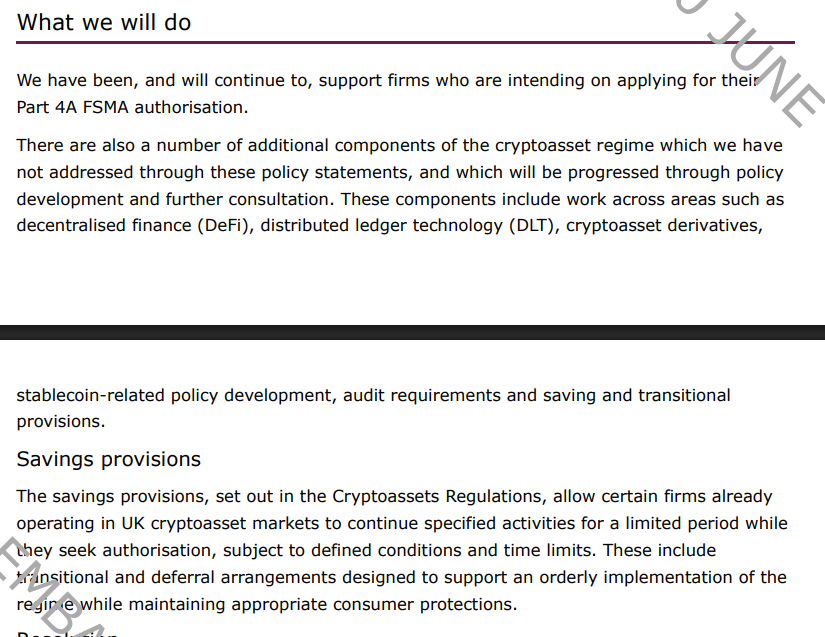
The UK’s Financial Conduct Authority (FCA) has published its landmark crypto regulatory framework, marking the completion of its crypto roadmap seeking to bring digital assets under the regulator’s purview.
Significant new elements include mandatory licensing for crypto firms, capital stress-testing requirements, improved market manipulation and insider trading rules, as well as simplified capital requirement standards for stablecoin issuers, according to a Tuesday press release shared with Cointelegraph.
The licensing window for crypto companies will open from September until Feb. 28, 2027, before the regime goes live on Oct. 25, 2027.
The new framework means that crypto companies in the UK will be held to “similar standards” as other financial service providers in the country, wrote David Geale, executive director of payments and digital finance at the FCA, adding:
“We’ve created a framework that doesn’t force firms to choose between regulatory certainty and room to innovate – this regime means they can have both in a stable, competitive home to build and grow.”
Cryptocurrency firms, including trading platforms, custodians, stablecoin issuers, staking companies and other intermediaries, must obtain FCA authorization to operate in the UK under the new framework.
The framework comes nearly a month after the regulator concluded its consultation window on the guidelines for the country’s future crypto regime on June 3.
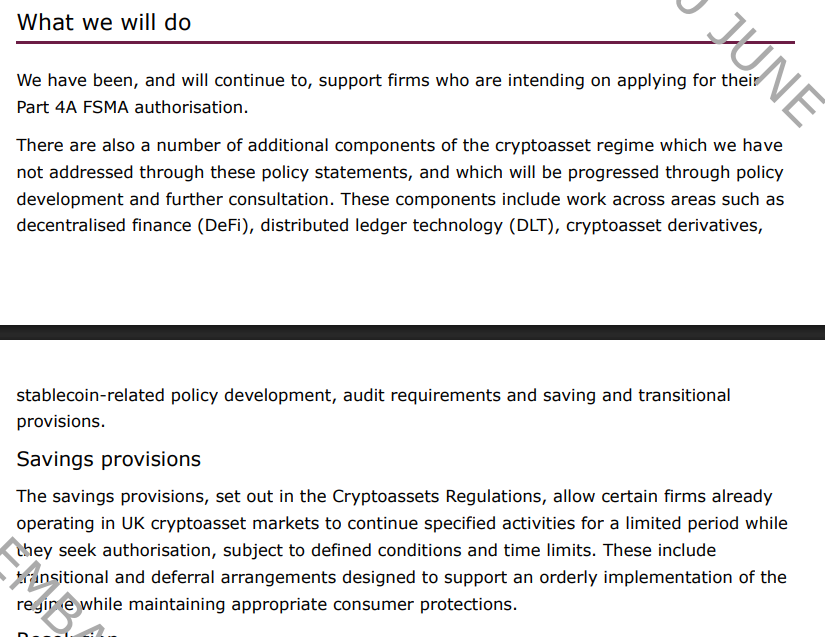
Overview of FCA crypto regime, next steps and savings provisions. Source: FCA
AML-authorized crypto firms need new licenses in the UK
Crypto firms with existing authorization under the money laundering regulations will not have their licenses automatically converted and will have to obtain new authorization.
Certain companies already operating in the UK may continue specified activities for a limited period as they seek authorisation under the framework’s transitional “savings provisions.”
The FCA said that pre-application support meetings for companies will be available starting next month.
The regulator will set out its policy statements during a webinar on July 17. It will also publish a further policy statement in September to establish how the regulatory perimeter applies to cryptoasset activities.
Related: Aave Labs’ Push gains UK FCA crypto registration
FCA simplifies stablecoin capital standards, promises tailored DeFi guidance
The FCA has maintained the core stablecoin framework but made minor adjustments, including simplifying the backing asset composition requirement by no longer requiring estimated redemption forecasts, adding requirements for statutory trust over reserves and removing unallocated backing fund accounts.
The guidelines will also require issuers to offer specific withdrawal rights to users, permit a 5% excess to be held in the backing asset pool and allow limited intragroup custody subject to safeguards.
The FCA noted that this establishes a “baseline regime for stablecoin issuance” and added that it will consult with the Bank of England later this year on how the the agency’s rules will apply to stablecoin issuers recognized as systemic by HM Treasury.
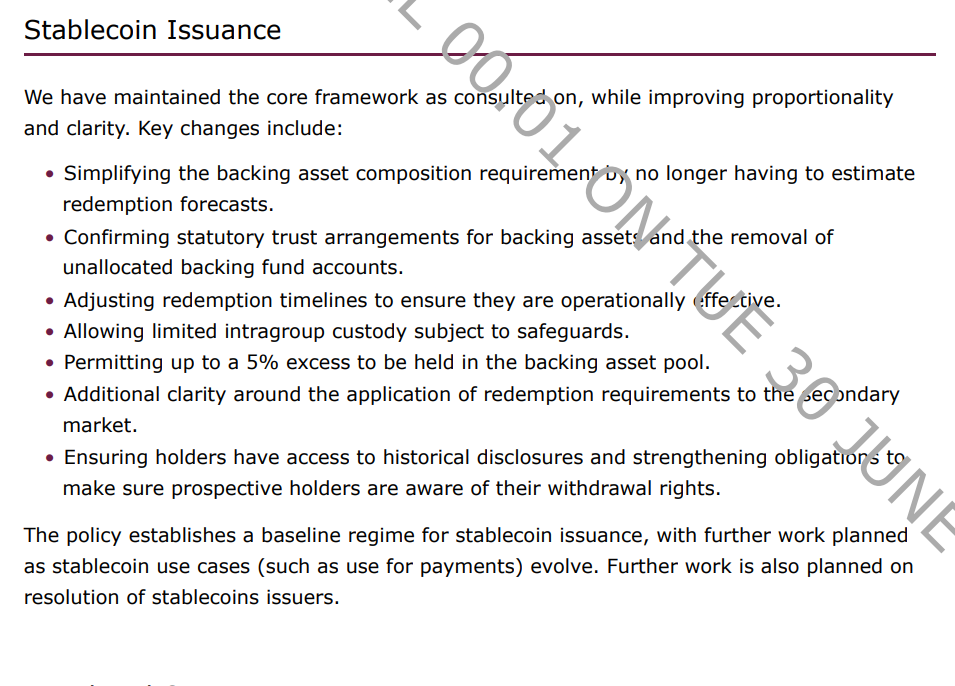
New guidelines for stablecoin issuance. Source: FCA
Later this year, the FCA will also host a separate consultation on decentralized finance (DeFi) guidance and operational resilience guidelines for firms using distributed ledger technology (DLT).
It also plans to consult on updates to the Financial Crime Guide relevant to crypto asset firms.
“We’re going to continue to work on DeFi,” said Matthew Long, director of payments & digital assets at the FCA, adding that they are seeking a case-by-case approach as “true DeFi” with “no identifiable person undertaking the activity” will fall out of the scope of the regulation.
Magazine: How crypto laws changed in 2025 — and how they’ll change in 2026

Key Points
- Shares of Velo3D advanced 7.1% Monday following the company’s inclusion in both the Russell 3000 and Russell Microcap indexes
- The metal 3D printing firm officially entered both benchmarks on June 29 during the 2026 annual reconstitution process
- Approximately $12.2 trillion in investment assets track Russell US indexes based on May 2026 data
- The company’s market capitalization reached around $496 million, with shares posting gains exceeding 126% year-over-year
- The additive manufacturing specialist will maintain Russell 3000 membership through December 2026’s next reconstitution
Shares of metal additive manufacturing specialist Velo3D (VELO) rallied 7.1% Monday following the company’s addition to both the Russell 3000 Index and Russell Microcap Index, which became effective June 29.
The inclusion occurred during the initial 2026 reconstitution of Russell indexes, an annual process that evaluates and ranks the top 4,000 U.S. companies by total market capitalization based on April 30 data.
For smaller publicly traded companies, Russell index inclusion carries significant weight. As of late May 2026, approximately $12.2 trillion in investment capital was benchmarked to Russell US indexes.
This massive pool of passive investment capital typically flows into newly added stocks, as fund managers who track these indexes must purchase shares to maintain accurate index representation.
Prior to Monday’s announcement, VELO had already demonstrated impressive momentum. Over the preceding 12-month period, the stock had appreciated more than 126%, bringing its market capitalization to approximately $496 million entering June.
CEO Arun Jeldi expressed enthusiasm about the development. “Being added to the Russell 3000 and Russell Microcap indexes is an important milestone for Velo3D,” he stated.
“We have made meaningful strides in transforming the company, advancing our technology leadership, and creating value for shareholders. Inclusion in these widely followed indexes broadens our exposure to the investment community.”
Companies included in the Russell 3000 are automatically categorized into either the large-capitalization Russell 1000 or small-capitalization Russell 2000, along with corresponding growth and value style indexes.
Based on Velo3D’s present market capitalization, the firm qualifies for inclusion in both the Russell 2000 and Russell Microcap categories — representing the smaller end of the market spectrum while still delivering significant institutional investor visibility.
Velo3D’s Business Model
Velo3D specializes in metal 3D printing solutions designed primarily for aerospace and defense industry supply chains. The company’s product portfolio encompasses Flow print preparation software, the Sapphire printer series, and the Assure quality assurance platform.
Notable clients include SpaceX and Honeywell — relationships that underscore the company’s credibility within defense and aerospace manufacturing sectors.
Duration of Index Membership and Future Outlook
Velo3D’s Russell 3000 membership remains guaranteed through December 2026’s semi-annual reconstitution event. During that review, the company could potentially migrate between the Russell 1000 and Russell 2000 based on market capitalization fluctuations.
FTSE Russell oversees these benchmark indexes, which rank among the most extensively utilized standards for U.S. equity portfolio managers.
Monday’s 7.1% stock appreciation follows a familiar trend observed when smaller companies gain entry to major indexes — an initial buying surge fueled by passive fund inflows and heightened institutional interest.


Stream Finance, the collapsed DeFi yield protocol behind the depegged xUSD token, has begun collecting information from potential creditors and claimants as a step toward what it called a "potential global resolution." The protocol said in a post on X that it is gathering and confirming claim… Read the full story at The Defiant


Crypto influencer Ansem has airdropped about $7 million worth of the $ANSEM memecoin to Solana users, and said he will keep distributing tokens as the price rises in a push to grow the holder base to 1 million wallets. Ansem, who posts under the handle @blknoiz06 and counts close to 1 million… Read the full story at The Defiant

Germany OUT of World Cup after shock last-32 defeat to Paraguay on penalties
Form 4 Village Farms International Inc For: 29 June
Ripple CTO Emeritus Unveils Plan to Tackle XRPL DEX Front-Running


-
 Sports6 days ago
Two goals and an assist by sheer aura: Cristiano Ronaldo just entered the World Cup chat
-

 Fashion3 days ago
Weekend Open Thread: Staud – Corporette.com
-

 Politics4 days ago
The House | Manchesterism won’t survive the painful trade-offs unless it gets citizens on board
-

 Politics4 days ago
Potential 2028er World Cup attendee leaderboard
-

 News Videos1 day ago
MAJOR BITCOIN & MARKET UPDATE!!!! (MUST WATCH ASAP!!!)
-

 Business4 days ago
Asia stock markets slide as tech shares slump
-

 Tech4 days ago
A Look At A Gaggle Of Transputer Boards
-
Crypto World6 days ago
Bitcoin (BTC) Dips Below $62K, Ethereum (ETH) Plunges 6% Daily: Market Watch
-
 Crypto World4 days ago
Dell (DELL) Shares Tumble Over 5% Following Analyst Downgrade to Hold
-

 Crypto World2 days ago
Coinbase, Circle Deepen Crypto Stock Losses Despite Resilient S&P 500
-

 Crypto World6 days ago
Securitize Wraps Roubini's SEC-Registered ETF as Dubai VARA Digital Security
-
Business6 days ago
Entergy settles forward sale agreements, raises $672 million in cash proceeds
-

 Crypto World3 days ago
Kraken's xStocks Opens Bending Spoons IPO Registration to EEA Retail
-

 Sports3 days ago
FIH Pro League: India defeat Pakistan 7-1, register biggest win of campaign | Other Sports News
-

 Crypto World4 days ago
Bitcoin Sparks $600M Hourly Liquidations With $65,000 Set To Become Resistance
-

 Tech2 days ago
Russian hackers now target Signal backup recovery keys
-

 Tech2 days ago
Bluekit phishing kit adopts browser-in-the-middle for login theft
-

 Crypto World3 days ago
RTX holders must register wallets before token distribution begins
-
Crypto World3 days ago
Hyperliquid Named on Singapore MAS Investor Alert Register
-
 Crypto World5 days ago
Ripple and SBI launch RLUSD in Japan after JFSA approval
You must be logged in to post a comment Login