
Crypto World
Bitcoin vs. Gold Bottom Emerges as BTC Bulls Defend $70K

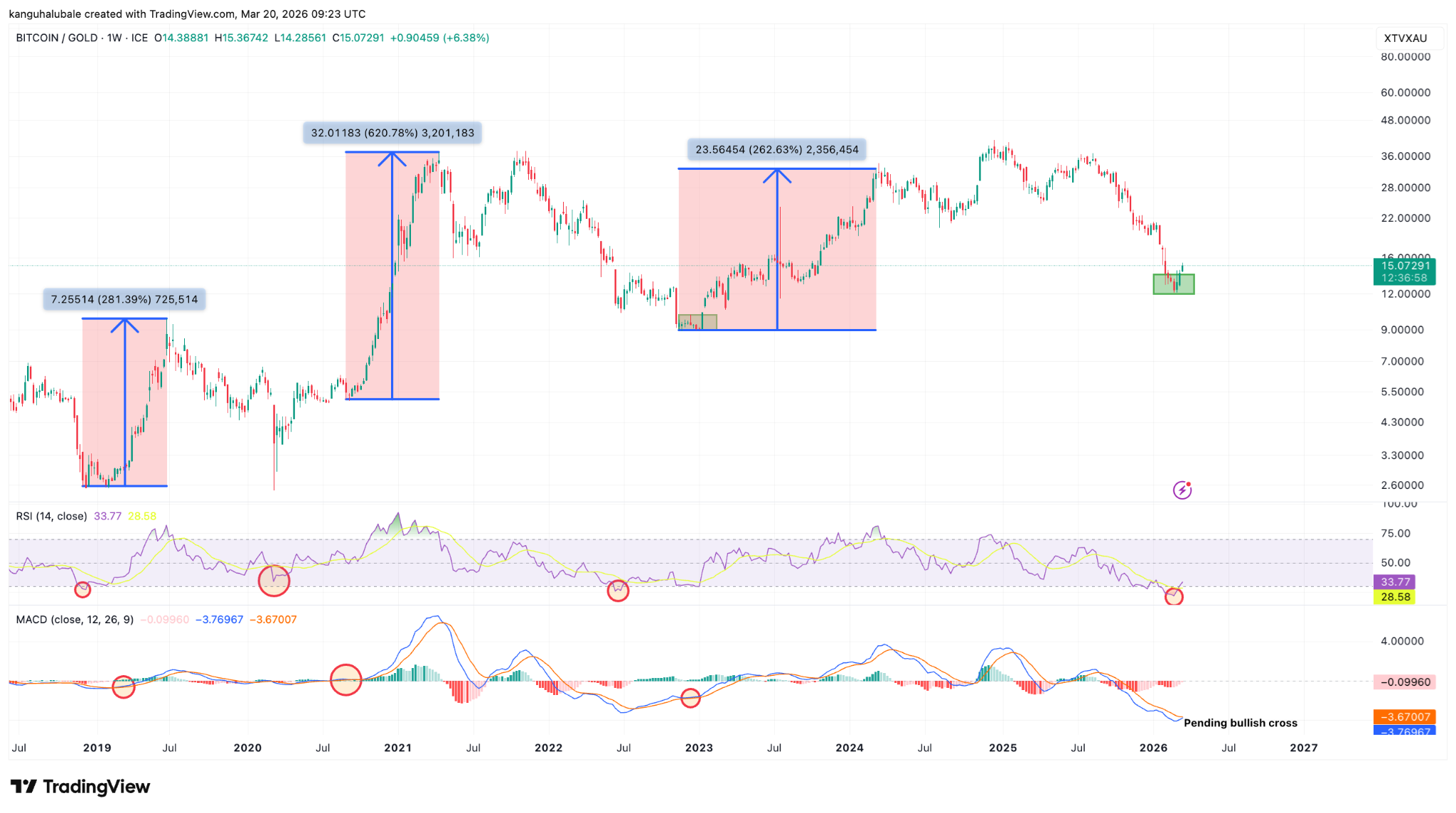
Bitcoin (BTC) has endured a 14-month bear market against gold, with the BTC/gold ratio and momentum indicators at historic lows that previously marked cycle bottoms.
Key takeaways:
-
The BTC/GOLD ratio is at historic lows as multiple indicators hint at a cycle bottom.
-
Bitcoin price must hold $70,000 to avoid a deeper drop over the coming weeks.
BTC/GOLD RSI, MACD print classic reversal signal
Data from TradingView reveals that the relative strength index (RSI) of the BTC/GOLD ratio has begun climbing.
The weekly RSI reached its most oversold level of 21 in mid-February, signaling fading bearish momentum.
Related: Bitcoin tests old 2021 top as gold falls to six-week lows under $4.7K
Similarly, the moving average convergence divergence (MACD) indicator has dropped to its lowest level ever and is about to produce a bullish cross.
Note that previous bullish crosses, particularly coming after the RSI has recovered from oversold conditions, have marked macro bottoms for the ratio.
This ultimately led to 280%-620% Bitcoin price breakout against gold, as seen in 2019, 2021, and 2023.

The RSI has now recovered to 33 from 21 in mid-February. When combined with a buy signal on the MACD, the picture begins to resemble previous cycles.
“Bottom is in for $BTC vs Gold,” technical analyst James Easto said in an X post on Friday, adding that the “stage is set” for Bitcoin’s recovery.
The last time Bitcoin bottomed against gold was in November 2022. It marked the beginning of a 700% BTC price rally to its current all-time high of $126,000.
Analysts at GeoMetric said the past 3 BTC/GOLD bear markets have taken between 12-14 months, with the drawdowns ranging from 75% to 84%.
About 13 months have elapsed in the current cycle, which has “so far gone down 81%, surpassing the 2021 bear market,” the analysts said, adding:
“I think there is a solid case for a potential bottom here.”

Investor and analyst Crypto Fergani echoed both scenarios discussed above saying:
“For over 13 years, we’ve seen the same pattern: Bitcoin enters a bear market against gold that lasts roughly 400 days. During that time, the RSI falls into deeply oversold territory. Historically, these phases have always marked the bottom.”
Bitcoin price must hold above $70,000
Meanwhile, BTC/USD remains cautiously bullish as long as it holds the $68,000-$70,000 support zone. This is where the 200-week exponential moving average (EMA) and 50-day simple moving average sit.
The 200-week EMA forms a key support band for BTC price during bear markets, and analysts warn that its reliability could be tested on Sunday’s weekly close.
Bitcoin analyst AlphaBTC said he had faith that Bitcoin will recover to $80,000 before dropping toward $50,000, as long as the price stayed above the weekly low at $68,800.
“I don’t want to see this week’s low lost, otherwise it’s going to break back down to range lows or lower!”

As Cointelegraph reported, holding $70,000 would align with a previous fractal recovery path, opening a move toward $76,000-$80,000.
This article does not contain investment advice or recommendations. Every investment and trading move involves risk, and readers should conduct their own research when making a decision. While we strive to provide accurate and timely information, Cointelegraph does not guarantee the accuracy, completeness, or reliability of any information in this article. This article may contain forward-looking statements that are subject to risks and uncertainties. Cointelegraph will not be liable for any loss or damage arising from your reliance on this information.

Crypto World
Wall Street is ‘ring-fencing’ the blockchain tech as Nasdaq’s tokenization plan wins a major regulatory battle


The SEC’s fresh approval of Nasdaq’s tokenized securities framework marks a key turning point for how stocks could trade in the future: it brings blockchain into the core of U.S. equity markets, but on Wall Street’s terms.
The regulatory green light allows Nasdaq to test a system where certain stocks and ETFs can be issued and settled as blockchain-based tokens while trading alongside traditional shares. In practice, investors could hold tokenized versions of securities in digital wallets, with clearing and settlement handled by the Depository Trust & Clearing Corporation (DTCC).
However, the effort isn’t a sweeping overhaul of market operations; rather, it focuses on post-trade plumbing.
DTCC executive Brian Steele said the firm aims to build “safe, secure tokenization services to advance a more resilient, inclusive, cost-effective and efficient financial system,” while working with exchanges and market participants to scale adoption.
Read more: Here is why Nasdaq and owner of NYSE are putting the $126 trillion equity market on blockchain
‘Biggest beneficiaries’
One of the main reasons Wall Street giants are moving to tokenizing stocks is that they can offer traders around-the-clock trading.
Traditional equity markets operate within fixed trading hours and rely on multi-day settlement cycles. Creating tokens of stocks on blockchain rails brings the possibility of near-instant settlement and, eventually, around-the-clock trading.
Val Gui, general manager at Kraken’s tokenized stock platform xStocks, called the approval “a clear signal the $126 trillion equity market will be shifting onto blockchain rails,” pointing to a future where stock ownership becomes “24/7 and global.”
“This builds on the SEC’s work with the DTC, and it’s an encouraging one,” said Ian De Bode, president of tokenization firm Ondo. “Progress toward 24/7 markets, even in permissioned form, is positive.”
“The biggest beneficiaries will be global investors… who have long lacked seamless, around-the-clock access to U.S. equities,” he added.
For that connection, Nasdaq said it is tapping crypto exchange Kraken to distribute stock tokens globally.
Wall Street keeps control
Still, Nasdaq’s model does not replace the old financial system. It only extends it to onchain securities.
Tokenized shares will still trade through brokers and settle via DTCC, with blockchain used mainly as an alternative record of ownership.
“Nasdaq is effectively ring-fencing the benefits of blockchain within the existing TradFi [traditional finance] stack,” said Maylea Ma, deputy general counsel at 1inch, a decentralized exchange (DEX) aggregator.
Investors may see faster settlement or more flexible ownership features, she said, but only inside a permissioned system that still relies on intermediaries.
“If tokenized equities cannot connect to broader onchain liquidity and non-custodial execution, the efficiency gains will be incremental rather than transformational,” Ma said.
‘Still a step behind’
While the move is a step towards the future of trading, U.S. is still lagging behind other jurisdictions.
Jesse Knutson, head of operations at Bitfinex Securities, who has worked on tokenized issuances in frontier markets like Kazakhstan and El Salvador, said the approval reflects regulatory progress but also highlights how far U.S. efforts still have to go.
“The flexibility of tokenization is what markets really want” offering 24/7 trading, fractionalization, real-time settlement and the ability to self-custody, he said.
In places like Kazakhstan’s Astana International Financial Centre (AIFC) and El Salvador, regulators have already allowed tokenized securities to be issued and traded with fewer legacy constraints, including more direct investor access and blockchain-native settlement. Other hubs such as Switzerland and the UAE also moved faster to establish frameworks for digital asset issuance and trading, giving firms room to experiment.
“It’s an encouraging move… but it’s still a step behind more progressive jurisdictions,” Knutson said.
To be fair, U.S. regulators oversee the world’s largest and most dominant equity market — worth roughly $62 trillion — which leaves less incentive and flexibility to overhaul the existing systems in favor of newer blockchain-based models. Any changes must fit within a deeply entrenched market structure built around investor protection, intermediaries and centralized clearing.
But for now, the SEC’s decision suggests a clear direction: Tokenization is coming to public markets, and it will be shaped, at least initially, by the same institutions and rules that define them today.


Over $3b in leveraged Bitcoin and Ethereum longs sit just above key support levels, with Coinglass data showing a liquidation cascade risk in either direction.
Summary
- Investors allege Gemini concealed a preplanned pivot to a Gemini 2.0 prediction-market model in its IPO filings.
- The suit follows a 77% stock plunge, mass layoffs, and withdrawals from key international markets after the IPO.
- Plaintiffs say these post-IPO shocks were foreseeable outcomes of a strategy Gemini chose not to disclose.
Leveraged long positions across Bitcoin (BTC) and Ethereum (ETH) are sitting on a knife’s edge, with more than $3 billion in combined exposure at risk of forced liquidation if prices slip to critical support levels, according to data published by Coinglass on March 20.
For Bitcoin, the figures are stark. If BTC falls below $66,827, the cumulative long liquidation intensity across major centralized exchanges would reach $1.878 billion. That would represent one of the more significant cascading liquidation events in recent months, as stop-losses and margin calls trigger a wave of automatic selling that could further accelerate any downward move. On the upside, a break above $73,757 would flip the pressure onto short sellers, with $1.062 billion in short positions vulnerable to a squeeze.
Ethereum presents a similarly precarious picture. A drop below $2,029 would trigger $1.204 billion in long liquidations on mainstream CEXs, while a rally above $2,240 would put $881 million in short positions at risk of being unwound.
The data arrives at a sensitive moment for both assets. Bitcoin has been trading in a narrow range around $69,700 following a recent dip that attracted bearish interest. Notably, open interest data tracked by Coinglass showed that during yesterday’s price decline, BTC’s open interest actually increased as prices fell — a sign that short sellers were actively adding positions rather than covering. The subsequent rebound has done little to change the OI picture, suggesting the recovery lacks conviction from new buyers and that the market remains range-bound rather than in the early stages of a trend reversal.
Ethereum has likewise struggled to find direction, hovering near $2,130 with traders watching the $2,029 floor closely. With ETH already under moderate selling pressure on the day, the proximity to that liquidation threshold is not lost on market participants.
Liquidation maps of this kind serve as a window into the market’s structural vulnerabilities. When large clusters of leveraged longs accumulate just above key support levels, they can create a self-reinforcing dynamic: a price drop triggers liquidations, which push prices lower still, triggering more liquidations in turn. This “liquidation cascade” effect has been behind some of crypto’s most violent short-term price dislocations.
For traders navigating the current environment, the message from the data is clear: the market is coiled tightly around these levels, and a decisive move in either direction could trigger outsized volatility. With macro headwinds persisting — including rising geopolitical tensions in the Middle East and a risk-off mood in traditional equity markets, where the Nasdaq fell 0.88% in pre-market trading — the path of least resistance for crypto in the near term remains highly uncertain.
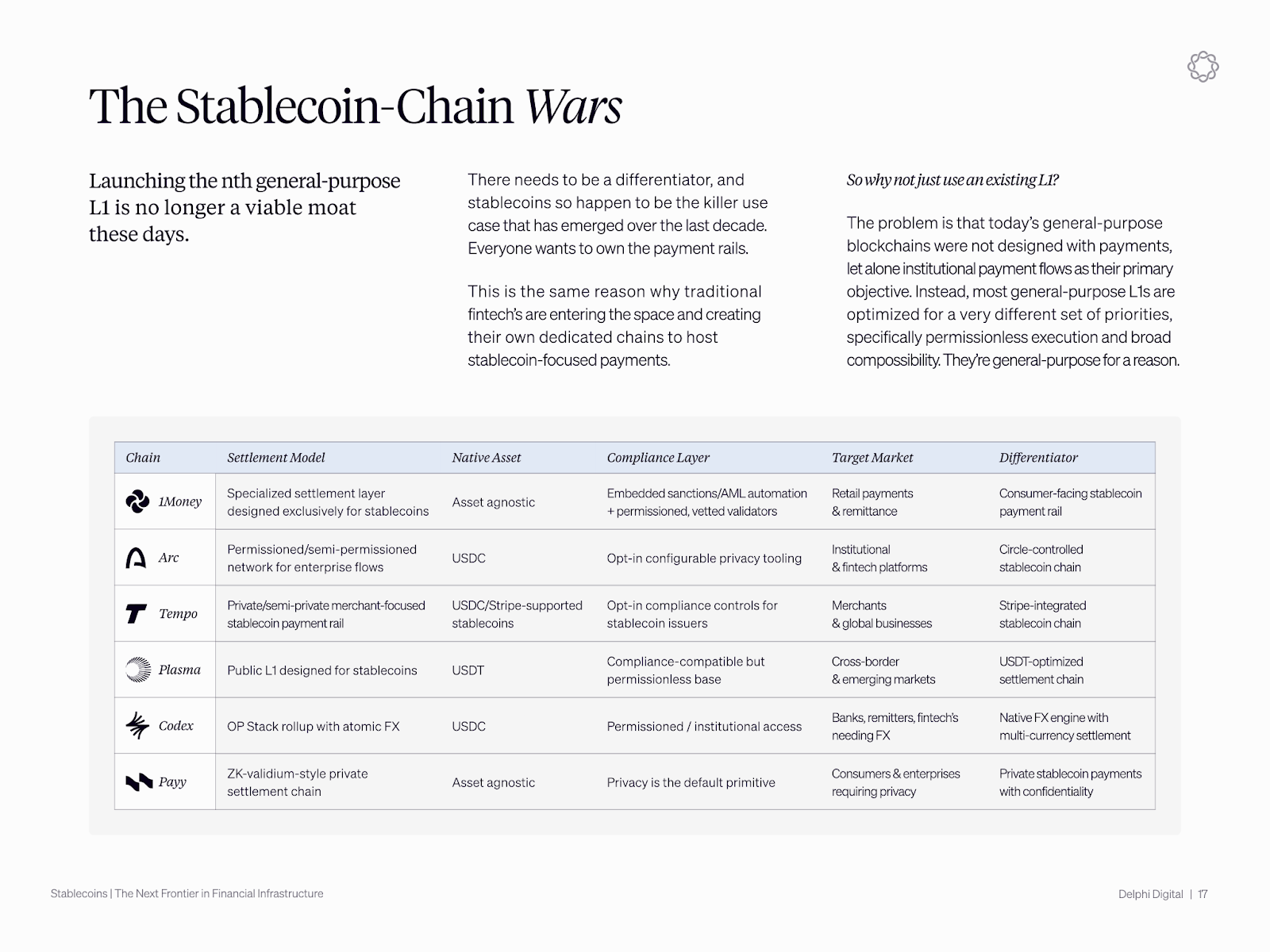
Stablecoin issuers and fintech-linked firms are launching payment-focused blockchains as they try to control more of the settlement infrastructure behind US digital-dollar transfers.
Some stablecoin issuers and fintech-linked companies are building a new wave of blockchain networks designed for institutional payment flows rather than the broader token issuance and smart-contract activity associated with general-purpose layer-1 networks, according to Delphi Digital.
These include stablecoin giant Tether-backed Plasma, a public L1 network optimized for cross-border USDt (USDT) transactions, which launched on mainnet on Sept. 25, 2025 after it raised $24 million in February. A month later, stablecoin issuer Circle launched the public testnet for Arc, which it describes as an open L1 blockchain purpose-built for stablecoin finance.
The developments add to signs of a structural shift from generic blockchain infrastructure toward payment-focused networks, as companies compete to control the rails underpinning stablecoin settlement, which Delphi Digital described as one of crypto’s clearest real-world use cases.
Fintech companies have also joined the payments infrastructure push, seeking to carve out a market share of the growing stablecoin payments sector.

Owning the payment rails is becoming “strategically important,” Ran Goldi, senior vice president of payments and network at digital asset custody platform Fireblocks, told Cointelegraph. He said:
“Instead of relying on external networks and paying fees to ecosystems like Ethereum, companies are looking to capture more of that value themselves by building or controlling the settlement layer.”
For payment companies, owning the underlying rails means they avoid being “taxed” for the mint and burn operations of the stablecoin, added Goldi.
Fintech companies are also joining the stablecoin chain wars
Tempo said Wednesday that its mainnet is live, describing the network as a merchant-focused settlement layer built for high-throughput stablecoin transactions. The project says it is incubated by Paradigm and Stripe.

In October 2024, Stripe acquired stablecoin infrastructure startup Birdge for $1.1 billion. In June 2025, it acquired crypto wallet infrastructure provider Privy and later bought billing platform Metronome on Jan. 14.
Delphi Digital said those deals positioned Stripe to control more of the issuance, wallet and billing layers around stablecoin payments alongside settlement infrastructure.
Stablecoin payment infrastructure is increasingly seen as a new “revenue layer,” positioning entities controlling the end-to-end payment workflow to capture fees on every transaction, according to Alvin Kan, chief operating officer at Bitget Wallet.
“As settlement costs at the protocol level trend lower, value capture shifts to the orchestration layer around the rail: compliance, FX conversion, wallet infrastructure, on- and off-ramps, local payout connectivity and merchant integration,” he told Cointelegraph.
Related: Stablecoins to replace old FX rails, but off-ramps remain a chokepoint
Controlling the settlement infrastructure behind stablecoins is the next battleground among crypto and fintech firms, according to Irina Chuchkina, chief growth officer of Wallet in Telegram. She said:
“Stablecoin payment rails could become the defining revenue driver of this cycle, for the same reason Visa and Mastercard became indispensable: not because they issued currency, but because they owned the pipes.”
Companies building settlement rails interoperable with agentic artificial intelligence stand to “capture a disproportionate share of the value flowing through these networks,” she added.
Magazine: Crypto wanted to overthrow banks, now it’s becoming them in stablecoin fight


In the latest Cointelegraph interview, professional trader Alessio Rastani warns that Bitcoin could fall below $60,000 before a meaningful bottom forms.
Professional trader Alessio Rastani is back with a fresh market update, and the key question remains: has Bitcoin (BTC) already found its bottom — or is the real move still ahead?
In this latest interview, Rastani revisits his previous outlook and explains why his view has shifted as price action unfolded. While Bitcoin managed a short-term recovery earlier this year, he argues that the structure of the recent bounce is not yet convincing enough to signal a sustained uptrend.
In fact, he warns that the probability still favors another move lower, potentially below the $60,000 level, before a more meaningful bottom forms.
But that’s only part of the picture.
Rastani highlights a range of key levels he’s closely watching, suggesting that even if Bitcoin does break lower, the downside may be more limited than many fear. According to his analysis, major support zones could emerge between roughly $59,000 and $46,000, where conditions may become increasingly attractive for longer-term opportunities.
At the same time, he remains skeptical that Bitcoin will reach new all-time highs in 2026, pointing instead to a more delayed recovery timeline.
Beyond crypto, the conversation expands to the broader macro landscape. Rastani shares his outlook on the stock market, noting a possible top forming in the coming months. He also explains why relying too heavily on fixed frameworks, such as the four-year halving cycle, can lead investors astray in unpredictable markets.
If you want to understand where Bitcoin could be headed next — and where the real opportunities might lie — check out the full interview on our channel and don’t forget to subscribe!
This interview has been edited and condensed for clarity.

FX markets have become increasingly reactive in March, with geopolitical developments—particularly the US–Iran conflict—driving price action across currencies, commodities, and interest rate expectations.
In this update, we examine the key forces shaping the FX market right now, including:
✔️ The impact of rising oil prices on inflation and currency dynamics
✔️ Shifting central bank expectations and delayed rate cut outlook
✔️ Elevated volatility and what it signals for near-term market conditions
Stay ahead of market moves — follow for timely insights into FX, macro trends, and volatility conditions.
Gain insights to strengthen your trading knowledge.
Watch it now and stay updated with FXOpen.
💬 Don’t forget to like, comment, and subscribe for more professional market insights every week.
This article represents the opinion of the Companies operating under the FXOpen brand only. It is not to be construed as an offer, solicitation, or recommendation with respect to products and services provided by the Companies operating under the FXOpen brand, nor is it to be considered financial advice.

Professional trader Alessio Rastani has revised his Bitcoin outlook, suggesting the market could slip below $60,000 before a meaningful bottom forms. In a recent Cointelegraph interview, Rastani explained that while Bitcoin staged a brief recovery earlier this year, the shape of that bounce does not yet justify a sustained uptrend.
Rastani has not abandoned his broader bearish-to-neutral stance; he argues that the current price action remains structurally fragile. The result, he says, is a heightened probability of another test of lower levels before buyers regain conviction and a durable bottom takes root.
Key takeaways
- Bitcoin may trade under $60,000 again before a lasting bottom appears, according to Alessio Rastani.
- A critical support corridor could emerge between about $59,000 and $46,000, where longer-term buying opportunities might materialize.
- Rastani remains skeptical of Bitcoin reaching new all-time highs in 2026, signaling a delayed recovery timeline.
- Beyond crypto, he cautions about macro risks and cautions against overreliance on fixed cycle frameworks, such as the four-year halving cycle.
Rastani’s revised stance: why the bounce isn’t enough yet
In detailing his updated view, Rastani emphasized that the most recent upward movement failed to create a convincing base for a sustained rally. He notes that price action needs to demonstrate more structure, breadth, and durability before market participants can reasonably anticipate a durable uptrend. Until such signals emerge, the door remains open to another downswing that could test important support levels.
While the near-term path remains uncertain, Rastani highlights a potential downside scenario in which Bitcoin tests sub-$60,000 prices again. He argues that the risk-reward calculus at current levels favors waiting for clearer confirmation of a bottom rather than chasing the next leg higher based on a fleeting bounce.
Where the chart could find footing: the $59k–$46k range
Looking beyond the immediate price action, Rastani identifies a key support zone that could act as a magnet for buyers if price declines resume. He points to a band roughly spanning $59,000 down to $46,000 as a critical area where conditions might become favorable for longer-term positioning. In such a range, traders often find a balance between downside risk and potential upside catalysts, creating opportunistic entry points for patient investors.
That said, the extent to which this range can hold—and whether a durable bottom forms within it—depends on a confluence of factors, including broader risk sentiment, liquidity conditions, and macroeconomic developments. If Bitcoin breaks decisively below the lower end of that corridor, the path to fresh lows could accelerate; if it holds, the market might spend time consolidating before any sizable bounce materializes.
Macro context, cycles, and what to watch next
Rastani’s broader market commentary stretches beyond Bitcoin. He sketches a view of a potential top forming in equities in the months ahead, underscoring the risk of a broader risk-off environment that can weigh on crypto assets as part of a correlated sell-off. More importantly, he cautions against overreliance on fixed, cyclical narratives. In his view, the four-year halving cycle and similar frameworks can mislead investors when markets move in ways that defy predictable patterns.
For readers tracking the crypto market, the takeaway is to balance micro-price action with macro signals. The proximity of Bitcoin to the $59k–$46k support window, combined with the direction of equity markets and liquidity conditions, will shape the near-term trajectory. In other words, the next move may hinge less on a single indicator and more on a lattice of price action, risk sentiment, and external economic pressures.
Readers seeking a deeper dive into Rastani’s reasoning can review the full Cointelegraph interview, where he revisits his prior calls and outlines how price action has reshaped his outlook. As always, investors should remain wary of drawing conclusions from a single data point and instead watch how key levels and macro cues interplay in the coming weeks.
What remains uncertain is how quickly a durable bottom could form and whether the market can sustain any multi-month rebound. As the chart continues to unfold, attention will stay tuned to whether Bitcoin can establish a meaningful base or if the next move tests the downside once again.

TLDR:
- The Trump administration released a six-part National AI Legislative Framework on March 20, 2026, targeting key policy areas.
- The White House urged Congress to give parents stronger tools to protect children from AI-driven exploitation and harmful content.
- The framework proposes removing outdated barriers to AI innovation while expanding workforce training programs across U.S. industries.
- A uniform federal AI policy is being prioritized to prevent conflicting state laws from weakening America’s global AI competitiveness.
The National AI Legislative Framework, released by the Trump Administration on March 20, 2026, outlines a broad national policy. The White House stated the framework addresses six key objectives tied to AI development and governance.
These objectives range from protecting children to enabling innovation across American industries. The administration also called on Congress to convert this framework into enforceable legislation. Federal leadership, the White House noted, is essential to maintaining public trust in AI.
Children’s Safety and Community Protections Take Center Stage
One of the framework’s primary areas of focus is protecting children online. The administration is calling on Congress to give parents tools to manage their children’s digital environments.
These tools include account controls to safeguard privacy and regulate device use among minors. The White House further called on AI platforms to reduce the sexual exploitation of children.
Beyond child safety, the framework also addresses broader community concerns. The administration stated that AI development should support economic growth for small businesses and communities.
It further proposed that ratepayers should not bear the financial burden of powering data centers. Congress is being asked to streamline permitting so data centers can generate on-site power.
The framework additionally proposes expanding federal capacity to combat AI-enabled scams. This addresses a growing concern among Americans about fraudulent activity powered by artificial intelligence.
The administration views these measures as essential to maintaining community safety nationwide. Together, these proposals form a layered approach to protecting the public.
Free speech is another concern the framework directly addresses. The administration proposed guardrails to prevent AI systems from censoring lawful political expression.
Federal protections are being sought to stop AI from suppressing ideological or political dissent. The administration stated that AI must be able to pursue truth without limitation.
Innovation, Workforce Development, and the Push for AI Dominance
The framework also focuses heavily on removing barriers that slow AI innovation. Congress is being asked to eliminate outdated regulations that hinder the deployment of AI.
The administration wants to accelerate AI use across multiple industry sectors simultaneously. Broader access to testing environments for building world-class AI systems is also being sought.
On intellectual property, the framework takes a balanced approach. It calls for respecting the creative works of American innovators, publishers, and creators.
At the same time, it acknowledges that AI must learn from existing content fairly. The administration proposed a middle-ground approach to address both concerns effectively.
Workforce development is another area the framework directly tackles. The administration encouraged Congress to expand AI skills training and workforce programs.
These programs are meant to help American workers participate in AI-driven economic growth. New jobs in an AI-powered economy are expected to follow from these efforts.
The administration also stressed the need for a uniform national policy. A patchwork of conflicting state laws, the White House said, would weaken American innovation.
Federal consistency is being presented as the path to winning the global AI race. The administration plans to work with Congress in the coming months on final legislation.

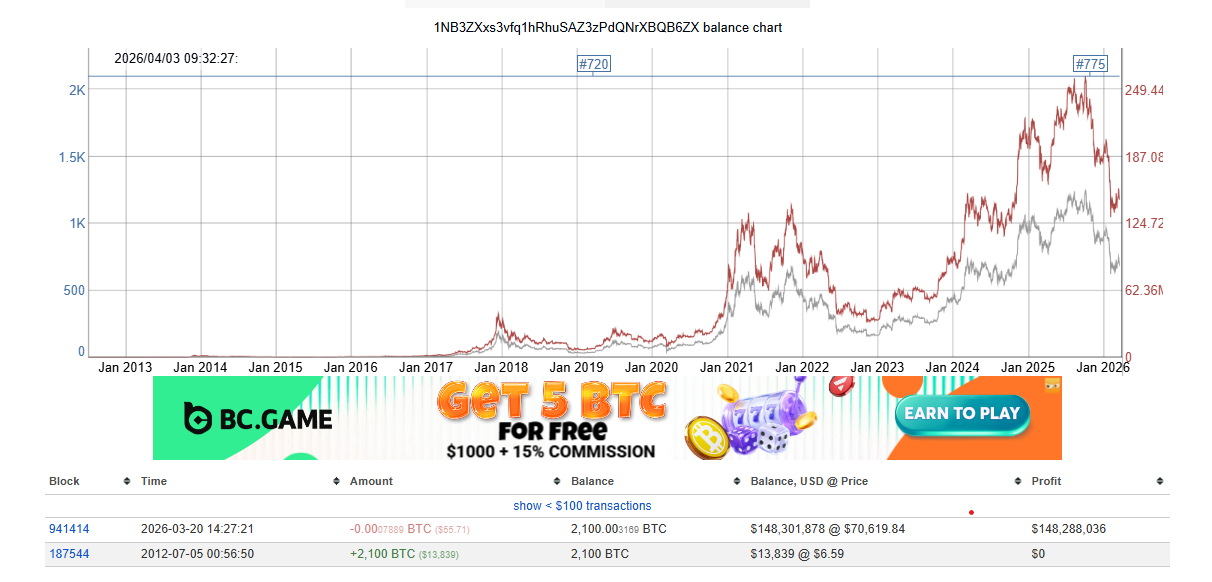
A long-dormant Bitcoin whale wallet has reactivated after 13 years and seven months of inactivity, shifting 0.00079 BTC ($56), a tiny fraction of a fortune now worth around $147 million.
Onchain data from BitInfoCharts shows that the legacy address “1NB3ZX…” received 2,100 Bitcoin (BTC) on July 5, 2012, when BTC traded at about $6.59 per coin. At today’s prices, that stash is valued at roughly $147 million, turning an initial outlay of about $13,800 into an unrealized gain of more than 10,000x.
The move caught the eye of onchain trackers like Whale Alert and LookonChain that monitor so-called Satoshi-era addresses, a term often used for coins acquired in Bitcoin’s early years.
BitInfoCharts shows the address was funded in a single large inflow on July 5, 2012, and then left untouched for almost 14 years.

Traders debate diamond hands vs recovered keys
Bitcoin traders are split between reverence and speculation. Some praised the HODLer’s apparent discipline for holding through multiple boom-and-bust cycles without selling, “No leverage. No day trading. No stress. Just conviction and time. The hardest strategy is also the most profitable.”
Related: Bitcoin whales shift $100M+ as oil spike rattles markets
Others argued that a more likely explanation was that the owner recently recovered their seed phrase or private key, and was sending a test transaction before cashing out a meaningful amount.
Test transactions of a few tens of dollars are common practice among long-inactive holders, who often move a tiny amount first to confirm they still control the wallet and that the destination address is correct.
Traders will now watch closely to see whether the wallet sends more of its 2,100 BTC to exchanges or fresh addresses in the coming days.
Satoshi-era whale echoes earlier $85 million move
The reawakened 2012 wallet follows another recent move by a Satoshi-era BTC holder in January. On that occasion, a separate address that first accumulated Bitcoin in 2013 transferred its entire balance of about 909 BTC (worth roughly $85 million) to a new wallet after more than 13 years of dormancy.
The whale locked in a gain of around 13,900x on coins originally bought for less than $7 each.
Magazine: Bitcoin may take 7 years to upgrade to post-quantum — BIP-360 co-author


- Stellar price hovered near $0.16 as bulls looked for a bounce despite the recent sell-off.
- XLM is among the coins designated as digital commodities under SEC and CFTC interpretations.
- €2.3 trillion asset manager Amundi launched a $100 million tokenized fund on Stellar.
Stellar Lumens (XLM) trades near $0.16 as bulls eye a rebound to month-to-date highs following recent sell-off.
Could this outlook materialize amid renewed investor attention on Stellar, with multiple potential catalysts in place? Developments across the ecosystem suggest so, and immediate targets include the psychological $0.20 mark.
Stellar gets key boost alongside Ethereum
The XLM token has pared recent gains to $0.18, and market data shows bulls are 41% down since touching highs of $0.50 in July 2025.
An overall downtrend puts bulls at risk of new pain.
However, the Stellar blockchain network is headlining crypto market sentiment amid a significant regulatory tailwind.
A Europe-based asset manager has also shown confidence in Stellar.
On the regulatory front, XLM is among several coins to receive official designation as digital commodities.
This follows a joint interpretation by the US SEC and CFTC, which listed XLM among other coins as digital commodities.
This clarity positions XLM favorably for compliant institutional adoption, reducing longstanding uncertainties that have hindered growth.
Elsewhere, Europe’s €2.3 trillion asset manager Amundi launched a $100 million tokenized fund on both Stellar and Ethereum networks.
The move reinforces the altcoin project’s potential in real-world asset tokenization.
On top of this news, on-chain data shows Stellar had a robust Q4, 2025.
The real-world asset (RWA) market cap grew 196% year-over-year to more than $890 million, and the stablecoin market cap jumped 53% to $243 million.
The other notable developments are a spike in DeFi TVL as a major US bank teased a stablecoin issuance on Stellar.
These ecosystem advancements highlight Stellar’s expanding role in bridging traditional finance and blockchain.
XLM price forecast: is $0.20 next?
Stellar price paints a bullish picture on the daily chart, with the decrease in intraday volume suggesting waning selling pressure.
According to data from CoinMarketCap, daily trading volume was down 16% in the past 24 hours to around $88 million.
Meanwhile, daily RSI reflects a neutral-to-bullish stance, hovering near 54 to indicate ample upside potential before overbought conditions.
The divergence suggests buyers are regaining control after recent consolidations around below $0.17.

If prices move higher, a breakout to $0.20 could allow bulls to revisit the 0.236 Fibonacci retracement level at $0.22.
More gains and bulls could eye $0.32 (aligns with the 0.5 Fibonacci retracement level).
However, downside risks include a drop in Bitcoin prices. XLM below $0.16 risks bearish continuation $0.13 or lower.
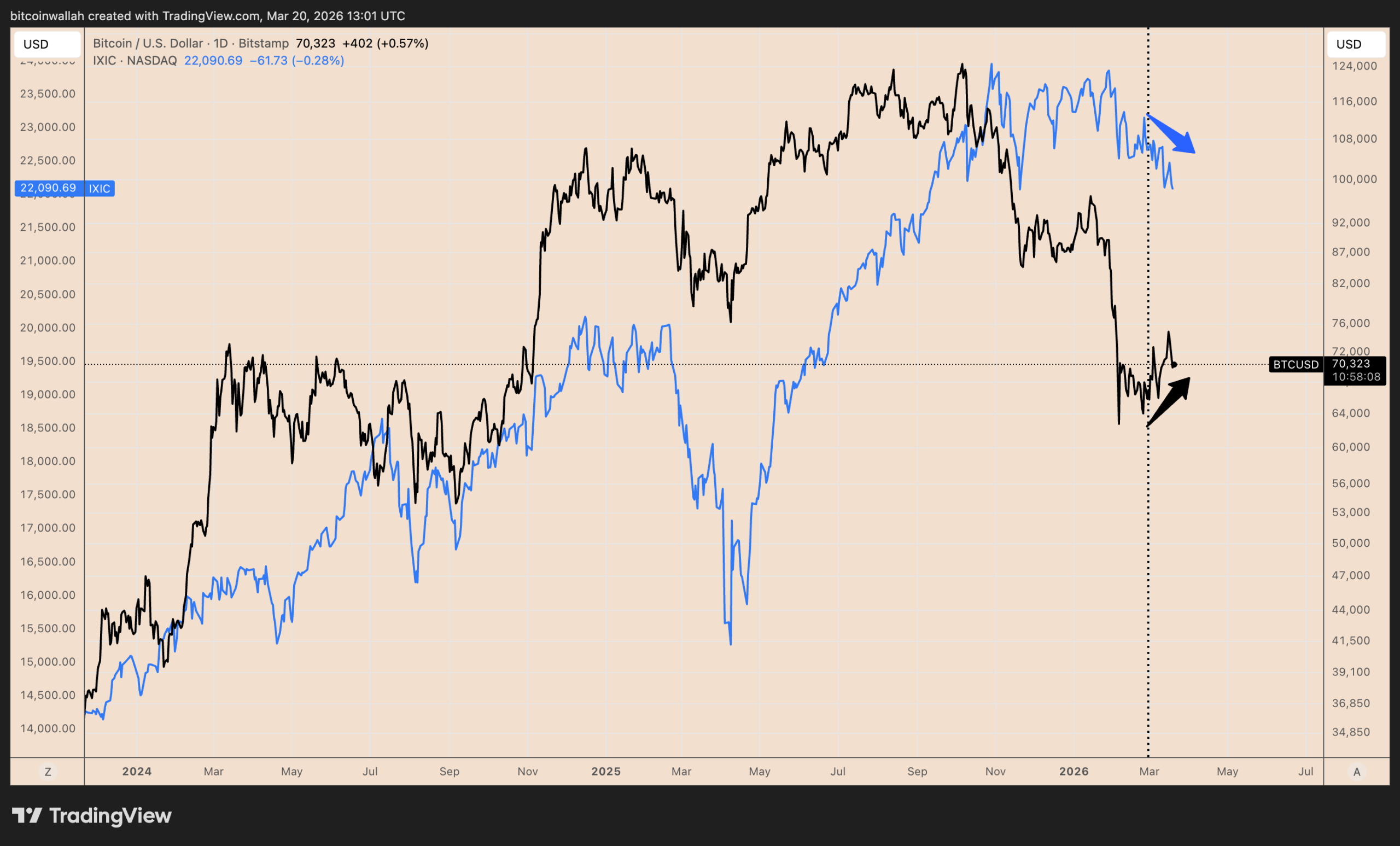
Bitcoin (BTC) has outperformed US equities and gold since the US and Israel’s attack on Iran on Feb. 28, underscoring its strength amid one of the year’s biggest geopolitical shocks.
However, BTC’s rally may face a serious challenge if oil prices spike toward $180 per barrel, a scenario some Saudi Arabian officials now see as plausible if Middle East supply disruptions persist beyond April.

Key takeaways:
-
US headline inflation may rise to 5% if oil supply shock persists, lowering rate cut odds in 2026.
-
Such macro headwinds risk sending the Bitcoin price to $51,000 in the coming months.
Oil boom may double US inflation and hurt Bitcoin
As of Friday, Brent crude was trading for around $105 per barrel, up roughly 50% since the US and Israel-Iran war started.

Oil transits through Iran’s Strait of Hormuz fell to 9.71 million barrels per day by mid-March from 25.13 million in February, according to Kpler data.

Vortexa, an energy data tracker, estimates a steeper drop to 7.5 million barrels per day, highlighting the scale of the Middle East supply shock and why experts anticipate oil to rise another 70%.
A 2023 US Federal Reserve study said that every 10% rise in crude price can add about 0.35–0.40 percentage points to US CPI.
By that measure, an extended oil rally could lift inflation by roughly 2.5–2.8 points, enough to push CPI well above its current 2.4% level and further above the Fed’s 2% target.
Markets are already adjusting to that risk.
Policy easing expectations have shifted more hawkish, with markets no longer pricing in a second rate cut in 2026 and the odds of the first cut now pushed further to October 2027.

Higher rates tend to keep borrowing costs high, tighten liquidity, and weaken investor appetite for risk assets such as Bitcoin and stocks.
Related: Trump ups pressure for Fed chair Powell to cut rates ‘right now’
Any signs of de-escalation in the conflict could quickly cool the oil rally.
Historically, such spikes have been short-lived, with prices normalizing over time and Bitcoin regaining strength as market fears fade.
Oil shock raises Bitcoin’s odds of hitting $51,000
The $180 oil warning appears as Bitcoin’s uptrend shows signs of fatigue.
BTC’s price has dipped 9.50% from its local high of nearly $76,000, trading under $70,000 as of Thursday. Its correction has painted a bear flag pattern with a $51,000–$52,000 measured downside target.

Bitcoin’s pullback also coincides with a complete halt in STRC-led BTC buying by Michael Saylor’s Strategy.
The firm did not buy Bitcoin this week, after purchasing 22,337 BTC in the week ending March 15 and 17,994 BTC the week before that.

That matters because Strategy had recently been absorbing supply at a pace equal to multiple weeks of global mining output. Its absence removes a major source of demand just as macro risks are building.
Coinbase premium has also turned negative, signaling softer US demand amid the ongoing oil supply shock.
This article does not contain investment advice or recommendations. Every investment and trading move involves risk, and readers should conduct their own research when making a decision. While we strive to provide accurate and timely information, Cointelegraph does not guarantee the accuracy, completeness, or reliability of any information in this article. This article may contain forward-looking statements that are subject to risks and uncertainties. Cointelegraph will not be liable for any loss or damage arising from your reliance on this information.
Globalfoundries: chief business officer Hogan sells $77,850 in shares

Wall Street is ‘ring-fencing’ the blockchain tech as Nasdaq’s tokenization plan wins a major regulatory battle

Neve Campbell Goes Full-On Die Hard In Her Explosive, Big-Budget Action Thriller


-
Crypto World7 days ago
HYPE Token Enters Net Deflation as HyperCore Buybacks Outpace Staking Rewards
-

 Tech5 days ago
Your Legally Registered ‘Motorcycle’ Might Not Count Under Proposed US Law
-

 Fashion7 days ago
Weekend Open Thread: Addict Lip Glow
-
 Tech3 days ago
Are Split Spacebars the Next Big Gaming Keyboard Trend?
-
Sports6 days ago
Why Duke and Michigan Are Dead Even Entering Selection Sunday
-

 Business5 days ago
Search for Savannah Guthrie’s Mother Enters Seventh Week with No Arrests
-

 Business6 days ago
US Airports Launch Donation Drives for Unpaid TSA Workers as Partial Government Shutdown Enters Fifth Week
-
Crypto World6 days ago
Coinbase and Bybit in Investment Talks: Could Bybit Finally Enter the US Crypto Market?
-

 Business4 days ago
Australian shares drop as Iran war enters third week
-

 Business6 days ago
Country star Brantley Gilbert enters growing non-alcoholic beer market
-

 Crypto World4 days ago
Crypto Lender BlockFills Enters Chapter 11 with Up to $500M in Liabilities
-

 Sports7 days ago
College Basketball Best Bets: Conference Tournament Semifinal Picks
-

 Politics2 days ago
The House | The new register to protect children from their abusers shows Parliament at its best
-

 News Videos2 days ago
RBA board divided on rate cut, unusually buoyant share market | Finance Report | ABC NEWS
-

 Fashion4 days ago
25 Celebrities with Curly Hair That Are Naturally Beautiful
-

 Tech12 hours ago
inKONBINI Lets You Spend Summer Days Behind the Register
-

 Crypto World2 days ago
Canada’s FINTRAC revokes registrations of 23 crypto MSBs in AML crackdown
-
 Politics3 days ago
Real-time pollution monitoring calls after boy nearly dies
-

 Crypto World6 days ago
Crypto Losses Drop 87% in February, But Hackers Are Now Targeting People, Not Code
-
 NewsBeat2 days ago
Residents in North Lanarkshire reminded to register to vote in Scottish Parliament Election


You must be logged in to post a comment Login