

Crypto World
Bitcoin Whales $60 Billion Selling Could Trigger Crash to $60,000

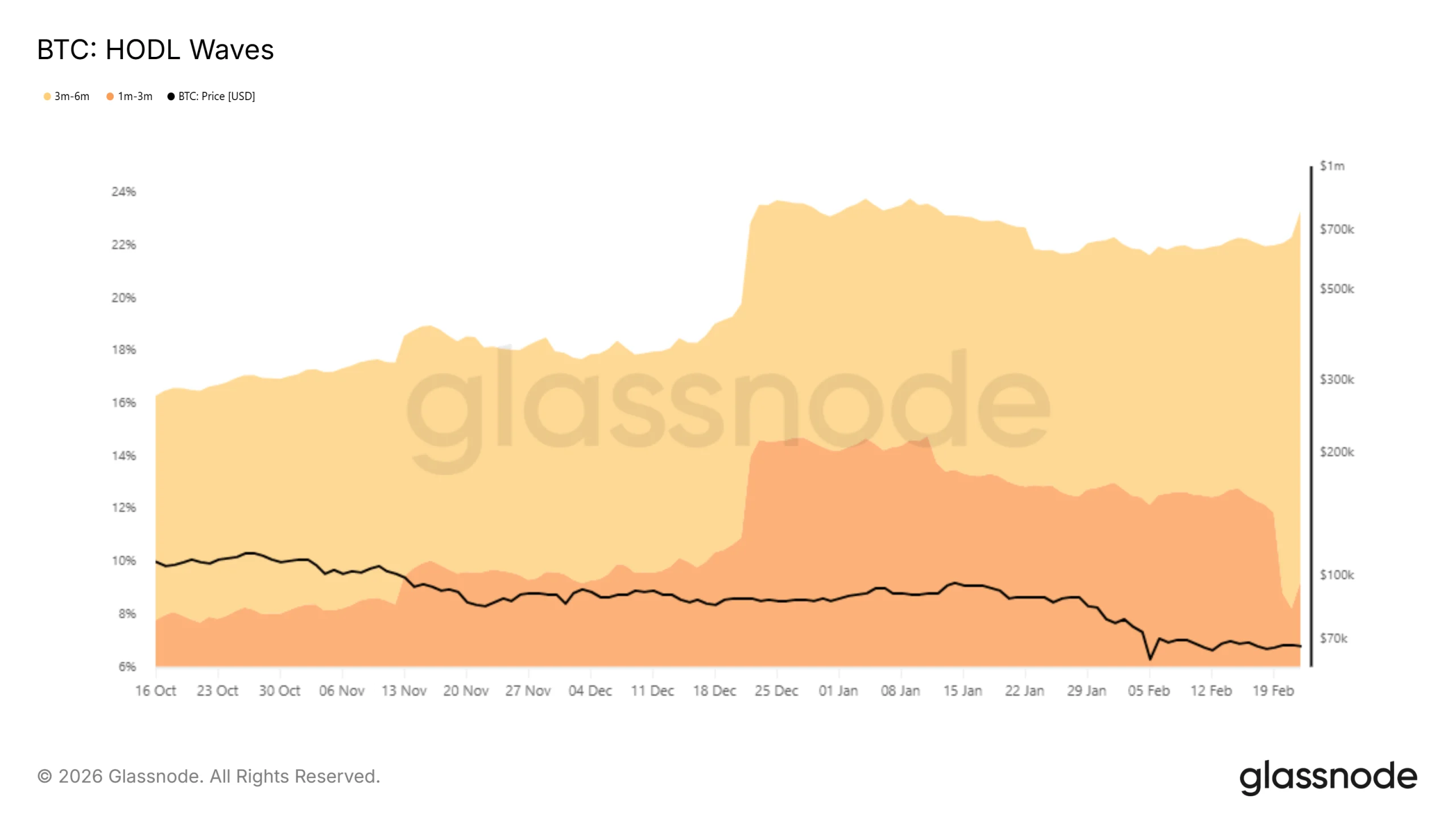
Bitcoin price is consolidating after recent volatility, trading within a neutral structure. The crypto king has struggled to establish a decisive trend over the past two weeks.
Currently, Bitcoin remains rangebound, reflecting balanced pressure between buyers and sellers. This equilibrium suggests that investor behavior from here will likely determine the next directional move.
Worry From Whales, Support From MTHs
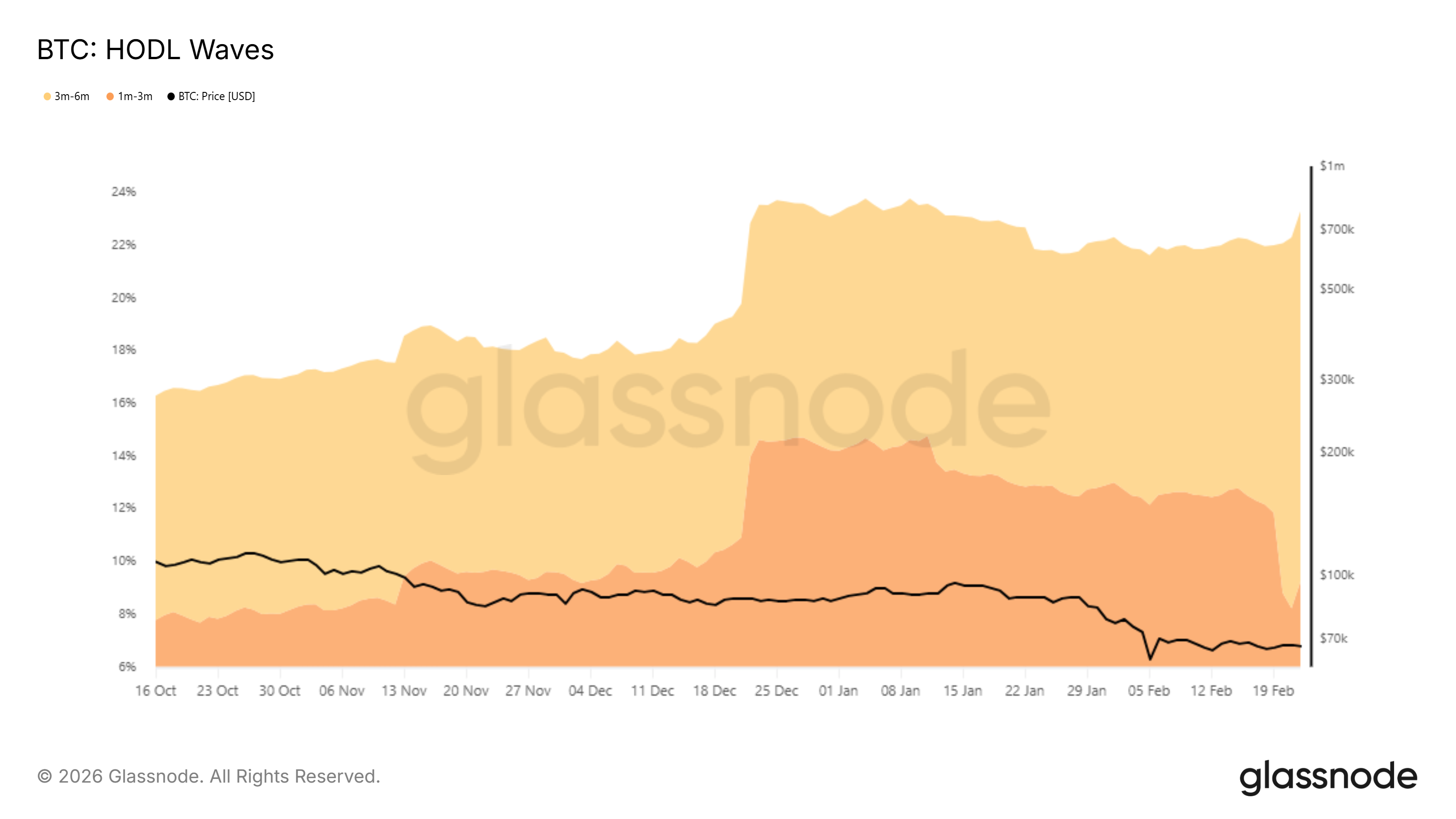
On-chain data indicates that younger holders are choosing to HODL rather than exit positions. HODL waves show that the supply held by investors aged one to three months has declined by 5%. This supply has matured into the three- to six-month cohort, signaling reduced short-term selling.
This shift reflects improving holder resilience despite recent drawdowns. Bitcoin investors who remain underwater are not engaging in panic-driven liquidation. Instead, coins are aging into longer-term categories, which historically supports price stability. Reduced short-term distribution often limits downside volatility and strengthens structural support zones.
Want more token insights like this? Sign up for Editor Harsh Notariya’s Daily Crypto Newsletter here.
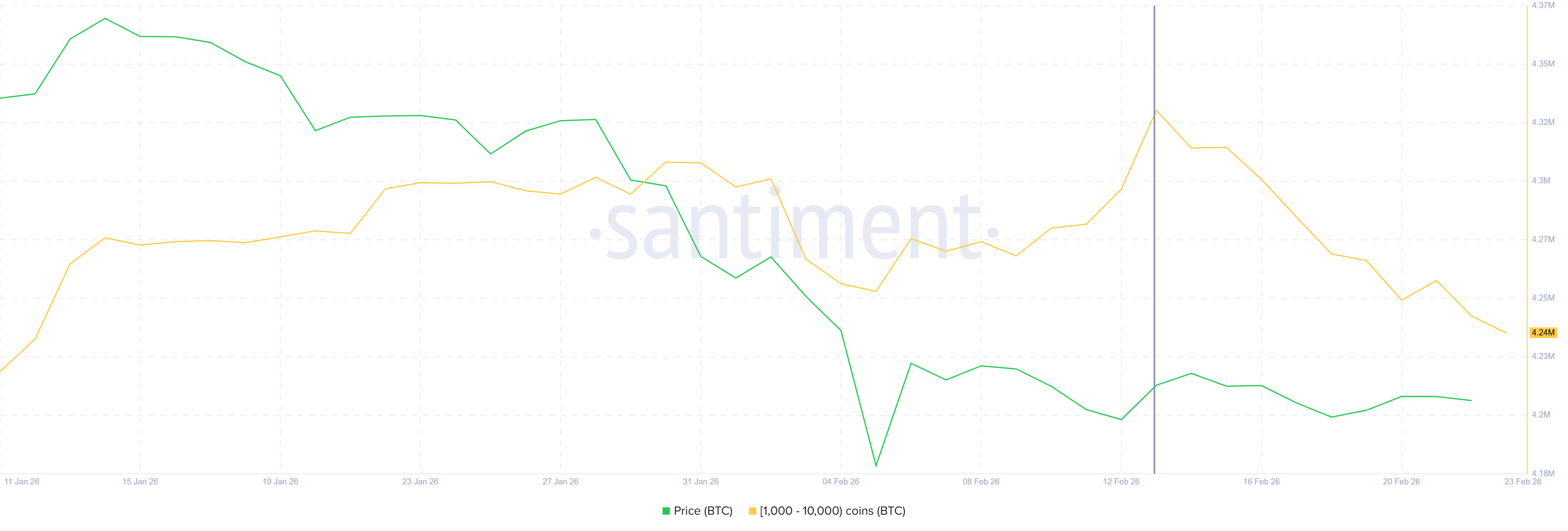
While some holders’ behavior appears stable, whale activity presents a contrasting dynamic. Since February 13, large holders have moved approximately 900,000 BTC, valued at $60 billion. This transfer activity suggests that significant capital may be preparing to exit positions following limited price appreciation.
Persistent whale selling can introduce supply shocks, particularly in range-bound conditions. Large distributions increase overhead resistance and weaken bullish momentum. If critical holders grow increasingly impatient, sustained selling pressure could undermine BTC’s stability and elevate the probability of a broader correction.
BTC Price Breakout or Breakdown Ahead?
Bitcoin is trading at $66,188 at the time of writing after slipping below the $67,394 support level. The asset remains confined between $65,000 and $70,000. This consolidation range reflects ongoing equilibrium. A decisive breakout or breakdown will likely define the next major move in Bitcoin price.
Over the past two weeks, BTC has formed a symmetrical triangle pattern. Price action shows no clear directional bias. However, continued whale selling could tip the balance downward. A breakdown below the triangle support may send Bitcoin toward $64,142. Losing that level would expose BTC to a potential decline toward $60,000. Notably, a recent long lower wick signaled dip buying interest.
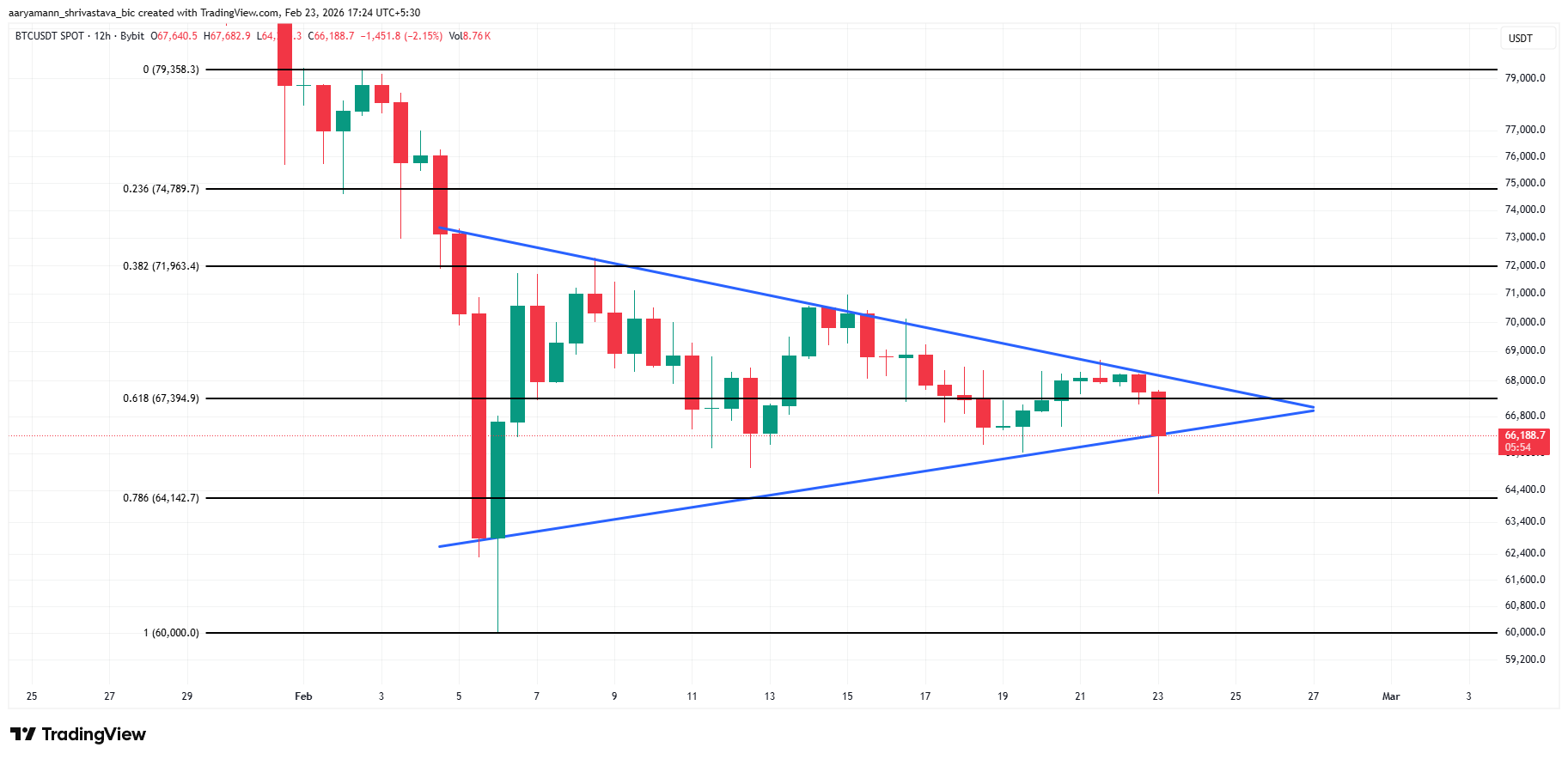
Conversely, if whale distribution slows and mid-term holders transition into long-term holders, recovery prospects could strengthen. Renewed demand may trigger a breakout above the range resistance. A sustained move toward $71,963 would invalidate the immediate bearish outlook. Clearing that level could extend gains toward $74,789, restoring bullish momentum in the broader crypto market.


TLDR
- ProShares recorded $17 billion in first-day trading volume for its new GENIUS money market ETF.
- The firm confirmed that internal fund allocations contributed to the early surge in activity.
- The GENIUS ETF follows federal rules for stablecoin reserve standards under the GENIUS Act.
- Analysts observed that the debut outpaced previous high-profile ETF launches across the market.
- Tokenized money market funds continued to gain traction as institutions explored blockchain settlement.
ProShares opened its GENIUS-branded money market ETF with heavy trading and strong early flows as firms continued exploring tokenized fund structures, and the launch drew wide market attention as cash-management demand persisted and blockchain rails expanded. The surge placed new focus on how issuers used internal allocations while investors assessed broader shifts. The event also advanced discussion around how digital cash products could interact with regulated funds.
GENIUS ETFs and Early Market Activity
ProShares reported $17 billion in first-day volume for its Genius Money Market ETF, and the firm confirmed internal transfers fueled much of the total. The company used cash from existing funds to support treasury operations, and this move highlighted how issuers managed liquidity across products.
Bloomberg tracked the debut and compared it with other launches, and analysts noted the sharp difference in volume. The debut exceeded the first-day totals of new crypto and ESG ETFs, and it shifted attention to cash strategies.
The GENIUS structure aligned with federal requirements for payment-stable assets, and the fund held short-duration government securities. The law set clear reserve and disclosure standards, and issuers applied these rules to maintain consistent oversight. Market observers watched activity closely, and early trading showed strong operational utility. The ETF advanced its role as a treasury tool, and issuers framed the approach as a way to streamline internal flows.
Tokenized Funds Enter Broader Use Cases
Tokenized money market funds gained traction as firms tested blockchain settlement, and the products offered yield while operating within compliance frameworks. Issuers presented them as interest-bearing complements to digital dollars, and adoption increased across institutional channels.
JPMorgan Chase strategists noted that tokenized fund shares could work as collateral, and they suggested the model preserved yield during transfers. One strategist said, “You can post money-market shares and not lose interest,” and firms continued building pilots.
The growth of tokenized vehicles aligned with rising stablecoin usage, and institutions explored both products for payments and custody. Funds positioned themselves as regulated alternatives, and issuers stressed transparency requirements. The Bank for International Settlements described tokenized money funds as fast-growing instruments, and the bulletin referenced their use in settlement trials. The report added context as markets evaluated new rails.
Regulatory Alignment and Current Developments
The GENIUS Act shaped how issuers structured reserves, and fund operators adopted those guidelines for liquidity portfolios. The law reinforced the role of high-quality assets, and managers applied these standards across new launches.
Firms also expanded product research, and issuers examined how tokenized versions might fit into custody systems. The approach strengthened administration flows, and providers continued monitoring regulatory updates.
ProShares used the GENIUS branding to reflect compliance, and the ETF’s early volume elevated attention on regulated cash tools. The debut arrived as digital asset firms explored new pathways, and issuers weighed operational benefits.
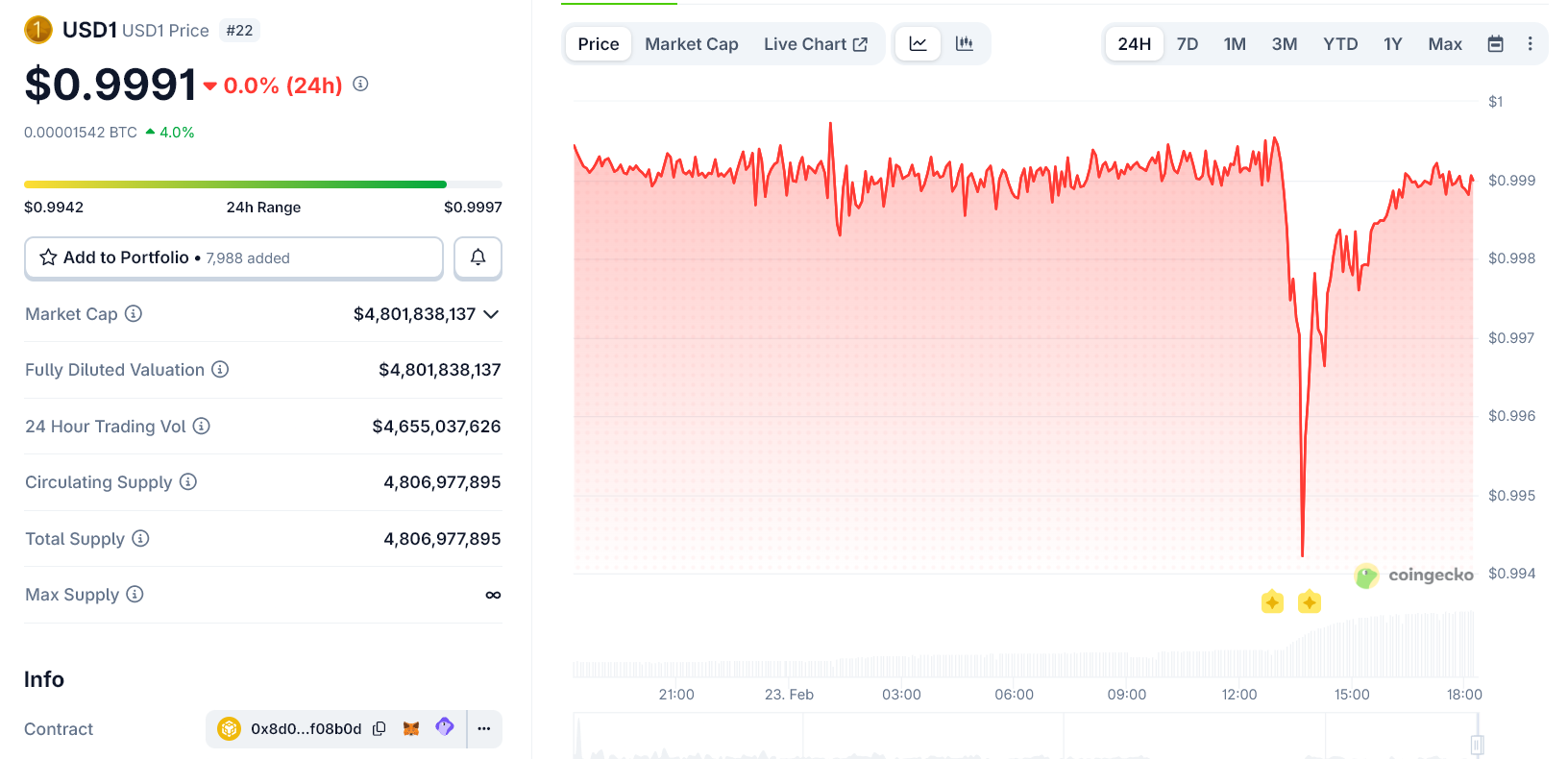
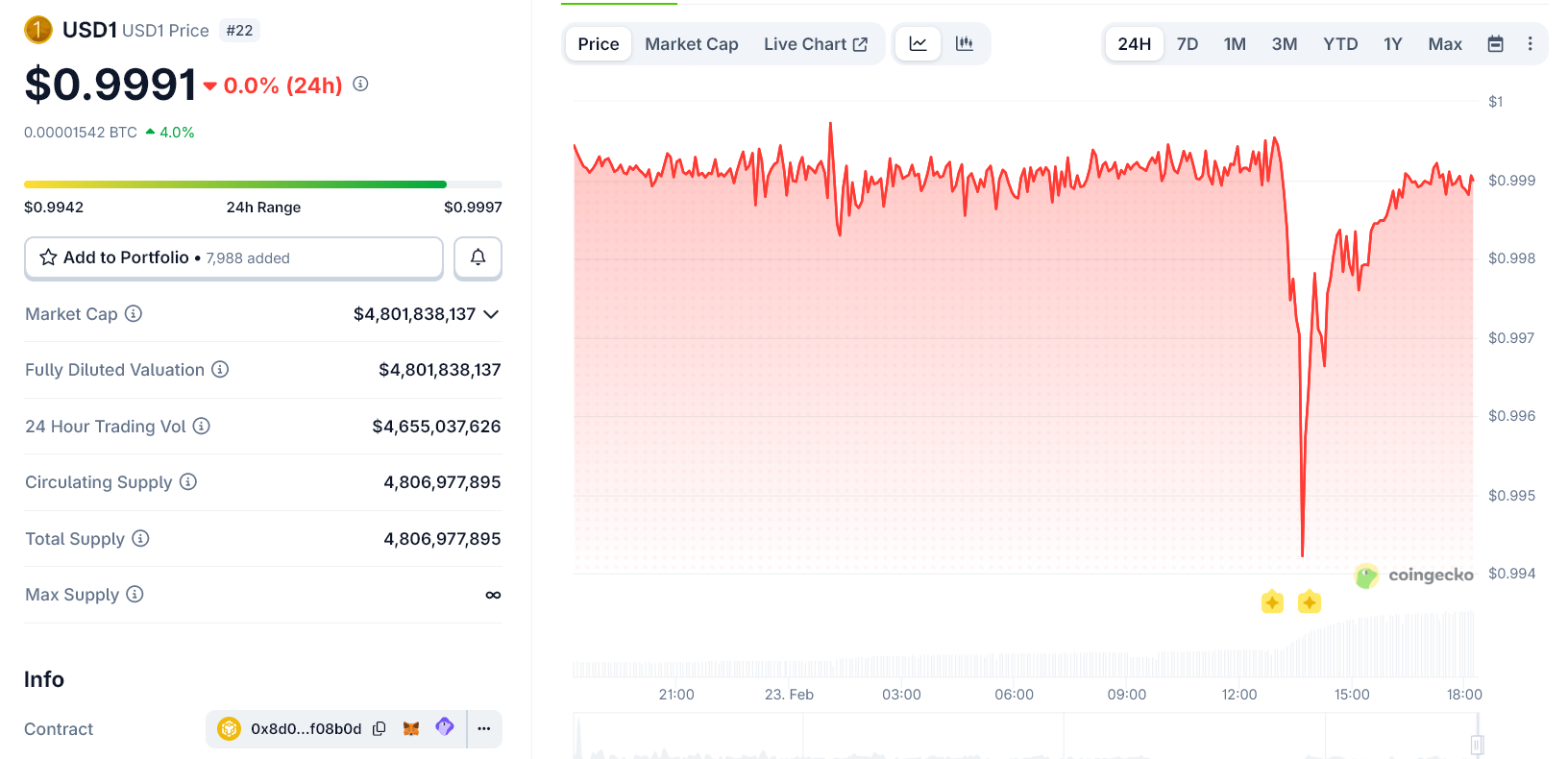
The USD1 stablecoin briefly lost its dollar peg on February 23, falling to around $0.994 before quickly recovering. The token now trades close to parity, suggesting the disruption lasted only minutes.
USD1 is issued by World Liberty Financial (WLFI), a DeFi project linked to business entities associated with Donald Trump and his family. The stablecoin currently has a market capitalization near $4.8 billion.
World Liberty Financial’s Stablecoin Depeg Triggers Speculation
WLFI responded within hours. The company said attackers compromised several cofounder accounts, spread false information, and opened short positions to profit from panic selling.
Despite the rapid recovery, the incident triggered widespread concern across the crypto community.
Some users compared the sudden depeg to early warning signs seen before the collapse of algorithmic stablecoins such as TerraUSD in 2022.
However, USD1 differs structurally. WLFI says it maintains full 1:1 reserves, unlike TerraUSD’s algorithmic design, which relied on arbitrage mechanisms rather than direct asset backing.
Meanwhile, unverified reports circulated on social media claiming that Eric Trump deleted older promotional posts related to USD1 during the volatility.
Screenshots have circulated online, but no independent confirmation has verified these claims.
Separately, blockchain investigator ZachXBT said he plans to release findings later this week on alleged insider trading involving a major crypto company.
He did not name the firm. Still, some social media users speculated that WLFI could be involved. There is no evidence supporting this claim at the time of writing.
Stablecoins rely heavily on confidence. Even brief depegs can trigger rapid selling if users fear insolvency or reserve weakness.
USD1’s quick recovery suggests that redemptions and liquidity mechanisms functioned as designed. Nevertheless, the incident reflects how quickly market sentiment can shift, especially for newer stablecoins tied to high-profile figures.
The company has not disclosed technical details of the alleged attack.
The coming days, including any investigation disclosures, will likely determine whether the event remains a short-lived market shock or develops into a broader credibility test for USD1.

Editor’s note: In the ongoing battle against malware, RenEngine’s reach underscores how attackers exploit trusted software channels to broaden their victim base. Today’s briefing from Kaspersky Threat Research highlights a multi-stage infection that pivots beyond gaming into widely used cracked productivity tools. The findings emphasize the importance of verifying software sources and maintaining updated defenses across personal and corporate environments. As cyber threats increasingly blend with legitimate workflows, readers should review security practices, stay vigilant about unofficial installers, and consider how threat actors opportunistically adapt to new distribution methods. This update offers context for executives, IT teams, and security professionals navigating a rapidly evolving threat landscape.
Key points
- RenEngine loader is distributed via dozens of pirated software sites, not just cracked games.
- Final payloads include Lumma, ACR Stealer, and Vidar in various infection chains.
- The distribution pattern is opportunistic and regional rather than targeted.
- The campaign uses Ren’Py-based game installers with fake loading screens to deploy malware
Why this matters
The expansion from gaming to cracked productivity software widens the potential victim pool and raises risk for individuals and organizations. Attackers use multi-stage delivery, anti-analysis checks, and broad distribution to bypass defenses. Organizations should reinforce software provenance checks, user education, and behavior-based detection to identify malicious activity masquerading as legitimate software.
What to watch next
- Watch for new distribution sites or bundles carrying RenEngine via cracked software.
- Monitor for updates from security vendors on HijackLoader-based campaigns across multiple payloads.
- Track any new payload families linked to RenEngine or related loaders.
Disclosure: The content below is a press release provided by the company/PR representative. It is published for informational purposes.
Kaspersky identifies RenEngine loader distributed through pirated games and software
Kaspersky identifies RenEngine loader distributed through pirated games and software
February 23, 2026
Kaspersky Threat Research has revealed its analysis of RenEngine, a malware loader that has recently gained public attention. Kaspersky identified RenEngine samples as early as March 2025, with its solutions already protecting users from the threat at that time.
Beyond the cracked games highlighted in recent reports, Kaspersky researchers discovered that attackers created dozens of websites distributing RenEngine through pirated software, including graphics editors like CorelDRAW. This expands the known attack surface beyond the gaming community to anyone seeking unlicensed software.
Kaspersky has recorded incidents in Russia, Brazil, Turkey, Spain and Germany, among other countries. The distribution pattern indicates opportunistic attacks rather than targeted operations.
When Kaspersky first identified RenEngine, the loader was delivering the Lumma stealer. Current attacks distribute ACR Stealer as the final payload, and Vidar stealer has also been observed in some infection chains.
The campaign exploits modified versions of games built on the Ren’Py visual novel engine. When users launch infected installers, a fake loading screen appears while malicious scripts execute in the background. The scripts include sandbox detection capabilities and decrypt a payload that initiates a multi-stage infection chain using HijackLoader, a modular malware delivery tool.
“This threat extends beyond pirated games — attackers are using the same technique to distribute malware through cracked productivity software, which broadens the potential victim pool significantly.”
— Pavel Sinenko, lead malware analyst at Kaspersky Threat Research
“Game archive formats vary by engine and title. If an engine doesn’t check the integrity of its resources, attackers can embed malware that executes the moment you click play.”
Kaspersky solutions detect RenEngine as Trojan.Python.Agent.nb and HEUR:Trojan.Python.Agent.gen. HijackLoader is detected as Trojan.Win32.Penguish and Trojan.Win32.DllHijacker.
To stay protected, Kaspersky recommends:
- Download games and software only from official sources. Pirated content remains one of the most common malware delivery methods.
- Use a reliable security solution. Kaspersky Premium protects against threats like RenEngine through its Behavior Detection component, which identifies malicious activity even when malware is disguised as legitimate software.
- Keep your operating system and applications updated to ensure known vulnerabilities are patched.
- Be skeptical of “free” offers. If a paid game or software is available for free download on an unofficial site, the cost is likely your security.
About Kaspersky
Kaspersky is a global cybersecurity and digital privacy company founded in 1997. With over a billion devices protected to date from emerging cyberthreats and targeted attacks, Kaspersky’s deep threat intelligence and security expertise is constantly transforming into innovative solutions and services to protect individuals, businesses, critical infrastructure, and governments around the globe. The company’s comprehensive security portfolio includes leading digital life protection for personal devices, specialized security products and services for companies, as well as Cyber Immune solutions to fight sophisticated and evolving digital threats. We help millions of individuals and nearly 200,000 corporate clients protect what matters most to them. Learn more at www.kaspersky.com.
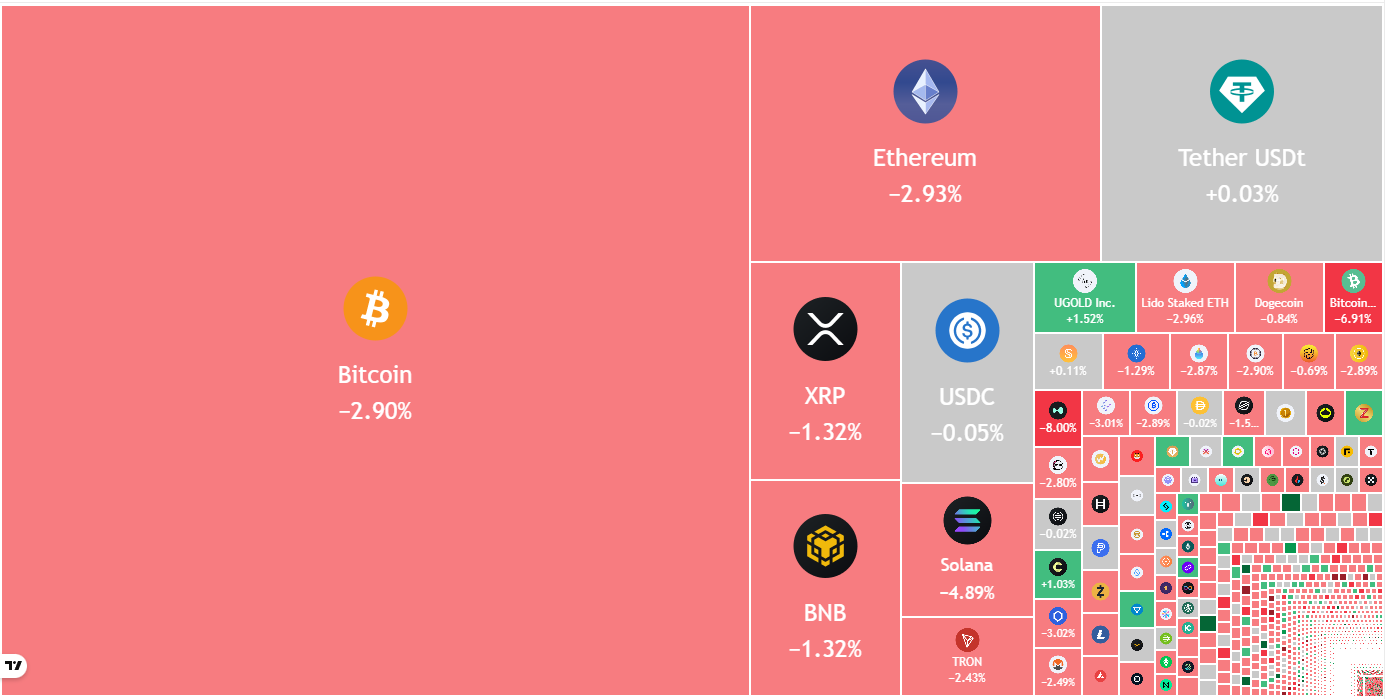
Bitcoin’s (BTC) weakness extended into the weekly open as major stocks sold off in response to US President Donald Trump’s threat to enforce a 15% global tariff after the Supreme Court ruled that his IEEPA tariffs were illegal.
Market sentiment remains fragile, as the Crypto Fear & Greed Index at 5 out of 100 remains in the “extreme fear” zone. Pseudonymous trader and investor BitcoinHyper said in a post on X that the index has been in the extreme fear zone for nearly three weeks, the longest since 2022.
Traders on the prediction market Polymarket have increased the odds of BTC falling below $55,000 to 72%. The prediction market expectations matches several analysts and financial institutions who expect a fall near or below $55,000.

While a bottom may not have formed, expectations are that BTC will eventually recover and move higher. Economist Timothy Peterson said in a post on X that BTC has been positive 50% of the time in the past 24 months. Using a statistical model, Peterson estimated that there is an 88% chance that BTC “will be higher 10 months from now.”
Could buyers defend the support levels in BTC and the major altcoins? Let’s analyze the charts of the top 10 cryptocurrencies to find out.
S&P 500 Index price prediction
The S&P 500 Index (SPX) has been trading between 6,775 and 7,002 for several days, indicating a balance between supply and demand.

The flat moving averages and the relative strength index (RSI) near the midpoint do not give a clear advantage either to the bulls or the bears. Buyers will have to achieve a close above the 7,002 resistance to signal the resumption of the uptrend. The index may then ascend to the 7,290 level.
This bullish view will be invalidated in the near term if the price turns down and breaks below the 6,775 level. The index may then tumble to the solid support at the 6,550 level.
US Dollar Index price prediction
The US Dollar Index (DXY) turned down from the 50-day simple moving average (97.95) on Friday, indicating that the bears are aggressively defending the level.

Sellers are attempting to sink and maintain the index below the 20-day exponential moving average (97.48). If they manage to do that, the index might slide to the 96.21 to 95.55 support zone.
Buyers are likely to have other plans. They will attempt to halt the pullback and push the price above the 50-day SMA. If they can pull it off, the index may jump toward the 99.50 level and subsequently to the 100.54 resistance.
Bitcoin price prediction
BTC fell below the $65,118 support on Monday, but the bulls are attempting to defend the level on a closing basis.

Any relief rally is expected to face selling at the 20-day EMA ($70,185). If the Bitcoin price turns down sharply from the 20-day EMA, it increases the likelihood of a drop to the vital $60,000 support. Buyers will have to defend the $60,000 level with all their might, as a break below it may sink the BTC/USDT pair to $52,500.
Buyers will have to propel the price above the 20-day EMA to signal demand at lower levels. The pair may then march to the $74,508 level, where the bears are again likely to pose a strong challenge.
Ether price prediction
Ether (ETH) fell below the nearby support at $1,897 on Monday, opening the doors for a retest of the $1,750 level.

The downsloping moving averages and the RSI near the oversold territory heighten the risk of a breakdown. If the $1,750 level is taken out, the ETH/USDT pair may resume the downtrend toward the next support at $1,537.
Contrarily, if the Ether price turns up sharply from $1,750, it suggests demand at lower levels. That may keep the pair inside the $1,750 to $2,111 range for a while longer. A close above $2,111 will be the first sign of strength, clearing the path for a rally to the 50-day SMA ($2,593).
XRP price prediction
XRP (XRP) has been trading between the support line of the descending channel pattern and the 20-day EMA ($1.47) for the past few days.

The downsloping 20-day EMA and the RSI in the negative territory indicate that the bears remain in control. If the support line cracks, the XRP/USDT pair may retest the Feb. 6 low of $1.11. A break and close below the $1.11 level may extend the decline to psychological support at $1.
Buyers have an uphill task ahead of them. They will have to swiftly propel the XRP price above the downtrend line to signal a potential trend change.
BNB price prediction
BNB (BNB) fell below the immediate support at $587 on Monday, but the long tail on the candlestick shows buying at lower levels.

The bulls will attempt to start a recovery, which is expected to face selling at the 20-day EMA ($651). If the price turns down from the 20-day EMA, the bears will again strive to pull the BNB/USDT pair below the $570 level. If they manage to do that, the BNB price may start the next leg of the downtrend to psychological support at $500.
Contrary to this assumption, if buyers pierce the 20-day EMA, the pair may rally to the breakdown level of $730.
Solana price prediction
The failure of the bulls to push Solana (SOL) to the breakdown level of $95 signals that the bears are active at higher levels.

Sellers will attempt to strengthen their position by pulling the Solana price below the $76 level. If they succeed, the SOL/USDT pair may fall to the Feb. 6 low of $67, which is a critical support to watch out for. If the level gives way, the pair may slump to $60.
Any relief rally is expected to face resistance at the 20-day EMA and then at the $95 level. A close above the $95 level suggests that the sellers are losing their grip. The pair may then surge to $117.
Related: Bitcoin traders diverge over BTC price strength with $60K in sight
Dogecoin price prediction
Dogecoin (DOGE) turned down from the 20-day EMA ($0.10) on Saturday and is likely to drop to the Feb. 6 low of $0.08.

The bulls are expected to fiercely defend the $0.08 level, as the failure to do so may start the next leg of the downward spiral toward $0.06.
The 20-day EMA remains the immediate near-term resistance to watch out for. A close above the 20-day EMA will be the first sign that the selling pressure is reducing. The DOGE/USDT pair may then ascend to the breakdown level of $0.12, where the bears are expected to mount a strong defense.
Bitcoin Cash price prediction
Buyers pushed Bitcoin Cash (BCH) above the 50-day SMA ($571) on Sunday but could not sustain the higher levels.

The bears sold aggressively and have pulled the Bitcoin Cash price below the 20-day EMA ($551). If the price maintains below $538, the BCH/USDT pair might plummet to the strong support at $500. Buyers are expected to aggressively defend the $500 level, as a close below it may sink the pair to $443.
Buyers will have to drive and maintain the price above the 50-day SMA to signal strength. The pair may then climb to $600.
Cardano price prediction
Despite repeated attempts, buyers failed to push and maintain Cardano (ADA) above the 20-day EMA ($0.28) in the past few days.

That increases the likelihood of a drop to the support line of the descending channel pattern. If the price rebounds off the support line and breaks above the 20-day EMA, it suggests that the ADA/USDT pair may remain inside the channel for some more time.
Instead, if the Cardano price continues lower and breaks below the support line, it indicates the resumption of the downtrend. The pair may then plunge toward $0.15. A short-term trend change will be signaled after buyers clear the overhead hurdle at the downtrend line.
This article does not contain investment advice or recommendations. Every investment and trading move involves risk, and readers should conduct their own research when making a decision. While we strive to provide accurate and timely information, Cointelegraph does not guarantee the accuracy, completeness, or reliability of any information in this article. This article may contain forward-looking statements that are subject to risks and uncertainties. Cointelegraph will not be liable for any loss or damage arising from your reliance on this information.


Crypto.com has received conditional approval from the U.S. Office of the Comptroller of the Currency (OCC) to charter Foris Dax National Trust Bank, taking a significant step toward becoming a federally regulated qualified custodian.
Centralized cryptocurrency platform Crypto.com has received a conditional approval from the U.S. Office of the Comptroller of the Currency (OCC) to establish Foris Dax National Trust Bank, d.b.a. Crypto.com National Trust Bank.
This development advances the firm’s ambition to become a federally regulated qualified custodian, according to an official announcement. Once fully approved, Foris Dax National Trust Bank will provide custody, staking, and trade settlement services under the stringent oversight of the OCC.
Crypto.com’s move aligns with a broader industry trend where crypto firms are pursuing regulatory approvals to enhance their credibility and expand service offerings.
For instance, Anchorage Digital recently launched regulated ‘Stablecoin Solutions’ to cater to institutional needs, while CME Group is set to offer 24/7 crypto futures trading, showcasing the industry’s shift towards regulated offerings.
The move also comes as the global crypto custody market is projected to reach over $4 trillion by 2033, growing at a CAGR of 23.6% from 2025 to 2033, according to Grand View Research.
Kris Marszalek, CEO of Crypto.com, emphasized the significance of this regulatory milestone in a statement.
“This conditional approval is the latest testament to both our commitment to compliance and to providing customers trusted and secure services they expect from Crypto.com,” said Marszalek. “This milestone brings us a major step closer to meeting leading institutions’ needs for a one-stop-shop qualified custodian under a gold standard of federal oversight.”
Headquartered in Singapore, Crypto.com offers a wide selection of crypto services, including trading, payments, and financial products. The platform has amassed over 150 million users worldwide, according to the platform’s website.
The OCC, a U.S. federal agency responsible for regulating and supervising national banks, has been actively involved in providing regulatory clarity for crypto-related financial services.
This article was generated with the assistance of AI workflows.
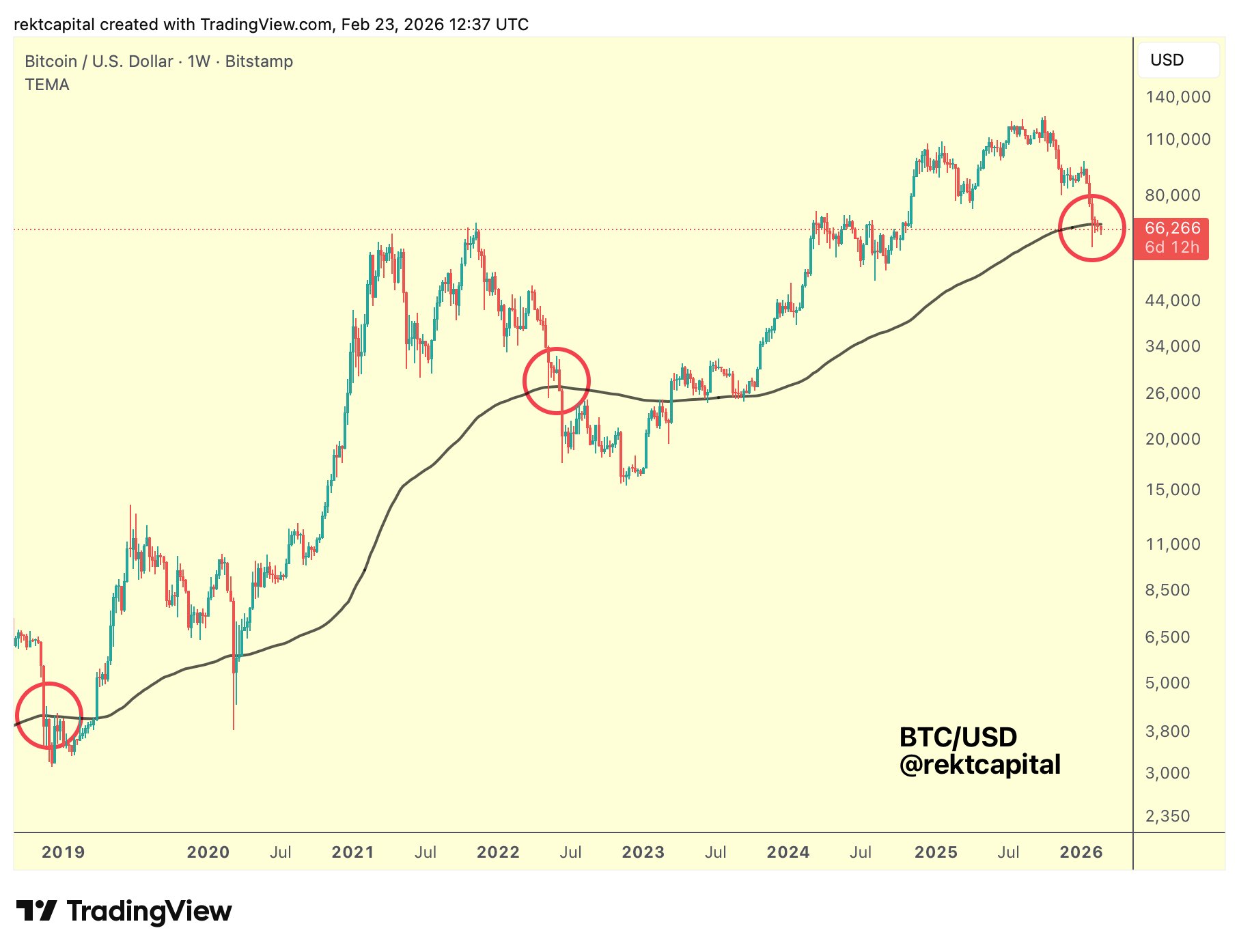
Bitcoin (BTC) closed a weekly candle below its 200-period exponential moving average (EMA) for the first time since October 2023. The weekly close ended a technical uptrend that lasted for 882 days.
The shift in trend renews focus on BTC’s onchain cost-basis levels and its historical interaction with the key moving average across previous cycles, framing a broader recovery timeline based on past market behavior.
The weekly trend may flip to resistance for Bitcoin
The 200-week EMA tracks Bitcoin’s long-term trend and has historically separated expansion phases from the deeper corrective periods. On the weekly chart, BTC closed below the average near $67,628, ending a support streak that began in late 2023.
Crypto analyst Rekt Capital noted the development, stating,
“This technically means that the EMA has been lost as support and that price could turn it into resistance on any upcoming recovery.”

Previous cycles show that reclaiming the 200-weekly EMA has required time. In 2018, Bitcoin traded below the level for roughly 14 weeks before regaining it.
During the Covid-led March 2020 liquidity shock, the recovery took about eight weeks. In 2022, BTC remained under the average for nearly 30 weeks. Across these instances, the average duration below the 200-weekly EMA was approximately 17 to 18 weeks.
Momentum indicators also reflect the cooling of longer-term investor participation. Last week, Bitcoin researcher Axel Adler Jr. noted that entity-adjusted liveliness peaked in December 2025 after BTC reached an all-time high near $126,000 in October.
Liveliness measures the ratio of coin days destroyed to coin days created, adjusted for the internal transfers. The metric has since declined below its 30-day and 90-day moving averages, while the 90-day remains above the 365-day at 0.02622. Similar rollovers in 2020 and 2022 preceded extended accumulation phases lasting one to two years.

A sustained decline in the liveliness metric typically signals reduced spending activity and slower capital rotation, conditions that may lengthen the time required for BTC to rebuild a position and reclaim the 200-weekly EMA.
Related: Tether flashes Bitcoin bottom signal: Can BTC stage another 100% rally?
BTC realized price bands outline the demand zone
Bitcoin’s realized price, near $55,000, reflects the average onchain cost basis of all coins. The shifted realized price, near $42,000, projects this metric forward and historically highlights the deeper value areas during drawdowns.

With BTC trading between the 200-weekly EMA and the realized price band cluster, the region has historically acted as a long-term accumulation zone since 2015. Prior cycles show consolidation periods of six to eight months around these levels before broader upside continuation.
A reclaim of the 200-weekly EMA restores the price above a key long-term trend threshold. Failure to do so maintains focus on the $55,000 realized price and the lower shifted band near $42,000 as potential areas of liquidity concentration.
Related: Bitcoin traders diverge over BTC price strength with $60K in sight
This article does not contain investment advice or recommendations. Every investment and trading move involves risk, and readers should conduct their own research when making a decision. While we strive to provide accurate and timely information, Cointelegraph does not guarantee the accuracy, completeness, or reliability of any information in this article. This article may contain forward-looking statements that are subject to risks and uncertainties. Cointelegraph will not be liable for any loss or damage arising from your reliance on this information.
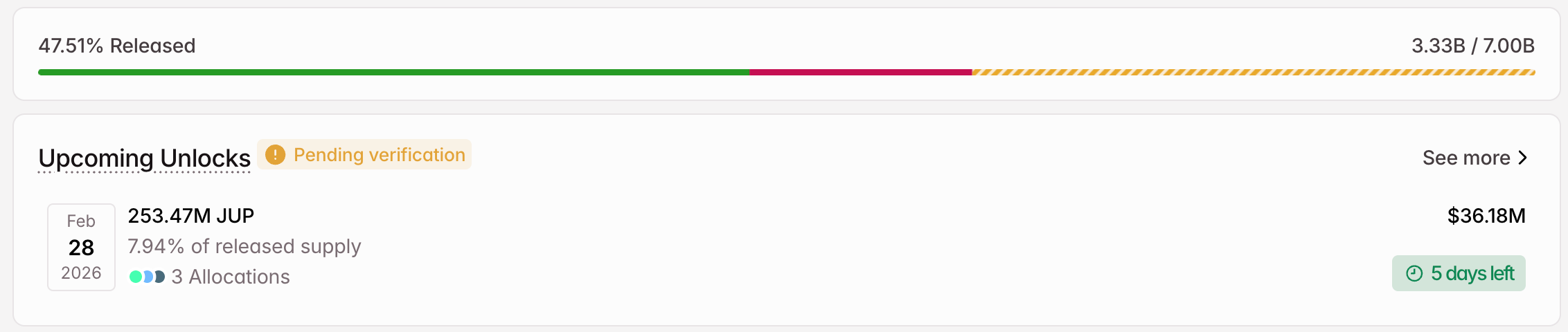
The crypto market will welcome tokens worth more than $317 million in the final week of February 2026. Three major projects, Jupiter (JUP), Humanity (H), and Grass (GRASS), will release previously restricted tokens into circulation.
Token unlocks are crucial events in the crypto market, influencing liquidity, price volatility, and overall investor sentiment. So, here’s a breakdown of what to watch.
1. Jupiter (JUP)
- Unlock Date: February 28
- Number of Tokens to be Unlocked: 253.47 million JUP
- Released Supply: 3.33 billion JUP
- Total supply: 7 billion JUP
Jupiter is a decentralized liquidity aggregator on the Solana blockchain. It optimizes trade routes across multiple decentralized exchanges (DEXs) to provide users with the best prices for token swaps with minimal slippage.
On February 28, Jupiter will unlock 253.47 million JUP, valued at approximately $36.18 million. The altcoins represent 7.94% of its released supply. This marks a substantial increase from Jupiter’s usual monthly unlock of 53.47 million tokens.
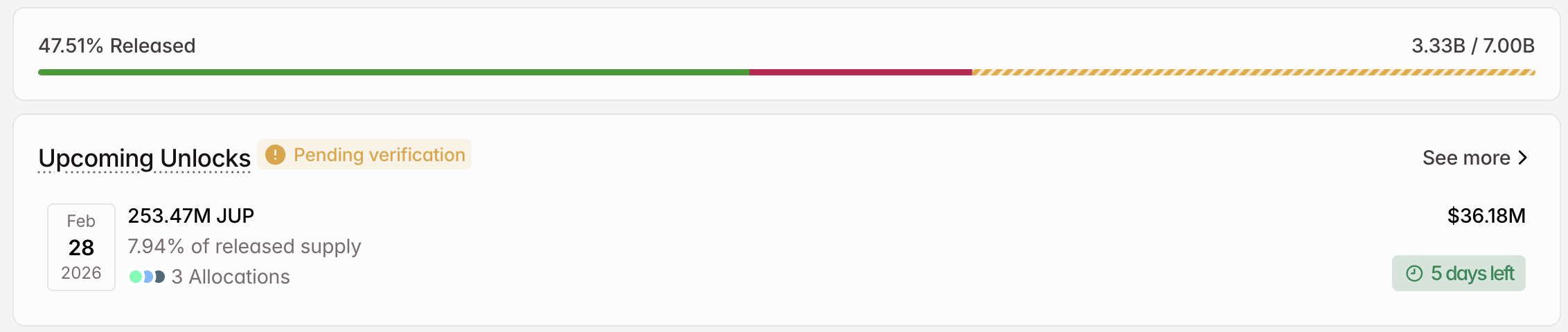
Jupiter will direct 38.89 million JUP to the team. Furthermore, mercurial stakeholders will get 14.58 million JUP altcoins.
Notably, the team has reserved the largest portion, 200 million JUP, for Jupuary. It is Jupiter’s yearly airdrop initiative aimed at rewarding users and long-term community supporters.
2. Humanity (H)
- Unlock Date: February 25
- Number of Tokens to be Unlocked: 105.36 million H
- Released Supply: 2.41 billion H
- Total supply: 10 billion H
Humanity (H) is a decentralized identity protocol that utilizes biometric palm recognition, zero-knowledge proofs, and blockchain to verify the authenticity of real human users without exposing their personal data. It features a native Proof of Humanity (PoH) consensus mechanism.
On February 25, the protocol will unlock 105.36 million tokens. The tokens are worth $16.74 million and account for 4.37% of the released supply.
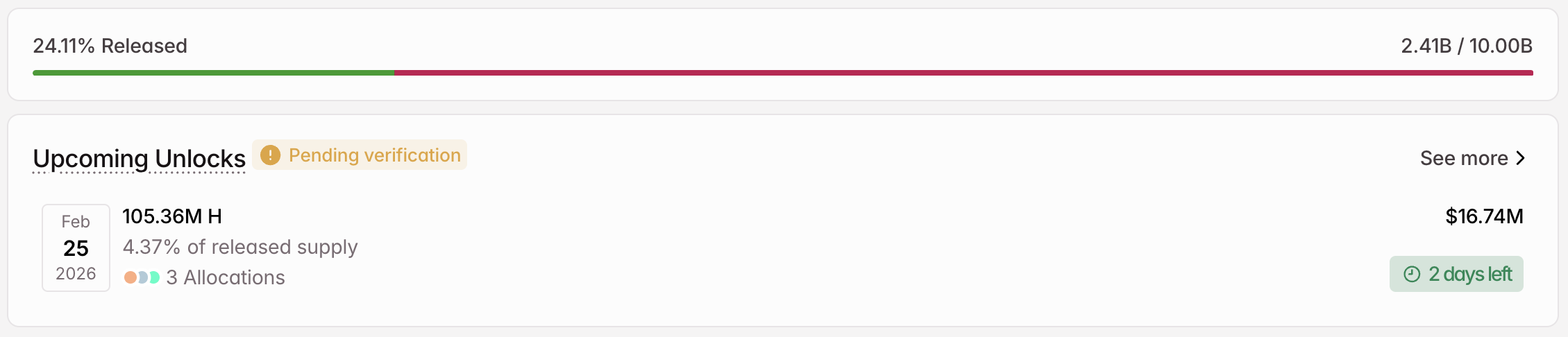
The team will split the released supply three ways. The ecosystem fund will receive 50 million H. Furthermore, Humanity will allocate 42.86 million altcoins to identity verification rewards and 12.50 million to the foundation operations treasury.
3. Grass (GRASS)
- Unlock Date: February 28
- Number of Tokens to be Unlocked: 55 million GRASS
- Released Supply: 416.54 million GRASS
- Total supply: 1 billion GRASS
Grass enables users to monetize unused internet bandwidth. It leverages blockchain to reward participants in a privacy-preserving manner, fostering a global network for accessible data sourcing.
The project will release 55 million tokens on February 28. The supply is worth approximately $9.33 million. It represents 13.15% of the released supply.
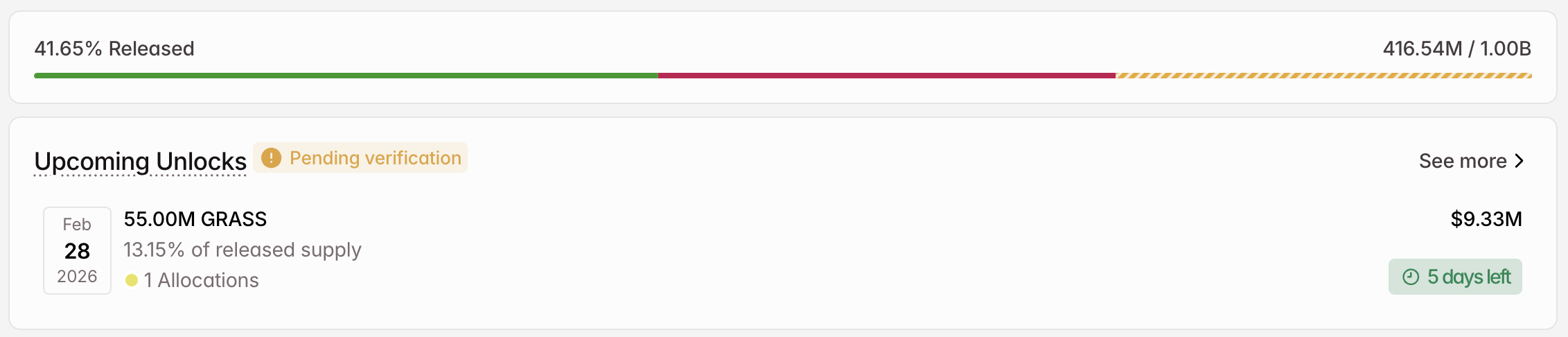
The contributors will receive the entire unlocked supply. In addition to these, other prominent unlocks that investors can look out for in the final week of February include Plasma (XPL), Kamino (KMNO), EigenCloud (EIGEN), and more.
Meme coin volatility is back in focus as the third week of February 2026 delivers explosive short-term rallies. While large-cap assets struggle to establish a clear direction, select low-cap tokens are posting double- and even triple-digit gains.
However, with rapid price expansions comes heightened correction risk. Thus, BeInCrypto has analysed three such meme coins that are pivotal to watch in the final week of February.
Siren (SIREN)
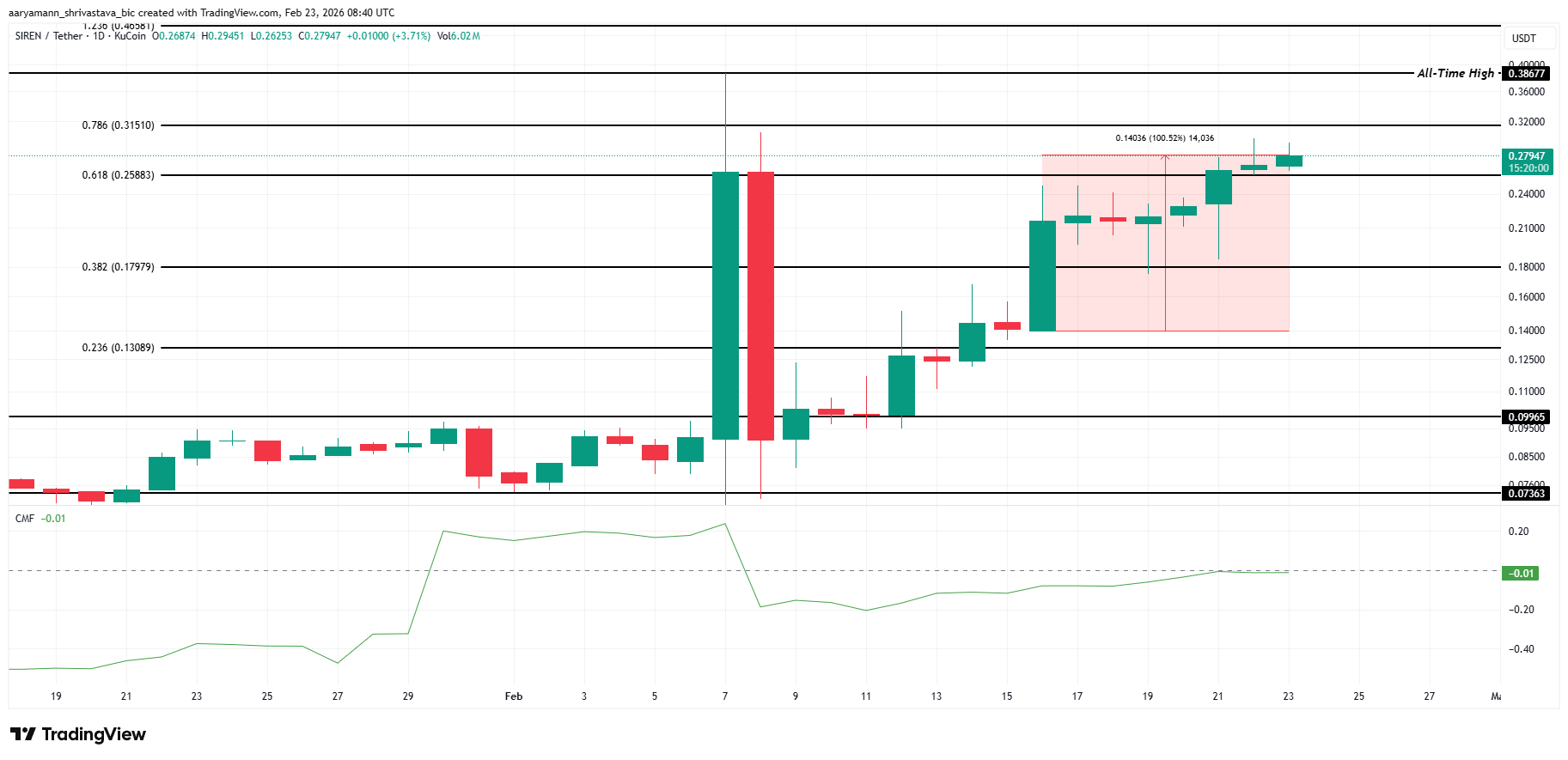
SIREN price has surged 100.5% over the past week, trading at $0.279 at the time of writing. The meme coin is benefiting from renewed investor optimism. Declining exchange outflows indicate holders are retaining tokens, a signal often associated with strengthening short-term bullish momentum in crypto markets.
The Chaikin Money Flow indicator has climbed above the zero line, reflecting rising capital inflows. Sustained buying pressure could support further upside. If momentum continues, SIREN price may retest its all-time high of $0.386. A breakout above that level could open the path toward $0.465.
Want more token insights like this? Sign up for Editor Harsh Notariya’s Daily Crypto Newsletter here.
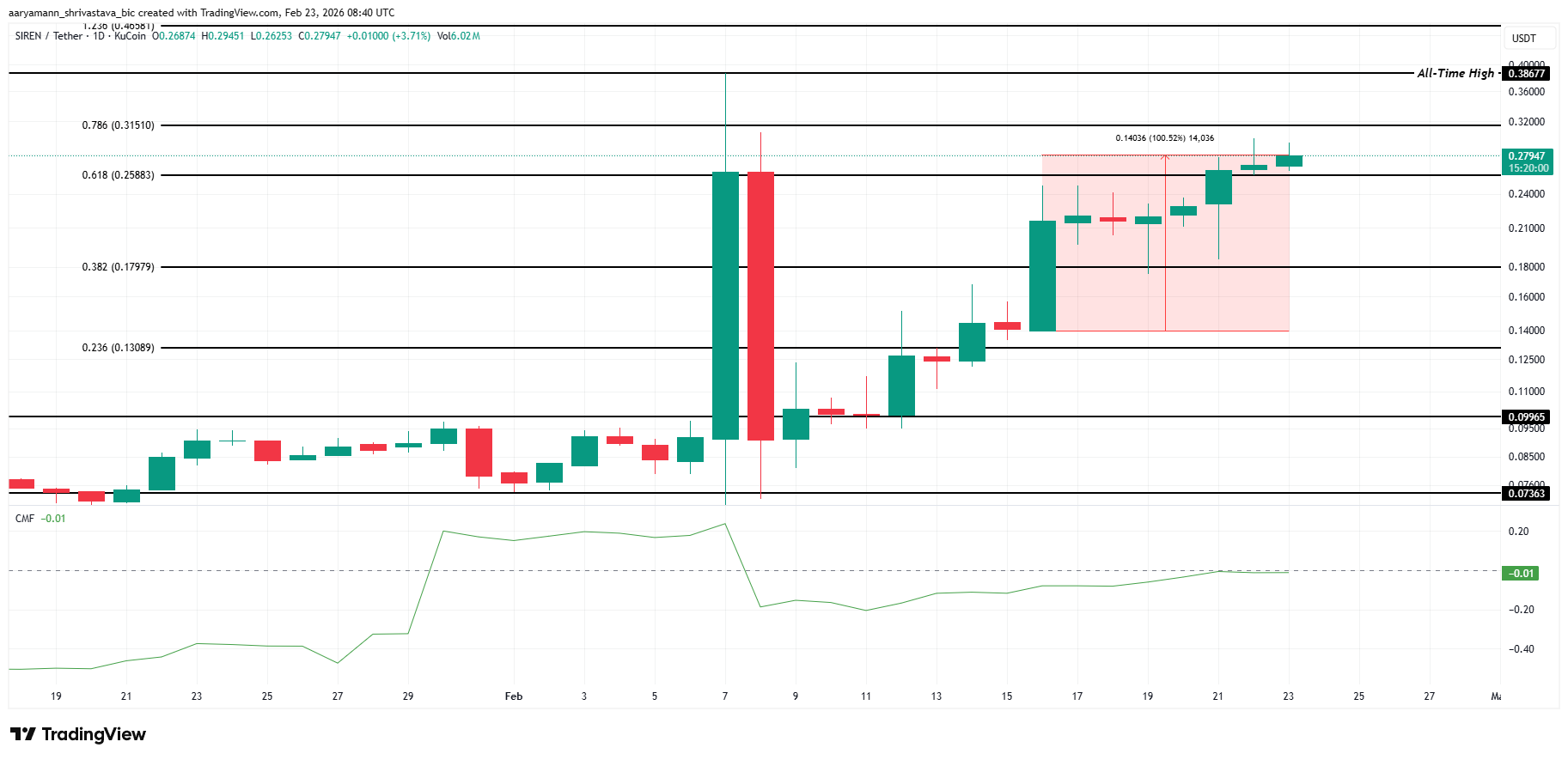
However, rapid gains increase the likelihood of profit taking. A shift in sentiment could push SIREN below the $0.258 support level. Losing this threshold would weaken the bullish structure. In that scenario, the meme coin could decline toward $0.179, delaying any attempt to reach new highs.
Not in Employment, Education, or Training (NEET)
NEET price surged 75% in the past 24 hours, trading at $0.0249 at the time of writing. The sharp rally caught the broader crypto market off guard. Elevated trading volume and social media traction have fueled momentum, positioning the altcoin for potential continuation if demand remains steady.
Sustained buying pressure has strengthened NEET’s short-term structure. A confirmed move above $0.0258 could support further upside toward $0.0329 in the coming days. The meme coin’s base of 14,100 holders relative to its $24 million market cap signals active community participation, often a catalyst for volatility.
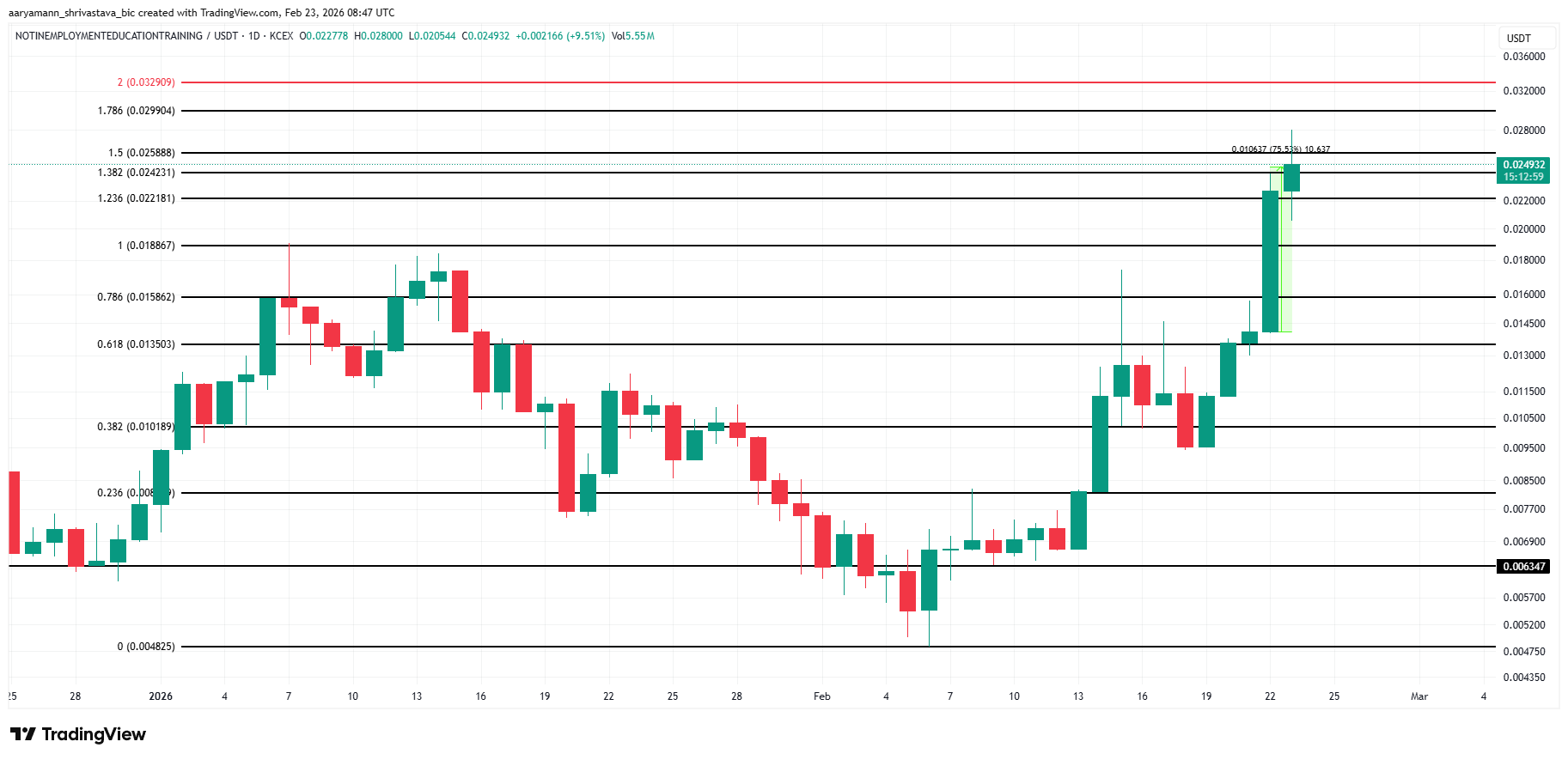
However, rapid price expansion increases correction risk. If buying pressure fades, profit booking may trigger a pullback. Holding $0.0188 support would preserve recovery prospects. A breakdown below that level could drive NEET toward $0.0158, invalidating the bullish outlook and signaling broader weakness.
BAN emerged as one of the stronger-performing meme coins this week, rising 34% despite broader crypto market weakness. This divergence from overall market losses highlights relative strength. Sustained decoupling from bearish sentiment could attract short-term traders seeking alternative upside opportunities in volatile digital assets.
BAN’s correlation with Bitcoin stands at -0.34, indicating it often moves opposite the leading cryptocurrency. This inverse relationship can benefit BAN during Bitcoin pullbacks. Continued negative correlation may support the ongoing uptrend, potentially driving BAN price toward $0.1617 and extending gains to $0.1835.
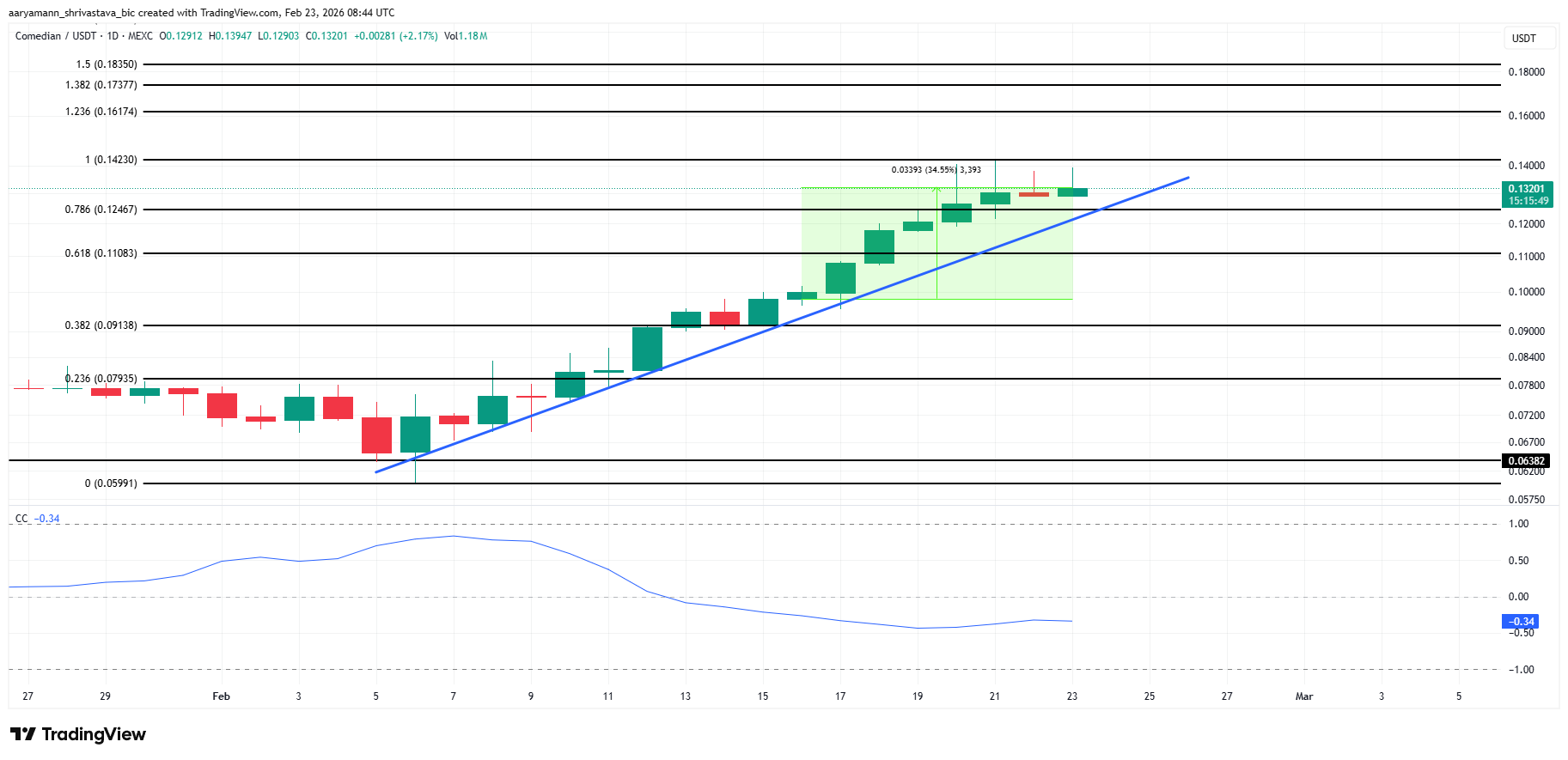
However, improving Bitcoin price momentum could alter this dynamic. If broader crypto sentiment strengthens, BAN’s inverse correlation may limit upside. A decline below $0.1108 would weaken the bullish structure. Sustained selling pressure could push the meme coin toward $0.0913, invalidating the current recovery outlook.

Editor’s note: As the AI boom accelerates, Nvidia sits at the heart of the conversation about how quickly hardware and software teams scale deployment. This editorial provides a concise context for the press release that follows, focusing on the broader market momentum, the role of data centers in AI infrastructure, and the potential implications of forward guidance for investors and traders in tech and beyond. While this note does not add new facts, it frames the lens through which Nvidia’s earnings will be digested by crypto traders and institutional investors who closely watch AI spending trends, capex cycles, and regional risks.
Key points
- Nvidia continues to be a focal point for AI infrastructure spend, with hyperscalers driving data center demand.
- Rubin, Nvidia’s next-generation platform, is a key area of investor focus alongside the Blackwell ramp and gross margin trajectory.
- Geopolitical risk remains a consideration, with export controls in China presenting potential upside if restrictions ease.
- Forward guidance and near-term revenue expectations are closely watched as drivers of momentum in the AI trade.
Why this matters
Nvidia’s earnings preview signals how AI infrastructure investment could shape market dynamics across technology, finance, and enterprise computing. The year ahead will test whether data center demand, platform innovations, and global capex cycles sustain the AI momentum that has underpinned recent market rally attempts and portfolio allocations.
What to watch next
- Rubin ramp progress and its impact on long-term profitability.
- Any developments on China export restrictions and potential upside if eased.
- Guidance clarity on 2027 AI infrastructure spending and data center revenue trends.
Disclosure: The content below is a press release provided by the company/PR representative. It is published for informational purposes.
Nvidia Earnings Set to Test AI Trade Momentum
Nvidia Earnings Set to Test AI Trade Momentum
Abu Dhabi, United Arab Emirates – February 23, 2026: Nvidia’s upcoming earnings report is poised to become one of the most significant events on the global financial calendar, reflecting its position at the centre of the artificial intelligence revolution.
“In the same way Apple once defined the smartphone era, Nvidia now represents the AI era,” said Zavier Wong, Market Analyst at eToro. “Its earnings are no longer just a tech sector event — they are a market-wide catalyst that can influence diversified portfolios globally.”
Wall Street expects quarterly revenue of approximately USD $65–66 billion, representing around 68% year-on-year growth, with earnings per share forecast at USD $1.52–1.53. Data centre revenue is projected to approach USD $60 billion, underscoring sustained demand from hyperscalers including Microsoft, Amazon, Google and Meta. Collectively, these companies are expected to allocate between USD $650–660 billion in capital expenditure in 2026, much of which is tied directly to AI infrastructure.
Beyond US technology giants, sovereign AI investment is emerging as a meaningful growth driver. Countries such as the UAE and Saudi Arabia, alongside several European nations, are accelerating domestic AI cloud development. This segment alone could contribute more than USD $20 billion to Nvidia’s annual revenue in 2026, providing further diversification of its revenue base.
Demand continues to be supported by Nvidia’s Blackwell architecture, which management has previously indicated is effectively sold out through mid-year. Market attention is now turning toward Rubin, the company’s next-generation platform unveiled at CES. Gross margins are expected to recover toward the mid-70% range following temporary pressure during the Blackwell ramp-up, a key signal for long-term scalability and profitability.
However, China remains a notable risk factor. Current guidance assumes no H20 chip sales into the region, meaning any easing of export restrictions would represent upside potential. For now, restrictions continue to act as a headwind.
Nvidia shares have traded broadly flat over the past six months, and investors are increasingly focused on forward guidance rather than headline results.
“The real driver of Nvidia’s share price is guidance,” Wong added. “Markets want confirmation that AI infrastructure spending is still in its early innings, especially as questions grow around the sustainability of industry-wide capex.”
Investors are looking for Q1 FY2027 revenue close to USD $75 billion, gross margins back in the mid-70% range, and clearer visibility on the Rubin ramp. Meeting those expectations could reignite momentum across the AI trade, while any shortfall may trigger volatility extending well beyond Nvidia itself.
Media Contact:
PR@etoro.com
About eToro
eToro is the trading and investing platform that empowers you to invest, share and learn. We were founded in 2007 with the vision of a world where everyone can trade and invest in a simple and transparent way. Today we have 40 million registered users from 75 countries. We believe there is power in shared knowledge and that we can become more successful by investing together. So we’ve created a collaborative investment community designed to provide you with the tools you need to grow your knowledge and wealth. On eToro, you can hold a range of traditional and innovative assets and choose how you invest: trade directly, invest in a portfolio, or copy other investors. You can visit our media centre here for our latest news.

FIFA World Cup organizers are reportedly considering moving this year’s tournament out of Mexico after the death of a crypto-laundering Mexican cartel kingpin led to a wave of violence from his supporters.
Nemesio Oseguera Cervantes, otherwise known as “El Mencho,” ran the Jalisco New Generation Cartel (CJNG) and was killed on Sunday during clashes between his organization and Mexican authorities.
The 59-year-old was reportedly injured during a firefight in the town of Tapalpa, and died while being transported to Mexico City.
His death resulted in an outpouring of violence from supporters. This included the burning of vehicles and buildings across the country, including in Guadalajara, a scheduled host of this summer’s World Cup.
As a result, rumours began to circulate that the city could be pulled from the tournament’s list of venues. Indeed, the host of Ticket Talk, Scott Friedman, claims a contact within FIFA informed him that games will be moved out of Mexico if the situation doesn’t improve in the next week or two.
Bitcoin investor and private fund founder Mike Alfred also claimed that “credible chatter” informed him that the cartel violence has led FIFA to consider moving games slated to take place in Mexico to the US and Canada.
Read more: Up to 127 years for CEO who laundered Mexican cartel funds with bitcoin
The violence has led to countries issuing warnings against travelling to affected regions of Mexico, and the US warning its citizens in the Jalisco region to seek shelter and stay inside.
FIFA is yet to publicly comment on the situation in Mexico. Protos has reached out to FIFA for comment and will update this piece should we hear back.
El Mencho laundered drug funds with crypto brokers
Cervantes founded the CJNG after working his way up the cartel ranks, killing rivals along the way. It was a notoriously violent, heavily armed organization that has been responsible for numerous massacres.
The drug lord was designated as a Kingpin in 2015 and his drug trafficking enterprise was recognised as one of the most powerful criminal groups in Mexico.
The US reward for information leading to his arrest was set at $15 million.

Read more: UK ‘El Chapo’ faces 120 years in US prison over bitcoin-for-drugs ring
Studies led by TRM Labs found that the CJNG has been utilizing crypto to convert drug funds into stablecoins. It was then sent to various wallets, withdrawn from exchanges, or spent as crypto.
In 2022, the Drug Enforcement Administration reportedly discovered that the CJNG had used Binance to move up to $40 million worth of cryptocurrency made through its cocaine and methamphetamine sales.
A Mexican broker was sentenced to eight years in prison for organizing a series of crypto laundering hubs across the US that took cash from the CJNG’s drug sales and converted it into crypto.
TRM Labs has also documented how Chinese money laundering brokers help out these cartels, as well as Chinese suppliers that sell them drug-related chemicals in exchange for crypto.
Got a tip? Send us an email securely via Protos Leaks. For more informed news, follow us on X, Bluesky, and Google News, or subscribe to our YouTube channel.

OpenAI forms “Frontier Alliances” with top consultancies

Italy cricket in crisis over alleged sexual assault by senior figure at national governing body

OpenAI CEO Sam Altman calls Elon Musk’s space data centers ‘ridiculous’


-

 Crypto World6 days ago
Can XRP Price Successfully Register a 33% Breakout Past $2?
-

 Video4 days ago
XRP News: XRP Just Entered a New Phase (Almost Nobody Noticed)
-

 Fashion3 days ago
Weekend Open Thread: Boden – Corporette.com
-

 Sports7 days ago
GB's semi-final hopes hang by thread after loss to Switzerland
-

 Politics2 days ago
Baftas 2026: Awards Nominations, Presenters And Performers
-
 Tech7 days ago
The Music Industry Enters Its Less-Is-More Era
-

 Business6 days ago
Infosys Limited (INFY) Discusses Tech Transitions and the Unique Aspects of the AI Era Transcript
-

 Entertainment5 days ago
Kunal Nayyar’s Secret Acts Of Kindness Sparks Online Discussion
-

 Politics2 hours ago
Nick Reiner Enters Plea In Deaths Of Parents Rob And Michele
-

 Video6 days ago
Financial Statement Analysis | Complete Chapter Revision in 10 Minutes | Class 12 Board exam 2026
-

 Tech5 days ago
Retro Rover: LT6502 Laptop Packs 8-Bit Power On The Go
-
 Sports5 days ago
Clearing the boundary, crossing into history: J&K end 67-year wait, enter maiden Ranji Trophy final | Cricket News
-

 Business1 day ago
Mattel’s American Girl brand turns 40, dolls enter a new era
-

 Business1 day ago
Law enforcement kills armed man seeking to enter Trump’s Mar-a-Lago resort, officials say
-

 Entertainment5 days ago
Dolores Catania Blasts Rob Rausch For Turning On ‘Housewives’ On ‘Traitors’
-

 Business6 days ago
Tesla avoids California suspension after ending ‘autopilot’ marketing
-
 NewsBeat10 hours ago
‘Hourly’ method from gastroenterologist ‘helps reduce air travel bloating’
-

 Sports1 hour ago
Women’s college basketball rankings: Iowa reenters top 10, Auriemma makes history
-

 Politics7 days ago
Eurovision Announces UK Act For 2026 Song Contest
-

 Tech1 day ago
Anthropic-Backed Group Enters NY-12 AI PAC Fight