

Crypto World
Bitcoin Whales Accumulate Again at $71K, Santiment


Bitcoin (CRYPTO: BTC) has hovered near the $71,000 level as large holders ramp up exposure, according to Santiment’s latest weekly assessment. The analysis highlights a renewed shift by wallets that hold 10 to 10,000 BTC, which Santiment described as a bullish signal if it endures. The share of the total supply controlled by this cohort rose to 68.17% from 68.07% a week earlier, signaling a persistent tilt toward big holders even as prices stabilize. Retail demand, meanwhile, remains fragile; the Crypto Fear & Greed Index was in Extreme Fear at 16 on Sunday, underscoring ongoing caution among everyday investors. Bitcoin was around $71,350 at the time of publication, marking a roughly 6% rise over the past week. On the liquidity side, US spot BTC ETFs logged their first five-day inflow streak of 2026, bringing in roughly $767.32 million this week, a reminder that regulated products continue to channel capital into the market.
For context, Santiment’s notes on on-chain behavior were complemented by a broader view of market sentiment. The firm’s observations on wholesale accumulation come as traders weigh the implications of a shift in ownership toward larger addresses. The wholesale activity is particularly relevant when juxtaposed with the persistence of cautious sentiment among retail participants, a dynamic that has characterized much of Bitcoin’s range-bound work over recent months. The interplay between accumulation by whales and the slower pace of retail adoption has created a tug-of-war that market participants are watching closely, especially in areas where technicals align with on-chain signals to form a potential base for price stability.
In a separate frame of reference, the market has been responding to regulatory and product-structure developments that shape how new participants access Bitcoin. ETF inflows, now aided by a broader appetite for regulated exposure, can lend a degree of liquidity that supports price discovery. At the same time, analysts caution that this is not a simple, linear uptrend; episodes of volatility can arise if large holders react to evolving risk cues or if retail conviction fluctuates sharply. The balance between on-chain momentum and macro-driven appetite for regulated products continues to define Bitcoin’s core narrative as the year progresses.
Past on-chain patterns also color expectations. A week earlier, Santiment noted a marked reversal among whales after a sprint of buying earlier in the month. In a Mar. 6 report, the firm highlighted that whales had sold roughly 66% of the Bitcoin they had purchased between Feb. 23 and Mar. 3, just as Bitcoin breached the $70,000 level and briefly touched $74,000. The takeaway is not that whales cannot sustain accumulation, but that their activity can pivot rapidly in response to price moves, implying that a potential bottom may require a clearer alignment of broader market participants around a stable price range. The market’s tendency to reward the consensus with a lag remains a recurring theme that analysts stress when evaluating the durability of any bottom signal. Willy Woo, a prominent on-chain commentator, recently framed Bitcoin’s price action as “solidly in the middle of its bear market through a lens of long-range liquidity,” a reminder that structural factors can influence how the market transitions from caution to confidence over time.
The current environment also reflects a broader appetite for regulated crypto exposure. The five-day inflow streak into US spot Bitcoin ETFs is a notable marker of renewed institutional interest, a trend that has historically added a layer of liquidity and can help moderate sharp downside moves. The inflows come as traders observe how on-chain activity interacts with price levels and how new participants engage with the asset through regulated vehicles. While this liquidity backdrop can support a steadier price path, it does not by itself guarantee a sustained rally, particularly in a market where sentiment remains guarded and retail participation shows mixed signals. In the mix of factors shaping near-term moves, the balance between whales’ accumulation and retail behavior, alongside evolving ETF dynamics, will likely influence Bitcoin’s trajectory over the coming weeks.
Key takeaways
- Whale accumulation around $71k offers a potential floor if the trend persists, signaling renewed on-chain demand from large holders.
- The rising share of supply held by wallets with 10–10,000 BTC suggests ownership concentration is increasing, which could impact price dynamics if these addresses sustain net buying.
- Retail demand remains a wildcard, with Extreme Fear readings implying a cautious market that could slow any rapid upside despite bullish on-chain signals.
- Regulated exposure via US spot BTC ETFs contributed to a five-day inflow streak of roughly $767.32 million, adding liquidity that can influence near-term price action.
- Historical whale behavior—selling into strength—serves as a reminder that large holders can shift momentum quickly, creating risk for a sustained rally without broader participation.
Tickers mentioned: $BTC
Sentiment: Neutral
Price impact: Positive. Bitcoin’s price has moved higher in the week, reflecting on-chain accumulation and improving liquidity conditions from ETF inflows.
Trading idea (Not Financial Advice): Hold. The current mix of whale accumulation and cautious retail sentiment suggests waiting for clearer directional cues before committing to a new position.
Market context: A liquidity backdrop is evolving as US spot BTC ETFs post renewed inflows, complementing on-chain signals and shaping potential price moves as investors reassess risk and regulatory considerations.
Why it matters
On-chain behavior remains a critical lens through which investors assess Bitcoin’s near-term health. The consolidation of ownership among larger addresses can indicate a readiness to anchor prices at higher levels, especially if these participants sustain their accumulation into key support zones. If whales continue to accumulate while smaller holders trim their activity, the market could be positioning for a more durable base rather than a transient spike. This dynamic matters because it can reduce the likelihood of rapid, sharp declines and increase the odds of a steadier ascent should risk sentiment improve modestly.
Retail sentiment, captured by the Fear & Greed Index, matters because it often acts as a contrarian indicator. When everyday investors grow increasingly optimistic, the market may face a pullback if the enthusiasm outpaces underlying fundamentals. Conversely, persistent caution can delay upside while prices remain tethered to macro and on-chain cues. The emergence of ETF inflows adds another layer to the equation: while inflows are not a guarantee of a sustained rally, they can augment liquidity and provide a stepping-stone for broader participation, including institutional players who seek regulated exposure. Together, these factors sketch a market that could wobble near a confluence of on-chain signals, regulatory dynamics, and liquidity shifts rather than follow a simple, predictable trajectory.
In practical terms, traders and investors should watch how whale and retail balances evolve in tandem. A sustained rise in the share of BTC held by the 10–10,000 BTC cohort could reinforce a floor, especially if accompanied by continued ETF inflows. However, a resurgence in retail buying could introduce additional volatility, particularly if it coincides with macro developments or shifting risk appetite. The market’s path forward will likely hinge on the resilience of on-chain signals and the depth of liquidity provided by regulated products as the year progresses.
What to watch next
- Monitor the balance between whale and retail wallet activity; a persistent tilt toward large holders could support a higher floor.
- Track the Crypto Fear & Greed Index for shifts in sentiment that could precede a change in buying patterns.
- Observe ETF inflows beyond this week’s levels to gauge whether regulated exposure remains a tailwind for liquidity and price discovery.
- Watch price action around $71k and nearby psychological levels to assess how momentum players respond to resistance zones.
- Stay alert to macro developments and regulatory signals that could alter risk appetite for the crypto sector.
Sources & verification
- Santiment weekly summary on wallet balances and the share of supply held by 10–10,000 BTC addresses.
- On-chain discussion of whale dynamics and potential bottom formation from Santiment.
- Crypto Fear & Greed Index reading (Extreme Fear) for the period referenced.
- Bitcoin price context around $71,350 with seven-day performance data (CoinMarketCap).
- U.S. spot Bitcoin ETF inflows totaling approximately $767.32 million in the week reviewed.

Crypto World
Investors Swapping Hype-Only Meme Coin for DeepSnitch AI for 1000X Return Ahead of March 31 Uniswap Listing

South Korea is set to use artificial intelligence to monitor cryptocurrency investment profits as it prepares to tax digital assets by 2027. The system will examine data on crypto transactions to enforce taxation.
Meanwhile, Pepeto news today shows the project has raised over $7.99M in its ongoing presale. While investors are still waiting on hype to fuel a Binance listing, utility-backed projects like DeepSnitch AI (DSNT) have secured a Uniswap listing.
DeepSnitch AI could also be listed on Binance before Pepeto due to its clear utility and team dedication. The project is at the seventh stage of its presale and priced at just $0.04487. Given its AI utility and March 31 deadline, the best crypto to buy for 1000X returns could be DeepSnitch AI.
South Korea turns to AI for crypto tax compliance
South Korea is planning to adopt AI to enhance cryptocurrency tax enforcement before it implements a digital asset tax rollout in 2027. A report by The Korea Times states that the country’s National Tax Service has put out a bid for an AI-based system that will analyze large amounts of data on crypto transactions.
The project is projected to cost 3 billion Korean won and will entail machine learning to detect abnormal trading patterns and potential tax evasion. In the new policy, tax crypto gains that exceed 2.5 million won will be taxed at 22% beginning in January 2027.
Pepeto news today: Two more legit and underdog presales with the potential to give much higher ROI
1. DeepSnitch AI (DSNT): The “must-buy” 1000X moonshot before March 31
The clock is ticking as DeepSnitch AI’s presale continues to sell fast ahead of its March 31 deadline. You have less than a month to hop on the train before the presale ends, and you will have to buy at an exchange price, which will be very high.
At the moment, DeepSnitch AI is in the seventh stage of its presale. It has raised over $2.14M in revenue and given those who joined early more than 191% returns. If you buy $5,000 worth of DSNT at the current price of $5,000, you will get 113,662 DSNT coins.
However, if you use the 50% bonus code, you will get 170,493 DSNT, which could be worth $170,493 if the price of DeepSnitch AI rises to $1. At its core, DeepSnitch AI is a fully operational platform that features five AI agents that work 24/7 to provide you with the latest market insights.
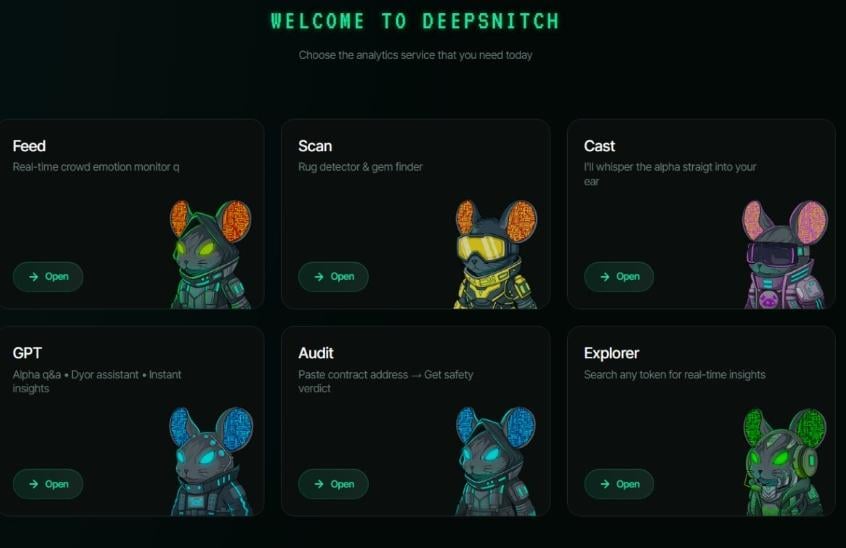
Also, the AI tools are housed together on a clean, intuitive dashboard, which is easy to navigate. The tools evaluate whale movements, scan projects for rug pulls and bugs, highlight top-performing coins, and those with potential for high growth. With these clear utility and live AI tools, the DeepSnitch AI price could see a growth of 1000X.
2. Pepeto news today highlights potential listing
Pepeto is an Ethereum-based project aiming to combine meme-coin culture with real trading infrastructure and DeFi tools. The platform is building an ecosystem that will house an exchange called PepetoSwap.
Recent Pepeto news today shows that the project’s presale growth has been terrific. According to Pepeto roadmap updates, the project could be close to the end of its presale.
It has raised over $7.99M and is close to the end of its target of $8.32M. Meanwhile, Pepeto ecosystem news indicates that developers are preparing major DeFi features and a potential Binance listing. Such a listing could push the Pepeto price to $0.00010 before the year ends.
3. Digitap, the first omni-bank
Digitap is a platform that aims at revolutionizing the cross-border payment industry. It aims to provide businesses, freelancers, and individuals with real-time crypto-to-fiat conversion at low costs and the highest speed.
Meanwhile, the project has a native token called TAP. The token powers the platform by enabling staking rewards, governance participation, fee discounts, and loyalty incentives for users.
Presently, Digitap is at round three of its presale and is priced at $0.0499. Over $5.26M has been raised so far as the project rallies towards $10M.
Final verdict
In summary, Pepeto news today highlights a likely delay in Binance listings. Meanwhile, DeepSnitch AI is already set for a Uniswap listing and could bag more after the end of its presale on March 31.
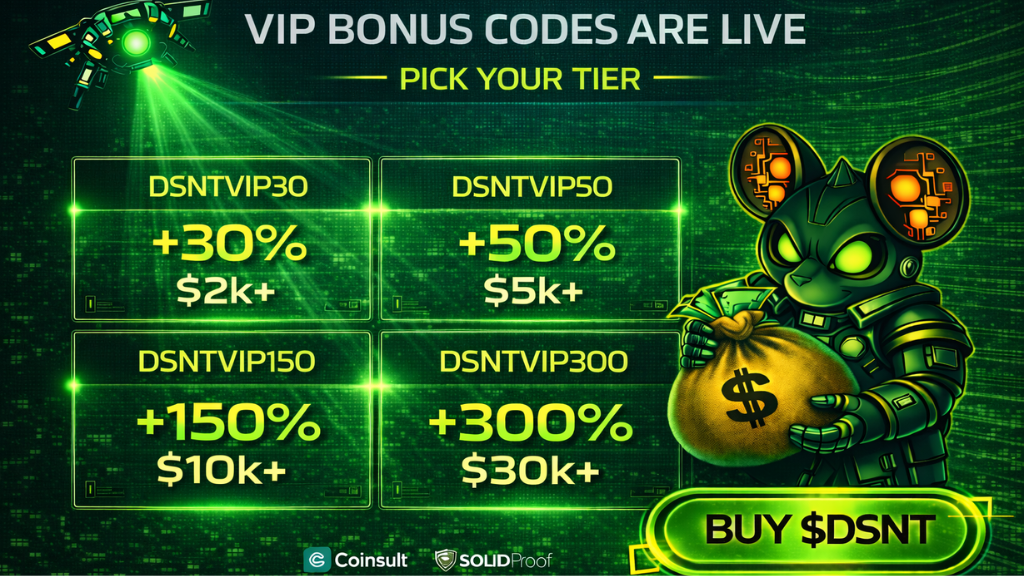
While Pepeto thrives on hype energy, DeepSnitch AI offers the rare combination of a presale success, AI tools, dynamic staking, and 1000X projection. It is currently at the early stages and is priced at $0.04487. Those who get in now can get more coins using the bonus codes, a rare opportunity that will no longer be available after March 31.
Visit the official website for more information, and join X and Telegram for community updates.
FAQs
1. Where will Pepeto be listed?
Pepeto community updates say the memecoin may be listed on Binance soon. However, this is not unconfirmed. On the other hand, DeepSnitch AI could secure a listing first. It is almost at the end of its presale and will be listed on Uniswap first. Also, more exchanges are expected to list DeepSnitch AI after the presale ends.
2. What is the latest Pepeto news today?
Recent Pepeto ecosystem news shows that it has raised over $7.99M in funding. On the other hand, DeepSnitch AI just crossed over $2.14M in a shorter time ahead of its March 31 deadline. The price of DeepSnitch AI is expected to soar by 1000X afterward, making it a good crypto to buy.
3. Is Pepeto coin a good investment?
Based on Pepeto news today, the Pepeto token is expected to soar to a new level soon. However, its lack of clear utility makes DeepSnitch AI a better option. Its AI tools could sustain long-term growth and over 1000X return.
Disclaimer: This is a Press Release provided by a third party who is responsible for the content. Please conduct your own research before taking any action based on the content.


TLDR:
- Elon Musk says AI may perform most tasks efficiently, making work optional in the future.
- Universal High Income differs from UBI, offering access to high-quality goods and services.
- Robots performing labor could lower costs to electricity and material prices, boosting abundance.
- Experts suggest taxing automation and distributing AI-generated profits for sustainable income.
Elon Musk Universal High Income envisions a future where artificial intelligence and robotics make traditional jobs optional.
Musk predicts AI-driven abundance could provide high living standards, turning work into a voluntary pursuit rather than an economic necessity for society.
Elon Musk Universal High Income
Elon Musk Universal High Income is a concept gaining attention after Musk predicted AI and robotics could make traditional jobs optional.
The Tesla CEO explained that advanced automation could fundamentally reshape human work and economic systems in the near future.
Musk stated that humanoid robots and AI could eventually handle most productive tasks more efficiently than humans.
He estimates an 80% chance that this “benign” scenario will emerge, where work is pursued mainly for personal satisfaction rather than financial necessity.
According to Musk, AI-driven productivity could create a world of sustainable abundance. He compared future work to hobbies, such as growing vegetables or playing sports, activities done for enjoyment rather than survival.
He further suggested that money might become less relevant as automation spreads. If AI and robotics continue improving, basic needs could be met through abundant production at minimal cost.
Sustainable Abundance and Economic Shift
Universal High Income differs from Universal Basic Income, which usually provides a minimum survival floor. Musk’s vision involves society-wide access to goods and services due to high productivity and low costs.
Labor, he explained, could essentially become capital. With robots performing tasks more efficiently, the cost of work would drop to the price of electricity and raw materials.
This could generate deflationary pressure, making high-quality food, housing, and healthcare accessible to everyone.
Experts indicate that achieving this future requires significant structural shifts. Taxing human labor may no longer be effective, and proposals include taxing automation or broad consumption instead.
Social dividends could also play a role. Citizens might receive income generated from AI-driven corporate profits, allowing people to benefit directly from automated economic activity.
Widespread corporate stock ownership could ensure citizens share in the prosperity created by AI systems.
Musk warned that physical constraints, such as electricity and materials, will continue to limit production. However, if automation reaches its potential, work may increasingly resemble voluntary participation rather than a necessity.
He emphasized that the greatest challenge could be existential. With machines handling most tasks, society may face a “crisis of meaning,” where humans must find purpose beyond traditional employment.
Musk suggested that humans may continue to contribute by defining roles for AI, creating a new way to assign meaning in society.
This vision positions Elon Musk Universal High Income as a possible future where AI and robotics transform labor markets, economic structures, and human engagement in work.
TLDR:
- Bitcoin ETF inflows stay positive during price dips, signaling ongoing institutional accumulation.
- Whale activity reaches a six-year high, showing large holders are buying strategically.
- Retail investors exit positions, while institutional demand absorbs market selling pressure.
- Consolidation around $70K reflects accumulation and support from long-term Bitcoin holders.
Bitcoin ETF inflows remain robust despite recent price fluctuations, showing long-term institutional accumulation. At the same time, on-chain data reveals the exchange whale ratio at a six-year high, suggesting strategic buying by large holders.
ETF Inflows Show Sustained Institutional Demand
Bitcoin ETF inflows continue to rise even as prices declined from above $120K toward $90K. Weekly data shows strong positive inflows, reflecting ongoing interest from institutional investors.
The divergence between price and capital flows indicates accumulation during market weakness. Large investors treat dips as opportunities, adding to ETF positions.
This behavior contrasts with retail traders who often react to volatility. The iShares Bitcoin Trust ETF (IBIT), according to Robert Mitchnick, Head of Digital Assets at BlackRock, attracted around $26 billion in inflows.
Despite being among the top global ETFs by capital inflows, it remains the only one in the top 20 showing a negative return.
This pattern highlights the conviction of long-term investors. While price appears weak in the short term, capital inflows continue steadily, signaling structural demand for Bitcoin.
Investors who follow ETF inflows can observe where large pools of capital are building positions. Market commentary on social platforms reinforces this behavior.
Tweets note that institutional buyers continue to accumulate during price dips rather than chasing short-term momentum, reflecting a patient approach to Bitcoin exposure.
On-Chain Data and Whale Accumulation
The Bitcoin exchange whale ratio recently reached a six-year high. This metric tracks the activity of large holders moving funds to or from exchanges.
High ratios typically indicate accumulation by whales during market lows. Retail participation is at its lowest level in six years, suggesting weaker hands are exiting positions.
Meanwhile, whales continue absorbing supply, gradually shifting ownership toward long-term holders. Price action shows consolidation around $70K.
Pullbacks toward this support zone are consistently absorbed by demand, reflecting accumulation rather than panic selling. On-chain indicators confirm the market structure favors long-term accumulation, not speculative trading.
ETF inflows combined with whale activity provide insight into structural demand. Capital continues moving into regulated vehicles while larger holders secure Bitcoin off exchanges, setting the stage for potential upward trends once consolidation ends.
The current combination of ETF inflows and on-chain whale accumulation indicates a market phase dominated by long-term strategic investment rather than short-term speculation. This dual signal is a key indicator of Bitcoin’s ongoing structural support.
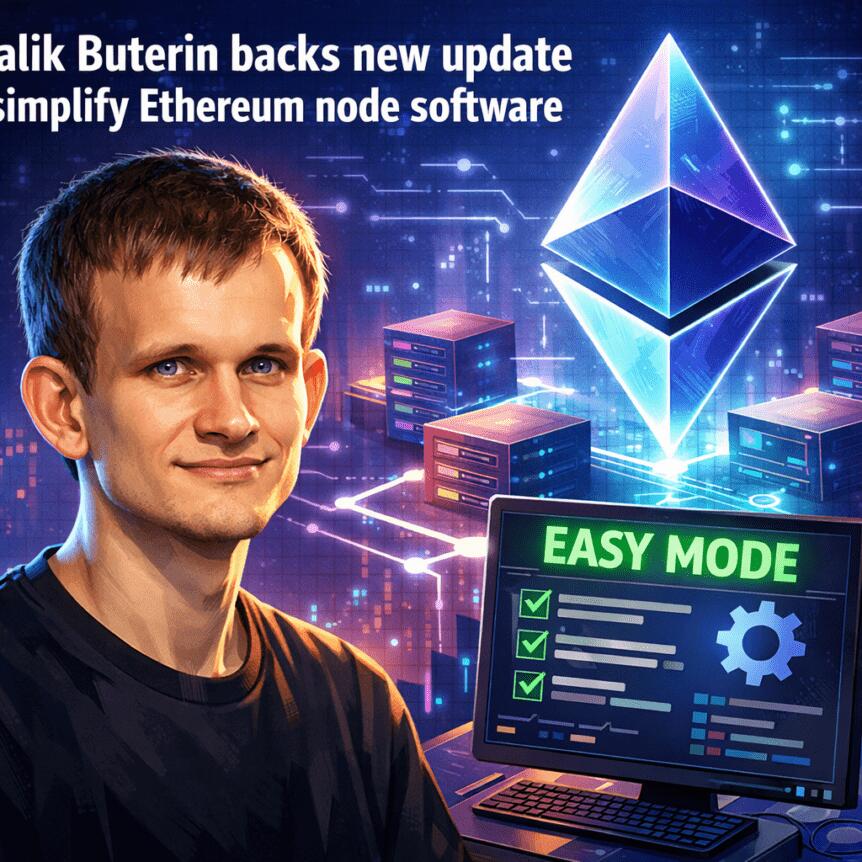
Vitalik Buterin, Ethereum’s co-founder, unveiled a proposal on Saturday to merge the backend programs that power Ethereum’s Beacon Chain consensus layer with the execution layer into a single codebase. The intention is to remove needless complexity from node operation and lower the barriers for individuals and households to participate as validators, not just large-scale operators or centralized service providers. The plan would reframe how a node is set up by unifying the two core software streams that currently run in parallel to coordinate consensus and transaction processing.
Today’s validators must manage two separate software stacks. The Beacon Chain governs consensus and staking, while the execution layer handles all transaction execution and smart contract logic. Each component requires careful synchronization to transmit data between layers, and any misalignment can complicate maintenance and uptime. That bifurcation has long been cited as a deterrent for hobbyists and smaller operators who want to contribute to Ethereum’s security and censorship resistance but lack the resources or time to manage a dual-stack environment. The proposed consolidation would, in theory, streamline operations and reduce the technical overhead for running a node, potentially expanding the pool of participants who can run their own infrastructure instead of leaning on RPC providers or managed services.
“I feel like at every level, we have implicitly made this decision that running a node is this oh so scary DevOps task that it is ok to leave to professionals. It is not. We need to reverse this. Running your own Ethereum infrastructure should be the basic right of every individual and household. ‘The hardware requirement is high, therefore it’s okay for the DevOps skill and time requirements to also be high,’ is not an excuse.”
Buterin’s message, posted on X, stresses a broad aim: decentralization should not be a privilege of those who can hire specialists or buy advanced hardware. Even among those who can afford robust hardware for node operation, time remains a scarce resource. In the Ethereum ecosystem, the prospect of running a node has often been framed as an advanced undertaking, with the costs and complexity viewed as an impediment to a more inclusive network. This tension—between the ideal of widespread participation and the practical realities of hardware, bandwidth, and maintenance—has fed ongoing debates about centralization risks and resilience in the ecosystem.
To illustrate how the broader landscape influences these discussions, the proposal comes amid longstanding conversations about centralization risk tied to reliance on remote procedure call (RPC) providers. Critics argue that when a relatively small number of RPC services handle most node traffic, the network becomes vulnerable to deplatforming or censorship if those providers restrict access for geopolitical or policy reasons. Buterin has repeatedly warned that a healthy Ethereum network depends on a robust base of independent operators who can verify transactions and participate in governance without being at the mercy of a handful of external services. The emphasis on easier self-hosting reflects a preference for a more resilient, bottom-up network architecture, even as the ecosystem continues to balance performance, scalability, and privacy concerns.
In a related thread, Buterin revisited the topic of node economics with a proposal from May 2025 that envisions partially stateless nodes. This concept would allow nodes to operate without maintaining the full historical state of the blockchain, instead keeping only the data necessary for their specific tasks. Partial statelessness is intended to lower disk space and data storage requirements, which have historically been a major bottleneck for individuals running full nodes. By reducing the storage burden, more users could run nodes locally to participate in transaction validation and block verification, reinforcing the decentralized fabric of the network. An illustration from Ethereum Research explains how a local node might retain only delta-state information relevant to a user’s interactions, rather than the entire chain state, as part of a broader scaling and decentralization strategy.
Disk space and hardware requirements remain central considerations in the node equation. The consensus-driven direction of Ethereum and other smart contract blockchains has long highlighted the tension between decentralization and practical limitations. The hardware reality—driven in part by the ever-growing volume of on-chain data—creates a natural pull toward specialized setups, which can inadvertently concentrate validation power among those who can afford the right gear. Buterin has repeatedly called attention to this disparity, arguing that a market structure dominated by a small cadre of RPC providers or centralized validators exposes the network to risk and reduces its openness to broader participation. His stance is that a more approachable infrastructure—where individuals and households can run nodes with reasonable effort—would enhance resilience and reduce systemic vulnerability to external disruption.
In late January, Buterin disclosed a personal commitment to privacy-preserving technologies and open hardware. He set aside 16,384 Ether, roughly $45 million at the time, to support initiatives in privacy, open hardware, and verifiable software, with deployment planned gradually over the coming years as Ethereum Foundation leadership described a period of “mild austerity” while continuing to pursue a clear technical roadmap. The funds underscore a longer-term strategy to fortify the ecosystem’s core infrastructure and to align research and development with a more inclusive, privacy-conscious hardware and software ecosystem. This financial stance indicates the foundation’s willingness to invest in foundational capabilities that could propel broader participation, even as resources tighten in other areas.
As the discussion around node accessibility evolves, Ethereum supporters and observers are watching closely how these proposals might translate into concrete tooling, documentation, and developer guidance that lowers barriers without compromising security and decentralization. The conversation also intersects with ongoing governance work that clarifies the Ethereum Foundation’s mandate and priorities, as well as broader debates about how the network should balance openness with performance and user privacy. The connected discourse on statelessness, unified backends, and the role of independent operators continues to shape expectations for upcoming roadmap milestones and security hardening efforts.
For readers seeking a deeper dive into the related conversations, the topic of partially stateless nodes has been explored in depth by researchers and community members. Additional context and viewpoints are available in discussions and articles linked in this coverage, including perspectives on decentralization, hardware requirements, and the trade-offs involved in making node operation more approachable for non-professional operators. The broader takeaway is that Ethereum’s path toward greater accessibility and resilience is being pursued through a combination of architectural simplification, storage efficiency innovations, and an emphasis on individual participation as a fundamental good for the network’s long-term health.
Contextual notes and related materials can be explored through the linked references, including the ongoing dialogue about governance goals and implementation details that shape how developers and validators interact with Ethereum’s core protocols and tooling. The core premise remains: by reducing complexity and storage demands, the ecosystem could foster a healthier, more distributed validation layer, less susceptible to central points of control while preserving the security guarantees that underpin decentralized finance and smart contracts.
Why it matters
At stake is the balance between decentralization, usability, and security. If running a node becomes a task within reach of more individuals and households, Ethereum’s censorship-resistance and fault tolerance could improve as a broader base of independent operators contributes to block validation and stake participation. The proposed backend unification is a structural step toward removing needless friction from node operation, which, in turn, could dilute the influence of a small cadre of service providers who currently dominate occasional uptime guarantees or data availability. The move aligns with a long-standing aspiration among developers and researchers to democratize participation in Ethereum’s security model, ensuring that governance, validation, and staking remain distributed across a wide ecosystem rather than concentrated in a few hands.
From a protocol design perspective, consolidating the two layers into one coherent codebase could simplify maintenance, reduce the risk of misconfigurations, and accelerate the deployment of updates across the network. If the change reduces the complexity of running a node, it may encourage more users to validate and participate directly in consensus, potentially enhancing network security by diversifying the validator set. However, implementing such a fundamental architectural shift will require careful testing, broad community scrutiny, and a clear plan for interoperability with existing tooling and RPC ecosystems to avoid unintended fragmentation.
Beyond the technical implications, the discussions reflect a broader philosophy about Ethereum’s future: how to sustain a security-focused, permissionless system while remaining inclusive and accessible. The funding decisions tied to privacy-preserving technologies and open hardware signals an intent to invest in the long arc of infrastructure resilience, transparency, and verifiability. As the ecosystem weighs centralization risks against practical constraints, the conversation around node design, state management, and the deployment of stateless or partially stateless architectures will likely shape the next wave of core protocol enhancements and tooling improvements for years to come.
What to watch next
- Progress of the unified-backend pull request: status updates, reviews, and potential merge milestones.
- Clarifications from the Ethereum Foundation on roadmap implications and governance expectations.
- Adoption of partially stateless node concepts and any pilot deployments or testnet experiments.
- Updates to hardware guidance and storage requirements as the community tests new node configurations.
- Responses from RPC providers and ecosystem tooling developers regarding compatibility and risk mitigation.
Sources & verification
- Vitalik Buterin’s X post detailing the node operation concerns and the push for a unified backend.
- May 2025 discussions and proposals around partially stateless nodes and their implications for storage and hardware.
- Geth hardware requirements page outlining current storage and hardware considerations for node operators.
- Ethereum Foundation mandate and goals articles providing governance context for the technical roadmap.
- Cointelegraph coverage of Buterin’s privacy/open hardware funding and related centralization discussions.
Unified backends and the path to easier Ethereum node operation
Ethereum’s core design has always prioritized decentralization and security, yet the practical realities of running a full node have often required specialized expertise and resources. Buterin’s proposal to merge the beacon chain’s consensus backend with the execution layer into a single, coherent code structure is a bold attempt to lower the barrier to entry for validators and ordinary users alike. The central question is whether this consolidation can maintain the robustness of the consensus mechanism while simplifying the operational burden on node operators. If successful, the initiative could broaden the base of participants who validate blocks, attest to consensus, and participate in stake-related governance, thereby enhancing the network’s resilience to outages and censorship risks.
The conversation touches on the broader dynamics of Ethereum’s ecosystem, where debates about centralization, hardware requirements, and reliable data availability intersect with ongoing efforts to scale and secure the network. The push for more approachable node operation aligns with a vision of a highly distributed validation landscape that reduces dependence on a handful of external providers. Yet, the technical path to achieve this—through a unified back end and, potentially, partially stateless architectures—requires careful engineering, extensive testing, and careful evaluation of security implications. The YouTube explainer linked in coverage offers an additional layer of context for readers seeking a more approachable briefing on these architectural questions and the trade-offs involved in moving toward stateless or partially stateless nodes. Watch video
As with many foundational changes in the Ethereum roadmap, stakeholders will await further disclosures about timelines, testing plans, and how the update would interact with existing tooling, wallets, and RPC endpoints. The aim is to unlock more widespread participation without compromising the security and decentralization properties that are central to the network’s value proposition. If executed thoughtfully, this dual-layer consolidation could mark a meaningful step toward a more inclusive and resilient Ethereum ecosystem, where running a personal node becomes a realistic option for more users rather than a niche undertaking reserved for specialists.
Crypto World
“Cash Is Not Trash in a Crash”: Kiyosaki Borrows Buffett’s Playbook for Market Uncertainty
TLDR:
- Cash allows investors to buy valuable assets during market downturns, says Kiyosaki.
- Kiyosaki cites Buffett’s strategy of holding liquidity to capitalize on market corrections.
- Millions invested recently by Kiyosaki in oil wells, gold, silver, and Bitcoin.
- Geopolitical tensions in the Strait of Hormuz may push oil prices higher.
Robert Kiyosaki cash is king strategy gained attention after the investor praised Warren Buffett’s approach of holding liquidity. He argued that cash becomes valuable during downturns when assets trade at lower prices.
Buffett’s Cash Philosophy and Kiyosaki’s Approach
Robert Kiyosaki cash is king strategy emphasizes holding liquidity during uncertain market periods. He argued that cash allows investors to purchase valuable assets at lower prices during downturns.
Kiyosaki referenced Warren Buffett’s discipline of keeping large cash reserves. Buffett’s approach provides flexibility to buy high-quality assets when market valuations are attractive.
On X, Kiyosaki wrote, “CASH is not TRASH in a CRASH.” He explained that investors maintaining liquidity may gain opportunities others miss during market declines.
The author noted that while some investors follow Buffett’s example, individuals must decide their own financial actions. Managing cash effectively depends on personal goals and risk tolerance.
Buffett has often sold stocks and bonds to retain liquidity for future market corrections. Kiyosaki used this example to illustrate that cash can be a strategic tool, not idle money.
Kiyosaki also highlighted that cash holdings can complement income from other sources, including businesses and real estate, providing financial stability during volatile periods.
Strategic Investments: Oil, Precious Metals, and Bitcoin
Despite advocating liquidity, Robert Kiyosaki cash is king strategy also includes investing in tangible assets. He disclosed spending millions on oil wells, gold, silver, and Bitcoin.
Kiyosaki explained that geopolitical tensions, especially in the Strait of Hormuz, could drive oil prices higher. Energy markets, he said, may benefit from supply disruptions due to regional instability.
Bitcoin performed well during recent uncertainty, trading near $71,517 with a 7.75% increase over several days. Investor Anthony Pompliano described it as a “chaos hedge” as traditional assets declined.
Other markets experienced declines, with the Nasdaq down 2.2%, the S&P 500 falling 3.45%, gold losing 3.5%, and long-term Treasury bonds dropping 4.71%. Bitcoin’s relative resilience highlighted its appeal during crises.
Kiyosaki emphasized that even if asset predictions are incorrect, income from real estate and businesses provides cash flow. This ensures financial flexibility while holding high-potential assets.
His approach combines liquidity with selective investments in energy, precious metals, and digital assets. The strategy reinforces Robert Kiyosaki cash is king strategy as a balanced method during market volatility.
TLDR:
- Ethereum Foundation sells 5,000 ETH to BitMine at $2,042.96 per ether in an OTC transaction.
- EF uses proceeds to fund protocol research, ecosystem growth, and community grants.
- BitMine now holds 4.53 million ETH, the largest publicly traded ether treasury.
- OTC sale avoids market disruption while transferring supply to a long-term institutional holder.
Ethereum Foundation sells 5,000 ETH to BitMine Immersion Technologies in a $10.2 million over-the-counter transaction.
The sale supports the foundation’s operational funding while transferring ether to one of the largest institutional ETH holders in the market.
Ethereum Foundation Uses OTC Sales to Manage Treasury
The Ethereum Foundation confirmed the sale of 5,000 ETH through an over-the-counter transaction. The deal was completed with BitMine Immersion Technologies at an average price of $2,042.96 per ether.
The foundation manages the Ethereum network’s development, research programs, and community initiatives. It periodically sells portions of its holdings to maintain operational liquidity.
Funds from this transaction will finance protocol research, ecosystem grants, and developer support. These programs are central to sustaining Ethereum’s technical and community growth.
The foundation maintains a reserve management strategy to balance digital assets with fiat-like holdings. This structure ensures that operational expenses remain covered without liquidating significant amounts on public exchanges.
Annual expenditures are targeted at roughly 15% of treasury value. Additionally, the foundation maintains a two-and-a-half-year buffer to cover operational costs in case of unexpected fluctuations.
Over-the-counter deals allow such sales to occur privately. This prevents immediate market pressure and price swings that could occur on public exchanges.
OTC sales have become a standard method for crypto organizations to execute large transactions without disrupting trading dynamics. The approach also aligns with the Ethereum Foundation’s treasury policy.
BitMine Strengthens Its Institutional ETH Position
BitMine Immersion Technologies acted as the buyer in this transaction. The company now holds approximately 4.53 million ETH, valued at over $9 billion at current market prices.
The firm is led by Tom Lee, who is also the chief investment officer at Fundstrat. BitMine has been expanding its ether holdings as part of its long-term treasury strategy.
In addition to ETH, the firm holds about 195 BTC and more than $1 billion in cash reserves. BitMine also maintains equity stakes in multiple companies, including a $200 million investment in Beast Industries.
It owns a 7% share in Eightco, a treasury entity connected to the Worldcoin project. This diverse portfolio complements its primary focus on ether accumulation.
Market coverage included social media mentions highlighting the transaction:
Tweet Example: “Ethereum Foundation sells 5,000 ETH to BitMine in a $10.2M OTC deal at $2,042.96 per ETH. The sale supports EF operations while BitMine expands its institutional ether holdings.”
The transaction reflects continued structured ether distribution, moving supply from operational wallets to long-term institutional holders.
Bitcoin is on track to close its strongest week since September 2025, rising about 8.5% and trading above $71,000.
The move stands out relative to other major assets.
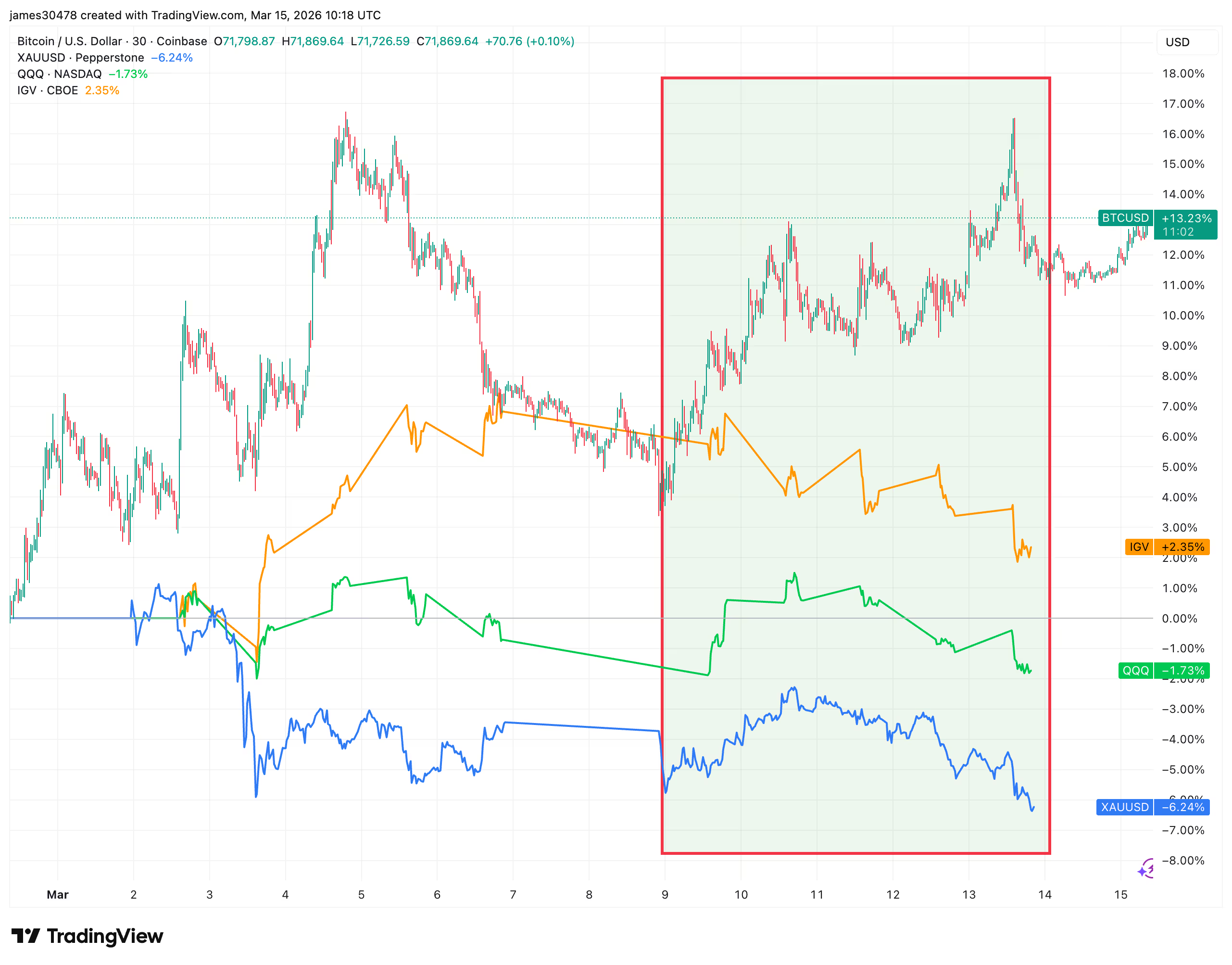
Over the past week, bitcoin has begun to diverge slightly from the broader market. Using BlackRock’s iShares Bitcoin Trust (IBIT) as a five-day proxy, IBIT is up roughly 3.5% and approached a one-month high on Friday.
In contrast, iShares Expanded Tech Software ETF (IGV), gold and U.S. equities all trended lower as the week progressed. This suggests bitcoin is starting to lose its strong correlation with software and tech, at least in the short term.

The divergence comes as bitcoin started to diverge from its traditional counterparts. Since the start of the conflict in the Middle East, over two weeks ago, bitcoin has gained roughly 13%, outperforming traditional risk assets and safe havens alike. Over the same period, IGV has risen about 3%, while gold has fallen around 6%, and U.S. equities have also posted losses.
On a monthly basis, the asset is up about 7% so far in March, which would mark its first positive month since September. That rebound follows five consecutive negative months in which bitcoin declined as much as 50% from its October all-time high.
The buyers of the largest digital asset appear to be U.S., as institutional demand from the region appears to be gradually returning. US spot bitcoin ETFs have recorded approximately $1.3 billion in net inflows so far in March, putting them on track for their first month of net inflows since October.
However, the divergence doesn’t mean that bitcoin is completely out of the woods yet.
The market sentiment remains extremely cautious. The crypto fear and greed index has stayed in “extreme fear” territory. At the same time, perpetual futures funding rates remain negative. Funding rates are periodic payments exchanged between traders in perpetual futures markets to keep contract prices aligned with the spot market. When funding rates are negative, short sellers pay long positions, indicating that bearish positioning is dominant and traders are willing to pay to maintain short exposure.
While it may not mean bitcoin is all-clear to take off, it does show that investors aren’t pricing it as a purely risk asset anymore.
As CoinDesk analysis showed, the move might just mean bitcoin has potentially become a 24/7 leading indicator of how the overall market might trade in response to a macro event. The Middle East conflict is the perfect example of this, as the price moved before any other asset classes when the war first started. And now, it seems everything else is following its price action, while bitcoin remains steady.
Read more: Bitcoin’s recent crash to $60,000 warned stocks first – now they’re following
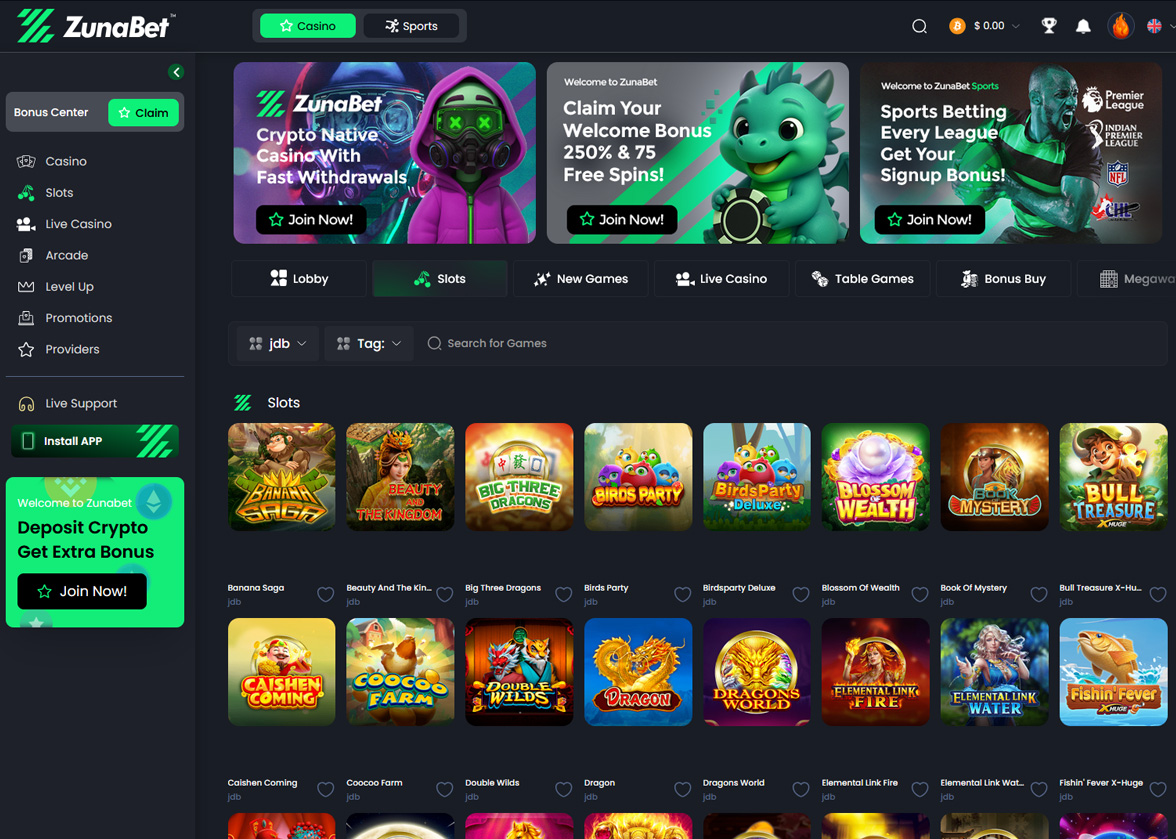
The crypto casino market has grown well past its experimental phase. Multiple platforms now compete for the same audience of crypto-native players, and the differences between them are no longer just about whether they accept Bitcoin. The real competition is about how many games you can play, what your loyalty earns, how generous the welcome offer is, and whether the platform treats every player well or just the ones at the top. Roobet and ZunaBet both operate in this space, but the experience each delivers tells a different story about what a crypto casino can be. One established its name through viral marketing and a youthful brand. The other launched in 2026 with a platform built to outdeliver on the metrics that matter most to everyday crypto gamblers.
Roobet: The Social Media Casino
Roobet launched in 2019 under a Curaçao license and quickly carved out a distinctive niche in the crypto gambling world. Where other platforms relied on traditional marketing channels, Roobet grew largely through social media, influencer partnerships, and a brand personality that skewed younger and more internet-native than most competitors. The platform’s playful aesthetic, featuring its kangaroo mascot, gave it an identity that resonated with a generation of gamblers who discovered crypto casinos through Twitch streams and YouTube content.
The gaming experience at Roobet combines proprietary original games with third-party content. Roobet Originals including Crash, Mines, and Towers follow the same fast, simple gameplay model that has become standard among crypto casino proprietary titles. Third-party games from providers like Pragmatic Play and others supplement the originals, though the total library sits well below what some competitors now offer. The platform has historically prioritised a curated, streamlined experience over maximum game volume.
The sportsbook at Roobet covers major sports including football, basketball, tennis, MMA, and others. Esports betting is available with markets on popular competitive titles. The betting product is functional and integrates with the casino, though it has not been positioned as aggressively as the sportsbooks at some competing crypto platforms.
Roobet supports cryptocurrency payments including BTC, ETH, LTC, and USDT. Transactions process without platform fees at blockchain speed. The payment experience meets crypto-native expectations without standing out from what other platforms in the space provide.
The loyalty programme at Roobet operates through a rakeback system and promotional offers. Players receive a base rakeback percentage with occasional boosts and promotional events. The system provides some ongoing return but has drawn mixed feedback regarding the transparency of how rakeback rates are determined and how players advance to better reward levels. Higher-tier benefits are available but the pathway to them is not always clearly communicated.
Roobet has offered welcome bonuses at various points, though the structure and availability have changed over time and may depend on the player’s region. The welcome offering has generally been more modest compared to what some newer crypto platforms have introduced.
ZunaBet: Maximum Value From Maximum Scale
ZunaBet launched in 2026 under Strathvale Group Ltd with an Anjouan gaming license. Built by a team with over 20 years of combined gambling industry experience, the platform was designed on crypto-native infrastructure with a straightforward objective — deliver more content, more bonus value, and more transparent rewards than what currently exists in the crypto casino market. Every system was built to serve that goal.
The game library is where the scale becomes immediately apparent. ZunaBet hosts 11,294 titles from 63 providers. Pragmatic Play, Evolution, Hacksaw Gaming, BGaming, and Yggdrasil headline the collection, supported by more than fifty additional studios. Slots claim the largest portion, but live dealer tables and RNG games carry genuine depth across the board. The sheer size of the catalog places ZunaBet among the largest crypto casino libraries available anywhere, giving players a breadth of choice that smaller platforms cannot approach.
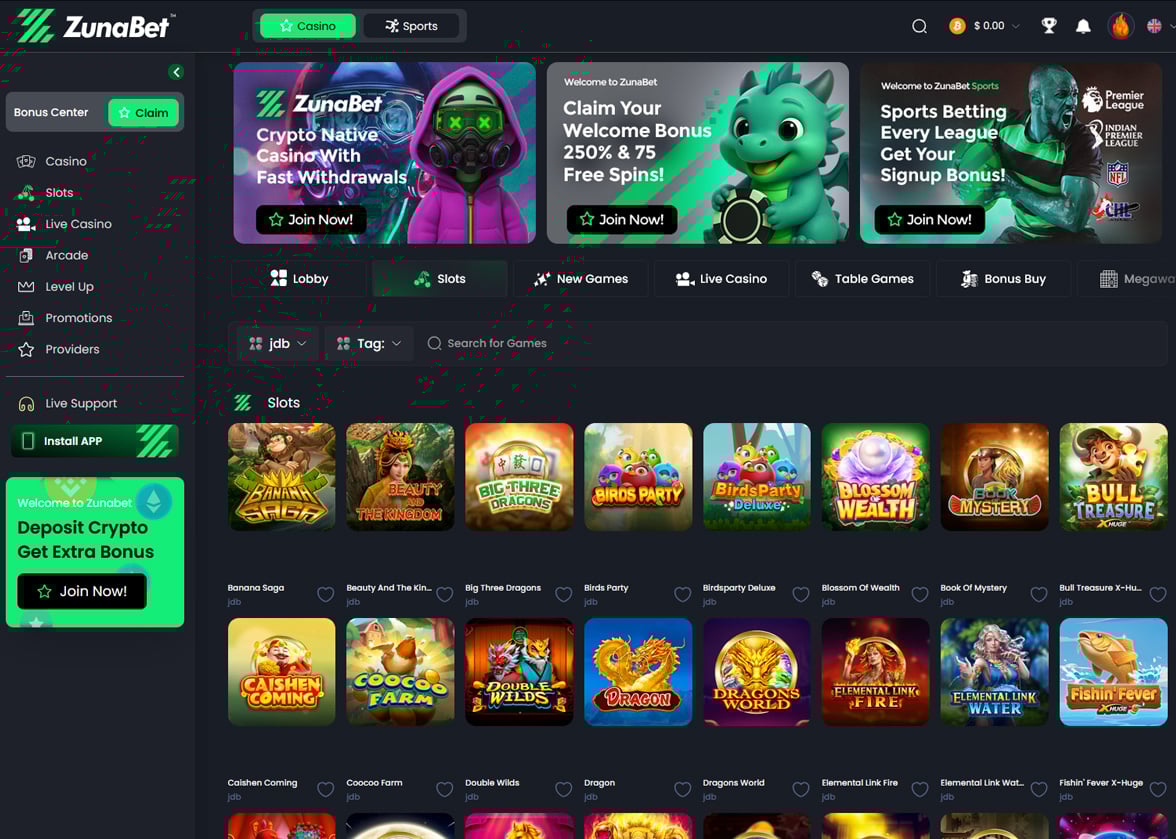
Sports betting was developed as a co-equal product alongside the casino. Football, basketball, tennis, hockey, and major global sports receive comprehensive market coverage. Esports are permanently integrated with dedicated markets on CS2, Dota 2, League of Legends, and Valorant. Virtual sports and combat sports push the range wider. The sportsbook was not added as a checkbox feature — it was built to serve serious bettors on its own merits.
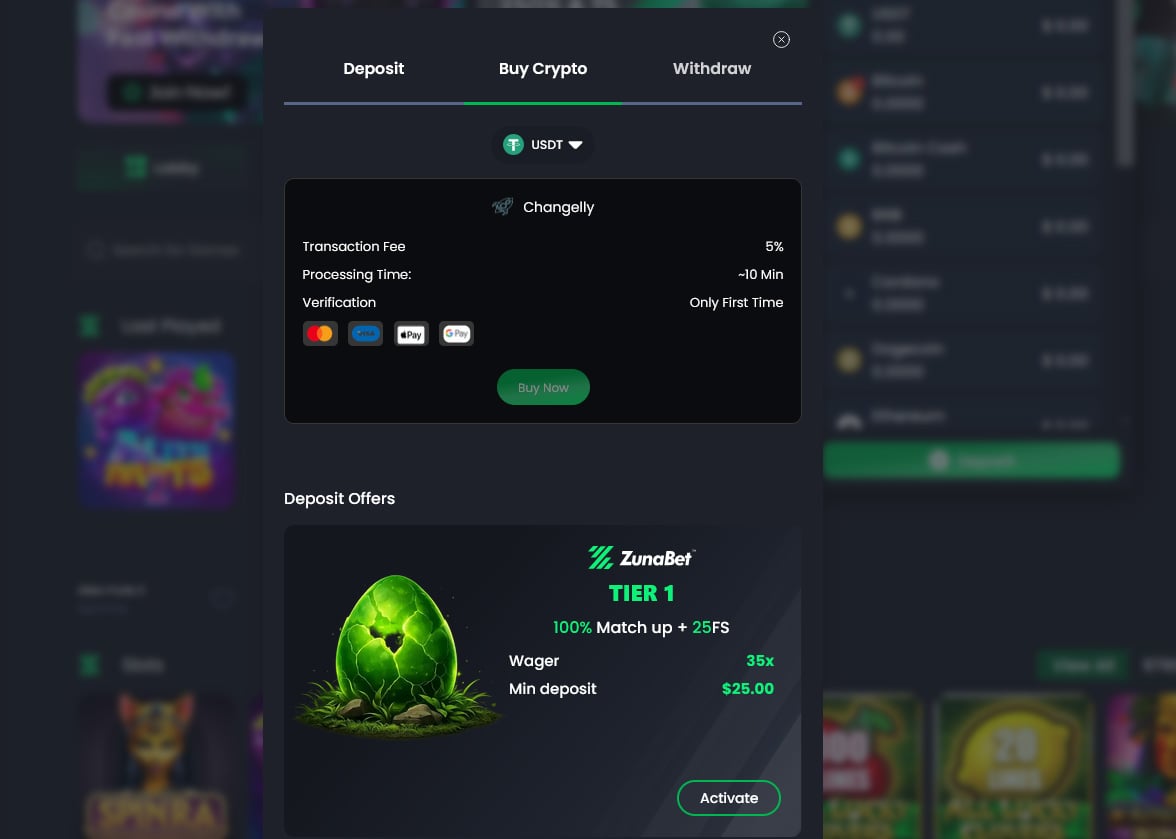
The welcome package makes a clear statement about player value from the first interaction. Up to $5,000 plus 75 free spins across three deposits gives new players a starting advantage that most crypto casinos do not match. First deposit earns 100% up to $2,000 with 25 spins. Second earns 50% up to $1,500 with 25 spins. Third earns 100% up to $1,500 with 25 spins. Three distinct bonus events sustain value well past the initial sign-up moment.
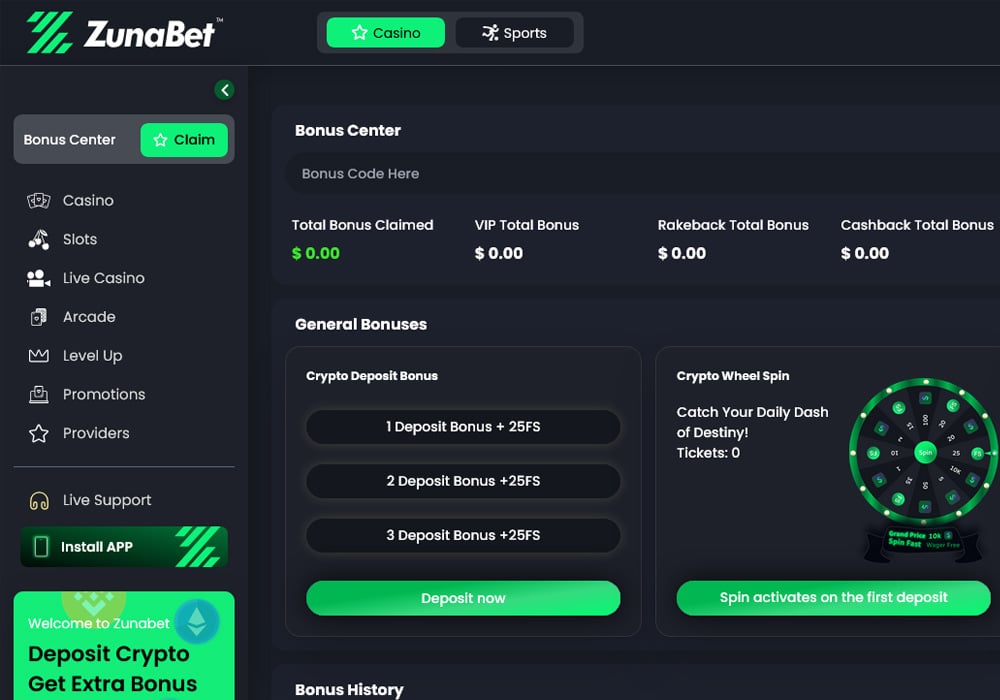
Over 20 cryptocurrencies are supported — BTC, ETH, USDT across multiple chains, SOL, DOGE, ADA, XRP, and many more. No platform fees on any transaction. Blockchain-based withdrawals process quickly and consistently. The breadth of coin support exceeds what Roobet offers, providing flexibility for players with diverse crypto holdings.
Native apps run on iOS, Android, Windows, and MacOS. The dark-themed responsive interface loads fast on every device. Live chat support operates 24/7.
Welcome Value: Setting the Tone
The welcome bonus establishes how a platform values new players from the very first deposit. The difference between Roobet and ZunaBet on this front is significant.
Roobet’s welcome offerings have varied over time and across regions. When available, they have generally been modest in scale compared to what newer competitors now provide. Players arriving at Roobet may find some introductory value, but the platform has not consistently positioned a large welcome package as a core part of its player acquisition strategy.
ZunaBet’s three-deposit structure totalling $5,000 plus 75 free spins treats the welcome period as a sustained investment in the player relationship. Each deposit triggers its own match and spins allocation, creating three separate waves of added value. For any new crypto gambler comparing their options, ZunaBet’s welcome package provides substantially more starting runway and a longer window of bonus-enhanced play.
Loyalty: Partial Transparency vs Complete Clarity
Both platforms offer rakeback, which puts them ahead of crypto casinos that rely solely on promotional cycles. But the structure and accessibility of that rakeback differ in ways that affect what regular players actually receive.
Roobet provides a base rakeback with opportunities for enhancement through promotions and tier advancement. The system returns some value to regular players, but the specifics of how rates are determined and how players progress to better levels have not always been communicated with full clarity. Some players report uncertainty about what their current rate is and what they need to do to improve it.
ZunaBet eliminates every source of ambiguity. The dragon evolution loyalty programme publishes six tiers with explicit rakeback rates — Squire at 1%, Warden at 2%, Champion at 4%, Divine at 5%, Knight at 10%, and Ultimate at 20%. A dragon mascot named Zuno evolves as players progress through each stage. Higher tiers unlock additional perks including up to 1,000 free spins, VIP club access, and double wheel spins.
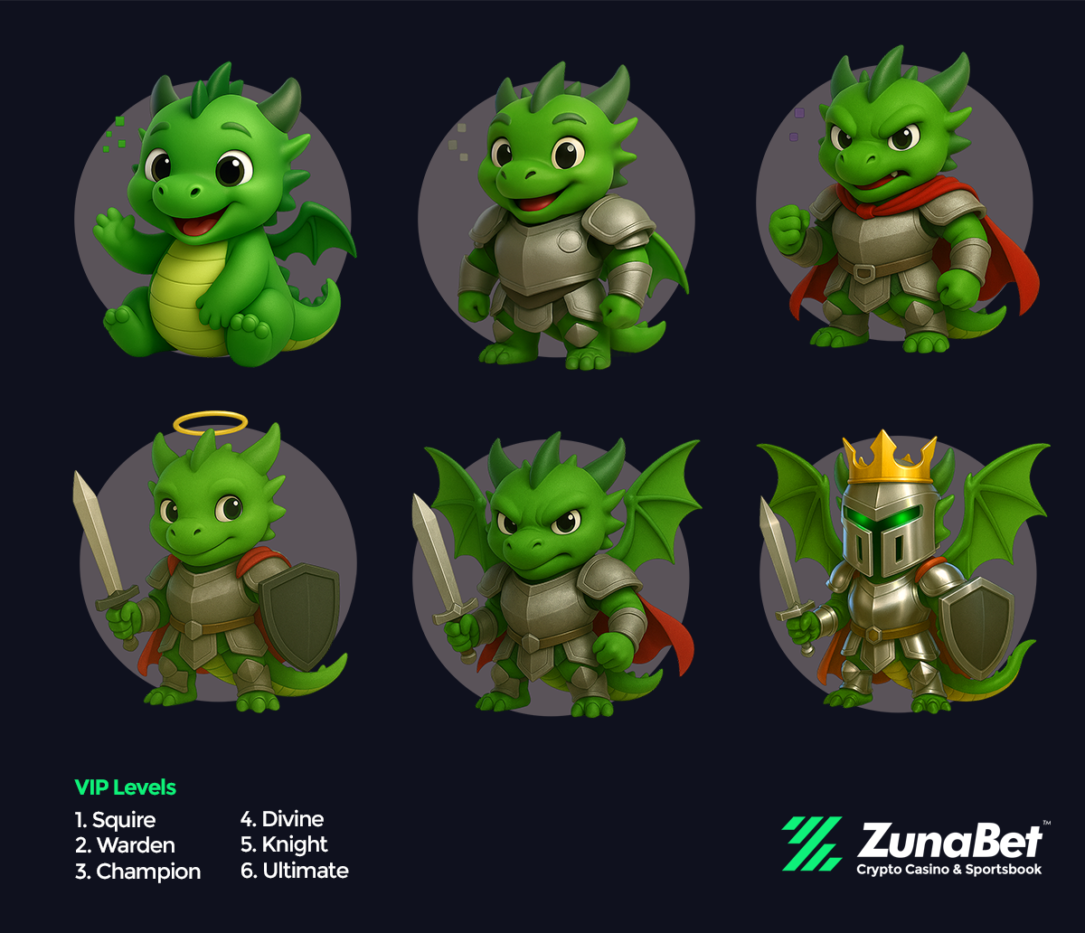
Every player at every tier knows exactly what their wagering returns. No uncertainty about current rates. No confusion about advancement criteria. No wondering whether better rewards exist behind an opaque threshold. The system operates with complete transparency at every level, and at rates that scale to 20% — a figure that exceeds what most crypto casinos offer even at their most generous tiers.
Content Depth: Curated vs Comprehensive
Roobet has taken a more curated approach to its game library. The combination of proprietary originals and selected third-party titles creates a focused experience that avoids overwhelming players with choices. For some players, that streamlined approach is a positive. For others, it means hitting the edges of available content sooner than they would like.
ZunaBet goes in the opposite direction entirely. With 11,294 games from 63 providers, the platform offers a level of variety that virtually guarantees players will discover new content for months. The range spans every major game category with depth from dozens of studios. Players who value having options — and who enjoy the process of exploring new games and providers — will find a fundamentally different scale of experience at ZunaBet.
The choice comes down to preference. A tighter, more focused library, or an expansive catalog that prioritises maximum variety. For the majority of players who equate more choice with more value, ZunaBet’s approach delivers a richer content experience over time.
Crypto Infrastructure: Common Ground With Key Differences
Both platforms are crypto-native and process transactions on blockchain infrastructure without platform fees. The core payment experience is comparable in terms of speed and cost.
Where ZunaBet pulls ahead is in the range of supported coins. With over 20 cryptocurrencies accepted — including USDT across multiple chains, SOL, ADA, XRP, and others that Roobet does not natively support — ZunaBet provides more flexibility for players whose crypto holdings extend beyond the most common tokens. For a player holding SOL or ADA who wants to gamble without converting to BTC or ETH first, ZunaBet removes a friction point that Roobet’s more limited coin support does not address.
Platform Maturity vs Platform Ambition
Roobet has spent several years building a brand with genuine personality. The social media presence, the community engagement, and the influencer-driven growth strategy created an identity that resonates with younger crypto-native audiences. The platform works, the games are fun, and the community feels active. These are real strengths that contribute to player retention.
ZunaBet arrives with less brand history but significantly more platform substance. A game library that dwarfs Roobet’s offering. A welcome bonus that provides materially more starting value. A loyalty system that publishes exactly what every tier earns without ambiguity. Broader cryptocurrency support. A sportsbook built to compete with dedicated betting platforms. Native apps across every major operating system.
Brand personality attracts attention. Platform substance keeps players. Roobet excels at the former. ZunaBet was engineered to excel at the latter. For players who evaluate crypto casinos based on what they measurably receive — in games, bonuses, loyalty returns, and payment flexibility — ZunaBet delivers a more complete package.
Where Crypto Gamblers Should Look in 2026
Roobet has earned its community through years of social engagement and a brand voice that feels genuine. The proprietary games are entertaining, the vibe is unique, and the platform has a loyal following that values the culture as much as the content. For players who prioritise community feel and brand personality, Roobet continues to offer something that bigger platforms often lack.
ZunaBet competes on a different axis entirely — raw value delivery. Over 11,000 games from 63 providers. A $5,000 welcome bonus across three deposits. Published rakeback scaling to 20%. Over 20 supported cryptocurrencies. A full sportsbook with embedded esports. Native apps on every platform. Each of these individually would strengthen any crypto casino. Together, they create a proposition that redefines what players should expect from the category.
Roobet built a community. ZunaBet built a platform that gives that community more than it has ever been offered in one place. For crypto gamblers in 2026 deciding where their deposits deliver the most value, ZunaBet makes the case that is hardest to argue with.
Disclaimer: This is a Press Release provided by a third party who is responsible for the content. Please conduct your own research before taking any action based on the content.
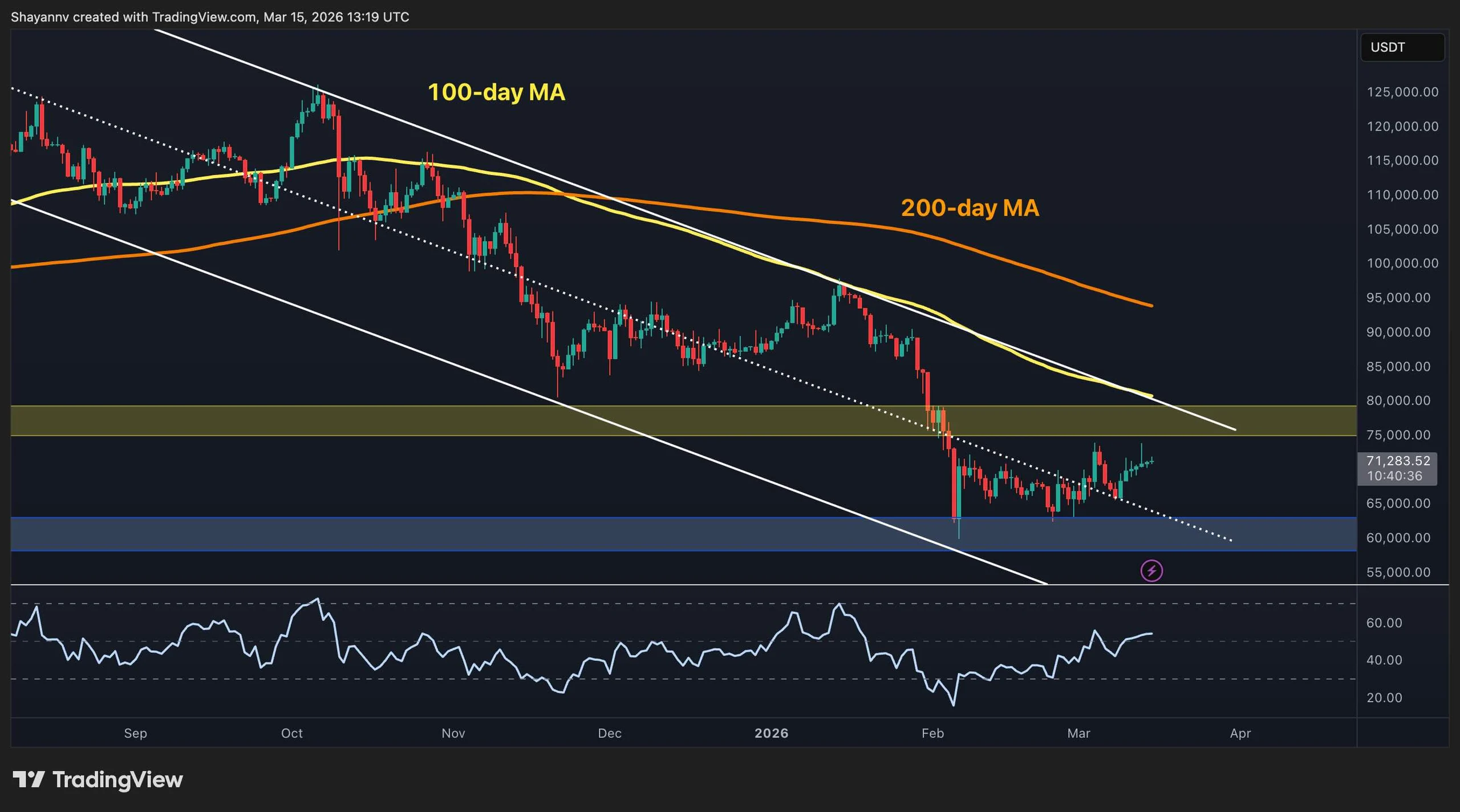
Bitcoin is extending its recovery, but the market is now approaching a more meaningful technical decision point. After holding the $60,000 region and building a series of higher lows, BTC has pushed back into the low-$70,000s, where short-term momentum is improving. Still, the broader structure has not fully flipped bullish, which means this move is best viewed as a test of resistance until proven otherwise.
Bitcoin Price Analysis: The Daily Chart
On the daily chart, Bitcoin continues to trade below both the 100-day and 200-day moving averages, keeping the higher-timeframe trend cautious. The price is also still sitting inside the broader descending structure, even though the latest rebound has clearly improved conditions compared to the panic sell-off seen near the February lows.
The key level to watch remains the $75,000 to $80,000 resistance area, which previously acted as support before turning into supply. As long as BTC stays below that zone, the broader move can still be interpreted as a rebound within a larger corrective phase. On the downside, the $60,000 to $62,000 area remains the main support base, and it is still the level buyers need to defend to preserve the current recovery structure.
BTC/USDT 4-Hour Chart
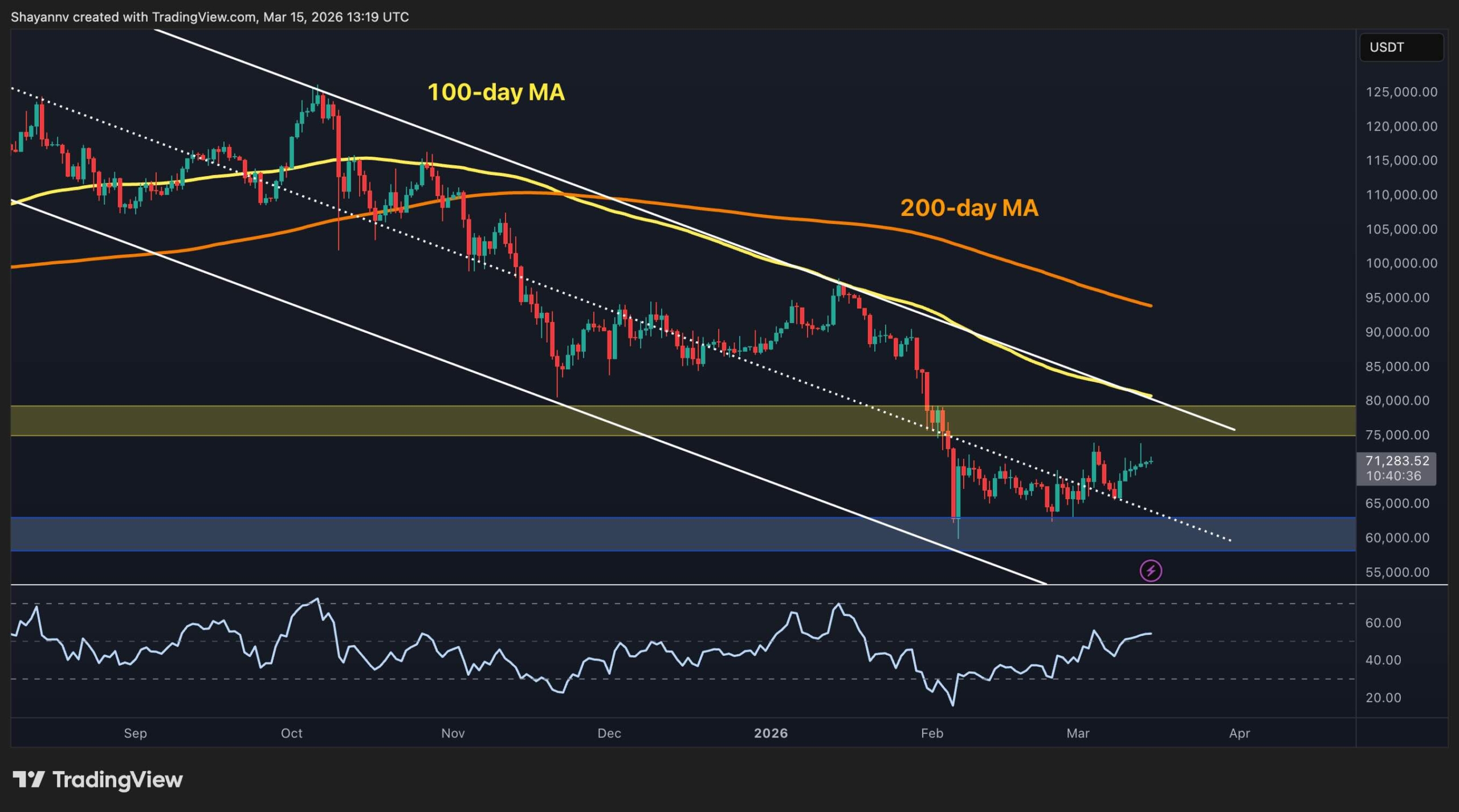
The 4-hour chart looks stronger. Bitcoin has been climbing within a rising channel, and price is once again pressing toward the upper boundary of that formation. The market is now trading around $71,000 to $72,000, with RSI also firming near the upper half of its range, which reflects improving short-term momentum.
That said, BTC is approaching a confluence zone where channel resistance overlaps with horizontal supply around $73,000 to $75,000. This makes the current area especially important. A clean breakout above it would strengthen the case for continuation into higher resistance, while another rejection could send price back toward the middle or lower end of the channel and keep the market in consolidation mode.

On-Chain Analysis
The on-chain picture adds a more constructive undertone. The Spot Average Order Size chart shows that recent activity is still being driven more by larger participants than by aggressive retail-style behavior. Historically, that kind of backdrop tends to be healthier than a move led by euphoric small buyers, because it suggests stronger hands are still active even as price trades below the cycle highs.
At the same time, the chart does not show the kind of broad retail frenzy usually associated with late-stage blow-off conditions. In practical terms, that means the current recovery still looks relatively controlled from an on-chain participation perspective. So while Bitcoin is facing an important technical resistance zone on the charts, the order-size data suggests the market has not yet entered a fully overheated phase.

Binance Free $600 (CryptoPotato Exclusive): Use this link to register a new account and receive $600 exclusive welcome offer on Binance (full details).
LIMITED OFFER for CryptoPotato readers at Bybit: Use this link to register and open a $500 FREE position on any coin!
Disclaimer: Information found on CryptoPotato is those of writers quoted. It does not represent the opinions of CryptoPotato on whether to buy, sell, or hold any investments. You are advised to conduct your own research before making any investment decisions. Use provided information at your own risk. See Disclaimer for more information.
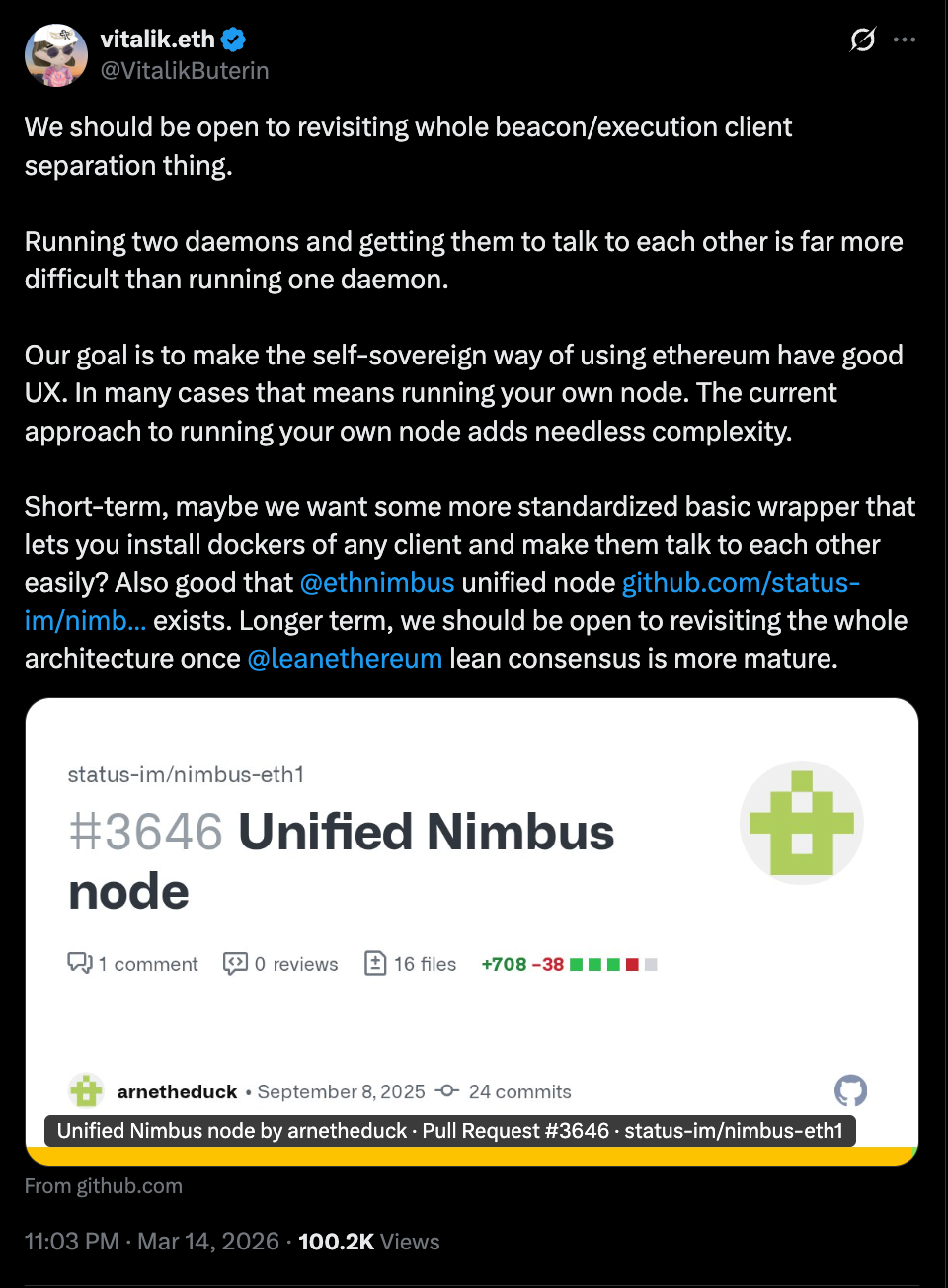
Ethereum co-founder Vitalik Buterin posted a proposal, or a pull request, on Saturday that would merge the backend programs used by nodes to interact with Ethereum’s Beacon Chain, which handles consensus and staking, and the protocol’s execution layer into one unified code structure to simplify node setup.
Ethereum node runners, also called validators, currently have to run two separate programs, which each require setup and synchronization to coordinate and communicate the data produced by Ethereum’s consensus and execution layers.
This raises the technical complexity of running a node or providing validation services for the Ethereum network, preventing ordinary users from running their own infrastructure and forcing reliance on third-party service providers.

“I feel like at every level, we have implicitly made this decision that running a node is this oh so scary DevOps task that it is ok to leave to professionals,” Buterin said in a post on X. He continued:
“It is not. We need to reverse this. Running your own Ethereum infrastructure should be the basic right of every individual and household. ‘The hardware requirement is high, therefore it’s okay for the DevOps skill and time requirements to also be high,’ is not an excuse.”
Even those who can afford the high-end computing hardware to set up an Ethereum node and have the technical expertise typically lack the time to set them up, Buterin said, adding that “nodes should be easy.”
The Ethereum network and other smart contract blockchains have faced criticism for the technical complexity and hardware requirements to run a node, which has also raised centralization concerns about those networks.
Related: Ethereum Foundation publishes mandate clarifying role and goals
Buterin proposes partially stateless nodes to further decentralize the network
In May 2025, Buterin proposed partially stateless nodes, which do not maintain the full block history and only keep data that the node runner requires.
This reduces the hardware costs and data storage requirements for users running nodes for personal purposes, like sending transactions and verifying the blockchain.

Disk space is usually the primary bottleneck for node operators, according to Go-Ethereum (GETH). Smart contract blockchain networks, like Ethereum, generate significant quantities of data that require ever-increasing storage space, making specialized node hardware a necessity.
“A market structure dominated by a few remote procedure call (RPC) providers is one that will face strong pressure to deplatform or censor users. Many RPC providers already exclude entire countries,” Buterin wrote.
In late January, Buterin said he had set aside 16,384 Ether, worth about $45 million, from his personal holdings to support privacy-preserving technologies, open hardware and secure, verifiable software. He added that the funds would be deployed gradually over the coming years as the Ethereum Foundation enters a period of what he described as “mild austerity,” while continuing to pursue its technical roadmap.
Magazine: Ethereum’s Fusaka fork explained for dummies: What the hell is PeerDAS?

Max Dowman at Arsenal: What next for teenager – how to look after a precious talent?’

‘Never Missed a Post for Years’

Investors Swapping Hype-Only Meme Coin for DeepSnitch AI for 1000X Return Ahead of March 31 Uniswap Listing

Smart energy pays enters the US market, targeting scalable financial infrastructure

Why Israel is blocking foreign journalists from entering

Bitcoin: We’re Entering The Most Dangerous Phase

Driving Empire ADMIN MONEY Codes Gives *FREE CAR?* Driving Empire Codes 2026

RIPPLE CEO JUST SEALED XRP’S FUTURE | EVERY XRP HOLDER MUST HEAR THIS!

Your wealth vault determines your financial abundance.#wealth #wealthtips #destiny #fate #fengshui
-
 Tech4 days ago
A 1,300-Pound NASA Spacecraft To Re-Enter Earth’s Atmosphere
-
Crypto World2 days ago
HYPE Token Enters Net Deflation as HyperCore Buybacks Outpace Staking Rewards
-

 News Videos6 days ago
10th Algebra | Financial Planning | Question Bank Solution | Board Exam 2026
-

 Business5 days ago
ExxonMobil seeks to move corporate registration from New Jersey to Texas
-

 Crypto World6 days ago
Paradigm, a16z, Winklevoss Capital, Balaji Srinivasan among investors in ZODL
-

 Fashion2 days ago
Weekend Open Thread: Addict Lip Glow
-

 Tech5 days ago
ChatGPT will now generate interactive visuals to help you with math and science concepts
-
Sports1 day ago
Why Duke and Michigan Are Dead Even Entering Selection Sunday
-

 NewsBeat4 days ago
Residents reaction as Shildon murder probe enters second day
-

 Business4 days ago
Search Enters Sixth Week With New Leads in Tucson Abduction Case
-
 NewsBeat6 days ago
Pagazzi Lighting enters administration as 70 jobs lost and 11 stores close across Scotland
-

 Tech6 days ago
Despite challenges, Ireland sixth in EU for board gender diversity
-

 Business1 day ago
US Airports Launch Donation Drives for Unpaid TSA Workers as Partial Government Shutdown Enters Fifth Week
-

 NewsBeat4 days ago
I Entered The Manosphere. Nothing Could Prepare Me For What I Found.
-
Crypto World1 day ago
Coinbase and Bybit in Investment Talks: Could Bybit Finally Enter the US Crypto Market?
-

 Business6 days ago
Search Enters 39th Day with FBI Tip Line Developments and No Major Breakthroughs
-

 Sports6 days ago
Skateboarding World Championships: Britain’s Sky Brown wins park gold
-

 Business1 day ago
Country star Brantley Gilbert enters growing non-alcoholic beer market
-
 Crypto World5 days ago
Will Chainlink price reclaim $10 amid volatility squeeze?
-

 Sports4 days ago
PWHL, Senators discussing plan to keep Charge in Ottawa

