
Crypto World
Bitcoin’s quantum threat is real, but far from an existential crisis, Galaxy says

Fears that quantum computing could one day break Bitcoin’s cryptography have sparked a heated debate across the crypto industry.
But according to Alex Thorn, head of research at Galaxy Digital (GLXY), the narrative that Bitcoin is unprepared, or that investors should avoid exposure because of it, is overstated.
The risk itself is not imaginary. A sufficiently advanced quantum computer could, in theory, derive private keys from exposed public keys, allowing an attacker to forge signatures and steal funds. But Thorn argues that framing this as an imminent or uniquely Bitcoin-specific crisis misses critical context, both about the technology and about the work already underway to address it.
“The risk is real but recognized,” Thorn told CoinDesk in an interview. “And the people best positioned to solve it are actively working on it.”
Quantum computing is a fundamentally different approach to computation that uses the principles of quantum mechanics rather than classical physics. Instead of traditional bits that are either 0 or 1, quantum computers use “qubits,” which can exist in multiple states at once, a property known as superposition, allowing them to process many possibilities simultaneously.
Combined with another feature called entanglement, this enables quantum machines to solve certain complex problems far more efficiently than classical computers, particularly tasks like factoring large numbers that underpin modern encryption
Analysis from Project Eleven, a security firm focused on quantum risks in digital assets, suggests that roughly 7 million bitcoin , worth about $470 billion at recent prices, could be vulnerable under a “long exposure” definition, meaning their public keys have already been revealed onchain. Other estimates vary widely depending on how exposure is defined.
Importantly, most bitcoin today is not immediately vulnerable. Funds are only at risk in scenarios where public keys are exposed onchain, either because users reused addresses, certain custodians employ operational shortcuts, or coins sit in older address formats. While some estimates suggest millions of BTC fall into these categories, they remain secure under current, publicly known quantum capabilities.
That distinction is central to Galaxy’s argument. The conversation has become polarized between those who dismiss quantum computing as decades away and those who warn of imminent danger. Thorn’s view lands in between. The probability of a future threat is meaningful enough to warrant action, but not so urgent that it outpaces Bitcoin’s ability to respond.
And that response is already underway.
A growing body of technical work is focused on making Bitcoin “quantum-resistant” over time. One of the most prominent efforts involves introducing new address types that rely on post-quantum cryptography. These would allow users to migrate funds away from potentially vulnerable formats, significantly reducing long-term exposure.
“There’s a lot more work being done than people realize,” Thorn said. “Developers are actively building pathways to upgrade the system.”
Other proposals tackle edge cases, such as dormant coins with permanently exposed public keys. One idea, sometimes referred to as an “hourglass” approach, would gradually restrict how such coins can be spent, mitigating systemic risk without outright confiscation or disruption.
More broadly, developers are exploring phased upgrade paths that would allow Bitcoin to adapt even under more extreme scenarios, such as a world where quantum systems can rapidly break existing cryptographic schemes. That could include changes to how transactions reveal public keys in the first place, limiting attack surfaces altogether.
While these efforts are complex, both technically and from a governance standpoint, Thorn emphasizes that Bitcoin’s open development model is a strength, not a weakness. The ecosystem has time, talent, and strong incentives to solve the problem well before it becomes critical.
Crucially, the number of actors capable of triggering a so-called “Q-day,” when quantum computers can break modern cryptography, is still extremely limited. Even optimistic projections suggest only a small group of highly specialized researchers could achieve such a breakthrough in the foreseeable future.
Against that backdrop, Thorn views the growing wave of quantum-related fear, uncertainty, and doubt as disproportionate.
“Quantum computing is a powerful, potentially disruptive technology, but that doesn’t mean every risk is immediate or unmanageable,” he said.
For investors, the takeaway is straightforward. Quantum risk should be monitored, but not used as a blanket justification to avoid bitcoin exposure. The network has a track record of evolving in response to credible threats, and the groundwork for quantum resilience is already being laid.
“It’s not certain that quantum is an existential issue for bitcoin, but the chance that it is justifies concern,” Thorn said. “But what’s clear today is that Bitcoin developers are not ignoring it. Instead, many are actively working on it,” he added.

In today’s newsletter, Dumpling Bullish, independent digital asset commentator, writes about the growing influence of bitcoin’s derivatives stack on its price.
Then, in Ask an Expert, Leo Mindyuk from ML Tech, answers questions about the evolution of bitcoin investment products.
Bitcoin price discovery: no longer just a demand story
For most of its history, bitcoin had a simple pricing logic: limited supply, growing demand and the occasional panic in between. That logic still exists. It just no longer runs the show.
What runs the show now is the derivatives stack sitting atop the asset.
From spot market to leverage system
Over the past decade, bitcoin has moved from a predominantly spot-driven market into a layered derivatives ecosystem. Futures, perpetual swaps, options, exchange-traded funds (ETFs), structured products and prime brokerage lending have transformed the way price discovery occurs.
CME futures launched in December 2017, giving institutions a regulated, scalable way to short bitcoin for the first time and providing a mechanism to express bearish views at the top of what had been a 19x run. The asset saw an 80% drawdown. That did not kill bitcoin. It allowed disagreement to be priced more efficiently.
Then came the 2024 ETF approvals, acting as the foundation for a new derivatives layer inside U.S. equity markets.
Each addition didn’t change what bitcoin is. It changed where and how its price gets discovered.
Three variables that now matter most
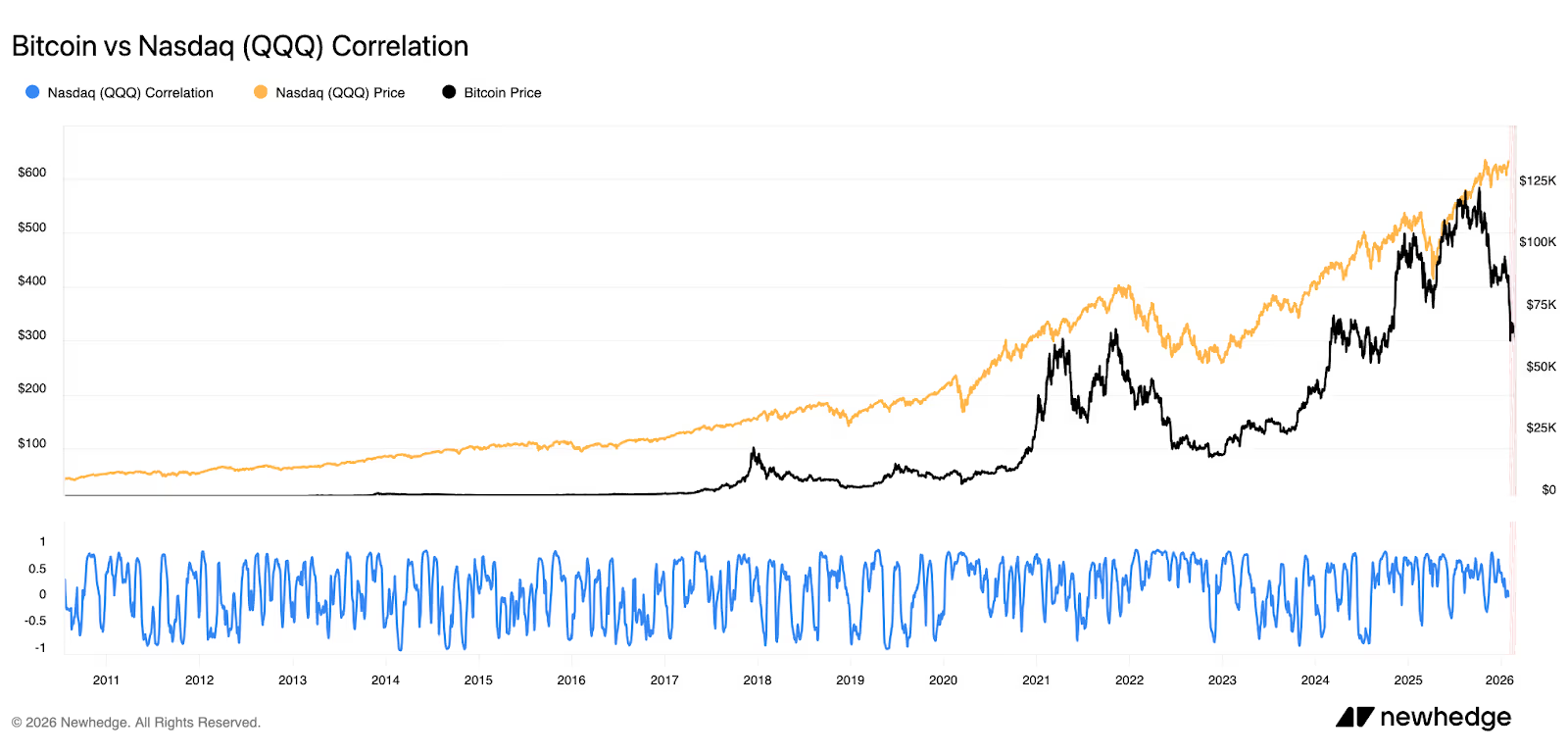
Real yields and dollar strength set the macro backdrop. Bitcoin has increasingly traded as a high-beta liquidity asset and when global risk appetite contracts, it sells off alongside equities and other risk assets, regardless of what the blockchain is doing.

Bitcoin 30-day rolling correlation with Nasdaq (QQQ), 2011 – present
Source: Newhedge
Derivatives positioning tells the short-term story. CME open interest and perpetual funding rates reveal whether a price move is built on genuine new demand or on leveraged speculation that will eventually unwind violently. When funding rates run persistently positive, the market is paying a premium to be long — and that premium is a fragility signal.

Bitcoin CME futures open interest and price, Dec 2017 – present
Source: CME Group via TradingView
ETF options mechanics have introduced a new transmission channel. When institutional investors buy calls or puts on the iShares Bitcoin Trust ETF (IBIT), dealers who sell those options must hedge by trading the underlying ETF and, in some cases, related futures or spot exposure. This hedging is procyclical. When Bitcoin rises, dealers must buy more; when it falls, they must sell. Modest directional moves get mechanically amplified. The result is that a meaningful share of Bitcoin’s short-term volatility is now generated mainly by equity market structure.
Financialization is not extinction
Gold offers a useful parallel. The development of futures and ETFs did not eliminate gold’s scarcity. It integrated gold into global macro portfolios and amplified its volatility during liquidity cycles. Bitcoin is undergoing a similar integration process at a faster pace. It is being absorbed into the global risk budget system. That absorption brings institutional capital, liquidity, and legitimacy. It also brings correlation, reflexivity, and the occasional violent unwind driven by forces that have nothing to do with the protocol.
Scarcity remains intact at the protocol level. But its influence on price is increasingly subordinated to the cost of capital and the mechanics of the derivative stack. Bitcoin is not losing its scarcity narrative. It is gaining a liquidity identity.
Scarcity anchors the asset. Liquidity sets the marginal price.
– Dumpling Bullish, independent digital asset commentator
Ask an Expert
Q: Over the past few years, bitcoin investment products have expanded from spot exposure to futures, options and ETFs. How do you see the evolution of bitcoin financial products shaping the way investors access the asset?
The evolution of bitcoin investment products mirrors the path we’ve seen in traditional asset classes. Early participants primarily accessed bitcoin through direct ownership — buying and holding the asset itself on crypto exchanges. Over time, as institutional interest increased, the market began developing a broader toolkit: regulated futures and options, structured products and regulated fund structures and more recently, spot ETFs.
This expansion is important because it changes bitcoin from simply being a speculative asset to something that can be integrated into portfolio construction and risk management frameworks. Different investors have different needs. Some want direct exposure to the asset’s price movement, while others want regulated vehicles, derivatives for hedging or ways to express more nuanced market views.
As the ecosystem matures, financial products make Bitcoin easier to access through familiar structures, which lowers barriers for institutional investors and broadens the ways the asset can be incorporated into diversified portfolios.
Q: In traditional markets, financial products often evolve from simple exposure to more complex structures like leveraged, inverse, and derivatives-based strategies. Are we starting to see a similar progression in the bitcoin ecosystem?
Yes, and it’s a natural progression. In most asset classes, markets begin with simple spot exposure and gradually develop layers of financial instruments that allow investors to manage risk, hedge positions or express different market views. Bitcoin is following that same trajectory.
Initially, the focus was simply on gaining exposure to the asset itself. Today, we’re seeing a more developed ecosystem that includes derivatives, volatility trading and structured products. These tools allow investors to do much more than just speculate on price appreciation. They can hedge downside risk, trade volatility or construct market-neutral strategies.
What’s interesting is that crypto markets often evolve faster than traditional markets because the infrastructure is digital and global. As liquidity deepens and regulatory frameworks become clearer, we’ll likely see even more sophisticated products emerge that resemble strategies commonly used in equities, commodities and fixed-income markets. For example, I expect growth in various income-generating ETFs — instruments for inversed, leveraged or broader crypto factor-based exposure. Moreover, we will likely see a tremendous growth in crypto option markets.
Q: With the growth of futures markets and the introduction of spot ETFs, how might the next generation of bitcoin products expand investor use cases, whether for hedging, leverage, or more sophisticated portfolio strategies?
Futures markets already allow investors to hedge exposure or express directional views without holding the asset directly. ETFs have made bitcoin accessible through traditional brokerage accounts. The logical next step is products that focus on portfolio outcomes.
As that happens, bitcoin starts to look less like a standalone trade and more like a portfolio building block. That’s ultimately where the market is heading: giving investors the flexibility to express views on the market in much more nuanced and sophisticated ways with the ease of access.
– Leo Mindyuk, CEO & CIO, ML Tech
Keep Reading

Key Takeaways
- Opera proposes replacing cash arrangement with 160M CELO token allocation
- Request represents approximately 27% of current circulating supply
- MiniPay’s 14M+ registrations justify expanded network participation
- Voting power capped at 10% to preserve decentralized governance structure
- Strategic pivot reflects Opera’s deepening commitment to blockchain payments
Opera Limited (OPRA) stock traded around $14.40 following a minor pullback, while the browser company unveiled plans for a substantial cryptocurrency arrangement with Celo. The firm has submitted a governance request to exchange its existing cash-based agreement for a significant token position. This transition could establish Opera among Celo’s most influential network participants.
Browser company transitions from cash payments to long-term token ownership
Opera has presented a formal governance petition requesting 160 million CELO tokens distributed across a three-year timeline. The arrangement would eliminate quarterly cash disbursements in favor of direct token ownership. This structural change creates stronger alignment between Opera’s financial interests and the blockchain’s success.
The proposed allocation accounts for approximately 27% of CELO’s currently available circulating tokens. Additionally, it comprises roughly 16% of the cryptocurrency’s maximum capped supply. The substantial size of this request demonstrates Opera’s intention to establish a meaningful presence within the ecosystem.
CELO was trading near $0.07 during reporting hours, significantly below its 2021 all-time highs. Despite current valuations, the token allocation provides considerable upside potential should market conditions improve. Consequently, Opera’s strategy balances forward-looking opportunity with present-day market realities.
Decentralization safeguards and treasury mechanics structure token distribution
The governance proposal details a single transfer from Celo’s unreleased token reserves to an Opera-managed wallet. This arrangement formalizes the browser company’s transition to long-term ecosystem participant. The mechanism replaces ongoing payments with consolidated token ownership.
The framework restricts Opera’s governance participation to maximum 10% of total staked CELO under standard circumstances. This limitation safeguards the network’s decentralized decision-making processes. Emergency situations may permit temporary adjustments to these restrictions.
Token holder consensus remains essential before implementation, as community members will evaluate the proposal through established governance procedures. Stakeholder feedback will determine whether the allocation magnitude receives approval. The final decision will establish Opera’s authority and influence within Celo’s governance framework.
Wallet platform success drives Opera’s strategic positioning within payment network
Opera grounded its token request in MiniPay’s demonstrated performance, its self-custody digital wallet developed on Celo infrastructure. The application enables peer-to-peer stablecoin transfers using simple phone number identification. It further accommodates regional payment systems across diverse geographical markets.
MiniPay has accumulated over 14 million user registrations following its 2023 introduction. The platform has facilitated more than 420 million transactions spanning across 66+ countries worldwide. These metrics underscore its significance in generating network engagement and activity.
Opera intends to enable over 50 million users to convert rewards into USDT directly through MiniPay. This feature integration may accelerate wallet adoption and transaction throughput. Through these developments, Opera reinforces both operational and economic ties with Celo.
Opera shares registered near $14.60 during recent trading following a modest decline. The organization continues broadening its cryptocurrency involvement through product development and direct token ownership. The pending agreement could fundamentally transform its standing within blockchain-powered payment systems.



- Zcash price was down nearly 10% in the past 24 hours.
- The ZEC token changed hands at around $239 as bulls risk a key support level.
- Is the dip a healthy consolidation move or the start of a deeper correction?
Zcash (ZEC) pulled back sharply on Thursday, falling nearly 10% in intraday performance as the surge to a multi‑month high near $280 risked fading.
The privacy coin traded to lows of $239, with the retreat coming amid a broader risk‑off shift in crypto markets.
Profit‑taking across the board means ZEC’s recent breakout could fuel bears’ move towards a key psychological support at $230.
Can bulls hold onto support levels, or is Zcash price poised for an even deeper correction?
Why is the Zcash price down today?
Zcash’s slide from the $280 level reflects a combination of several short‑term factors.
Broadly, it’s the investor jitters around the global macro and geopolitical environment.
Bitcoin, for instance, is struggling to hold gains above $70k, and a similar outlook is engulfing top altcoins, including Ethereum, Solana, BNB, and XRP.
A key perspective is the profit‑taking amid heightened macro uncertainty.
ZEC outlook amid key network growth metrics
Zcash price has shown resilience amid interest in privacy coins, with a recent spike to $280 aligning with this sentiment amid Zodl’s milestone.
Despite the pullback to $239, bulls remain positive as on-chain metrics outline notable network growth.
For instance, Zcash’s hashrate has hit a new all-time high of 16.54 GS/s.
Meanwhile, shielded supply has climbed to 5.15 million ZEC, accounting for roughly 31% of the coin’s circulating supply.
A surge in shielded supply indicates growing demand for private transactions.
Importantly, a sizable portion of ZEC is off crypto exchanges, which signals a long-term bullish view.
The robust network security and increased interest in privacy-focused transactions offer a two-pronged approach to adoption, and could boost ZEC price.
Zcash price technical picture
From a technical standpoint, ZEC’s daily chart points to a mixed outlook with oscillators and moving averages leaning neutral-to-towards selling.

The current structure suggests risk appetite could allow for a clean breakout to $300.
In this case, bulls must flip $240 into a major support base, with the 50 EMA at $262 crucial.
Further upside movement will bring the 200 EMA ($281) into view.
Above these levels lie $300 and the 100 SMA at $339, which could be a key resistance zone as bulls eye the $500 target.
Zcash’s sharp pullback after the spike to $280, therefore, provides bulls with an opportunity to pump amid a shakeout of weak hands.
However, if short‑term selling gains momentum amid broader crypto weakness, the coin’s price could fall to $206 and then $185.
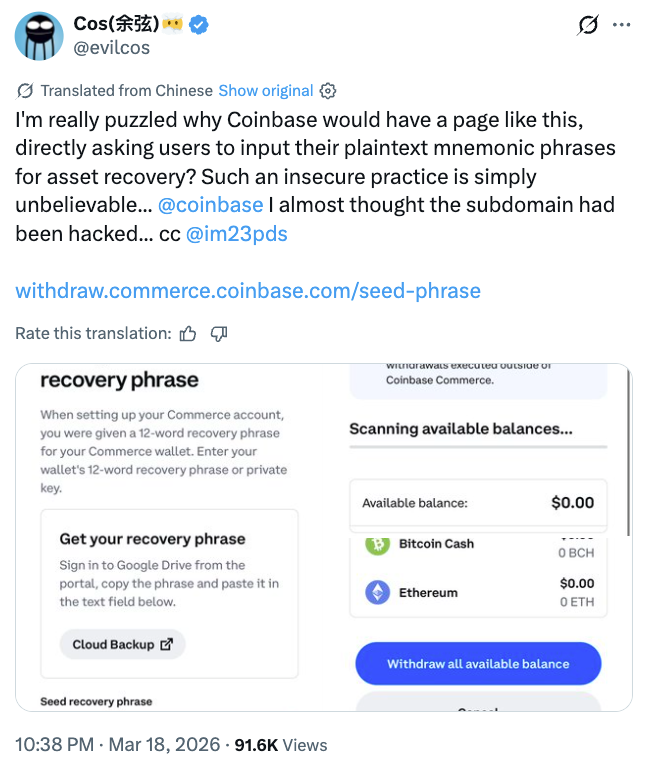
Security researchers have raised concerns about a Coinbase-associated Commerce page that appeared to prompt users to enter wallet recovery phrases, warning that such a flow could normalize behavior commonly exploited in phishing scams.
The page has circulated widely on social media after being flagged by the founder of the blockchain security platform SlowMist, Yu Xian, widely known as Cos.
“I’m really puzzled why Coinbase would have a page like this, directly asking users to input their plaintext mnemonic phrases for asset recovery,” Yu wrote in an X post on Wednesday, adding: “Such an insecure practice is simply unbelievable.”
Coinbase has yet to address the issue publicly. The company told Cointelegraph it was looking into the matter and did not provide additional information. Cointelegraph also approached Yu Xian for comment, but had not received a response by publication.
Recovery phrases give full control over a self-custody wallet and should never be shared with third parties, customer support agents or untrusted websites. They are normally used only in trusted wallet recovery or import flows.

Coinbase referred to the subdomain as a commerce “withdrawal tool”
According to blockchain sleuth ZachXBT, the page in question was referenced in a Coinbase Help guide related to its Commerce product.
The guide, now appearing to have been removed, reportedly outlined an option for users to recover funds by importing their seed phrase into a compatible wallet such as Coinbase Wallet or MetaMask. It also directed users to a withdrawal tool hosted at the same subdomain that has drawn scrutiny.

The help documentation also emphasizes that Commerce wallets are self-custodial, meaning Coinbase does not have access to users’ seed phrases and cannot recover funds if they are lost.
Related: OpenClaw devs targeted by phishing scam promising free ‘CLAW’ tokens
“So basically Coinbase has an official page live threat actors can use to target Coinbase users via seed phrase social engineering if they wanted?” ZachXBT wrote on X.
Coinbase advises against pasting seed phrases into any website
It remains unclear whether the page in question was the result of a technical error or another issue on Coinbase’s side.
In another guide, Coinbase strongly advised users to never paste seed phrases into any website.

On Tuesday, Coinbase warned that scammers are posing as customer support over the phone or online to steal login information and verification codes. The company said it will never reach out, directing users to its official channels on X and Reddit.
Magazine: Bitcoin’s ‘narrative vacuum,’ Ethereum now inevitable: Trade Secrets


Bitcoin’s price was heavily rejected at $76,000 a couple of days ago, and the correction accelerated today. The cryptocurrency is now trading below $70,000, sending the entire market sentiment to extreme fear.
Major altcoins like Ethereum and Ripple’s XRP are also on the downside, both losing important support levels.
Amid these dwindling market conditions, Playnance’s newly launched native token, GCOIN, is eyeing an impressive milestone.
Bitcoin’s Price Corrects Heavily
The leading cryptocurrency was trading at around $74,00 last Friday when the bears were able to intercept the movement and pushed it south toward $70,000 during the weekend. This happened after the most recent bombings that took place in the Middle East. The good news was that it was able to maintain this level, allowing for the buyers to return in force.
The retaliation took place on Tuesday morning, when the BTC price exploded to a price that we hadn’t seen in around six weeks at $76,000.

As you can see on the chart, though, the momentum was anything but sustained. Although the price remained near the local highs on Wednesday, more volatility occurred in the hours leading up to the highly anticipated FOMC meeting. The US Federal Reserve announced that it wouldn’t change the interest rates – an entirely expected outcome.
Unfortunately, the markets responded negatively, perhaps driven by rising geopolitical uncertainty, and BTC plunged to $71,000 almost immediately upon the announcement’s public release.
Today, the price fell further, and it’s currently trading in the mid $69,000s. Most altcoins also suffered, as it can be seen in the heatmap below.

The entire thing resulted in more than $500 million in liquidated positions, as well as the broader market returning to a state of extreme fear. But it’s these conditions that can also serve well for projects with solid foundations.
PlayNance’s GCOIN Eyes $100M FDV
Launched yesterday, GCOIN, the native cryptocurrency of the PlayNance ecosystem, is already turning heads. At the time of this writing, GCOIN boasts $80 million in fully diluted valuation, less than 24 hours since its token generation event.
Moreover, the locked supply currently stands at more than 3.2 billion tokens, while another 1.3 billion are staked, effectively removing more than 10% of the circulating supply from the market. This reduces selling pressure while also showing conviction in the project’s fundamentals.
The cryptocurrency boasts an impressive user base of more than 200,000 holders, trading on the popular MEXC exchange.
GCOIN is the native utility token that powers the entire PlayNance ecosystem. It’s designed for the Web3 gaming and entertainment infrastructure of the protocol, enabling real-time on-chain interactions through many platforms and digital experiences.
Already, the PlayNance ecosystem powers an average of 1.5 million on-chain transactions every single day, all executed using GCOIN as the settlement and utlity layer. The token might be trading for a day, but its ecosystem has been shaped and honed for the past five years, already catering to a plethora of users and developers.
Those who want to get in on the action early can find more information about GCOIN here.
Binance Free $600 (CryptoPotato Exclusive): Use this link to register a new account and receive $600 exclusive welcome offer on Binance (full details).
LIMITED OFFER for CryptoPotato readers at Bybit: Use this link to register and open a $500 FREE position on any coin!
Crypto World
Cheniere Energy (LNG) Stock Soars to Record High Amid Hormuz Crisis and Thai Contract Boost

Key Highlights
- Cheniere Energy (LNG) reached a record intraday peak of $267.24 on March 18, finishing the session up 5.85% at $266.22.
- Natural gas prices climbed 5.59% to $3.20/MMBtu amid ongoing Strait of Hormuz disruptions, marking a 6.90% March gain.
- Thailand’s government confirmed plans to increase its long-term LNG purchase from 1 million tons to 1.3 million tons annually.
- The enhanced Thailand agreement extends through 2041, securing a 15-year revenue stream.
- The company recently announced a $10 billion stock repurchase program following record-breaking quarterly results.
Cheniere Energy posted a historic trading session on Wednesday, March 18, propelled by geopolitical supply constraints and confirmation of an expanded commercial agreement with Thailand.
Shares of the LNG export leader touched an all-time intraday high of $267.24 before closing at $266.22, marking a single-day advance of 5.85%. The stock has now climbed approximately 30% since the start of the year.
This surge aligns with broader momentum in the natural gas market. Spot prices for natural gas increased 5.59% during the session, reaching $3.20/MMBtu. Month-to-date, natural gas has appreciated 6.90%.
The primary catalyst remains the ongoing blockage of the Strait of Hormuz — a vital chokepoint for global energy transportation. This disruption is constricting worldwide LNG availability and driving demand toward American export facilities like those operated by Cheniere.
Thailand Secures Expanded LNG Supply Agreement
Early this week, reports surfaced that Thailand is negotiating to both expand and accelerate LNG shipments under its existing long-term arrangement with Cheniere.
Thailand’s Energy Minister Auttapol Rerkpiboon verified that the nation is boosting its annual LNG commitment from 1 million tons to 1.3 million tons. Initial shipments under the revised terms are scheduled to commence in the second quarter of 2026.
The contract maintains its duration through 2041 — providing Cheniere with guaranteed demand for the next decade and a half. Thailand’s motivation stems from securing reliable energy supplies for its electricity generation infrastructure.
These types of extended, firm-commitment contracts represent the cornerstone of Cheniere’s revenue model.
Robust Financial Performance Underpinning Rally
Cheniere entered this week from a position of financial strength. The enterprise recently unveiled a $10 billion share repurchase authorization and delivered quarterly earnings that exceeded analyst projections.
These financial results bolstered investor sentiment as geopolitical uncertainties intensified. The convergence of earnings outperformance, shareholder capital allocation, and constrained global LNG availability has positioned Cheniere as a preferred investment vehicle for those seeking natural gas exposure.
Technical analysis indicates a “Strong Buy” rating for the stock, with current market capitalization hovering around $52.87 billion.
Typical daily share volume averages approximately 2.1 million, though high-momentum sessions like Wednesday often attract increased participation from trend-following traders.
The stock’s nearly 30% year-to-date appreciation significantly outpaces broader equity market indices.
With the Thailand contract nearing finalization and Hormuz shipping disruptions persisting, Cheniere approaches the remainder of March supported by multiple positive catalysts.
Is BTC yet to feel real pain during this market cycle?
After a solid multi-day run, the primary cryptocurrency lost momentum again, dipping below $70,000.
Numerous analysts caution that the bears still control the market, expecting much more substantial price declines in the near future.
Where’s the Bottom?
The recent FOMC meeting, and especially Chairman Jerome Powell’s subsequent speech, poured cold water on BTC, which earlier this week touched $76,000 for the first time since the beginning of February.
Recall that America’s central bank kept interest rates unchanged for the second consecutive time this year, whereas Powell said the stubborn inflation remains an issue for the local economy. He also outlined the military conflict in Iran, describing the rising price of petrol as another hurdle.
His comments were unfavorable to the cryptocurrency market, whose total capitalization once again slipped below $2.5 trillion. As for Bitcoin, its valuation temporarily fell to as low as $69,500 and currently struggles to remain above that line.
Several analysts have weighed in on BTC’s performance, noting similarities between its recent price action and past cycles. X user Ted pointed out that the current structure closely mirrors the pattern seen in 2022, which ultimately led to a drop to around $16,000. If that historical parallel plays out again, he warned that the price could slip under $50K in the near term.
The analyst who goes by as bee on the social media platform outlined an analogous thesis. They suggested that BTC’s resurgence to nearly $76,000 has been a “fakeout” and bull trap, claiming that “we are still in a bear market” and the valuation could plummet to as low as $46,760 in the coming months. Leshka.eth joined the pessimists’ club, predicting a pullback to almost $53,000 sometime this summer.
You may also like:
The Bullish Case
However, it’s not all doom and gloom, as some key indicators signal BTC may experience another significant revival soon. For instance, whales snapped up 40,000 units in a matter of a single week, potentially positioning themselves for the next leg up. At the same time, spot Bitcoin ETFs have seen strong inflows, suggesting growing institutional demand.
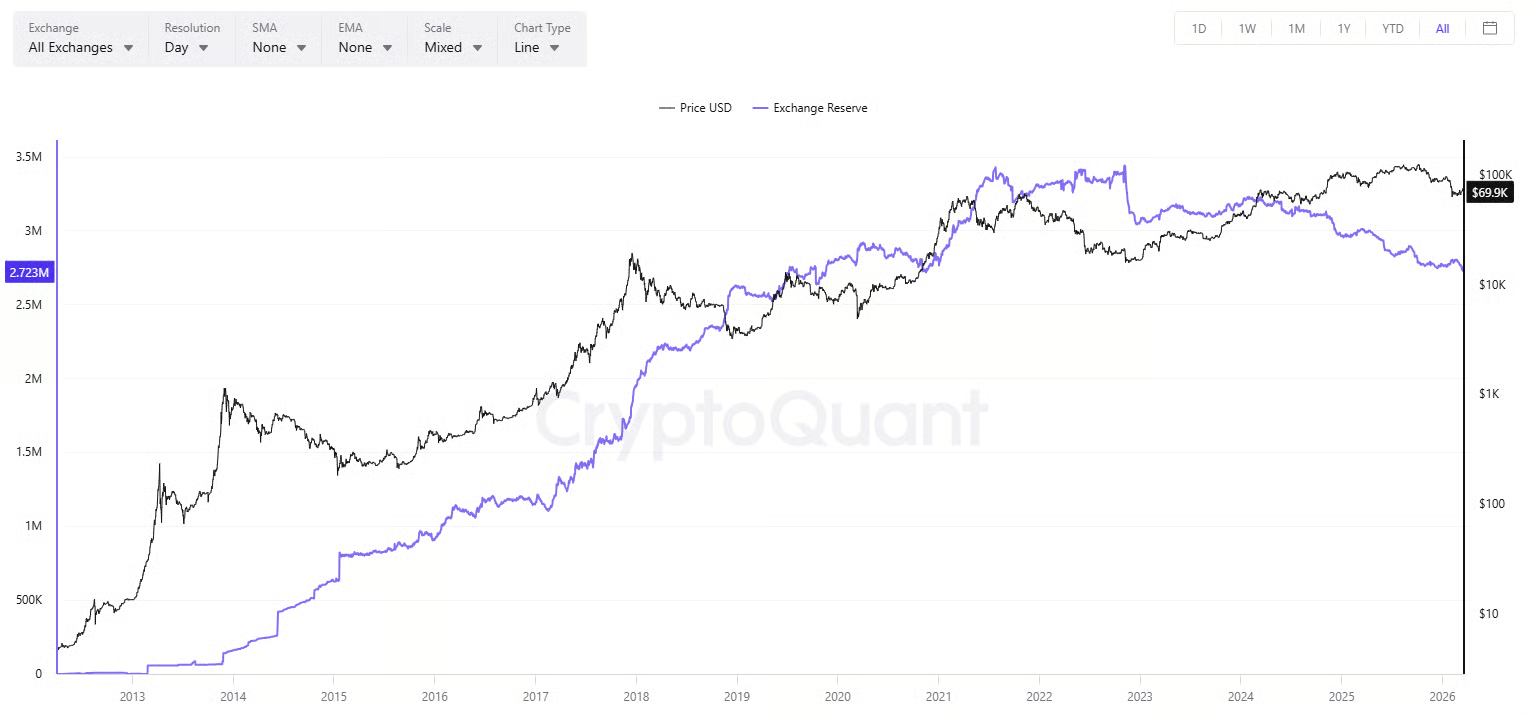
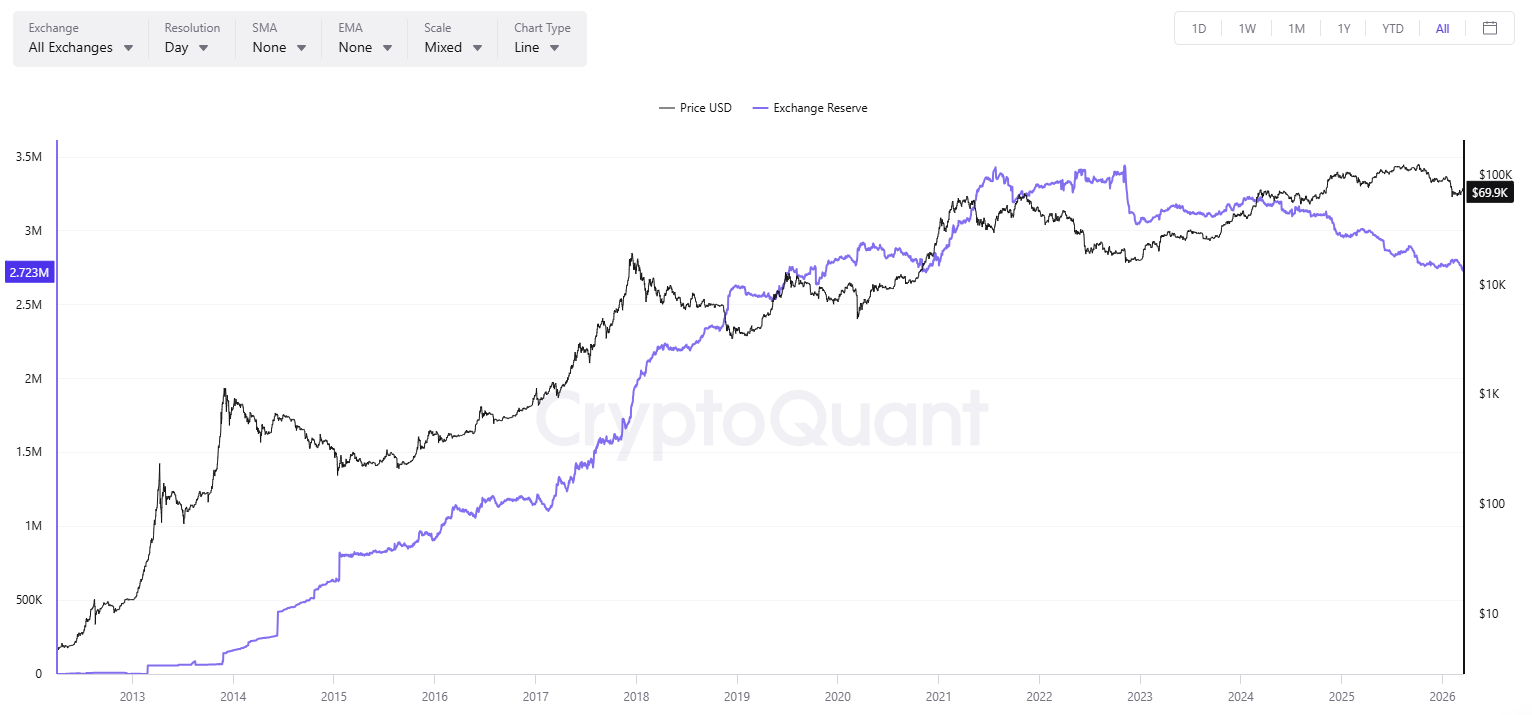
The amount of coins sitting on crypto exchanges should also be mentioned. The figure has been gradually decreasing lately, and earlier today (March 19) dropped to a new six-year low of approximately 2.723 million. This means that many investors continue to abandon centralized platforms and move their holdings to self-custody, thereby reducing immediate selling pressure.
Meanwhile, some analysts, such as Ali Martinez, expect a significant price boom based on the formation of certain setups. Just a few days ago, he noted that BTC’s funding rates have turned negative, and in the past, that has always been a precursor of a “major relief rally.” Martinez reminded that in August 2023, such a development was followed by a whopping 176% price increase for BTC.
Binance Free $600 (CryptoPotato Exclusive): Use this link to register a new account and receive $600 exclusive welcome offer on Binance (full details).
LIMITED OFFER for CryptoPotato readers at Bybit: Use this link to register and open a $500 FREE position on any coin!
Elon Musk has once again taken to X to share a post about Dogecoin, mimicking one of the most famous scenes from the blockbuster movie “The Godfather.”
Summary
- Elon Musk shared a Dogecoin-themed AI video inspired by The Godfather, generating over 18 million views and high engagement on X.
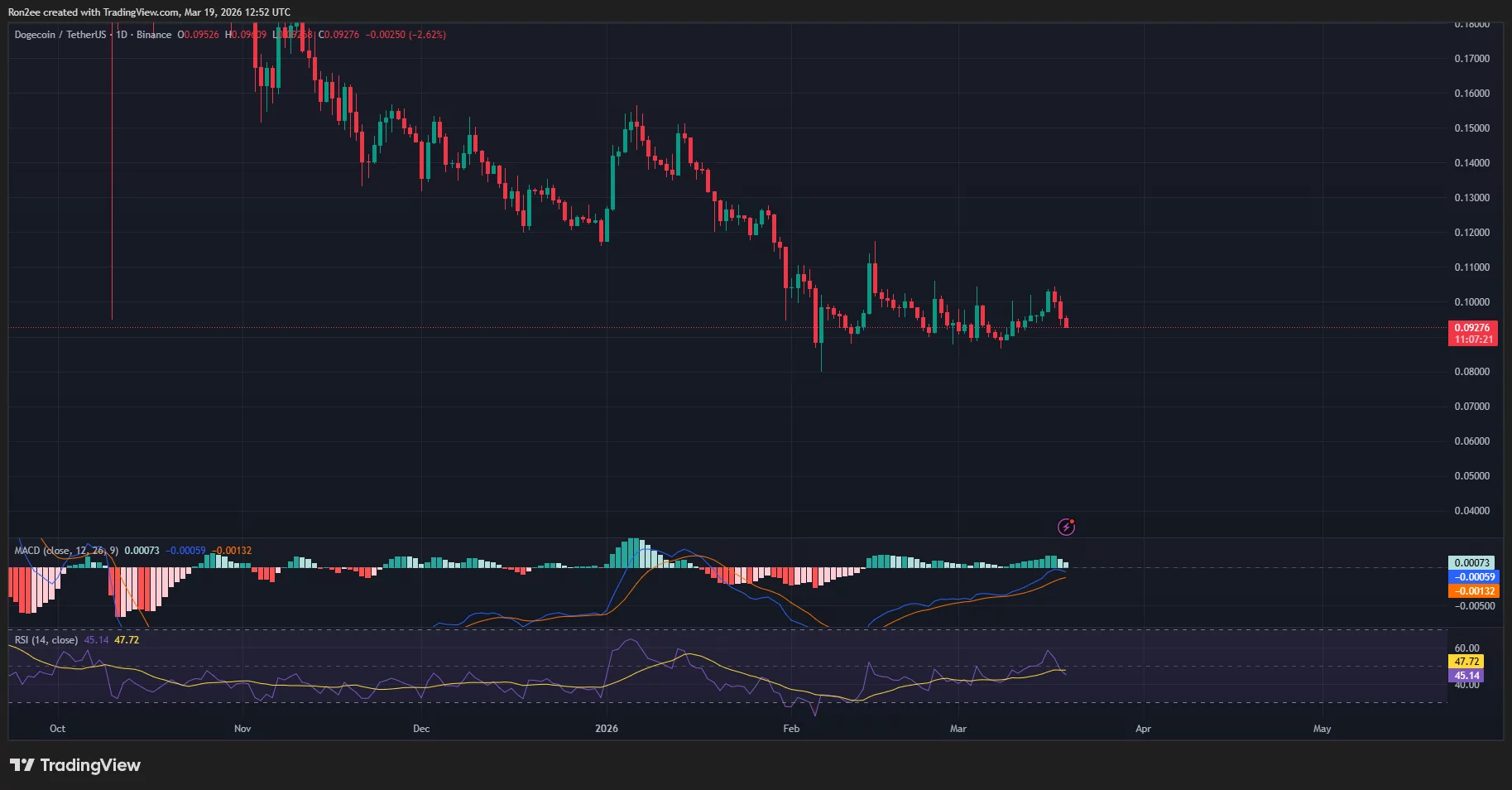
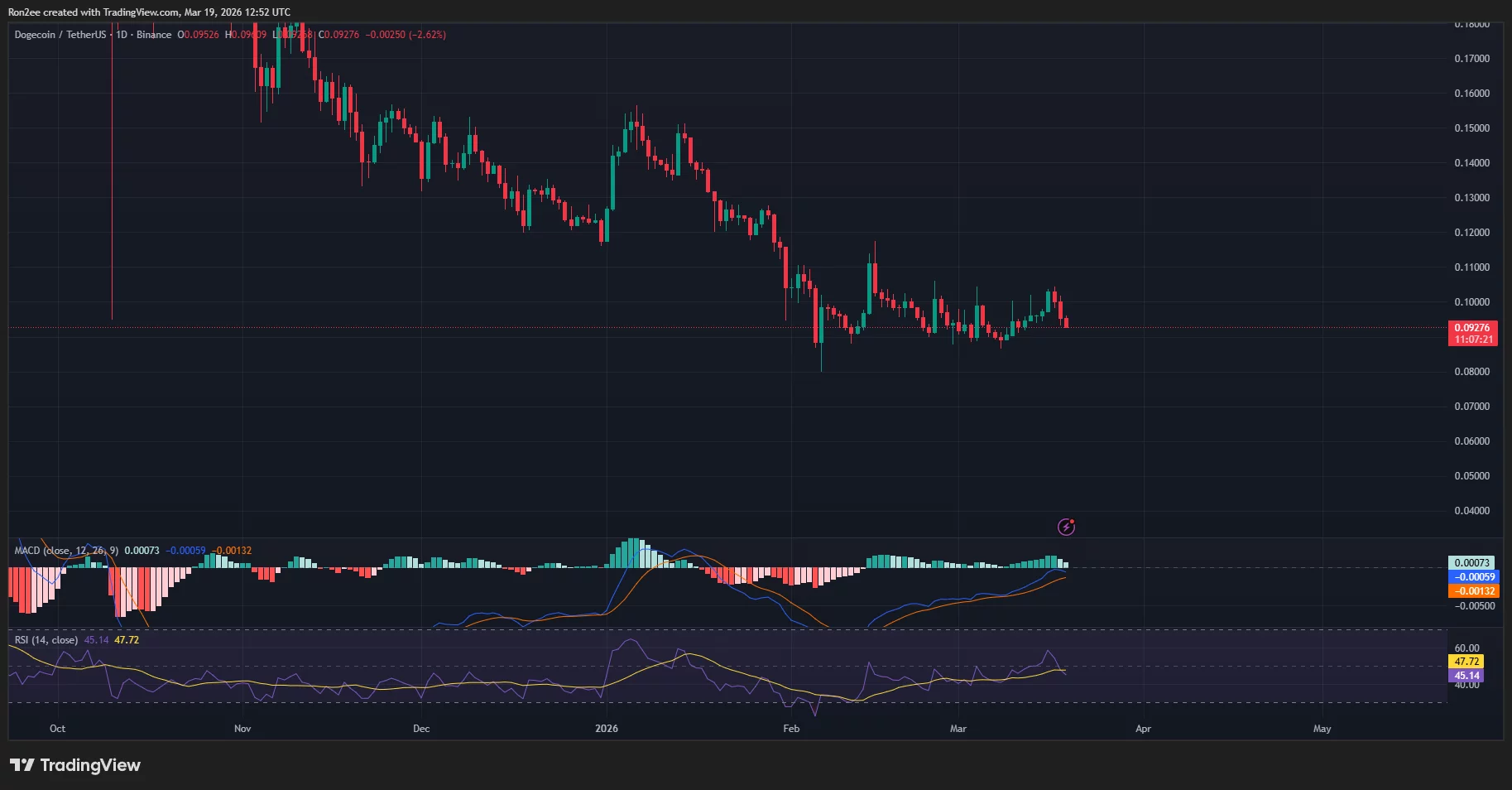
- Dogecoin price showed little reaction, trading around $0.093 and remaining nearly 40% below its yearly high amid broader market weakness.
In a March 19 X post, the X owner and a long-time advocate of the world’s leading meme coin Dogecoin, Musk shared an AI-generated video from the parody X account Sir Doge of the Coin.
In the video, Musk was seen dressed in a black tuxedo with a Shiba Inu dog while seeming to mimic a famous scene played by Marlon Brando as the character Vito Corleone from the classic movie “The Godfather.”
“You come to me on the day of my doge’s wedding, and you ask me for my private key. Are you even a friend? You don’t even think to call me the dogefather,” the AI-generated avatar of Musk said.
At press time, the video had gained over 18.4 million views, 64,000 likes, and over 6,800 retweets, showing the sheer scale of engagement by the crypto community.
The tech tycoon has long been known to advocate Dogecoin, with his social media posts on the meme coin historically triggering massive volatility in Dogecoin (DOGE), often referred to as the “Musk Effect.”
In his past antics, he even once briefly turned the Twitter blue bird logo into the Shiba Inu (Doge) meme for several days. DOGE soared over 30% at the peak of the frenzy. When the logo was changed back three days later, the price dropped by roughly 9%.
However, the most memorable event would be his Saturday Night Live (SNL) Appearance at the peak of the 2021 bull run, where he called himself the “Dogefather” in promos, but jokingly referred to DOGE as a hustle during a sketch. Dogecoin price shot up to an all-time high of $0.73 just before the show. However, it came crashing down nearly 30% to 40% during the broadcast.
This time, Dogecoin’s price has not yet shown any positive momentum following the latest post. Trading at $0.093, the meme coin has fallen over 3.2% as observed at press time. The 10th largest crypto asset in the market has fallen nearly 40% from its year to date high and 87.2% from its all-time high.
Momentum indicators like the MACD and RSI suggest that the meme coin could extend its downtrend, especially since risk-on sentiment is withering amid ongoing geopolitical and macroeconomic uncertainty.
Disclosure: This article does not represent investment advice. The content and materials featured on this page are for educational purposes only.
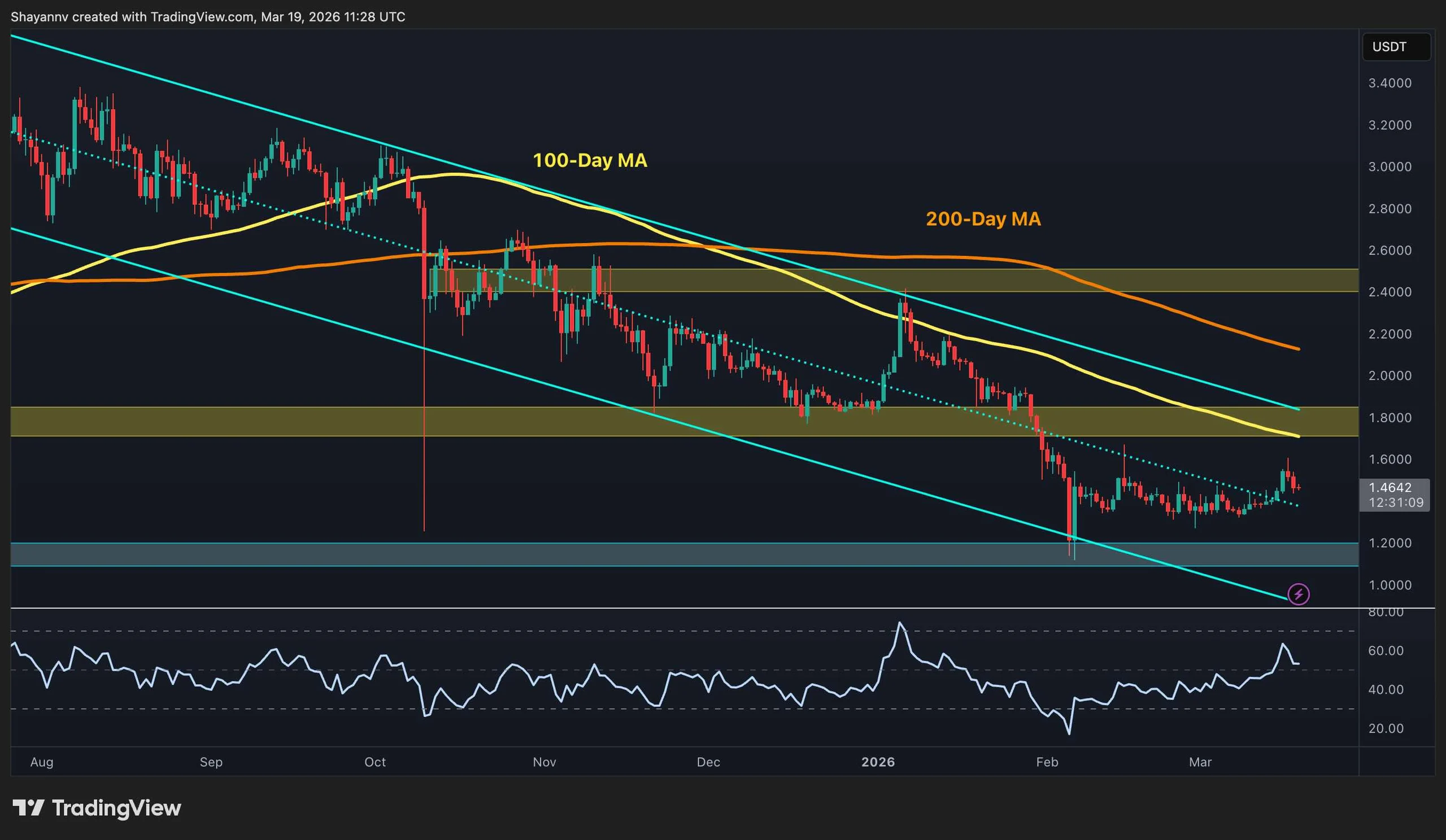
XRP is trying to build a short-term recovery, but the broader trend still leans cautious. The recent bounce has improved momentum on both pairs, yet the price is still trading beneath major trend-defining resistance levels. In other words, sellers are no longer fully in control of the very short term, but buyers have not done enough to claim a real trend reversal either.
XRP/USDT Analysis: The Daily Chart
On the XRP/USDT chart, the asset has pushed back toward the mid-$1.40s after defending the $1.10 to $1.20 demand zone earlier this month. That rebound matters because it keeps XRP off the lows and lifts RSI back into a healthier range, but the price is still stuck inside the descending structure and below the first major supply band around $1.75 to $1.80.
That leaves XRP in a tricky spot. The current move looks constructive, but it still resembles a relief rally inside a larger downtrend rather than a clean breakout. If buyers can force a reclaim of the $1.75 to $1.80 region, the door opens toward the much heavier $2.40 to $2.50 resistance area. But the price would also need to climb above both the 100-day and 200-day moving averages to reach this area. Until then, the bounce is not decisive.
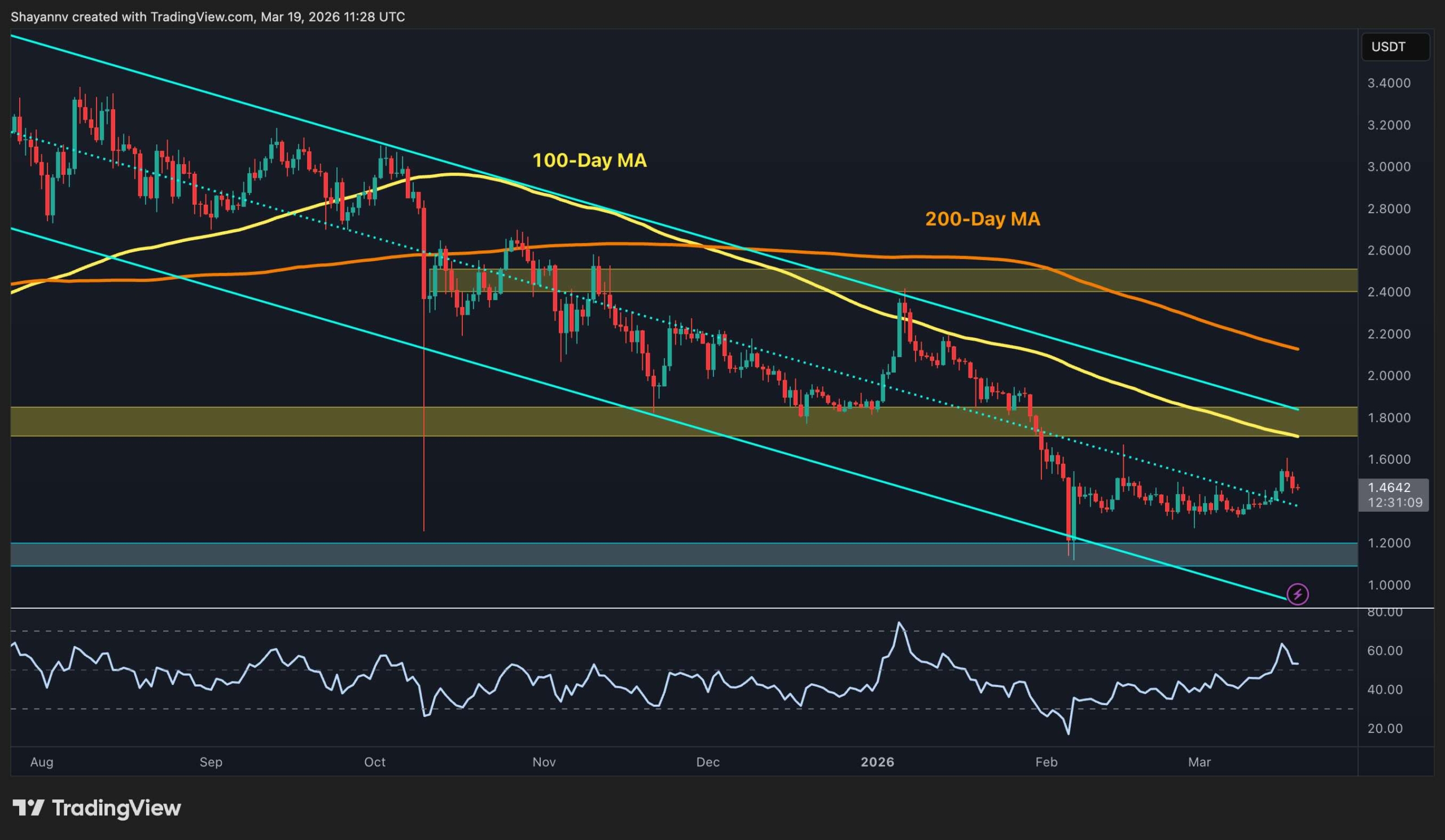
XRP/BTC 4-Hour Chart
The XRP/BTC pair is telling a similar story. After repeatedly holding the 2,000 sats area, XRP has started to recover a bit and is now pressing back above that support zone. Momentum has improved, and the pair no longer looks as weak as it did during the recent dip, though it is still trading under both the 100-day and 200-day moving averages.
For the BTC pair, the first task is to turn this rebound into follow-through. A push through the 2,100 to 2,200 sats area would be a good start, and lead to a breakout above both key moving averages. But the real test remains higher at 2,400 to 2,500 sats, where layered resistance and the broader downtrend line converge. If XRP gets rejected before that, the market likely falls back into the same sideways-to-bearish range. However, if it breaks through, the tone shifts from simple stabilization to genuine recovery.

Binance Free $600 (CryptoPotato Exclusive): Use this link to register a new account and receive $600 exclusive welcome offer on Binance (full details).
LIMITED OFFER for CryptoPotato readers at Bybit: Use this link to register and open a $500 FREE position on any coin!
Disclaimer: Information found on CryptoPotato is those of writers quoted. It does not represent the opinions of CryptoPotato on whether to buy, sell, or hold any investments. You are advised to conduct your own research before making any investment decisions. Use provided information at your own risk. See Disclaimer for more information.
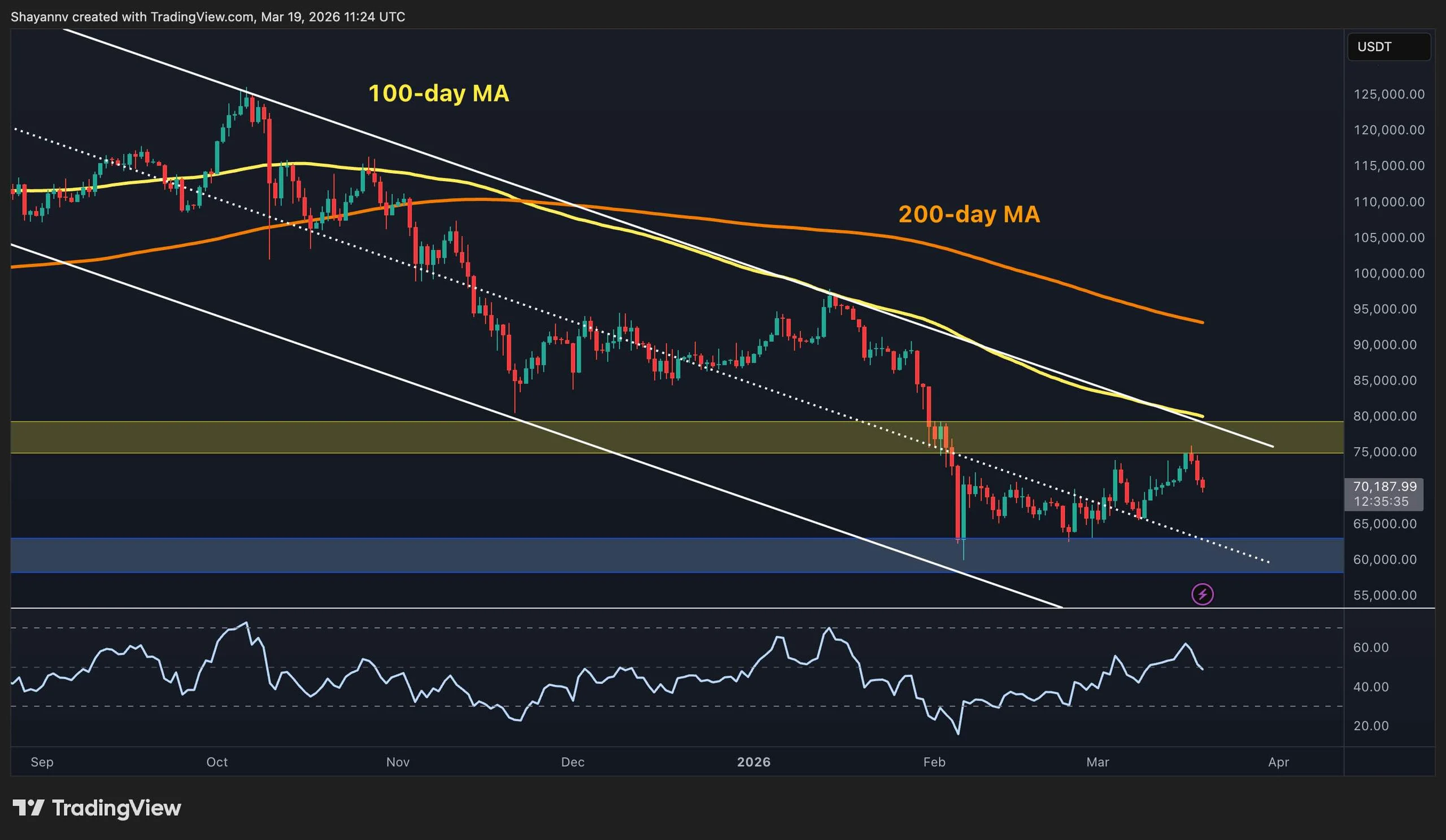
Bitcoin has continued to trade in a precarious zone after months of relentless selling pressure from the October 2025 highs above $125K. The asset is currently hovering below $70,000, attempting to stabilize after a dramatic downtrend, but several technical and on-chain signals suggest the battle between buyers and sellers is far from over.
Bitcoin Price Analysis: The Daily Chart
Looking at the daily timeframe, the broader picture remains firmly bearish. BTC has been trapped inside a descending channel since its peak above $125K, printing a consistent series of lower highs and lower lows. The asset is now trading well below both the 100-day and 200-day moving averages, which are acting as dynamic resistance overhead. The 200-day MA sits around $92K, and the 100-day near $80K, both far above the current price.
The daily RSI has recovered from deeply oversold territory, currently oscillating around the midline. A key horizontal support zone between $58K and $62K (highlighted in blue) held during the February capitulation wick, and that area remains the most critical floor to watch. For any meaningful reversal, however, the market would need to reclaim the $75K–$80K zone, which also aligns with the descending channel’s upper boundary.
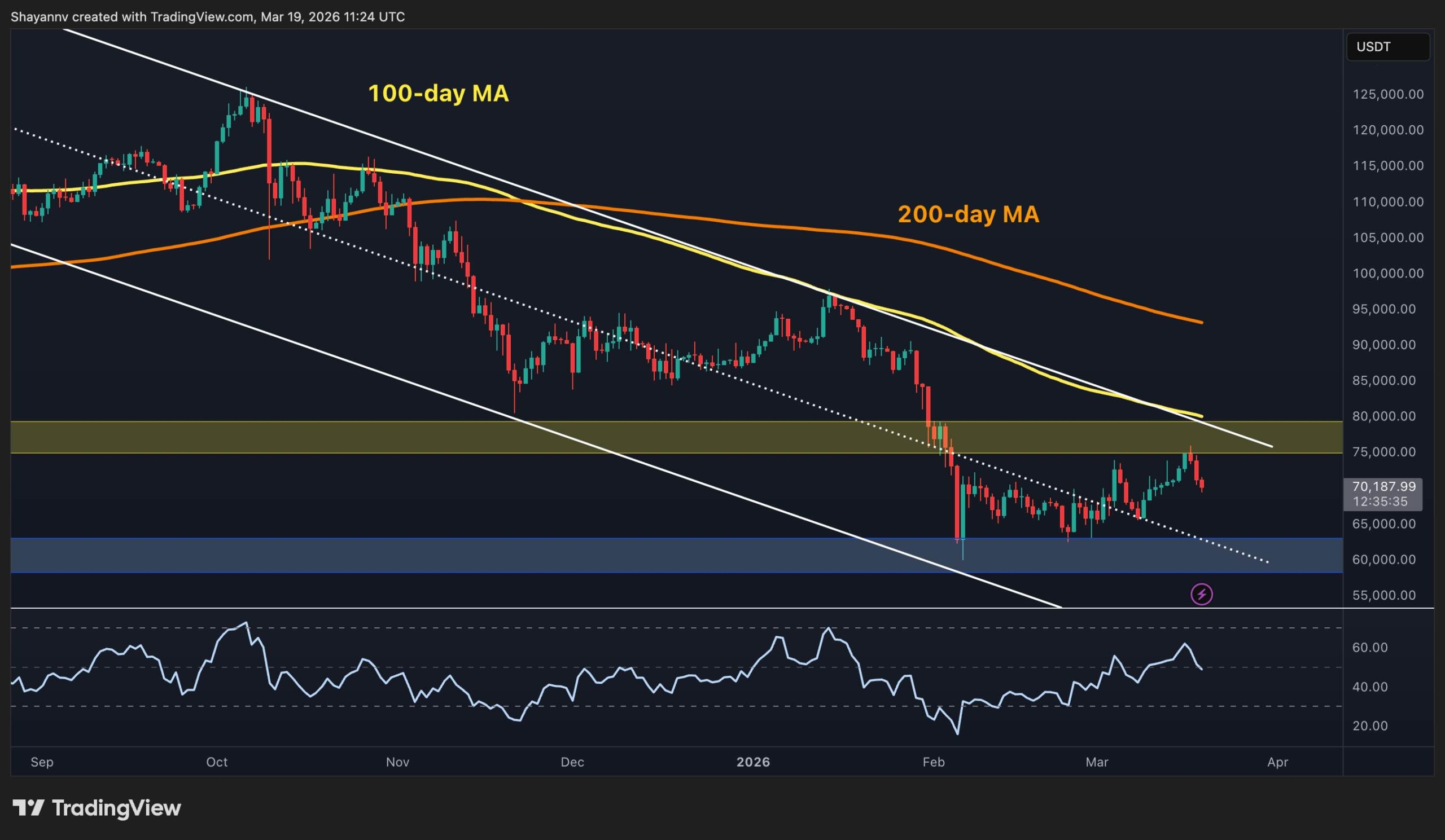
BTC/USDT 4-Hour Chart
Zooming into the 4-hour chart, a more constructive short-term structure emerges. Since the early February lows near $60K, BTC has been forming an ascending channel pattern with higher lows, supported by a rising trendline. Yet, the price recently tagged the upper resistance near $75K before facing a decisive rejection and pulling back sharply toward $70k.
The area between $74K and $76K has acted as a stubborn supply zone, rejecting multiple attempts to break higher. The 4-hour RSI has also cooled off from overbought conditions and now sits below the 40 level, indicating a change in momentum to relatively bearish. A confirmed break below the rising trendline (~$66K) would likely accelerate selling toward $60K, while a push above $75K could trigger a squeeze toward $80K, and change the market outlook to bullish in the short-term.

On-Chain Analysis
The Exchange Whale Ratio, measuring the proportion of large transactions relative to total exchange inflows, has shown a notable spike in recent weeks. After months of relatively subdued whale activity during the prolonged downtrend, the ratio has jumped sharply from around 0.45 to above 0.6, signaling that large holders are becoming more active on exchanges.
Historically, sharp increases in this metric have coincided with periods of heightened volatility, as whales tend to move coins to exchanges either to sell or to reposition. The current uptick, combined with the price hovering near a technically sensitive zone, suggests that big players are preparing for a decisive move. Whether this translates into distribution (selling) or accumulation at these levels will likely determine BTC’s direction in the coming weeks.

Binance Free $600 (CryptoPotato Exclusive): Use this link to register a new account and receive $600 exclusive welcome offer on Binance (full details).
LIMITED OFFER for CryptoPotato readers at Bybit: Use this link to register and open a $500 FREE position on any coin!
Disclaimer: Information found on CryptoPotato is those of writers quoted. It does not represent the opinions of CryptoPotato on whether to buy, sell, or hold any investments. You are advised to conduct your own research before making any investment decisions. Use provided information at your own risk. See Disclaimer for more information.
no longer just a demand story

Liverpool hosts continuous trauma seminar

First time ever! India to host 2028 World Indoor Athletics Championships | More sports News

Smart energy pays enters the US market, targeting scalable financial infrastructure

Why Israel is blocking foreign journalists from entering

Bitcoin: We’re Entering The Most Dangerous Phase

How To Invest In Cryptocurrencies For Beginners | Cryptocurrency Sinhala

Waka Flocka On Becoming A Financial Historian #rapper #investments #mindset #mentality

Financial Seatbelts: 3 Risks Every Youngster Must Cover!#financialfreedom #helthinsurence #shorts
-
 Crypto World5 days ago
HYPE Token Enters Net Deflation as HyperCore Buybacks Outpace Staking Rewards
-

 Tech4 days ago
Your Legally Registered ‘Motorcycle’ Might Not Count Under Proposed US Law
-

 Fashion6 days ago
Weekend Open Thread: Addict Lip Glow
-
 Tech2 days ago
Are Split Spacebars the Next Big Gaming Keyboard Trend?
-
Sports5 days ago
Why Duke and Michigan Are Dead Even Entering Selection Sunday
-

 Business4 days ago
Search for Savannah Guthrie’s Mother Enters Seventh Week with No Arrests
-

 Business5 days ago
US Airports Launch Donation Drives for Unpaid TSA Workers as Partial Government Shutdown Enters Fifth Week
-
Crypto World5 days ago
Coinbase and Bybit in Investment Talks: Could Bybit Finally Enter the US Crypto Market?
-

 Business3 days ago
Australian shares drop as Iran war enters third week
-

 Business5 days ago
Country star Brantley Gilbert enters growing non-alcoholic beer market
-

 Crypto World3 days ago
Crypto Lender BlockFills Enters Chapter 11 with Up to $500M in Liabilities
-

 Sports6 days ago
College Basketball Best Bets: Conference Tournament Semifinal Picks
-

 Politics1 day ago
The House | The new register to protect children from their abusers shows Parliament at its best
-

 Business7 days ago
Trump demands Powell cut rates as Iran conflict raises energy prices
-

 Fashion3 days ago
25 Celebrities with Curly Hair That Are Naturally Beautiful
-

 News Videos22 hours ago
RBA board divided on rate cut, unusually buoyant share market | Finance Report | ABC NEWS
-

 Crypto World7 days ago
Senate Votes to Include CBDC Ban in Bipartisan Housing Bill
-

 NewsBeat7 days ago
Deane Road crash near Bolton colleges and university
-

 Crypto World22 hours ago
Canada’s FINTRAC revokes registrations of 23 crypto MSBs in AML crackdown
-

 News Videos7 days ago
Tom Lee: The 100x Opportunity EVEN Bigger Than Bitcoin (New Ethereum Prediction 2026)


You must be logged in to post a comment Login