

Crypto World
Bitcoin’s Ramadan Rally Pattern May Be Breaking in 2026

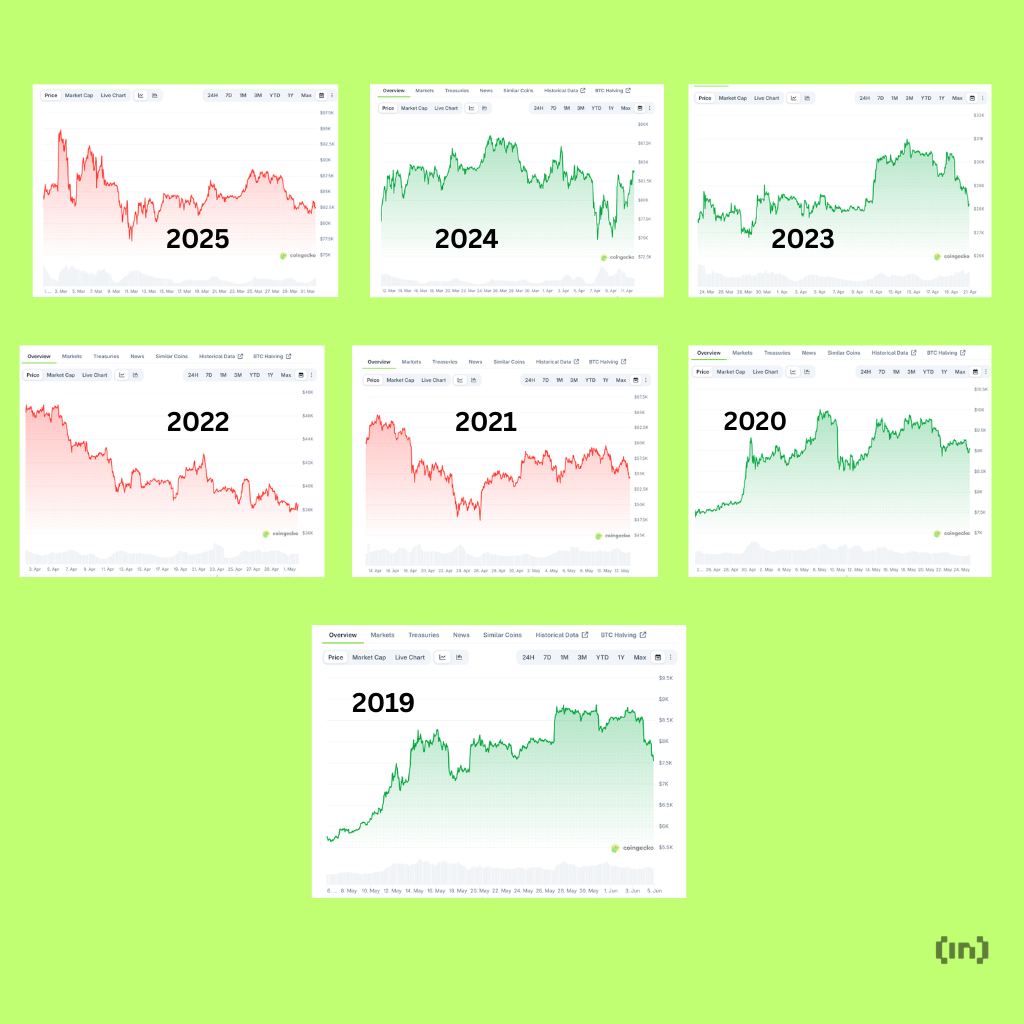
Bitcoin’s often-cited “Ramadan rally” setup may be fading in 2026. However, the volatility pattern many traders have watched in recent years still appears to be present.
To be clear, the holiest month in Islam has nothing to do with digital assets. Crypto trades on global liquidity, macro news, positioning, and sentiment.
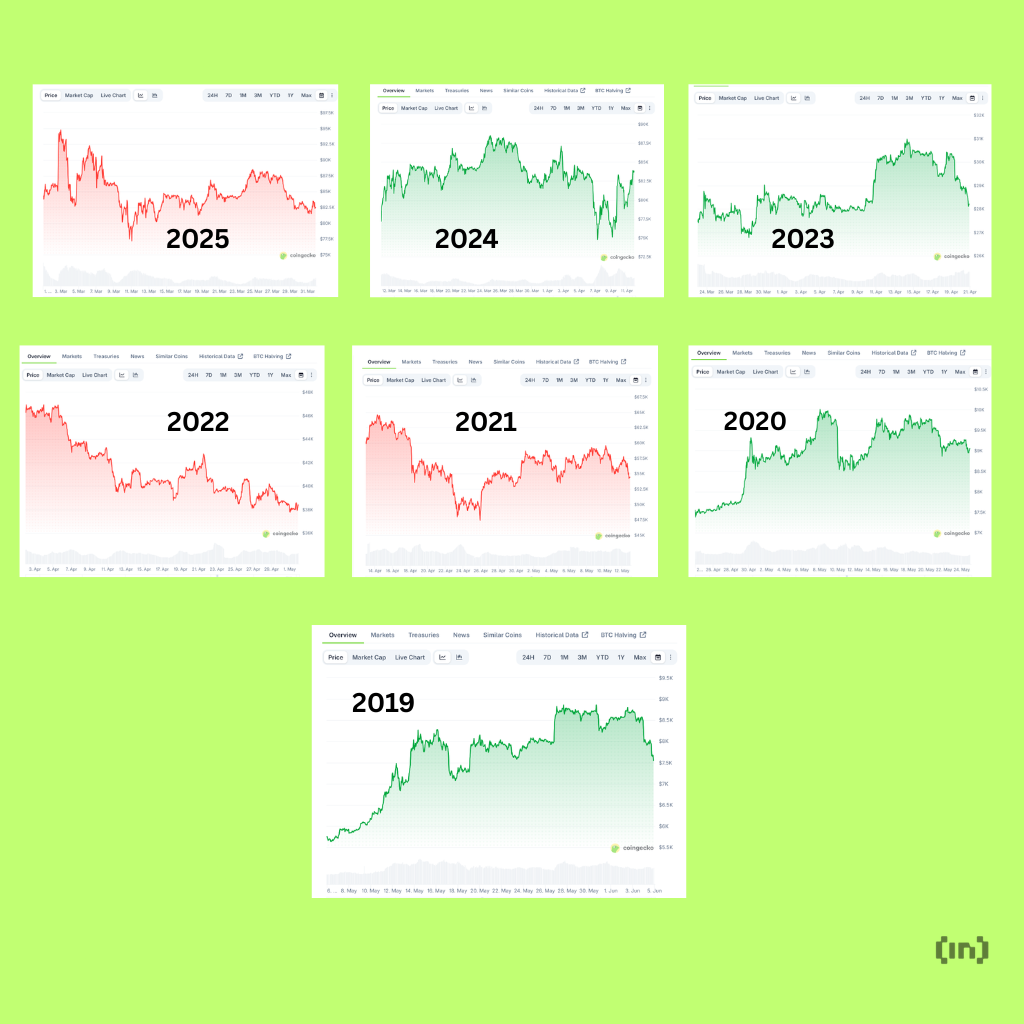
Still, when looking at the last seven Ramadan periods (2019–2025), Bitcoin showed a surprisingly consistent shape in six of seven cases: an early sharp move, then choppy trading, then a later pullback or fade. The main exception was 2020, when a stronger macro recovery trend dominated.
What the Last Seven Ramadans Showed
The pattern was not “Bitcoin always goes up in Ramadan.” That is not true.
Instead, the recurring pattern was more specific: Bitcoin often saw front-loaded volatility, usually with a strong early move, followed by mid-period exhaustion and a weaker finish. In some years, Bitcoin still ended Ramadan higher overall. But even then, price often pulled back after a mid-Ramadan peak.
That makes this less of a directional pattern and more of a timing-and-structure pattern.
What Looks Different in 2026
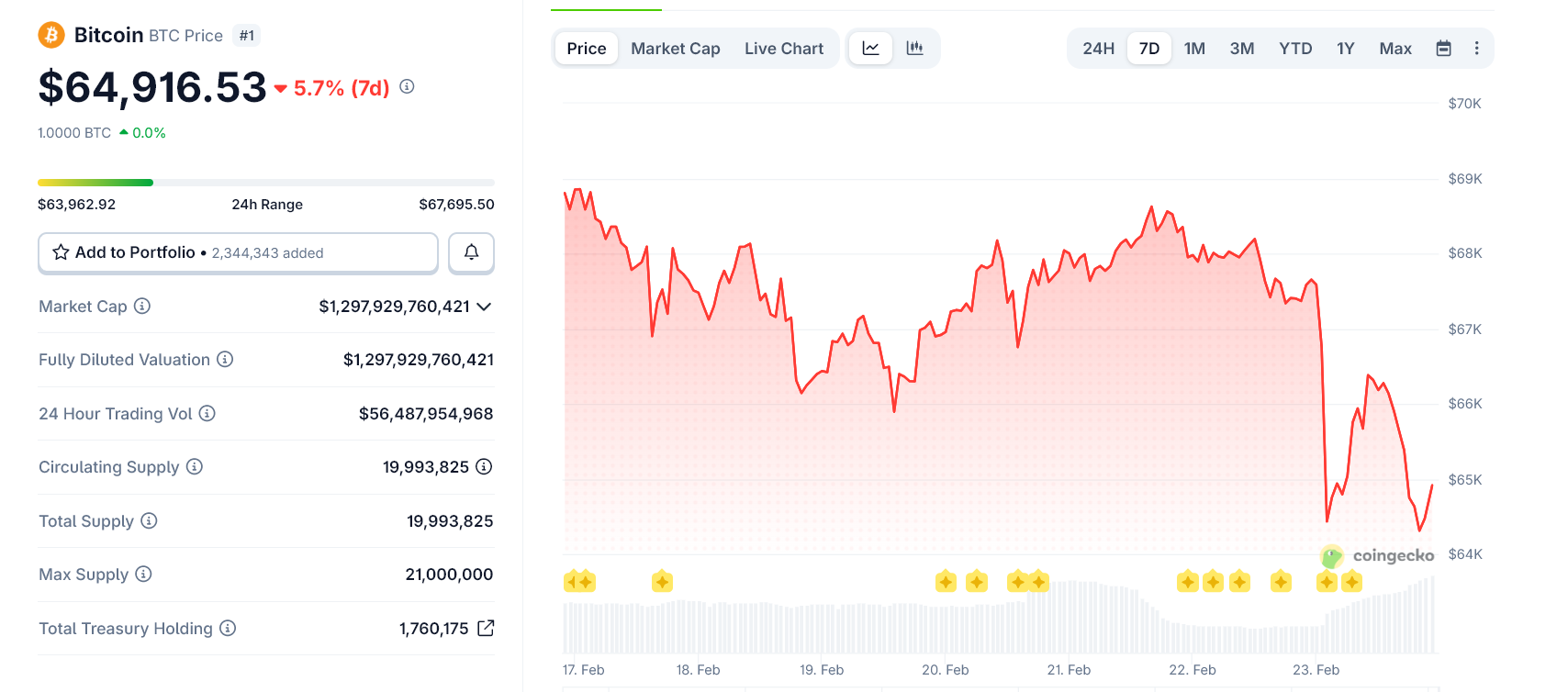
This year’s first week looks different in one important way. Bitcoin did not open with a clean rally. It opened with chop, then a sharp flush, and only after that started a bounce attempt.
That means the pattern is still familiar in shape — fast move, emotional swing, unstable recovery — but the sequence has changed. The market looks weaker than the stronger Ramadan years, at least so far.
On-Chain Data Shows Why Bitcoin Remains Weak in Q1
The on-chain picture is mixed.
First, the Binance Buying Power Index has dropped to a level that previously appeared near compressed, exhausted conditions.
That is a contrarian positive. It suggests a relief bounce can happen if selling pressure fades.
Also, network activity has stayed weak for six straight months. That is a structural warning. It suggests demand and participation remain soft, which can make rallies fragile.
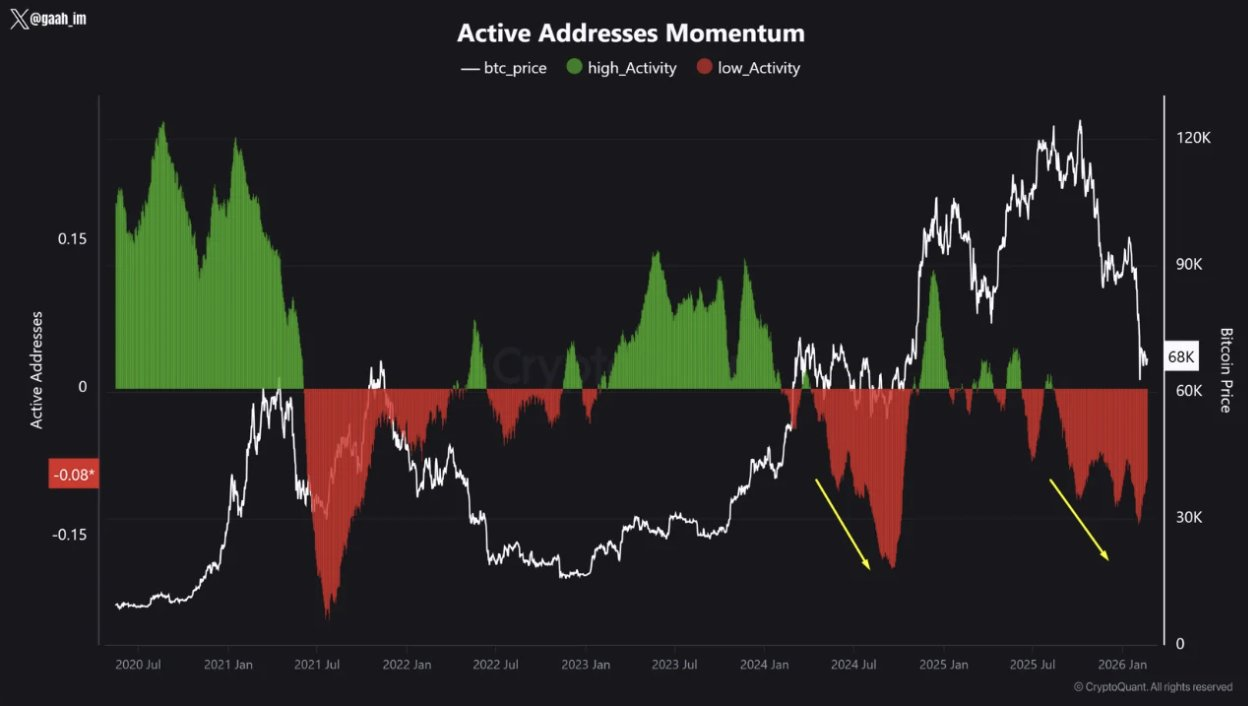
Third, short-term holder realized losses remain negative, even after the worst capitulation cooled.
In simple terms, panic selling has slowed, but many recent buyers are still exiting at a loss. That usually points to base formation, not a confirmed uptrend.
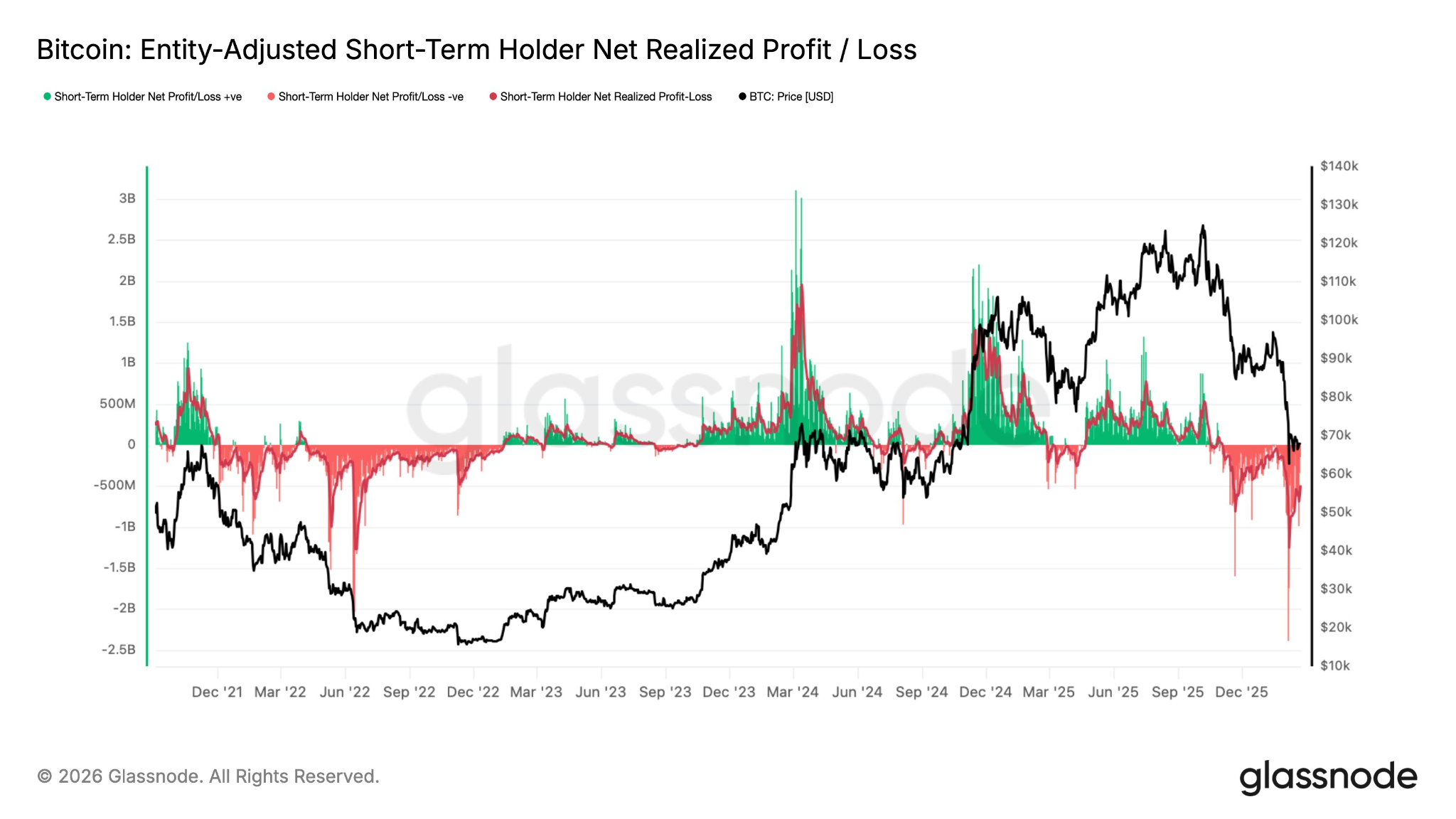
Overall, a relief bounce or choppy recovery attempt is plausible for Bitcoin in the coming weeks, especially if the Binance buying power signal plays out.
But the on-chain demand + STH P/L backdrop suggests that upside may initially be fragile and resistance-heavy.
In short, the old Ramadan “rally” narrative looks weaker in 2026. Yet the broader pattern of early volatility, sharp swings, and uncertain follow-through remains visible.



Bitcoin trades near 200-week EMA; loss of support could spark 30–60% capitulation.
Summary
- Bitcoin trades around $68.4k, above the ~$68.3k 200-week EMA that marks the key cycle support line.
- In 2018 and 2022, a weekly close below the 200-week EMA followed by a failed retest turned it into resistance and led to sharp selloffs.
- Analyst Rekt Capital says multiple weekly closes above the EMA keep downside “unconfirmed,” but a breakdown from this level could again trigger accelerated capitulation.
A cryptocurrency analyst has warned that Bitcoin (BTC) could experience a significant price decline similar to events in 2018 and 2022 if the digital asset fails to maintain a critical technical support level.
The analyst, known by the pseudonym Rekt Capital, told 563,100 followers on social media platform X that Bitcoin faces potential downside risk if it loses support at the 200-week exponential moving average (EMA), according to statements posted on the platform.
Historical data shows that a weekly close below the 200-week EMA, followed by a post-breakdown retest of the EMA into new resistance, has triggered bearish acceleration in previous market cycles, the analyst stated.
“The 200-week EMA represents the key level,” Rekt Capital wrote, adding that a weekly close below it followed by a bearish retest would likely position Bitcoin for additional downside over time.
The analyst noted that Bitcoin has posted weekly closes above the 200-week EMA for two consecutive weeks, which has prevented bearish confirmation in the near term. However, the analyst cautioned that Bitcoin remains vulnerable without sustained upward momentum.
According to the analysis, historical patterns suggest Bitcoin may struggle to generate significant upward price movement from the 200-week EMA level before an eventual breakdown occurs.
The analyst stated that a convincing breakout above the 200-week EMA resistance level would be necessary to invalidate the likelihood of a price collapse.
Bitcoin experienced major capitulation events in both 2018 and 2022, when the cryptocurrency lost significant value following extended bear markets.

Three Solana-based platforms have announced they are shutting down after a Step Finance hack at the end of January that has been deemed unrecoverable.
Solana portfolio dashboard and DeFi aggregator Step Finance announced on Monday that it would be winding down operations. The closure also extends to subsidiaries Solana NFT analytics and the ecosystem media outlet SolanaFloor, as well as lending and yield protocol Remora Markets.
“Following the hack at the end of January, we explored every possible path forward, including financing and acquisition opportunities,” it stated, referring to a $27 million security breach of its treasury wallets in January.
The team said they were “unable to secure a viable outcome,” resulting in the decision to “end all operations effective immediately.”
The DeFi platform said it is working on a buyback for holders of its native token, STEP, based on a snapshot taken before the incident. There will also be a redemption process for Remora rToken holders, they said.

Step suffers $27 million security breach
Step Finance reported a “breach of security for some of our treasury wallets” on Jan. 31 and asked cybersecurity firms to assist with the investigation.
Blockchain security firm CertiK reported that 261,854 Solana (SOL), worth roughly $27 million at the time, was unstaked and transferred during the incident.
Related: Solana treasuries sitting on over $1.5B in paper SOL losses
Crypto investor Mike Dudas said he was contacted by Step Finance about participating in a bridge round, but requested a security post-mortem first and received no response.
Step Finance co-founder George Harrap said on Tuesday that “Some people have reached out on acquiring various businesses, and we will pursue those if serious and have interest, but we are on a time crunch.”
The platform’s native STEP token tanked 96% in the days following the hack. It slumped a further 36% following the announcement of the closure on Monday and is currently trading at $0.00057, according to CoinGecko.
STEP hit an all-time high of $10.20 in August 2021.

Solana DeFi total value locked tanks 50%
The triple closure is another blow to decentralized finance on Solana, which has seen total on-chain value tank 52% since its September peak. Solana DeFi TVL currently stands at just $6.3 billion, according to DeFiLlama.
Meanwhile, SOL prices have lost a further 1.8% on the day, falling to $78, according to CoinGecko. The asset is now 74% down from its January 2025 all-time high of $293, hit during the peak of memecoin mania.
Magazine: Bitcoin may take 7 years to upgrade to post-quantum: BIP-360 co-author

Taylor Lindman, the deputy general counsel at blockchain firm Chainlink Labs, has joined the Securities and Exchange Commission’s Crypto Task Force as its new chief counsel, filling a role left by now-CFTC chair Michael Selig.
In an X post on Monday, Chainlink Labs announced Lindman’s departure after five years and confirmed his official appointment to the SEC’s Crypto Task Force.
“We thank Taylor for his great five years as a key part of the Chainlink Labs team in his role as deputy general counsel. We all look forward to modernizing the US financial system together, taking it to the next level of its development and rapid growth,” Chainlink Labs said.
SEC Commissioner Hester Peirce, who leads the Crypto Task Force, also confirmed Lindman’s new appointment on X, predicting “great things!” ahead.

A chief counsel typically serves as the senior legal advisor, guiding legal interpretation, ensuring compliance, managing risk and supporting leadership decision-making.
Lindman brings a decade of legal experience to the SEC
Lindman spent more than five years at Chainlink, according to his LinkedIn profile, across various roles, including deputy general counsel and associate general counsel.
During his tenure at Chainlink, Lindman was responsible for ensuring compliance with US and international regulations and was also part of a delegation that met with the Crypto Task Force in March 2025 to discuss crypto regulation, including token taxonomy and securities record-keeping requirements.
Before Chainlink, Lindman was an associate at Perkins Coie from 2018 to 2021 and at Debevoise & Plimpton from 2016 to 2018.
Lindman succeeds Selig, who held the role until December of last year, when he became chair of the Commodity Futures Trading Commission.
Other experienced crypto hands at the SEC
Peirce announced the original lineup of 14 Crypto Task Force members in March 2025, which included several crypto industry natives along with staff taken from the chair’s office and other divisions and offices across the commission.
Landon Zinda, a former policy director at Coin Center from March 2023 until February 2025, is on the task force as a senior advisor.
Related: US SEC crypto task force to tackle financial surveillance and privacy
Veronica Reynolds, also a senior advisor on the task force, previously worked as an associate at Baker Hostetler, a law firm with a practice group focused on digital assets and Web3 technology.
The SEC Crypto Task Force was established following a friendlier policy shift from the incoming Trump administration. Since then, the task force has held roundtable events and tours to gather feedback from the crypto industry, academics and market participants on digital asset regulation.
Magazine: Is China hoarding gold so yuan becomes global reserve instead of USD?
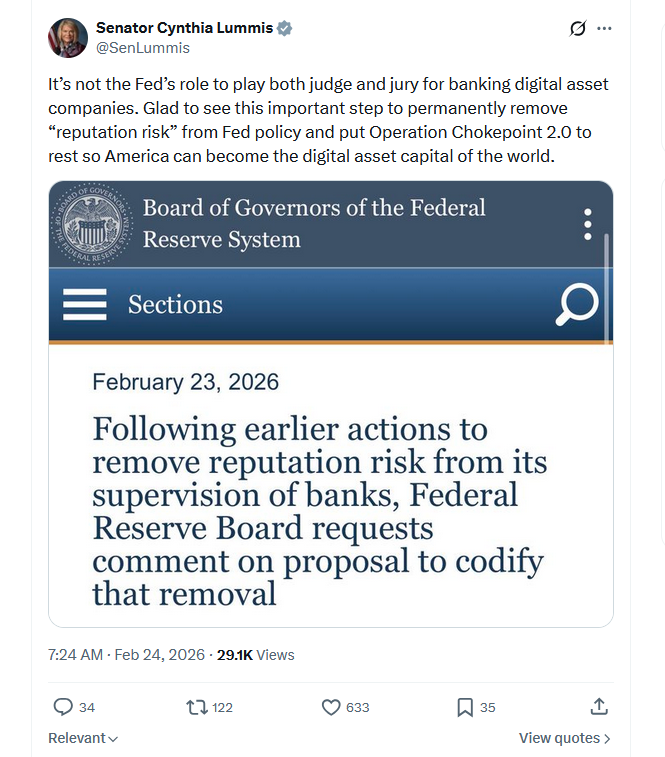
The US Federal Reserve is seeking to codify a rule removing “reputation risk” from banking supervision, which some have blamed for a wave of crypto debanking in recent years.
The Fed initially began making changes in June last year, announcing that it had directed its supervisors to stop pressuring banks to shut down client accounts over reputation risk, meaning banks can only make decisions on clients based on financial risk management.
In a press release on Monday, the Fed said that it is requesting feedback on a proposal to turn this into law. The Fed has set a 60-day deadline for submitting comments.
“We have heard troubling cases of debanking — where supervisors use concerns about reputation risk to pressure financial institutions to debank customers because of their political views, religious beliefs, or involvement in disfavored but lawful businesses,” said vice chair for supervision Michelle Bowman.
“Discrimination by financial institutions on these bases is unlawful and does not have a role in the Federal Reserve’s supervisory framework,” she added.
In an X post on Monday, Lummis praised the move, adding that it is “not the Fed’s role to play both judge and jury for banking digital asset companies.”
“Glad to see this important step to permanently remove ‘reputation risk’ from Fed policy and put Operation Chokepoint 2.0 to rest so America can become the digital asset capital of the world.”

Galaxy Digital’s head of firmwide research, Alex Thorn, also praised the move, noting via X on Monday that “chokepoint 2.0 rollback continues.”
Operation Chokepoint 2.0 is a term used by many in the crypto industry to describe what they felt was a coordinated effort by the Joe Biden-led US government and banking sector to cut crypto firms off from using traditional banking services.
The current US administration has made a concerted push to end debanking in the US, with US President Donald Trump initially exploring a draft order in August to direct bank regulators to investigate debanking claims from crypto firms and conservatives.
Related: SEC allows broker-dealers to take 2% ‘haircut’ on stablecoins
It also sought to direct bank regulators to scrap any policies that led banks to cut ties with such clients due to reputational risk.
Trump himself is currently in a $5 billion legal stoush with JPMorgan over debanking, alleging that the firm unlawfully closed his accounts for political reasons back in 2021.
While JPMorgan has argued that the case has no merit, a former executive recently acknowledged in court that the bank had closed Trump’s account following the Jan. 6 Capitol Hill riots.
Magazine: Is China hoarding gold so yuan becomes global reserve instead of USD?


Summary
- Bitcoin briefly dropped below $64.5k, erasing weekend gains and sending the Crypto Fear & Greed Index back into extreme fear.
- Around 140k traders were liquidated, with total wrecked positions nearing $500M; the largest single hit was a $61.5M BTC long on HTX’s BTC/USDT pair.
- Machi Big Brother was partially liquidated on his ETH longs but still holds 1,700 ETH (~$3.2M) with a liquidation price near $1,819, after losses topping $28.8M.
Bitcoin (BTC) dropped to its lowest level in more than two weeks during early trading hours, triggering widespread liquidations across cryptocurrency markets, according to industry data.
The rapid decline resulted in approximately 140,000 traders experiencing liquidated positions within hours, data from CoinGlass showed. The total value of liquidated positions increased significantly during the period.
An unidentified whale trader faced a substantial liquidation in the past 24 hours during the bitcoin downturn, according to market observers. The liquidation occurred on the HTX exchange and involved the bitcoin trading pair.
Taiwanese-American entrepreneur and former musician Jeffrey Huang, known as Machi Big Brother, was partially liquidated on his Ethereum position during the decline, according to data from blockchain analytics firm Lookonchain. Huang’s cryptocurrency portfolio had previously fallen below earlier levels, posting losses, CryptoPotato reported days earlier.
Following the latest liquidation, Huang continued to maintain long positions in Ethereum (ETH), currently holding 1,700 tokens, according to the data.
Ethereum’s price declined over the weekend after facing resistance at higher levels, marking its first significant drop since the February 6 market downturn.
Key Insights:
- XRP drops over 30% in February, trades 61% below its $3.66 all-time high.
- Whales accumulated 3.17B XRP since October, controlling 17.04% supply.
- XRP ETFs hold $1B+ AUM despite mixed February inflows.
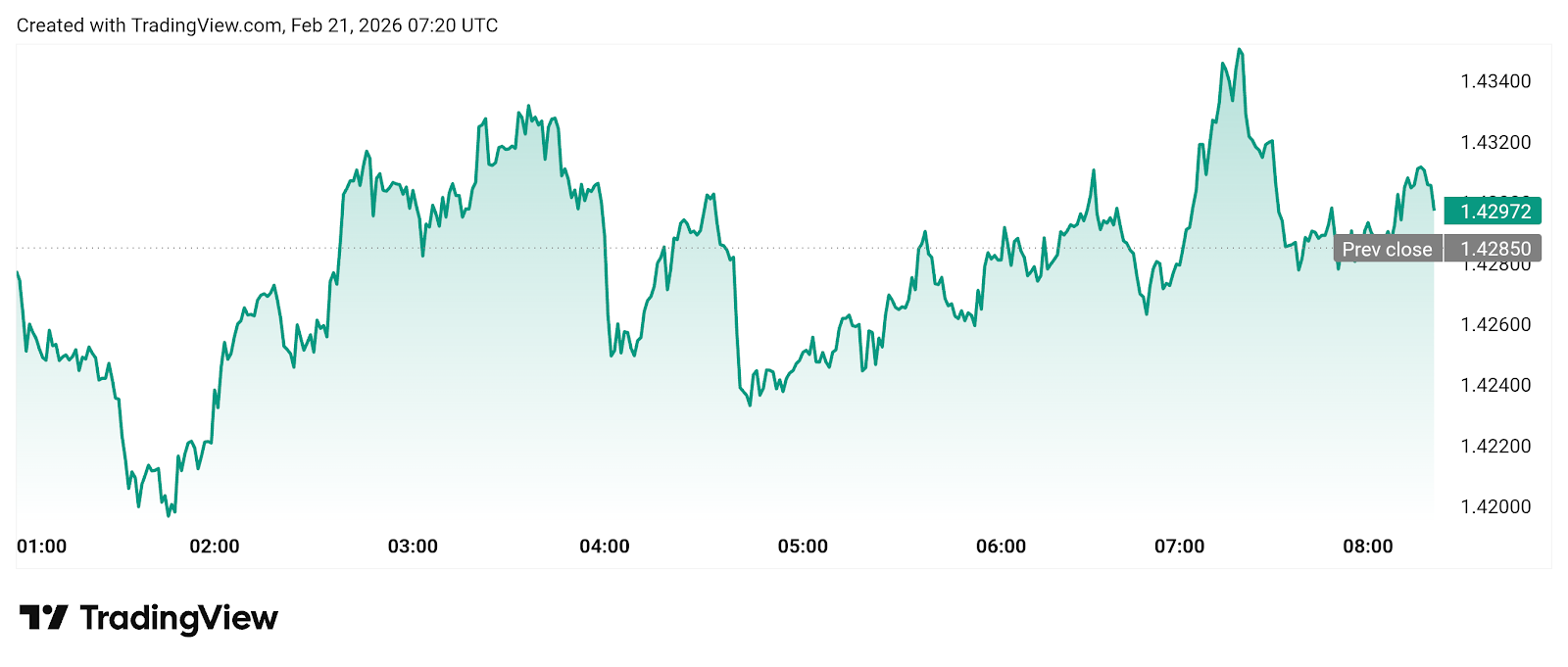
XRP is set to close February in negative territory as it trades near $1.43, down more than 30% from its early-month level of $2.05. The token fell to a monthly low of $1.11 before rebounding into the $1.40 range.
Despite strong whale accumulation and expanding institutional activity on the XRP Ledger, broader crypto market weakness continues to pressure price action. The downward trend experienced in February, marks one of weakest months in XRP history, reinforcing a cautious sentiment among traders.
Since 2014, XRP has recorded losses in seven of 11 February trading periods. The highest monthly drops reached 33.4% in 2014 and 22.1% in 2018. With only a few days remaining, the asset would require a rally of more than 40% to end the month positive. With this in mind, analysts believe that this is not likely to happen under the current circumstances. The market capitalization of the token is over 87 billion and the 24-hour volume is approximately 1.7 billion. XRP is still about 61% below its all-time high of $3.66 in July 2025.
Institutional Adoption Expands Despite Price Weakness
The XRP Ledger adoption metrics indicate further growth. Network-based tokenized real-world assets have surpassed $354 million in the last month, and the report indicates that 63% of tokenized U.S. Treasurys are issued on XRPL infrastructure.
Banking organizations such as DBS Group and Franklin Templeton are establishing trading and lending infrastructures over tokenized money market funds on the ledger. In payments, Deutsche Bank is partnering with Ripple to modernize cross-border transfers, signaling continued enterprise engagement.
ETF Flows and Whale Accumulation Signal Divergence
Seven XRP spot exchange-traded funds now trade in the United States, with combined assets exceeding $1 billion and roughly 790 million XRP locked. The funds recorded 43 consecutive trading days without outflows after launch. However, flows turned mixed between Feb. 11 and Feb. 20, with only one positive inflow day totaling $4.5 million.
On-chain data from Santiment shows wallets holding between 10 million and 100 million XRP accumulated 3.17 billion tokens since October 2025, now controlling 17.04% of the asset circulating supply. The exchange balances decreased by 55 percent to 1.7 billion XRP. On Binance, the funding rates dropped to negative 0.028%, historically associated to short-term rebounds.
Ahead of the month-end, traders are keeping a watch on funding rates, ETF flows, and overall crypto sentiment. Stay in touch with Crypto Breaking News as we continue uncovering the XRP price outlook, February 2026.
XRP slid ~3% in 24h, stuck in a descending channel after failed breakout.
Summary
- XRP trades near $1.39, down about 2.9% day-on-day and ~46% year-on-year, hovering mid-range between key supply and demand zones.
- Price sits inside a descending channel, with lower highs and lows; a failed move above the mid-channel caused a liquidity sweep before spot selling forced price back into the range.
- As long as XRP remains below the channel’s mid-line and overhead supply, rallies face selling, while a break of current support would expose the lower channel boundary and raise downside risk.
Ripple’s XRP (XRP) token declined alongside broader cryptocurrency markets on Monday, continuing a pattern of weakness within a descending price structure, according to technical analysis from Cryptopotato.
The digital asset is currently trading within a defined range as market participants await a decisive move to establish the next directional trend, the analysis stated.
On the daily timeframe, XRP attempted to break above a channel’s middle boundary but failed to sustain the move, according to the report. The brief push beyond this level resulted in what technical analysts term a liquidity sweep, where buy-side positions were triggered before selling pressure returned and pushed the asset lower.
The price subsequently moved back into the established range and continues to trade between an upper supply zone and lower demand base, the analysis indicated. The current structure suggests ongoing consolidation rather than an immediate trend reversal, according to the report.
Technical analysts noted that unless the token reclaims and holds above the channel’s middle boundary, the market is likely to remain range-bound, with activity on both sides of the range contributing to short-term volatility.
On shorter timeframes, XRP remains within a descending structure, forming lower highs and lower lows within channel boundaries, the analysis stated. A recent bounce from a lower demand zone was characterized as corrective in nature.
The asset is consolidating around intraday support levels, according to the report. As long as it remains below the channel’s mid-structure and key supply zone, upward moves are expected to face selling pressure, technical analysts said.
A loss of current support levels would expose the lower boundary of the channel and increase the probability of further downside movement, according to the analysis.


Cardano trades near $0.28, flat on day, as LayerZero unlocks 80+ chain connectivity.
Summary
- ADA changes hands around $0.28, up ~0.2% in 24h, trading between ~$0.28–$0.29 with ~$397m daily volume.
- Hoskinson says the LayerZero integration makes Cardano “no longer an island,” connecting it to 80+ chains including ETH, SOL, and BNB Chain.
- LayerZero now lets Cardano dApps send messages and assets across dozens of networks, potentially opening omnichain DeFi, cross-chain lending, and deeper liquidity if developers and capital follow.
Cardano has integrated with LayerZero, connecting the blockchain network to more than 80 other blockchains, according to Cardano founder Charles Hoskinson.
Hoskinson stated that the integration represents a significant development in connecting Cardano with other blockchain networks, addressing what he described as the platform’s previous isolation. The founder characterized Cardano as “no longer an island” following the LayerZero integration.
The integration was announced earlier this month at Consensus Hong Kong 2026, where Hoskinson revealed the partnership after completing negotiations with key stakeholders, according to reports.
LayerZero is an interoperability protocol that enables communication and asset transfers between different blockchain networks. The integration allows Cardano to connect with the more than 80 blockchains already supported by LayerZero’s infrastructure.
Cardano (ADA), a proof-of-stake blockchain platform founded in 2017, has historically operated with limited direct connectivity to other blockchain ecosystems. The LayerZero integration marks a shift in the network’s interoperability capabilities, according to Hoskinson’s statements.
Details regarding the technical implementation timeline and specific blockchains accessible through the integration were not immediately disclosed.
Standard Chartered’s newest briefing sticks to a bullish view on stablecoins, arguing that the sector will swell to about $2 trillion in market capitalization by late 2028, even as near-term demand for U.S. Treasuries eases. The bank’s analysts, Geoffrey Kendrick and John Davies, contend that dollar-backed stablecoins such as Tether’s USDt (USDT)(CRYPTO: USDT) and Circle’s USDC (USDC)(CRYPTO: USDC) will remain the bedrock of a shift in reserve management that could lift Treasury bill demand toward the $2.2 trillion mark by 2028. The note comes despite a cooling in the overall crypto cycle that has kept the dollar-stablecoin market cap hovering near $300 billion in recent months.
In making the case, the analysts point to policy momentum in Washington that they say underpins the thesis. The GENIUS Act, signed into law in 2025, is cited as a potential catalyst for broader acceptance and clarity around stablecoins, which in turn could influence both institutional wallet allocations and sovereign appetite for short-duration Treasuries. The report argues that the structural shift remains intact even if the pace of near-term demand is tempered by market cycles.
“We see these issues as cyclical rather than structural, and we continue to expect stablecoin market cap to reach $2 trillion by end-2028,” the Standard Chartered note states, framing a longer-run reallocation of liquidity toward crypto-enabled reserves as a core driver of T-bill demand.
Stablecoins may drive Treasury to issue more bills despite lowered demand
Standard Chartered’s forecast envisions a substantial uplift in T-bill demand driven by stablecoins acting as reserve assets. The bank now sees stablecoins generating an additional $800 billion to $1 trillion in fresh T-bill demand by late 2028, a sizeable downgrade from the $1.6 trillion projected in April 2025, even after GENIUS Act provisions took effect. The fundamental idea is that as stablecoins grow as credible cash-equivalents, institutions and cash-rich entities will prefer Treasuries as collateral or reserve holdings, prompting a broader issuance program by the Treasury.
The piece underscores that the Treasury may respond to this reserve-driven demand by issuing more T-bills. It cites Treasury Secretary Scott Bessent’s remarks in early February, which framed the GENIUS Act as a potentially important financing tool for the U.S. government, aligning policy with the evolving liquidity landscape created by stablecoins. The quarterly refunding announcement on the same day highlighted “growing demand for Treasury bills from the private sector,” the bank notes, signaling a potential loop where rising demand for crypto-backed reserves could spur additional government debt supply.
“Stablecoin-related demand, in conjunction with the Fed’s recent decision to commence RMPs [reserve management purchases] and replace its maturing MBS [mortgage-backed securities] with T-bills, could arguably cause T-bills to become overly scarce.”
Beyond the stablecoin thesis, Standard Chartered has not abandoned itsBitcoin(BTC)(CRYPTO: BTC) outlook. While the bank previously carried a bullish longer-run target, it recently trimmed its price forecast for 2026 from $150,000 to $100,000, acknowledging that BTC could dip toward $50,000 before any meaningful recovery unfolds. The downgrade illustrates the bank’s approach to balancing aggressive longer-term premises with near-term macro uncertainties.
In tandem with these macro considerations, the bank’s researchers maintain that the stablecoin storyline remains a key driver of liquidity and risk sentiment in crypto markets. The broader takeaway is that the relationship between sovereign debt management, central-bank operations, and the crypto ecosystem is evolving in a way that could rewire how liquidity is allocated in the coming years, even as the sector continues to navigate cycles of volatility and regulatory scrutiny.
Source: Standard Chartered
Market context
The forecast arrives as a broader crypto environment continues to digest policy signals and investor appetite for digital assets. The GENIUS Act is a central thread in this narrative, offering a legislative framework that could reduce regulatory friction for stablecoins while clarifying their role in institutional reserve practices. At the same time, the Fed’s reserve management purchases and its ongoing balance-sheet adjustments—alongside a possible reweighting of Treasuries in private-sector liquidity pools—shape the backdrop against which stablecoins could influence T-bill issuance and market depth.
Why it matters
The projection matters because it links stablecoin growth to sovereign debt management and macro liquidity dynamics. If stablecoins become a routine, preferred form of reserve or collateral, banks, institutions, and non-bank financials may channel more liquidity into Treasuries, potentially altering demand curves for T-bills and influencing credit conditions across markets. For crypto users and builders, the interplay between regulatory clarity, stablecoin infrastructure, and central-bank liquidity programs could translate into a more robust on-ramp to digital-asset ecosystems and a longer horizon of institutional participation.
From an investor perspective, the narrative signals that stablecoins are not simply a payments convenience but a bridge between the crypto world and traditional finance. The possibility of more T-bill issuance to accommodate rising secure-lien demand could keep risk-free yields anchored while offering new channels for liquidity and collateral management. Yet the path remains contingent on how regulators implement policy, how successfully stablecoins maintain reserve health, and how swiftly the broader market absorbs shifts in risk sentiment.
What to watch next
- Details on GENIUS Act implementation and regulatory guidance as 2025–2026 unfolds.
- Updates from the Treasury’s refunding calendar and any reported private-sector demand signals.
- Federal Reserve communications about reserve management purchases and any shifts in MBS-to-T-bill reallocation.
- Progress in stablecoin reserve frameworks, including regulatory clarity on collateral and liquidity requirements (SEC developments).
Sources & verification
- Standard Chartered report outlining a $2 trillion stablecoin market by end-2028 and the projected impact on T-bill demand.
- References to the GENIUS Act and its role in shaping stablecoin policy.
- Treasury quarterly refunding announcements and statements on private-sector demand for T-bills.
- Federal Reserve actions related to reserve management purchases (RMPs).
- SEC discussions on stablecoin exemptions or haircuts for broker-dealers.
Crypto World
Jamie Dimon says ‘watch out’ as lofty asset prices add to economic risks: ‘My anxiety is high’
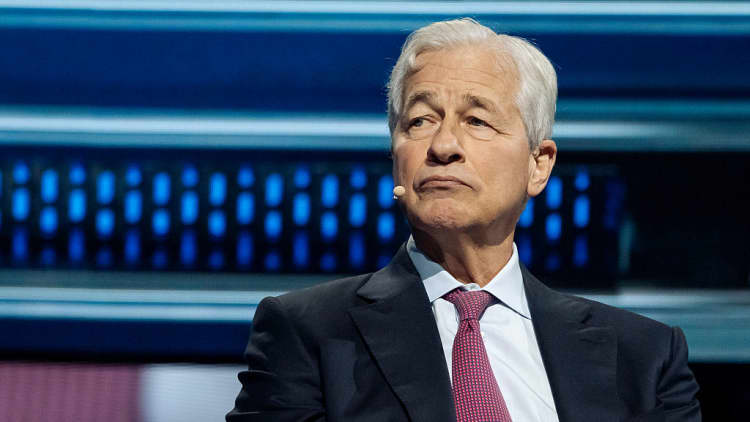
Jamie Dimon, chief executive officer of JPMorgan Chase & Co., during the 2025 IIF annual membership meeting in Washington, Oct. 16, 2025.
Samuel Corum | Bloomberg | Getty Images
JPMorgan Chase CEO Jamie Dimon said Monday that he was anxious over the U.S. economy, citing elevated asset prices and a competitive environment in banking that reminded him of the pre-2008 crisis years.
Even as economists tout the Trump administration’s tax and deregulatory policies as boosting economic growth this year, Dimon said during an annual investor update that his own tendencies were to consider what could go wrong when expectations are riding high.
“My own view is people are getting a little comfortable that this is real, these high asset prices and high volumes, and that we won’t have any problems,” said Dimon, who was dressed in black and wore a brace on one of his hands.
Inevitably, Dimon said, the economic cycle will turn, leading to a wave of borrower defaults that would broadly affect lenders, and often impacting industries few people expect, he said.
“There will be a cycle one day… I don’t know what confluence of events will cause that cycle. My anxiety is high over it,” Dimon said. “I’m not assuaged by the fact that asset prices are high. In fact, I think that adds to the risk.”
While fears over how artificial intelligence models from Anthropic and OpenAI could disrupt a myriad of industries — especially software firms — have churned markets in recent weeks, the broader S&P 500 isn’t far off from its all-time record level.
At the same time, concerns over loans to software companies at the nexus of AI worries have walloped private credit lenders after Blue Owl spooked markets last week when it announced it had to sell assets to satisfy investors clamoring to exit one of its funds.
The episode, which dragged down the shares of larger alternative asset managers including Apollo, KKR and Blackstone, led some market observers to wonder if the start of a broader downturn in credit had begun.
Doing ‘dumb things’
“There’s always a surprise in a credit cycle,” Dimon said. “The surprise has often been which industry” is impacted most, he said. “You didn’t expect utilities and phone companies in ’08, ’09, and this time around, it might be software, because of AI.”
Dimon also said that he endorsed his deputies’ comments about private credit from earlier in the investor event.
Troy Rohrbaugh, co-head of the firm’s commercial and investment bank, said that he didn’t think issues would likely be contained to private credit lenders, but instead be “more broad-based.”
“At this point, it feels a bit isolated to a handful of situations, but that could quite easily change, and we’re prepared for that,” Rohrbaugh said.
In response to a question from the veteran banking analyst Mike Mayo, Dimon said the current environment felt similar to the three years leading into the 2008 financial crisis in that “everyone is making a lot of money, people were leveraging, the sky was the limit.”
The JPMorgan chief said that some financial firms were “doing some dumb things” that involved chasing interest income, which is made through lending and investing activities, though he didn’t name the companies doing so.
“You feel stupid when everyone’s coining money and everyone’s great… it does feel really good,” Dimon said.
“And then when I think about all the factors taking place,” Dimon added, “I take a deep breath and say `watch out’.”
Dimon also addressed the perennial question of CEO succession at JPMorgan, which he built into the world’s largest bank by market capitalization over his two-decade tenure.
While he has often given a specific time frame for the number of years he had remaining as CEO, he avoided doing so on Monday.
“I was told to say this very specifically,” Dimon said to scattered laughter among the analysts in attendance. “I’m here for a few years as CEO, and maybe few after that as executive chairman.”


FedEx sues US government for refund of President Donald Trump tariffs

Bitcoin risks 2018-style crash if 200-week EMA breaks, warns analyst

Welsh Open: Defending champion Mark Selby beaten by Jiang Jung in first round


-

 Crypto World7 days ago
Can XRP Price Successfully Register a 33% Breakout Past $2?
-

 Video4 days ago
XRP News: XRP Just Entered a New Phase (Almost Nobody Noticed)
-

 Fashion3 days ago
Weekend Open Thread: Boden – Corporette.com
-

 Politics2 days ago
Baftas 2026: Awards Nominations, Presenters And Performers
-

 Sports9 hours ago
Women’s college basketball rankings: Iowa reenters top 10, Auriemma makes history
-

 Politics10 hours ago
Nick Reiner Enters Plea In Deaths Of Parents Rob And Michele
-

 Business6 days ago
Infosys Limited (INFY) Discusses Tech Transitions and the Unique Aspects of the AI Era Transcript
-

 Entertainment6 days ago
Kunal Nayyar’s Secret Acts Of Kindness Sparks Online Discussion
-

 Video7 days ago
Financial Statement Analysis | Complete Chapter Revision in 10 Minutes | Class 12 Board exam 2026
-

 Tech6 days ago
Retro Rover: LT6502 Laptop Packs 8-Bit Power On The Go
-
 Sports5 days ago
Clearing the boundary, crossing into history: J&K end 67-year wait, enter maiden Ranji Trophy final | Cricket News
-

 Business2 days ago
Mattel’s American Girl brand turns 40, dolls enter a new era
-

 Business1 day ago
Law enforcement kills armed man seeking to enter Trump’s Mar-a-Lago resort, officials say
-

 Entertainment5 days ago
Dolores Catania Blasts Rob Rausch For Turning On ‘Housewives’ On ‘Traitors’
-

 Business6 days ago
Tesla avoids California suspension after ending ‘autopilot’ marketing
-
 NewsBeat18 hours ago
‘Hourly’ method from gastroenterologist ‘helps reduce air travel bloating’
-

 Politics7 days ago
Eurovision Announces UK Act For 2026 Song Contest
-

 Tech1 day ago
Anthropic-Backed Group Enters NY-12 AI PAC Fight
-

 NewsBeat1 day ago
Armed man killed after entering secure perimeter of Mar-a-Lago, Secret Service says
-

 Politics2 days ago
Maine has a long track record of electing moderates. Enter Graham Platner.